




Abstract
This study explores the psychological mechanism connecting multi-platform news consumption and acceptance coping strategies individuals adopt concerning the pandemic. We contend that people’s perceptions of and responses to public health disasters are socially constructed; their beliefs of human beings as a whole will substantially shape their response behaviors. Data obtained from a quota sampling survey in Macao (N = 1,088) reveals that multi-platform news consumption during the pandemic increases individuals’ fear of the COVID-19 pandemic, thereby contributing to adoption of acceptance coping. Trust in information sources positively moderates the effects of multi-platform news consumption on fear of the pandemic. Notably, this research incorporated the concept of proxy efficacy to humanity in explaining the psychological process, an aspect that prior studies have often overlooked when employing extended parallel process model to examine efficacy. The findings indicate that proxy efficacy to humanity positively moderates the relationship between fear of the pandemic and acceptance coping, with the nature of this relationship shifting from negative to positive as the level of proxy efficacy increases. Drawn on message-behavior-audience framework of fear appeal, this study also contributes to the literature on how multi-platform news consumption fosters people’s acceptance coping with two audience psychological features as moderators.
Plain Language Summary
This study looks at how getting news from many different platforms affects the way people mentally deal with the COVID-19 pandemic, especially through a strategy called “acceptance coping”—which means recognizing the situation and adjusting to it. Researchers surveyed over 1,000 people in Macao and found that consuming news from multiple sources made people more fearful of COVID-19. Surprisingly, this fear actually led them to better accept and deal with the situation. But not everyone reacted the same way. People who trusted the news sources more were even more likely to feel fear after seeing news, which in turn made them more likely to use acceptance coping. Another key factor was how much people believed in humanity’s ability to manage the crisis—a concept the researchers call “proxy efficacy to humanity.” This belief acted like a booster: when people had strong belief in humanity, their fear of the pandemic was more likely to turn into productive coping. But for people with low belief in humanity, fear didn’t help much—or might even have made coping harder. In short, this study shows that fear from news can sometimes help people cope—but only if they trust the news and believe in humanity’s strength. The study offers a new way of understanding how media, emotions, and beliefs interact during a public health crisis.
Keywords
Introduction
When facing external or internal threats, individuals often adopt cognitive and behavioral efforts. These efforts to manage and mitigate the detrimental effects brought by stress under threats are known as coping (Bae, 2022; Folkman, 1984). Research on how people actively cope with the stressor is well documented (e.g., Dailey et al., 2023; Greenglass et al., 2022; Tindle et al., 2022). Specifically, individuals may take actions to modify stressors (Ding et al., 2024; Greenglass et al., 2022). However, there are situations of unchangeable negative events, such as infectious disease outbreaks. Under such circumstances where people perceive low levels of control, insufficient preparation could hinder individuals from actively addressing the pandemic, for example, through problem-focused coping (Khoury et al., 2021). In these cases, acceptance coping, a strategy in which individuals acknowledge and accept distressing situations, rather than attempting to change or deny them (Williams & Lynn, 2010), may become an alternative adaptive way to maintain psychological well-being (Nakamura & Orth, 2005). Nevertheless, there remains a limited literature that explores factors and mechanisms that activate acceptance coping strategies. Grounded in message-behavior-audience frameworks of fear appeal, this study explores the mechanism of how a vital news habit in today’s high-choice media environment—multi-platform news consumption—fosters individuals’ acceptance coping. Moreover, we also identify and discuss how such mechanisms vary in levels of audience psychological features.
A public health emergency like the pandemic caused substantial damage to human life, beyond the individual’s capabilities in terms of controlling the virus. As for psychological features, the perceived sense of losing control hinders their capacity to effectively cope with the situation, solely through confidence in their own actions or abilities. In this case, how people’s proxy efficacy, the perception of social environment and collective efforts of the community, even of the entire human beings to be specific, might enable them to accept this immutable negative circumstance. Prior studies have primarily focused on how psychological interventions or treatments can enhance individual acceptance coping (Nordin & Rorsman, 2012; Yovel et al., 2014). However, when faced with a global public health crisis, professional psychological therapy is not accessible to every individual. Thus, the psychological process of how people arrive at coping deserves a more theoretical explanation and empirical verification. Incorporating proxy efficacy to humanity the research investigates how the efficacy will pacify the individuals and escalate their acceptance coping strategy in the face of the calamity.
Noted, media plays a pivotal role in the process of social response (Bennett & Segerberg, 2011; Rojas & Puig-i-Abril, 2009). People in pandemics rely heavily on the media to obtain information and respond accordingly (X. Liu & Lo, 2014; Liu et al., 2024). Media exposure also substantially shapes the public’s perception of the current situation and can effectively encourage them to adopt appropriate actions or mindsets (Jost & Dogruel, 2023). Previous studies verified that the media as a whole influences people’s perceptions of public health issues (Liu, Li, & Wang, 2024; Liu & Lo, 2014). However, limited research investigates how multi-platform news consumption, known as a news habit of regular attention to more than one information channel and communication technology modality when consuming information (Waeterloos et al., 2021), might influence people’s response to the pandemic. This study posits that people’s multi-platform news consumption affects their understanding of the health crisis. This, in turn, might present a more universal avenue to advocate for the adoption of acceptance coping strategies.
Using data based on quota sampling from Macao during the context of the COVID-19 pandemic, we propose a moderated mediation model. Specifically, fear of the pandemic mediates the relationship between multi-platform news consumption and acceptance coping. Within this framework, trust in information sources is posited as the potential media effect amplifier that may buffer the influence of media consumption on fear of the pandemic. On the contrary, proxy efficacy to humanity manifests the belief that human beings as a whole would work together on one’s behalf and achieve desired goals (handle the pandemic in this study; Bandura, 2001; X. Liu et al., 2021). This is considered to be capable of strengthening the effect of fear on acceptance coping. By integrating individuals’ appraisals of media and the human community as social actors, this study sheds light on the understanding of the mechanism underlying acceptance coping.
Literature Review
Theoretical Framework
A growing body of literature and theories focuses on fear appeals and individuals’ responses. Since the mechanisms and outcomes of fear appeals are complex, Tannenbaum et al. (2015) have established a holistic perspective to understand them, namely message-behavior-audience framework (MBAF) of fear appeals. The MBAF organizes three vital aspects—message, behavior, and audience—within one integrative framework, pointing out how these three factors synergistically influence fear appeal effectiveness. The features of messages, which usually indicate the degree of depicted fear, induce a diverse level of fear. Behavior refers to individuals’ actions after the fear-appealing process, including accepting or rejecting recommendations from messages. The characteristics of audience, such as demographic features and psychological states, may vary the impact of fear activation and individuals’ responses (Tannenbaum et al., 2015). Taking the discussion above, MBAF suggests that when messages contain more fear-activating cues, the audience is more likely to fear, thereby performing certain behaviors. Meanwhile, such a mechanism would differ from groups with diverse demographic or psychological characteristics.
In the current study, we investigate how pandemic messages from multiple platforms (i.e., message features) influence individuals’ fear and their corresponding coping strategies (i.e., behavior). Moreover, we identify two psychological characteristics of the audience: trust in information sources and proxy efficacy to humanity. Specifically, trust in information sources amplifies the fear activation process, while proxy efficacy varies the effect of fear on individuals’ coping strategies. Figure 1 demonstrates the proposed model in the current study, and we discuss the relationships among these concepts in detail in the following section.

Proposed model.
Multi-Platform News Consumption and Acceptance Coping
How people cope with stress has a significant psychological impact on how stressful life events like COVID-19 affect people’s mental health. Prior research indicates two primary coping strategies and their different impacts (Folkman et al., 1986). Problem-focused coping strategies actively address and reduce stressors and threats (Sigaeva et al., 2025). Passive coping strategies, such as avoidance coping, on the contrary, facilitate a temporary escape from negative emotions but can lead to long-term anxiety by denying the current situation (Neophytou et al., 2023).
The study of social perception suggests that people’s perception of natural disasters is a social issue: the social or cultural environment shapes how people process information concerning critical crisis (Bempah & Olav Øyhus, 2017). Media are the crucial social actors in informing and shaping people’s understanding and awareness of social realities during a crisis (X. Liu & Lo, 2014; Liu, Pang, & Li, 2024). During social crisis, people intentionally access media and attentively process the media messages for immediate information about the crisis (Mesch et al., 2022) and for reasonable judgment (Holmes et al., 2020; Liu, Li, & Wang, 2024). People not only access, or come into, the media, but also use media for preset purposes, which entails media consumption. Content analysis reveals that social media messages have been highlighting virus characteristics, vaccines, and disease risks when the pandemic was in cession (Canary et al., 2023). Individuals rely on the media messages to evaluate situations and manage uncertainty, rendering their behaviors, attitudes, and emotions more susceptible to media influence (Maxian, 2014; Mesch et al., 2022). A meta-analysis also demonstrates that media consumption amplifies public risk perceptions (Niu et al., 2022). Prior studies thus agree that people’s responses to the pandemic are a subjective process (Bempah & Olav Øyhus, 2017) positively shaped by the consumption of media messages about the event.
Existing literature demonstrates that news content significantly influences how individuals perceive and respond to adverse events, particularly during public health emergencies. This relationship between message framing and coping behavior manifests through several distinct mechanisms. Research indicates that particular news framing approaches promote distinct coping responses. News featuring war metaphors facilitates positive emotions and threat perception, promoting individuals’ active behavior to combat the virus (R. Tao et al., 2024). Similarly, news with efficacy framing, which emphasizes individuals’ capability to cope with threats, encourages greater health behaviors in dealing with pandemic anxiety (T. J. Tao et al., 2022). On the contrary, news with uncertain solutions about pandemic contributes to a higher level of information avoidance, which fails to promote preventative behavioral intentions (Zhao et al., 2024). These findings suggest that consistent exposure to specific news frames through a single information channel can direct individuals toward either active engagement or avoidance behaviors, depending on the framing elements presented.
Multi-platform news consumption refers to the news habit that individuals consuming news outlets through various channels and platforms. Consistent with its definition, a higher level of multi-platform news consumption means that the audience uses a greater diversity of channels and media technologies to obtain news. Research indicated that individuals exhibiting higher levels of engagement in current social affairs have media habits that combine multiple information channels (Wolfsfeld et al., 2016). This can be explained by the fact that multi-platform media consumption requires them to invest much more time and effort in surveilling events they are undergoing (Waeterloos et al., 2024). Consequently, instead of media exposure from single channels, multi-platform media consumption is more likely to amplify the public’s cognitive and emotional responses to current social events. This is the particular reason that such media habits are worthy of scholarly attention regarding their psychological impact on the public during public health crises such as pandemics.
Unlike single-channel news consumption, individuals who consume news outlets from diverse media channels and sources are more likely to see thorough, sometimes controversial information (Jung & Horng-En Wang, 2025). Comprehensive information exposure gradually envelops individuals in the perceptual world presented by the media, which reduces the psychological distance between the individuals and the pandemic. This eventually escalates people’s perceived severity and concern (Y. Liu et al., 2023). Moreover, controversial news about pandemic may change individuals’ judgments about the effectiveness of preventive behaviors (Szabo, 2020), resulting in less active coping strategies without denying or neglecting the pandemic. Additionally, thorough information from diverse channels comprehensively shows the audience how to prepare for a prolonged coexistence with the pandemic adequately. Consuming this content hence further aids people in forming a comprehensive awareness and understanding of the current situation with a prolonged coexistence with the virus, fostering an accepting attitude toward the pandemic status quo (Kabat-Zinn, 2013).
Thereby, multi-platform news consumption contributes to neither active nor denying strategies due to its unique features. Instead, it facilitates acceptance coping, characterized as dealing with inevitable events through accepting current situations without additional actions or efforts. This is another type of coping strategy, which could safeguard an individual’s psychological health from unchangeable negative events (Wojnarowska et al., 2020), such as the global public health crisis. It is worth noting that acceptance is not a maladaptive emotion regulation strategy, because it promotes an open and welcoming attitude toward one’s external events (Williams & Lynn, 2010). Research found that situational factors serve as a pivotal tool for coping success (Nakamura & Orth, 2005), while news consumption may enhance this impact (Bempah & Olav Øyhus, 2017). Specifically, complex information from multiple sources amplifies characteristics of the current situation—unchangeable and merely controllable, which fosters individuals’ acceptance coping. Taking the discussion together, when consuming news outlets in more media channels, audiences are likely to be exposed to more comprehensive and controversial pandemic-related information. At this time, acceptance coping is more likely to be activated. Based on this, we propose the following hypothesis:
Media as the Fear Appeal
Traditionally considered maladaptive, fear also plays an important role in eliciting adaptive responses (So, 2013; So et al., 2016). Given the severe nature of the public health emergency presented by COVID-19, it is understandable that people may experience fear, particularly regarding the possibility of contracting the virus (Taylor et al., 2020). Among various sources that can contribute to fear, media consumption is the salient one during the pandemic.
Bendau et al. (2021) found that frequent and prolonged media consumption might raise fear of the pandemic. The media influence individuals’ assessments of threats in their environment, and consequently, their perceptions of danger are heavily shaped by the media’s portrayal of events (Ball-Rokeach & DeFleur, 1976; Mesch et al., 2022). Consequently, access to pandemic messages disseminated through multi-channel media has a positive impact on how people perceive the risk and severity of contracting the pandemic. Increased levels of media consumption may, in turn, intensify people’s fear. Specifically, compared with single-channel, multi-platform news consumption often means consuming diverse, even controversial information about pandemic. This phenomenon becomes more pronounced as media channels are more abundant. Therefore, fear is more likely to be induced when they use more media channels to consume news outlets. This assertion is supported by prior research (R. Li, 2022; Melki et al., 2022), which demonstrated the media’s potential to act as a trigger of fear. Thus, this study proposed hypothesis 2.
Trust in information sources refers to the extent to which an audience believes that the sources provide reliable and trustworthy information (Gardikiotis et al., 2021; Jackson et al., 2019). Within the pandemic context, news sharing about the virus varied in credibility (Canary et al., 2023). This trust influences the effects of media on people’s perceptions, attitudes, and behaviors; trusted media sources tend to have more significant impacts (Adam et al., 2023). In addition, the social amplification of risk framework suggests that risk signals, such as information about the severity and public fear of the pandemic, may be amplified by media as social institutions. As a result, individuals with high levels of trust in information sources may perceive the risk to be even greater. Moreover, negative sentiments prevalent in media might intensify fear emotions during public emergencies, further amplifying risk perceptions among the audience (T. T. C. Lin & Bautista, 2016). Therefore, we postulate that those who have a higher level of trust in the media may experience greater fear regarding the pandemic.
Fear, Acceptance Coping, and Proxy Efficacy to Humanity in the Pandemic
When confronted with the fear of constant and unchangeable negative events, acceptance coping is one of the common strategies that individuals employ to preserve their mental well-being. For instance, patients facing the possibility of a life-threatening disease recurrence may employ acceptance coping to manage their fear, which is an effective strategy (Hasratian et al., 2021; Kanera et al., 2019). The COVID-19 virus may not be as fatal as cancer, particularly with the widespread availability of vaccines. Thus, it is still perceived as highly risky and severe, especially when media coverage of pandemic-related information is extensive (Curtis et al., 2022; Nguyen et al., 2022).
Some extant research indicates that fear might be related to negative coping styles such as escaping, avoidance, and resigning (Stenseng et al., 2021; Wang et al., 2023; Xu et al., 2021). However, little is known about the association between fear and acceptance coping. Among the few studies, scholars argue that acceptance coping is emotion-oriented, which is employed to regulate negative emotions generated under pressure (Nakamura & Orth, 2005; Wojnarowska et al., 2020). Qualitative evidence indicates that individuals may employ accepting the current situation to deal with their fear of incurable diseases and pain (Kanera et al., 2019). As discussed above, the COVID-19 pandemic can be framed as severe and unchangeable, which causes situations where individuals have no choice but to manage their emotions to maintain their well-being. Taking the discussions together, we ask whether fear of the pandemic drives individuals to employ acceptance coping. Furthermore, we raise the question of whether fear acts as a mediating factor in the relationship between multi-platform news consumption and the fear of the pandemic. Thus, we put forward the following questions:
It is pertinent to acknowledge that the selection of coping strategies is often contingent upon the prevailing context (Moskowitz et al., 2009; Smith et al., 2010). That is, fear might not necessarily lead to acceptance coping. Specifically, the extended parallel process model (EPPM) proposes that people use danger control or fear control to respond to fear arousal (Witte, 1991). High levels of efficacy beliefs, together with high threat perception, motivate individuals to take protective actions that might reduce the threat actively. The rationales concur that people’s choices of coping style are shaped by their cognition of the social environment, which will sustain their own efficacies when confronted with the disaster (Bempah & Olav Øyhus, 2017; Bubeck et al., 2018).
Little research, however, has specifically incorporated proxy efficacy in observing its association with people’s coping responses. Differing from self-efficacy, which pertains to the belief in oneself in handling specific issues, proxy efficacy refers to the perceived effectiveness of the recommended measures (Bigsby & Albarracín, 2022). This concept is concerned with the evaluation of the capabilities of outside parties. These proxies are typically tasked with responsibilities that extend beyond an individual’s direct capabilities. Thus, proxy efficacy is defined as an individual’s faith in the potential of certain communities to act on their behalf and attain desired outcomes (Bandura, 2001).
Proxy efficacy is perceived in specific and at different levels, from the immediate cohort level to the humanity level. Public health crises like COVID-19 potentially put all human beings under threat. During global public health crises, the collaborative effort of humans becomes essential. For instance, the development and deployment of effective and safe vaccines depend on the collaboration of the global scientific community, which is also the best approach to ending the pandemic (Koff et al., 2021). Protecting individuals from infections is a collective effort of humanity, while a certain person is vulnerable and has little control over the situation, considering that this pandemic resulted in 1.9 million deaths worldwide in less than 2 years (Koff et al., 2021). The humanity serves as a proxy for the general public. People will seek proxy control, and their securities will rest with competent “others” (Bandura, 1982) when the situation is out of their control, which was the case when the pandemic occurred. This context invites consideration of individual beliefs about humanity’s capacity to manage such crises.
Amidst the coexistence of an individual’s feeling of powerlessness and faith in humanity’s capability to confront the pandemic, there may be less inclination to intensify personal protective measures against the pandemic. People with high proxy efficacy to humanity would believe that the pandemic can be well controlled with mankind’s efforts, and they would also decrease their perceived difficulties in challenging scenarios (Shields & Brawley, 2007). The public can better accept the situation of a public health crisis if they believe in the capabilities of the institutions in dealing with the pandemic (Cheng et al., 2023; X. Liu et al., 2021), even when they have underlying fears regarding the situation. When there is a heightened sense of acceptance, people’s perception of the urgency of responding to the issue will decrease.
In addition, individuals with high proxy efficacy will enjoy the benefit of the performance of the competitive “others” and reduce their own active work to control the distress (Bandura, 1982). People with high proxy efficacy tend to place trust in and rely on the competence of proxies. In light of such trust, their fear regarding the public health crisis, bolstered by this dependency, may steer them towards employing acceptance coping strategies to navigate the crisis. In contrast, when the perceived proxy efficacy to humanity is weak, there is a diminished belief in others’ capacity to address the public emergency. In this situation, people’s fear might not prompt them to accept the prevailing circumstances, even if they are unchangeable, while they might arrive at irrational or illusory pattern perceptions instead (Whitson & Galinsky, 2008). Synthesizing the above rationale, this study anticipates that proxy efficacy will impose a positive moderating influence on the correlation between fear of the pandemic and acceptance coping.
Method
Sample
A survey-based quota sampling was conducted from October to November 2022 in Macao, China by wenjuan.com, a professional survey company with more than 7 million subscribers in China. Macao was selected as the research site for several reasons. As a Special Administrative Region with distinct governance structures, Macao is a relatively independent region. Nonetheless, the policy issued by the Macao government in dealing with the pandemic largely aligns with other regions in the world. As such, choosing Macao as the context may facilitate the generalizability of the findings, especially for densely populated regions like Macao where the spread of pandemic can be difficult to control. Additionally, Macao’s position as a global tourism hub dependent on cross-border mobility resulted in especially stringent public health measures and comprehensive communication strategies, providing a rich environment to examine how multi-channel pandemic messaging influences fear responses. The region’s distinctive media ecosystem, which encompasses both local Cantonese/Portuguese outlets and broader Chinese and international news sources, offers an ideal setting to investigate multi-platform information consumption patterns.
Only permanent residents of Macao were included in this survey. Participants were recruited to meet demographic quotas with gender (i.e., female and male) and approximately ten-year age intervals (i.e., 18–25, 26–35, 36–45, 46–55, 56–65, and 65 above). This quota aligns with the population distribution of Macao, according to the Population Statistics Database from the Statistics and Census Service, Government of the Macao Special Administrative Region (see dsec.gov.mo). Additionally, a priori power analysis using G*power indicates that the minimum sample size achieving 95% power for detecting a medium effect was 74, which is significantly lower than our final sample size. Finally, a total of 1,088 completed questionnaires were collected. This study has obtained ethical approval from the authors’ affiliation.
Among the 1,088 participants who completed the survey, 55% were female, 45% were male, with an average age of 45.48 (SD = 16.25). Approximately 37% of the participants reported having completed college or attained a higher level of education. Moreover, around 61% of the participants indicated a monthly income ranging from MOP$10,001 to MOP$30,000.
Measures
Multi-platform new consumption was measured by five items (1 = yes, 0 = no) adapted from C. Liu and Liu (2020) and Waeterloos et al. (2021). Participants were asked to indicate whether they obtained information about the pandemic from three types media channels (traditional media, online media, and non-media channels) including (a) public institutions in Macao (e.g., Health Bureau of Macao); (b) international organizations (e.g., WHO); (c) local traditional media in Macao; (d) foreign traditional media; and (e) online media. Responses were added up to construct the composite scale (M = 4.47, SD = 1.04).
Fear of the pandemic was measured by seven items adapted from Ahorsu et al. (2022). Participants were asked to indicate to what extent they agreed with the following statements, such as: “Currently, what I fear the most is the Coronavirus,” and “I feel so nervous that I sweat when thinking about Coronavirus.” Scores were on a 5-point Likert scale (from 1 = totally disagree to 5 = totally agree). A composite scale was constructed by averaging responses (M = 3.28, SD = .74, Cronbach’s α = .87).
Acceptance coping was measured by five items on a 5-point Likert scale (from 1 = totally disagree to 5 = totally agree). The measurement was based on a brief COPE (Carver, 1997) and was adjusted to fit the Macao context. The items included “I think I know more than enough about the COVID-19 pandemic,” and “I won’t take more preventive means to protect myself from the pandemic.” and so on. Total scores were calculated by averaging responses (M = 3.08, SD = .82, Cronbach’s α = .85).
Trust in information sources was measured by five items adapted from Ardèvol-Abreu et al. (2018) and Jackson et al. (2019), asking participants about the extent to which information from a given media channel was reliable (from 1 = not reliable at all to 5 = completely reliable). Media presented included (a) website of public institutions in Macao (e.g., Health Bureau of Macao); (b) website of international organizations (e.g., WHO); (c) local media in Macao; (d) foreign traditional media; and (e) foreign online media. The composite scale was built by averaging responses (M = 3.45, SD = .59, Cronbach’s α = .70).
Proxy efficacy to humanity was measured by five items on a 5-point Likert scale (from 1 = totally disagree to 5 = totally agree), which was adapted from X. Liu et al. (2021). The items included “I am confident that the mankind community will get the COVID-19 pandemic under control,” and “I am confident that human beings have full preparation for the mutation of Coronavirus.” A composite scale was constructed by averaging responses (M = 3.21, SD = .84, Cronbach’s α = .88).
Demographic variables including gender, age, monthly income, and education were controlled in this study.
Results
IBM SPSS 26 and PROCESS macro (Hayes, 2017) were applied to conduct data analysis. Descriptive statistics, reliability tests, and zero-order correlations were performed first with IBM SPSS 26. Moderated mediation analysis was then conducted with PRCOESS model 21. PROCESS is a widely used and effective statistical tool for serial moderated mediation analysis, and has a more powerful and accurate bootstrapping procedure (SPSS Tutorials, n.d.). Besides, our proposed model incorporates a single independent variable, allowing for appropriate analysis within the established models. According to Hayes (2017), raw values of continuous variables without mean-centering were used for analysis. To test the mediation effect, 5,000 bootstrapping samples were performed (Preacher & Hayes, 2004). Simple-slope technique was used to test and visualize moderation effects (Table 1).
Zero-Order Correlations of Key Variables.

Note. N = 1,088.
p < .01. ***p < .001.
Hypothesis Testing
H1 assumed a positive association between media consumption and acceptance coping. As shown in Tables 2 and 3, multi-platform news consumption is positively associated with acceptance coping (b = .13, p < .001), thus supporting H1. H2 proposed that media consumption was positively associated with fear of the pandemic. Indeed, a positive association was observed in this study, the effects of multi-platform news consumption on fear of the pandemic are 0.05 when trust in information sources is at mean − 1 SD level (p > .05), .10 when trust in information sources is at mean level (p < .001), .15 when trust in information sources at mean e 1 SD level (p < .001). H2 was therefore supported. As the result suggested, the effects of fear of the pandemic on acceptance coping are −.10 when proxy efficacy to humanity at mean − 1SD level (p < .05), .01 when proxy efficacy to humanity at mean level (p > .05), .12 when proxy efficacy to humanity at mean + 1 SD level (p < .01), which addressed RQ1. Also, the conditional indirect effect of news consumption on acceptance coping was revealed (see Table 3). Therefore, RQ2 was addressed.
Regression Results for Fear of Pandemic and Acceptance Coping.
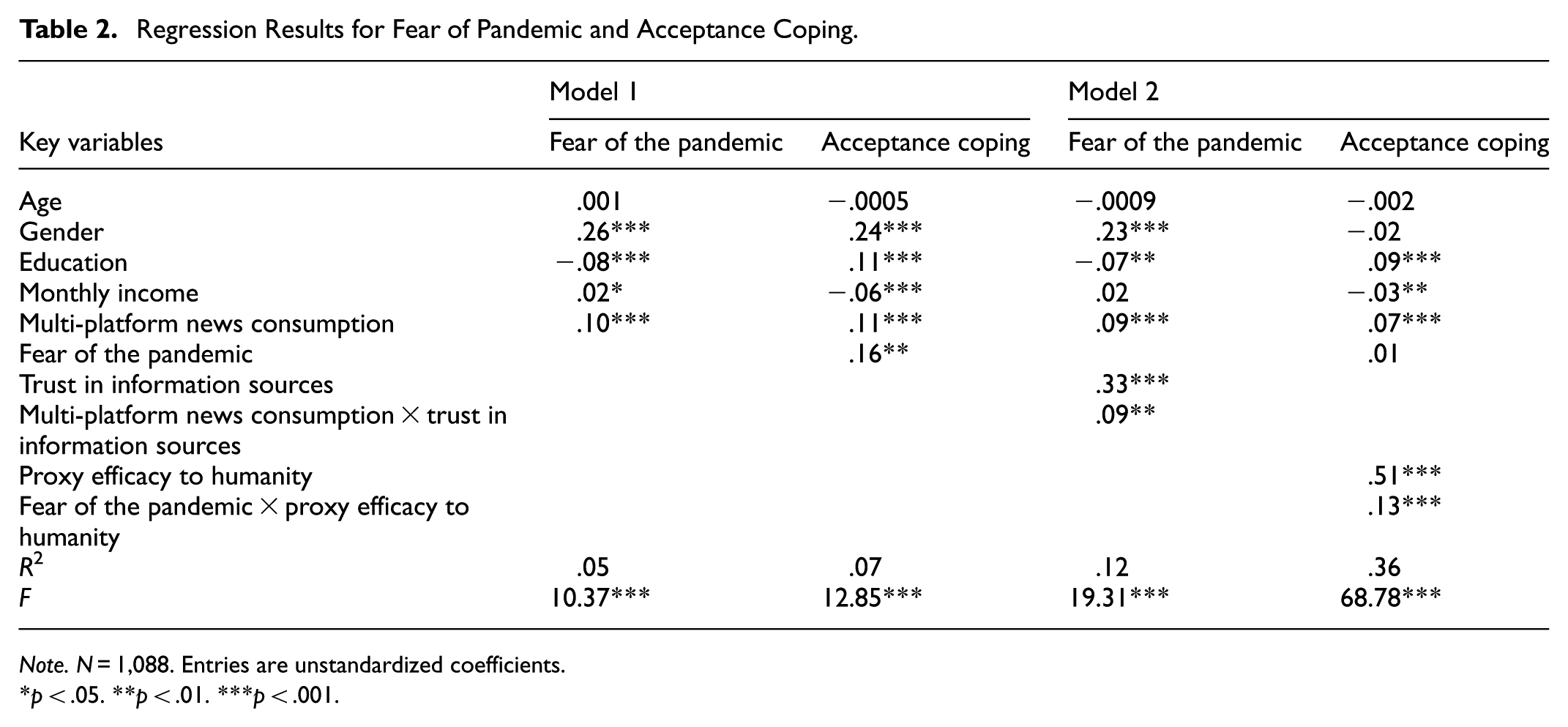
Note. N = 1,088. Entries are unstandardized coefficients.
p < .05. **p < .01. ***p < .001.
The Moderated Mediation Model Results.

The significance of indirect effect is judged based on bootstrap.
p < .05. **p < .01. ***p < .001.
As shown in Table 3 and Figure 2, the moderating role of trust in information sources on the association between multi-platform news consumption on fear of the pandemic was statistically significant for media consumption to fear of the pandemic path (b = .09, p < .01). That is, multi-platform news consumption has a stronger positive effect on fear of the pandemic in the high trust in information sources group than those in low trust in information sources group. Thus, H3 was supported.

Moderating effect of trust in information sources on multi-platform news consumption and fear of the pandemic.
The result also showed that proxy efficacy to humanity positively moderates the effect of fear of the pandemic and acceptance coping (b = .13, p < .001), which supported H4 as shown in Figure 3. Specifically, fear of the pandemic may enhance acceptance coping in the high proxy efficacy group, while the opposite occurs in the low and middle proxy efficacy group (conditional effects were shown in Table 3; Figure 4).

Moderating effect of proxy efficacy to humanity on fear of the pandemic and acceptance coping.

Analysis coefficients in the model.
Discussion and Conclusion
By analyzing quota-sampling data collected in Macao, China, this study investigated how media consumption motivates individuals to engage in acceptance coping, with fear of the pandemic as the underlying mechanism in the process. The association between media consumption and fear of the pandemic, as well as media consumption and acceptance coping, was found to be positively moderated by trust in information sources.
This study bears several theoretical implications. Firstly, grounded in message–behavior–audience framework (MBAF) of fear appeals, we have novelly investigated how a vital news habit, that is, multi-platform news consumption, influences individuals’ fear-appealing process and outcomes. Within today’s diverse-channel and high-choice media environment, individuals’ news habits shift to multi-platform news consumption from relying on a single channel (Waeterloos et al., 2021). Unlike single-channel, news from multi-platforms is more likely to be comprehensive and controversial (Jung & Horng-En Wang, 2025). Individuals hesitate about the effectiveness of preventive behaviors posted on media due to this controversial information, thereby taking fewer actions when facing the pandemic (Szabo, 2020). Moreover, thorough pandemic information that they obtain from diverse media channels decreases their psychological distance from the pandemic while increasing their understanding of the current situation. This eventually fosters individuals’ new normalcy, leading them to accept the current situation without making further attempts to respond to their fear of the pandemic, thereby adopting acceptance coping. Secondly, this study has identified two audience psychological traits that vary fear-appealing effects. Existing MBAF literature has illustrated how several audience traits, such as gender and cultural backgrounds (Tannenbaum et al., 2015). Instead, we found that state-based psychological features (i.e., trust and proxy efficacy) also moderated the impacts of fear activation on audience responses in the current study. Specifically, trust in information sources amplifies fear induced by news content, particularly news from diverse channels featuring highly controversial and uncertainty. Meanwhile, people with higher proxy efficacy to humanity are more likely to hold acceptance coping strategies dealing with fear. On the contrary, fear decreases individuals’ acceptance coping when they have a low level of proxy efficacy.
Another Side of Media Mobilization: Acceptance Coping
During the public health crisis like the pandemic, people heavily rely on the media to acquire information. As assumed by H1, the results of this study indicate that as exposure increases, individuals are more likely to engage in acceptance coping. Prior research suggests that media may mobilize citizens to take active measures to fight against the pandemic, including getting vaccinated (F. Yin et al., 2021) and maintaining social distancing (Nabi et al., 2022). This study, however, reveals an additional function of media mobilization during the COVID-19 pandemic, suggesting that media consumption may result in a comparably passive but adaptive coping style, that is, acceptance coping. As suggested by previous works, though not as active as approach coping strategies, acceptance coping can ease anxiety and decrease individuals’ avoidant tendencies (Ferreira et al., 2013; Kamaludin et al., 2020). In the context of public health emergencies where individuals have limited response capabilities, this study has found a valuable means of maintaining public psychological well-being, that is, a diverse media consumption that promotes acceptance coping. On this basis, we suggest practitioners improve the diversity of news diet as a means of promoting acceptance coping among the public, thus protecting public psychological health.
In line with previous works (Chu et al., 2022; J. Yin & Ni, 2021), the supported H2 found that multi-platform news consumption would induce an individual’s fear of the pandemic. Consuming information from multiple media sources may amplify the individual risk perception, as indicated by previous works (Liu et al., 2023; Niu et al., 2022). Therefore, it could be expected that fear can be triggered by multi-platform media consumption.
Addressing RQ1, a positive association between fear of the pandemic and acceptance coping was established in this study. This was consistent with preceding works (Wulf, 2021; J. Yin & Ni, 2021). While most previous works have focused on active coping styles, such as actively addressing the impact of the pandemic and solving problems or regulating emotional states during the pandemic, (Akeman et al., 2022; Jin et al., 2022), this study has investigated how media consumption resulted in acceptance coping via the mediation of fear. Stressful or traumatic events that an individual was unable to overcome on his or her own might lead to acceptance coping (Darabos et al., 2023; Tipsword et al., 2022). In the context of COVID-19, information regarding the context might be a major stressor for the audience, causing people to perceive the pandemic as a problem that they could not solve on their own. Within such a context, active coping strategies including problem-focused and emotion-focused coping might help little in dealing with the pandemic and maintaining individual well-being. As a result, individuals will likely utilize acceptance coping as a strategy to alleviate their distress. Based on these findings, we highlight the significance and unique benefits of multi-platform news consumption. According to our measures (i.e., summarizing the channels through which people consume news), a higher degree of multi-platform news consumption indicates a greater news channel diversity. Thus, the positive association between multi-platform news consumption means that compared with a single or fewer news obtaining channels, greater channel diversity allows individuals to adopt acceptance coping, which, to some extent, is a more effective coping strategy facing unchangeable adverse situations such as pandemic. This finding thereby encourages science communication agents and experts to use multiple channels and platforms to disseminate public health and other science-related content and knowledge.
Media Effects Amplifier: Trust
The role of trust in information sources as a moderator is indeed an important conclusion of this study. Higher levels of trust in information sources indicate that individuals perceive media information as more trustworthy (Adam et al., 2023; Gardikiotis et al., 2021). As a result, those with higher levels of trust in information sources are more likely to perceive greater veracity in media coverage of the COVID-19 epidemic. Thus, trust in information sources may further amplify the impact of news consumption on individuals’ fear and acceptance coping, as found in this study.
This finding enriches the literature on trust in information sources during a public crisis by incorporating individuals’ prior attitudes toward media (i.e., trust in information sources). Specifically, we believe that future research should focus on the role of individual attitudes and traits in the process of how media induce emotional reactions. Understanding how these individual factors interact with media consumption can provide valuable insights into the effects of media coverage on public behavior during crises.
Fight or Flight: The Role of Beliefs in Humanity
This study acknowledges proxy efficacy as another crucial individual-level factor. In line with our expectations, we discovered that the influence of fear on acceptance coping is more profound among individuals who possess a higher degree of confidence in humanity’s ability to handle a sudden outbreak emergency. As articulated in earlier sections, an individual has minimal control over the pandemic. Thus, many tend to depend significantly on the conceptual community of mankind as an agent combating the pandemic. This observation can be rationalized by the tendency of individuals who trust in a proxy agent to minimize their personal efforts. In the context of the pandemic, an individual who believes in the ease of humanity’s response may deem their own substantial effort as excessive and unrealistic. This revelation presents a unique perspective on the role of proxy efficacy.
The incorporation of proxy efficacy to humanity in explicating coping responses contributes to EPPM, which traditionally focuses on self-efficacy and responsive efficacy in the process of fear control or threat control. As our results illustrate, individuals with low levels of proxy efficacy may feel inadequately protected, prompting individuals to take personal action and rely less on acceptance coping. Conversely, individuals with high levels of proxy efficacy may ascribe the responsibility of managing the pandemic to the global community and feel that they are well-protected. This could make them more likely to adopt acceptance coping strategies. Prior studies found that a lack of control in disasters increases illusory pattern perceptions (Whitson & Galinsky, 2008). This study precedes to reveal that the perception that the humanity as a whole can work to control the crisis on a certain individual’s behalf can pacify him/her and motivate the individual to accept the status quo of the calamity first, instead of responding to it irrationally. This also illustrates the mechanism by which fear-inducing media content improves public psychological resilience effectively. Consistent with our findings, content that solely activates fear may diminish public acceptance of pandemic measures. Such content risks triggering extreme reactions stemming from fear and panic, potentially compromising psychological well-being. Conversely, media content that simultaneously evokes both fear and proxy efficacy fosters public trust in the global community’s capability and commitment while experiencing apprehension. This dual-activation content enhances psychological resilience during public emergencies, enabling individuals to accept the prevailing circumstances with greater equanimity. Thereby, when facing public emergencies, science communicators could consider using co-framing media strategies that induce both fear and proxy efficacy. This would benefit the public’s psychological resilience more efficiently compared to barely evoking their fear feelings.
By revealing this, this study offers an alternative view of the role of proxy efficacy. Contrary to previous research which stated that proxy efficacy may encourage individuals to take actions (X. Li, 2018), this study found that in challenging situations that individuals cannot handle alone, those with high proxy efficacy to humanity may delegate the responsibility of achieving desired outcomes to the community. Based on these findings, we suggest that the investigations into proxy efficacy and its roles in coping strategy selection should consider contextual factors. In other words, proxy efficacy may influence individual behaviors differently in different scenarios.
Limitations and Future Outlooks
Some limitations should be noted. First, the nature of cross-sectional survey data hindered the investigation of casual relationships. Therefore, longitudinal design (e.g., panel survey) or controlled experiment should be considered in future studies to further explore the association between media consumption and coping strategies. Second, we only discuss the effects of media channel diversity, rather than media content diversity. Further investigation could be conducted by exploring how diverse media content or frames influence the audience’s mind and their responses to fear in public health emergencies. Third, the scope of this study was analyzed in the factors that activate acceptance coping within the pandemic context in Macao. Future research might extend these findings, especially the proxy efficacy’s moderating effect across various social issues and diverse geographical contexts that potentially elicit acceptance coping strategy.
Footnotes

Ethical Considerations
The study was approved by the Macau University of Science and Technology Medical Ethics Committee (MUST-20231027001) on January 1, 2022.
Consent to Participate
All participants provided written informed consent prior to participating.
Consent for Publication
Not applicable.
Author Contributions
Qingrui Li: Conceptualization; Formal analysis; Data curation; Methodology; Writing – original draft. Kun Peng: Conceptualization; Writing – review & editing. Xudong Liu: Conceptualization; Writing – original draft; Writing – review & editing. Zhen Sun: Supervision; Project administration; Writing – review & editing. Yu Guo: Validation; Writing – review & editing. Piper Liping Liu: Validation; Writing – review & editing.
Funding
The authors received no financial support for the research, authorship, and/or publication of this article.
Declaration of Conflicting Interests
The authors declared no potential conflicts of interest with respect to the research, authorship, and/or publication of this article.
Data Availability Statement
The datasets generated and analyzed during the current study are available from the corresponding author on reasonable request.