




Abstract
School counselors are essential staff in an education setting, contributing to student success by delivering critical services when implementing a comprehensive school counseling program. The study examined the predictive relationships of school counselors’ level of grit and mindset with their activities performed in programmatic service delivery. This novel study contributed to the expansion of grit and mindset predictive relationship with school counselor’s activities performed in a comprehensive counseling program. Practical implications were discussed, and further research is warranted to identify other factors that are predictive of counselor’s job activities in a comprehensive school counseling program.
School counselors are essential members of the educational environment contributing to student success. As school educators, they deliver critical services when implementing a Comprehensive School Counseling Program (CSCP) that addresses students’ academic achievement needs, social-emotional and career development (Alger & Luke, 2015; Carey et al., 2012). The American School Counselor Association (ASCA) National Model was created as a framework to support the school counselor’s comprehensive counseling program (ASCA, 2003). Despite the benefit of a comprehensive school counseling program, counselors still struggle to implement such a program (Burkard et al., 2012; Fye et al., 2017; Studer et al., 2011). School counselors indicate challenges in implementing CSCP due to the task’s difficulty (Cigrand et al., 2015; Sink & Yillik-Downer, 2001) and the demanding job environment (Mullen & Crowe, 2018). Accordingly, school counselors face challenges in performing activities in CSCP, and increasing their likelihood to persist in the delivery of student services may lead to better student outcomes (Lapan, 2012; Mullen & Crowe, 2018).
Substantial research has found that many factors (e.g., leadership practices, school climate, caseload, self-efficacy, values) hinder school counselors from delivery of services outlined by the ASCA National Model (ASCA, 2012; Ernst et al., 2017; Mullen & Lambie, 2016; Scarborough & Culbreth, 2008; Shillingford & Lambie, 2010). In previous studies, self-efficacy has been examined as a factor that contributes to the frequency of school counselors’ activities performed in programmatic service delivery (PSD; Mullen & Lambie, 2016; Scarborough & Culbreth, 2008). Self-efficacy is positively associated with growth mindset and grit (Novotny, 2016) and correlated with delivering services in a comprehensive school counseling program (Scarborough & Culbreth, 2008). Grit and growth mindset may be relevant factors that increase the school counselor’s ability to perform PSD activities in a CSCP. Both constructs contribute to performance in both academia and the workplace (Robertson-Kraft & Duckworth, 2014; Zingoni & Corey, 2017). Although these constructs have been studied with other populations, grit and mindset have not been examined as predictive factors in a school counselor’s performance in delivering of services in a comprehensive school counseling program.
Grit
Grit is a disposition or trait that individuals possess that fosters their ability to undertake challenges. Grit has been referred to as an individual’s ability to sustain their effort and interest through perseverance and passion for reaching the desired goal (Duckworth et al., 2007). Grit has proven to be a potential motivator in performance (Von Culin et al., 2014) and predictive of individuals’ performance and retention in the military, work, marriage, and high school domains (Eskreis-Winkler et al., 2014). In the education setting, grit has demonstrated to be an essential factor for novice teachers’ effectiveness and retention in the educational environment (Robertson-Kraft & Duckworth, 2014). Given the challenges that face educators in the school system, grit may be an essential characteristic for predicting performance and success. Mullen and Crowe (2018) found that grittier school counselors were related to decreased stress and burnout. Because school counselors face challenges in initiating PSD in a CSCP, personal characteristics such as grit and growth mindset may help overcome these challenges and lead to better student outcomes (Mullen & Crowe, 2018). Therefore, grit as a predictive variable may increase school counselors’ persistence in accomplishing a CSCP.
Mindsets
Similar to the grit construct, a growth mindset promotes performance in academic and occupational settings. Individuals’ beliefs and assumptions about their intelligence, personality, and abilities often produce patterns of thoughts and feelings that impact behavior, known as mindsets (Dweck, 2006). There have been more than 40 years of prolific research in mindset with students and adults in educational settings. The literature has described differences in mindsets, either fixed or growth that impacts student and adult performance. A growth mindset encourages persistence when encountering prolonged challenges (Renaud-Dubé et al., 2015; Yeager & Dweck, 2012; Yeager et al., 2014). Individuals with a growth mindset generally outperform those with a fixed mindset. Researchers have begun to investigate how a teachers’ mindset may impact students (Butler, 2000; De Kraker-Pauw et al., 2017; Rattan et al., 2012). Teachers with a growth mindset influence students’ belief about their ability and encourage students to try harder (Schmidt et al., 2015). School counselors’ growth mindset may be just as critical and influential in facilitating students’ beliefs to grow and reach their highest potential.
Duckworth and Gross (2014) conclude that the growth mindset is the precursor to grit, suggesting that individuals who succeed in challenging situations need a growth mindset (Hochanadel & Finamore, 2015). Thus, grit and mindset may be valuable characteristics that increase school counselor performance in the implementation of CSCP. Thus, this research started by asking:
Prior research revealed a need for further investigation of other factors related to PSD in a CSCP (Mullen & Lambie, 2016) and whether the level of grit was associated with the implementation of services (Mullen & Crowe, 2018). Therefore, the study examined whether school counselors’ grit and mindset had a predictive relationship to their performance in accomplishing PSD activities to address the gaps in the literature. Hence, the second and third questions were asked:
Lapan (2012) stresses the importance of a comprehensive school counseling program due to the positive impact on student outcomes. School counselors have found the implementation of a CSCP challenging despite these benefits. This investigation provides further understanding of school counselors’ grit and mindset characteristics contributing to PSD counseling activities aligned with CSCP. A programmatic service encompasses specific activities performed in counseling, consultation, coordination, and curriculum delivery, components of a CSCP (Mullen & Lambie, 2016; Scarborough & Culbreth, 2008; Shillingford & Lambie, 2010). The counseling activities include direct services to students through individual and group counseling to address personal, career, and academic concerns. Consultation activities include school counselors collaborating with all stakeholders (parents/guardians, staff, community members) to support students’ academic success, career development, and social-emotional skills. Coordination activities include developing and implementing school-wide events, staff, and parent workshops and evaluating student progress in delivering services. School counselors who perform more of the PSD activities have a more fully implemented comprehensive program demonstrating an increase in positive student outcomes. This study’s focus was to examine the predictive relationship of school counselors’ grit and mindset and their activities performed in CSCP. The preceding theoretical review led to the following hypotheses:
Grit and mindset among practicing ASCA school counselor members in the United States significantly predict their activities performed in a PSD measured by SCARS.
Grit among practicing ASCA school counselor members in the United States significantly predicts their activities performed PSD measured by SCARS.
Mindset among practicing ASCA school counselor members in the United States significantly predicts their activities performed in a PSD measured by SCARS.
Method
Procedures
After Grand Canyon University institutional review board approval (IRB-2019-1099), an invitation for participation was listed in the ASCA Scene, an online networking site, and ASCA Aspects, a monthly e-newsletter. The criteria for participation identified school counselors currently practicing in a K–12 setting in the United States. Participants selected a link to the survey and were required to acknowledge meeting criteria and understand the informed consent before accessing the demographic questionnaires and the three Likert-type surveys (SCARS, Grit-S, and Implicit Person Theory [IPT] Scale). A sample size of 86 respondents was collected. The preliminary power analysis determined the minimal sample of 68 for the regression analysis model. A Bonferroni correction computation was completed for regression analysis with two predictors with overlapping dependent variables. The study needed a minimal sample size of 88. Preliminary power analysis for Research Questions 2 and 3 presented an estimated sample size of 73. After removing five incomplete survey responses and completing data imputation of mean values to replace the one missing value for the six participants, the final sample was 75.
All data were entered into Statistical Package for Social Sciences (SPSS Version 26). Data analysis proceeded through a sequence of steps that included data screening, regression imputation, calculation of total scores for each scale, the examination of descriptive statistics, and assumptions was tested for any violations of normality of scores. The data were analyzed to determine any violation of assumptions for regression analysis. The data did not produce any violations, allowing for further statistical analysis. Cronbach’s alpha was calculated to determine the scores’ internal consistency for the total Grit-S, IPT, and SCARS scales. The three research questions were tested in successive order, constructed to assume that both predictor variables would be significant. A Bonferroni correction level of alpha = .0167 determined whether to accept or reject the null hypothesis because analysis included three statistical tests of the overlapping data set with one criterion variable.
Participants
Participants (N = 75) were practicing ASCA school counselors in a K–12 school setting in the United States. The collection of demographic data was used to provide a profile of the participants that could be compared with previous related studies (Mullen & Crowe, 2018; Mullen & Lambie, 2016; Shillingford & Lambie, 2010). The authors used the ASCA school members’ demographic characteristics to compare with relevant school counseling research. Seventy participants identified as females (93%). The majority of participants identified as White or Caucasian (n = 66; 88%). The participants in this study were predominately female and Caucasian consistent with school counseling research (Ernst et al., 2017; Mullen & Crowe, 2018; Mullen & Lambie, 2016; Scarborough & Culbreth, 2008). Years of school counselors’ years ranged from 1 to 20 years, with average participants 7.47 (SD = 6.05) years of experience. Participants with 1 to 5 years were most frequently observed category with 29 (39%). The majority of participants indicated that they worked in a high school setting (n = 27, 36%), subsequently followed by an elementary setting (n =26; 35%). This study was similar to other ASCA school counselors’ demographics in counseling research (Ernst et al., 2017; Mullen & Crowe, 2018). The participants’ primary work setting was located in rural (n = 28; 37%), and subsequently, working in suburban (n = 30; 40%) areas that align with previous studies.
Prior studies have discovered that school counselors with lower caseloads have higher success in implementing a school counseling program (Fye et al., 2017; Lapan, 2012). The student to counselor ratio ranged from less than 250 to more than 500, and the average participant had 346 (SD = 24.47) students per counselor in their caseload. ASCA (2019) advocates for schools to have a 250:1 student to counselor ratio. School counselors with the student to counselor ratio with the highest frequency had a caseload of 250 to 350 (n = 29, 39%). Only five participants reported having caseloads more than 500 students (6.5%). The participants mostly indicated that they were not Recognized ASCA Model Program (RAMP) certified (n = 64; 93%). School counselors recognized as RAMP recipients demonstrate a fully implemented and maintained comprehensive school counseling program. The lack of national demographic information for ASCA school counselors in the United States hinders this study comparison.
Results
To understand the level of study variables, means and standard deviations were obtained for the Grit-S, IPT, and SCARS (Table 1). The observations for school counselors’ grit mean scores were 3.94 (SD = .46), with the range of score values among 75 participants beings 2.71 to 4.86. In this study, school counselors indicated a high average grit scores (M = 3.94, SD = .46) compared with Mullen and Crowe’s (2018) investigation of Grit with ASCA school counselors (M = 3.83, SD = .56). The authors’ findings determined that school counselors had scored significantly higher on grit than adults from a general nonspecified adult sample in Duckworth and Quinn (2009). A participant’s highest grit score achieved is a 5 (extremely gritty) and the lowest score of 1 (not gritty at all; Duckworth & Quinn, 2009). The school counselors’ scores in this sample for both the median (Mdn = 4.00) and mean (M = 3.94) were higher than three (3) the middle point on the scale, thus tipping toward extremely gritty according to Duckworth and Quinn (2009). The findings reveal that ASCA school counselors’ average grit levels were moderately high, similar to Mullen and Crowe (2018) findings with a larger sample of school counselors. On average, school counselors may be grittier due to the stress in a demanding job (Bardhoshi et al., 2014; Mullen & Gutierrez, 2016). The current findings may indicate that grittier school counselors can persevere during challenges and overcome obstacles to achieve a more fully implemented PSD in a CSCP.
Descriptive Statistics of Study Variables.
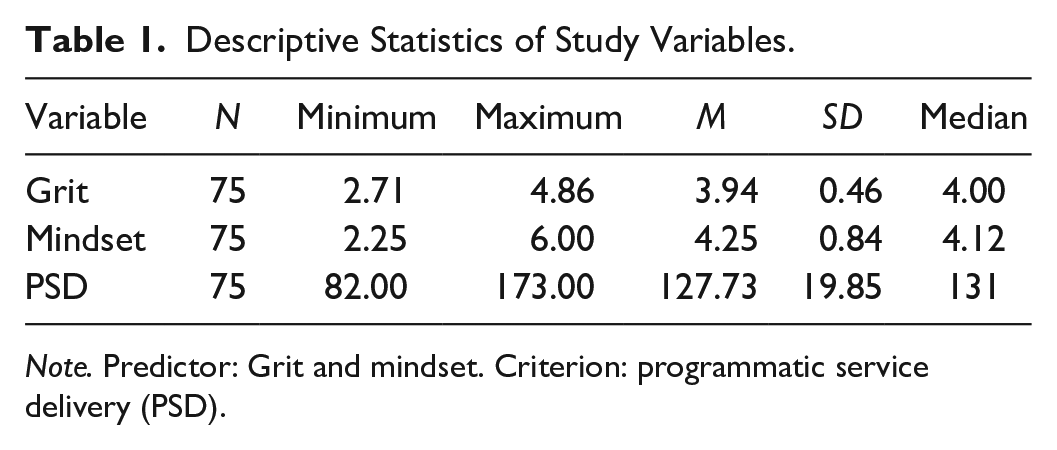
Note. Predictor: Grit and mindset. Criterion: programmatic service delivery (PSD).
The IPT average scores for school counselors’ mindset were based on a unitary nature of beliefs, indicating either a growth or fixed mindset (Dweck, 2006). The highest average IPT overall score is 6 displaying a growth mindset, whereas the lowest average IPT overall score is 1 pointing a fixed mindset. In this study, the school counselors’ range of scores values was from 2.25 to 6.00, with a mean score of 4.25 (SD = 0.84) displayed in Table 1. Participants’ mean scores were above the median, indicating a growth mindset, whereas an average score below the median aligns with a fixed mindset (Levy et al., 1998). The findings from the descriptive statistics revealed the school counselors favored a growth mindset (M = 4.25, SD = .84) identified as above the participants’ median score of 4.12.
The score value for the school counselor PSD (counseling, coordination, consultation, curriculum) ranged from 82 to 173 with a mean of 127.73 (SD = 19.85) and a median of 131 (Table 1). A score of 190 identifies a fully implemented PSD that describes school counselors routinely perform these activities in a fully implemented CSCP (Mullen & Lambie, 2016; Scarborough & Culbreth, 2008; Shillingford & Lambie, 2010). The school counselors’ scores in this study population perform programmatic service activities vary between occasionally and frequently according to the rating scale in PSD (Scarborough & Culbreth, 2008).
Research Question 1: Grit and Mindset Predicting PSD
The first research question focused on variables predicting school counselors’ ability to perform activities aligned with a more fully implemented CSCP. The correlation coefficients were calculated for the continuous variables. The correlation coefficients displayed in Table 2 show the strength and direction between the predictor and criterion variables. Both grit and mindset showed a positive relationship with PSD. Grit coefficient of .341 represents a moderate effect size and mindset demonstrates a small effect size according to Cohen’s standard to evaluate the strength of the relationship (Cohen, 1988).
Correlations for Study Variables (n = 75).

Note. PSD = programmatic service delivery.
p < .01 (two-tailed).
First, regression analysis assumptions were tested and no violations were found. A linear regression analysis was then conducted to examine the predictive relationship of school counselors’ grit and mindset with PSD. A Bonferroni correction was used to decrease a Type I error. The Bonferroni-corrected statistical significance with an alpha = .0167 was used to complete the regression analysis. The linear regression model results were statistically significant, F(2, 72) = 5.67, p = .005, R2 = .14, indicating that approximately 14% of the variance in PSD was explained by grit and mindset together. Grit significantly predicted programmatic, B = 13.46, t(72) = 2.80, p = .007, whereas mindset was not significant, B = 3.39, t(72) = 1.29, p = .202 (Table 3). The grit and mindset analysis indicated an adjusted R2 = .11 between a small and moderate effect size determined by Cohen’s f2 (Cohen, 1988).
Regression Analysis Summary for Predicting PSD.

Note. R2 = .11 (N = 75, p < .01). PSD = programmatic service delivery.
The calculated regression coefficients indicated a zero-order correlation between grit and PSD, r = .341, indicating a moderate positive relationship (Cohen, 1988). Mindset and PSD were r = .205, showing a small positive correlation coefficient. The unique correlation between grit and mindset with PSD indicated that grit represented 31% of the unique relationship to PSD, whereas the mindset variable unique relationship to PSD was 14%. The findings suggest that grit and mindset among practicing ASCA school counselor members in the United States were a significant positive predictor of their activities performed in a PSD measured by SCARS.
Research Question 2: Grit Predicting PSD
The second research question focused on the predictive relationship of school counselors’ grit with their PSD. After completing assumption checks with no violations, a simple linear analysis was conducted to determine whether grit independently was a significant predictor of PSD. The regression equation for grit and PSD produced an R2 = .12 and was statistically significant, F(1, 73) = 9.59, p = .003, indicating that approximately 12% of the variance PSD was explained by grit. The adjusted R2 = .11 for this simple linear regression indicated a value between a small and moderate effect size (Cohen, 1988). The statistics reveals that ASCA school counselors’ grit significantly predicted their PSD, β = .34, t(73) = 3.10, p = .003 (Table 4).
Regression Analysis Summary for Grit Predicting PSD.
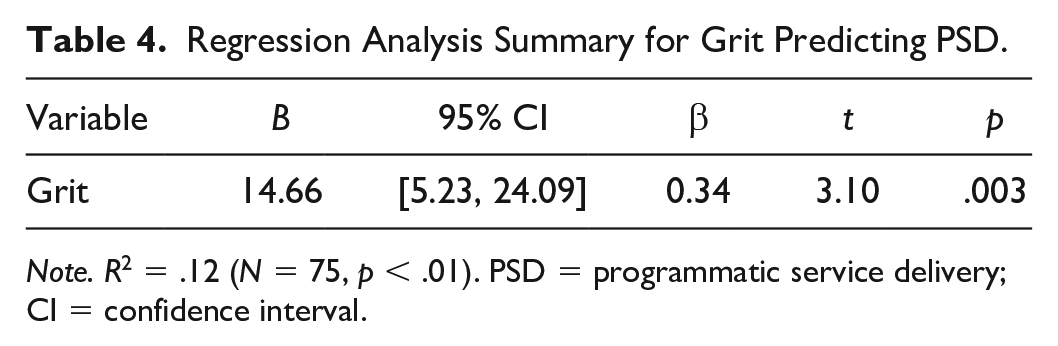
Note. R2 = .12 (N = 75, p < .01). PSD = programmatic service delivery; CI = confidence interval.
Research Question 3: Mindset Predicting PSD
The third research question focused on school counselors’ mindset predicting PSD. A simple linear regression analysis was conducted to assess whether the mindset significantly predicted school counselors’ activities performed in PSD. The result of the linear regression analysis indicated the model was not significant, F(1, 73) = 3.19, p = .078, adj. R2 = .03. The ASCA school counselors’ mindset was not a statistically significant predictor of their activities performed in a PSD, β = .205, t(73) = 1.786, p = .078. Based on these results, the null hypothesis was accepted. Although school counselors in this study favored a growth mindset, there was not a significant predictive relationship between mindset and school counselors’ performance.
Discussion
This investigation examined whether school counselors’ grit and mindset, independently and together, were predictive of a higher frequency of activities performed in PSD. School counselors who perform more activities in a PSD measured by SCARS indicate a more fully implemented CSCP (Mullen & Crowe, 2018), leading to positive student outcomes (Lapan, 2012). Previous research has focused on many factors (self-efficacy, leadership practices, caseload) that impede school counselors’ ability to accomplish a CSCP (Ernst et al., 2017; Mullen & Lambie, 2016; Scarborough & Culbreth, 2008; Shillingford & Lambie, 2010). Importantly, this was the first study to determine new factors related to school counselors’ characteristics of grit and mindset related to their performance in PSD activities. The first research question’s findings indicate a positive, statistically significant predictive relationship between grit and growth mindset with activities in PSD using the Bonferroni-corrected alpha level = .0167. The significance of the grit contribution to the criterion, PSD was statistically significant, B =13.46, t(72) = 2.80, p = .007, indicating one unit of grit will increase PSD by 13.46. Mindset did not significantly predict PSD, B = 3.39, t(72) = 1.29, p = .202, for this multiple regression model.
The findings also revealed that school counselors’ grit levels were moderately high, similar to Mullen and Crowe’s (2018) study results. The results indicated that the participants had a higher average mindset score than Zingoni and Corey’s (2017) study with sales employees. Yet, school counselors may, on average, be grittier due to the stress of demanding jobs (Bardhoshi et al., 2014; Mullen & Gutierrez, 2016). The current findings may indicate that grittier school counselors can persevere during challenges and overcome obstacles to achieve a more fully PSD in a CSCP. More resolute individuals may have more coping strategies when faced with challenges or adversity related to stress (Meriac et al., 2015). Due to the school counseling field’s challenges with the workload and professional job demands (Bardhoshi et al., 2014), school counselors will need to have more grit to accomplish a PSD in a comprehensive school counseling program.
School counselors’ unitary mindset belief favored a growth mindset, although there was not a significant predictive relationship between mindset and school counselors’ PSD. On average, participants were found to have a growth mindset, which tends to view challenges as opportunities and value learning (Zingoni & Corey, 2017). The role of individuals with a growth mindset in the workplace facilitates employees’ learning (Thadani et al., 2015), work engagement (Caniëls et al., 2018; Keating & Heslin, 2015), and success in the work environment (Heslin et al., 2005; Zingoni & Corey, 2017). Relevant literature has found that a growth mindset is essential in developing grit (Aditomo, 2015; Duckworth & Eskreis-Winkler, 2013; Larkin-Wong, 2015; Polirstok, 2017).
For Research Question 2, the findings revealed a positive, statistically significant predictive relationship between school counselors’ grit contributing to activities in PSD. The significance of the grit contribution to the criterion, PSD was statistically significant, B = 14.66, t(73) = 3.10, p = .003, indicating one unit in grit will increase PSD by 14.66. The results showed that 12% of the variance in PSD was accounted for by grit.
The findings for Research Question 3 indicated school counselors’ mindset was not a statistically significant predictor for activities performed in their PSD. The coefficients determined a positive relationship between mindset and PSD (R = .205) with a small effect size (Cohen, 1988). The regression model with mindset as a predictor accounted for only 2.9% of the total variance in PSD.
This study lends to grit and growth mindset constructs that have proven to influence individuals’ motivation and reveal predictive patterns of behaviors related to improved performance in various domains (Burnette et al., 2013; Hochanadel & Finamore, 2015). A school counselors’ grit was predictive of a higher frequency of activities in PSD with a comprehensive program. Compared with Mullen and Crowe’s (2018) study results, the school counselors’ grit levels were moderately high. School counselor participants had a higher average mindset score than previous studies in the work setting (Zingoni & Corey, 2017). Possibly, other variables would add to the prediction. Previous studies have shown a positive correlation between self-efficacy and PSD (Ernst et al., 2017; Mullen & Lambie, 2016; Scarborough & Culbreth, 2008). And counselors’ self-efficacy was positively associated with growth mindset and grit (Novotny, 2016). Grit and mindset may overlap with other personality characteristics such as self-efficacy.
The abundance of research demonstrates grit and growth mindset as an essential motivator of hard work and dedication to an individual’s success and performance during challenging tasks with all ages (Duckworth, 2016; Duckworth & Eskreis-Winkler, 2013; Dweck, 2006; Yeager & Dweck, 2012). In this study, the grit and mindset constructs provided a further understanding of school counselor’s performance in implementing a more fully comprehensive school counseling program. This study of grit and mindset with school counselors’ performance will extend the theoretical body of knowledge lacking in current research.
Limitation and Implications for Research
The present study’s limitations include the lack of generalizability of results, sampling procedures, participants’ perceptions, and the correlational design. One of the shortcomings of the study was the lack of understanding of whether the sample was reflective of all ASCA school counselors located across the United States. There are approximately 34,000 ASCA members, yet participation was less than 1% of ASCA membership. The school counselor participants may not be indicative of ASCA school counselors across the United States. Currently, the ASCA does not collect member’s demographic information beyond total recipients of the RAMP award from the program incipient in 2004. Possibly, ASCA school counselor members who volunteered may differ in characteristics to those who did not respond. And the participants were those who read the monthly newsletter or weekly networking site and may have different characteristics, such as a growth mindset that indicates someone willing to learn new ideas and take risks (Dweck, 2006). The study sample does not reflect school counselors who were not ASCA members. Consequently, the generalization of the results to all school counselors in the United States was a limitation.
The methodology using convenience sampling and anonymous data collection through an online survey with recruitment from the ASCA electronic networking and e-newsletter was a limitation. The length of the study advertised in the recruitment letter was 15 to 20 min, which may have been a deterrent in completing the surveys. The online survey system indicated participants, on average, completed the study in 9 min. Therefore, it is assumed that the smaller population sample size compared with the ASCA population of 34,000 members may be due to the survey length listed in the recruitment letter. Another possible indicator of the smaller sample size was due to the data collection that started at the end of June and did not finish until the end of July. Typically, this is when educators are on summer vacation, and may not be representative of ASCA school counselors across the United States.
Self-report surveys are standard practice in the social science field (Croasmun & Ostrom, 2011), yet this is a limitation. The participant’s answers to the survey may reflect their interpretation, and responses may be their perception rather than their actual grit, mindset, or school counseling practice. The response bias may have occurred if participants wanted their answers to be perceived as more positive views toward being seen as more a gritty school counselor with a growth mindset and a more fully implemented school counseling program. Therefore, self-reports to determine school counselors’ implementation of a comprehensive school counseling program may not reflect their actual activities in the school setting.
Another limitation of the current study was the correlational design that does not establish a causal relationship between variables. The study’s intent was not to make a causal relationship but to determine the predictive relationship between grit and mindset with school counselors’ performance in accomplishing PSD activities. Like many studies, this study has limitations yet demonstrates significant findings that contribute to school counselors’ performance in a comprehensive school counseling program.
The implications of this study lend themselves to future research. The findings revealed that grit was related to an increase in school counselors’ performance of activities in PSD. When school counselors perform more activities in PSD, they have a more fully implemented comprehensive school counseling program with better student outcomes (Dimmitt & Wilkerson, 2012; Mullen & Lambie, 2016). These results may be due to school counselors’ perseverance related to their grit and growth mindset, which has shown to be critical motivators to overcome challenges in other settings (Eskreis-Winkler et al., 2014; Robertson-Kraft & Duckworth, 2014; Zingoni & Corey, 2017). Further exploration of additional psychosocial factors and a larger sample may be necessary to understand other characteristics that contribute to school counselors’ implementation of PSD in CSCP aligned with the ASCA model. The need for future research may include other psychosocial factors related to grit, such as conscientiousness (Duckworth et al., 2007) and self-control (Duckworth & Gross, 2014). These studies found that such factors were predictive of performance outcomes in other domains.
As a predictor, grit is an essential factor for novice teachers’ retention and effectiveness (Robertson-Kraft & Duckworth, 2014). A teachers’ growth mindset impacts their students’ beliefs and performance (Esparza et al., 2014; Rattan et al., 2012). An individual’s growth mindset as an agent increases achievement by helping students reach their full potential (Butler, 2000). As an educator, school counselors’ grit and a growth mindset may influence students’ growth in the educational setting. Future research may be essential to determine whether grit and growth mindset may be predictive of their effectiveness with student outcomes.
Duckworth et al. (2007) found that grit increases with age and might grow over a person’s life span. Grit was significantly related to age and educational attainment, indicating older people having higher grit scores (Duckworth & Quinn, 2009). Demographic factors were not examined in this study. Future research may be needed to determine whether grit or mindset scores are related to demographic factors such as school counselors’ years of experience, student to counselor ratio, and age that is described in other studies. School counselors’ grit and growth mindset may increase as they have additional life and work experience in the school counseling field.
Other methods of recruiting may be beneficial to address a more robust sampling representation of ASCA school counselors. The recruitment of school counselors through state associations or the National Certified Counseling Association may allow for a broader sample. This type of sampling may also increase the sample size needed for a larger effect of these constructs with performance outcomes. Further research could replicate this quantitative study using a larger school counselor sample size that may produce a larger effect size. These recommendations would expand the generalization of the study.
SCARS (Scarborough, 2005; Scarborough & Culbreth, 2008) have been used in previous research to measure service delivery in a comprehensive school counseling program (Mullen & Lambie, 2016; Shillingford & Lambie, 2010). A valid and reliable measurement that aligns with the current ASCA National Model (ASCA, 2019) may help measure fully implemented comprehensive school counseling programs. A future study may want to utilize other ways to measure school counselor performance, such as School Counseling Program Implementation Survey (Clemens et al., 2010), formal state or school district evaluation, and schools awarded the RAMP certification.
Mullen and Crowe (2018) suggested a need to investigate the Grit-S measurement with other school counselors to examine the soundness of Grit-S Item 2. Similarly, the current study also found higher internal consistency when Item 2 (“Setbacks don’t discourage me”) was removed. Counselors may have setbacks that discourage them but are still motivated to provide activities to support student success. Further examination to understand how school counselors perceive Item 2 would lead to a better measurement model of Grit-S with practicing school counselors.
This study was a correlational design that does not establish a causal relationship between predictor and criterion variables. Several studies have shown interventions designed to increase growth mindset also develops grit in academic settings that promotes perseverance and higher performance (Aditomo, 2015; Eskreis-Winkler et al., 2016; Larkin-Wong, 2015; Paunesku et al., 2015; Walton & Wilson, 2018; Yeager et al., 2016). Future research with an experimental design would allow a researcher to determine a causal relationship between these constructs and school counselors’ performance. A qualitative or mixed-method approach may be beneficial to understanding the school counselors’ perspective.
School Counselor Practice
Grit and growth mindset may be essential characteristics that enable school counselors to overcome challenges and obstacles when implementing a CSCP to facilitate optimal student success. Both grit and mindset are malleable characteristics that can be developed (Duckworth, 2016; Duckworth et al., 2011; Dweck, 2006; Dweck et al., 1995; Robins & Pals, 2002). To enhance grit, an individual may need to have a growth mindset that embraces effort and hard work to accomplish goals (Duckworth, 2016; Duckworth & Eskreis-Winkler, 2013; Dweck, 2007; Hochanadel & Finamore, 2015; Larkin-Wong, 2015; McClendon et al., 2017). There has been much debate about whether grit facilitates a growth mindset or enables individuals to become grittier (Polirstok, 2017). An individual’s effort and dedication to goals may contribute to the connection between a growth mindset and grit (Duckworth & Eskreis-Winkler, 2013). Grit and mindset are relatively stable characteristics, but have shown to be malleable (Duckworth, 2016; Dweck, 2007; Dweck et al., 1995; Robins & Pals, 2002). Therefore, it may be crucial to provide professional development to enhance their awareness and ways to build skills and traits that facilitate school counselors’ ability to meet their job tasks in a CSCP. There is a need for district, state, or national awareness regarding the development of grit and growth mindset that potentially leads to overcoming challenges and persistence toward goals. School counselor educators, district, and building stakeholders play a critical role in providing opportunities to increase awareness and boost these characteristics in school counseling professionals.
Importantly, education leaders at the district and university level need to provide adequate preparation for the specific skills in implementing activities in a CSCP. School counselors must also have the opportunity to learn about best practices and opportunities to perform activities in a PSD that lead to improvements in student performance. Deliberate practice has shown to be an effective way to improve performance and acquire skills through intentional practice (Duckworth, 2016; Eskreis-Winkler et al., 2016; McClendon et al., 2017; Yeager et al., 2016). For school counselors to accept the challenges and learn, they must have direct experiences and implement strategies to support their effort to learn new skills (Duckworth, 2016; Duckworth et al., 2011; Maurer & Chapman, 2013; McClendon et al., 2017).
School counselors need ways to manage the psychological workload to enhance their implementation of a CSCP (Holman et al., 2019). Higher grit levels are related to a decreased stress and burnout in school counselors (Mullen & Crowe, 2018) and other professionals (Dam et al., 2019). Therefore, the development of malleable traits may be valuable to overcome the challenges of school counselors’ work demands.
Conclusion
In conducting this study, the findings enhance the understanding of factors that may influence school counselors’ ability to overcome challenges and obstacles in delivering services in a CSCP. This study was the first to examine grit and mindset that have a predictive relationship to school counselors’ performance in implementing PSD. The findings indicate that school counselors’ grit is a crucial characteristic to increase in delivery of services in a CSCP. Grit may lend to school counselors’ ability to accomplish a CSCP that is often a challenge due to the daily professional demands (Mullen & Crowe, 2018). Also, Duckworth and Gross (2014) conclude that the growth mindset is the precursor to grit, suggesting that individuals who succeed in challenging situations need a growth mindset (Hochanadel & Finamore, 2015). Because a CSCP enhances student achievement and school success (ASCA, 2019), a well-established counseling program is essential in today’s educational system. Consequently, school counselors’ grit and a growth mindset may be influential in increasing their ability to implement a CSCP that impacts students’ academic and social-emotional growth in the educational setting.
