




Abstract
The mechanisms underlying metaphor comprehension, particularly the roles of analogical reasoning and language-specific conceptual integration have long been debated, with most studies focusing on English as L1 while paying limited attention to L2 contexts. Based on that, this study explores how three individual difference factors—fluid intelligence, crystallized intelligence, and L2 proficiency—influence the comprehension of L2 metaphors with varying degrees of complexity among Chinese EFL learners. Since fluid intelligence is closely associated with analogical reasoning, while crystallized intelligence facilitates the language-specific conceptual combination, this study further investigates their respective contributions, alongside L2 proficiency, to metaphor comprehension. Adopting an individual-difference approach, this study investigated Chinese learners’ metaphorical competence using three measures. The results demonstrate positive correlations between all three factors and L2 literary metaphor comprehension. Both L2 proficiency and crystallized intelligence play a significant role across all levels of metaphor complexity. Crystallized intelligence has a greater influence on literary metaphor comprehension, whereas L2 proficiency is the strongest predictor of non-literary metaphor understanding. In contrast, fluid intelligence functions as a predictor in literary metaphors but has a negligible effect on non-literary metaphors. These findings indicate that both analogical reasoning and conceptual integration are the underlying mechanisms of L2 metaphor interpretation, though their relative contributions vary depending on metaphor complexity. The study verifies the pedagogical significance of enhancing L2 proficiency and crystallized intelligence (cultural knowledge accumulation) in fostering L2 learners’ metaphor comprehension competence. Moreover, for the interpretation of metaphors with high cognitive complexity, training in fluid intelligence may also be beneficial.
Plain Language Summary
This study investigates how Chinese college students’ language proficiency, reasoning abilities (fluid intelligence) and general knowledge (crystallized intelligence) influence their understanding of English metaphors, including both everyday and literary types. While previous research has primarily focused on native English speakers, this study investigates how these three individual differences influence metaphor comprehension in an L2 context. To examine this, we used three tests: a subscale from the Raven Intelligence Scale, a semantic test to measure crystallized intelligence, and a combination of LexTALE and TEM4 Test (a standard English test for college students in China) to evaluate L2 proficiency. We found that the influence of these factors on L2 metaphor comprehension varies depending on the type and complexity of the metaphor. Crystallized intelligence plays a key role in understanding literary metaphors, while L2 proficiency is the strongest predictor of non-literary metaphor comprehension. Fluid intelligence contributes to the interpretation of more complex literary metaphors but has little impact on simpler, non-literary ones. These findings suggest that understanding L2 metaphors relies on both analogical reasoning (Understanding metaphors by finding similarities between two things – like comparing life to a journey to see shared patterns) and categorization (Creating new mental categories to connect abstract ideas – for example, grouping ‘time’ under a temporary ‘valuable resource’ category ‘money’ derives). To help students get better at the interpretation of L2 metaphors, improving L2 proficiency and crystallized intelligence is essential. Additionally, training in analogical reasoning may be beneficial for interpreting highly complex metaphors.
Keywords
Introduction
Humans consistently employ language to represent one concept through the lens of another conceptually different one, which is the essence of metaphor. Since Lakoff and Johnson (1980) define metaphor as a conceptual instrument, it has transcended its traditional role as a rhetorical device and has become a mode of human cognition and a means of conceptualizing the world. Metaphors are ubiquitous, appearing not only in literary contexts but also in various scientific fields. For instance, Wachowiak and Gromann (2023) investigate how GPT-3 can automatically detect and interpret metaphors. Recognizing and understanding metaphors is of paramount importance due to their pervasive nature.
The two major theoretical models regarding the mechanisms of metaphor comprehension that have been debated within the psycholinguistic community are analogy and categorization, the latter also referred to as conceptual integration (Estes & Glucksberg, 2000). Analogical reasoning involves systematic mapping of the underlying propositional structures in the source and target domains to identify the complex relationships between these two domains, while categorization pertains to the target domain being a member of the abstract category, the source domain derives in metaphorical expressions. Stamenković et al. (2019) emphasize that “analogical reasoning is a typical domain-general cognitive ability that operates on complex propositional structures stored in working memory, while conceptual combination is a relatively simpler process, relying on the activation of lexical concept expansion” (p. 109). This definition highlights that complex analogical reasoning is an effective mechanism for interpreting complex metaphors—those characterized by intricate syntax and significant semantic distance between the source and target domains, requiring an analysis of the correlations between various elements of the two domains (Glucksberg & Haught, 2006; Kintsch, 2000). Previous studies have indicated that fluid intelligence is strongly associated with analogical reasoning ability, operating independently of prior knowledge, while crystallized intelligence relates to the integration of concepts, often drawing on prior knowledge reserves (Holyoak, 2012; Stamenković et al., 2019). This integration relies on activating related conceptual structures rather than complex analogical reasoning. Studies indicate that metaphor comprehension among native English speakers involves both fluid and crystallized intelligence (e.g., Stamenković et al., 2019, 2020).
Understanding metaphors, a hallmark feature of native speakers’ language use, has garnered attention in foreign language and second language (L2) research. Danesi (1986) was among the first to introduce this concept into L2 research. Language serves as the primary vehicle for metaphors, and the foundational premise for grasping metaphors in L2 is understanding the literal meanings of words (Xu & Zhao, 2014). This necessitates that learner develop basic language skills or achieve a certain level of proficiency. While the relationship between L2 proficiency and metaphor comprehension has been a focal point of research, there is no consensus, as findings generally fall into two camps: one suggesting L2 proficiency has minimal effect on metaphor understanding (Johnson, 1991; Johnson & Rosano, 1993; Yuan & Xu, 2019), and the other positing that it does (Galantomos, 2019; Littlemore, 2001; Wei, 2012; Xu & Zhao, 2014).
Given that metaphor comprehension is closely tied to cognitive abilities, studies have also explored how cognitive factors influence L2 learners’ understanding of metaphors. Research has examined elements such as working memory (Chiappe & Chiappe, 2007) and fluid intelligence (Chen et al., 2022; Wei, 2012), demonstrating that cognitive abilities significantly affect L2 metaphor comprehension (Galantomos, 2019; Littlemore & Low, 2006). Chiappe and Chiappe (2007) further demonstrate that both fluid and crystallized intelligence play essential roles in metaphor processing. However, existing studies have not addressed crystallized intelligence as a cognitive factor influencing L2 metaphor comprehension.
According to the available literature, research on metaphor comprehension among Chinese learners of English has yet to simultaneously consider the roles of L2 proficiency, fluid intelligence, and crystallized intelligence. This study aims to explore the correlations among these three individual difference factors and their impact on L2 metaphor comprehension of Chinese learners of English through metaphor comprehension tests. This investigation may contribute to resolving the ongoing debate regarding metaphor comprehension processing mechanisms in the context of L2 learning.
The structure of the rest of the paper is organized as follows: Section 2 offers an overview of the definitions of fluid intelligence, crystallized intelligence, and metaphoric competence in L2, and explores the relationships among these factors. Section 3 describes the research methodology and the experimental study. Section 4 provides the discussion of our findings, and Section 5 concludes the paper, offering remarks on the limitations of the research and implications for future research.
Literature Review
This section introduces the definition of the key terms in this research, namely fluid intelligence, crystallized intelligence, and metaphoric competence. The relationship between cognitive abilities (fluid and crystallized intelligence) and mechanisms of metaphor processing (analogy and conceptual integration) is then explored. Then previous research on the relationship between each of the individual difference factor and L2 metaphor comprehension will also be reviewed.
Fluid Intelligence, Crystallized Intelligence and Metaphorical Competence: the Definition
Cattell (1963) classifies the factors influencing intelligence into two categories: fluid intelligence (denoted as “gf”) and crystallized intelligence (denoted as “gc”). Horn and Cattell (1967) further expand on these concepts, defining fluid intelligence as the capacity to solve reasoning problems, which is linked to important skills such as understanding, problem-solving, and learning (Cattell, 1963). Fluid intelligence can effectively predict academic performance and achievement (Deary et al., 2007) and is not an innate trait. An increasing body of research suggests that cognitive training, particularly working memory training, can enhance fluid intelligence (Jaeggi et al., 2010, 2011; Peng et al., 2014).
Crystallized intelligence refers to cognitive abilities derived from acquired knowledge and skills developed through practice (Horn & Cattell, 1967). This includes language and literacy skills, judgment, associative reasoning, and more (Ma, 2004). Crystallized intelligence reflects the influence of experience and culture and is considered a more stable ability (Horn, 2020). Assessments of crystallized intelligence typically involve vocabulary tests, abstract word analogies, and language mechanisms, etc. (Horn, 1968).
Research on metaphoric competence spans multiple disciplines, “including linguistics, psychology, and education, with each field focusing on different aspects” (Shi & Liu, 2010, pp. 10–16). In linguistics, definitions diverge into narrow and broad conceptualizations (Littlemore & Low, 2006). The narrow sense centers on the ability to produce and understand metaphorical meanings (Pollio et al., 1990), including the processing speed (Littlemore, 2001). In contrast, the broad sense extends beyond basic production and comprehension to pragmatic awareness and the social functions of metaphors (Littlemore & Low, 2006). Chen (2013, pp. 57–66) conceptualizes metaphoric competence as “a deep cognitive process inherent to human metaphor production and application, which involves identifying the commonalities, individual characteristics, and underlying rules in metaphor processing,” thus revealing the fundamental processes and effects of using metaphors in communication. Danesi (1986, p. 493) further frames it as “a native-like discourse skill rooted in conceptual encoding through metaphorical reasoning,” suggesting that L2 learners must internalize target-language conceptual frameworks to attain such competence. While these perspectives vary in scope, Xu et al. (2012) argue for the narrow definition particularly in cross-linguistic contexts, focusing on metaphor interpretation, analysis, and production in both L1 and L2 settings.
Aligning with Littlemore and Low (2006) and Chen et al. (2022), this study defines metaphoric competence as the ability to recognize, comprehend, and generate metaphors, as well as employ them for communication. To ensure analytical precision, this study narrows its focus to one core facet: metaphor comprehension competence, especially the cognitive processes underlying the understanding of metaphoric expressions.
Mechanisms of Metaphor Comprehension and Cognitive Abilities (Crystallized Intelligence and Fluid Intelligence)
Psychologists, linguists, and philosophers have proposed numerous theories regarding the mechanisms of metaphor comprehension, which can be broadly categorized into two types: analogical reasoning (Black, 1962; Gentner & Clement, 1988) and language-specific conceptual combination (Glucksberg & Keysar, 1990). One thing worthy of note is that conceptual combination or categorization in this research is different from conceptual integration in cognitive linguistics, in which conceptual integration is an underlying mechanism of online meaning construction. It is a cognitive process focusing on explaining the emergence of creative meanings in communication. To avoid misunderstanding the term, we use categorization in the rest of the paper to refer to language-specific conceptual combination. Additionally, conceptual mapping (Lakoff & Johnson, 1980) is another significant mechanism discussed in cognitive linguistics. While this mechanism differs from analogical reasoning by emphasizing that metaphor is not a matter of language but a pattern of thought, it also interprets metaphor comprehension through mapping, aligning it with the analogy mechanism (Holyoak & Stamenković, 2018). Therefore, we focused on analogical reasoning and conceptual combination here.
Analogical reasoning serves as a primary mechanism of human creativity, building connections between concepts based on their relational relevance. In metaphor comprehension, this process involves analyzing the two domains—the source and the target—representing them in specific propositions or elements, and identifying the correspondences between elements of the two domains.
The categorization mechanism suggests that metaphor comprehension depends on the indirect comparison of two distinct concepts (Glucksberg & Keysar, 1990; Holyoak & Stamenković, 2018). This begins with the target, accessing the metaphorical meaning of the source by assigning it an abstract temporary category related to the target using target* to represent, and this target* category is characterized with typical elements of the target (Rubio, 2007; Wu & Yang, 2014). In this view, the source is included in this temporary abstract category, while the target is considered a typical member of that category (Chen, 2013). There has been debate on whether any of these two mechanisms or both of the two play a role in metaphor comprehension (see Holyoak & Stamenković, 2018 for review). Based on the above content and Stamenković et al. (2019), we use the following diagram (Figure 1) to generalize metaphor comprehension mechanisms.
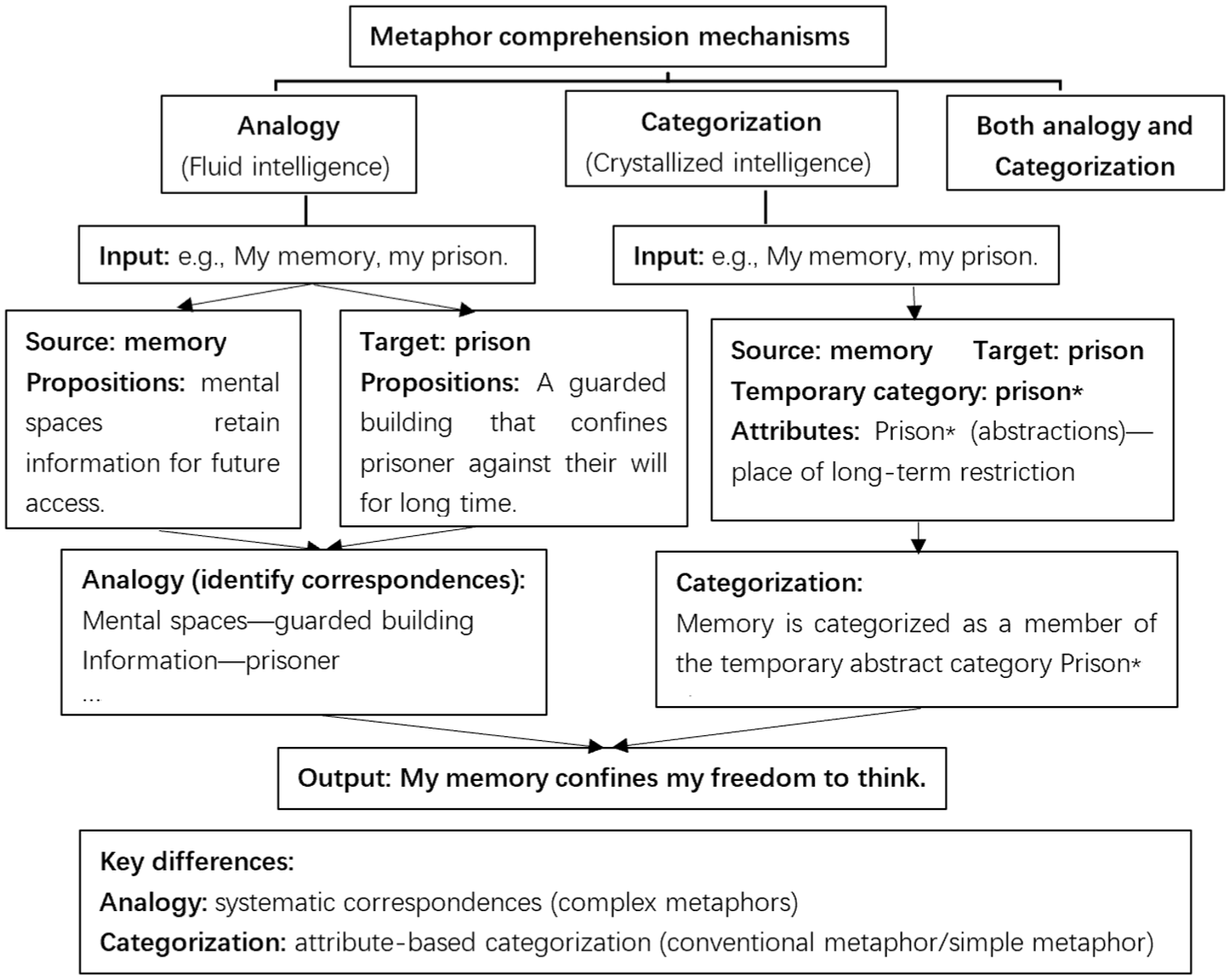
Metaphor comprehension mechanisms.
Stamenković et al. (2019) argue that this is because psychological studies mainly adopt simple nominal metaphors, which are relatively easy to process without the need to refer to complex analogical reasoning. At the same time, it is found that when interpreting metaphoric expressions with complex syntax, categorization alone is not sufficient (Glucksberg & Haught, 2006). This suggests that the application of both complex and simple metaphoric expressions in exploring metaphor processing is urgently needed. Aligning with Stamenković et al. (2019), this research uses metaphors from both literary and non-literary sources because literary metaphors are believed to be novel, and complex, require higher cognitive abilities, and are more difficult to understand than non-literary metaphors (Chen et al., 2016; Semino & Steen, 2008).
As for the relationship between these two mechanisms of metaphor comprehension and cognitive abilities like crystallized and fluid intelligence, it is commonly acknowledged that metaphor comprehension via analogy relies on fluid intelligence (e.g., complex literary metaphors or novel metaphors) whereas categorization-based processing depends on crystallized intelligence (e.g., conventional, simple metaphors) (Beaty & Silvia, 2013; Kintsch, 2000; Primi, 2014; Silvia & Beaty, 2012). Using metaphors from literary and non-literary sources, Stamenković et al. (2019) find that both fluid and crystallized intelligence can predict the comprehension of these metaphors with fluid intelligence significantly linked to comprehension of novel or cognitively complex metaphors, while crystallized intelligence relates to metaphors of varying complexity. However, these studies have primarily focused on native speakers.
Cognitive Abilities and L2 Metaphor Comprehension
Littlemore and Low (2006) argue that L2 learners’ cognitive abilities can influence their metaphoric comprehension competence. To investigate the factors affecting the metaphoric competence of L2 learners, Wei (2012) targets Chinese learners of English to explore how cognitive abilities and L2 language proficiency impact metaphor comprehension. He utilizes three tests to measure the cognitive abilities of L2 learners: the Raven Intelligence Test, a metacognitive ability test, and a creativity test, with the latter two being significant components of cognitive ability (Albert & Kormos, 2004). The findings indicate that cognitive ability predicts metaphor comprehension competence, and higher cognitive ability corresponds to higher metaphor comprehension. Notably, crystallized intelligence is not included in their research. Chen et al. (2022) also examine the relationship between cognitive ability and L2 learners’ metaphoric competence, focusing on fluid intelligence and metaphor production competence among Chinese learners of English. However, they find that fluid intelligence does not serve as a consistent predictor of metaphor production competence for these learners. These results highlight ongoing debates regarding the relationship between cognitive ability and L2 metaphoric competence, particularly concerning fluid intelligence.
To address this uncertainty, this study investigates how L2 metaphor comprehension competence is influenced by three individual factors: fluid intelligence, crystallized intelligence, and L2 language proficiency, aiming to clarify the contributions of reasoning abilities to L2 metaphor understanding. The metaphor comprehension tests include both literary and non-literary metaphors, as literary metaphors are more complex and related to complex analogical reasoning ability whereas nonliterary sources of metaphor are associated with language-based categorization. This approach may help clarify the relationship between complex analogical reasoning and metaphor comprehension, given that most cognitive neuroscience evidence indicates that simple metaphors do not necessitate complex analogical reasoning (see Vartanian, 2012).
L2 Proficiency and Comprehension of Metaphoric Expressions in L2
L2 proficiency is widely recognized as a multi-componential construct in second language acquisition (SLA) research, encompassing “complexity, accuracy, and fluency” in L2 usage (Housen et al., 2012, p.1). Regarding the influence of L2 proficiency on metaphor comprehension, two opposing views have emerged. Some researchers argue that L2 language proficiency is a strong predictor of L2 metaphoric competence (Chen et al., 2022; Galantomos, 2019; Horvat et al., 2022; Jiang, 2006; Littlemore & Low, 2006; Martinez, 2005). Others contend that L2 language proficiency is unrelated to L2 metaphorical competence, suggesting that metaphoric competence is fundamentally cognitive in nature (Johnson, 1991; Johnson & Rosano, 1993; Yuan & Zhang, 2015).
Johnson (1991) examines metaphor comprehension difficulties between bilingual children (English) and monolingual children (Spanish and English) and finds no significant difference in comprehension levels. He concludes that L2 proficiency has a limited role in metaphor comprehension, with children’s cognitive abilities as the primary factors influencing their metaphor comprehension competence. Similarly, Johnson and Rosano (1993) investigate the relationship between adult language proficiency and metaphor comprehension, supporting the notion that L2 proficiency has minimal impact on comprehension outcomes. As for different complexity degrees of L2 metaphors, Yuan and Zhang (2015) argue that when understanding novel metaphors, cognitive ability outweighs language proficiency, positing that metaphoric competence is primarily cognitive rather than linguistic.
Conversely, Martinez (2005) investigates Spanish bilinguals learning English as a second language and finds that language proficiency significantly affects metaphor comprehension, asserting a positive correlation between metaphoric competence and language proficiency (Chen et al., 2022; Jiang, 2006). Horvat et al. (2022) demonstrate that bilinguals have a distinct advantage over monolinguals in identifying novel metaphors. Additionally, Özçalişkan (2005) examines Turkish-speaking children and adults, concluding that both cognitive and linguistic abilities impact metaphor comprehension. Wei (2012) explores English major students in China, finding significant correlations between both language proficiency and cognitive ability with metaphor comprehension competence.
Thus, it is evident that diverse opinions exist regarding the relationship between L2 proficiency and metaphor comprehension competence, with no unified conclusion reached. Furthermore, previous metaphor comprehension tests often do not include literary metaphors with high cognitive complexity, which could be valuable for identifying the underlying mechanisms of metaphor comprehension.
Objectives of the Present Study
Existing research has primarily focused on the underlying metaphoric processing mechanisms (analogy and categorization) by evaluating these two cognitive abilities (crystallized intelligence and fluid intelligence) in native speakers (see Stamenković et al., 2019, 2020). However, there is limited research on metaphor comprehension as a crucial aspect of L2 acquisition concerning both cognitive abilities. Given that fluid intelligence and crystallized intelligence are closely linked to metaphor processing, we will explore whether both play a role in L2 metaphor processing. Besides, concerning the ongoing debate about the impact of L2 proficiency on metaphor comprehension, this study also investigates L2 proficiency as a factor to explore evidence of the three individual differences in L2 metaphor comprehension competence.
Kintsch (2000) argues that analogical reasoning, typically assessed through fluid intelligence, plays a significant role in understanding conceptually complex metaphors. Building on this premise, we explore two types of metaphors with varying levels of complexity: those derived from literary sources and those from non-literary sources. The use of literary metaphors from poetry aims to avoid the criticism associated with metaphors constructed by researchers.
In light of this research background and related discussions, this study aims to address the following two research questions:
Method
The study employed a between-subjects experimental design of 2 (Second Language Proficiency: High/Low) × 2 (Fluid Intelligence: High/Low) × 2 (Crystallized Intelligence: High/Low). Participants were required to complete three tasks: a fluid intelligence test, a crystallized intelligence test, and metaphor comprehension tests.
Fluid intelligence was assessed using the abbreviated version of the Raven’s Progressive Matrices (Arthur et al., 1999). The crystallized intelligence test utilized the Semantic Similarity Test (SST) (Stamenković et al., 2019, 2020). The metaphor comprehension test included complex literary metaphors and non-literary metaphors, with all experimental materials sourced from Stamenković et al. (2019). Though these two tests are designed for native English speakers, the vocabulary used in these two tests all fall into the basic vocabulary requirement for Chinese college students. Therefore, we adopt these two tests for L2 speakers.
Sample
We adopted convenience sampling to recruit participants. An online questionnaire link was sent using WeChat (a mobile communication application, widely used across different age groups in China) to acquaintances of the authors and we got oral approval from all the participants. The research design and questionnaire obtained approval from the Ethics Committee of the University.
A total of 100 undergraduate English major students (62 females, 38 males), aged between 18 and 23 (M = 21, SD = 1.47) were recruited and they are native Chinese speakers studying English as their foreign language or second language. The entire testing process took at least 30 minutes to complete. Based on the minimum time required and the participants’ diligent completion, we excluded those who finished the test in less than 15 minutes, scored less than 12 points on the crystallized intelligence test (out of a maximum of 30), or scored below 5 points on the metaphor comprehension test (out of a maximum of 29), following the criteria established by Stamenković et al. (2019). Two participants failed to submit their results due to personal reasons, and 10 did not meet the minimum requirements for either time or test scores. Ultimately, 88 participants remained for analysis.
Data Collection and Procedure
The data were all collected through inviting participants to complete three tasks in a fixed order, that is fluid intelligence, crystallized intelligence, and metaphor comprehension tests. L2 level test LexTALE was also conducted online. All the tasks were completed online using questionnaires.
Raven’s Progressive Matrices (RPM, Fluid Intelligence (gf) Test)
RPM was employed to assess an individual’s observational and logical reasoning abilities. As a non-verbal intelligence test, it is widely used in assessments of intelligence and reasoning skills across various contexts, categorized within progressive matrix figures. It is generally recognized as a central measure of fluid intelligence (Snow et al., 1984), and Chen et al. (2022) find that RPM can effectively differentiate the fluid intelligence levels of college students. In this study, fluid intelligence was evaluated using the abbreviated version of the RPM (Arthur et al., 1999), consisting of 12 items. Each item requires participants to select the missing part of a 3 × 3 abstract matrix from 8 options, relying on reasoning. Participants were instructed to make their selections as quickly as possible. The total score from the 12 items was used as the fluid intelligence score, with higher scores reflecting higher levels of fluid intelligence. Since analogical reasoning is essential for metaphor comprehension, RPM is expected to be “a strong predictor of individual differences in metaphor comprehension” (Stamenković et al., 2019, p. 110).
Crystallized Intelligence (gc) Test
Horn (1968) observes that the assessment of crystallized intelligence typically involves tasks such as vocabulary, abstract word comparison, and language mechanisms. The standard approach for measuring crystallized intelligence often uses the vocabulary section of the Wechsler Adult Intelligence Scale (WAIS). However, due to the unavailability of WAIS resources, this study intends to use the SST developed by Stamenković et al. (2019). The SST has been shown to have a strong correlation with the WAIS-III (the third edition of WAIS) Vocabulary test, supporting its use as a measure of verbal crystallized intelligence (Stamenković et al., 2019). Similar to the WAIS, the SST incorporates various vocabulary tasks and broadens the range of word similarities, including five pairs with relatively specific similarities (e.g., bird-airplane, both can fly), five pairs with more general similarities (e.g., tavern-church, both are public buildings), and 10 pairs with metaphorical similarities (e.g., memory-prison, both may trap human), totaling 20 pairs. The similarities among these 20 word pairs encompass “perceptual, functional, structural, categorical, and emotional similarities” (Stamenković et al., 2019, p. 110).
During the SST test, participants first familiarized themselves with the test based on two examples, such as judging the similarity between chair and sofa when asked, “How are the two concepts in each pair similar to one another?” The answer is “Both are types of _____. (Answer: furniture).” The formal test consists of 20 word pairs, each worth 2 points, totaling 40 points (see Stamenković et al., 2019). Participants’ scores were based on the acceptability of their responses. For instance, fully acceptable answers received 2 points, partially acceptable answers were awarded 1 point, and entirely unacceptable answers received 0 points. The words were presented in a sequence of increasing difficulty. The scoring key for SST follows Stamenković et al. (2019).
The RPM test is a non-verbal test, while the SST test is a semantic test, the two complement each other, representing tests of fluid and crystallized intelligence, respectively. Fluid and crystallized intelligence are components of intelligence factors.
L2 Metaphor Comprehension Test
The Metaphor Comprehension Test (MCT) included a total of 30 metaphor examples, with 15 literary metaphors and 15 non-literary metaphors. All metaphor examples were sourced from Stamenković et al. (2019) and were noun-based metaphors (A is B) (see Table 1 for example). During the test, the items were presented in the order from non-literary to literary metaphors, and participants were required to select the correct option that explains the metaphorical sentence from the three options provided for each metaphor sentence. There was no time limit for the metaphor test section. Each question was worth 1 point, with a total of 30 points. The literary metaphor examples used in this study have been verified by Jacobs and Kinder (2018) using computer algorithms and other quantitative methods, showing that these literary metaphors are relatively complex.
Examples of Literary and Nonliterary Metaphors in the Metaphor Comprehension Task (Stamenković et al., 2019).

Indicates the correct response.
L2 Proficiency
All the participants filled out LexTALE (Lexical Test for Advanced Learners of English) (Lemhöfer & Broersma, 2012). This 60-item test required participants to differentiate between real words and non-words and has been proven as a quick, reliable, and valid tool to measure participants’ general English (L2) proficiency (ibid). However, LexTALE only taps into word knowledge, which is not sufficient to reveal the overall L2 proficiency level. Puig-Mayenco (2023) calls for caution in only using LexTALE scores to determine the global language proficiency of L2 participants. Therefore, we also adopted a standard test in China: TEM 4 (Test for English Majors, Band 4) for second-year English majors to determine L2 levels and “TEM 4 is recognized and accepted for entry to programs that require an IELTS score of 6.5 and align with the Common European Framework of Reference (CEFR C1)” (Lu & Deignan, 2024, p. 5). There are three levels in TEM 4: competent (60–69), proficient (70–79), excellent (80–100). The classification criteria of LexTALE set by Lemhöfer & Broersma (2012) are upper and lower advanced/proficient (80%–100%), upper intermediate (70%–79%), and lower intermediate and lower (below 59%). Considering the number of participants with advanced LexTALE scores (less than 15), our standard in determining participants’ English proficiency was set as follows: students who failed in their TEM4 and got 59% and below LexTALE scores were classified as having lower L2 proficiency group and those who received 70 to 100 in TEM4 and 60% to 100% in LexTALE were grouped into higher (upper intermediate and advanced) L2 proficiency group. Notably, our data indicated that participants demonstrating proficient and excellent performance on TEM4 consistently achieved intermediate to advanced proficiency levels (60%–100%) on LexTALE. Consequently, we specifically excluded participants who failed TEM4 but scored above 60% on LexTALE.
All the students finished LexTALE using an online questionnaire in 5 minutes and the scores ranged from 36.25 to 97.5 with the mean score of 63.30 (SD = 14.53). Based on Lemhöfer & Broersma (2012) and the classification level of TEM4, there were 43 higher English levels and 45 lower English levels.
Scoring
The sum of all correct answers in the Raven’s intelligence test (abbreviated version) served as the fluid intelligence score. Based on the median score of all participants’ fluid intelligence levels, all participants were divided into high and low fluid intelligence level groups. The independent samples t-test revealed a significant difference between the high and low fluid intelligence groups in both literary and non-literary metaphor comprehension (Cohen’s d > 2.91, p < .05).
The total number of correct answers on the SST test was used to determine the crystallized intelligence score. Similarly, based on the median crystallized intelligence score of all participants, they were categorized into high and low crystallized intelligence groups. Additionally, the independent samples test revealed a significant difference between the high and low crystallized intelligence groups (Cohen’s d > 2.89, p < .05).
The metaphor comprehension test was conducted in the form of multiple-choice questions, with participants completing 30 questions (literary metaphors and non-literary metaphors), and selecting the option that best fits the interpretation of the metaphorical sentence was worth 1 point, otherwise 0 points. Additionally, we need to manually calculate the specific scores for literary metaphors and non-literary metaphors.
Results
The Relationship Between Fluid Intelligence, Crystallized Intelligence, L2 Proficiency, and L2 Metaphor Comprehension
To examine the relationship between fluid intelligence and L2 metaphor comprehension competence, crystallized intelligence and L2 metaphor comprehension competence, and L2 proficiency and L2 metaphor comprehension competence, the study employed SPSS 27.0 statistical software to perform a Spearman correlation analysis and regression analysis on the research data.
The descriptive statistical results of each test are shown in Table 2 below. Although a Kolmogorov-Smirnov (K-S) test indicated that the distribution of the data was not quite normal (RPM: KS = .128, p < .01, SST: KS = .129, p < .01, L2: KS = .138, p < .01, MC: KS = .164, p < .01), skewness and kurtosis values of these three variables were within approximate normality (RPM: Skewness = -.44, Kurtosis = -.55, SST: Skewness = .13, Kurtosis =-.58, MC: Skewness = -.51, Kurtosis = .78, L2: Skewness = -.64, Kurtosis = .53), suggesting no severe departure from normality based on West et al. (1995) (absolute values < 2). The sample size of our research is 88, indicating parametric statistics can be applied (Lei, 2017).
Descriptive Statistics for Each Test.

Note. Non-L = nonliterary metaphor; L = literary metaphor.
The Pearson correlation analysis revealed that fluid intelligence was positively correlated with metaphor comprehension (r = .27, p = .012) and literary metaphors (r = .28, p = .008) but not significantly correlated with non-literary metaphors (r = .21, p = .055). As for the correlation between crystallized intelligence and the metaphor comprehension test, there existed a strong positive relationship (r = .51, p < .001), specifically showing a strong correlation coefficient with both non-literary metaphors (r = .45, p< .001) and literary metaphors (r = .47, p < .001). Moreover, English proficiency also showed a strong positive correlation with metaphor comprehension tests (r = .54, p < .001), non-literary metaphors (r = .54, p < .001), and literary metaphors (r = .44, p < .001). Additionally, a significant positive correlation was observed between fluid intelligence and L2 proficiency (r = .27, p = .012), and crystallized intelligence and L2 proficiency (r = .34, p = 0.001). This result revealed that there might exit collinearity among these independent variables. Then collinearity analysis of these three variables was performed and the result showed that there was little chance of collinearity (Mean VIF = 1.14 < 3, Mean Tolerance = .89 > 0.1).
Regression analysis was employed to investigate the predictive effects of L2 proficiency, fluid intelligence, and crystallized intelligence on metaphor comprehension (both literary and non-literary metaphors). Building on previous evidence indicating essential roles of fluid intelligence (Black, 1962; Gentner & Clement, 1988), crystallized intelligence (Glucksberg & Keysar, 1990), and L2 proficiency (Chen et al., 2022; Wei, 2012) in figurative language processing, all the variables were simultaneously entered to assess their interdependent effects. The results (Table 3) showed a significant proportion of variance in non-literary metaphor comprehension ability (R2 = 0.38, Adjusted R2 = 0.36, F (3, 84) = 17.42. p <.001) explaining 36% of the variance in non-literary metaphor comprehension. In the model, L2 proficiency (β = .42, p < .001) and crystallized intelligence (β = .31, p = .001) emerged as significant contributors, indicating that these two are key predictors in non-literary metaphor comprehension with L2 proficiency having greater predictive effect, whereas fluid intelligence did not contribute uniquely to the model (β = .07, p = .43). This implies that the processing of cognitively simple metaphors predominantly relies on language-specific competence and accumulated knowledge systems.
Regression Analysis on Fluid Intelligence, Crystallized Intelligence, L2 Proficiency and Metaphor Comprehension (N-L, L).

Note. N-L (R2 = 0.38, Adjusted R2 = 0.36, F (3, 84) = 17.42. p < .001). L: (R2 = 0.34, Adjusted R2 = 0.32, F (3, 84) = 14.35, p < .001).
In contrast, when examining the three independent variables concerning literary metaphor comprehension, all three were found to be significant predictors for literary metaphor comprehension (R2 = 0.34, Adjusted R2 = 0.32, F (3, 84) = 14.35, p < .001), accounting for 32% of the variance in literary metaphor comprehension. Meanwhile, crystallized intelligence emerged as the primary predictor (β = .37, p < .001), with supplementary contributions from L2 proficiency (β = .26, p = .009) and fluid intelligence (β = .19, p = 0.047). This result suggests that cognitively complex metaphor processing demands the engagement of verbal analytical ability, L2 proficiency, and analogical reasoning.
The Impact of Fluid Intelligence, Crystallized Intelligence, and L2 Proficiency on L2 Metaphor Comprehension
This study conducted a 2 × 2 × 2 between-subjects ANOVA with L2 proficiency (low/high), fluid intelligence level (low/high), and crystallized intelligence level (low/high) as the independent variables, and L2 literary and non-literary metaphor comprehension as the dependent variables (See Tables 4–6 for descriptive results). Levene’s test indicated significant heterogeneity of variance for non-literary metaphor tests across groups (F (7, 80) = 7.92, p < .001). Welch correction revealed that there was a significant difference in non-literary metaphors comprehension between the two groups: both two groups of L2 (Welch’s F (1, 55.14) = 41.95, p < .001) and two groups of crystallized intelligence (Welch’s F (1, 85.16) = 7.62, p < .05). The results revealed significant main effects of L2 proficiency and crystallized intelligence (F (1, 80) =24.99, p < .001, η2 = 0.24), F (1, 80) = 5.11, p = .027, η2 = 0.06). The main effect of fluid intelligence was not significant (F (1, 80) = 1.39, p = 0.24, η2 = 0.02). Additionally, no significant interaction effects were found between L2 proficiency and fluid intelligence, crystallized intelligence, or between fluid intelligence and crystallized intelligence. This means that English proficiency has a large and significant effect on non-literary metaphor comprehension. Higher L2 proficiency groups scored substantially higher than lower proficiency groups in non-literary metaphors. Crystallized intelligence showed a medium and significant effect, indicating that those with higher crystallized intelligence performed better in non-literary metaphor comprehension. The full model explained 39% of the variance in non-literary metaphor comprehension.
Descriptive Statistics of Scores of Metaphor Comprehension Across High L2 and Low L2.

Descriptive Statistics of Scores of Metaphor Comprehension Across High Crystallized Intelligence and Low Crystallized Intelligence.

Descriptive Statistics of Scores of Metaphor Comprehension Across High Fluid Intelligence and Low Fluid Intelligence.

As for the influence of the three independent variables on literary metaphor comprehension, Levene’s test for equality of variances showed marginal violation when using the mean-based test (F (7, 80) = 2.14, p = .049), but no significant violation when using the median-based test (F (7, 80) = 1.21, p = .311). Welch correction indicated significant differences between the two groups: both crystallized intelligence (F (1, 81.36) = 9.76, p = .002) and L2 proficiency (F (1, 80.63) = 25.75, p < .001). The ANOVA results revealed significant main effects of L2 proficiency (F (1, 80) = 13.03, p < .001, η2 = 0.14) and crystallized intelligence (F (1, 80) = 7.49, p = .008, η2 = 0.09). No significant main effect was found for fluid intelligence (F (1, 80) = 2.86, p = .095, η2 = 0.04) and no significant two-way or three-way interaction effects were observed. The full model explained 34% of the variance in literary metaphor comprehension.
Considering the weak but significant predictive effects of fluid intelligence in literary metaphor comprehension, this study conducted a further hierarchical regression analysis to evaluate the incremental contribution of fluid intelligence to literary metaphor comprehension after controlling L2 proficiency and crystallized intelligence. Results showed that before adding fluid intelligence, the model explained 29.1% of the variance in literary metaphor comprehension (R2 = 0.307, adjusted R2 = 0.291), F (2, 85) = 18.83, p < .001). After adding fluid intelligence (ΔR2 = 0.032, FΔ (1, 84) = 4.05, p = .047), the model significantly improved explaining 31.5% of the variance (R2 = 0.339, adjusted R2 = 0.315), F (3, 84) = 14.35, p < .001). This means fluid intelligence contributed a small but statistically marginal effect (β = .19, p = .047) indicating a potential but weak role in literary metaphor processing.
Discussion
This study investigates the roles of individual differences variables—fluid intelligence, crystallized intelligence, and L2 proficiency—in metaphor comprehension among Chinese learners of English. As far as we are aware, this is the first study to compare these three variables in the context of L2 metaphoric competence, particularly incorporating literary metaphors, which are characterized by greater cognitive complexity (Stamenković et al., 2019). Most prior research on the connection between cognitive abilities and L2 metaphor comprehension has predominantly relied on fluid intelligence assessments, often overlooking the influence of crystallized intelligence. Furthermore, prior studies have not incorporated literary metaphors when examining the role of analogical reasoning in L2 metaphor comprehension. Several studies have suggested that the analogical reasoning mechanism is not typically involved in the interpretation of simpler metaphors (Kintsch & Bowles, 2002; Vartanian, 2012).
Based on the experimental data and analysis presented above, we can draw the following preliminary conclusions:
Correlation analysis indicated that fluid intelligence, crystallized intelligence, and L2 proficiency were all significantly and positively correlated with literary metaphor comprehension. However, in non-literary metaphor comprehension, L2 proficiency had a significantly better prediction effect than crystallized intelligence, while fluid intelligence was not a reliable predictor. In contrast, for literary metaphor comprehension, crystallized intelligence demonstrated the strongest predictive power compared with L2 and fluid intelligence.
As for how the three independent variables influence both non-literary and literary metaphor comprehension, L2 proficiency had a significant and large main effect, crystallized intelligence exhibited a significant and medium main effect, whereas fluid intelligence had no significant main effect.
The Impact of L2 Proficiency on L2 Metaphor Comprehension
Our findings revealed that L2 proficiency demonstrated the strongest predictive power for non-literary metaphor comprehension among Chinese EFL learners. Specifically, the high English proficiency group demonstrated generally higher metaphor comprehension competence than the low proficiency group, with higher English proficiency associated with improved abilities in both literary and non-literary understanding. These results are consistent with prior studies highlighting a strong association between language proficiency and L2 metaphoric competence (Chen et al., 2022; Littlemore, 2010; Wei, 2012), challenging perspectives that downplay the significance of language proficiency in metaphor comprehension (Johnson, 1991; Johnson & Rosano, 1993). This discrepancy arises because metaphor comprehension, especially in L2 contexts, is initially language-driven, requiring learners to first process the literal meanings of words, clauses, and sentences (Wei, 2012). Furthermore, L2 proficiency is associated not only with linguistic capabilities but also with cognitive skills (Cummins, 1979). Our data analysis also revealed significant correlations between L2 proficiency and both fluid intelligence and crystallized intelligence.
Given the complexity of literary metaphors, learners must attain a certain level of language proficiency for proper understanding. Martinez (2003) also observes that accurate interpretation of metaphorical language necessitates reaching a specific threshold of L2 proficiency.
The Impact of Crystallized Intelligence on L2 Metaphor Comprehension
The findings indicate that crystallized intelligence is significantly associated with metaphor comprehension among Chinese EFL learners and serves as a reliable predictor for both complex literary metaphors and non-literary metaphors. For literary metaphor comprehension, crystallized intelligence demonstrates stronger predictive power than L2 proficiency with a medium-to-large effect size. This result aligns with Stamenković et al. (2019), who also report that crystallized intelligence correlates with both literary and non-literary metaphors. However, the predictive power of crystallized intelligence across both types of metaphors contrasts with previous research suggesting that fluid intelligence is a better predictor of L2 learning compared with crystallized intelligence (Davoudi & Sadeghi, 2015) or that complex metaphor comprehension is solely driven by language-specific conceptual integration (Kintsch, 2000).
Crystallized intelligence encompasses an individual’s accumulated knowledge, vocabulary, and reasoning based on acquired information (Happé, 2013). This cognitive ability is enhanced through life experiences, cultural exposure, and education. For L2 learners, language acquisition extends beyond grammar and vocabulary to include cultural knowledge enrichment (Lantolf, 1999). Thus, improved language proficiency, reading ability, L2 cultural background, and vocabulary reflect the development of crystallized intelligence (Motallebzadeh & Tabatabaee, 2016; Vermeiren & Brysbaert, 2024). These findings are in accord with Prat et al. (2012), who emphasize that enhancing reading ability is crucial for improving metaphor comprehension. This suggests that accumulated experience and cultural exposure are particularly influential in interpreting complex metaphors, which can partly counteract the cultural differences that L2 learners encounter. As crystallized intelligence is closely related to categorization (Beaty & Silvia, 2013; Stamenković et al., 2019), our results support the role of language-based conceptual integration as a key mechanism for metaphor comprehension among Chinese learners of English.
It is noteworthy that ANOVA analysis revealed a medium effect size for crystallized intelligence in literary metaphor comprehension, whereas regression analysis indicated a large effect size of this cognitive ability highlighting the complementary relationship between L2 proficiency and crystallized intelligence.
The Impact of Fluid Intelligence on L2 Metaphor Comprehension
Fluid intelligence was found to be significantly correlated with literary metaphor comprehension but not with non-literary metaphor comprehension (p = 0.055). Consistent with previous research (Stamenković et al., 2019), this study reveals that fluid intelligence does not reliably predict non-literary metaphor comprehension. This aligns with Chen et al. (2022), who also report that fluid intelligence is not a predictor in metaphor production among Chinese learners of English. However, our results were in contrast with previous research highlighting the role of fluid intelligence in L2 non-literary metaphor comprehension (Chiappe & Chiappe, 2007; Wei, 2012; Yuan & Zhang, 2015). This challenges the necessity of analogical reasoning in interpreting non-literary metaphors (Holyoak & Stamenković, 2018; Wei, 2012; Kintsch & Bowles, 2002; Vartanian, 2012).
Our results further suggest that fluid intelligence plays a role in complex literary metaphor comprehension, suggesting that cognitively demanding metaphors require greater cognitive resources (Van Mulken et al., 2010). Since fluid intelligence is usually assessed through analogical reasoning tasks, this finding implies that analogical reasoning may contribute to the comprehension of certain complex literary metaphors among L2 learners. Given the strong predictive power of crystallized intelligence and weak predictive power of fluid intelligence in literary metaphor comprehension, our findings support the proposition that combining analogical reasoning mechanisms with conceptual integration mechanisms is necessary for metaphor comprehension (Glucksberg & Haught, 2006; Kintsch, 2000; Stamenković et al., 2019). Although necessary, analogical reasoning appears to play a secondary role compared to the categorization mechanism for Chinese EFL.
The results provide insight into the mechanisms underlying L2 metaphor comprehension. For Chinese learners of English, language-based categorization predominates over complex analogical reasoning in the interpretation of metaphors with diverse complexity. However, in the processing of some complex literary metaphors, a combination of both mechanisms is employed, which can be shown in a hierarchical compensatory system: the first tier is the basic level where L2 proficiency lays the foundation, the second tier is the knowledge level where crystallized intelligence provides semantic extension and culture accumulation, the third tier is the compensatory level where fluid intelligence can be applied in metaphors with high complexity and novelty.
Although L2 proficiency and crystallized intelligence have significant predictive effects on L2 metaphor comprehension, cultural factors may also influence the L2 metaphor processing (Chen et al., 2025). Previous research has already proved that learners’ own culture has a significant impact on L2 metaphor comprehension (Türker, 2016) except for cognitive abilities and language proficiency. Therefore, for EFL learners, the mechanisms of metaphor comprehension should also consider the influence of the cultural dimensions except for cognitive abilities and L2 proficiency. For example, in non-literary metaphor with cultural universality “A hypothesis is the foundation of a theory” in this research, Chinese EFL learners can apply linguistic competence to interpret the conceptual structure of this L2 metaphor, which might counteract other cognitive abilities like analogical reasoning in the comprehension of L2 metaphoric expressions. While in the understanding of metaphors with specific cultural stereotypes, the underlying mechanisms may be different (Littlemore, 2003; Chen et al., 2025). For example, in the interpretation of metaphoric expression “My boss is a dragon,” individuals from European and East Asia cultural backgrounds might exhibit different interpretations. For those who have spent their lives in Europe, the expression may be understood as “my boss is difficult to deal with.” In contrast, individuals from East Asia may interpret it as “my boss is praiseworthy and successful” (Chen et al., 2025, p. 1). This reminds us to explore the processing mechanisms underlying cross-cultural differences in metaphor comprehension among L2 learners in the future.
Pedagogical Implications
The present study has important pedagogical implications for metaphor instruction in L2 acquisition. The results revealed three interdependent competencies essential for developing L2 metaphoric comprehension competence: L2 proficiency, crystallized intelligence (associated with knowledge accumulation), and fluid reasoning abilities.
Considering the importance of L2 proficiency in the comprehension of metaphors with diverse complexity. The following instructional approach should be prioritized: systematic expansion of lexical-semantic networks through high-frequency exposure to conventionalized metaphoric expressions, explicit training in syntactic-semantic integration using contextually embedded metaphor comparison tasks to improve learners’ ability to infer the meanings of metaphoric expressions, and development of metalinguistic awareness via contrastive analysis of source-target domain mappings.
Crystallized intelligence, which reflects cultural knowledge, experiences accumulation, is closely related with categorization mechanisms. To strengthen this aspect, instructional methods should include: exposure to culturally salient metaphors through authentic literary materials, such as selected poetry readings, schema-building exercises comparing L1 and L2 conceptual metaphors to facilitate cross-cultural awareness, categorization training emphasizing the detection of conceptual similarities across languages, which can help in the recognition of metaphoric patterns.
Based on language and cultural knowledge training, fluid intelligence plays a role in processing some novel and complex metaphors, which calls for complex analogical reasoning training (Holyoak & Stamenković, 2018; Van Mulken et al., 2010). To enhance this cognitive ability, instructional strategies should incorporate AI-mediated feedback for generating metaphors allowing learners to experiment with metaphor creation dynamically, transforming conventional metaphors into novel metaphors fostering creativity.
Conclusion
This study investigated the influence of individual differences in fluid intelligence, crystallized intelligence, and L2 proficiency on the metaphor comprehension competence of Chinese EFL learners. Importantly, this is the first study to use both literary and non-literary metaphors to evaluate L2 metaphor comprehension competence. L2 proficiency and crystallized intelligence are the core motivating factors for Chinese EFL learners’ metaphor comprehension especially in the interpretation of metaphor with cultural universality (metaphors without any cultural differences, e.g., Divorce is the earthquake of the family.).
Regarding fluid intelligence, this study found it to be a significant but weak predictor in interpreting literary metaphors (cognitively complex metaphors) for Chinese EFL learners, suggesting that analogical reasoning plays a role understanding these cognitively complex metaphors. In contrast, for non-literary metaphors, L2 proficiency and crystallized intelligence emerged as reliable predictors with crystallized intelligence as a more reliable predictor. These findings offer additional empirical evidence supporting L2 proficiency as a key predictor of metaphor comprehension competence and emphasizing the significant role of crystallized intelligence in understanding cognitively complex metaphors. All these results underscore the importance of improving both language-based categorization and complex analogical reasoning skills in foreign language teaching to cultivate metaphor comprehension competence, particularly in complex metaphor comprehension.
Limitations and Future Directions
In summary, the study offers further evidence of conceptual combination mechanism in L2 metaphor comprehension among Chinese EFL learners, suggesting that analogical reasoning may work in the interpretation of processing complex metaphors. However, due to certain research limitations, there remain several shortcomings.
First, the homogeneity of participants and metaphor materials limits the generalizability of the research findings. All the participants were Chinese EFL learners majoring in English and the metaphor stimuli in this research were culturally universal, which overestimates the effect of L2 proficiency in metaphor comprehension and underestimates the interference of L1 on the interpretation of L2 metaphorical expressions (Türker, 2016). At the same time, although proved to be complex (Jacobs & Kinder, 2018), literary metaphors in this research might exhibit high conventionality or a high degree of similarity between the source and target, which are the driving conditions for the categorization mechanism in metaphor comprehension (Gentner & Wolff, 1997). Future studies should compare EFL learners from different cultural backgrounds interpreting the same metaphors, include metaphors with cultural specificity and a higher degree of complexity to disentangle cultural and linguistic influences, employ online processing methods like eye-tracking, ERP, or fMRI to capture real-time processing characteristics of metaphors with cultural differences.
Second, the use of an online questionnaire in this study introduced potential biases, e.g., participants might have consulted dictionaries while doing the tests. To enhance experimental control, future research should consider conducting offline experimental tasks with screen recording to monitor participants’ behaviors, and integrate attention-check questions to ensure task engagement.
Third, the decontextualized metaphor comprehension tasks omitted contextual factors that are significant for understanding metaphors (Camp, 2006; Hartung et al., 2020). Thus, future research can embed metaphoric expressions in authentic contexts (e.g., narratives, dialogues) to investigate the interplay between context and individual differences in L2 metaphor comprehension and to explore how learners use co-textual clues to resolve ambiguous metaphors.
Finally, while our findings provide insights into the individual differences influencing L2 metaphor comprehension, they do not exhaustively explain individual differences in L2 metaphoric competence. Recent research has indicated that factors such as gender (Galantomos, 2019) and L1 conceptual and linguistic knowledge (Türker, 2016; Zibin, 2015; Chen et al., 2025) also play a significant role in L2 metaphoric competence. Cognitive linguistics posits that metaphor is deeply rooted in embodied experience, suggesting that sensorimotor simulation, strongly shaped by cultural background, may influence metaphor interpretation (Casasanto & Gijssels, 2015; Gibbs et al., 2004; Lakoff & Johnson, 1980). That is to say, individuals with different cultural backgrounds may rely on different conceptual structures to interpret metaphors (Kövecses, 2005). In the comprehension of metaphors with specific cultural origins, learners’ native language conceptual systems may influence the processing of this type of metaphor (Littlemore, 2003). Therefore, a multidisciplinary approach integrating cognitive linguistics, psycholinguistics, and language education is necessary to deepen our understanding of the cognitive and cultural mechanisms underlying L2 metaphoric competence, and improve metaphor instruction in L2 learning contexts.
Footnotes
Acknowledgements
The authors would like to thank Dušan Stamenković for providing us the answers for all the metaphor comprehension tests. We extend our gratitude to the anonymous reviewers for their constructive feedback and insightful suggestions, which have greatly improved the quality of this manuscript. We also appreciate the editorial team’s guidance and support throughout the review process.

Ethical Considerations
The research design and questionnaire obtained approval from the Ethics Committee of the College of Foreign Languages and Cultures, Xiamen University, Number: 2025031201.
Consent to Participate
The informed consent to participate was verbal by all the participants.
Author Contributions
All authors approved the submitted manuscript and contributed actively to the study.
Funding
The authors received no financial support for the research, authorship, and/or publication of this article.
Declaration of Conflicting Interests
The authors declared no potential conflicts of interest with respect to the research, authorship, and/or publication of this article.