




Abstract
By comparing two unbalanced Chinese–English bilingual groups, this study explored whether differences in second-language (L2) proficiency and language use influenced mental set shifting in cognitive control, through language switch (which tested participants’ language control) and task switch (which tested participants’ mental set shifting in cognitive control). The ANOVA results showed that the higher L2 proficiency group and the lower L2 proficiency group did not differ in language switch, and the two groups did not differ either in the task switch. Further correlation and regression analyses showed that L2 proficiency did not contribute to task-switching performance; however, language-switching frequency and L2 use significantly contributed to the performance of task switch. These results suggest a weak relation between L2 proficiency and mental set shifting, and indicate that language-switching frequency and L2 use may be important factors influencing mental set shifting and should therefore be included as crucial variables in future studies.
Introduction
In recent years, there has been an upsurge in the study of bilingualism and cognitive control (or executive control), and studies investigating general cognitive control in bilinguals show that bilinguals have an advantage throughout their life span in comparison with monolinguals. Studies have shown that bilinguals are more efficient in inhibiting irrelevant information, and bilinguals are better at resolving conflict than their monolingual peers (Carlson & Meltzoff, 2008; Costa, Hernandez, & Sebastian-Galles, 2008; Kroll & Bialystok, 2013; Martin-Rhee & Bialystok, 2008; Morales, Gómez-Ariza, & Bajo, 2013). Studies have also shown that older adult bilinguals experience a delayed cognitive decline compared with monolinguals (Bialystok, Craik, & Freedman, 2007; Craik, Bialystok, & Freedman, 2010; Gold, Johnson, & Powell, 2013). It has been assumed that the cognitive advantages attributed to bilinguals may come from the fact that bilinguals continuously need to decide which language to use when two language representations are potentially activated in their minds. To appropriately select the intended language (target language), bilinguals must have an operating control mechanism that makes the correct selection. This mechanism must have the function of inhibiting unwanted stimuli or of activating the intended language. 1 The Inhibitory Control Model (Green, 1998) is one of the possible accounts widely accepted in the field. In this model, both language representations are active for competition, and a higher supervisory attention system is at work to focus attention on the target language and inhibit the interference of the non-target language. The long-term practice of such language control enhances bilinguals’ general cognitive control abilities, so that bilinguals also perform better in non-linguistic executive tasks (Bialystok, Craik, Green, & Gollan, 2009; Prior & Macwhinney, 2010).
There have been many studies (for a review, see Bialystok et al., 2009; Hilchey & Klein, 2011) that have tapped into the bilingual advantage in cognitive control. However, there is no coherence among those studies as suggested by Calabria, Hernandez, Branzi, and Costa (2011) and Paap and Greenberg (2013). Several studies produced null effect of bilingual advantage. For example, in Paap and Greenberg’s (2013) study, 15 indicators of executive processing (cognitive control) were examined between monolinguals and bilinguals by multiple tasks, including Antisaccade, Simon, Flanker, and Color/Shape Switch. The results found that there were no significant differences between the monolingual and bilingual groups on any indicators. A review by Hilchey and Klein (2011) concluded that traditional bilingual advantage was usually not observed on inhibitory control (response time [RT] difference between congruent trials and incongruent trials in tasks such as Flanker, Stroop, Simon). The incoherence of bilingual advantage may come from the fact that the origin of such an advantage remains largely unknown. Some studies have looked at the cross-talk of language and non-linguistic control. Calabria et al. (2011) explored whether the pattern of symmetrical switch costs in language-switching tasks generalizes to a non-linguistic-switching task in the same group of highly proficient bilinguals. The results found that participants showed symmetrical switch costs in the linguistic-switching task but not in the non-linguistic-switching task. In further analysis, they suggest that the bilingual language control system is not completely subsidiary to the general domain executive control system. In another study by Prior and Gollan (2013) which investigated the relationship between language control and executive control by testing three groups of bilinguals, they found a limited but significant role for executive control in bilingual language control, particularly in facilitating non-dominant language production and in error monitoring (Prior & Gollan, 2013). One recent study (Hernández, Martin, Barceló, & Costa, 2013) further identifies that bilingualism reduces non-linguistic switch costs among the highly proficient Catalan–Spanish bilinguals by task-switching tasks.
However, most of the previous studies did not take into account that there are different types of bilinguals. In most of the previous studies, the bilingual groups being examined were heterogeneous; bilingual subjects either spoke a wide variety of language pairs, or were single groups of highly balanced bilinguals (Prior & Gollan, 2011). In addition, few designs allowed for a direct comparison between different bilingual populations and for an investigation of the degree to which one must be bilingual for cognitive control to be qualitatively changed. Therefore, we believe that taking into account the factor of “bilingual types” will clarify the specific origins of bilingual advantage. For example, in one recent study, it is suggested that language use and bilingual type predicted performance in cognitive domains only for a subset of bilinguals (Goral, Campanelli, & Spiro, 2013). In another example, Prior and Gollan (2011) found that Spanish–English bilinguals who switched languages more frequently exhibited smaller switching costs than Mandarin–English bilinguals who switched languages less frequently. Therefore, language use in different ways may lead to significant variations of cognitive control.
In addition, we believe that language proficiency (particularly second language [L2] for the unbalanced bilinguals) is another important factor that distinguishes bilingual types. A few recent studies suggest that language proficiency may be an independent factor that affects cognitive control in bilinguals (Abutalebi et al., 2013; Iluz-Cohen & Armon-Lotem, 2013; Marian, Blumenfeld, Mizrahi, Kania, & Cordes, 2013; Pivneva, Palmer, & Titone, 2012; Veivo & Järvikivi, 2012). According to Tse and Altarriba (2012), the first language (L1) and L2 proficiency of bilinguals modulates their performance in conflict resolution and goal maintenance while performing the Stroop task (Tse & Altarriba, 2012). One recent study shows that young bilinguals (19.5-22.1 years) with higher L2 proficiency react faster than lower L2 proficiency bilinguals in target detection tasks (Mishra, Hilchey, Singh, & Klein, 2012). Another recent study, which used eye movement techniques to explore this issue, shows that bilinguals with higher language proficiency have better oculomotor control compared with their lower proficiency counterparts (Singh & Mishra, 2013). Moreover, some studies suggest, via the attention network task, that linguistic competence (proficiency), rather than competence in other skill domains, has a decisive role in the alerting component of executive control (Videsott, Della Rosa, Wiater, Franceschini, & Abutalebi, 2012). Obviously, previous studies indicate a clear relationship between language proficiency and cognitive control. It is very likely that the differences in language proficiency will have an impact on cognitive control. In the current study, by comparing different bilingual groups differing in L2 proficiency, we are able to see how specific features of bilingualism are related to cognitive control.
Cognitive control can be decomposed into different parts, which can be measured by different markers in various behavioral tests (as inhibition 2 tested by the tasks mentioned above, such as Stroop, target detection task, and attentional network task [ANT]). In the literature, it is widely accepted that cognitive control can be decomposed into some relevant but relatively independent aspects, such as inhibition, mental set shifting, and working memory updating. These three types of cognitive control (inhibition, mental set shifting, and working memory updating) are substantially correlated with each other (unity) but are separable (diversity) (Friedman & Miyake, 2004; Miyake & Friedman, 2012; Miyake et al., 2000). Therefore, it is very necessary and important to identify the specific relationship between L2 proficiency and specific aspects of cognitive control. Thus, one of the main goals of the current study is thus to investigate how L2 proficiency is related to cognitive control in one important aspect—mental set shifting, by adopting a special task—color/shape task switch, which tests several cognitive control processes, among them mental set shifting.
For the current study, we investigated whether differences in L2 proficiency would have significant differences in performing language switch and task switch. Language switch was to test bilinguals’ language control abilities in language switching, and task switch was to test bilinguals’ mental set shifting abilities in cognitive control. If bilinguals have higher L2 proficiency, they are likely to have better language control. We wanted to see whether this language superiority would transfer to general cognitive control. Language switch and task switch share some compelling similarities. First, both have a “switch cost,” which refers to the case that changes from the response set result in slowed reaction times when compared with trials in which there is no such change (Meuter & Allport, 1999; Monsell, 2003) and a “mix cost,” which refers to the different reaction times when trials in a single task are compared with trials in the no-switch conditions of a mix task. Second, usually in low-proficient (unbalanced) bilinguals there is an asymmetry in switch cost, 3 which means that switching from an easier task to a more difficult task results in a smaller cost than switching in the other direction (Meuter & Allport, 1999). Specifically, for our investigation, we included two groups of young adult unbalanced Chinese–English bilinguals, who differed in L2 proficiency, for comparison.
Method
Participants
Forty-two unbalanced Chinese–English bilinguals (right-handed, 5 males/37 females) with a mean age of 20.31 years (SD = 1.024) from Jiangxi Normal University in China participated in the study. All of them were late bilinguals who started to learn English as a L2 around age 10. All participants gave informed consent and took part in the experiment either for monetary compensation or for course credit, and their rights were protected according to the ethics of the university academic board. The participants were divided into two groups according to their English-learning background and proficiency. The two groups differed in L2 proficiency. The higher level group came from students majoring in English (3 males/18 females), who passed the national English proficiency test of College English Test (CET-4). The lower level group came from non-English-major students (2 males/19 females), who did not pass the CET-4 before participating in the study. Furthermore, as English-major students, the higher L2 proficiency group spent more time in L2 learning and used the L2 more extensively than the lower L2 proficiency group. According to their class schedules, English-major students took around 16 hr of in-class English learning and using each week, whereas the non-English-major students took only about 3 hr of in-class English learning and using each week. To incorporate group differences, we required the participants to report their background information such as language proficiency, language-learning history, language use, and the frequency of language switching. As objective measures of IQ, language proficiency, and switching ability, participants completed an adapted IQ test (Gong, 1989) that included verbal questions and performance questions, a vocabulary test in English (L2), and a language-switching task.
Materials and Procedure
All participants completed a battery of linguistic and cognitive measures in a quiet behavior lab room. Computerized tasks were programmed by software E-prime 2.0 on a desktop computer with a 17-inch color monitor. Naming times were recorded by a voice response box connected to the computer. Reaction times were recorded by pressing designated keys on a computer keyboard. Participants have a range of 60 cm to adjust their seats closer or farther from the monitor.
Questionnaire, Vocabulary Test, and IQ Test
All participants firstly took part in a self-rating questionnaire, which identified the participants’ language-learning history, L2 use (%), intentional language switching (1-5 scale: 1 = almost never and 5 = constantly), language proficiency (7-point Likert-type scale: 1 means little knowledge of the language and 7 means perfect mastering of the language), and background. Such questionnaires have been widely used in bilingual research, and are significantly correlated with objective measures of language proficiency (Marian, Blumenfeld, & Kaushanskaya, 2007; Prior & Gollan, 2011). Second, all participants completed a computerized vocabulary test (EnglishField: 4 http://www.englishfield.net/). The test consisted of 50 multiple-choice questions in which participants were asked to choose which of the five answers (in Chinese) was closest in meaning to an English target word. After completion, the computer would report an estimated vocabulary size of each participant. Third, all participants completed an IQ test (Gong, 1989), in which participants were asked to finish 30 questions within 30 min (5 points for each question). Table 1 shows the results of the vocabulary test, the IQ test, and the self-report questionnaire concerning language background and demographic information for each group.
Means and Standard Deviations of Participant Characteristics.

Note. L1 = First Language; L2 = Second Language. The means differ from each other significantly at p<.05.
Language switch refers to the frequency of intentionally using two languages interchangeably.
English (L2) vocabulary test: The numbers indicate the estimated vocabulary size according to the vocabulary test.
The results showed that there were no group differences between the two groups in age, Chinese proficiency (L1), English-learning history (L2), and IQ test (ps > .100). However, the two groups differed in (self-rated) L2 proficiency, t(38) = 5.177, p < .001; L2 vocabulary test, t(38) = 11.639, p < .001; and L2 use, t(38) = 5.490, p < .001, and language-switching frequency, t(38) = 2.333, p = .027.
Language Switch
The setup of the language-switch paradigm task was adapted from Prior and Gollan (2011). In the language-switch task, there were two single-language blocks, followed by one mixed-language block. The stimuli in all blocks were single digits from one to nine, and participants named the digit out aloud as fast as possible. The cues were a Chinese flag for Chinese and an American flag for English. Each trial started with a fixation cross presented for 350 ms, followed by a blank screen presented for 150 ms. The task cue then appeared on the screen above the target. The cue and target remained on the screen until the participant responded, or for a maximum duration of 4 s. An 850-ms intertrial blank screen interval was presented before the onset of the following trial. Participants first performed L1 naming and L2 naming with order counterbalanced across participants. Each block had 8 practice trials and 36 experimental trials. Next, they performed a mixed-language block test, including 16 practice trials and 144 experimental trials. Switch trials and non-switch trials were evenly distributed by half and presented randomly, and there were never more than four consecutive trials of the same type (switch or non-switch).
Task Switch
The design of the task-switch paradigm was based on language switch. Participants were required to judge visually presented stimuli made of colors and shapes, using button presses to indicate their selection. The color–shape task switch is a special case of Executive Control (EC) task, which taps several EC processes and among them mental set shifting. There were two single blocks (color or shape) with order counterbalanced across participants, followed by one mixed block: task switch (color and shape). In the color task, there were two circles of red/green color. In the shape task, there were two shapes of circle/triangle (black and white). Participants were required to judge (by pressing designated button) which color the target is or which shape the target is in each single block. Targets were red or green circles or (3-cm radius) triangles or circles in black and white (3-cm base, 2.5-cm height). In the color task, the subjects saw two circles of red/green, and they were asked to press one button for red (e.g., d) and another for green (e.g., f). In the shape task, the subjects saw two shapes of circles/triangles, and they were asked to press one button for circle (e.g., j) and another for triangle (e.g., k). In the mixed task when either red/green circles or black and white circles/triangles appeared, the subjects were required to press the same buttons for each particular feature. Participants first completed two single tasks. Each had 8 practice trials and 36 experimental trials. Second, participants completed mixed tasks in which the color task and shape task were mixed together and participants were required to respond to each stimulus (in an identical manner with the color task and the shape task) by pressing the previously dedicated keys. The mixed task included 16 practice trials and 144 experimental trials. Switch trials and non-switch trials were evenly distributed by half and presented randomly, and there were at most four consecutive trials of the same type (switch or non-switch).
Results
Out of the 42 participants, 2 (females) were excluded due to recording failures. Correct RTs were analyzed by SPSS 15.0. Errors were excluded, with an error rate of 0% for single language, 1.36% for mixed language, 3.21% for single task, and 4.36% for mixed task. Outliers and data deviating beyond 2 standard deviations (SDs) from the mean were trimmed for each participant and separately for each task. This procedure eliminated 2.18% and 3.54% of the data from the single-language and mixed-language blocks in the language-switching paradigm, respectively, and 3.19% and 4.36% from the single-task and mixed-task blocks in the task-switching paradigm, respectively.
To compare the task performances (language switch, task switch) between groups, we analyzed three dependent variables. The first was global RTs, signifying the overall reaction speed in executing a task. Shorter RTs indicate more efficient processing in the task. The second was switch cost (the RT difference between switch and non-switch trials in mixed block). Smaller switch costs indicate greater strength in conflict resolution (Prior & Gollan, 2011). The third was mix costs (the RT difference between non-switch trials in the mixed-task block test and responses in the single-task block test). Smaller mix costs indicate more efficient ability to engage top-down management of competing task sets (Soveri, Rodriguez-Fornells, & Laine, 2011).
Language Switch
To determine whether bilinguals of higher L2 proficiency completed the language-switch task more efficiently than bilinguals of lower L2 proficiency, we conducted repeated-measures ANOVA with language group (higher L2 proficiency, lower L2 proficiency) as a between-subject variable and condition (switch, repeat) and language dominance (L1, L2) as within-subject variables (Table 2).
Mean Reaction Times (ms) in Condition, Switch Costs, and Mix Costs (Standard Deviations) in the Language-Switch Task by Language Direction and Group.

Note. RT = Response Times; L2 = Second Language.
Mix RT means the overall response times in each group in the mixing block test.
In the analysis of language-switching performance, the main effect of condition was significant, F(1, 38) = 84.512, p < .001, η2 = .690, which means that bilinguals responded more quickly with language-repeat than with language-switch trials, but the interaction between condition and group was not significant (F < 1). The main effect of language dominance was significant, F(1, 38) = 23.535, p < .001, η2 = .382. This revealed that bilinguals were unbalanced and they responded more quickly in their dominant language (L1) than in their non-dominant language (L2). In addition, there was an interaction between language dominance and group, F(1, 38) = 10.525, p = .002, η2 = .217, and between language dominance and condition, F(1, 38) = 4.327, p = .044, η2 = .102, but there was no three-way Group × Language dominance × Condition interaction (F = 1.209, p = .278). Moreover, tests of between-subjects effects showed that there was no group difference in overall reaction times (p > .05), but there was a tendency of marginal significance (p = .081) in L2 naming, revealing that the higher L2 proficiency group was faster in retrieving L2 from their mental lexicon. Of great interest, however, was the fact that there was no significant group difference in language-switch costs either in the dominant language (L1) direction or in the non-dominant language (L2) direction (ps > .05). Language dominance did, however, modulate the size of switch costs. L1-switch costs were significantly larger than L2-switch costs, F(1, 38) = 4.327, p = .044, η2 = .102, which indicates that switching from non-dominant language (L2) to dominant language (L1) takes a longer period of time than switching from dominant language (L1) to non-dominant language (L2), reflecting significant switch-cost asymmetry (Meuter & Allport, 1999; Verhoef, Roelofs, & Chwilla, 2009).
The analysis of language-mixing effects mirrored the results reported above for language switching. There was no evidence of a mixing advantage for the higher L2 proficiency group in language mixing. There was also no group difference in mix RTs (p = .713). Naming times were faster in the dominant (L1) than in the non-dominant language (L2), F(1, 38) = 88,639, p < .001, η2 = .700. In addition, RTs were faster in the single-language than in the mixed-language blocks, F(1, 38) = 273.387, p < .001, η2 = .878. However, there was no group difference in language-mixing costs either in the dominant language (L1) direction or in the non-dominant language (L2) direction (ps > .05), but the effect of language dominance was significant: Mixing costs to the non-dominant language (L2) were smaller than costs to the dominant language (L1), F(1, 38) = 8.376, p = .006, η2 = .181, reflecting significant mixing-cost asymmetry.
The result indicated that there was no difference between the higher L2 proficiency group and the lower L2 proficiency group in the variables (global RTs, switch costs, mix costs) we observed.
Task Switch
Similarly, to find out whether the higher L2 proficiency group completed task switch more efficiently than the lower L2 proficiency group, we conducted a repeated-measures ANOVA with language group as a between-subject variable (higher group, lower group) and condition (repeat, switch) as a within-subject variable (Table 3).
Mean Reaction Times (ms), Standard Deviations, and Costs in the Task-Switch Paradigm by Language Group.

Note. L2 = Second Language.
Single task means the average performance of color task and shape task. The two tasks did not differ in performance, so the two sets of data were collapsed.
The analysis revealed a significant main effect of condition, F(1, 38) = 210.680, p < .001, η2 = .847, indicating that participants responded more quickly in task-repeat than in task-switch trials, but there was no main effect of participant group (F < 1), and the interaction between group and condition was not significant (F < 1). The independent-sample t-tests showed that there was no performance advantage for the higher L2 proficiency group either in the single task or in the mixed task (ps > .330). More importantly, further analysis of switch costs and mix costs revealed that there was no difference between the two groups (ps > .330; Table 3 and Figure 1).

Switch costs, mix costs, and mix RT in task switch.
According to Prior and Gollan (2011), relative switch costs can be analyzed by dividing the switch costs by the mean RTs on repeated trials. Following this method, we analyzed relative switch costs. The result showed that there was no difference between the two groups (p = .814). Therefore, the results from task switch indicate that L2 proficiency does not necessarily result in a reduction of mix RTs, switch costs, or mix costs.
What, Besides Language Proficiency, May be Related to Mental Set Shifting in Cognitive Control?
It has generally been assumed that there is a tight link between language proficiency and general cognitive control. However, the findings of both language switch and task switch in the current study are not consistent with previous studies, which suggest that more proficient bilinguals show an advantage in cognitive control compared with less proficient bilinguals (e.g., Iluz-Cohen & Armon-Lotem, 2013; Videsott et al., 2012). Nevertheless, as already mentioned in the introduction, perhaps certain aspects of bilingual language use, which are not common to all bilinguals, are closely associated with cognitive control. Table 1 reveals some important differences in bilingual types. The most obvious difference is that the two bilingual groups differed in L2 proficiency. Results of self-rating and the vocabulary test consistently showed that the English-major Chinese–English bilinguals were significantly more proficient in English than their non-English-major counterparts. Moreover, the higher L2 proficiency group also reported using and switching languages more often than their counterpart group in daily bilingual language use. As the two groups were evenly matched in other factors, such as age, IQ, Chinese (L1) proficiency, and language-learning history, it is very possible that, along with language proficiency, language uses and language switching or their interactions may contribute to cognitive control differences between the bilingual groups. Therefore, we conducted additional analyses to explore the possible relationship.
We first conducted correlation analysis between the independent variables (L1 proficiency, L2 proficiency, L2 vocabulary, L2 use, language-switching frequency) and the dependent variables (bilingual advantage in task switch: switch costs, mix costs). The correlation analysis showed an important result (Table 4). The performance of the task switch (indexed by switch costs and mix costs) was not correlated to either L1 proficiency or L2 proficiency or L2 vocabulary size. However, task switch costs were significantly correlated to L2 use percentage (r = −.335), and task mix costs were significantly correlated to bilingual language-switching frequency (r = −.326). Second, we conducted stepwise regression analysis, by taking switch costs and mix costs as dependent variables and L2 proficiency, L2 use, L2 vocabulary, and language-switching frequency as independent variables. The regression analysis showed that L2 use significantly predicted switch costs, R = −.335, R2 = .112, F(1, 38) = 4.805, p = .035, and language switching significantly predicted mix costs, R = −.326, R2 = .106, F(1, 38) = 4.516, p = .040, whereas the other factors were not significant.
Pearson’s Correlations Between Language Proficiency, Language Switching, Language Use, and Costs in Task Switch.
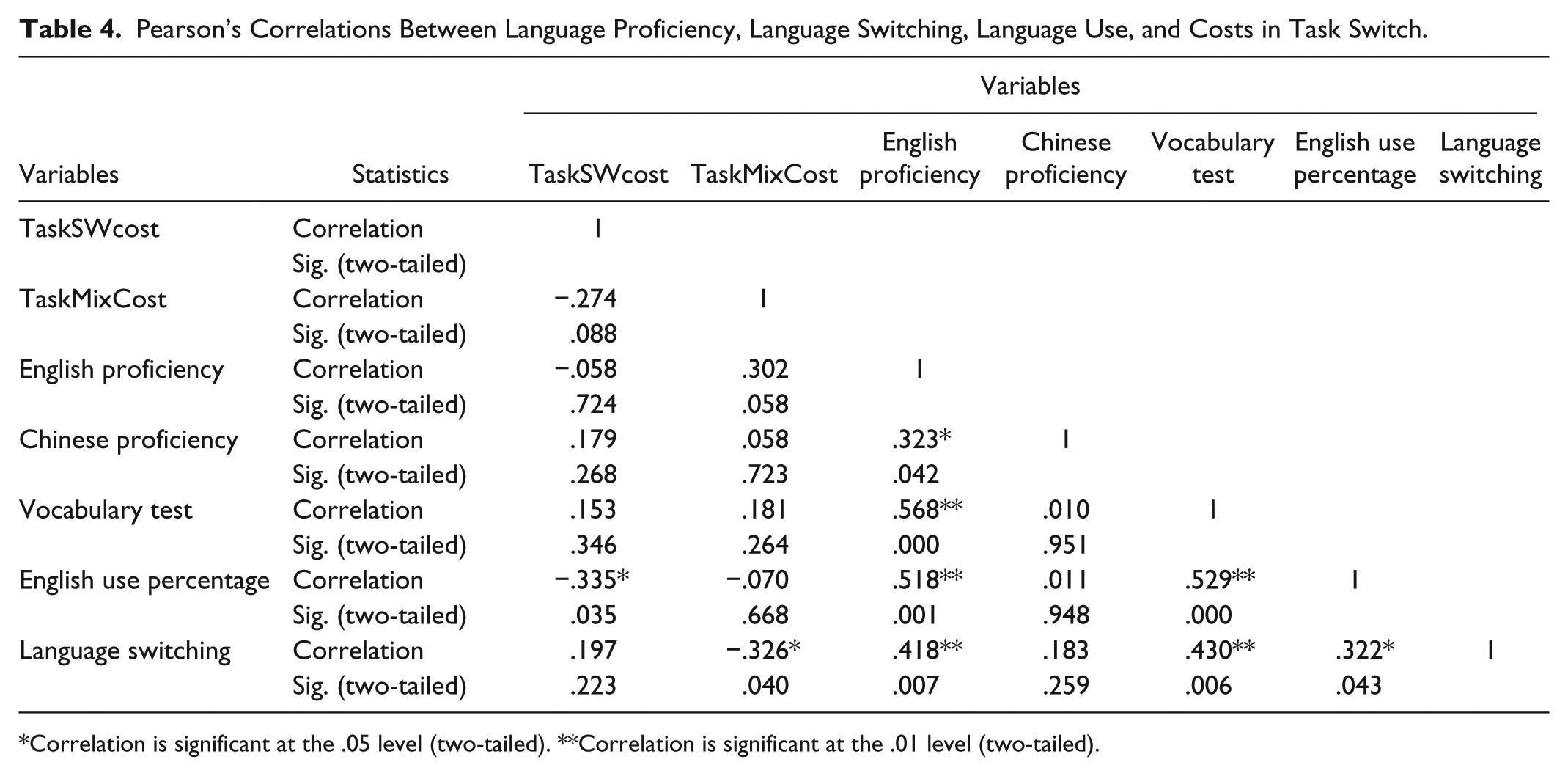
Correlation is significant at the .05 level (two-tailed). **Correlation is significant at the .01 level (two-tailed).
One would then intuitively predict that greater use of L2 (including switching languages more often) would keep L2 at a higher level of activation compared with less frequent use of L2, thus leading to a longer time in switching from L1 to L2. The switch-cost asymmetry would be smaller, which means that language-switching ability would become stronger. If stronger language-switching ability translates into a stronger task-switching ability in general, then the bilinguals with more experience using L2 should also demonstrate more efficient performance in task switch, thus resulting in smaller switch costs. The result of the correlation analysis was consistent with this prediction. The results of regression analysis in the current study really do provoke new debates in the field, as the results suggest that language switching/language use should be counted as important factors in the study of cognitive control in bilinguals. At the same time, the results indicate that L2 proficiency plays a limited or indirect role.
General Discussion
The current study examined the relationship between L2 proficiency, language use, and cognitive control by administering language-switching and task-switching paradigms in two bilingual groups differing in L2 proficiency and language use. Of the two bilingual groups that we tested, the higher L2 proficiency group exhibited an insignificant difference in language switch, and there was no sign of advantage for the higher L2 proficiency group in task switch. The higher L2 proficiency group did not present smaller switch costs compared with the lower language proficiency group, even when other factors such as age, IQ, and English-learning history were matched. Besides, the correlation and regression analyses indicate that language proficiency is not correlated with task-switch performance. However, language use and language-switching experience significantly contribute to the performance. The results indicate that language proficiency is not strongly related to bilingual cognitive control in the aspect of mental shifting, which is inconsistent with previous studies, suggesting that language proficiency is highly related to inhibition in cognitive control (see Introduction). However, the correlation and regression analyses reveal that there are strong links between language-switching frequency and mental set shifting, between L2 use and mental set shifting in cognitive control.
The ANOVA results in the language-switch and task-switch tests suggest that L2 proficiency may not be a direct factor causing cognitive control difference. This may be explained by the complexity of proficiency construct. In the research field, people usually operationally distinguish different groups by statistical methods. In the current study, we also classified the two bilingual groups into higher and lower L2 proficiency groups by statistical means. However, in practice, there exists no standardized method for determining the degree of bilingualism (Prior & Gollan, 2011), thus causing the role of language proficiency in bilingual cognitive control to remain ambiguous. If the L2 proficiency gap was greater between the two groups, the higher L2 proficiency group might perform better and the difference might be significant. Moreover, when L2 proficiency improves, language use patterns such as language switching may confound the results. Future studies should have a more applicable standard to single out those factors when investigating this issue regarding language proficiency. Besides, along with language proficiency, more factors such as individual difference (Festman, Rodriguez-Fornells, & Munte, 2010; Mercier, Pivneva, & Titone, 2013), the studied age range (as reviewed in the introduction; Bialystok et al., 2009), and bilingual type (Goral et al., 2013) might also modulate the effect of bilingualism. Finally, it is also possible that the lack of significant difference between groups was due to the low cognitive demand of the tasks. It has been reported that in tasks of low cognitive demand, bilinguals do not differ in performance from monolinguals, but in tasks of high cognitive demand, bilinguals might display superior performance when compared with monolinguals (Costa, Hernandez, Costa-Faidella, & Sebastian-Galles, 2009). This may also be the case for bilinguals with differing L2 proficiency. In our study, we included digit naming (from one to nine) in the language-switch task, which requires low cognitive demand. Therefore, increasing the cognitive demand of the task may increase the effect of group difference.
However, the correlation and regression analyses results suggest that specific language use experience such as language switching and language use may be critical factors leading to bilingual advantage or cognitive control differences between bilingual groups. This new finding is consistent with the recent view put forward by Green (2011), which states that specific bilingual language use ecology (the community context in which bilingual speakers typically use their two languages) may act as a very important variable causing cognitive control enhancement. For example, Prior and Gollan (2011) proposed that bilinguals (particularly unbalanced bilinguals) vary greatly in the extent to which they use their L2 and in how often they switch between the two languages. When switching between two languages, bilinguals may need to switch between two different mental sets. One would reasonably expect that long-term language-switching experience would lead to stronger ability in cognitive control (such as in task switching; Prior & Gollan, 2011). This new finding is also consistent with some previous studies (Rodriguez-Fornells, Kramer, Lorenzo-Seva, Festman, & Munte, 2011; Soveri et al., 2011), which stated that intensive switching between languages might greatly enhance mental set shifting in cognitive control. This is particularly true for interpreters because in language switching both languages must be kept active, and the mechanism of mental set shifting is highly required (Yudes, Macizo, & Bajo, 2011). In Yudes et al.’s (2011) study, professional interpreters, who intentionally and intensively switched languages very often, were reported better than both bilinguals and monolinguals in performing the Wisconsin Card Sorting test, which measures mental set shifting. The results in the current study further confirm previous findings and are also consistent with the suggestion from Luk and Bialystok (2013) that there is an interaction between proficiency and usage, and that the multiple related dimensions of bilingual experience will need to be considered in assessments of the consequences of bilingualism. Specifically, the current results suggest that it is not a large vocabulary that makes a difference, but the practice of a L2. Indeed, theoretically speaking, one of the proposed hypotheses (Bialystok et al., 2009; Peal & Lambert, 1962; Prior & Gollan, 2011) suggests that the bilingual advantage of cognitive control comes from the continuous use and switching between two languages.
As for the measuring task, the measurement of cognitive control should be properly addressed in future studies. As we have stated in the introduction, cognitive control has different dimensions, so the enhancement of one dimension does not necessarily mean the enhancement of another. In the current study, the aspect of mental set shifting was not significantly enhanced for the higher L2 proficiency group, but this does not rule out the possibility that the higher proficiency group may be better at inhibiting (as reported in some recent studies). Thus, the diversity of cognitive control invites us to consider which cognitive control measuring task would best match bilinguals’ specific language use experience.
In conclusion, the current study failed to capture bilingual cognitive control difference in task switching when comparing bilingual groups differing in L2 proficiency, but extended the topic by associating cognitive control more specifically with language switching and language use in bilinguals. The results indicate that bilingual language proficiency (L2 proficiency) alone does not necessarily bring about cognitive control changes in bilinguals but specific bilingual experience/use such as language switching may significantly contribute to cognitive control in some ways. Therefore, in future studies, classifying different types of bilingual experiences and controlling language proficiency at the same time may be helpful in identifying the relationship between specific features of bilingualism and cognitive control among bilinguals.
Footnotes
Acknowledgements
The author wants to thank the reviewers and the editor for their constructive comments and insightful suggestions and also thank Mr. Oliver Ju Wang from Jiangxi Normal University for the language editing.
Declaration of Conflicting Interests
The author(s) declared no potential conflicts of interest with respect to the research, authorship, and/or publication of this article.
Funding
The author(s) received no financial support for the research and/or authorship of this article.