




Abstract
Business will prosper if the environment is conducive to talent gathering. If the environment is nurturing and transformative for workers, it will attract and retain global talent. This study clarifies China’s global talent management policies through a quantitative analysis of the content of global talent management policy texts. We selected two dimensions to explore, namely, policy instrument types and management functions, and constructed a quantitative analysis framework of global talent management policy texts in China. Utilizing the Chinalawinfo Pkulaw Database, which is jointly launched by Peking University and Chinalawinfo Co. Ltd., the keywords “global talent,” “foreign experts,” and “foreign employees” were searched and a total of 145 relevant policy texts were selected. Based on the results, we recommend that for the formulation of future policies of global talent management, the frequency of using policy instruments of customs and traditions should be increased. Additionally, we should promote the integration and cross-cultural adaptation of global talent and strengthen the recognition of foreigners within Chinese culture.
Plain language summary
This study focuses on understanding China’s global talent management policies and their impact on attracting and retaining talent from around the world. We conducted a quantitative analysis of policy texts related to global talent management in China to gain insights. Two dimensions were considered: policy instrument types and management functions. We used the Chinalawinfo Pkulaw Database, which contains relevant policy texts, and searched for keywords such as “global talent,” “foreign experts,” and “foreign employees.” We selected a total of 145 policy texts for analysis. Based on their analysis, future policies on global talent management in China should increase the use of policy instruments that promote customs and traditions. This means creating an environment that respects and values foreign talent’s cultural backgrounds and experiences. It is essential to encourage integration and cross-cultural adaptation and strengthen the recognition of foreigners within Chinese culture. This study highlights the importance of creating a nurturing and transformative environment for global talent to attract and retain them. It provides recommendations for formulating future policies in China’s global talent management, emphasizing the need to value customs and traditions, promote integration, and enhance cultural recognition.
Introduction
Global talent management is an important issue for all open countries in the era of globalization (Cooke et al., 2020; Gallardo-Gallardo et al., 2020), and is defined as including organizational programs that help recruit, hire, develop, and retain the best workers in the most crucial positions around the world (Vaiman et al., 2012). With the deepening of China’s reform and opening up, the importance and urgency of global talent management have become increasingly clear. The global talent referred to in this study constitutes high-level international talent urgently required for national economic and social development, including leaders in science and technology, international entrepreneurs, specialists, and highly skilled individuals who meet the requirements of “high precision and shortage” roles as well as market demand.
Talent of this kind plays a crucial role in China’s talent strategy. China issued 336,000 work permits to global talent in 2022, and the number of global employees working in China has exceeded 1,430,695, according to the results of China’s 7th National Census in 2021. The data shows that China is gradually transitioning from an intellectual outflow country to an intellectual inflow country. The service and management of global talent will become an important means of extending China’s opening up, and introducing and utilizing global innovation resources.
Policy instruments are governance tools that are malleable, flexible, and coherent. Our study aimed to not be limited to a single or a small number of policy texts, but to focus on both macro and micro aspects of policy texts in a specific area to clarify China’s global talent management policies through a quantitative analysis of the content of global talent management policy texts. We also planned to investigate how policy instruments are configured and combined, and provide targeted opinions and suggestions on China’s global talent management policies from the perspective of policy instruments.
Literature Review
In addition to acquiring, integrating, maintaining, motivating, controlling, and developing international talent resources, global talent management mainly involves seeking, employing, motivating, and retaining talent (Sidani & Al Ariss, 2014). Researchers have emphasized the significance of maximizing the effectiveness of global talent management policies in response to the emerging challenges in the late 1990s (Scullion & Collings, 2011). To address the complexities of managing global talent, scholars have proposed frameworks and theories. Tarique and Schuler (2018) constructed a multi-level framework for global talent management systems, which takes into account individual, organizational, and contextual factors. This framework provides a comprehensive perspective on designing and implementing talent management strategies in a global context. Collings and Isichei (2018) examined the changing patterns of global talent mobility and highlighted the implications for global talent management. Their research sheds light on understanding the challenges and opportunities associated with global talent mobility and the need for flexible talent management approaches.
Chinese researchers have made significant contributions to the understanding and study of global talent management. Zhang and Yingxiu (2022) adopt a historical institutionalism perspective to analyze the evolution of China’s initiatives in attracting intelligence. They provide constructive suggestions for improving talent attraction strategies in the country. Li (2022) focuses on the management of global talent during the normalization of the Covid-19 epidemic, using the Tianjin Science and Technology Bureau as a case study. The research explores the challenges and solutions in providing effective management services to global talents in the face of the pandemic. S. Yu et al. (2021) conduct structured interviews with high-level global talents residing in Shandong to examine their satisfaction levels and influencing factors in relation to their work experiences in China. This study sheds light on the factors that impact the retention and satisfaction of global talent within the Chinese context. Z. Ma and Wu (2017) investigate the administrative management systems in place for global talent in China, exploring the policies and practices that facilitate the attraction and retention of international professionals. Additionally, Liu (2018) examines the policies and legal regulations governing the entry and employment of foreigners in China, specifically focusing on the introduction of global talent. These studies provide valuable insights into the strategies, management practices, and regulatory frameworks associated with global talent management in China.
Numerous studies have compared the practices and approaches of global talent management between China and other countries. Cooke et al. (2014) examine the perceptions and human resource practices related to talent management in China and India. They identify the significance of materialistic value systems and the need to consider the specific context of each country. Froese et al. (2020) focus on the challenges faced by Chinese, Japanese, and Korean multinational enterprises (MNEs) in global talent management. They highlight similarities in ethnocentric staffing and organizational cultures, as well as differences in performance appraisal and compensation practices. Latukha and Selivanovskikh (2016) compare talent management practices in IT companies from China, India, and Russia. They emphasize the influence of institutional and cultural factors and discuss the similarities and differences shaped by the emerging market and industry-specific contexts. These studies underline the importance of recognizing cultural and contextual factors and developing tailored strategies to effectively manage global talent across borders. Such insights contribute to enhancing global talent management practices for organizations operating in China and other countries.
Problem Statement and Framework
Problem Statement
Extant studies on global talent management research contribute to the theoretical underpinnings of global talent management by providing frameworks for effective talent management practices and insights into the dynamics of global talent mobility. However still have some limitations in global talent management in China. First, previous research focuses mainly on management mechanisms and methods, the wider picture of policies is unclear, and systematic analysis and argumentation are lacking. What are the specific policies and regulations governing global talent management in China, and how do they contribute to the overall talent management framework, these questions need to be explored.
Second, research on global talent management policy is mainly theoretical and lacks quantitative research and data support. Quantitative research methods and data support need to be employed to enhance the current theoretical understanding of global talent management in China, and base on the quantitative data, to find answers about what are the potential gaps or challenges in the existing management mechanisms and methods for global talent in China.
For the aforementioned reasons, to meet the gap in research, we used policy texts to reflect government actions (Kerwin & Furlong, 2018; Kraft & Furlong, 2019). We surmised that these texts, as a product of government information openness and the development of big data, can effectively be used as a large sample for qualitative and quantitative cross-sectional research. Policy text analysis identifies and processes policy concepts by defining units of analysis that reflect the mapping relationship between policy semantics and lexical words, and constructs a coding standard from units of analysis to values and a policy analysis framework from policy text to policy semantics (Pandey et al., 2017).
Framework for the Quantitative Analysis of Policy Texts
Public policy is the output of authoritative decisions by the political system, and a rational policy system is the authoritative distribution of social values (Oni, 2016). As constituent elements of the policy system, policy instruments are the means and measures that the government uses to achieve its policy goals and cooperate with the government to fulfill its stated role in public policy.
The study of policy instruments has emerged along with the complexity and diversity of public management; therefore, this study selects two dimensions, namely, policy instrument types and management functions, to construct a quantitative analysis framework of global talent management policy texts.
Dimension X: Types of Policy Instruments
There are different criteria for classifying policy instruments, and the quantitative analysis of policy texts requires flexibility in choosing different classifications according to the purpose of the study so that the policy instrument chosen matches the problem to be solved. Among the many political instruments, Rothwell (1984) classified policy instruments into supply-oriented policy instruments, environment-oriented policy instruments, and demand-oriented policy instruments. These categories are based on innovative government policies which have been widely applied in policy research in the fields of science, technology, finance, wind energy, information services, conversion of scientific and technological achievements, and talent introduction in China. In global talent management, supply and demand policies play a direct role in influencing China’s global talent introduction strategy directly, while environment-oriented policies play an indirect role in influencing global talent management in terms of the policy environment, as shown in Figure 1.

The way policy instruments work for global talent management.
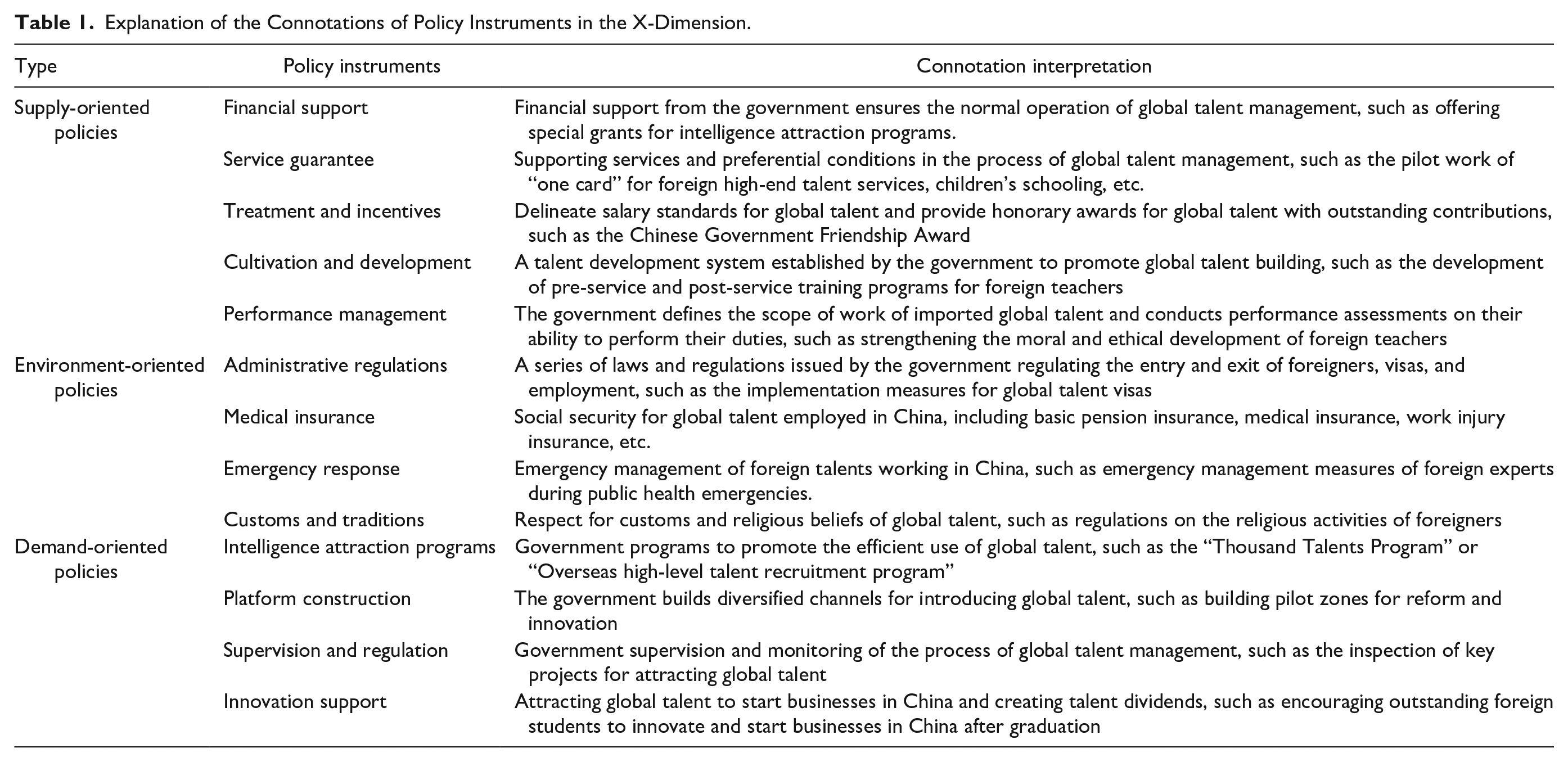
Supply-oriented policy instruments in talent policy specifically refer to policies and programs that are attractive to talent and thus promote the efforts of talent introduction and management, mainly financial, human, and technical assistance provided by the government. In this study, supply-oriented policy instruments were divided into five sub-instruments: financial support, service guarantee, treatment and incentives, cultivation and development, and performance management. Environment-oriented policy instruments refer to a series of policies implemented by government agencies or related departments that can influence the management of global talent and provide favorable conditions for global talent management, including policy frameworks such as tax policies, patent policies, and regulations. In this study, according to the characteristics of global talent management, environment-oriented policies are divided into four sub-instruments: administrative regulations, medical insurance, emergency response, and customs and traditions. Demand-oriented policy instruments refer to the government’s implementation of public measures to increase the demand for global talent by employers, including central and local government procurement and contracts. This is particularly true for innovative products, processes, and services. In this study, demand-oriented policy instruments were divided into four sub-instruments: intelligence attraction programs, platform construction, supervision and regulation, and innovation support. The names and connotations of the various policy instruments selected in this study are shown in Table 1.
Explanation of the Connotations of Policy Instruments in the X-Dimension.
The Y Dimension: Global Talent Management Functions
Unlike human resources, which are common factors of production, talent is a carrier that aggregates large amounts of human and intellectual capital (Al Aina & Atan, 2020; Muhammad & Shao, 2013). In comparison, talent management is more macro and performance-oriented than human resources management. In global talent management, the government needs to coordinate and supervise global talent and ensure that they perform their jobs efficiently and effectively. Therefore, this study uses four management functions—plan, organization, leadership, and control—as the Y dimensions of the quantitative analysis framework of global talent management policy texts, shows in table 2.
Explanation of the Connotation of the Global Talent Management Function in the Y Dimension.

Policy Text Source and Coding
Policy Text Sources
In this study, legal and policy texts were searched from the Chinalawinfo Pkulaw Database, which is jointly launched by Peking University and Chinalawinfo Co. Ltd. By using global talent, foreign experts, and foreign employees as keywords, 145 relevant policy texts were searched, including 117 current and valid policy texts, 15 administrative regulations, 110 departmental regulations, and two party regulations and systems. To ensure that the selected policy texts are representative, scientific, reasonable, and fully reflect the policy status of global talent management in China, the 117 policy texts are further sorted and selected in conjunction with the purpose of the study. The policies and regulations issued at the national level are used, while the policies and regulations of local departments are not selected; the policy texts that only mention global talent but not the elements of global talent management are not selected; and the policy texts that can reflect the government’s attitude toward global talent management, such as laws and regulations, opinions, measures, and notices, are selected. Finally, this study composes 53 policy texts as the policy samples of global talent management in China for analysis, as shown in Table 3.
Sample of China’s Policies on Global Talent Management.

The 13th National People’s Congress approved the State Council institutional reform program in March 2018, which integrated and optimized the functional configuration of some State Council agencies. For example, the State Administration of Foreign Experts Affairs, one of the administrative departments attributed to the management of global talent in China, was integrated with the responsibilities of the Ministry of Science and Technology according to the State Council’s institutional reform program, and the Ministry of Science and Technology was reconstituted, retaining the brand of the State Administration of Foreign Experts Affairs externally. The names of the agencies used in this study are those used by the departments in the year the policy text was released. For departments with subordinate relationships, the names of the competent departments were used in the statistics.
Policy Text Coding
After determining the text sample of China’s global talent management policy, this study uses the qualitative research analysis software NVivo 12 for text coding, with the sentences in the policy text as the smallest coding unit and the paragraphs as the largest coding unit. Formal coding commenced with a small amount of policy text coding to ensure full understanding of the coding connotation interpretation and analysis framework. When coding, according to the degree of fit between the policy text and the research topic, the text was first coded into the corresponding entry of the X dimension and then coded into the corresponding entry of the Y dimension to form a sample coding table of global talent management policies in China. Finally, 646 nodes were coded; some coding examples are detailed in Table 4.
Sample Code Examples of China’s Global Talent Management Policies.

To ensure consistency between the measurements of the quantitative analysis of policy content, coding was performed jointly by two researchers. The Kappa coefficient of consistency between judges was 0.83. The coding results were credible and suitable for further analysis.
Quantitative Analysis of Global Talent Management Policy Texts
Diachronic Analysis of Global Talent Management Policy Texts
Drawing on previous studies and based on the concept of “key nodes” in historical institutionalism (X. Yu, 2022), this study divides the introduction and management of global talent in China into four important stages: pioneering stage (1980–1990), developing stage (1991–2000), perfecting stage (2001–2010), and deepening stage (2011−present), with a decade as the dividing point. Figure 2 shows the diachronic distribution of the sample of global talent management policies in China.

Diachronic distribution of policy texts.
The total number of policy texts in the pioneering stage is seven, accounting for 13% of the total policy samples. This stage is marked by Deng Xiaoping’s important talk on “utilizing foreign intelligence and expanding foreign opening,” after which the Communist Party of China (CPC) Central Committee and the State Council formulated the interim provisions on the introduction of global talent and other related policies following the spirit of Deng Xiaoping’s talk. At this stage, China had just experienced its reform and opening up and began to gradually focus on strengthening and utilizing foreign talent. The development stage is a small peak in the number of global talent management policies issued, with a total of 11 policy texts, accounting for 21% of the total number of policy samples. In this stage, a series of policies such as “Regulations on the Employment of Foreign Experts and Foreign Teachers in Higher Education Institutions,” “Interim Provisions on Arbitration of Disputes on Employment Contracts of Foreign Experts,” and “Notice of the Ministry of Labor and Social Security on Issues Related to Strengthening the Management of Foreigners’ Employment in China” were issued successively, which standardized and legalized the construction of global talent. The total number of policy texts in the perfection stage is seven, accounting for 13% of the total number of policy samples. At this stage, China joined the World Trade Organization, fully integrated into the globalized division of labor, and intensified the introduction of global talent, and the policies showed the characteristics of subdivision. The total number of policy texts in the deepening stage is 28, accounting for 53% of the total policy samples. The number of policy texts in this stage has increased rapidly, especially since the 18th National Congress of the CPC, which has been implementing the strategy of strengthening the country with talent; increasing efforts to attract global talent; and deepening the reform of the global talent management system in all aspects, such as improving the service guarantee, strengthening supervision and regulation, and establishing innovation and entrepreneurship platforms.
Policy Text Dimension Analysis
X Dimension Analysis of Policy Instruments
Based on the coding of global talent management policies, frequency statistics were conducted for the different policy instrument dimensions. The results, detailed in Table 5, indicate that supply-oriented policies had the highest number of coded nodes at 292 (45.20% of the total). Environmentally oriented policies had 184 coded nodes (28.48%), and demand-oriented policies had 170 coded nodes (26.32%), suggesting a similar frequency of use between the two. Analyzing the distribution of sub-instruments within each policy category, service guarantee had the largest share among supply-oriented policies (33.90%), followed by treatment and incentives (30.48%), while cultivation and development had the least share (4.45%). For environment-oriented policies, administrative regulations accounted for 48.37% of the coded nodes, with emergency response showing a higher percentage (23.91%). Among demand-oriented policies, supervision and regulation had the highest number of coded nodes (41.18%), whereas innovation support policies had a relatively smaller share (4.12%). These findings provide valuable insights into the utilization of different policy instruments in global talent management.
Frequency Statistics of the Nodes Coding the Dimensions of the Policy Instruments of the Sample Global Talent Management Policy in China.

Using the policy date as an attribute in NVivo software, a crosstab query of X-dimension policy instrument coding nodes was conducted to obtain the statistics of the distribution of coding nodes in the sample of global talent management policies at different time stages. A bar chart was developed with the vertical coordinate of frequency, as shown in Figure 3. At the early stage of reform and opening up, there was a serious imbalance between the number of supply-oriented policy instruments and environment-oriented and demand-oriented policy instruments. The situation of overuse of supply-oriented policy instruments is presented. However, with the deepening of the reform, the use of the three types of policy instruments gradually tends to be balanced, and the push and pull effect is evident.
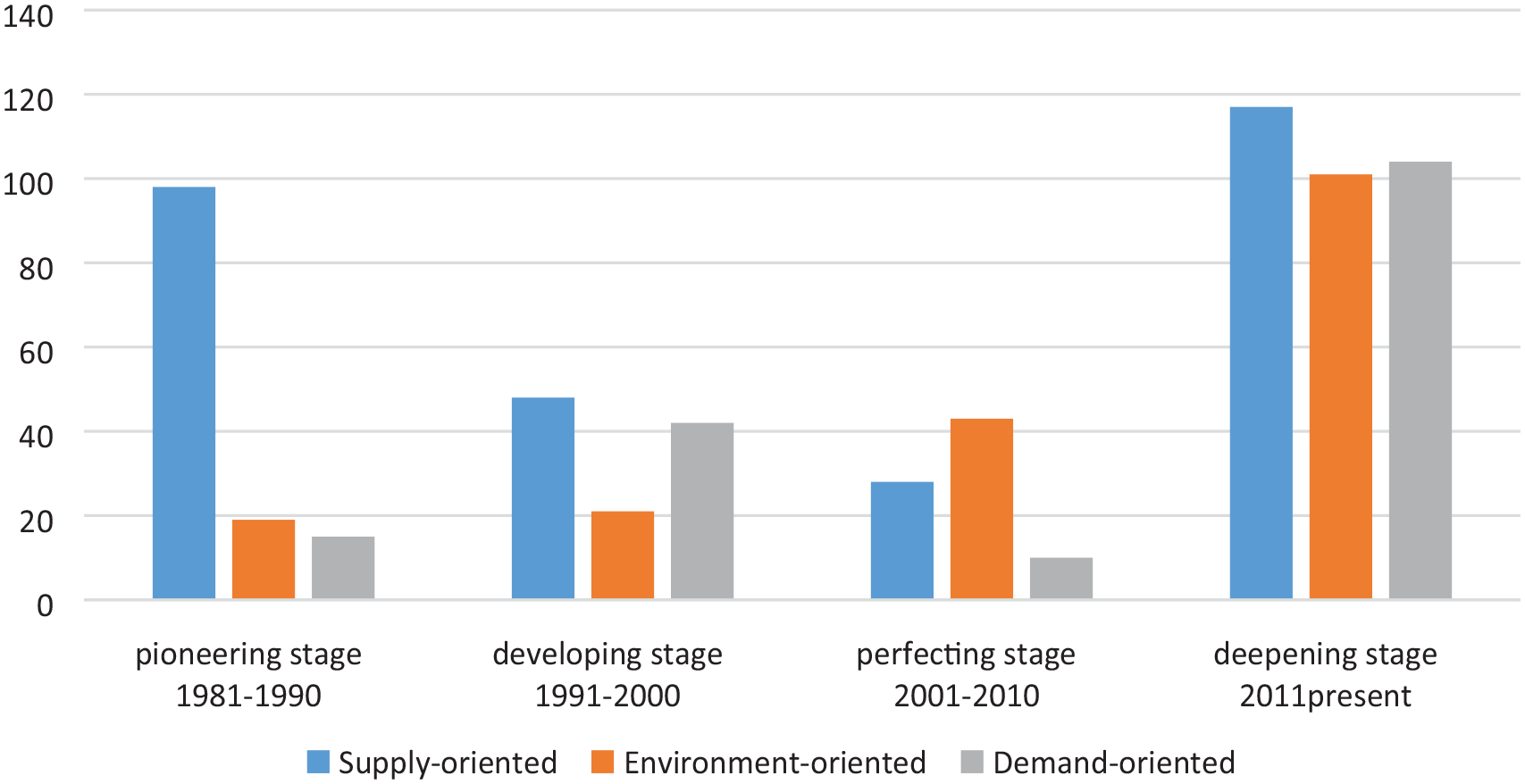
Frequency of use of policy instruments by stage.
Y Dimension Analysis of the Global Talent Management Function
The frequency analysis of coded nodes for the management function dimension in global talent management policies is presented in Table 6. Organizations accounted for 53.10% of the coded nodes, while plan, leadership, and control had similar proportions of 14.71%, 16.56%, and 15.63% respectively. Figure 4 provides statistics on the distribution of coded nodes for management functions at different time stages. Instruments used in the plan and organization functions increased significantly over time. The use of instruments for leadership was less frequent in the developing and perfecting phases but improved in the deepening phase. The use of instruments for control increased in the deepening phase, indicating parallel implementation and supervision in global talent management.
Frequency Statistics of Nodes Coding the Management Function Dimension of a Sample of Global Talent Management Policies in China.


Frequency of use of management function by stage.
Two-Dimensional Matrix-Coding Analysis of Policy Instruments and Management Functions
A matrix-coding query in NVivo software was used to analyze the intersections between policy instruments and management functions. Table 7 and Figure 5 display the utilization of policy instruments across different management functions.
Two-Dimensional Matrix Coding of Policy Instruments and Management Functions.


Bar chart of two-dimensional matrix coding of policy instruments and management functions.
For the supply-oriented policy, the main management functions involved are organization (48.97%) and leadership (34.25%). Treatment and incentives sub-instruments are primarily utilized within the leadership function. In environment-oriented policies, the organizational function (71.2%) plays a significant role, as these policies mainly influence the implementation process and achieving policy objectives. In demand-oriented policies, the supervision and regulation sub-instruments are primarily utilized within the control function (43.53%), while the other three sub-instruments are mainly distributed within the organization function (40.59%). All three types of policy instruments (supply-oriented, environment-oriented, and demand-oriented) have a relatively small presence in the planning function.
Discussion
The Overuse of Supply-Oriented Policy Instruments
It is clear from the results of the study that China’s global talent management policy instruments and supply-oriented instruments are overused, reflecting the government-led “top-down” strong supply characteristics, with more push than pull; this presents the policy fundamentals of supply-oriented instruments, supplemented by environment-oriented and demand-oriented instruments. This is closely related to China’s economic development process (Azam et al., 2019; Johnson & Koyama, 2017). Among the supply-oriented instruments, the more frequently used are the service guarantee and treatment incentive sub-instruments. At the early stages of pioneering, limited by its economic conditions, China mainly attracted global talent to work in the country by improving their salaries and wages. During this period, treatment incentives were more frequently used. The most typical policies in this period were “Interim Measures on Giving High Salaries to Some Experts Hired from Abroad” and “Opinions on Technical Service Fees and Living Conditions for Foreign Engineers and Technicians and the Conditions They Should Have,” among others. Since the 18th National Congress, the government has gradually changed its position from a manager to a public policy servant (Noesselt, 2015). As a result, global talent management has been focusing on process service guarantees, such as providing visas and employment permit facilities for global talent and optimizing the policy of enrolling foreigners’ children in school, so the use of supply-oriented policy instruments is on the rise in the deepening stage.
The success of businesses relies on creating an environment that fosters talent accumulation (Spigel & Harrison, 2018). A nurturing and transformative environment has the potential to attract and retain global talent (Gallardo-Gallardo et al., 2020; Stahl et al., 2012). Such a global talent pool is more sensitive to environmental perception and recognition compared to international mobile resources or competitors (Haak-Saheem, 2020). Therefore, the government should reduce the usage of supply-oriented policy instruments and increase the number of environment-oriented policy instruments. Currently, China predominantly utilizes laws and regulations as environment-oriented policy instruments for global talent management. This preference highlights China’s recognition of the unique characteristics of global talent and the importance of ensuring their rights and obligations during policy formulation.
Uneven Distribution of Demand-Oriented Policy Instruments
According to the results, the use of supervision and regulation sub-instruments among the demand-oriented policy instruments is relatively high, and the coding nodes are mainly concentrated in policies that strengthen the supervision of global talent special fees, foreign organizations, and domestic intermediaries, as well as the qualifications of employing units, such as the Interim Measures for Inspection of Key Intelligence Attraction Projects. Demand-oriented policy instruments are pull policies for global talent management (Boon & Edler, 2018; G. Ma et al., 2022), mainly external motivational management with regulatory-type policies. Supervision and regulation policy sub-instruments can be based on the management terminal, with the regulatory department as the launching point and pulling global talent management policies into place as managers (Yue et al., 2020). Overuse of supervision and regulation-type policy instruments should be avoided in the management process to prevent excessive and strict supervision.
In contrast to the supervision and regulation sub-instrument, the innovation and entrepreneurship sub-instrument had only seven coding nodes. At present, the innovation support policies of global talent in China are mainly at the provincial and municipal levels, focusing on the provinces with more active economies, such as the establishment of the Overseas Talent Bureau in Shanghai Pudong New Area, which proposes to establish a “1+X” overseas talent policy system to promote the innovation and entrepreneurship of global talent. However, an innovation support policy system at the national level is relatively lacking. The future of Chinese talent innovation and entrepreneurship depends on strengthening policy guidance and creating an innovation and entrepreneurship support system with an effective and smooth system (Ahlstrom et al., 2018; Kerr, 2020; Wanga et al., 2019), especially in the field of science and technology (Chamorro-Premuzic et al., 2017), to drive the development of the industry with policies and inject talent power for innovation and technology.
Analyzing China’s global talent management policies at present, it becomes evident that the utilization of demand-oriented policy instruments is relatively low, resulting in insufficient intellectual attraction projects and limited platforms for attracting global talent for employment. To address this, it is recommended to establish a global talent resource agency responsible for selection, investigation, assessment, interviewing, and recruitment of global talent, while also creating a robust service platform to enhance their public service capacity (Miao, 2021; Sarabi et al., 2018). Furthermore, active involvement of global talent from universities in enterprise innovation should be encouraged, necessitating the strengthening of industry-university-research cooperation channels (Zhao & Zhu, 2009). It is also essential to proactively attract high-end science and technology talents worldwide and optimize the allocation of science and technology innovation resources in favor of global talent (Appelbaum et al., 2018; Bai & Cao, 2021).
Uneven Distribution of Policy Instruments Across Management Function Dimensions
The coding nodes of each policy instrument in the management function dimension mainly focus on the organizational function, and the policy instruments in the planning, leadership, and control dimensions are not used in sufficient proportions. Although China’s global talent management policy focuses on clarifying the responsibilities of each department and optimizing resource allocation, it also focuses on standardizing the management system and building a clearer information and communication system in the management process (Hongal & Kinange, 2020). The process of global talent management in China, should also focus on setting up talent management goals and formulating talent management development strategies, accelerating the transformation of the government’s talent management function, improving the introduction of talent policy and regulatory system construction, and strengthening the government’s macro-control ability in introducing talent work. Strengthening the planning, leadership, and control functions of policy instruments must be undertaken, so that they can better serve policy goals by stimulating endogenous motivation for global talent development.
Conclusions and Implications
To analyze the public policy of overseas talent management in China, this study quantified policy texts based on the perspective of policy instruments, selected a sample of policies in China, and established a two-dimensional analysis framework of policy instruments and management functions for coding and quantitative analysis. The findings have extended our knowledge on a macro view of these policies, and a systematic analysis which was lacking in the existing literature. Combined with the historical analysis of global talent management policies, we found China’s overseas talent management policies to be characterized by a “strong supply,” more supervisory and regulatory than providing innovation support, and an uneven distribution of various policy instruments in terms of management functions. Therefore, the optimal allocation of overseas talent management policies should strengthen the balanced use of policy instruments, provide a “soft environment” for retaining overseas talent, expand the use of demand-based policy tools through multiple channels, develop an evaluation system, and improve the efficiency of incorporating this overseas talent.
We suggest that in future policy formulation, multidimensional channels for attracting global talent should be increased. Better efforts are required in constructing reform and innovation pilot zones, increasing the opening of science and technology programs to the outside world, and launching intercountry industrial cooperation and innovation projects. Further actions such as promoting diversity and digitization of global talent mobility governance platforms, and the promotion of various carriers to actively serve local industries and play a long-term talent attraction and gathering function by increasing financial support, can help build a diversified international development platform for global talent in China.
At the meanwhile, the use of policies for attracting, nurturing, retaining, and employing talent is equal important in talent management. International students are often considered “quasi-international talent,” at present, the number of international students arriving in China is steadily increasing, but the employment system for international students in China to promote global talent reserve is lacking. In the use of future policy instruments, attention should be paid to relaxing the employment conditions of international students in China and improving the system of work-study for international students to build up a pool of global talent, and providing channels for international students to work and apply for permanent residence in China after graduation. It is not contradictory to prioritize the employment of domestic students and reasonably absorb outstanding foreign graduates in China; encouraging the introduction of high-end international talents and protecting the domestic labor market can go hand in hand.
Footnotes

Author Contributions
Conceptualization, Cai Yueyue and Nor Akmar Nordin; methodology, Cai Yueyue, and Nor Akmar Nordin; software, Cai Yueyue; writing—original draft preparation, Cai Yueyue; writing—review and editing, Nor Akmar Nordin; supervision, Siti Aisyah Panatik; project administration, Siti Aisyah Panatik.; funding acquisition, Cai Yueyue. All authors have read and agreed to the published version of the manuscript.
Data Availability Statement
All data generated or analyzed during this study are included in this published article, presented through tables and figures.
Declaration of Conflicting Interests
The author(s) declared no potential conflicts of interest with respect to the research, authorship, and/or publication of this article.
Funding
The author(s) disclosed receipt of the following financial support for the research, authorship, and/or publication of this article: This research was funded by 2023 Gansu Provincial Social Science Planning Project: “Research on the Path of Enterprise Internationalization Led by Gansu Proactive Opening-up Strategy”, Grant number 2023YB009
Informed Consent Statement
Informed consent was obtained from all subjects involved in the study.