




Abstract
In the digital screen era, family dynamics are increasingly shaped by the intersection of media use and work-family conflict, with significant implications for young children’s development. This study addresses a critical gap by focusing specifically on parental-directed screen-based media use—that is, media exposure permitted, initiated, or supervised by parents—as a mediating mechanism between work-family conflict and children’s prosocial behavior. Based on a survey of 1,542 Chinese families with children aged 0 to 6, the findings highlight how parents strategically employ screen-based media to manage work-family demands, using it for learning, entertainment, emotional soothing, and compromising with their children. Crucially, results show that heightened work-family conflict predicts increased parent-directed screen time, which is negatively associated with prosocial behavior in children. By examining media use across four functional dimensions, the study reveals a nuanced mediational pathway, emphasizing that even intentional and regulated screen use may inadvertently undermine social development. These insights carry important implications for policymakers and practitioners seeking to support family well-being and children’s socioemotional growth in increasingly digital domestic environments. To contextualize these findings, it is important to note that the study is limited by its reliance on parental self-reports and cross-sectional data, which suggest directions for future longitudinal and multi-informant research.
Plain Language Summary
In the age of digital screens, managing work and family responsibilities is a challenge for many parents. This study explores how 1,542 Chinese families with children aged 0-6 use screen-based media to cope with work-family conflict and how it impacts their children’s social skills. Using survey data analyzed with Mplus 8, a tool designed for advanced statistical modeling, the research uncovers significant findings. When parents experience work-family conflict, they often rely on screen-based media to manage daily challenges, such as teaching, entertaining, soothing, or compromising with their children. However, this increased reliance on screens is linked to a decline in children’s prosocial behaviors, such as kindness, sharing, and cooperation. The study highlights how screen time mediates the relationship between work-family conflict and children’s social development, offering important insights into the unintended effects of digital parenting. These findings emphasize the need for practical support and policies to help families reduce their dependence on screens and foster healthier social and emotional development in children. This research provides a clear roadmap for educators, policymakers, and parents on balancing screen use with children’s developmental needs in today’s digital era.
Keywords
Introduction
Prosocial behavior in children stands as a cornerstone of healthy socioemotional development, embodying the capacity for empathy, cooperation, and altruism. It lays the foundation for positive social interactions, fosters meaningful relationships, and predicts long-term well-being (Caprara et al., 2000; Eisenberg et al., 2015; Laible & Karahuta, 2014). Previous studies have demonstrated that children exhibiting prosocial tendencies tend to experience higher levels of peer acceptance and academic success, indicating the far-reaching impact of these behaviors in various life domains (Ladd, 1999; Wentzel, 2005).
Parenting styles and practices wield considerable influence over a child’s prosocial inclinations, marking a critical nexus in the developmental trajectory. Variations in parenting styles, from authoritative to permissive, have been linked to differential outcomes in prosocial behavior (Hu & Feng, 2021; Wong et al., 2021). Furthermore, cultural contexts have been demonstrated to play a pivotal role in shaping parental approaches, thus further diversifying the landscape of prosocial development. Collectivist cultures, for example, characteristically accentuate shared values, thereby engendering a pronounced emphasis on cooperation and interdependence in children’s social interactions (Markus & Kitayama, 1991).
Within the Chinese cultural milieu, parenting practices take on distinctive contours, reflecting the Confucian ethos of filial piety and collectivism. These values underpin parenting behaviors, as Chinese parents often prioritize academic achievement and moral development (Ng et al., 2007; Wu & Chao, 2005). However, the confluence of familial and occupational responsibilities in contemporary China has given rise to heightened family-work conflict, potentially shaping parenting practices and, subsequently, children’s prosocial behavior (Greenhaus & Beutell, 1985; Y. Wang et al., 2023). Notably, a critical juncture in this discourse lies in the integration of screen-based media devices as potential mediators of parenting strategies in the face of such conflict (Konok et al., 2019).
While extensive scholarship has scrutinized the effects of family screen-based media on child development (Jusienė et al., 2020; Lunkenheimer et al., 2023; Swider-Cios et al., 2023; Tooth et al., 2021). Recent research underscores that the effects of digital media on young children’s development are multifaceted, influenced by factors such as parental involvement, content quality, and cultural context. On one hand, studies highlight the potential benefits of Joint Media Engagement (JME), where parents actively participate in their children’s media consumption, emphasizing that co-viewing and discussing media content can enhance children’s executive function and learning outcomes (Bukhalenkova et al., 2023).
Conversely, other studies caution against excessive or unsupervised screen time. Skalická et al. (2019) conducted a longitudinal study revealing that increased screen time at age four predicted lower levels of emotion understanding at age 6, suggesting that excessive screen exposure may impede the development of social-emotional competencies.
These conflicting findings underscore the complexity of digital media’s role in early childhood development. While Joint Media Engagement (JME) may provide educational and social benefits through parental co-use and guided interaction, unregulated or excessive screen exposure is often associated with reduced empathy, diminished real-life social interactions, and developmental concerns (Shoshani et al., 2022; Shou & Nanakida, 2022). These divergent perspectives highlight that digital media’s impact on children is not monolithic but deeply contingent on contextual factors such as parental involvement, content quality, and socio-cultural norms.
However, within this broader discourse on digital media and child development, the intersection between digital media use and parental work-family conflict remains conspicuously underexplored. Existing research tends to examine these domains in isolation or with unidirectional causality—for instance, how work-family conflict affects parenting stress or how screen time affects children’s behavior—without fully considering how screen-based media might operate as both a coping strategy and a mediating factor within the family system.
This study aims to address this critical gap by exploring how parental work-family conflict may influence children’s prosocial behavior via patterns of family media exposure. In contemporary Chinese families, where digital technology is seamlessly integrated into everyday life, screen media is often used not only for entertainment or education but also as a tool to manage time and reduce parental stress. Therefore, this research focuses on unraveling the complex, potentially bidirectional relationships among work-family dynamics, screen-based media practices, and children’s prosocial development, offering a more holistic and ecologically valid understanding of early childhood socialization in the digital age.
Literature Review
Work-Family Conflict and Child Development
Work-Family Conflict (WFC) refers to the strain caused by conflicting demands between work and family roles, where involvement in one area hinders participation in the other (Carlson et al., 2000; Greenhaus & Beutell, 1985). WFC includes two main types: work-to-family conflict (WFC) when work interferes with family, and family-to-work conflict (FWC) when family obligations disrupt work. This conflict manifests as time-based (e.g., lack of time for both roles) or strain-based (e.g., stress from one role affecting performance in the other) challenges. Research links WFC with adverse outcomes, including burnout, psychological distress, and reduced job satisfaction and performance (Amstad et al., 2011; Grzywacz & Marks, 2000).
WFC also impacts family well-being and children’s development. Studies show that high WFC correlates with lower family satisfaction, reduced marital quality, and decreased parenting quality, as parents facing high WFC may lack the time and energy for positive parenting behaviors (Buehler & O’Brien, 2011; Frone, 2003). Although evidence shows WFC affects children’s social behaviors directly, the complex family interactions underlying these effects are less understood. According to Bronfenbrenner’s (2000) ecological systems theory, more research is needed to clarify how WFC, as it interacts with family caregiving factors, influences young children’s socioemotional development and the specific pathways involved.
With the widespread penetration of various digital media in households, screen-base media use has become a common mode of family interaction and parenting (Rideout, 2017). Existing research addresses that family media use activities associated with the development of children’s language skills and parent-child interactions (Anderson & Hanson, 2017; Gath et al., 2023; Lusted & Joffe, 2018). Therefore, the interaction between parents and children through screen-based media and devices in different cultural contexts and situations has increasingly become a focal point of attention. However, there is a notable scarcity of research on how parents, particularly in the context of work-family conflict, engage with children through screen-based media use and the subsequent impact on children’s development. Thus, there is a need for further exploration of the dynamic relationship between these factors to comprehensively understand family well-being and child development. Addressing these gaps will provide a more comprehensive understanding of the intricate dynamics at play in the context of work-family conflict, screen-based media use, and their implications for children’s social development.
Children’s Prosocial Behavior and Screen-Based Media Use
Prosocial behavior in children refers to actions or behaviors that are intended to benefit others (Hepach & Warneken, 2018), such as helping, sharing, comforting, and cooperating (Eisenberg et al., 1998). It is a vital aspect of socioemotional development, reflecting the child’s capacity for empathy, altruism, and positive social interactions (Hepach & Warneken, 2018; Luengo Kanacri et al., 2013).
Children’s natural inclination to help, share, and offer emotional support is a key predictor of successful adjustment and academic performance (Eisenberg et al., 2013; Luengo Kanacri et al., 2013) and aligns with Chinese cultural values, emphasizing collectivism, community harmony, and filial piety. Chinese families encourage prosocial behaviors as a reflection of social responsibility, reinforcing the importance of cooperation and mutual support to foster positive social bonds and reduce aggression and depression (Caprara et al., 2000).
Research highlights a strong link between parental warmth and young children’s prosocial behavior. Parental affection, emotional support, and shared activities nurture empathy and kindness. Studies (e.g., Bower & Casas, 2016; Spinrad & Gal, 2018) show that constructive, empathetic parental interactions, like praising positive behaviors, increase children’s prosocial tendencies. However, not all parents consistently adopt such strategies, and the long-term benefits often depend on children’s ability to navigate challenging conditions. Parental influence on children’s prosocial development can be mediated by emotional factors (e.g., empathy, guilt; Mussen & Eisenberg, 2001; Prot et al., 2014), as well as socialization agents like teachers and peers, who play facilitative roles (Mussen & Eisenberg, 2001).
A particularly significant factor in modern family life is the prevalence of digital media. Current research often views screen-based media independently rather than as a potential mediator in parenting (Knitter & Zemp, 2020), particularly in the context of work-family dynamics. As screens increasingly integrate into family interactions, they may serve as intermediaries, either mitigating or amplifying the effects of work-family conflict on children’s prosocial development. Understanding these mediated relationships may offer critical insights into the nuanced dynamics shaping children’s social behaviors today.
In summary, the current body of research on children’s prosocial behavior, while substantial, lacks a targeted exploration of the specific dynamics between family screen-based media use, Chinese parenting practices, and children’s social behavior. This research gap underscores the need for studies that address the nuanced interplay between these factors, considering the cultural specificity of Chinese parenting values and the evolving role of media in family life. Addressing this gap will contribute to a more comprehensive understanding of how family screen-based media use shapes children’s social development within the unique context of Chinese parenting.
The Present Study
Based on the provided evidence, there exists a significant research gap in understanding the interplay between family screen-based media use, Chinese parenting practices, and their combined influence on children’s social behavior. Three research questions were carried out for this study.
Rationale: This question aims to explore the specific role of screen-based media use in mediating parenting strategies within the unique context of Chinese families facing work-family conflict. It seeks to understand how technology is incorporated into parenting practices and its subsequent impact on children’s prosocial behavior.
Rationale: This question delves into the cultural dimensions that shape the use of technology in Chinese parenting. It explores how traditional values influence the adoption of screen-based media as parenting aids, especially when balancing familial and occupational responsibilities, and its consequent effects on children’s prosocial behavior.
This question specifically addresses the mediating role of family media use in the relationship between work-family conflict and children’s prosocial behavior in the context of Chinese families. It explores how the exposure to family media use may amplify or diminish the impact of work-family conflict on children’s prosocial behavior.
Theoretical Framework
Given the background and research questions, this study has constructed a theoretical framework by integrating ecological system theory (Bronfenbrenner, 1979) and the digital parenting framework (Livingstone & Helsper, 2008). Ecological system theory posits that individuals are influenced by multiple layers of environmental systems, ranging from the immediate microsystem (family and home environment) to the broader macrosystem (cultural and societal influences). In this research, it aims to analysize how work-family conflict acts as a stressor, how parents cope with this conflict (potentially using screen-based media as a coping mechanism), and how these processes collectively impact parenting practices and children’s prosocial behavior.
The digital parenting framework focuses on how parents navigate the digital landscape and incorporate technology into their parenting practices. It can be applied in this research to understand how Chinese parents use digital tools in the context of work-family conflict and its influence on children’s behavior.
By integrating these theoretical perspectives, the research gains a comprehensive framework for examining the intricate dynamics shaping children’s prosocial behavior within the Chinese cultural context, taking into account familial, cultural, and technological influences.This model (Figure 1) can help to understand how the interplay between work-family conflict, parenting practices, and media use operates within the larger socio-cultural context of China.

Integration of work-family conflict, screen-based media use, and prosocial behavior.
Methodology
This study explores how Chinese parents incorporate digital media into their parenting practices, particularly in the context of work–family conflict, and how such practices may relate to children’s prosocial behavior. While the research adopts a primarily quantitative design through the use of structured questionnaires, it also integrates open-ended items to capture richer, contextual insights, thereby addressing all three research questions with greater depth and flexibility.
A structured questionnaire was developed as the sole data collection instrument, designed to include both closed-ended items (e.g., Likert-scale questions on family-work conflicts and children’s behavioral outcomes) and open-ended prompts that allow for narrative responses (e.g., usage purposes). For example, one item asked parents to elaborate on: “How do traditional Chinese cultural values influence your use of screen media in parenting, especially when dealing with work–family conflict?” Such items enable participants to provide qualitative insights that directly contribute to understanding the complex motivations and sociocultural dimensions behind media use decisions.
To ensure a diverse and representative sample, the study employed stratified random sampling across childcare centers and kindergartens located in different provinces and municipalities in China. The research objectives were first explained to the administrative staff and principals of each participating institution. With their permission, an information sheet was distributed to parents outlining the purpose, procedures, and voluntary nature of participation. Informed consent was obtained prior to data collection.
Paper-based questionnaires were then distributed to participating parents and collected upon completion. A total of 1,600 questionnaires were distributed, with 1,542 valid responses collected, resulting in a high response rate of 96.4%. The inclusion of open-ended items within the instrument allowed for a limited but meaningful integration of qualitative data, complementing the broader statistical analysis with interpretive depth.
Participants and Data Collection
This study draws on a stratified sample of Chinese parents of preschool-aged children (ages 3–6), who are actively navigating screen-based media as part of their everyday parenting practices. Data were collected between September 2023 and February 2024, with the aim of capturing the nuanced interplay between digital media use and family dynamics, particularly within the context of work-family conflict.To ensure regional and socioeconomic diversity, a stratified sampling strategy was employed. Six provinces were selected to represent three major economic regions in China:
Eastern China: Zhejiang Province and Jiangsu Province
Central China: Hunan Province and Anhui Province
Western China: Shanxi Province and Sichuan Province
Within each province, kindergartens were contacted with the assistance of administrative directors who facilitated access to families. Data collection took place during regularly scheduled parent-teacher conferences, a context which allowed for direct interaction and fostered a setting conducive to authentic responses. This approach also enhanced ecological validity, as parents responded in an environment closely tied to their children’s daily routines. Eligible participants were primary caregivers of children enrolled in kindergartens at the time of data collection. Participation was entirely voluntary, and all respondents were informed of the anonymity and academic purpose of the study. To foster engagement and express appreciation, participants who completed the questionnaire received a small educational gift, such as a recently published parenting guidebook, a set of developmental stickers, or a children’s picture book. These incentives were carefully selected to align with the study’s focus on child development and media use in the home environment.
Through this carefully designed sampling and data collection process, the study aimed to reflect the diversity of media-related parenting practices in contemporary Chinese families and provide insight into how digital media may mediate the relationship between work-family conflict and children’s prosocial development.
Measures
The scale used in this study includes demographic variables and three scales.
Demographics
Participants in each family were asked to provide demographic information regarding the gender of the child, the nature of the kindergarten the child attended, whether the child was an only child, the family structure, the annual household income.
Work-Family Conflict Scale
The Work-Family Conflict Scale employed in this study is a comprehensive instrument designed to assess both work interference with family (WIF) and family interference with work (FIW) (Carlson et al., 2000; Greenhaus & Beutell, 1985). It comprises distinct dimensions, including time-based WIF, strain-based WIF, time-based FIW, and strain-based FIW conflicts. Participants will be presented with a series of statements reflecting their experiences in managing the demands of work and family roles. They will rate each statement on a 5-point Likert scale, ranging from 1 = strongly disagree, 2 = disagree, 3 = can’t say, 4 = agree, to 5 = strongly agree. This nuanced approach allows for a detailed examination of the specific facets of work-family conflict, providing a robust foundation for understanding the complex interplay between work, family, and technology use among Chinese parents and its potential implications for children’s prosocial behavior. The scale’s reliability and validity have been established in prior research, ensuring its suitability for investigating the nuanced dynamics within the targeted cultural and familial context.The reliability analysis, yielding a Cronbach’s alpha value of .956, confirms the high reliability of this scale.
Child Prosocial Behavior Questionnaire
The Child Prosocial Behavior Questionnaire (CPBQ) is a 10-item parent-report instrument designed to assess prosocial behaviors in young children (Luengo Kanacri et al., 2021). Parents provide ratings on a 5-point scale (1 = never, 2 = rarely, 3 = sometimes, 4 = often, 5 = always) based on the applicability of each item to their child over the previous 2 months. These items encompass aspects related to comforting, sharing, and helping behaviors, providing a comprehensive assessment of prosocial tendencies in early childhood without replicating existing literature.The internal consistency reliability, assessed through Cronbach’s alpha, yielded a value of .944, indicating good reliability for the scale.
Screen-Based Media Use
It encompasses the average daily exposure to media screens for children aged 0 to 6 and the parenting strategies involving parent-directed screen-based media use to cope with work-family conflict by parents. It consists of semi-structured questions, such as: “ how much screen time do you allow your child per day,”“what is your primary purpose for allowing your child to engage with screen-based media in work-family conflict situation?”“ frequency of use in work-family conflict contexts”. It utilized a five-point Likert-type scale to assess the extent of parental-directed screen-based media use. A rating of 1 indicated “rare,” while 5 indicated “always.” As scores increased, the corresponding frequency of media usage also intensified.
Procedure and Analysis
The present study employed statistical analyses on the data using SPSS version 26 and Mplus 8. Based on the literature and theory we constructed a structural equation model (Li, 2021), this structural equation was used to simultaneously examine the hypothesized relationship between family-work conflict, young children’s screen exposure, and pro-social behavior. The relationship between them was confirmed by measuring model fit and regression (Wickrama et al., 2021). We first conducted descriptive statistics and correlation analyses via SPSS version 26, followed by model testing and regression analyses using Mplus 8, and finally mediated effects analyses.
Descriptive Statistics
Participants were drawn from 1,542 Chinese households with children aged between 0 and 6 years old. The descriptive statistics of characteristics are presented in Table 1. In this survey, there were 282 fathers who completed the questionnaire, accounting for 18.3%, and 1,240 mothers, accounting for 80.4%. Additionally, there were 20 participants who did not fill out this section, representing 1.3% as missing values. The gender composition of children aged 0 to 6 years old was balanced, with 757 boys, accounting for 49.1%, and 785 girls, accounting for 50.9%.Regarding the type of kindergarten attended, 89.8% of the children were from public kindergartens, while 10.2% were from private kindergartens. Among these families, 26.5% were only-child families, while the rest were families with more than one child, with parents raising at least two or more children. Parents with a higher education background accounted for 59.7%, and 65.2% of the families were nuclear families. Regarding the total duration of parental-directed screen-based media usage, 7.4% allowed their children to use media for less than 30 min per day, 17.2% for 30 to 60 min, 19.6% for 1 to 2 hr, 12.6% for 2 to 3 hr, and 43.3% for more than 3 hr per day.
Descriptive Statistics for the Samples (N = 1,542).

According to the Pearson correlation analysis results presented in Table 2, work-family conflict is significantly positively correlated with the amount of screen-based media time, parents use screen-based media to facilitate learning, entertaining, soothing or compromising with young children. It is also significantly negatively correlated with prosocial behavior. The amount of screen-based media time, parents use screen-based media to facilitate learning, entertaining, soothing or compromising with young children are all significantly negatively correlated with prosocial behavior.
Correlation Analysis of Various Variables (N = 1,542).
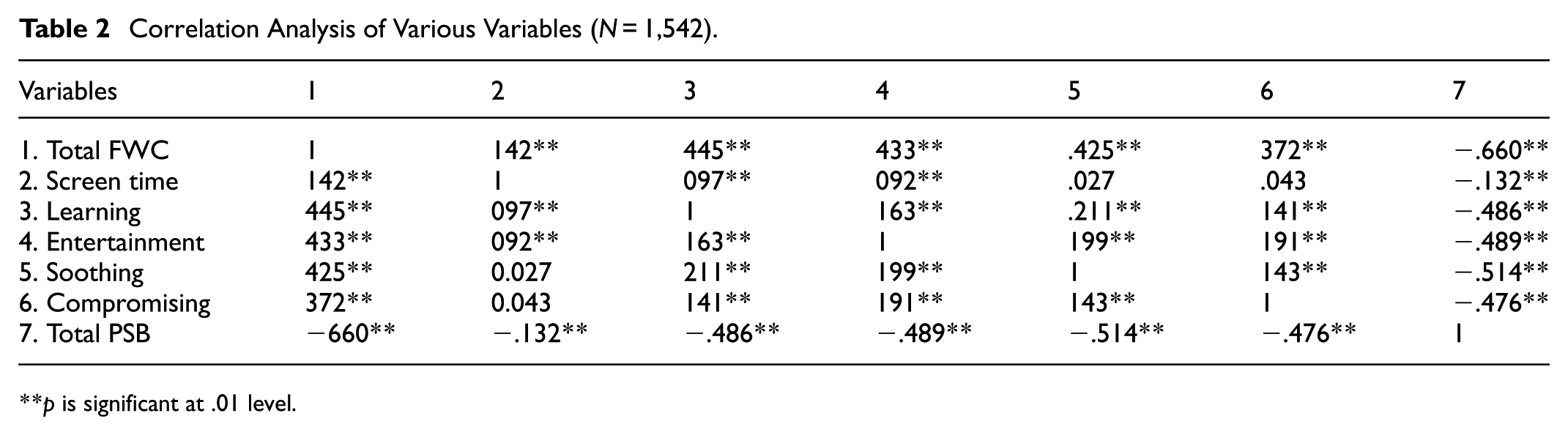
p is significant at .01 level.
As shows in Figure 2, it demonstrates a well-fitted model with statistical significance. According to the model fit test in Table 3, the χ2/df value is 2.145, which is less than 3. Additionally, the RMSEA value is 0.027, SRMR is 0.025, both of which are less than 0.08. Furthermore, CFI is 0.990, and TLI is 0.989, both of which are greater than 0.9. These indicators collectively suggest a good fit for the model.

Hypothetical structural equation model.
Summary of Model Fit Test.

The results of the path coefficients in Table 4 show that household income and family structure have a significant negative impact on work-family conflict. Other indicators do not have a significant impact on work-family conflict, with p-values greater than .05, indicating no statistical significance. Work-family conflict has significant positive effects on the amount of screen time, parents use screen-based media to facilitate learning, entertaining, soothing or compromising with young children, with a p-value of .000, indicating statistical significance. Furthermore, work-family conflict (β = −.429, p = .000), the amount of screen-based media time (β = −.046, p = .000), facilitate learning (β = −.511, p = .000), entertainment (β = −.494, p = .000), soothing child (β = −.583, p = .000), and compromising with child (β = −.544, p = .000) all have a significant negative impact on children’s prosocial behavior.
Summary of Model Path Coefficient Testing (N = 1,542).

Based on our hypotheses and path analysis results, a mediation analysis was performed. Bootstrap results (Table 5) show that work-family conflict has a significant direct effect on prosocial behavior (−0.429, 95% CI [−0.521, −0.352]). Additionally, the mediation effects through screen-based media time (−0.009, 95% CI [−0.018, −0.001]), learning (−0.206, 95% CI [−0.243, −0.174]), entertainment (−0.197, 95% CI [−0.233, −0.164]), soothing (−0.225, 95% CI [−0.263, −0.191]), and compromising (−0.189, 95% CI [−0.221, −0.156]) are all significant, as their confidence intervals do not include zero.
Summary of Mediation Analysis Testing (N = 1,542).

Findings and Discussion
Amid increasing work–family conflict, it has become increasingly common for Chinese parents of young children (aged 0–6) to rely on screen-based media as an alternative parenting tool—serving purposes such as learning, entertainment, emotional soothing, and negotiation in daily routines. This pattern reflects broader social and economic changes in contemporary China, where dual-career households and the pressures of supporting both young children and aging parents exacerbate tensions between professional obligations and family responsibilities (H. M. Wang et al., 2020). Within this context, screen-based media use emerges not only as a pragmatic coping strategy but also as a culturally influenced parenting response.
Chinese parenting practices are strongly shaped by Confucian traditions, emphasizing family harmony, filial piety, and high expectations for children’s academic and moral development (Chao & Tseng, 2002; Yang & Shin, 2008). As such, some parents may perceive screen media—especially educational content—as a tool aligned with these values, particularly when direct parental engagement is constrained by work–family conflict. However, the findings of this study suggest that parent-directed screen-based media use, when employed primarily as a substitute for direct interaction, may be associated with adverse outcomes in children’s prosocial behavior.
Recent empirical studies provide further support for this observation. Pyne et al. (2025) found that certain parenting styles—such as permissive or authoritarian approaches—are associated with greater screen use among young children, while authoritative parenting, which emphasizes warmth and structure, tends to reduce screen exposure. Moreover, Lee et al. (2022) highlight how parents’ own media habits and their attitudes toward technology significantly influence children’s digital media consumption. These findings underscore the bidirectional relationship between parenting practices and media use, reinforcing the need for intentional and reflective parental engagement.
Although traditional values emphasize moral development (Chiu et al., 1997; Luo et al., 2013), the reliance on screen-based solutions in response to work–family pressures may inadvertently conflict with these cultural expectations. The current study’s findings call for a reexamination of parenting strategies within the cultural context of China, suggesting that screen-based practices, while convenient, may not foster the social and moral outcomes parents intend. Future research and family education programs should address this mismatch, offering culturally sensitive guidance on balancing digital media use with the developmental needs of young children.
This study found that parental work-family conflict significantly predicts lower prosocial behavior in children. When parents face conflict between work and family, it can negatively affect children’s prosocial tendencies, aligning with research that links parental stress to children’s socio-emotional challenges (Huhtala et al., 2014; Ruiz Ortiz & Barnes, 2018). The spillover hypothesis (Bolger et al., 1989) suggests that stress in one life domain can affect others; thus, parental stress from work may reduce emotional support and learning opportunities for children, limiting their prosocial development (Belsky, 1984). Traditional Chinese values, such as familial harmony and filial piety (Zhang et al., 2020), may intensify this effect, as work-family conflict disrupts family unity and hinders the transmission of prosocial values. Moreover, societal pressures for success in work and family roles exacerbate stress, straining Chinese parents’ ability to nurture prosocial behavior. While some parents may attempt to buffer these conflicts by prioritizing family harmony, the resulting estrangement can ultimately harm children’s social development, suggesting that this strategy may be counterproductive.
Parental work-family conflict positively predicts the total amount of time children spend using media, as well as parents using screen media to facilitate children’s learning, entertainment, emotional soothing and compromising with children. The higher the conflict, the greater the extent to which media is used as a substitute for parents in fulfilling parental functions. When parents experience conflict between their family responsibilities and work obligations, it may lead to increased reliance on screen-based media as a coping mechanism for both parents and children. This finding is consistent with previous research indicating that parental stress and time constraints are associated with greater use of screen-based devices among children (Ribner et al., 2021; Shin et al., 2021). The role of screen-based media as a convenient and accessible distraction for both parents and children amidst the demands of balancing work and family life. Parents facing high levels of work-family conflict may turn to screen time as a means of managing their own stress and providing temporary relief for their children, thereby inadvertently increasing children’s exposure to screen-based entertainment (Coyne et al., 2021). Research has shown that parental employment, particularly maternal employment, is linked to increased screen time in children. A longitudinal study utilizing data from the China Health and Nutrition Survey indicated that maternal formal employment positively predicted children’s screen time on both weekdays and weekends, suggesting that work demands may limit parents’ ability to regulate their children’s media use (Xie et al., 2023). Additionally, the use of media for compromising and emotional soothing purposes may serve as a coping strategy for resolving conflicts or calming tensions within the family environment, good parent-child relationships can mitigate work-related psychological stress among mothers (Gareis & Barnett, 2002), which may albeit at the expense of excessive screen time for children.
Furthermore, the pervasive influence of digital technology in contemporary Chinese society likely contributes to the observed relationship between parental work–family conflict and children’s exposure to screen-based media. With the widespread availability of smartphones, tablets, and other digital devices, screen media has become an integral part of daily life for many Chinese families (Wang et al., 2019). Recent studies have highlighted that parental stress and work–family conflict can lead to increased reliance on digital media as a coping mechanism, potentially resulting in problematic media use among children. A study conducted in Shanghai during the 2022 spring lockdown found that maternal distress and parenting stress were significantly associated with children’s problematic media use, emphasizing the need for adaptive parenting strategies to mitigate these effects (J. Wang et al., 2024). The ubiquity of digital media platforms offers parents and children numerous opportunities for engagement and entertainment, making it tempting to rely on screen time as a convenient solution to alleviate stress and boredom in the face of family-work conflict. Parents’ use of screen-based media as a means of facilitating learning, entertaining, soothing children and compromising with children mediates the relationship between parental work-family conflict and children’s prosocial behavior, negatively predicting children’s prosocial behavior. The use of screen-based media as a parenting tool has been extensively studied (Elias & Sulkin, 2019; Nikken, 2019; Pretorius et al., 2019; Vandewater, Bickham et al., 2005; Vandewater, Park, et al., 2005). When parents rely on screen-based media to fulfill these functions for their children, it may inadvertently detract from opportunities for children to engage in prosocial behaviors. This finding is consistent with prior research indicating that excessive screen time and passive media consumption can displace time spent on activities that promote social skills and empathy development in children (Gordon-Hacker & Gueron-Sela, 2020; McDaniel & Radesky, 2020; Swider-Cios et al., 2023). Although previous studies have delineated the positive impact of shared media usage by parents and children on parent-child interaction, cognition, and socio-emotional aspects (Alroqi et al., 2023; Archer et al., 2021), the negative impact brought about by parents assuming a mediation role, as explicitly identified in this study, cannot be overlooked. Maternal use of screen-based media to regulate toddlers’ distress is associated with an increase in their negative emotions (Gordon-Hacker & Gueron-Sela, 2020), parents are deprived of face-to-face interaction with their children under the work-family conflict. The displacement hypothesis provides a comprehensive explanation for this result.It posits that time spent on screen-based media replaces time that could be allocated to more enriching and interactive activities, including those that foster prosocial behavior (Vandewater et al., 2005). When parents replace meaningful social interactions, such as collaborative play, shared storytelling, or community involvement, with screen time, it can impede the development of children’s empathy, cooperation, and altruism (Coyne et al., 2021; Radesky et al., 2014). In addition, the passive nature of many screen-based activities may limit children’s opportunities to practice social skills and learn from real-life social interactions, which are essential for the development of emotion and prosocial behaviors (Ostrov et al., 2006; Padilla-Walker et al., 2024; Wan et al., 2021). Moreover, the specific purposes for which parents use screen time for their children may have differential effects on children’s prosocial behavior. In order to alleviate the stress caused by work-family conflict, parents resort to using screen-based media to fulfill their parental responsibilities. This educational purpose compels children to learn through screen-based media, while this is not a negative thing from a parent’s point of view, it is not a child-initiated learning behavior. It may lead to a reduction in prosocial behaviors and poor psychosocial well-being if it displaces time that could be spent on cooperative learning activities or peer interactions in school or community settings (Jordan, 2004; Poulai et al., 2019; Zhao et al., 2018). Similarly, relying on screen time for soothing purposes, such as calming a fussy child or managing disruptive behavior, may provide temporary relief in the short term but may hinder the development of self-regulation and emotion regulation skills necessary for prosocial behavior in the long run (McDaniel & Radesky, 2018a, 2018b).
These findings suggest that while screen media may temporarily alleviate parental stress associated with work–family conflict, overreliance on digital devices as a parenting tool may negatively impact children’s social development. Therefore, it is crucial for parents to establish structured screen-time rules and engage in effective communication with their children to promote healthier media consumption habits. Implementing adaptive parenting techniques can help balance the demands of work and family life, ultimately supporting children’s prosocial behavior.
Conclusion
This study highlights a prevalent trend among parents of 0 to 6-year-olds, wherein screen-based media use is increasingly employed as an alternative parenting tool amidst work-family conflicts in Chinese context. The motivations driving this phenomenon encompass facilitate learning, entertainment, soothing and compromise with children. However, the findings underscore a significant and adverse consequence: parental work-family conflict emerges as a robust predictor of diminished pro-social behavior in young children (Y. Wang et al., 2023). Notably, parental work-family conflict positively correlates with increased media usage, specifically for facilitate learning, entertainment, soothing, and compromising purposes. Moreover, the severity of conflict directly influences the extent to which screen-based media substitutes parental roles, indicating a discernible link between heightened conflict and the media’s augmented role in fulfilling parental functions. Notably, the use of screen-based media for learning, entertainment, soothing and compromising with children emerges as a mediator in the relationship between parental work-family conflict and prosocial behavior in 0 to 6 children, exerting a negative predictive effect on the latter.
It also identified that societal expectations regarding parental involvement in childcare and the pressure to succeed in the workplace may exacerbate the strain experienced by Chinese parents, further compromising their ability to foster children’s prosocial behavior. These findings bear significant implications for parenting practices and family dynamics in China. The increasing reliance on screen-based media as a surrogate parenting tool, driven by escalating work-family conflicts, underscores the need for targeted interventions to mitigate the potential negative impact on children’s prosocial development. Acknowledging the link between conflict severity and screen-based media substitution, interventions should encompass strategies aimed at reducing conflict levels, thereby fostering a more conducive family environment .Specifically, policymakers should consider interventions aimed at reducing parental family-work conflict and supporting work-life balance are crucial for promoting positive child outcomes. Employers can implement flexible work arrangements and family-friendly policies to help alleviate the strain experienced by parents juggling work and family responsibilities (Kossek et al., 2006). Additionally, providing resources and support for parents to manage stress and enhance coping strategies can mitigate the negative impact of family-work conflict on family functioning and children’s development (Repetti et al., 2009). Meanwhile, interventions targeting parenting practices and family dynamics should incorporate strategies to enhance parental supportiveness and promote prosocial behaviors in children. Parenting programs can provide guidance on effective communication, conflict resolution, and stress management techniques to help parents navigate the challenges of balancing work and family life while maintaining positive parent-child relationships (Sanders et al., 2014). Moreover,educators and healthcare professionals can play a crucial role in providing support and resources to help families navigate the challenges of balancing work and family responsibilities while minimizing the reliance on screen-based media. promoting awareness of the potential negative effects of excessive screen time on children’s health and development can empower parents to make informed decisions about media use in their families. This may include offering guidance on healthy media habits, promoting alternative forms of leisure and recreation, and providing parenting workshops or support groups to address family stressors and enhance coping strategies (Bayer et al., 2015).
Limitation and Future Implications
This study contributes to the growing body of literature on the intricate interplay between parental conflict, screen-based media use, and children’s socio-emotional development, offering valuable insights for practitioners, policymakers, and researchers invested in optimizing child well-being in the Chinese context. However, there are still two specific limitations that should be acknowledged. First, the data on children’s screen-based media use were based on parental self-reports, which may be subject to recall bias or subjective interpretation. In particular, while the study focused on parent-directed screen-based media use—that is, media exposure permitted, initiated, or supervised by parents—it is possible that children may occasionally use digital devices independently, without parental permission. Such unmonitored usage may not be fully captured or distinguished in the parent’s report, potentially leading to underestimation or misclassification of certain screen time behaviors. Future studies may benefit from incorporating multi-informant data sources (e.g., direct observation, device tracking, or reports from multiple caregivers) to improve the accuracy and ecological validity of screen time assessment.
This study offers cross-sectional insights into Chinese parents’ use of screen-based media as a parenting tool for children aged 0 to 6 within the context of work-family conflict, yet it primarily examines a single-dimensional relationship. Given prior research substantiating the influence of media exposure on children’s social behaviors, future studies should adopt a more comprehensive approach. Specifically, further research should investigate, from both parental and child perspectives, whether work-family conflict induces significant variations in screen-based media use—whether directed toward learning, entertainment, or soothing—and how these variations impact children’s social behaviors and broader development. Moreover, comparative analyses between screen-based media usage and other parenting strategies amidst work-family conflict would provide a nuanced understanding, thereby equipping parents with empirically grounded, sustainable recommendations to foster children’s prosocial development and overall well-being.
Footnotes

Ethical Considerations
This research was approved by the Scientific Ethics Committee of Shandong Women’s University. Participation in the study was anonymous and voluntary. The procedures used in this study adhere to the tenets of the Declaration of Helsinki.
Consent to Participate
Informed consent was obtained from all individual participants included in the study.
Funding
The authors received no financial support for the research, authorship, and/or publication of this article.
Declaration of Conflicting Interests
The authors declared no potential conflicts of interest with respect to the research, authorship, and/or publication of this article.
Data Availability Statement
The datasets generated during and/or analyzed during the current study are available from the corresponding author on reasonable request.