




Abstract
The current research was carried out to identify dispositional predictors of work/family conflict and enrichment faced by working women. Purposive sampling strategy was used to collect a sample of 265 working women, out of which 129 were married and 136 were unmarried, aged between 22 to 54 years (M = 29.31, SD = 6.39). Data was collected via Big Five Inventory (BFI), Work/Family Conflict Self-Efficacy Scale, Work/Family conflict Scale and Work/Family Enrichment scale. Data was analyzed using correlation, MANOVA and multiple regression analysis. Results revealed that married women with children experienced higher levels of work/family conflict than unmarried working women and married women having one or no children. Moreover, women living in nuclear family system had higher levels of work to family conflict and women living in joint family system had higher levels of family to work conflict. Regression analysis showed conscientiousness, neuroticism and work/family conflict self-efficacy as salient predictors of work/family conflict and extraversion, agreeableness and work/family conflict self-efficacy to be significant predictors of work/family enrichment. These results have important implications for individuals as well as organizations as they demonstrate that dispositional factors do play a major role in determining the levels of work/family conflict and enrichment and will help in identifying women who are more or less prone to experiencing the negative side of work/family interface so that additional support may be provided to them in terms of family friendly workplace policy, social support, and employee counseling, etc.
Plain language summary
The current research was carried out to explore the how the two most important domains of a women’s life, that is, work and family interact and influence each other and to identify individuals who might be more prone to experiencing the negative impact of work/family interface. A sample of 265 working women from diverse professions was selected and information was collected via questionnaires such as big five personality inventory, work/family enrichment scale, work/family self conflict scale and work/family conflict self-efficacy scale. Results show that there is higher incidence of work/family conflict among working women as compared to work/family enrichment. Moreover, having more children and living in extended family system make one more susceptible toward experiencing the negative side of the work/family interface. Additionally, results show that personality can play a role in increasing or decreasing the levels of work/family conflict and/or enrichment. These results have important implications for individuals as well as organizations as they demonstrate that dispositional factors do play a major role in determining the levels of work/family conflict and enrichment and will help in identifying women who are more or less prone to experiencing the negative side of work/family interface so that additional support may be provided to them in terms of family friendly workplace policy, enhancing self-efficacy, providing social support, and employee counseling, etc.
Keywords
Introduction
The social dynamics of collectivistic societies have always ascribed the role of breadwinner to men and house makers to women leading to greater gender disparity (Ali et al., 2011). However, these dynamics have changed considerably in the past few decades. One prime reason for this social change has been the educational achievement of girls/women (Chakraborty et al., 2018). In Pakistan, as more and more women are now getting formal educational qualifications; they are entering the work force due to their educational achievement; financial hardships and rising inflation (Pande-Desai & Rajadhyaksha, 2017). These factors have changed the workforce demographics as the ratio of women entering the workforce is increasing day by day. Resultantly, the family dynamics have also undergone from single earning to dual earning families (Molina, 2020). However, these changing dynamics have not exempted South Asian women from household responsibilities. They are expected to fulfill their family related responsibilities, at times without any help from the female/male members of the family. Moreover, their work burden is in addition to their domestic jobs; thus adding to their overall burden as a working and family person. This multi role burden makes it imperative to study work/family interface in the context of those countries where gender role compartmentalization is predominant. Such is the case in Asian countries, where collectivistic non-egalitarian values result in females assuming the responsibility of the entire household in addition to their jobs. Moreover, this research aims to highlight how the interaction of work and family domains can have both negative as well as positive impact on the life’s of women impacting their relationships as well as overall well-being and how important it is to provide them with additional support to overcome the negative impact and enhance the positive impact of work/family interface (Sarfaraz & Khalid, 2021).
Work/family interface (WFI) refers to the interplay between family and work domains comprising of both negative (family or work conflict) and positive (family or work enrichment) sides; either inhibiting or facilitating the family or work life (Holmes et al., 2020). Majority of work that has been done in the context of family or work interface has focused primarily on work or family level factors impacting work/family interface while little attention has been paid to dispositional level factors (Salleh et al., 2018). Some of the dispositional factors that have gained researchers attention in the perspective of family and work conflicts include negative affectivity, type A behavior, general self-efficacy, maladaptive perfectionism, general locus of control and toward big five personality traits (Andreassi, 2011; Zhang & Liu, 2011).
Recent research by Soni and MisraBakhru (2019) validates that the work/family interface is in fact regulated by dispositional and personality traits, such as the big five factors, etc. It highlights that the family or work conflict can be mitigated while adaption of positive traits that enhance facilitation like “extraversion, conscientiousness, agreeableness” or through the reduction of negative traits like “neuroticism”. Another research by Salleh et al. (2018) and Paulson and Leuty (2016) also confirms that dispositional predictors (such as personality, self-efficacy, positive effect, and coping styles, etc.) are important determinant of work/family interface). However, individual differences in the way people balance the domains of work and family life needs further exploration and this issue needs to be highlighted especially in the context of less developed or developing countries so that additional support may be provided to working women who are more susceptible to the effects of the negative side of work/family interface (i.e., work/family conflict) (Molina, 2020; Sarfaraz & Khalid, 2021).
Resultantly, researchers believe that it is important to study big five factors in the context of work and family interface, since the big five factors highly correlate with innovative workplace behaviors (Woods et al., 2018) and shape the way we respond to work and family interactions (Zaman et al., 2020). Moreover, different studies have focused on the exploration of family or work with reference to general self-efficacy with no or little emphasis to more relevant work conflict self-efficacy (Cinamon, 2006; Zhang & Liu, 2011).
Additionally, in the perspective of Pakistan, there is limited published work relating work/family interface to dispositional factors. Since Pakistan is a predominantly, a patriarchal non-egalitarian country where gender roles are prescribed and binding in nature. Hence, women in addition to working outside the home are expected to resume full responsibility of household work as well as child/elderly care responsibilities. As a result they may face higher levels of work family conflict. On the other hand employment status provides women a sense of autonomy as they gain the financial power and independence in the household. This may result in enriching their work/family work experience. Additionally the joint family system (i.e., where extended family members live together) might add to the burden of working women leading to higher levels of conflict. However, some researchers argue that extended family members can also provide additional support leading to enrichment (Sarfaraz & Khalid, 2021). Thus the way the two most important spheres of women’s life, that is, work and family interact can have important implications for parenting, child development, relationships, well-being and ability to take care of extended family members (Holmes et al., 2020).
Therefore, it is important to highlight the impact of a highly understudied intersection of work and family domain; and how it affects a women’s life in indigenous context. It is an ignored discourse in the context of Pakistan, hence it is significant to add to the limited body of work/family interface literature in Pakistan. Eby et al. (2005) also highlight the importance of studying work/family interface from different cultural perspective as the social and cultural strings have an impact on the level of positive and negative interface from work and family domains.
Thus, the purpose of the current study is to address this issue and highlight how the interface of work and family can have both negative and positive impact on the lives of working women and to explore the relationship among big five personality factors, work/family conflict self-efficacy (WFC-SE), work/family conflict (WFC) and work/family enrichment (WFE). This will help us identify women who might be more susceptible to developing work/family conflict and thus require greater support from both work and family domains.
Methodology
Participants
The method used to collect data for this study was a non-probability sampling; using community referrals and/or snow ball sampling technique. The primary inclusion criterion was 1 year regular employment status of the participants. Both early and mid-career participants were recruited from a full time, formal work setting such as Banks, Hospitals, Non-profit organization, Telecom companies, and Educational Institutes. These work settings are popular among women seeking employment opportunities in Pakistan. Initially a sample of 300 participants was contacted out of which 273 participants returned the questionnaires after repeated follow-ups. Eight more questionnaire had to be discarded as the data was incomplete. Thus, the sample for this study composed of 265 working women (129 married; 136 unmarried). The age range was between 22 to 54 years (M = 29.31, SD = 6.39). The education of the participants varied from Bachelors to PhD. The sample predominantly belonged to middle and upper-middle socio-economic status.
Psychological Measurements
The psychological instruments were used in the current research study to collect the data from participants.
Work/Family Conflict Scale (WFCS)
The work family conflict scale is an 18 items self-report measure developed by Carlson et al. (2000). It measures responses on a 5-point Likert type scale ranging from 1 (completely disagree) to 5 (completely agree). The items measure the six aspects of the work family conflict resulting from two directions of work/family conflict (work to family conflict and family to work conflict) and three forms of each type of conflict (i.e., time-based, strain-based and behavior-based). The high scores indicate high work and family conflict and low scores indicates low response in the conflict between the variable. The reliability alpha coefficient of the scale ranges from .78 to .87.
Work/Family Enrichment Scale (WFES)
Work Family Enrichment Scale is an 18 item self report measure developed by Carlson et al. (2005). It measures both directions of work/family enrichment, that is, work to family and family to work enrichment using a 5-point Likert type scale ranging from 1 (completely disagree) to 5 (completely agree). It measures three dimensions from the work to family direction (development, affect, and capital) and three dimensions from the family to work direction (development, affect, and efficiency). The high scoring of the mentioned scales shows the higher level of individual’s enrichment experience and vice versa. The reliability alpha coefficient of the scale ranges from .76 to .87.
The Big-Five Personality Inventory (BFI)
The personality assessment scale which was developed by John and Srivastava (1999), which measures individual personality magnitudes. The different trait based personality phrases used to measure the personality aspects. The response of an individual was collected through Likert scale scored from 1 to 5 respectively. The psychological instrument presents 8 to 10 items which represents different dimensions of personality. The score of every dimension collected separately and computed at the end of the instrument. Furthermore, the scale reliability alpha coefficient ranges from .75 to .90 has alpha ranges with an average above.80.
Work/Family Conflict Self-Efficacy Scale (WFCSES)
The psychological instrument developed by Cinamon (2006), which helps to measure about individual’s belief system. This individual system who helps to keep balance between family and work conflicts. The psychological instrument consisted on 10 items. It has been developed on a 10-point measurement instrument, where “0” refers “complete lacking of confidence level in individual’s capability” or “9” raises “Individual’s confidence level”. The final score of this scale is designed while summing up of all responded answers. The reliability alpha coefficient of the instrument ranges from .83 to.84.
Procedure
The workplace remained the main place to collect the data for the present study. After obtaining both verbal and written consent forms; individual participants were approached to contribute in the study at their respective workplaces. The purpose of the study was briefed to them and they were ensured that their confidentiality and data protection will be the main priority of the research. They were informed that their responses will be kept anonymous and a specific number will be assigned to them so that their data could not be used outside of this study, specifically by their employers. They were informed that the questionnaires would take about 15 to 20 min of their time; however some participants requested to return the questionnaire after a day or two which after repeated follow-ups were returned within a weeks period. The copies of questionnaire which were disseminated were 300 and approximately 273 copies of questionnaire were returned to the research team by the consented participants due to the repeated follow ups by the research team. Moreover, eight questionnaires were discarded by the research team since more than half of the items in the questionnaire were left incomplete. The SPSS software was used to run analysis on the answers obtained through 265 questionnaires.
Results
Results were analyzed using SPSS, for correlation analysis “Pearson Product Moment Correlation”, and for predictive relationship between the study variables “Multiple Linear Regression Analysis” was used. The demographic characteristics of the study participants are presented in Table 1.
Result Showed About the Percentages and Frequency of Demographic Variables (N = 265).
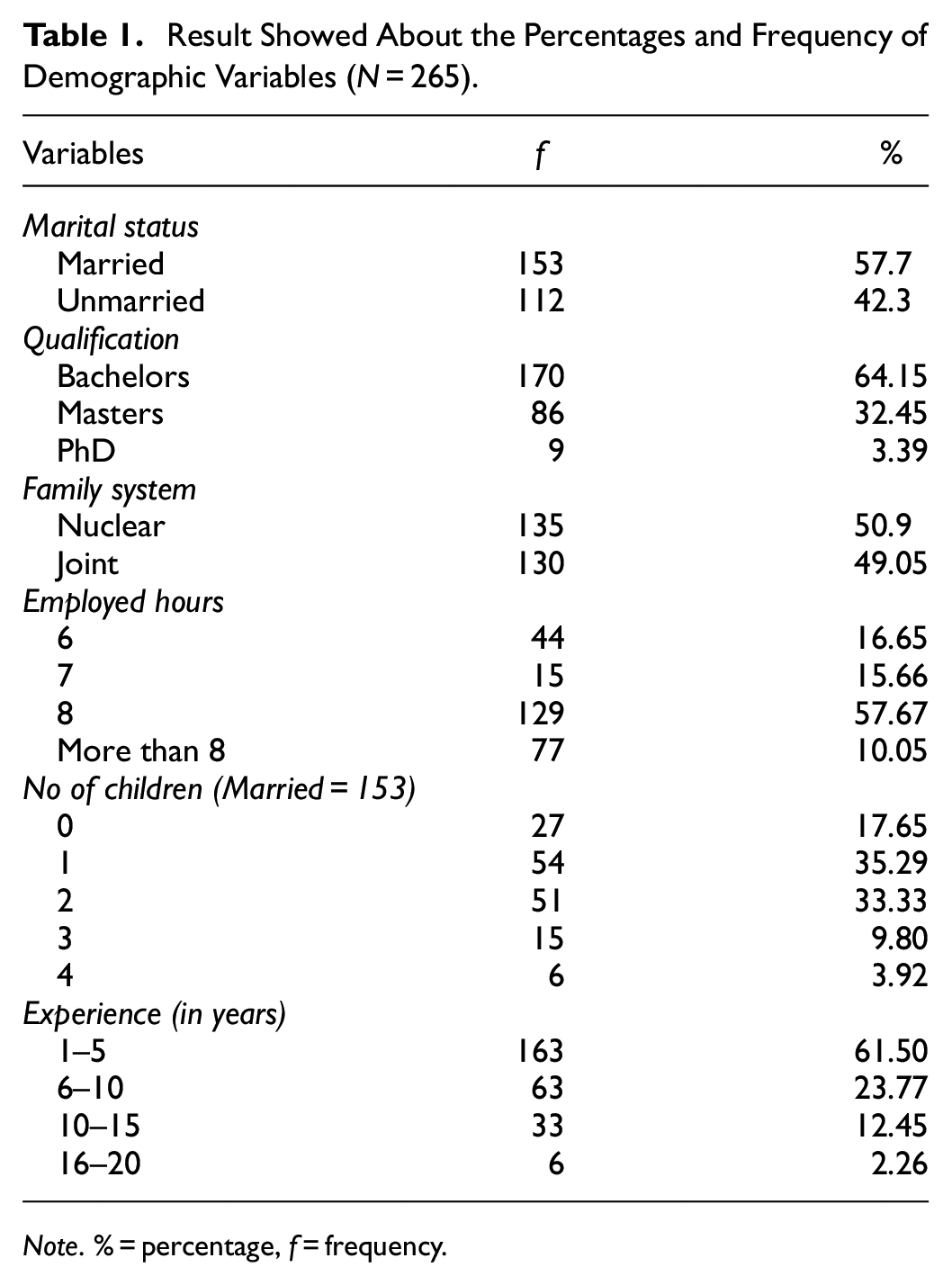
Note. % = percentage, f = frequency.
Descriptive analysis revealed that more than 70% of the sample had higher levels of work to family conflict, and 69% of the sample reported higher levels of family to work conflict. Moreover, in case of work/family enrichment, almost 61%of the sample reporting medium to high levels of work to family enrichment and 49% of the sample reported medium to high levels of family to work enrichment.
MANOVA was used to analyze differences in the levels of both forms of work/family conflict and work/family enrichment across different demographic variables. Results show that married and unmarried women differ significantly in their levels of work/family conflict F(2, 264) = 7.58, p < .001, where married women score significantly higher (M = 209.36, SD = 46.50) than unmarried women (M = 185.95, SD = 56.62) on both forms of work/family conflict. However, non-significant results were reported in case of both forms of work/family enrichment.
Number of children was also a significant determinant in case of work/family conflict F(4,148) = 6.45, p < .001, women having one or no children scored lower on both domains of work/family conflict than women having two or more children, however in case of work/family enrichment number of children did not make any difference. Additionally, women living in joint family system scored higher on family to work conflict, whereas women living in nuclear family system scored higher levels of work to family conflict F(2, 264) = 4.32, p < .01. However, non-significant differences were found among people living in nuclear and joint family system on WFE. Education level, working hours and experience had no impact on both directions of work/family conflict and work/family enrichment.
Correlational analysis reveals that both variables such as work to family and family to work conflict had significant negative correlation with self-efficacy, which shows that individuals with high levels of work/family conflict have low work/family conflict self-efficacy and vice versa. Furthermore, big five factors of personality showed that both WFC and FWC had significant negative correlation with majority of its factors such as conscientiousness and openness to experience and agreeableness, while it is significantly positively associated with one of the factor which is neuroticism. However, work to family and family to work conflict has non-significant association with extraversion.
In case of family to work enrichment (FEW) and work to family enrichment (WFE) both variables were significantly positively associated with work/family conflict self-efficacy showing that higher the self-efficacy higher the levels of enrichment experienced by the individuals. In addition, “Extraversion, Agreeableness, Conscientiousness and Openness to experience” were significantly positively correlated with both directions of enhancement such as; family to work and work to family. However, negative significant association was found between both directions of work/family enrichment and Neuroticism. The results are presented in Table 2.
Inter-Correlations Among Scales and Subscales (N = 265).
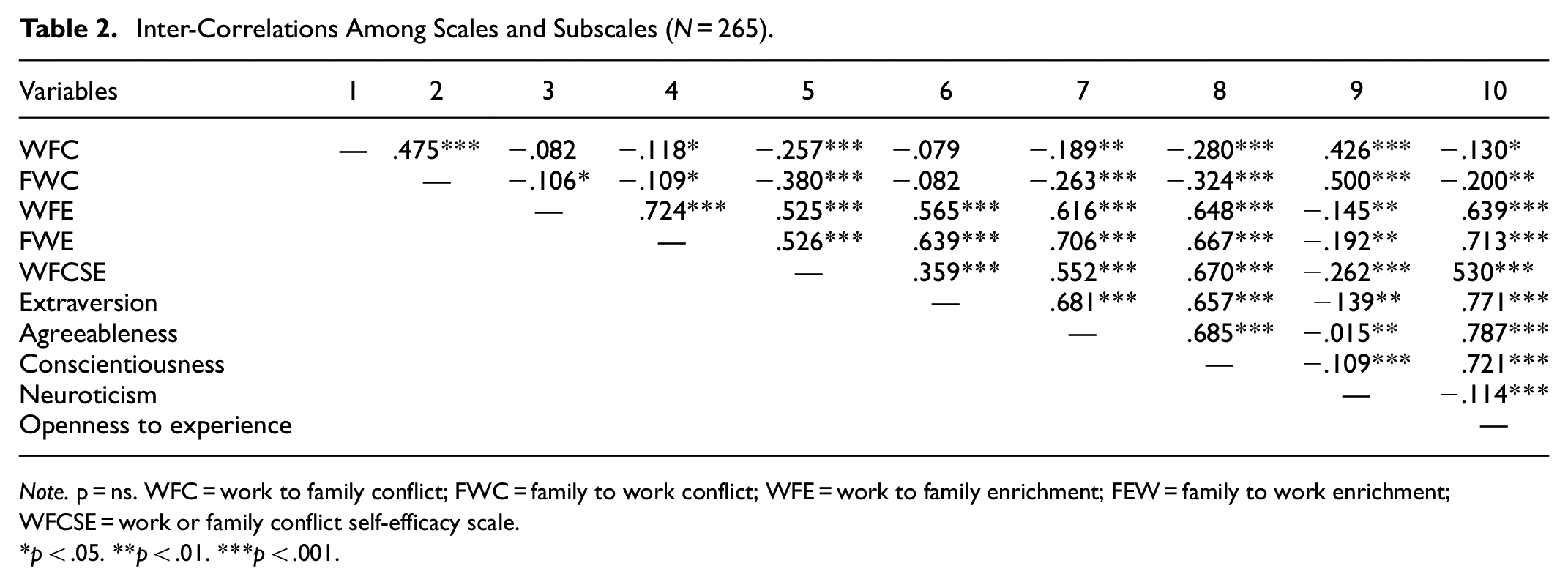
Note. p = ns. WFC = work to family conflict; FWC = family to work conflict; WFE = work to family enrichment; FEW = family to work enrichment; WFCSE = work or family conflict self-efficacy scale.
p < .05. **p < .01. ***p < .001.
In case of work to family conflict the model accounted for 32% variance in the outcome variable (F(10,254) = 12.05, p < .001). Only one component of big five, that is, Conscientiousness (β = −0.199, p < .05) and work family conflict self-efficacy (β = −0.123, p < .05) significantly negatively predicted work to family conflict, and Neuroticism (β = 0.330, p < .001), Openness to experience (β = 0.344, p < .01) significantly positively predicted family to work conflict. However, in case of extraversion and agreeableness results were non-significant (Table 3).
Multiple Regression Analysis Predicting Work and Family Conflict (N = 265).

Note. p = ns.
p < .05. ***p < .001. **p < .01.
In case of family to work conflict, the results were significant F(10,254) = 21.82, p < .001, having R value of .68 and R2 value of .46 respectively. The model accounted for almost 46% of the variance in FWC. Neuroticism (β = 0.398, p < .001) and “Openness to experience (β = 0.329, p < .001) positively predicted work to family conflict and agreeableness (β = −0.218, p < .05), conscientiousness (β = −0.179, p < .05), and work/family conflict self-efficacy (β = −0.154, p < .05) negatively predicted work to family conflict. However, extraversion did not turn out to be a predictor of work to family conflict (Table 3).
Result of Table 4 showed that there was a significant relationship F(7,257) = 79.15, p < .001, with an “R2 value of .68” and “R value of .82”. The value of R2 represents that the model accounted for 68% variance in family to work enrichment, where “Agreeableness (β = 0.304, p < .001)”, “Extraversion (β = 0.295, p < .001)”, “Openness to experience (β = 0.052, p < .05)”, and work family conflict self-efficacy (β = 0.128, p < .05) turned out to be significant predictors of work to family enrichment.
Multiple Regression predicting Work or Family Enrichment (N = 265).

Note. p = ns.
p < .05. **p < .001.
The model for family to work enrichment was also significant F(7,257) = 88.05, p < .001, with an R value of .84 and R2 value of .706. Extraversion (β = 0.347, p < .001), Agreeableness (β = 0.274, p < .001), openness to experience (β = 0.273, p < .001) and work or family conflict with self-efficacy (β = 0.105, p < .05) turned out to be significant predictors of family to work enrichment (Table 4).
Discussion
The current research aimed to look at the extent of work/family conflict and work/family enrichment among working women and to see whether level of work/family conflict and work/family enrichment vary as a result of marital status, number of children and family status in addition to other demographic variables. Moreover it also explored the role of dispositional factors in determining the levels of work family conflict and work family enrichment.
Descriptive and differential analysis reveals that there is high prevalence of work/family conflict among working women; where married women especially those having two or more children were more susceptible to experiencing the negative side of work/family interface. This is primarily because married women had to play multiple roles at home in addition to their work roles adding to the work burden as compared to unmarried working women. However, when it comes to resources; being married doesn’t call for any level of support for south-Asian women (Sarfaraz & Khalid, 2021). Moreover women living in nuclear set up experienced higher levels of work to family conflict and women living in joint family system experienced higher levels of family to work conflict. This is because women living in nuclear family system have to accomplish all tasks by themselves and greater demands at work interfere with their ability to manage family roles on the other hand women living in joint family system have to cater to the needs of immediate and extended family adding to the burden which might be carried over to work domain (Sarfaraz & Khalid, 2021; Syed et al., 2018). However, when it comes to work/family enrichment; number of children, marital status and family system does not make a difference.
Results of correlational analysis showed that in case of work/family conflict. Personality variables such as “Neuroticism” and “Openness to experience” are positively associated with both directions of family and work conflict. Moreover, conscientiousness, agreeableness and work/family conflict self-efficacy have negative correlation with work to family and family to work conflict. Nonetheless, it has been indicated that non-significant correlation exists between extraversion and both directions of work/family conflict.
In case of work/family enrichment correlation analysis shows “Conscientiousness”, Agreeableness, Extraversion and Openness to experience” has positive association with work to family and family to work enhancement. Meanwhile work to family self-efficacy also has positive significant association toward WFE as mentioned in the previous studies (Crain & Hammer, 2013; Micheal et al., 2010; Wayne et al., 2006).
The Multiple Regression Analysis showed that neuroticism is a substantial predictor of family to work and work to family conflict. This could be because individuals who score high on neuroticism are emotionally unstable (John & Srivastava, 1999); they are unable to handle the pressures and demands of work and family life and the emotional baggage that comes with it which results in higher levels of WFC. The results also indicate that openness to experience significantly positively predict both directions of WFC. The reason for openness to be a positive predictor both directions of WFC could be because individuals who score high on openness to experience are more likely to indulge in new experiences and are open to new opportunities to learn and grow in their profession/family life which might take away the time which could be spent in the other domain. Earlier researches also support the results of current research (Bruck & Allen, 2003; Micheal et al., 2010; Priyadharshini & Wesley, 2014).
Result also show that conscientiousness is a significant negative predictor of both sides of WFC. It has been noted that individuals who achieved high score on the factor of conscientiousness are more organized, efficient, punctual, strong willed and are better able to balance the demands of both domains. Additionally, significant negative correlation was also found between agreeableness, WFC and FWC. The cooperative and compassionate nature of the agreeable individuals might support in the reduction of tension and conflict at home resulting in decrease in the family related factors influencing the work or vice versa. Relevant literature also supports these results (Allen et al., 2012; Bruck & Allen, 2003; Priyadharshini & Wesley, 2014).
In addition, work/family conflict self-efficacy also significantly negatively predicts both domains of WFC. This shows that individuals who have higher WFC-SE are better able to handle the competing demands of work and family domain as they are more resilient and believe in their ability to handle life conflicts. As a result, they experience lower levels of work to family and family to work conflict. Different studies also proved that self-efficacy is an important determinant of WFC (Cinamon, 2006; Hennessy, 2007). However, present study did not show the statistical significant relationship between extraversion and both directions of WFC nor did it turn out to be a significant predictor toward the study variables.
Regression analysis for both forms of work/family enrichment was also carried out to identify the predictors of WFE. Result shows that extraversion, agreeableness and openness to experience are significant positive predictors of both directions of WFE. This is because extrovert individuals have bigger social circle due to their friendly and outgoing nature, thus have greater chances of support from work and family domains leading to higher levels of enrichment. Moreover, sympathetic nature of agreeable individuals would support them in reducing interpersonal conflict which eventually result in increasing WFE. Previous literature also shows that extroversion and agreeableness are positively associated with WFE (Crain & Hammer, 2013; Micheal et al., 2010). Openness to experience variable is conceivably being linked with learning of new skills, experiences or being open to changes as a result openness to experience significantly predicts work/family enrichment. Existent literature in the area of work/family interface also support the results of this study (Micheal et al., 2010; Wayne et al., 2006). However, “Neuroticism” and “Conscientiousness” which are prominent predictors of WFC did not turn out to be significant predictors in case of WFE.
The work and family conflict self-efficacy was also found to be significant positive predictor of WFE. Those individuals, who have high self-efficacy, believe that they are able to resolve family and work conflict and believe that they can control the outcomes in both work and family domains, leading to greater enrichment. These results are also supported by previous literature (Greenhaus & Powell, 2006; Micheal et al., 2010; Wayne et al., 2006).
The results shed light on the nature of the constructs of WFC and WFE and it can be asserted that these variables can exist simultaneously since they are not in contrast to one another. It is further strengthened by the way these variables relate to dispositional factors. Where one is predicted the other is not by most of the dispositional factors, such as; neuroticism and conscientiousness predict WFC but not WFE. While, extroversion is an important predictor of WFE but not of WFC; openness to experience stood out as the only factor that related to both WFC and WFE. Hence the intricate interfaces of enrichment and conflict can exist side by side and factors that can lead to create or enhance enrichment in work/family domain can also be a source of conflict in another or similar dynamics. The key element of the core of this complex and sophisticated cyclic interaction is the unique cultural aspect of collectivistic, patriarchal, and non-egalitarian psycho-socio-cultural undercurrents. This multi-dimensional situation calls for to appreciate the fact that women living in the cultures under discussion have some very peculiar, situational, culturally, and value laden string that bind them to their multiple gendered roles. It’s a very cultural and indigenous concept that a woman is seen as the first person to look after her family; no matter how significant or remarkable role she has at work, which comes second to her primary family roles. Hence the study in the context of indigenous work, has certain ground breaking results that add to our understanding of the constructs of work/family conflict and work/family enrichment (Micheal et al., 2010).
Suggestions and Limitations
The finding of the current study reveals the following limitations which may impact the generalizability of this study. The current study sample was limited and based on a sample of working women. To foster inclusivity and avoid the gender bias, the same study could be extended to explore the same factors among men. It will aid the generalizability of the study. Moreover, only formally educated urban women were approached in this study. Another important population of interest could be less or uneducated, informal, domestic workers/house maids in urban and sub-urban towns; rural area. These are the most vulnerable, under or unpaid and exploited working class. Study sample was based on the one major city due to the time and other constraints. Therefore, in future a socio-economically and geographically representative sample could enhance our understanding of the variables. Questionnaires were used to collect data which does not take into account temporal information, thus in future research should be done using mixed-method approach to gain a thorough understanding of the phenomenon under study.
Conclusion
Current research was aimed to explore the role of WFC and WFE in South Asian context in addition it was also aimed to identify the role dispositional factors play in determining work/family conflict and work/family enrichment among full time, educated and qualified working women. Results revealed that dispositional personality factors are not only related to both directions of WFC and WFE but also turn out to be significant predictors of both conflict and enrichment. Moreover, it was additionally observed that the inter-twining of socio-cultural background and dispositional factors of women living in collectivistic cultures presents an interesting but complex multifaceted interaction of cultural value system, dispositional personality factors and WFC and WFE.
Study Implications
Current study insights derived from the results and analysis discern that the dispositional influences play a dominant part in the determination of the family and work conflicts and enrichment and add to the existing body of work/family interface literature. Moreover, the results also provide significant implications for organizations working for both women centric advocacy and policy making. It does it by suggesting the importance personality may play while maintaining the balance in between work and family expectations. Therefore dispositional factors (such as personality) of working women must also be taken into consideration to identify individuals who will be able to balance between work and family domains, and to identify those who might be at greater risk for developing work/family conflict. Additionally, it creates awareness concerning the impact of work and family domains on working women. Study outcomes will also be of use to occupational councilors to identify individuals who might in need of greater help in balancing the demands of work and family domain. Therefore, researchers should also focus on studying these variables in the context of work/family interface in addition to other work and family level factors.
Footnotes
Acknowledgements
The authors would like to acknowledge the contribution made by the research participants. The authors acknowledge the contribution of all the individuals who participated in this study.
Declaration of Conflicting Interests
The author(s) declared no potential conflicts of interest with respect to the research, authorship, and/or publication of this article.
Funding
The author(s) received no financial support for the research, authorship, and/or publication of this article.
Ethical Approval
As per the institutional regulations and local laws, ethics committee approval was not required for survey-based research concerning human participants.

Data Availability Statement
Data sharing not applicable to this article as no datasets were generated or analyzed during the current study.