




Abstract
The widespread promotion of Chinese in the world is closely linked to the training of pre-service Chinese teachers in China. Agentic engagement in pre-service Chinese teachers’ training study is particularly important for their professional ability and career development. Supported by self-determination theory and social cognitive theory, this study seeks to investigate the process through which the satisfaction of basic psychological needs such as autonomy, competence, and relatedness, as well as course self-efficacy, as motivating factors, influence agentic engagement to help pre-service Chinese teachers actively participate in course activities and make full preparation for the future Chinese teaching career. A total of 201 pre-service Chinese teachers from six public liberal arts universities in Beijing, China, participated in this study. The results from structural equation modeling indicate that (1) the need for autonomy, competence, and relatedness directly predicts course self-efficacy and agentic engagement; (2) Course self-efficacy has a direct positive effect on agentic engagement; (3) Course self-efficacy partially mediates the relationship between the three basic needs and agentic engagement, respectively. This study emphasizes the need to address the three fundamental needs and sense of efficacy of pre-service Chinese teachers in fostering and motivating their agentic engagement and considers implications for research and teaching at the higher education level.
Plain language summary
This study examines how pre-service Chinese language teachers being trained to teach Chinese as a foreign language globally are actively engaged in their learning and how personal factors such as basic needs and self-confidence affect this engagement. Active participation in education is crucial for the skills and self-confidence they will need. Understanding their motivations for participating in training can help improve educational programs and better equip them for their teaching roles. Researchers surveyed 201 Chinese preservice teachers from six public universities in Beijing, China. The extent to which their three basic needs, autonomy (self-directed), competence (capable), and relatedness (relationship with others), were satisfied was measured, as well as how self-confidence affected their active learning behaviors. The results showed that the three basic needs directly enhanced confidence in engaging in active learning. And their confidence also had a strong positive impact on active engagement. The findings of the study suggest that teacher training programs should focus on meeting the psychological needs of pre-service teachers and building their self-confidence.
Keywords
Introduction
Benefiting from China’s increasing global influence, more and more countries and regions have begun to value Chinese learning (Starr, 2009; S. Wang & Wang, 2010). Following the founding of the inaugural Confucius Institute in South Korea in 2004, the teaching of the Chinese language has flourished internationally (Zhao & Huang, 2010). In several countries, Chinese has even been incorporated into the national education system (Tang, 2021), signifying that Chinese has emerged as one of the most widely spoken languages globally following English (Gil, 2011).
In light of the growing interest in learning the Chinese language, prioritizing the training of Chinese teachers has become essential. To address the problems of Chinese language teaching alignment as well as teacher shortage (Aimin, 2015), the Chinese Council of Education (CCE) established a master’s degree program called Teaching Chinese to Speakers of Other Languages (TCSOL) in 2008, with the aim of cultivating excellent Chinese teaching talents with cross-cultural communicative competence (Ding, 2018).
Up to now, more than 200 institutions in mainland China have offered this program. Currently, Chinese language teachers are the backbone of Chinese teaching. It will take the majority of these pre-service Chinese teachers at least 2 to 3 years of intensive study to achieve a master’s degree and then become professionally qualified to teach in various areas of the world. Recent studies on pre-service Chinese teachers mostly focus on whether the curriculum is scientific, the teaching methods are appropriate, and the cultivation of cross-cultural awareness is implemented (Feng, 2009; Z. Lin & Yi, 2023; H. Liu, 2012). Additionally, there is a lack of studying them from the perspective of educational psychology (Zhang et al., 2020).
Agentic engagement, as an emerging concept, is an individual’s actively participating in learning, taking the initiative to ask questions, expressing personal insights, and contributing to the learning activity (Reeve & Tseng, 2011), and now associated with individual motivation as well as achievement (Reeve & Jang, 2022). Examining the factors that influence students’ agentic engagement has garnered interest in several fields of study (Montenegro, 2017; Zambrano et al., 2022). In second language learning, for instance, factors influencing agentic engagement have been investigated (Dong, 2020), while the field of teaching Chinese still has gaps.
Grounded in self-determination theory (SDT), needs for basic satisfaction are ingredients and nutrients essential to individual development and have been shown to have universality across cultures (B. Chen et al., 2015). Additionally, it is frequently assumed that self-efficacy is impacted by satisfaction for basic needs, which is a motivational construct (Macakova & Wood, 2022; Meng, 2022). Additionally, according to social cognitive theory (SCT), individuals’ perception of self-competence enhances self-knowledge as well as the ability to cope with challenges. According to the existing literature (Dostmohamadi et al., 2021; Lisady & Wong, 2022), basic needs satisfaction and self-efficacy can serve as motivational factors influencing agentic engagement.
Therefore, the proper aim of this study is to thoroughly examine the devices whereby basic needs satisfaction and self-efficacy affect pre-service Chinese teachers’ agentic engagement, and whether self-efficacy could mediate their relationship, establishing a link between motivational structure and agentic engagement. Furthermore, supported by SDT and SCT, this study validates the rationale of Reeve and Tseng’s (2011) framework of agentic engagement, which provides guidance on how to encourage active learning among students in higher education classrooms.
Literature Review
Basic Needs Satisfaction and Course Self-Efficacy
Needs for basic psychological satisfaction have been proven to be a fundamental element of individuals’ development, influencing self-motivation and psychological health (Ryan & Deci, 2000). It contains three dimensions called autonomy, competence, and relatedness need that demonstrate universality across different cultures. For example, B. Chen et al. (2015) conducted a cross-cultural study involving participants from China, the United States, and other countries. The results showed that the satisfaction of autonomy, competence, and relatedness needs predicted well-being across all cultural contexts. This finding supports the view proposed by SDT that these basic psychological needs are not culturally limited and are universally applicable. In addition to cultural universality, these basic psychological needs are also evident across various life domains, such as sports, work, and education (Breaugh, 2021; Erturan-İlker et al., 2018; Holzer et al., 2021).
In the educational realm, the fulfillment of these basic needs not only greatly affects the growth of students’ intrinsic motives and academic outcomes but also their psychological health and overall learning experience (Ryan & Deci, 2000). For instance, Badri et al. (2014) conducted a study involving 296 high school students in Tabriz, Iran, and found that the satisfaction of basic psychological needs had a positive effect on students’ intrinsic motivation and academic achievement. Their study highlighted that a school culture supporting autonomy fosters an environment conducive to academic success.
Similarly, Niemiec and Ryan (2009) proposed that when the educational environment supports students’ needs for autonomy, competence, and relatedness, students tend to show higher academic engagement, better academic achievement, and improved psychological well-being. They further noted that the satisfaction of these needs facilitates the internalization of learning and promotes personal growth.
According to Bandura (1997), self-efficacy represents individuals’ faith in their ability, and some studies indicated that it is related to basic needs satisfaction (Karbakhsh & Ahmadi Safa, 2020; Macakova & Wood, 2022). For example, a survey conducted by Karbakhsh and Ahmadi Safa (2020) on 506 Iranian university students found that basic psychological needs satisfaction indirectly enhanced self-efficacy through the mediating role of goal orientation and willingness to communicate, emphasizing its important role in stimulating motivation and behavioral dispositions. Similarly, Macakova and Wood (2022) found that basic psychological need satisfaction was significantly and positively related to self-efficacy in a study of 203 European adult students, suggesting that need satisfaction contributes to learners’ confidence in their abilities in educational contexts.
During the learning context, satisfaction of basic needs can positively affect self-efficacy across different groups (students and teachers). A study by Y. L. Wang and Tsai (2020) foundstudy by Y. L. Wang and Tsai (2020) found that students’ science self-efficacy was significantly predicted by basic needs satisfaction in Taiwan high schools. Additionally, for explaining self-efficacy, basic needs satisfaction is the most prevalent factor. However, many studies only treat basic needs satisfaction as a whole construct. The specific functions of autonomy, competence, and relatedness on course self-efficacy are less. Hence, based on previous literature, the following is the study’s first hypothesis:
Course Self-Efficacy and Agentic Engagement
Under SCT, self-efficacy is key in influencing student educational engagement (Bandura, 1986). Self-efficacy determines the amount of experiences a person has when faced with a challenge or misfortune; people who perceive a strong sense of efficacy are inclined to confront difficulties head-on, whereas those who have a doubtful view of their abilities are more inclined to give up (Bandura, 1997). Previous studies demonstrated that sense of self-efficacy and engagement were highly correlated and together predicted students’ academic performance (Sökmen, 2021).
Concerning agency, it refers to an individual’s adoption of submissive behaviors or other behaviors by exerting self-influence (Bandura, 1999). For the significance of agency in classroom learning, Reeve and Tseng (2011) proposed a new idea: agency can be used as a new dimension of learning engagement to motivate students to learn. Earlier, it was accepted that learning engagement encompasses emotional, cognitive, and behavioral components (Fredricks et al., 2004). In light of this, Reeve and Tseng (2011) introduced a new dimension (agentic engagement) and used 365 high school students from Taiwan and confirmed that agentic engagement forecasted academic achievement in addition to being related to the other three dimensions of learning engagement.
Specifically, agentic engagement is a behavioral performance that can be observed as the learner emits an initiative that contributes to the learning process (Reeve, 2013). It means that students are not passive learners but try to actively create personalized and enriched learning environments by presenting their needs according to their wishes, as well as having the freedom to express their opinions (Reeve, 2013). This suggestion is in line with the current student-centered perspective in curriculum-based education, where students are both learners and learning builders (Lea et al., 2003).
Agentic engagement possesses a predictive effect on students’ learning skills, classroom performance, and so forth (Reeve & Tseng, 2011). Some studies agree with Reeve and Tseng’s (2011) agentic engagement framework by incorporating it into learning engagement (Jiang & Zhang, 2021; Montenegro, 2017). However, when it comes to the factors affecting agentic engagement, there are fewer studies of them specifically. Research has shown that behavioral, cognitive, and emotional engagement can all be influenced by motivational factors in the context of curriculum-based learning (H. Liu et al., 2025; Y. Liu et al., 2024; Park & Yun, 2018). For example, H. Liu et al. (2025) found in a study of 687 Chinese high school students that basic psychological needs influenced behavioral engagement in English learning both directly and indirectly via motivation and boredom. Moreover, Y. Liu et al. (2024) conducted a study with 745 undergraduate students majoring in education who were enrolled in the course “Educational Policies, Regulations, and Teachers’ Professional Ethics,” and found that extrinsic motivation significantly and positively predicted students’ emotional engagement. In addition, Park and Yun (2018) found in their study of 95 American undergraduate and graduate online course learners that different motivational regulation strategies significantly predicted behavioral engagement, emotional engagement, and cognitive engagement after controlling for academic level. These findings collectively underscore the critical role of motivational factors in fostering student engagement across diverse educational settings.
Therefore, as a presence alongside the remaining sorts of engagement, the agentic aspect should cater to this requirement as well and predict learning achievement. Previous research has confirmed that a sense of efficacy predicts learning engagement (W. Guo et al., 2025; Sökmen, 2021; Zhen et al., 2017). For example, W. Guo et al. (2025) conducted a random sampling survey of undergraduate students in Shandong Province, China, and found that academic self-efficacy significantly predicted students’ learning engagement. Hence, in a specific domain of study, course self-efficacy implies the perceptions that students hold about their self-confidence and ability to accomplish learning tasks and challenges, which in turn contributes to their learning engagement (Yi et al., 2024).
To date, studies have proven that course-related self-efficacy predicts agentic engagement (T. J. Lin, 2021; Montenegro, 2019). However, there are also findings of opposite results. For instance, a study at a Peruvian university found that engineering undergraduates’ sense of efficacy was not significantly related to agentic engagement (Gonzales-Macavilca & Nolberto-Quispe, 2019).
Given this, the present study aims to examine whether pre-service Chinese teachers’ perceived course self-efficacy significantly predicts their agentic engagement in teacher training programs. Although previous research has demonstrated the important role of self-efficacy in promoting student engagement (Linnenbrink & Pintrich, 2003; Schunk & Mullen, 2012), few studies have specifically explored agentic engagement as a distinct dimension, particularly within the context of teacher education. Investigating the factors that affect agentic engagement can deepen the understanding of proactive, self-regulated involvement in learning activities, which is essential for supporting pre-service teachers’ motivation, growth, and long-term professional development. Hence, the subsequent hypothesis is put forth:
Mediatory Role of Course Self-Efficacy Between Basic Needs Satisfaction and Agentic Engagement
In conjunction with the SDT’s perspective on engagement in learning, the perception of three satisfaction for basic needs underlies the motivation for high-quality engagement (Reeve, 2012). The satisfaction of students’ autonomy need encourages them to engage in learning activities with mental freedom and perceived choice. For example, students are more active in setting learning goals and arrangements as well as expressing their ideas.
The need for autonomy satisfaction is also closely linked to internal motivation, which significantly influences students’ involvement in learning (Reeve, 2013). Of particular importance is the sense of competence, and that satisfaction effect on student behavioral performance is often noticeable. Students exhibit a higher likelihood of participating in learning with determination and persistence when they perceive themselves as being in control (Bandura, 1997). The experience of relatedness need satisfaction involves students interacting with teachers and peers (Reeve & Halusic, 2009), and students whose experience is supported are more positively attuned to the learning environment and show high levels of behavioral and emotional engagement (Furrer & Skinner, 2003).
Agentic engagement can serve as an effective measure of student involvement in the learning process due to its observable property (H. Jang et al., 2012). Currently, the exploration of the role of basic psychological satisfaction in agentic engagement involves primary and secondary schools and even universities. For example, Benlahcene et al. (2021) found that competence and relatedness were positively correlated with students’ agentic engagement among Malaysian college students. Similarly, R. Cohen et al. (2020) also pointed out that adolescents’ autonomy and sense of relatedness help to improve their agentic engagement. Moreover, Jiang and Zhang (2021) found in their study of Chinese undergraduates that teachers’ teaching styles (such as autonomy support, social relatedness, and controlling) indirectly affect students’ agentic engagement levels by affecting their achievement goal tendencies.
Based on previous findings, the present study intends to investigate whether pre-service Chinese teachers’ three basic needs satisfaction also predict agentic engagement. Therefore, the hypothesis is as follows:
Combined with what has been mentioned earlier, basic needs satisfaction can influence course self-efficacy and agentic engagement; course self-efficacy can also influence agentic engagement. Then, whether course self-efficacy served as a mediating variable mediates the relationship between basic needs satisfaction and agentic engagement. There are few studies on this topic; thus, the proposed hypothesis for this study is as follows:
Drawing from the aforementioned research and hypotheses, Figure 1 illustrates the research model and the correlation between the variables.

Research model.
Previous Research on the Effects of Basic Needs Satisfaction, Course Self-Efficacy, and Agentic Engagement
Existing research has begun to explore the effects of motivational constructs such as basic psychological need satisfaction and course self-efficacy on agentic engagement, respectively, but studies integrating these three variables are still limited. For example, Zhen et al. (2017) found that secondary school students’ sense of competence and relatedness significantly influenced learning engagement, and academic self-efficacy mediated these effects. However, their study focused only on behavioral, cognitive, and emotional engagement, without including agentic engagement. A similar study was conducted by Dostmohamadi et al. (2021), who found that basic psychological satisfaction and academic self-efficacy of high school students have a direct effect on learning engagement and that basic satisfaction can mediate learning engagement through self-efficacy. However, in their study, basic psychological needs were treated as a unified construct, which made it difficult to distinguish the specific roles of autonomy, competence, and relatedness. Moreover, their conceptualization of academic engagement did not include agentic engagement, which limits the understanding of students’ agentic engagement.
In the context of higher education, Yi et al. (2024) found that graduate students’ sense of belonging in online courses could directly and indirectly (through self-efficacy) predict behavioral, cognitive, and emotional engagement. While their study underscores the significance of relatedness at the graduate level, it did not explore the potential roles of autonomy and competence during this stage of education. Furthermore, agentic engagement was not included in their conceptualization of academic engagement.
Overall, although existing research provides support for the relationships among basic needs, self-efficacy, and engagement, empirical studies that focus specifically on how autonomy, competence, and relatedness influence agentic engagement through course self-efficacy are still relatively rare. Hence, this study aims to fill this gap by focusing on pre-service teachers, a group who experience both the responsibilities of learners and future educators. By examining their basic psychological needs satisfaction, course self-efficacy, and agentic engagement within the context of teacher education, this research extends earlier findings and contributes additional empirical evidence for future studies.
Present Study
Consolidating SDT, SCT, and the previously mentioned research, this research aims to examine the effects of perceived satisfaction for basic needs and course self-efficacy on agentic engagement, and whether course self-efficacy can mediate basic needs satisfaction and agentic engagement of pre-service Chinese teachers in their course training. Therefore, the model of this study will be built with course self-efficacy as a mediator in the connection between needs satisfaction and agentic engagement (Figure 1). According to the above research, course self-efficacy is apt to be facilitated by the specific autonomy, competence, and relatedness need, which is sequentially expected to mobilize students’ agentic engagement.
As both satisfaction for basic needs and course self-efficacy are motivational constructs that predict agentic engagement, the following hypotheses are made: First, each satisfaction of basic needs, such as autonomy, competence, and relatedness, predicts agentic engagement. Second, course self-efficacy directly predicts agentic engagement. Third, satisfaction with basic needs of autonomy, competence, and relatedness predicts course self-efficacy. Finally, course self-efficacy is the mediator that mediates basic needs satisfaction and agentic engagement. By focusing on the satisfaction of students’ basic needs (SDT), this study intends to stimulate the critical role of intrinsic satisfaction in students’ agentic engagement. It also examines how self-efficacy is a fundamental drive (SCT). For example, perceptions of students’ beliefs about their own competence drive agentic engagement. Therefore, this research broadens the application of both theories to deepen the understanding of mobilizing students’ agentic engagement. In other words, students’ basic needs are met while their confidence in their own competence is enhanced, which in turn jointly promotes their initiative and motivation in learning. Empirical support is provided for the further development of these two theories.
Method
Participants and Procedure
This study employed a quantitative cross-sectional survey design, a method widely recognized for social science research to examine predictive relationships between variables when guided by established theoretical frameworks (Rindfleisch et al., 2008). In this study, SDT and SCT provided a solid conceptual basis for hypothesizing the predictive roles of motivational factors on agentic engagement. Moreover, this approach allows for efficient data collection within a short timeframe, minimizing participant burden while maintaining consistency across measurements (X. Wang & Cheng, 2020).
Before the data collection, the present study was approved by the Research Ethics Committee of the University (UM.TNC2/UMREC_3601). All participants were informed about the purpose and procedures of the study and provided informed consent before participating. Participation was entirely voluntary, and participants were assured of their right to withdraw from the study at any time without any negative consequences.
The data was obtained by distributing questionnaires to students in six public universities in Beijing. These six universities are all liberal arts universities, usually oriented to humanities, social sciences, and arts disciplines, and encompass both undergraduate and graduate training. According to the overall training program, these students, as pre-service Chinese teachers, spend the first academic year taking intensive specialized courses such as language, education, and culture. In the second year, they engage in Chinese teaching internships, either in China (at universities or organizations) or overseas (as Chinese teaching volunteers), to gain experience in becoming a Chinese teacher in the future. A total of 205 first-year students who attended the Graduate Diploma in TCSOL voluntarily took part in the survey by stratified random sampling, with a questionnaire response rate of 100%. Incomplete and unreliable questionnaires were deleted after screening the questionnaires, and 201 valid questionnaires were finally retained. To ensure data privacy and confidentiality, no personally identifiable information was collected. All data were anonymized and securely stored, accessible only to the research team.
Descriptive findings show that participants’ mean age was 23.24 (SD = 1.022), with a 21 to 28 range. This reflects the stage of higher education in China, where the majority of students choose to continue their education after undergraduate studies, with a few working for a few years before returning to campus. In terms of gender, most of the students are female (N = 190) because of the specialized character of the major.
Measures
Basic Psychological Needs Satisfaction Scale (BPNS)
BPNS is a nine-item Chinese translation of Sheldon and Niemiec (2006) by Du (2020). It is categorized into three dimensions: autonomy (three items), competence (three items), and relatedness (three items). To suit pre-service Chinese teachers in course learning, a specific context is added to every item. For example, “During the Chinese teacher training course, my choices are based on my real interests and values” (autonomy); “During the Chinese teacher training course, I feel very capable in what I do” (competence); “During the Chinese teacher training course, I feel a strong sense of intimacy with the people I spend time with” (relatedness). Participants answered these items using a 5-point Likert scale, with 1 denoting “strongly disagree” and 5 denoting “strongly agree.” A higher score on each scale meant higher corresponding psychological satisfaction for the participants. The scale had good psychological properties with an alpha coefficient of .76 for autonomy, .84 for competence, and .88 for relatedness (Sheldon & Niemiec, 2006). Du (2020) also showed good internal consistency with α = .82 (autonomy), α = .86 (competence), and α = .80 (relatedness). In this study, the Cronbach coefficients for autonomy (α = .878), competence (α = .874), and relatedness (α = .901) are all above 0.80.
Course Self-Efficacy Scale (CSE)
Pintrich et al.’s (1993) Questionnaire of Motivated Strategies for Learning (MSLQ) with eight items is employed to measure self-efficacy. Within this research, the Chinese version of MSLQ is translated from English to Chinese (Brislin, 1980). Minor adjustments were then made by including specific contexts to measure pre-service Chinese language teachers’ course self-efficacy. For example, “I expect to do well in the Chinese teacher training course.” To score, a 5-point Likert scale was used, with 1 denoting “strongly disagree” and 5 denoting “strongly agree.” A higher total score of course self-efficacy means the participant possesses a higher sense of course self-efficacy. The original scale by Pintrich et al. (1993) with an alpha coefficient of .930, which showed good internal consistency. In this study, the internal reliability of course self-efficacy is 0.929.
Agentic Engagement Scale (AES)
The AES from Reeve and Tseng (2011) consists of five items that evaluate the level of agentic engagement of students in the learning process. Referring to Brislin (1980), the original scale is back-translated from English to Chinese. Thereafter, the items are minutely contextualized in this study by adding “during the teacher training course” as a qualifying sentence. For example, “During the Chinese teacher training course, I express my preferences and opinions.” The participants rated themselves on a 5-point Likert scale, measuring from 1 “strongly disagree” to 5 “strongly agree.” Higher total scores on their ratings imply that they possess a high level of agentic engagement. According to previous studies, the AES has satisfactory reliability (e.g., α = .84, Reeve, 2013; α = .93, Jiang & Zhang, 2021). In the current study, the AES also shows favorable reliability (Cronbach’s α = .914).
Data Analysis Method
According to Hair et al. (2022), missing values, suspicious response patterns, and outliers were checked initially. Following this, Pearson correlation analysis was conducted to examine the linear associations among the study variables, with statistical significance set at p ≤ .05. This descriptive analysis process was conducted using IBM SPSS Statistics 26.0. Then, the variance-based structural equation modeling software SmartPLS 4.1.0 was used. The Partial Least Squares (PLS) method was chosen for path modeling, as it can still maintain stable results when analyzing small samples and can handle non-normally distributed data. Furthermore, it can also analyze the causal relationship among multiple variables simultaneously. In this study, satisfaction for autonomy, competence, and relatedness needs are exogenous variables, course self-efficacy is a mediating variable, and agentic engagement is an endogenous variable. The analysis followed a two-step approach: first, the measurement model was assessed to establish validity and reliability; then, the structural model was examined. Path coefficients and significance levels were estimated using the bootstrapping procedure with 5,000 subsamples.
Results
Descriptive Statistics and Correlation Analysis
Table 1 displays the results obtained in this study using descriptive and correlation analysis. According to J. Cohen (1988), correlation strengths are classified as small (.10 ≤ |r| < .30), medium (.30 ≤ |r| < .50), and large (|r| ≥ .50). The Pearson correlation analysis has shown that the three basic satisfactions are significantly and positively associated with course self-efficacy and agentic engagement, respectively. Specifically, autonomy and relatedness needs are moderately correlated with course self-efficacy (rautonomy need = .497, p < .01; rrelatedness need = .334, p < .01) and agentic engagement (rautonomy need = .423, p < .01; rrelatedness need = .360, p < .01), while competence need shows a strong correlation with both outcomes (r = .569 with course self-efficacy; r = .510 with agentic engagement; both p < .01). Additionally, perceived course self-efficacy is significantly and strongly correlated with agentic engagement (r = .582, p < .01). The significant correlations among the variables suggest the potential presence of direct effects, thereby meeting the prerequisites for conducting the subsequent structural model analysis.
Descriptive Statistics and Correlations.

Note. AS = the satisfaction for autonomy need; CS = the satisfaction for competence need; RS = the satisfaction for relatedness need; CSE = course self-efficacy; AE = agentic engagement.
Correlation is significant at the .01 level (two-tailed).
Structural Equation Modeling
The reflective measurement model was first evaluated using the consistent PLS-SEM algorithm. Table 2 provides the results of construct validity and reliability tests for the five measurement models, where all outer loadings reach the threshold of 0.70 and are significant (p < .05). In addition, the average variance extracted (AVE) values of the five measurement models ranged from 0.619 to 0.755, all meeting the condition of being greater than 0.50 (Hair et al., 2022). Regarding the internal consistency of all the constructs in this study, the Cronbach coefficients are all greater than the minimum requirement of .70, which ranges from .874 to .929, demonstrating a medium to high level of reliability. The values of composite reliability (CR) vary from 0.873 to 0.928, which is greater than 0.70 with acceptable results (Hair et al., 2022). Discriminant validity values below 0.85 indicate that the constructs are distinguishable from each other (Henseler et al., 2015), and Table 3 confirms that the measurement model in this study meets this criterion.
Assessment of Measurement Models.

Assessment of Discriminant Validity.

As shown in Tables 2 and 3, the five measurement models in this study have demonstrated acceptable validity and reliability. Therefore, it is appropriate to proceed with testing the hypothesized structural model.
The bootstrapping procedure was then employed to assess the significance of the hypothesized relationships in the structural model. Table 4 shows that satisfaction for autonomy, competence, and relatedness need significantly predicts course self-efficacy (βautonomy = .283, p < .01; βcompetence = .476, p < .001; βrelatedness = .212, p < .01), respectively. According to Hair et al. (2022), these standardized path coefficients suggest a small effect for autonomy, a moderate effect for competence, and a small effect for relatedness. The coefficient of determination (R2) is the strength of the explanation of endogenous variables by exogenous variables of the model (Hair et al., 2022). According to J. Cohen’s (1988) classification of R2, Figure 2 shows that the three needs satisfaction together explain 54.7% of the variance in course self-efficacy, indicating a medium effect (R2 = .547). Therefore, H1 is supported. In addition, course self-efficacy also significantly predicts agentic engagement (β = .321, p < .01) with a medium level of direct effect. Hence, H2 is supported.
Result of the Structural Model Evaluation.

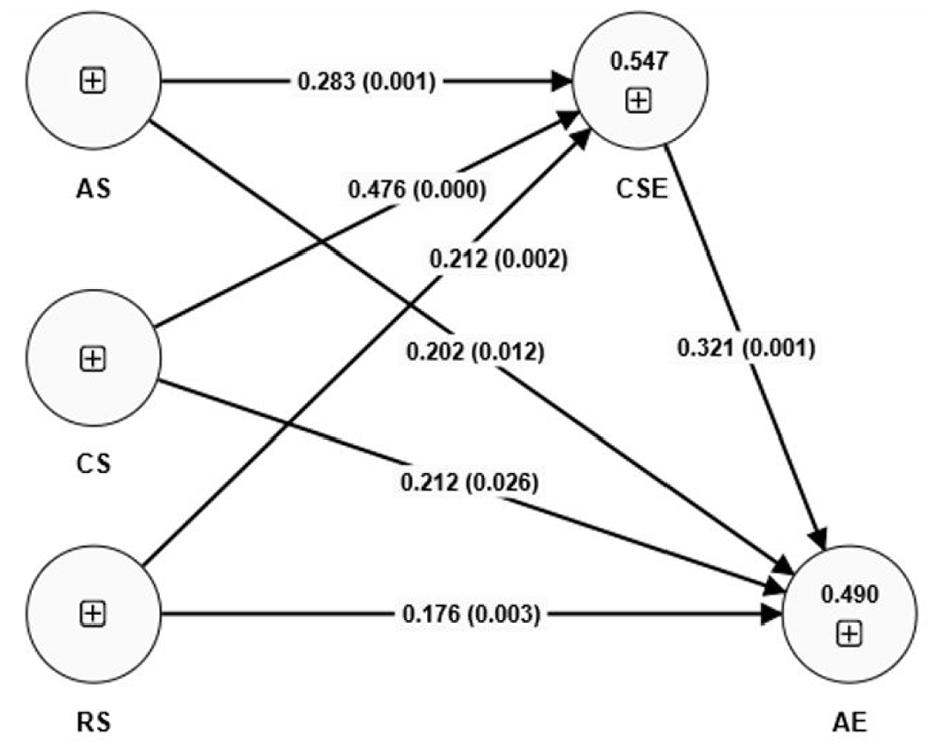
Structural model with path coefficients, significance, and R2, solid lines represent significant paths (p < .05).
Regarding the direct effect of these three basic satisfactions on agentic engagement, the results have shown that agentic engagement is directly and significantly predicted by each of the basic needs (βcompetence = .212, p < .05; βautonomy = .202, p < .05; βrelatedness = .176, p < .01). Among them, competence need satisfaction exhibits the strongest direct effect. Moreover, three needs satisfaction and course self-efficacy have moderate explanatory power for the variance of agentic engagement, together explaining 49% of its variance. In conclusion, H3 is supported.
Thereafter, the statistics of the effect of the independent variables on the dependent variable (effect size; f2) are compared. According to J. Cohen’s (1988) criterion for f2, the need for autonomy (f2 = 0.052), competence (f2 = 0.046), relatedness (f2 = 0.053), as well as course self-efficacy (f2 = 0.092), all have very small effects on agentic engagement (see Table 4). Although the effect of autonomy need (f2 = 0.132) on course self-efficacy is much greater than the threshold of 0.02, it is less than 0.15, which is still a small effect. In contrast, course self-efficacy is found to be significantly influenced by competence (f2 = 0.358) and relatedness need satisfaction (f2 = 0.094), with competence satisfaction having the greatest effect.
Additionally, all variance inflation factor (VIF) values ranged between 1.053 and 2.209, which are below the cut-off value of 3.3, indicating no serious multicollinearity problems (Hair et al., 2022).
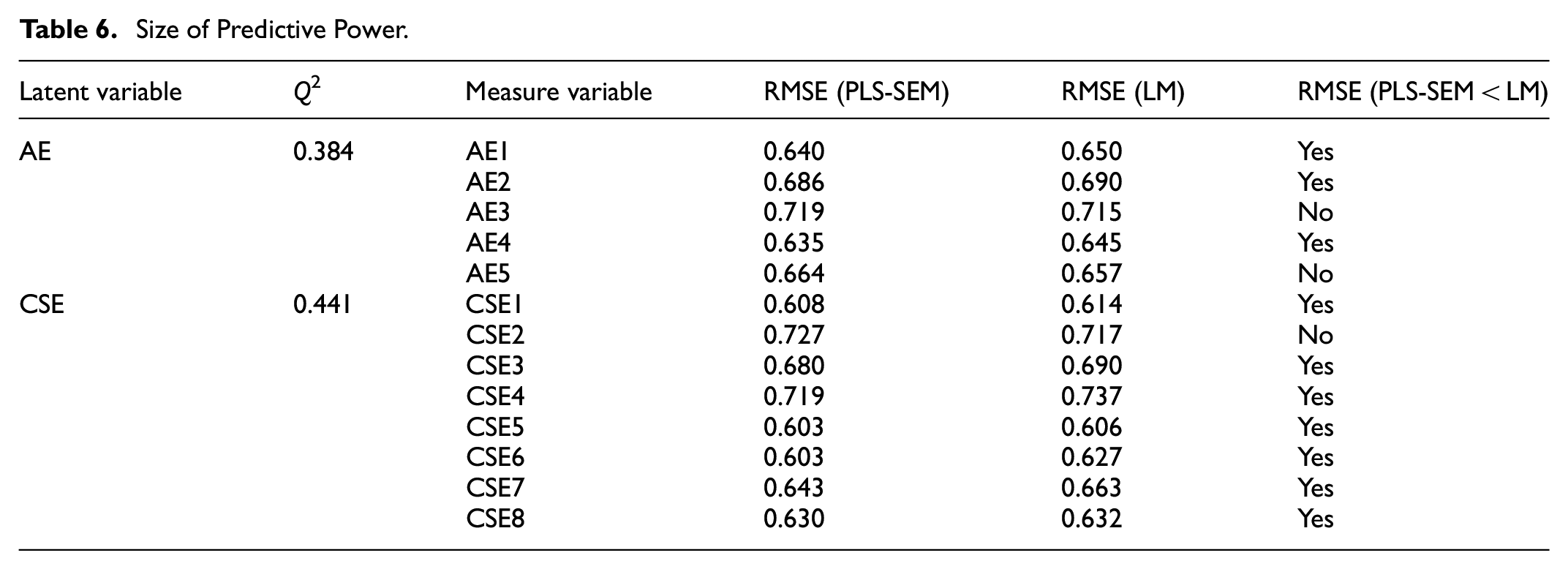
Subsequently, the prediction performance of the structural model’s exogenous variables on the endogenous variables was assessed using the PLSpredict procedure. Predictive relevance exists when the predicted value is positive (Stone, 1974). Table 6 shows that basic need satisfactions have sufficient predictive power to predict course self-efficacy (Q2 = 0.441) and, together with it, agentic engagement (Q2 = 0.384). Basic needs and course self-efficacy have moderate predictive power for agentic engagement (3 out of 13 prediction errors of the PLS-SEM model are smaller than the LM model). Finally, model fit is used to test whether the measured model can be applied to subjects in the overall population. Table 5 provides a standardized comparison of this study’s model with Henseler et al. (2016). The SRMR, d_ULS, and d_G of the model in this study are found to meet the criteria, denoting that the model can better predict the data.
Model Fit of the Structural Model.

Note. SRMR = standardized root mean square residual; d_ULS = unweighted least squares distance; d_G = geodesic distance.
Size of Predictive Power.
Mediation Analysis
The mediation analysis procedure is used to test H4. Based on Baron and Kenny (1986), the mediating role in this study exists in the following conditions: BPNS has a direct effect on CSE, and CSE has a direct effect on AE. When these two conditions are satisfied simultaneously, CSE can be used as a mediator, see Figure 3. Table 3 shows that the CSE mediates the relationship between BPNS (AS, CS, and RS) and AE. Since BPNS (AS, CS, and RS) can directly and significantly predict AE, CSE plays a partial mediating role between AS (β = .091, p < .05), CS (β = .153, p < .01), and RS (β = .068, p < .05) and AE, respectively. Hence, H4 is supported.

Mediation model.
Discussion
The current study seeks to investigate the direct effects of three basic psychological needs on the agentic engagement of pre-service Chinese teachers at six public universities in Beijing, China, as well as the mediating role of course self-efficacy between the fulfillment of the three basic needs and agentic engagement. The outcomes of the study support the hypotheses that the agentic engagement of pre-service Chinese teachers can be predicted by satisfaction of three basic needs and course self-efficacy individually. In addition, their course self-efficacy can mediate the relationship between three basic needs and agentic engagement. It is noted that these three needs satisfaction and course self-efficacy explain 49% of the variance in agentic engagement. Additionally, compared with the effect of autonomy and relatedness on course self-efficacy, competence is the best predictor (β = .476, p < .05). Regarding the direct effects of three basic needs and course self-efficacy on agentic engagement, course self-efficacy has the greatest effect on agentic engagement.
The findings are in line with several studies that basic needs satisfaction is a key factor in promoting individual motivational development as well as academic engagement (Akram & Li, 2024; López-García et al., 2023). During the learning process, students become incentivized to better invest in their studies when their basic satisfaction is met (H. Chen & Zhang, 2022). Combined with SDT and SCT, satisfaction for basic needs and self-efficacy as personal factors to influence students’ engagement in learning (Thomas et al., 2025).
First, this study verifies that all the levels of basic needs predict pre-service Chinese teachers’ course self-efficacy during learning. This finding is supported by previous studies (S. Chen, 2024; Macakova & Wood, 2022; McLennan et al., 2021). However, most studies view the three basic needs as a whole construct without exploring the specific roles of competence, autonomy, and relatedness. For example, S. Chen (2024) revealed that academic self-efficacy among undergraduates in Henan Province, China, could be significantly predicted by basic psychological needs, but there was no mention of the concrete influence played by the three types of needs satisfaction.
Regarding the specific impact of the fulfillment of three basic needs, this study discovers that competence is particularly important for course self-efficacy, which is in accordance with Çınar-Tanrıverdi and Karabacak-Çelik (2023). They reported that American undergraduates’ sense of competence was the most powerful predictor of academic self-efficacy, followed by autonomy and relatedness. A study by Q. Guo and Xu (2024) found that Chinese trainee teachers’ perception of competence need was highly correlated with their sense of self-efficacy, whereas autonomy and relatedness were correlated with intrinsic motivation and enjoyment, respectively. This also implies that there are variations in the functioning of the three needs satisfaction, and that competence seems to be more closely tied to self-efficacy (Hirosawa et al., 2024).
Nevertheless, the finding of this study diverges from that of Meng (2022), who found that Chinese university teachers’ relatedness satisfaction was not a direct predictor of a sense of efficacy. In contrast, in the current study, compared to competence and autonomy, pre-service Chinese teachers’ need for relatedness has the least impact on course self-efficacy. This discrepancy prompts the present study to consider in-service and pre-service teachers. In-service teachers tend to be confident in teaching, and their self-efficacy is influenced more by knowledge and skills than by external recognition or support, which is more critical at the pre-service level (Norton, 2019; Stahl et al., 2016). Hence, the predictive power of in-service teachers’ sense of relatedness to self-efficacy is perhaps weakened by excessive autonomy and competence.
Based on the majority of studies, the sense of relatedness facilitated academic performance in primary and secondary school students (Benlahcene et al., 2024; H. Liu et al., 2023). Additionally, students’ connection with teachers, peers, and learning environments at the tertiary level may still influence students’ perceptions of their own confidence and academic success (Q. Wang et al., 2022). For instance, Ma et al. (2024) revealed that support from mentors was not only significantly positively related to Chinese graduate students’ research efficacy but also improved students’ psychological well-being. Therefore, the results of the present study highlight the significant role of relatedness need satisfaction in inducing course self-efficacy at the graduate education level.
Second, this study demonstrates that the course self-efficacy of pre-service Chinese teachers directly predicts agentic engagement. Of these, course self-efficacy is expected to be the strongest predictor (β = .321, p < .01), which is consistent with existing current research (Luo et al., 2023; Meng & Zhang, 2023). This means that when pre-service Chinese teachers hold a higher sense of course self-efficacy, they are more inclined to proactively engage in the course activities and even provide their insights and feedback on what they have learned. Several studies had similar findings (Benlahcene et al., 2024; Vomund et al., 2021). Student engagement can be significantly predicted by a sense of self-efficacy, and agentic engagement has sparked the attention of researchers in its new direction. Therefore, students’ perceptions of efficacy are important not only for enhancing behavioral, cognitive, and emotional engagement but also for agentic engagement (Sökmen, 2021).
Furthermore, this study supports Reeve and Tseng’s (2011) claim that agency serves as a fourth aspect of academic engagement that is directly influenced by basic psychological satisfaction. The results indicate that autonomy, competence, and relatedness needs received by pre-service Chinese teachers can significantly increase their agentic engagement during course learning. However, many studies have not tested this relationship in Asian populations (Benlahcene et al., 2021; R. Cohen et al., 2020; Cunha et al., 2023). Surprisingly, the present study discovers that the need for autonomy is still a strong predictor of agentic engagement in a group of Chinese graduate students. This suggests that Chinese postgraduates’ need for autonomy in learning can be met even in an Eastern collectivist context. For example, D. Liu and Morgan (2020) investigated the reasons for pursuing a master’s degree among current Chinese graduate students, and they found that students cited career development and personal interest as the main reasons. Thus, for the majority of graduate students, pursuing a degree is based on their own choices. After their autonomy needs are met, the achievement of academic goals is promoted through the dynamic construction of the learning process.
The present study seems consistent with some previous findings (H. R. Jang et al., 2024; Jiang & Zhang, 2021). For example, H. R. Jang et al. (2024) mentioned that teachers take pedagogical practices, such as autonomy-needs-fulfilling instructional behaviors that encourage students to participate in decision-making. These autonomy-supportive pedagogical dispositions are therefore particularly important for students’ agentic engagement in learning. Furthermore, Michou et al. (2023) used a cross-assessment approach to study the 5-week diaries of Turkish secondary school students and teachers and also discovered that students’ perceived weekly autonomy support was a positive predictor of their agentic engagement.
For postgraduates, learning involves facing complex academic tasks and challenges, which can also make them more concerned about the performance of their competence (J. Guo et al., 2021). When they feel satisfied with their self-competence and thus confident to face challenges, it will also motivate them to interact with their classmates in coursework. Therefore, the strongest effect of competence need on agentic engagement is found in this study. Additionally, perceived relatedness satisfaction (relationships with mentors and classmates) also affects their agentic engagement. Relatedness need satisfaction can motivate them to feel a harmonious and comfortable atmosphere in learning, which in turn promotes agentic engagement. For example, Oh et al. (2024) mentioned that in higher education, students’ connections with faculty and classmates help them understand difficult courses. Shin and Johnson (2021) also stressed the importance of gaining support from classmates in improving students’ internal motivation.
However, the study finds that the need for relatedness is a minimal predictor of agentic engagement. Likewise, H. Jang et al. (2009) found similar results that both the autonomy and competence of Korean high school students predicted engagement. This differential finding can be explained in terms of the research group as well as the cultural context. Currently, relevant studies neglect to consider higher education. Both graduate and undergraduate students are part of the nation’s higher education talent development, but there are also differences between them. For example, graduate students are more autonomous and self-supporting than undergraduates (Xia, 2006).
This study also confirms that course self-efficacy plays a partial mediating role between basic needs and agentic engagement. It implies that, in some cases, basic needs satisfaction may require the intervention of other variables, which in turn affects learning engagement (H. Chen & Zhang, 2022; Eskandari & Sadoughi, 2021). For example, self-efficacy mediates the relationship between autonomy and agentic engagement, and this finding is in accordance with several studies (H. Chen & Zhang, 2022; Karimi & Sotoodeh, 2020). When pre-service Chinese teachers believe they have the autonomy to choose what to learn (autonomy), perceived control over study materials (competence), and good relationships with their instructors and peers (relatedness), it is more likely to motivate them to recognize their self-efficacy. In turn, this stimulates them to actively participate in learning. In addition, these three basic needs satisfaction affect individuals differently in different educational contexts and conditions (Vansteenkiste & Ryan, 2013). Overall, from this study, basic needs and course self-efficacy as motivational constructs have been shown to directly influence agentic engagement, which in turn promotes academic success.
Conclusion
This study finds that the three needs satisfaction in course learning can promote course self-efficacy and motivate them to actively engage in learning. This finding echoes the assumptions of SDT and SCT, which both emphasize the role of internal motivation and competence beliefs in driving student engagement (Bandura, 1999; Reeve, 2012; Ryan & Deci, 2000). It emphasizes the importance of fostering autonomy, competence, and relatedness in course design to promote meaningful and sustainable student engagement. This finding also provides a reference for other curricular domains as well as teaching practitioners.
For example, it is essential to provide students with an environment that supports their psychological needs, particularly the sense of competence, as a way to enhance their confidence and willingness to engage. Research has shown that students are more likely to persist when they feel capable of meeting academic demands (Reymond et al., 2022). Therefore, instructors should design tasks that match students’ current ability levels while gradually increasing the level of challenge to expand their knowledge and skills. The difficulty of the subject matter needs to be graded according to the students’ level, to enhance their self-confidence in the learning process and their courage to face academic challenges.
In addition, it is also necessary to create a harmonious learning atmosphere, appropriately increase the opportunities for students to get along with teachers and classmates, and learn cooperatively, such as through the organization of group activities to help students learn interactively. Creating such a climate not only promotes relatedness but also encourages collaborative learning, which is conducive to deeper understanding and sustained engagement (Reeve, 2013). Furthermore, timely and constructive feedback not only improves ability, but also strengthens students’ belief that they can make progress through effort and guidance. When teachers provide clear and supportive feedback on class performance and assignments, students can better recognize their strengths and areas for improvement, thereby enhancing their self-evaluation and motivation (Reymond et al., 2022).
Regarding autonomy, giving students opportunities for choice in their learning, such as selecting discussion topics or adjusting learning sequences, can increase their perceived control and intrinsic motivation. Autonomy-supportive strategies have been shown to facilitate greater engagement and deeper learning (Reeve & Cheon, 2021). In actual course learning, the learning sequence of course modules can be adjusted according to students’ needs; the choice of topics in discussion sessions can be based on students’ advice; and the content of learning is linked to reality to enhance their understanding of learning. Empowering students to make meaningful academic choices enhances their sense of ownership over the learning process, thereby fostering agentic engagement.
As for course self-efficacy, one needs to focus on whether the curriculum meets the needs of students, develops their competency levels, and encourages them to ask difficult questions, thus enhancing their ability to cope with learning challenges (Bandura, 1997). Encouraging students to tackle challenges and ask questions fosters a supportive environment that enhances their resilience and academic self-belief.
Taking pre-service Chinese teachers as research subjects provides empirical support for China’s efforts to optimize their learning and acquire knowledge and skills in teaching Chinese. It also fills the gap in how basic needs satisfaction and self-efficacy motivate students’ agentic engagement in a specific educational context. This provides important insights for teacher education programs seeking to develop proactive, self-assured, and reflective educators. It also provides insights into the professional training and development of teachers in other contexts, enhancing the quality of classroom instruction and learning experiences to strengthen teaching and professional development.
This study also has limitations. First, the study population is pre-service Chinese language teachers at six liberal arts universities in Beijing, China, and the results should be treated with caution as to whether they can be widely applied to groups in other fields. Next, the measurement is in the form of self-report, which, although an important method often used by researchers, may be subject to certain biases. As such, the results should be evaluated more comprehensively by combining various research methods, such as using interviews or adding reverse questions to the questionnaire. For subsequent studies to better understand whether a change in one variable causes a change in another, longitudinal research methods should be considered. Certainly, there are other factors that influence students’ agentic engagement, such as self-regulation ability, social support, feedback, and assessment, all of which need attention.
Footnotes
Acknowledgements
The author would like to thank all the participants who generously contributed their time and effort to this study.

Ethical Considerations
This study was approved by the Universiti Malaya Research Ethics Committee (Non-Medical) (approval no. UM.TNC2/UMREC_3601) on July 16, 2024.
Consent to Participate
Agree to participate. Informed consent to participate in this study was obtained from all participants prior to data collection. Participants gave their consent by completing a paper-and-pencil questionnaire that included an informed consent form explaining the purpose of the study, the voluntary nature of participation, and the assurance of data confidentiality. Completion of the questionnaire was considered as an indication of informed consent.
Consent for Publication
This study does not contain any person’s data in any form (including individual details, images, or videos).
Author Contributions
Tianlin Xie: Writing-Original Draft. Fong Peng Chew: Writing-Review & Editing.
Funding
The author(s) received no financial support for the research, authorship, and/or publication of this article.
Declaration of Conflicting Interests
The author(s) declared no potential conflicts of interest with respect to the research, authorship, and/or publication of this article.
Data Availability Statement
The datasets generated during and/or analyzed during the current study are not publicly available due to ethical considerations and restrictions imposed by the Universiti Malaya Research Ethics Committee but are available from the corresponding author upon reasonable request.