




Abstract
Virtual learning, necessitated by COVID-19, is novel in Kuwait. This study explores Islamic education pre-service teachers’ perceptions regarding online learning experiences with virtual discussions to demonstrate its effectiveness in interaction, engagement, and socialization. Data were collected from 161 female Islamic education pre-service teachers enrolled at (Kuwait University). A mixed methods research approach confirmed the participants’ positive perceptions regarding the virtual learning experience and the role of virtual discussions in fostering engagement, interaction, and perceived learning. Virtual discussions maximized peer cooperation, enforced communication skills, and generated constructive feedback. The drawback was that a few pre-service teachers dominated the discussion, highlighting the importance of the instructor’s guidance in achieving learning outcomes. For these teachers in training, this study clarifies the impact of virtual discussions on learning outcomes and in fostering interaction and engagement and helps them understand the importance of being heard, communicating ideas, and sharing perspectives in a virtual environment.
Plain language summary
Purpose: This study explores Islamic education pre-service teachers’ perceptions regarding online learning experiences with virtual discussions to demonstrate its effectiveness in interaction, engagement, and socialization Methods: A mixed methods research approach applied. Conclusion: participants hold positive perceptions regarding the virtual learning experience and the role of virtual discussions in fostering engagement, interaction, and perceived learning. Virtual discussions maximized peer cooperation, enforced communication skills, and generated constructive feedback.
Background
Education was significantly affected by the outbreak of the coronavirus disease 2019 (COVID-19) pandemic. Lockdowns were an important initiative implemented to protect lives. As part of the lockdown, schools switched to online classes. Global COVID-19 constraints have rendered online teaching and learning in higher education and international education increasingly important. The pandemic has created unprecedented global challenges. UNESCO reported that by late March 2020, more than 190 countries had closed schools to prevent the spread of COVID-19, affecting the education of approximately 1.6 million children (Dorn et al., 2020).
Before the pandemic, the significance of online learning, commonly known as distance learning or e-learning, was already growing (Abbasi et al., 2020). Although implementing e-learning limits interactions, it increases students’ flexibility and accessibility to participate in the learning process. According to Moore and Diehl (2019), e-learning has more advantages than face-to-face learning because it is more interactive, multi-modal, effective, convenient, ubiquitous, and learner-centered. The most challenging aspect of e-learning and hybrid learning is providing students with high-quality practical experiences (Gill et al., 2020). Furthermore, these non-traditional classroom settings drastically alter students’ modes of interaction, participation, and development (Xie, 2021).
Despite school being an integral element of any community, the decision was made to cancel classes at the time. The suspension of school attendance impacted the field of education because it stopped the direct-teaching process (Mayo, 2020; McCarthy, 2020). UNESCO’s (2020) Director-General, Audrey Azoulay, pointed out that the suspension of physical classes was a radical, unprecedented, and unexpected change for the educational system and that working collaboratively was now essential. However, it was crucial to adjust to and deal with the pandemic, to find and explore new ways to adapt, and to make the most of all available resources in light of the circumstances. One of the first preventative steps implemented in educational institutions worldwide was limiting people’s exposure to one another by transitioning to online learning (Fenza et al., 2021; Y. Wang et al., 2021). Before this, research indicated that many faculty and staff had experienced difficulty delivering effective online education to students. Post-pandemic, this stigma changed, and even in developing countries, the utilization of digital resources and technological advances continues to grow and develop (Chan et al., 2021).
In Kuwait, in-person education did not resume for almost 5 month. The government was hesitant about opening schools; however, it was also unprepared for virtual learning (VL). Pressure to shift to VL came from various stakeholders—teachers, college teachers, parents, and politicians—to abate the possible long-term adverse effects and unpredictable and damaging consequences of transitioning to online learning and its impact on postponing VL classes on students’ learning, acquisition of skills, and performance. Owing to the constant pressure, the government approved the implementation of VL, leading to another dilemma: preparing teachers, students, and parents. Accordingly, college teachers conducted workshops to train teachers, students, and parents to ease the transition to online learning. Through extensive preparation and workshops, teachers at all levels attained new online-appropriate teaching skills to enhance their VL experience. Learners were exposed to virtual collaboration and online communication. At the university level, virtual classes were delivered on the Blackboard and Microsoft Teams platforms. Despite the inevitability of implementing distance education, numerous consequences had to be considered. The dynamic transition from stationary to e-learning significantly increased the marginalization of students’ communication, engagement, and socialization. Furthermore, its adequate and effective implementation, as well as other factors, such as the effect of students’ transition to VL on their knowledge acquisition, learning outcomes, and level of stress, had to be considered.
Educators must continue to investigate methods for enhancing students’ engagement and participation in the online learning environment. According to Escobar Fandiño and Silva Velandia (2020), educators should never stop looking for innovative ways to enhance online student learning. Aderibigbe (2020) and Magyar et al. (2020) pointed out that technology-enhanced pedagogy can improve education. They also discussed that educators are capitalizing on students’ natural interest in and aptitude for using technology to increase the motivation to learn and engage in class (Troussas et al., 2020).
The shift to VL entailed a massive change in learning models, which impacted students’ satisfaction with their perceived learning approaches. This eventually impacts the quality of their online learning experience and outcomes. Students, including the author’s students, received VL with skepticism, concern, or rejection. The author aimed to promote their engagement, communication, and participation and, to some extent, emulate the face-to-face setting and help alleviate some of the drawbacks of online education. Initially, some students hesitated to switch their cameras on, and others refused to speak through the microphone even when cameras were off and participated only through the chat box. This problematic hesitancy requires further exploration.
Participation, communication, and socialization are crucial in the author’s teaching practice to assist students in realizing their potential and honing their capabilities. The author adopted several practices to encourage socialization during VL, and also utilized the features of the online platform to promote students’ engagement and urged them to socialize more with their classmates during and after classes. Virtual discussions (VDs) and online discussions were highly encouraged in either an asynchronous or synchronous format with class sessions, verbal or written, or one-on-one or in groups. The VDs entailed encouraging students’ interaction and engagement with one another in real time on the online forum, providing them with opportunities to reflect, think, and organize ideas, and improving the adaptability of individual and group learning. Students are afforded the opportunity to engage critically and assume responsibility for their education when time and learning contexts are adaptable (Aderibigbe, 2020). Asynchronous discussions were held on the assigned readings available on a discussion board by taking into consideration students’ responses. These discussions permit students to respond to questions at different times over several days, which could increase their participation rate (Galyon et al., 2016). Students also conducted and recorded their own discussions on selected topics, thus activating an autonomous learning experience and fostering self-regulation skills. They experienced an independent space and autonomy to voice their thoughts, thereby promoting their self-worth.
Literature Review
Engagement, Interaction, and Socialization in a VL Setting
Interaction and engagement are intertwined within an active classroom environment to produce authentic learning outcomes wherein, through engagement, learners develop the ability to interact; hence, active learning occurs (Anderson, 2003). The Seven Principles for Good Practice in Undergraduate Education, propounded by Chickering and Gamson (1989) and used for decades by faculty members, teachers, and students, discusses facilitating genuine interaction among students in higher education. Figure 1 shows the seven principles.

The seven principles for good practice in undergraduate education (Chickering & Gamson, 1989).
These principles represent a framework for educators to build active, authentic learning experiences by fostering relationships among students and between students and teachers. Applying these principles to a VL environment might be difficult compared to using them in face-to-face classroom settings. Many factors may cause conflict while following these principles and hinder quality learning outcomes. One such factor is the context, which significantly influences engagement and disengagement (Bergdahl, 2022), as both occur concurrently and sequentially (M.T. Wang & Hofkens, 2020). There is also an underlying assumption that giving students access to digital learning resources online will increase their motivation to learn. However, student engagement is actually reflexive and grounded in students’ own personal objectives (Kahn et al., 2017). The adaptability and convenience of online education allows students to better manage their time (Stone et al., 2016).
Research has highlighted many advantages to online teaching, but keeping students engaged can be more difficult in this mode than in a traditional classroom setting. One drawback of online education is that there is less face-to-face contact between students and teachers (Paulsen & McCormick, 2020). Despite this, communication via social media could benefit less confident students in terms of interaction and engagement (Mukhtar et al., 2020).
Social interaction is considered an indispensable means of satisfying social needs (Turk et al., 2022). Here, existing research has highlighted the significance of social interaction and provided helpful theoretical frameworks. Essentially, sociability is a crucial factor affecting group collaboration and learning performance (Çoban et al., 2022). Al-Rahmi et al. (2018) clarified whether and how social interaction impacts online learning, noting that learning in an online active collaborative environment is more productive than learning in an in-person setting. Compared to in-person meetings, the empirical data showed that campus students required more guidance when using active collaborative learning alternatives provided by supplementary social media platforms. Kurucay and Inan (2017) discovered the crucial role of learner–learner interaction in an e-learning environment in enhancing learning performance. They also found that students who interact with their peers appear to perform better than those who do not. Similarly, Molinillo et al. (2018) demonstrated that both learner–instructor and learner–learner interactions impact learners’ emotional engagement and enhance their active learning. Social interaction is essential for generating critical thinking and enhancing learning outcomes because it can improve social presence and reduce feelings of isolation among learners. It is also strongly correlated with student satisfaction and perceived learning (Fang et al., 2018; S. Zhang et al., 2023).
Learners in any learning environment need to be accepted and respected by their peers and feel like they belong in the classroom psychologically and socially (Peacock et al., 2020). Therefore, socialization and social interaction present a significant challenge in a VL environment. This multifaceted term is defined as communicating and building connections, wherein individuals interact, engage in discussions, and share their thoughts to reach a common understanding (Irwin & Berge, 2006). The notion of socialization in the educational context results in deep comprehension among students and builds their knowledge through interaction with others (Sthapornnanon et al., 2009). However, some studies contend that the social dimension is unnecessary (Symonds et al., 2021). Recent research has validated models of involvement and disengagement that incorporate markers reflecting behavioral, cognitive, emotional, and social components. Socialization relates to the extent to which students feel included, heard, and respected in online discussions. If this is not the case, students may feel that they have been left alone to figure out how to use digital technology (Bergdahl et al., 2020).
Learning occurs within a collaborative activity through peer interactions. Teachers actively promote socialization by framing the learning environment and designing activities that foster students’ engagement and interaction (Al-Rahmi et al., 2018; Doolittle & Hicks, 2003). To facilitate socialization and interaction in the online context, Moore (1993) addressed the three types of interactions shown in Figure 2.
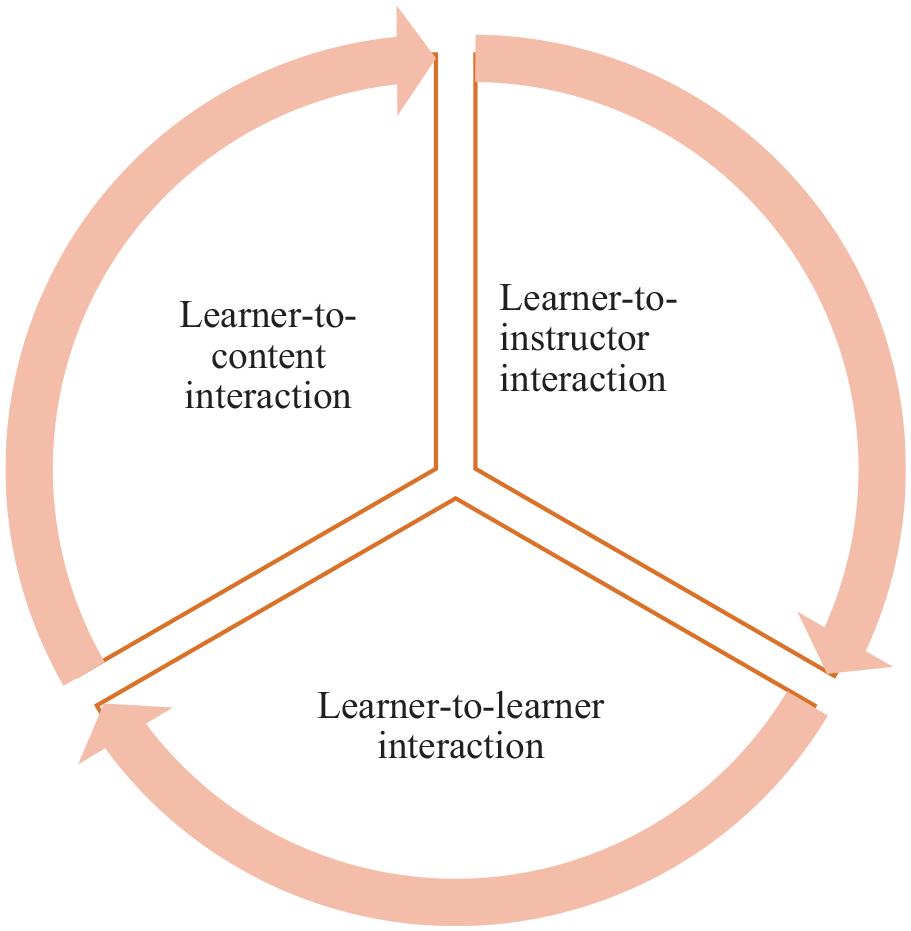
The three types of online interactions that facilitate socialization (Moore, 1993).
The interactions initially require a thorough understanding of the instructor, for whom the notion of online interaction might be vague. At present, teachers are required to facilitate effective interpersonal interactions in the online context. To this end, the literature notes three types of interpersonal interactions, as shown in Figure 3.

The three types of interpersonal interactions teachers must facilitate in the online context (Mehall, 2020).
Discussion is the most familiar technique that educators apply to replace face-to-face interaction and encourage interpersonal communication in the VL environment. However, instructors face pressure to integrate online courses with the most suitable methods to empower communication and socialization in their classes (Paquette, 2016).
In the last decade, online engagement has been extensively investigated because interaction is considered a crucial element in promoting students’ learning and performance (Sher, 2009). Klisc et al. (2017) and Yen et al. (2019) pointed out that online discussion is an effective means of encouraging students to think critically and constructively, parallel to helping them understand their roles as learners and comprehend the relationships they build in the VL context. This understanding allows students to develop a sense of presence and belonging. However, presence in VL classes is limited to interactions with other classmates or the instructor, even when they are not physically present. Various studies have refined this concept, holistically considering it in terms of the notion of community. As such, students are engaged as a social unit (Gallant, 2020; Giesbers et al., 2014). Accordingly, various terms, such as “communities of inquiry,”“communities of learners,” and “knowledge-building communities,” have evolved (Picciano, 2002).
Through positive and active engagement in the VL environment, students can attain higher levels of satisfaction with learning in this online context (Dziuban & Moskal, 2001; Hartman & Truman-Davis, 2001). However, although engagement might be present, some researchers contend that social presence is not a result of interaction in virtual reality; rather, it reflects students’ extensive communication within their groups or with other students (Picciano, 2002).
Interaction in the VL Environment
Interaction in higher education is a critical factor that has been stigmatized for being diminished in an online learning environment. Allen and Seaman (2016) revealed that 25% of academic leaders in 2015 pointed out that online courses are, to some extent, inferior to traditional learning environments. However, Jaschik and Lederman (2018) held that in general, online learning is analogous to face-to-face learning.
The VL environment and its impact on students’ learning and performance have been researched extensively. Various studies have also supported the significance of students’ interaction and engagement with their classmates and instructors. Picciano (2002) examined students’ social and actual presence and concluded that a strong relationship exists between students’ perceived learning and the perception of their interaction. The study demonstrated a positive and statistical relationship among students working on written assignments. Through these assignments, discussions were reinforced, resulting in active socialization. In addition, Sher (2009) emphasized that students appreciated being permitted to participate and interact with each other regarding class content. It provided them with a meaningful opportunity to share their understanding of the knowledge they constructed, resulting in their making sense of the learning experience. Moreover, online discussions helped them develop self-regulation and critical thinking skills (Barnard-Brak et al., 2010).
Another aspect addressed is the social network, which encompasses three elements: student-to-student interaction, student-to-content interaction, and student-to-teacher interaction. It is not limited to interaction frequency. Such social networks are multifaceted; they reveal how students interact with each other; form clusters; construct social relationships; and understand their individuality, their responsibilities, and the feedback provided or received within the VL experience (Yen et al., 2019). Social network analysis was designed to gain a thorough understanding of students’ interaction in the online sphere and their learning process in the VL environment (Jo et al., 2017; Tirado et al., 2015). Sun et al. (2018) found that online discussion strongly activates students’ communication, results in knowledge construction, and predicts their final grades and learning outcomes.
To promote interaction and communication that positively reflect students’ socialization and encourage their constructivist learning process, teachers must design, organize, and facilitate the online learning environment and promote genuine student interaction (Nasir & Mansor, 2019).
Other studies found that online environments do not promote interpersonal interaction. For instance, Cole et al. (2014) pointed out that both graduate and undergraduate students were dissatisfied with the absence of interaction in their online courses. Similar results were obtained by Muuro et al. (2014): students voiced their dissatisfaction with their online courses not merely owing to the absence of feedback from their instructors but also because of the lack of appropriate levels of interpersonal interaction, which negatively impacted their perceived learning. This indicates that differences in the supportive environments and learning strategies of online students are more attributable to the characteristics of the students themselves than to the learning mode. However, in terms of student–teacher interaction and group projects, online education still has a long way to go (Paulsen & McCormick, 2020).
Alghamdi (2013) explored the pedagogical implications of implementing Blackboard’s discussion board and its efficacy in enhancing the learning and performance of students of higher education in Saudi Arabia. The results indicate that using Blackboard’s post and discussion features positively improved students’ learning in the controlled group compared with the experimental group. Similarly, DeFrance (2011) researched students’ interaction in an online learning environment, including the activation of discussions via the discussion board. She found that, even though the interaction between the classmates and the instructor was active, the students did not agree that the discussion board was the perfect means to facilitate such interaction. Their main concern was that the discussion board as an online feature of Blackboard might not address their individuality and diversity.
Nielsen (2013) investigated the effects of various aspects of online discussions as a learning strategy—such as teachers’ participation and the quality and quantity of overall participation—on the participation of Japanese English as a Foreign Language (EFL) students. The results revealed that despite the low levels of quality and quantity of the written language that was posted, students’ interaction levels were high. In addition, the students showed a strong apperception toward using discussion boards to promote interaction between themselves and their classmates and teachers. They used the discussion board as a medium of communication and social interaction, wherein the social interaction experience results from human mental activity (González Moreno, 2011).
Avval et al. (2021) surveyed 317 Iranian EFL students to examine the effectiveness of receiving corrective feedback from students in online environments, such as online chats and class discussions. The results showed that students who received such corrective feedback produced higher-quality essays than those who received corrective feedback through traditional methods in class discussions.
Another study by Przymuszała et al. (2022) showed that students positively interacted within the online learning environment and appreciated their instructors. They believe that such measures should be preserved even after the pandemic ends. Time efficiency, student friendliness, flexibility, and learning situations are all areas in which online learning can help students. They also addressed obstacles associated with VL, such as the lack of human interaction and decreased socialization that might lead to diversions and elicit avoidance tendencies. Finally, Alzahrani (2022) showed that students in Saudi Arabia enhanced their level of interaction and participation when they participated in online learning.
Furthermore, studies have identified the risk of students’ sense of isolation negatively influencing their impressions of online courses (Koutsoupidou, 2014). Additionally, the lack of student-to-student and student-to-instructor contact is a major element that might contribute to an unsatisfying VL experience (X. Liu, 2021). Thus, it is essential that teachers enhance students’ learning because they are obligated to know how their students interact with the online learning components of their courses. Student involvement in online contexts is distinct from that in a traditional classroom setting, and several recent studies (e.g., Martin et al., 2020; Z. Zhang et al., 2020) have highlighted the importance of learning more about this factor (Martin et al., 2020). Furthermore, student disengagement has often been ignored despite it having detrimental repercussions on the individual and the institution (M. T. Wang et al., 2017).
During the COVID-19 pandemic, pre-service Islamic education teachers—who were enrolled in courses such as “Principles of Teaching Islamic Education,”“Advanced Islamic Education Teaching Methods,” and “Graduation Project in Islamic Education”—were introduced to VDs through the discussion board tool of virtual platforms. The university endorsed the transition to online learning environments after 5 month of suspended classes. Students used the Microsoft Teams platform during online classes through which they were introduced to and could utilize its various features.
Based on the above, this study seeks to investigate the VL learning experiences of Islamic education pre-service teachers to clarify how the use of VDs promotes participants’ opportunities for interaction, engagement, and socialization as well as to identify and analyze the potential difficulties that participants may encounter in the process.
The study also intends to examine the intertwined aspects of using VDs, such as replacing a face-to-face learning setting with a remote learning setting, promoting students’ engagement, optimizing their self-efficacy through participation, and achieving authentic learning outcomes. This is done so that pre-service teachers comprehend the value of encouraging students’ participation and engagement in various settings. Furthermore, pre-service teachers’ attitudes, beliefs, and practices regarding future teaching tactics that increase students’ interaction and engagement can be influenced by exposure to such innovative experiences during their training years.
Research Questions
This study aimed to address the following research questions:
What are Islamic education pre-service teachers’ perceptions about their virtual learning experience?
What reflections do Islamic education pre-service teachers have on their learning experience with regard to using VDs?
To what extent were the VDs effective in promoting the engagement, interaction, and socialization of Islamic education pre-service teachers?
What difficulties did Islamic education pre-service teachers encounter throughout their VD sessions?
Methodology
Data were collected from 161 female Islamic education pre-service teachers enrolled in undergraduate courses at (blinded for review), namely “Principles of Teaching Islamic Education,”“Advanced Islamic Education Teaching Methods,” and “Graduation Project in Islamic Education.” Most participants were in their sophomore or senior year at college. This study applied a mixed methods research approach. Furthermore, it employed a convergent parallel design, which involved the systematic collection and analysis of both quantitative and qualitative data using separate procedures. Therefore, the findings derived from the examination of both datasets are merged to offer a comprehensive understanding of the research topic being investigated. The quantitative approach was used by implementing the Constructivist On-Line Learning Environment Survey (COLLES) to assess pre-service teachers’ initial perceptions about their VL experience. COLLES comprises 24 questions divided into six sections. Each section contained four questions that required responses on a five-point Likert scale (ranging from “almost never” to “almost always”) in addition to open-ended questions requiring short answers. Additionally, to promote participants’ collaboration in exploring ideas and perspectives, a qualitative method was implemented in the study by using various instruments involving Focused Group Discussions (FGDs). Group settings encourage discussions and debates, lead to more complete and nuanced data, and reveal group ideologies, divergences, and power imbalances (Hennink, 2013). Another qualitative instrument applied was reflection papers on pre-service teachers’ experiences of implementing VDs in their Islamic education courses and their effectiveness in increasing engagement, interaction, and socialization. These reflections were also used to highlight any difficulties experienced in implementing the VDs. The purpose was to understand the benefits and drawbacks of using VDs in terms of students’ interaction and engagement. The employment of reflection as a methodology for gathering qualitative data has garnered recognition and is considered a promising approach (Billups, 2021). The process involves retrospectively recording and analyzing a recent interaction, focusing on its significant elements. This includes identifying crucial aspects and examining their consequences, with the potential to support the validation and improvement of research outcomes. By engaging in a systematic analysis of participants’ reflections, researchers are able to assess the validity and comprehensiveness of their findings. Moreover, it is within the capabilities of individuals to identify and evaluate any potential biases or limitations present in their research findings (Lutz & Paretti, 2019).
The 161 participants were asked to complete the COLLES survey. They were then expected to engage in VDs during their courses, followed by reflection on their experiences and on the group discussions held on Microsoft Teams.
The participants were encouraged to actively engage in various forms of discussions through the discussion board, whether written or verbal, and synchronously or asynchronously. In addition, pre-service teachers recorded small-group discussions without the instructor’s presence, which provided them with authority, space, and the experience of self-managed coordination of VDs. Various topics, articles, and reading materials were uploaded on the discussion board. Students were assigned to interact and engage with these topics through their input, reflections, and feedback and respond to their classmates’ participation and input.
The instructor’s role was limited to monitoring students’ input, and if any misunderstanding emerged, the person’s interventions were merely to correct such misconceptions, guide participants not to stray from the task or topics that needed to be discussed and reflected on, encourage reluctant participants to engage, and compliment participation that exceeded expectations. To a large extent, the instructor was neutral and objective toward pre-service teachers’ participation. Their inputs and ideas were not criticized, and the intervention aimed to promote participant engagement and interaction. In other words, the instructor’s authority was limited and tempered during the period that students provided input.
During these courses, various discussion topics were raised in and out of class to promote students’ understanding, analysis, and critical thinking skills and encourage their engagement, interaction, communication, and socialization. At the end of each semester, the participants engaged in reflective sessions with the instructor regarding their perceived experiences toward utilizing the discussion board and VDs and their efficacy in developing their skills. The VDs that were utilized aimed to facilitate various modalities of online discussion, whether between the instructor and students or among the students themselves, to allow students’ ideas to surface, reflect their responses, encourage them to inquire about different perspectives, and receive or provide constructive feedback for any assigned topic or argument.
The first research question was addressed based on COLLES. The responses were analyzed using the Statistical Package for Social Sciences (SPSS) 26.0 version. In total, 161 questionnaires (for a 100% response rate) were manually verified and matched. The second and third research questions were examined through a qualitative approach using various instruments, including a group discussion conducted virtually at the end of each course that the participants were enrolled in during the VL period. Each group comprised six to eight pre-service teachers. The discussions lasted 30 to 45 minutes and were digitally recorded and completely transcribed. In addition, the participants were required to write reflection papers and provide written comments on the application of VDs in their Islamic education courses. This provided a comprehensive view of their experiences with VDs.
All pre-service teachers were given clear instructions on what to expect in exchange for their willingness and confidential participation in the survey. As the participants in the focus group were students in classes that were taught by the author, the author obtained their permission to use their data via their oral agreement and by explaining in detail how the information would be used and protected. They were also informed that participation was completely voluntary.
The purpose of integrating quantitative and qualitative research methods is to enable the researcher to apply a variety of methods, combining inductive and deductive reasoning and offsetting the limitations of exclusively quantitative or qualitative research. This enables a complementary approach that maximizes the strengths of each data type and facilitates a deeper understanding of the research questions and findings. A mixed-methods approach can also help provide a rigorous interpretation of the data, make quantitative conclusions more comprehensible, and explain the importance of small-sample qualitative data (Dawadi et al., 2021). Deriving meaning from qualitative data entails consolidating and immersing oneself therein to identify patterns and themes and then comparing segments to identify overarching themes and insights. The research results are based on these interpretations or meanings (Butina, 2015).
Applied qualitative data were coded using colored pens to subdivide the raw gathered information; these data were then labeled, rearranged, and classified into themes to extract the meaning and make sense of them. This included responses from the group discussion transcripts, reflection papers, and the researcher’s notes. The analysis of the qualitative data was dynamic and mainly involved picking up on the overlapping themes and zeroing in on the core ideas and overarching concepts gleaned from the aforementioned literature. Significant patterns were also discovered after a thorough review of the data collected. Patterns emerged and took on a seemingly thematic weaving as we investigated their connections to our research questions and the existing literature. Each language, phrase, and quotation relevant to the study’s subject or focus was carefully scrutinized (Mohajan, 2018). The ultimate goal of any research endeavor is to provide broad, descriptive statements in response to research questions that demonstrate that the researcher has a firm grasp of the facts at hand (Lester et al., 2020).
Ethical Considerations: As the study used an anonymous online questionnaire, the Institutional Review Board (blinded for review) determined that permission from the board was unnecessary. Participants were not required to provide any personal information apart from their gender and year in school, and their participation was entirely voluntary. No survey fields were mandatory; the respondents could choose whether to answer any question, allowing them unlimited freedom of expression. In addition, the students were reassured through group discussions that their participation in the study was voluntary, their identities would remain confidential, and they could request to see the transcription of their interview if they desired. During data collection, every effort was taken to ensure that the process conformed to the principles outlined in the Helsinki Declaration.
Findings
Reliability and Validity of the Instrument
The results displayed in Table 1 show the Cronbach’s alpha coefficients pertaining to the different dimensions. The “relevance” dimension produced a coefficient of .60, which is deemed acceptable as per the criteria established by George and Mallery (2016). The “interactivity,”“interpretation,” and “peer support” dimensions produced coefficients ranging from .70 to .79, suggesting a satisfactory level of reliability. It is worth mentioning that the “reflective thinking” and “instructor support” constructs exhibited strong reliability, as indicated by the coefficients ranging from .80 to .89 (George & Mallery, 2016). The instrument’s overall reliability, as assessed by a Cronbach’s alpha coefficient of .87, indicates a strong degree of internal consistency. Cronbach’s alpha is a statistical measure used to evaluate the internal consistency or reliability of survey items in measuring a common construct. It is computed by determining the average correlation among pairs of items. In general, it is widely accepted in academic research that a Cronbach’s alpha coefficient of .70 or above is deemed as satisfactory, as higher values indicate a higher level of reliability.
Cronbach’s Alpha Values For the Study Dimensions.

Regarding the survey’s validity, it underwent an initial review by professors specializing in curriculum and instruction within the college of education. These experts assessed the relevance and inclusiveness of the survey’s components. Additionally, they conducted a content validity analysis to determine the extent to which the survey items adequately cover all important aspects of the construct being measured. The suggestions and advice provided by the professionals were incorporated and utilized via the survey, resulting in an improved ability of the instrument to accurately measure the content of the construct being studied (Davis, 1992; Zamanzadeh et al., 2014).
Regarding the relevance of the VDs held in the Islamic Education courses, pre-service teachers reported that, to a large extent, they learned how they could improve their professional practice (mean = 4.75, SD = ±0.51; Table 2). In addition, most (97.5%, n = 157) indicated that what they learned was important for their professional practice (mean = 4.73, SD = ±0.62). Overall, the means of the responses to the four statements on the relevance of VDs in Islamic education courses varied between 4.23 and 4.75, while the standard deviation ranged from 0.51 to 0.90, indicating a low spread of the scores around the mean point of the five-point scale (i.e., 3.0), which shows that there was no extreme or abnormal value, and the majority of the respondents agreed to agree or be neutral.
Descriptive Statistics of Sample’s Responses—Relevance.

Note. Min = Minimum; Max = Maximum; Std. Dev. = Standard deviation.
Regarding reflective thinking, most pre-service teachers (60.0%, n = 96) reported that they often think critically about their own ideas (mean = 3.96, SD = ±1.0; Table 3). Similarly, most pre-service teachers (60%, n = 95) reported that they think critically about how they learn (mean = 3.92, SD = ±1.04). Overall, the means of the responses to the four statements on reflective thinking during VDs in Islamic education courses varied between 3.72 and 3.96, while the standard deviation ranged from 1.00 to 1.18, indicating a moderate spread of the scores around the mean point of the five-point scale, which represents a medium degree of dispersion, such that the standard deviation is greater than one and less than approximately 1.5.
Descriptive Statistics of Sample’s Responses—reflective Thinking.

Note. Min = Minimum; Max = Maximum; Std. Dev. = Standard deviation.
Regarding pre-service teachers’ interactivity in the VDs in Islamic education courses, those who participated in the survey reported that they explained their ideas to fellow learners (mean = 4.12, SD = ±1.03; Table 4). Moreover, their fellow learners responded to their ideas as well (mean = 4.09, SD = ±0.67). Overall, the means of the responses to the four statements on the interactivity dimension varied between 3.64 and 4.12, while the standard deviation ranged from 1.00 to 1.18, indicating a moderate spread of the scores around the mean point of the five-point scale.
Descriptive Statistics of Sample’s Responses—Interactivity.
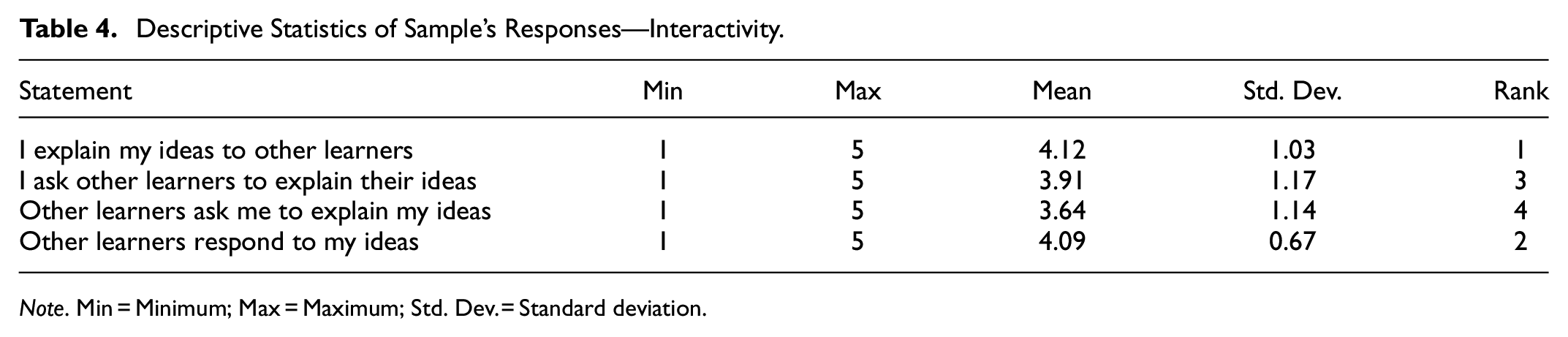
Note. Min = Minimum; Max = Maximum; Std. Dev. = Standard deviation.
Table 5 shows the descriptive statistics of the sample’s responses regarding interpretative skills developed in the VDs in Islamic education courses. Most pre-service teachers (97.5%, n = 157) indicated that the instructor understood their messages (mean = 4.37, SD = ±0.68). Similarly, the pre-service teachers made good sense of the instructor’s messages through the VDs (mean = 4.35, SD = ±0.62). Overall, the means of the responses to the four statements on the interpretation dimension varied between 4.16 and 4.37, while the standard deviation ranged from 0.62 to 0.84, indicating a low spread of the scores around the mean point of the 5-point scale.
Descriptive Statistics of Sample’s Responses—Interpretation.

Note. Min = Minimum; Max = Maximum; Std. Dev. = Standard deviation.
Most pre-service teachers considered their instructors highly skilled communicators after interacting with them through the VDs (mean = 4.67, SD = ±0.61) (Table 6). Simultaneously, the instructor encouraged the pre-service teachers to participate (mean = 4.61, SD = ±0.62). However, the means of the responses to the four statements on the instructor support dimension varied between 4.40 and 4.67, while the standard deviation ranged from 0.61 to 0.68, indicating a low spread of the scores around the mean point of the five-point scale, which shows that there was no extreme or abnormal value, and the majority of the respondents agreed to agree or be neutral.
Descriptive Statistics of Sample’s Responses—Instructor Support.
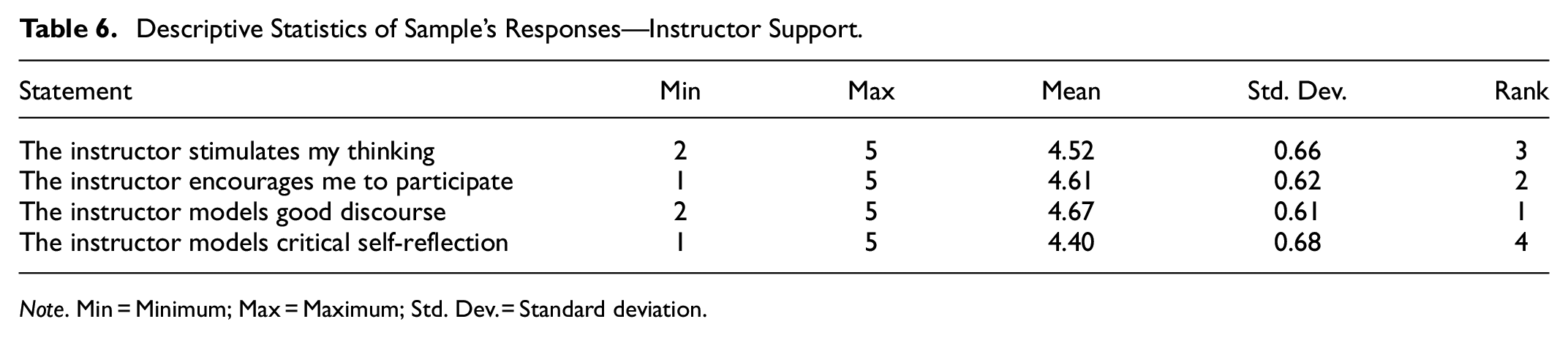
Note. Min = Minimum; Max = Maximum; Std. Dev. = Standard deviation.
Regarding peer support, most pre-service teachers (94.4%, n = 152) reported that other learners highly encouraged their participation (mean = 4.23, SD = ±0.77; Table 7). Likewise, most (95.6%, n = 153) indicated that other learners highly praised their contribution (mean = 4.19, SD = ±0.67). In general, the means of the responses to the four statements on the peer support dimension varied between 3.85 and 4.23, while the standard deviation ranged from 0.67 to 1.01, indicating a low spread of the scores around the mean point of the five-point scale.
Descriptive Statistics of Sample’s Responses−Peer Support.

Note. Min = Minimum; Max = Maximum; Std. Dev. = Standard deviation.
As Table 8 and Figure 4 show, relevance comes first in the matrix of the spectrum of the VDs in Islamic education courses with an overall mean of 4.57 (SD = ±0.47). The result is statistically significant (p-value < .01), which means that most of the pre-service teachers found VDs relevant in Islamic education courses. Instructor support ranked second, as the overall mean was 4.55 (SD = ±0.52), followed by interpretation with an overall mean of 4.28 (SD = ±0.52). The results were statistically significant (p-values < .01). However, reflective thinking ranked the lowest, with an overall mean of 3.87 (SD = ±0.88), and the result was statistically significant (p-value < .01). Overall, all of the dimensions of the survey had a high degree of importance as the values of the means varied between 3.67 and 5.00 on the five-point scale used in the questionnaire.
T-test of One Sample for Overall Students’ Perceptions of Virtual Discussions in Islamic Education Courses (n = 161).

Note. Std. Dev. = Standard deviation; df = Degree of freedom.

Overall descriptive statistics of pre-service teachers’ perceptions of virtual discussions in Islamic education courses.
Efficacy of the VDs for Student Teachers’ Engagement
Participants stated that using a VD in its various modalities in Islamic education courses improved their engagement, lessened their sense of failure, and reduced their rate of hesitation and anxiety. One participant wrote the following: Through traditional engagement, I felt hesitant to participate since I wanted to spare myself the instructor’s judgment. I lacked the self-confidence to be active in classroom discussions, and I was hiding behind my decision to be silent and invisible… However, through the virtual discussion, I felt the barriers were, to some extent, fading; it might be [because of] the absence of the actual presence of people and the freedom to either switch the camera on or participate without it.
The students also reported that the VDs maximized peer cooperation, enforced communication skills, and generated constructive feedback. One participant stated the following: The group discussion was a focal transition for me. It was the first time I was introduced to such a practice. I have been assigned to operate and manage the group discussions, [which] we worked on without the instructor. [The discussions] promoted self-regulation skills, listening, sharing ideas, respecting disagreements, and valuing the essence of authentic communication.
Efficacy of the VDs on Pre-service Teachers’ Interactions
The participants were highly satisfied with their interpersonal interactions during the VDs, which eventually reflected positively in their perceived learning. A participant stated, “VDs promoted creativity toward listening to others and building on their ideas.” Others confirmed that interaction through the VDs “increased the level of interest in what [they] had been introduced to in order to learn and discuss.” Constructive feedback from peers was beneficial and purposeful, enabling participants to develop self-appreciation and self-regulation abilities. These VDs fostered interaction based on participants’ extensive reading, research, and investigation, thereby developing their critical thinking skills and the achievement of genuine learning outcomes. One participant said, “During these discussions, there were disagreements, arguments, and fallacies, but we managed to clarify, refute, and confirm ideas in an environment that promoted sharing and communicating genuinely. Although there were disagreements, we learned the ethics of conducting an objective dialog.” Whether synchronous or asynchronous, the VDs led to learning to respect others’ intellectual differences and thoughts and encouraged a thorough understanding of the various perspectives introduced. Moreover, the participants were allowed to enforce their self-regulation skills and autonomous learning. A participant said, “I am now aware of the major skills I acquired through the VD and find myself capable of self-learning, conducting a constructivist discussion, and learning from others.”
Efficacy of the VDs on Pre-service Teachers’ Socialization
Socialization in the learning environment involves cultivating relationships with others and building connections at various levels (Irwin & Berge, 2006). Socialization in a traditional learning environment differs from socialization in a VL environment, which involves multifaceted challenges related to anticipated learning outcomes, interaction, communication, and collaboration. Interaction in the online context is anticipated to mirror traditional face-to-face interaction, although such anticipation provokes a dilemma that might accompany such mimicking, overloading students with activities that could turn into barriers rather than catalyzers (Northrup, 2002).
The concept of socialization is included in interactions and communication. It is rooted in the constructivist learning process wherein learners, introduced to various learning materials, work meaningfully by acquiring knowledge through communication and interaction with their classmates and the instructor. Such implicit interaction promotes students’ awareness of others’ input, help, and participation, which is considered the vehicle for socialization (Irwin & Berge, 2006). In addition, in this study, pre-service teachers practiced peer review within the VD, providing their classmates’ ideas, feedback, and opinions. Such actions motivated them to work more with others and encouraged collaboration to generate learning outcomes at an acceptable level. They learned to converse with each other, communicate meaningfully, and provide constructive feedback to improve the work produced collaboratively. Parallel to this practice, the pre-service teachers built social skills, confidence in taking charge, and autonomy toward their learning through the VD. A participant said that communicating the knowledge imparted to [the students] during the VD strengthens the relationship between [them] as classmates as well as with the instructor. Through these discussions, [they] felt empowered and owned the authority throughout the interchange of ideas. The virtual platform was a critical tool that facilitated interactions and exchange of knowledge, which kindled [their] socialization skills and self-confidence in a way [they] thought would be strenuous.
Difficulties Encountered During the VDs
Online and VL environments are not free of challenges; obstacles can hinder the achievement of anticipated learning outcomes and the creation of a successful learning community that facilitates interaction, socialization, and active engagement in the learning process. The creation of learning communities in an online sphere relies on encouraging students to interact, communicate, navigate ideas, and construct knowledge accordingly. The participants of this study noted that despite the substantial positives of the VDs, a few obstacles were related to the characteristics of some learners who held rigid opinions and refused to accept others’ convictions. Such hindrances might also have caused deviation from the core of the discussion, resulting in time being wasted and some students taking sides, thereby minimizing the discussion’s objectivity. One participant pointed out the following: In one of the VDs, we were assigned a discussion exclusively with classmates, wherein the instructor sought to allow us more authority and autonomy in conducting these discussions, which were also recorded via Microsoft Teams. We encountered some adamant classmates who forced their opinions and convictions onto the rest of the group. I felt annoyed and wanted to leave the session. It was not a healthy environment for conducting a discussion or my benefiting from it, and engagement in any sort of dialogue was not possible.
The students stated that VDs must provide authority to manage such rigidity and resolve tensions during discussions. To create a learning environment suitable for sociability in these virtual settings, students may want to assist or converse with others in this context. If this desire and interest are lacking, students may perceive that their social interactions are hindered, and their motivation may decrease (Çoban et al., 2022).
Another difficulty pre-service teachers perceived was related to learners’ age: VDs are not suitable for younger generations and are preferable for higher levels of school and college. One participant said, “I enjoyed the VDs. However, I do not see myself applying it to my class of secondary school students since I feel they are not accustomed to discussions on online platforms. I would allow it in the traditional learning setting.”
In addition, the participants said that their experience with the various forms of VDs—synchronous or asynchronous and written or verbal—was novel, and it was highly encouraged in their Islamic education courses. Because of the absence of previous exposure to VDs, pre-service teachers said they were not comfortable initiating discussions, and if they participated or engaged in the discussion, it was for an extremely brief period. Either they were shy or afraid of being judged for their input or they were hesitant and uncertain about whether they added any significant knowledge to the VD. One participant said, “I prefer to engage in written VD rather than verbal discussion because I feel less pressured. I can edit my thoughts and get extra time to think about my ideas and exchange them with others.” Another participant disagreed with her classmate. She said, “Written discussions can be allowed but with limited usage. I will urge my prospective students, even those who are shy, to participate verbally on online learning platforms.”
Effective exposure of students to regulate VDs is important in reducing pressure and problems. The participants stated that interruption was a major obstacle to conducting a fruitful discussion. Mismanaging the time allotted equally for each classmate’s input might also affect the benefits of a VD, with some students possibly dominating the discussion and not allowing others to voice their opinions or arguments, thereby marginalizing their engagement and contributions. The participants said that the instructor played a focal role in initiating and setting the regulations for a successful VD, wherein students engaged, interacted, and communicated with others and genuinely learned from their experiences.
Discussion
An online discussion holds multifaceted challenges related to facilitating the learning environment, compensating for the absence of face-to-face interactions, and creating a motivated learning context for students to actively engage and socialize in a positive atmosphere that results in authentic learning experiences and outcomes.
To compensate for the natural face-to-face learning environment, instructors must set objectives to reach anticipated learning outcomes, activities, time frames, materials, and technology-supported resources. The aim of this study was to examine the implementation of VDs and their impact on pre-service teachers’ learning experiences. For this purpose, various authentic requirements were applied involving various modalities of discussions—written and verbal, synchronous and asynchronous, and with and without the instructor’s presence. These were recorded and self-directed by the assigned class groups.
The significant findings of the study stem from the participants’ application of these discussion modules. They reported that the VDs helped them improve their all-around professional practice by encouraging them to reflect on their ideas, thoughts, and opinions from various perspectives. Students’ participation is significantly influenced by teacher support (Çoban et al., 2022; G. Liu et al., 2021). Teachers can help increase students’ motivation and promote their active engagement. Students with caring and supportive relationships at school reported positive academic attitudes and increased academic engagement. A limitation linked to the online learning environment is the lack of face-to-face communication, which renders group discussions more difficult. As such, students’ engagement and motivation may decline over time as they participate in the virtual learning environment (Przymuszała et al., 2022).
Nonetheless, this study’s researcher watched a small number of recorded VD sessions—in which students participated without an instructor’s presence—and found that students thrived with their increased autonomy. Exposure to VDs as a new form of learning experience can be beneficial and enlightening and help learners develop interpersonal competence and self-assurance.
Another major finding of the study was the novelty of the VDs during which participants were exposed to an encouraging VL environment to develop their reflective thinking skills. They stated that such new practices helped them voice their input, especially those who were shy to engage in discussions in face-to-face learning environments. Small group VDs eased the process of interaction, engagement, reflection, and the sharing of ideas among students, consistent with previous research findings (Delaney et al., 2019; Halabi & Larkins, 2016; Lai, 2015). This shows that VDs promoted positive interaction and improved perceived learning. Furthermore, in online courses, hostile peer interactions are extremely rare (G. Liu et al., 2021).
As the participants stated that the VDs were their first exposure to such learning experiences, they were highly motivated to interact and engage therein. Alghamdi (2013) confirmed that students found themselves interacting by discussing various topics effectively and without a sense of embarrassment in the VL environment. Another explanation that might affirm this result is that the allocated space of freedom and autonomy introduced to students through their courses facilitates their connections and interactions, which eventually leads to productive perceived learning (Mehall, 2020). Through these discussions, students can achieve deep and purposeful learning and focus extensively on the quality of the interactions, not merely on their quantity, as Garrison and Cleveland-Innes (2005) note. They found that “simple interaction, absent of structure and leadership, is not enough. We need to have a qualitatively richer view of interaction.”
VDs enhance students’ level of social interaction, motivating them to understand others’ ideas, thoughts, opinions, and even disagreements. However, online discussions might cause misconceptions. In such cases, the instructor plays a vital role in eliminating misinterpretations of ideas and providing constructive feedback to reduce the adverse effects of VDs (Sthapornnanon et al., 2009).
The instructor initially facilitates any VD-related experiences, wherein students reflect on and discuss each other’s ideas and views independently to receive the instructor’s feedback at the end. This coordination during a VD demonstrates the instructor’s role and their bond and relationship with their students (González Moreno, 2011). In addition, peer support and interaction are highly catalyzed through VDs, wherein students reflect on their classmates’ written responses on the discussion boards or provide insightful input during synchronous interactions.
This study found that student peer support and interactions were high and active, respectively, which differs from the findings of González Moreno (2011), who pointed out that teacher–student interaction is productive compared with student–student interaction in the online learning environment. Beck (2010) and Garrison and Cleveland-Innes (2005) contended that students seek help from their peers when they cannot direct questions to their teachers for feedback, which results in them relying more on and working collaboratively with their peers.
The three main aspects investigated among pre-service teachers through the VDs were engagement, interaction, and socialization. The study showed several advantages of VDs, such as participants being optimistic about their interaction and engagement, which led to positive social interactions in the VL environment. Engaging through VDs significantly fostered social construction. Moreover, exposing students to this practice not only promoted their interaction and socialization but also extended the construction of a thorough understanding of their knowledge and perceived learning simultaneously with their peers’ knowledge construction (Çoban et al., 2022; Sthapornnanon et al., 2009). The VDs also motivated students who were reluctant to engage by motivating them intrinsically. The autonomy, self-regulated skills, and critical thinking skills that participants suggested had been acquired during the VDs did not merely reflect on some other students; they were mirrored by others in what became an active learning environment. The technology mediated the essential role of collecting information and supporting arguments, resulting in higher self-esteem and confidence. The VDs helped pre-service teachers scaffold their knowledge, develop cognitive recognition, and voice their opinions and ideas in a positive atmosphere. As suggested in their reflections, this resulted in them feeling part of the community of professional students and learners. It helped create a sense of value for teamwork and collaboration through participants’ supporting each other in building skills. One participant said, “[My] classmates were the critical voice in developing my skills. Engaging and interacting in these VDs broadened my perspectives regarding the quality of my ideas and promoted my analytical skills during the discussion and sharing of my thoughts.”
The VDs empowered pre-service teachers who felt they were lagging in both the face-to-face learning environment and VL and who relied heavily on the instructor-student relationship rather than diversifying the interaction styles. One participant said, “This VL environment provided various styles of interaction, which intrinsically motivated me to engage more and allowed me to build a positive relationship with my classmates.”
Finally, crucial responsibility lies with the instructor as a facilitator of such experiences for achieving various authentic learning outcomes. Most of the pre-service teachers pointed out an obstacle concerning the novelty of the VDs: some students might dominate the discussion, which can result in other voices subsiding. In this situation, the pre-service teachers suggested that the instructor’s guidance and intervention are needed to direct the VD toward achieving a purposeful learning outcome. The instructor can also prevent the VD from deviating from the anticipated and planned objectives. Teachers should set authentic goals when using technology to facilitate expressing students’ voices, interaction, and engagement through robust planning and understanding of the complexity of the online environment.
Conclusion and Recommendations
This study addressed the experience of Islamic education pre-service teachers exposed to VDs in their Islamic education undergraduate courses. The results confirmed that this exposure led to the development of an authentic learning experience. Pre-service teachers developed a greater ability to recognize their level of engagement and willingness to interact in online discussions, which improved their socialization skills and perceived learning outcomes. Teachers play a central role in the online environment. They must create a well-designed and well-planned self-regulated environment that relies on various modalities of discussions to activate students’ engagement, encouraging them to voice their opinions and enabling their construction of knowledge and understanding (Bolliger & Martindale, 2004). This study also pointed out that VDs, despite their extensive benefits, also have various challenges for both teachers and students. VDs require an understanding of the social construction of knowledge within the VL environment, which must be managed to achieve learning outcomes.
This study is significant for the following reasons. First, it enriches the existing educational literature by providing updated research on the impact of COVID-19 on online learning. Second, it provides valuable insight into the effects of fostering students’ engagement, interaction, and socialization virtually through the use of VDs. Third, it provides educational institutions and decision-makers with insight into maximizing the utilization of online learning to achieve authentic learning outcomes. Fourth, it provides a guide for pre-service teachers and teachers regarding the significance of VDs in students’ performance and achievements.
This study has some limitations. The main limitation pertains to the sample, which comprised only female Islamic education pre-service teachers. They were selected for this study because this cohort was enrolled in the courses that employed VDs. Thus, future studies should include both male and female participants and students at various levels of study—not just at the university level—to examine the variables from a broader perspective.
Footnotes
Acknowledgements
The author would like to thank the participants for their willingness, and input, which helped in pursuing and completing this paper.
Declaration of Conflicting Interests
The author declared no potential conflicts of interest with respect to the research, authorship, and/or publication of this article.
Funding
The author received no financial support for the research, authorship, and/or publication of this article.

Data Availability Statement
Data sharing not applicable to this article as no datasets were generated or analyzed during the current study.