



Abstract
This study investigates how product and cultural knowledge shared by streamers in live streaming e-commerce affect consumers’ purchase behavior, and examines the heterogeneity of these effects across different live streaming times. Drawing on dual-processing theory and attention theory, we develop a comprehensive empirical model with an unsupervised machine learning approach applied to 198,648 min of live streaming data from Douyin, a leading Chinese e-commerce platform. Our findings show that different dimensions of streamers’ knowledge-sharing have distinct impacts on consumer purchase behavior, with cultural knowledge demonstrating a significantly stronger effect than product knowledge. Furthermore, we find that live streaming time moderates the relationship between streamers’ knowledge-sharing and consumers’ purchase behavior. This study provides empirical insights for streamers, enterprises, and live-streaming platforms to develop differentiated marketing strategies and customize live streaming content to optimize conversion rates and marketing effectiveness.
Introduction
Traditional e-commerce platforms present products through static images, text, and pre-processed video content, where consumers can only receive information unidirectionally without real-time interaction, resulting in a weaker product experience (H. Chen et al., 2022; Y. Y. Guo et al., 2022). In contrast, live streaming e-commerce, as a hallmark of the digital economy era, combines real-time interaction with visual presentations, allowing consumers to simultaneously watch product demonstrations, ask questions, and receive immediate answers, greatly enhancing the certainty of consumer decision-making and purchase experience (Diao et al., 2023). This innovative model has emerged as a new engine driving global economic development, demonstrating the revolutionary power of the network and digital technology (Acs et al., 2021; Hong et al., 2023; Luo et al., 2025; Ojala et al., 2018).
As the country occupies the dominant position in global live streaming economic revenue, China’s consumer behavioral preferences have significant academic research value (Alam et al., 2025; J. L. Chen & Wu, 2024; Liang et al., 2025). In the live streaming e-commerce ecosystem, streamers serve as a bridge linking products and consumers, stimulating consumers’ purchase intentions by delivering accurate and valuable information, ultimately promoting purchase behavior. An in-depth study of streamers’ information delivery strategies, effects, and optimization paths is crucial for effectively promoting consumer purchase behavior and maximizing the benefits of streamers, enterprises, and platforms (X. Gu et al., 2024; Liao et al., 2023; Zeng et al., 2023).
As dominant players and opinion leaders in live streaming e-commerce, streamers have provoked widespread academic interest in their impact on consumers’ behavior (Alam et al., 2025; He & Jin, 2024; L. Li et al., 2024; L. Liu et al., 2023). Existing research focuses on two core dimensions that influence consumer behavior: streamers’ personal characteristics and their linguistic expressions.
In terms of personal characteristics, streamers’ professionalism (He & Jin, 2024; X. H. Liu et al., 2023), attractiveness (Ji et al., 2025; L. Li et al., 2024), interactivity (Qin et al., 2023; Y. Zhou & Huang, 2023), and gender differences (X. Yang et al., 2023) have been proven to impact consumer behavior. Regarding linguistic expression, warm words and humorous live streaming style (Y. Y. Guo et al., 2022), assertive, directive, and expressive speech acts (L. Liu et al., 2023), and emotional and informative voice characteristics (Luo et al., 2025) all influence consumer behavior.
However, with the diversification of live streaming forms, streamers not only share product knowledge but also cultural knowledge, including bilingual teaching, poetry recitation, music performance, and philosophical discussion. This knowledge-sharing form of live streaming has attracted consumers’ attention, and its explosive economic benefits in the short term have triggered scholars’ interest (Luo et al., 2024). Yet there are significant gaps in research on how streamers sharing different knowledge content impacts consumers’ purchase behavior.
Additionally, existing research in live streaming e-commerce has considered the influence of the time factor on consumer behavior, focusing primarily on the duration of viewing live streaming, immersive experience (Huang et al., 2023; Shiu et al., 2023), and the feeling of time pressure (Alam et al., 2025; Y. D. Zhang et al., 2024). Academic research has shown that consumer behavioral preferences vary over time (Kedia et al., 2024; Nguyen et al., 2019), and consumer attention affects behavioral responses (Florack et al., 2020). Existing literature has explored the impact of consumer attention resource competition (Shen et al., 2015; Q. Yang et al., 2023) and attention allocation (Ilicic & Webster, 2014) on behavior from an attention perspective.
However, in live streaming e-commerce scenarios, there is a lack of individual consumer-level research that considers how changes in the external time environment and consumers’ internal physiological states lead to differences in consumer attention allocation and thus influence purchase behavior. That is, there is insufficient research on the differences in purchase behaviors that result when consumers watch the same live streaming room at different times due to the distribution of consumer attention.
Based on the identified research gaps, this study addresses two main research questions:
(1) What is the specific content of product and cultural knowledge that triggers consumers’ purchase behavior in live streaming e-commerce, and what are the differences in their impact on consumers’ behaviors?
(2) How does the impact of streamers’ knowledge-sharing on consumers’ purchase behavior differ at different live streaming times, considering the differences in individuals’ attention levels and allocation at different times of the day?
To address the above two questions, building on existing research that streamers can influence consumers’ purchase behaviors through talk content in live streaming (Dash et al., 2021; W. Gu et al., 2023; Luo et al., 2024), based on dual-processing theory (Griffin et al., 2002; McCabe et al., 2016) and attention theory (Lavie, 1995; Shen et al., 2015), a comprehensive regression model is constructed to analyze empirical data for 198,648 minutes and 17,576,788 pieces of consumer bulletin screen data from Douyin, a Chineses leading e-commerce platform, to explore the effects and differences of streamers’ sharing product and cultural knowledge on consumers’ purchase behavior in live streaming e-commerce. On this basis, we further verified the moderating effect of different live streaming times. This empirical research using big data overcomes the limitations of traditional survey research on the reliance on self-reporting, small sample sizes, and others (Bharadwaj et al., 2022).
Literature Review and Hypothesis Development
Dual-Processing Theory and Attention Theory
Dual-processing theory suggests that individual behavioral decisions are based on two distinct and complementary systems (i.e., cognitive reasoning and emotional response) (McCabe et al., 2016) which are used to explain how individuals receive and process persuasive information (Chaiken, 1980). The existing literature differs in naming two systems that influence consumer decision-making, but there is a convergence of views on how information is processed. System 1, referred to as the fast system (J. Evans, 2008; J. S. T. Evans & Stanovich, 2013), focuses on heuristic processes for information processing (Chaiken, 1980), influences consumer behavior through peripheral routes (Petty et al., 1983), and has been evidenced to consumer emotions (Cao et al., 2024; McCabe et al., 2016; Ruiz-Mafe et al., 2018). System 2, referred to as the slow system (J. Evans, 2008; J. S. T. Evans & Stanovich, 2013), focuses on analytical processing for information handling (Chaiken, 1980), influences consumer behavior through central routes (Petty et al., 1983), and has been evidenced to consumer cognition (Zeng et al., 2023). Both of these information processing routes can coexist, and different routes may also affect individuals differently (Griffin et al., 2002). In the live streaming e-commerce, the influence of the streamer on the consumer is crucial, and the consumer obtains product information from the recommendation of the streamer (persuasive information) and is infected by its emotion (Lin et al., 2021), which subsequently influences the consumer’s attitude and purchase decision (M. F. Li et al., 2023; C. L. Liu et al., 2023).
Attention theory suggests that attention is a limited cognitive resource (Lavie, 1995), which is one of the dominant antecedents of an individual’s behavioral decisions (Shen et al., 2015). It has now been widely applied in several research areas such as psychology, marketing, and consumer behavior (Fei et al., 2021; Javadi et al., 2013; Q. Yang et al., 2023). Different task orientations can result in people’s attention levels and allocation being different due to changes in both the external environment and internal physiological states, thus affecting their behavioral responses (Florack et al., 2020; Wickens, 2021). Consumers’ attention to products can improve their overall assessment of products (Florack et al., 2020) while attachments and attention to influencers can migrate to products recommended by influencers, which can promote attention and attitudes toward products (Ilicic & Webster, 2014; Q. Yang et al., 2023). In live streaming e-commerce, the changes in both the external environment and the consumer’s internal physiological state at different live streaming times make the level and distribution of the consumer’s attention different. Consumers in different task-oriented for the information obtained in different cognitive processing ways, streamers as the soul core of the live streaming process, through talk as a stimulus to convey the main information to consumers at different live streaming times, which attracts and reasonably allocates consumers attention to streamers and products, thus triggering consumer purchase behavior (Fei et al., 2021).
Streamers Impact on Consumers’ Behavior
Derived from social e-commerce, live streaming e-commerce provides a virtual space where consumers and streamers can have real-time interactions (Recktenwald, 2017; Wongkitrungrueng & Assarut, 2020; Xu et al., 2020), which allows consumers to enter and exit the live room freely during live streaming (J. L. Zhou et al., 2019), aiming at providing a new type of interaction and an enjoyable online shopping experience for consumers (X. Gu et al., 2024; Y. Y. Guo et al., 2022). As a new type of social interaction marketing model, live streaming e-commerce attracts interest from brands and merchants due to its higher sales performance than other online channels in the same circumstances, which helps to increase product sales (M. Zhang et al., 2020). Distinguished from traditional online shopping by displaying pictures, texts, and processed video content to lead consumers to purchase, in live streaming e-commerce process, consumers can visualize products more intuitively through real-time online live streaming which reduces uncertainty in the purchasing process, thus increasing products’ sales.
As the key opinion leader (KOL) of the live streaming e-commerce process, the streamer’s influence on consumer behavior is essential and has been widely investigated in the academic field (Cai et al., 2023; Y. Y. Guo et al., 2022; Luo et al., 2025; Peng et al., 2024; X. Yang et al., 2023; Zhu et al., 2021). Existing research on consumer behavior by streamers in live streaming e-commerce focuses on two levels. On the one hand, there is the level of personal characteristics of streamers, their attractiveness, credibility, expertise, and beauty positively affect consumers’ purchase intentions (Y. Y. Guo et al., 2022; He & Jin, 2024; Liang et al., 2025; Pu et al., 2025; Zhu et al., 2021). Streamers of different gender are suitable for selling different types of products, and compared to female streamers, male streamers perform better in selling experienced products (X. Yang et al., 2023). The other aspect is the streamer’s linguistic expressions, the humor and enthusiasm of the streamer can help to enhance the consumer’s perceived value and thus influence the consumer’s behavior (Y. Y. Guo et al., 2022), in addition, different linguistic styles have variations in their impact on consumer purchase, assertive and directive speech acts have a positive impact on sales performance, while expressive have a negative impact on sales performance (L. Liu et al., 2023). Moreover, the streamer can also attract consumers to purchase by interacting with them in the live streaming room, providing products information, using emotional vocabulary, different voice characteristics including emotional and informational voices, and others (Luo et al., 2024, 2025; Wang et al., 2024; Q. Yang et al., 2023).
Table 1 summarizes the factors that influence consumer behavior in live streaming e-commerce. Existing literature on consumer behavior in live streaming e-commerce mainly focuses on sales performance (X. Gu et al., 2024; Liao et al., 2023; Peng et al., 2024; X. Yang et al., 2023; C. Zhang et al., 2024), consumer engagement (L. Y. Guo et al., 2021; Hu & Chaudhry, 2020; Wongkitrungrueng & Assarut, 2020), purchase intention (X. Y. Chen et al., 2023; Fei et al., 2021; Q. Yang et al., 2023; Zeng et al., 2023; Zheng et al., 2022), and impulse buying (L. Li et al., 2024; Lo et al., 2022). Consumer purchase behavior is an effective manifestation of the monetization of consumer identification, and exploring it can help develop effective marketing strategies to maximize benefits.
Recent Research on the Influencing Factors of Consumer Behavior.
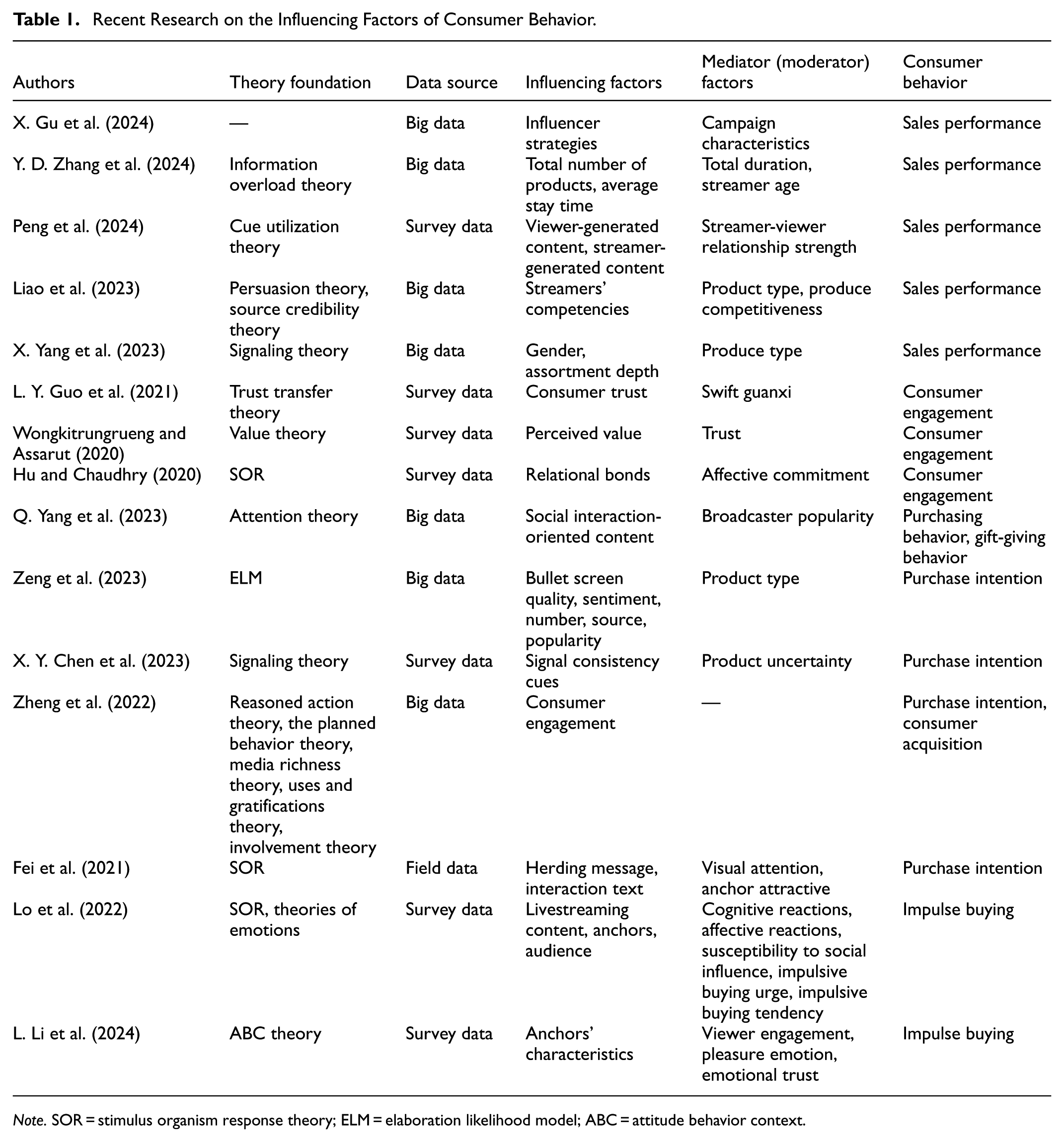
Note. SOR = stimulus organism response theory; ELM = elaboration likelihood model; ABC = attitude behavior context.
Streamers’ Knowledge-Sharing and Consumers’ Purchase Behavior
In live streaming of e-commerce, streamer knowledge-sharing refers to delivering professional knowledge, life skills, industry dynamics, personal experience, and other content to the viewers through real-time interaction (Kang et al., 2021; Luo et al., 2024; Qin et al., 2023; Q. Yang et al., 2023), including product knowledge and cultural knowledge. The product knowledge includes introductory descriptions of products, prices, promotions, after-sales service, and other aspects (Kang et al., 2021; Qin et al., 2023), and cultural knowledge includes streamers’ sharing of valuable insightful content on science, culture, history, and topical current events combined with their personal erudition and experiences (Luo et al., 2024; Mao, 2022). Based on the dual-processing theory (Griffin et al., 2002; McCabe et al., 2016), streamers share product knowledge that is directly related to products as central cues, and the role path that affects consumer behavior process persuasive information is the central (cognitive) route, share cultural knowledge indirectly related to products as peripheral cues that affect consumers’ behaviors acting in a peripheral (emotional) route.
Persuasion is regarded as the process of individuals influencing others’ self-determination and behavior through communication (Jones, 2017). Streamers reduce uncertainty about the product generated by space distance through professional product knowledge introduction and demonstration (Y. Y. Guo et al., 2022). The streamer deeply interactions with consumers by responding to questions about the product in bullet screen comments in live streaming (Deng et al., 2022; Y. Li et al., 2021), providing personalized services for consumers (Fu et al., 2024), and helping them to understand the product more deeply and grasp the product’s features, advantages and usage scenarios (Luo et al., 2024). In addition, streamers combine erudition, experience, and emotions to share cultural knowledge during the interaction process, providing valuable insights to consumers, which enhances the viewers’ perception of the streamers’ charms (Xue et al., 2020), and develops a stronger emotional connection (Qin et al., 2023). Social networks provide consumers with social learning environments, where consumers gain social experience and actions through streamers’ knowledge-sharing knowledge and interaction during live streaming (M. Li & Hua, 2022). Streamers’ profound erudition, rich experiences, and valuable insights help consumers gain knowledge and insights, increase their gratification due to the gains, and form an identification with streamers. Differences in the impact of streamers’ knowledge-sharing as persuasive information on consumer behavior through different information processing routes in live streaming e-commerce. Therefore, we propose a series of hypotheses as follows:
The Effects of Live Streaming Time
Existing studies have confirmed the differences in consumer preference behaviors and classified consumer behavioral preferences in different time slots (Nguyen et al., 2019; Southerton, 2003; van der Lippe, 2007). China is the largest live streaming market in the world as well as one of the fastest growing live streaming markets, and its consumers are concerned about balancing their time at work and at home, with the daytime usually devoted to work and study, and the nighttime to relaxation and leisure (J. L. Chen & Wu, 2024; Kedia et al., 2024; van der Lippe, 2007).
In live streaming e-commerce, the impact of the time dimension on consumer behavior has become increasingly prominent and has received extensive empirical support (Huang et al., 2023; Shiu et al., 2023; C. Zhang et al., 2024). Changes in the duration of consumers’ live streaming viewing not only directly shape their live streaming experience, but also profoundly affect their behavioral decision-making, such as purchase intention (Huang et al., 2023; Shiu et al., 2023). The time consumers spend in the live streaming room and the total live streaming duration of the streamer, as direct manifestations of the time factor, directly or indirectly impact the sales performance in the live streaming room (C. Zhang et al., 2024), moreover, the time pressure felt by consumers during viewing live streaming also affects consumer purchasing behavior (Alam et al., 2025; Y. D. Zhang et al., 2024), which highlights the importance of time in shaping consumer behavior. As individuals, consumers’ behaviors and decision-making processes are influenced by their living habits. Attention theory suggests an individual’s limited attention (Shen et al., 2015), and individuals are unable to process all cognitive stimuli at the same time but only allocate part of their attention to processing the stimulus while abandoning the others (Lavie, 1995; Roda & Thomas, 2006), and changes both in external times and in internal physiological states affect individuals’ attention levels and allocation ways (Florack et al., 2020; Wickens, 2021). Combined with the lifestyle habits of consumers, during work and study time, consumers might be in a more busy and rational state, watching live streaming in fragmented time, and have limitations in processing the information they obtain from live streaming. During relaxation and leisure time, consumers are likely to invest more time and energy to focus on the live streaming process, and their emotions are more relaxed and emotional, making them more easily attracted by live streaming content and generating in-depth interactions.
The differences in how attention allocation leads to changes in consumers’ cognitive processing of acquired information within different task-oriented contexts, and thus there are differences in the impact on customers’ behavior (Lavie, 1995; Roda & Thomas, 2006). Streamers can influence consumers’ cognition and emotion by sharing product and cultural knowledge in live streaming e-commerce, which in turn influences consumers’ purchase behavior. There are differences in the way consumers allocate attention levels at different live streaming times, and compared to work and study time, which are task-oriented, consumers are more likely to allocate more attention to live streaming at relaxation and leisure time, which in turn has a greater impact on consumer purchase behavior. Therefore, we propose the following hypothesis:
Methodology
Data Collection and Pre-Process
The empirical data for this study was obtained from Douyin (the Chinese version of TikTok), one of the top three live streaming platforms in China, which topped the valuation list of the “Top 100 Chinese New Economy Unicorn Enterprises in 2023” published by iiMedia Ranking, a China-based evaluation agency for new consumption brands, in September 2023, and has a certain value for investigation. The platform allows merchants and streamers to conduct live streaming events (Z. C. L. Wang et al., 2024; C. Zhang et al., 2024), during which consumers can access, watch, participate in as well as purchase live streaming products. The data was obtained from a Chinese live streaming service provider (https://www.douchacha.com), which has been recognized and used in academia for research (Q. Yang et al., 2023). This study obtains data on three typical learnable live streaming rooms that have demonstrated strong commercial explosiveness and sustainable economic returns in the short term in Chinese live streaming e-commerce marketing, with diversified product categories for sale and a certain degree of influence including East Buy, Travelling with Hui, and Gaotu Jiapin. The data from 28 February to 21 May 2024, and consists of two parts. The first part detected the numerical data such as the number of viewers, sales performance, consumer likes, and sales conversion in the live streaming process, and the data were acquired at a two-minute interval, resulting in a total of 99,324 pieces of consumer behavioral data in 198,648 min. The second part is the monitoring of the voice of the streamer during live streaming, which is displayed in the form of text and records the specific time of the streamer’s talk content, with a total of 214,620 pieces of data obtained.
We aligned and merged streamer talk content and bullet screens from 99,324 behavioral data corresponding to time from 214,620 talk content by writing code in Python and removing redundant, incomplete, and invalid data. Based on this, the non-numeric data were converted into a numeric format for subsequent data analysis (Sun et al., 2019). Finally, 35,777 pieces of consumer behavior data were retained for the next variable construction and data analysis through the above pre-process.
Variables and Models
Variables
Consumer purchase behavior is represented by sales performance over the time interval. Sales performance is a visual embodiment of consumer purchase intention and behavior, which has been validated as a measure of consumer purchase behavior (X. Gu et al., 2024; Q. Yang et al., 2023). The data are numerical variables and can be obtained directly from the live streaming service provider.
Streamer’s knowledge-sharing in live streaming e-commerce is obtained from the streamer’s talk content in live streaming. We use Structural Topic Modeling (STM) (Roberts et al., 2016) to analyze the unstructured textual data, which is the streamer’s talk content, for the topics of the streamer’s knowledge-sharing. STM is an unsupervised machine learning approach that is an extension of the basic LDA model, which helps researchers with the ability to identify topics contained in text documents such as social media content, posts, or consumer reviews and to construct models for their relationships (Roberts et al., 2016). The structural relationships between topics extracted from massive texts are modeled to analyze their impact on consumer behavior, revealing the real meanings of the topics (Roberts et al., 2019), and the data are deep-mined to explore useful information (Roberts et al., 2019), which breaks the limitations of traditional methods due to sample or data size limitations (J. J. Li et al., 2018). The accuracy of STM for identifying topics from massive amounts of text data, gaining insight into consumer behavior data, and reducing subjective bias has been widely evidenced (Bai et al., 2024; Ding et al., 2020; Hannigan et al., 2019). Firstly, we conducted basic data cleaning on the 35,777 pieces of streamer’s talk content data obtained after pre-processing by writing Python code to apply the jieba package to cut the text data and remove all punctuation marks, numbers, and other non-Chinese text data to ensure that the cleaned data can be used for subsequent STM unsupervised machine learning data mining. Secondly, we searched for K by calling functions in the stm and furrrr packages in R. We obtained the number of topics K (from 3 to 20) related to the semantic consistency of the topics, and used the elbow method to determine the optimal number of topics (Bai et al., 2024; H. Y. Liu et al., 2022; Roberts et al., 2014), namely, K equals 12. Figure 1 shows the process of determining the number of topics. Finally, the topics were labeled manually according to key words in relation to the category with nine topic words related to the streamer’s knowledge-sharing, and Table 2 shows the types of topics and key words related to streamers sharing knowledge.
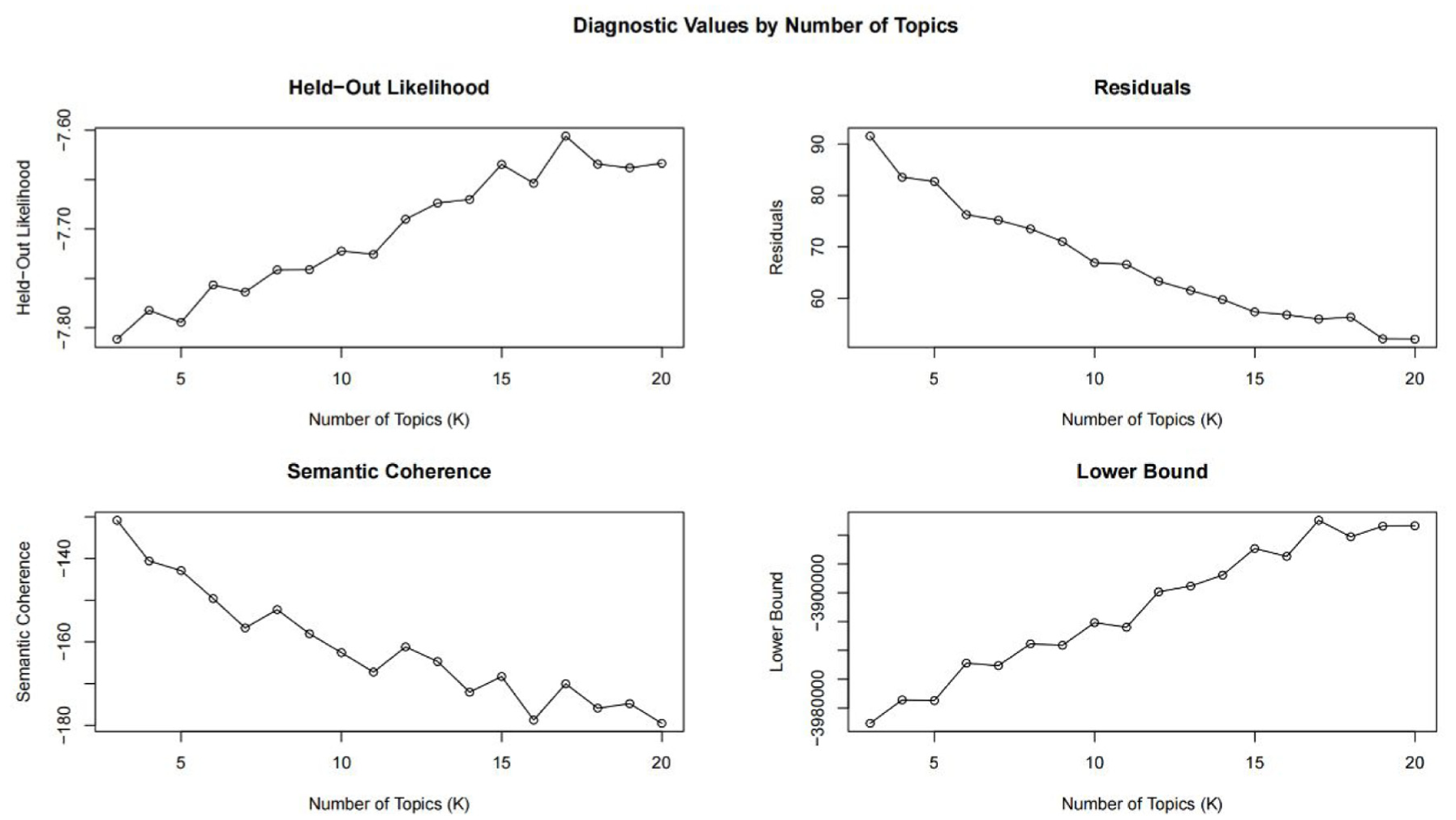
The process of determining the number of topics.
Part Result of Structural Topic Modelling.

The “product knowledge” variable is measured by counting the percentage of all product knowledge topics shared in the streamer’s talk content in a unit time interval, and the value of the variable ranges from “0” to “100.”
The “culture knowledge” variable is measured by counting the percentage of all culture knowledge topics shared in the streamer’s talk content in a unit time interval, and the value of the variable ranges from “0” to “100.”
Time is when streamers are live streaming. We follow the existing literature that divides 18:00 as the precept cut-off point between daytime and nighttime (Kedia et al., 2024; Nguyen et al., 2019), and divided live streaming time into two periods: 8:00 to 18:00 for work and study time, and 18:00 to 8:00 the next day for relaxation and leisure time. To accurately quantify this variable, we rely on a detailed dataset of streamer talk content and capture and categorize the specific moment of occurrence of each talk by precisely extracting talk-starting time nodes into the aforementioned pre-defined time frameworks. This process not only ensured the timeliness and accuracy of the data but also provided a solid foundation for subsequent analyses. Subsequently, we used a binary coding system to systematize the obtained data, with “1” representing work and study time and “0” representing relaxation and leisure time. Such coding not only simplifies the complexity of data analysis but also enhances the intuitiveness and interpretability of the results.
Existing studies have demonstrated that the streamer speed rate can affect consumer behavior (Z. C. L. Wang et al., 2024). To better explore the effect of streamer’s knowledge-sharing on consumer behavior and to exclude the influence of other variables, we used the streamer speed rate as the control variable in this study. The measure for streamer speech rate is the number of words per unit time interval of the streamer’s talk.
Table 3 shows the specific definitions of the variables for this study.
Definitions of Variables.

Note. DV = dependent variable; IV = independent variable; MV = moderator variable; CV = control variable.
Models
The purpose of this study is to investigate the influence of streamer’s knowledge-sharing on consumer purchase behavior in live streaming e-commerce. Based on this, we explore the heterogeneity of time in the influence process. Combined with the framework, the ordinary least square (OLS) regression model is constructed as follows: the comprehensive regression model (1) was constructed and M1 as a control group. A comprehensive regression model (2) was constructed and M2 explored the effect of different dimensions of streamer’s knowledge-sharing on consumer purchase behavior in live streaming e-commerce. A comprehensive regression model (3) was constructed, and M3 explored how product knowledge and cultural knowledge of the streamer’s sharing in live streaming e-commerce affects consumer purchase behavior. The comprehensive regression model (4)-model (5) was constructed, and M4 to M5 was added to consider the effect of live streaming time on consumer purchase behavior.



where β0 is the intercept term; β1 to β11 are the coefficients of interest variables, and ε is the error term.
Figure 2 displays the logical framework for data collection and pre-processing, variables construction, models, and empirical analyses for this study.

The logical process of this study.
Results
Data Analysis
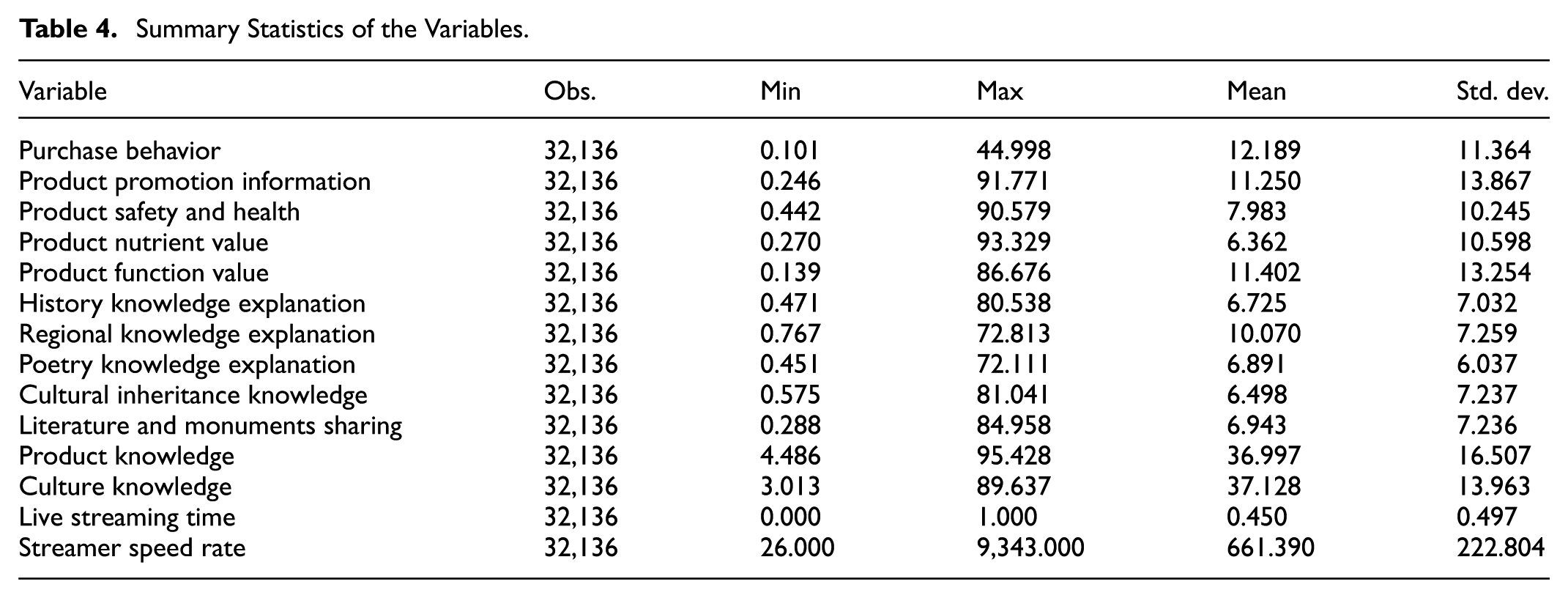
The study statistically analyzed the variables and constructed a series of comprehensive regression models through SPSS 26. Table 4 shows the descriptive statistics of the variables, including the minimum, maximum, mean, and standard deviation. Table 5 shows the results of the correlation test between the variables. The results show that the data can be used for subsequent analysis. In addition, the results of the correlation analysis show that the streamer speed rate has a significant correlation with consumer purchase behavior, which further proves the necessity of including it in the comprehensive regression model. The introduction of control variables has facilitated a better assessment of the streamer’s knowledge-sharing on consumer purchase behavior in live streaming e-commerce, which makes the results obtained more scientific and reliable. On this basis, we examined the variance inflation factor (VIF) among the variables with values far less than 10, eliminating the possibilities of the variables influencing the results by multiple covariances and ensuring that the data could be used for further analyses.
Summary Statistics of the Variables.
Correlation Test Between Variables.

Note. 1: Purchase Behavior; 2: Product Promotion Information; 3: Product Safety and Health; 4: Product Nutrient value; 5: Product Function value; 6: History Knowledge Explanation; 7: Regional Knowledge Explanation; 8: Poetry Knowledge Explanation; 9: Cultural Inheritance Knowledge; 10: Literature and Monuments Sharing; 11: Product Knowledge; 12: Culture Knowledge; 13: Live streaming time; 14: Streamer Speed Rate.
p < .05. ***p < .01.
Regression Analysis
Direct Effects on Consumer Purchase Behavior
Table 6 shows the empirical results of streamers’ knowledge-sharing and different live streaming times on consumers’ purchase behavior in live streaming e-commerce. The third column of Table 6, Model 2, shows the results of the impact of streamers’ knowledge-sharing content of different dimensions on consumers’ purchase behavior. The coefficient of Product Promotion Information (β1 = −.093, p < .01), suggests that the increase in the content of product promotion information shared by streamers negatively affects consumer purchase behavior in live streaming e-commerce. The coefficients for Product Safety and Health (β2 = .296, p < .01), Product Nutrient Value (β3 = .125, p < .01), Product Function Value (β4 = .375, p < .01), History Knowledge Explanation (β5 = .187, p < .01), Regional Knowledge Explanation (β6 = .122, p < .01), Poetry Knowledge Explanation (β7 = .173, p < .01), and Cultural Inheritance Knowledge (β8 = .146, p < .01), and Literature and Monuments Sharing (β9 = .095, p < .01), suggests that the increase in the content of product safety and health, product nutrient value, product function value, history knowledge explanation, regional knowledge explanation, poetry knowledge explanation, cultural inheritance knowledge, literature and monuments sharing aspects shared by streamers are positively influencing consumer purchase behavior in live streaming e-commerce.
Regression Results.

p < .01.
Based on dual-processing theory (Griffin et al., 2002; McCabe et al., 2016), the content of knowledge shared by streamers serves as persuasive information in live streaming e-commerce, and different dimensions of persuasive information have different impacts on consumer purchase behavior. When streamers share product knowledge as persuasive information to consumers, consumers’ purchase behavior is weakened with the increase of sharing product promotion information, on the one hand, the excessive frequency of product promotion information makes consumers experience “promotion fatigue.” On the other hand, consumers will doubt the products’ real value when streamers persuade them to purchase through product promotion information, which will perceive cognition of “cheap but no good,” thus reducing their trust in product quality and weakening their purchase intentions. When streamers share product’s safety and health standards, scientifically verified nutritional value, and functional value in practical use as persuasive information to consumers, enhancing consumer perception of streamers’ professionalism and sincerity, which helps to build and enhance their trust in streamers and products, thus making them more willing to accept, adopt, and purchase products recommended by streamers. The transparency and profundity of product information shared by streamers reduce consumers’ uncertainty and risk perception, which provides consumers with a comprehensive and accurate basis for decision-making. Therefore, H1a is partially supported.
When streamers combine their erudition and experience to share diversified knowledge such as history knowledge explanation, regional knowledge explanation, poetry knowledge explanation, cultural inheritance knowledge, literature and monuments sharing as persuasive messages in live streaming, it results in a positive impact on consumer purchase behavior and the three aspect reasons are follows. First, cultural knowledge as persuasive messages influences consumer behavior in that it satisfies consumers’ desire to explore and curiosity about new things. The historical knowledge and regional characteristics shared by streamers broaden consumers’ horizons and make them feel rewarded. Second, streamers persuade consumers to purchase by sharing cultural knowledge as persuasive messages in enhancing their identifications with streamers. The historical stories, regional customs, poems, and song knowledge shared by streamers always carry deep emotions and cultural values. These knowledge contents combined with streamers’ erudition and experience can inspire consumers’ emotional resonance, help consumers perceive streamers’ charisma, enhance their identification with products recommended by streamers, and thus increase their purchase intention. Third, consumer purchase behavior has shifted from basic needs to higher-level spiritual needs, which is promoted by value perception and consumption upgrading. Streamers often touch consumers’ deep emotional memory or cultural identification by sharing cultural knowledge as a persuasive message, thus fostering a strong emotional connection. The strong connection consumers feel with streamers, products, and the broader cultural community enhances their sense of belonging. Consumers are not only able to obtain physical satisfaction but also spiritual pleasure and fulfillment during the purchase of products recommended by streamers. The fulfillment of these spiritual needs makes consumers more willing to pay for high-quality, high-value-added products. Therefore, H1b is supported and H1 is partially supported.
Comparative analysis of different knowledge-sharing dimensions
The 4th column of Table 6, Model 3 shows the effect of streamer sharing knowledge of products and culture on consumers’ purchase behavior, and the results suggest that in comparison to product knowledge (β1 = .158, p < .01), streamers’ sharing culture knowledge (β2 = .184, p < .01) has a greater effect on consumers’ purchase behavior. Dual-processing theory suggests that consumers process persuasive information and respond to it in their behavior through both central (cognitive) and peripheral (emotional) routes (Griffin et al., 2002; McCabe et al., 2016). In live streaming e-commerce, the product knowledge shared by streamers influences consumer behavior through their cognitive routes, which are directly related to their actual needs, prompting them to make rational evaluations and comparisons. In contrast, streamers share cultural knowledge to influence consumer purchase behavior through their emotional routes. Cultural knowledge, as persuasive information, which often touches consumers’ deep emotions and identification.
Compared to product knowledge, cultural knowledge has a greater impact on consumer purchase behavior for three reasons. First, within the information-intensive environment of live streaming e-commerce, consumers are often confronted with a large amount of complex information. They might be more inclined to rely on emotional routes to process information to save time and energy. Cultural knowledge, as persuasive information, can quickly attract consumers’ attention and stimulate their interest, thus resulting in a significant persuasive effect in a short time. Second, cultural knowledge not only enriches the live streaming content but also strengthens the emotional connection between streamers and consumers. When consumers develop a sense of identification and belonging with streamers, it is more likely that they will make positive purchase decisions, even if the decisions are not entirely based on a rational assessment of product knowledge. Finally, the emotional factor is more influential than the rational one in the consumers’ purchase decision-making. The sharing of cultural knowledge can stimulate consumers’ emotional resonance, and this emotional resonance exceeds the products’ physical attributes, making consumers experience a sense of cultural belonging and spiritual satisfaction during the purchase process. Persuasion based on emotional connection can often close the distance between streamers and consumers quickly, prompting consumers to make purchasing decisions without relying entirely on rational analyses. The differences in the impact of product and cultural knowledge on consumer purchase behavior provide the basis for the next analysis.
Heterogeneity Analysis of Live Streaming Time Effects
Table 6 Columns 5 to 6 in Model 4 to Model 5 demonstrate the impact of streamers’ knowledge-sharing and live streaming time on consumers’ purchase behavior. The significance of the coefficients of live streaming time indicates that there are different effects on consumer purchase behavior, which provides further support for the next heterogeneity analysis, and H2 is supported. Columns 2 to 3 of Table 7 applied Model 3 to show the heterogeneity of the effect of streamers’ knowledge-sharing on consumers’ purchase behavior at different live streaming times. The results show that in work and study time (β1 = .134, p < .01; β2 = .171, p < .01) and relaxation and leisure time (β1 = .180, p < .01; β2 = .196, p < .01), streamers sharing product knowledge and cultural knowledge are both positively influence consumers’ purchase behavior. The coefficient equality test results of product knowledge (Z = −8.132, p < .01) and cultural knowledge (Z = −3.536, p < .01) indicate that streamers’ sharing knowledge in relaxation and leisure time has a greater impact on consumers’ purchase behavior compared to work and study time.
Heterogeneity Analysis Results.

p < .05. ***p < .01.
Based on attention theory (Lavie, 1995), the resources of human attention are limited and their allocation pattern varies in different time periods. In work and study time, most people’s attention is focused on work or study tasks, though their attention is easier to focus, they might not have enough time and energy to carefully consider and compare the advantages and disadvantages on different products, and they might be more inclined to make quick decisions. However, in relaxation and leisure time, consumers’ attention is diversified and they are more inclined to pursue leisure, relaxation, and entertainment. The mental state of consumers is more relaxed and they have more time and space to think deeply and analyze the content shared by streamers. Therefore, products and cultural knowledge shared by streamers during this period are more easily accepted and have a greater impact on consumers’ purchase behavior, and specific knowledge dimension impact differences are analyzed as follows.
Columns 4 to 5 of Table 7 applied Model 2 to show the heterogeneity of the impact of different dimensions of knowledge shared by streamers on consumers’ purchase behavior at different live streaming times. The coefficient equality test results of product promotion information (Z = 3.073, p < .01), product safety and health (Z = −1.223, p > .1), product nutrient value (Z = 2.020, p < .05), product function value (Z = −2.712, p < .01), history knowledge explanation (Z = −8.476, p < .01), regional knowledge explanation (Z = 2.081, p < .05), poetry knowledge explanation (Z = −0.529, p > .1), cultural inheritance knowledge (Z = −2.051, p < .05), literature and monuments sharing (Z = −4.800, p < .01) summarized as follows. First, the coefficient equality test results of product safety and health and poetry knowledge explanation are not significant, indicating that streamers sharing this knowledge at different live streaming times can significantly influence consumers’ purchase behavior.
Second, the coefficient equality test of product promotion information is significant, suggesting that streamers’ sharing of product promotion information in relaxation and leisure time has a greater weakening effect on consumers’ purchase behavior compared to work and study time. Based on the attention theory, from the perspective of limited attention resources, compared to work and study time, consumers’ mental state and attention allocation pattern changed significantly when they watched live streaming in relaxation and leisure time. Live streaming provides a way of entertainment, when streamers overemphasize product promotion information, it is likely to be contrary to consumers’ current original intentions in seeking relaxation and leisure, which results in this promotion information being seen as intrusive or disruptive, triggering negative emotions such as revulsion or boredom, and thus having a more debilitating effect on consumers’ purchase behavior.
Third, the coefficient equality test results of product nutrient value and product function value are significant, indicating that streamers sharing knowledge of product nutrient value in work and study time have a greater positive impact on consumers’ purchase behavior while sharing knowledge of product function value in relaxation and leisure time has a greater positive impact on consumers’ purchase behavior. From the perspective of differentiated allocation of attention resources, people’s attention is highly focused on current tasks or learning activities in work and study time, forming a “task-oriented” attention pattern. The product nutrient value shared by streamers, such as health benefits and ingredient analysis, directly matches consumers’ pursuit of a healthy life beyond work and study, and therefore can quickly attract and maintain their attention, which promote purchase behavior. In contrast, in relaxation and leisure time, consumers have more diversified attention and are no longer limited to specific tasks. They are more inclined to look for entertainment, relaxation, or self-improvement content. The introduction of products’ functional value, such as the convenience of use and performance advantages, is more likely to attract consumers’ attention. This is because such information is directly related to product utility and usage experience, which fulfills the consumers’ psychological need to explore new things in their leisure time. Therefore, H2a is partially supported.
Fourth, the equality test results for history knowledge explanation, regional knowledge explanation, cultural inheritance knowledge, literature and monuments sharing are significant, indicating that streamers sharing regional knowledge explanation in work and study time have a greater positive impact on consumers’ purchase behavior while sharing history knowledge explanation, cultural inheritance knowledge, literature and monuments sharing in relaxation and leisure time have a greater positive impact on consumers’ purchase behavior. Based on the attention resource allocation affecting consumers’ cognitive perspective (Lavie, 1995), consumers are more likely to focus attention and their cognitive processing is more inclined to rational analysis in work and study time. The explanation of regional knowledge shared by streamers, although it has a certain cultural color, is more often presented objectively and accurately, which meets consumers’ rational cognitive needs in work and study time. Consumers’ attention is more diversified in relaxation and leisure time, and they process persuasive information relying more on emotion and intuition. They are more susceptible to emotional resonance and the historical knowledge, cultural heritage, and literature monuments shared by streamers, through vivid narration and emotional expression, inspire emotional resonance in consumers, thereby promoting purchase behaviors more effectively. Therefore, H2b is partially supported.
Discussion and Future Research
Based on dual-processing theory and attention theory, and using big data text analysis and machine learning methods, we explore the impact of streamers’ knowledge-sharing on consumers’ purchase behavior and the heterogeneity of the impact of live streaming time by analyzing real data from the 198,648 minutes of online shopping live streaming from the Douyin platform. There are several interesting findings in the results that are valuable for both the live streaming e-commerce industry and academia.
Discussion of Findings
First, based on big data analysis, this study mines the knowledge-sharing content in streamers’ talk, providing a fine-granularity explanation for knowledge-sharing dimensions in live streaming e-commerce. Unlike previous research that treated streamers’ knowledge content as unidimensional or focused mainly on product-related information (H. Chen et al., 2022; Wongkitrungrueng & Assarut, 2020), our study identifies two distinct categories with multiple sub-dimensions. We divide knowledge-sharing into product knowledge (product promotion information, product safety and health, product nutrient value, and product function value) and cultural knowledge (history knowledge explanation, regional knowledge explanation, poetry knowledge explanation, cultural inheritance knowledge, and literature and monument sharing). This detailed categorization enables platforms and streamers to develop more targeted content strategies that align with consumer preferences, and provides researchers with a more nuanced framework for analyzing knowledge-sharing effects in e-commerce contexts.
Second, the study found that different contents of knowledge shared by streamers have different influences on consumers’ purchase behavior. Contrary to existing research that emphasizes the positive influence of price promotions (Lo et al., 2022), our findings reveal that excessive sharing of promotional information actually weakens consumers’ purchase intentions, suggesting “promotion fatigue” effects previously overlooked in live streaming contexts. Meanwhile, product safety, nutritional value, and functional value information positively impact purchase behavior by reducing uncertainty, consistent with earlier findings (Wongkitrungrueng & Assarut, 2020). Most notably, we discovered that cultural knowledge-sharing has an even stronger positive effect than product knowledge, challenging the conventional wisdom that utilitarian information dominates purchase decisions in e-commerce (Diao et al., 2023; Liao et al., 2023). This finding highlights the unique value proposition of live streaming as a medium where cultural storytelling creates emotional connections that drive sales, offering marketers a distinctive strategy beyond traditional product-focused approaches.
Third, we evidenced heterogeneity in the impact of streamers’ knowledge-sharing on consumers’ purchase behavior at different live streaming times, which points out the direction for streamers to share knowledge content at different times. Distinguishing from existing research on time in live streaming including duration viewing time, total duration of live streaming, and other aspects, we clarify the heterogeneity of consumer behaviors during different live streaming times (Huang et al., 2023; Shiu et al., 2023; C. Zhang et al., 2024). Our findings not only deepen the understanding of consumer behavioral preference variation across time (Kedia et al., 2024; Nguyen et al., 2019; van der Lippe, 2007), but also extend the analytical framework of this variation to the emerging and rapidly growing field of live streaming in e-commerce, bridging the gap of research on time-dimensioned consumer behavior within the field.
Theoretical Contributions
The study has the following theoretical contributions. First, this study deepens and broadens the theoretical level of the route by which persuasive information influences consumers’ behavior in dual-processing theory. In live streaming e-commerce, the streamer as the soul core of the live streaming process, can influence the consumer to purchase the products by sharing knowledge (persuasive information) in the live streaming room. Consumers’ processing paths for persuasive information are divided into central and peripheral paths (Griffin et al., 2002; McCabe et al., 2016). This study further clarified the central route into product knowledge and the peripheral route into cultural knowledge, vertically extending existing research on extending the connotation of dual-processing theory in which persuasive information influences consumers’ behavioral routes (He & Jin, 2024).
Second, this study advances methodological innovation by employing big data text analysis and machine learning techniques to measure knowledge-sharing content with unprecedented precision. Unlike previous research that relied primarily on surveys, interviews, or manual content analysis with inherent subjectivity and limited scale (Bharadwaj et al., 2022), our approach captures and analyzes 198,648 minutes of live streaming content automatically. This methodological advancement allows us to identify fine-granular knowledge-sharing patterns that would be impossible to detect through traditional methods. By creating a data-driven, objective framework for categorizing knowledge dimensions in streaming contexts, we establish a more reliable measurement system that captures the dynamic nature of knowledge flow across different communities, topics, and time periods. This methodological contribution provides a robust foundation for future quantitative analyses in digital marketing, e-commerce, and knowledge management research.
Third, our study significantly extends attention theory by applying it to temporal contexts in live streaming e-commerce, revealing how time-based attention patterns influence consumer responses to different knowledge types. While previous research has primarily focused on attention distribution within a single viewing session (Q. Yang et al., 2023) or between competing elements in the interface (Shen et al., 2015), we demonstrate that attention theory has broader explanatory power when considering consumers’ daily schedules and biological rhythms. By documenting that cultural knowledge has stronger effects during leisure hours while certain product information is more impactful during work hours, we establish that attention allocation varies systematically with time of day, not just with content characteristics. This temporal dimension of attention theory opens new research avenues for understanding how digital content effectiveness fluctuates throughout the day and provides a theoretical foundation for time-based content optimization strategies in digital marketing and e-commerce contexts.
Practical Implications
First, based on the effect of product knowledge-sharing content on consumer purchase behavior, targeted customization of product knowledge talk contents in live streaming. Enterprises should focus on the content of product knowledge which positively affects the consumers’ purchase behavior, and provide streamers with professional information such as product safety standards, product nutrition, and product functional value, which helps them to better promote products during live streaming.
Second, it integrates brand value concepts into cultural knowledge-sharing, which provides support for enterprises to enhance brand image and build brand identification. In view of the positive impact of cultural knowledge-sharing as persuasive information on consumer purchasing behavior in live streaming e-commerce and the differences in the impact of different knowledge topics. Compared to literature and monument sharing and regional knowledge explanation, enterprises should strengthen communication with streamers more on the development history of the brand and how it integrates with traditional cultural knowledge, and provides cultural knowledge content that triggers consumers’ emotional resonance, enabling streamers to naturally incorporate brand value concepts while sharing cultural knowledge and promoting consumers’ brand identification.
Third, given the heterogeneity of the impact of different knowledge-sharing content on consumer purchase behavior due to live streaming times, which helps enterprises develop differentiated marketing strategies to boost product sales. Enterprises should accurately locate the outstanding selling points of their products and set the time for product sales differently. For instance, products with outstanding nutritional value are set to sell at work and study time, while products with outstanding functional value are set to sell at relaxation and leisure time, which provides a targeted setting of product sales time to boost product sales.
Limitation and Future Research
Despite its contributions, this study has several limitations that present opportunities for future research. First, our data comes exclusively from a single Chinese live streaming platform, potentially limiting generalizability. Future research should examine these relationships using data from diverse cultural contexts to establish the external validity of our findings. Second, while we focused specifically on knowledge-sharing content, we acknowledge that purchase behavior in live streaming environments is influenced by multiple factors beyond our scope, including live streaming room atmosphere, streamers’ emotional expressions, and co-viewer interactions. Future research should incorporate these elements to develop more comprehensive models of consumer behavior in live streaming contexts. Third, although our big data approach provides robust correlational evidence, establishing causality remains challenging. Complementary experimental studies manipulating knowledge types could strengthen causal inferences about how different knowledge dimensions influence purchase behavior. Finally, while we identified heterogeneous effects across different streaming times, future research should explore additional boundary conditions such as product category, consumer expertise, and platform design that might moderate these relationships and enhance our understanding of knowledge-sharing effectiveness.
Footnotes

Ethical Considerations
This article does not contain any studies with human participants performed by any of the authors.
Consent to Participate
There are no human participants in this article and informed consent is not required.
Author Contributions
S.B.: funding acquisition, investigation, project administration, resources, supervision, validation. X.H.: conceptualization, formal analysis, methodology, visualization, and writing original and revised manuscripts. H.H.: conceptualization, supervision, and writing-review. H.G.: supervision, writing-review, providing comments on the framework of the first draft, and providing guidance and review on the revised manuscript and rebuttal letter during the revision process. All authors substantially contributed to the article and approved the submitted version.
Funding
The authors disclosed receipt of the following financial support for the research, authorship, and/or publication of this article: We appreciate the financial support of the National Social Science Found of China (Grant No. 23BJY151).
Declaration of Conflicting Interests
The authors declared the following potential conflicts of interest with respect to the research, authorship, and/or publication of this article: I would like to declare on behalf of my co-authors that the work described is original research that has not been published previously and is not under consideration for publication elsewhere, in whole or in part. All the authors listed have approved the manuscript that is enclosed.
Data Availability Statement
Research data can be obtained by contacting the corresponding author.