



Abstract
Blockchain technology has applications beyond cryptocurrencies, notably in marketing through blockchain-based loyalty programmes (BBLPs). This study examines key factors for their implementation using importance-performance map analysis (IPMA) and necessary condition analysis (NCA), based on an adapted TAM3 model. The key endogenous variables include behavioural intention to use (BEINT), perceived usefulness (USEF), and perceived ease of use (EASE). The model suggests that USEF mediates the effects of trust (TRUST) and price-value (PVAL) on BEINT, while EASE mediates self-efficacy (SEFFIC) and perceived enjoyment (PENJ). Structural equation modelling reveals that USEF, EASE, PVAL, SEFFIC, and PENJ significantly impact BEINT. TRUST influences USEF but not BEINT directly, and social norms (SNORM) are not significant. IPMA analysis identifies USEF as the critical variable for BBLP acceptance, with EASE and PENJ being key influencers, followed by PVAL. NCA and IPMA findings show that all variables, except SNORM, can act as constraints to increasing BEINT. However, TRUST and SEFFIC exceed the necessary threshold, indicating they are not actual constraints. Conversely, USEF, EASE, and PENJ act as bottlenecks, with USEF being crucial for BEINT improvement, while EASE and PENJ enhance perceived usefulness. Strengthening these factors can drive BBLP adoption.
Plain Language Summary
This study explores why people may consider to engage with loyalty programmes powered with blockchain. Using a well-established technology acceptance model, we analysed data from U.S. consumers to understand which factors most influence adoption. We found that perceived usefulness, ease of use, and enjoyment are key drivers. The study also identifies which elements may limit adoption and which areas should be improved to increase acceptance. Our findings can help businesses design better loyalty programmes by focusing on transparency, simplicity, and engaging user experiences.
Keywords
Introduction
Blockchain technology has become a transformative force across many sectors. Its influence now goes far beyond its original link to cryptocurrencies (Rozas et al., 2021). Academics, professionals, and policymakers regard it as one of the most disruptive technologies in recent years, with strong potential to reshape economic activity in complex settings (Dubey et al., 2023).
Blockchain can impact all stages of the production process in Industry 4.0. It boosts productivity and efficiency, and applies to areas such as supply chain management (Alsmadi et al., 2023; Javaid et al., 2021) and business accounting (Giang & Tam, 2023). It also enhances product traceability and authenticity, which builds trust and improves operations (Pal et al., 2021). Firms can use blockchain to offer secure financial services, cut fraud, and reduce costs tied to intermediaries—especially in banking and cross-border payments (Gil-Cordero et al., 2024; Yang et al., 2024). These benefits can improve financial inclusion for people or businesses with limited access to traditional systems (Schuetz & Venkatesh, 2020).
The field of marketing is no exception to the transformative and disruptive potential of blockchain (Rejeb et al., 2020). By eliminating intermediaries in information transmission, blockchain can accelerate and improve the efficiency of various processes in marketing management (Wasiq et al., 2023). It ensures data integrity, fostering consumer trust in brands and increasing their value (Haynes, 2023). An example in this setting is bringing transparency to digital advertising and to give consumers full control over their data in brand–consumer interactions (Yun & Strycharz, 2023). This study focuses on blockchain as a support for loyalty programmes, especially blockchain-based loyalty programmes (BBLPs), one of the most promising uses (Lemos et al., 2022).
Loyalty programmes (LPs) are strategic tools used by companies to manage customer relationships, encouraging loyalty by offering rewards for purchases (Kumar & Reinartz, 2018). These programmes are commonly employed by firms, as they can foster customer commitment by promoting long-term satisfaction (Thomas et al., 2023). The level of customer participation in LPs depends factors such as expected benefits, privacy, variety, and the ease of redeeming rewards (Dorotic et al., 2012). An additional key issue is that customers often join several programmes, which reduces their loyalty to any one of them (Dowling & Uncles, 1997).
Enhanced and tailored using blockchain, allowing users obtaining points that could be used in several brands (Treiblmaier & Petrozhitskaya, 2023). Blockchain also addresses the dispersion of loyalty programmes by developing a global rewards system that is simple to oversee and more attractive to customers (Utz et al., 2023). Blockchain allows the tokenisation of rights, which can be used to get cryptocurrencies, reduced prices in new purchases or goods and services (Vennapusa et al., 2018), enhancing the attractiveness of blockchain application to LPs. Moreover, smart contracts can simplify the implementation of rewards, thereby fostering engagement with the LP (Sönmeztürk et al., 2020).
Despite the broad applicability of blockchain across various sectors, it is often met with scepticism due to a general lack of understanding and incidents of illicit activities in the cryptocurrency space (Stamatakis et al., 2024). From an organisational perspective, barriers to adoption include potential incompatibility with existing information systems infrastructure; uncertainty regarding regulations, policies, and standardisation; and a lack of technological expertise (Treiblmaier & Petrozhitskaya, 2023). From the consumer perspective, a lack of knowledge about how to access and benefit from blockchain-based applications has been cited as a challenge (Knauer & Mann, 2020).
These issues explain why most research on blockchain adoption focuses on cryptocurrencies (Bommer et al., 2023). However, few studies examine adoption in other areas, such as marketing (Arias-Oliva et al., 2024; Paajala et al., 2022). This gap motivates our study. We aim to identify key drivers of BBLP adoption—those with statistical significance and the potential to act as bottlenecks. For this, we apply the framework shown in Figure 1, based on the extended technology acceptance model (TAM), specifically TAM3 (Davis et al., 1989; Venkatesh & Bala, 2008).

Groundwork developed in Section 2.
This study is based on a survey conducted in the Midwest region of the United States and involves the following assessments. First, we use partial least squares structural equation modelling (PLS-SEM) to assess how the variables in Figure 1 influence the intention to use BBLPs. Then, we apply a combined importance-performance map analysis (cIPMA), following Sarstedt et al. (2024). This approach combines results fromPLS-SEM with traditional importance-performance map analysis (IPMA; Ringle & Sarstedt, 2016) and necessary condition analysis (NCA; Dul, 2016).
These methods help identify which factors companies should prioritise to implement BBLPs successfully—and which ones may not need much attention. They also show which variables act as bottlenecks in adoption.
Theoretical Groundwork
Modelling Acceptance of Blockchain Based Loyalty Programmes With a TAM3-Based Groundwork
Studies on the adoption of information systems require the use of a theoretical framework that offers a comprehensive explanation. Naturally, this applies to BBLPs (Arias-Oliva et al., 2024). TAM (Davis et al., 1989) and the unified theory of acceptance and use of technology (UTAUT) (Venkatesh et al., 2003) provide the theoretical foundations for a significant body of literature on the adoption of blockchain (Taherdoost, 2022). These theories should not be interpreted as rigid theoretical models. They should be understood as foundational models that require adaptation to the activity and context in which they are applied. The parsimony of the TAM allows for the inclusion of exogenous variables deemed relevant by the researcher for the specific case study (Davis et al., 1989). Similar considerations apply to the UTAUT model, which, as Venkatesh et al. (2016) assert, requires theoretical extensions to adapt it the setting (the information system, cultural context, etc.) in which it is applied.
Figure 1 illustrates the approach used in our study. It represents an extended version of the TAM, which can be interpreted as a simplified version of TAM3 (Venkatesh & Bala, 2008). As in TAM3, the variable measuring acceptance is behavioural intention (BEINT), which in this study refers to the behavioural intention to engage with BBLPs. The implementation of blockchain is still not in a developed stage, making the technology less accessible to consumers (Treiblmaier & Petrozhitskaya, 2023). Therefore, using BEINT as the output variable makes it possible to assess acceptance-related questions fairly. These questions are framed around behavioural intention, not actual use or reuse, which ensures equal evaluation across respondents (Arias-Oliva et al., 2024).
Among the variables directly influencing BEINT, we first differentiate those that can be described as TAM-baseline: perceived usefulness (USEF) and perceived ease of use (EASE). These are the foundational variables of the TAM (Davis, 1989) and its extensions, such as TAM2 (Venkatesh & Davis, 2000) and TAM3. As shown in Figure 1, these are endogenous variables that mediate the influence of all other factors considered relevant to explaining BEINT.
As in the TAM2 model (Venkatesh & Davis, 2000), we introduce external variables that influence BEINT, either fully or partially mediated by USEF. Judgements about the usefulness of a technology arise, in part, from cognitively comparing what a system can achieve with what is required to accomplish specific tasks (Venkatesh & Davis, 2000). In a blockchain context, these judgements are shaped by perceptions of how technology enhances performance in the task of interest when powered by blockchain (Ullah et al., 2020). Blockchain enhances LP performance by using its immutability to prevent premature reward expiration, reducing pressure on consumers to redeem early (Treiblmaier & Petrozhitskaya, 2023).
As illustrated in Figure 1, one of these external factors is the subjective norm (SNORM), which is the only exogenous variable whose influence on BEINT is partially mediated (Venkatesh & Bala, 2008; Venkatesh & Davis, 2000). We also include price-value (PVAL) and trust (TRUST), both fully mediated by USEF. In this study, since these three variables are mediated by perceived usefulness, we refer to them as USEF-mediated variables.
Figure 1 also shows that the proposed model includes two external adjustment variables that influence BEINT through EASE. Specifically, these are self-efficacy in the use of new technologies, particularly blockchain-powered technologies (SEFFIC), and perceived enjoyment (PENJ). Adjustment variables are factors affecting the perceived ease of use of technology, grounded in individual experience (Venkatesh, 2000). These two external variables are labelled EASE-mediated in this paper due their influence on BEINT is fully mediates by perceived ease of use. Importantly, EASE-mediated variables influence BEINT in two ways: directly through EASE and indirectly through dual mediation by EASE and USEF. This dual mediation arises from the basic TAM framework, which acknowledges the partial mediation of EASE on BEINT via USEF.
The decision to adopt a simplified, context-specific version of TAM3 is grounded in the characteristics of BBLPs. Unlike TAM2, which is oriented toward workplace settings and emphasises factors like image and voluntariness, TAM3 incorporates key cognitive and affective constructs—such as self-efficacy and perceived enjoyment—that are especially relevant in consumer environments involving emerging technologies like mobile application and smart devices (Jaradat & Al-Mashaqba, 2014) and, of course, blockchain (Souto-Romero et al., 2025). Given this study’s focus on identifying both statistically significant and necessary antecedents of behavioural intention, TAM3 offers a robust yet flexible framework for analysing ease of use and performance expectations, both crucial in shaping early consumer perceptions of BBLPs.
Moreover, TAM3 allows for the simultaneous integration of individual-level beliefs (e.g., self-efficacy), hedonic elements (e.g., enjoyment), and cognitive or social evaluations (e.g., trust and perceived value). This aligns with the multifaceted nature of blockchain adoption in marketing contexts (Wasiq et al., 2023). Its structure also supports the use of importance-performance and necessary condition analyses, which benefit from clear mediating paths and manageable model complexity.
Model Development
Influence of TAM-Baseline Variables on Behavioural Intentions
Perceived usefulness (USEF), also referred to as performance expectation in UTAUT, is usually the most relevant factor to explain the adoption of novel technologies for instrumental purposes (Venkatesh et al., 2003). This also applies to the case of cryptocurrencies (Bommer et al., 2023). Blockchain technology allows the development of global LPs that fosters accessibility, objectivity and dependability. It avoids the typical drawbacks of conventional LPs, such as brand restrictions, unfair rewards, rapid expiration of premiums and lack of transparency (Shaikh et al., 2023).
USEF is often the strongest predictor of adoption in blockchain-related studies using TAM or UTAUT. This holds across various applications, including cryptocurrencies (Albayati et al., 2020; Almuraqab, 2020; Arias-Oliva et al., 2019; Jegerson et al., 2023; Shahzad et al., 2024), supply chain management (Alazab et al., 2021; Alsmadi et al., 2023; Sharma et al., 2023), finance and banking (Gan & Lau, 2024; Gil-Cordero et al., 2024), and education (Chawla et al., 2024; Gao & Li, 2021; Shrestha & Vassileva, 2019). Based on this evidence, we propose the following:
EASE is a relevant factor to explain the adoption of blockchain uses (Grover et al., 2019). Making their applications user friendly is essential for increasing their adoption, given that the technological literacy of potential users is not homogeneous. Research has shown that it is relevant to overcome potential drawbacks in ease of use of blockchain with participant-centred architecture of applications (Jang et al., 2020). This involves intuitive interfaces that shield users from the complexity of the underlying technology (Utz et al., 2023). So, when users perceive the platform as high-quality and easy to use, they are more likely to accept blockchain-based services (Gil-Cordero et al., 2024).
The literature shows that perceived ease of use (EASE) has a direct effect on the intention to use blockchain applications. This effect is observed in various contexts, such as cryptocurrency investment (Albayati et al., 2020; Almuraqab, 2020; Shahzad et al., 2024), supply chain management (Alsmadi et al., 2023; Bandinelli et al., 2023; Kamble et al., 2019; Sharma et al., 2023), finance and banking (Gan & Lau, 2024), education applications (Chawla et al., 2024; Gao & Li, 2021; Ullah et al., 2021), internal organisational processes (Afifa et al., 2023; Chen, 2023; Lian et al., 2020; Vijh et al., 2023) or industries linked to travel (Li et al., 2021; Nuryyev et al., 2020). Therefore, we propose the following:
Davis (1993) postulated that EASE can affect behavioural intention indirectly, through USEF. When two systems capable of achieving the same objectives, users tend to perceive a system that is easier to use as more useful. For instance, blockchain makes possible to automatically manage communities functioning (Rozas et al. 2021). This possibility includes rewards through smart contracts, which are executed automatically when the LP conditions are met and do not require active user intervention (Santos et al., 2023). This reduces effort and increases the reward redemption rate which is a key factor to engage with LPs (Yan & Cui, 2016).
The influence of EASE on USEF within the context of blockchain applications has been documented in various settings. They embed cryptocurrencies (Albayati et al., 2020), industrial applications (Kamble et al., 2019; Li et al., 2021), online gaming (Gao & Li, 2021; Pérez et al., 2023), learning environments (Ullah et al., 2021), and accounting applications (Afifa et al., 2023). Thus, we propose the following:
Modelling the Influence of USEF-Mediated Variables
Subjective norms affect behavioural intention because people tend to follow the expectations of others they value—especially if they are motivated to do so (Venkatesh & Davis, 2000). This is particularly relevant for new technologies like blockchain, where adoption depends on perceived social support. When a system is unfamiliar or requires technical knowledge, users often look to others for guidance (Jegerson et al., 2023).
The decision to use blockchain-based technology may be influenced by its association with moral values positively perceived by many, such as anonymity or low regulation (Ishmaev, 2020; Teng, 2021). However, there are also aspects of blockchain technology that may generate negative perceptions from an ethical standpoint. For example, some applications, such as cryptocurrencies, may be used in money laundering (Stamatakis et al., 2024). Additionally, the high energy consumption of blockchain and the existence of regulatory gaps may be viewed negatively from an ethical perspective (Tripathi et al., 2023).
There is a significant body of empirical studies on blockchain applications reporting the direct impact of subjective norms on behavioural intention. The papers include cryptocurrency investment (Albayati et al., 2020; Jegerson et al., 2023), supply chain management (Alazab et al., 2021; Sharma et al., 2023; Wamba et al., 2020), accounting (Afifa et al., 2023), education applications (Gao & Li, 2021), and industries linked to tourism and hospitality (Nuryyev et al., 2020). Consequently, we propose the following:
In TAM2 and TAM3, subjective norms influence not only behavioural intention but also how users’ perception of system usefulness. Greater alignment translates into a perception of greater utility (Venkatesh & Bala, 2008). When the subjective norm favours the use of a specific technology, this influence is internalised by the user, creating the perception that the technology is useful (Venkatesh & Davis, 2000).
The influence of businesses on their stakeholders is key in shaping the perception of the usefulness of blockchain technology. Strong support from senior management is essential to encourage its use among employees or customers (Chen, 2023). Additionally, social networks can be a keystone to boosting BBLPs. They influence consumer perceptions of how blockchain improves the performance of LPs (Rejeb et al., 2020). Empirical studies on blockchain adoption have shown that the SNORM is significantly linked to the perception that this technology is useful in contexts such as cryptocurrencies (Albayati et al., 2020), supply chain management (Kamble et al., 2019), or internal processes in large companies (Chen, 2023). Therefore, we propose:
Price-value (PVAL) can be conceptualised and the rate between of the gains due to the use of a new technology and the cost stated by the customers (Venkatesh et al., 2012). In LPs, the perceived benefits may be related to intangible aspects, such as status, or to clearly tangible economic advantages (Belli et al., 2020). This could explain why a significant portion of the literature highlights that the pursuit of exclusivity is a key factor for the success of closed-loop LPs compared with open-loop LPs. Similarly, tiered LPs tend to generate greater adherence than those lacking this structure (Belli et al., 2020). This fits with findings that consumers engage more with LPs offering clear financial rewards (Ruzeviciute & Kamleitner, 2017).
BBLPs offer benefits typical of the collaborative economy. They provide opportunities in terms of usage, accumulation, value, maturity, and portability (Treiblmaier & Petrozhitskaya, 2023). Blockchain also enables decentralised LPs networks, removing platform interconnection limits. This can enhance perceived usefulness, as accumulated credits may be traded or converted into cryptocurrency (Santos et al., 2023). Turning nonfungible tokens (NFTs) into monetary assets is a key blockchain feature that adds value for LP users.
In the TAM2 model, factors like image and result demonstrability positively influence perceived usefulness in work settings (Venkatesh & Davis, 2000). In loyalty programmes, image aligns with the idea of exclusivity. Result demonstrability relates to the monetary value blockchain adds to LPs. For example, Fortagne and Lis (2024) found that higher perceived price value of NFTs increases their perceived usefulness. Likewise, Knauer and Mann (2020) showed that blockchain-based payment methods are seen as more useful when they bring clear benefits in future purchases. Therefore, we propose the following:
According to Glikson and Woolley (2020), trust (TRUST) in new technologies encompasses both cognitive and relational dimensions. The cognitive aspect is linked with the judgement that a technology is adequate for the task to be performed. Thus, this concept of trust can be likened to job adequacy in relation to mandatory information systems within TAM2 (Venkatesh & Davis, 2000).
The decentralisation, immutability, and transparency of information processed via blockchain represent significant capability to make trades reliable, secure. These properties also provide a high degree of privacy. These characteristics may stimulate the cognitive trust among users (Bandinelli et al., 2023; Gao & Li, 2021). Furthermore, blockchain surpasses current centralised technologies in these aspects. So, the perception of its usefulness will increase (Almuraqab, 2020).
People perceive blockchain as less likely to fail than conventional technologies. This lower risk is linked to higher perceived usefulness in payment applications (Knauer & Mann, 2020). In blockchain-based accounting, Afifa et al. (2023) also found that higher trust leads to greater perceived usefulness. Thus, we propose the following:
Modelling the Impact of EASE-Mediated Variables
Venkatesh and Bala (2008) define self-efficacy (SEFFIC), in the context of computer use, as “the degree to which an individual believes they have the ability to perform a specific task or job using computers.” In our study, this definition is adapted to the use of a blockchain-mediated applications.
The use of blockchain differs notably from that of centralised information technologies, requiring a shift in how related activities are approached (Afifa et al., 2023). For example, many prospective cryptocurrency users are unaware that they must create a wallet on the specific network they wish to use (Jang et al., 2020).
Not all potential users of BBLPs possess the same technological skills (Jang et al., 2020). Therefore, when users perceive adequate support while using a blockchain-based application, this assistance can enhance their skills. As a result, they are more likely to experience a smoother and more satisfying interaction, which fosters greater engagement (Sharma et al., 2023). In fact, greater awareness of blockchain increases perceived ease of use in the case of cryptocurrencies (Almuraqab, 2020; Shahzad et al., 2024). Furthermore, Afifa et al. (2023) found that a stronger sense of mastery in information technologies positively influences organisations’ behavioural intentions to adopt blockchain for accounting purposes. Therefore, we propose the following:
Perceived enjoyment (PENJ) refers to the extent to which performing an activity with a given system is inherently pleasurable, independent of any performance-related outcomes (Venkatesh, 2000). Beyond the user’s natural inclination to enjoy the system, blockchain also enables gamification through features such as interactive activities (Denden et al., 2024). In the context of BBLPs, gamification enhances user engagement by encouraging participation in collaborative decision-making, offering token-based rewards, and shaping behaviour through system-driven incentives (Nguyen et al., 2021).
Venkatesh (2000) and Venkatesh and Bala (2008) argue that systems that enable greater enjoyment encourage users to minimise the difficulties associated with their use. Venkatesh (2000) observed, in reference to the Windows system, that an information system is perceived as easier to use when the interaction is not only simple but also enjoyable.
Arias-Oliva et al. (2024) showed, using configurational methods, that BBLP rejection is linked to profiles lacking both PENJ and EASE. Likewise, Treiblmaier and Petrozhitskaya (2023) found through Twitter sentiment analysis that joy is a common positive emotion among loyalty programme participants. So:
Materials and Methods
Sample and Sampling
This paper assesses an online administered survey answered by persons aged 18 years or older living in Midwest regions, United States. Invitations to complete the survey were distributed between May and June of 2024 to a consumer panel managed by a leading market research platform. Data collection concluded at the end of July 2024.
The minimum sample size was determined based on power analysis. To assess the significance of the regressions in the model (Figure 1), the statistical power was set at 80%, with a 5% significance level and a conservative minimum R 2 of 5%. Since the endogenous variable with the most predictors is USEF—explained by EASE, SNORM, TRUST, and PVAL—the minimum required sample was calculated as 244 observations using G*Power 3.1 (Faul et al., 2009).
At the conclusion of the survey in July 2024, the sample size reached 478 observations. After applying filters to exclude inattentive and rushed responses, the final number of usable observations was 310 respondents. This sample accomplished the objective of achieving 80% statistical power at the 5% significance level.
Table 1 shows the main sociodemographic threats of the survey. The 45% of the participants identified as male, and 54% identified as female. Approximately 44% of the respondents were under the age of 45. The majority of the respondents reported holding a degree, bachelor’s degree, or professional qualification (52.73%). The most commonly reported ethnicity was White or Caucasian (201 responses), followed by Latino or Hispanic (40 responses), Black or African American (32 responses), and Asian or Pacific Islander (18 responses). Under the category of experience and use, 15.16% of respondents (47) reported having no experience with loyalty programmes. The majority, 56.77%, indicated participation in between one and five programmes. A further 19.35% (60) reported using between 6 and 9 programmes, while 8.71% (27) stated they were enrolled in 10 or more.
Sample Profile.

Factor Measurement
Regarding the TAM-endogenous variables, the scales for behavioural intention, performance usefulness, and perceived ease of use are based on Davis (1989). The measurement of the exogenous latent variables—SNORM, SEFFIC and PENJ—are based on those proposed by Venkatesh and Bala (2008). Finally, while the perceived price value is based on Venkatesh et al. (2012), the trust scale relied in the scale in Morgan and Hunt (1994). The wording of the items is provided in Table A1.
All the items were responded in a 11-point Likert scale. It varied between 0 (strongly disagree) to 10 (strongly agree). Some authors recommend using 11-point Likert scales instead of the more common 4-, 5-, or 7-point formats due to several advantages. Primarily, this scale captures a wider range of response nuances, overcoming the limitations of shorter scales. An eleven-point scale also offers greater measurement sensitivity, approximating interval-level data and supporting a more normal distribution of responses. Moreover, it is intuitive for respondents, as the 0 to 10 range is widely recognised and easily understood (Leung, 2011).
Data Analysis
The application of cIPMA is carried out following the protocol outlined by Sarstedt et al. (2024). It involves sequentially applying conventional PLS-SEM analysis (Hair et al., 2019) and then leveraging the results from PLS-SEM to perform IPMA (Ringle & Sarstedt, 2016) and NCA (Richter et al., 2020). Likewise, the use of PLS-SEM is justified over other methods of structural equation modelling, as we are also interested in the predictive capability of the model (Dash & Paul, 2021).
The PLS-SEM analysis begins with an assessment of scale reliability. The paths in Figure 1 are then estimated using percentile bootstrapping with 10,000 resamples. This procedure allows for evaluating the overall validity of the model and testing the significance of the path coefficients and total effects of the explanatory variables on the endogenous constructs. The analysis was conducted using SmartPLS 4.0 software (Ringle et al., 2024). To further ensure the robustness of the model, the Stone–Geisser Q 2 values were examined, and the cross-validated predictive ability test was performed (Liengaard et al., 2021).
An IPMA is then conducted for BEINT, and for USEF and EASE if they show a significant direct effect on BEINT. Following Ringle and Sarstedt (2016), the importance of the explanatory constructs is quantified by the value of their total influence on the target construct. The performance, is measured on the normalised value out of 100 for the items. In our case, this normalisation is performed almost directly, as the scales are referenced on a 10-point scale. However, the presentation of the map differs from that of the conventional map used in Ringle and Sarstedt (2016), which divides the two-dimensional plane into four equal quadrants. Instead, we use the approach of Abalo et al. (2007) since it provides greater discriminative power than the conventional four-quadrant IPMA.
The reference line for distinguishing between high- and low-priority variables is a diagonal drawn from the point of minimum performance–importance to the centroid of all pairs. This diagonal represents the importance–performance pairs that can be considered “balanced.” Variables above the diagonal deserve greater attention, as their performance is lower than expected given their importance. In contrast, variables below the diagonal require less effort—they either exceed expectations or simply need to maintain their current performance. Figure 2 illustrates the IPMA approach used in this study.

Focus used in this paper to make the IPMA.
Finally, an NCA (Dul, 2016) is performed on the outputs analysed in the previous IPMA. The latent variables are quantified on the basis of the factor scores used in the PLS–SEM adjustment (Richter et al., 2020; Sarstedt et al., 2024). The approach used in the NCA is referred to as ceiling envelopment (Sarstedt et al., 2024).
Results
Results of PLS–SEM Analysis
Table A2 provides the descriptive statistics for the items of the latent variables. The fact that the scales are based on a 11-point system gives us a fairly accurate idea of their performance. As shown in Table A2, acceptance exceeds the neutral value of 5 but does not reach 6. So, there is much room for improving the intention to use BBLPs. A similar trend can be observed for the other items. The exceptions are SNORM, where none of its items exceed 5, and two items (but not all) of SEFFIC and PENJ.
Table A3 shows that the scales exhibit internal consistency, as both Cronbach’s alpha and composite reliability are greater than .7 and less than .95. Furthermore, the scales demonstrate convergent reliability. Factor loadings in Figure 3, are above 0.702 in all the items. In Table A3 it can be checked that the average variance extracted (AVE) is greater than 0.5. On the other hand, the discriminant ability of the scales is adequate since the squared AVEs are above the Pearson correlations.

Results of the PLS-SEM estimation of the model developed in Thoretical Groundwork.
The graphical representation of the inner and outer model estimations is shown in Figure 3. Additionally, the effect sizes of the path coefficients and their significance levels are presented in Table 2. The model exhibits a substantial fit to the data. Table 2 shows that the coefficient of determination for BEINT is close to 70%, while for USEF and EASE, it exceeds 70%. These values confirm that the sample size is more than sufficient to ensure statistical power above 80%. Moreover, the regressions show no significant collinearity issues, as all variance inflation factor values are below 5.
Results of Fitting the Paths of the TAM3-Based Model in Figure 1.

Note. The coefficient of determination for BEINT is 68.3%, that for USEF is 76.5%, and that for EASE is 76.2%. f2 = effect size; SD = standard deviation; VIF = variance inflation factor.
In explaining BEINT, only the direct impact of USEF is significant, with a path coefficient (β) of .692 and a p value (p) of <.001. This path is not significant for EASE or SNORM. In explaining USEF, the significant direct paths are associated with EASE (β = .431, p < .001), TRUST (β = .131, p = .048), and PVAL (β = .393, p < .001). Regarding the paths related to EASE, both SEFFIC (β = .207, p < .001) and PENJ (β = .726, p < .001) are significant.
Table 3 assesses the predictive power of the proposed model. The Stone–Geisser Q2 values exceed 50% for all endogenous variables, indicating high predictive relevance (Hair et al., 2019). The cross-validated predictive ability test shows that the proposed model outperforms both the benchmark indicator average and the parsimonious linear model in predictive power across all constructs. However, this improved performance is statistically significant only when compared to the indicator average model.
Evaluation of the Predictive Capability of the Proposed Model.
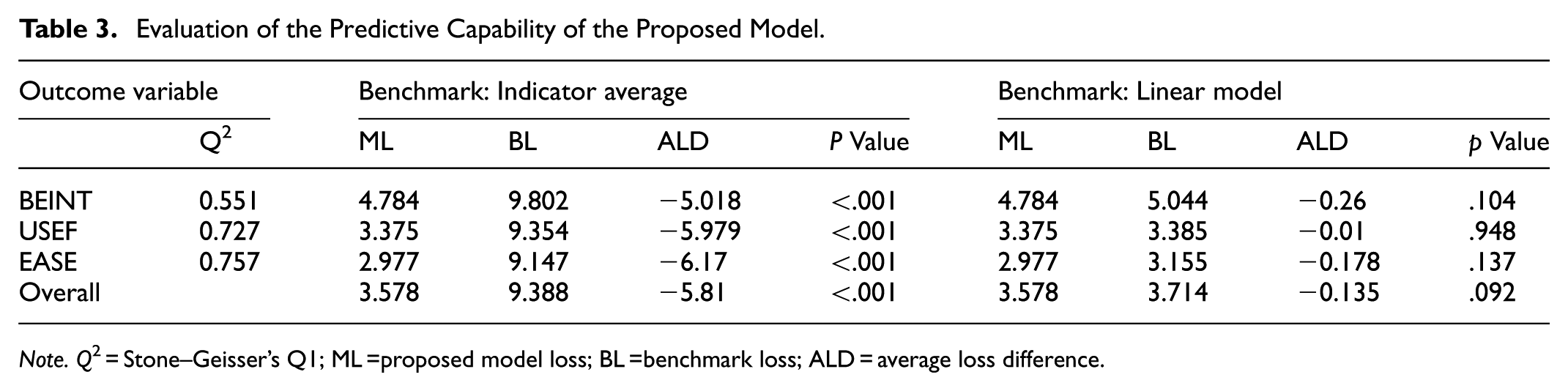
Note. Q 2 = Stone–Geisser’s Q1; ML =proposed model loss; BL =benchmark loss; ALD = average loss difference.
Results of Importance–Performance Map Analysis
The importance of the explanatory variables for BEINT and USEF is assessed through their total effects (Ringle & Sarstedt, 2016). For instance, the effect of USEF on BEINT is purely direct. In contrast, the effect of PENJ is fully mediated by EASE, which itself may be partially mediated by USEF. These effects are computed by multiplying the path coefficients linking the mediated variables through their mediators to the outcome.
Furthermore, the performance of the constructs is an average of the rescaled item values on a 100-point scale, weighted by their rescaled weights. While Table 4 shows the total effects, the performance of each latent variable is shown in Figure 4. The variables with the highest performance are USEF and PVAL, while those with the lowest performance are SEFFIC, PENJ, and SNORM.
Total Effects of Explanatory Factors on Behavioural Intention and Perceived Usefulness.


Performance of all considered constructs.
Figures 5 and 6 allow for an IPMA according to the approach of Abalo et al. (2007). In the map related to BEINT (Figure 5), the variables requiring special attention are PENJ, EASE, and particularly USEF. With respect to PVAL, at least the current levels may be maintained but no increased. Finally, SNORM, SEFFIC, and TRUST are variables that do not require significant attention. It is also evident that the variable requiring the most focus, as its importance-performance pair is significantly above the diagonal, is USEF. Additionally, as shown in Table 4, this variable is directly or indirectly influenced by the other explanatory variables.

Importance-performance map for behavioural intention.

Importance-performance map for perceived usefulness.
Figure 6 presents the importance–performance map related to the USEF. Therefore, stimulating the USEF requires paying attention to the PENJ induced by BBLPs and EASE. The PVAL falls between the attention zone and the “maintenance level” zone. In other words, while it may require some attention to stimulate BEINT, it is not as critical as EASE and PENJ. Thus, maintaining the current effort is likely sufficient. Once again, SNORM, TRUST, and SEFFIC are variables with limited relevance for the implementation of BBLPs. Notice that they are either in the low priority zone or in the overkill zone.
Results of Necessary Condition Analysis
Table 5 shows the necessary effect sizes (d) of the NCA conducted for BEINT and USEF. For BEINT, all variables—except SNORM—are necessary conditions, each showing a significant effect size from practical point of view (above 0.1). All effects fall within the intermediate range, as none exceed the 0.3 threshold (Dul, 2016). USEF (d = 0.287) and PVAL (d = 0.210) show the highest potential to act as bottlenecks, while SEFFIC (d = 0.132) has the smallest effect.
Necessary Condition Effect Sizes.

Table 6 presents the bottleneck analysis for BEINT. To reach the 80th percentile in BEINT—a level considered high—the most demanding condition is USEF, which must be at or above the 58th percentile. This threshold is higher than its actual performance, which is just above the 50th percentile. This gap suggests that the moderate acceptance of BBLPs may stem from the perception that blockchain’s usefulness falls short of the level needed for broader adoption. For the remaining variables, the thresholds required to reach BEINT at the 80th percentile range from the 25.85th percentile (EASE) to the 35th percentile (PENJ). Since their performance levels are around 50%, it can be inferred that, on average, these variables exceed the necessary threshold.
Bottleneck Tables for Behavioural Intention and Perceived Usefulness.

Note. Quantities are percentages.
Table 5 also shows the effect size for the NCA of the explanatory variables for USEF, which is the key factor in inducing BBLP acceptance. Neither SNORM nor SEFFIC reaches d = 0.1. On the other hand, the remaining variables influencing USEF exhibit a medium effect size as a necessary condition.
Table 6 also presents the bottleneck analysis for USEF. Achieving high levels of USEF (above the 80th percentile) requires EASE and PENJ to reach at least the 60th percentile. However, both variables perform just above the 50th percentile. This gap suggests that the modest performance of USEF may result from EASE and PENJ not meeting their required thresholds. In contrast, the thresholds for PVAL and TRUST are lower—around the 40th percentile. Since their average performance exceeds 50%, these variables surpass the level needed to support a high perception of usefulness in BBLP engagement.
Discussion
Global Considerations
This study developed a TAM3-based model to explain the acceptance of blockchain-based loyalty programmes (BBLPs). The model, estimated using PLS-SEM, explains 70% of the variance in behavioural intention (BEINT), and 75% in both perceived usefulness (USEF) and perceived ease of use (EASE). The proposed model also demonstrates strong predictive capability. These strong results justify the subsequent application of importance-performance map analysis (IPMA) and necessary condition analysis (NCA), as they are grounded in a well-fitted structural model.
Among the three variables that directly influence BEINT, only the influence of USEF is significant. This is commonly the most determining variable in the intention to use blockchain applications. This has been reported in cryptocurrencies (Jegerson et al., 2023; Shahzad et al., 2024), supply chain management (Alsmadi et al., 2023; Sharma et al., 2023), finance and banking (Gan & Lau, 2024; Gil-Cordero et al., 2024), and academic applications (Chawla et al., 2024).
The finding that the direct influence of EASE on BEINT is not significant, although it contradicts the hypothesis posed, is not exceptional in the literature. Within TAM-based models, several studies have found no significant effect of EASE on attitudes toward BBLPs—for example, Jegerson et al. (2023), Kamble et al. (2019), and Shrestha and Vassileva (2019). Similarly, in UTAUT-based models, this relationship was not observed by Arias-Oliva et al. (2019) or Wong et al. (2020). It is also common for subjective norm (SNORM) to show no significant influence on BEINT (Alazab et al., 2021; Arias-Oliva et al., 2019; Gan & Lau, 2024; Kamble et al., 2019).
Since USEF is the main variable explaining the intention to use BBLPs, it is particularly relevant to examine the direct effects of EASE, TRUST, price-value (PVAL), and SNORM on USEF. The positive and significant effect of EASE aligns with prior research on BBLP adoption (Afifa et al., 2023; Albayati et al., 2020; Gao & Li, 2021; Kamble et al., 2019; Li et al., 2021; Pérez et al., 2023; Ullah et al., 2021). Similar findings apply to TRUST and PVAL, both of which also show significant positive effects. The role of TRUST in driving blockchain acceptance has been widely documented (Albayati et al., 2020; Chen, 2023; Kamble et al., 2019), as has the impact of PVAL (Fortagne & Lis, 2024; Knauer & Mann, 2020). Interestingly, contrary to expectations, SNORM does not have a significant influence on USEF.
In the IPMA analysis, the total effects of TRUST, PVAL, EASE, and SNORM on the intention to use BBLPs (BEINT) are of particular interest. For TRUST and PVAL, the effects are fully mediated by USEF, while for EASE and SNORM, the effects are only partially mediated. EASE and PVAL show a significant total positive influence on BEINT, whereas the effects of TRUST and SNORM are not significant. Thus, the influence of EASE and PVAL on BEINT can be attributed primarily to their indirect effects through USEF.
The analysis of EASE shows that both proposed explanatory variables—SEFFIC and PENJ—are significant. Notably, both variables exert a significant total effect on USEF, fully mediated by EASE, and on BEINT, where the effect is largely mediated by both EASE and USEF. The relevance of SEFFIC has been documented in blockchain applications related to cryptocurrencies (Almuraqab, 2020; Shahzad et al., 2024) and accounting (Afifa et al., 2023). Similarly, the importance of PENJ has been emphasised by several authors (Arias-Oliva et al., 2024; Fortagne & Lis, 2024; Pérez et al., 2023; Treiblmaier & Petrozhitskaya, 2023).
The IPMA for BEINT indicates that USEF is the variable requiring the most attention, followed—though to a lesser extent—by EASE and PENJ. Given the strategic relevance of USEF in enhancing BEINT, an additional IPMA was conducted for this variable. The results show that EASE and PENJ also demand special focus to improve USEF. In contrast, perceived price value requires only the maintenance of its current performance. Finally, SNORM, TRUST, and SEFFIC do not warrant further effort, as they have little impact on improving either BEINT or USEF.
The NCA of BEINT shows that all its explanatory variables—except SNORM—are necessary conditions. All display medium-sized effects. Accordingly, USEF, EASE, and PENJ are necessary and, as indicated by the IPMA, fall within the “concentrate here” zone. These variables represent bottlenecks that must be addressed to increase BEINT. In contrast, TRUST and SEFFIC, although necessary, fall into the low-priority or overkill zones. This suggests that their performance levels exceed what is required for the current level of BBLP acceptance in the sample. While PVAL shows the second-highest necessity effect, it is positioned in the “maintain” zone, indicating that its current performance is sufficient and not a limiting factor—although its impact on BEINT is greater than that of TRUST, SNORM, or SEFFIC.
The NCA for USEF reveals that all variables—except SNORM and SEFFIC—have medium necessity effects. PVAL shows the highest effect size but does not fall clearly into the “concentrate here” zone, unlike EASE and PENJ. Furthermore, TRUST appears in the overkill zone, suggesting that although low TRUST could hinder acceptance, its performance in the sample far exceeds the level required to achieve high BEINT.
Theoretical and Practical Implications
The proposed TAM3-based model demonstrates a strong fit for explaining the acceptance of BBLPs and also a high predictive ability. Analytically, this study also highlights the value of combining structural equation modelling with IPMA and NCA (Sarstedt et al., 2024) for analysing the adoption of emerging technologies. The extended TAM model and the integrated analytical approach used here can be applied to study blockchain adoption in other domains, including marketing and various business, economic, and management contexts.
The study demonstrates that a greater statistical influence of a variable on a specific outcome does not imply that it requires more effort. It is crucial to assess the performance level achieved in the input variables as well. In this context, the main factors to consider for the successful implementation of a BBLP are USEF and EASE, as they fall into the area of IPMA, which indicates the need for improvement and has the greatest total effect on the PLS-SEM estimation of BEINT. However, the IPMA of the USEF reveals that PENJ requires more attention and effort than PVAL does, even though the latter has a greater effect on the USEF.
Although NCA identifies potential bottlenecks, this does not necessarily imply that it is currently limiting performance or requires immediate attention. For instance, the necessity effect size of PVAL for BEINT is substantially higher than that of EASE and PENJ. However, the IPMA results indicate that focusing on EASE and PENJ would be more effective for promoting BBLP adoption. The combined IPMA–NCA analysis shows that, under current conditions, EASE and PENJ have a greater influence on actual bottlenecks in BEINT than PVAL. Conversely, although TRUST and SEFFIC are necessary for acceptance, IPMA places them in a zone that does not demand further action. This suggests that their performance levels exceed the minimum required to sustain the current level of BEINT observed in the sample.
Given that USEF, EASE, and PENJ are the variables requiring the most attention, the implementation of a BBLP should include targeted strategies to enhance users’ perceptions of these constructs. Perceived usefulness can be improved through greater transparency—for example, by enabling real-time tracking of point accumulation and redemption via an immutable ledger. Interoperability can be promoted by allowing points to be used across multiple brands through shared standards. Tokenising loyalty points would enhance their price-value by converting them into tradable digital assets, increasing their flexibility. Furthermore, designing globally scalable programmes would broaden access. Finally incorporating eco-friendly and socially responsible rewards would strengthen ethical perceptions and align the programme with consumer values.
To enhance perceived ease of use, simplifying user interactions with the loyalty programme is crucial. Intuitive interfaces, clear icons, and user-friendly navigation can reduce the learning curve. Given that blockchain-based systems tend to be more complex than centralised ones, adopting simple registration methods—such as email or social media logins—can lower barriers to entry. Integrating a built-in wallet would eliminate the need for external tools. Using familiar terms like “points” or “rewards” instead of technical jargon such as “tokens” would make the system more accessible. Smart contracts can further simplify the user experience by automating reward distribution without requiring user action. Finally, ensuring compatibility across platforms and integrating with familiar payment systems would streamline reward usage.
To enhance perceived enjoyment in blockchain-based loyalty programmes, it is essential to offer engaging and interactive experiences. Immersive gamification—featuring challenges, levels, and surprise rewards—can generate excitement and motivate user participation. Personalised rewards, based on protected user data, foster a sense of being valued. Integration with the metaverse and augmented reality adds a layer of digital innovation, while exclusive events and limited-edition items strengthen the feeling of privilege. Creative storytelling and interactive design enhance immersion, and social elements—such as team-based activities or global competitions—reinforce a sense of community. Additionally, offering original redemption options and showcasing user success stories can inspire others.
Conclusions and Further Research
This study proposes a TAM3-based model to explain the adoption of blockchain-powered loyalty programmes. It has been successfully validated with a sample of consumers from the Midwest region of the United States. Following confirmation of its reliability, an IPMA analysis identified perceived usefulness as the most strategically relevant variable for promoting BBLP adoption. Enhancing perceived ease of use, perceived enjoyment, and price-value emerged as key strategies to improve perceived usefulness. The NCA identified which variables may act as bottlenecks in strengthening behavioural intention. With the exception of subjective norm, nearly all variables showed potential to constrain adoption. However, only those located in the importance-performance map “concentrate here” zone represent actual bottlenecks in this sample. These include USEF—most notably—along with EASE and PENJ for behavioural intention, and EASE, PENJ, and to a lesser extent, PVAL for perceived usefulness.
This study is limited in both geographic and temporal scope. It focuses exclusively on the Midwest region of the United States and relies on a cross-sectional survey, which restricts the generalisability of the findings. Therefore, the results should be interpreted with caution. A natural extension of this research would involve applying the model to other cultural contexts or conducting cross-cultural comparisons (Venkatesh et al., 2016). Such studies could explore regional cultural differences within the United States (Conway et al., 2001) or compare samples across countries. Prior research suggests that cultural factors—such as religious background or the individualism–collectivism dimension—often moderate the influence of explanatory variables on technology adoption (Srite & Karahanna, 2006).
As this study is based on a cross-sectional sample, the findings cannot be extrapolated to long-term scenarios. This limitation is further amplified by a common drawback in survey-based academic research: the time lag between data collection and publication. It is not unusual for a year to pass between the completion of the survey and the final publication, due to the time required for manuscript preparation, peer review, and editorial processes.
Blockchain adoption in loyalty programme management is still at an early stage, and its evolution over time may alter the dynamics observed. Future research should explore the use of IPMA and NCA as tools for dynamic, longitudinal analysis. At present, the main bottleneck in BBLP implementation appears to be perceived enjoyment, rather than price-value or trust. However, this may change as the technology matures—enhancements in perceived enjoyment could eventually shift the bottleneck toward other factors, such as price-value or trust.
Footnotes
Appendix
Measures of Internal Consistency, Convergent Reliability, and Discriminant Validity of the Scales.

| Variable | Internal consistency of scales | Discriminant validity assessment | |||||||||
|---|---|---|---|---|---|---|---|---|---|---|---|
| CA | CR | AVE | BEINT | USEF | EASE | SNORM | TRUST | PVAL | SEFFIC | PENJ | |
| BEINT | .926 | .926 | 0.931 | 0.965 | |||||||
| USEF | .933 | .933 | 0.881 | 0.823 | 0.939 | ||||||
| EASE | .94 | .94 | 0.892 | 0.727 | 0.831 | 0.945 | |||||
| SNORM | .907 | .907 | 0.915 | 0.606 | 0.69 | 0.703 | 0.956 | ||||
| TRUST | .935 | .936 | 0.884 | 0.68 | 0.769 | 0.772 | 0.812 | 0.94 | |||
| PVAL | .937 | .938 | 0.941 | 0.716 | 0.829 | 0.815 | 0.795 | 0.84 | 0.884 | ||
| SEFFIC | .871 | .872 | 0.782 | 0.521 | 0.568 | 0.669 | 0.602 | 0.651 | 0.651 | 0.849 | |
| PENJ | .945 | .948 | 0.858 | 0.731 | 0.837 | 0.858 | 0.827 | 0.836 | 0.876 | 0.635 | 0.926 |
Note. For the assessment of discriminant validity, the square root of the AVE is presented on the principal diagonal, while the Pearson correlation coefficients are shown below the diagonal. CA = Cronbach’s alpha; CR = composite reliability; AVE = average variance extracted.

Ethical Considerations
(1) All participants were given detailed written infor-mation about the study and procedure; (2) no data directly or indirectly related to the health of the subjects were collected, and thus, the Declaration of Helsinki was not generally mentioned when the subjects were informed; (3) anonymity of the collected data was ensured at all times; (4) the ethical approval of this research was registered by the corresponding author’s institution (CEIPSA-2024-PRD-0030).
Consent to Participate
Informed consent was obtained from all the subjects involved in the study.
Funding
The authors disclosed receipt of the following financial support for the research, authorship, and/or publication of this article: This research was supported by Telefonica and the Telefonica Chair on Smart Cities of the Universitat Rovira i Virgili and Universitat de Barcelona (project number 42.DB.00.18.00).
Declaration of Conflicting Interests
The authors declared no potential conflicts of interest with respect to the research, authorship, and/or publication of this article.
Data Availability Statement
The raw data supporting the conclusions of this article will be made available by the authors on request.