




Abstract
The increasing growth of new hotels in the Malaysian domestic market indicates that the hospitality and tourism industry is growing rapidly. As a result, there will be high competition as customers can easily switch from one hotel to the other. Therefore, to maintain competition in the market, it is crucial for hotels to recognize the importance of conflict handling, trust, and customer commitment in maintaining good relationships with their customers. Hence, the objective of this study is to study, relationship marketing constructs such as conflict handling, trust, and commitment are evaluated based on their direct and indirect relationships with customer retention. Overall, 188 questionnaires were collected from hotel guests in Malaysia to evaluate the structural relationships between these constructs and the performance of the measurement model using SmartPLS 3.2.3. Moreover, the importance-performance map analysis (IPMA) was used to identify measures that could be utilized to enhance management activities. The research outcomes of this study indicated that customer retention is directly influenced by conflict handling, whereas customer engagement is directly affected by trust, conflict handling, and commitment. However, conflict handling, commitment, and trust indirectly affected customer retention via customer engagement. The IPMA also revealed several aspects to help decision-makers and managers prioritize their actions efficiently. The results of this study revealed that customer engagement and conflict handling had the highest effect, whereas commitment and customer engagement had the highest performance on customer retention in the hotel industry. Therefore, to maintain customer loyalty, it is recommended that hotel managers prioritize their customers’ complaints and resolve them effectively.
Keywords
Introduction
Relationship marketing (RM) plays a crucial role in ensuring the success of a company. Nowadays, companies are able to sustain themselves in the market for the long term by implementing strategies to create a long-lasting relationship with their customers through RM (Payne & Frow, 2017). However, it should be noted that achieving a successful relationship with customers is not an easy task as the implementation of poor RM practices can lead to negative impacts.
Several factors such as commitment, trust (Miquel-Romero et al., 2014), experience (O’Malley & Prothero, 2004), and culture (Iglesias et al., 2011) may reduce the negative impact of poor RM. Nevertheless, several studies have investigated RM as a single construct (Hennig-Thurau & Thurau, 2003) or a composite of many constructs, whereas a few studies have investigated the direct or indirect effects of conflict handling, commitment, and trust on customer retention. It is widely anticipated that significant research contributions pertaining to customer retention and variables of RM will be enabled through studies involving tourism and hospitality services.
In Malaysia, one of the top contributors to the nation’s economy is the hospitality and tourism industry (Mazumder et al., 2011). The hotel industry is a component of the hospitality and tourism industry that primarily supports economic growth over time (Hilman & Kaliappen, 2014; Mohamad et al., 2017). The hotel service sector offers a range of accommodation types, leisure activities, and other facilities for travelers and customers. According to the Department of Statistics (2020), the revenue generated from the hotel industry in Malaysia is expected to increase to US$1,373 million by 2023, which is higher than the revenue of US$1,179 million recorded in 2019.
The increasing growth of new hotels in the Malaysian domestic market indicates that the hospitality and tourism industry is growing rapidly (WBJAJ et al., 2018). As a result, there will be high competition as customers can easily switch from one hotel to the other. Therefore, to maintain competition in the market, it is crucial for hotels to recognize the importance of conflict handling, trust, and customer commitment in maintaining good relationships with their customers. Hence, the objective of this study is to investigate the relationship between various marketing constructs and evaluate the direct and indirect association between these constructs.
The structure of this study is as follows. The next section describes the theoretical background, followed by the literature review and research hypotheses of this study. Methods designed and used to investigate the relationships between the variables in this research are subsequently explained. Results from this study are revealed in the next section and discussed extensively in the following section. Finally, the limitations of this study and recommendations for future research are described in the last section.
Theoretical Background
The RM theory is one of the services and industrial marketing theories that has gained considerable interest among academicians and experts (Gummesson, 2017). Bataineh et al. (2015) previously indicated that a healthy cooperative relationship created by a company will lead to successful marketing relationships with customers. According to Maggon and Chaudhry (2015), RM is the process of establishing connections with stakeholders to achieve customer retention. Maggon and Chaudhry (2015) indicated that RM is a marketing strategy that includes several activities that manage, maintain, and control the relational exchanges with customers. In RM, trust, dedication, interaction, fulfillment of assurances, competence, as well as conflict handling are used as measurement indicators of RM (Ndubisi, 2007). However, in this study, RM is investigated as a group of variables consisting of conflict handling, commitment, and trust. These variables were selected as they represent the standard building blocks of RM and were previously validated as important variables in RM (Ndubisi, 2011; Ryssel et al., 2004).
Literature Review and Hypotheses Development
Customer retention, commitment, conflict handling, and trust are an important factor that is based on the concept of maintaining customers (Kang & Kim, 2017). Similarly, Bodey et al. (2017) defined customer retention as a lifelong relationship with either a product or a service. Customer retention is the percentage of clients of a firm who are considered as active customers at the start of each year (Bodey et al., 2017). Customer retention is regarded as one of the successful strategies performed by hotels to develop a long-term customer relationship and thus, reduce customer switching within the hospitality and tourism industry (Han & Hyun, 2015).
Commitment, however, is defined by the value of the relationship and the effort by two parties of a relationship to maintain the relationship (Narteh et al., 2013). From a psychological perspective, it is defined as the psychological feelings of the mind toward creating a positive relationship with a business (Ashley et al., 2011). Van Tonder and Petzer (2018) implied that commitment could also be a default action when two parties rely on this relationship to create a sense of value for the relationship. Likewise, Yao et al. (2019) indicated that commitment will increase when people recognize that the relationship is valuable and worthy. This recognition is similar to the relationship between a company and its customers and ultimately creates a positive perception for the customer. As a result, there is a strong connection and continuous intention to be associated with a particular company. A study by Amoako et al. (2019) implied that commitment is a vital antecedent to client retention. Likewise, the study by Su et al. (2016) concluded that fully committed clients have an extra positive perception of their relationship with a company as well as a continued intention to remain in the relationship, thus indicating that commitment has a crucial role in customer retention.
Al Abdulrazak and Gbadamosi (2017) also mentioned that trust was a crucial factor in building relationships with clients. It is defined as an individual’s belief in the credibility of others that can be determined by their competence, integrity, and benevolence (Agyei et al., 2020; Xie & Peng, 2009). According to Brown et al. (2019), a relationship is established when both parties trust each other. Based on previous studies as well as from the clients’ perspective, trust is defined as obtaining a service or product at a reasonable price. As a result, a strong relationship will be established between an organization and its consumers.
Iglesias et al. (2020) defined trust as a critical factor that leads to customer loyalty. Therefore, a bond is created and it will be difficult for consumers to switch to other brands. Similarly, Marakanon and Panjakajornsak (2017) noted that trust and customer retention have a positive relationship with each other. Thus, companies should find ways to build trust with their customers to achieve customer retention and thus sustain themselves in the market.
In the service industry such as hotels, customer feedback is essential to determine whether the customers are either happy or unsatisfied with the services provided (Azar et al., 2020). Therefore, complaints are a form of feedback that can influence company performance especially if the complaint was not solved in an effective manner. According to Cheng et al. (2019), complaints can occur if the customers were not satisfied with the handling of the issue such as delays in solving the issue and lack of communication between the service provider and customer. Therefore, it is evident that companies should have a strategy to resolve conflicts and thus retain their customers (Shooshtari et al., 2018). Customer satisfaction and retention are significantly affected by the successful handling of conflicts. In a study by Ofori et al. (2018), the authors concluded that the handling of conflicts is a factor that influences customer retention or results in customers choosing to leave the company. Therefore, the following hypotheses are proposed:
Commitment, Trust, Conflict Handling, and Customer Engagement
The definition of engagement has been widely discussed in several contexts. In business, engagement is defined as a contract between two parties. In marketing, engagement is defined as customer involvement, which is based on the activity of customers toward a particular firm (Gumparthi & Patra, 2020). According to So et al. (2016), customers start to engage when they are satisfied with their relationship with a company and there is an emotional bond established. One of the main objectives of improving customer engagement is not only to create a positive attitude toward a service or a product but also to help the organization manage and control the relationship with its customers. Therefore, customer engagement is a crucial building block for companies to develop a long-term relationship with the customer and thus reach a certain level of customer retention and decrease the possibility of customers switching to other brands (Hapsari et al., 2017).
Roy et al. (2020) and Zaki et al. (2017) previously mentioned that the level of customer engagement with a product or service depends on their level of commitment with a company. Customer engagement is the outcome of a good and strong relationship between customers and the organization. Similarly, Bergel and Brock (2019) indicated that customer commitment leads to customer engagement based on the relationship exchange. Hence, customers who receive care from a company feel that the company wants to continue to serve them for the long term, thus increasing the level of engagement by the customers. Similarly, another study found that dedicated customers who can identify and show attachment toward the company are more likely to show engagement behaviors such as giving positive feedback and showing positive attitudes toward the company as well as providing company recognition (Thakur, 2018).
Trust is established between the consumers and the companies when the consumers fully believe that the company is reliable and acts with integrity. According to Al-nassar (2015), customers will have more trust in the companies based on how predictable the company is. In addition, how companies deliver their services significantly influences the confidence and trust of their customers. Hence, if the company delivers its services with care and compassion, the confidence of consumers will increase, thus leading to trust being established between the two parties (Thakur, 2018). Engagement is encouraged when a relationship is built on trust and commitment. Trust helps customers to relate to the perception of identification, affiliations, and attachments as well as increase the connection with the company.
A study by Naumann et al. (2020) showed that customer engagement is substantially affected by conflict handling. According to Andleeb (2017), conflict handling is considered as a nonbillable service that service companies use to obtain customer value. Cheng et al. (2019) noted that the proper handling of customer complaints shows the desire to prioritize the customer’s interest and ultimately improves customer satisfaction, thus increasing customer engagement. Therefore, the level of engagement by customers based on the services is highly influenced by conflict handling. The following hypotheses are proposed based on the above arguments:
Customer Engagement and Customer Retention
The relationship between customer retention and customer engagement has been widely investigated (Ho et al., 2020; Van Tonder & Petzer, 2018). According to So et al. (2016) as the level of customer engagement increases, the number of customers retained will be higher. In addition, customer engagement is a significant factor that affects customer retention. Similarly, Rather and Sharma (2017) validated the notion that customer engagement is an antecedent of customer retention. Therefore, the following hypothesis is proposed:
Customer Engagement as a Mediator Between Commitment, Conflict Handling, Trust, and Customer Retention
Most of the service-based companies implement RM strategies to maintain a high level of customer engagement toward their services, thus reducing the level of customer switching to a small percentage (Jung et al., 2017). According to Jung et al. (2017), the components in RM such as trust, commitment, and conflict handling demonstrated a strong effect on customer motivation, thus helping customers to become more engaged with the brand. Romero (2017) noted that customer retention will be high if they became more engaged with a particular brand. In most cases, the attachment will be based on the trust and the prompt handling of their issues by the company. Therefore, it is proposed that
Research Framework
The research framework in Figure 1 consists of the factors in RM, which include commitment, conflict handling, and trust as well as their relationships with customer engagement and customer retention.

Conceptual framework.
Research Methodology
A quantitative method was used in this study by employing self-administered questionnaires to address the research problem and to evaluate the hypotheses (Ferguson et al., 2010; Salem & Salem, 2019).
A pilot study on 35 individuals was carried out to assess the validity of the questionnaire, in which the survey instrument was then modified and used to gather the actual data of the study.
The questionnaire was adapted from previous studies for the measurement of commitment, trust, conflict handling, customer engagement, and customer retention. In total, four questions regarding customer engagement were adapted from Brodie et al. (2011), whereas four questions on customer retention were obtained from Narteh et al. (2013). Another five questions to measure commitment and four questions to measure trust were adapted from Narteh et al. (2013) and Ndubisi and Wah (2005). For the measurement of conflict handling, five questions were adapted from Narteh et al. (2013) and Ndubisi and Wah (2005).
Data Collection and Sample
A total of 250 questionnaires were distributed from June 1, 2019 to August 30, 2019, and 188 questionnaires were returned, thus obtaining an acceptable response rate of 75%. The sample size has been calculated via power analysis (based on the observed variables = 22, statistical power = 95%, and probability level = 0.05; Hair et al., 2016). Accordingly, the sample size that required for this study is 129. Therefore, as the proposed sample size of the present study falls within the aforesaid justifications, the requirement of the sample size is met. A purposive sampling technique was selected to identify the right respondents.
The study sample consisted of regular guests who had previously stayed at luxury hotel chains for 10 or more nights, with a total of at least three visits per year. Luxury hotels were selected for this study as compared with other hotels as they maintain a high quality with a strong focus on customer relationships. It has also been previously shown that five-star hotels use more RM techniques than mid-range or budget resorts and hotels (Cheng et al., 2019).
Based on the statistical analysis by Cheng et al. (2019), high-end hotels located in Kuala Lumpur (KL), Malaysia represent approximately 76% of hotels in Malaysia. This study was also restricted to KL as obtaining data from each hotel in Malaysia was beyond the scope of this study. The management staff of 11 luxury hotels in KL was approached by the researchers of this study to describe the study’s purpose and obtain their permission to participate in the study. Places such as the reception area, restaurant, and room service were chosen for the study as these were the areas that customers had the most contact with the service delivery process, thus representing an optimal opportunity for the service provider to come into direct contact with the guest. The study was held in different hotels based on their agreement to participate and the drop-off approach was used to distribute the questionnaire (Cheng et al., 2019). In this approach, the questionnaires were directly given by the researchers and assistants to the hotel guests in any of the previously discussed locations within the hotel. Any comments that were made during the survey were noted and further explanation was provided while the participants answered the questionnaire.
SPSS Version 20 and SmartPLS 3 were used to analyze the data. The descriptive analysis of the variables was performed by SPSS, whereas the statistical evaluation of the structural model was performed by SmartPLS 3 as it is considered to be one of the best techniques in evaluating hypothesized relationships within a sophisticated design (Hair et al., 2016). For the estimation of the model’s diagnostic value, an importance-performance map analysis (IPMA) tool was applied in this study.
Analysis and Results
Demographic Profile of the Respondents
From a total of 188 respondents, 97 were males (51.6%) and 91 were females (48.4%). In total, 9% of the respondents were aged between 21 and 30 years, whereas 49.5% were aged between 31 and 40 years and followed by 30.3% of respondents aged between 41 and 50 years. Furthermore, 11.2% consisted of respondents who were above 51 years old. Based on their purpose of travel, most of the respondents (58.5%) were traveling for leisure purposes, whereas 31.9% and 9.6% stayed at the hotel for business and conference activities, respectively.
Assessment of the Measurement Model
Reliability and Validity Tests
The composite reliability analysis was performed to validate the reliability of the constructs in the measurement model. The composite reliability values obtained in this study are shown in Table 1. These values indicated that the reliability of the measurement model was achieved as all the values were greater than the minimum value of 0.7 (Hair et al., 2016). The results also indicated that there was no multicollinearity issue as the values of Variance Inflation Factor (VIF) for all the items were below the suggested threshold value of five. The discriminant and convergent validities were also analyzed to measure the validity of the constructs. Convergent validity was evaluated using the typical average variance extracted (AVE), in which values higher than 0.5 should be obtained. The results of the measurements are shown in Table 1.
Construct Reliability and Validity.

Table 2 shows the values of the heterotrait–monotrait correlations (HTMT) ratio. This assessment was deemed crucial for the study to measure the discriminant validity as previously suggested by Henseler et al. (2015). As shown in Table 2, the values of HTMT for all the variables were below the critical value of 0.9, thus establishing the discriminant validity.
Discriminant Validity—Heterotrait–Monotrait Ratio.

Note. CE = customer engagement; CH = conflict handling; CO = commitment; CR = customer retention; TR = trust.
Heterotrait–monotrait correlation value is below .9.
Structural Model
Direct Effects of Conflict Handling, Trust, and Commitment on Customer Retention
The measurement of coefficients, t values, and p values of the direct relationships between commitment, conflict handling, and trust was performed for customer retention (dependent variable). As depicted in Table 3 and Figure 2, there was a direct significant relationship between conflict handling (β = 0.217, t = 2.571, p = .06) and customer retention, whereas commitment (β = −0.014, t = 0.181, p = .442) and trust (β = 0.013, t = 0.134, p = .445) did not display a direct significant relationship with customer retention.
Summary of Hypotheses Testing.

Note. CE = customer engagement; CH = conflict handling; CO = commitment; CR = customer retention; TR = trust.

Path model.
Impact of Commitment, Trust, and Conflict Handling on Customer Engagement
As shown in Table 3, commitment (β = 0.202, t = 2.425, p = .007), trust (β = 0.287, t = 3.641, p = .00), and conflict handling (β = 0.343, t = 4.242, p = .00) had a positive relationship with customer engagement.
Indirect Effect of Commitment, Trust, and Conflict Handling on Customer Retention Through Customer Engagement
Based on the result obtained from the SmartPLS 3 output, there is an indirect impact of commitment, trust, and conflict handling on customer retention through engagement with β = 0.091, 0.1401, and 0.217, respectively, and the value of T statistics at 2.186, 3.534, and 2.553, respectively. The indirect effects 95% boot confidence interval bias-corrected: [.022, .190], [.060, .262], [.125, .208], and do not straddle a 0 in between indicating there is mediation (Preacher & Hayes, 2004, 2008). Thus, we can conclude that the mediation effects are statistically significant. The results of the mediation analysis are presented in Table 4.
Hypothesis Testing on Mediation.

Note. CE = customer engagement; CH = conflict handling; CO = commitment; CR = customer retention; LL = lower limits; TR = trust; UL = upper limits.
Summary of Hypotheses Tests
The significance values of the study hypotheses and the corresponding path coefficients are represented in Table 3 and Figure 3. In total, eight out of 10 hypotheses were validated in this study. For the evaluation of direct relationships, there was no significant relationship between commitment customer retention (t = 0.181). Similarly, the relationship between trust and customer retention (t = 0.134) was not found to be significant. Nevertheless, the relationship between commitment and customer engagement (t = 2.425) was significant. In addition, the relationship between trust and customer engagement was found to be significant as well (t = 3.641). Likewise, the relationships between conflict handling and customer engagement as well as customer retention were supported with values of t = 4.242 and 2.571, respectively. The results also showed that the relationship between customer engagement and customer retention was supported (t = 5.176), whereas conflict handling, trust, and commitment had an indirect relationship with customer retention through customer engagement (t = 2.186, 3.534, and 2.553, respectively).
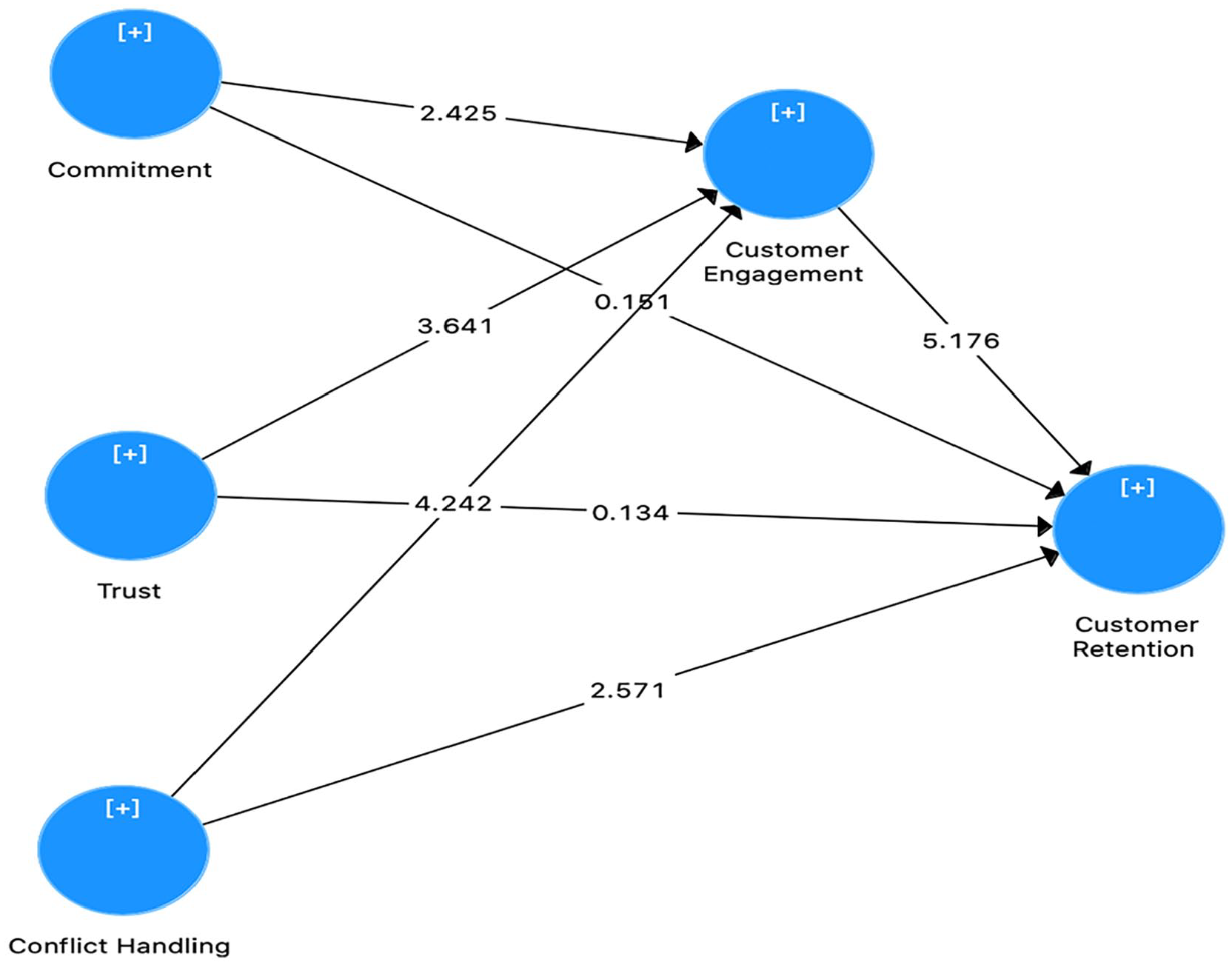
Bootstrapping diagram.
IPMA
The performance of each construct was evaluated for a target construct using the IPMA analysis. The results based on the IPMA analysis can be used by managers to prioritize their actions. This analysis is based on the average of latent variable scores (performance) and the initial results of PLS-SEM for the application of the total effects of the structural model (importance) (Völckner et al., 2010). Customer retention was employed as the target construct of this study. Figure 4 shows the schematic IPMA results of customer retention as the target variable, in which customer engagement and conflict handling had the highest performance (0.439 and 0.368, respectively), and followed by the trust with an overall effect of 0.139. In addition, commitment and engagement had the highest performance of 66.474 and 63.926, respectively, and followed by conflict handling and trust with values of 62.433 and 61.831, respectively. The IPMA was performed to measure the model’s diagnostic value (Martilla & James, 1977). The assessment is based on the comparison of the average values (performance) and PLS estimates, which indicate the significance of each construct. Specifically, features of the precursor constructs and the performances of the hypothesized associations within the exogenous factors were evaluated by IPMA for the final focal construct. For quantification, the total impact of general associations which explained the variation of the final focal construct, customer retention, was considered in this study. As shown in Figure 4, the commitment was located on the extreme left, thus suggesting that its level of importance among hotel guests was not closely related to their decision to book the five-star hotel.
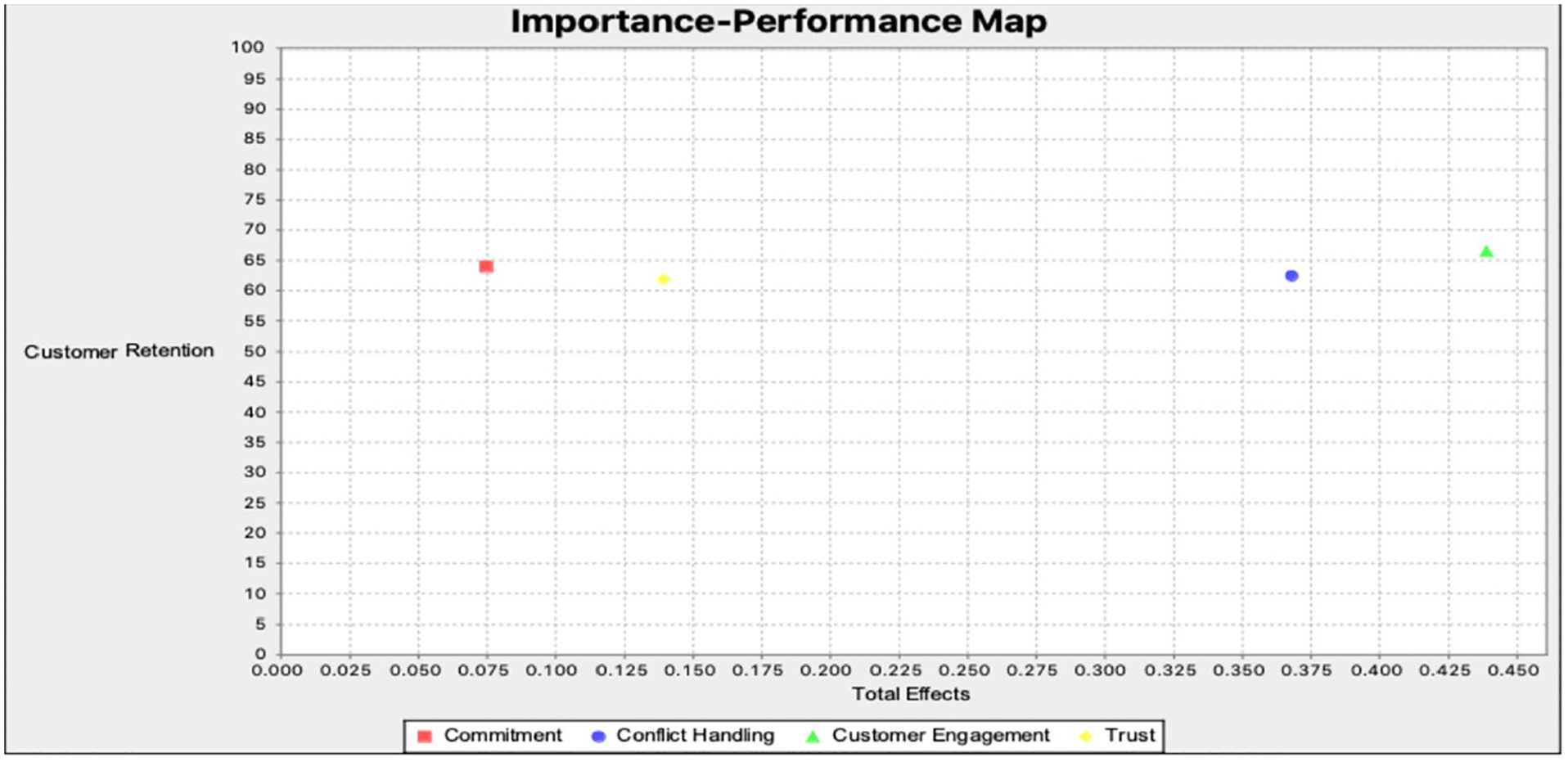
Importance-performance map analysis (construct level).
However, Figure 4 shows that conflict handling and engagement were located in the far-right corner, thus indicating that its level of importance was closely related to the decision-making process among five-star hotel guests. Therefore, marketing strategies that encourage a strong sense of effective handling for conflicts to enhance customers’ engagement should be considered to influence customers in the hotel industry.
Discussion
The main objective of this study was to examine both the direct and indirect relationships between the RM constructs and customer retention. The results showed that commitment has a significant effect on customer engagement in the hotel industry. This observation is consistent with a previous study by Richard and Zhang (2012) who indicated that commitment has a strong impact on customer engagement in service industries such as the airline industry. Moreover, the results revealed that trust has an effect on customer engagement as previously noted by Bowden (2009). In this study, it was shown that customers became more engaged with services when the trust was improved.
Conflict handling was also identified as an important factor that affected customer engagement and customer retention. This observation indicates that when hotels have the ability to prevent conflicts or implement good strategies to handle any conflicts with a customer, they can increase customer engagement and maintain customer loyalty toward the hotel. Therefore, the relationships between the customer and the hotel can be maintained for the long term. Mahmoud et al. (2018) previously found that conflict handling enhanced and improved customer retention within the telecommunication industry. However, the research outcomes of this study indicated that commitment and trust did not have an impact on customer retention in the hotel industry. These results were consistent with a study by Ranaweera and Prabhu (2003) who found that trust did not have a significant relationship with customer retention in the service industry. Several studies found that trust was a crucial factor in engaging customers (Luk & Yip, 2008), spreading positive feedback by word of mouth, and maintaining customer loyalty. However, in the hotel industry, trust does not lead to customer retention as other factors such as conflict handling were regarded as more important factors than trust and commitment for customers who received services in Malaysia.
The outcomes of this study indicate that conflict handling, commitment, and trust have an indirect relationship with customer retention through customer engagement. More importantly, these results indicate that customer engagement is the key factor in customer retention for the hotel industry in Malaysia.
Conclusion, Implications, and Further Research Directions
In the service industry, predicting customer retention is considered an important process of the marketing relationship strategy. This strategy helps companies to build strong relationships with customers for the long term and reduce customer switching. Thus, the direct and indirect relationships between RM variables and customer retention in the hotel industry in Malaysia were investigated in this study. The findings of this study showed that conflict handling was the most significant factor influencing customer engagement as opposed to commitment and trust that showed a lesser impact on customer engagement.
The results of this study contribute significantly to both academicians and business practices. From a business perspective, it is evident that different levels of customer engagement can result in different levels of customer retention. The implication of this finding indicates that managers need to focus on RM practices to enhance and improve customer engagement and thereby improve customer retention. For the hotels to achieve this, they need to provide customers with services that they have promised to offer. For instance, hotels should focus on improving their service quality and train their employees on how to treat customers respectfully according to the situation faced by their customers.
Based on all the RM constructs evaluated in this study, conflict handling was identified as a key indicator of customer engagement and customer retention. This finding indicates that hotel service providers should continuously develop and implement conflict handling procedures to manage and control different forms of conflicts in an effective way. Hotel services should also provide an easy option for customers to submit a complaint if they encounter any issues at the hotel as well as ensure that there are professionally trained staff who can handle problems with customers on a daily basis.
The IPMA analysis offers several improvement measures that can be performed by the management. The results obtained from IPMA enable the identification of factors with high and low significance. For example, this study shows that conflict handling and customer engagement have a primary significance for the establishment of customer retention. Subsequently, managerial tasks to improve and maintain customer retention should be focused on conflict handling and customer engagement. Therefore, it should be noted that the rise in the efficiency of customer engagement and conflict handling leads to an increase in consumer retention.
Nevertheless, despite the significant research contributions, there are some limitations in this study that should be addressed. First, this study represents a cross-sectional survey for data collection, thus making it more difficult to identify relationships between RM and customer retention. Hence, future research should implement a longitudinal study to gain insights into the RM constructs and customer retention. Second, this study reflects the Malaysian culture as it was performed in Malaysia. Therefore, future studies involving different countries and cultures should be performed to determine the effects of culture on customer retention. Finally, this study is only limited to customers in the hotel industry, and thus future research incorporating data from customers of other services providers should be performed accordingly.
Supplemental Material
sj-docx-1-sgo-10.1177_21582440211009224 – Supplemental material for Do Relationship Marketing Constructs Enhance Consumer Retention?: An Empirical Study Within the Hotel Industry
Supplemental material, sj-docx-1-sgo-10.1177_21582440211009224 for Do Relationship Marketing Constructs Enhance Consumer Retention?: An Empirical Study Within the Hotel Industry by Suha Fouad Salem in SAGE Open
Footnotes
Declaration of Conflicting Interests
The author(s) declared no potential conflicts of interest with respect to the research, authorship, and/or publication of this article.
Funding
The author(s) received no financial support for the research, authorship, and/or publication of this article.

Supplemental Material
Supplemental material for this article is available online.
References
Supplementary Material
Please find the following supplemental material available below.
For Open Access articles published under a Creative Commons License, all supplemental material carries the same license as the article it is associated with.
For non-Open Access articles published, all supplemental material carries a non-exclusive license, and permission requests for re-use of supplemental material or any part of supplemental material shall be sent directly to the copyright owner as specified in the copyright notice associated with the article.
