




Abstract
This article explores cross-country patterns in how conditions relating to family background, education, and the labor market are related to literacy and numeracy skills. It seeks to assess whether these patterns are in agreement with models of skills formation as identified in the political economy literature. The novelty of this article resides in a reexamination of the findings in the literature of skills formation and education and training system with new data on adults’ skills. This research uses a two-step approach: first it applies Shapley decomposition variance on adult skills and then each country scores are clustered to search for common pattern and regularities in skills formation. This leads us to single out common regularities among groups of countries in the way skills are structured and distributed. We find three main typologies and different subgroups within them that are compatible with the literature on skills formation models.
Introduction
In recent decades, the demand for skills and qualifications has greatly intensified, with the automation of production and the service sector making low-skilled workers easily replaceable (Mayer & Solga, 2008). The pressures for creating innovation and human capital have put emphasis on the economic functions of the education and training system, rather than on its cultural (socializing knowledge and identities) and social functions (offsetting inequalities to ensure equal opportunities). However, while the relationship between macro-economic factors and skills has been widely examined (Manuelli & Seshadri, 2014), insights into the way in which adult skills are configured are only now emerging.
A diverse literature has focused on the implications of national-specific models of skills formation. Educational science, for example, has employed a range of different dimensions, including those of state expenditure and control, stratification and standardization, and degrees of access to identify different types of education system (Allmendinger & Leibfried, 2003; Busemeyer, 2014; Dupriez et al. 2008; Janmaat & Green, 2013). Above all, this stream of the literature has been concerned with the identification of the characteristics of an effective institutional architecture for providing education, highlighting large-scale features of institutional differentiation by adopting cross-sectional measures of skills derived from the Program for International Student Assessment (PISA), which are treated as results of the schooling process. This literature reflects in a certain way the typology of capitalism promoted by the welfare state (Esping-Andersen, 1999).
Another stream of the literature has focused on relations between education systems, labor market regulations and firm/industry structure, in its configuration of different international models of skills formation. This has led to the identification of different political economies that vary in the way they manage their coordination and interrelationships with their institutions. These different “varieties of capitalism,” which constitute two archetypal heuristics—liberal and coordinated market economies (Hall & Soskice, 2001)—are highly heterogeneous in their labor-market behavior.
While several typologies have been devised to classify countries into different regimes according to the characteristics of their institutions (Borgonovi & Pokropek, 2016; Esping-Andersen, 1990; Hall & Soskice, 2001; Walther, 2006), none captures the principal differences in training and skills formation. The majority, moreover, take a macro-analytical approach, although a number of exceptions to this are reported in Allmendinger and Leibfried (2003) and West and Nikolai (2013).
The novelty of this article resides in the re-examination it undertakes of the findings in the literature of skills formation and education and training systems. It combines different sources of the formation of adult skills as employed widely in the literature (Desjardins, 2003; Murray et al., 2016; Scandurra & Calero, 2017; Vézina et al., 2019). The contribution seeks to assess whether these patterns of skills formation agree with the models identified in the typologies of capitalist countries. For an in-depth discussion of the differences and similarities of these typologies, please see chapter 3 of Schroeder (2013). The article uses a direct measure of adult skills and explores cross-country patterns and how conditions relating to family background, education, and the labor market impact literacy skills.
This article uses a two-step approach: first, it applies Shapley decomposition variance on individual adult skills and, second, it clusters each country’s factors scores to search for common patterns and regularities in skills formation. Thus, the approach goes beyond a simple comparison of the institutional characteristics of education and training systems or labor markets and takes as its explanandum direct measures of adult skills. This article extends previous research (West & Nikolai, 2013) by including 23 countries which represent largely Western Capitalist economies. Our contribution strengthens the links between different streams of literature: welfare state and labor regimes studies, on the one hand, and models of skills formation, on the other.
This article has the following structure: in the next section, we discuss the classification and then we briefly tackle the underlying rationality of the model and the correlates of skills. In section “Data and methods,” we present our data and explain the methods employed, while in sections “Results” and “Discussion,” we analyze and discuss the results, respectively. This article finishes with a section that presents our main conclusions.
A Country Classification Based on Education and Competence Production
A seminal study (Allmendinger & Leibfried, 2003) has depicted four models of competence production by analyzing PISA 2003 data of the mean values and distributions of competences, which mainly reflects the classification of countries by social policy and welfare model. The authors distinguish along two dimensions: level of competencies and their differentiation. In the same line, other researchers have used structural indicators of social policy, and of education and training systems to identify cross-country characteristics and common regularities (Bulle, 2011; Desjardins & Rubenson, 2013; Green, 2006; Nelson, 2010). This stream of the literature has sought to establish distinctive “educational regimes” and has identified regimes like social policy models (Esping-Andersen, 1990, 1999). Using indicators of (in)equality of opportunity and education expenditure, West and Nikolay (2013) identified four educational models in 16 Organization for Economic Co-operation and Development (OECD) countries: the Nordic, Continental, Mediterranean and English-speaking, which present a number of similarities with those identified in studies of welfare states. Compared to other studies, they report higher differences between Continental and Mediterranean countries, the former showing stronger relationship between social origin and educational outcomes (Beblavý et al., 2011). Other authors (Pechar & Andres, 2011) analyzed participation in higher education and educational attainment regarding welfare policies. They explored the trade-off hypothesis (Heclo, 1985) between education and welfare investment and found a negative relation between tertiary graduation rates, higher education policy, and welfare regimes generosity. Peter et al. (2010) analyzed education inequality in secondary education decomposing educational outcomes in 15 OECD countries and found differences in education inequality among schools to be lowest in the Nordic, social-democratic countries and highest in the conservative welfare states. These findings are in line with other studies (Hega & Hokenmaier, 2002) which also show an association between educational policies and social programs.
The institutional design of education and training systems has long been associated with cross-national differences of labor market entry. For instance, the dual system of work-vocational training at high school is often considered as an explanation for several countries’ good performances in the labor market. These countries—including Germany, Austria, the Netherlands and Denmark—present not only low youth unemployment but also smoother labor market transition for young adults (Allmendinger, 1989; Shavit & Müller, 1998). The main line of argument in such studies is that, by providing occupational skills that are transferable and by offering broad work experience, market entrants are better able to compete for work in labor markets that are segmented by occupation.
The political economy of skills formation adopts a more comprehensive approach, by assuming that skills level and distribution are not a matter of individual free choices but are on the contrary enabled and constrained by institutional balance (Busemeyer & Trampush, 2012; Iversen & Stephens, 2008). This stream of literature reveals that “coordinated market economies” combine high-skills, high-employment equilibria fostering the competitiveness of their economies. Thus, skills formation is embedded within an institutional, cultural, and political context (P. Brown, 1999; Thelen, 2004) that provides an explanation of these differences going back to historical path-dependency and the organization of skills formation. These important features characterize, and partially delimit, the evolving possibility of future equilibrium (path dependency). The design of a welfare state influences an individual’s motivation, participation, and outcomes at particular stages of their learning process (e.g., life transitions, employer support and costs of enrolment).
As is clearly apparent in this first section, when tackling the issue of skills formation, the labor market is critical since it is here that educational credentials and qualifications are shaped and used. Although often presented as part of the welfare states literature, some authors (Bosch et al., 2009; Ciccia, 2015) explicitly talk about labor regimes. These labor regimes may vary in some respects compared to the welfare state typologies: Commodification—the making of modern labour markets– and decommodification—the degree to which state policies render individuals free from the labour market—are generally treated as if they were symmetrical concepts: the more of one, the less of the other. The general attention to those policies that protect people from labour market risks has concealed differences in the ways in which the commodification of labour has historically taken place across countries. In these processes of commodification and decommodification it is important to look at skills formation for adults and young people. (Ciccia, 2015, p. 59)
Indeed, comparative studies of Europe’s labor markets have shown that differences at the beginning of a career reflect different institutional methods for promoting labor market entry, identifying in some instances different approaches to the labor-force integration of young people (Allmendinger, 1989; Bussi & Leonard, 2013; Kerckhoff, 1995.
Given the availability of new comparable microdata on adults’ skills, here, we explore the factors that shape the formation of skills, the extent to which OECD countries present different configurations of skills formation and just how far the classification we derive corresponds to the typology established in the literature of education and skills formation.
Hence, we explore the following hypotheses: (a) Central European/collective formation countries have a relatively higher association of labor market, skills use, and work-based training on skills, since in these countries occupational-skills are prevalent; (b) Nordic/Universalist-model countries have a similar pattern of configuration of skills as Central European countries; however, they show a lower association of family background on adult skills because of their more inclusive education and welfare systems; (c) in Southern European countries, the association between labor market and skills use at work on literacy is lower because of their low-skills, precarious employment equilibria; (d) in English-speaking/Liberal countries, the impact of family background on skills is relatively high.
The Definition of Skills: Literacy and Its Correlates
Just how skills should be defined remains highly contentious in the social sciences, although it is agreed that the process of skills formation is dynamic and that it involves the interaction of a multitude of components (Cunha et al., 2010; Desjardins, 2003; Saar et al., 2013). Our results are based on a proxy of skills taken from the theoretical framework of the Program for the International Assessment of Adult Competencies (PIAAC). A number of international bodies, including the OECD, have undertaken assessments of a range of skills so as to acquire insights into their distribution (Schleicher, 2008). Prior to the PIAAC, the International Adult Literacy Survey (IALS) (1994–1998) and the Adult Literacy and Lifeskills (ALL) Survey (2004–2006) were the most important international sources of information. These surveys provided direct measures of skills and involved the macro assessment of education, their aim being to compare the “quality of education as a social outcome” beyond schooling. Once established, they became relevant tools of governance (Desrosières, 2002; Grek, 2009) that are, likewise, influential for the education agenda (Meyer & Benavot, 2013). They have the advantage of being both a source of valuable information for comparative analysis and being completely independent from the national certification systems.
The PIAAC, on one hand, is characterized by a number of formal constraints in the way it assesses adult competencies, including (a) the focus on core skills; (b) the cross-sectional nature of the measures provided; (c) the limited availability of social stratification measures; and (d) the unavailability of any direct measures of the skills employed in the workplace. On the other hand, international assessments like the PIAAC include substantial indirect effects such as the creation of educational measurement indicators and the production of norms, which result in governance by comparison.
The literacy domain has been defined as “the ability to understand and use information from written texts in a variety of interactive contexts and situations, which involves understanding, reflection and judgment” (OECD, 2013b). Numeracy skills are defined by the PIAAC as “the ability to access, use, interpret and communicate mathematical information and ideas to engage in and manage the mathematical demands of a range of situations in adult life.” The survey framework assumes that this set of core skills enables retraining and a higher order set of skills to be introduced within an ever-changing and increasingly knowledge-based labor market. Such skills may be considered narrow, but they involve a level of functionality with the potential to maintain and develop higher order and job-specific skills. Furthermore, they help people cope with tasks—such as, text-based processing—that are applicable to a wide range of jobs and contexts. In the rest of this article, we use the term skills or core skills interchangeably.
Since skills are not fixed at a given moment in time and individuals gain and lose skills during their lifespan, a plurality of factors needs to be considered (Scandurra & Calero, 2017). For this reason, the proposed model considers a wide variety of factors (see Table 1), not strictly related to the education and training system, to provide a richer picture of how skills are configured in a comparative perspective. These control variables are very much in keeping with the literature on the determinants of literacy skills (Murray et al., 2016; Scandurra & Calero, 2017; Vézina et al., 2019). Skills are acquired in different contexts and through an iterative and complex process. The literature depicts two research paradigms of literacy skills (Reder, 1998) focusing, respectively, on the specific or general nature of literacy: that is, the cultural practices and the individual skills paradigms. The former stresses that literacy and knowledge are learned within the context of specific practice, while the latter sees literacy as a set of information-processing skills that become contextualized when an individual is required to engage in specific literacy-related tasks (Reder, 1998). Theory also suggests that the way an individual performs on these tasks is influenced by a number of factors, but primarily by their engagement or practice in literacy-related situations. In this line, we focused on the acquisition of literacy skills in a plurality of individual and contextual factors. In building the models, we first include a set of demographic variables and then incorporate family background, education, occupation and current employment, on-the-job training and on-the-job skill use. A brief review of the correlates of literacy is presented in the following.
Variables Included in the Model.

Source. Own calculation.
Note. PIAAC = Programme for the International Assessment of Adult Competencies.
Education Attainment
Education is strongly associated with skills (Boudard, 2001). This link is implicit in the education system’s objectives and way of learning, since education is based on routines that promote language instruction and motivate the use and mastery of literacy resources. The way we were educated and education’s collective objective influence society’s conception of a determined set of skills as being important at any given moment. In addition, surveys focused on skills assessment are influenced by the way we envision the objectives of education and, to a certain extent, they are likely to be biased toward academic-related skills.
But while the relationship between education attainment and skills is strong, it is not perfect, since many other factors are likely to be involved. Skills acquisition is, ultimately, the result of engaging in different spheres of life that include the home and leisure as well as the workplace and daily practice. For this reason, we need to think of literacy acquisition as a dynamic stock of assets rather than as a fixed, determined stock at a given point in time. At an aggregate level, a country that combines higher level and low dispersion in education attainment scores high on both IALS and PIAAC. Education attainment in the model was considered as the highest level of initial education achieved.
Family Background
Since the 1960s, many scholars have examined the relationship between individual background and academic outcomes (Coleman, 1966), highlighting the importance of the family on education attainment (Bukodi & Goldthorpe, 2013; Jerrim & Macmillan, 2015; Schütz et al., 2008). Indeed, background is critical for shaping educational preferences, opportunity and access, as well as attitudes, values, and behavior (Boudon, 1973; Gambetta, 1987).
The dataset provides information on such aspects of family background as the language spoken at home and whether the individual was born in the country or not. In many countries, it has been reported that non-native speakers and foreign-born have lower literacy skills (OECD, 2000). While it might be expected for an individual to be more proficient in his or her native language, the difference might also be related to the cultural, social, and economic gap that the education system, in part, fails to bridge. In this block, we include the language spoken at home, whether the individual was born outside the country in which the assessment was conducted, the parents’ highest level of educational attainment, and the number of books individuals recall having at home when they were 15 years old. A high number of books might be an indicator of a family’s cultural and economic environment, which correlates strongly with a child’s education effort and aspiration enhancing their academic success (Schütz et al., 2008). This has been proven to be a good proxy for family background and it also ensures cross-country comparability. The language spoken is an important source of differences in adult skills, which connects also to the language distance and language use between the origin and destination country of the individual and the time of arrival of the migrant. In many studies, non-native speakers obtain lower literacy scores (OECD, 2000). A recent study has also shown that the linguistic distance between the mother tongue and the language of destination is an important factor in explaining disadvantages in IALS scores (Isphording, 2014).
Age and Gender
Literacy tends to be lower for older adults, while those aged 26–35 years have comparatively higher scores (OECD, 2013a). This process might be related to biological deterioration and the aging process, but also to education expansion, with younger adults having been within the education system for longer (Desjardins & Warnke, 2012). Moreover, curriculum obsolescence and a reduced use of certain skills in daily life certainly play a role. As for gender, PISA has demonstrated that female students tend to have an advantage in reading, while boys have an advantage in mathematics.
Position in the Job Market
Individuals in employment have higher skills than the reserve labor force (OECD, 2000, 2013a). The work environment provides for the better maintenance or development of core skills. The IALS (OECD, 2000) shows how people with high literacy skills have more opportunities to use them in the workplace. Furthermore, people who are employed in a skilled job position have higher literacy compared to non-skilled workers. We included, in this block of variables, labor market status, occupational qualification at four levels, and the number of years of work experience.
Formal Training in the Workplace
Access to formal training in the workplace is crucial in skills development over the life course, and it has been demonstrated that specific training in the workplace can give access to improvement or maintenance of skills (Bassanini & Brunello, 2008, 2011). Moreover, skilled employees are more likely to be the recipients of formal training in the workplace and so acquire new skills. However, capturing higher order skills is difficult as the PIAAC focuses specifically on core skills.
Skills Use at Work
Measures of occupational classification used in standard surveys discriminate vertically between different categories but do not perform well when we need to account for horizontal differences (within the same occupational status or category position). This is increasingly the case in our knowledge-based society with most of the workforce employed in a skilled or semi-skilled job. To unravel the differences, we used two indicators related to tasks performed daily in the workplace, including numeracy and literacy use. The aim was to give a measure of the intensity of skills use in the workplace.
Data and Methods
Data and Sample
The PIAAC provides data for large samples of the active population between the ages of 16 and 65 years and allows rich analyses of education attainment and social outcomes. The first round of PIAAC data were collected in 2011 and 2012 and results were published in October 2013. The survey includes three adult skill domains: literacy, numeracy, and problem solving in technology-rich environments, though the latter was not implemented by all participating countries. The PIAAC combines a household survey with the testing of the skills of the adult population. It also comprises a fairly comprehensive background questionnaire, with respondents providing details about their socioeconomic conditions, education, training, labor market experience, skills use, health, and civic participation. Each country employs a different sampling method, which is subsequently adjusted to known population counts using post-sampling weighting.
Literacy and numeracy assessments are based on 56 items distributed across the three main task characteristics (medium, context and aspect), with a distinction being drawn between paper and computer-based questions. In addition, interviewers timed respondents on the reading component, with these outcomes forming part of the efficiency measure (OECD, 2013b). Arguably, the most relevant omissions in terms of direct measures are individuals’ job-specific skills together with intrapersonal and interpersonal skills. PIAAC, in common with other international assessments of education, uses item response techniques for the generation of plausible domain values. However, it should be stressed that the resulting values are not the individual test scores and, as such, cannot be interpreted at an individual level. The three skill domains show strong intercorrelations, with numeracy and literacy (problem-solving) presenting an individual-level correlation coefficient of 0.85 (0.76).
The final study sample comprised 107,178 individuals from 23 countries and subnational units between the ages of 25 and 65 years. We excluded those between the ages of 16 and 24 years because they are unlikely to have completed their initial education. Here, we draw on data from the first wave of PIAAC for all OECD member countries, excluding Australia due to problems of restricted data access.
Methods
We use a two-step method. First, we decompose the variance of the relationships between literacy and several factors relevant to adult skill variation, some of which—for example, the use of numeracy and literacy-related practices at work—have attracted little research attention. Second, we use cluster analysis to classify the previous estimates. The first step employs Shapley decomposition to break down the variance of each set of variables and disentangle their explanatory power in relation to skills. We assume that variables with a high intercorrelation are not independent of each other. For instance, a respondent’s education attainment tends to be highly associated with that of his or her parents. In this sense, Shapley decomposition has an advantage over other methods when there is high collinearity between the explanatory variables. This method has been used to decompose differences in income or in health distribution (Deutsh et al., 2018; Sastre & Trannoy, 2002). Shapley decomposition assigns a given value x of the number of factors k of the aggregate explanandum (e.g., I). If X k (k = 1, 2, . . ., m) denotes the contributory factors that together account for the value of I, then

The objective of all decompositions is to assign a given contribution to each factor and this means calculating the marginal impact of each successive factor as it is eliminated and averaging the impacts for all possible sequence of elimination (Shorrocks, 2013).
In the variance decomposition, we replicated the estimated values 80 times applying the corresponding weighting factors as calculated in the survey and after normalizing for the actual sample of each country. Sensitivity analysis showed that using only one plausible value of literacy, in the variance decomposition, altered the coefficient only to a third of a decimal point, even though the standard errors vary slightly. All the results shown correspond to the literacy skill domain, although similar results were obtained using numeracy skills as our explanatory factor. For the robustness check we also produced results for numeracy skills. Results are available upon request from the authors. The general model for skills is reported in Table 1A.
In the second step, we explored how different social factors influence skills formation and sought to identify any regularities emerging between countries. Based on the former Shapley variance decomposition, a cluster agglomerative hierarchical analysis was performed, using the values for each block of variables. In the cluster analysis, we employed the squared Euclidean distance as a measure of similarity and the nearest neighbor as the aggregation method. Considering that the variables employed are all ratios, since they are expressed as a percentage of the overall r squared explained by each block of variables, the Euclidean distance is equal to the Mahalanobis distance. All the variables and their codifications are shown in Table 1.
Results
This section is structured in two successive steps: first, it presents the findings of the variance decomposition reported in Table 2 and Figure 1; second, it describes the cluster analysis reported in Figure 2 and
General Model for OECD, Literacy.

Source. Programme for the International Assessment of Adult Competencies (2013 Own calculation).
Note. OECD = Organization for Economic Co-operation and Development.
p < .1. **p < .05. ***p < .01.
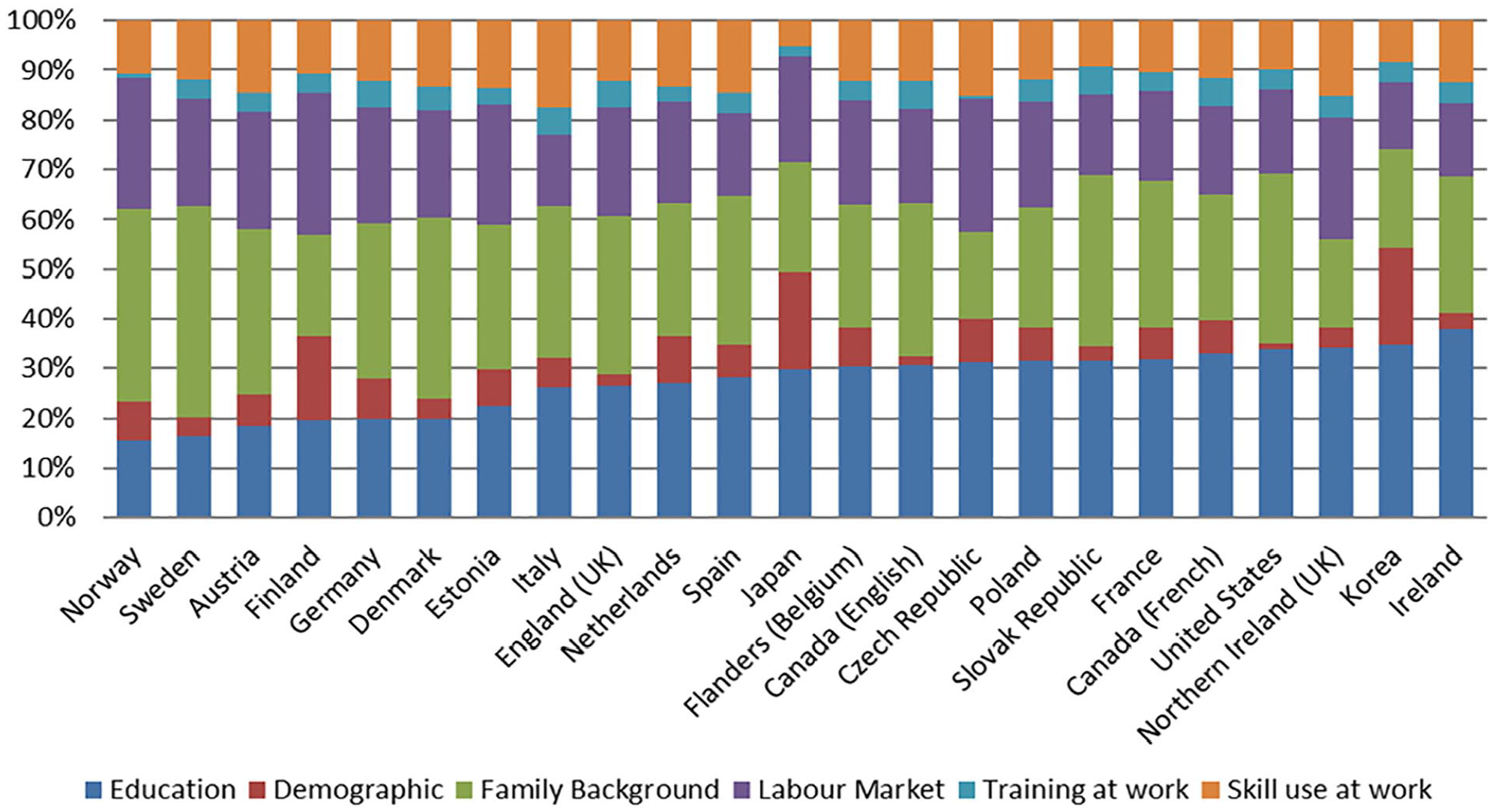
Percentage of total variance of literacy skills explained by block of variables, sorted by education.
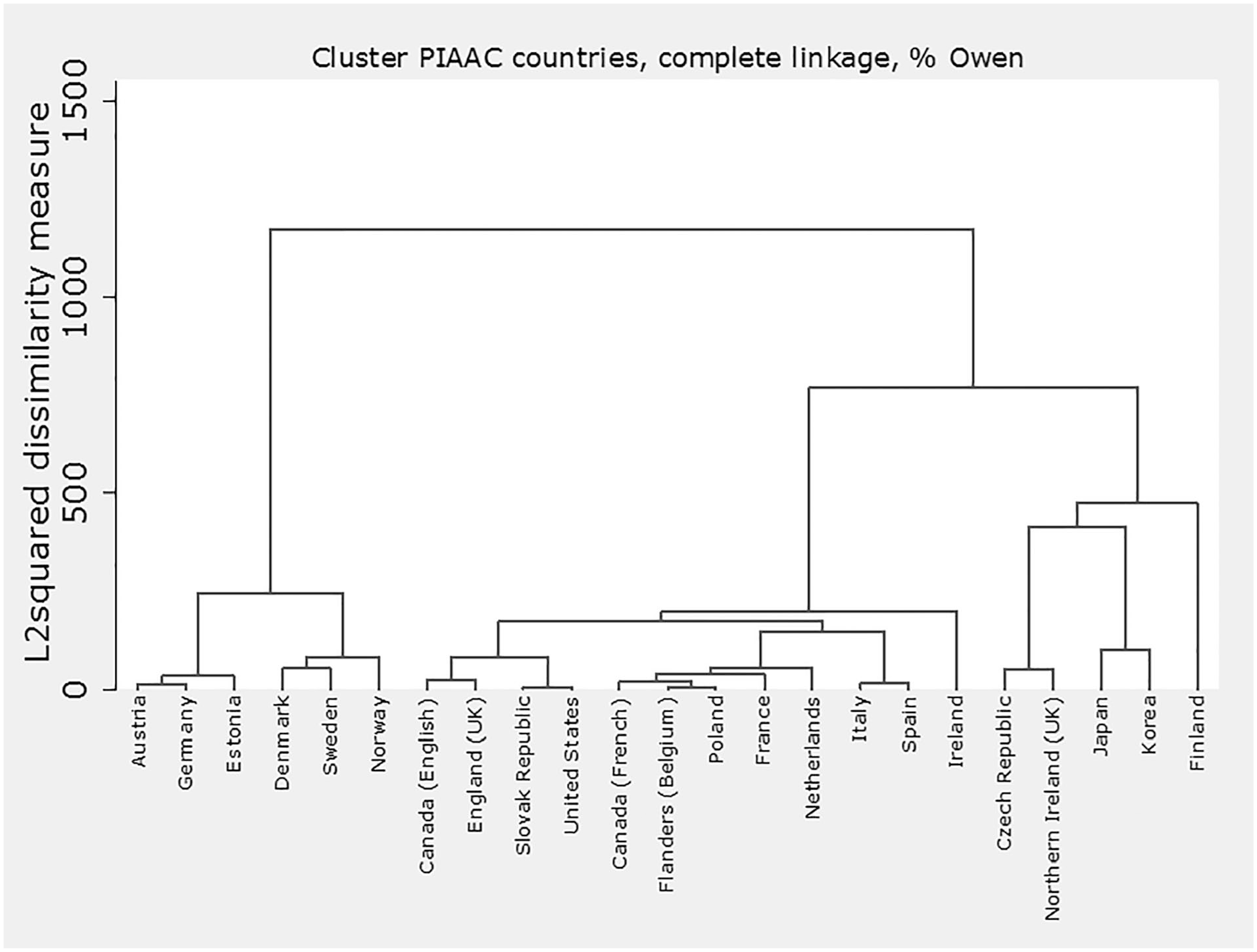
Hierarchical agglomerative cluster of skills factors formation.
The overall fit of the model accounts for 35% of the variance in both the literacy and numeracy domains for OECD countries. In six countries or regions—Sweden, Province of Quebec (French Canada), Flanders (Belgium), Sweden, the United States, and Norway, the full model accounts for between 40% and 45% of the variance in literacy (see Table 4A). However, this model does not perform well in explaining literacy skills in Estonia, Japan, the Czech Republic, and the Slovak Republic (between 21% and 29%). In line with former studies, individual education attainment is the variable with the highest association with adult skills. As shown in Table 2, among the adult skill factors, family background is the most important correlate, accounting for 31% of the variance for all the OECD countries assessed in PIAAC, followed by education attainment (28.4%), the labor market position (17.8%), and skills use at work (13.2%). Interestingly, even after accounting for all the other model variables, skills use at work is still influential in explaining skills. It represents the extent of the amount of variance which is not explained by standard labor position variables. This element underlines the central role of the labor market in shaping the conditions and profile of workers and serves as a reminder of the importance of a lifelong-learning approach.
As shown in Table 2, literacy appears to be less sensitive than numeracy to the model variables. In the case of numeracy, only the size of the coefficients of education attainment and occupation qualification was higher. This might reflect the fact that literacy constitutes a more commonly used set of skills than numeracy and that these former skills are more closely related to schooling, as IALS and ALL results have demonstrated. Both models present similar coefficients and corresponding signs, which indicates the robustness of our analysis. In the background variables block, speaking the native language and being born abroad are highly related to literacy. Having a tertiary academic credential represented, on average, a 34.8-point advantage in literacy and a 38-point advantage in numeracy.
The height of the histograms in Figure 1 shows the percentage of total variance explained by each successive set of variables. Family background is very important in Austria, Denmark, Norway, Sweden, and the United States, accounting for more than a third of the total model variance. These results seem surprising at first sight for the first four countries considering that they have traditionally been known for their high degree of decommodification and these welfare states (including educational systems) guarantee a certain level of social mobility. For the Czech Republic, Estonia, Finland, Northern Ireland, Poland, and Japan, family background was less relevant. Education was the most important explanatory factor in French Canada, Flanders, France, Ireland, and Korea.
Figure 1 shows a negative relation between the amount of variance explained by family background and education achievement. This pattern is particularly consistent in Scandinavian countries and German-speaking countries, where family background variables account for a high proportion of the variance in literacy. The reverse is true in most Anglophone countries, Korea, and Japan: education was more relevant than family background in explaining literacy. In Finland, the Netherlands, Spain, France, the Slovak Republic, Canada (English), and the United States, the pattern of these two dimensions in explaining literacy is more balanced, even though the levels between countries were very different.
One common feature of the OECD countries surveyed in the PIAAC was the cross-country divergence in structuring skills. This is basically the assumption that led to the following step in the analysis. Based on the results of the Shapley variance decomposition reported in Figure 1, we proceeded to explore whether and how the factors of skills formation included in our model configured different typologies across OECD countries. The outcomes from this hierarchical cluster were similar to the results provided by model-based clustering and are illustrated as a dendrogram in Figure 2.
The countries are divided into three main groups. The first group differs quite markedly from the rest as the dendrogram shows. It is formed by Austria, Estonia, Germany, Denmark, Norway, and Sweden. These countries show a high education attainment level and a medium-high level of skills use in the workplace. Moreover, the largest variability in terms of literacy is given by the labor market and family background. They also register a moderate percentage of population with literacy level below 1. Level 1 on the PIAAC literacy scale corresponds to a score below 176 points on a scale from 0 to 500. At this level, respondents are required to read short texts on familiar topics and to locate a single item of specific information. In these countries, the labor market appears to be very stable and skill-demanding, with a high employment rate and skilled and semi-skilled population, and very high levels of working experience and on-the-job training. Moreover, being born abroad and being, therefore, a non-native are strongly associated with skills level in these countries. Within this group, the Nordic countries form another subgroup, which differs for the high effect of family background on skills, very high parental education level and a rather low impact of education variables on literacy. These countries have both the highest percentage of individuals with tertiary education and highest parental education attainment. In Nordic countries, family background is the most relevant block in explaining numeracy skills. In these countries, this could be due in part to a high percentage of non-native speakers and foreign-born population. The acquisition of skills in this group is more work-oriented with the countries traditionally having a more stable labor market and initial education being less important in relative terms.
The second group comprises the Czech Republic, Northern Ireland, Finland, Japan, and Korea. It is characterized by a high level of education attainment with a very low percentage of lower secondary educated people. In these countries, family background has the lowest effect on literacy, indicative of higher educational opportunities. In contrast, the biggest differentials in skills are associated with the position in the labor market. Moreover, this group has the lowest percentage of people with literacy below Level 1 and, with the exception of Finland, these countries have very low dispersion in literacy compared to the OECD. This group is divided in two sub-groups with Finland, Japan, and Korea having the highest impact of demographic variables and the lowest in terms of family background. These countries have a very high percentage of tertiary educated population and are among those countries having experienced the largest education expansion over the past decades. Overall, this group of countries is characterized by more egalitarian skills training, with family background having less impact on skills than in the other OECD member states.
Canada, England, the United States, the Slovak Republic, Flanders, France, Poland, the Netherlands, Spain, Italy, and Ireland composed the largest cluster. In this group, skills are explained by educational attainment, whereas labor market position variables have a low impact on explaining skills. Within this cluster, we detect four subgroups. Italy and Spain form a group that is characterized by the lowest levels of education attainment both in terms of individual and parental attainment. A comparison of these countries with the rest of the OECD members shows low levels of education participation. Indeed, they shared the lowest percentage of individuals with parents with tertiary level education and presented very high proportions with only secondary or lower education. In addition, Italy and Spain present a very high polarization of skills, having both the highest percentage of people with literacy below Level 1 and the lowest share of those with literacy Level 4 or above (see Table 2A). Moreover, the association between family background, initial education attainment, and literacy are very high. These countries report high impact of skills use at work, but a low impact of labor market position; however, the dispersion in terms of standard deviation is lower for Italy than it is for Spain. These two countries report the lowest employment rate and have the fewest people employed in highly qualified posts, as well as very low rates for the intensive use of on-the-job skills and on-the-job training.
Francophone Canada, Flanders, France, the Netherlands, and Poland formed a group of countries where family background was less influential, while individual education was relatively more important than in the other countries. The other sub-group comprised the Anglophone countries, that is, Canada (English), the United States, and England, together with the Slovak Republic. This group has very high educational attainment, the lowest impact of age and gender in explaining skills, while both family background and education level were highly related to skills. On the other hand, they tend to have a polarized distribution of literacy. For this reason, in these countries, skills distribution appears to be less egalitarian.
Discussion
Since the international comparative assessments of educational competencies were first introduced, many studies have examined the drivers of skills formation. This interest lies, logically, in the assumption that certain skills are critical for effective communication and to facilitate an individual’s personal, social, and economic development. In short, to function in society, an individual requires the core skills of literacy and numeracy. Moreover, literacy outcomes are thought to permeate other aspects of an individual’s life, having beneficial personal, intellectual, health effects, as well as impacting their socioeconomic success (OECD, 2013).
A vast strand of literature has developed from a country-centered approach and the identification of either established welfare or economic production systems. A varieties of capitalism approach (Hall & Soskice, 2001; Soskice et al., 2001) stresses the complementarities of economic, institutional, and social relations, while a welfare regimes approach (Esping-Andersen, 1990, 1999) places the emphasis on class struggle and the historical development of the production system. The empirical analysis of a national system means having to “average out” real world complexities, which means the resulting representation does not necessarily capture the characteristics of the system’s specific parts.
Our analysis tried to apply this approach to educational and skills formation, re-examining former findings with new data and a two-step approach pooling a wide range of factors that potentially affects skills formation. We detect major variation in skills formation within OECD countries. The way groups are formed partially supports the earlier institutional comparative literature (Green, 2006; Janmaat et al., 2013; Soskice et al., 2001) examining systems of education and training systems and skills formation, and, in part, at least, analyses of welfare state models and labor regimes.
In common with other studies that compare, for instance, labor regimes to more traditional welfare state models (Ciccia, 2015), we should stress that the skills formation model developed in our study examines aggregates of individual skills and coincides (only in part) with the general model of welfare state regimes.
Our results indicate that a large number of countries group together, although a number of subgroups with common characteristics also emerge. Similar to previous findings, the article shows that Northern European (Denmark, Norway and Sweden) and some Central European countries (Austria, Estonia and Germany) have an occupation-centered model of skills formation (Ryan, 2001). In these countries, vocational training is indeed highly developed and there are strong connections between their systems of education and job markets. For these countries, we record both a general high level of educational attainment and a marked inequality associated with family background, especially in the case of non-nationals (Bol & van de Werfhorst, 2013). This contrasted with the traditional welfare state model of Nordic countries where these inequalities increased toward non-nationals. This is connected, at least in part, to the great impact immigration has had on these countries in recent years (Scarpa & Schierup, 2018).
The Czech Republic, Northern Ireland, Japan, Korea, and Finland, in contrast, seem to have a more egalitarian model of structuring differences in skills. In these countries, skills are not strongly associated with individual background, nor with the educational credentials attained. In these countries, education attainment is high, and they show both a higher level of skills combined with a very low variation (Jonas, 2018). This group includes a variety of countries and seems to differ from traditional welfare state models. Moreover, Japan, Korea, and Finland show a higher association between demographic variables and literacy. However, the first two Asian countries show a stronger association between gender and skills, which confirms their large and widening gender gap. In Finland, middle-aged women register higher levels of literacy (Kim, 2018).
The Anglophone countries (Canada, England, and the United States) and the Slovak Republic form a group where both family background and education attainment play a fundamental role in skills formation (Scandurra & Calero, 2020). In these countries, the balance of these two factors demonstrates the relationship between education credentials and skills, but also the strong link between individual family background and education attainment. Comparing country-level differences for a subsample of young adults in PISA and PIAAC, Green et al. (2015) show that these countries have higher dispersion in adult skills compared to the rest. Moreover, Jerrim and Macmillan (2015) report that, in the case of these countries, there is a very high intergenerational relationship between parental education and the labor market outcomes of their children and that this is mainly produced through education. This model of skills formation could be coherent with the traditional liberal model of the welfare state regimes, which includes the majority of these countries (the United Kingdom, Canada, and the United States). The exception, here, is the Slovak Republic, which was included among “Eastern European and former communist countries” in the traditional welfare states model.
Spain and Italy have a common, very specific, model of skills, in which the differences appear to be the result of the combination of poor individual family background and a lower degree of educational attainment. Furthermore, in these two countries, the position in the labor market has a very weak impact on skills compared to that in other countries. However, to some degree, this labor market position does not correspond to skills but rather to external factors. This finding is reinforced by the fact that skills use in the workplace has a higher impact on skills. In fact, Spain and Italy together present very high overeducation rates and very low levels of adult skills compared to the corresponding levels in the other OECD countries (Nieto & Ramos, 2017). Spain and Italy have comprehensive education systems but low participation in VET, under-developed active labor market policies and related services, blended with a weak labor market supply, all of which deteriorated after 2008. In these countries, the links established between education and the job market are both weak and fragmented. These results suggest a common trajectory for skill formation in Italy and Spain which seems to coincide with the Southern European welfare state model.
Our analysis suggests that the characteristics of the system driving skills formation may differ during different life stages. Without entering into a debate on the rationality of distinctive models of capitalism, in this article, we support the importance of diverse spheres in shaping adult skills (Scandurra, 2016). The way of structuring these differences in skills varies in the analyzed countries.
As we have observed, this distinction, at least in part, responds to divergent welfare regime models and the micro-macro organization equilibria which underpin them. The results are based on a single year’s observations—that of 2012—which was a period when the economic and financial crisis hit OECD economies most severely, but unequally, and only partially captures the characteristics of their respective systems of education and training. However, the dimensions analyzed capture long-term effects, which are likely to be less affected by the economic crisis.
Conclusion
Using a new direct measure of adult skills and a two-step approach, we have re-examined the way in which adult skills form and are distributed in the OECD area. Our results show that the distribution of these skills is, in fact, complex, configuring quite distinct equilibria, which partially reflects the findings of the literature dedicated to skills formation, social policies and welfare state regimes. It is our contention that adult skills can be explained both by a different combination and a different distribution of social factors. However, we are able to identify a certain regularity within countries that reflects the latter’s specific production and welfare systems.
However, it is important that these results be interpreted in conjunction with a close consideration of our study’s limitations. First, the study reported is cross-sectional in its approach and is, therefore, limited to an analysis of associations based solely on present data. Second, it includes only those skills assessed by the PIAAC, which is limited to a set considered necessary for an adult to function in the knowledge economy. Thus, any implications that we might draw on the basis of these findings should be treated with caution. Future cross-national studies of adult skills face the challenge of addressing the issues of endogeneity and reverse causality that are likely to affect these skills and their related acquisition factors. This research should help shed light on the impact of distinct phases of an individual’s lifelong learning and also disentangle the most relevant policies and characteristics of a system in each phase.
Our country-centered approach which considers both “varieties of capitalism” and “welfare state regimes” helps to counterbalance more simplistic arguments that claim globalization represents an inevitable convergence of national economies. And while the social, political, and cultural diversity of each welfare and education system may be a resource for implementing new social measures, it also runs the risk of becoming a limitation: “Adaptation continues to modify the various starting conditions through paths where choices and opportunities are given neither by individual utility nor by predetermined social institutions” (Ghezzi & Mingione, 2007, p. 19). In terms of path dependency, the most efficient solutions in many countries vary according to the demographic processes previously experienced (e.g., migration from rural regions) and the policies previously implemented (e.g., the historical presence of the third sector and associations, the economic development of different territories and a consequent territorial division, etc.). Therefore, despite major changes, a number of distinctive features of each welfare model remain evident.
The variations reflect marked differences in just how an overall approach has been translated into a national policy regime and this, in turn, is a reflection of historical divergences in basic economic and social conditions as well as ingrained political values. Soskice et al. (2001) analyze what they refer to as “welfare production regimes” and which they define as the characteristic national set of “product market strategies, employee skill trajectories, and social, economic, and political institutions that support them” (p. 146). It is these characteristics that subsequently come to reflect the equilibrium reached by a plurality of social actors in the different welfare state regimes (Esping-Andersen, 1990, 1999; Korpi, 2006). The main differences in the approaches are attributable to the reasons that underpin the rationality of the configuration of different models of modern capitalism; yet, the grouping of countries does not differ greatly in this literature.
This recurring pattern between education and training systems and the way in which welfare is designed and skill formation models are articulated is based on the common heritage and path dependency of countries. Moreover, these historical and institutional characteristics may affect the evolution of the education and welfare systems in each country. If education and training outcomes, on one hand, and production and welfare regimes, on the other, are understood as being closely woven together, policy makers might begin to understand better the underlying links between the two. Thus, the overall objective of improving skills outcomes cannot be achieved without referring to a broader social system. This is particularly relevant in times of growing unemployment and rising social risks when governments should strive harder to increase the employability of the workforce and ensure economic prosperity. From an organizational perspective, it is important to strengthen both welfare state policies that can protect people from the risks of the labor market and provide retraining programs that target specific competencies (i.e., knowledge, skills, and attitudes) and foster employability.
Supplemental Material
sj-pdf-1-sgo-10.1177_21582440211019738 – Supplemental material for A Classification of Factors Affecting Adults’ Skills Distribution
Supplemental material, sj-pdf-1-sgo-10.1177_21582440211019738 for A Classification of Factors Affecting Adults’ Skills Distribution by Rosario Scandurra and Marco Alberio in SAGE Open
Footnotes
Declaration of Conflicting Interests
The author(s) declared no potential conflicts of interest with respect to the research, authorship, and/or publication of this article.
Funding
The author(s) disclosed receipt of the following financial support for the research, authorship, and/or publication of this article: The Canada research Chair on social innovation and territorial innovation covered the publication fees and open access licence. Rosario Scandurra is a Juan de la Cierva Grants Programme fellow (Ref. IJC2019-040056-I).

Supplemental Material
Supplemental material for this article is available online.
References
Supplementary Material
Please find the following supplemental material available below.
For Open Access articles published under a Creative Commons License, all supplemental material carries the same license as the article it is associated with.
For non-Open Access articles published, all supplemental material carries a non-exclusive license, and permission requests for re-use of supplemental material or any part of supplemental material shall be sent directly to the copyright owner as specified in the copyright notice associated with the article.
