




Abstract
Although micromanagement commonly characterized with excessive control and negative impacts is theoretically expected to decline, it is still a major workplace concern in contemporary organizational life especially when numerous digital solutions are developed and adopted by organizations. By reviewing 94 papers systematically selected from organizational studies, the study aims to clarify how micromanagement is understood and measured, and identify what are underlying theories and nomological network of the current research. The review found that explicitly or implicitly drawing upon different leadership, management and social-based theories, micromanagement is manifested through various individual qualities but lacks a clear and formal definition and validated measurement scale. Its occurrence and consequences vary over time across individual factors such as personality trait, leaders’ competence or perception and contextual factors such as task characteristics, organizational culture or organizational structure. The findings are structured into an integrative framework that can enrich current literature, direct future research, and enhance managers’ awareness of causes, manifestations and positive sides of micromanagement. As a result, managers can be more flexible in deploying micromanagement to achieve organizational goals but not at the expense of individual well-being.
Introduction
The complexity and uncertainty caused by global challenges such as resource depletion, pollution, greater competition, and rapid technological advancements have theoretically made the command-and-control style inappropriate for organizations (DiGangi, 2023; Milner, 2024). This may explain why micromanagement has received limited attention in current management studies (Irani-Williams et al, 2021; H. Lee et al., 2023; Limon & Dilekçi, 2021). However, micromanagement commonly characterized by excessive control is still popular in current organizational life across sectors (Chambers, 2009; Irani-Williams et al, 2021; Milner, 2024). Particularly, recent widespread applications of digital technologies (Lanzolla et al., 2020), especially algorithmic technologies that enable organizations to perform different kinds of control in a more cost-efficient manner (Ivanov, 2023; Kellogg et al., 2020), have intensified workplace concern over micromanagement (S. Ryan & Cross, 2024). In addition to theoretical assumption of its decline, negative sides of micromanagement are often overemphasized (Irani-Williams et al, 2021) sometimes even without credential evidence (Mayer, 1993), despite its desirability in certain cases such as implementing strategic changes or managing newly hired employees (Mayer, 1993; Radey & Stanley, 2018).
Considering the prevalence, contemporary, and mixed impacts of micromanagement, we believe that a comprehensive review of micromanagement is necessary to synthesize current perspectives on the topic and provide researchers with additional insights to form new research focuses and theoretical constructs. Several literature reviews on this topic have been conducted, yet a holistic picture of its conceptualization and nomological network – a system or a framework describes interconnections between constructs of interest (Cronbach & Meehl, 1955) – is still limited for several reasons. First, current reviews have a narrow focus. For example, the review by J. Lee et al. (2023) focuses only on nursing field and does not clearly separate factors influencing micromanagement into antecedents, moderators and mediators. Second, some existing studies have methodological weaknesses. For example, the review done by Mishra et al. (2019) adopted a traditional literature review approach that lacks transparency and reproducibility. Third, while micromanagement involves two parties: controller (managers) and controlees (employees) (Cram & Wiener, 2018), current reviews largely ignore factors related to controlees such as perception or attitude.
In contribution to fulfilling the above research gaps, the study adopts a systematic literature review approach to answer the following questions:
- How is micromanagement defined and understood in organizational studies?
- How is micromanagement measured?
- What are underlying theories and nomological network of current micromanagement research?
- What is future research agenda?
The remain of the study is structured into three sections. Section “Methodology” indicates data collection and analysis methods. Section “Findings” summarizes meanings of micromanagement, underlying theories utilized by researchers, and then presents a nomological network describing relations between micromanagement and its antecedents, moderators, mediators, and consequences. Section “Discussion” concludes the study by discussing its theoretical contributions, practical implications and suggestions for future research agenda.
Methodology
In order to ensure the transparency, reproduction and objectivity of data collection, analysis and synthesis process (Kraus et al., 2020), the study followed steps suggested by Tranfield et al. (2003).
Article Search
The study used keyword strings to search in titles, abstracts and keywords of three databases: Web of Science, Scopus and ScienceDirect. In order to include relevant keywords as many as possible, the study conducted an initial search on Web of Science using keywords (“micromanagement*” OR “micromanaging*” OR “micromanager”). After skimming some articles such as Skiba et al. (2016), the study found that the word “microclimate” was associated with “micromanagement.” Therefore, the study expanded keyword strings to (“micromanagement*” OR “micromanaging*” OR “micromanager” OR “microclimate”) and conducted the search again in Scopus and Web of Science. However, when skimming through certain exported articles with the word “microclimate,” the study found that the word “microclimate” may increase the number of irrelevant publications because it is often associated with natural conditions and engineering specifications such as temperature, heat, density, or light. Therefore, the study excluded this word when conducting the search in ScienceDirect. Because ScienceDirect does not allow to use the symbol “*,” the study used the word “micromanaging leadership” instead of “micromanaging*.”
Because the number of entries showing up after using keywords was quite large, the study narrowed the search scope to improve the relevance of publications. The study included only studies that are (i) in the field of social science, business and management, (ii) written in English and (iii) categorized as Article and Review. Only these two types of publications are included because of their standardized formats and recognized impacts in scholarly discourse (Klang et al., 2014). The study also cross checked citations of other articles to identify additional papers that may be relevant but omitted by the keyword search. The study did not set time bound for the search in order to capture relevant literature as many as possible (Gallardo-Gallardo et al., 2017). Table 1 shows the details of the article search process:
Keywords and Database.

Article Selection
The study only included publications that are satisfied the following criteria for finding synthesis stage:
(1) Titles and/or abstracts contain at least one word “micromana*” or “microclimate”
(2) Research context is organizational context. In particular, microclimate needs to refer to social climate within organizations
(3) Full text is accessible
Figure 1 shows PRISMA flow diagram of the screening process.

PRISMA flow diagram of the screening process.
Data Coding and Finding Synthesis
Due to certain constraints, the content of each article was manually explored by only one author. Information about year of publication, research design (qualitative, quantitative and mixed method), research area, research context, variables (independent, dependent, moderator, mediator) and key findings were captured and organized into a summary excel file. Discussions about micromanagement were investigated carefully and categorized into key themes related to the research questions: definition, measurement (newly developed or adopted from others), consequences, background theory, and other factors (antecedents, moderators and mediators). Themes or factors were named after a group of key words that frequently appeared across the articles within the review.
Findings
Publication Bibliometrics
Total 94 identified publications occur between 1992 and 2024. However, the number of annual publications remained low for a long period and sharply increased after the year 2020 (Figure 2). The majority of publications are in business and management field (Figure 3) and are qualitative (Figure 4). Where available, empirical data was mainly cross-sectional, collected through self-reported surveys and interviews, and from single country context (Table 2).

Number of yearly publications on micromanagement.

Proportion of publications by research area.

Proportion of publications by research design.
Country Context and Data Type.

Micromanagement Conceptualization
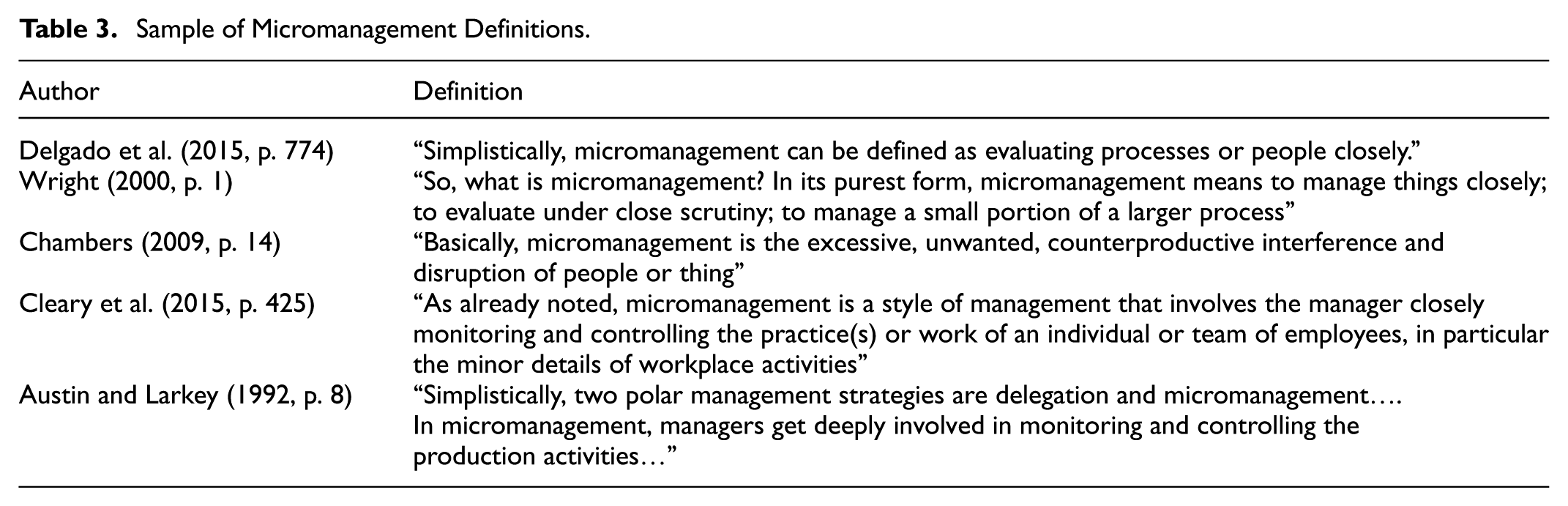
The term “micromanagement” was first mentioned in 1975 in the Economist’s article long after it had been practiced in organizational life (White, 2010). However, despite various studies mainly or partly on micromanagement, there has been no a formal and clear definition of this concept. It has been defined and understood in different ways (see Table 3 for sample definitions). Its simplest meaning is a managerial level that is responsible for “a small portion of a larger process” (Alam et al., 2014; Wright, 2000). From this perspective, micromanagement is normally associated with the term “microclimate” that refers to close environment surrounding a person (Courtney et al., 2024; Walsh, 2010) such as a group of students of the same ethnicity (Papadaki et al., 2024) or a department of a university. However, the concept is more well-known as a managerial and leadership style. Some authors (Alvesson & Sveningsson, 2003; Cleary et al., 2015; Limon & Dilekçi, 2021; Wright, 2000) consider it as a management style, while Austin and Larkey (1992) refers it to be a management strategy and others (Gelei et al., 2015; Ghamrawi, Abu-Shawish, et al., 2024; Pastel, 2008; Schafer, 2010) equate it to a behavioral trait of ineffective leadership. Regardless of being considered as a management or leadership issue, micromanagement is manifested in a variety of qualities that can be divided into four dimensions: (a) excessive control or interference, (b) excessive communication, (c) ignorance of subordinates’ capabilities and (d) arbitrary decision making.
Sample of Micromanagement Definitions.
Excessive control or interference means that managers or leaders spend too much energy and time on observing, analyzing and monitoring daily activities and small details such as break time, daily number of papers used by copy machine or even font size of reports (Cleary et al., 2015; D’Antoine et al., 2023; Franken & Plimmer, 2019; Houlihan, 2001; Irani-Williams et al., 2021; Kamarudin et al., 2023; J. Lee et al., 2023; Limon & Dilekçi, 2021; Selesho & Matjie, 2024; White, 2010; Zabrodska et al., 2011). They provide or strictly impose detailed instructions on how to carry out the work (Austin & Larkey, 1992; D’Antoine et al., 2023; DiGangi, 2023; Ghamrawi, Abu-Shawish, et al., 2024; Ghamrawi, Abu-Tineh, et al., 2024; Haug, 2024; Kamarudin et al., 2023; White, 2010). In some cases, they request subordinates to seek their approval or permission for all decisions and activities (Limon & Dilekçi, 2021; Schafer, 2010; White, 2010; Zaidi & Jamshed, 2023) including those within “subordinate’s level of authority” (Tavanti, 2011). This dimension is the most common quality when referring to micromanagement. Excessive communication means that superiors maintain frequent communication with subordinates by sending constant task reminders and requiring numerous reports (Irani-Williams et al., 2021; H. Lee, 2021; Limon & Dilekçi, 2021; White, 2010). Ignorance of subordinates’ capability refers to managerial or leader behaviors that disregard or doubt subordinate’s expertise and judgment. Superiors consider subordinates incompetent and inexperienced to carry out tasks (Ghamrawi, Abu-Shawish, et al., 2024; H. Lee, 2021; Limon & Dilekçi, 2021; S. Ryan & Cross, 2024; Selesho & Matjie, 2024; White, 2010). Finally, arbitrary decision making describes unilateral and opaque nature of decision-making process by managers or leaders. Subordinates have limited or no opportunities to express or get their inputs factored into organizational decisions (Egitim, 2022; Ghamrawi, Abu-Shawish, et al., 2024; Haug, 2024). Drawing upon these dimensions, the study would define micromanagement as a detail oriented management style manifested through a strict top-down approach to decision making, constant task related surveillance and monitoring, and disrespect of subordinate’s capability.
Micromanagement has been generally labeled as “bad” leadership (Alvesson & Sveningsson, 2003), “destructive leadership” (Ghamrawi, Abu-Shawish, et al., 2024), “ineffective leadership” (Schafer, 2010), and “toxic” (Wasylyshyn, 2005) or “mean” manager (Milner, 2024). Chambers (2009) argued that these negative labels have been so overused that people blame micromanagement for any of their unhappiness at work. This way of labeling can be problematic because it decontextualizes the concept, which can lead to biased understanding of micromanagement and ineffective organizational responses. First, this labeling overlooks the rational root of control and other supervisory activities. Managers or supervisors are both responsible and accountable for collective actions of their subordinates (Houlihan, 2001). They are expected to ensure their subordinates’ behaviors and competence align and support the achievement of organizational objectives (Cram & Wiener, 2018). Even in case of transformational leadership – the most dominant contemporary (positive) leadership (Gardner et al., 2020), ultimate motivation to lead is also the sake of organizational benefits and goals (Stone et al., 2004). Micromanagers are not an exception. Some of them deploy close supervision or provide detailed directions because they want to foster competency development (Cram & Wiener, 2018), bring out “the best performance from their team” (Milner, 2024) or maintain high standards and consistency (S. Ryan & Cross, 2024; Mayer, 1993) within organizations. For employees who work from home, many managers are devoted to maintaining different forms of communications to help them avoid the feeling of being isolated socially and professionally (Richardson, 2010). Milner (2024) named micromanagers with positive motivation to lead as motivational micromanagers. Apart from control motive, micromanagement is part of managers’ job description in some cases. For example, it is essential for managers to be detail oriented when “analyzing critical reports, reviewing accidents, and compiling a budget” (White, 2010, p. 72) and to deploy tight supervision over legal compliance of organizational software (Cram & Wiener, 2018). Kamarudin et al. (2023) argued that the high level of control or supervision in this case should not be considered as micromanagement.
Second, this way of labeling largely excludes the role of controlees’ perception of control legitimacy. According to control theory, the nature of control system is dyadic between controllers and controlees (Cram & Wiener, 2018). Whether the level of control is considered to be “excessive, unwanted or counterproductive” (Chambers, 2009) depends partly on controlee’s judgment about the legitimacy of a particular intervention (Mayer, 1993). Based on legitimacy literature (Suchman, 1995), control or interference is perceived by controlees to be legitimate when it is responsive to their interests, morally acceptable, or simply consistent with their normal comprehensibility. Hultink and Atuahene-Gima (2000) found that training courses helping salesperson understand the nature and process of selling new products before undertaking the selling responsibility were perceived by the salesperson to be illegitimate. They perceived these training courses as a micromanagement practice, and consequently more training did not help improve their selling performance. The perceived illegitimacy of the training programs in this case and other supervisory practices can result from the way they were communicated. Without careful and clear communication, legitimate practices can become illegitimate (Cram & Wiener, 2018). For example, participants in the study of H. Lee (2021) felt uncomfortable receiving frequent reminders of what cannot be done, but expected to receive frequent guidance on what can be done instead.
Measurement of Micromanagement
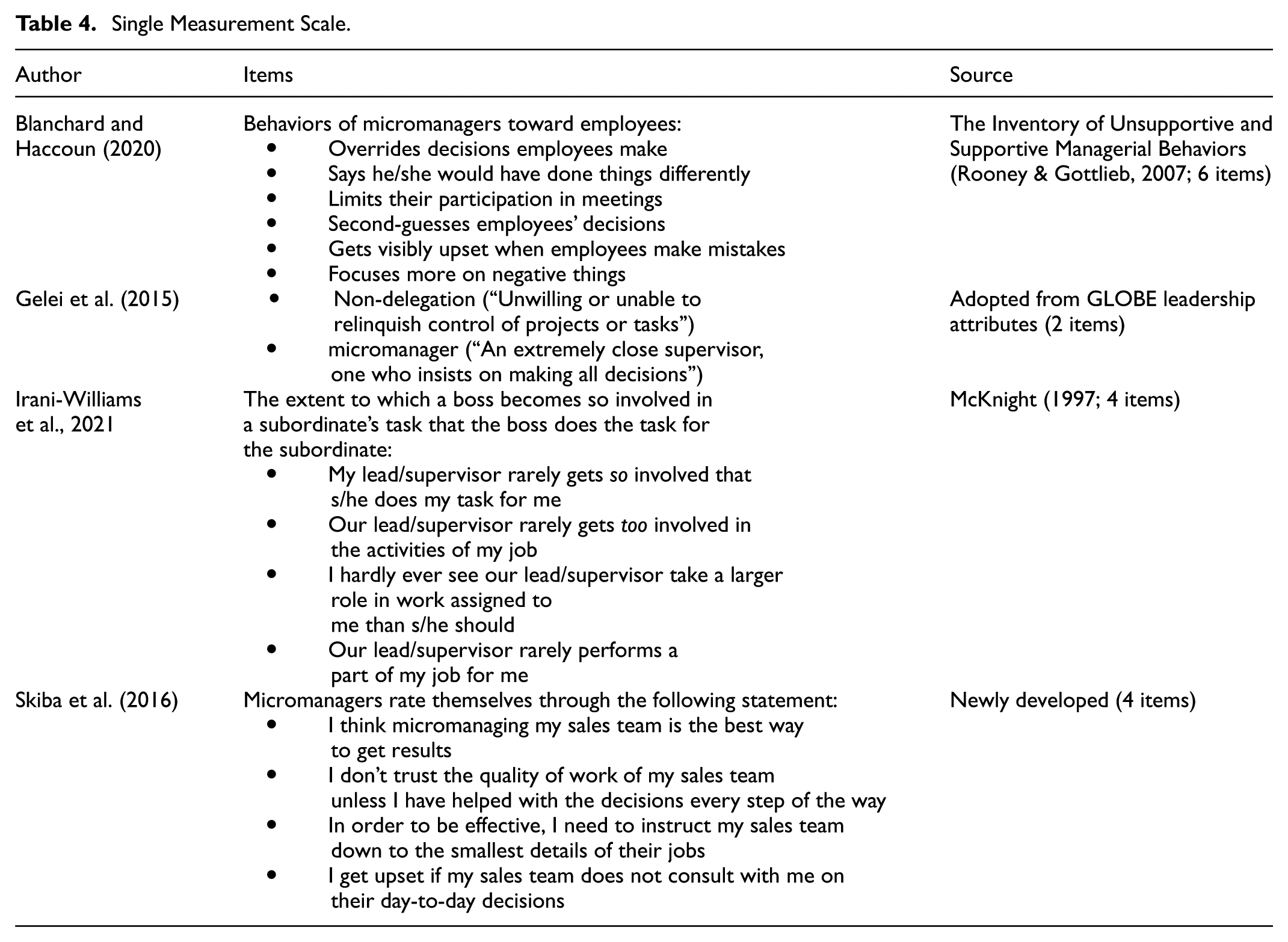
Different measurement scales are developed and utilized in micromanagement research. Measurement scales are either unidimensional or multidimensional. Kamarudin et al. (2023) developed 18 items and divided them into 6 statements to describe leaders’ self-reflection about specific actions and people’s reaction to their behaviors. Six statements are “my team performs most efficiently on their assigned projects when I am…,”“when I propose changes or delegate assignments within the organization, my co-worker’s…,”“tasks that I can easily complete myself…,”“the reporting that I demand from my team is…,”“when I am out of the office and away from work, my team…,”“relinquishing power or control to other team members…” (p. 8). Similarly, Limon and Dilekçi (2021) developed a four-dimensional measurement scale with 27 items: unable to subordinate self (15 items), time manipulation (5 items), excessive control over methodology (4 items) and excessive reporting (3 items). For single dimensional measures, the number of indicators varies from 2 to 6 (see Table 4 for information). Micromanagement mostly appeared as a peripheral issue in the research within the review. When it appeared as one of the central phenomena in the research, it was measured through completely different scales (see Table 5 for information).
Single Measurement Scale.
Reliability and Validity Value of Different Measures.
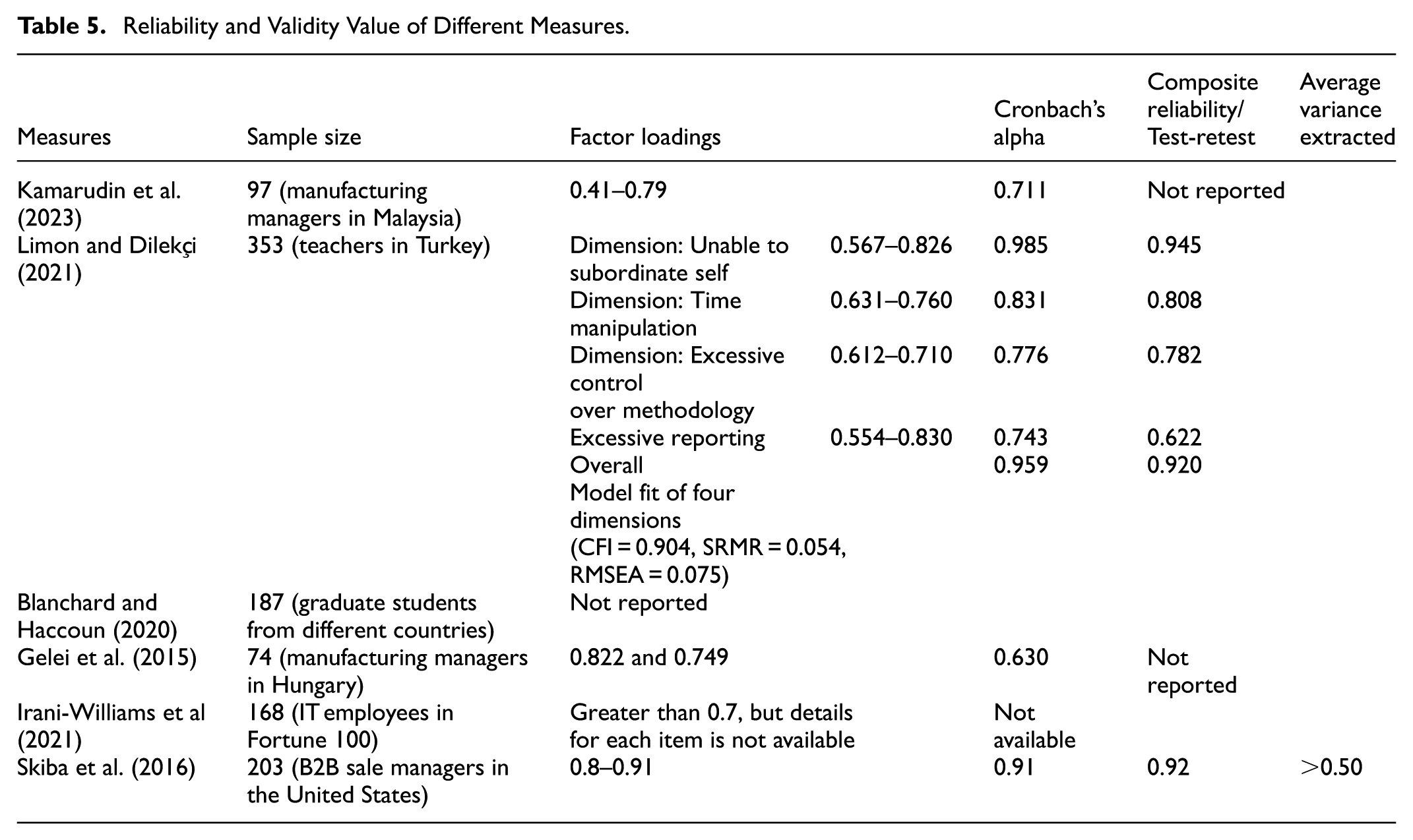
Given the lack of clear conceptualization of micromanagement, it is not a surprise that measurement scales have some problems. First, there is a weak alignment between the meaning of micromanagement and measurement indicators. Kamarudin et al. (2023) considered micromanagement as “increased observation, attention to small details,”“keep track of the value of time” and “extremely demanding of unrelated status updates or justifications.” However, it is not clear what items under the statement “when I am out of the office and away from work, my team” including “usually need me to respond back to their email,”“only sometimes needs me to respond back,”“rarely needs my attention when I am gone” actually measure. Similarly, it is a bit confusing that Blanchard and Haccoun (2020) include two items related to leaders’ constraint on employees’ participation in meetings and leaders’ focus on negative things in their micromanagement measure scale, even though they define micromanagement as “the control of an enterprise in every particular and to the smallest detail, with the effect of obstructing progress and neglecting broader, higher-level policy issues” (p. 1013). Second, there is a mismatch between micromanagement conceptualization and measure perspective. Although some studies refer to Leader-member exchange (LMX) theory as theoretical background and consider micromanagement as interpersonal issues (Irani-Williams et al, 2021), current measure scales do not reflect dyadic nature of micromanagement and focus only on subordinates’ perception. Third, there is a lack of transparency in testing and reporting validity and reliability of the measures (see Table 5). For example, Kamarudin et al. (2023) treated all items of the scale under a single dimension when testing validity and reliability, even though the scale has six dimensions. Although Limon and Dilekçi (2021) investigated reliability and validity for each dimension of the scale, they did not perform the same testing procedure for higher-order construct (micromanagement).
Therefore, it would be beneficial if future research can refine the current scales to ensure their construct and content validity, and develop new multidimensional measures including both employee and manager side to reflect the complexity of micromanagement better. Particularly, when examining reliability and validity of multidimensional measures, future research should follow appropriate procedures such as the one proposed by Sarstedt et al. (2019).
Theories Utilized in Micromanagement Research
Current research on micromanagement is explicitly and implicitly drawn upon single or combination of leadership management and social-based theories. Leader-member exchange (LMX) theory, social identity theory, and self-determination theory are used to explain antecedents and consequences of micromanagement (Irani-Williams et al., 2021; Kane & Levina, 2017; Rivard et al., 2022; White, 2010), while job characteristics theory is drawn upon to explain its mechanism (Irani-Williams et al., 2021).
LMX theory indicates that managers or leaders develop different types of interpersonal relations based on the level of mutual trust, respect and obligation that they have with their subordinates (Graen & Uhl-Bien, 1995). Therefore, lack of trust or confidence in subordinate’s capability is commonly quoted as a reason for why managers resort to micromanagement.
Identity can be defined as qualities that distinguish individuals or groups from others (Swann & Bosson, 2008). According to social identity theory, people hold multiple identities: personal identity (originating from their own characteristics and sense of own self), and social identity (emerging from their membership of particular groups or roles) (Stets & Burke, 2000). Identity establishes standards that regulate people’s actions (Stets & Burke, 2000; Swann & Bosson, 2008). It can be adjusted and evolve in response to contextual changes as well as individuals’ own desire for change (Kreiner et al., 2006). For example, when group membership is perceived to be unfavorable, group members may deny this membership or attempt to join and attach themselves to other dominant groups (Matheson & Cole, 2004). Kane and Levina (2017) refer to social identity theory to explain why junior immigrant managers are more likely to micromanage professionals from their home country than others in the same project. Because these managers hold a strong assumption about low status of their home country identity, they treat professionals from their home country as those who lack professional knowledge and ethics to work well. They not only keep close control on these professionals, but also deny their familiarity with home country identity by communicating with team members in English language.
Job characteristics theory basically describes the relationship between five core dimensions of jobs (skill variety, task identity, task significance, autonomy, and built-in feedback) and positive personal and work outcomes. This relationship is mediated by three psychological states: “perceived meaningfulness of the work, felt responsibility for the work outcomes, and knowledge of the results of the work activities” (Hackman & Oldham, 1976, p. 256). The first three dimensions – skill variety (the amount of skills required to perform a job), task identity (the wholeness of a job), and task significance (the impacts of a job on individuals, organizations or extended environment) – contribute to the level of perceived meaningfulness of the work. Autonomy (the degree to which individuals have freedom and discretion in determining how and when to carry out their work) attributes to the felt responsibility, whereas built-in feedback (the degree to which implementing the job itself provides direct and clear information about how effective a job holder’s performance is) explains the last psychological state (Oldham & Hackman, 2010). When these three psychological states are not present, people lack motivation to perform well. They feel dissatisfied and may end up with leaving the organization (Oldham & Hackman, 2010). Micromanagement characterized with limited autonomy, underutilized expertise, and unclear decision-making process is found to reduce felt responsibility and therefore, negatively associated with organizational commitment and job satisfaction (Irani-Williams et al., 2021).
Self-determination theory is a basic framework that explains impacts of initiating or regulatory events on people’s behaviors, wellness and development in given situations by evaluating how well the events fulfill their fundamental psychological needs: autonomy, competence and relatedness (R. M. Ryan & Deci, 2019). Rivard et al. (2022) found that teaching technique characterized by unclear expectation, attention to simple tasks, overutilization of “show and tell” method or so-called micromanagement teaching was unwelcome by surgical residents at the faculty of surgery because it provides surgical residents with limited opportunities to perform their competence as well as to learn and collaborate with their colleagues.
Nomological Network of Micromanagement Research
Antecedents of Micromanagement
Although micromanagement is considered to be a product of combination of both individual factors and contextual factors around them (Chambers, 2009; J. Lee et al., 2023; Schafer, 2010), there have been a very limited number of empirical evidence for this relationship (see Figure 5).

The nomological network of micromanagement research.
Individual Factors
Micromanagement can emerge due to managers’ perception and attitude toward their subordinates, their actual competence and personality traits.
Manager’s Perception of Subordinates. The extant literature indicates that micromanagement practices are adopted when managers have low trust and respect for their subordinates. Managers consider their subordinates untrustworthy (Chambers, 2009) and incompetent to carry out tasks (Chambers, 2009; Kane & Levina, 2017; Sims, 2021) especially those they perceive as important and complex (Chambers, 2009; White, 2010). Superiors’ low trust and respect for subordinates can be rooted from social stereotype in their community. For example, women in academic field is often associated with social image of being incompetent and untrustworthy (Sims, 2021). However, they can be due to subordinates’ problematic performance such as low compliance level with organizational policy (Mayer, 1993). Therefore, managers or leaders want to keep the tasks under their full control to avoid unexpected consequences for their career progression (Schafer, 2010). They also believe that their ignorance of subordinates’ expertise or inputs and implementation of close supervision and detailed directives on how tasks should be completed are rational (Davidhizar & Shearer, 2002) for the sake of organizational goals (Mayer, 1993).
Manager’s Competence. Some managers are doubtful about their own capability and become anxious about failure. They strive to maintain control (Franken & Plimmer, 2019; White, 2010) or keep themselves busy by undertaking different projects, requesting excessive reports, or checking minor details in order to prove their value to the world (Kerfooot, 1998) and overcome the feelings of anxiety (Franken & Plimmer, 2019; White, 2010). However, some managers actually lack necessary managerial knowledge and skills. They are not only confused about their responsibility and accountability (Chambers, 2009) but also unaware of alternative forms of management (Schafer, 2010) other than micromanagement. They often prefer adopting “one size fits all” approach (Cleary et al., 2015) to attempting to utilize a new one (Schafer, 2010). Therefore, they end up using micromanagement as their prefered management style.
Manager’s Personality Traits. Two managerial personality traits suggested by current literature as antecedents of micromanagement are perfectionism and egotism. “Perfectionism is a common personality characteristic that describes people who strive for excellence (perfectionistic strivings) and who seek for flawlessness (perfectionistic concern)” (Chang et al., 2016, p. 260). Perfectionists measure their self-worth through their achievement of high standards or others’ high evaluation (Chang et al., 2016). Therefore, a manager who is a perfectionist is more likely to become attentive to details and impose detailed directives on subordinates’ work to ensure zero mistakes (Cleary et al., 2015) and maintain their high standards. Egotism is a personality trait of being over self-confident in one’s capability and importance compared to others. Egotist can become selfish and self-righteous (Schafer, 2010). They may not only be desperate to display their power and dominance but also rely on others to feed their ego frequently (Wasylyshyn, 2005). As a result, a manager with high egotism is more likely to overlook subordinates’ capability, make decisions in an arbitrary manner, or require subordinates to get his/her approval for all activities.
Organizational Factors
Apart from individual factors, micromanagement can be a product of organizations’ inherent characteristics (structure and culture), or organizations’ new practices and strategies such as digitalization, telework, offshoring, and merge and acquisition.
Organizational Structure. Hierarchical structure and weak internal processes can lead organizations to naturally adhering to micromanagement (Franken & Plimmer, 2019; Kim, 2005). On the one hand, White (2010) argued that hierarchical structure leaves supervisors too few things to do, so they are likely to adopt micromanagement as a way to fill up their spare time. When micromanagement is adopted by one management level, it can easily cascade to lower levels and spread throughout organizations. This explains why White (2010) considers micromanagement as a disease. On the other hand, Alvesson and Sveningsson (2003) suggested that because weak internal processes are normally associated with ambiguity in roles, responsibilities, and measurement of success, managers or leaders tend to focus on managing low level issues and details as a way to maintain their leadership identity and overcome this ambiguity. Hierarchical structure is also a great source of micromanagement because it creates not only dominant supervisory positions (Yeboah-Assiamah et al., 2019) but also information asymmetry (Kim, 2005). In this aspect, although micromanagement and abusive management are two distinct concepts (Chambers, 2009), they have some overlaps. Zabrodska et al. (2011) found that possessing dominant supervisory positions allows managers at universities to keep close control and surveillance on female teachers to ensure female teachers work hard on what they request. Similarly, Haug (2024) found that possessing better professional knowledge and other resources related to public service management enables public service providers to micromanage their partnership with intermediaries and service users, such as making arbitrary rules and decisions on co-production process. Despite potential problems, some organizations still consider hierarchical structure to be the only possible way for them to achieve harmony, smooth operations (Egitim, 2022) and high productivity (Zabrodska et al., 2011).
Organizational Culture. For some organizations, micromanagement behaviors are already embedded in the way they operate (Alvesson & Sveningsson, 2003; Chambers, 2009; Zabrodska et al., 2011). In these kinds of organizations, management lacks a clear picture of visions and strategies. Vision statement and strategies are often vague or rhetorical themes that are difficult to be translated into actions (Alvesson & Sveningsson, 2003). Management neither aims to achieve excellence nor appreciates contemporary values and practices. Therefore, opportunities are often missed while outstanding employees are more likely to be driven out of organizations (Berman & West, 2003). Management also focuses more on administrative issues (Alvesson & Sveningsson, 2003) and how to please their superiors (Berman & West, 2003) than on employee well-being and development (Franken & Plimmer, 2019). They appreciate long working hours more than valuable professional insights and capability (Zabrodska et al., 2011). Although harmonious relationship between different units of organizations hardly exists (Mayer, 1993), limited or no training courses on collaboration at work are provided (Chambers, 2009). As a result, management tends to gravitate to controlling behaviors (Chambers, 2009) or small details (Alvesson & Sveningsson, 2003). Some authors describe this way of organizational operation as an essential part of mediocrity culture (Franken & Plimmer, 2019).
Organizational Implementation of new Practices and Strategies. Current literature suggests that organizations have tendency to adopt some forms of micromanagement when they are in initial stages of change initiatives (H. Lee, 2021), when problems arise and need immediate attentions (Clark, 2020), or when organizations adopt new strategies and practices (Mishra et al., 2019). The review identified four major organizational changes: digitalization, telework, offshoring and merge and acquisition that are commonly associated with micromanagement practices.
Digitalization. The adoption of digital solutions allows organizations to perform workplace surveillance or control more frequently and in more sophisticated and cost-efficient ways (Ivanov, 2023; Kellogg et al., 2020; Muhl & Andorno, 2023). Various behaviors and activities of individuals are recorded, tracked, and analyzed easily through algorithms (Kellogg et al., 2020). For example, through sale force automation system, sales managers can observe performance of salesperson, closely monitor and timely intervene sales process when needed (Barker et al., 2009). Feelings of being under constant surveillance increase workers’ anxiety, stress, and other psychological issues (Ivanov, 2023). The latest neurotechnology even enables organizations to observe and measure workers’ specific mental activities such as attention, emotions, memory, preferences, or workload, and then take actions to improve their self-awareness and concentration level (Niso et al., 2023). Although the use of neurotechnology devices can help improve workers’ performance and reduce accidents in high risk occupations such as long-distance truck drivers, airplane pilots, and medical emergency responders, it threatens workers’ mental privacy and increases job stress. Furthermore, because the operation of neurotechnology devices is based on mathematical modeling of biological indicators, their use in recruitment and selection activities may lead to the exclusion of people with neuroatypical characteristics, thereby intensifying employment discrimination and reducing workplace diversity (Muhl & Andorno, 2023).
Telework, offshoring, merge and acquisition. Several qualitative studies indicated that the popularity of telework goes hand-in-hand with an increment of micromanagement because organizations want to ensure security issues and performance of teleworkers when they are out of their sight (Doberstein & Charbonneau, 2022; H. Lee, 2021; Richardson, 2010; S. Ryan & Cross, 2024). Micromanagement practices such as increased oversight, detailed reviews, more frequent communications and reports are also likely to be adopted when organizations offshore their business activities (Rottman & Lacity, 2006) or implement merge and acquisition (Austin & Larkey, 1992; Haug, 2024; Mayer, 1993; Pangarkar, 2021). Micromanagement in these cases is considered as a possible way that allows parent firms to detect problems timely (Austin & Larkey, 1992), minimize risks caused by social, economic and cultural differences, and build trust within organizations (Rottman & Lacity, 2006). However, whether micromanagement generates the expected outcomes of the parent firms or not depends on their partners’ capabilities and culture.
Outcomes of Micromanagement
The current literature suggests mixed impacts of micromanagement on individuals and organizations in the short-term and long-term. However, empirical evidence to support these outcomes is rather limited and in particular, the effects of micromanagement on managers are largely ignored.
Positive Impacts
Micromanagement can generate positive outcomes in the short-term such as increasing organizational productivity (Irani-Williams et al., 2021) or initiating organizational changes. Jones and Callaway (1995) indicated that intrusive interference and strict scrutiny from the Congress related to annual appropriation bills play a major role in prompting agency changes for better operation efficiency in forest service management system. Mishra et al. (2019) and Radey and Stanley (2018) found that supervisors’ close scrutiny, excessive guidance and detailed feedback help inexperienced people develop their competence and improve their performance. In some cases, micromanagement practices such as task reminders or wearable devices can help subordinates avoid procrastination and stay focused on their core tasks (Doberstein & Charbonneau, 2022; Muhl & Andorno, 2023), thereby improving their performance and safety (Muhl & Andorno, 2023).
Negative Impacts
Despite positive impacts, micromanagement can bring adverse effects for employees, managers and organizations in the long run (Chambers, 2009).
Increase Stress and Lower Psychological Safety. Micromanagement not only increases subordinates’ job stress (Blanchard & Haccoun, 2020; D’Antoine et al., 2023; Ivanov, 2023; Matsuoka et al., 2024; Behn, 1995; Rivard et al., 2022) but also dampens psychological safety climate in organizations (H. Lee, 2021). On the one hand, leader behaviors such as constant surveillance and close monitoring signal their distrust and disrespect for subordinates (Irani-Williams et al., 2021; Richardson, 2010; Yeboah-Assiamah et al., 2019). On the other hand, requests for frequent reports and attention to unnecessary details increase subordinates’ workload, whereas strict imposition of rules, directives and arbitrary decision making process reduce their job autonomy. In addition to subordinates, micromanagement also generates job stress for managers themselves. For example, for micromanagers who are perfectionists, their inability to adjust their high or sometimes unrealistic standards generates job stress for themselves. This is because their strict adherence to high standards not only requires them to work hard to succeed but also prevents them from having an excuse in case of failure (Shagirbasha et al., 2023). However, Chang et al. (2016) found that leaders’ tendency for perfectionistic strivings enhance their innovative behaviors, while perfectionistic concern leads to job burnout.
Increase Job Dissatisfaction and Employee Turnover. Different behaviors of micromanagers can lead to job dissatisfaction in different ways. While constant surveillance makes employees feel dehumanized (Yeboah-Assiamah et al., 2019), thereby reducing their morale (Chambers, 2009; D’Antoine et al., 2023; Fisher et al., 2021; Kim, 2005; Wright, 2000), arbitrary decision–making or underutilization of their expertise makes them feel excluded (Egitim, 2022) and lowers their sense of self-worth (Sims, 2021). Moreover, subordinates may demonstrate unsupportive behaviors toward managers (cf. S. Ryan & Cross, 2024) in response to distrust, disrespect and unwanted advice from these managers, which increases tensions (H. Lee, 2021) and undermines leader-subordinate relationship (Fisher et al., 2021). Job dissatisfaction can eventually lead to employee resignation (Chambers, 2009; Khesroh et al., 2022; Selesho & Matjie, 2024; Yeboah-Assiamah et al., 2019). In education context, while Khesroh et al. (2022) found that 87% of program directors at an academic medical center quoted micromanagement and lack of support as their main reason for considering to change their job, Blanchard and Haccoun (2020) found that micromanagement by advisors increased student dropout intention. Skiba et al. (2016) also found that micromanagement enhanced the positive relationship between cost prioritization and sales force turnover.
Reduce Employee Creativity. The persistence of close supervision, strict imposition of leader’s way, lack of participative decision making, and ignorance of subordinates’ expertise reduce not only job autonomy but also subordinates’ willingness to take risks (Skiba et al., 2016), to do experiments (cf. Kim, 2005), or to engage in extra-role activities (Franken & Plimmer, 2019). Subordinates become “yes” people (Franken & Plimmer, 2019) and feel less self-confident or less assertive to perform tasks without superiors’ instructions especially in urgent situations (Yeboah-Assiamah et al., 2019). Moreover, leaders’ attention to small details and low level activities substantially increases people’s administrative workload, which reduces their quality time and energy for high value added activities (Kim, 2005; Mayer, 1993; Zaidi & Jamshed, 2023). As a result, employee creativity is stifled (D’Antoine et al., 2023; Fisher et al., 2021; Ghamrawi, Abu-Shawish, et al., 2024; Limon & Dilekçi, 2021; Paek et al., 2020; Skiba et al., 2016) and organizational flexibility can be eroded.
Reduce Operational Efficiency. Micromanagement can increase operational costs when managers spend time and resources on doing unimportant activities. For example, Rottman & Lacity (2006) found that although micromanagement from a client corporation, such as more frequent reports, detailed work reviews, and personal check and interview with offshore team members, is to ensure sufficient competence of offshore IT suppliers, it increases transaction costs and can cancel out cost advantages generated by this offshoring strategy. Moreover, arbitrary decision making process can make instructions, goals or requirements imposed by micromanagers at high level become irrelevant to business reality (Houlihan, 2001). As a result, it is difficult for lower-level managers and subordinates to formulate action plans (Mayer, 1993) and balance between compliance and business service quality (Houlihan, 2001; Kim, 2005), leading to inefficient allocation of organizational resources and reducing organizational effectiveness.
Mediators and Moderators of Micromanagement
Mediators
Mechanisms through which micromanagement impacts individuals and organizations have been discussed to a very limited extent. This review is able to identify only two studies that discuss this topic. First, Irani-Williams et al. (2021) provided empirical evidence that felt responsibility significantly mediates the relationship between perceived micromanagement and job satisfaction and organizational commitment. Based on Job Characteristics Theory, the authors explained that micromanagement reduces people’s job autonomy, thereby decreasing their experienced responsibility for their work outcomes. As a result, they lack motivation to work, feel dissatisfied and eventually leave organizations. Second, Austin and Larkey (1992) proposed three more mechanisms: sense of ownership, detail oriented performance measurement, and goal conflicts. Similar to felt responsibility, the authors argued that micromanagement reduces sense of ownership. Subordinates act merely on the purpose of compliance with detailed instructions and requirements to avoid taking responsibility for unexpected things rather than attempt to improve current processes or practices (Austin & Larkey, 1992). Moreover, micromanagement leads to the use of detail oriented performance measures that not only keep subordinates fully occupied by trivial tasks but also make them become less collaborative in order to protect their own performance (Austin & Larkey, 1992). Attention to details together with the lack of transparent and participative decision making process of micromanagement may create goal conflicts, which leads to inefficient resource allocations and negatively affects organizational performance. For example, when the performance and compensation of salespersons are linked to sale effort quantity (how hard they work on new products such as the number of phone calls and customer meetings they made) rather than to their sale effort quality, their total closed sales of new products increase in the same accounting cycle, but not in future cycles (Matsuoka et al., 2024). However, unlike felt responsibility, these three mechanisms have not been empirically tested yet.
Moderators
Micromanagement’s consequences are not always negative, but depend on various individual and contextual factors in a given circumstance.
Individual Factors. As mentioned above, whether micromanagement is undesirable or not depends on controlees’ perception or judgment (Chambers, 2009; Egitim, 2022; Mayer, 1993). For people who lack competence or specialized knowledge in the field (Kamarudin et al., 2023; Limon & Dilekçi, 2021; Santen et al., 2018), who are new to organizations (Mayer, 1993; Radey & Stanley, 2018), who are new to a task (Mishra et al., 2019), and who are goal avoidance oriented (Blanchard & Haccoun, 2020), a micromanaging supervisor can be desirable. They perceive close supervision, detailed guidance and advice as instrumental support that helps them avoid mistakes, become competent and perform their jobs well (Radey & Stanley, 2018). However, some authors argue that these positive impacts of micromanagement are only temporary (Gelei et al., 2015; Irani-Williams et al., 2021; Limon & Dilekçi, 2021; White, 2010). For people who are knowledgeable of their field (Kamarudin et al., 2023), who distrust competence of their supervisors (Irani-Williams et al., 2021), and who hold an assumption that their current work practices are already rational and coherent (Mayer, 1993), micromanagement is more likely to be perceived as a hindrance, which intensifies its negative consequences. In merge and acquisition activities, micromanagement can be helpful when acquired firms do not have strong culture and expertise and vice versa (Pangarkar, 2021). However, current literature has empirically investigated moderating effects of individual factors to only a limited extent.
Task Characteristics. For tasks that are highly complex (Hoffmann et al., 2023) or high-risk (Radey & Stanley, 2018), people are more likely to welcome micromanagement because it helps reduce uncertainty for them. For example, cross-selling practices require salespersons to sell a broad range of product portfolio and deal with multiple buyers and heterogeneity of purchasing requirements (Schmitz et al., 2014). These practices increase the complexity and quantity of salespersons’ work, so excessive guidance from sales managers on salespersons’ work-related tasks and their way of thinking are likely to be welcome by salespersons in order to reduce uncertainty and ensure strategic alignment and performance of the whole firm (Hoffmann et al., 2023).
Parenting Style. Helicopter and authoritarian parentings have some characteristics similar to micromanagement. They are both characterized by strict control of parents on childrens’ behaviors and limited child-rearing decisions to ensure their children’s success in future life. Parents also perform activities instead of teaching their children how to do. Although both styles refer to deep intrusion of parents into children’s life, they are different in terms of intrusion scope. While authoritarian parents intervene almost all areas of their children’s life, helicopter parents focus on a specific area such as education (LeMoyne & Buchanan, 2011). Therefore, it is expected that individuals who are raised by these parenting styles are more likely to accept micromanaging leadership than others. However, S. Ryan and Cross (2024) did not find supporting evidence for this assumption.
National Culture. Zaidi and Jamshed (2023) indicated that corporate culture in Pakistan is significantly influenced by “clan, tribal and familial system” that is characterized by inefficient bureaucracy, huge power and status disparity between managers and subordinates, absolute power for the owner, and political relationship. Therefore, if individuals are raised and educated in this kind of social systems, micromanagement may be taken for granted and have no impacts on them. Similarly, Gelei et al. (2015) argued that culture of non-participative leadership among Hungarian managers may explain why micromanagement has a statistically significant contribution to successful implementation of lean production techniques by Hungarian manufacturing firms. Because evidence for the moderating role of culture in micromanagement research is still limited, it is beneficial if future research explores further which types of culture intensify or reduce the impacts of micromanagement.
Discussion
Theoretical Contributions
The study has three theoretical contributions. First, the study enriches the micromanagement literature by providing a nomological network of current research. Unlike previous reviews, the study categorized factors related to micromanagement into antecedents, mediators, moderators, and consequences and then configured connections between them and micromanagement. The network not only helps researchers visualize current research gaps but also suggests additional perspectives to distinguish micromanagement from other negative leadership concepts such as abusive, destructive, self-protective, unethical, or derailed leadership. Micromanagement differs from negative leadership concepts in terms of focus, motive and impacts. While negative leadership focuses merely on leader’s self-interest, micromanagement can be both leader and organization oriented. While conducts and behaviors of negative leadership are obviously harmful and unjustified (Khizar et al., 2023; Mackey et al., 2021), it is not the case for micromanagement. Micromanagers’ behaviors and conducts can be perceived as undesirable, but they are not necessarily toxic and can be legitimate in some cases. While negative leadership styles are consistently found to be detrimental to organizations and individuals (Mackey et al., 2021), micromanagement practices appear helpful to organizational and individual performance and development in certain circumstances.
Second, the study enhances a more balanced perspective and the dyadic nature of micromanagement by highlighting the role of time and individual and contextual characteristics in understanding its occurrence and consequences. These findings provide additional evidence to support non-linear relationship between job stressors and employee performance (Lepine et al., 2005), between social support and work stress (Bavik et al., 2020), and between supervisor support and employee well-being (Somers et al., 2021). “Stressors are the conditions that place excessive or unusual demands on a person and are capable of engendering psychological discomfort” (Cullen et al., 1985, p. 507). Micromanagement can serve as a challenge stressor that motivates subordinates to expend effort and facilitates their accomplishment of valued outcomes (Lepine et al., 2005) when they are inexperienced, or new to organizations. However, it can become a hindrance stressor that deteriorates followers’ work motivation and performance (Lepine et al., 2005) when they gain more experience and competency. As a result, it can serve as a facilitator for organizational change at first, but can become an impediment for organizational efficiency in the long run. Employee well-being refers to “the overall quality of an employee’s experience and functioning at work” (Grant et al., 2007, p. 52) that can be measured through both objective and subjective indicators in three core dimensions: physical, psychological and social (Danna & Griffin, 1999). Physical well-being means objective health such as the absences of illness, diseases, or injuries and perceived good body functioning (Testa & Simonson, 1996). Psychological well-being refers to the feelings of pleasure, self-efficacy and self-actualization or growth (Warr, 1990). Social well-being is captured through the quality of relationship with others, levels of social support, perceived trust and fairness of treatment (Guest, 2017). High employee well-being means “psychological and physical health and positive social relationships at work” (Guest, 2017, p. 32). Although micromanagement can support subordinates with their competence development, it can increase their job stress, minimize their personal growth, and undermine their relationship with managers. As a result, the net effects of micromanagement on employee well-being can be either positive or negative, depending on given circumstances.
Third, the study provides potential directions to enrich the nomological network of micromanagement by synthesizing theories explicitly or implicitly utilized in current research and their role in the network. Drawing upon these theories, new constructs and relations can be estimated and added to the network. For example, based on LMX theory, a new construct, which is the interaction between individual factors such as knowledge, skill or competency and organizational practices such as digitalization or remote work, can be meaningfully added to the network. Justifying the addition of a new construct to the network refines not only the network but also the construct itself (Cronbach & Meehl, 1955).
Practical Implications
Managers easily gravitate toward command and control management approaches such as micromanagement without knowing and understanding their consequences (Franken & Plimmer, 2019; J. Lee et al., 2023) when operating in increasingly uncertain environment and rapid advancement of digital technologies. The review provides managers a quick and easy access to gain insights of micromanagement and conveys three practical implications. First, managers should be critical of micromanagement. Instead of avoiding or adopting micromanagement at all costs, they should be aware of its motivational aspects, mixed impacts, and boundary conditions to respond better to employees’ demands for supervisory support. Second, even when micromanagement is not derived from toxic motive, it is essential for managers to develop a careful communication plan for their interference. A poor communication plan can turn legitimate micromanagement into illegitimate and cause unexpected negative consequences. Fisher et al. (2021) highlights that right timing, purpose clarity and responsive intensity of a particular intervention from micromanagers are key for its success. Third, organizations can help their managers avoid deploying micromanagement as the only way of management by providing more regular training courses such as situational leadership, management in hybrid work environment to expand their knowledge repertoire of management approaches. This increases managers’ flexibility in selecting and combining management styles including micromanagement when dealing with uncertainty and changes of the environment, as well as various expectations of a diverse workforce (Schafer, 2010).
Limitations and Future Research Suggestions
The study found that micromanagement research is still in its infancy. Therefore, more research on micromanagement is imperative in response to its prevalence in organizational life and the lack of managerial unawareness of this issue. Future research can explore more deeply in four major areas as follow. First, future research could start with developing a formal and clear definition of micromanagement that not only distinguishes micromanagement from other negative leadership styles such as abusive or authoritarian but also provides a good foundation for developing measurement scales and solutions to effectively handle it. Second, more quantitative studies are definitely beneficial to enrich empirical evidence for micromanagement. On the one hand, researchers can investigate a wide range of constructs related to micromanagement antecedents, moderators, mediators, and consequences from both employees and managers perspectives. Considering the ubiquity of digitalization and algorithmic management, exploring how they and their interaction with individual factors affect micromanagement would be one of the most fruitful and relevant research areas. On the other hand, they can extend their analysis levels to interorganizational relationships within and across national borders. The appropriateness of micromanagement in international business expansion strategies such as opening wholly owned subsidiaries or merge and acquisition can be a good start. Third, despite its predominance in current micromanagement research design, additional qualitative research using other data collection methods, such as observation, is still essential to gain deeper insights about the contexts in which micromanagement can be normalized. Fourth, more longitudinal studies are highly needed to reflect the dynamics of micromanagement’s consequences and reduce unnecessary biases about micromanagement. However, due to some limitations during the publication collection process such as limited databases, keywords, and written language of publications, the study does not claim to present all possible gaps. Moreover, due to the predominance of qualitative studies and the limited number of research contexts in the review, the study does not claim the inclusiveness of the proposed nomological network as well as generalizability and causal inference of the identified empirical findings.
Conclusion
Academic interest in micromanagement across sectors has increased sharply in the last 4 years after remaining low for a long period. By systematically reviewing literature of different disciplines, the study aims to explore how micromanagement concept is understood and measured, what basic theories are utilized in micromanagement research, and how factors and findings related to micromanagement are connected. The study reveals that micromanagement is a complex phenomenon that and does not have yet a clear and formal definition. Research on micromanagement is still in the infancy stage. Therefore, more theoretical and empirical research is essential to respond to the prevalence of workplace concern on micromanagement and to advance this research area. Unlike previous reviews, the study notices some validity and reliability issues with micromanagement measures that future research should pay attention to in order to improve its quality. The study also goes further than previous reviews by presenting both mixed impacts and boundary conditions of micromanagement. On the one hand, these findings suggest the unnecessity of avoiding micromanagement at all costs by organizations. On the other hand, they emphasize the importance of improving managers’ awareness and insights of micromanagement and other management styles if managers want to increase their flexibility in managing workforce to achieve both organizational goals and individual well-beings in given circumstances.
Footnotes

Funding
The authors received no financial support for the research, authorship, and/or publication of this article.
Declaration of Conflicting Interests
The authors declared no potential conflicts of interest with respect to the research, authorship, and/or publication of this article.
Data Availability Statement
Data sharing not applicable to this article as no datasets were generated or analyzed during the current study.