




Abstract
Teachers are the main resources for the high-quality development of universities. The construction of teacher identity is one of the important components influencing the building of teacher team, and performance management is the fundamental institutional situation for the construction of teacher identity in universities. In terms of performance management, Chinese universities are increasingly emphasizing short-term quantitative efficiency. The marketization of performance has prompted teachers to reconsider “who I am,” as well as the challenge of identity construction. This study selected Chinese Local G University as a case to collect and analyze interview data on teacher identity construction. It is found that teacher identity construction in the situation of G University performance management is a game process of interest and belief. Teachers’ cultural identity crisis, subjective status masking, and generalization of professional identity have caused them to become “dogsbody in the system,” as a result of instrumental rationality’s overwhelming over the value rationality of performance institutions, the decline of rationality and binding force of the academic community, and the imbalance between teachers’ internal motivation and external behavior induction. To improve University teachers’ performance management experiences and promote their reasonable identity construction, it is necessary to optimize the performance management system and strengthen the people-oriented institutional incentives, to actively promote performance evaluation reform and substantially promote academic peer review, to pay attention to ensure health factors and optimize the salary and welfare system of teachers, and to improve the academic ecological environment and guide the professional consciousness of teachers’ beliefs.
Keywords
Introduction
In China, higher education has entered the era of popularization and begun to focus on the connotative construction of quality and efficiency. As the core of deepening the reform of the university management system, performance management serves as an important starting point for promoting the high-quality development of universities. It focuses on the improvement of target achievement and total output. The implementation of performance management in universities can enhance their competitiveness. The “Overall Plan for Deepening the Reform of Education Evaluation in the New Era,” issued in 2020, emphasizes that universities should give priority to improving teacher evaluation mechanisms (The State Council, 2020). The reform of the university performance management system, which adjusts teachers’ salaries, professional titles, and positions according to assessment results, has its practical requirements and policy supports.
Identity is a key factor influencing the construction of the teaching team. The “Opinions on Comprehensively Deepening the Reform of the New Era Teaching Staff Construction,” released in 2018, proposed that “To build a high-quality and innovative teaching staff and improving the overall quality of university teaching, it is necessary to enhance their sense of identity” (The State Council, 2018). For university teachers, identity recognition is not only related to their educational values and teaching behaviors but also to their self-existence value, self-efficacy, and sense of professional belonging (Beijaard et al., 2004). To a certain extent, the identity of university teachers affects their willingness to be committed to education for a long time.
University teachers are facing an identity dilemma within the current performance management context in China. Universities often utilize quantitative assessment requirements, result-oriented evaluation methods, and competitive management approaches to stimulate the output of teachers’ work performance. This approach not only reinforces the recognition of teacher identity as “Economic Man” but also weakens their identity as educators and scholars. Performance management, which centers on performance and emphasizes efficiency and competition, impacts teachers’ professional significance, mission, value, and the meaning production of the professional self, causing university teachers to face the dilemma of repositioning their self-identity.
Teacher identity is not a natural inherent attribute but is constructed through continuous individual-situation interaction. This study selects the category of identity construction to explore the understanding and response of local university teachers to the performance system reform in the current performance management situation, as well as the interaction between individual teachers and performance management situations. It will further expand the theoretical research on teacher identity construction and promote the reform and high-quality development of performance management in local universities in China. Specifically, this study focuses on a case university to explore three questions:
(1) How do teachers adjust their original beliefs and construct their professional identities in performance management situations?
(2) In the dynamic evolution of the performance system, how do teacher beliefs and interest considerations influence the process of teacher identity construction?
(3) How do institutional contradictions in performance management lead to teacher identity crises? And how to promote the sound construction of teacher identity through institutional change?
Literature Review
University Performance Management
University performance management aims to promote the achievement of teachers’ individual and organizational goals by establishing a comprehensive remuneration mechanism based on audit assessment to improve the organization’s core competitiveness and achieve sustainable development. Existing research mainly focuses on the process, method, and practical issues of university performance management. In terms of process, Hristov et al. (2022) believe that performance management includes five important stages: setting organizational key goals, executing strategies and plans, setting performance target values, rewarding and motivating employees, and providing feedback on cyclic performance information. From a methodological perspective, Niven and Lamorte (2017) believe that by using data envelopment analysis, the work output and input of university teachers can be decomposed into multiple decision-making units, which can better analyze the performance of university teachers and optimize the allocation of university resources. In practice, there are problems such as simply understanding performance management as performance evaluation, excessive quantification of evaluation indicators, and single application of evaluation results. The current university performance management focuses on a single result-oriented approach while neglecting process management (Cosenz, 2022). The “indicator-quantification-reward” model converts the results of teachers’ work into a single number for evaluation, and connects it with teachers’ performance reward, which affects the development of education evaluation reform in universities (Zhongtai, 2022). The production-team-style “Work Point System” performance evaluation method conflicts with universities’ educational philosophy, cultural connotations, and knowledge characteristics (Daguang, 2019).
The Construction of Teacher Identity
Social constructivism, as one of the theoretical foundations of identity construction, holds that action and change are crucial and remaining static and unchanging can lead to problems (Sharkey & Gash, 2020). Therefore, identity construction is a process that continuously evolves and develops in a continuous manner (Ashforth & Schinoff, 2016). Xingsong and Xia (2020) argue that the construction of teacher identity is an unstable and constantly changing process, which is influenced by past and present external policies, internal organizations, and personal experiences. Stout (2001) claims that the construction of teacher identity is affected by three factors: the environment of educational reform, school organizational culture, and interpersonal relationships within the group. Starting from the teacher’s attitude, Narayanan et al. (2023) suggest that personal values, self-efficacy, personal emotions, and practical knowledge have an impact on the construction of a teacher’s identity. To construct teacher identity, the problems and countermeasures mainly focus on the external institutional level and the teacher’s individual levels. At the external institutional level, Guangcai (2006) states that with the intrusion of business logic and popular culture into education organizations, the boundaries between teachers and other professions have begun to blur, and teachers who have lost their unique identity have fallen into an identity dilemma. At the teacher individual level, Gui (2019) found that rural teachers exhibit the elimination, ambiguity, and anxiety of identity in schools, villages, social structures, and other fields, and proposed the solution idea that teachers should consciously improve their professional abilities, rely on local culture, and regain their sense of identity.
The Identity Construction of University Teachers in the Situation of Performance Management
In the situation of university performance management, the construction of teacher identity mainly faces problems such as an identity recognition crisis, a lack of identity belonging, and identity confirmation anxiety. Regarding the identity recognition crisis, the administrative-led management model fails to fully consider the professional attributes and job characteristics of university teachers, thus undermining teachers’ psychological contract and reducing their professional identity (Ruokun, 2011). Due to the lack of identity belonging, the assessment in university performance management blindly pursues quantifiable explicit performance, which undermines teachers’ self-identity (Taihong, 2018). In terms of identity confirmation anxiety, the invasion of academic capital disrupts the internal logic of academic research, resulting in a deviation of teachers’ academic research interests. As a result, teachers are no longer the sole protagonists in academic activities (Kucirkova & Quinlan, 2017). The service attribute of teaching is increasingly strengthening. While meeting students’ personalized demands and providing knowledge serving, teachers are repositioning their self-identity and experiencing anxiety about identity confirmation (Jingning, 2013).
Overall, the relevant research has laid a solid foundation for this study. However, based on the literature review, it has been found that most of the existing research perspectives follow one-way analysis paths centered on institutions or actors, lacking a connection between internal and external factors in the analysis. Further research is required on university teachers’ understanding and response to the performance management system as well as their self-awareness and identity construction during this process. The application of qualitative research methods also needs to be enriched. Therefore, this research takes the teachers of G University in A Province as the research objects. From the research vantage point, it employs the dual perspectives of institutional perspective and actor-centered perspective to probe into the differentiated understandings and responses of local university teachers regarding the performance management system, thus widening the scope of research problems concerning university teachers. In terms of research methodologies, case study and qualitative research approaches are utilized to explore the identity construction of teachers within the context of performance management. Based on the case analysis, countermeasures, and suggestions are proposed to achieve methodological innovation. Additionally, in contrast to the exploration of extrapolation pathways from a macroscopic perspective, this study delves into an endogenous pathway, thoroughly investigates the more crucial and less quantifiable intrinsic factors that are decisive in the formation of college teachers’ identity, examines the construction process of teacher identity within the performance management context, and enriches the theoretical framework of teacher identity and its construction.
Analysis Framework
The construction of university teacher identity refers to the process in which teachers make a meaningful interpretation in line with their value tendencies during the interaction with the performance management situation, continuously coordinate the construction of self-identity attributes, and constantly revise their cognition of professional rights and responsibilities as well as self-awareness. This cognition ultimately externalizes teachers’ performance behavior choices in practice. Teacher identity has social and individual attributes and is a unity of commonality and individuality. The former reflects the discipline of the social structure and system on university teachers, while the latter emphasizes the self-empowerment of teacher identity. Therefore, research on the construction of teacher identity can be placed within the analytical framework of the interaction between institutions and individual teachers; that is, teachers are in the performance management situation, and their identity construction is carried out in the game between the discipline of the external system and the teacher’s self-belief and value position.
In terms of the situation’s impact on teachers, according to the “Person-in-Situation” theory, individual behavior and thinking patterns are influenced by external environmental factors, and human psychological factors are often in complex interactions with their situation (Woods & Hollis, 1990). Therefore, research should not only start from individual traits but also explore the impact of situations and understand the complex interactions between individuals and situations (Abrahams et al., 2021). Universities are an essential component of society, and university teachers are not independent and free individuals but rather teachers who carry teaching, research, and social service responsibilities and are in the system situation of university performance management, namely teachers in the performance management situation. Based on this theory, the natural purpose of university performance management is to pay attention to the subjectivity of individual teachers, as well as the objective setting which teachers encounter, adjust the interactive relationship between teachers and performance situations, promote positive interaction between individual teachers and performance situations, solve the problem of identity identification and the imbalance of institutional functions in situations, and thus improve organizational performance.
In terms of institutional influence, according to the structural theory proposed by British sociologist Anthony (2016), individual behavior is limited and influenced by structure, and in turn, individual behavior can reproduce structure. The external structural factors affecting the actions of local university teachers mainly include meso-level personnel reform policies for university teachers, performance management systems, academic community culture, and macro-level national policies and discourse guidance. In performance management, while the performance management system restricts and affects individual teachers, the performance behavior of individual teachers is also solidifying and strengthening the performance management system. This can also explain that in the process of interaction with the performance management situation, individual university teachers interpret the performance management system in line with their value tendencies, produce specific performance behaviors, complete the construction of identity, and further affect the reform and implementation of the performance management system.
At the level of individual agency, from the perspective of Neo-institutionalism, institutions are constructed by specific historical actors who are driven by both self-interest and personal values and beliefs (Meier et al., 2007). On the one hand, Sims (2021) argues that the quality structure of teachers is like an onion, in which the inner and outer layers influence each other at the outside-in level. The outer layer is relatively easy to change, such as ability, etc.; the closer to the inner layer of the quality, the more difficult it is to change. The fundamental change of teachers depends on the inner layer, such as teachers’ beliefs, recognition, and mission. On the other hand, Zhengwei (2007) believes that teachers’ consideration of their interest is an important driving force for constructing their teacher identity. The teacher’s identity has both legal provisions and social reality confirmation. In practical life, the legal and social identity of teachers overlap. In the overlapping identification of teacher identity, whether the interest of teachers can be recognized and protected has become an important consideration in the construction process of teacher identity. Therefore, the construction of teacher identity requires attention to teachers’ internal psychological activities, emotional experiences, and the game process of teachers’ internal beliefs and interest consideration in the external institutional situation.
Research Methods
Case Study Approach
In order to ensure that the case selected is both typical and feasible, the study selected G University in A Province as the case for local university performance management research based on the following three aspects. Firstly, from the perspective of the province where G University is located, the economy of A Province is relatively developed. The prevalence of business culture leads to the infiltration of the corporate governance mode into the university governance mode. There is a considerable investment in financial education funds, and self-financing is flexible. Moreover, performance-oriented tendencies are often more prominent. Secondly, from the perspective of school hierarchy, it often determines the development platform and resources of universities. Correspondingly, it also determines the working environment of teachers at different university levels. G University is a comprehensive university with multiple disciplines, distinct characteristics, and strong professionalism. In recent years, it has developed rapidly and ranks high among local universities across the country. Thirdly, in terms of the implementation of the performance management system, due to the pressure of the “Double First-Class” construction, G University attaches great importance to scientific research work, and the implementation of performance management is relatively strong, which has brought tremendous pressure to teachers. G University’s adoption of the “work point system” performance management method is typical. Based on the above, the study selected G University to analyze the construction of teacher identity in its performance management situation, and reflect on its performance management practice based on this. To some extent, by seeing the big from the small, it can inspire performance management reform in similar universities.
Policy Text Analysis
The values, management models, and operational processes of local university performance management are primarily manifested and conveyed through policy texts. Consequently, via methods such as investigations on the official websites of the target university, and on-site research, this study has gathered the policy texts related to performance management in G University. These texts include the First Employment Assessment System, the Annual Performance Allocation System, the Job Appointment System, and the Professional Title Promotion System of G University. Qualitative analysis is performed on the aforementioned policy texts to extract textual keywords and high-frequency terms, and interpretations are made from diverse perspectives, thereby refining scattered and specific data into concepts with relevant semantic connections. Based on this, the development process of the performance management systems in G University is analyzed, and both the performance management systems and practical scenarios are summarized.
Deep Interview and Sampling
Deep interview is a method in which researchers listen to research subjects sharing their cognition and experiences in their language through oral communication and obtain first-hand information through in-depth communication. (Woodhouse, 2005) The study selected stakeholders from G University in A Province as the research object, including front-line teachers and university administrators. To obtain comprehensive, detailed, in-depth, and high-quality interview data, the study used flexible and non-probabilistic theoretical sampling to select respondents who could provide the maximum information relevant to the research questions. The research followed the principle of theory-driven sampling, fully considering the differences in factors such as job title, subject, and professional title. This study selected the teachers of G University as the main research objects, encompassing teachers with different titles such as assistant teachers, lecturers, associate professors, and professors, as well as teachers with different subject backgrounds in engineering, science, humanities, and social sciences. Additionally, the main managers of the personnel department of the university are also included. In addition, it should be noted that the case university selected for this study is not the institution where the author is employed. Moreover, there is no professional relationship between the author and the interviewees. In order to protect the confidentiality of the research subject, the basic information of the interviewed teachers was anonymized. The basic information of the 28 interviewees in this study is shown in Table 1.
Research Participants and Interview Implementation Information.
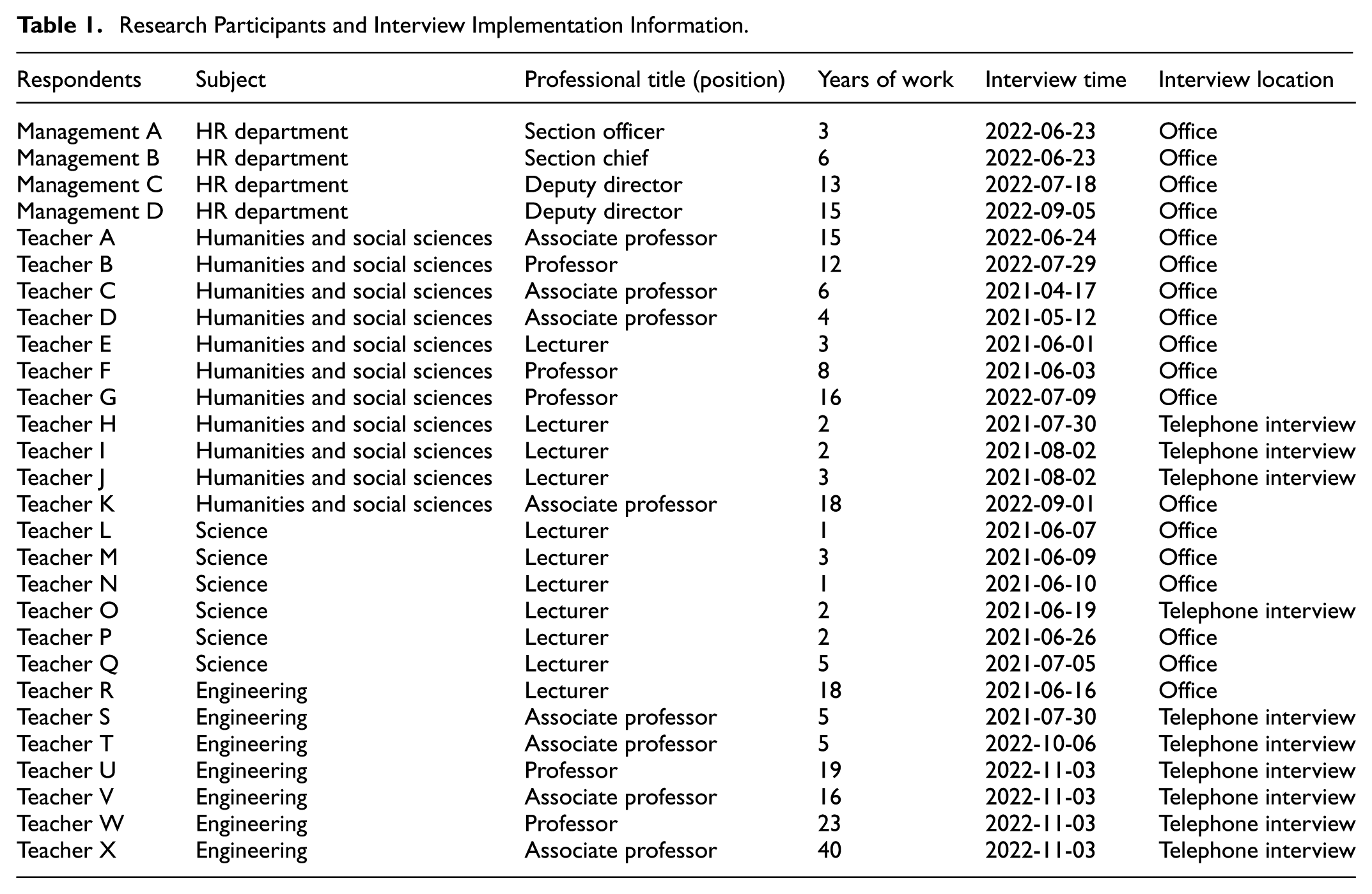
The study adopted a semi-structured interview approach. Before the interview, different interview outlines were prepared for two different types of interviewees: university management personnel and university teachers. The interview outline was modified according to the teacher’s answers during the trial test and was only used to clarify the interview direction. During the interview process, responses were made based on the interviewee’s answers; following the interview outline, appropriate questions were asked accordingly. The interview outline for university teachers focuses on the construction of the identity of local university teachers in the performance management situation. The interview outline for university management personnel is mainly based on the implementation and development process of the performance management system in case university (Appendix).
After the interview, the interview corpus was sorted out, and the interview data of university teachers and administrators were analyzed. Similar views were then extracted from the data and coded step by step, ultimately forming a first—level code of teachers’ career intention, teaching conscience, academic feelings, academic interests, material interests, and spiritual interests.
Theoretical Saturation and Ethical Consideration
After interviewing 25 university teachers and management personnel, a preliminary theoretical model was constructed. Subsequently, the sample size was expanded by selecting three more university teachers from different disciplines for further interviews, with the intention of testing whether the data collection had attained theoretical saturation. The concept of theoretical saturation was initially proposed by the founders of grounded theory, Glaser and Strauss (1967), who defined it as “if additional sampling persists, no new categories or related topics will emerge.” Upon analyzing the interview data of these three newly added teachers, it was determined that no new categories or topics emerged from the research, signifying that the data collection had achieved theoretical saturation. The study collected data from a variety of sources and in diverse forms, including G university’s performance management policy texts, interview data from personnel department managers, and interview data from teachers. Triangular mutual verification was then carried out to determine the authenticity and effectiveness of the research results and enhance the credibility of the research.
In addition, the fundamental rights and interests of the respondents are important issues that need to be considered in research. During the research process, three basic ethical principles were always followed: the principle of informed consent, the principle of respect and equality, and the principle of minimum harm and benefit to avoid potential conflicts of interest.
G University Performance Management System and Its Practice
The study analyzed relevant policy texts including the New Teacher Assessment System, the Annual Performance Allocation System, the Job Appointment System and the Professional Title Promotion System of G University. By combining the interview data with the management personnel of G University, it explored the institutional practice of performance management in the case of the university.
The Performance Management System of the University
Since 2000, G University has explored performance system reform in four aspects: initial employment, performance-based pay, job appointment, and professional title promotion. Over the past 20 years, the performance management policy of G University has been gradually refined, and the performance management situation in G University has been further strengthened.
The performance assessment system during the first employment period primarily focuses on teaching and scientific research while also giving full attention to the ideological and political performance, moral performance, and social service of teachers. The assessment content for new teachers at G University includes scientific research level and quantity, teaching and course evaluation level, and teacher ethics standards, among other aspects. In terms of scientific research, the assessment tasks for new teachers are arduous. They need to complete three CSSCI papers or one SSCI paper and preside over one provincial or ministerial-level project. In terms of teaching, the teaching evaluation level of new teachers needs to reach level B or above.
Local universities widely adopt performance-based salaries as an internal distribution system. Overall, the total performance-based salary of G University accounts for about 70% of the total teacher income (excluding the public accumulation fund for housing). Moreover, the higher authorities in A Province impose a “Per Capita Cap” on the performance-based salary of G University. Therefore, what a teacher gains more in performance-based salary means what other teachers gain less, objectively forming a “Zero-sum Game” pattern in the performance-based salary.
Job appointment and professional title promotion systems are also crucial for university performance management. The main content of the job performance assessment for teachers at G University includes four aspects: teaching work, scientific research work, public affairs work, and the evaluation of teacher ethics and professional conduct, with an emphasis on quantitative assessment. Completing teacher appointment tasks is directly correlated with the distribution of performance-based salary, job level promotion, award, and the job appointment level in the next round. The promotion of professional titles at G University is based on the quantitative work points counted in three dimensions: scientific research, teaching, and social services, and the total numbers of quantitative work points of teachers applying for professional title promotion needs to be compared.
Practice of Performance Management System
Through in-depth interviews with teachers and management staff at G University, it can be seen that performance management has stimulated teachers’ enthusiasm and has had a positive impact on the personal development of teachers and the university. However, the problems in performance management in terms of assessment concepts, methods, and standards have also brought practical difficulties for G University in implementing performance management.
Firstly, it has stimulated the enthusiasm of teachers in their work. In order to maintain its qualification as a “Double First-Class” university, G university reflects a sense of performance and motivation in the introduction, training, and management of teachers, continuously promoting performance management reform. As Manager C pointed out, “the incentive mechanisms and channels introduced by performance management enable teachers to clearly understand their tasks, and specify the workload and work effectiveness of teachers.” This enables teachers to have a direction to strive for and strive to be seen, maximizing the enthusiasm of teachers in their work.
Secondly, the conflict between teaching and research is becoming increasingly prominent. Teaching and research are the main responsibilities of university teacher and the channels for constructing teacher identity. G University has clearly stated in its official documents that it values high-quality teaching. However, the tangible rewards in the performance management policy actually reinforce the emphasis on scientific research. “From a policy perspective, the teaching workload must be greater than the scientific research workload. But the salaries of teachers mainly engaged in teaching may be lower than those of teachers mainly engaged in research.”(Manager B) In addition, the demand bias of university strategy and the difficulty in objectifying teaching quality have also contributed to the contradiction between teaching and research.
Thirdly, performance evaluation standards are difficult to achieve fair. There are significant differences in knowledge attributes, research paradigms, value orientations, and achievement forms between the hard disciplines represented by science and engineering and the soft disciplines represented by humanities. Manager A acknowledged that “the methods, means, difficulties, and time—horizons for generating research outcomes differ across various disciplines. This renders it arduous to assess the academic productivity of diverse fields with uniform indicators, and there indeed exist certain disciplinary disparities in performance evaluations.” Although G University has attempted to optimize performance evaluation in recent years by implementing classified evaluations based on positions and disciplines, the differences between disciplines are not fully reflected, and the performance evaluation standards cannot truly be fair.
Fourthly, the promotion space for teacher professional titles is gradually narrowing. The promotion system for university teachers’ professional titles is regarded as the most effective institutional arrangement for motivating and promoting teacher professional growth. However, due to the limitations on the number of senior professional titles in universities imposed by higher-level personnel management departments of A Province, G university has relatively few senior positions allocated. “Province A has very strict control over the number of senior—level professional titles. The insufficient number of title quotas means that teachers who originally meet the assessment requirements are unable to be promoted to a higher professional title, intensifying the competition among teachers.” (Manager C) The scarcity of senior titles and the strong connection between professional title promotion and quantitative research output has led to increasingly fierce competition among teachers, narrowing the space for professional title promotion and making it difficult for teachers to achieve psychological peace.
Teacher Beliefs and the Identity Construction of University Teachers
Teacher’s beliefs refer to the cognitions, viewpoints, and assumptions that a teacher personally confirms and firmly adheres to throughout the entire educational activity, reflecting a teacher’s understanding of individual identity (Li & Liu, 2010). Teachers’ beliefs are often different, being influenced by both individual internal factors and the external environment (Wang & Hsieh, 2024). Internal factors include the teacher’s personal educational background and life experience (Richardson, 2002), reflecting the endogeneity of identity construction. Individuals form the meaning production of identity cognition through the generation and change of self-awareness. External factors include educational policies, organizational environment, etc. (Kagan, 1992), and teachers reconstruct their self-identity through interaction with organizational performance management system.
Teachers’ Belief Recognition in Performance Management Situation
Based on the analysis of interview data, in the performance management situation, the internal influencing factors of teachers’ beliefs and identity mainly involve three aspects: teachers’original professional intention, teaching conscience, and academic sentiment.
The original intention of a teacher’s career choice has an impact on their beliefs in work. The individual interest of teachers mainly stems from the recognition of the teaching profession in universities, which is based on their past learning experiences (Shouxin & Rujun, 2024). Teacher O holds the view that “the sense of mission and fulfillment in academic research led me to choose the profession of a university teacher.” Some of the interviewed teachers found the position of a university teacher appealing after comparing their past work experiences. As Teacher B stated, “Teaching and research in university are more autonomous.” Some respondents have a low initial recognition of university teachers but remain at university to work due to coincidence or psychological inertia (Dexin & Yue, 2020). For example, teacher D believes, “Most liberal arts doctoral students in China go to work in universities after graduation; otherwise, where else can they go?!”
The tendency of the performance management system leads to the phenomenon of “valuing scientific research over teaching” in universities, which means that university teachers will face many conscience tortures when engaging in professional work. Teaching conscience refers to the high sense of moral responsibility formed by teachers consciously adhering to external teaching norms and internalizing them into stable teaching beliefs (Hong & Dong, 2018). Teachers K and G believe that “teaching must be the priority. It must align with the original intention of preaching and teaching.” However, the performance management system environment in the university makes it difficult to form a robust incentive mechanism for teaching activities, and some teachers may view teaching as a task of “meeting standards without accidents,” leading to teaching becoming a “conscience work” in another sense.
Academic research is one of the main responsibilities of university teachers. Endogenous academic beliefs often influence teachers’ academic actions. How teachers interpret the significance of academic research work is a concentrated reflection of their researcher identity. Most interviewed teachers believe that academic research requires consistent interest and passion, a mission to explore truth, and a dedication to science. “We enjoy the high-quality educational resources, then our identity should be the backbone of social development, which is our responsibility.”(Teacher G; Teacher E) However, teacher’s academic sentiment will be severely eroded by high-intensity performance evaluations.
The external factor that affects teachers’ belief identity is the performance management situation in universities, which mainly influences teachers’ beliefs through organizational management purport and performance culture. The New Managerialism has impacted the management methods of universities, making them focus on output efficiency and utility value (Exworthy & Halford, 1999). Performance management in universities has more characteristics of Managerialism, which has been transformed into huge pressure on teachers. Teacher B believes that the pursuit of efficient management logic contradicts the law of knowledge production. “The institutional requirements of all aspects of the school emphasize that teachers need to produce output every year. But in fact, it violates the law of knowledge production, not that it can always be achieved after planning. This conflict is a great pressure for many teachers.” In terms of performance culture, the organizational culture centered on performance pursuit will have a profound negative impact on teachers’ value orientation and behavioral norms. Teachers’ identification with the university organizational culture affects their work enthusiasm and has a negative impact on their belief building.
The Construction of Teacher Identity Under Different Belief Recognition
Based on teachers’ personal value orientation and belief support, university teachers will make different choices when facing the performance management system. The results of teachers’ choices manifest as adhering to, adjusting, or giving up their original beliefs, which affects their identity construction. Both teacher C and Management C maintain that the current performance management culture in the university is more utilitarianism and lacks basic humanistic care, which gradually weakens teachers’ sense of identification with the organization. In the performance management situation, teachers interpret their identity as “academic migrant workers” who “earn work points.” The university can “have a set of standards that specify what kind of teachers are successful in university, but when managing people with institutions, there should be basic humanistic care.”
Based on the analysis of interview data, according to the different matching degrees between teacher beliefs and organizational situation, the identity of G University teachers can be divided into three categories: the “adhering to the original mindset” type that is low in compliance with the system, the “round outside but square inside” type that is passive in compliance, and the “taking what is necessary” type that is active in compliance (Figure 1).
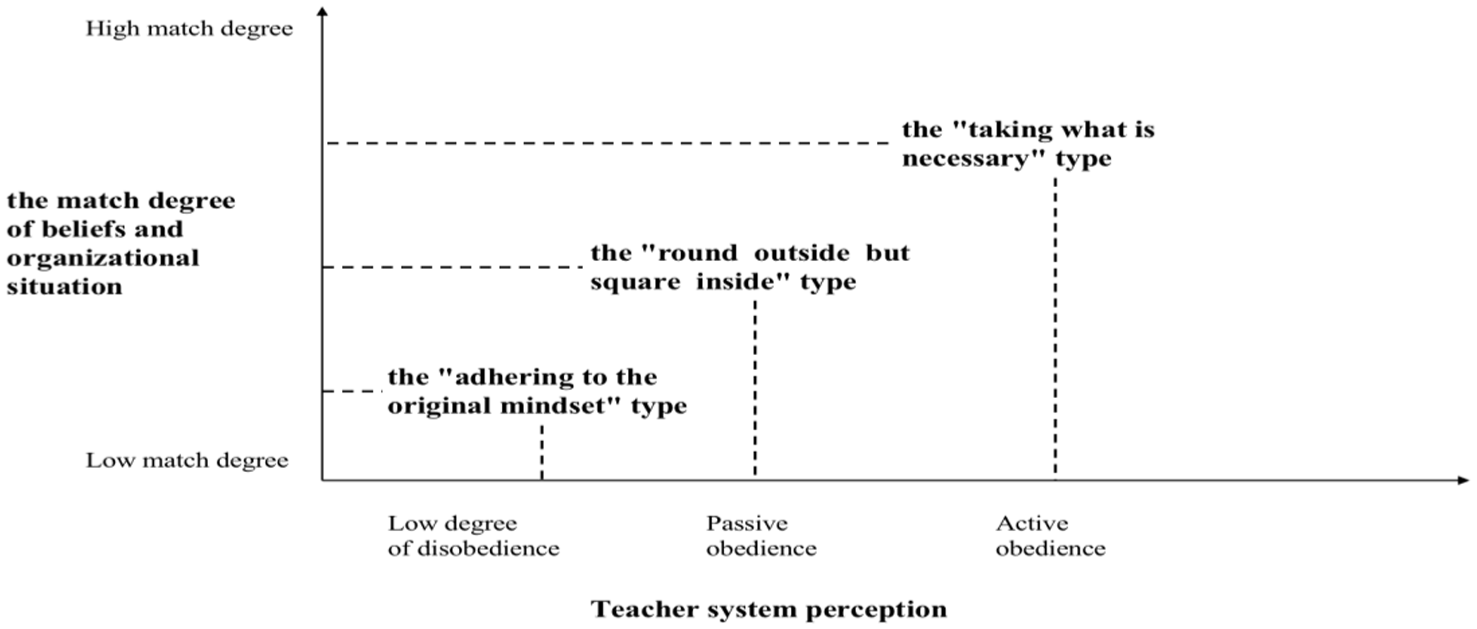
Teachers identity construction framework based on their beliefs.
In the performance management situation at G University, when faced with conflicts between internal beliefs and institutional expectations, teachers of the “adhering to the original mindset” type choose to adhere to academic ideals and beliefs and attach great importance to the output quality. Therefore, in the process of identity construction, they mainly rely on individual internal beliefs, and pay more attention to realizing self-life value in terms of professional value. When faced with differences and conflicts between individual concepts and external institutional expectations, teachers of the “outer circle and inner square” type tend to balance the relationship between the two but sometimes also have to compromise with the regulations of external institutions. In terms of professional values, they often passively comply with the requirements of the institutions to ensure their survive. Teachers of the “taking what is necessary” type tend to consciously combine personal and organizational development to achieve organizational goals and actively comply with external institutional guidance. In terms of professional value, they mostly “value scientific research over teaching,” especially in the pursuit of the output of scientific research results.
Interest Considerations and the Identity Construction of University Teachers
People continuously and consciously pursue their interests, and the starting point of personal actions is often related to their interests (Bureau of Compilation and Translation of Works by Marx, Engels, Lenin and Stalin of the CPC Central Committee, 2001). Interest considerations are also commonly found in the performance behavior choices of university teachers. On the one hand, as a complex of “Economic Man” and “Academic Man,” university teachers have multiple interest needs. Their survival and development needs determine their pursuit of certain material interests, and the particularity of the teaching profession determines their academic and spiritual interests. On the other hand, actors determine their goals based on their needs and motivations, thus forming diverse definitions of interests. Especially in education, teachers place greater emphasis on their subjective initiative and have their own judgments on what is valuable and worth striving for (Lijun, 2021).
Considerations of Teacher Benefits in Performance Management Situation
Based on the analysis of interview data, in terms of academic interests, the academic professionalism of university teachers is an essential attribute that distinguishes them from other professions. Academic interests are a special demand arising from the professional characteristics and work contents of university teachers. Specifically, academic interests can be manifested as academic freedom, academic status, academic achievements, and academic discourse power. Respecting academic and academic freedom is an important academic interest demand of the university teacher community (Cao & Chen, 2024). However, the current overly quantified performance management system has compressed the academic freedom of G University teachers, and teachers unilaterally pursue research efficiency and the quantity of research results, resulting in a non-free working state.
In terms of material interests, the profession of university teachers also has the material pursuit to meet basic survival needs. Most respondents stated that the basic salary in the performance-based salary system is too low, and the efforts and gains of teachers are not commensurate. “Our current basic salary is too low, and there is a Pareto Principle in performance management research, which is that 80% of workload is completed by 20% of teachers”(Teacher A). The mismatch between the material benefits and work efforts of G University teachers has led to unsatisfactory external material incentives. Even some teachers who lack academic ability have completely abandoned scientific research and turned to other “side jobs” with higher material returns.
The spiritual interests of university teachers are a form of interest that meets their spiritual needs. Spiritual needs depend on obtaining high-level needs such as self-realization, achievement, belonging, and happiness in the work practice process. The satisfaction of spiritual needs can more effectively mobilize their initiative and enthusiasm in work (Yuan, 2018). However, spiritual interests are an invisible benefit. The corresponding needs of teachers are easily marginalized or even ignored, which is a problem existing in the performance management of G University. Based on interview data, it is precisely the quantitative rigidity and short-term output orientation of performance management that seriously erodes teachers’ sense of organizational belonging and self-actualization, highlighting the mentality of “dogsbody.”
The Construction of Teacher Identity Under Different Interest Considerations
Under different interest considerations, university teachers construct their identity in the following three dimensions of performance behavior choices.
Firstly, Maximizing the Utility of Cultural Capital
As intellectuals who have received systematic academic training, university teachers often employ the complete action strategy of “accelerating publication speed, adjusting research topic selection direction, and focusing on knowledge application” to convert their cultural capital into economic capital. “The performance management Piece-Rate salary system is to make teachers earn more work points, and teachers can only write, submit, and publish desperately”(Management D). This makes it necessary for individual teachers to focus on performance indicators that involve less investment and yield quicker returns. At the same time, the direction of topic selection has shifted from the original personal interest of teachers to actively pursuing “hot topics.”“Nowadays, journal editors prefer to publish papers on hot topics. Although some hot topics are not what I want to do, I still pursue them”(Teacher F). Hot topics are easier to publish because they meet the preferences of the market and journals. Teachers have gradually lost the research freedom driven by curiosity.
Secondly, the Daily Implementation of Emphasizing Scientific Research Over Teaching
When a university lacks genuine recognition of the value of teaching and increases resource incentives for scientific research through performance management systems, teachers as “rational individuals” tend to tilt their internal balance toward “researchers” in terms of identity recognition. Once the performance system reinforces such performance behaviors, teachers rationalize these behaviors based on cost-benefit measurement and peer imitation. Thus, “emphasizing scientific research over teaching” becomes a collective action (Guangcai, 2019). Teacher B said, “I think scientific research is more important. There is a huge difference between a teacher doing well or not doing well in scientific research. I don’t think any Yangtze River scholar (Changjiang Scholar) is rated because of their good teaching.”
Thirdly, the Universalization of Social Capital Reciprocity
In universities, social capital refers to interpersonal relationships that significantly enhance the cultural and economic status of individual or team teachers (Xianzhong et al., 2015). Many teachers rely on administrative organizations or hold dual administrative and academic roles to enhance their academic status and reputation. To gain more benefits in scientific research, some teachers have to integrate into the culture of “scholar circle” and create the so-called “academic community of interests.” As Teacher G said, “Developing on one’s own is very slow. Collaborating with a few college leaders is much faster, and I will take the initiative to do some work for them. My research interest will be temporarily put aside to maximize my interests.”
Discussion: “Dogsbody in the System”
Problems and Its Attribution in Teacher Identity Construction in Performance Management Situation
Based on the comprehensive analysis of interview data, it can be concluded that there is a cultural identity crisis in the construction of G University teachers’ identity, which is aggravated by a utilitarian mentality. In the performance evaluation process, the lack of teacher subject identity leads to the obscuring of teacher subject identity. In performance practice, the multiple identity functions of teachers have resulted in the generalization of teachers’ professional identity (Erjun, 2011). “Now university teachers are engaged in teaching, research, and administrative tasks simultaneously. So, what is your main identity?”(Teacher I)
The main reasons for these problems are the conflict between instrumental rationality of performance systems and value rationality (Chen, 2017), the decline in the rationality and constraints of academic communities in universities (Dongdong, 2022), and the imbalance between internal motivation stimulation and external behavior induction (Guang & Huajun, 2019; Huajun & Guang, 2022). These three attributions also echo existing research on university performance management in the academic community. It can be observed that the excessive pursuit of a short-term input-output ratio by the universities is a manifestation of instrumental rationality (Cai & Zhang, 2021). In contrast, the substantive contribution of higher education as a noble social cause to human civilization and social development, as a pursuit of value rationality, has been overwhelmed in frequent quantitative performance evaluations and even performance point measurement comparisons. The academic community where university teachers are located has its academic rationality in existence and thus forms intangible academic shared value (Songlin & Tingting, 2015). However, the binding force of these norms is weakened in the benefits calculation advocated by performance management systems. “Right now, I can’t do something that I’m really interested in. I have to work hard to earn points under the pressure of performance reviews.”(Teacher Q) In addition, the current paradigm of performance management systems presents a simple “indicator-statistics-reward and punishment” logic (Zhongtai, 2022), which focuses more on external behavior induction than on stimulating and strengthening the internal work motivation of individual teachers through belief identification and institutional incentives. The existence of these three types of problems ultimately leads to the dilemma of constructing the identity of G University teachers in performance management.
The Game Between Beliefs and Interests of Teacher Identity Constructing
A situation is a product constructed through the interaction between individuals and systems (Goffman, 2008). From the perspective of the factors influencing the construction of teacher identity and the process of teacher identity construction, the teacher’s identity is constantly reshaped as they seek self-meaning and value through the interaction between individual teachers and external situations (Shuhai & Mei, 2015). This research has found that the identity construction of G University teachers is influenced by two dimensions of factors: belief identification and interest considerations. The performance management system guides, stimulates, and strengthens the interaction between belief identification and interest considerations. Therefore, in the performance management situation, teachers’ performance behavior will oscillate between belief identification and interest considerations, and engage in games and trade-offs between belief identification and interest seeking, thereby affecting the teachers’ identity construction. The game details of beliefs and interests in the process of constructing teacher performance identity are shown in Figure 2.

Identity construction of local G University Teachers in performance management situation.
In the dimension of interests, teachers’ interest considering are widespread. Among them, material interests serve as the external driving force for transforming university teachers’ behavior. Achieving achievements based on survival and development holds an important position in the teachers’ needs. Academic interests are an important driving force for the academic development of university teachers and an important factor for teachers to judge their status and value. Spiritual interests are the endogenous driving force that promotes the transformation of teacher behavior and can have more lasting and profound motivating effects on teachers. “These three factors have an impact on my behavior choices, and I will have my own considerations” (Teacher A; Teacher V). Based on the practical characteristics of performance management at G University, such as high intensity, short-term nature, quantitative assessment, single subjectivity, and obscured professional growth, teachers position their identities according to specific situations of triple-interest considerations. To maximize their interests, some teachers’ performance behavior is manifested as fully “mobilizing” various capital, maximizing the utility of cultural capital, and emphasizing scientific research over teaching and universalizing social capital reciprocity. In the dimension of belief, the development of teachers goes through four stages: pre-employment, onboarding, growth, and stability. Teacher beliefs mainly consist of academic, teaching, and social service beliefs. At each stage of development, the self-interpretation of teacher identity is undergoing changes and gameplay. “At different stages, my understanding of the importance of academics, teaching and community service is different, and this belief is in flux” (Teacher T). After entering the stable period, three different types of teacher identity construction with varying intensities of belief have gradually formed, they are the type of taking what is necessary, the type of outer circle inner square, and the type of adhering to the original heart.
The Interaction Between Performance Management and Teacher Identity Construction
Constructing teacher identity includes individual teachers forming internal beliefs based on a certain value orientation, interacting with external situations through their resources, choosing the parts they identify with, and engaging in games with their existing concepts (Shuangmiao & Jing, 2022). This process is ultimately manifested in the individual performance behavior choices of teachers. In this process, there is an interaction between individual teachers and performance management situations. Performance management situations regulate the construction of teacher identity, while the latter solidifies the existing performance culture when it is difficult to resist institutional rigidity (Figure 3).
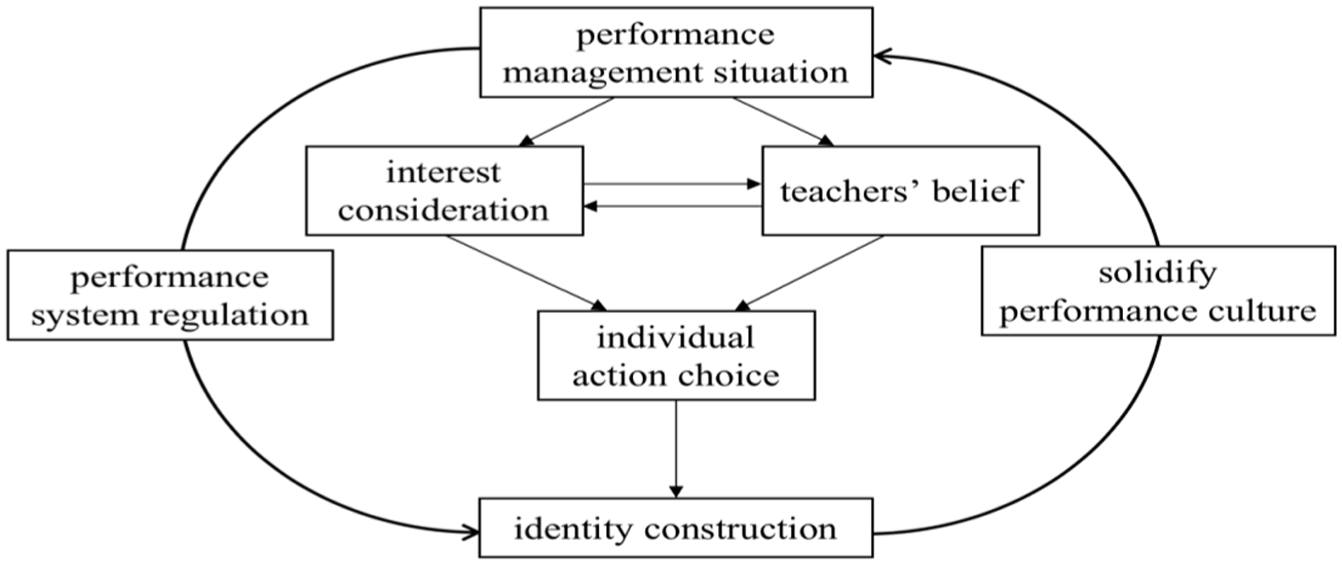
Interaction between teacher identity construction and performance management situations.
The performance management situation encompasses tangible management mechanisms such as performance policies and regulations, and deep-seated performance culture, beliefs, concepts, etc. (Van Dooren et al., 2015). On the one hand, the performance management system puts new expectations on teachers and guides their behaviors to match performance goals. The expectations of the external institutional situation and the judgment of the individual success of teachers will be largely internalized into their definition of success, thereby supporting the formation of self-identity among teachers. On the other hand, the performance management system has limited applicability, and essential differences exist between university and business enterprise organizations. Teachers’ work performance has limited measurability and is difficult to replace and quantify. If simply copying the performance management system in the business field, it will inevitably cause teachers’ exclusion reaction, which will negatively restrict the construction of teachers’ reasonable identity. In addition, when the academic beliefs of individual teachers are insufficient, the result of teacher identity construction will strengthen the existing performance management system and solidify the performance culture. The original driving force of institutional reform is a rational choice, that is, when individual actors predict through rational calculation that it will benefit themselves, the system begins to change. On the contrary, when teachers become accustomed to the original performance management situation and gain benefits from it, it will be difficult to promote reform of the performance management system.
The “Dogsbody in the System”
From the foregoing discussion, it can be concluded that in performance management situations, the identity construction of G University teachers is influenced by the interaction between individual and external factors. On the one hand, the game process between teachers’ personal beliefs and interests significantly impacts teacher identity formation. On the other hand, the construction of teacher identity is shaped in the interaction between individual teachers and performance management situations. Performance management situation exerts a regulatory and constraining effect on the construction of teacher identity, and the performance behavior generated by the interaction between individual teachers and situations will also strengthen existing performance management system.
It should be noted in addition that the performance management scenario of the case university is embedded in the entire social governance system, or it can be said to be isomorphic with social governance. Specifically, meritism has actually become the ideological basis of the university governance system and has been implemented through technocracy as a methodology. Technocracy is manifested in “technological governance” and “technopolis,” and “technology” and “expert” are the two basic elements of technocracy (Scott, 1984). Technological governance implies that technological rationality dominates all aspects of university management (Esmark, 2017). In the performance management system, this is specifically reflected in the quantitative assessment of teachers’ work. Meanwhile, the assessment indicator system, quantitative standards, and decentralization are all determined by the so—called experts, with no positive interaction with stakeholders. In this situation, the pressure resulting from the prevalence of technocracy is transmitted through the pressure system. The university transfers the performance responsibility of pursuing a “Double First-Class University” to the college in the form of indicators. The college further elaborates these and continues to pass them down, and ultimately, the performance pressure is placed on the university teachers.
In this context, overall, the identity construction of G University teachers can be characterized by “dogsbody in the system.” Firstly, universities are affiliated with public institutions, and university teachers are workers within the system. During China’s planned—economy era, the term “within the system” signified an iron rice bowl, featuring stable employment, relatively good salary and benefits, and a high social status. After the market—economy reform, the “iron rice bowl” for university teachers has been gradually shattered. Although their jobs still retain a certain degree of stability, the basic salary accounts for merely about 30% of the total teacher salary. The remaining 70% is derived from performance-based pay. Secondly, the term “dogsbody” implies that an individual exchanges corresponding remuneration and benefits by contributing labor, knowledge, skills, etc., to the company. In the situation of rigorous performance management, the basic salary of university teachers is insufficient to cover the basic cost of living. As a result, they still need to exert great efforts to earn work points so as to obtain performance-based pay and meet the assessment requirements of the university. This bears resemblance to how workers strive for performance bonuses and job promotions, objectively enhancing the “dogsbody” identity of university teacher. In addition, the self-identity positioning of “dogsbody” also reflects the insufficient identification of university teachers with the university organization and their weak sense of belonging to the university. Mainly relying on external motivation rather than internal belief to enhance teachers’ work enthusiasm, teachers are always “dogsbody” who work for the university, and the internal motivation to dedicate themselves to the development of the university is insufficient.
Conclusions
As important stakeholders in the performance management system, university teachers are responsible for talent cultivation, scientific research, and social services (Yingqiang, 2009). The research has found that the performance behavior of teachers in case university can be intertwined between personal beliefs and considerations of interests. In the situation of performance management, there are three different characteristics of university teacher identity, namely “adhering to the original mindset,”“round outside but square inside,” and “specialized in what is needed.” Based on the two-dimensional analysis framework of teacher beliefs and interests, the study provides a deep understanding of the identity construction process of different types of teachers in performance management situations. Although strong individual belief identification is a powerful tool for teachers to maintain their true selves, the performance management system of instrumental rationality orientation and the performance appraisal of administrative control, quantitative and immediate output has largely shaken the teachers’ individual beliefs and weakened their sense of identity as educators, researchers, and service providers. Therefore, targeted measures are needed to improve the performance management practices of the case university.
Implications
Based on the findings and discussion, it is necessary to optimize the performance management of case universities from the following four aspects to promote the construction of teacher identity.
Firstly, Optimize the Performance Management System and Strengthen People-Oriented Institutional Incentives
As academic elites in society, university teachers generally have a strong need for self-actualization (Hongrui, 2015). “Personally, I really want to write something. I have my academic interest and passion, but under the current performance management system, my interest and passion are gradually eroded by various trifles” (Teacher E). Therefore, the university should weaken the orientation of the performance management system with efficiency as the value orientation, strengthen people-oriented institutional incentives, improve the pertinence and effectiveness of incentives, urge teachers to implement performance behaviors based on reasonable beliefs.
Secondly, Promote Performance Evaluation Reform and Substantially Advance Academic Peer Review
Performance evaluation, as the key part of performance management, is a dynamic evaluation process for the short, medium, and long-term performance results of organizational members (Dexin, 2021). “Our current performance evaluation only focuses on grade and quantity, and quantifies all outcomes. This approach appears to lack a humanistic touch” (Teacher K). The university should abandon formal performance evaluations focusing on quantity improvement and adopt substantive evaluations focusing on connotation improvement and high-quality development, with representative academic peer reviews as the main assessment approach.
Thirdly, Focus on Ensuring Health Factors and Optimizing the Teacher Salary and Welfare System
According to the current salary system for university teachers, the proportion of performance-based pay is too high, and the survival needs of university teachers cannot be fully met. It will dampen teachers’ work enthusiasm in the long run. “Our base salary is so low that if we don’t work hard to earn merit pay, we may not be able to meet our basic needs. This process demands significant effort and can be, at times, exhausting” (Teacher V). Therefore, it is necessary to pay more attention to the protection function of health factors such as teachers’ salary, working equipment, and working environment, strengthen the construction of hardware facilities and resource supply, and optimize the teacher salary and welfare system.
Fourthly, Improve the Academic Ecological Environment and Guide Teachers’ Professional Consciousness of Their Beliefs
Performance management has largely solved the problem of incentive failure caused by the rural club style management of G University, which existed before the performance management reform. Nevertheless, excessively-incentivized performance management can lead to teacher burnout, loss of self-esteem, and loss of meaning in life. Therefore, the university should improve the academic ecological environment, pay attention to the explicit and implicit role of academic communities in teachers’ professional development, and guide teachers’ professional beliefs towards professional consciousness. “The current academic milieu is unfavorable for the construction of a positive teacher identity, with the pressure originating from diverse aspects being overly intense. I believe that it may be necessary for us to contemplate how to enhance this situation”(Teacher P).
Limitations
Case G University is a local university located in a relatively economically developed region in China. After successfully being selected as a national “Double First-Class” construction university, it is eager to enhance the competitiveness through performance management reform. The performance management implemented has a certain typicality among Chinese local universities, and the research conclusions and countermeasures have certain external validity, which has good inspiration value for other similar universities to implement performance management reform.
Because the identity construction of university teachers is an abstract issue involving teachers’ deep minds, research may have shortcomings such as short tracking period and insufficient data collection. In future research, we will continue to focus on transforming university performance management, adopt more diverse research methods to collect and analyze data, and then further deepen our understanding of teacher identity construction in performance management situation.
Footnotes
Appendix
Acknowledgements
We would like to express our great appreciation and admiration for the participants who were part of this study.

Ethical Considerations
The Zhejiang Normal University research ethics committee granted ethical approval to conduct the study (ZSRT2023114). We confirm that all methods related to the human participants were performed following the Declaration of Helsinki.
Consent to Participate
All participants had signed informed consent before the interview.
Author Contributions
Yijian Hu contributed to the conception and design of the study, data collection, data analysis, and drafting of the manuscript. Rui Zhou was responsible for data collection, manuscript revision and editing. Lianyu Cai contributed to the study design, data collection and analysis, drafting of the manuscript, and critically revised the manuscript. Chun Wu contributed to the study design and data collection and analysis. All authors have read and approved the final version of the manuscript.
Funding
The authors received no financial support for the research, authorship, and/or publication of this article.
Declaration of Conflicting Interests
The authors declared no potential conflicts of interest with respect to the research, authorship, and/or publication of this article.
Data Availability Statement
The datasets generated and analyzed during the current study are available from the corresponding author on reasonable request.