




Abstract
Every year, a number of Chinese undergraduates from urban teacher universities are selected as volunteer pre-service teachers to teach in schools located in underdeveloped rural areas. In this qualitative case study, the researchers explore four pre-service teachers’ 1-year experience as volunteer educators in rural schools, their communities of practice in the south and west of China, and present their reflections on the challenges, including how their responses (re)shaped their teacher identity. It is found that these pre-service teachers have built their social capital through rural teaching experience, and they have begun to construct their professional teacher identity within that transitional community of teaching practice. The paper contributes to discussions of pre-service teacher education and pre-service teacher identity construction in the context of secondary education in rural China and in other parts of the world.
Introduction
Since the late 1970s, China’s reform and opening up have promoted its economic and social development, yet education is still underdeveloped in some rural areas (Brock, 2009). This gap provides opportunities for undergraduates from teacher universities to serve as pre-service teachers and construct their professional identity. The volunteers are usually graduates from universities in big cities such as Beijing, Shanghai, and other large cities, and most of them have fulfilled the essential requirements for becoming a teacher, including their internship, but have not been employed formally. In this qualitative case study, the four volunteers had completed the required curriculum and been awarded a teacher’s certificate; they were labeled as pre-service teachers by the education system. It is posited that the unfamiliar conditions in their communities of practice affected their identity construction, since identity formation responds to the sequence of events that make up life trajectories (Tomlinson, 2013). However, there are few studies of how volunteer pre-service teachers construct their teacher identity in rural China, and how their experience of teaching in rural China affects their future career choice.
This study examines four pre-service teachers’ experiences of moving from the city of Beijing to teach in rural schools in underdeveloped western China. In their 1-year volunteer teaching experience, they were challenged to work within and adapt to the conditions of rural schools, which this study sees as communities of practice (Wenger, 1998) for these volunteers. Chinese rural schools are different from those in urban and developed areas. Born and brought up in urban China, these pre-service teachers encountered circumstances very different from what they had experienced so far in their life and professional training.
This study explores whether and how the teachers’ experiences in rural schools shaped their teacher identity. In the following sections, previous studies of teacher identity construction and of pre-service teacher education are reviewed. The concept of communities of practice frames a qualitative case study approach to the discussion. This study seeks to contribute to current discussion on pre-service teacher identity. Our aim is to unpack pre-service teachers’ professional identity negotiations and construction in rural China, enquiring into how these pre-service teachers perceive their career and how they have grown in their communities of practice in an unfamiliar social and cultural space. This paper will add value to the current literature on pre-service teacher education and identity construction, and it will be meaningful for volunteer teachers who are planning to work in rural China.
Extant Studies on Teacher Identity Construction
Identity can be perceived as “the way we make sense of ourselves and the image of ourselves that we present to others” (Day, 2011, p. 48). Identity construction is described as an ongoing and dynamic life-long process, and it is related to one’s values and personal, social, and cognitive experiences (Flores & Day, 2006). The formation of teacher identity has attracted great interest in the field of teacher education, and the number of extant studies concerning teacher identity construction and pre-service teacher identity construction has increased significantly (Beijaard, 2019; Laletas & Reupert, 2016; Lummis et al., 2015; Pillen et al., 2013a; Poom-Valickis & Löfström, 2019; Tran & Nguyen, 2015; Trent, 2016; Willemse, 2014). For example, a study examining tensions encountered by 182 beginning teachers during their professional identity development found that their professional identity tensions stemmed from conflicts between what they desired and what was possible in reality; most beginning teachers tried to cope with their tensions by speaking to their significant others or by searching for a solution themselves (Pillen et al., 2013b).
A teacher’s professional identity construction is located at the intersection of three different domains: “personal experience, professional context, and the external political environment” (Mockler, 2011, p. 521), and develops through teaching practices in a specific workplace. In this process, agency plays a crucial role in a teacher’s identity construction and professional development (Buchanan, 2015; Cobb et al., 2018; Tao & Gao, 2017; Ye & Zhao, 2019). Agency can provide a powerful lens to examining teachers’ varying perceptions, decisions, and actions in the shifting educational landscape (Tao & Gao, 2021, p. 4).
Resilience is also regarded as a necessary character trait for sustaining and developing a teacher’s professional capacity (Arnup & Bowles, 2016; Evans, 2017; Fernandes et al., 2019; Gu & Day, 2013; Mansfield & Beltman, 2019; Price et al., 2012). Resilience is conceived as “the capacity of teachers to be resilient over a career, in different contexts and in times of change” (Fernandes et al., 2019, p. 682). Resilience is not inborn, but can be developed and strengthened through introspection and meeting challenges with coping skills (Bonanno, 2004). Resilience is closely allied to teachers’ everyday capacity to sustain their educational purposes and successfully manage the unavoidable uncertainties which are inherent in the practice of being a teacher (Gu & Day, 2013). In China, scholars have studied how teachers’ resilience and their working conditions interact. For instance, the nature of resilience in 455 primary and secondary school teachers in Beijing was investigated; it was found that the quality of work conditions and relational trust can significantly predict teacher resilience. School contexts are a catalyst for developing resilience, with implications for teacher recruitment and retention (Li et al., 2019).
Research Literature on Pre-Service Teachers
Pre-service teachers’ developing identity has drawn scholars’ attention, and various projects have been conducted to explore the best methods for training pre-service teachers (Arnold, 2021; Clark & Newberry, 2019; Edwards & Nuttall, 2015). A cohort of Turkish pre-service teachers’ experiences related to a 2-month international teaching and cultural experience in the United States of America were examined, and it was found the international teaching experience helped them develop professionally and personally. Through cross-cultural exchanges with their mentors, along with other students and their community, the pre-service teachers expanded their knowledge of a new culture and adapted to a new working environment (Ateşkan, 2016). A pedagogical practice constructed across disciplines was explored as an approach to training pre-service teachers (Aalto et al., 2019). Professional conversations which included multiple stakeholders in the school-university partnership reveal the complex process of becoming for pre-service teachers as they navigate across time and space (Gutierrez & Kostogriz, 2020). In Australia, rural placements for pre-service teachers do not guarantee that staffing shortages in rural areas will be alleviated, but they can enhance graduates’ desire to seek positions in rural schools (Cuervo & Acquaro, 2018).
Scholars have studied pre-service teachers and student teachers as individuals and investigated how they construct their teacher identity (Deng et al., 2018; Iversen, 2021; Katwijk et al., 2021; Laletas & Reupert, 2016; Näykki et al., 2021; Yuan et al., 2019). For example, a research project on secondary pre-service teachers’ responsibility to care for students found that neither pedagogy nor discipline strategies would be effective without care, which raises training implications and suggestions for future research into training these teachers (Laletas & Reupert, 2016). Attention to pre-service teacher education is growing, including to pre-service teachers in specific fields such as pre-service teachers involved in teaching bilingual students or English as a foreign language (Lummis et al., 2015; Qiu et al., 2021). Pre-service teachers’ critical reflections on lessons taught during practice teaching are analyzed to assess how they put their theories into teaching practice (Heeralal, 2014). In the field of linguistic teacher education, a cohort of 16 bilingual pre-service teachers were examined; findings revealed that when supportive practices and policies were already implemented in the classroom, pre-service teachers adopted similar practices; however, when there were negative or ineffective language policies and practices, they become practicing language arbiters, making decisions that challenged normative practices (Nuñez & Espinoza, 2019). In the Netherlands, the relationships between the quality of research and teaching and pre-service teachers’ perceptions were examined; positive perceptions of practitioner research and a positive correlation between the quality of inquiry and quality of teaching were revealed (Katwijk et al., 2021). These findings present possibilities for improving the quality of pre-service teacher education.
In China, there are few studies concerning how pre-service teachers build their teacher identity, as they are often labeled as students rather than professional teachers; but they have many professional challenges to face, including taking responsibility for a classroom of students from different backgrounds when they move from the university classroom to their teaching space. This transitional time is more challenging when they volunteer in rural schools. Accordingly, this project explores how this small cohort of Chinese pre-service teachers face their identity (re)construction when they move from their familiar urban space into a rural space. This paper will address the knowledge gap with retrospective data gathered from four pre-service teachers’ experiences in rural schools in the south and west of China, followed up by further reflections on their teaching experiences as they progressed through their master’s programs, developing knowledge, and understanding of the complex challenges to a teacher’s unfolding identity.
Communities of Practice as Theoretical Framework
Learning is not just individual, it is an interactive process situated in a particular social, cultural and historical context (Farnsworth et al., 2016). The concept of “communities of practice” refers to “groups of people who share a concern, a set of problems, or a passion about a topic, and who deepen their knowledge and expertise in this area by interaction on an on-going basis” (Wenger et al., 2002, p. 4). When people participate in a particular community, they express their belonging through three modes of identification: “engagement, imagination, and alignment” (Wenger, 2000, p. 226), which are not mutually exclusive. Individuals engage with each other and with the world, and thus we shape who we are. Professional identity is formed in a community of practice. Imagination refers to a process of reflecting and constructing an image of the practice so that we can orient ourselves as a member of a community. Alignment of the self with community expectations/standards is necessary, coordinating one’s actions toward a common goal. Thus, the identity of a larger group can gradually become part of the individual identities of its members (Wenger, 1998).
Identity is shaped by participating in and learning from various practices in particular communities (Wenger, 1998), a dynamic and fluid process related to specific space and place. The concept of a community of practice emerged to capture how learning takes place in organizations, and it is understood that through participation, members in the community will develop shared practices, adopt a common identity, and build up mutually interdependent relationships in collaborative learning activities (Wenger, 1998). Participation in a community of practice is not just doing things together, because “members are bound together by their collectively developed understanding of what their community is about” (Wenger, 2000, p. 229). Identity construction is about the formation, interpretation and negotiation of the individual’s position in the community (who we are) and the ways they are related to one other—what we do (Gioia et al., 2000).
In this study, the rural students, parents, and local rural teachers, including the rural social context, are seen as crucial factors in these pre-service teachers’ communities of practice. Their teaching experiences in the learning community influence their identity construction and their professional development. Their understanding of and attitudes toward teachers, teaching, their professional beliefs, and their classroom teaching practices are likely to be (re)shaped, impacting their concepts of self (professional teacher identity) and future teaching practice. It is expected that there is a correlation between a teacher’s sense of professional identity and their propensity to stay in teaching.
Questions
In this qualitative case study, four pre-service teachers with city backgrounds all have had little exposure to rural schools, so in their rural community of practice, they are likely to encounter various living, professional, and psychological challenges. It is assumed that their biography, education, change of lived space, and experience gained through pedagogical placements, all play an important role in the ongoing process of their teacher identity construction (Flores & Day, 2006). Four pre-service teachers working in underdeveloped rural schools were invited as participants; their 1-year teaching experiences were assumed to have affected their psychological process of becoming a teacher. This study was guided by the following questions.
What challenges have these pre-service teachers encountered when working in their rural community of practice?
How did these pre-service teachers integrate and align themselves with the people in their community of practice and construct their teacher identity?
Methodology
Case Selection
In order to recruit appropriate participants for this project, approximately 100 posters were placed on the campuses of several teacher universities located at the city of Beijing, China. Over 10 students were enlisted, and 4 were finally selected, for a small qualitative case study usually consists of “no more than four or five cases” (Creswell, 2007, p. 76). The use of a purposeful sampling method in the final selection allowed researchers to focus “in depth” on a phenomenon, exploring “information-rich cases” pertinent to the research questions and making an effective use of limited resources (Patton, 1990). Commonalities for these participants were that they were brought up in urban China, and they did not have experience of living or teaching in rural communities, and they were therefore likely to encounter circumstances that would affect their teacher identity formation and future career choice. During data collection, the four volunteers (Table 1) finished volunteer teaching at their rural schools, two in Yunan province, and two in Xinjiang Uygur Autonomous Region (Xinjiang, hereafter).
The Profile of These Participants.
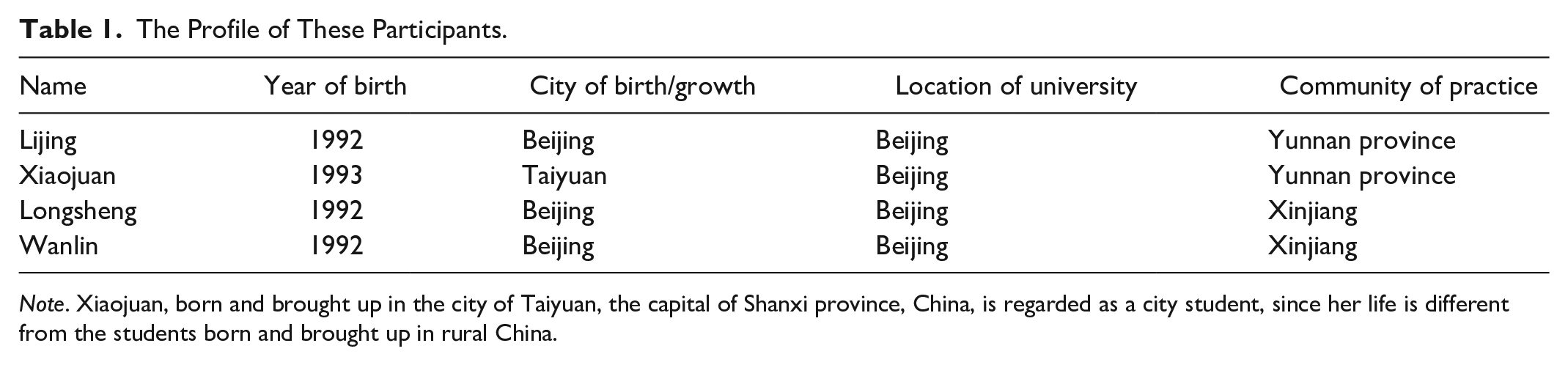
Note. Xiaojuan, born and brought up in the city of Taiyuan, the capital of Shanxi province, China, is regarded as a city student, since her life is different from the students born and brought up in rural China.
Data Collection and Analysis
These participants were enrolled in different Bachelor degree courses at University X, a top teacher university in China; after several contacts, the researchers decided to formally invite them to join in this project. A formal written letter describing the details of this project was sent to them, outlining relevant aspects of this study. The authors acknowledge their integrity and honesty, as they willingly provided their reflections and points of views for this study. The researchers expected to develop rapport with these participants and elicit rich, nuanced data which would answer the research questions. The participants gave their written consent; their privacy was protected by using pseudonyms.
When the researchers started interviewing them, these participants had all finished their volunteer teaching in rural schools and returned to University X. They then enrolled as master-level students in the Faculty of Education, University X. The data collection comprised the researchers’ semi-structured interviews with these participants. The interviews were conducted in the Chinese language, since the participants and the researchers use Chinese as their first language. These interviews were recorded and transcribed in Chinese and then translated into English. After the English transcripts were ready, the participants read them to ensure that the English version accurately conveyed their experiences. The interviews and data collection work lasted for 3 years, spanning their return from rural schools to the end of their 3-year masters course. Over this period, the researchers reflected on how their experiences in a rural community of practice had influenced their perceptions of being and becoming a qualified teacher. Three years on, the volunteers were revisited to check whether they still agreed with their comments at the first round of interviews.
It should be noted that the second author once taught as a volunteer pre-service teacher in a middle school situated in rural Beijing. Like the participants, after she did her bachelor degree at a teacher university in Beijing, she completed her volunteer teaching, and then finished her masters degree in education at a top teacher university in Beijing. The second researcher’s experience and witnessing of volunteer teaching in rural China helped the researchers to capture the nuances of the interviewees’ experiences. When interpreting and analyzing these data, the other two researchers were heavily involved. They are both professional educators and experienced scholars, and they acted as gatekeepers to ensure that the data were processed objectively. The teaching events in the participants’ interviews were analyzed. The events gathered from all the data were coded and themed, and then they were put together to identify their common characteristics. Thus, all the events were identified, and finally, based on their common characteristics, they were classified into four themes, which are discussed in the next section.
Two dialogues emerged from data coding, theming, and analysis: the researchers’ conversations with the participants, such as interview and daily online communication; and the researchers’ understandings and discussion of the written texts produced in the primary dialogues. These dialogues helped the researchers to catch the nuances of the meanings expressed by the participants. Although the data and findings are limited in scope by the small number of participants and reliance on interview material, the three researchers actively discussed the results, informed by the second author’s first-hand similar experience. Triangulation was achieved through extending the study, with ongoing feedback from these pre-service teachers over 3 years until they achieved their full postgraduate qualifications. These participants’ afterviews were sought 3 years from the start of the study to allow the maturity of perceptions gained through further training and experience to modulate initial perceptions.
Findings and Discussion
Integrating a Rural Educational Community
In the interviews, the pre-service teachers recalled their impressions of their rural community of practice, including their schools, students, and parents. They all stated that the rural education conditions were different from conditions in Beijing. Yet their experience of these differences helped them to understand the local students, schools, and everyday education practices in rural China. For example, Wanlin spoke of his impression of local students and their parents:
The rural educational conditions are like Beijing’s over 10 years ago, and local parents still believe in the Chinese saying, ‘spare the rod and spoil the child’. Generally, local parents are nice, and students look naughty but they are simple and honest. . . . The parents trusted me so much and even told me that I could punish their kids physically. . . . They would follow me, rather than complaining about my work, which is different from some parents in Beijing. (Wanlin)
Addressing their motivation for undertaking teaching in the rural school, the participants mentioned that their primary motivation was to become a teacher, so they wanted to learn how to be a good teacher, and volunteering teaching offered them an opportunity to practice their skills. The following comments reflect that their motivation arose from their interest in rural education and recognition that rural experience would further their careers. As pre-service teachers, they had no prior understanding of rural education.
When I first heard of the opportunity to teach as a volunteer in rural China, I was attracted. . . . I hope I can do something meaningful at some places that need me. . . . This experience will be helpful to my future study and research life. My parents also gave me a lot of support. (Lijing) The essential reason was that I will engage in a teaching career, and this . . . will be very important for my future career. . . . This helped me to grow. (Xiaojuan)
A strong motivation and sense of self are essential to teachers’ long-term commitment and professional development. Their responses suggest that they took agency in constructing their teacher identity when they chose to enter the rural schools, their new community of practice. Becoming a teacher was their choice and decision; they hoped to widen their teaching experience and to gain the trust of students and parents in their rural community. This empowered them to teach well, even though the rural educational facilities and ethos were different from what they experienced in Beijing. For instance, as Wanling stated, some parents gave their permission to punish the students physically, though today this is not acceptable in school education in China; they were expressing their respect and trust for these pre-service teachers from the city. These teachers had to exercise their agency when faced, as in this case, with a conflict between the parents’ expectations and the principles of their training. When an individual’s will and character are met with conflicting standards and expectations, this tension drives the development of their identity. Here, an objective gap between rural China’s expectations and teachers’ experience of urban China is apparent. Nevertheless, these pre-service teachers felt that they were needed, which contributed to their teacher identity construction and helped them to cope with the challenges that they faced.
Engaging in the Rural Community of Practice as a Teacher
During these pre-service teachers’ stay in their rural communities of practice, they all experienced various challenges, making them more aware of the difficulties of teaching in rural China; they could not find answers to some challenges, but they used them to observe, reflect, and grow. They expressed their worries and challenges that they encountered:
Rural students’ family conditions are more complicated. Some students are from single parent families, or their parents may have divorced or passed away, or they stay with grandparents, since their parents have become migrant workers in cities for earning money. . . . Some students’ family conditions are different, which was a great challenge in teaching and managing my class. (Wanlin) The biggest challenge is to stay on good terms with my students. . . . As a teacher from the city, we were able to give them a fresh experience, but it was hard to change them much. (Xiaojuan)
Gao (1999, p. 255), a Chinese-Australian scholar, uses the concept of “two Chinas,” rural China and urban China, and he comments that “rural China is not only different from urban China economically, but also politically.” These pre-service teachers needed to learn about rural China as well as about the social and educational practices in rural areas. They also needed to understand the real social contexts in which the rural students were brought up. They found that they could not teach these students well in their rural community of practice unless they got to know them and set up good communication patterns with them, as well as with their parents. In doing so, they needed to make allowance for different practices of learning, behavior, and discipline. In such an unfamiliar community of practice, the teachers drew on what they had learned, and they found they needed to be flexible and find new ways of solving problems and helping students. This positive approach helped them to teach creatively and to construct their teacher identity. For example, both Lijing and Wanlin reflected on how they found ways of helping their students to learn.
Initially, I used my previous way of teaching in class, but I found it was not the best way for students. Here the students’ English was weak, and they could not understand me. I discussed it with local experienced teachers and solved this problem. . . . I needed to change and overcome the gaps, and I did this. (Lijing)
Wanlin also mentioned that she adopted a different way of teaching because the rural students were different from the students in Beijing.
If I noticed that a student was different from the others, I would try to figure out the reason and help him or her to become happy and active. For instance, some students were aggressive, and they liked to fight with each other. I told them that a fist is not an effective way to solve any problems. I also threw away the ‘teaching stick’, a wooden stick used to punish students physically, and told them that they should learn to respect others. I also helped them to improve their learning interests, and gradually their marks improved a lot. (Wanlin)
This teacher used her observation, intuition, and compassion to help her to understand and work with students who were “different.” She taught her classes about respect and non-aggression by example, and she also focused on their learning interests and helped them to develop their knowledge. Although physical discipline was an accepted method in the school, she drew on her training as well as her emotional intelligence and found other ways of disciplining her students. Her approach was a holistic one, looking at all sides of the learning process in a community of practice: emotional, physical, and intellectual. It is expected that these pre-service teachers’ experiences in their rural community of practice will benefit and inform their future career choices and professional identity development.
Aligning With Supporters in Rural Community of Practice
Over the year of teaching in the rural community of practice, these pre-service teachers changed their roles to cope with teaching challenges. Some tried to engage in the world of rural students and help them to build up confidence or change learning habits, as they became aware of the social issues in rural schools. For example, they found that rural students needed more attention; their problems were connected to the fact that most of them were away from their homes. The process of professional identity construction is reflected in their comments about the roles required of a teacher in rural schools.
At the beginning, I often lost my temper. Later I realized a teacher’s emotions could have a negative influence on students and could not solve any problems. A good teacher needs to help students to face problems and solve them. . . . I then become more patient and was able to teach students more effectively, rather than doing something for them. (Wanlin)
Xiaojuan learned to modulate her responses to rural students’ learning behavior and difficulties and see things more from the students’ point of view. She encouraged a motivated student to develop her learning skills and improve her performance. Similar teaching experiences reminded these pre-service teachers to consider their teacher identity in future education practices.
In my class, a female student wanted to learn math but could not find an effective way. I helped her and encouraged her a lot. When I left, she passed her math examination. In her latest examination she scored over 100 out of 120. From her change I could clearly see the influence that a teacher can have on a student, and this drives me to think more about how to be a professional teacher. (Xiaojuan)
Both Lijing and Wanling used agency in their responses to the gap between teacher and student, and modulated the hierarchical, Confucian pedagogic style that they had been taught. Lijing expressed friendship and openness in her communication in an effective way.
Very often new teachers are taught to first create a sense of authority as an effective approach to controlling the class, so they will not give their students a smiling face. However, I tried to be a friendly teacher, and encouraged students to have dialogues with me. My teaching style was successful, and a local teacher agreed with me [that it was effective]. (Lijing)
Wanling found that reliance on textbooks was not enough.
A teacher must often communicate with students. Practically, a teacher may find that those theories learned from textbooks are not as effective as frequent communication with students. A teacher needs to play different roles, sometimes as a father or a mother, and sometimes as a brother or a sister. The most essential role is to be a teacher. A new teacher may hurry to push a student to change; however, it is not easy, and a student cannot be changed in one day. (Wanlin)
Wanlin expresses a nuanced awareness that communication in a classroom is not a one-way process of rote learning, and that a teacher’s role is multi-dimensional in a community of practice, and teaching is a practice of patience. These reflections reveal that the teachers were able to modulate their practice, although they had not been prepared for such complex pedagogical challenges. They reshaped their professional role little by little as they adapted to the rural community of educational practice, and this enabled them to empower their students to learn and to develop; reciprocally, in the process of becoming teachers, they were constructing their professional identity and preparing themselves for a future career in education. This is the power of a community of practice.
The teachers acknowledged that they learned a lot from their community of practice. For example, the positive comments and praise offered by local teachers and parents rewarded and encouraged them to think further about how to be a good teacher. Some teachers in rural settings have worked very hard, and they have given up their position in large cities to contribute to rural students’ education; their devotion and contributions set a good example for these pre-service teachers from the city and encouraged them to think about their own future careers.
I keep in contact with a local teacher. She is humble and nice to students. She does not feel that she has achieved much, as she is always modest. Another local teacher was invited to Beijing and praised by the national government. She was professional, though she experienced many difficulties. Their teaching career impressed me greatly. (Longsheng)
In putting their best into their rural community of practice, the participant teachers found support, encouragement, and many rewards and joys.
Here people were kind to me. The leaders treated us well, and students’ parents invited us to share a meal on Chinese festival days. An experienced local teacher was assigned as tutor to supervise me so that I could learn how to teach. Some local peers came to observe my teaching and gave me suggestions. Some peers always remembered to look after pre-service teachers like me, and I was touched. Local students often picked wildflowers for pre-service teachers from cities, which made me feel that these students remember me. As a teacher, my teaching is meaningful, and I feel very good [about the experience]. (Xiaojuan)
This was, for these pre-service teachers, a true and positive community of practice. They learned from other experienced teachers and peers, and they felt that they were respected and appreciated by local students and parents, and had a positive influence on their student’s learning experiences. Their experiences in this community of practice gave them a sense of satisfaction and encouraged them to devote themselves to teaching in the future.
Reflections on Becoming a Teacher
Opportunities for productive and purposeful reflection are necessary and helpful for a new teacher’s growth and professional development (Schön, 1987). These pre-service teachers did not have much experience when they started to teach soon after finishing their bachelor’s degree course. When they finished their rural teaching, they had come to value their teaching practice and the profession of teaching. In the interviews, they reflected on what becoming a teacher meant to them. A common theme expressed in their reflections is that teaching should not just be concerned with textbook knowledge; rather, a teacher’s identity is based on a pedagogy of love and respect. Here, some participants shared their reflections:
I am not just concerned with textbook knowledge; I am more concerned about how to help students to grow. What students need is not just knowledge from textbooks; they need someone to help them to grow. . . . The most important thing is to give students a bright and positive direction and help them to grow in the right direction, not just help them to achieve a high score. (Longsheng) Education is not like what the textbook tells us, that students will change after a teacher simply tells them a story. . . . Without love, he or she cannot be a good teacher, and . . . teaching is an art. (Wanlin) Previously I felt that teaching is no more than an occupation. . . . Now, teaching is a responsibility and it is an obligation to our community. (Xiaojuan)
Through these reflections, these pre-service teachers express that they can begin to align what they have learned in their previous course work with what they observed and learned in their rural community of practice. They agreed that rural teaching practice had given them food for thought about their future teaching. For example, both Lijing and Wanlin felt that their teaching experiences have pushed their identity construction.
My rural teaching experience pushed me to commit to an education career. . . . I often thought about how to educate a person. The one-year teaching experience has become an inner resource, a hidden treasure. It is a layer in my mind and will be helpful in my future teaching career. (Lijing) What my students gave to me is much more than what I gave to them. . . . I have become mature and confident. (Wanlin)
It is significant that these pre-service teachers felt that their experience in the rural education community of practice was a resource that they could draw on in future careers, that they had gained a great deal from their community of practice, and were moved by their experiences to reflect on teaching, not just as a job, a way of earning a living, but as a practice of mind, body, and spirit, an exchange of learning, and a labor of love. Their interactions in the year of teaching in their communities of practice gave them confidence that they were becoming qualified as teachers both emotionally and professionally, because they felt needed at the rural schools where they practiced and gratified by the learning that they had both given and gained. At the same time, they gained the respect of the local people. These experiences in their rural community of educational practice helped them to understand rural China and rural educational challenges and gave impetus to their future career as well as enabling their teacher identity construction.
Conclusion and Limitations
Every year, a number of pre-service teachers are selected to teach as volunteers in the schools located in rural China, yet these volunteers and their experience are seldom studied, and there is little understanding of the challenges pre-service teachers face to their learned pedagogy and communication practices, how they interact with local students, teachers, and local people, and whether/how their experience in rural schools will influence their professional identity construction and future career choice. The small cohort of pre-service teachers’ experiences are reported in this qualitative case study, offering in-depth reflections on how such challenges can be met by other pre-service teachers who are planning volunteer teaching. The researchers’ findings are valuable for all stakeholders to understand rural education practices, including rural students, teachers, and university graduate students and their educators. In particular, some of the findings are relevant to the philosophy of teacher education, suggesting that the traditional, authoritarian model of teaching lacks the human qualities of love, understanding, kindness, and awareness of the need for flexibility and inclusiveness in teaching diverse cohorts of students with complex needs. Academically, therefore, this project may inform current and future pre-service teacher education.
These pre-service teachers’ professional identity construction can be understood as a dialogue between the nascent identity of a pre-service city teacher and the becoming-identity of a professional teacher within a rural community of practice. In their dialogues, these participants did not rely on their privileged position in relation to rural students and their local peers; instead, they made use of their agency and devoted themselves to their work. In this process, they encountered conflicts and challenges and gained strength and confidence through them, building their teacher identity in positive ways. For instance, these teachers showed their resilience in finding ways to meet rural teaching challenges. They also showed sensitivity and imaginative observational powers in their interactions with local students, parents, and peers, and in turn, were offered support by them and by the principal, as well as by parents. This helped them to learn how to teach effectively. They were able to open themselves to others, reflecting on aspects of their changing selfhood. They learned a lot about how to teach professionally and began the process of gradually constructing a resilient, resourceful teacher identity. In the process, and in reflective retrospect, they were able to see their identity through the eyes of different people without losing their sense of self.
The teaching experiences gained in rural communities of educational practice enabled these pre-service teachers to earn their social capital (Bourdieu, 2002), which can be transformed into other forms of capital in their future career. Also, when they encountered at first hand the needs of the rural students for encouragement, love, understanding, and kindness, they came to question some of the traditional authoritarian ideas concerning the teacher’s professional roles that they had been taught in the university classroom. They observed the local students’ need for praise, for positive mentoring and parenting roles, for freshness and enthusiasm, for friendship, for approval. All these human qualities gained in this rural community of practice exceed the traditional authoritarian model of a teacher’s identity in China and inspired them to teach within a more humane and holistic model. Accordingly, both their personal and their professional identity were challenged and reshaped, thus, no doubt, contributing to their teacher identity construction and professional development. Their reflections on their immersion in this community of educational practice throw a fresh light on the role of a teacher and the different needs of students and limiting factors in their development which affect their learning process.
A teacher’s identity construction and professional development usually continue to develop throughout his or her career (Buchanan, 2015), and these pre-service teachers’ identity construction in their rural community of practice was just the beginning of their teacher identity construction. It will be an ongoing process, building on the agency that they achieved as fledgling teachers within a rural community of practice. Their rural teaching experience will push them to think about the value of being a qualified teacher and how to be an effective teacher. In this sense, their teaching experience in the rural communities of practice was successful, and will contribute to their teacher identity construction and professional development. These participants’ experiences confirm that volunteer teaching in rural community of practice is an effective method to train pre-service teachers, and enriches the pre-service teacher education.
This qualitative case study is limited to an exploration of four pre-service teachers’ identity construction in their rural communities of practice. The voices of rural students and local teachers are not explored, and this warrants future research. The restriction of the study to four cases was in response to the need for in-depth, rich data, and to limited resources. This was offset by having three researchers, one of whom has first-hand experience of rural teaching as a volunteer pre-service teacher, and by extending the study over 3 years to catch the modulations of retrospective reflection and triangulate the findings. When revising this paper, the researchers were recently informed that these participants have chosen teaching as their career, though they did not choose to work in rural China for various reasons. The rich social capital that these pre-service teachers earned in rural China has influenced and will continue to influence their future career and identity construction. This invites follow-up research in the future.
Footnotes
Declaration of Conflicting Interests
The author(s) declared no potential conflicts of interest with respect to the research, authorship, and/or publication of this article.
Funding
The author(s) disclosed receipt of the following financial support for the research, authorship, and/or publication of this article: This work was supported by Shanghai University of Finance and Economics (grant number 2019110115).
