




Abstract
Motivation as the driving force for achieving success, pursuing goals and fulfilling objectives, is shaped and affected by intrinsic and extrinsic factors, psychological contract and work attitude. Like other professionals, English language teachers also need to be motivated for continuous professional improvement in order to achieve organizational goals and ultimately reach high educational quality. Thus, it is of high importance to investigate teachers’ (de)motivation toward CPD. This paper focuses on the (de)motivational reasons as to why English language teachers at a university do not take part in professional development despite their awareness of its significance for their career, institution’s development and their students’ learning. The data from EFL teachers were collected through an online questionnaire consisting of three open-ended questions. The majority of the teachers were found to feel that the continuing professional development events were organized without considering their current workload, needs and contextual factors. It was also found out that the general organizational atmosphere and work attitudes of their colleagues led to decreased motivation and psychological contract. These results offer certain implications for the administrators of educational institutions regarding the importance of considering motivational factors, psychological contract and work attitude in planning continuing professional development for English language teachers.
Plain Language Summary
This paper focuses on the (de)motivational reasons as to why English language teachers at a university do not take part in professional development despite their awareness of its significance for their career, institution’s development and their students’ learning. The data from 30 English language teachers were collected through an online questionnaire consisting of three open-ended questions. According to the findings, the majority of the teachers feel that the continuing professional development events were organized without considering their current workload, needs and contextual factors. It was also found out that despite a group of teachers being motivated, the general organizational atmosphere and work attitudes of their colleagues led to decreased motivation and psychological contract. These results offer certain implications for the administrators of educational institutions of the same type regarding the importance of considering motivational factors, psychological contract and work attitude in planning continuing professional development for English language teachers.
Keywords
Introduction
The ever-lasting technological developments and ever growing demand for changes affect all aspects of life including education in general and English language teaching (ELT), in particular. Such developments in ELT make continuing professional development (CPD) an inevitable requirement for teachers’ and institutions’ long-term success as well as improved student learning. However, English language teachers’ perceptions, attitudes and needs regarding professional development may vary based on various factors. Thus, teachers have different CPD needs and expectations according to which stage they are at in their careers (Davidson et al., 2012; Mahmoudi & Özkan, 2015). For example, experienced teachers take their own knowledge base, ability to make on-spot decisions depending on prior experience, deeper understanding of the learners, and better awareness of their teaching context into consideration (Tsui, 2003) to choose the CPD activities they would like to participate.
At this point, it is critical to understand that “engagement and motivation, sometimes used interchangeably, are distinct but overlapping concepts” (Noonan, 2022, p. 2) and positive feelings for the components of engagement (behavioral, cognitive, and emotional) lead to higher levels of motivation (Noonan, 2022). In addition to the years of experience, the available literature suggests that language teachers’ (de)motivation for professional development is closely related to psychological contract, work attitude and organizational factors (Çimen & Ozgan, 2018; Geijsel et al., 2009; İpek & Kanatlar, 2018; Praver & Oga-Baldwin, 2008). It is also reported in the literature that a well-planned professional development program contributes to L2 teachers’ identity formation and development (Aslan, 2022). Therefore, it has been more challenging for the institutions to offer CPD activities to trigger teachers’ motivation, especially when they experience demotivation due to psychological factors, relatively long years of experience and organizational factors. Without strong sources of motivation or in cases of lack of motivation, people tend to lose their interest and desire to achieve a certain objective.
This paper concentrates on the relationship between motivation of experienced L2 teachers and CPD in an attempt to analyze the reasons behind experienced L2 teachers’ (de)motivation toward CPD from the perspectives of self-determination theory and psychological contract. According to Khanal et al. (2021) teachers’ demotivation emerging from emotional, cognitive, sociocultural and psychological factors results in “exhaustion, depersonalization, burnout, decreased teacher achievement and self-worth stress” (p. 82). Recent studies on the motivation of language teachers toward CPD mainly focus on the opinions and views of teachers who participate in CPD with varying degrees of motivation (Ballıdağ & Dikilitaş, 2021; Basikin, 2020; Tran et al., 2022; Yang, 2021; Zhang et al., 2021). There are scarce number of studies that investigate into the views of teachers who do not wish to participate in CPD and their (de)motivational reasons. To fill this research gap, this study focuses on identifying the views of the teachers who were reluctant participate in the CPD program offered in their institution by elaborating their reasons behind this (de)motivation.
Literature Review
In a recent study, Lamb and Wyatt (2019) reported that motivation has not received much attention in the field of second language teacher education (SLTE) and “protecting and enhancing teacher motivation should be an inherent goal of SLTE” (p. 522). Such a realization would result in more effort to understand the nature of teachers’ motivation, therefore, it “will help teacher educators determine whether participating teachers are likely to benefit from the processes of SLTE on offer, and if not, which alternative continuing professional development activities might be more successful” (Lamb & Wyatt, 2019, p. 522).
Toward the goal of understanding the reasons behind teachers’ (de)motivation, it is essential to understand what motivation is and what elements it is made of. Motivation can be defined “as the drive and persistence required to fulfil targets” (Lee & Liu, 2009, p. 322). According to Pintrich and Schunk (1996), motivation functions as a crucial foundation for successful cognitive planning, organizational goals, learning and assessment. In this regard, motivation has been associated with achievement, and due to the increasing decline in motivation in schools and the need to foster motivation in academic settings, researchers ultimately concentrated on motivation (Vu et al., 2022).
As one of the earliest theories on work motivation, motivation-hygiene theory suggests that factors that motivate individuals are of two types: (i) motivator factors that are directly related to the work; or (ii) hygiene factors that are associated with the workplace setting and contextual conditions (Herzberg, 1966). In the research following this theory, these two types were named as intrinsic factors and extrinsic factors, respectively (Deci, 1975; Deci & Ryan, 1985) while discussing self-determination theory. In other words, intrinsic motivation refers to “the doing of an activity for its inherent satisfactions rather than for some separable consequence” (Ryan & Deci, 2000, p. 56). On the contrary, extrinsic motivation reflects a concept “that pertains whenever an activity is done in order to attain some separable outcome” (Ryan & Deci, 2000, p. 60).
Although there is a relatively high level of consensus regarding the classification of motivational factors, some scholars believe that intrinsic and extrinsic motivation can work together, mostly extrinsic motivation fostering intrinsic motivation (Herzberg, 1966; Maslow, 1943; Hackman & Oldham, 1976 as cited in Amabile, 1993); while other researchers argue that the two forms cannot work collaboratively and most of the time, extrinsic motivation hinders intrinsic motivation (Deci, 1975; Lepper & Greene, 1978 as cited in Amabile, 1993). Grant and Shandell (2022) describe work motivation as “the set of psychological forces that guide, energize, and sustain effort in jobs, projects, and tasks” (p. 302).
The complex relationship between intrinsic and extrinsic motivation is examined in detail through self-determination theory (Deci & Ryan, 1985) in which motivation is explained through a continuum starting with amotivation, which is complete lack of motivation, followed by extrinsic motivation, which could be controlled or autonomous, and finalized with intrinsic motivation, which expresses interest and enjoyment of the task (Gagné & Deci, 2005). According to self-determination theory, teachers would genuinely be motivated toward CPD on the condition that it is presented without an external reward, concentrating on its own benefits (Lamb & Wyatt, 2019). Thus, drawing on how self-determination theory can influence work motivation (Gagné & Deci, 2005), it can be claimed that teachers’ motivation toward CPD could also be investigated based on the motivation continuum suggested by self-determination theory.
Considering the nature of motivation and the fact that “motivation can be driven by connections to broader groups and organizations, where people aim for belonging, status, or impact on complete strangers” (Grant & Shandell, 2022, p. 302), it is logical to imply that the concept of psychological contract is also a significant component for (de)motivation in the workplace. As a key component of motivation, the term, psychological contract, refers to the concept that affects and shapes the relationship between an employer and an employee (Argyris, 1960; Guest, 2004). Based on the nature and fulfilment of the expectation of both parties from one another, psychological contract is suggested to take one of the following forms: (i) transactional contract which is based on short-term tasks with mostly financial benefits; (ii) relational contract through which a satisfactory relationship is experienced between employers and employees with both affective and financial benefits; (iii) balanced contract which offers a relationship in the form of a combination of transactional and relational forms; and (iv) transitional arrangements where there is a problematic or non-existing relationship between the parties, especially common in cases of extreme changes in the organization (Hui et al., 2004). It is also suggested that fostering teachers’ fundamental psychological needs would result in more sustainable and improved motivation for CPD (Yang, 2021).
In addition to psychological contract, work attitude is another major factor which influences employees’ motivation in the workplace. Work attitude is composed of three main components: organizational identification, work devotion, and satisfaction with work (Yu, 2006). The first component, once the staff establish a strong identification with their organization, they are more inclined to consider “themselves representing the organization during interactions with nonemployees, embrace corporate interests as primary in their strategic and task decision opportunities, and disassociate themselves from others whose values and goals contradict those of the organization” (Miller et al., 2000, p. 629). Also, work devotion refers to the extent of an employee’s identification with their work through psychological attachment and participation (Kanungo, 1982; Marshall et al., 2004). As for the final component, work satisfaction is defined as an individual’s assessment of their work in terms of psychological, emotional and physical outcomes and the resulting level of overall satisfaction (Hoppock, 1935 as cited in Lee & Liu, 2009; Robbins, 1992).
In addition to the abovementioned component, certain benefits of professional development can be important drives for teacher motivation. One of the main benefits of professional development is achievement of teachers’ goals and institutional objectives. Although both parties’ goals are parallel, teachers’ goals may focus on increasing subject-matter knowledge and pedagogical expertise, understanding learners, curriculum and materials, and career advancement (Richards & Farrell, 2005). On the other hand, institutional objectives can concentrate on institutional development, career development of its teachers, enhancing students’ learning (Richards & Farrell, 2005), creating a learning community for teachers, engaging teachers in research, encouraging teachers to collect and analyze context-specific information, giving teachers opportunity to initiate curriculum improvements, and helping teachers develop new teaching initiatives through professional development (Joyce, 1991). Similarly, Nawab (2020) argues that effective CPD with customized benefits emerge from CPD activities offered and organized within the institution specifically for the teachers of the same organization.
Moreover, existing literature suggests a wide range of factors that influence teachers’ overall motivation regarding their profession. As grouped under intrinsic and extrinsic motivation by İpek and Kanatlar (2018), such factors include: (i) intrinsic factors: “autonomy, feedback, communication and rewards” (p. 27); and (ii) extrinsic factors: opportunities for professional development, organizational support, organizational atmosphere, available resources, facilities and physical infrastructure, working relations with colleagues and administration, leadership practices, teachers’ active participation in the decision-making processes, workload and time constraints (Pennington, 1995). Categorizations similar to these, have been made by other scholars (Dinham & Scott, 2000; Doyle & Kim, 1999; Praver & Oga-Baldwin, 2008; Ryan & Deci, 2000).
Considering that “teachers like their students, have basic psychological needs for autonomy, competence, and relatedness” (p. 7), hence, meeting teachers’ such needs helps them to become more equipped in fostering students’ learning (Ryan & Deci, 2020). It is believed that investigating the reasons why experienced English language teachers are reluctant to participate in CPD activities despite their awareness of its significance for their career, institution’s development and their students learning, is important. Thus, this paper focuses on the reasons why some experienced EFL teachers from a tertiary education institution were not motivated to attend any of the continuing professional development activities organized over a period of one academic year and whether there are any psychological reasons behind this demotivation.
The present study is part of a comprehensive study which aimed to evaluate a voluntary-based continuing professional development program organized in the Foreign Languages and English Preparatory School (FLEPS) of Eastern Mediterranean University (EMU) in North Cyprus based on Guskey’s Model designed specifically for evaluating professional development programs (Guskey, 2000).
The preliminary evaluation of this program revealed that a number of teachers had not attended any of the six CPD events. Thus, a new question originated regarding the reasons for these teachers’ lack of motivation to attend these CPD events.
Method
The present study adopts a qualitative research design which is used as “a means for exploring and understanding the meaning individuals or groups ascribe to a social or human problem” by identifying participants’, usually a small number of people, views in their particular context through open-ended formats of data collection (Creswell & Creswell, 2018, p. 333). Case study research design is generally preferred when the research attempts to find answers to the question of why in real-life contexts (Yin, 2014). Thus, this study is designed as a case study because the study aims to evaluate a program in detail through the voices of participants regarding their reasons for demotivation at the end of one academic year in their own context.
Context
The context of this study is the Foreign Languages and English Preparatory of an English-medium university in Northern Cyprus, offering up to a year of intensive English education for students who will study at English-medium programs. The professional development program in this institution is organized by the Teacher Training and Professional Development Unit (TTPDU) of the preparatory school. Although the unit offers three different programs for the teachers, majority of the teachers opt for the Continuing Professional Development branch which organizes a series of workshops and seminars. One of the remaining programs is a compulsory branch for part-time teachers and the other one is a voluntary program for teachers who were interested in action research.
An online needs analysis survey is sent out to all teachers at the end of each academic year to identify the topics preferred by the teachers and to organize next year’s CPD events (seminars/workshops). Once the topics are identified, a seminar or a workshop on that topic is organized to be presented by an external expert. A repeat session is also organized on the next day of each event for teachers who miss the first session.
The 1-year CPD program in the present study consisted of a total of five seminars/workshops on various topics presented by external speakers and one international conference to which the teachers could have attended on a voluntary basis. The results of the larger study revealed that a number of teachers preferred not to take part in any of these six events. Thus, this study concentrated on the teachers who were reluctant to attend the seminars, in order to find out motivational reasons for their reluctance, as well as their expectations regarding future CPD events and what changes they would like to see to take part in future CPD programs.
Participants
As mentioned before, during the evaluation of the overall professional development program, considerable number of teachers, among 180 teachers of the institution, were identified as reluctant to take part in CPD events. As the study specifically concentrates on the voices of teachers who were reluctant to participate in the CPD events throughout the year, purposeful sampling method was employed in order to collect data that would help to understand the problem and seek answers to the research questions (Creswell & Creswell, 2018) and reached out to the 59 teachers who were reluctant to attend any of the CPD events. Of them, only 30 of them volunteered to respond to the questionnaire. From the participating teachers, 23.3% were male while 76.7% were female. All participants were at the age of 40 or above with more than 15 years of experience. As for their working unit, 33.3% of the teachers were working at the English Preparatory School division and 66.7% of them were working at Foreign Languages division which offers compulsory and elective EAP and ESP courses to all undergraduate programs of the university. The demographic background of the participating teachers are given in Table 1, below:
Demographic Information of the Participants.

Research Questions
In order to investigate why teachers were reluctant to participate in professional development events, the following two research questions were formulated:
What are the reasons for the teachers’ lack of motivation to attend any of the CPD events?
What are the teachers’ expectations regarding the future CPD events?
Data Collection Instrument
The data for the study was collected through an online questionnaire sent out to all the teachers. Following some demographic questions concentrating on gender, nationality, age, years of experience, division they are working at, level of education and frequency of taking part in CPD events within school; the questionnaire consisted of the three following open-ended questions: (i) Why were you not able to attend most of the PD sessions (e.g., workload, clash with teaching hours, topics not interesting, etc.)?; (ii) What would you like to see/have in your institution so that you can attend the future events?; (iii) additional comments. The questions were formulated by the researchers in accordance with the aim of the study as open-ended based on the principles of qualitative research design as they need to be “few in number and intended to elicit views and opinions from the participants” (Creswell & Creswell, 2018, p. 263). In line with the aim and research questions of the study, the questionnaire was piloted after receiving two expert opinions. Then, the questionnaire was piloted with three teachers from the same institutions and who did not take part in the study for clarity. The results of the pilot study showed that the questions were clear to understand, so no changes were made to the instrument. The finalized questionnaire was sent out to all 59 teachers who were reluctant to attend any of the CPD events throughout the academic year and 30 of them responded.
Ethical Considerations
The questionnaire was first approved by the Research Advisory Board of the Eastern Mediterranean University (EMU). Then, a second approval was received from the Research Board of the Foreign Languages and English Preparatory School, EMU. The participants were also asked to read and sign a written informed consent form before responding to the questionnaire. The participating teachers were also ensured about the anonymity of their identities.
Data Analysis
Upon completing the data collection procedures, the collected responses from the teachers were analyzed through thematic content analysis which according to Creswell (2016)“involves identifying segments of text that have meaning and assigning codes to those segments” (p. 365) who also suggests certain steps to be followed during thematic content analysis. In line with these steps, the data collected for the study were analyzed through five steps. First, the collected data were sorted and organized for analysis. Then, the data were read through to gain a general understanding before starting the coding process. Thirdly, the coding process took place by organizing the data in chunks and segments and identifying the codes to represent similar chunks. The themes were, then, generated from the codes to represent the major findings. Lastly, narrative passages and summarizing tables have been used to represent and describe the themes. In order to ensure reliability for data analysis, inter-coder agreement was employed ensure congruency between the agreement of two coders (Creswell, 2016). Inter-coder agreement is preferred in qualitative research because it “adds to the sophistication and rigor of qualitative database analysis because more than one individual’s coding scheme is taken into consideration” (Creswell, 2016, p. 421). According to Miles et al. (2014) the agreement rate should be between 85% and 90%. The inter-coder agreement rate for this study was found to be 90%.
Results
The Reasons for the Teachers’ Lack of Motivation to Attend Any of the CPD Events
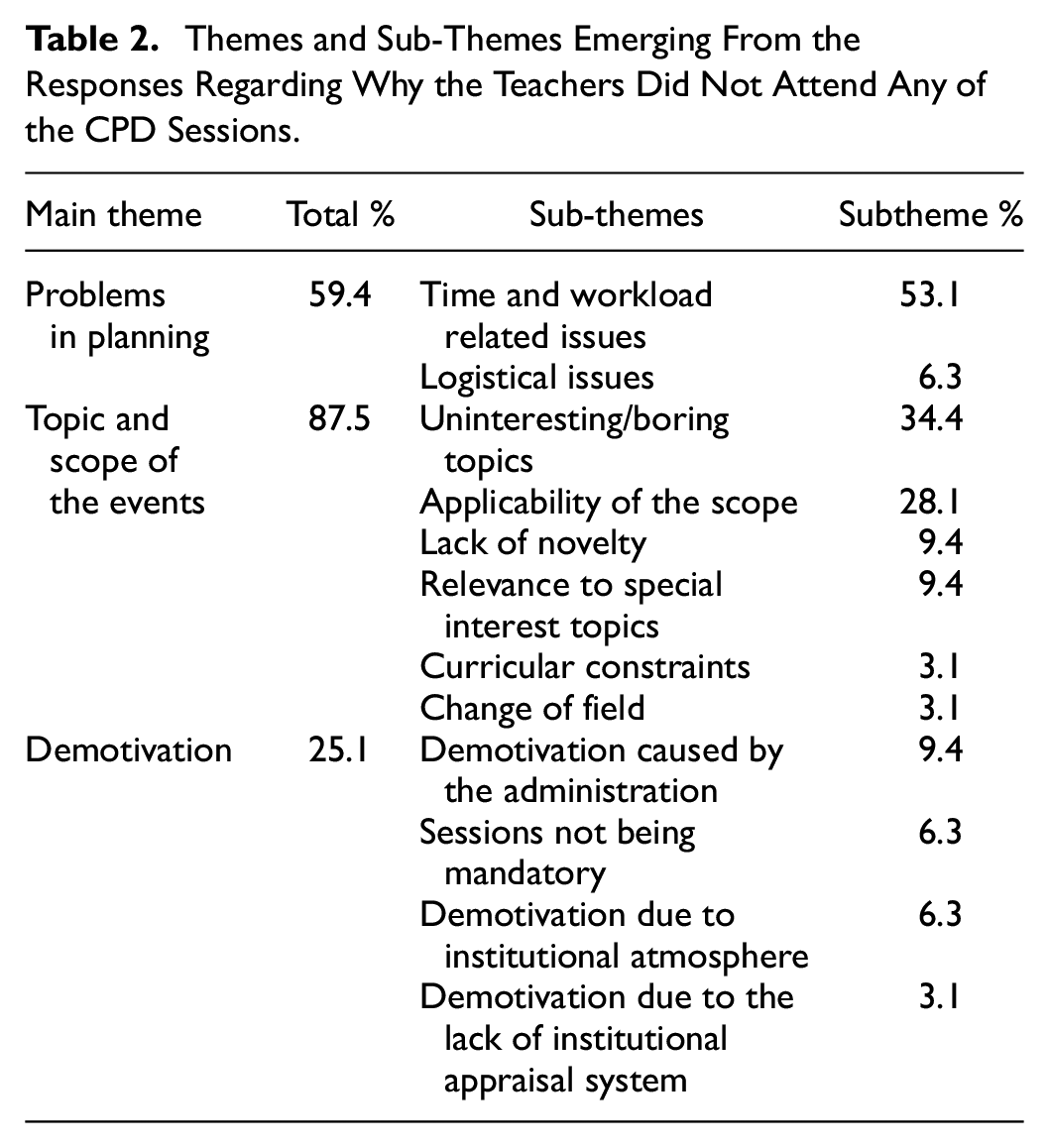
In line with the first research question, the teachers were primarily asked about their reasons for not attending any of the CPD sessions organized over one academic year. The themes and sub-themes that emerged from teachers’ responses regarding their reasons are summarized in Table 2. The results are presented in the order of the main themes given in Table 2.
Themes and Sub-Themes Emerging From the Responses Regarding Why the Teachers Did Not Attend Any of the CPD Sessions.
Main Theme 1: Problems in Planning
Apparently, there are several reasons for teachers that may prevent them from attending the CPD sessions offered by the university. The results revealed that 53.1% of the participants were demotivated due to the time frame limits. For instance, T1 declared that working for several hours a day may not allow him to have sufficient energy to enroll in any of the sessions: “It was hard to attend after 5 hr of teaching usually” (T1). Teachers are usually loaded with several teaching classes, administrative duties, preparation, as well as personal and financial responsibilities. Hence, attending sessions, although being important for their development, may be a stick in their life’s wheel as pointed out in the excerpts from the teachers: “Most sessions clashed with my teaching hours, others that did not were right between my teaching hours” (T7) and “…there were the ones that I found interesting and I really wanted to attend, but I couldn’t find time as I had class/teaching or other administrative duties” (T22).
Main Theme 2: Topics and Scope of the Sessions
Time and workload related reasons were followed by reasons uninteresting/boring topics (34.4%). It is clearly evident in the teachers’ responses that their areas of interest and needs for CPD were not taken into account while planning the CPD activities. Thus, even though the teachers were motivated to take part in CPD, they opted not to participate in any CPD event as the topics failed to meet their field of expertise: “…some were not interesting in my own perspective of teaching vocational English” (T27). Other teachers who found the school-based CPD topics irrelevant or uninteresting preferred to take part in CPD because they know how important it is for this profession but they chose to do so in the CPD activities organized by sources outside the school: As a language teacher, I am really interested in improving myself and try to do so throughout using language-related internet sites or different sources; attending conferences. However, I was not able to attend most of the CPD sessions offered in FL for the last few years as the topics presented were not attractive to me at all (T31).
It was found that 28.1% of the teachers believed that the topics repeated over the years focus mainly on theoretical input which is a (de)motivating factor for teachers. The majority of the teacher take part in CPD events in order to learn about innovative and practical ideas which could be implemented in their classroom. The four-teacher education they received in university provides them with theoretical knowledge, thus, the teachers concentrate more on practicality during their in-service teacher education journey: “Some topics were not very interesting and more theoretical than practical” (T24). Evidently, there are times when the teachers attend the CPD events with the hope of exploring new, practical ideas however, they realize, during the sessions, that the CPD events are not organized specifically for their context, so the ideas provided do not match their teaching context. Due to such previously negative experiences, the teachers opt for not attending the sessions no matter how trending or current the session topic is: …but the main reason is that, the utopic-ideal conditions/classroom which the invited speakers/teachers base their teaching does not exist in a real world, at least in our institution. Most of the time, these are sessions that are organized by book sellers because they have just promised in the contract that they had with our school (T14).
On the other hand, teachers sometimes check the topic of the CPD events and try to decide if they would be able to implement the skills they would gain from the sessions in their actual classrooms. Unfortunately, some teachers reported that even if they attend the CPD events and gain new skills, the physical facilities available throughout the campus would prevent them from practising new ideas. The excerpts below clearly show that the teachers of the Foreign Languages Division opt not to take part in CPD, especially if they are about technology. This is because they do not always use the same classrooms in the campus and not all buildings have the same facilities available. This is another indication that the teachers’ needs and teaching contexts are not considered when planning the CPD events which results in a sense of inequality between the teachers of English Preparatory School, who have technological facilities in all classrooms, and the teachers of Foreign Languages Division, who teach in different buildings in the campus: Actually, as far as I remember, most of them were based on technology. Since the technology (Internet in classes, overhead projector, etc.) in our institution is not good enough, these sessions didn’t excite me. I knew that I wouldn’t be able to use the techniques shown in the sessions. Therefore, I didn’t attend (T9); I am not motivated to attend these sessions, because, as a language school, we are not equipped to try the things we learn with our students. I even do not have a laptop to take into class (I was given once, 10-11 years ago, which is useless now!) to use technology for example. We use record players from 1980s for the listening activities. The classes we use are not for language teaching. It’s too difficult to have group work activities, for example, as the tables and chairs are fixed in the classes. We have a syllabus that we have to follow, and most of the time, it’s impossible to have 10-15 minutes to do an extra activity etc. So let’s not fool each other ☺ we need to be given opportunities, equipment, etc. to be able to make our classes more attractive, enjoyable, and memorable. Knowing very good games, activities etc. is not enough to take this knowledge and use it in class (T19).
Main Theme 3: Demotivation
Another significant finding that emerged from the teacher responses was that 9.4% of the teachers associated their lack of interest in CPD with the demotivation they felt because of the administration’s attitude. For example, some teachers believed that taking part in CPD is not appreciated in their institution: “…Considering that your efforts in developing your academic qualities are not valued much, I’ve lost my interest and motivation to attend the CPD sessions” (T6). As another example of demotivation caused by the administration, the teachers shared their concerns regarding vision-building and genuine interest of the administration in staff development. As a result of administration’s attitudes, the teachers lost their sense of belonging to their institution and thus, do not feel that taking part in CPD matters for them: To be totally honest, I didn’t attend due to lack of interest. I feel the institute (prep school) has lost its focus on teacher training courses and seminars and therefore cannot transfer its own interest to the staff in order for the staff to feel the same interest. I don’t trust the Administration’s intentions of truly wanting to develop their staff’s teaching or even care about the staff at all. Therefore I chose not to attend the seminars. Basically, due to Administration’s attitude towards staff I have lost some ownership (T21).
The teachers also claimed that it is not only the administration of the school that causes demotivation for them, but it is also the higher administration of the university: “I believe that our university has lost its feature of appraising its academic staff’s CPD efforts since 2010. In the past, I attended several workshops and seminars and completed my master’s degree” (T6). In addition to the higher administration, the teachers reported the attitudes of their colleagues toward CPD, “lack of motivation related with the F(oreign) L(anguages) department” (T28) and the indifference of the administration toward such attitudes is another factor for demotivation: Having a busy schedule in terms of workload; bad timing in terms of submission dates of student work (grading); timing as working hours are 8-17 yet the reality is that people need to and do collect children from school so I have decided to follow this trend too (T12).
In addition to the demotivation caused by the school administration, higher administration and their colleagues, the teachers noted that planning the CPD events solely on voluntary basis, rather than making it completely or at least, partially mandatory, caused demotivation on the teachers’ part: “Finally, another simple reason that affected my attendance was probably the fact that it was not compulsory” (T7). This shows that although mandatory CPD is not popularly preferred by teachers, planning CPD events that are partially compulsory or a CPD program with both voluntary and mandatory components would help overcome the demotivation of teachers toward CPD.
As can be seen from Table 2, other reasons for not attending the CPD sessions included changes in teachers’ field of interest, logistical reasons like transportation to and from the sessions, teachers having special interest areas outside the session topics, and curricular constraints.
As mentioned before, this paper comprises only part of a larger study which focuses on the evaluation of a CPD program at a higher education institution. In this comprehensive study data were collected from both the teachers who had participated in more than half of the CPD events during the same academic year regarding the aspects they enjoyed the most and the least about the CPD events and those who did not participate. The responses from the teachers who attended CPD events showed similarities with the responses of the non-participating teachers regarding the negative aspects of the CPD program such as difficulty in finding the time to attend the sessions, how the sessions are unrelated to their specific teaching contexts, the topics not being new for them and less focus on practical applications.
The Teachers’ Expectations Regarding the Future CPD Events
The second research question aimed to find out teachers’ wishes and expectations regarding future CPD events in order to increase their motivation. The themes and sub-themes that emerged from the responses regarding teachers’ expectations for future CPD events are presented in Table 3. The results are discussed in the order of the themes provided in Table 3.
Themes and Sub-Themes Regarding What Teachers Would Like to See in the School to Attend Future CPD Sessions.

Main Theme 1: Topic/Scope of the Events
Similar to their reasons for demotivation toward CPD, the teacher also listed a variety of expectations regarding future CPD events in order to increase their motivation for participation. In line with the complaints on uninteresting or irrelevant CPD topics, 43.8% of the teachers stated that their experience in the profession and field of expertise necessitates customized CPD events with targeted topics. For example, T5 explicitly provided a topic for CPD: “I’m an English teacher with more than 20 years of experience and I had the opportunity to attend many sessions, workshops and seminars. For future events, I’d like to have sessions about testing and assessment” (T5). During the data collection process, it was noted that specialized topics such as testing and assessment or curriculum development were offered in the form of short courses or seminars only for the teachers who were working in the testing unit or the syllabus unit. Thus, the teachers feel that they, as teachers who are not a part of the testing or syllabus unit, are not provided opportunities of CPD in their field of need based on their years of experience.
Additionally, it was found that the teachers do not only consider that the CPD events solely serve the purpose of academic development for teachers and students. It was interesting and pleasing to note that teachers would like to take part in CPD events that focus on topics, other than academic issues such as T9 who wishes to see personal development techniques to be able to improve herself and help her students more: “Personally, I want to see energetic, lively people and trendy new techniques such as Whole Brain Techniques by Chris Biff” (T9). It was also found that teachers are aware of their demotivation and they would like to see CPD events on relevant topics to help them manage burnout or exhaustion in the profession: “I don’t have a specific topic, but apart from academic/ educational topics, we can have some other topics related to administrative issues, teachers’ problems like demotivation, burning out, stress, etc.” (T22). Teachers’ interest in dealing with their demotivation, burnout and stress relevant to their profession can be interpreted as the administration’s lack of concern for the teachers’ well-being. It is possible that the teachers believe that the administration is either not exhibiting sufficient concern for the teachers or not it does not show any concern at all. This causes teachers’ to feel left out by the administration and thus, they seek out solutions to their problems on their own. Another list of possible CPD topics were offered by T12 mostly concentrating on material development and students’ academic success and learner-centered education: More hands-on classroom ideas related to technology, production, no photocopying, e.g. Kahoot, was a huge success among teachers. How to focus on students’ individual needs. How students focus in evaluating their individual needs. How to encourage and deal with student self-evaluation and the benefits it has. How students benefit from learning tool available at our institution. How teachers act as a guide in this process (T12).
The above excerpt is a clear indication of teachers’ awareness of changing learner profile and thus, the changes needed in materials development such as the shift from printed worksheets and books toward e-books, online testing and online worksheets. The teachers are also conscious about the benefits of learner-centered education. However, despite this awareness, they feel that they need more improvement as teachers and as the organization as a whole, to establish guidelines on mutual practices of learner-centered education fitting for the 21st century learners.
Main Theme 2: Administrative/Institutional Expectations
Following the teachers’ expectations concerning the scope of the CPD events, it was found that 21.9% of the teachers emphasized that they would like to see changes in administrative-related issues. The teachers might be believed to resist mandatory CPD, however, the participants of this study stated that the administration could at least make the CPD program partially-mandatory: “Also, a minimum number of compulsory attendance can be required by Admin. The scheduled sessions can be announced at the beginning of the semester and all instructors will have to attend (compulsory minimum 2). For example, 10 sessions; instructors can attend all or choose the most appropriate two and attend those sessions (two is better than none)” (T7). This suggestion could help teachers feel more equality within the institution as all teachers will have to take part in CPD and that their efforts toward CPD would be valued by the administration. In line with responses to the first research question on the limited facilities available within the campus, the teachers feel that the school administration can ask for input from the teachers within the institution for CPD events, rather than paying external speakers and use the money to improve facilities in the classrooms so that the teachers who are genuinely interested in implementing new techniques and skills would be able to do so. Such an approach would also make the teachers feel that their needs are considered and their desire to improve themselves is valued. One of the participants, T19, elaborates on this issue in the following words: I know that these sessions are very important to keep ourselves up to date. But I suggest spending money on having language classes for the first one or two years instead of inviting foreign presents and spending money for them. There are many experienced instructors in our school who are very skilful and have knowledge about lots of different topics. We can ask these instructors to give sessions and/or organize workshops for the school both to save money and to encourage and motivate these instructors. Knowledge is not enough to be able to apply. Instead of saying “we organized 10-15 CPD events, it’s better to be able to say that we have equipped language classes in which our experienced instructors can use, I believe” (T19);
The teachers’ responses show that the establishment and implementation of an appraisal system that would monitor teachers’ CPD practices and show them that these practices and valued and rewarded would contribute to resolving the sense of inequality among teachers, raise awareness that CPD events could actually help to improve classroom practices and foster students’ learning, and increase collegiality within the institution. For example, T6 claimed that an effective appraisal system would ultimately improve motivation: “To determine a healthy appraisal system to increase the motivation and job satisfaction” (T6). Moreover, T28, reported that the two division of the same institution should increase collegiality within themselves by offered unit-specific CPD events to increase motivation of the teachers: “First of all, my department should build teamwork and increase the motivation of the staff. This may invite us to attend the events” (T28). One of the teachers highlighted that the institution sincerely show an effort to help teachers develop with flexible times of CPD sessions so, he believes that the teachers’ motivation to take part in CPD could be increased through a rewarding system:
I honestly think that my institution is trying its best to allocate CPD sessions flexibly enough and in accordance with teachers’ timetables. Instead of changing the timing of CPD events, I think teachers should be motivated to attend these events through simple rewards or designing level-specific CPD events to suit teachers’ instruction (T23).
Main Theme 3: Planning of CPD
Another expectation for future CPD events is related to planning and organization of the events. The teachers believe that the administration could work better in terms of promoting the seminars and that it can show sincere interest in the development of the teachers along with the institution as stated by one of the teachers: “A true developmental interest from the Admin. More promotion of the seminars” (T21). It is evident in the responses of teachers to both of the research questions that the administration is perceived as not showing a sincere interest in development or even if they have such an interest, it is not conveyed to the teachers through the actions and attitudes. As for the planning and workload related expectations from the administration, the teachers wish to see the list of CPD events available for that academic year at the start of the year to review their schedule and plan accordingly: “Maybe, if all the events are promoted at the beginning of the semester, everyone can choose the CPD event they are most interested in in advance, and plan accordingly” (T30). The teachers also think that the TTPD Unit and the administration should consider teachers’ heavy workload during exam weeks and toward the end of the semester due to assignments and feedback for students, so the Unit should avoid scheduling CPD events during these periods: “I would like the CPD team to consider our academic commitments and that our priority is our students” (T32).
The findings revealed that although the TTPD Unit conducts an online needs analysis survey at the end of each academic year, a more detailed needs analysis with specific focus on context specific factors, such as the contextual differences for English Preparatory School Division and Foreign Languages Division is required. Among the participating teachers, 15.6% of the teachers suggested a more detailed needs analysis that would help to plan CPD events in more customized detail: “To organize sessions/events that will contribute to my classroom, bearing in mind the needs of my students, my technological disadvantages and testing/curriculum factors” (T14). Additionally, needs analysis should be carried out to find out about the facilities available in the classrooms, different student profiles and cultural setting throughout the campus so that the scope of the CPD events would be better suited for teachers using various classrooms with limited facilities: “More practical sessions on effective use of technology in class considering our teaching environment, facilities and student profile” (T24).
The results that emerged from the responses to both of the research questions were partly surprising as teachers generally tend not to overtly criticize the administration of their institution or state that they need a mandatory CPD program along with a monitoring mechanism. By the same token, the teachers who attended more than half of the CPD events during the same academic year listed their suggestions for improvement which were found to show parallelism with the expectations of the teachers who were reluctant to attend the CPD events. The suggestions included needs-based workshops on specific topics, short follow-up sessions on how to apply the practical knowledge, and improving the organizational atmosphere to encourage the attendance of more colleagues.
Discussion
Regarding the first question on the reasons for teachers’ reluctance, the findings of the current study revealed that the reasons for experienced teachers’ (de)motivation to take part in the CPD events were not limited to time and workload related issues, uninteresting topics, theoretical sessions rather than practical ideas but were also affected by the lack of an appraisal system, institutional practices, as well as organizational atmosphere and workplace conditions. Unlike the majority of the studies included in the literature which have focused on the teachers who participate in CPD events, this study concentrates on the responses of the teachers who were reluctant to take part in any kind of CPD event for one academic year. In this respect, this study attempts to fill a research gap in the relevant literature by focusing on the reasons for the (de)motivation of teachers who opt not to participate in CPD.
As regards the effect of organizational climate on teachers’ motivation, some teachers noted that although they were motivated to participate in CPD events, the general atmosphere of the institution and the attitudes of the majority of their colleagues, caused demotivation. This was in line with the findings of the study conducted by Cirocki and Farrell (2019). In support of this finding, there are many studies which suggest that collegial relations and the overall atmosphere of the institution have significant impact on teachers’ motivation in the workplace (İpek & Kanatlar, 2018; Praver & Oga-Baldwin, 2008). Similar to what Fox and Poultney (2020) found in their study, lack of mutual perception toward and understanding of CPD could be a limiting factor for teachers (de) motivation.
The findings showed that although majority of the teachers had certain topics in mind which they want to learn about, they still did not attend any of the CPD sessions due to various reasons such as change of field of interest, workload or time-related constraints, uninteresting topics, applicability of the presented content, novelty of the topics, curricular constraints, limited availability of the facilities. Similarly, Fox and Poultney (2020) also reported “tensions between priorities and agendas within and beyond school” and financial issues play a role as challenging factors (p. 397). In such cases, as supported by other studies, teachers feel that the CPD sessions and activities are organized without considering their needs in terms of professional growth, actual classroom practices and workload (Güçlü, 2018; Yücedağ & Karakaş, 2019). Ignoring teachers’ professional and contextual needs as well as their workload while organizing the CPD activities is believed to cause teachers to feel not valued as a team member within the organization (Doyle & Kim, 1999), it negatively influences their psychological capital and work devotion (Çimen & Ozgan, 2018), ultimately resulting in demotivation.
In an attempt to answer the second research question on teachers’ expectations for future CPD events, the responses implicate that the administration might want to consider working more with the teachers in planning and executing the CPD activities so the teachers would feel more involved and be more motivated to participate. CPD sessions are suggested to be organized separately for two divisions: English Preparatory School where English is offered solely as EFL; and Foreign Languages Division where classes focus on EAP and ESP, in addition to EFL. Also, an agreement on the topics of PD activities and how new knowledge can be utilized in real-life classrooms is crucial in teachers’ practices of new knowledge and skills (Reynolds et al., 2022). Such a practice of transformational leadership will ensure that customized CPD is offered to each division in accordance with their needs which will improve teachers’ sense of identification with the organization and their motivation (Geijsel et al., 2009; Leithwood & Jantzi, 2006; Sokel, 2019).
Additionally, teachers’ responses indicate that the lack of an appraisal system might be the reason revealing the perceived inequality between the teachers who take part in CPD and those who do not. It would be necessary to implement some kind of appraisal system without threatening the teachers job security and welfare within the institution so the teachers’ resistance against CPD activities might be overcome and they would feel the need to participate in CPD which they might also, in return, find rewarding, after all (İpek & Kanatlar, 2018). In line with teachers’ preference on establishing and implementing and appraisal system, it is also suggested that such mechanisms in institutions are needed to determine the needs and objectives to be met within the institution (Davidson et al., 2012).
An essential component of each CPD program is the evaluation by the teachers and the administration (Davidson et al., 2012). The responses from the teachers showed that a mechanism is needed to evaluate the CPD program from the perspectives of all stakeholders (e.g., teachers, presenters, school administration, and teacher trainers). The teachers of the study reported that they feel isolated because their needs are not taken into account as well as their opinions regarding the planning of CPD activities and their views upon completion of the CPD program. The lack of a systematic evaluation of CPD activities may lead to a risk of losing opportunities and not noticing significant areas of deficiency (Borg, 2015). The teachers can share their observations or notes with their colleagues to receive peer feedback while the institution conducts a more comprehensive evaluation of the program in general and share the results with the staff over lunch, a short meeting or a written report to kindly ask for their feedback and suggestions for improvement. Also, democratic staff meetings, attitudes and values congruent with the CPD vision and mission of the institution, supportive leadership, administration taking part in CPD as learners foster collegiality and collaboration within the institution (Stutchbury et al., 2022). This will ensure teachers’ sense of belonging toward the institution and increase their overall participation in the CPD activities as well as offering them a concrete path for professional development (Dinham & Scott, 2000; Ryan & Deci, 2000).
The views of the teachers who were reluctant to participate in CPD revealed their reasons for being (de)motivated toward CPD, mainly, as the administration’s disregard for their needs and views about CPD, sense of inequality between teachers who participate in CPD and those who do not, lack of collegiality and sense of belonging to the institution, and non-existence of an evaluation mechanism for the overall program. It is believed that for any of these changes to take place or for any CPD program to work effectively, it might be a good idea to establish a strong community of practice or a learning community within the institutions. In the case of the institution under focus in the present study, two communities can be formed for the two separate divisions. A strong learning community can be established by forming a sense of belonging and helping teachers realize that both the administration and the teachers are working toward the same goal: students’ learning. In other words, it should be acknowledged by all teachers and the administration that the institution’s vision is a priority and the members of the institutions should work collaboratively toward this vision. This vision building is a key element in transformational leadership practices (Geijsel et al., 2009). A consensus regarding what PD is and how it can be sought within the institution is critical in determining the effectiveness of school-based CPD programs (Nawab, 2020). An example of such practices could be lesson study, a Japanese PD model, found to foster collegiality and collaboration among teachers and help to establish a bottom-up PD model (Bayram & Bıkmaz, 2021). Another simple yet effective way of establishing a strong learning community would be to prepare a document on CPD policy of the institution by taking into account the needs of the institution; needs, interests and prior experience of the teachers; the CPD resources available to the institution; and ways to evaluate the impact of the program regarding students’ learning and meeting the needs of both the institution and the teachers. Such a document should/might include and clearly define the following: institution’s approach to CPD; how CPD is linked to the other activities of the institution; offered investment opportunities for teachers’ individual CPD; help teachers to plan and record their CPD activities; help teachers identify their needs and find relevant CPD activities; provide teachers with CPD resources such as reading lists, blogs or websites to visit; describe how CPD will be evaluated within the institution; and how the impact of CPD will be evaluated in general (Davidson et al., 2012).
Conclusion
To sum up, the findings showed that while most of the teachers are demotivated due to various factors, there is a small number of teachers who embarked on their CPD journal with high level of motivation but were exhausted in the process due to organizational climate and other factors. Yelich Biniecki (2022), similarly, reported that concentrating on group learning and structure of the programs can contribute to the improvement of CPD programs. Recalling the discussion on whether intrinsic and extrinsic motivation factors can work together or not and in light of the findings from this study, it can be claimed that extrinsic factors (attitude of the administration, sense of unfair treatment between teachers, workload-time related issues, institutions’ overall climate, etc.) have a strong negative impact on teachers’ intrinsic motivation (autonomy, communication, etc.) which is in line with the research findings of some scholars (Deci, 1971; Lepper & Greene, 1975).
As suggested by Yu (2006), organizational identification, work devotion and satisfaction with work are the components of work attitude which also influence psychological contract of teachers. The findings of this study also showed that these components affect teachers’ (de)motivation toward CPD. All these factors contribute to teacher (de)motivation and this has certain implications for teacher educators, as well. Considering that students’ motivation in learning is directly affected by teachers’ motivation, acknowledging and protecting prospective teachers’ desire to become teachers and helping them understand the importance of “developing as teachers should be a central concern of teacher educators” (Lamb & Wyatt, 2019, p. 530).
In light of the findings of the present study on the effects of organizational climate and workplace conditions on teachers’ (de)motivation, it can be argued that institutions should constantly evaluate the institutional facilities and workplace conditions they provide for the teachers. Recent research on ideal workplace conditions for teachers’ professional development listed the four significant concepts as “collaboration, teacher empowerment, supervision and evaluation, and teachers’ motivational strategies” (Tran et al., 2022, p. 238). These four key elements of a workplace supporting teachers’ professional development support the findings of this study that teachers’ (de)motivation is affected by organizational atmosphere and climate within the workplace to participate in CPD.
The responses from the teachers indicated that innovative leadership practices consisting of common vision building and active involvement of teachers in the planning and implementation of CPD activities play a crucial role in the (de)motivation of teachers. Lack of such practices might be the reasons causing a decrease in their identification with the organization and devotion to their profession. This is also evident in the study by Amzat et al. (2022), where they found that instructional and distributed leadership practices result in more effective CPD.
Limitations
The current study is limited in terms of its context as it was conducted in a single institution with a limited number of teachers. It is also limited in terms of not employing an experimental approach to investigate the impact of self-determination theory on work motivation as proposed by Gagné and Deci (2005). Another limitation is the data collection instrument which is an online questionnaire rather than face-to-face or online interviews.
Suggestions for Further Research
Further studies can help similar institutions in different contexts to take a transformational leadership approach and involve teachers in the vision building process to improve their organizational identification. Furthermore, future studies can create a customized, tailor-made appraisal system for specific institutional contexts and evaluate teachers’ attendance and performances following the implementation of a rewarding system which would attempt to eliminate the sense of unfair treatment among teachers. Moreover, studies with experimental approach could by conducted to investigate the impact of self-determination theory on work motivation and motivation toward CPD. Lastly, the professional learning conditions of English language teachers from different institutions can be investigated to reach comparative results and generalizable implications as to the motivation, psychological contract and work attitude of English language teachers in CPD programs.
Footnotes
Declaration of Conflicting Interests
The author(s) declared no potential conflicts of interest with respect to the research, authorship, and/or publication of this article.
Funding
The author(s) received no financial support for the research, authorship, and/or publication of this article.
Ethics statement
The data collection instrument of the study was reviewed and approved by the Research and Publication Ethics Board of Eastern Mediterranean University (Decision Number: ETK00-2017-0233). The participants provided their written informed consent to participate in this study.

Data Availability Statement
Datasets can be accessed upon request from the corresponding author via