




Abstract
Using data from the Teaching and Learning International Survey (TALIS; 2013), this article explores teachers’ needs, support, and barriers in their professional development. The research finds that Australian teachers expressed greater needs in information and communication technology (ICT) use and new technology training for teaching, while Shanghai teachers required more assistance to satisfy students’ individual learning and pedagogical competencies. More than 80% of Australian and Shanghai teachers received scheduled time to support their participation in professional development, whereas less than 20% of Australian and Shanghai teachers received monetary or nonmonetary support. In terms of barriers, Australian and Shanghai teachers reported two significant barriers that conflicted with their participation in professional development: “working schedule” and “a lack of incentives to take part.” This article reveals implications of the study in the design of an effective professional development program for Australian and Shanghai teachers and ends with discussing the limitations of the research and future research directions.
Keywords
Introduction
There is a strong perception that teachers’ teaching effectiveness and their students’ performance can be improved by teachers participating in professional development programs (Garet et al., 2001). However, some other studies argue that professional development has limited positive influences on teachers and students (Darling-Hammond et al., 2017; TNTP, 2015; M. L. Zhang et al., 2015). In fact, the domain of effective professional development is attracting more and more attention from scholars, and one critical topic is the features of an effective professional development program. Many studies try to address this problem and provide answers on the features of effective professional development, such as a focus on curriculum and subject content, connect with teachers’ daily practice, align with educational authorities’ standards for teachers, and provide learning opportunities for teachers (Borko, 2004; Darling-Hammond et al., 2017; Garet et al., 2001; Loucks-Horsley et al., 2003; Penuel et al., 2007). However, these features are perhaps too broadly defined to give specific guidance for us to design an effective professional development program. Researchers suggest that a professional development program should be designed which is relevant to real practice within classrooms and which meets the needs and requirements of teachers (Borko, 2004; Rotherham et al., 2008). Therefore, identifying teachers’ professional development needs and confirming that teachers can conveniently participate in professional development programs are regarded as a solution to the misalignment in design of professional development programs and will earn many researchers’ attentions than before (Darling-Hammond et al., 2017; Tooley & Connally, 2016).
Recently, teachers’ participation in and need for professional development have been discussed in the context of various subjects, such as teaching the English language (Kabilan & Veratharaju, 2013; Mak, 2010; Zein, 2017), science (M. L. Zhang et al., 2015), and special education (Cooc, 2019), as well as in different countries (regions), such as Hong Kong (Mak, 2010), Turkey (Gokmenoglu et al., 2016), Sweden (Karlberg & Bezzina, 2020), and the United States (S. Zhang et al., 2019). These studies provide insightful implications of understanding teachers’ professional development needs and the design of professional development programs within a specific context. While the fact is that each country is no longer considered an “isolated island,” policy borrowing and lending between countries has increased under the impact of globalization, especially under the prevalence of international large-scale assessment programs, such as the Programme for International Student Assessment (PISA) and the Teaching and Learning International Survey (TALIS). A question that arises from the international survey data is whether teachers in different places have similar or different professional learning needs. Can this information lead to shared ideas to resolve barriers and challenges in teachers embracing and prioritizing professional development? A comparative perspective could add to the research involving teachers’ participation and the need for teachers’ professional development. Because of Shanghai’s excellent performance in PISA, Shanghai has become a preferred reference point for other countries to improve their education (Sellar & Lingard, 2013). Teachers’ professional development has been shown to be a secret of Shanghai’s education success (Cheng, 2011; Tan, 2013). Although Shanghai is not a representative of China, it follows the national framework of teacher professional development and has often given the privilege of experimenting with reform before it is endorsed by other parts of the nation (Chan & Seddon, 2012; Organisation for Economic Co-operation and Development [OECD], 2016). Therefore, our attention has focused on Shanghai as the pioneer of educational reform in China involving professional development.
The importance of professional development has been emphasized (Hardy, 2008), as well as some strategies that have been implemented in the Australian context (O’Meara, 2011). The influences of some of the professional development initiatives in Australia were not as successful as anticipated (Speering, 2016). Therefore, it could be beneficial for Australia to explore the successful professional development programs in Shanghai for some refreshed ideas.
According to the training needs analysis theory (Gould et al., 2004), H. Z. Zhang (2017) argued that teachers’ professional development needs should be analyzed based on Professional Standards. Shanghai and Australia both have published Professional Standards (Australian Institute for Teaching and School Leadership, 2011; Ministry of Education of the People’s Republic of China, 2012) that teachers are expected to adhere to and are a reference point to demonstrate their performance capabilities. When looking at the Professional Standards of Shanghai and Australia, two similarities were noticed. First, both standards reflect a student-centered approach so that students’ diverse needs are prioritized. The second similarity is that the Professional Standards in Shanghai and Australia both focus on curriculum content, pedagogical knowledge, and assessment. Since the Professional Standards in Shanghai and Australia are similar to an extent perhaps, we need to pay our attention to the professional development programs that are offered and delivered in Shanghai and Australia to explore any differences in teachers’ needs and barriers.
The TALIS may offer an opportunity to fill this gap by exploring teachers’ professional development needs and participation in Shanghai and Australia. According to the conceptual framework of TALIS 2013, teachers’ professional development was evaluated in three aspects: need for professional development, support for professional development, and barriers to participation in professional development. Accordingly, the following 3 questions will be addressed in this study: (a) How do Australian and Shanghai teachers perceive their professional development needs? (b) What types of support have Australian and Shanghai teachers received for their professional development? (c) What are the possible barriers for participating in professional development among Australian and Shanghai teachers?
Literature Review
In line with teachers’ professional development as defined in the conceptual framework of TALIS 2013, this study presents the literature review in three aspects.
Needs for Professional Development
Addressing teachers’ professional development needs is critical in the design of an effective professional development program (M. L. Zhang et al., 2015), while there are various needs in terms of teachers’ teaching subject, teaching experience, or position within schools (Kabilan & Veratharaju, 2013; Zein, 2017; S. Zhang et al., 2019). Various studies explored English language teachers’ professional development needs within different contexts (Kabilan & Veratharaju, 2013; Mak, 2010; Zein, 2017). For example, in Malaysia, English language teachers claim that both pedagogical skills and language skills should be incorporated in the professional development programs (Kabilan & Veratharaju, 2013; Khandehroo et al., 2011). This finding is also echoed in other contexts, such as in Bangladesh (Hamid, 2010) and Vietnam (Le & Do, 2012). In another study, the need for language skills is further defined as skills in pronunciation, language utilization, and the language of classroom instruction (Zein, 2017). Similarly, English teachers from Hong Kong also defined their needs in the domain of classroom teaching and management, and added a new requirement that focuses on students, such as fostering student creativity and motivating underachieving students (Mak, 2010). Interestingly, more than half of the investigated English teachers in Hong Kong indicated that they would not need or they were not sure whether they would need training in information and communication technology (ICT) use in their teaching (Mak, 2010).
When considering teachers’ general needs in professional development, M. L. Zhang et al. (2015) investigated in-service science teachers’ need for professional development with respect to some specific science domains based on the theory of pedagogical content knowledge (PCK; Shulman, 1987). This study revealed that teachers need professional development training in teaching the specific domains of scientific topics as well as various aspects of PCK, such as knowledge of students, instructional strategies, and knowledge of curriculum and assessment (M. L. Zhang et al., 2015). Another study also demonstrated mathematics teachers need professional training in both subject knowledge and knowledge of students, for example, how to increase teachers’ mathematical knowledge and how to help students to link their daily experiences with their mathematical knowledge (Shriki & Lavy, 2012). Meanwhile, how to integrate technology with teaching, especially in respect to detailed topics is an urgent need for mathematics teachers’ professional development (Bennison & Goos, 2010).
Some studies utilized the TALIS data or the teachers’ questionnaire in TALIS to address teacher needs in professional development (Badri et al., 2016; Cooc, 2019; Karlberg & Bezzina, 2020; S. Zhang et al., 2019). In Abu Dhabi, teachers presented the highest level of need in aspects of teaching students with special needs and new technologies in workplaces (Badri et al., 2016). Another study compared the needs of American novice and veteran teachers in professional development and indicated that overall novice teachers have stronger needs in professional development, especially in the aspect of knowledge training, while veteran teachers have stronger needs in technology-related training, such as ICT use in classroom and new technology in workplaces (S. Zhang et al., 2019).
Support of Professional Development Participation
Teachers could receive individual or school-related support to motivate their participation in professional development. From the teachers’ perspective, the fact that a program can improve students’ academic outcomes is one of the strongest supports for teachers’ participation in professional development. Meanwhile, it would also increase the possibility of teacher participation in professional development if the training topic meets teachers’ interests (Appova & Arbaugh, 2018). In addition, addressing teachers’ intrinsic motivations and building positive interpersonal relations with colleagues, such as promoting teachers’ professional growth and improving students’ academic outcomes, would support teachers’ participation in professional activities (McMillan et al., 2016).
From the schools’ perspective, various studies reveal that financial incentive is one of the critical supporting factors for teachers’ participation in professional development (Appova & Arbaugh, 2018; Marsh & Mccaffrey, 2011/2012; Mitchell & Peters, 1988), while another study argued that financial incentives, such as salary, would in fact have limited effect on motivating teachers’ participation (McMillan et al., 2016). Additional factors such as the duration of the professional development program and the format for teacher participation will increase teachers’ participation in that professional training (Lipowski et al., 2011; McElearney et al., 2019).
Barriers for Professional Development Participation
A three-dimensional framework has been proposed to describe the barriers to teachers’ participation in professional development, including technical barriers (e.g., reliance on textbooks, lack of instructional skills), political barriers (e.g., lack of support from principals, lack of leadership), and cultural barriers (e.g., teachers’ beliefs about professional development) (Johnson, 2006). Similarly, a study revealed three different categories of barriers, which include personal factors, task factors, and work environment factors, and further argued that personal factors have more significant influence than task and environment factors (Kwakman, 2003).
Specifically, many studies indicated that time and financial considerations are essential barriers to teachers’ participation in professional development, including teachers’ lack of time to engage in those activities and a time schedule which does not suit teachers (Abdal-Haqq, 1998; Cherrington & Wansbrough, 2010; Kennedy, 2011; Lind, 2007; Maria & Garcia, 2016). Cherrington and Wansbrough (2010) presented several other barriers to teachers’ professional development participation, such as teachers’ workloads, or the fact that professional activities did not engage the whole team, and they also emphasized that the cost of participation is the most influential barrier. By interviewing primary school teachers, Kennedy (2011) found some new barriers, such as teachers’ beliefs about professional development and teachers’ cultural background. To sum up, the above studies explored teachers’ professional development needs and the influencing factors for participating in professional development (supports and barriers) according to background, such as for teachers from different places or in the context of different subjects. Indeed, these studies provide valuable information to understand this topic on multiple levels and from multiple perspectives. Rarely has research explored these three aspects together (S. Zhang et al., 2019), and comparative research is needed to extend this line of research.
Method
Data Source
The OECD launched the TALIS in 2008 with the aim of investigating teachers’ teaching and the working environment in schools. The survey was implemented again in 2013 and covered 24 OECD countries and 10 partner countries and economies. TALIS is an international large-scale survey, targeting teachers and principals within a school context. Specifically, TALIS is concerned with topics which include teacher education, teacher professional development, teachers’ classroom teaching practice, teachers’ self-efficacy, and principals’ leadership, school climate, and so on. Several studies have assessed teachers’ professional development needs and participation by using TALIS data or by using the TALIS instrument to conduct their study (Badri et al., 2016; Cooc, 2019; Karlberg & Bezzina, 2020; S. Zhang et al., 2019). It is hoped therefore that TALIS 2013 data can answer our research questions. For this reason, the TALIS 2013 data from Australia and Shanghai for International Standard Classification of Education (ISCED) Level 2 schools (secondary schools) are used in this study.
Australia and Shanghai were selected based on two considerations reported in TALIS (OECD, 2014): (a) both systems indicated a high demand for teachers’ professional development and (b) the two systems have different levels of students’ academic outcomes, which would infer a different effectiveness in teachers’ professional development training. Specifically, by using systematic, random sampling with probability proportional to size (PPS), 154 schools in Australia and 200 schools in Shanghai were randomly selected. Next, approximately 20 teachers with various subject backgrounds from each school were selected. In all, 1,947 teachers from Australia and 3,916 teachers from Shanghai were selected for this study. All selected teachers were teaching at the secondary level during the data collection.
Key Measures
Three survey questions in the TALIS teacher questionnaire are primarily concerned with teachers’ professional development needs, support, and barriers. Thus, the data are mainly based on teachers’ perspectives.
The first question is related to 14 types of teachers’ professional development needs. This question requires teachers to indicate to what extent they feel each need in relation to professional development. The responses range from 1 to 4, where 1 = no need at present and 4 = high level of need. Thus, a high score means teachers have a high need in this item.
The second question is applied to assess the support for professional development that teachers received during the previous 12 months. This question has three subitems—scheduled time, salary supplement, and nonmonetary support. This is a binary question, requiring yes or no responses.
The third question concerns barriers to teachers’ professional development. Teachers were required to provide information on seven barriers for participating in professional development activities. The responses are in a 4-point Likert-type form whereby 1 = strongly disagree and 4 = strongly agree. If a teacher has the highest score in the first item, this means he or she may face the first aspect as a strong barrier.
Meanwhile, we also consider the influence of teachers’ teaching experience on their professional development. S. Zhang et al. (2019) claimed teachers’ working experience correlates with their professional development, so we categorized the variable of teaching experience into a binary variable such that teachers whose teaching experience is below 5 years are regarded as new teachers and those whose experience is more than 5 years are regarded as veteran teachers (S. Zhang et al., 2019).
Data Analysis
As we mentioned, the TALIS adopted a two-stage stratified probability sampling technique to recruit schools and teachers, and then collect their information, where the issue of sampling weights is critical. Because of the sampling weights, the computation of sampling errors becomes extremely complicated (Rutkowski et al., 2010). As a result, the International Association for the Evaluation of Educational Achievement Data Processing and Research Center (IEA DPRC) created the International Database (IDB) Analyzer software. The IDB Analyzer was developed to analyze an international large-scale data set such as TALIS, by addressing the problem of sampling weights.
In this study, the IDB Analyzer (version 3.3) and SPSS 25.0 are used to analyze data. Specifically, parametric and nonparametric statistical analyses were conducted to answer our research questions. Teachers’ needs for professional development and barriers to professional development were measured in an interval scale, while the support for teachers’ participation in professional development was measured in a categorical scale. The data analysis was completed within two steps. First, we utilized IDB Analyzer to generate the syntax, which could be analyzed in SPSS software. Then, we copied the new developed syntax to SPSS and conducted the analysis.
Results
Needs for Professional Development
Table 1 shows the professional development needs of Australian teachers and Shanghai teachers. Shanghai teachers stated stronger professional development needs in a number of categories in comparison with Australian teachers. These include “knowledge and understanding of my subject fields,” “pedagogical competences in teaching my subject field,” “knowledge of curriculum,” “student evaluation and assessment practice,” “ICT skills for teaching,” “school management and administration,” “approaches to individualised learning,” “teaching in a multicultural or multilingual setting,” “ teaching cross-curricular skills,” “approaches to develop cross-occupational competencies for future work or future studies,” and “student career guidance and counselling.” In contrast, Australian teachers reported a higher level of needs in “teaching students with special needs” and in “new technologies in workplaces” than did Shanghai teachers.
Australian and Shanghai Teachers’ Needs for PD.

Note. PD = professional development.
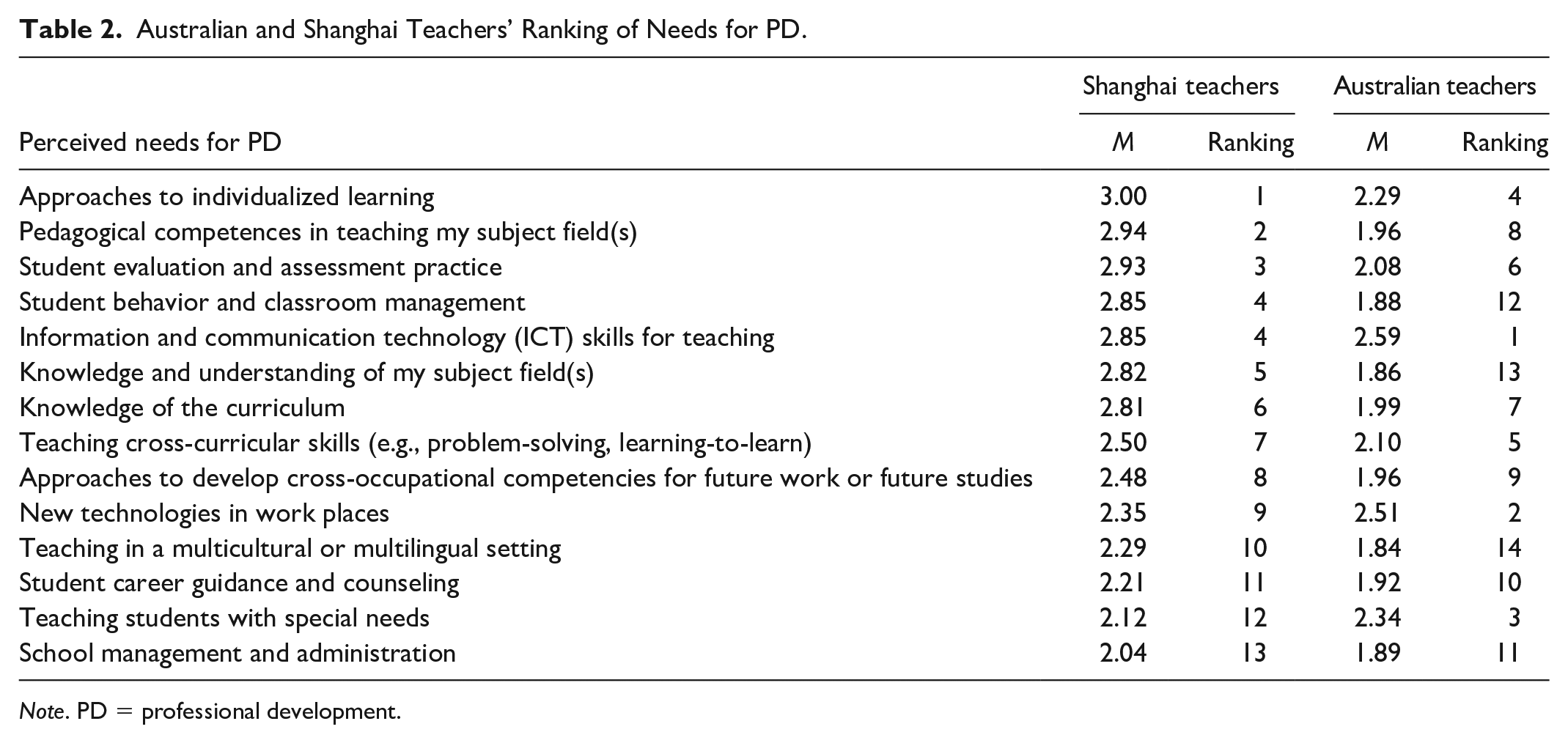
More specifically, Table 2 shows the ranking of Australian and Shanghai teachers’ professional development needs. The highest need of Shanghai teachers is “approaches to individualised learning” (M = 3), while Australian teachers reported the highest need in “ICT (information and communication technology) skills for teaching” (M = 2.59). These results suggest that Shanghai teachers feel a lack of training in how to meet students’ individual needs and that Australian teachers feel less competent in how to use technology effectively in classroom teaching. Both Australian and Shanghai teachers reported limited need for training in “school management and administration” (M = 2.04 of Shanghai teachers and M = 1.89 of Australian teachers) and in “teaching in a multicultural or multilingual setting” (M = 2.29 of Shanghai teachers and M = 1.84 of Australian teachers). These findings reveal that Shanghai and Australian teachers are not very concerned about school management or how to cater for students’ diverse contexts. Interestingly, three aspects of needs of professional development are distinctly different between the Australian and Shanghai teachers. Shanghai teachers ranked “teaching students with special needs” number 12 while, among Australian teachers, it was ranked at number 3. Thus, we may conclude that, compared with Shanghai teachers, Australian teachers show a higher level of need in how to meet students’ special needs. For “student behaviour and classroom management” and “knowledge and understanding of my subject field(s),” Shanghai teachers gave a ranking of 4 and 5, respectively, while Australian teachers ranked these two aspects 12 and 13, respectively. This indicates that student management and subject knowledge training are needed more by Shanghai teachers than Australian teachers.
Australian and Shanghai Teachers’ Ranking of Needs for PD.
Note. PD = professional development.
Support for Professional Development Participation
Table 3 shows the results of the support for Australian and Shanghai teachers’ participation in professional development. In Shanghai, nearly 90% of both new and veteran teachers received the support of scheduled time to help them with participating in professional development (see Table 3). However, as is shown below, in Shanghai, 20% of new and veteran teachers received salary supplements and about 10% of new and veteran teachers received nonmonetary support. Compared with veteran teachers, new teachers received more support in salary supplement and nonmonetary support (p < .001).
Australian and Shanghai Teachers’ Perceived Support for PD.

Note. NT = new teachers; VT = veteran teachers; ns = not significant; PD = professional development.
In Australia, approximately 80% of new and veteran teachers received scheduled time support. However, only about 5% of new and veteran teachers received salary support for participating in professional development activities. As for nonmonetary support, the percentage increased to about 20% of new and veteran teachers. There are no significant differences in the three kinds of supports between new and veteran Australian teachers.
We also compared the differences between Australian and Shanghai teachers on the support they received. As can be seen in Table 3, a majority of Australian and Shanghai teachers received scheduled time support and chi-square tests reveal that many Shanghai teachers received scheduled time support than Australian teachers. However, only a small number of teachers, in either Australia or Shanghai, received salary supplement support, although the percentage receiving it in Shanghai (10.81%) is double that in Australia (4.67%) and this difference is significant (p < .001). In contrast, only about 7% of teachers from Shanghai received nonmonetary support and this percentage increased to about 18% among Australian teachers. Thus, compared with Shanghai, about twice the number of Australian teachers received nonmonetary support and this difference is also significant (p < .001).
Barriers to Professional Development Participation
It seems that there are many commonalities of barriers than needs and support among Australian and Shanghai teachers in terms of their professional development (see Table 4). Both Australian and Shanghai teachers agreed that professional development conflicts with work schedule and lack of incentives for participating in professional development activities. Generally, Shanghai teachers indicated higher level perceptions of barriers to participating in professional development than did Australian teachers in the following five aspects: the prerequisites (e.g., qualifications, experience, seniority), lack of employer support, professional development conflicts with work schedule, have no time, professional development is irrelevant, and no incentives for participating. In contrast, Australian teachers reported higher perceptions of barriers to participating in professional development in the costs of participating than did Shanghai teachers.
Australian and Shanghai Teachers’ Perceived Barriers to PD.

Note. PD = professional development.
In addition, Australian and Shanghai teachers also acknowledged that the prerequisites present the least barriers to them. However, Australian teachers reported that “professional development is too expensive/unaffordable” as a significant barrier to them, whereas Shanghai teachers illustrated it as a limited barrier.
Discussion and Conclusion
The Australian and Shanghai sample data from the TALIS 2013 are analyzed to answer the above research questions. Based on the empirical findings, some practical implications are provided when considering the design and delivery of professional development programs in Australia and Shanghai. This is offered from a comparative perspective.
Needs for Professional Development
By conducting comparative research, the similarities and differences among Australian and Shanghai teachers’ needs for professional development were identified. Australian and Shanghai teachers expressed low needs in “school management” and “teaching in a multicultural or multilingual setting.” Low needs in the area of school management are not surprising, given that most of the teachers are not school leaders so their primary concern is their teaching, leaving the responsibility of school management to school leaders. As to the low needs for teaching in a multicultural and multilingual context, Shanghai teachers may not see the need of multicultural sensitivity in teaching because the majority of students attending school in Shanghai speak the same language and are from the same cultural background. PISA (2009–2012) data reported that in Shanghai, the migrant students accounted for 3.9% and 5.7%, respectively, of the total 15-year-old students in Shanghai (Zhu & Zhang, 2014). Because teachers in Shanghai teach a very small number of migrant students, it seems like they have not prioritized professional development to support multicultural and multilingual teaching. A study by Jin (2014) suggested that Shanghai teachers have a low cultural sensitivity. Interestingly, similar to Shanghai teachers, Australian teachers also did not indicate a high priority for professional development in multicultural and multilingual teaching despite Australia being identified as a multicultural country and “Intercultural Understanding” is a General Capability in the Australian Curriculum. One may infer that this was not a professional development priority for Australian teachers during TALIS 2013 but may have been a priority at a different time. Therefore, we are proposing that a needs analysis is used before professional development programs are designed.
This study also reveals three differences in the needs for professional development of Australian and Shanghai teachers. First, Shanghai teachers have a higher level of needs in “meet students’ individual learning” and “assess students based on their own characteristics” than their counterparts in Australia. This could be because of a series of educational policies that have been developed since 1999, which aimed to help teachers to develop beliefs in student-centered teaching (Hu, 2012; Li, 2017; Zhao & Wang, 2015). Second, compared with Australian teachers, Shanghai teachers reported a relatively higher need in managing class discipline. This could be due to the average class size in Shanghai which is significantly greater than that in Australia. Large class sizes are more demanding on teachers to maintain classroom management (Meyer & Schiller, 2013; Ning et al., 2015). Australian teachers have expressed a greater need in teaching students with special needs than Shanghai teachers have. This reflects the inclusive school policy in Australia. The Australian Curriculum states “education providers to ensure that all students with disability can access education ‘on the same basis’ as their peers, supported by reasonable adjustments and teaching strategies tailored to meet individual needs” (Australian Curriculum, 2020). Australian teachers indicated a professional development need in using new technologies in workplaces, whereas Shanghai teachers expressed a low need in this aspect. This finding is consistent with the research of Zhu and Zhang (2017) and OECD (2014) by indicating that teachers from Western countries have strong needs in technology training. In Australia, technology is widely used in the classroom, and teachers are prioritizing a need for professional development in “Information and Communication Technology” which is also a General Capability in the Australian Curriculum. However, in Shanghai, teachers may not yet see the value of technology use in student learning (Mak, 2010). These findings seem to support the notion that the needs of teachers in Australia and Shanghai are dependent on the school context but also on current classroom needs. This study used TALIS data that “captured” professional development needs of teachers at a particular moment in time which adds to the complexity of planning and delivery of professional development programs in a timely manner to address “current needs.”
Support for Professional Development Participation
In this study, most teachers in both Australia and Shanghai received time support for attending professional development, which is consistent with the findings of McElearney et al. (2019), while few teachers have a salary or other nonmonetary support. In Shanghai, inexperienced teachers receive more support than veteran teachers to participate in professional development programs. This finding that Shanghai gives priority to new teachers’ training is also confirmed by Zhu and Zhang (2017). Among Australian teachers, there are no significant differences in support for professional development participation among new and veteran teachers. For example, all teachers in Victoria (a state in Australia) are entitled to 4 days per year to focus on the improved delivery of high-quality teaching and learning. To teach in Victoria, teachers are required to register annually and to fulfill registration requirement, and 20 hr of professional development must also be completed every year. However, the TALIS data showed that the Shanghai teachers have significant higher support, both in time and salary supplement for professional development, than Australian teachers, although many Australian teachers have higher nonmonetary support than Shanghai teachers. One possible reason is the implementation of accountability-based salary policy around the whole of China so that teachers’ salaries are positively related to their teaching performance and their professional development training record. In Australia, school principals are required to support teachers and “release” them from classroom duties to complete the necessary professional development. As was mentioned previously, this is a requirement for annual teacher registration and this could influence salary remuneration. In Shanghai, less experienced teachers are provided with more support to participate in professional development programs, and perhaps this could be considered in the Australian context. Nevertheless, all teachers must be able to access high-quality professional development as this is dependent on subjects taught, skills and experience, and most importantly, individual teacher needs and priorities.
Barriers to Professional Development Participation
This study is consistent with several studies (Kennedy, 2011; Lind, 2007; Maria & Garcia, 2016) in emphasizing that professional development conflicts with work schedule and lack of incentives for participating, as two significant barriers for Australian and Shanghai teachers. Interestingly, similar to the teachers from other Western countries (Cherrington & Wansbrough, 2010), Australian teachers regarded the costs of participating in professional development as a barrier, whereas Shanghai teachers have a reverse perception. This may be explained by the difference of the investment system in professional development in Australia and Shanghai. In Shanghai, professional development activities are publicly funded and not a direct financial burden on a school budget. In Australia, school principals allocate a budget for professional development and teachers must seek principal approval to be “released” from class duties (usually with the replacement of a casual paid teacher) and to attend a professional development that may incur a cost. It seems that the excessive school costs associated with professional development programs in Australia are a barrier to teachers’ participation, and this is also dependent on the negotiation and approval from the school principal. Principals in Australia should be made more aware of their direct impact on teacher participation in professional development programs. At a system level, the government in Australia may consider further subsidies to professional development courses, to lessen the financial burden on the school budget allocation.
In regard to the barriers for professional development, Australian and Shanghai teachers agreed that professional development conflicts with their work schedule and the lack of incentives as two significant barriers. These two barriers are significant for consideration by school and system-level education leaders. If professional development courses are to be highly valued in education, teachers should be supported to complete these during working hours, with principal support and incentives for career growth.
Implications and Limitations
This study investigates and compares needs, support, and barriers regarding professional development among Australian and Shanghai teachers. The findings suggest that teachers in Australia and Shanghai have different professional development priorities. To support professional development, governments should consider further monetary and time support for Australian and Shanghai teachers. Meanwhile, teacher educators also need to consider teachers’ working schedule when designing professional development activities.
This study contributes to effective professional development research by indicating teachers’ needs, support, and barriers for professional development from a comparative perspective. Based on this study, we know what types of professional development that Australian and Shanghai teachers need according to the 2013 TALIS data and which factors support or prevent their participation. However, there are two limitations of this study that should be noted. First, it is a secondary data analysis, and the boundaries of some concepts are not entirely clear. For example, in the section on barriers, there is limited clarity provided as to what is regarded as monetary and nonmonetary incentives, which leads to understanding of these concepts only based on individual teacher interpretation of the terms monetary and nonmonetary in the TALIS. Second, Shanghai is one of the most developed cities in China; thus, it cannot represent the whole country. Therefore, the findings of this study cannot be generalized to the national level.
To extend this study, future research should be conducted on aspects of collecting firsthand data at a national level in both countries and investigating why teachers formulated their perceptions toward professional development as they do, as well as evaluating the possible influences on these perceptions over a duration of time. This will enable us to provide further advice as to what needs to be considered in effective professional development programs.
Footnotes
Acknowledgements
Many thanks to the potential reviewers.
Author’s Note
Guangbao Fang another affiliation is Jiangxi Normal University Science and Technology College, China.
Declaration of Conflicting Interests
The author(s) declared no potential conflicts of interest with respect to the research, authorship, and/or publication of this article.
Funding
The author(s) received no financial support for the research, authorship, and/or publication of this article.

Ethical Approval
This study uses open data, and the ethic issue is not applicable.