



Abstract
Persons with disabilities have consistently been excluded from deliberations on climate change actions since the beginning of the global debate on this crucial issue. The Middle East and North Africa (MENA) region has the harshest weather conditions worldwide, highlighting the need to understand the factors that could impact awareness of climate change among persons with sensory impairments. Guided by Ajzen’s theory of planned behaviour, this study sought to explore the relationship between attitudes towards climate change and participation in pro-environmental climate change behaviours among persons with sensory impairments in the MENA region. The Awareness of Climate Change and Pro-Environmental Behaviour Willingness Questionnaire was completed by 542 persons with sensory impairments. The data were subjected to hierarchical multiple regressions and moderation analysis. The findings indicate a significant relationship between attitude and participation in climate change behaviour. The study concludes with an urgent call to policymakers to engage the disability community in the MENA region in climate change action.
Introduction
Climate change, one of the defining challenges of the 21st century, has profound implications for societies, economies, and vulnerable populations globally (Aziz & Anjum, 2024; Dietz et al., 2020; Okesanya et al., 2024; Rising et al., 2022). The urgency to mitigate climate change aligns closely with the United Nations Sustainable Development Goals (SDGs), particularly climate action (SDG 13), reducing inequalities (SDG 10), enhancing sustainable energy levels (SDG 7), and inclusive, sustainable economic growth (SDG 8). Despite high levels of concern for climate change action (Dechezleprêtre et al., 2022; Kowalcyk & Dorevitch, 2024; Naser et al., 2024), practical action by governments, institutions, and individuals continues to be hindered by socio-economic, political, and informational barriers (Antwi-Agyei, Amanor, et al., 2021; Lefèvre et al., 2022; Nguyen et al., 2021). Empirical evidence has shown that though awareness of climate change’s impact is widespread, there remains a significant gap in the knowledge of adaptive strategies (Danish & Isaifan, 2024; Hügel & Davies, 2020; Khatibi et al., 2021; Marty et al., 2025).
Consequently, scholars have attempted to understand the drivers of climate change behaviour and attitudinal change towards climate change (Basiru et al., 2024; Ben Hassen & Zurayk, 2024; Brosch, 2021; Helm et al., 2021; Thøgersen, 2021; Whitmarsh et al., 2021; Wong-Parodi & Berlin Rubin, 2022). While discussions on climate change are increasing (Blimpo et al., 2024; Hase et al., 2021; Liao et al., 2024; Mukherjee & Fransen, 2024), the intersection between climate action and social inclusion remains underexplored (El-Husseiny et al., 2024; Garcia & Tschakert, 2022; Rao et al., 2025; Udo et al., 2025). Specifically, persons with sensory disabilities affected by both environmental and societal challenges (Devkota et al., 2024; Kosanic et al., 2022; Stein et al., 2024; Uddin et al., 2024; Wolbring & Escobedo, 2023) rarely contribute to global discussions on climate change. The purpose of the current study is to explore the factors that moderate the relationship between attitude and climate change behaviour awareness among persons with sensory impairments in contexts such as the Middle East and North Africa (MENA).
The MENA region, made up of 21 Arabic-speaking countries, is faced with severe and rapid climate change, which is mainly attributed to human activity (Hamed, Hasani et al., 2024; T. Mehmood et al., 2024). For instance, over the past four decades, there have been reports of increasing temperature, particularly in arid and semi-arid areas, with recent years recording unprecedented heat levels (Francis & Fonseca, 2024; Hamed, Sobh et al., 2024; Kenawy et al., 2025). Notably, in July 2023, extreme heatwaves affected countries such as Algeria, Kuwait, Tunisia, and Jordan (Francis & Fonseca, 2024; Hamed et al., 2025). This alarming trend highlights the urgency of enhancing climate change awareness and resilience across all societal sectors.
As one of the world’s most water-scarce regions, the MENA region faces acute vulnerabilities to climate-induced water shortages and extreme heat (Bhattarai & Yousef, 2025; Mfarrej, 2025; Namdar et al., 2021). Projections suggest that towards the end of the 21st century, nearly half the population could endure heatwaves exceeding 56°C for prolonged periods, posing critical challenges for marginalized populations (Wedler et al., 2023; Zittis et al., 2021), including persons with disabilities, who have limited resources and adaptive capacity (Jodoin et al., 2023; Marzouk et al., 2022). Furthermore, the region’s climate systems are highly susceptible to changes, such as shifts in the Intertropical Convergence Zone, impacting seasonal weather patterns, dust emissions, and atmospheric moisture transport (Alizadeh et al., 2025; Berhane et al., 2024; Darvishi Boloorani et al., 2024). These disruptions are likely to affect water availability, extreme weather events, and broader regional climate dynamics, necessitating adaptive strategies tailored to the region’s unique challenges.
The compounded effects of climate change and systemic inequities disproportionately affect vulnerable groups, particularly individuals with sensory impairments. Physical barriers, discriminatory attitudes, and inadequate policy frameworks exacerbate their exclusion from climate action and reduce their capacity to adapt (Bell et al., 2020; Jodoin et al., 2023; Kett et al., 2021; Kosanic et al., 2022; Uddin et al., 2024). While awareness of climate issues is growing, evidence shows that awareness alone does not lead to equitable action unless supported by targeted, context-specific interventions (Constantino et al., 2022; Eriksen et al., 2021; Mazumder & Hossain, 2024). For persons with sensory disabilities, barriers to accessing climate education, early warning systems, and resources further exacerbating their vulnerabilities, hindering both individual and collective action (Kisira et al., 2023; Kosanic et al., 2022; Stein et al., 2024). In addition to the physical challenges posed by climate change, societal exclusion restricts the participation of persons with sensory impairments in climate action. The lack of inclusive infrastructure and insufficient accommodations in disaster preparedness heighten their exposure to climate risks (Donkor & Mearns, 2021; Jodoin et al., 2023; Makamanzi, 2025; Ssennoga et al., 2022). The MENA region’s rapid population growth further amplifies these challenges, underscoring the need for infrastructural adaptation, equitable policy frameworks, and targeted climate awareness campaigns (Anwana & Owojori, 2024; El Bari et al., 2024; Jaad & Abdelghany, 2021; Maja & Ayano, 2021). Given the MENA region’s susceptibility to extreme climate events and socio-economic disruption, a proactive and inclusive climate change approach is imperative.
Globally and in the MENA region, persons with sensory impairments encounter significant barriers, ranging from limited access to education and employment to pervasive discrimination (Besoain-Saldaña et al., 2023; Ilyas et al., 2021; Kaur et al., 2024; Odame et al., 2021). These challenges are further compounded in the MENA region, where cultural attitudes and systemic obstacles intensify their exclusion (Al-Zoubi & Al-Zoubi, 2022; Ilyas et al., 2021; O’Dell, 2023). The region’s harsh climatic conditions, coupled with societal rejection and infrastructural shortcomings, could undermine the ability of persons with sensory disabilities to engage in climate-positive behaviours or effectively respond to climate-induced crises. During climate-induced disasters, individuals with sensory impairments often face heightened barriers to accessing critical services such as early warning systems, health care, and emergency shelters (Fraser, 2024; Jodoin et al., 2020; Uddin et al., 2024). For instance, hearing impairments can hinder responses to auditory alerts, while visual impairments may impede recognition of visual evacuation cues—both essential for timely action in emergencies. Moreover, the physical environment frequently lacks the necessary accommodations for inclusive disaster preparedness and response, leaving persons with sensory disabilities particularly vulnerable to the adverse impacts of climate change (Crock & McCallum, 2024; Kett et al., 2021; Namdar et al., 2021). It is concerning that persons with sensory impairments have been left out on discussions on climate change.
In the literature, there are intense advocacies for the inclusion of vulnerable groups such as those living with sensory disabilities in climate change policies, discussions, and initiatives (Bubb & Le Dé, 2022; Chtatou, 2023; Kim, 2024). According to Mertens (2021), power hierarchies exist in almost all societies. Majority groups dominate deliberations on climate change, suppressing the voices of minority groups (Adiga, 2024; Datta & Kairy, 2024; Porcuna-Ferrer et al., 2023). Persons with disabilities are more likely to be harmed or severely affected by harsh climate conditions (S. S. Ahmed et al., 2021; Lindsay et al., 2023; Tampubolon, 2023), and climate change initiatives without the input or perspectives of those with disabilities are likely to be unresponsive to their needs (Humalisto, 2022; Kim, 2024; Kosanic et al., 2022; Namdar et al., 2021). Advocacy for the inclusion of persons with disabilities in climate change initiatives has been promoted through initiatives such as climate justice, inclusive cities, and inclusive innovations (Bubb & Le Dé, 2022; Harpur & Stein, 2025; Kim, 2024). In view of this, the inclusion of persons with disabilities in climate change initiatives should enable them to make inputs, add their voices, and participate in adaptation strategies tailored to suit their uniqueness (Adiga, 2024; El Bari et al., 2024; Kim, 2024). There is therefore a need for empirical research capturing the voices of persons with sensory disabilities on climate change (Bråten, 2021; Kosanic et al., 2022; Mertens, 2021).
The literature on factors impacting on persons with sensory impairments’ attitudes and willingness to participate in climate change behaviour is limited, and there is therefore an urgent need for disability-inclusive climate policies that prioritize resilience, accessibility, and equity, alongside strategies for environmental awareness and education tailored to their needs. Addressing these challenges requires a comprehensive and intersectional approach that integrates persons with sensory disabilities into broader societal frameworks. Policymaking must confront attitudinal biases, close infrastructure gaps, and foster representation to enable active participation in climate resilience initiatives. Particularly in regions such as the MENA region, where climatic extremes and societal barriers intersect, advancing inclusion is essential for achieving equitable and effective climate action. Research addressing these issues, such as the present study, is needed to provide useful insights into how some of the issues may be addressed. The current study is novel and extend contemporary discussions on climate change attitudes and behaviour to persons with sensory disabilities. The overarching aim of this study is to understand the factors that could moderate the relationship between attitudes towards climate change and climate change behaviour awareness among persons with sensory impairments in the MENA region. The study was guided by the following research questions:
What is the contribution of attitude towards climate change in the variance in climate change behaviour awareness among persons with sensory impairments in the MENA region?
What are the moderators (demographic variables) of the relationship between attitude towards climate change and participation by persons with sensory impairment in climate change behaviour awareness in the MENA region?
In the current study, persons with sensory disabilities are understood to mean persons living with a form of hearing or visual impairment. This quantitative study consists of nine sections. Following the introduction, the remaining sections are organized as follows: the theoretical framework, review of the literature on attitudes towards climate change, review of the literature on climate change behaviour, study context, methodology, results, discussion, study limitations, and conclusion and implications for practice.
Theory Framework
One of the most widely used theories to study human intention towards a given behaviour is Ajzen’s (Ajzen, 1991) theory of planned behaviour (TPB). The TPB (Ajzen, 1991) was built on the theory of reasoned action, which holds that behaviour is the product of two related types of beliefs, normative and behavioural beliefs, which are mediated through intentions. However, in the MENA context, the TPB has rarely been applied in studies exploring climate change, attitudes, and climate change behaviour. While behavioural belief refers to one’s judgement of a given behaviour, normative belief, that is, the relevance and perception that an individual could engage in a given behaviour, refers to external pressure that views or perceptions could have on a person’s actions. However, Ajzen added that there could be a third type of behaviour, control belief, which could also, directly or indirectly, predict human behaviour. Control belief refers to a person’s perception that they have been given all the required resources and the conducive environment to engage in a behaviour. According to Ajzen, these three related beliefs, behavioural, normative, and control beliefs combine to predict human intention to engage in a behaviour.
In the current study, the three related beliefs were applied to the subject (see Figure 1). For instance, behavioural belief develops into attitudes towards a given behaviour such as advocating against climate change. Attitude is defined as one’s cognitive, affective, and perceptual beliefs towards a given behaviour. Thus, having an in-depth understanding of a given behaviour would enable individuals such as those living with sensory disabilities to form appropriate attitudes. Second, normative belief accumulates into perceived social norms in the form of support or pressure from peers or influential persons in an individual’s life. In turn, control beliefs develop into perceived behaviour control, which is an individual’s confidence in their ability to engage in a given behaviour. Based on information and resources provided, an individual could decide whether they have the ability to engage in a given activity.

Graphical presentation of theory of planned behaviour.
The TPB model has been widely supported in disciplines such as teacher education (Dierendonck et al., 2024; Opoku, Nketsia, et al., 2023; Qin & Tao, 2021). To the best of our knowledge, the TPB is yet to be adopted for studies on climate change and persons with sensory disabilities. In the current study, two components of the TPB model were applied: attitude and actual behaviour. Attitude (used interchangeably with ‘awareness’ in this study) is believed to be the first stage towards understanding individuals’ behaviour. In view of this, the contribution of attitude towards climate change in the variance in climate change behaviour awareness was explored. Moreover, Ajzen (2011) argued that background variables could provide additional insight into intentions towards a given behaviour. It was suggested that authors explore the influence of background variables on the predictors of intentions. Consequently, in this study, the contribution of demographic variables, used as moderators in this study, on the relationship between attitudes and climate change behaviour awareness was explored.
Attitudes Towards Climate Change
Public attitudes towards climate change are critical in shaping the success of mitigation policies and climate action initiatives globally (Anwana & Owojori, 2024; Fairbrother, 2022; Khatibi et al., 2021; Luomi, 2021). Studies on attitudes towards climate change have evolved significantly, focusing on global perceptions (Dechezleprêtre et al., 2022; Fairbrother, 2022; Gössling & Humpe, 2020; Ofori et al., 2023; Simpson et al., 2021), policy effectiveness (Bergquist et al., 2022; Epule et al., 2021; Ogunyiola et al., 2022; Otto & Gugushvili, 2020), and socio-demographic drivers (Ibrahim & Mensah, 2022; Muttarak, 2021; Thabane et al., 2024; Weckroth & Ala-Mantila, 2022).
In terms of global perception trends, studies reveal a widespread consensus on the urgency of addressing climate change (Adebayo, 2025; Bedasa & Deksisa, 2024; Pettorelli et al., 2021; Romanello et al., 2021; Zurek et al., 2022). For instance, focus group discussions conducted across 22 countries identified the urgent need to address climate change as a critical issue (Fritz et al., 2024). However, methods of mitigation, such as carbon taxation and renewable energy adoption, elicit mixed reactions due to differences in cultural and economic contexts (Baiardi & Morana, 2021; Biddau et al., 2022; Douenne & Fabre, 2020; Kabir et al., 2024; Maumoh & Onoja, 2024; O’Connell, 2024). More importantly, research underscores the power of targeted information in shaping public attitudes (Apollo & Mbah, 2021; Arıkan & Günay, 2021; Carmen et al., 2022; Jakob et al., 2020; Leiserowitz et al., 2021; Slothuus & Bisgaard, 2021). Providing clear, relatable insights on the fairness and efficacy of policies proves more effective than general climate awareness campaigns (Elvis Muse, 2025; Fegher, 2023; Kehler & Birchall, 2023; Mildenberger et al., 2022; Odoom & Fosu, 2023).
Similarly, individual behaviours and their alignment with policy have also received scholarly attention. Although individuals often express willingness to engage in climate-friendly actions, this does not consistently translate into support for broad policies (Ben-Enukora et al., 2025; Hornsey & Fielding, 2020). Behavioural studies highlight that alignment with personal financial or lifestyle considerations drives stronger climate change policy endorsement (Balogun et al., 2024; Ewulo et al., 2025). While persons without disabilities in the MENA region share common values and ways of doing things, people with sensory impairment could differ on factors which could impact on their attitudes and behaviours to addressing climate change.
Relative to the current literature, research consistently demonstrates that public support hinges on the perceived fairness and efficacy of policies (Dechezleprêtre et al., 2025; Ghafouri, 2023; Grelle & Hofmann, 2024; Huber & Wicki, 2021). For example, progressive mechanisms such as redistributive carbon taxes receive broader endorsement compared to regressive ‘pay-to-pollute’ schemes (Barrez, 2024; D’Acunto et al., 2022; Magistro & Alvarez, 2024). Moreover, economic concerns, including policy affordability and personal costs, significantly influence public attitudes (Douenne & Fabre, 2020; Jakučionytė-Skodienė & Liobikienė, 2022; Malerba, 2022; Sefa-Nyarko, 2024). For instance, farmers in the United States show greater optimism about technological solutions but less support for climate change initiatives and an increased propensity to express a preference to delay adaptation-related actions (Gardezi & Arbuckle, 2020). Furthermore, regional disparities reflect differing levels of vulnerability and socio-economic conditions. In high-income nations, policy support aligns with environmental awareness, while in middle-income countries, economic priorities often overshadow climate concerns (Lundquist, 2025; Trotter et al., 2022). The lack of policy support could derail efforts towards climate change initiatives. However, it remains unclear as to whether persons with sensory disabilities are aware of climate change as well as its effect on their willingness to contribute to climate change initiatives.
Demographic factors play a pivotal role in shaping attitudes to climate change. Younger individuals in developed nations exhibit heightened climate awareness (Calculli et al., 2021; Jürkenbeck et al., 2021), while in other low and middle-income settings, such as Africa, older respondents have shown greater knowledge of mitigation strategies (Ayalon et al., 2023; Galang & Vaughter, 2020; Katey & Zanu, 2024). Similarly, there is a close correlation between higher education levels and climate literacy and support for mitigation policies, reflecting an enhanced understanding of risks and solutions (Jaoul-Grammare & Stenger, 2022; Pan et al., 2023; Zouine et al., 2024). Economic standing influences attitudes (Dibeh et al., 2021; Duijndam & van Beukering, 2021), with wealthier urban populations demonstrating greater support for climate policies due to perceived affordability (Du et al., 2024; Immergluck & Balan, 2018; Ivković & Mandić, 2024; Zeigermann et al., 2023). In addition, urban respondents typically show stronger support for climate action compared to rural populations, which may prioritize immediate economic concerns (Allred et al., 2022; Haupt et al., 2020; Salvia et al., 2021; Zeigermann et al., 2023). The influence of demographic variables on attitudes to climate change among persons with sensory impairment is yet to be studied.
Participation in Climate Change Behaviour
The willingness of individuals to engage in climate change mitigation behaviours is a crucial determinant of global efforts to address environmental challenges (Amoah & Addoah, 2021; Anwana & Owojori, 2024; Hornsey & Fielding, 2020; van Valkengoed et al., 2022). Research into willingness to participate in climate change behaviours has evolved significantly over the past decade (Antwi-Agyei, Dougill & Abaidoo, 2021; Brosch, 2021; Haj-Salem et al., 2022; Kotcher et al., 2021; Xie et al., 2019). These show that when people are aware of the gravity of climate change issues, they are more likely to participate in climate change behaviours (Azeez et al., 2024; Haj-Salem et al., 2022; Ngcamu, 2023). Equally, when people believe the policies set by governments will be effective in averting the adverse effects of climate change, they will engage in behaviours that will help the policy succeed (Bergquist et al., 2022; Bradley et al., 2020; Fischer & Karl, 2022; Trotter et al., 2022; Whitmarsh et al., 2021; Zhang et al., 2020). Other studies using experimental designs have highlighted the impact of tailored information on enhancing public support, underscoring the role of evidence-based communication strategies (Alant & Bakare, 2021; Hamelin & Halawa, 2024; Leiserowitz et al., 2021; Matos et al., 2022; O’Neill et al., 2020). In these studies, Matos et al. (2022) and O’Neill et al. (2020) concluded that policymakers could commit resources to creating public awareness about climate change to enhance public support for climate change initiatives.
At a country/community level, recent trends emphasize global disparities in willingness to act, with high-income countries reporting greater climate scepticism despite widespread awareness (Dechezleprêtre et al., 2022; Ejaz et al., 2024; Zhou & Shen, 2022). By contrast, middle- and low-income nations exhibit a greater willingness to engage in climate-inspired behaviours, driven by localized vulnerability and a need for community-driven interventions (Appau et al., 2024; Bush & Clayton, 2023; Saeed et al., 2023). However, most of these studies recruited their participants from urban and educated members of society, which limits their generalizability to vulnerable communities.
Demographic factors, including education, income, and political ideology, shape individuals’ willingness to act. For example, younger individuals show greater concern for climate change but less technical knowledge than older individuals, particularly in high-income countries (Dechezleprêtre et al., 2022; Helm et al., 2021; Thomas et al., 2022). Relatedly, women generally express stronger concern for climate change and willingness to act but face barriers in technical knowledge and economic participation in certain regions (Awiti, 2022; Bryan et al., 2024; Dechezleprêtre et al., 2022; Nosheen et al., 2023). Higher educational attainment also correlates with greater support for progressive climate policies and the adoption of climate-friendly behaviours (Mahalik et al., 2021; Özbay & Duyar, 2022). In addition, economic constraints disproportionately limit lower-income groups, while higher-income individuals are more likely to adopt private behaviours to counter climate change, such as purchasing electric vehicles (Esteves et al., 2021; Evensen et al., 2025; Lee et al., 2024; Qiao & Dowell, 2022). Cultural norms and political affiliations further shape these patterns, with left-leaning individuals in many nations showing a greater willingness to support stringent climate policies compared to their right-leaning counterparts (Dechezleprêtre et al., 2022; Lægreid et al., 2025; Nishijima & Pal, 2023; Vuong et al., 2024). The limited literature on persons with sensory impairment lends support to understanding the demographic factors that could impact on climate change behaviour awareness.
Current Study
The current study investigates the complex relationship between attitudes towards climate change and climate change behaviours among individuals with sensory impairments in the MENA region. The MENA region has economic, cultural, and historical relevance. For example, the region plays a pivotal role in the global crude oil trade (Abdelsalam, 2023; Matallah, 2022; Olawuyi, 2021). Specifically, the region produces half of the world’s crude oil and gas. This makes the MENA an epicentre of global energy and trade. Moreover, the MENA is also major consumer of fossil fuel. Government subsidies on fossil fuel make it cheap for the general populace. This has culminated in international advocacy and pressure on countries in the region to introduce transformative policies aimed at reducing the emission of hydrocarbons.
Culturally, the MENA region is the birthplace of three major religions: Islam, Christianity, and Judaism (Meri, 2021; Ramazanova et al., 2022; Timothy, 2020). This has made the region an important destination for pilgrims. In view of this, issues such as climate change that threaten the lives of people in the region should be given scholarly attention. Governments in the region have taken a keen interest in discussions on climate change as the region hosted the COP28 and continues to engage in global deliberations on climate change.
Recent studies have highlighted that individual attitudes significantly predict climate-friendly behaviours (Emberger-Klein et al., 2021; Koessler et al., 2022; K. Mehmood et al., 2023; Skeirytė et al., 2022; Yadav et al., 2023). However, there is a lack of literature on awareness of climate change among persons with disability such as those with sensory disability. Furthermore, existing studies have focused disproportionately on high-income nations (Chaloner et al., 2021; Kulin et al., 2021; Schöngart et al., 2025; Sesana et al., 2021; Taff et al., 2025), limiting the global applicability of their findings. The link between attitude towards climate change and participation in pro-environmental behaviour has been widely studied among the general population. However, studies on climate change awareness and behaviour among persons with sensory disabilities in non-Western countries remain sparse, despite the heightened vulnerability of these groups to climate impacts. The participation of persons with sensory disabilities in climate change behaviour is vital as they are at risk due to the effects of climate change and should therefore contribute to global deliberations on climate change.
The overarching aim of this study is to explore the relationship between climate change awareness and its effect on climate change behaviour awareness. The study is novel as this is the first time the voices of persons with sensory disabilities were captured on issues such as climate change. According to Ajzen (1991), demographic variables can enhance understanding of awareness and actual behaviour. This study explored the distinct role of moderation effects—such as socio-economic status, policy awareness, and community support—in shaping attitudes and climate change behaviours among persons with sensory disabilities who may face multiple barriers.
Methods
The study was guided by a cross-sectional design in which data were collected at a given point in time from a given population (Wang & Cheng, 2020). This quantitative method, that is, using a questionnaire, is ideal for cross-sectional studies as it facilitates collecting data from a sizeable proportion of the target population (Hall, 2008).
Study Participants
The study sample consisted of persons with sensory disabilities residing in the MENA region. The participants were characterized by a shared Arabic language, religion, and cultural practices. The MENA region can be further divided into the Gulf Cooperation Council (GCC) and non-GCC member states. The GCC consists of six countries—Bahrain, Kuwait, Oman, Qatar, Saudi Arabia, and the United Arab Emirates—that play a significant role in the global crude oil industry. Moreover, the MENA region has seen the emergence of several disability advocacy organizations, such as the Arab Organization of Persons with Disabilities, which primarily consist of persons with sensory disabilities in the MENA. Other organizations such as the UAE Deaf Association and the Emirates Association for Visually Impaired helped with the recruitment. These advocacy groups constituted key participants in the study. To facilitate data collection, an electronic version of the research instrument was disseminated among the disability organization’s shared social media platforms for wider distribution.
The recruitment of participants and data collection were guided by the following inclusion criteria: (a) persons with disabilities residing in the MENA region, (b) persons diagnosed with either visual or hearing impairments, (c) adults with disabilities, and (d) persons with the capacity to provide consent for participation. Simple random sampling was used with an online survey shared on social media as well as the social media platforms of disability organization. Simple random sampling was appropriate, as a heterogeneous (S. K. Ahmed, 2024) population of persons with sensory disability who satisfied the inclusion criteria had an equal chance to participate in this study. Persons with sensory disabilities do not live as a homogeneous group. Moreover, in the MENA region, disability is a very sensitive issue, making it difficult to identify or reach such groups (Ghazy et al., 2025; Javaid, 2024; Sweileh, 2024). Recruiting participants via disability groups was determined to be a viable option for this study. Specifically, persons with sensory disabilities are usually members of disability groups who usually use social media platforms to share information. Sharing the survey link on such social media platforms gave diverse members an equal chance to participate in this study.
The organizations contacted have a total membership of about 3,000, of which 18% participated in this study. A total of 542 participants took part in the study: of these participants, 58% were from GCC countries, while 42% were from non-GCC countries, as indicated in Table 1. Participants with visual impairment constituted 63% of the participants, with the remaining 37% reporting hearing impairments. In terms of gender distribution, 54% of the participants were female, while 46% were male (see Table 1 for details).
Demographic Characteristics of Participants.

Instrument
A two-part survey instrument was employed for the data collection. The first part captured participants’ demographic information (see Table 1). The second part consisted of the Awareness of Climate Change and Pro-Environmental Behaviour Willingness Questionnaire (ACCPEBWQ), which employs Likert scales to measure attitudes. These two parts align with the two principles of the TPB that guided the study. While the Awareness of Climate Change measures attitudes towards climate change, the Pro-Environmental Behaviour Willingness Questionnaire measures climate change behaviour awareness. The ACCPEBWQ was adapted from a previous study conducted in Nigeria and modified to better fit the current context. For instance, references to generators (commonly used in Nigeria), were replaced with solar energy, which is prevalent in the MENA region.
The instrument was structured around two domains: (a) Awareness of Climate Change (29 items) and (b) Pro-Environmental Climate Change Behaviour (15 items). The awareness domain included three subscales, namely Perceptions on Climate Change (7 items), Causes of Climate Change (11 items), and Effects of Climate Change (11 items). The pro-environmental behaviour domain consisted of two subscales: (a) General Societal Support (7 items) and (b) Personal Educational Initiatives (9 items). Responses were recorded on a five-point Likert scale, ranging from ‘Strongly Disagree’ to ‘Strongly Agree’.
The revised instrument was translated into Arabic for accessibility and reviewed by six bilingual (Arabic and English) experts with a research interest in climate change. In addition, two academics affiliated with a regional disability organization reviewed the instrument. Based on their recommendations, data reporting was divided into GCC and non-GCC categories rather than assigned to specific countries. Feedback from reviewers led to modifications, including dividing the pro-environmental behaviour scale into two subscales, which was supported by expert consensus. The revised instrument underwent pilot testing before full-scale implementation.
In this project, the instrument used for data collection was valid and found to have appropriate goodness-of-fit indices (Authors, in press). For example, computation of confirmatory factor analysis yielded the following goodness-of-fit indices: chi-square = 5.14, comparative fit index = .94, Tucker–Lewis index = .91, square root of the mean error of approximation = .08, and standard root mean square residual = .04. The reliability of the scale, using Cronbach’s alpha, was as follows: Overall ACCPEBWQ = .90, awareness of climate change = .85, and participation in pro-climate change behaviour = .91.
Procedure
The study obtained ethical approval from the Social Science Research Ethics Committee at United Arab Emirates University (ERSC-2023_3934). Subsequently, executives and collaborators of disability organizations in the MENA region were invited to distribute the instrument among their members. Data were collected digitally via Google Forms between June 2023 and April 2024. The instrument was primarily shared on the social media platforms of disability organizations, with additional accessibility features tailored to participants’ needs.
For potential participants with hearing impairments, a sign language video explaining the study was provided. For those with visual impairments, an audio recording accompanied the survey link. The survey included details on the study objectives, voluntary participation, the confidentiality of the data, and withdrawal procedures. Personal identifiers and country-specific data were excluded from being reported to ensure anonymity.
Participants were assured that the research team would maintain the confidentiality of their responses and that no external parties would have access to the data gathered. Participants received no compensation for their participation. They were also continuously reminded of their right to withdraw at any time without repercussions. All the participants read and signed an e-consent embedded at the beginning of the questionnaire.
Data Analysis
The data were transferred to Excel for cleaning before it was imported to SPSS for data analysis. The data were assumed to be normally distributed based on the sample size (Field, 2013). Based on the data analysis, the research questions were answered.
To answer research question 1, hierarchical multiple regression was used to explore the contribution of attitude towards climate change in the variance in pro-environmental climate change behaviour. Attitude was used as an independent variable to estimate its impact on the willingness of persons with sensory impairments to participate in pro-environmental climate change behaviour. In step 1, attitudes were regressed directly to climate change behaviour. In step 2, demographic variables (e.g., gender, age) were added to the model to understand their individual contributions as well as their combination with attitudes to understand their contribution to the variance in pro-environmental climate change behaviour awareness. The following assumptions were observed, and it was evident that they had not been violated: normality, linearity, multicollinearity, and homoscedasticity (Pallant, 2020).
To answer research question 2, following the computation of the hierarchical regression, demographic variables that made significant contributions to the variance in pro-environmental climate change behaviour were used as moderator(s) to explore their influence on the relationship between the independent variables and the outcome variables. Hayes’s (2022) moderation method 1 was used for the computation. The moderation effect was assumed as follows: (a) the significance effect was noted at an alpha value less than .05; (b) the moderator and the predictor had a direct effect on the dependent variable; and (c) the moderator had a significant effect on the relationship between the dependent and independent variables.
Results
The mean scores were computed at domain and sub-scale levels: awareness of climate change (M = 3.50, SD = .71) and participation in pro-environment climate change behaviour (M = 3.79, SD = .76). For awareness of climate change, the sub-scales yielded the following mean scores: Perception (M = 3.57, SD = .78), effect (M = 3.50, SD = .82), and causes (M = 3.42, SD = .88). With respect to pro-environment climate change behaviour, the means for the sub-scales were: General societal support (M = 3.90, SD = .79) and Educational initiatives (M = 3.67, SD = .79).
Predictors of Climate Change Behaviour Awareness
Predictors of climate change behaviour were explored using hierarchical multiple regression (see Table 2). In step 1, attitude towards climate change (β = .56, p = .001) was regressed directly and found to contribute 31% (R2change = .31) to the variance in climate change behaviour, F (1, 476) = 212.16, p = .001.
Predictors of Climate Change Behaviour.

p ≤ .01.
In step 2, nine demographic variables were added to the model, which contributed 7% (R2change = .07) to the variance in climate change behaviour, F (9, 476) = 6.09, p = .001. The combined demographic variables and attitude made a 38% (R2change = .38) contribution to the variance in climate change behaviour, F (10, 467) = 28.73, p = .001. At this stage, attitude (β = .58, p = .001), gender (β = .14, p = .001), country (β = .14, p = .001), educational qualification (β = −.15, p = .001), and training in climate change (β = −.13, p = .001) made individual contributions to the variance in climate change behaviour. However, attitude towards climate change made a greater contribution to pro-environment climate change behaviour than the other variables.
Moderators of the Relationship Between Attitude and Climate Change Behaviour Awareness
Following the hierarchical multiple regression (see Table 3), demographic variables which impacted on climate change behaviour awareness were used as moderators (gender, country, educational qualification, and training in climate change).
Moderators of Attitude and Climate Change Behaviour.
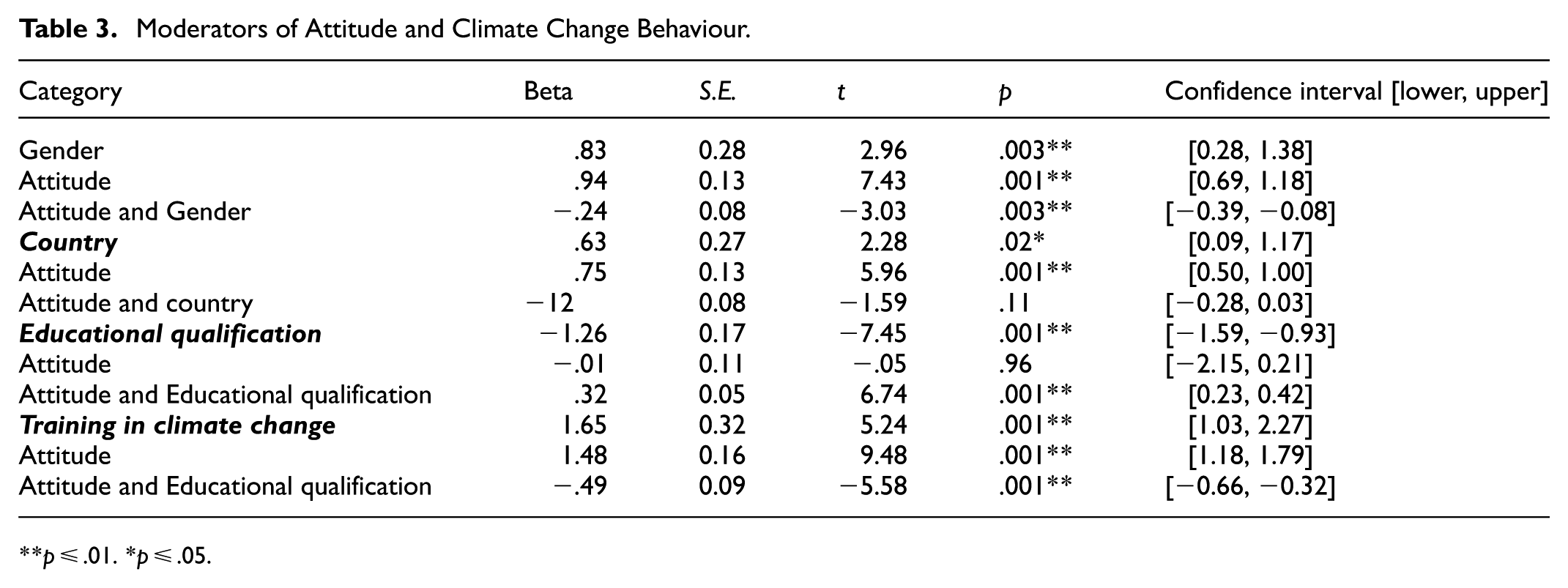
p ≤ .01. *p ≤ .05.
First, the interactive effect of gender on the relationship between attitude and climate change behaviour awareness was explored. The overall model was significant, R2 = .30, F (3, 524) = 74.55, p = .001. Individually, attitude (β = .94, t = 743, p = .001, 95% CI [.69, 1.18]) and gender (β = .83, t = 2.96, p = .003, 95% CI [.28, 1.38]) contributed to the variance in climate change behaviour. Gender significantly moderated (β = −.24, t = −3.03, p = .003, 95% CI [−.39, −.08]) the relationship between attitude and climate change behaviour, R2change =.01, F (1, 524) = 9.17, p = .003. To elaborate, for male participants, a significant relationship was found between attitude and climate change behaviour, β = .70, t = 12.28, p = .001, 95% CI [.58, 81]. However, for female participants, a significant relationship was also found between attitude and climate change behaviour, β = .46, t = 8.44, p = .001, 95% CI [.35, .57].
Figure 2 illustrates that when attitude is low, climate change behaviour is low. Similarly, when attitude is low, females were more likely to participate in climate change behaviour compared to their male counterparts. However, as attitude increased, climate change behaviour also increased. When attitude increased, males’ climate change behaviour was higher than that of females.

Gender as a moderator of attitude and behaviour.
Second, training in climate change was found to be a significant moderator of attitude and climate change behaviour, R2 = .37, F (3, 509) = 99.09, p = .001. Attitude (β = 1.48, t = 9.48, p = .001, 95% CI [1.18, 1.79]) and training in climate change (β = 1.65, t = 5.24, p = .001, 95% CI [1.03, 2.27) were direct predictors of climate change behaviour. Training in climate change significantly moderated (β = −.49, t = -5.58, p = .001, 95% CI [−66, −.32]) the relationship between attitude and climate change behaviour, R2change = .04, F (1, 509) = 31.14, p = .001. In the event that persons with sensory impairment had received training in climate change, a significant relationship was found between attitude and climate change behaviour, β = .99, t = 13.28, p = .001, 95% CI [.85, 1.14]. In addition, when participants had no training in pro-environment climate change behaviour, a significant relationship was found between attitude and climate change behaviour, β = .50, t = 10.88, p = .001, 95% CI [.41, .59].
Figure 3 illustrates that when attitude is low, participants who indicated they had no training in climate change scored higher compared to those who indicated otherwise. However, as attitude increased, those who had participated in training in climate change scored higher on climate change behaviour compared to those who indicated that they had not received any training in climate change.

Training in climate change as a moderator of attitude and behaviour.
Discussion
The current study explores factors that can moderate the relationship between attitudes to climate change and the willingness of persons with sensory impairments to participate in pro-environmental climate change behaviour. This study was conducted because of the scarcity of research on disability and climate change awareness globally. It is concerning that, while persons with sensory impairments could be affected by worsening climate, their perceptions and understanding of climate change have not been explored, especially in the MENA region, which is one of the world’s regions that are most likely to be negatively impacted by climate change (Akasha et al., 2023; Marzouk et al., 2022; T. Mehmood et al., 2024; Namdar et al., 2021).
The study was guided by a component of Ajzen’s theory of planned behaviour, that is, attitude and behaviour. According to Ajzen, attitude combines with other two variables (social norms and self-efficacy) to predict behaviour directly or indirectly. However, the two other variables were not included in this study. The results align with Ajzen’s conceptualization of attitudes making a significant contribution to variances in behaviour. The results of this study indicate that enhancing the positive attitudes of people with sensory impairment could have positive effects on their participation in climate change behaviour. The findings affirm those of a previous study which reported that there is a relationship between attitude towards climate change and participation in climate change behaviour within the general population (Ogunbode et al., 2022). This finding is valuable because attitude represents the first stage in eliciting support for a given initiative (Ajzen, 1991). Once individuals understand a given phenomenon and perceive it positively, they are inclined to support advocacy for such a behaviour. Consistently, awareness creation has been recommended as pivotal in global efforts for putting in place structures for climate change interventions (Anwana & Owojori, 2024; Ben Hassen & Zurayk, 2024; Constantino et al., 2022; Govind, 2022; Ziervogel et al., 2022).
It is undeniable, however, that persons with disabilities have been excluded from global discussions on climate change (Amenyedzi, 2022; Kim, 2024; Kosanic et al., 2022; Stein & Stein, 2022; Uddin et al., 2024). This is unsurprising because in most global initiatives, such as Coronavirus vaccination, these groups are rarely consulted or engaged, which has led, for example, to their hesitancy towards vaccination (Opoku, Belbase, et al., 2023; Sebring et al., 2022; Wiggins et al., 2022).
Another important finding concerns the neutrality of participants in terms of both their attitudes and participation in pro-climate change behaviour. This finding is unsurprising because, according to the theory of planned behaviour, Ajzen argued that favourable attitudes intersect with willingness to execute a given behaviour. In this regard, it is expected that if persons with sensory disabilities possess favourable attitudes, this should correlate with positive behaviour to yield favourable responses. However, in this study, the reverse was noted. One of the reasons for this result could be that people with disabilities are not sufficiently included in climate change discussions by policymakers in the MENA countries, as was also found by researchers such as Stein and Stein (2022) and Kosanic et al. (2022).
Sustainability Development Goals 7 and 13 call for the participation and involvement of all segments of society in climate change initiatives and actions. It is apparent that the disability population are yet to be considered in the context of the global call for climate change. Indeed, a disability climate change action should be considered by the international community spearheading global initiatives against climate change. Without that, persons with sensory impairments may bear the consequences of climate change as they would be powerless to advocate for sustainable climate action. This finding serves as a call to action to stakeholders in climate change in the MENA to begin engaging the disability community and educating them about climate change, as well as adding their inputs to climate change actions.
Ajzen (2011) further argued that demographic variables are important because they could explain intentions towards a given behaviour. As expected, in the current study, some demographic variables made a significant impact on the relationship between attitudes and pro-climate change behaviour. For instance, gender moderated the relationship between attitudes and pro-climate change behaviour. The moderation analysis indicated that when attitudes were high, males were more likely to engage in climate change behaviour compared to females. This finding is somehow inconsistent with previous studies, which found an insignificant relationship between gender, attitude, and participation in climate change behaviour (Gannon et al., 2025; Pinho, 2025). The MENA region presumably represents a patriarchal society in which women are more reserved and unlikely to engage in societal activities (Haddad et al., 2025; Lust & Benstead, 2024). It could therefore be inferred that the females who took part in this study hail from and were influence by their cultural background. Although there is intense advocacy to get more females involved in societal activities, it is clear that when it comes to climate change and actions geared towards the disability community, more needs to be done to encourage the participation of females. Specifically, policymakers could design targeted climate change training programmes for persons with sensory disabilities in the MENA region based on gender.
Another demographic variable which moderated the relationship between attitude and climate change behaviour is training in climate change. The moderation analysis demonstrated that when attitude is high, those who indicated that they had engaged in training in climate change reported a high level of willingness to participate in pro-climate change behaviour. One should caution here that over 60% of the study participants indicated that they had not received any training in climate change. However, the trend identified in this study could be capitalized on by climate change policymakers in the MENA region. Specifically, training in a given initiative is at the heart of attitudinal change and pro-environment climate change behaviour (Melariri et al., 2021; Trott & Weinberg, 2020; Ziervogel et al., 2022). In other domains, such as education, training teachers or community members has a positive effect on their attitudes as well as their willingness to engage in desired behaviour (Hassanein et al., 2021; Koliqi & Zabeli, 2022; Opoku et al., 2022; Scanlon et al., 2022).
In the field of climate change, training has been identified as fundamental to addressing climate change and promoting awareness of actions to counter climate change. Consequently, the findings indicate that the institutionalization of training programmes in climate change for the disability community could positively impact their attitudes and commitment to taking action on climate change. The responsibility lies with policymakers in the MENA region to develop climate change training programmes targeting the disability community.
Study Limitations
The findings of this study should be interpreted with caution due to certain limitations. First, participants were recruited electronically via social media, primarily through disability organizations in the MENA region. This recruitment approach may have introduced potential biases, as members of the disability organizations could have shared the study information within their networks of interest. This also means recruitment may have excluded individuals without access to social media platforms. To counteract this, the research team also shared the survey link with individuals outside these disability organizations and encouraged wider dissemination. Future research studies could employ printed questionnaires to integrate perspectives from individuals in underserved communities lacking digital access. Moreover, there was no direct interaction between participants and the research team, excluding the possibility of participants querying researchers for clarification. Nonetheless, comprehensive and accessible information was provided to prospective participants to facilitate informed survey completion. Furthermore, the study focused on two out of the five components of Ajzen’s theory of planned behaviour, leaving scope for future research to include the additional components for a more comprehensive understanding of the intentions of persons with sensory impairments in the MENA region or other contexts regarding climate change.
In addition, the study used a self-reported measure to assess climate change awareness and did not independently verify participants’ responses. However, the survey was administered in participants’ native language, which likely facilitated accurate self-expression. Furthermore, expanding the scope of the study in the future to include persons with other types of disabilities, such as cognitive impairments, as well as their families and special education teachers, could also offer valuable insights into how climate change is taught and perceived within these groups.
Conclusion and Implication for Practice
The current study explored the moderators of the relationship between attitudes towards climate change and the willingness of persons with sensory impairments to participate in climate change behaviour. The study used the TPB as a theoretical framework to explore a novel field in the contemporary literature on climate change. The findings support Ajzen’s proposed relationship between attitudes and behaviour, demonstrating that attitude towards climate change make a significant contribution to the variance in willingness of the disability community to participate in climate change action. In addition, demographic variables such as gender and training in climate change significantly moderated the relationship between attitude and participation in climate change action. However, the mean scores demonstrated the study participants’ ambivalence, which could be considered in future climate change actions targeting the disability community.
It is undeniable that the international community has yet to consider the input of the disability community in climate change actions and initiatives. This study therefore advocates that policymakers should urgently engage the disability community on climate change actions. The findings could have implications for future climate change policy initiatives. For instance, policymakers could develop a climate change training curriculum as part of efforts to extend climate change actions to the disability community. Policymakers could also engage the disability community to gain insight into their understanding of climate change and how they could contribute towards climate change actions. This would help develop insight into their perspectives as well as capture their views on ways in which they could participate in climate change initiatives. Based on the principle of nothing about us, without us, this step is pivotal to ensure that tailored training is provided to the disability community.
Second, media campaigns and disability advocates interested in climate change could be used as part of public education efforts. Policymakers could adopt a training-the-trainer approach where persons with disabilities are trained on climate change actions to then transfer this knowledge to members of their communities. The training should focus on changing attitudes and increasing awareness of climate change behaviour. Third, training could be tailored based on gender in the MENA region. This would ensure that appropriate training is provided to the various disability groups in the region.
The SDGs emphasize the interconnectedness of environmental sustainability and social equity. Effective climate policies must be inclusive, recognizing that marginalized groups often experience the greatest barriers to participation (Adebayo, 2025; Adiga, 2024; Khatibi et al., 2021; Kim, 2024; Kosanic et al., 2022). The current study addressed an important issue, that is, extending the discussion of climate change to the disability community to capture the attention of policymakers. This focus is not only timely but critical, given the MENA region’s unique socio-political and climate vulnerabilities.
Footnotes
Acknowledgements
We would like to thank all the participants who contributed to this study.

Ethical Considerations
Approval was obtained from the Social Science Research Ethics Committee at United Arab Emirates University, United Arab Emirates (ERSC_2023_3934). The procedures used in this study adhere to the tenets of the Declaration of Helsinki.
Consent to Participate
All the participants read and signed an e-consent embedded at the beginning of the questionnaire.
Author contributions
Funding
The authors received no financial support for the research, authorship, and/or publication of this article.
Declaration of Conflicting Interests
The authors declared no potential conflicts of interest with respect to the research, authorship, and/or publication of this article.
Data Availability Statement
The data that support the findings of this study are available on request from the corresponding author.