




Abstract
The release of scientific research has substantial consequences for both the research and the institution in which it was carried out. The selection of publishing methods for scientific articles, such as journal type, quartile, indexed databases, and publishing models, plays a crucial role. Various publishing models exist, including platinum, gold, and green open access. In this study, we examine the implications of open access publishing on reputable journals for Middle East and North Africa (MENA) countries. Additionally, we explore the correlation between open access publishing and MENA country classification according to the World Bank. Bibliometric data from Scopus database are used, focusing on researchers from each MENA country. The World Bank determines if a country is low, middle, or high income. The total number of published documents and open access publications are also considered. The study investigates how open access publishing affects university and research center rankings within MENA countries, utilizing Scopus database information. This encompasses the number of open access documents indexed in Scopus and citations from MENA countries. Multiple ranking systems, such as 2024-QS World University Ranking (QSWUR) and 2023-Scimago Institutions Ranking, are assessed. Findings reveal that open access articles contribute to 72% to 95% of citations received by institutions in MENA countries, highlighting the influence of this publishing model. Additionally, the percentage of open access publishing ranges from 32% in low-income countries to 56% in other MENA countries. The study also demonstrates that MENA countries with higher numbers of open access publications are more likely to have institutions ranked in prestigious systems such as QS World University Ranking and Scimago Institutions. It is discovered that the average percentage of citations received from open access publications indexed in Scopus for MENA countries is 82%, indicating the significant impact of open access publishing on academic citations in these nations. We believe that the procedures done in this study for MENA countries can be generalized further for global countries.
Plain language summary
The open access is a significant model of the article publishing for its availability and accessibility. This research focuses on the useful aspects of the open access model publishing in the Middle East and North Africa countries which are known as MENA countries. The main finding and implications related to the research is that the open access publishing models have their effects on the scientific research output of the institutional performance. For example, it is found that the percentage of the total citations of one of the MENA countries for the open access publications represents about 95% of the total citations. This means that all of the scientific research performance factors which are related to the citations are governed by the open access publishing.
Keywords
Introduction
Open access refers to the practice of making scholarly research freely available to the public, without any financial barriers or restrictions. It is a movement that seeks to promote the wide dissemination and accessibility of knowledge, aiming to remove the traditional barriers that limit access to research papers, articles, and other scholarly materials. Open access enables anyone, regardless of their financial or institutional affiliation, to access, use, and share these research resources. The concept of open access emerged in response to the increasing costs of accessing academic literature and the limitations imposed by traditional publishing models. Many individuals, including researchers, educators, and policymakers, recognized the need to democratize knowledge and make it universally accessible for the betterment of society. Open access provides several advantages. First, it enhances the visibility and impact of research. By removing financial barriers, open access increases the chances of researchers’ work being discovered, read, and cited by a wider audience, ultimately leading to greater dissemination and potential collaboration. Secondly, open access promotes innovation and faster progress in research. By enabling researchers to build upon and cite previous work more easily, it helps to accelerate the development of new ideas and advancements. Thirdly, open access supports equal opportunities for researchers worldwide. It provides researchers from underprivileged or financially constrained regions with access to the same knowledge and resources as their counterparts in well-funded institutions, fostering a more inclusive and diverse research environment. There are two main types of open access publications: green open access and gold open access. Green open access involves self-archiving, where authors deposit their preprints or postprints in institutional or subject repositories, making them freely available after an embargo period. Gold open access involves publishing in open access journals, which do not require a subscription or access fee for readers, thereby making research immediately and permanently available. Open access has gained significant traction globally, with numerous academic institutions, research funders, and governments endorsing and adopting open access policies. Many research funding agencies now mandate or strongly encourage researchers to make their work accessible through open access channels. However, open access is not without challenges. Publishing costs in open access journals may be transferred to authors in the form of article processing charges (APCs), which can be a burden for researchers with limited funding. Additionally, there are concerns about the quality and integrity of open access publications, as not all open access journals undergo the same rigorous peer-review process. Despite these challenges, open access continues to pave the way for a more inclusive, collaborative, and transparent research landscape, fostering global knowledge sharing and advancing scientific progress for the benefit of society as a whole. The scholarly publishing ecosystem operates within the gift economy of academia, where authors generously contribute their content without financial compensation, and editors and peer reviewers generously volunteer their time to evaluate and assess the quality of that content (Fitzpatrick, 2012; Wellen, 2005). In the pre-internet era, the expenses associated with printing, shipping, and other operational aspects of scholarly publishing were balanced through user and institutional subscriptions. However, as the commercialization of publishing intensified during the latter half of the 20th century, the prices of journal subscriptions started to rise, surpassing both inflation rates and the financial capacities of universities (Creaser & White, 2008; Greco, 2015). We report how the publishing of the open access documents in the open access journals or books which are abstracted and indexed in the Scopus database affects the ranking of the university or the research centers in the MENA countries. In the second section of the article, we study some of the literatures. In the third section of the article, we illustrate the main method and idea which we use in our study. In the fourth section of this study, we illustrate the results of the method. In the last section of the study, we illustrate the conclusions remarks of the study.
Literature Review
Over the past three decades, a multitude of open access (OA) publishing models have arisen as alternatives to, or in conjunction with, traditional subscription-based publishing methods, commonly referred to as “toll-access” publishing. Green OA refers to the practice of authors self-archiving their research articles in an online repository or institutional repository. This can be done either by depositing a preprint (before peer review) or post-print (after peer review) version of the article. Green OA typically involves no additional cost for authors, and it enables wider access to research without violating any copyright agreements with publishers. On the other hand, gold OA involves publishing research articles directly in open access journals. These journals make all articles freely available to the public immediately upon publication (Björk & Solomon, 2012; Suber, 2012), without any paywalls or subscription fees. Gold OA often involves payment of article processing charges (APCs) by the authors or their institutions to cover the costs of publication and peer review (Harnad, 2014; Piwowar et al., 2018). Gold open access (OA) can be further subdivided into two categories: gold journals (Björk, 2017; Laakso & Björk, 2016), which are fully open access and may or may not require authors to pay article processing charges (APCs), and hybrid journals (Langham-Putrow et al., 2021; Tenopir et al., 2017), which require authors to pay an APC in order to make their articles openly accessible within an otherwise subscription-based journal (Smith et al., 2021). In the past two decades, scholars and publishers have introduced numerous classifications of open access (OA) beyond the traditional green and gold models. These categories are: Grey, platinum, black, and bronze open access (OA). Grey OA encompasses non-traditional channels like preprints and conference papers, which are made publicly available without formal peer review (Bosman & Kramer, 2018; Zhang & Watson, 2018). Platinum OA refers to fully OA journals that do not rely on author fees or subscriptions for funding, often supported by institutional subsidies or grants. Black OA involves unauthorized sharing of copyrighted research materials without permission, often through pirate platforms (Demeter et al., 2021; Iyandemye & Thomas, 2019). Bronze OA is a hybrid model where individual articles are openly accessible upon publication, funded by author APCs, while the rest of the journal remains behind a paywall (Fuchs & Sandoval, 2013; Green, 2019). The Open Access Citation Advantage (OACA) has been a prominent subject of scholarly discourse in the literature for the past two decades (Davis & Walters, 2011). It is commonly assumed that improved accessibility through open access leads to increased research impact (Wang et al., 2015). However, this belief is not universally evident, as studies examining the OACA have yielded conflicting findings that are challenging to compare. These discrepancies arise due to various factors, including disciplinary variations, the specific types of open access considered, the types of publications analyzed, as well as the methodologies and databases employed in the studies (Li et al., 2018). Furthermore, the importance of citation advantage is not only limited to the performance of journals (De Moya-Anegón & Herrero-Solana, 1999; Ntuli et al., 2015), but also is extended to the economic performance (Pinto & Teixeira, 2020; Solarin & Yen, 2016), especially for developing countries (Al-Raeei, 2023a; Azmeh, 2022). The study of Lawrence (2001), was one of the early studies that investigate the impact of open access on citation rates and overall visibility of research papers. The study found that papers available for free online tend to have significantly higher citation rates compared to those behind paywalls or with limited accessibility. Thereafter, several recent studies examined the existence of OACA in numerous disciplines. In social sciences, according to the full text recognition feature of Google Scholar, Mikki et al. (2018) revealed that 74% of the items from Web of Science were openly accessible, and the median citation count for these items was twice as high compared to documents that were restricted behind paywalls. Abbasi et al. (2019) gave evidence of a notable disparity in the average citation count between open access (OA) articles in the field of (LIS), which received an average of 15.6 citations, and non-open access (non-OA) articles, which received an average of 2.25 citations. Valderrama-Zurián et al. (2019) found that open access articles in the field of education generally receive more citations and garner greater attention when compared to non-open access articles. They concluded that open access publishing has the potential to enhance the visibility and influence of research within the education field. In medical and health sciences, Hudson et al. (2019) demonstrated that open access publishing in the field of pediatric medicine leads to higher citation rates and greater visibility for research articles. Their findings highlight the importance of providing free access to research materials, as it not only increases citations but also facilitates the wider dissemination of knowledge within the pediatric medicine community. O’Kelly et al. (2019) revealed that open access journals in the field of pediatric urology showed a greater tendency to publish basic science or laboratory research (10.9%) in contrast to clinical publications (3.3%). Moreover, open access journals exhibited higher average citation rates per publication (17) compared to non-open access journals (8). Out of the total number of papers presented at the meetings of the British and American Associations of Clinical Anatomists, Miller et al. (2021) demonstrated that the citation rates for OA papers were significantly higher compared to non-OA papers. Open access papers receiving an average of 18.95 citations compared to 15.14 citations for non-open access papers.
In Natural sciences, Lin (2007) highlighted the significance of open access publishing in enhancing the reach of scientific articles, boosting citation rates, and fostering collaboration within the molecular sciences field. Wang et al. (2015) confirmed the citation advantage of open access (OA) publishing in Nature Communications and demonstrates that this advantage extends beyond citations to include article views and social media attention. Additionally, the study revealed that OA papers not only have higher total download counts but also maintain sustained and steady downloads over a longer period of time. Moreover, Clements (2017) analyzed the citation patterns of open access articles in hybrid marine ecology journals. The results confirmed that open access articles do receive a greater number of citations, demonstrating the beneficial effect of making research freely accessible. Archambault et al. (2016) examined the research impact of paywalled papers and open access papers in all disciplines. The results indicated that open access papers generally have a greater research impact, as they are more extensively accessed, cited, and shared.
On the other hand, there are some studies (less numerous) that gave evidence of a less important or non-existent impact of OA on citations. For instance, Tonia et al. (2016) did not find an OACA while examining the impact of OA on downloads and citations for the international journal of Public Health. Mimouni et al. (2017) examined the citation rates of open-access and non-open access clinical studies in prominent ophthalmology journals. They gave evidence of limited impact of OA on Citations after controlling for several other factors, such as year of publication, number of listed authors, study group collaboration. Moreover, Nazim and Ashar (2018) indicated a clear advantage in terms of citation rates for open access journals in the health and medical sciences field in India compared to non-open access journals. However, upon conducting the Mann-Whitney U Test analysis, no significant difference was observed in the citation impact between open access and non-open access journals. Campos et al. (2016) revealed, in contrast with the prevailing findings in the scientometric literature, that scientific articles published in closed access journals receive a higher number of citations compared to those published in open access journals. They attributed their results to the stronger presence and recognition of closed access journals within the field of ethnobiology. Furthermore, Peidu (2020) demonstrated that paid-access articles receive significantly more citations, with an average of 23.06 citations per paper (CPP), compared to open-access articles, which receive an average of 13.62 CPP, in life science. Dorta-González et al. (2017) analyzed the citation rates of open access and closed access articles across different subject areas in the multidisciplinary database. The results of the study challenge the commonly held belief and offer valuable insights into the intricate connection between access models and citation impact across diverse subject categories. Some recent studies discussed multiple factors and applications such as the negative points related to paying versus publishing (Al-Raeei, 2023b; Ji-Xu et al., 2023; Tmava, 2023; Zhang et al., 2022), the open access in different subject areas such as medicine (Al-Raeei et al., 2023; Chiozza & King, 2023; Kellner et al., 2022; McNamara et al., 2023), and sustainable development, and the relationship to Sci-hub (Dérozier et al., 2023; Maddi & Sapinho, 2023). In this study we report a bibliometric study of the open access publishing in MENA (Middle East and North Africa) countries which are Afghanistan, Algeria, Armenia, Azerbaijan, Bahrain, Djibouti, Egypt, Islamic Republic of Iran, Iraq, Jordan, Kuwait, Lebanon, Libya, Mauritania, Malta, Morocco, Oman, Qatar, Saudi Arabia, Somalia, Palestine, Sudan, Syrian Arab Republic, Tunisia, Turkey, United Arab Emirates, Yemen, and Western Sahara.
Methods
In this study, we outline the primary approach utilized. Our first step involves analyzing bibliometrics data extracted from the Scopus scientific database. Subsequently, we delve into the discussion of this data specifically for the countries in the Middle East and North Africa (MENA) region. To achieve this, we employ a set of procedures aimed at identifying the appropriate strings to explore the bibliometrics data for MENA countries. The initial identification of the bibliometrics data involves locating the complete information of published documents that have been abstracted and indexed within the Scopus database. The process of determining these data is outlined as follows:
(1) Determine the institutions in the considered MENA country: Here we use the string related to each one of the institutions in Scopus database in that country. We use the string AF-ID and the keyword that is related to the affiliation. For example: AF-ID (“University of Aleppo” 60072762).
(2) Choose the other possible name of the considered institution: Here we use the institution string OR AF-ID. For example: OR AF-ID (“Aleppo Faculty of Medicine” 60072763).
(3) Determine the considered years: Here we use the year string in Scopus database. This string is (LIMIT-TO. For example: (LIMIT-TO (PUBYEAR, 2022) OR LIMIT-TO (PUBYEAR, 2021) OR LIMIT-TO (PUBYEAR, 2020) OR LIMIT-TO (PUBYEAR, 2019) OR LIMIT-TO (PUBYEAR, 2018)).
(4) We combine between the previous four strings to get the full published documents related to the considered institutions. For example: For University of Aleppo and for the period between 2018 and 2022, we use the following search string: “AF-ID (‘University of Aleppo’ 60072762) OR AF-ID (‘Aleppo Faculty of Medicine’ 60072763) AND (LIMIT-TO (PUBYEAR, 2022) OR LIMIT-TO (PUBYEAR, 2021) OR LIMIT-TO (PUBYEAR, 2020) OR LIMIT-TO (PUBYEAR, 2019) OR LIMIT-TO (PUBYEAR, 2018)).”
The second step involves identifying the open access data available for each institution within the chosen country. This process is similar to the previous step, but includes an additional fifth step which incorporates a keyword string specific to open access data. The designated string pertains to the open access data is (LIMIT-TO (OA, “all”). For example, for the open access data for the University of Alepoo is: “AF-ID (‘University of Aleppo’ 60072762) OR AF-ID (‘Aleppo Faculty of Medicine’ 60072763) AND (LIMIT-TO (PUBYEAR, 2022) OR LIMIT-TO (PUBYEAR, 2021) OR LIMIT-TO (PUBYEAR, 2020) OR LIMIT-TO (PUBYEAR, 2019) OR LIMIT-TO (PUBYEAR, 2018)) AND (LIMIT-TO (OA, ‘all’)).”
Finally, we go through the previously mentioned steps for every institution within each of the MENA countries. Of course, no biases are found in the retrieving or analyzing the data related to all of the countries.
This method can be utilized to investigate the impacts of publishing in open access journals and ranking. Multiple ranking systems can be employed, such as QSWUR (QS World University Ranking) which considers nine criteria in its 2024 edition (Table 1). These criteria, including Academic Reputation, Citations per Faculty, Employer Reputation, Employment Outcomes, Faculty Student Ratio, International Faculty Ratio, International Research Network, International Student Ratio, and Sustainability, are listed in Table 2 of the article, along with their respective sources and weights. Another ranking system, Scimago Institutions Ranking (SIR), consists of three main sections: research, innovation, and societal impact, where the weights of these factors vary within the Scimago ranking, also provided in Table 2 with the weight of each one of the criteria.
The Factors of QS World University Ranking.

The Factors of the Scimago Institutions Ranking.

The Scimago Institutions Ranking assigns a weight of 50% to research, which is based on various factors related to published documents in the Scopus database. These factors include the international collaboration of the published document and the main affiliation of the author’s affiliations. On the other hand, the QS World University Ranking only assigns a weight of 30% to research, which is divided into three criteria. Both rankings place significant importance on scientific research, as evident from the high weight given to published documents in the Scopus database. The number of published documents serves as a key metric in determining research performance.
Results and Discussion
In this section, we examine the primary results obtained from collecting bibliometric data for MENA countries. We specifically selected 10 countries from the MENA region, namely Afghanistan, Algeria, Armenia, Bahrain, Egypt, Iran, Saudi Arabia, Syrian Arab Republic, Turkey, and the United Arab Emirates. There were various reasons for choosing these particular countries. For instance, Afghanistan was included as it is classified as one of the MENA countries according to the International Monetary Fund (IMF). Other countries were chosen to represent diverse examples based on the classifications provided by the World Bank. The analysis began by presenting the total number of published documents from 2017 to 2022 for each of the 10 MENA countries, extracted from the Scopus database. Figure 1 displays these results, while Figure 2 illustrates the classification of each country as low-income, middle-income, or high-income according to the World Bank. Figure 3 depicts the total number of published documents available through open access models, including gold and platinum open access journals, as well as journals offering open access options. Finally, Figure 4 demonstrates the percentage of open access documents indexed in the Scopus database in relation to the total number of published documents for each of the selected MENA countries.

The total number of the published documents for each country.

The classification of the countries (2023) based on the World Bank.
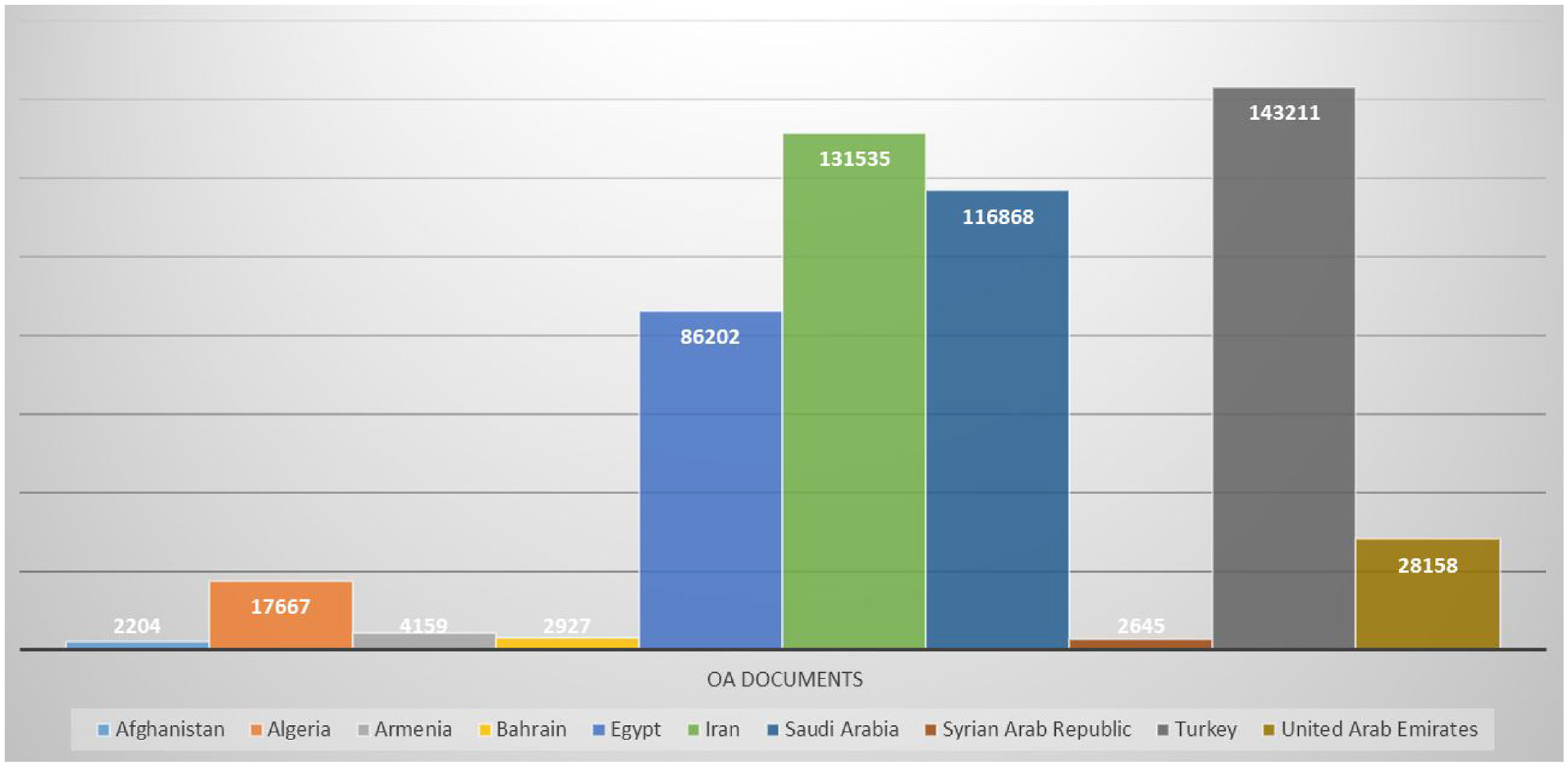
The total number of the published open access documents for MENA countries.
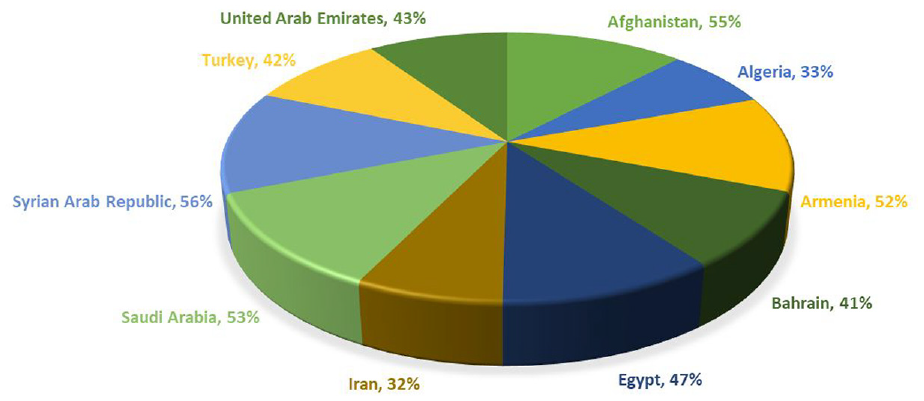
The percentage of the open access published documents for MENA countries.
According to Figure 1, the MENA countries have a range of published documents in the Scopus database, starting from 4,029 for Afghanistan and going up to 413,705 for the Islamic Republic of Iran. Figure 2 shows that Afghanistan is classified as a low-income country while the Islamic Republic of Iran is classified as a high-income country. Figure 3 reveals that the number of published documents through the open access model differs among MENA countries, with Afghanistan having 2,204 published documents and Turkey having 143,211 published documents. Furthermore, the data reveals that Afghanistan and the Syrian Arab Republic have the lowest numbers of published documents using the open access model. This can be attributed to their classification as low-income countries according to the World Bank classifications, as shown in Figure 2. This classification significantly impacts the publishing rates in the open access model. Additionally, Figure 4 illustrates that the percentage of publishing using the open access model varies among MENA countries, ranging from 32% for the Islamic Republic of Iran to 56% for the Syrian Arab Republic. Figure 5 presents the total number of citations received by the first two thousand documents for each of the 10 MENA countries. Likewise, Figure 6 provides the total number of citations for the first two thousand open access documents in each country. Lastly, Figure 7 showcases the percentage of citations received from open access published documents compared to the total number of published documents for each MENA country.

The total number of citations of all published documents for MENA countries.
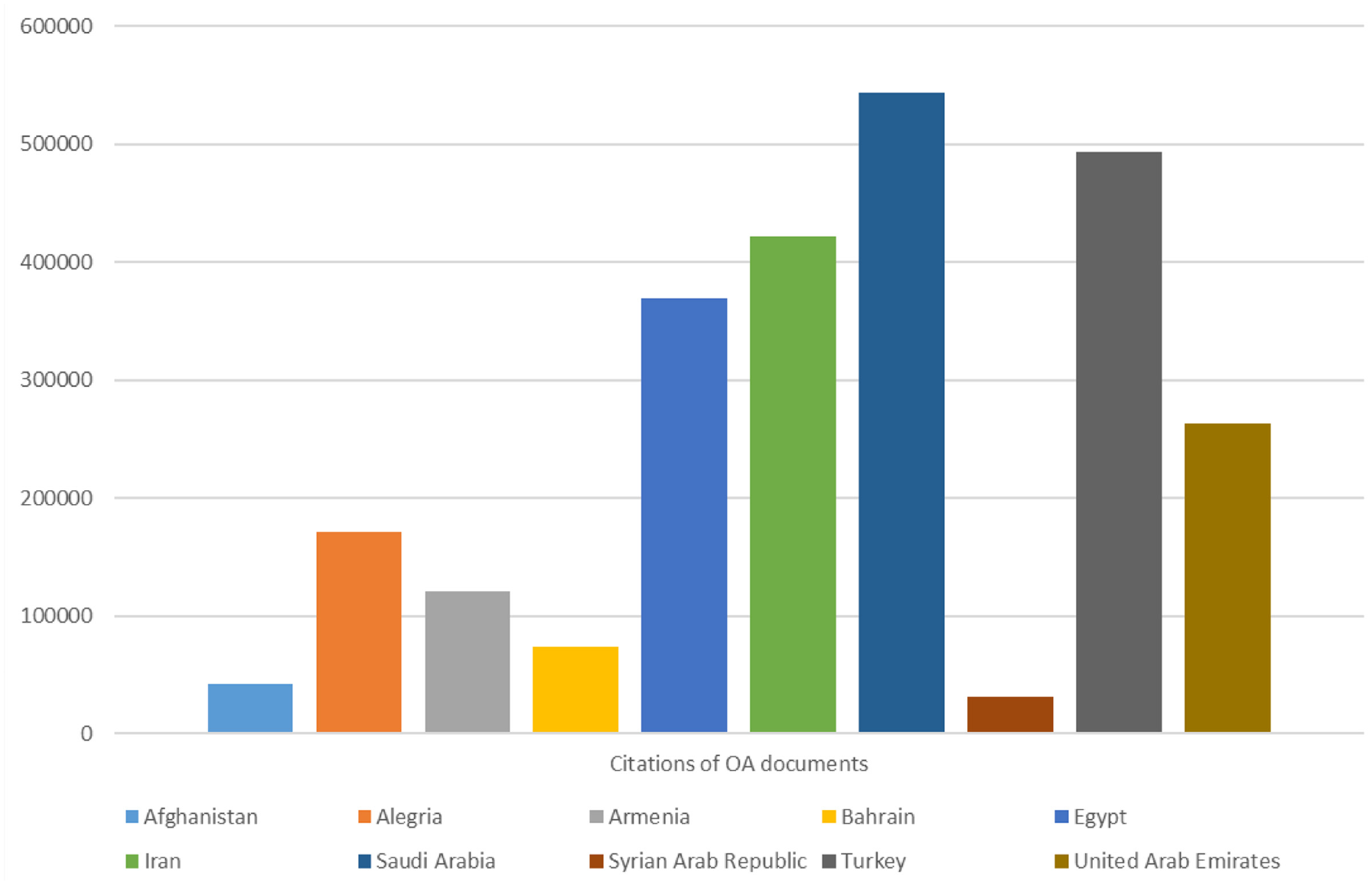
The total number of citations of OA published documents only for MENA countries.

The percentage of the citations of OA to the total published documents.
By examining Figures 5 and 6, we can observe several valuable findings regarding the ranking of institutions based on the total number of citations associated with open access publishing. From Figure 5, it becomes evident that Saudi Arabia has the highest number of citations among all published documents. Additionally, Figure 6 confirms that Saudi Arabia also leads in terms of citations received from open access model publications, with a total of 543,841 citations. The Syrian Arab Republic has the lowest number of citations with 31,461 published documents using the open access model. This indicates that authors from Syria have limited participation in the open access model. Figure 7 shows that the percentage of citations received from open access publishing varies, with Syria receiving 72% and Armenia receiving 95%. This suggests that only 5% of citations in Armenia come from non-open access documents. The chart in Figure 7 also highlights the importance of open access publishing as a significant source of citations, with a minimum of 72% and potentially up to 95% of total citations. This emphasizes the role of open access publishing in scientific research. Additionally, Figure 8 depicts the number of institutions from MENA countries included in the Quacquarelli Symonds World University Ranking QSWUR (labeled for QSWUR-2024), which considers multiple inclusion and ranking criteria. Similarly, Figure 9 illustrates the number of institutions from the 10 MENA countries included in the Scimago Institutions Ranking SIR (labeled for SIR-2023), which has its own scientific criteria for ranking and a single inclusion condition. These figures allow for further examination of the impact of open access publishing on the rankings of institutions in MENA countries.
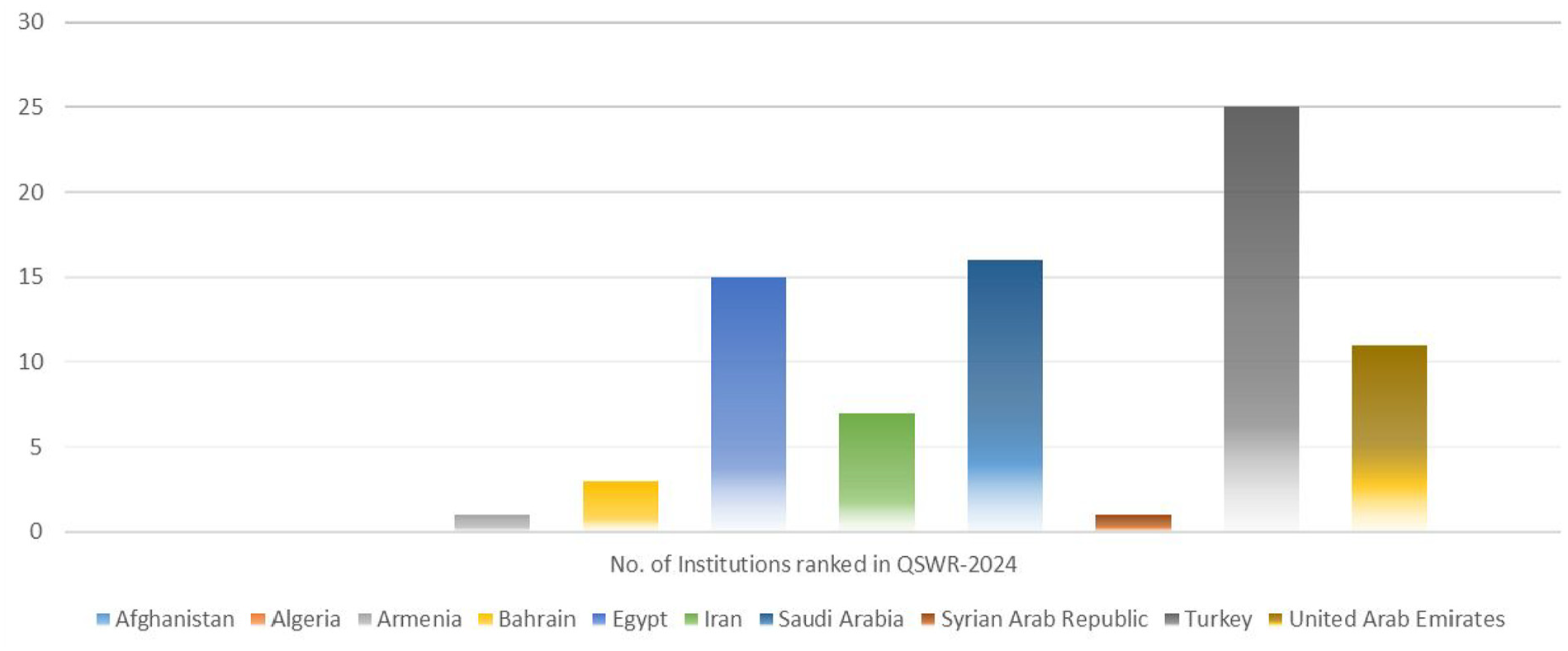
The total number of the institutions of each MENA country which are ranked in QSWUR-2024.
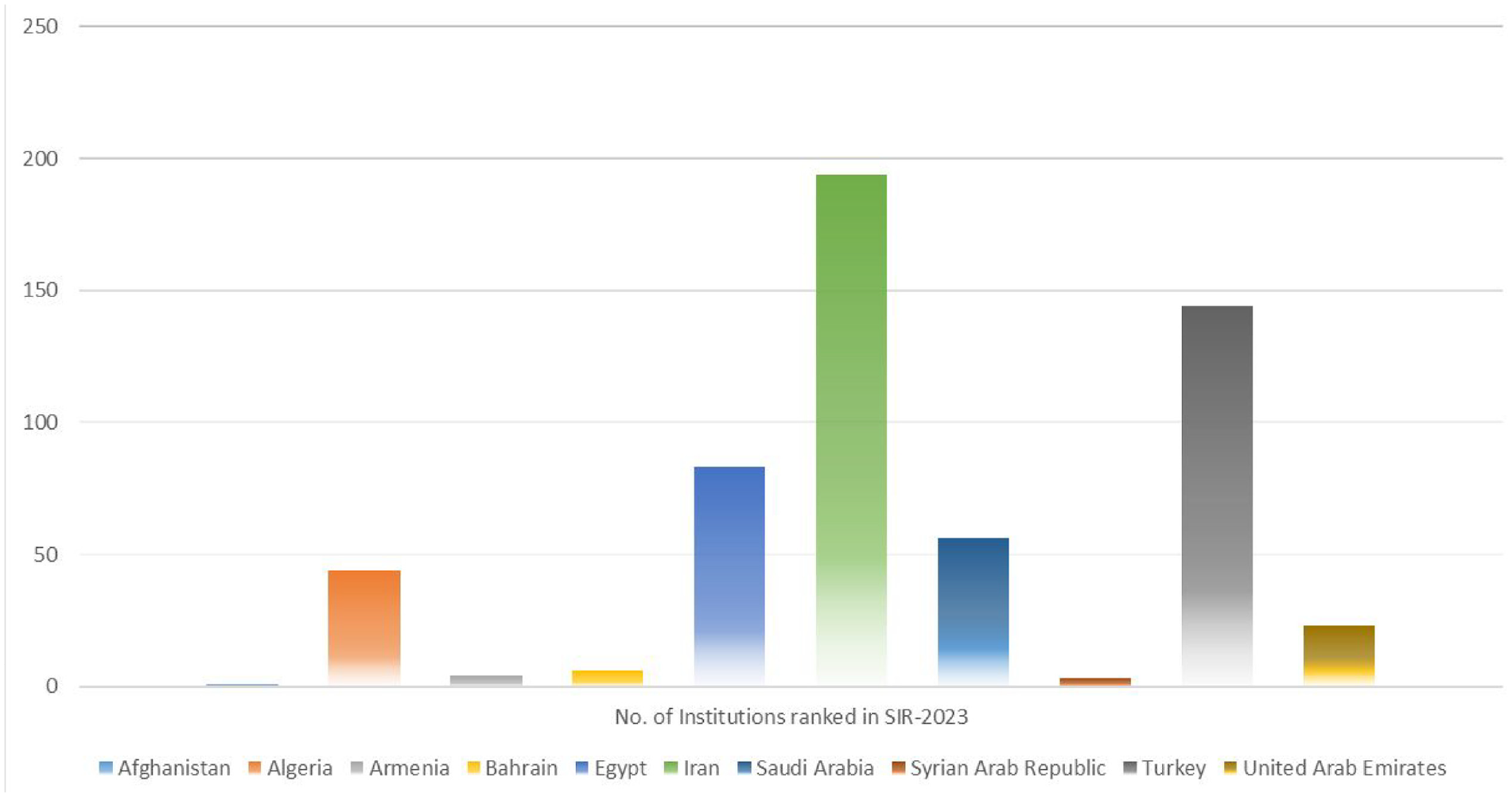
The total number of the institutions of each MENA country which are ranked in Scimago Institutions Ranking-2023.
From Figure 8, it is evident that Saudi Arabia and Turkey are the only two MENA countries listed in the QS World University Ranking-2024 with more than 16 included institutions. These countries also stand out due to their high number of publications in the open access model or the citations received from documents published in the open access model. Similarly, Figure 9 shows that the Islamic Republic of Iran has the highest number of institutions included in the Scimago Institutions Ranking-2023. This is attributed to two main factors: firstly, the country’s high number of published documents indexed and abstracted in the Scopus database (as seen in Figure 1), and secondly, the number of institutions within the country itself. The most significant finding is the number of ranked institutions in the first quartile of the Scimago Institutions Ranking and the first 500 ranked institutions in the QS World University Ranking that have the highest number of open access publications or citations. This correlation is due to the inclusion of open access criteria in the Scimago Institutions Ranking. One noteworthy result is the variation in open access publishing rates among MENA countries, with some countries, like Saudi Arabia, providing financial support for publishing in open access journals. The findings of this factor can be observed in Figures 3 and 4, where it is evident that Saudi Arabia has more than half of its published documents abstracted and indexed in the Scopus database published in open access (OA) models. Another important aspect is the discount offered by reputable journals from publishers like Elsevier, Springer-Nature, Sage, Wiley, Taylor and Francis, and the American Institute of Physics to authors from low-income and middle-income countries. The effects of this factor can be seen in Figure 4 for the Syrian Arab Republic. Additionally, the quality of open access publishing is influenced by several factors, including the peer review process and self-citation practices. Self-citation is often not considered in rankings such as the QS World University Ranking. These insights can be used by policymakers and academic institutions to improve their research and publishing strategies. Furthermore, for the selected MENA countries, open access publishing models play a crucial role in their scientific output, affecting both citation metrics and institutional rankings. It is important for funding resources to be allocated to support open access publishing, as it has a significant impact on the performance of scientific research and institutional standing. These findings have broader implications for the significance of open access publishing.
Conclusions
The purpose of this study was to examine the relationship between university and research center rankings in Middle East and North Africa (MENA) countries and their publication practices in open access models, specifically gold and platinum open access. This was done by analyzing bibliometric data from documents indexed in the Scopus database. Additionally, the study aimed to explore the connection between each MENA country’s classification by the World Bank and their open access publishing.
Data on bibliometrics for each MENA country were collected using two search strings in the Scopus database. The study discussed the proportion of published documents available in open access compared to the total number of documents published by authors from MENA countries. The findings revealed that the percentage of open access publishing varied across countries, with the Islamic Republic of Iran at 32% and the Syrian Arab Republic at 56%. Additionally, it was observed that the countries with the lowest number of published documents in open access were the Syrian Arab Republic and Afghanistan, both classified as low-income countries by the World Bank. Conversely, Turkey and the Islamic Republic of Iran, classified as high-income countries by the World Bank, had the highest number of publications in open access.
In addition, we analyzed the citations of bibliometric data for open access published documents in the MENA countries to examine the relationship between institution rankings. Our findings revealed that one MENA country had 95% of its citations derived from open access publications indexed in the Scopus database. The lowest percentage of citations from open access publications was 72%. This disparity in citation percentages influenced the rankings of institutions in reputable systems like the QS World University Ranking and Scimago Institutions Ranking. Our study also discovered that MENA countries with higher numbers of published documents in open access had a greater number of institutions ranked in these prestigious rankings. Given the significance of the open access publishing model based on these results, we propose policymakers in institutions worldwide to provide more support for open access publishing as it impacts the factors that affect institutional rankings. Additionally, we believe that the findings of this study can be applied to other countries globally.
Footnotes
Authors’ Contributions
All authors (MA) and (CA) of the article are responsible to the design and implementation of the research to the analysis of the results and to the writing of the manuscript.
Declaration of Conflicting Interests
The author(s) declared no potential conflicts of interest with respect to the research, authorship, and/or publication of this article.
Funding
The author(s) disclosed receipt of the following financial support for the research, authorship, and/or publication of this article: This research is funded by Damascus University (https://damascusuniversity.edu.sy), and International University for Science and Technology ( ).
).
Data Availability Statement
All data generated or analyzed during this study are included in this published article.