




Abstract
This study examines the factors associated with wage expectations among Macao youth in the context of potential emigration to mainland China. Using survey data, logistic regression analyses were employed to identify associations between individual characteristics and wage expectations. The findings show that permanent residents of Macao are more likely to expect a monthly wage of MOP 17,000 or above compared to non-permanent residents (OR: 2.641). Employed youth also exhibit higher wage expectations (OR: 4.677) than unemployed individuals and students. These results suggest that residency status and employment experience are important factors associated with wage expectations among Macao youth considering migration to mainland China. These insights may inform the development of migration-related policies and initiatives aimed at better aligning wage expectations with actual opportunities in mainland China.
Plain Language Summary
This study explores the factors influencing Macao youth's wage expectations when considering moving to mainland China. Using survey data and logistic regression analysis, the study found that permanent residents of Macao and employed youth have higher wage expectations, with permanent residents being 2.64 times more likely to expect a monthly wage of MOP 17,000 or above, and employed youth being 4.68 times more likely compared to unemployed youth and students. These findings suggest that policymakers should address these factors to better align youth wage expectations with opportunities in mainland China.
Introduction
Anticipations regarding future conditions in the destination region play a crucial role in shaping emigration decisions (Hoxhaj, 2015). This influence can be observed in both international and domestic migration. For most migrants, expected wage serves as a primary economic foundation for sustaining their lives in the destination region. Securing sufficient income to support their living standards is a critical consideration that migrants must carefully evaluate when deciding to migrate. In both developed and developing countries, expected wage is a key driver of migration intentions, particularly for low-income groups, who are more sensitive to perceived income gaps between the destination and origin regions, leading to higher migration rates (Jestl et al., 2017). Exploring the issue of expected wage in migration provides a deeper understanding of the driving mechanisms behind migration.
Migration between mainland China and Macao provides a relatively unique context for examining the issue of expected wage in population migration. The “One Country, Two Systems” framework gives this migration distinct characteristics, such as specific permit requirements and unique border-crossing procedures, even though it is considered internal migration within a single country. This setting provides a type of migration that differs not only from international migration but also from migration between different regions within the same country.
The youth population constitutes an important demographic group in the context of migration flows between mainland China and Macao. Recent research increasingly highlights various factors—especially wage—influencing Macao youth migration to the mainland. For example, Chen et al. (2024) employed a mixed-methods approach, combining surveys and interviews, to investigate the challenges faced by Macao youth integrating into mainland cities within the Guangdong-Hong Kong-Macao Greater Bay Area. Their correlation analysis demonstrated that wage is significantly related to Macao youth’s willingness to pursue development in mainland cities, alongside other influential factors such as the employment environment and industry prospects. Similarly, Zhang et al. (2022), through the analysis of 772 survey responses, identified wage, together with living and working environments, as key determinants influencing Macao youth’s decisions to develop in Hengqin. Further, Zhong (2017) explored job preferences among students from Hong Kong and Macao, and found that when considering employment in mainland China, these students prioritize the following factors in order: job location, opportunities for career advancement, chances to acquire new skills, and wage.
Moreover, Wen (2010) conducted a survey of 226 Hong Kong and Macao students, revealing that their wage expectations declined in response to the financial crisis. Although there is a growing body of literature concerning wage expectations in labor migration between Macao and mainland China, there is still a lack of in-depth understanding regarding the underlying determinants of these expectations. Future research should further investigate these influencing factors to provide a more comprehensive understanding of wage expectations within the context of youth migration between the two regions.
Wage expectations are likely to remain a significant force shaping employment-related migration between Macao and mainland China, especially among young people. At present, wage levels in Macao are still higher than those in mainland China. While the gap is expected to gradually narrow as salaries in mainland China rise, a considerable disparity is likely to persist in the near future (Zhuang, 2022). Therefore, understanding the factors associated with Macao youth’s wage expectations for employment in mainland China is essential for exploring the determinants of wage expectations in cases where individuals migrate from higher- to lower-income regions. Such research will offer deeper insights into the role of wage expectations in broader migration dynamics. To this end, the present study uses survey data from 332 Macao youth and applies logistic regression analysis to examine the factors associated with their wage expectations for employment in mainland China.
Theoretical Framework
Within the framework of neoclassical economics, income inequality consistently emerges as a significant factor influencing migration decisions (Zhu, 2002). Traditional labor migration theories, such as Todaro’s “urban-rural expected income disparity” hypothesis, further develop this perspective by arguing that rural-to-urban migration is driven by individuals seeking to maximize expected income. Specifically, when anticipated earnings in urban areas exceed those available in rural regions, rural workers are incentivized to migrate to cities (Wu & Zhang, 2023). This decision-making process largely depends on a comparative assessment of income before and after migration, closely linked to expected urban wages versus wages in traditional agricultural sectors (Harris & Todaro, 1970). Among young adults, there is a notable correlation between wages and migration: higher wages tend to attract in-migration and reduce out-migration rates (Sprung-Keyser et al., 2022).
Expected wages at migration destinations represent subjective estimates shaped by various factors. Research on wage expectations primarily investigates their accuracy and how individuals adjust expectations in response to new information (Fernandes et al., 2021). Numerous factors—including gender, the performance of previous labor market cohorts (Bonnard & Giret, 2016; Leibing et al., 2023; Schweri & Hartog, 2017), and policy shifts (Brown & Taylor, 2013)—have been identified as influencing expected wages. Evidence shows that migrants often either underestimate or overestimate potential earnings, with such misestimations shaped by socio-economic and cultural contexts. For instance, McKenzie et al. (2013) found that migrants from Tonga to New Zealand often underestimated their potential wages, a pattern attributed to the unique socio-economic and cultural environment of the Tongan Islands. In contrast, Hoxhaj (2015), analyzing survey data from apprehended illegal immigrants in Italy, found that many migrants overestimated potential wages in Italy—a tendency linked to migration networks and prior experience, even after accounting for human capital.
In China, studies underscore the pivotal role of both migration networks and individual characteristics in forming wage expectations. He and Xiao (2024), using an extensive dataset of domestic worker resumes from 14 major cities combined with information from the “Dynamic Monitoring Survey of Migrant Population in China,” demonstrated that migrant networks significantly and positively impact the wage expectations of domestic service workers. Similarly, Kuai (2010), utilizing data from the “2007 Survey on Enterprise Human Resource Conditions in Dongguan City, Guangdong Province,” discovered that migrant workers’ expected urban wages were strongly associated with their educational attainment and whether they had received vocational training. According to existing research, individual characteristics (such as gender and training experience), as well as socio-economic and cultural factors, are associated with individuals’ wage expectations when considering migration.
Methods
Research Design
The data for this study was collected through a survey. The survey was self-administered online and completed by adults aged 16 years or above.
Study Locations
The survey was conducted in Macao, a Special Administrative Region of China that, despite its return to Chinese sovereignty in 1999, operates under the “One Country, Two Systems” framework. This arrangement allows Macao to preserve its unique political, legal, and economic systems. While migration between Macao and mainland China is an internal migration within a country, the “One Country, Two Systems” framework gives it distinct characteristics, including specific permit requirements and border crossing procedures. Compared to Hong Kong, Macao has consistently maintained closer communication and cooperation with mainland China, both at the governmental and public levels (Fu, 2022).
Participants
The survey was conducted in September 2022. The online questionnaire was primarily distributed through the Macao Chinese Student Association, the Jiangmen Association, and various other community organizations in Macao. Macao is characterized as a “community society,” with an average of one community organization for every 64 people as of 2021 (Lou, 2022). Among the key organizations involved, the Macao Student Union stands out as a prominent youth organization with a history spanning over 70 years. Its members include university and high school students, representing a large portion of Macao’s youth demographic. The Macao Chinese Student Association is a representative youth organization in Macao (Zhang et al., 2022). Established in 2002, the Jiangmen Association has grown rapidly to become one of the largest and most influential community organizations in Macao. The survey yielded 989 valid responses, of which 332 respondents were aged between 16 and 30.
To assess the sample’s representativeness, this study compares it with the overall Macao youth population aged 16 to 30 in 2022, based on data from the Macao Youth Indicators published by the Macao Education and Youth Development Bureau. Since only gender, age, and employment status match the study’s demographic variables, the comparison focuses on these three indicators. As shown in Table 1, the sample is largely similar to the general Macao youth population, with minor differences such as a slightly higher proportion of females, those aged 23 to 30, and students, and a lower proportion of males and employed youth. Overall, the sample is broadly representative despite these small deviations.
The Sample and the Population of Macao Youth in 2022.

Note.* The data for Macao youth population aged 16 to 30 in 2022 is derived from the “Macao Youth Indicators” published by the Macao Education and Youth Development Bureau. The webpage address is: https://www.dsedj.gov.mo/ijm/db.html#1.
Statistical Analysis
Descriptive statistics were first used to summarize the sample characteristics and provide an overview of key demographic and related variables. Next, correlation analysis was conducted to identify associations between variables. Following this, binary logistic regression analysis was performed to further examine how the independent variables are related to wage expectations among Macao youth considering migration to mainland China. Finally, the robustness of the regression results was tested to ensure the reliability of the findings.
Variables
This study incorporates “expected wage” as an independent variable in the model. Macao’s economic development level is significantly higher than that of the mainland of China, resulting in substantially higher salaries in Macao. The wage disparity between Macao and mainland China is primarily driven by economic factors. According to the research by Sprung-Keyser et al. (2022), 80% of young adults migrate for higher wages within 100 miles of their place of origin. Geographically, the Guangdong-Macao In-Depth Cooperation Zone is adjacent to Macao; however, it belongs to the mainland of China. Therefore, the Guangdong-Macao In-Depth Cooperation Zone is one of the ideal locations for Macau residents seeking employment opportunities in the mainland of China. This study explores the wage expectations of Macau youth when considering emigration to the Guangdong-Macao In-Depth Cooperation Zone.
Based on data from the Macao SAR Government’s Statistics and Census Service, the median monthly income for Macao residents in September 2022, when this survey was conducted, was MOP 17,000 (Statistics and Census Service & Government of the Macao Special Administrative Region, 2024). Therefore, this study uses MOP 17,000 as the threshold for categorizing expected wages. An expected wage of MOP 17,000 or above indicates that Macau youth expect to earn an income equivalent to or higher than the median income in Macau when seeking employment in mainland China. On the other hand, an expected wage below MOP 17,000 suggests that Macau youth are willing to accept a lower income than the median income in Macau to work in mainland China.
Factors such as residency status, gender, educational background, age, employment status, willingness to emigrate to the Guangdong-Macao In-Depth Cooperation Zone, familiarity with the Zone, and prior work experience there are likely to influence Macao residents’ expected wages in the region. Accordingly, these variables are included in this study’s analysis. As all these factors are categorical variables, they were converted into dummy variables before being incorporated into the regression model.
Results
Descriptive Analysis
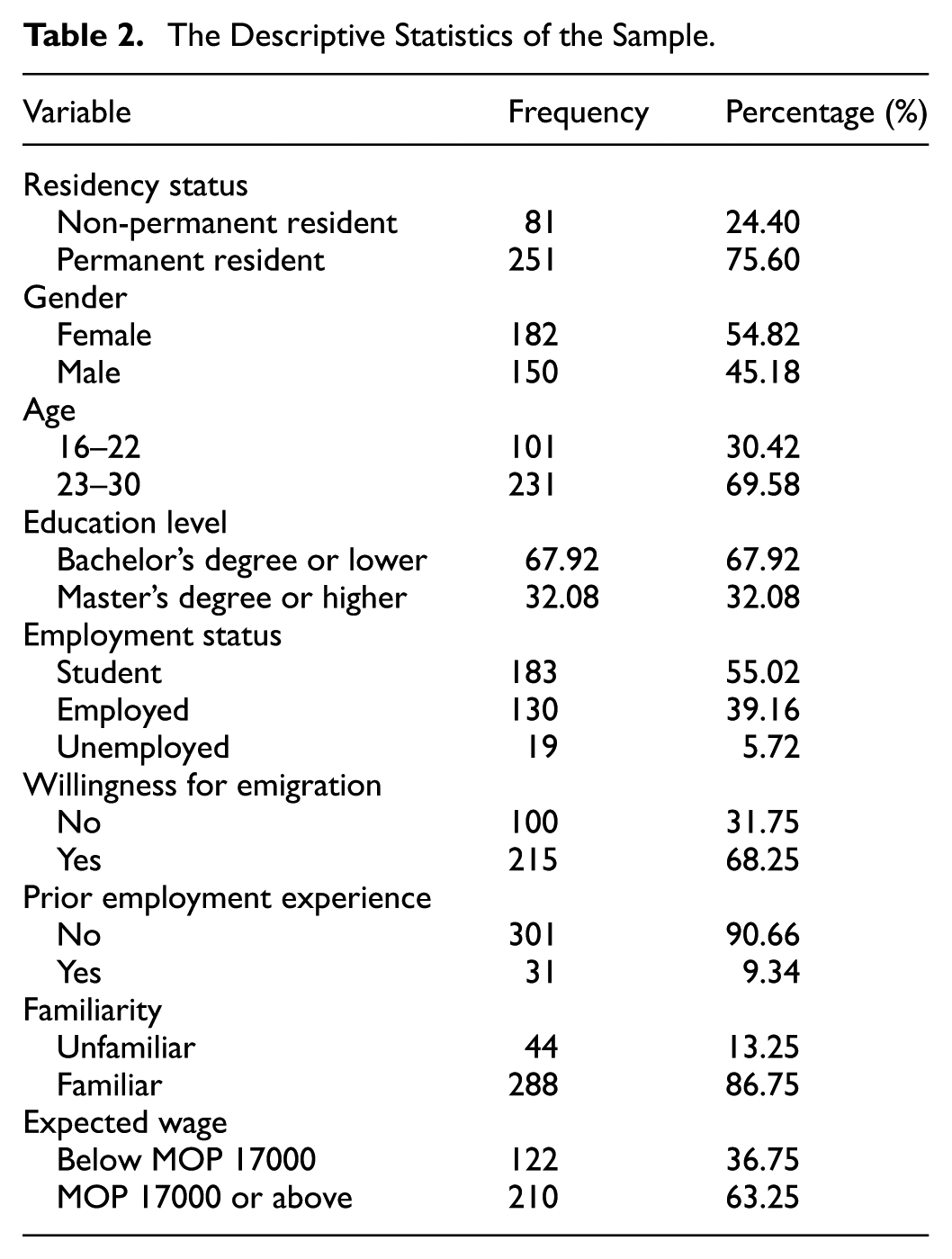
Table 2 summarizes the characteristics of the respondents. Most were permanent residents of Macao (75.60%), with non-permanent residents comprising 24.40%. Females accounted for 54.82% and males for 45.18%. The largest age group was 23 to 30 years old (69.58%), followed by those aged 16 to 22 (30.42%). In terms of employment, 55.02% were students, 39.16% were employed, and 5.72% were unemployed. A majority (68.25%) expressed willingness to relocate to the Hengqin Guangdong-Macao In-Depth Cooperation Zone, while 31.75% were not willing. Most respondents (90.66%) had no prior employment experience in the Zone, and 86.75% reported being familiar with it. Additionally, 62.53% expected a monthly salary of MOP 17,000 or above for work in the Zone, while 37.47% expected less.
The Descriptive Statistics of the Sample.
Correlation Analysis
Table 3 presents the Pearson correlation coefficients among all study variables. The results show that expected wage is positively correlated with residency status and employment. Age is positively associated with education level and employment, while student status is strongly negatively related to employment. Willingness for emigration shows weak correlations with most variables. Overall, although some variables are significantly correlated, most relationships are weak.
The Correlation Analysis of the Variables.

Note.***p < .001, **p < .01 *p < .05.
The multicollinearity analysis based on Pearson correlation coefficients shows that there is a collinearity issue with the “student” category in employment status (correlation coefficient with “employed” exceeds 0.6). Therefore, this variable was excluded from the subsequent regression model analysis.
Regression Analysis
Table 4 summarizes the prediction accuracy of the binary Logit regression model. The table shows the relationship between actual and predicted values, along with the prediction accuracy and error rates. For actual value 0, the model predicted 0 correctly 47 times and misclassified 65 instances as 1, resulting in a prediction accuracy of 41.96% and an error rate of 58.04%. For actual value 1, the model correctly predicted 170 instances as 1 and misclassified 33 instances as 0, achieving a prediction accuracy of 83.74% and an error rate of 16.26%. Overall, the binary Logit regression model achieved an aggregate prediction accuracy of 68.89% and an error rate of 31.11%, indicating that the model’s fit is acceptable.
Binary Logit Regression Prediction Accuracy

Table 5 presents the result of the binary logistic regression analysis. The model’s R-squared value is 0.218, indicating that the independent variables explain 21.8% of the variation in expected wage. The key findings are as follows.
The Result of the Binary Logistic Regression Model.

Note.***p < .001, **p < .01, *p < .05.
Residency status is a significant factor associated with expected wages. The regression coefficient for permanent residents is 0.971, significant at the 0.001 level (p < .001), with an odds ratio (OR) of 2.641. This indicates that permanent residents are 2.641times more likely than non-permanent residents to expect a same wage with the median monthly income in Macao or above in the Guangdong-Macao In-Depth Cooperation Zone. Employment status also plays a significant role. Employed individuals are 4.677 times more likely to expect a wage of MOP 17,000 or above compared to those with other employment statuses, as indicated by a regression coefficient of 1.543, significant at the 0.001 level (p < .001).
Gender, age, education level, willingness for emigration, prior employment experiences, and familiarity do not show statistically significant association with expected wages. For example, males are 1.406 times more likely than females to expect a wage of MOP 17,000 or above, but this result is not statistically significant. Similarly, individuals aged 23 to 30 are slightly less likely (OR = 0.808) than those aged 16 to 22 to expect a higher wage, but this difference is not significant.
Robustness Test
To verify the robustness of the above empirical analysis results, this study changes the dependent variable “expected monthly wage” from a binary categorical variable to an ordinal variable. The new variable has three categories: Below MOP 13,000, MOP 13,000 to 16,999, and MOP 17,000 or above. At the same time, based on the characteristics of the new variable, an Ordered Logistic Regression Model is used for analysis.
Table 6 presents the prediction accuracy of the ordered logistic regression model, showing the relationship between actual frequencies, predicted accurate frequencies, and the corresponding prediction accuracy for three income categories. It can be concluded that the overall prediction accuracy of the research model is 65.71%, indicating that the model’s fit is acceptable.
Ordered Logistic Regression Model Prediction Accuracy

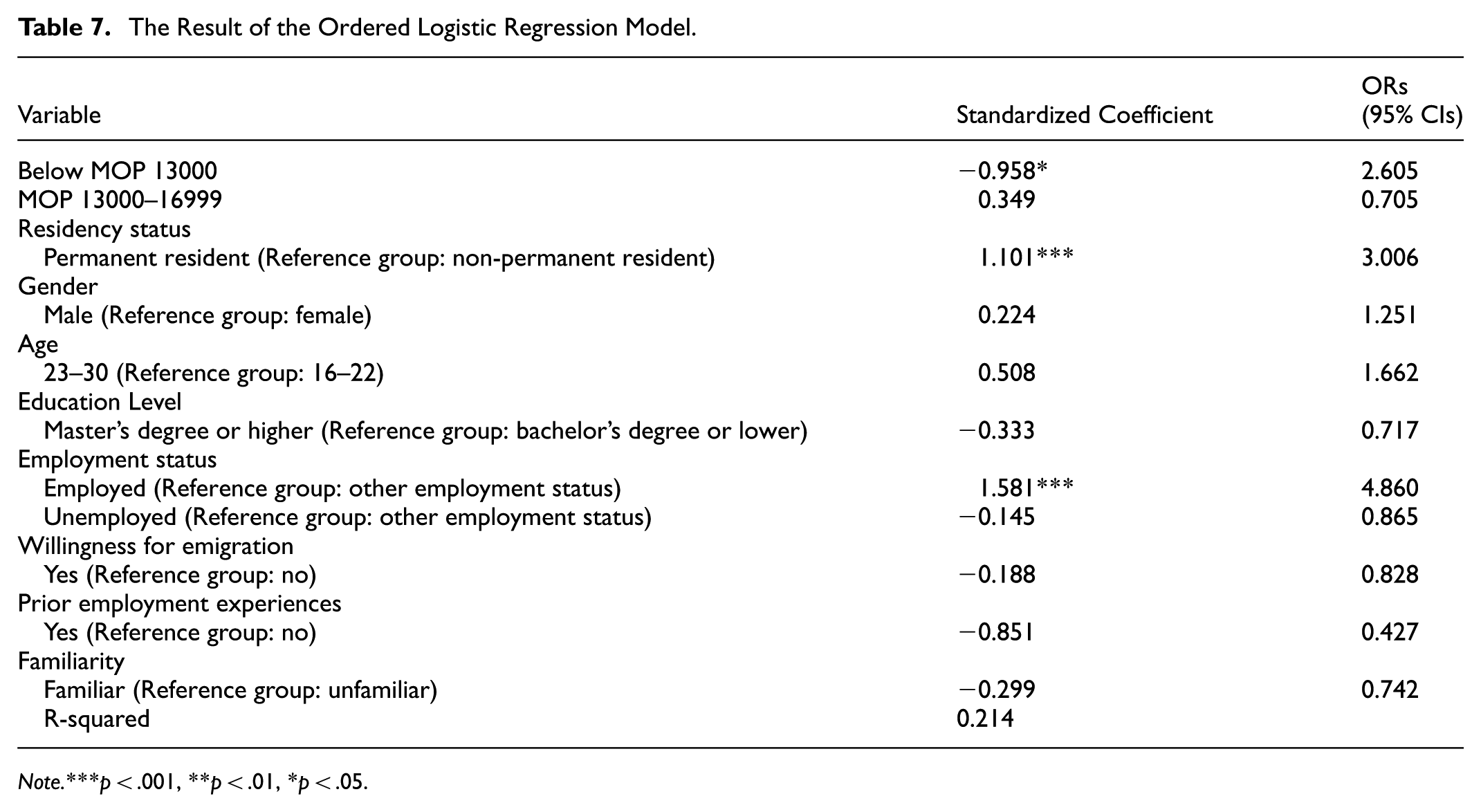
Table 7 presents the results of the model analysis. The results of the ordered logistic regression analysis are consistent with the findings of the earlier model. Both residency status and employment status remain significant factors in determining expected wages in the Guangdong-Macao In-Depth Cooperation Zone. Specifically, residency status continues to show a significant positive effect, with permanent residents being substantially more likely to expect higher wages. Similarly, employed individuals consistently demonstrate a higher likelihood of expecting elevated wage levels. The similarity in the direction and significance of the coefficients, as well as the odds ratios across different model specifications, confirms the robustness of these relationships.
The Result of the Ordered Logistic Regression Model.
Note.***p < .001, **p < .01, *p < .05.
Discussion
The results show that young people in Macao generally expect a salary of around MOP 17,000 when considering job opportunities in mainland China, reflecting their preference for salaries comparable to those in Macao. This suggests they view the mainland as a functional employment area rather than a place to settle, with personal lives and social networks firmly rooted in Macao (Zhang et al., 2022). Many see mainland employment as a temporary arrangement to achieve career or financial goals while maintaining their residence and lifestyle in Macao, emphasizing limited integration into the mainland’s social and economic environment.
Residency status plays a significant role in shaping these perspectives, as Macao’s employment policies reserve certain positions for permanent residents. For example, public office roles, government staff, university administrators, teachers, and gaming industry positions like dealers are often restricted to permanent residents (Government of the Macao Special Administrative Region, 2017). These policies ensure stable and desirable job opportunities for permanent residents.
The economic context further illustrates these disparities. As of September 2022, when this survey was conducted, the median monthly income for local residents in Macao was MOP 17,000 (Statistics and Census Service & Government of the Macao Special Administrative Region, 2024). However, salaries for certain positions, particularly in public administration, education, and the gaming industry, were significantly higher than this median figure. For example, the median monthly income for government staff and administrative positions in universities, as well as teaching roles in primary and secondary schools within the public administration, social affairs, and education sectors, was MOP 50,000 and MOP 28,000, respectively. These figures far exceed the overall median income of local residents. Similarly, the gaming industry, a cornerstone of Macao’s economy, offers highly competitive salaries. In the fourth quarter of 2022, the average monthly salary for dealers in the gaming industry was MOP 19,800 (Statistics and Census Service & Government of the Macao Special Administrative Region, 2022), surpassing the median income of all local residents by a significant margin.
A large proportion of young people in Macao are employed in specific occupational categories, with positions such as dealers in the gaming industry being particularly prominent (Cai, 2019). These roles serve as a significant source of employment for the younger generation, highlighting the pivotal role of the gaming sector in Macao’s economy. This reliance on the gaming industry aligns with the stable and well-compensated job opportunities available to permanent residents, as discussed earlier. Despite potential career and development opportunities in mainland China, most young people prefer to remain in Macao for work, demonstrating a reluctance to pursue employment in the mainland (Yin & Liu, 2022).
Furthermore, young people in Macao who are employed generally have higher salary expectations, often aiming for MOP 17,000 or above when considering mainland opportunities. In contrast, students and unemployed individuals tend to have lower expectations. These findings are consistent with previous research by Leibing et al. (2023) and Schweri & Hartog (2017), which also demonstrate that the performance of labor market plays important roles in shaping individuals’ wage expectation.
This difference may arise from employed youth having a clearer understanding of their professional skills and the realities of the local labor market, especially during the COVID-19 pandemic. The pandemic significantly impacted Macao’s labor market. By the third quarter of 2022, the unemployment rate for local residents reached 5.2%, and the underemployment rate surged to 17.9% (Statistics and Census Service & Government of the Macao Special Administrative Region, 2024). Young people were particularly vulnerable, with nearly 7,000 individuals aged 16 to 34 accounting for 44.07% of the unemployed population. The unemployment rate for those aged 16 to 24 was 12.2%, while it stood at 6.5% for ages 25 to 34, both higher than other age groups.
Workers who retained employment and higher wages during the pandemic often possess in-demand, specialized skills. For these individuals, staying in Macao provides stable income, but emigrating to mainland cities offers opportunities for career growth and higher earnings. Relocating is seen as a chance to align wages with professional skills and achieve career advancement. For Macao youth, migration is driven by aspirations for better salaries and long-term development prospects (Lin, 2019; Wu & Sun, 2021).
Implications for Policy
Using subsidy policies to narrow the labor compensation gap between the mainland and Macao, thereby encouraging Hong Kong and Macao youth to work in the mainland, has become a policy consensus in many mainland cities (Chen & Wu, 2021). According to the research findings that Macao permanent residents are more likely than non-permanent residents to expect to earn an income equivalent to or above the median income in Macao, differentiated subsidy schemes based on Macao residency status can be considered when formulating subsidy policies. For Macao permanent residents, it is advisable to appropriately increase the subsidy standard and the amount of subsidies in policy design, in order to better meet their salary expectations when relocating to work in mainland China and to attract them to seek employment there.
In addition, based on research findings related to employment status, subsidy policies can also provide targeted support to Macao youth who are currently employed, with appropriate increases to the subsidy standard. Especially for Macao youths with high professional skills, they can be further incorporated into the talent recruitment programs of mainland cities, enabling them to benefit from higher remuneration and increase their willingness to work in the mainland. At the same time, continuous improvement of professional skills is a key driver of career development for workers. For Macao youth to achieve long-term career growth in the mainland, sufficient access to vocational training is essential. This training not only supports their professional development but also serves as a foundation for earning higher salaries.
Limitations
This study has several limitations that should be acknowledged. First, the minor deviation in the sample may limit the generalizability of the findings. Additionally, the study focuses exclusively on the youth population. However, wage expectations in migration decisions are not limited to this demographic and may vary across different age groups. Future research could expand the scope to include older populations, offering a more comprehensive understanding of wage expectations in migration dynamics. Furthermore, the questionnaire survey used in this study included only a limited number of factors potentially associated with expected wages. Expanding future research to address these limitations could enhance the representativeness of the sample and incorporate additional factors, such as family income and social networks, to offer a more thorough examination of the determinants of wage expectations.
Conclusion
This study investigates the factors associated with wage expectations among Macao youth in the context of emigration to mainland China. The findings reveal that Macao youth with permanent resident status are more likely to anticipate a monthly wage of MOP 17,000 or above, compared to those with non-permanent resident status. Likewise, employed youth in Macao tend to have higher wage expectations than their unemployed peers and students. Overall, the results suggest that residency status and employment status are both significant and positive determinants of wage expectations among Macao youth considering relocation to mainland China.
Footnotes

Ethical Considerations
This study was conducted in accordance with the Declaration of Helsinki and approved by the School of Humanities, Jinan University (approval number 2).
Consent to Participate
All participants read the consent form and only those who consented took part.
Author Contributions
WW conceptualized the study and developed the draft of the manuscript. SY conducted the statistical analysis. TG reviewed the drafts of the manuscript and made inputs. All the authors approved the final version of the manuscript.
Funding
The authors disclosed receipt of the following financial support for the research, authorship, and/or publication of this article: This work was supported by the National Social Science Fund of China (23BZZ099).
Declaration of Conflicting Interests
The authors declared no potential conflicts of interest with respect to the research, authorship, and/or publication of this article.
Data Availability Statement
The data that support the findings of this study are available from the corresponding author upon reasonable request.