




Abstract
The aim of this article is to develop an Intercultural Business Communication Competence Scale (IBCCS) and provide evidence for the construct, convergent, discriminant, content, criterion, and external validity of the scale. The scale was developed based on 20 key elements of intercultural business communication competence (IBCC) and a review on the scales measuring international business practitioners’ intercultural competence. The three factors extracted with exploratory factor analysis (EFA) were the cognitive ability for the intercultural business communication situation, business English linguistic proficiency, and intercultural business communication motivation. The scale showed sound internal consistency and the confirmatory factor analysis (CFA) demonstrated sound degree of fitness and stable scale structure. The survey results revealed that respondents’ IBCC significantly correlated with their emotion intelligence (EI) and cultural intelligence (CQ). IBCCS was capable of differentiating the participants with hypothesized high IBCC level and tracking their IBCC development, which documented content validity and external validity of the measure. Hierarchical regression analysis indicated that the business students’ IBCC appeared to predict their number of foreign friends and job aspiration for an international career.
Keywords
Introduction
Intercultural communication (IC) is prevalent in almost every field of human society and the business field is one of the dimensions that cannot be neglected. One of the most important contexts for intercultural interaction in the 21st century is the global workplace (Martin & Nakayama, 2015). Intercultural business communication (IBC) is communication within and between businesses that involve people from more than one culture (Chaney & Martin, 2013). Varner (2000) holds a similar opinion that IBC is the communication among individuals or groups from different cultural backgrounds in a business environment. It is necessary to note the variety of terminology on IBC: cross-cultural commercial communication (Hernández, 2014), intercultural and international business communication (IIBC; Palmer-Silveira, 2013), IC in global business (Washington et al., 2012), and international business communication (IBC; Louhiala-Salminen & Kankaanranta, 2011).
The study on IBC has been addressed from a wide range of perspectives (Aichhorn & Puck, 2017; Birlik & Kaur, 2020; Glikson & Erez, 2020; Planken, 2005; Raisanen, 2020; Shachaf, 2008; Q. Wang et al., 2018). The importance of IBC in international business has also been widely recognized (Birlik & Kaur, 2020; Camiciottoli, 2020; Glikson & Erez, 2020; Shachaf, 2008; Thompson & Anthonissen, 2019; Q. Wang et al., 2018). In the increasingly globalized and diversified international business arena, international business practitioners have to take more active and frequent parts in IBC activities. But the communication process is not always smooth and successful due to negative emotion (Q. Wang et al., 2018), foreign language anxiety (Aichhorn & Puck, 2017), cultural diversity (Shachaf, 2008), language and communication issues (leading to stress, frustration, and negative attitude) (Wilczewski et al., 2018), to list only a few factors. The inadequate intercultural business communication competence (IBCC) was concluded as the main factor causing the failure of some international business ventures (Washington et al., 2012). To bridge cultural gaps, realize effective communication, and attain business and rapport objectives in an increasingly multicultural workplace, the international business students and practitioners should have IBCC, but the construct has yet to be fully investigated.
Individuals’ IBC is, in essence, face-to-face or media-based interpersonal and IC situated in international business activities. The communication partners are international business practitioners from different cultural backgrounds and the goal of communication is to facilitate international business transactions and realize business and rapport objectives. A brief review on intercultural communication competence (ICC) and the existing study related to IBCC could help to frame our elucidation on IBCC.
Literature Review
Intercultural (Communication) Competence
Historically, ICC is investigated from the perspectives of interpersonal communication competence (Spitzberg, 1989; Spitzberg & Cupach, 1984) and communicative competence (Byram, 2012; Martin & Nakayama, 2015). Intercultural competence is the ability to communicate effectively and appropriately in intercultural situations based on one’s intercultural knowledge, skills, and attitudes (Deardorff, 2006). The dimensions or components of ICC has long been studied in scholarship (Arasaratnam, 2007; Arasaratnam et al., 2010; Byram, 2012; Chen, 2009, 2014; Dai & Chen, 2014; Deardorff, 2006, 2009; Kealey, 1989; Rathje, 2007; Spitzberg & Changnon, 2009). It has been generally acknowledged that ICC is a multidimensional construct basically involving three interlinked cognitive, behavioral, and motivational or affective dimensions, although there have been different opinions on other dimensions and controversies over the specific items encapsulated in each dimension. Xu and Jiao (2017) provided a detailed literature review on international business practitioners’ intercultural competence and concluded three main dimensions. The cognitive ability involved the practitioners’ knowledge on culture, language, business, specific business setting, the counterpart’s standpoint and attitude, and empathy. The behavioral dimension included interpersonal skills, linguistic skills, and nonverbal skills. The required attitudes were getting rid of ethnocentrism and stereotypes, putting the feet in the other’s shoes, patience, and tolerance for cultural differences.
Existing Study Related to IBCC
The knowledge on the components of IBCC is still limited. Some scholars have investigated theoretical models for the construct (Xu & Jiao, 2017; Yan, 2009). Yan (2009) proposed a theoretical model including cognitive, affective, and behavioral ability. In his model, the cognition about business knowledge, intercultural business-relation building competence, and international business discourse competence are highlighted. Varner and Beamer (2014)argued that to be an effective communicator in IBC, one should have the cultural knowledge on the counterparts and himself; be flexible and open-minded; reflect his communicative behaviors, process, and results; and adapt to the recognized and accepted rules of actions in the target cultures. The similar construct “international management communication competence” was also addressed by Chapel (1997), who held that the competence was a cognitive process involving cultural awareness and understanding, language knowledge (verbal and nonverbal), and motivation to use cultural awareness for the development of global business relationship.
Only scarce empirical studies are available on the construct of IBCC. Based on an in-depth, semi-structured interview with Chinese international business practitioners, Xu and Jiao (2017) proposed a theoretical model of IBCC incorporating three dimensions: cognitive, affective, and behavioral. In their empirical study, Louhiala-Salminen and Kankaanranta (2011) argued that business professionals’ global communicative competence (GCC) consisted of three layers: multicultural competence, competence in BELF (English as a Business Lingua Franca), and the communicators’ business know-how. In the GCC model, language was included as a key component. Although GCC is not the same as IBCC literally, according to the authors, it was used to address a new type of communicative competence required in global business communication. As “work in the domain of international business automatically implies a multicultural and multilingual working environment,” the GCC model gives us some illumination to the construct of IBCC. Yao and Du-Babcock (2020) found that the construct of intercultural communicative competence (IBCC) consisted of four obligatory components: three in relation to cultural ability (metacognitive intelligence, motivational intelligence, and behavioral intelligence) and one to language ability (strategic competence). The conclusion was drawn from the tested hypothesis that “An individual’ s IBCC level is likely to be predicted by the components of cultural intelligence (CQ) and language ability.” But it seems that the predictors of IBCC are not equal to the components of the construct per se, so the conclusion deserves reconsideration.
The Assessment of International Business Practitioners’ Intercultural Competence and Related Constructs
The past 40 years witnessed emerging number of measures for international business practitioners’ intercultural competence or related constructs (Matsumoto & Hwang, 2013). An examination on these assessments may shed some light on the scale development in this study. Many cross-cultural management consulting companies (such as Tucker, Caligiuri & Associates, Worldwork, Global Interface Pty, and ICUnet) have been pushing forward the efforts in this area (Jiao, 2017). The assessment approaches can be categorized into three types: scale measurement (as an indirect method), qualitative assessment (as a direct method), and mixed methods involving the two. One of the most representative mixed assessments is the intercultural assessment center (IAC) introduced by the HR managers of a German multinational corporation (Bennett, 2015).
The Likert-type scale is applied most widely for measuring international business practitioners’ self-perceived intercultural competence or related constructs. Among the scales tailored for international business practitioners, some measures demonstrate sound validity and reliability such as Cultural Intelligence Scale (CQS; Ang et al., 2007), Multicultural Personality Questionnaire (MPQ; Van Der Zee & Van Oudenhoven, 2000), Intercultural Adjustment Potential Scale (ICAPS; Matsumoto et al., 2001), Intercultural Communication Motivation Scale (ICMS; Kupka et al., 2009), and Attitudes and Behavioral Openness Scale (ABOS; Caligiuri et al., 2000).
Although McCroskey and McCroskey (1988) argued that the self-perceived communication competence (SPCC) scale could be used to generate a global SPCC score, SPCC showed poor evidence of construct validity in Croucher et al.’s (2019) study with respondents from 12 countries. The verbal and oral communication behaviors included in the SPCC scale are very important aspects of IBC, but they are not sufficient to represent the complex IBC activities. Actually nonverbal communication strategies play a significant role in BELF face-to-face interactions between business communicators of diverse linguacultural background (Birlik & Kaur, 2020) and intercultural encounters (Ang et al., 2007). Louhiala-Salminen and Kankaanranta’s (2011) research was characterized as exploratory since the authors attempted to decide the important elements in BELF and communicative competence rather than measure individuals’ communicative competence. In Yao and Du-Babcock’s (2020) study, respondents’ IBCC was measured with four items used in Louhiala-Salminen and Kankaanranta’s (2011) survey. Although the four items represent important aspects of IBCC, they may not be sufficient to represent the complexity of the construct.
The specific intercultural skills or knowledge needed for a globally competent engineer are somewhat different from those needed for a culturally competent health care worker (Deardorff, 2009). The specific skills and knowledge required for international business practitioners should also be different from those included in the generic ICC (Barker & Mak, 2013) or other intercultural professional communication competences. Up till now, not a self-perceived instrument has been especially developed to measure Chinese international practitioners’ IBCC. An empirical study is also called for on an IBCC model supported by validity and reliability evidence. We attempt to fill this research gap and develop and validate an Intercultural Business Communication Competence Scale (IBCCS) with five studies. Our scale development process began with a semi-structured, in-depth interview and a survey among Chinese international business professionals to explore the key components of IBCC.
The Scale Development Process
Experts Interview
In December 2015, we carried out a semi-structured, in-depth interview with four experienced Chinese international business practitioners. The practitioners were managers from multinational corporations and Chinese government officials dealing with international business. The main topic of the interview was the components of IBCC. Each interview, lasting about an hour, was carried out according to the syllabus designed by us. The topics in the syllabus were based on the literature review. The components of IBCC were categorized into three hypothesized dimensions, namely, the knowledge, the emotion, and the behavior dimension; 11 questions were included in the syllabus. Seven questions were about the components of IBCC and four about the IBC frequency, training, and a critical incident, respectively. The question on the critical incident read, “What is the most unforgettable intercultural business communication event in your career life?” Open-ended questions were included such as “Besides the three dimensions above, what other dimensions should be included?” The interviews were recorded, transcribed, and studied. Thematic analysis was made on the transcripts. Three main dimensions of the construct were confirmed: the cognitive, affective, and behavioral dimension (Xu & Jiao, 2017).
Basing on the literature review and interview results, we proposed an operational definition for IBCC. As the special interpersonal communication competence required in international business, IBCC is individuals’ ability to exchange information, affection, and thoughts effectively and appropriately to gain economic and rapport benefits based on their complex knowledge about the general culture, business culture and communication situation, positive intercultural attitude, sensitivity, and motivation. The cognitive, affective, and behavioral dimensions of the integrated competence system coordinate and produce synergy effect.
Importance Evaluation Survey
An importance evaluation survey was designed and implemented with more Chinese international business practitioners to explore the key components of IBCC. The questionnaire was designed according to the operational definition. The formal questionnaire involved 30 items: four on demographic information and 26 for importance evaluation. The questions were mainly about the respondents’ perception on the importance of IBCC components. The typical questions were, for example, “In my intercultural business communication, linguistic skills are . . .” and “The related industry knowledge is . . . in my intercultural business communication.” The 5-point Likert-type scale was used for response choices ranging from “not important at all” (1) to “very important” (5).
In January 2017, a formal survey was administered through WJX.cn; 185 questionnaires were filled and 177 were valid responses. The respondents’ demographic information is shown in Table 1.
Respondents Profile (n = 177).
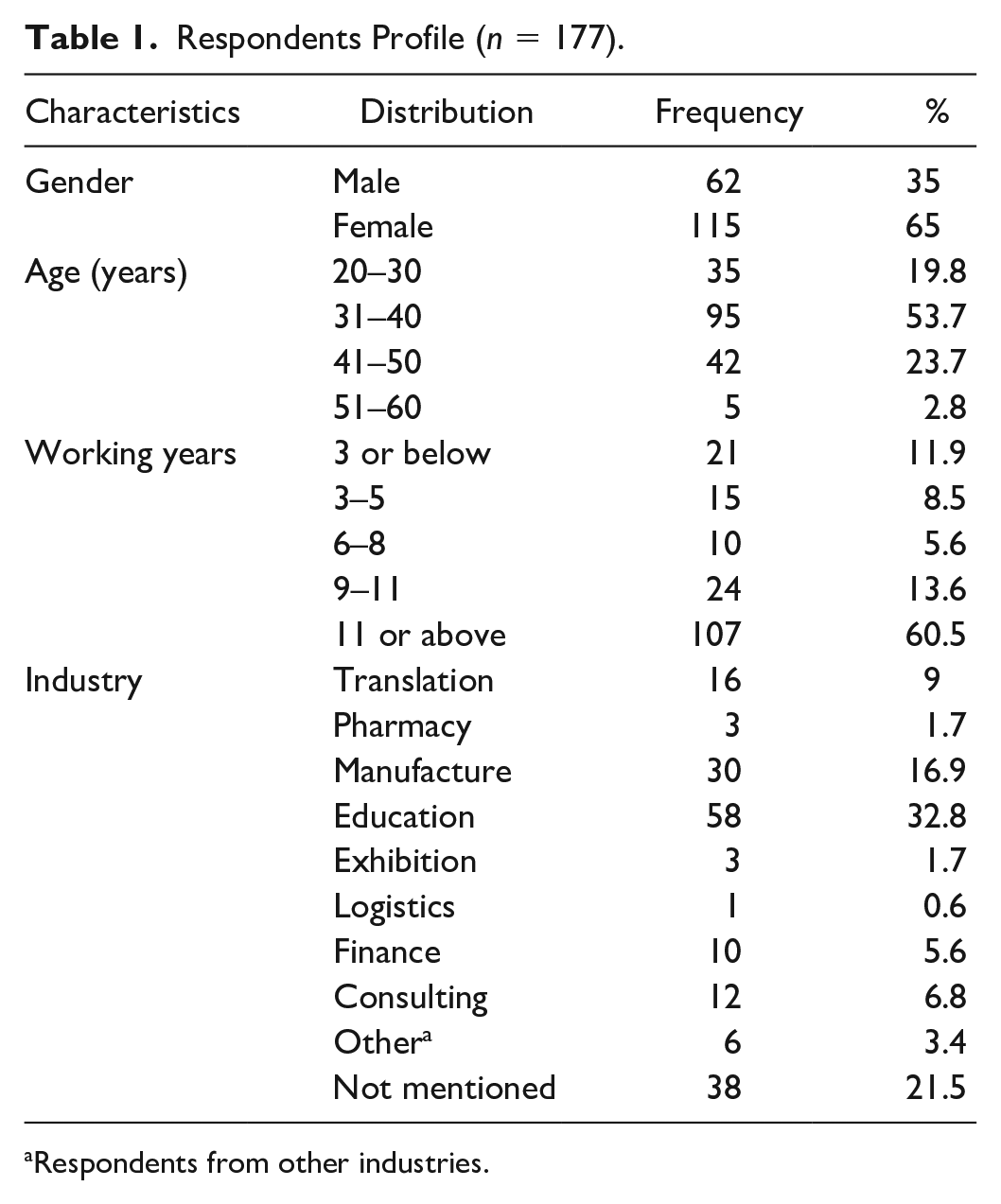
Respondents from other industries.
SPSS 22.0 was applied to analyze the 26 items in terms of item total correlation (≧0.4) and homogeneity test (commonality ≧ 0.2, factor loading ≧ 0.45). A total of 20 items with statistical significance were retained. The 20 items with high average value and small standard deviation were components widely perceived “important.” The high average value means high perceived importance level, while low standard deviation value indicates respondents’ more consensus on the importance. We made a four-quadrantal diagram with Excel to identify the components (see Figure 1). As shown in the figure, the horizontal axis represents the perceived importance level indicated by numbers 1, 2, 3, and so on, and the vertical axis stands for the consensus level indicated by the decimals from 0.05 to 0.45. Most of the dots, representing the items, scatter in the first quadrantal, signifying high perceived importance and consensus level. Only three dots, standing for Items 13, 18, and 20, respectively, are located in the second quadrantal, indicating high perceived importance value but lower consensus level.

A quadrantal for perceived importance and consensus level.
The 20 key components of IBCC are listed as follows: the ability to initiate communication, the cognition about the international business communication situation, the ability to establish trusting relationship with the counterpart, the ability to handle international business conflicts, flexibility of dealing with the changing business communication situations, cognition on the business communication strategies, open-mindedness, emotion management, confidence in performance in IBC, nonverbal communication skills, avoiding stereotypes about the partner’s foreign culture, sensitivity to the partner’s culture, ability to handle cultural uncertainty, business English linguistic skills, the motivation to maintain harmonious relations with business partners, cognition about the international business culture and related industry knowledge, adequate mental tension or anxiety in communication, professional expertise in international business, and adequate attention to each client in communication.
Scale Development
Hinkin (1995) held that the initial item pool should contain the double number of planned items to ensure effective item reduction. We developed 41 preliminary items based on the 20 components.
The literature review on IBCC, the in-depth interview, and survey results have demonstrated the importance of business and industry cultural knowledge. But items concerning individuals’ cognitive ability on these knowledge are scarcely found in the related scales. In the CQS, the items about the cognitive CQ are directed toward the general national cultural knowledge, for example, “I know the legal and economic systems of other cultures.” We referred to the item phrasing in CQS for some items but made modifications for key words to characterize international business situations. The items measuring individuals’ cognitive ability on their business and industry cultural knowledge were designed such as “I know the knowledge on international business culture.” Items assessing the behavioral ability were phrased as, “I pay attention to our cultural differences in facial expressions, gestures, eye contact and body distance and adjust to them accordingly.” Five items on business English linguistic proficiency were also developed. The items on communication motivation were designed as, “I enjoy working in the unfamiliar business culture.” Two reverse items were included: “I feel nervous when communicating with business people from different cultures” and “I am worried about my failure in my communication with business people from different cultural backgrounds.” Overall, 41 scale items and seven demographic and criterion variable questions were included in the draft. The criterion variable questions were about the respondents’ IBC internship frequency, experience abroad, number of foreign friends, and foreign language proficiency level. The scale was responded on a 5-point Likert-type scale. The original version of the measure was Chinese, which was translated by us for publication in English. Then it was back translated by three fluent English and Chinese speakers with professional knowledge on communication and scale development. It was finally confirmed by the experts that our English version was accurate and consistent.
Analysis Strategy for Instrument Validation
Five studies were implemented to validate the IBCCS. In Study 1, the evidence for the construct validity is documented with exploratory factor analysis (EFA) and confirmatory factor analysis (CFA). Convergent and discriminant validity evidence are also provided. Study 2 provides the instrument’s convergent validity evidence with CQS and criterion validity evidence with emotion intelligence (EI). In the third and fourth studies, content validity and external validity of IBCCS are tested respectively. Study 5 demonstrates the criterion validity of the measure.
Based on the literature review and the expert interview results, we set Hypothesis 1 and attempt to confirm it in Study 1:
Study 1
Method
Sample
A total of 248 freshmen and sophomore business students (127 females, 121 males, mean age = 21 years, SD = 0.78 years) in a comprehensive university in Shanxi, China, were recruited for the trial test using convenience sampling. In the formal test, the final version IBCCS was administered face-to-face to business practitioners and subjects from three different universities: a comprehensive university in Shanxi, a business college in Shanxi, and a national key business university in Peking, China. Chinese business practitioners were invited to fill in the scale, who assisted foreign business practitioners’ sales promotion in the Third International Cultural Industry Fair held in Taiyuan, Shanxi, in August 2017. In the formal survey, 891 questionnaires were altogether handed out and 850 were valid responses; 721 scales filled out by business practitioners and students (410 females, 311 males, all ranging in age from 16 to 25 years) from the comprehensive university and business college were prepared for EFA; and 129 questionnaires finished by subjects (104 females, 25 males, all ranging in age from 16 to 25 years) from the national key business college and the provincial business college were used for CFA.
Procedure
Both the trial test and the formal survey were anonymous and the respondents volunteered to participate in the study. Their information was also kept confidential. In the 248 questionnaires for the trial test, 227 were valid. SPSS 22.0 was then applied for EFA and 16 items were retained after deleting the items impacting the scale’s construct validity and reliability. The 16 items, together with seven demographic and criterion variable questions, constituted the IBCCS final version. The final version was then administered with 721 respondents (n = 721) for EFA. CFA was made with another independent sample of 129 respondents (n = 129).
Results
An EFA was made using varimax rotation with the 721 responses. The KMO (Kaiser–Meyer–Olkin) value was 0.884, the Bartlett test of sphericity was 5155.441, the degree of freedom was 120, and the p-value was .000, which signified the fitness of EFA. Three factors were explored and Items 8, 9, 10, 11, 12, and 16 were grouped into one dimension concerning the cognitive ability about the IBC situation (including communication rules, genre knowledge and awareness, communicators’ roles, communication strategies, and knowledge on international business culture); Items 20, 21, 22, 23, and 24 belonged to the behavioral dimension on business English linguistic proficiency; the third dimension included Items 14, 15, 17, 18, and 19, which were about IBC motivation such as communication anxiety, attention to differences in paralinguistic behaviors, communication attitude, and efficacy, as shown in Table 2. The three factors with eigenvalue more than 1 accounted for an accumulative contribution ratio of 61.340. We labeled the first factor cognitive ability about the IBC situation (CB), the second business English linguistic proficiency (LP), and the third IBC motivation (CM), with variance contributions being 23.462%, 20.620%, and 17.258%, respectively.
Varimax Rotated Component Matrix of IBCCS (n = 721).

Note. IBCCS = Intercultural Business Communication Competence Scale; Component 1 = cognitive ability about the intercultural business communication situation; Component 2 = business English linguistic proficiency; Component 3 = intercultural business communication motivation.
A reliability analysis was made for the 16 items and the scale’s Cronbach α was .881, showing sound internal consistency. Table 3 lists the construct validity and the reliability of the three subscales: the KMO values are all above 0.8 and the Cronbach α above .7, demonstrating sound construct validity and reliability.
KMO Value and Reliability Coefficient of Each Subscale.
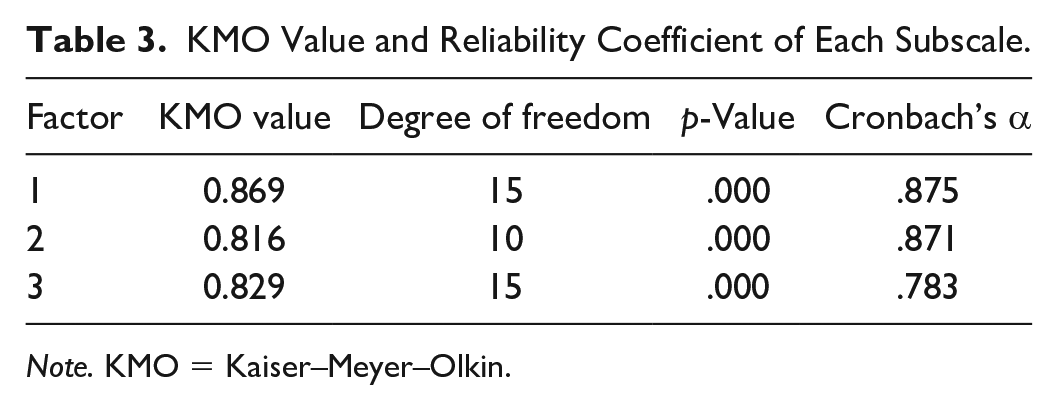
Note. KMO = Kaiser–Meyer–Olkin.
Mplus 6.12 was used to implement a CFA with the 129 responses. Following the modification instruction, we improved the fitness indices, which are shown in Table 4: the comparative fitness index (CFI) is 0.964 (>0.9), signifying sound fitness degree. The root mean square error approximation (RMSEA) is 0.070 (<0.1), the chi-square value is 35.263, the degree of freedom is 23, and the p-value is .049. The fitness indices demonstrate that the data and the model fit well and the three-dimensional IBCC model is stable. Hypothesis 1 is confirmed.
Fitness Indices of the CFA.
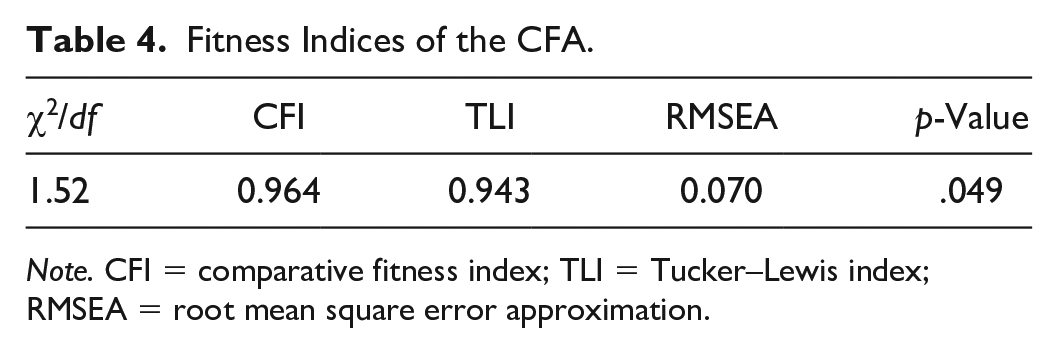
Note. CFI = comparative fitness index; TLI = Tucker–Lewis index; RMSEA = root mean square error approximation.
Pearson’s correlation analysis was made on the 721 respondents’ subscale scores and total score. The results are shown in Table 5. The correlations between each subscale score and the total score reach modest or high level (p < .01), which supports the convergent validity of the measure. The correlations between each subscale score are significantly low, ranging from .321 to .492 (p < .01), which demonstrates the scale’s discriminant validity. The subjects’ LP is positively related to their CM (r = .321, p < .01) and their LP is also positively associated with their CB (r = .492, p < .01). The subjects’ CM correlates significantly with their CB (r = .480, p < .01).
Pearson Correlations Between the Subscale Scores and the Total Score (n = 721).

Note. LP = business English linguistic proficiency; CM = intercultural business communication motivation; CB = cognitive ability about intercultural business communication situation.
p < .01, two-tailed.
Study 2
The items in IBCCS were designed to characterize individuals’ business communication competence in different cultural settings and some items on communication cognition and motivation were adapted from those in CQS, so it would be expected that the respondents’ IBCC would be related to their CI. In IBC activities, international business practitioners need to integrate their cognitive, affective, and behavioral abilities and adjust to the changing communication scenarios accordingly. Q. Wang et al. (2018) found that both native English speakers and Chinese business practitioners experienced anxiety in IBC and negative language-induced emotions affected their communication behavior. In the current study, emotion management was also included in the 20 key components for IBCC. So we expect that high emotional intelligence (EI) should facilitate individuals’ IBC. The following hypotheses were tested:
Method
Sample
The sample for the trial test for the CQS and EI were recruited with convenience sampling. A total of 93 business students (45 females, 48 males, all ranging in age from 16 to 25 years) from the School of Economics and Management of a comprehensive university in Shanxi, China, were involved in the trial test for the Chinese version of EI; 94 translation and interpreting majors (85 females, nine males, 92 ranging in age from 16 to 25 years; two ranging from 26 to 35 years) from the School of International Studies of the same university were invited to complete the Chinese version of CQS; 122 majors of international economics and trade (84 females, 38 males, 120 ranging in age from 16 to 25 years; two ranging from 26 to 35 years) were recruited for the formal survey; 44 were freshmen, 43 were juniors, and 35 were seniors of the major.
Instruments
Cultural Intelligence Scale
CQS was developed by Ang et al. (2007), who defined cultural intelligence as capability to function effectively in culturally diverse settings. The four dimensions of the CQS are metacognitive CQ (MC), cognitive CQ (COG), behavioral CQ (BEH), and motivational CQ (MOT). Respondents are expected to rate on a 7-point Likert-type scale involving 20 items. The Chinese version of CQS has shown sound construct validity and criterion-related validity among Chinese respondents (Tang et al., 2010; Q. Q. Wang et al., 2008; Xiao & Zhang, 2012, all published in Chinese). In the current study, we adopted the Chinese version and the respondents were invited to rate on a 5-point Likert-type scale (1 = strongly disagree, 2 = disagree, 3 = neutral, 4 = agree, 5 = strongly agree).
Emotion intelligence
EI was developed by Wong and Law (2002), who quoted Mayer & Salovey’s definition of EI as a set of interrelated skills concerning the ability to perceive accurately, appraise, and express emotion; the ability to access and/or generate feelings when they facilitate thought; the ability to understand emotion and emotional knowledge; and the ability to regulate emotions to promote emotional and intellectual growth. The four dimensions of the 16-item EI are self-emotion appraisal (SEA), regulation of emotion (ROE), uses of emotion (UOE), and others’ emotion appraisal (OEA). The Chinese version in Miao et al.’s (2015) work was used in the present study.
IBCCS
The 16 items developed by us were used to measure the participants’ self-perceived IBCC level. The response format was a 5-point Likert-type scale. A demographic information sheet was also completed including the participants’ gender, age, and criterion variable questions.
Procedure
Trial tests were implemented to confirm the construct validity and reliability of the Chinese version CQS and EI, respectively. CFAs were administered with the two scales, respectively, and the results confirmed fitness between the data and the model, as shown in Table 6. A formal survey was implemented among international economics and trade majors who completed the IBCCS, CQS, and EI at two different timepoints (IBCCS for one time, and CQS and EI for another time after 3 months). The Harman test was administered to diagnose common method bias and the results indicated that the first factor explained 18.53% of the variance, less than 40%, the maximum acceptable value. Pearson’s correlations were computed based on the survey results, and Table 7 demonstrates the correlations between the dimension and the total score of the IBCCS, CQS, and EI.
The Fitness Indices and Reliability Coefficients of the CQS and EI.

Note. CQS = Cultural Intelligence Scale; CFI = comparative fitness index; TLI = Tucker–Lewis index; RMSEA = root mean square error approximation; EI = emotion intelligence.
Correlations, Means, Standard Deviations, and Reliabilities for Study 2 Variables (n = 122).

Note. IBCC = intercultural business communication competence; EI = emotion intelligence; CQ = cultural intelligence; LP = business English linguistic proficiency; CB = cognitive ability about the IBC situation; CM = IBC motivation; SEA = self-emotion appraisal; OEA = others’ emotion appraisal; UOE = uses of emotion; ROE = regulation of emotion; MC = metacognitive CQ; COG = cognitive CQ; BEH = behavioral CQ; MOT = motivational CQ.
p < .05, two-tailed. **p < .01, two-tailed.
Results
In Table 7, the correlation between the IBCC total and EI total is 0.235 (p < .05), indicating significant low correlation. Hypothesis 2b was confirmed, and this result supports criterion validity for IBCCS. The IBCC total and CQ total correlate modestly at .489 (p < .01), providing convergent validity for the measure. Hypothesis 2a was confirmed. The subjects’ LP correlates with the CQ total at .390 (p < .01), approximating modest correlation. It also correlates significantly with COG (r = .248, p < .01), BEH (r = .254, p < .01), and MOT (r = .336, p < .01). The CB dimension has a significantly positive association with ROE (r = .216, p < .05). The correlations between it and the COG and MOT are .384 (p < .01) and .252 (p < .01), respectively. The subjects’ CM correlates significantly with their SEA (r = .407, p < .01) and OEA (r = .219, p < .05). The correlations between their CM and MC, BEH and MOT are .273, .416, and .252 (p < .01), respectively.
Study 3
Study 3 involves a new analysis of the data in Study 1. In Study 1, respondents were from a comprehensive university and two business universities. Meanwhile, they were from different majors (international economics and trade, English, business English, for example) in the same university or the same major from different universities. In the current study, we label the respondents majoring in international economics and trade, finance, economics, management, and business English as “business students” since they all took courses on business, although the courses were not exactly the same and had different focuses. Non-business students refer to English majors who did not take any business-related courses. Furthermore, even among the “business students,” their IBCC level might not be the same. The majors of international economics and trade in the present study received courses on international economics and trade and business English especially designed for them but other business majors did not. So they had acquired more knowledge and ability on international business than business English majors and more on business English than other business students. We were interested in finding out whether IBCCS was capable of discriminating those students with hypothesized high IBCC level. If so, the content validity of IBCCS could be addressed. The following hypotheses were proposed:
Method
Sample
In the comprehensive university, 127 English majors were recruited, who provided 122 valid responses (100 females, 22 males); 62 international economics and trade majors and 118 business students from other majors also participated in the survey. In the provincial business college, 300 majors of international economics and trade were invited to finish the scale and 287 scales were valid (125 females, 162 males); 134 business English majors volunteered to fill the questionnaires and 133 were valid (98 females, 35 males); 78 questionnaires were completed by business English majors from the national key business university and 77 were valid responses (50 females, 27 males). All the respondents were juniors and their age ranged from 16 to 25 years.
Instruments
All participants completed the IBCCS and a demographic information sheet.
Procedure
The sample were divided into seven groups for independent sample t-test. Group 1 involved respondents (majoring in English, international economics and trade, finance, economics, and management, respectively, n = 283) from the provincial comprehensive university and those (majoring in business English and international economics and trade, respectively, n = 322) from the provincial business college. Group 2 included international economics and trade majors from the provincial comprehensive university (n = 62) and those from the provincial business college (n = 251). In Group 3, we compared the IBCC total scores of international economics and trade majors (n = 62) and English majors (n = 103) all from the provincial comprehensive university. Group 4 involved international economics and trade majors (n = 62) and other business students (n = 118) all from the provincial comprehensive university. For Group 5, we tested the IBCC level of the international economics and trade majors (n = 251) and business English majors (n = 71) all from the provincial business college. Group 6 involved English majors from the provincial comprehensive university (n = 103) and business English majors (n = 71) from the provincial business college. We compared the IBCC level of business English majors from the provincial business college (n = 71) and those from the national key business university (n = 71) in Group 7. Test for homogeneity of variance was administered for each group.
Results
Results of independent sample t-tests for the seven groups are illustrated in Table 8. In Group 1, the mean value for IBCC total of the students from the comprehensive university is significantly lower than the value of those from the business college. The inclusion of non-business students (English majors) might have led to the lower IBCC total of the sample from the comprehensive university. The mean values of the international economics and trade majors from the comprehensive university and those from the business college do not differ significantly. In Group 3, the IBCC total score of international economics and trade majors is higher than that of the English majors. The results of Group 4 demonstrate that the international economics and trade majors’ IBCC level is significantly higher than other business students’ level. In Group 5, majors of international economics and trade perceived themselves as more competent in IBC than business English majors from the same college. It can be found in Group 6 that English majors reported themselves less competent than business English majors. But interestingly, the perceived IBCC of business English majors from the provincial business college is lower than that of the students from the national key business university.
Independent Sample t-Tests of the IBCC Total Score.

*p < .05, two-tailed. ***p < .001, two-tailed.
Results of Group 3 and Group 6 support Hypothesis 3a. Results of Group 4 and Group 5 confirm Hypothesis 3b. To conclude, the results of Study 3 support the content validity of the scale.
Study 4
Study 4 addresses the external validity of IBCCS. If IBCCS is a valid measure, it should trace the competence level change of the same group of respondents. Respondents from two classes were involved in Study 4. The first author of the article taught courses of Business English Listening & Speaking and Business English Reading, respectively, to them. A pre-test and post-test were administered at the beginning and end of the 4-month semester, respectively. During the semester, the students were taught not only business English vocabularies on international business, listening, speaking, reading, and translating skills but also linguistic genre analysis, and general and business cultural knowledge. Intensive practice was implemented on business English listening, speaking (such as pronunciation imitation, retelling, and presentations), and translating. The textbook of the listening and speaking course was complied based on various basic IBC situations. The textbook for the reading course highlighted hot topics on international business and most of the articles were excerpted from magazines such as The Economist, Business Week, and Reader’s Digest. Meanwhile, the respondents also attended other courses on international economics and trade, which enriched their knowledge on international business. If the business English courses promoted the respondents’ business English linguistic proficiency, other courses increased their knowledge on international economics and trade and if the IBCCS measures the psychological constructs that reflect the components associated with such potential, we would expect an increase in both the IBCC total score and dimension scores. The following hypotheses were proposed:
Method
Sample
Majors (sophomores and juniors) of international economics and trade (n = 82, 48 females, 34 males) were recruited in Study 4. All the respondents’ age ranged from 16 to 25 years. The sophomores had never taken any courses on business English and the juniors had attended a business English course: Business Letter Writing.
Instruments
The participants completed the IBCCS together with a demographic information sheet.
Procedure
At the very beginning of the second semester of academic year 2019–2020, we handed out the IBCCS (α = .860) to the participants. Four months later, at the end of the semester, the IBCCS (α = .752) was again filled by the respondents, who had completed their study on all the courses of the semester. Test for homogeneity of variance was implemented for the pre-test and post-test scores, which were then compared with paired sample t-tests.
Results
As shown in Table 9, T1 refers to respondents’ total score at the beginning of the semester and T2 the total score at the end. C stands for the score of the CB dimension, L for LP dimension, and M for CM dimension. The total scores and the dimension scores all increased significantly, so Hypotheses 4a and 4b are confirmed. Study 4 provides external validity for IBCCS. Moreover, in terms of the mean value and standard deviation, the two values for CB dimension are the largest, those for the LP dimension are the second largest and those for the CM dimension the least, signifying that during the 4-month semester, the self-perceived CB was generally promoted most significantly but with the largest deviation and CM dimension was strengthened the least but with the least deviation. The two values for LP dimension range in the middle. Maybe not enough training on CM was especially provided to the respondents or they had few chances to participate in real IBC activities, so they felt incompetent in this dimension. This result suggests the respondents’ CB and LP dimensions may be more easy to be cultivated in the short term but their abilities in the CM dimension may be more difficult to be promoted during a short time span. The communicators’ attitude, paralinguistic behaviors, and communication efficacy cultivation may need long term and special efforts such as chances of IBC in real business world.
Paired Sample t-Tests of IBCC Total Scores and Dimension Scores (n = 82).

Study 5
Study 5 investigates the criterion validity of IBCCS. If it is a good measure, it should predict the respondents’ intercultural personal network. The more competent they are in IBC, the more foreign friends they would have. Also, as McCroskey and McCroskey (1988) held, the respondents made more global life decisions, such as what career to enter, based at least in part on such judgments on how competent they believe they are to communicate well. We hypothesize that the more competent they are in IBC, the more likely they would want an IBC-related job:
Method
Sample
The sample in Study 4 and seniors of the major were included in Study 5 (n = 136, 77 females, 59 males, all ranging in age from 16 to 25 years).
Instruments
All participants completed the IBCCS (α = .870) and a demographic information sheet. To assess the respondents’ job aspiration, we developed an item “In the future, I am willing to have a job related to international business or affairs” as Van Der Zee and Van Oudenhoven (2000) did in the validity test for the MPQ.
Procedure
Hierarchical regression analysis was made on the subjects’ number of foreign friends (as dependent variable) and total score (as independent variable). The same regression analysis was used for the job aspiration as dependent variable and their total score as independent variable. The respondents’ demographic variables and frequency of visits abroad and IBC activities were entered as control variables in each model.
Results
The results of regression analysis are shown in Table 10. As can be seen in Model 2, the total score is capable of predicting the number of foreign friends (R2 = .175, b = 0.285), an important indicator of their intercultural social capital. It seemed that the more competent the respondents were in IBC, the more foreign friends they had. Hypothesis 5a is confirmed. In Model 4, the total score appears to predict the respondents’ job aspiration (R2 = .085, b = 0.236). So, Hypothesis 5b is also tested.
Regression Analysis Results.

Note. IBC = Intercultural business communication; IBCC = intercultural business communication competence.
p < .05. **p < .01. ***p < .001.
Discussion
Contributions and Implications
We develop an IBCCS and provide the evidence for the construct, discriminant, convergent, content, external, and criterion validity of the reliable measure among Chinese respondents. The IBCC construct consists of three interlinked dimensions: the cognitive ability about the IBC situation (CB), business English linguistic proficiency (LP), and IBC motivation (CM).
The IBCC model contributes to the existing IBC theory, which constitutes an important part of the study on business communication and IC. By further elaborating the components of the IBCC construct and providing empirical evidence for the IBCC model, we expand the extant knowledge on what exactly are the components and dimensions for IBCC. Our research with Chinese participants showed that besides LP, the CB and CM dimensions are also integral parts for the construct. As the behavioral dimension of IBCC, the LP dimension encapsulates items on six business English linguistic skills: listening, speaking, reading, writing, translating, and interpreting. The research finding lends support to Louhiala-Salminen and Kankaanranta’s (2011) exploratory research on GCC with Finnish samples. Language (BELF) was included as a key component in the GCC model. It also works in concert with Yao and Du-Babcock’s (2020) study, Nair-Venugopal’s (2015) research, and Varner and Beamer’s (2014) points of view on the importance of language in IBC: “linguistic fluency is undoubtedly important and a great advantage in doing business with people from other cultures . . . .” This finding is also similar to Fantini’s (2012) and Peng and Wang’s opinion on the importance of language in IC. In IC, the language communication is irreplaceable and it is the most effective means as well (Peng & Wang, 2014). The CB dimension focuses upon the cognitive ability about features of business English in different business scenarios, knowledge on the rules of business communication, knowledge on business communication strategies in negotiating prices and maintaining business relations, international business culture, and appropriate communicative behaviors based on different roles in various business communication scenarios, namely, the cognitive complexity required for communicators. This finding echoes the survey results by Louhiala-Salminen & Kankaanranta (2011): the shared vocabulary of the specific field—and the shared genres and genre knowledge which such vocabulary implies were perceived as essential for doing the work. Previous study on IBCC has highlighted the importance of cultural learning (Varner & Beamer, 2014), cultural issues, international business culture, knowledge of the business principles and professionals’ expertise (Louhiala-Salminen & Kankaanranta, 2011), and cultural ability (Yao & Du-Babcock, 2020) and we confirm the importance of these facets in our study with participants from Mainland China. In addition, we propose the importance of other items in the CB dimension: knowledge on the rules of business communication and business communication strategies. Item CB4 specifically reflects the required awareness of societal forces and power hierarchies (Martin & Nakayama, 2015) in the highly dynamic, fluid, and changeable communication scenarios. The items involved in the CM dimension center about communicators’ attention to differences in paralinguistic behaviors, communication attitude, anxiety, and efficacy, which echoes Kupka et al.’s (2009) study on the ICMS including three dimensions: IC anxiety, IC trust, and IC self-efficacy.
The 16 items of the measure are featured by IBC scenarios and reflect IBCC with greater depth and scope. So the current study improves the four-item measure used by Yao and Du-Babcock (2020). SPCC was purported to generate a global SPCC score, but poor construct validity was reported in Croucher et al.’s (2019) study. Not only verbal but paralinguistic behaviors are incorporated in the items, so our measure expands the scope of past measures.
The respondents’ IBCC was modestly related to their CQ and this provides convergent validity for our measure. Their IBCC was also positively associated with EI, which conforms to the study by Q. Wang et al. (2018) and Aichhorn and Puck (2017), who stressed the importance of emotion in IBC. Specifically, the subjects’ LP positively correlated with their CQS total. It also significantly correlated with COG, BEH and MOT. The CB dimension had a significantly positive association with ROE. The correlations between it and the COG and MOT were low but significant. The subjects’ CM correlated significantly with their SEA and OEA. Their CM had positive low correlations with their MC and MOT, respectively. The CM dimension was modestly associated with BEH.
By capturing the key features of individuals’ IBCC behaviors, IBCCS was capable of differentiating the participants with hypothesized high IBCC level and reflecting their IBCC development after facilitation efforts, which supported content validity and external validity of the measure. The IBCC total predicted the respondents’ number of foreign friends, an indicator of their intercultural social network. Although quantity of foreign friends is not the only indicator of social capital, the result provides criterion validity for our measure. The IBCC total also predicted the respondents’ job aspiration, which also supports its criterion validity.
Our study has some implications for IBC pedagogy. In IBC teaching, the three interlinked dimensions should be focused upon in textbook and curriculum design. Business English linguistic proficiency consists of only one important dimension for individuals’ IBCC. Attention should also be paid to the CB and CM dimension. As shown in the results of Study 4, knowledge instruction and linguistic skill training for CB and LP dimension, respectively, may be effective in the short term, but the cultivation on CM may need longer time and special efforts such as IBC internship or learning by doing in the real international business world. Exposure to the communication partners in real scenarios may be helpful to cultivate CM.
Nearly all IBC activities, media-based or face-to-face, take place in organizations engaged in international business, so our study also bears implications for corporate communication and managerial communication, which are virtually IBC among colleagues, leaders and subordinates, employees, clients, and so on, in Chinese international organizations or multinational corporations managing Chinese employees. To facilitate the organizations’ international business, individuals in these organizations should have IBCC. The IBCC model proposed in the present study may serve as a reference to improve professionals’ IBCC. Three dimensions should be included in the organizations’ IBCC training program. The IBCCS may serve as a self-perceived measure and the IBCC model may also act as a basis for a multi-method IBCC assessment system in organizations.
Limitation and Future Research
One limitation of the current study is business students were included as main respondents in the validity test. In our future research, more Chinese international business practitioners should be involved. According to Croucher et al. (2019), the cross-cultural and even the cross-generation validity of a scale should be strongly reconsidered. So, more respondents from other cultural backgrounds deserve our attention to test the scale’s intercultural validity.
The second limitation of the current work is more validity evidence should be provided to further validate the scale. Future research should investigate whether the IBCCS is capable of predicting international business practitioners’ intercultural social capital or their job performance. Although the number of foreign friends is considered as criterion variable in our study, it is not a comprehensive measure of the subjects’ intercultural social capital.
Our study is also limited by the inherent disadvantage of SPCC measure. Although self-reports may serve as useful indirect measures of self-perceptions and help us build understanding of communication behavior, they are not indicants of competent communicative performances (McCroskey & McCroskey, 1988). Other direct measurement methodologies are called for in future study to assess individuals’ IBCC performance and further validate the IBCCS.
Conclusion
The IBCCS is supported by sound reliability and construct, convergent, discriminant, content, external, and criterion validity among Chinese respondents. It can be applied to measure individuals’ self-perceived IBCC. The three-factor IBCC model has theoretical value and contributes to the existing IBC theory. The model provides a reference for IBC pedagogy and organizations’ training efforts to improve Chinese individuals’ IBCC in corporate communication and managerial communication. It also serves as a basis for a multi-method assessment system for IBCC. Our study may also shed some light on the IBCC study with non-Chinese international business students or practitioners.
Footnotes
Declaration of Conflicting Interests
The author(s) declared no potential conflicts of interest with respect to the research, authorship, and/or publication of this article.
Funding
The author(s) disclosed receipt of the following financial support for the research, authorship, and/or publication of this article: The author(s) received financial support of Shanxi Soft Science Research Program 2017041015-7 and 2018041064-3 for the research of this article.
