




Abstract
English learning contexts are typically categorized as English as a Second Language (ESL) and English as a Foreign Language (EFL). ESL pertains to English acquisition in regions where it is an official language, while EFL refers to contexts where it is not. Although previous research has examined written language differences among learners in L1 and L2 settings, most studies have focused on monolingual L2 contexts, with limited attention to bilingual environments like Hong Kong. This comparative study investigates the compositions of Chinese ESL students from senior secondary schools in Hong Kong and their EFL counterparts from Mainland of China, aiming to identify differences in linguistic features and influencing factors. The analysis of persuasive writing performance utilizes measures of lexical richness and syntactic complexity across 10 dimensions: lexical diversity, sophistication, density, syntactic complexity, accuracy, writing fluency, connective ratio, content word overlap, and latent semantic analysis. Results indicate significant differences in six indicators. Mainland students excel in lexical diversity, syntactic complexity, and syntactic accuracy, reflecting superior mastery of vocabulary and syntax. In contrast, Hong Kong students outperform in lexical accuracy, writing fluency, and content word overlap, highlighting their strengths in diction, lexical appropriateness, and readability. These findings underscore the varying impacts of official curriculum requirements, vocabulary and sentence structure instruction, and writing pedagogies in these distinct learning contexts.
Plain Language Summary
This study compared the writing skills of Chinese students learning English as a second language in Hong Kong and as a foreign language in Mainland of China. The results showed that Mainland students had better vocabulary and sentence structure, while Hong Kong students excelled in language fluency and cohesion. These differences were influenced by the different teaching methods used in each region.
Keywords
Introduction
Language learning context refers to the social-linguistic context in which language is learned or acquired, characterizing the activities, instructional strategies, educational content, and the social environment surrounding the learners, which is considered as a crucial factor of language acquisition (Loewen, 2015). As Collentine (2009) argues, “one of the most important variables that affects the nature and the extent to which learners acquire a second language (L2) is the context of learning, that is, whether learning takes place within the society in which the L2 is productive or where the first language (L1) is productive” (p. 218). Learning contexts vary depending on the scope of exposure to the target language, which can be divided into micro learning context (i.e., pedagogical context) and macro learning context (i.e., social context or environment). Given that instruction is the direct motivator for the development of L2 competence (Loewen & Sato, 2017; Mitchell et al., 2019), this study primarily takes the micro learning context into consideration. While previous research has investigated written language differences among learners in L1 and L2 micro settings, the majority of studies have focused on monolingual L2 contexts (Loewen, 2015), with insufficient attention given to bilingual environments such as Hong Kong.
A critical categorization in English learning contexts is the distinction between English as a second language (ESL) context and English as a foreign language (EFL) context. (Shehadah & Coombe, 2012). The concepts of ESL and EFL are distinguishable, and the differences primarily lie in their official language status, socio-linguistic contexts, and the function of the target language. These factors influence the formulation and implementation of language education policies on a macro level and the teaching resources, instructional objectives, and strategies on a micro level. From the perspective of second language acquisition, ESL refers to the learning of English by non-native English learners in countries or regions where English is an official language, in which they can be exposed to and use the target language in a social context, and they can learn English in an instructed setting (e.g., emerging classroom) where the learning process has certain natural acquisition properties, hence the term “second language acquisition.” However, EFL refers to English learnt through the formal medium in a non-native-speaking social context where English is not an official language (e.g., English learning in China), in which the use of the target language is extremely limited, and there is little exposure and opportunity to use English outside the classroom, hence the term “foreign language learning.” The crucial marker that distinguishes a second language from a foreign language is therefore whether the target language has its legal language status, whether it occurs in an emerging context and whether it has a widely recognized social function (Cook, 2016).
In fact, second language acquisition can be divided into two types: one is learning the second language in the target language context (e.g., learning English in English-speaking countries, learning Chinese in China), where learners can either unconsciously “acquire” the target language in their daily lives or purposefully “learn” the target language in emerging classrooms. The other is learning the second language in a bilingual context (e.g., learning English in Hong Kong), in which the second language has an official or recognized social status and is widely used in political, economic, and educational spheres, and is an essential language medium for social life. The official status and social functions of bilingualism make it possible for second language learners to have both explicit formal learning opportunities and implicit learning conditions (access to second language books, newspapers and periodicals, film and radio information, social interaction). As such, it shows that ESL learners approximate the acquisition mechanism or learning process of native speakers in terms of their learning context and the way of language exposure (Ortega & Han, 2017; Spolsky, 1989), which can be inferred that their language competencies should be higher than those of EFL learners in the same grade. Whether this is actually the case, then, requires evidence-based judgments from the analyses of their linguistic output.
To engage in writing as a process of creating meaning, writers need to develop ideas grammatically and coherently (Kim & Crossley, 2018). Therefore, writing performance is a valid measurement of language competence for its comprehensiveness on written accuracy, complexity and cohesion. Previous studies have concentrated on the analysis of learners’ synchronic and diachronic language characteristics within the multiple measure framework (e.g., linguistic complexity, accuracy, fluency and cohesion), in which the main focus has been on the language performance of second language learners in the target language context (Atasoy & Temizkan, 2016; Housen & Kuiken, 2009; Llanes, 2012; Ortega, 2003; Plakans, 2009; C. G. Polio, 1997; C. Zhang, 2022) and on the language development of foreign language learners in their L1 context (Baba & Nitta, 2014; Crossley et al., 2011; Manchon, 2012; Vandeweerd et al., 2023; Verspoor & Smiskova, 2012). There has been limited research comparing the written language output of second language learners in bilingual contexts, such as Hong Kong, with that of foreign language learners in their native language environments, such as mainland of China. Consequently, the existing literature offers few relevant findings, which hampers the understanding of English language acquisition in bilingual settings and in mainland of China, home to the largest population of English as a Foreign Language (EFL) learners worldwide. This gap in research may also impact the theoretical development of the critical distinctions between English as a Second Language (ESL) and EFL, as discussed by Liu and McCabe (2017). In view of this, this study compares the written output between the ESL learners from Hong Kong and EFL learners from mainland of China within the multiple measure framework, namely, linguistic complexity, accuracy, fluency, and cohesion as well as their potential influencing factors, aiming to understand differences in linguistic features across learning contexts.
Literature Review
Theoretical Research on Language Features of Second Language Learners
Studies on language features of second language learners began earlier in the 1970s, when researchers concentrate on constructs that measured the quality of second language output, attempting to apply grammatical complexity, and accuracy measures of first language development to the field of second language acquisition (Brown, 1973). Then, researchers investigated the relationship between the quality and language characteristics of second language learners’ oral expressions in terms of fluency and accuracy (Brumfit & Johnson, 1979). On this basis, Skehan (1998) developed a conceptual framework of complexity, accuracy and fluency (CAF) as overall indicators to measure language features of second language learners, which have provided a theoretical basis and measuring instrument for the study of second language learners’ language output. Wolfe-Quintero et al. (1998) refined the measures of fluency, accuracy and syntactic complexity to improve the system of language profiling, and summarized the lexical richness and syntactic complexity indicators used in the past decades of research, and Read (2000) further pointed out that lexical distinctiveness is not suitable for evaluating learners’ second language vocabulary development, and that lexical richness should be considered as a multidimensional construct covering four sub-dimensions: lexical variation, lexical complexity, lexical density, and lexical errors. Researchers have found significant differences in the correlation between different lexical and syntactic indicators and the quality of writing performance (Lu, 2012).
The CAF framework has been a hot topic of research to examine factors influencing CAF, involving tasks (Abrams, 2019; Johnson et al., 2012), and instructional context (Knoch et al., 2014), which confirms the validity of the CAF for measuring second language written language proficiency, primarily from the linguistic and cognitive perspectives (Latif, 2009; Robinson, 2001, 2011; Skehan, 1998, 2009; Skehan & Foster, 1997). Several studies have shown that CAF measures have varying degrees of discriminatory level and explanatory power in terms of the quality of language output and language proficiency (Ellis & Yuan, 2004; Latif, 2009; Phuoc & Barrot, 2022), which can be used to make evidence-based judgments and conclusions about learners’ language competence and proficiency (Ellis & Barkhuizen, 2005; Housen & Kuiken, 2009). Latif (2009) further distinguishes between process-based fluency and output-based fluency; the former involves the procedural behavior of writing, and the latter concerns the text itself with cohesive features. Cohesion refers to the interpretive dependence of discourse components (Halliday & Hasan, 1976, p. 4) with relevance to output-based fluency and coherence (Atasoy & Temizkan, 2016, p. 1460), both of which are important indicators of written language.
Empirical Research on Language Features of Second Language Learners
Empirical studies have explored language development patterns of second language learners based on the CAF framework. Researchers have found that learning context has a potential influence on written and oral performance of second languages (Llanes, 2012; Monaghan et al., 2024; Mora & Valls-Ferrer, 2012). However, language learning does not occur with evident advantages in the target language context when it comes to grammar learning (Collentine, 2004); a foreign language classroom in the context of non-target language can facilitate learning and acquisition of linguistic knowledge or language usage (DeKeyer, 2009). Similar findings have been reported by Serrano et al. (2011) who compared the language output characteristics of three groups of learners, indicating that the group learning in the target language for 2 months showed higher levels of written and oral fluency and lexical complexity than the two other groups studying in their native languages. In addition, the students who participated in the intensive program in L1 context showed almost the same performance and even outperformed those who participated in the general training program or the semi-intensive program in the target language. These findings indicate that both implicit and formal learning or purposeful training (i.e., instructional intervention) in the target language context have a positive effect on second language acquisition or foreign language learning (Serrano et al., 2011). That is, the target language context can provide learners with more exposure to the second language than the foreign language context, and the intensity of training has a direct impact on learners’ learning outcomes. Conversely, it has also been shown that there is no significant correlation between complexity, accuracy and fluency and language proficiency (Larsen-Freeman, 2009). A study on textual comparison between L1 and L2 shows that L1 learners did not outperform L2 learners in terms of syntactic complexity. However, it is difficult for L2 learners to achieve a similar quality in other aspects to those of L1 learners except correct expressions (Pallotti, 2009).
Furthermore, research has explored the textual characteristics of second language learners’ writing complexity and fluency (Phuoc & Barrot, 2022; Vandeweerd et al., 2023; X. Zhang & Lu, 2024). In terms of lexical and syntactic complexity, it was found that although students’ lexical richness changed in different trajectories among different levels, there was an accumulation of lexical complexity and lexical output ability (Housen et al., 2012; Zaytseva et al., 2021); learners’ syntactic ability gradually increased with the amount of English sentence exposure (Geeslin & Long, 2014; Loewen, 2015), and an increase in the length of learners’ output units indicates that their language development is relevant to writing fluency (Lu & Ai, 2015).
Previous studies have compared differences in the written language of learners in L1 and L2 settings. However, the L2 context in these studies were primarily monolingual L2 contexts, few studies concentrate on the writing performance between second language acquisition in bilingual contexts (e.g., Hong Kong) and foreign language learning in L1 settings (Serrano et al., 2011), and there is a need to broaden the scope of research on second language writing and to explore the current state of writing in more instructed contexts (Cumming, 2004; C. Polio, 2012). It is well known that for the historical reasons, Hong Kong has become a bilingual society. English is the working language of Hong Kong SAR Government, commerce, and industry, playing an irreplaceable role in the society. Since the handover, Hong Kong SAR Government has adopted a “biliterate and trilingual” language education policy, which aims to nurture talents who are good at both Chinese and English in Hong Kong to ensure its advantageousness of human resources as an international financial center and a world trade center. In daily life, the government documents (e.g., official reports and speeches, policy, and curriculum documents, etc.) are made available to the public in both Chinese and English with equal legal effect. In fact, Hong Kong society gives priority to English over Chinese. English has become the most important language medium for further education, employment, and personal development, as well as for international exchange. In the field of education, Hong Kong follows the tradition of education and use of language of the British Hong Kong era. Therefore, schools, parents and student groups attach importance to English. In addition to the English language curriculum, other courses (e.g., Mathematics, Science, Physics, Chemistry, Computer, and Information Technology, etc.) are also taught in English or bilingually, depending on the conditions of the school. In mainland of China, the official language is Chinese, although English is given a significant weight in examinations as a compulsory course for high school students. Media materials (e.g., newspapers, radio, television) in mainland of China are written or spoken primarily in Chinese, and teachers in primary and secondary schools in mainland of China basically use Chinese when teaching various courses. Therefore, mainland of China is a typical EFL learning context. The students in mainland of China, including the participants in this study, have little contact with English in their daily lives, except in English classroom. As such, this study focuses on whether there are differences in the written English of high school students who grew up in different language contexts and different education systems in the two regions of China. As such, this study aims to compare the features of written texts in different learning contexts. Therefore, a corpus-based approach was used to guide the analysis of the linguistic features in written language of ESL learners versus EFL learners. The research questions are formulated as follows:
(1) What are the features of writing complexity of Chinese ESL and EFL learners?
(2) What are the features of writing accuracy of Chinese ESL and EFL learners?
(3) What are the features of writing fluency of Chinese ESL and EFL learners?
(4) What are the features of writing cohesion of Chinese ESL and EFL learners?
Research questions are answered based on a quantitative analysis of the compositions of the two groups, specifically using complexity, accuracy, fluency, and cohesion measures to compare the differences between the two groups in 10 sub-dimensions at the lexical and syntactic levels and to observe the linguistic characteristics of the two groups’ writing. With salient patterns available from the quantitative analysis of the linguistic features in their written language, further analyses are conducted qualitatively. Specifically, analyses are made on the content of their curriculum documents, teaching materials and ways of instructional guidance for writing, which is considered as the micro learning context of the participants, namely, the pedagogical context of writing. The purpose of this is to find out the potential formative factors of these salient patterns, thus making evidence-based description of the differences between the two groups in terms of their writing output.
Method
Participants and Their Learning Contexts
The participants, aged from 17 to 19 years old, are 60 seniors in two secondary schools, in which 30 participants are from Hong Kong and 30 participants are from the mainland of China. The two groups are of similar education and language proficiency levels, having studying English for the same academic years, but exposed to different English educational environments, teaching materials, and instructional modes, with the prime difference being that the mainland high school students are EFL learners in a native-speaking context and the Hong Kong students are ESL learners in a bilingual context.
The group of participants in mainland of China is from an economically developed province in eastern China, and the other group of students came from Hong Kong, a well-known international financial center. The selected high schools are of upper-middle level in both regions (i.e., Hong Kong and an East China province in mainland of China). Compositions have been reviewed and scored by professional writing teachers according to standard scoring criteria, and no statistically significant differences (p > .05) were found in terms of their scores, indicating that the two groups of participants have similar language proficiency.
This study was conducted in strict compliance with the APA Ethical Principles of Psychologists and Code of Conduct. To ensure procedural rigor, ethical approval was formally secured from the Anonymized University Research Ethics Committee prior to research activities. Given the educational context of this research, the protocol deliberately employed non-invasive methodologies: all analyzed materials consisted of anonymized student compositions, thereby eliminating the need to collect sensitive personal identifiers or implement physical/psychological interventions. During the risk-benefit assessment phase, the review board confirmed that the study’s potential to enhance ESL/EFL pedagogical practices justified its minimal risk profile.
Three-tier safeguards were implemented to protect participant rights: First, written informed consent was obtained from all adolescent participants and their legal guardians after detailed explanations of the research objectives, voluntary participation terms, and data protection measures. Notably, consent forms specifically highlighted participants’ entitlement to withdraw submissions without academic penalty—a critical provision given the teacher-student power dynamics inherent in educational research. Second, immediately upon data collection, a systematic anonymization protocol was activated: (a) permanent deletion of direct identifiers (names, student IDs); (b) assignment of randomized alphanumeric codes (e.g., JS-01, HK-01) to dissociate compositions from individual identities; and (c) generalization of institutional affiliations by replacing specific school names with broad regional descriptors. Finally, during the analytical phase, all scoring and linguistic evaluations were conducted exclusively on anonymized texts.
Instruments
A non-material restricted writing task was conducted in classroom settings, in which the participants from Hong Kong Secondary 6 and their counterparts in the mainland of the same grade level (mainland Senior Secondary 3) were required to complete a same writing task: to write an invitation letter to a principal as Chris Wong for a cultural exchange program. According to Beers and Nagy (2011), persuasive genres indicate writing performance effectively, and there are significant differences in writing performance indicators compared to narrative, descriptive, comparative/comparative genres. To minimize the impact of genre variables on research results, participants were required to use persuasive genres for writing. Moreover, this type of applied genre is familiar to the participants, in which the content and intended audience are clear, making it relatively easy for them to focus on the writing task and express their ideas. The writing activity is treated as normal writing exercise without telling the participants the purposeful use for research, so as to ensure that they are not distracted or influenced by external evaluative factors.
Measures of Written Linguistic Features
Accuracy, complexity, fluency, and cohesion are effective indicators for measuring the quality of writing performance (Kim & Crossley, 2018; McNamara et al., 2014; Wolfe-Quintero et al., 1998). The following text analysis indicators were used to provide a birdview of learners’ written language development based on previous research on the measurement criteria.
Complexity
Complexity consists of lexical and syntactic dimensions. The lexical dimension refers to lexical richness, including three metrics: lexical diversity, lexical sophistication, and lexical density. Lexical diversity is measured by the type-token ratio (TTR), which is subject to text length. In order to eliminate this deficiency, the Uber indicator was used in this research (Jarvis, 2002), which is a variant of the TTR calculated as:

Lexical sophistication refers to the proportion of low-frequency words to the total number of words. The formula is the number of complex words divided by the total number of words. Lexical density concerns the proportion of grammatical words (Lu, 2012), calculated as grammatical words divided by the total number of words. And the syntactic complexity is calculated as the total number of words divided by the total number of sentences, with sentence length as the indicator.
Accuracy
Accuracy refers to the error-free rate of a text and is calculated as one minus the ratio of the number of errors to the total number of words. In order to make the identification more distinguishable, accuracy was divided into two categories, namely, lexical accuracy and syntactic accuracy.
Fluency
Writing fluency refers to the fluency-related written output that learners produce in writing coherently within a given time (Atasoy & Temizkan, 2016; Fillmore et al., 1979), including output-based and process-based writing fluency. In other words, writing fluency can be considered as a speed-related measure or a text-related construction, including sentence coherence and discourse cohesion. Since the output-based fluency measure is still controversial (Latif, 2009), the less controversial process-based criterion is used in this study, that is, the number of words the learner produces per unit of time. The formula is fluency = total number of words/total writing time.
Cohesion
Cohesion is quantified in terms of three dimensions: connective, overlap, and latent semantic analysis, where the connective indicator was calculated with the ratio of the number of concatenated words to the total number of words (connective ratio), the overlap indicator was calculated using the overlap ratio of content words in the text, and the latent semantic analysis (LSA) was calculated with Coh-Metrix (McNamara et al., 2014).
Data Analysis
This study used the lexical complexity analyzer (40Lu, 2012) to calculate three indicators, namely, lexical diversity, lexical sophistication, and lexical density. And Coh-Metrix (McNamara et al., 2014) was used to calculate sentence length, connective ratio, content word overlap, and LSA, which is considered to be with relatively high validity. Then the accuracy was calculated by manual methods. All texts were reviewed and scored by the authors and a secondary English teacher, and the interrater reliability was higher than 0.95. The types of errors were divided into lexical and syntactic ones, which were manually counted and reckoned up in an Excel sheet, and then lexical accuracy and syntactic accuracy were calculated respectively with accuracy formulas. The indicators of text analysis were finally summarized and t-tested, and the results of descriptive statistical analysis were made by SPSS 22.0.
Results
Descriptive statistical analysis showed that there were differences between Hong Kong and mainland students in some dimensions of their written English (Table 1). In terms of complexity, mainland students showed higher lexical diversity (M = 22.11, SD = 3.27) and syntactic complexity (M = 15.81, SD = 2.83) in their essays. However, the lexical sophistication of Hong Kong students’ written language was higher (M = 0.22, SD = 0.06) than that of mainland students (M = 0.20, SD = 0.06). With regard to lexical density, Hong Kong students and mainland students produced similar output. In terms of accuracy, findings revealed that Hong Kong students demonstrated significantly higher lexical accuracy (M = 0.98, SD = 0.01) compared to their mainland counterparts. Conversely, mainland students exhibited a notable advantage in syntactic accuracy, achieving a mean score of (M = 0.98, SD = 0.01) that surpassed that of Hong Kong students. For a detailed comparison of these results, please refer to Appendices 1 and 2. In the fluency dimension, Hong Kong students’ writing fluency (M = 5.98, SD = 2.04) was higher than that of mainland students. In the cohesion dimension, Hong Kong students’ essays had higher connective ratio (M = 80.86, SD = 18.92), content word overlap (M = 0.10, SD = 0.05) and LSA (M = 0.19, SD = 0.13) than those of mainland students’ essays.
Differences in Written English Features Between Learners of the Two Regions.
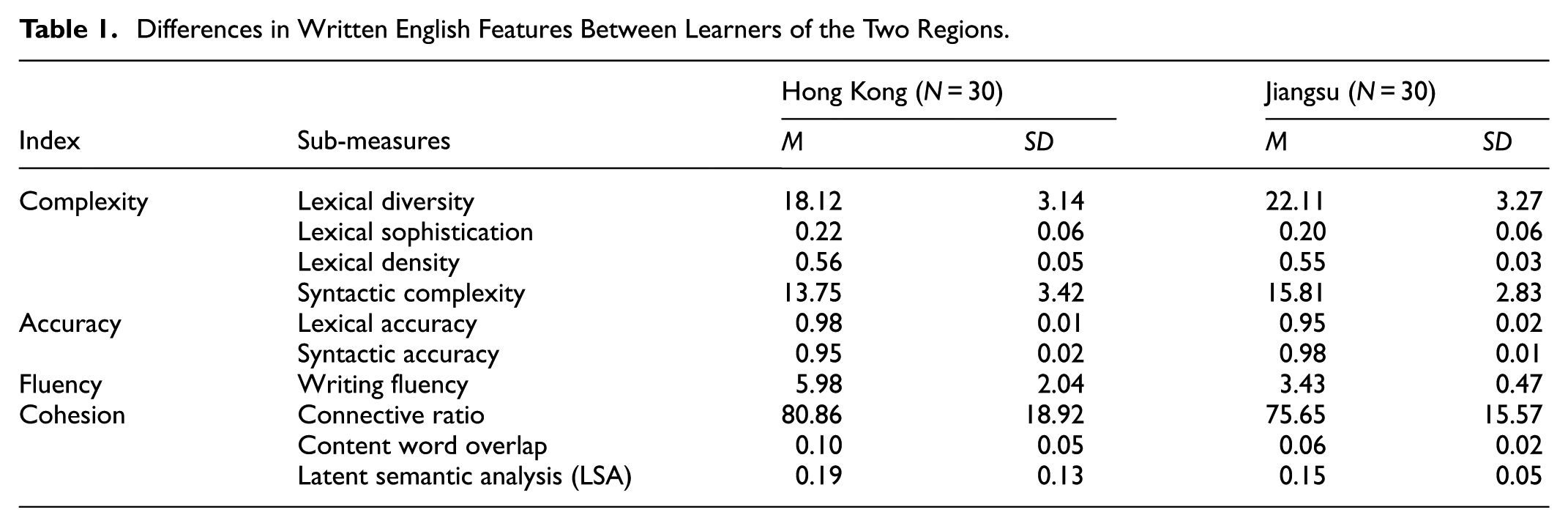
The results of the independent samples t-test (Table 2) further revealed that in the complexity dimension, the differences between the two groups of writing texts reached a statistically significant level in lexical diversity (t = −4.829, p < .01) and syntactic complexity (t = −2.543, p < .05), and did not reach a statistically significant level for lexical sophistication and lexical density (p > .05). In the accuracy dimension, the differences between the two groups of writing texts reached statistically significant levels of lexical accuracy (t = 5.182, p < .01) and syntactic accuracy (t = −7.962, p < .01). In the fluency dimension, there was a difference in writing speed between the two groups, which reached a statistically significant level (t = 6.672, p < .01). In the cohesion dimension, the difference between the two groups of writing texts only reached a statistically significant level for the indicator of content word overlap (t = 4.763, p < .01), and did not reach a statistically significant level for the indicators of connective ratio and latent semantics (p > .05).
Independent Samples t-Test of Written English Features.

The analysis on written features showed that there were significant differences between Hong Kong and mainland students in sub-indicators of their English writing: lexical diversity, syntactic complexity, lexical accuracy, syntactic accuracy, writing fluency, and content word overlap. Among them, mainland students significantly outperformed Hong Kong students in terms of lexical diversity, syntactic complexity, and syntactic accuracy, whereas Hong Kong students performed better than mainland students in terms of lexical accuracy, writing fluency and content word overlap.
Discussion
This study compared the linguistic features of Chinese ESL and EFL learners’ compositions. The results revealed no significant differences between the two groups of texts on four sub-dimensions of written language (lexical sophistication, lexical density, connective ratio, and latent semantics) and significant differences on six sub-dimensions (lexical diversity, syntactic complexity, lexical accuracy, syntactic accuracy, writing fluency, and content word overlap).
Lexical and Syntactic Complexity of Mainland Students’ Written Language
Lexical and syntactic complexity is a dimension in measuring the level of writing competence (Norris & Ortega, 2009), which to a certain extent, reflects the maturity of learners’ language acquisition (Lu, 2011; Ortega, 2003). Quantitative analyses of lexical and syntactic items indicate that mainland students performed better than Hong Kong students in language richness, as reflected in lexical diversity, syntactic complexity, and syntactic accuracy. Further analysis reveals that the strengths in lexical and syntactic performance of mainland students supported by the requirements of the curriculum and the modes of teaching and learning, which is reflected in two dimensions. Firstly, the mastery objectives and requirements of vocabulary and grammar in the mainland are clear-cut. New English Curriculum for Chinese Senior Middle Schools (NEC) issued by the Ministry of Education of the People’s Republic of China stipulates the vocabulary mastery at each level of senior secondary schools, such as a cumulative mastery of 3,000 to 3,100 words at the compulsory level and 4,000 to 4,200 words at the advanced level. Also, it prescribes the scope of grammatical knowledge mastery, and offers the specific vocabulary and grammar items in the Appendixes. Textbooks are compiled based on the requirements of the curriculum standards, within which each unit provides a detailed word list and glossaries at the end of the teaching materials; and students are required to memorize and master the prescribed words and grammar rules. In contrast, the Eight Key Learning Area Curriculum Guides (from Primary 1 to Secondary 6) recommended by The Curriculum Development Council and the Hong Kong Examination and Assessment Authority (2015) only states the language knowledge objectives in principle, without specific requirements for grammar and syntax mastery; the teaching materials under consideration present only approximately 15 commonly used words per unit, lacking glossaries and imposing rigid or specific mastery requirements. This aligns with similar findings reported by Hu et al. (2021), which indicate that the text difficulty of English-medium science textbooks is insufficient in terms of both academic vocabulary coverage and readability levels. Secondly, the learning and intensive training of language knowledge are valued in the mainland. The NEC emphasizes understanding and learning words in specific contexts and guides students to accumulate and internalize vocabulary knowledge. However, English language course focuses on teaching and practicing language usage, paying more attention to language forms, which to a certain extent facilitates students’ acquisition of lexical and syntactic rules (Loewen, 2015; Logan, 1988). Explicit instructional interventions, for example, reinforcement of word recitation and language usage training, can stimulate students’ language awareness, forming associative learning and morphosyntactic mapping, which contributes to their language competence in language use (Gass et al., 2013).
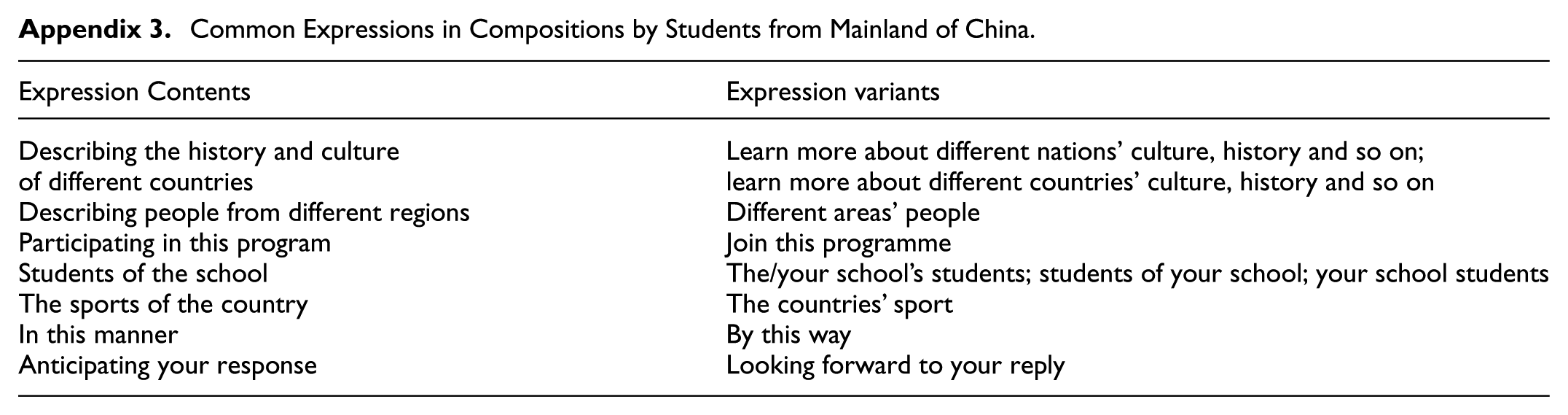
Although compositions by Mainland Chinese students exhibit lexical diversity, their syntactic variety is relatively limited. A qualitative analysis of common expressions reveals distinct patterns in sentence construction (see Appendix 3). For instance, students often utilize formulaic expressions such as “learn more about the culture, history, and other aspects of different nations” and “join this program.” Additionally, phrases like “people from different areas” and “the sports of the country” reflect a preference for straightforward descriptions, often resulting in less syntactic complexity. It should be noted, however, that while Mainland students’ compositions demonstrate lexical diversity, the differences do not reach statistically significant levels in terms of lexical density, which pertains to the use of content words that convey the main information of the text. Moreover, syntactic correctness is a crucial indicator of textual quality. Linguistic appropriateness, coupled with an awareness of the reader’s perspective, is essential for fulfilling communicative objectives, yet this dimension is excluded from the present study. Consequently, while these compositions illustrate certain expression patterns, the overall syntactic diversity is limited, indicating a need for further development in this area to enhance both clarity and engagement in academic writing.
Lexical Appropriateness and Readability of Hong Kong Students’ Written Language
The strengths shown by Hong Kong students in lexical accuracy and content word overlap indicate that Hong Kong students have better lexical competence in expressing ideas more fluently and naturally. Vocabulary knowledge as a construct of language accords with language proficiency substantially, and cohesion involves the overlap of content words in the text (McNamara et al., 2014). This result is in accordance with the characteristics of language acquisition in a bilingual context. As mentioned above, due to its colonized history, English has become an official language and integral part of Hong Kong’s social life, which makes it possible for students to acquire English implicitly; In addition, English textbooks used in Hong Kong features the authenticity of materials and contextualized activities of language learning as well as the function of language use. Both the English materials and way of teaching in Hong Kong enable students to acquire the target language more naturally in context through diverse writing activities, and make form-meaning connection through dynamic interactions in idea sharing. Theoretically, language output is the integrated use or selective expression of the learner’s linguistic knowledge in specific context. Self-expression of language generally relies on the intervention of appropriate contextual variables in the learning process, forming a connection between static language form and dynamic content (Manchon, 2012). Consequently, the opportunities and scope of second language exposure directly influence the learners in language use. Specifically, learners can perceive the variety and authenticity of language expressions through interaction with L2 speakers in context, which further contributes to the fluency of their language output.
In addition to quantitative indicators of language, textual indicators of writing fluency also include qualitative characteristics of linguistic accessibility and the readability (Atasoy & Temizkan, 2016; Tarone et al., 1993). Writing is the behavior of communication, expressing one’s feelings, desires, opinions, and ideas with certain rules and logical orders rather than making up words or sentences haphazardly (Atasoy & Temizkan, 2016). Higher cohesion (i.e., content word overlap) means that Hong Kong students are able to perform communicative tasks and express their thoughts fluently, and more importantly, they can think reversely and frame their essays from the reader’s perspective, making their work more readable. Linguistic output with high-quality is admittedly fluent. In other words, the integration of lexical knowledge, grammar, and rhetorical skills, as well as the accurate and authentic use of language reflects the effectiveness of expression and the maturity of language use (Hayes, 1996; Manchón & Polio, 2022). The term “readability” therefore refers to the readability of the content of the essay, rather than the legibility of handwriting. There is a sharp difference in their handwriting of the two groups. Mainland students’ handwriting shows advantage in terms of legibility of their scripts. There is some room for improvement in some of Hong Kong students’ handwriting, for they have not met the basic requirement prescribed in the official curriculum guideline, which is directly related to the teaching requirements and intensity of training.
The Effect of Instructional Systems on Writing of Chinese ESL and EFL Learners
Hong Kong presents a distinctive ESL environment that differs significantly from Western contexts due to its unique sociolinguistic dynamics and cultural influences. Unlike many Western ESL settings, where English is often the primary medium of instruction and communication, Hong Kong operates within a bilingual framework where both Chinese (Cantonese or Mandarin) and English coexist. This bilingualism affects not only language acquisition but also the methods of teaching and learning English, as students often navigate between languages in their daily lives (Chan et al., 2020). Furthermore, the educational system in Hong Kong places a strong emphasis on high-stakes examinations, which can impact students’ motivation and attitudes toward learning English, contrasting with more communicative approaches commonly found in Western ESL environments. Additionally, the societal context in Hong Kong, characterized by its historical ties to British colonialism and its status as an international business hub, significantly influences both instructional systems and the motivations for English language learning in ways that may not be evident in Western contexts. This interplay of historical and contemporary factors creates a unique educational landscape that shapes how students engage with the English language. Consequently, recognizing the interconnectedness of these distinctive features—particularly the instructional frameworks within Hong Kong’s ESL environment—is essential for comprehensively understanding the complexities of English language acquisition in this region. Such recognition also facilitates more valid comparisons with other ESL settings, allowing for a nuanced exploration of the diverse factors that impact language learning outcomes globally.
Extended analysis of the data reveals that there are some differences in the instructional systems in writing (e.g., the philosophy of writing instruction, the form and content of writing, and the curriculum requirements and standards on writing) between the mainland and Hong Kong, which inevitably influences the acquisition of students’ writing skills and the development of their writing competence. Both the curriculum documents of the mainland and Hong Kong contain requirements for the content of writing instruction and assessment; however, the extent to which they can be operationalized varies. Although the mainland’s NEC specifies the scope of the writing knowledge for college entrance examination (i.e., story continuation, composition with pictorial prompts, composition with assigned topic and summary writing) and states the dimensions of assessment for writing (i.e., fluency, accuracy, and appropriateness), it does not provide teachers and practitioners with specific criteria or operating framework by which the quality and level of composition can be evaluated. In contrast, the Hong Kong’s Eight Key Learning Area Curriculum Guides (S4–S6) offers specific and operational requirements for writing guidance and assessment. Moreover, the Hong Kong Examinations and Assessment Authority has developed detailed writing assessment criteria in terms of the content, language, and organization, and provided seven grades of essays assessment, with specific description of quality characteristics for each grade. For example, the criteria for language assessment focus on textual elements such as complexity of sentence structure, grammar, vocabulary, spelling, register, and text type. These detailed assessment criteria, issued to English teachers, can be incorporated as a standard guide and assessment basis for teaching, and as a reference standard and direction for students to practice in writing.
Concerning the organization of the writing content, textbooks on both sides objectivize the philosophy of their respective curriculum documents, with each unit designed to include a writing section and supporting writing exercises and guidance. The difference is that the teaching of writing in the mainland primarily focuses on the demonstration of sample texts and normative training, with a preference to teaching writing knowledge and skills. In contrast, the writing instruction in Hong Kong concentrates on writing practicality, which provides continuous, extended, and supplementary writing training based on certain materials with a variety of writing activities. Additionally, procedural knowledge of the writing process is emphasized, and three types of writing approaches are recommended to scaffold the learning of writing, namely, text-based, or pictorial prompts, discourse-based and task-based writing (Jones & Summit, 2009). For example, students are trained to write a wide range of practical writing, including formal letters (requests, invitations, applications, etc.), informal/personal letters (e.g., private letters, including family and social letters), business and school communications (notices, memos, CVs, reports, etc.), short essays on social issues, book reviews, speeches (welcome notes, thank-you notes), etc. The writing process is self-contained, consisting of writing requirements and a number of other well-designed tasks, analysis of sample essays, various writing exercises, and assessment sessions. Moreover, this study examines the differences in language output among learners from two regions that share similar economic and educational contexts, specifically focusing on a non-interventional state of language teaching and learning within different educational environments. Key variables such as motivation, textbook quality and content, teaching efficacy, students’ personal interests, and self-directed learning habits serve as intermediating factors, all intricately linked to the broader learning contexts. This approach aligns with complexity theory, which posits that language development functions as a complex adaptive system wherein various components—instruction, curriculum, learning materials, and even campus culture—are interrelated and subject to continual change over time. Consequently, this study emphasizes that the relationship between instructional methods and specific language characteristics of learners is not merely linear; it also encompasses the nuanced interactions between instruction and the development of learners’ language features. As such, Hong Kong’s writing activity focuses on authenticity and contextualization of writing tasks, allowing students to acquire basic writing skills and rhetorical approaches through exposure to authentic material, strengthening students’ sense of readership. Given the specific tasks, students are guided to clarify their expected readership, with the choice for the tone, style, rhetoric, and expressions appropriate to the reader, to express their views and opinions naturally. These concepts of writing instruction and purposeful writing practice are based on meaningful language input, facilitating the transformation of learners’ declarative knowledge into procedural knowledge (Anderson, 1996; Mitchell et al., 2019), which is an effective measure to support learners’ self-expression in writing and a worthwhile reference for writing teaching practice in similar situations.
Based on the findings and discussion of this comparative study, several instructional suggestions may be beneficial for practitioners. To enhance lexical diversity and syntactic complexity among mainland students, it may be advantageous to incorporate activities that encourage the exploration of varied vocabulary and complex sentence structures. For instance, utilizing writing prompts that stimulate engagement with diverse topics, along with peer review sessions, could facilitate opportunities for students to critique and refine each other’s work. Conversely, practitioners may find it valuable to focus on fostering lexical accuracy and writing fluency among Hong Kong students. Implementing structured vocabulary-building exercises that emphasize correct word usage in context, as well as incorporating timed writing activities, might help students develop greater fluency in articulating their ideas. Furthermore, regarding the cohesion in writing for Hong Kong students, enhancing instruction on cohesive devices, such as transitional phrases and logical connectors, may be beneficial. Providing models of well-structured texts could aid students in understanding how to effectively link ideas and maintain coherence. Additionally, creating opportunities for cross-context learning—such as pairing students from mainland of China and Hong Kong for collaborative writing projects—might allow them to share strengths and insights, enriching their respective writing practices. Finally, the importance of continuous assessment and constructive feedback cannot be overstated. Implementing formative assessments that focus on the identified strengths and weaknesses can enable educators to tailor their instruction to meet the specific needs of their students, ultimately fostering a more targeted approach to language development. In light of these findings, these suggestions aim to support practitioners in effectively addressing the diverse writing needs of students, thereby enhancing overall language proficiency in various learning contexts.
Conclusion
The findings of this study are in line with the basic academic perception of the mechanisms of second language acquisition and the laws of foreign language learning. The social context and function of English as a legal language provide ESL learners in Hong Kong with more opportunities to expose and use English than EFL learners; their contextualized teaching approach based on authentic materials creates prerequisites for the internalization of students’ language knowledge, facilitating the development of the comfortableness and fluency in written language. The specific requirements of the mainland curriculum standards for language knowledge, the knowledge-based learning and intensive training aimed at accuracy make it possible for the student to accumulate vocabulary and acquire syntactic structures effectively, forming the basis for language production. The findings, to some extent, reflect the effects of different requirements from curriculum documents, teaching interventions, writing instructional approaches, and levels of learning engagement in the two regions.
The findings highlight the effect of language learning context, curriculum and teaching methods on second and foreign language development to more effectively develop L2 learners’ written skills. It is recommended that curriculum developers and educators in mainland of China focus on syntactic training, purposefully enhancing EFL learners’ exposure to and use of English to improve vocabulary accuracy and language fluency The curriculum provides students with more authentic language materials and creates resources to accumulate knowledge of composition and layout so that they can notice and learn the variety of English expressions to compensate for the disadvantage of lack of exposure to English. Moreover, we focus on the contextualization of language training and strengthen the extended training based on background materials, so that students can apply the language knowledge they have learned in context, thus improving their writing fluency and enhancing their written language skills. It is recommended that curriculum developers and writing teachers in Hong Kong focus on curriculum authenticity and contextualization, while appropriately strengthening curriculum design and instructional design that reinforce vocabulary diversity and syntactic accuracy orientation. Other EFL and ESL learners from Oceania (Knoch et al., 2014), Pacific Northwest (Beers & Nagy, 2011), and Europe (Trapman et al., 2018), etc., have varying degrees of incomplete knowledge of written language expression, which echoes the findings of this study. As such, the pedagogical implications of this research can be further generalized to these EFL and ESL instruction contexts, as well.
Admittedly, there are some limitations in this study. First, the sample of students’ essays from two natural classes in ordinary schools only partially reflects the current state of participants’ language performance in a particular context, more representative samples are needed for a better understanding of the topic under discussion. Second, there are analytical bottlenecks in the study. The focus of the variables (i.e., the complexity, accuracy, fluency, and cohesion) is on the language features without considering the inclusion of the pragmatic dimension into the evaluation system, although the current measurement framework is recognized by academia as a valid indicator system for measuring learners’ language characteristics. Despite the potential and inevitable involvement in the research process, we did not personally engage participants in the writing process during data collection; instead, we invited the students’ writing teachers to perform the writing tasks without further instruction or contact, and made the writing tasks as consistent as possible to minimize task differences between the two areas. In addition, another aspect needs to be mentioned is the categorization of learning context. Regarding the ESL learning context in Hong Kong, we adopt the view that ESL learning contexts are those in which English is an official language and is widely used in society (Ellis, 2015), providing learners in Hong Kong with more exposure to and use of English than learners in mainland of China. However, compared to ESL learners in the Anglosphere, the ESL context in Hong Kong is unique in that it differs from these countries in terms of English exposure, which may cause contradictory discussion. But this study only takes the micro learning context (i.e., the pedagogical context of explicit language input) into consideration, excluding the macro learning context (the social environment of implicit language input) as indicator for it is beyond the scope of data analysis.
Future research should extend the scope of this study to explore the relationship between language exposure and language output, thereby providing further validation of the findings. While the present study serves as an exploratory investigation into the linguistic outputs of EFL and ESL learners, future studies would benefit from incorporating larger sample sizes and a variety of writing tasks. This would address the limitations associated with the lack of representativeness across different socioeconomic backgrounds within each region, ultimately enhancing the robustness of the conclusions drawn. Additionally, future studies could examine a wider array of learning contexts, which would contribute to a more comprehensive understanding of the linguistic features exhibited by learners. Such research could uncover additional characteristics and patterns of language output among ESL and EFL learners. Furthermore, it is essential to explore a broader range of linguistic features, including pragmatic factors. Investigating these dimensions may illuminate how learners interpret language functions and adapt their writing to various sociocultural contexts. Moreover, examining the influence of critical factors on language development—such as language learning experiences, implicit language input, learning engagement, personal interests, and self-directed learning habits—could lead to a paradigm shift from an exclusive focus on language output to the processes underlying language production. This shift has the potential to significantly advance the field of second and foreign language writing education and research.
Footnotes
Appendix
Common Expressions in Compositions by Students from Mainland of China.
| Expression Contents | Expression variants |
|---|---|
| Describing the history and culture of different countries | Learn more about different nations’ culture, history and so on; learn more about different countries’ culture, history and so on |
| Describing people from different regions | Different areas’ people |
| Participating in this program | Join this programme |
| Students of the school | The/your school’s students; students of your school; your school students |
| The sports of the country | The countries’ sport |
| In this manner | By this way |
| Anticipating your response | Looking forward to your reply |

Ethical Considerations and Informed Consent Statements
This study was approved by the Qufu Normal University Research Ethics Committee (approval no. 2023-0012) on March 16, 2023.
Consent to Participate
All participants provided written informed consent prior to participating.
Funding
The authors disclosed receipt of the following financial support for the research, authorship, and/or publication of this article: This work was supported by the National Social Science Fund of China (Grant Year: 2025; Project Title: “Intelligent Evaluation System and Mechanisms for L2 Chinese Writing Quality”; Principal Investigator: Dr. Chao Zhang).
Declaration of Conflicting Interests
The authors declared no potential conflicts of interest with respect to the research, authorship, and/or publication of this article.
Data Availability Statement
Data generated or analyzed during this study are included in this published article and its Supplemental Information files.