




Abstract
Safety is argued to be one of the most critical issues for the sustainable development (SD) of transportation. Thus, the current paper aims to evaluate the risk of navigational safety for passenger-cargo ferries (PCFs). In doing so, the paper investigates risk factors (RFs) for navigational safety of PCFs based on pertinent research and ferries’ operational characteristics. After that, a Revised Fuzzy Analytic Hierarchy Process (RFAHP) is developed to estimate the priority weights of those RFs. Thanks to that, an advanced continuous risk matrix (ACRM) model is proposed to integrate the defensiveness of ferry operators (FOs) and then classifying RFs’ risk level. Lastly, PCF operators in Taiwan (hereafter Taiwan-PCFs case) are empirically investigated to validate the proposed research model. Results might provide practical information for PCF companies to boost their navigational safety. In addition, the proposed advanced risk matrix (ARM) can supply references for theoretical methodologies in risk assessment research.
Introduction
Sustainable development is the trend for a new generation of businesses in the 21st century. The World Commission on Environment and Development regards SD as meeting the needs of the present without harming future generations (Zhao et al., 2020). Accordingly, UNCED adopted the “Agenda 21” in 1992, incorporating environmental, economic and social concerns into its policies, and proposed the concept of SD, as seen in Figure 1. It has been argued that measures of SD and maritime safety are intrinsically connected because strengthening maritime safety might contribute significantly to the three sustainability pillars, for instance, environmental protection (W.-K. K. Hsu, Huynh, Le Quoc, & Yu, 2024), economic stability (Nguyen et al., 2022), and social well-being (S.-H. Huang et al., 2025).

The three aspects of SD.
Stemming from the concept of SD, sustainable transport could be defined in both wide and narrow senses. According to the broad definition, transportation sustainability is considered under the three mentioned aspects (Singh et al., 2020; Zhao et al., 2020). In contrast, the narrow one only focuses on the environmental effects of the transportation activities (Anwar et al., 2021) and energy consumption efficiencies (Pamucar et al., 2021). Following such a narrow definition, the current study develops an advanced risk matrix model for the navigational safety of pPCFs as the proxy for the social sphere in sustainable transport. According to Gu and Liu (2025), maritime risk assessment may positively impact passenger safety, which is central to the social sustainability pillar. Additionally, Mohsendokht et al. (2025) argued that ensuring high safety standards for marine transport through rigorous risk assessment can maintain public trust and confidence in ferry services, and in turn, contributing to social cohesion and stability. Plus, it has been acknowledged that risk management practices in maritime transport, such as regular maintenance (Aziz et al., 2019), vessel inspections (W. K. K. Hsu et al., 2024), and safety regulation adherence (Kececi & Arslan, 2017) can prevent operational risks in ferry operations (i.e., mechanical failures, structural issues, and navigational accidents), then enhancing the well-being and safety of passengers and crew. To our knowledge, few articles have discussed this topic before.
In the recent decade, transportation of cargoes and passengers by ferries across the Taiwan Strait has become increasingly popular. It is postulated that ferries are generally regular multi-functional means of transport for passengers and cargoes. Their main advantages are low cost (Della et al., 2020) and high speed (Lau et al., 2021) in comparison with other modes of transportation, such as cruises, airplanes, etc. Therefore, in design, the tonnage of ferries is rather light. Additionally, Della et al. (2020) argued that FOs normally pay little attention to accident prevention for ferry operations. In practice, the way to model navigation risk management for the routes of PCFs and conduct risk management procedures for the prevention of ferry incidents is still undocumented.
For marine safety research, it is posited that risk management is considered an extremely critical issue (Aziz et al., 2019). Particularly, risk matrixes have been extensively adopted as a risk analysis tool in various maritime domains, such as naval archaeology, and marine engineering, owing to their simplicity (Schuett, 2024) and intuitive nature (Opabola & Galasso, 2024). According to the conventional risk management theories, the RFs for safety are typically determined upfront. After that, a discrete risk matrix (DRM) on the basis of the RFs’ measurements of consequence and probability is developed in order to categorize the RFs’ risk levels into groups. From such results, company leaders may implement policies to enhance the overall safety performance of their organizations (W.-K. Hsu et al., 2017). A DRM, on the other hand, has a severe deficiency in accuracy when used in actual situations (Duijm, 2015); thus, a continuous risk matrix (CRM) is suggested to enhance it.
Moreover, another pragmatic drawback of the conventional risk matrix is that it is necessary to consider organizational features in order to develop efficient risk management strategies. (Aven & Cox, 2016). In practice, an organization’s ability to prevent potential risks, defined as defensiveness, is a vitally significant factor in transport firms’ risk management strategy. Also, Lim et al. (2018) argued that strengthening FOs’ capacity in preventing potential risks via defensiveness can minimize maritime mishaps, such as ship collisions, the capsizing of vessels, and the release of hazardous chemicals from ships. Besides, W.-K. K. Hsu, Huang, Le, and Huynh (2024) demonstrated that for some high-risk RFs, if a shipping operator has a solid defensiveness to prevent accidents, their risk level should be downgraded. It is believed this kind of situation is commonplace in real-world cases. Yet, the conventional risk matrix, irrespective of the discrete or continuous matrix, cannot reflect the defensiveness effect of a shipping operator.
To contribute to the pertinent research, the present study aims at assessing navigational safety for PCFs by developing an ACRM that considers the defensiveness of FOs for accidents. In the current paper, RFs influencing PCF navigational safety are first examined. Because risk evaluation of PCFs is highly professional, RFAHP is developed to figure out the priority weights for such RFs, including consequence, probability, and the proposed defensiveness for accidents. Theoretically, traditional AHP assumes the independency of the evaluated criteria in the hierarchical structure, which is often floated in past studies. To meet this assumption, this article introduces an influence matrix to revise the original weights computed by traditional FAHP. From those weights, the ACRM model is developed to rank the RFs’ risk value. Ultimately, the Taiwan-PCFs case and a specific Tai-Hua Wheel (THW) in Taiwan were empirically surveyed to verify the ACRM approach.
The remainder of this study is arranged in the following manner. Sections “Literature Review” and “Research Method” provide an explanation of the RFs associated with ferry navigation as well as the research methods, respectively. Lastly, we discuss some of our findings, research limitations for future research.
Literature Review
The Overview of the Passenger-Cargo Ferries in Taiwan
In recent years, the exchanges between the two sides of the Taiwan Strait have become more frequent. Related information indicated that the significant influx of travelers and cargoes between China (including Hong Kong and Macau) and Taiwan has dramatically sped up with an average growth rate of approximately 8% from 2010 to 2018 (National Development Council, 2019). Such growth is a favorable condition for developing PCF transportation across the Taiwan Strait. Figure 2 illustrates that four major routes are now operating across the Taiwan Strait:
(1) Kaohsiung-Penghu-Xiamen run by THW,
(2) Keelung-Matsus/Dongyin operated by THS,
(3) Tapie-Pingtan run by LW, and
(4) Taichung-Pingtan served by the Strait.
Among these, the first one (THW) traveling on the Kaohsiung-Penghu-Xiamen route is the biggest. The Tai-Hua ferry operator, with 8,134 tons, can carry 1,150 passengers and 21 crews.

The PCF transport between Taiwan and the archipelagic islands.
Identification of Risk Factors for PCF’s Navigation
As seen in Figure 3, EU classifies RFs for ship navigational safety into four independent dimensions: humanware, hardware, software, and environment (Safer EURORO Report, 2008). Building upon that framework, extensive research related to navigation has been performed. More specifically, most previous studies concur that potential RFs for marine transport encompass various elements, for instance, technological issues (Mutmainnah et al., 2017), organizational processes (Della et al., 2020), environments (Bolbot et al., 2024), and occupational safety management systems (Rebelo & Uchenna Amaefule, 2024). Additionally, these potential RFs often result in severe consequences for individuals and the environment, for example, injuries (Ung, 2021), fatalities (H. Wang et al., 2021), and maritime pollution (Martínez de Osés & Ventikos, 2003). Consequently, addressing these RFs to ensure marine navigational safety has attracted significant attention from both maritime operators and researchers.
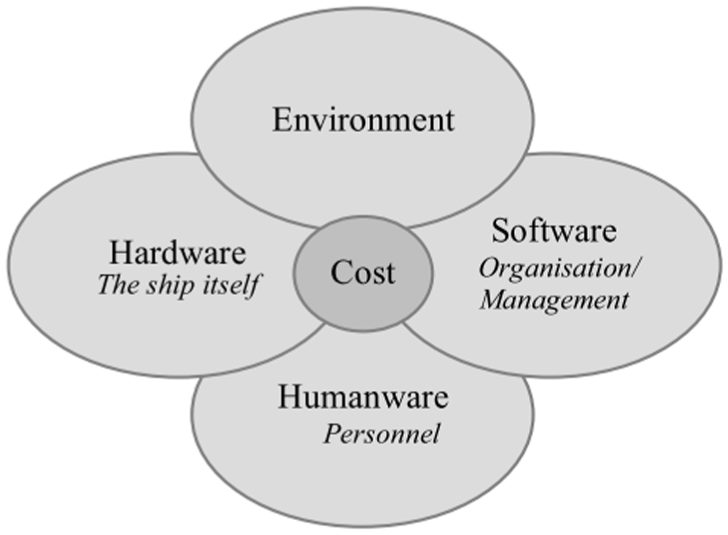
Elements of maritime safety.
In this paper, we largely rely on previous research and IMO standards concerning maritime navigational safety. Consequently, the current paper focuses on four principal safety measurement indicators for PCF transportation, viz., crew factor (CF), ship hardware (SH), ship management (SM), and company management (CM).
Crew Factor
There is a general consensus among researchers about the responsibility of human errors in maritime accidents. All crew-related elements affecting marine transportation’s safety and security comprise individual knowledge, skills, abilities, attitude, working motivation, alertness, and personal experience (Mutmainnah et al., 2017). According to Bowo and Furusho (2018), over 80% of accidents in shipping transportation are caused by human negligence. Meanwhile, Martínez de Osés and Ventikos (2003) pointed out that human elements are responsible for about 79% of marine accidents in Europe during 1981-1992. More specifically, human errors are the primary cause of approximately 79% of towing vessels grounding (Dhillon, 2019), nearly 26% of fire and explosion accidents (Mutmainnah & Furusho, 2016), and roughly 30% of fire/explosion onboard (Martínez de Osés & Ventikos, 2003). Errors in the crew members’ operation might be distinguished into internal and external components. Internal human negligence can be attributable to physical health factors (i.e., health conditions), and psychological reasons (i.e., anxiety disorders and depression). To conclude, the crew factor is an imperative aspect of safety assessment for PCF operations.
Ship Hardware
The vessels’ performance heavily relies on its status, especially the ship hardware, which is one of the main factors ensuring maritime navigational safety. SH also consists of all elements enabling a master and workers onboard to complete their tasks, such as technology (Della et al., 2020), ferry’s equipment (H. Wang et al., 2021), safety monitoring systems, and the early-warning facilities (Amro et al., 2020; Lau et al., 2021). Many studies showed that machinery failure is responsible for approximately 10.6% (Ung, 2021) to 51% of ship accidents (Mutmainnah et al., 2017). The ship construction is likewise illustrated as a necessary aspect impacting maritime transportation safety. Main components for the quality of the ship construction are the engineering design and technical specifications (Gunnarsson, 2021), the structural strength of the hull and superstructure (Wahid et al., 2020), engine efficiency (Gunnarsson, 2021), propulsion systems (Chen et al., 2021), and maneuverability (Lu & Tseng, 2012). Rebelo and Uchenna Amaefule (2024) appreciated the roles of onboard equipment in guaranteeing navigation safety in maritime operations, including the global positioning system, electronic chart display, gyrocompass, the radar system, and the bridge navigation watch alarm. Additionally, Ung (2021) and Mohsendokht et al. (2025) illustrated the necessity of the AI models for identifying navigational risk patterns during ferry operations. For example, AI systems can be used to predict ship collision potentials by analyzing the trajectories of multiple vessels in real-time. Also, it has been widely acknowledged that such systems can be helpful in calculating the likelihood of collision thanks to ship movement speed (H. Wang et al., 2021), clash avoidance distance (Lau et al., 2021), and the course of nearby vessels (Della et al., 2020).
Ship Management
This dimension is required to ensure the effective maintenance and operations of vessels, eliminate unwanted incidents/accidents, and control operational costs. For the systemization of ship management, the International Safety Management code has been formally implemented in the marine industry since 1994. According to the stipulations of this code, ship operators are mandatory to carry out the standard operational procedures (SOPs) to maximize ships’ operational efficiency and diminish risks. It is commonly asserted that in addition to crews’ skills and knowledge, managing crew members aboard is essential in increasing ships’ safety operations (Mutmainnah et al., 2017). To put it in a nutshell, crew members-related elements, viz., hours of operation, work burden, psychological and physical wellness, and job allocation, should be noted meticulously to reduce undesirable accidents.
Company Management (CM)
Della et al. (2020) found that safety management, training, practice, and procedures influence employees’ actions and attitudes to prevent work accidents. It is also suggested that PCF operators might provide safety advisory services to influence ferry service staff’s safety-related behavior such that employees reduce unsafe behavior, thereby minimizing accidents caused by human negligence. Lu and Yang (2011) justified the roles of safety policies, emergency preparedness, and safety communication in exploring and preventing accidents in the passenger ferry context. Meanwhile, Lu and Tseng (2012) stressed the significance of safety training in enhancing employees’ safety awareness, accordingly minimizing casualties and injuries in shipping accidents. Lau et al. (2021) also had a similar finding. Moreover, other elements impacting navigational safety for ferries include regulatory activities (Mutmainnah et al., 2017), certificate fraud, inadequate inspection (Kececi & Arslan, 2017), rewards and punishment mechanisms (Khan et al., 2018), and crew recruitment process (Della et al., 2020).
Risk Matrix
Traditionally, from consequence and probability, a standard risk matrix (SRM) can be formed to rank RFs. For instance, Figure 4 depicts a 4 × 4 risk matrix that divides RFs into three categories of risk. Level L (low risk) is assigned to RFs situated in the green region with risk ratings between 1 and 2. Meanwhile, RFs in yellow and red zones are categorized as medium-risk (M) and high-risk (H), respectively, according to their location. Because consequence and probability are not continuous, and accordingly, the SRM is converted into the DRM (Jidda et al., 2025).

The standard risk matrix.
In practice, the discrete feature of risk matrixes can restrict their usefulness in terms of accuracy, owing to risk matrix scores (Anthony Cox, 2008). The notion of a CRM was introduced for handling the drawbacks of discontinuity in risk assessment, as shown in the curve in Figure 5 (Duijm, 2015), and has been extended to include the actual risk control of airlines (W.-K. Hsu et al., 2016) and inland container terminals (W.-K. K. Hsu, Huang, & Wu, 2022).

The continuous risk matrix.
Research Method
In the current study, RFs for the navigational safety of PCFs are initially addressed. The fuzzy AHP is then adopted to figure out the priority weight of such RFs, comprising consequence, probability, and defensiveness. Such weights are then revised by the influence matrix to reflect dependency among criteria. From such weights, both the SRM and the proposed advanced risk matrix are explained in sequence. Further, two empirical cases, including the ferries in Taiwan and a specific Tai-Hua ferry, are employed to validate the two risk matrixes. Finally, based on the result, practical managerial actions are proposed to enhance PCFs’ navigational safety.
Identifying Risk Factors for PCFs’ Navigational Safety
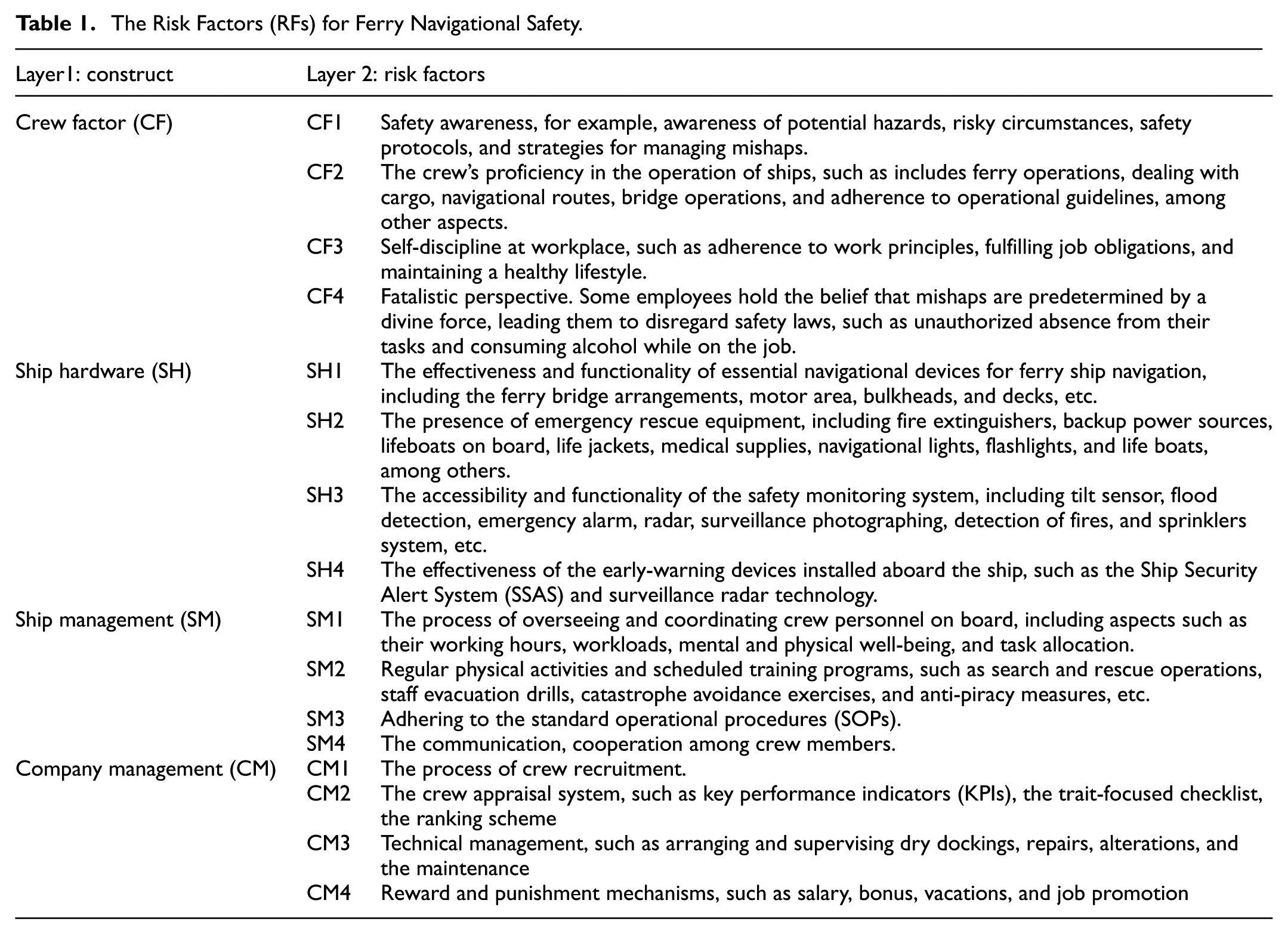
Based on the navigation features of the ferry and preceding studies in Section “Identification of Risk Factors for PCF’s Navigation,” 16 RFs are generated on the basis of four aspects regarding PCFs’ navigational safety, as follows:
Crew Factor
The current article defines the “crew factor” as crew members’ personal perceptions and attitudes toward PCFs’ safety control procedures. Particularly, this factor includes crews’ safety awareness (Jovanović et al., 2022), crews skills toward shipping handling(W.-K. K. Hsu, Tai, et al., 2022; X. Wang et al., 2021), self-discipline at workplace (Solomon et al., 2021; Ung, 2021), and fatalistic perspective (Mia et al., 2021; Öztürk et al., 2021), etc.
Ship Hardware
Ship hardware refers to the conditions and usability of hardware facilities and equipment aboard to implement ferry safety management. This dimension comprises the quality and usability of key navigational devices (Bu & Nachtmann, 2023; Xu et al., 2020), the dependability of rescue equipment (Kulkarni et al., 2020; Sys et al., 2020), the risk-preventing system (Başhan et al., 2020; Coraddu et al., 2020), and shipboard alert devices (Fan et al., 2019; Ozturk & Cicek, 2019).
Ship Management
Ship management refers to the formulation and implementation of various safety management procedures on board. This construct includes the process of overseeing and coordinating crew personnel on board (Fan et al., 2019; Kececi & Arslan, 2017), routine drills and scheduled training sessions (Başhan et al., 2020; Ozturk & Cicek, 2019), abiding by standard operational performance protocols (Coraddu et al., 2020; Sys et al., 2020), communication and cooperation among crew members (Bu & Nachtmann, 2023; Xu et al., 2020), etc.
Company Management
This factor refers to the establishment and implementation of the company’s safety management system. It consists of crew recruitment (Mia et al., 2021; Öztürk et al., 2021), the crew appraisal systems (Solomon et al., 2021; Ung, 2021), technical monitoring and management (W.-K. K. Hsu, Tai, et al., 2022; X. Wang et al., 2021), reward and punishment mechanism (Jovanović et al., 2022; Kececi & Arslan, 2017), etc.
Thanks to the aforementioned definitions, RFs’ two-layer hierarchy was built. Three experienced crews that worked aboard ferries in Taiwan were asked to review and amend the RFs to boost the practical validity of the results. After a few rounds of modifications, the complete decision structure of RFs, as displayed in Table 1, consists of 04 dimensions in Layer 1, and 16 RFs in Layer 2. It should be noted that the independency of the dimensions in Layer 1 was also verified because they were referred to from prior literature, as mentioned in Section “Identification of Risk Factors for PCF’s Navigation.”
The Risk Factors (RFs) for Ferry Navigational Safety.
Standard Risk Matrix (SRM)
SRM is established based on Figure 5. Particularly, SRM only relates to consequence and probability.
Sampling
Because this research proposed a fuzzy AHP technique for weighting RFs, the respondents’ perception was surveyed using a nine-point rating scale (T. L. Saaty, 2002, pp. 69–79). Then, an expert questionnaire with four dimensions and 16 RFs, as shown in Table 1, was designed to gather data.
The current article deployed the Taiwan-PCFs case, noted in Section “The Overview of the Passenger-Cargo Ferries in Taiwan,” to validate the proposed research model. In doing so, the research team asked every ferry operator to supply 6 to 10 experienced seafarers for an interview. In addition, to enhance the survey’s quality, research assistants were appointed to help respondents answer the questionnaire properly. Eventually, we had 21 responses to our survey. Additionally, because of using fuzzy AHP, respondents’ rating should be tested using the consistency index


where:
n is the order of PCMs
RI stands for a randomized index (Table 2). It is argued that
The Values of the RI Corresponding to a Variety of n.

In this study, the CI of each sample was initially determined using the software program Expert Choice 11.5. Its CR could then be determined using Equation (2). Consequently, nine samples had CIs or CRs greater than 0.1, indicating inconsistency. Therefore, respondents to these surveys were instructed to make changes to their responses until the scales they provided matched the consistency tests.
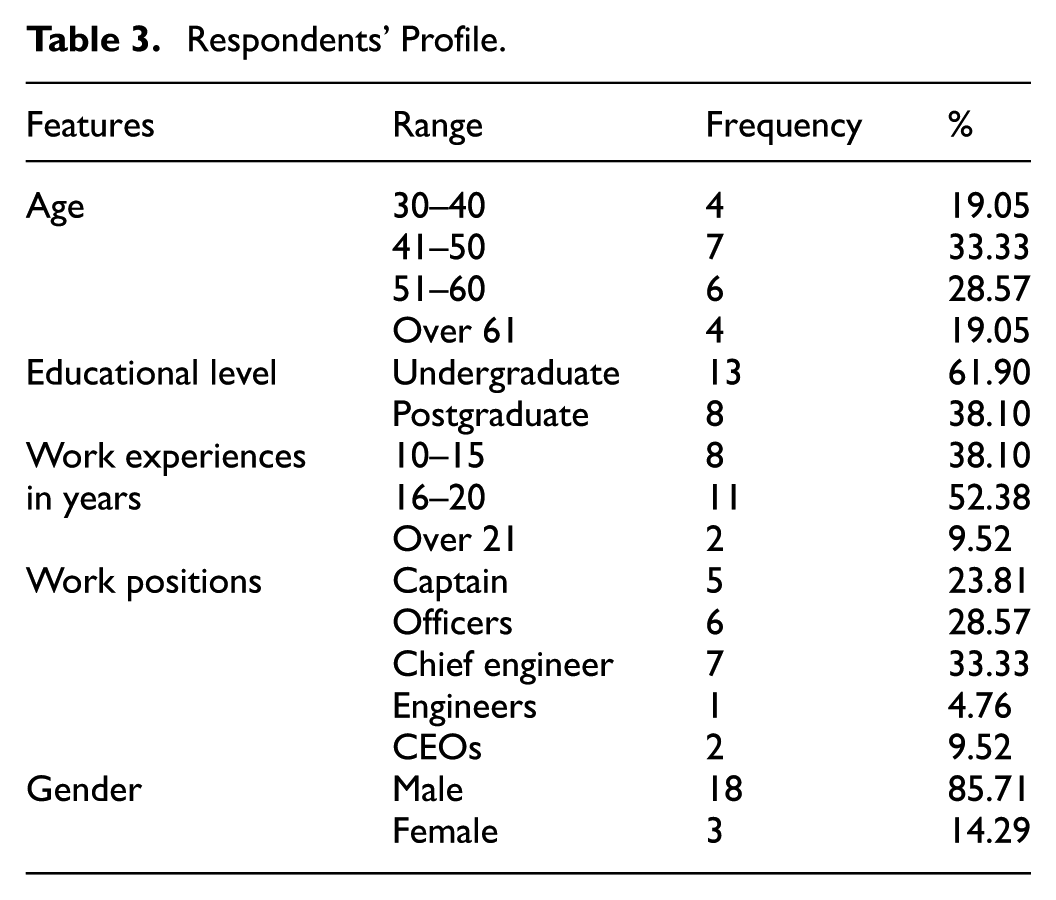
As a result, we surveyed 21 experts, whose backgrounds are displayed in Table 3. It is argued that most experts have at least 5 years working in the ferry industry and are certified in occupational safety and health. Stated differently, the respondents’ expertise and qualifications can enhance the reliability of the survey results.
Respondents’ Profile.
RFs’ Priority Weights
This paper used RFAHP to determine the consequence and probability of RFs for the Taiwan-PCFs case. For ease of explanation, this paper took four RFs of the CF construct with the probability measure to illustrate how to adopt the RFAHP approach. Table 1 points out that four RFs of the CF dimension are
Suppose

where the element

Let E = (1,2,…,k,…,K) be the panel of experts in the sample. Note that each expert’s rating creates one individual positive reciprocal matrix (IPRM). Then, such K IPRMs can combine to form IFPRM by using the formula:
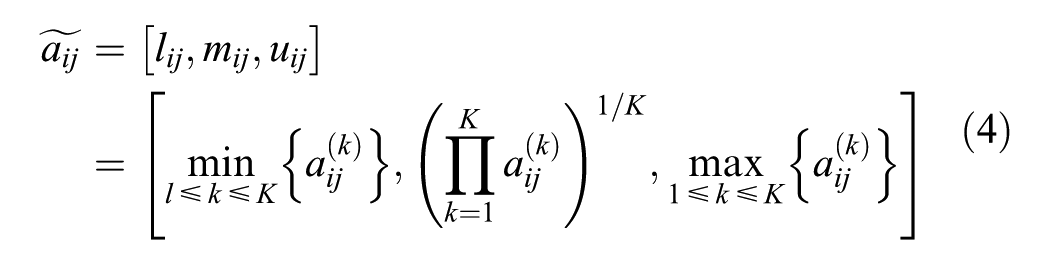
For the CF dimension, there were 21 IPRMs created from 21 respondents’ ratings. Based on Equation (4), the IFPRM of this construct can be generated as:

In the manuscript, we tested the consistency of the IFPRM using the equation of Z.-J. Wang and Lin (2017), as follows:
Let

Besides, the critical point of

Back to the matrix
Consistent Test for Probability and Consequence Measures.

Ramík and Korviny (2013) argued that the fuzzy matrix, as formulated from Equation (3), must be reciprocal, for instance,

Keep in mind that according to Equation (6),
It is clear that the matrix
Theoretically, RFs’ original weights may be obtained from the eigenvector of
For


Using Equation (7) for the matrix

By Equation (8), we have:
Also, by virtue of Equations (7) and (8), the weight

Next, using Equation (9), the weight

Here, we can find RFs’ original weight by thXweight

The Buckley’s indicator (1981) of

Normalizing

For the fuzzy matrix
Thus, we have the original weights of (CF1, CF2, CF3, and CF4) as (26.81%, 26.76%, 28.82%, and 17.61%).
In the same way, original weights for RFs regarding the probability and consequence measures are attained and seen in Table 5.
Original Weights for Probability and Consequence of RFs.

Nguyen et al. (2022) and W.-K. Hsu et al. (2021) illustrated that the weight of a factor should include two components: one resulting from fuzzy AHP and another from the revision process. More specifically, the former is obtained from Steps (1)–(4), as noted earlier, while the latter is estimated via the following process.
Building the Influence Matrix
The interrelation degree

where

The original and affected weights for
The current paper measures
Revert to the CF construct, the value

It is argued that the degree
The Normalized Influence Matrix
Householder (1956) advised that the matrix M should be normalized to assure the long-run convergence:

where:

Back to the CF dimension, by Equation (14), it is obtained

The Long-Run Influence Matrix
Cyert and March (1963) defined the matrix T in the long term as:

Thus, Equation (15) could be expressed as:

By virtue of Equation (16), the matrix T for the CF dimension is obtained:

The Revised Weights of RFs
Let

Back to RFs (i.e., CF1, CF2, CF3, and CF4) in the CF dimension, their original weights in terms of the probability measure are: (0.2681, 0.2676, 0.2882, and 0.1761), as presented in the fifth column of Table 5. Using Equation (17), its revised weight is attained as:

At last, the

As a result, we got:

In the same vein, the RFs’ revised weights in the other dimensions in terms of probability and consequence are shown in the fifth and sixth column of Table 6.
Revised Weights for Probability and Consequence of RFs.

Let

By means of Equation (19), RFs’ global priority weight regarding probability and consequence is attained and seen in the last two-field of Table 6.
The Standard Risk Matrix
In principle, a risk factor with a greater weight assigned to both consequence and probability should be classified as a higher level of risk, which is reflected by a TRV (traditional risk value) (Anthony Cox, 2008; Aven & Cox, 2016).
Let

Normalizing TRVi, we get:

For the Taiwan-PCFs case, TRVs of RFi are attained and shown in the 4th column of Table 7, named "TRVs". The result exhibits that the highest risk factors include: CF2 (12.35%), CF3 (11.55%), SM3 (9.3%), and CF1 (8.29%)
The Result of SRM.

The Advanced Risk Matrix
It may happen easily that FOs can pragmatically pay less attention to lower RFs; consequently, the safety guidelines pertaining to certain RFs may not be implemented with precision. Therefore, the present study categorizes such a situation as a diminished state of defensiveness for FOs. It is argued that the risk levels for FOs should be increased for RFs with lower defensiveness. Nevertheless, the SRM fails to represent such defensiveness effects accurately. Since the defensiveness magnitude varied from one ferry operator to another, this study selected a specific Tai-Hua ferry company, which was the largest FOs in Taiwan, as an empirical case to verify the ARM model.
The Measurement of Defensiveness
In this article, defensiveness refers to the ferry operator’s capacity to anticipate, detect, and proactively prevent potential navigational risks. However, because “defensiveness” is not directly observable, this study uses employee dissatisfaction as a proxy indicator. The underlying logic is that employees’ dissatisfaction regarding safety management practices, operational conditions, and risk management approaches reflects weaknesses in the ferry operator’s safety culture and preparedness. It is widely admitted that employees’ dissatisfaction with management practices, safety training, communication clarity, and responsiveness to reported risks typically indicate an organizational deficiency in preventing navigational risks (Khan et al., 2018; Lim et al., 2018). Specifically, assessing employees’ dissatisfaction through surveys assumes that higher dissatisfaction scores correlate with lower defensiveness, meaning FOs cannot effectively prevent risks. Conversely, lower dissatisfaction scores suggest higher defensiveness, reflecting a robust capability in risk management and prevention. Thus, employee dissatisfaction provides a practical, measurable indicator to indirectly gauge the operator’s overall defensiveness and preparedness for ferry navigation risks.
This article surveyed six senior crews from the Tai-Hua ferry, who were working on board at the time of surveying. Their profile was detailed in Table 8, illustrating that respondents were high-class crews with licenses as Officers and Engineers and 18 years of work experience averagely.
The Profiles of Senior Experts in Tai-Hua Ferry Case.

The Weights of Defensiveness on RFs
Like Section “RFs’ Priority Weights,” RFAHP was employed to weight RFs by the dissatisfaction measure. The mathematical formulas of RFAHP (from Step 1 to Step 7) results in Table 9, positing that the Tai-Hua ferry has defenseless (i.e., higher dissatisfaction level) on RFs: SM1 (9.98%), SM2 (8.79%), and SM3 (7.56%). By contrast, it has stronger defensiveness (i.e., lower dissatisfaction level) on RFs: CF1 (3.75%) and CF4 (3.77%).
Revised Weights for the Dissatisfaction Construct.

Analysis of the Advanced Risk Matrix
An ARM is created by building upon SRM. According to the logical concept, if a ferry operator has a weak (strong) defensiveness towards a risk factor in terms of TRV, then the TRV of such a risk factor should be increased (reduced). From this idea, an advanced risk value (ARV) is proposed. Thanks to Section “The Weights of Defensiveness on RFs,” a dissatisfaction weight was adopted to assess the ferry operator’s defensiveness. Thus, let

ARVs are normalized by:

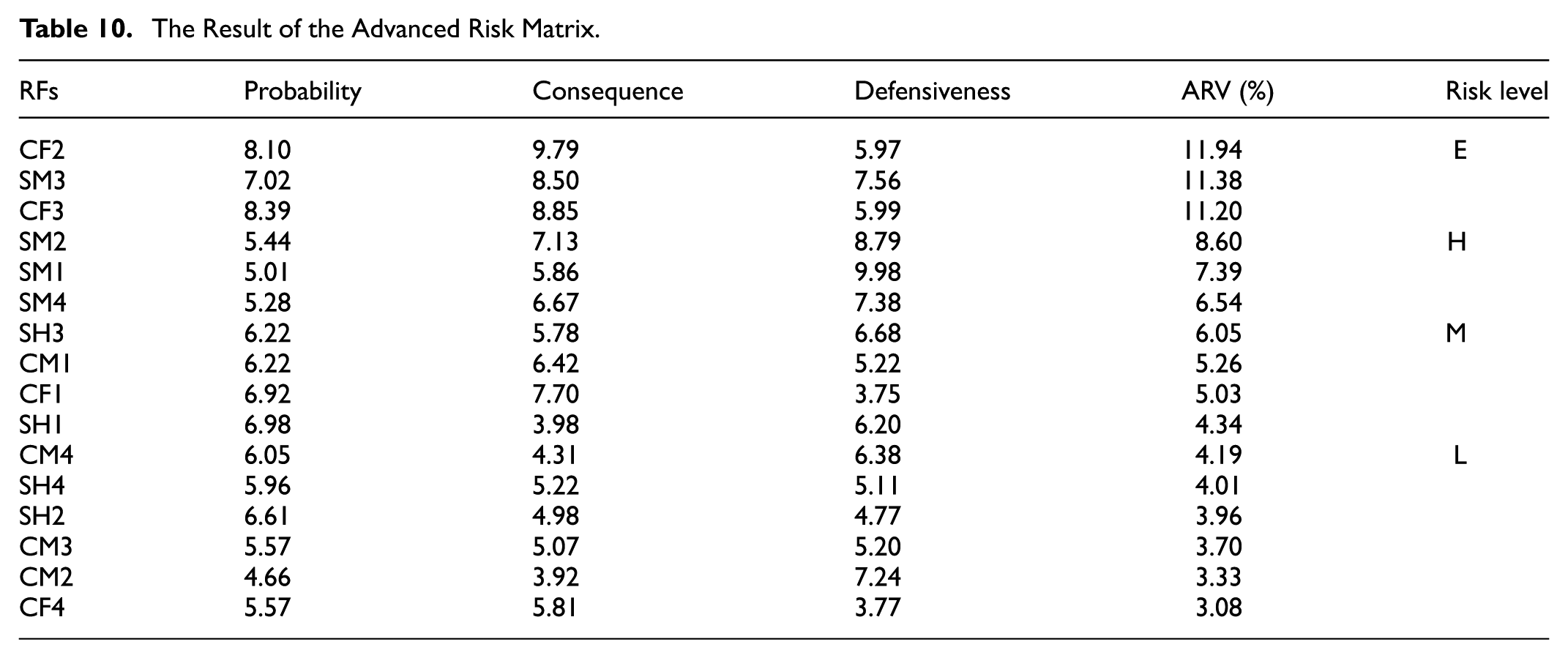
Equation (23) indicates that an RF with the higher consequence, higher probability, and higher dissatisfaction weights (i.e., defenseless) may generate higher risk values. Based on Equation (23), we have the ARVs for the Tai-Hua ferry case exhibited in the fifth column of Table 10. It is indicated that the higher RFs include CF2 (11.94%), SM3 (11.38%), CF3 (11.19%), SM2 (8.60%), and SM1 (7.39%).
The Result of the Advanced Risk Matrix.
Discussion
Determining the Risk Factors’ Risk Levels
From the ARVs (advanced risk values) in the last second column of Table 10, three quartiles are generated:
The Comparison of the Standard Risk Matrix and the Advanced Risk Matrix
The SRM, which is based on the probability and consequence of risk factors, is often considered the most common approach in the risk handling framework. However, it is posited that SRM has some weaknesses needing to be revised.
Similar to the ARM, the SRM can distinguish RFs’ risk level from the values of TRVs, and three quartiles
The ARM model (Table 10) for the empirical case of the Tai-Hua ferry shows that CF2, SM3, and CF3 are extreme risk factors (named E). This finding aligns with the earlier SRM results (CF2, CF3, and SM3), except for a slight difference in the sequence of the risk factors. Nonetheless, there is a notable difference in the number of high-risk RFs when comparing between SRM and ARM. More specifically, SRM identifies two high-risk RFs (SM3 and CF1), while ARM highlights only three ones (SM2, SM1, and SM4). This finding demonstrates that the Tai-Hua ferry has enhanced defensiveness in CF1, leading to lower risks. As a result, its risk levels have been decreased from high to medium.
On the other hand, SM1 and SM4 exhibit higher dissatisfaction weights, indicating weaker defensiveness, which leads to an increase in their risk values. As a result, their risk levels are elevated from Medium (M) to High (H). Therefore, the manager of the Tai-Hua ferry should prioritize enhancing SM1 (the process of overseeing and coordinating crew personnel on board) and SM4 (communication and cooperation among crew members) over CF1 (safety awareness). These findings offer detailed managerial insights, enabling the Tai-Hua ferry to refine its management policies for navigational safety.
Conclusion
With reference to sustainable transport’s narrow definition, the absolute majority of the preceding literature has gauged environmental aspects and the efficiency of power consumption from transport activities. To contribute to the body of knowledge relating to the SD theory, the current article aims at assessing the risk of navigational safety for PCFs as a good proxy for the social pillar of sustainable transport. Initially, a total of 16 RFs were examined for PCFs’ navigational safety. The RFAHP approach was used to construct an ARM model for evaluating the risk level of RFs. This paper addresses three main contributions:
First, the introduction of the ARM allows FOs to determine which RFs should be paid more attention to. The ARM, in contrast to the standard one, incorporates an additional dimension known as the defensiveness of accidents, in addition to the fundamental dimensions of consequence and probability. In theory, the ARM has the potential to offer more accurate information for a particular ferry than the traditional one. Consequently, it provides a theoretical framework for related studies in risk evaluation. The ARM can also be applicable to risk management for other modes of waterborne transport, such as cruises, barges, container vessels, etc.
Besides, to verify the ARM model, the main ferries in Taiwan and a specific ferry (Tai-Hua) operated by TNC (Taiwan Navigation Company), were empirically investigated. The analysis identifies three key RFs for the Tai-Hua ferry: the crew’s operational skills, adherence to standard operational performance guidelines, and self-discipline on board. From the empirical results, some management policies were suggested. This outcome offers valuable insights for TNC to enhance its navigational safety. Currently, the Tai-Hua ferry is the biggest ferry company in Taiwan, with a traffic capacity of over 1,000 passengers for each voyage. This case is exemplary and can also offer useful managerial guidelines for international ferry operations.
The second contribution is to revise RFs’ original weights, which are obtained by the traditional fuzzy AHP, by developing the influence matrix. Jidda et al. (2025) indicated that the theory of the conventional fuzzy AHP requires the independency of under-evaluation criteria (i.e., RFs). In real-world applications, this assumption is infrequently satisfied across various instances. As a result, revising the original weights might support the progression of fuzzy AHP theory. It can be said that such revision process can be applicable in the estimation of priority weights of other multiple-criteria decision analysis (MCDA), for example, TOPSIS, VIKOR, and SAW.
The last contribution is to consider the interrelationship between criteria, which is relatively commonplace, especially in risk management activities. So, this problem has received much attention from preceding studies. To gauge the magnitude of the interrelationship among evaluated criteria, some approaches have been proposed so far, such as the Current Reality Tree (Ikeziri et al., 2019), Interpretive Structural Modeling (Yang & Lin, 2020), and Fuzzy MICMAC analysis (Shankar et al., 2018). Thus, the revision process in the current study can further contribute a methodological reference to relevant literature.
While this paper effectively evaluates the navigational safety of ferries, it has some potential shortcomings. First, this study conducted an empirical investigation on ferry maritime safety in the Taiwan Strait. However, many ferry routes are not uniform and can differ significantly based on their unique environmental characteristics. Hence, the empirical findings in the current article might not be entirely applicable to other regions of ferry transportation. Second, only 21 skilled specialists from the Taiwan-PCFs case were requested to engage in an empirical survey conducted as part of this study. It is highly recommended that future studies might need more representative samples for better policies. Third, adopting the quartile-based risk classification method (e.g., Q1, Q2, Q3 cutoffs) may oversimplify the nuanced differences between RFs, which future studies should overcome. Fourth, the current article was not yet to compare the navigational risks of ferry transport from the proposed research framework with those of other MCDM techniques, for instance, TOPSIS, or FMEA. Accordingly, this research limitation opens the door for further studies. Finally, the lack of dynamic and real-time risk data integration into current models may not fully capture the rapidly changing conditions of the maritime environment. Therefore, it is suggested future research incorporate dynamic data streams, such as real-time vessel tracking, environmental monitoring and instantaneous weather updates, in the navigation risk assessment models.
Footnotes
Acknowledgements
We acknowledge Nguyen Tat Thanh University, Ho Chi Minh City, Vietnam for supporting this study.
Abbreviation
The list of jargons in the paper
SD Sustainable development
PCFs Passenger-cargo ferries
RFs Risk factors
RFAHP Revised Fuzzy Analytic Hierarchy Process
ACRM Advanced continuous risk matrix
DRM Discrete risk matrix
DRM Continuous risk matrix
THW Tai-Hua Wheel
CF Crew factor
SH Ship hardware
SM Ship management
CM Company management
SRM Standard risk matrix
CI Consistency index
CR Consistency ratio
RI Random index
λmax The biggest eigenvalue
IFPRM Integrated fuzzy positive reciprocal matrix
TFN Triangular fuzzy number
GCI Geometric consistency index
TRV Traditional risk value
FOs Ferry operators
ARV Advanced risk value
MCDA Multiple-criteria decision analysis

Funding
The authors received no financial support for the research, authorship, and/or publication of this article.
Declaration of Conflicting Interests
The authors declared no potential conflicts of interest with respect to the research, authorship, and/or publication of this article.
Data Availability Statement
Data sharing not applicable to this article as no datasets were generated or analyzed during the current study.