




Abstract
Obtaining information about the knowledge and awareness of the risk of pesticide use among farmers is essential to reduce the risk to the environment and health. This study aims to measure the level of knowledge of the risk of pesticide use to the environment and health, the level of awareness of pesticide use and to evaluate the relationship between both sociodemographic and knowledge factors toward awareness of pesticide use. The study was conducted among 360 farmers from Pulau Pinang. The results showed that the farmers’ level of awareness on pesticide use was moderate, although their level of knowledge on the risks of pesticide use to the environment and health was high. Farmers higher awareness of the prohibition of using harmful pesticides but the awareness level on how to dispose of used pesticide containers was low. This is driven by the factor of moderate knowledge of the existence of pesticide residue. There is a strong relationship of awareness with the educational factor, a moderate relationship for the area of paddy field factor, and also for the experience factor. There is also significant moderate relationship for knowledge on the risks of pesticide use to the environment and health with awareness. The government should emphasize furthering the educational program, the management and safe operating procedures for pesticides, and giving incentives to farmers who lack knowledge and experience, especially to younger farmers, as well as reducing environmental taxes and giving an incentive to farmers who cultivate paddy fields on a large scale.
Keywords
Introduction
The agricultural sector is one of the most important sectors globally and is the major contributor to the food industries. However, only 25% of the total agricultural land is cultivated organically; the rest uses applied pesticides. Globally, the use of pesticides in paddy cultivation contributes to 15% of the total pesticide use in agricultural activities (Agnihotri, 2000). In Malaysia, pesticides are conventionally and commonly used by farmers, especially in paddy cultivation, for pest control. The implementation of pesticides became a tradition that guaranteed the prevention of Bena perang, a type of pest that commonly attacks paddy fields. To prevent the problem and to increase yield, the implementation of a variety of techniques—modern paddies, pesticides, irrigation, and technology—have been intensively practised and have changed the ecological structure, increasing the pest problem (Parveen, 2010). To maximize profits via efficient and productive techniques, modern agriculture practices have affected the environment and human health, especially chemical, combined agricultural methods.
For two reasons, paddy is Malaysia’s most significant crop in the food subsector. First and foremost, rice is the bulk of the population’s primary diet. Malaysian adults ate 2.5 plates of white rice each day on average. (Kasim et al., 2018). Second, for the rice farming community, the crop is the major source of income and livelihood, particularly for small-scale farmers and landless agricultural laborers. Paddy production is the sole source of income for around 40% of farmers. Thus, Malaysia’s paddy and rice policies are primarily designed to fulfill three goals: to promote equitable income for farmers, to maintain price stability, and to assure supply security for consumers. In general, rice security represents the nation’s food security, and establishing rice self-sufficiency is a critical component in improving national food security (Rajamoorthy et al., 2015).
The safety and quality of food have raised serious concerns in the production and marketing of agricultural products, especially those for paddies. With the liberalization of global trade activity through the World Trade Organization (WTO) and the ASEAN Free Trade Area (AFTA), the need to produce safe and high-quality agricultural products has become a key factor to become more competitive in both domestic and international markets. Furthermore, consumers are now transitioning to healthier lifestyles by choosing healthier, more nutritious, and high-quality products (Yeong et al., 2012).
The importance of awareness of the risk of pesticides used in the agricultural sector has caught the attention of many countries worldwide, including Malaysia. The use of unsafe pesticides in terms of operation procedures, dose density, regularity and the amount of time spent applying the pesticides will leave an amount of residue on crops and in the environment, leading to adverse effects on the environment and human health. Pesticide residues, particularly those of extremely toxic pesticides, have emerged as a significant danger to the safety and quality of agricultural goods. Chemical residues pose a hazard not only because of pesticide quality and specifications, but also because paddy farmers are not aware of the problems associated with pesticide usage (Li et al., 2007; Rother, 2005; Zhou, 2007). According to Heong et al. (2002), the success of Integrated Pest Management (IPM) methods in addressing pesticide problems with crops depends largely on the agricultural practices used by farmers and the extent to which different factors influence the use of pesticides. Mekonnen and Agonafir (2002) stated that farmers’ knowledge and awareness of pesticide risk plays an important role in determining the use of Personal Protection Equipment (PPE) while their level of education plays an important role in increasing the knowledge of pesticide risk (Jensen et al., 2011).
The agricultural sector has played an important role in the development of the Malaysian economy. Since 1984, three National Agricultural Policies have been constructed to help develop the agricultural sector. The First National Agricultural Policy (1984–1991) was implemented with a focus on export-oriented development while the Second National Agricultural Policy (1992–1997) focused on increasing productivity, efficiency and competition, increasing farmland area and developing the agro-based industry. Both policies emphasize the efficiency of local resource utilization, aiming to maximize agricultural income (Murad et al., 2008). Later, the Third National Agricultural Policy was formed from 1998 to 2010 to meet the challenges and needs of the country to ensure adequate, safe, highly nutritious, and quality food is produced and to ensure sustainable agricultural development.
Paddies are the third-most important plantation after rubber and oil palm and cover about 526,000 hectares of all agricultural land in Malaysia. In Peninsular Malaysia, paddy cultivation covers an area of about 400,000 hectares, contributing to 86% of the total rice production in the country (Awang et al., 2021; Watanabe et al., 1996). However, the presence of pests causes a decline in yield and rice quality. Agricultural production has suffered significant losses from pest problems and pests have long been considered a major problem for farmers.
The level of knowledge and awareness among farmers about the risks to the environment and human health posed by using pesticides needs to be ensured as they are the ones who handle and use the chemical content of the pesticides, not the latest and most advanced machines. Most paddy farmers who handle the pesticides do not understand the harmful effects that pesticides can have on the environment and the threats to their own and public health. There is also a lack of studies on farmers’ knowledge and awareness of safe pesticide practices. Therefore, this study was conducted to assess the level of knowledge and awareness of the risks of pesticide use among farmers in Pulau Pinang. Most previous studies have focused on the distribution of weeds on paddies in the Muda areas (Begum et al., 2005). There was also a study conducted by Alam et al. (2012) on attitudes and perceptions among paddy farmers in the Muda irrigation area that focused on weed infestation associated with herbicidal use. In addition, there was a study conducted by a group of students from Universiti Kebangsaan Malaysia (1998) on the knowledge, attitudes and practices of pesticide use and the influencing factors among the farmers of Tanjung Karang Selangor. The study only touched on the health effects on paddy farmers and the connection to their knowledge, attitudes, and practices.
Methodology
Research Area
This study involved farmers from Pulau Pinang. Pulau Pinang is a state in Malaysia located near the north-western coast of Peninsular Malaysia. It is surrounded by the states of Kedah (to the north and east), Perak (to the south), and the Straits of Malacca and Sumatra (to the west). Pulau Pinang is made up of two parts, an island and part of the mainland known as Seberang Perai with a total area of 1046 km². The area of the island is 285 km² and is completely separated from Seberang Perai.
According to the Integrated Agricultural Development Area of Pulau Pinang (IADA Pulau Pinang), the total area of paddy cultivation in Pulau Pinang is 12,782 hectares and it is one of the largest rice producers in Malaysia. Out of the total paddy cultivation, 10,305 hectares are in the paddy field area while 2,477 hectares are not under the paddy field area and are referred to as in an irrigation area. The estimated return on paddy cultivation is 105,498 metric tonnes for rice production.
The paddy field area in Pulau Pinang covers four districts, namely North Seberang Perai (SPU), Seberang Perai Central (SPT), South Seberang Perai (SPS), and Southwest (BD) in Balik Pulau, and these study sites incorporate all the paddy field farmers in Pulau Pinang, Malaysia.
In these four districts, there are about 10 paddy cultivation areas or locations, Bakau Tok Kiat, Pokok Kenanga, Sungai Acheh, Sungai Kulim, Bumbung Lima, Pokok Sena, Padang Menora, Air Melintas, Pinang Tunggal, and Sungai Burung. All of these locations were divided into different irrigation schemes that get their water supplies from different rivers. An irrigation scheme is an irrigation and drainage system developed and provided by the Pulau Pinang Integrated Agricultural Development Area (IADA Pulau Pinang). The irrigation and drainage systems were constructed to control water supply, drainage and are scheduled so that the water supply can be optimally used. In total, six irrigation schemes included the locations in the study: the Sungai Muda Irrigation Scheme and the Pinang Tunggal Irrigation Scheme located in North Seberang Perai District, the Sungai Jarak Irrigation Scheme, and the Sungai Kulim Irrigation Scheme located in the Central Seberang Perai District, Sungai Acheh Irrigation Scheme located in South Seberang Perai District and the Sungai Burung Irrigation Scheme located in Southwest District as referred to in Table 1.
Paddy Field Irrigation Schemes in Pulau Pinang.

Research Methods
A quantitative method was used for this study with a purposive sampling technique that aimed to collect data and individual information from the selected population via a questionnaire form. Purposive sampling technique is a sampling technique where specific respondents were selected to collect specific information out of the data. The respondents were required to meet certain criteria for the objectives of this study involving the paddy farmers. According to the IADA human resources division of Pulau Pinang, the average population of paddy farmers registered in Pulau Pinang is 5,000 individuals.
According to the guidelines of Krejcie and Morgan (1970), at least 357 people are needed based on a population of 5,000. The survey measures two main aspects. The first is the farmers’ knowledge on the risk of pesticides to the environment and human health while the second is the awareness of pesticide practices and implementation among farmers. The questionnaire was developed using the KAP model developed by Food and Agriculture Organisation (FAO, 2014) KAP model questionnaires in MS Word format from the FAO publication Guidelines for assessing nutrition-related knowledge, attitudes and practices (FAO, 2014). The questionnaire was divided into three sections, Parts A, B, and C. Part A included questions related to sociodemographic information like the farmer’s gender, age, educational level, paddy cultivation experience, their total area of paddy fields and average income from the paddy yield per season. Part B is a question related to their knowledge on the risks of using pesticides to the environment and human health, while Part C is a question about their awareness on pesticide use including sources of information on pesticides, pesticide use practices and safety management of pesticides.
Respondents were asked to select the correct and appropriate answers for the questions on knowledge. A total of five (5) points are given to the correct answer (yes) and zero (0) points to the wrong answer (no) and (uncertain). The procedure was the same for awareness questions where a score of five (5) points was given to the correct answer choice while zero (0) points for the wrong answer. Then, average scores were determined and divided into three categories: low level knowledge (0–1.59), medium level knowledge (1.60–2.99), and high-level knowledge (3.00–5.00).
Research Analysis
This study uses two types of analysis which is descriptive analysis and inference analysis. Descriptive analysis was used to present respondents’ profiles and choices of answers on knowledge and awareness to obtain the total value, percentage, frequency, average mean, and standard deviation. The findings from this descriptive analysis allowed the researchers to identify the variables that influenced the farmers’ levels of knowledge on pesticide risks to the environment and public health and their level of awareness on pesticide use and implementation. While inference analysis which is independent Chi-Square test was used to present the evaluation of the relationship between sociodemographic and knowledge factors against awareness. The Chi-Square Test was used to determine if a difference between observed data and expected data is due to chance, or if it is due to a relationship between the variables. The strength of the relationship was determined using Phi and Cramer’s V correlation coefficient (Akoglu, 2018).
Results
Respondent Sociodemographic Profiles
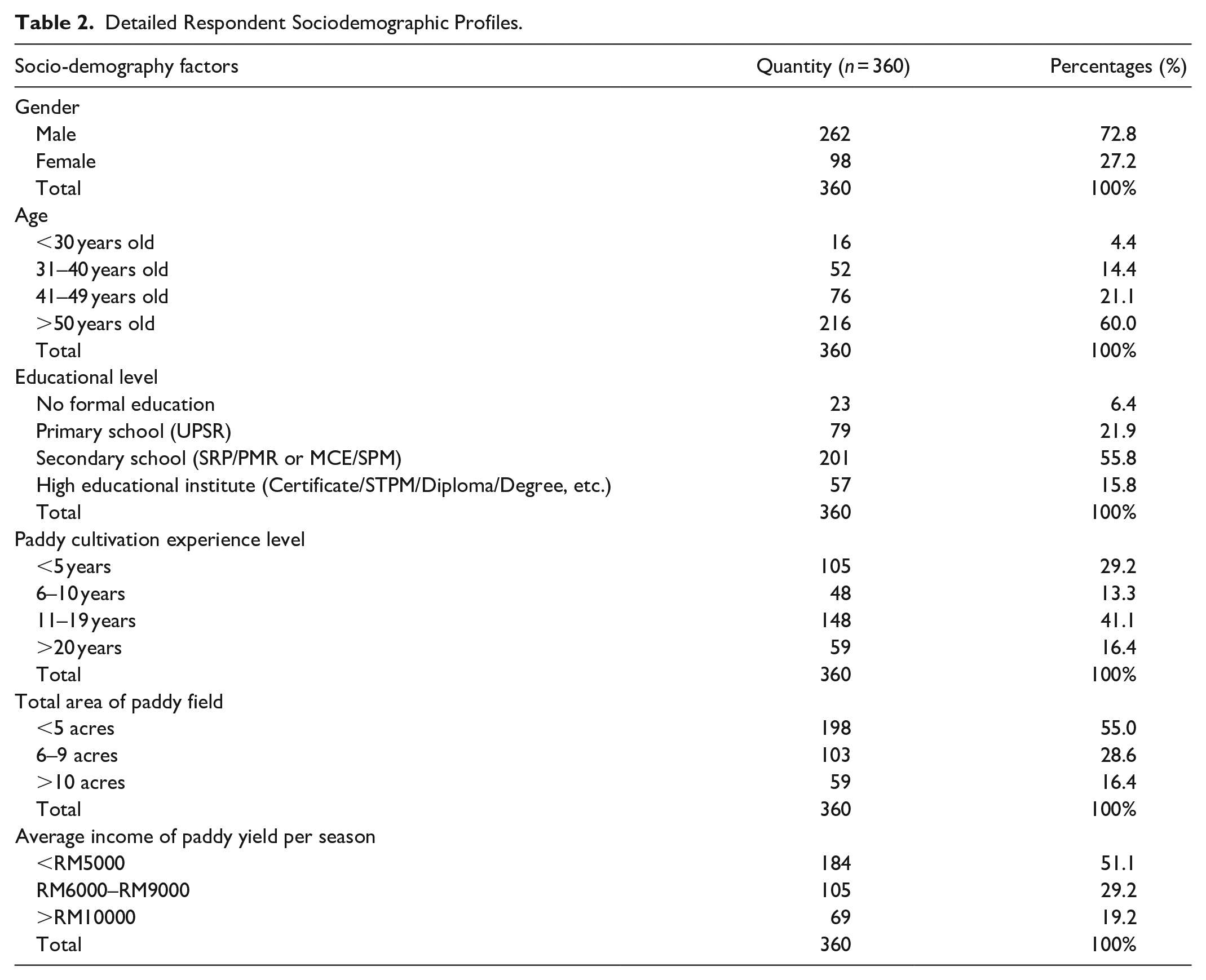
The results for the respondents’ sociodemographic survey (Table 2) showed that the majority of the farmers were male with 262 individuals (72.8%), while 98 individuals were female (27.2%). The majority of the farmers were above the age of 50 with 216 individuals (60%), followed by 76 individuals (21.1%) from the ages of 41 to 49, then 52 individuals (14.4%) from the ages of 31 to 40, and lastly ages 30 and below with 16 individuals (4.4%). Meanwhile, the educational level among farmers showed that the majority of farmers had been educated to secondary school level with 55.8% (201 individuals), followed by primary school level with 21.9% (79 individuals), and 15.8% (57 individuals) had a higher institution educational level, while 6.4% (23 individuals) had no formal educational background. Looking at the experience of paddy cultivation level, the highest experience level among the paddy farmers was 11 to 19 years with 148 individuals (41.1%), followed by less than 5 years of experience with 105 individuals (29.2%), then above 20 years of experience with 59 individuals (16.4%), while 48 individuals (13.3%) had 6 to 10 years of experience. When looking at total paddy field area, the majority of farmers had 5 acres of paddy with 184 individuals (55%), followed by 6 to 9 acres with 103 individuals (28.6%), while the rest had 10 acres of paddy field with 59 individuals (16.4%). The average income from the paddy yield per season showed that the majority of farmers gained approximately RM5000 with 184 individuals (51.1%), the second-highest yield per season was RM6000 to 9000 with 105 individuals (29.2%), while the rest gained more than RM10000 per season with 69 individuals (19.2%).
Detailed Respondent Sociodemographic Profiles.
Level of Knowledge of Pesticides
The level of knowledge of the risk of pesticide use to the environment and human health was analyzed and was divided into three categories: low level (mean score 0–19), moderate level (mean score 1.60–2.99), and high level (mean score 3.00–5.00). Table 3 shows the results and the majority of farmers had a high level of knowledge of the risks of pesticide use on the environment and human health with an average score of (3.63, ±1.55). From the total score of 5, the knowledge mean score variation acquired was 2.43 to 4.51 for each different question (Figure 1). Question 2 showed the highest mean score with 4.51, indicating that the farmers have a high level of knowledge of the risks of pesticides on human health, while the lowest score (2.43) was on their knowledge about pesticide residue in the environment, although this was still a moderate mean score.
Knowledge Levels of The Risks of Pesticides to the Environment and Public Health.


Mean scores of farmers’ knowledge levels on the risk of pesticides to the environment and public health.
Farmers’ Level of Awareness on Pesticide Management
The results showed that the majority of farmers had a moderate awareness (mean score 2.35, ±1.03) of all aspects of pesticide management. From the total score of 5, the awareness mean score variation acquired was 1.59 to 3.29 for each question (Figure 2). Question 7 recorded the highest mean score with 3.29, indicating the farmers’ awareness on the use of prohibited pesticides, while question 5 had the lowest mean score with 1.59 indicating a lack of awareness of the procedures of disposing of used pesticide containers.

Mean Score of farmer’s awareness on pesticides management.
The Relationship Between Sociodemographic Factors and Farmers’ Levels of Knowledge and Awareness on the Risks of Pesticide Use
The relationship between sociodemographic factors and awareness levels
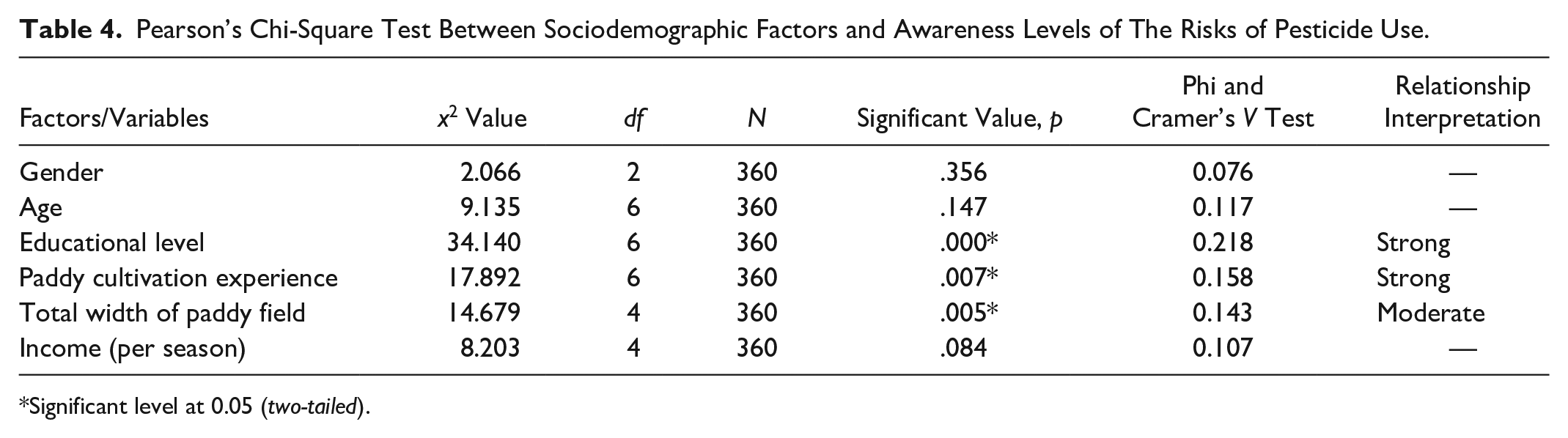
The relationships between sociodemographic factors (gender, age, level of education, level of paddy cultivation experience, the total width of paddy field, and income) and awareness levels were analyzed using the independent Chi-Square test. The analytical results for sociodemographic factors and awareness levels are shown in Table 4.
Pearson’s Chi-Square Test Between Sociodemographic Factors and Awareness Levels of The Risks of Pesticide Use.
Significant level at 0.05 (two-tailed).
Based on the Chi-Square test analysis, the gender factor showed no significant relationship between male and female farmers for their awareness on the risk of pesticide use with a value of x2 = 2.066, df = 2, N = 360; p > .05. This shows that there is no significant relationship between gender and the level of awareness among farmers. The same goes for the age factor where the Chi-Square test showed no significant relationship between the four age groups and the level of awareness on the risks of pesticide use with a value of x2 = 9.135, df = 6, N = 360; p > .05.
For the Chi-Square test analysis on educational factors, a significant relationship between the four categories of educational level and the awareness level was seen. This indicates that the level of an educational factor among farmers had a significant relationship with the level of awareness of the risk of pesticide use. A Pearson’s Chi-Square test showed that farmers with secondary school educational level surpassed other levels of education significantly for awareness with the value of x2 = 34.140, df = 6, N = 360; p < .05. A Phi and Cramer’s V test, representing the relationship value between the level of education and awareness level, was 0.218 meaning that there was a strong relationship between them.
A Chi-Square test analysis on the paddy cultivation experience factor showed a significant result with the awareness level for all four categories. This indicates that the level of paddy cultivation experience has a significant relationship with the awareness level of the risk of pesticide use. A Pearson’s Chi-Square test showed that farmers with 11 to 19 years of experience surpassed other levels of experience significantly for awareness level of the risks with a value of x2 = 17.892, df = 6, N = 360; p < .05. A Phi and Cramer’s V test, representing the relationship value between the level of paddy cultivation experience and awareness level, was 0.158, meaning that there was a strong relationship.
For the total area of paddy field factor, the Chi-Square test analysis showed significant differences in awareness level between the three paddy field area categories. This shows that the total area of the paddy fields has a significant relationship with farmers’ awareness level of the risk of using pesticides. A Pearson’s Chi-Square test showed that farmers with less than 5 acres of paddy field surpassed other categories significantly with a value of x2 = 14.679, df = 4, N = 360; p < .05. A Phi and Cramer’s V test, representing the relationship value between the total area of the paddy field and awareness level, showed a moderate relationship with 0.143.
Finally, for the farmers’ income factor, the Chi-Square test analysis showed no significant difference among the three categories with a value of x2 = 8.203, df = 4, N = 360; p > .05. Thus, the income factor shows no significant relationship with the awareness level of the risks of pesticide use.
The relationship between knowledge factors and awareness levels
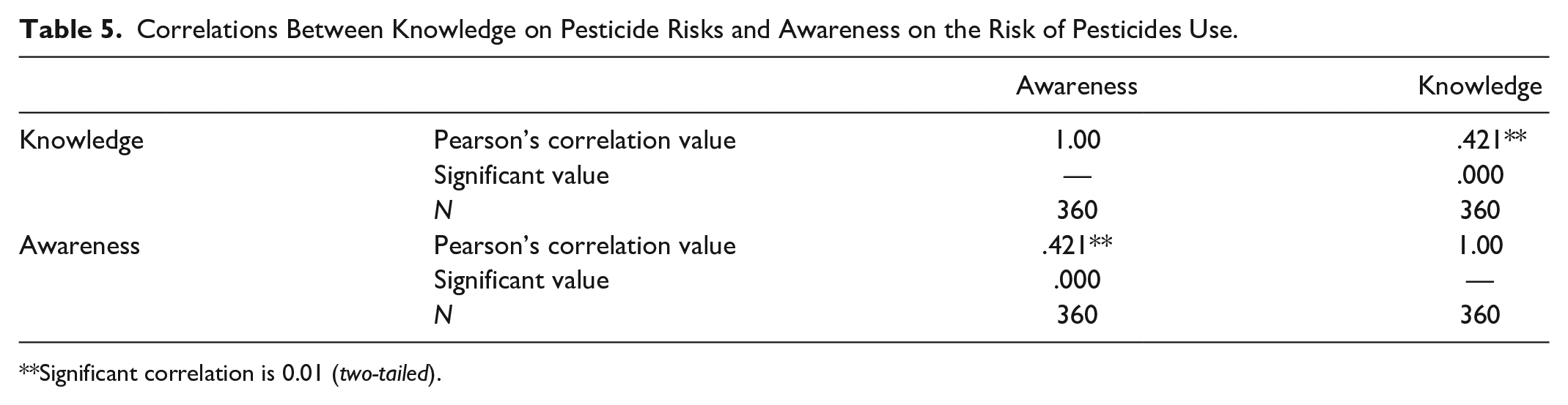
The knowledge factor and awareness levels were analyzed using a Pearson’s correlation test as the data collected met the requirements of this analysis—normal and scattered data measured on a continuous scale. The results of the analysis of knowledge and awareness factors are shown in Table 5.
Correlations Between Knowledge on Pesticide Risks and Awareness on the Risk of Pesticides Use.
Significant correlation is 0.01 (two-tailed).
Based on the Pearson correlation test analysis, there was a significant relationship with a moderate strength value between farmers’ knowledge and awareness with the values r = 0.421; p < .05 (p = .000). This shows that the knowledge of pesticide risks to the environment and human health factors can influence the level of awareness among paddy farmers on pesticide use.
Discussion
Farmers’ Knowledge Levels on the Risks of Pesticide Use
According to Abhilash and Singh (2009) due to a lack of knowledge among farmers, the misapplication of pesticides has become a major problem in agricultural production. Based on that, the results on the level of knowledge among farmers (pesticides residue concentration in the environment, impact on human health, impact on the environment, water pollution, the association with a disease that could affect human health, and safety procedures to counter the risk of pesticides) can determine the degree to which negative externalities are associated with the use of pesticides. The results from this study showed that overall, the level of knowledge from the respondents was high (with an average score 3.63, ±1.55) and five out of the six questions about knowledge that were asked indicated that farmers had a high level of knowledge.
The farmers had a high level of knowledge (score value of 4.51, ±1.48) of the negative impact of pesticides on human health with 325 individuals (90.3%). The results share similarities with a study by Yang et al. (2014) in which it was shown that 90% of farmers are aware of the dangers posed by pesticides to human health. The results are supported by Karunamoorthi et al. (2012) who found that 58.8% of farmers reported toxicity-related symptoms due to pesticide use such as headaches and vomiting. Other researchers have also reported similar symptoms like headaches, vomiting, dizziness, abdominal, or lower abdominal pain (Recena et al., 2006). Meanwhile, a cohort study made by Kamel et al. (2005), conducted on 18,782 pesticide users in the United States, found that a greater number of symptoms were associated with the use of pesticides, especially organochlorine and organophosphorus. There are many studies on the dangers of pesticides to human health, and these are likely the cause of their high level of knowledge on this matter.
Furthermore, the level of knowledge among farmers of the existence of ways to counter the risks of pesticide use was high (score value 3.92, ±2.06) with 282 individuals (78.3%) having a high score. A total of 128 farmers (35.56%) stated that PPE is the best defense against harmful pesticides. According to Keifer (2000), PPE includes equipment such as rubber gloves, respiratory protection masks, face shields and safety goggles. A study by Salvatore et al. (2008) stated that there was a significant decrease in pesticide exposure indicated by organophosphorus levels in urine for individuals who were using PPE compared to those who were not. Alam et al. (2012) stated that the use of PPE is the major factor in reducing the exposure to harmful pesticides. However, only the farmer’s knowledge of the pesticide effects that can be avoided using PPE was studied, not the extent of their willingness to use PPE. Whether farmers regularly use PPE remains unclear.
The level of knowledge among farmers on the risks of pesticides to the environment was high (score value 3.82, ±2.13) with 275 individuals (76.4%) achieving this score. Other than posing a serious threat to human health, especially among smallholder farmers, unsafe pesticide practices can also harm the environment (Houbraken et al., 2016; John & Shaike, 2015). In a study by Shammi et al. (2020) 80% of the farmers asked agreed that excessive use of pesticides can lead to surface water pollution, kill beneficial insects and degrade the surrounding ecosystem. Recena et al. (2006) also stated that most of the agricultural farmers studied considered that pesticides are harmful to the environment, especially to rivers (88.0%), air (63.2%), and land (57.2%).
Other than that, farmers’ knowledge levels on the effects of pesticide use on water quality were high (score value 3.58, ±2.26) with 71.7% (258 individuals) scoring high on this factor. The knowledge itself is important as the lack of knowledge and awareness can be a big challenge to safe and sustainable pesticide management and preventing underground water pollution (FAO, 2011). In their study, Al-zain and Mosalami (2014) showed the percentage knowledge level among farmers regarding the capability of pesticides to reach underground water was high.
Most of the farmers also had a high knowledge level of the existence of relations between pesticides and diseases that can affect human health (score value 3.50, ±2.29) with 252 individuals (70%) scoring high. Acute and chronic health problems have been linked to exposure to pesticides through drinking water and food (Wiles et al., 1994) as well as through daily agricultural work (Blair et al., 1992). From the interviews conducted with farmers, it remains unclear how these health problems occurred given the high knowledge level among farmers. A study by Kishi et al. (1995) stated that the development of a variety of diseases after the implementation of pesticides on crops is considered common among farmers, whereas the problem will only become evident to farmers when more serious chronic diseases occur. The development of chronic diseases such as cancer occurs after being exposed to pesticides over time. The use of pesticides containing chlorine and methyl bromide among farmers who are above the age of 50 carried the risk of getting prostate cancer (Alavanja et al., 2003).
However, the level of knowledge of the presence of pesticide residues in the environment among farmers was still at a moderate level (score value 2.43, ±2.50) with only 48.6% (175 individuals) scoring this. Pesticide residues, especially the highly toxic pesticides, become a major threat to the safety and quality of an agricultural product. Research by the Pesticide Testing Institute of the Chinese Ministry of Agriculture in 2001 stated that the majority of farmers lack knowledge on the threat posed by pesticide residues (Guangxue & Yuerong, 2002). The threat not only depends on the pesticide quality and specification but also on the farmer’s knowledge of pesticide residues and their attitude when applying pesticides (Li et al., 2007; Rother, 2005; Zhou, 2007). Therefore, the level of knowledge on pesticide residues indirectly influences their method of implementing the pesticides.
Farmers’ Awareness Level of the Risks of Pesticide Use
The farmers’ awareness of aspects of pesticide management are averagely moderate (mean score 2.35, ±1.03). The level of awareness on the risks of pesticide use is very important, especially to the farmers who are the front-liners in managing the safety measures of pesticide use in rural areas. According to Yang et al. (2014), the level of knowledge of pesticide use is reflected in the farmer’s attitude and their safety awareness in its implementation, their knowledge of avoiding risk and how to reduce potential pollution to the agricultural system.
To be more specific, this study found that the farmers had high awareness levels (mean score 3.29, ±2.38) of uncertified and banned pesticides with 237 individuals (65.8%) scoring highly. This shows that they are well informed of the risks and problems posed by these pesticides. The majority of the farmers were aware that the paraquat pesticide is the most lethal pesticide that can be used. This is shown in Table 6—72.34% of the respondents stated that paraquat is the deadliest pesticide and had caused the highest death toll all around the world with a rate of 60% to 70% (Seok et al., 2009). However, the prohibition of the paraquat pesticide remained unknown to the farmers (Table 6). Although today there are a lot of eco-friendly pesticides available, there are still many uncertified pesticides on the market, especially from the neighboring country of Thailand.
Awareness Level on Pesticides Management.

Note. *The most appropriate answer.
This study also found that the farmers’ awareness of the importance of keeping the pesticides in a safe and proper place was very high (mean score 3.26, ±2.38). Most of the farmers (65.3%) were aware of the importance of the proper storage of pesticides to reduce the potential risks that could be caused by them. A study by Jallow et al. (2017) showed similarities in that farmers had the same high awareness of keeping the pesticides properly stored. Furthermore, Mekonnen and Agonafir (2002) found that farmers that have received proper training tended to keep the pesticides in a safe and proper place. However, there were still some farmers (13.9%) who randomly misplaced the pesticides. This kind of attitude can be related to the lack of technical awareness and training on pesticides safety management (Jallow et al., 2017).
Meanwhile, the awareness among farmers on the type of protection that can be used for safety measures during pesticide application was at a moderate level (mean score 2.49, ±2.50). Less than half of the farmers from this study (49.7%, 179 individuals) chose to wear a protective mask and, as stated by Hygnstrom et al. (2017), the item is one type of PPE that should be worn while using pesticides. From the conducted survey most of the farmers admitted that they lack the awareness that pesticide residues can affect them through breathing them in. The respiratory tract is the main entry point where pesticides can enter into the body and then the bloodstream where they circulate and causes damage. Furthermore, farmers confess that the use of protective masks is uncomfortable, especially on sunny and hot days were their sweat will fill up the mask thus distracting from their work. This issue is one the authorities should be aware of as by law the farmers’ safety is the authority’s responsibility, especially regarding pesticide use. Proper implementation and protection along with good personal hygiene can be considered to be the best defense against the risks of pesticide use (Matthews, 2008).
Farmers also seemed to have a moderate awareness level (mean score 2.11, ±2.47) on the amount of pesticide needed according to the authorized specification by the Pesticide Control Division, Department of Agriculture Malaysia. Only 42.2% (152 individuals) knew about the pesticide guidelines outlined under the 149th ACT of the Pesticides Act 1974 (Department of Agriculture 2019) and in accordance with the United Nations Food and Agriculture Organization (FAO) code of ethics. The ignorance and lack of taking an initiative leads to a lack of awareness among farmers. However, the percentage of farmers who chose to ask the pesticides suppliers as a reference on the amount of dose needed for pesticides use was 38.1% (137 individuals). Due to that reason, an experienced and authorized supplier with a lot of knowledge on pesticides should be present to explain the pesticide implementation procedure so no pesticide misuse occurs, which could lead to poisoning and harm to human health and the environment.
While the farmer’s awareness of where to obtain the correct information on pesticides was at a moderate level (mean score 2.08, ±2.47), verbal communication between farmers and authorized suppliers is important so that farmers gain information on the methods of use and functions of pesticides. Only 41.7% (150 individuals) of farmers obtained information from the correct channel—through suppliers—while the rest obtained the information from co-workers (39.4%, 142 individuals). Suppliers are competent individuals able to provide information about the safe use of pesticides. Getting information about pesticides from co-workers can be inaccurate and unreliable due to the lack of experience of pesticides, leading to miscalculations of pesticide mixtures and negative reactions between the chemicals. The result will not only ineffective but could also cause damage to the farmer’s health and the environment (Karunamoorthi et al., 2012).
Meanwhile, farmers’ awareness on personal hygiene after the application of pesticides was very low with a mean score of 1.64, ±2.35, and knowledge of proper pesticide container disposal management was also low (mean score 1.59, ±2.34). Nearly half of the farmers (45.8%, 165 individuals) thought that hand washing was sufficient to remove pesticide stains after applying pesticides to crops while only 32.8% (118 individuals) cleaned themselves by taking a shower, which is believed to be necessary to remove pesticide residue from the body. There are similarities in our results to a study conducted by Gesesew et al. (2016) that showed that less than half of the respondents chose to clean themselves by taking a shower. Farmers’ awareness of the importance of cleaning themselves after the use of pesticides was very low. A route of exposure to pesticide toxins is via absorption through the skin (Damalas & Koutroubas, 2016). The absorption happens when there is direct contact with pesticides while using them (mixing, pouring, applying, or disposing of). The level of risk depends on the types of chemicals used in the pesticides, the concentrations of the chemicals in the pesticides, the exposure period, and which part of the body has been contaminated by the pesticides (Baldi et al., 2006). Thus, the authorities should devise a seminar on this matter to raise the level of awareness, especially among farmers.
Lastly, the awareness of the right procedure to dispose of used pesticide containers among farmers was very low. Only 31.9% (115 individuals) of the farmers burnt or buried the used containers, which is the correct and safe way to dispose of them, while 68.1% (245 individuals) stated that they disposed of containers in general waste areas while some disposed of them directly to the surrounding environment. This shocking information shows that the level of awareness among farmers was very low. According to Matthews (2008), disposal methods for used pesticide containers are crucial for intervention strategies to raise the safety awareness of pesticide implementation and disposal. Pesticide residues from containers that have been poorly disposed of might enter the irrigation system via a non-point source water. The uncontrolled residue might damage the soil and water source thus threatening the ecosystem quality and human health.
Factors Associated with the Awareness on the Risks of Pesticide Use to the Environment and Public Health
Knowledge factors on the risks of pesticide use
The study showed that farmers’ knowledge of the risks of pesticides to the environment and public health is related to their awareness of pesticide use. This supported by Sharifzadeh et al. (2018) who stated that farmers with high awareness levels on obtaining information on the dose, danger and toxicity level, and safe pesticide management are those who give priority to the environment and the effects the pesticides may have on it.
Farmers who have a high level of knowledge on the impact of pesticides on the environment and public health would be aware of the danger of using prohibited pesticides. This indicates that farmers already realize the harmful effects of prohibited pesticides on the environment and human health. Most of the pesticides that have high concentrations of toxic chemicals, are longer-lasting, and cheap can cause serious health problems and environmental pollution locally and even globally (Ecobichon, 2001b).
Furthermore, this study shows that farmers also realize the importance of the safe and proper storage of pesticides due to the awareness of the harmful effects pesticides have on the environment and human health. Satya Sai et al. (2019) stated that farmers realize the potential danger exposure to pesticides brings to their family if the pesticides are kept in insecure and easy access places. They also realize the proper placement of pesticides can minimize the harmful effects on health. Therefore, providing proper storage for pesticides can avoid unwanted accidents.
The same goes for the use of PPE while applying pesticides. This study showed that farmers who wore PPE while applying pesticides on crops were more conscious of their health than farmers who chose not to wear PPE. The improper use of pesticides might pose a threat to human health, especially in developing countries (Ecobichon, 2001a).
Educational factor
Farmers who have at least primary and secondary school educational levels seemed to have a high awareness level of the risks of pesticide use to the environment and human health. It can be seen that 90% of farmers received an education either from primary school or up to higher educational institution level while only 6.4% do not have any formal educational background. Gaber and Abdel Latif (2012) stated in their study that farmers who received a formal education tend to have a better awareness of the negative effects of pesticides.
Furthermore, according to Hou and Wu (2010), farmers who do not have any basic education will lack the ability to absorb more professional knowledge and information on pesticides. Meanwhile, Hwang et al. (2000) and Yassin et al. (2002) reported that farmers with lower educational levels will have a limited ability to understand the risks posed by pesticides to human health and the importance of taking safety precautions. Thus, farmers with lower educational backgrounds will tend to be less aware of the harmful effects of pesticide residues and the importance of applying pesticides based on standard procedures.
Experience factor
This study showed that the experience level on paddy cultivation had a significant relationship with the awareness level of the risks of pesticides to the environment and human health. More than 50% of the farmers who had more than 11 years of experience tended to have a higher awareness level. Shammi et al. (2020) stated that the background and experience factor give extra credit to their awareness of the harmful effects of pesticides on the environment and health regardless of whether they are in rural or urban areas. Moreover, a farmer’s experience is bound to their age. Commonly, the older the farmer the more experience they have in paddy cultivation (Ibrahim & Mook, 1999). Farmers with ages of around 50 years have more experience and thus higher awareness of the risk of pesticide use (Maitah et al., 2015). According to Kohsaka and Rogel (2019) experience may also be called local knowledge of the elder. The elder gained local knowledge via direct experience and observation, which was gathered through time and changed as it was passed down through generations. Tools, clothes, and shelter are examples of tangible cultural components, whereas folklore and spiritual activities are examples of intangible cultural elements.
Area of paddy field factor
The results of this study showed a significant relationship between the total area of the paddy field factor and farmers’ level of awareness on the risks of pesticide use to the environment and human health. More than 80% of the farmers had less than 10 acres of paddy field. Based on that result, farmers with less than 10 acres of paddy field had a higher level of awareness on the risks of pesticide use. According to Mubushar et al. (2019), the level of knowledge and awareness among farmers in Pakistan on the proper and safe way of implementing pesticides was influenced by the area of the agricultural land owned by the farmers.
The results of the interviews conducted with the farmers showed that most of them have less than 10 acres of paddy field and most of it is private property. In a study by Mubushar et al. (2019), it was stated that when the farmer was also the private owner of the land, the owner was influenced to have better awareness and understanding on the impact of pesticides to human health and the environment compared to those who rented land for agricultural purposes—these people tended to have less concern for their own safety and health and only focused on maximizing profit. The study also revealed that farmers owning private land use pesticides wisely, take appropriate precautions, avoid soil degradation, and take steps to protect the environment for the benefit of future generations. Furthermore, other research also shows that respondent socio-economical characteristics such as level of education, income, the width of paddy field and experience greatly influence the use of PPE and their willingness to invest in PPE in order to avoid the risks of the harmful effects of pesticides (Khan & Damalas, 2015).
Conclusion
The study concluded that farmers’ levels of awareness of the risks of pesticides to the environment and human health were moderate. Therefore, agencies such as IADA, Department of Agriculture and the government should take action to raise awareness among paddy farmers regarding the risk and danger posed by both prohibited and unprohibited pesticides. The current framework needs to be expanded via educational programs for prevention strategies related to the use of pesticides, exposure to pesticides, and also for general awareness. The risks of pesticide use among farmers need to be reduced. A variety of activities that can be easily understood like seminars, picture and video presentations, and even performances that illustrate the risks of pesticides to the environment and human health can be applied.
Furthermore, the safe management of pesticide use should be amplified through training which should be conducted by the Department of Agriculture and IADA for farmers who use pesticides on their crops. The focus should be on inexperienced farmers, especially younger farmers. An incentive to younger farmers should be considered so that the awareness of the risks of pesticide to the environment and human health can be raised. One of the methods to implement this is to export the knowledge from other countries, especially Asian countries so that an exchange of ideas and experience can be made. We can also compare the work ethics on pesticide implementations. This will boost farmers’ confidence and work ethic and be more aware of the risks of pesticide use to the environment and human health.
Footnotes
Acknowledgements
We would like to thanks IADA for their huge support in term of hospitality and resources.
Declaration of Conflicting Interests
The author(s) declared no potential conflicts of interest with respect to the research, authorship, and/or publication of this article.
Funding
The author(s) disclosed receipt of the following financial support for the research, authorship, and/or publication of this article: This study was supported by Universiti Kebangsaan Malaysia through research grant (SK-2021-023 & MPOB-UKM-2020-015).
