




Abstract
This study utilized police archival data of 6,824 stalking events from January 2022 to June 2023, measured by the Urgent Emergency Measure Checklist. Latent class analysis was used to identify five subgroups and compared stalking duration and frequency, risk, request for urgent emergency measures, and reasons for non-request. The Aggression–Destruction (6.8%) displayed psychological problems, previous stalking histories, and combining stalking with violence. The Rationalizing-Noncompliance (3.5%) was characterized by rationalizing stalking behavior, and challenges in complying with or uncooperative with police instruction. The Rationalizing-Noncompliance and Aggression–Destruction had significantly high frequency and probabilities of risk and request. The Gradual (10.7%) and Shadowing (39.7%) merely hovered around the victim, with the latter having more extensive stalking histories. The Gradual had the lowest probabilities of request and necessity. The Hoverer (39.3%) threatened victims’ daily lives but lacked previous stalking histories. Future research should establish stalking classification system for police investigation and develop evidence-based intervention programs tailored to each subgroup. Additionally, evaluating the effectiveness of police-clinician collaboration frameworks could enhance risk management and victim protection strategies.
Plain Language Summary
Stalking is a serious issue that can cause fear and harm to victims. In South Korea, police use the Urgent Emergency Measure Checklist to assess the risk level of stalkers. This study analyzed 6,824 stalking incidents recorded by the police between January 2022 and June 2023. We identified five distinct types of stalkers based on their behaviors and risk levels using Latent Class Analysis. Aggression-Destruction stalkers (6.8%) are the most dangerous, often displaying violent behavior and mental health issues. Rationalizing-Noncompliance stalkers (3.5%) justify their stalking behavior and resist police interventions. Gradual stalkers (10.7%) engage in long-term stalking but a lower likelihood of requesting emergency measures. Hoverer stalkers (39.3%) disrupt victims' daily lives but lack a prior history of stalking. Shadowing stalkers (39.7%) monitor or follow victims but do not make direct contact. Our findings suggest the different types of stalkers require different approaches for intervention and prevention. Future research should focus on developing targeted strategies for managing each group. Additionally, collaboration between police and clinical psychologists could improve risk assessment and victim protection. This study highlights the need for a classification system to help law enforcement respond more effectively to stalking cases.
Keywords
Introduction
Until recently, in South Korea, stalking was considered a civil matter, akin to courtships or quarrels between lovers, following the adage “little strokes fell great oaks.” Despite efforts to enact legislation for over two decades, the legal system could not punish stalkers until the 2010s. In 2013, legislators first considered stalking an offense by newly establishing the crime of consistent harassment under the Punishment of Minor Offenses Act, which defined it as repeatedly approaching, watching, following, or secretly waiting for another person, or persistently requesting meetings or dates, against the explicit will of that person. However, in case of violation, the punishment was limited to a fine of less than 100,000 won (approximately $80), which indicated that they still underestimated the seriousness of stalking. Finally, prompted by several high-profile cases ranging from stalking to murder, an Anti-stalking Act was passed in 2021, making stalking criminally punishable under a dedicated law.
Simultaneously, the South Korean National Police Agency implemented several interventions to protect victims while investigating their accusations (Korean National Police Agency, 2023). These interventions encompass various measures to protect victims, including providing protective devices such as smart watches, ankle monitors, and private security services. However, despite these efforts, several incidents occurred in which stalkers killed the victims while the investigation is ongoing. The South Korean police also provided counseling for high-risk groups on a trial basis to fundamentally prevent such tragedies during the investigation process. This initiative can be understood as part of a therapeutic jurisprudence approach to stalking, aiming to address underlying psychological problems among stalkers. Specifically, stalkers are often characterized by insecure attachment (Leigh & Davies, 2022; MacKenzie et al., 2008; Wheatley et al., 2020) and heightened rejection sensitivity (Thomas et al., 2008). Individuals with insecure attachment strongly fear the loss of relationships and may develop ruminative thoughts about restoring it (Civilotti et al., 2023; McEwan et al., 2021). As they interpret rejection as a state of uncontrollable threat (Downey & Feldman, 1996), they frequently attempt to manage their anxiety through controlling behaviors, which manifest as stalking. Unless these distorted schemas are corrected, stalking is likely to persist or escalate (Mullen et al., 2009).
Purcell et al. (2008) argued that therapeutic intervention at the early stage of stalking is most effective way to reduce recidivism and to prevent escalation into other violent crimes. Indeed, several studies have reported that stalkers who received treatment-focused interventions exhibited lower rates of recidivism (Rosenfeld et al., 2019). Likewise, according to the police report, psychological problems such as anger control among stalkers who participated in counseling decreased, which indicates the necessity of tailored interventions for stalkers. To provide such tailored interventions, it is critical to identify distinct subgroups of stalkers, as different psychological and behavioral patterns may require different preventive and therapeutic approaches.
Previously, in South Korea, two recent studies have attempted to classify stalkers’ typologies empirically. However, they primarily sampled individuals convicted of stalking, which means that cases where stalking did not lead to legal punishment were omitted. In South Korea, until July 2023, stalking was not punishable if the victim did not wish to pursue charges after reporting, resulting in approximately 25% of all reports not being forwarded to the court and leading to the underrepresentation of early-stage or non-convicted stalkers in prior research. To address this limitation, the present study examines a broader range of stalking cases by analyzing police-reported stalking incidents using the Urgent Emergency Measure Checklist (UEMC; Police Science Institute, 2022), a risk assessment tool used by police to evaluate the likelihood recidivism among reported stalkers. Specifically, we identified distinct subgroups of stalkers using latent class analyses (LCA). We also examined the relationships between stalking subgroups and the persistence and recurrence of stalking behaviors, the necessity of urgent emergency measures, victims’ requests for emergency protection, and reasons why victims may choose not to request protection.
Stalking and Police Response in South Korea
Stalking is a pervasive crime in South Korea. In 2022, reports of stalking cases surged to 29,565, more than ten times the 2,767 cases reported in 2018, when the police established the stalking code in the 112 system (Korean National Police Agency, 2022). The increase was most pronounced in 2021 when the Anti-stalking Act was enacted. About 80% of stalkers were men, while 80% of victims were women (Korean National Police Agency, 2023). The relationships between stalkers and victims also align with previous studies, which found that intimate relationships were the most common and stranger relationships were the least familiar (Miller, 2012). In particular, the ex-lover accounted for over 60%, the highest percentage (Korean National Police Agency, 2023).
With the enactment of the Anti-stalking Act, South Korean police reinforced their response to stalking. When someone reports stalking to 112, the police must respond to the scene and assess the risk using the UEMC. Based on the result, the police can take emergency or urgent emergency measures. Emergency measures include warning stalkers of punishment, investigating crimes, and guiding victims to shelters. Urgent emergency measures are taken when repeated stalking is a concern, prohibiting stalkers from approaching within 100 meters of the victim and from contacting them via telecommunications. Both victims and police can apply for this measure. If the recurrence of stalking remains a concern, the prosecutor or police can detain the stalkers in a detention center through provisional measures.
Until 2022, 1,671 emergency measures and 2,073 provisional measures were implemented (Korean National Police Agency, 2022). Since these measures require approval from the police, prosecution, and court, it takes an average of 2 to 3 days, sometimes as long as a week. Even if the measure is approved, 10% of them are violated, resulting in fines. Although police strengthened their response to stalking, the immediate deterrent effect is low for stalkers due to the slight punishment.
Stalking Subgroups in South Korea
In South Korea, two recent studies have attempted to classify subgroups of stalkers empirically. These studies primarily targeted individuals convicted of stalking and focused on various stalking behaviors of the convicts stated in the judgment. Each study categorized stalking: shadowing, surveillance, and gradual stalking (Kang & Kim, 2021); online, approach, and attack stalking (Park & Lee, 2022). Although these subgroups are distinct, they share characteristics. Integrating both studies, a typology of South Korean stalking emerges that includes (1) stalking without direct contact with the victims, (2) stalking with a combination of direct and indirect contact with the victim, and (3) stalking that involves directly attacking or harming the victim. We identified these three subgroups, and integrate them with the stalking typology discussed in previous studies.
The first subgroup includes shadowing stalking (Kang & Kim, 2021) and online stalking (Park & Lee, 2022). These stalkers follow the victim’s daily routine or contact them online rather than directly. They do not specifically face the victim or attempt to cause physical harm. This behavior is typical of early-stage stalking. However, if such early-stage stalking behavior persists for more than 2 weeks, they may become more intrusive and threatening to victims (Purcell et al., 2004, 2005).
The second subgroup includes surveillance stalking (Kang & Kim, 2021) and approach stalking (Park & Lee, 2022). These stalkers follow or contact the victim online and also visit the victim in person. They make contact, tail, or watch the victim. This stalking is more severe than that of the first subgroup. Notably, the rate of mental illness among stalkers in this subgroup is relatively high, which is particularly concerning (Park & Lee, 2022). While stalkers with mental illness are not necessarily at high risk of violence (Mullen et al., 1999), those with personality-disordered are more likely to exhibit violent tendencies (Schwartz-Watts & Morgan, 1998).
The third subgroup includes gradual stalking (Kang & Kim, 2021) and attack stalking (Park & Lee, 2022), who are the most dangerous. These stalkers did not respond to initial rejection appropriately and developed into an aggressive type with long-term persistence. They go beyond stalking and engaging in violent crimes to harm their victims. They often have previous criminal histories and are frequently former lovers or spouses of victims. Among the RECON typology (Mohandie et al., 2006), the intimate stalkers (type I) are considered the most dangerous subgroup, as they frequently engage in violence throughout the course of stalking (Farnham et al., 2000; Racine & Billick, 2014; Tjaden, 1998).
Method
Sample
The data for this study originated from the South Korean National Police Agency and consisted of stalking report records in the 112 system. No personal identifiers were included, and there was no direct contact with human participants. Risk were minimized by using only de-identified data, and IRB approval was obtained (DUIRB2024-06-19).
Table 1 presents the demographic characteristics of stalkers and victims. The data comprised 6,824 stalking incidents reported to police from January 2022 to June 2023. Most cases were reported by calling 112 (n = 6,194, 90.8%), and some were reported to the police in person (n = 388, 5.7%). Most stalkers were men (n = 5,567, 81.6%), while most victims were women (n = 2,580, 77.4%). Stalkers were typically former romantic partners or spouses of the victims (n = 4,164, 61.0%). In addition, there were also family relationships (n = 147, 2.2%), acquaintances (friends, co-workers, neighbors, etc.; n = 27.6, 28.0%), and even relationships that they did not know at all (n = 548, 8.0%). Over half of stalking cases were reported within approximately 1 month of the first known stalking event (n = 4,228, 62.0%). On average, it took 3.31 months (SD = 11.61) to report. Approximately half of all stalking was reported following the first known occurrence. The highest rate of occurrence among stalking cases was over 100 times a year, with an average rate of 52.75 times a year across cases 53.72 (SD = 92.56). Urgent measures were required in 24.0% of the cases where UEMC scores were four or higher. The average UEMC score was approximately 2.25 (SD = 1.87). Victims requested urgent emergency measures in 24.2% of cases, which reflected the necessity for urgent emergency measures across cases (24%). For cases in which urgent emergency measures were not requested, the reasons for not request were also investigated. “Other reasons” were the most common, and there were reasons such as “the stalker was not identified” and “a later decision.” The most common reason for not requesting urgent emergency measures, excluding “other reasons,” was that the stalking was considered a matter of no consequence (n = 281, 4.1%).
Descriptive Statistics on Stalking Reported to the Police.

Note. Percentages of reason for non-request do not sum to 100% due to exclusion of missing or uncategorized responses. “Other” responses include reasons such as “the stalker was not identified” and “a later decision.”
Measures
Urgent Emergency Measure Checklist Score
Upon receiving a stalking report, the police must promptly attend the scene and assess the risk of stalking using the UEMC developed by the National Police Agency and the Police Science Institute (2022). It measures the risk of stalking to allow the police to decide more objectively and quickly whether to take emergency measures.
The checklist consists of a total of 12 items assessing the risk factors of stalking through interviews with three-key individuals: victims, stalkers, and police. Each of them responds to four items, respectively. First, it assesses the situations related to the stalking, such as threats or assault from the stalkers, exposure to daily living places from the stalkers, difficulties in daily life due to stalking, and the possibility of events that intensify stalking. Secondly, it measures the risk factors related to stalkers, such as substance abuse, mental disorders, suicide attempts, and violation of previous protective measures. Lastly, it measures previous stalking reporting history, the combination of stalking and other violent crimes, justification of stalking, and uncooperative attitude to police.
They are measured as categorical variables (“Yes,”“No,” and “not confirmed”). A score of “1” indicates “yes,” while “0” indicates “no” or “not confirmed.” The total score on the scale can range from 0 to 12, with higher scores indicating a greater risk. A score of 4 is the cutoff score for urgent emergency measures (Police Science Institute, 2022).
Risk
The total score of UEMC indicates a high risk of recidivism, prompting the need for urgent emergency measures. This total score is re-measured as a dichotomous variable. A score of 4 or more indicates a high risk of recidivism, prompting the need for urgent emergency measures. A score of “1” indicates the need for urgent emergency measures due to the high risk (a total score of 4 or more), while a score of “0” indicates that no urgent measures are necessary (a total score of 3 or less).
Request
This checklist also measures whether the victims request urgent emergency measures using a dichotomous variable (“Yes, I need urgent measure” and “No, I do not need urgent measure”). This variable refers to the victims’ request for urgent emergency measures. It is measured as “1” for cases where the victim requests emergency measures and “0” otherwise.
Reason for Non-Request
If the victims did not need urgent emergency measures, the police asked why. The victims can respond to one of four answers: fearing retaliation, thinking the incident is not a big deal, not expecting the emergency measure to be effective, or others.
Each reason is measured as a dichotomous variable, where “1” indicates correspondence and “0” means not applicable. Using these variables, we re-measured the variables as polychotomous variables with four categories (1 = “fearing retaliation,” 2 = “thinking the incident is not a big deal,” 3 = “not expecting the emergency measure to be effective,” 4 = others).
Duration
When the police evaluate the stalking risk with UEMC, they collect additional information related to the occurrence of stalking. They measure the first occurrence by asking the victims roughly when the stalking began (e.g., August 2024). We calculated days from the first occurrence to the stalking report date and converted it to “month.” This variable refers to the duration of stalking, the longer the stalking lasted.
Frequency
The police also asked the victim how often stalking occurred. This variable refers to the frequency of stalking occurrences over a year. They measured the frequency with two items: occurrence interval (first occurrence, weekly, monthly, and annually) and the number of unwanted intrusions.
We extrapolated the frequency variable to a yearly frequency. For example, if someone stalked 20 times a month, we would multiply 20 by 12 to get an annual frequency count. This variable refers to the number of stalking occurrences in a year; the more significant the stalking was, the more frequent it was.
Statistical Analyses
We conducted LCA to identify meaningful subgroups of stalking in South Korea. LCA is used to identify qualitatively different subgroups within populations with specific characteristics (Hagenaars & McCutcheon, 2002). It is a person-centered mixture modeling, analyzing responses to categorical indicator variables to detect latent heterogeneity in samples (Hagenaars & McCutcheon, 2002; Muthén & Muthén, 2000). The primary objectives of LCA are to select the final class model based on indicator variables and to explore associations with covariates.
We utilized LCA using Mplus ver.8 (Muthén & Muthén, 2017) statistical software, employing maximum likelihood robust estimation. We initiated the use of 500 random sets to avoid local maxima. Several commonly applied fit indices were utilized to ascertain the best fitting model, such as the Akaike information criterion (AIC; Akaike, 1987), the Bayesian information criterion (BIC; Schwarz, 1978), and the sample size-adjusted Bayesian information criterion (ssBIC; Schwarz, 1978; Sclove, 1987), with lower values indicating better fit. Among these fit statistics, BIC is considered the most reliable indicator (Nylund et al., 2007; Vermunt, 2002). Additionally, we used a significance test—the bootstrap likelihood ratio test (BLRT; McLachlan & Peel, 2000)—to assess whether adding one more class improved the model fit significantly. Specifically, the bootstrapping method is one of the likelihood ratio tests between the k-1-and k-class model. If the test fails to reject the null hypothesis at the 5% significance level, the result indicates the k-1-class model is statistically better than the k-class model (McLachlan & Peel, 2000). Additionally, entropy was employed as a diagnostic statistic to indicate how accurately the model defines classes (Celeux & Soromenho, 1996; Wang et al., 2017), with a value higher than .80 considered acceptable, indicating a more accurate fit.
Following the class determination, we included covariates as distal outcomes using the three-step approach (Asparouhov & Muthén, 2014a). Auxiliary functions were used to assess associations between classes and the distal outcomes, employing the DCAT option in Mplus for categorical outcome variables (Lanza et al., 2013) and the BCH option for continuous distal outcomes (Asparouhov & Muthén, 2014b).
Results
Latent Classes of Urgent Emergency Measure Checklist
We fit a series of LCA models, progressively increasing the number of classes by one for each subsequent model. Table 2 presents fit indices for the LCA models with two through six latent classes. The AIC, BIC, and ssBIC all exhibit a decreasing trend as the number of latent classes increases, decreasing with slight variation on the five-class models. The five-class solution exhibits the highest entropy value, indicating distinct class separations based on UEMC items. These findings endorse the five-class solution as the best-fitting model for delineating stalker subgroups.
Fit Indices for LCA Models with 2 to 6 Classes.

Note. The boldface indicates the preferred model for a given fit index.
LCA = latent class analysis; AIC = Akaike information criterion; BIC = Bayesian information criterion; ssBIC = sample-size adjusted BIC; BLRT = bootstrap likelihood ratio test.
Figure 1 displays item probability plots for the five-class model and shows the class distributions for the sample, providing insight into the likelihood of specific class members endorsing UEMC items. These items help differentiate latent classes and offer a descriptive overview of the five identified subgroups based on their profiles. The probabilities for each item by class are also presented as percentages in Table 3. We sorted the classes according to the risk level based on class-specific probabilities for each item, and discussed the detailed characteristics of each class accordingly.
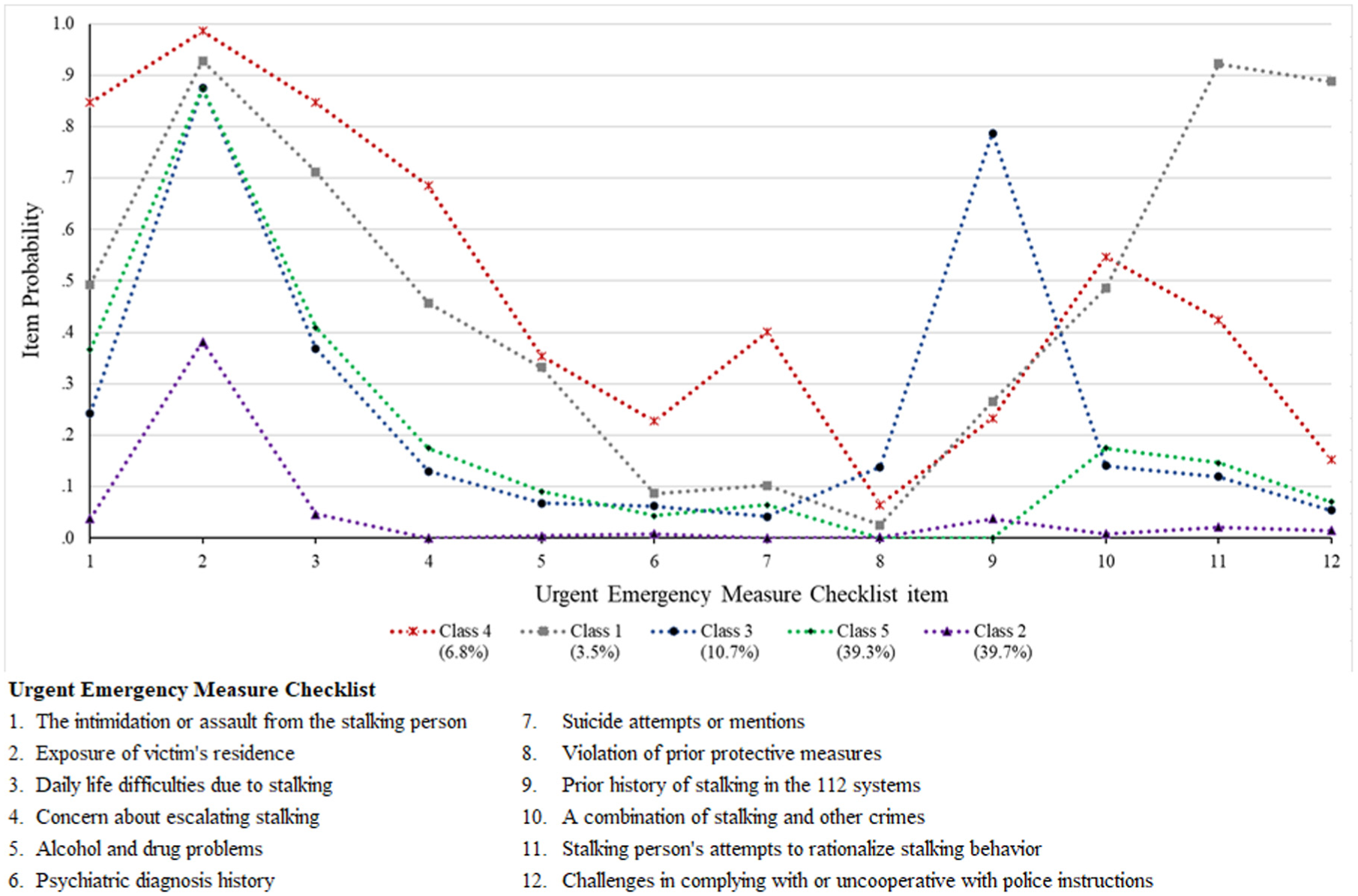
Profile of five latent classes—Conditional item probability based on class.
Profile of Five Latent Classes—Conditional Item Probability Based on Class.
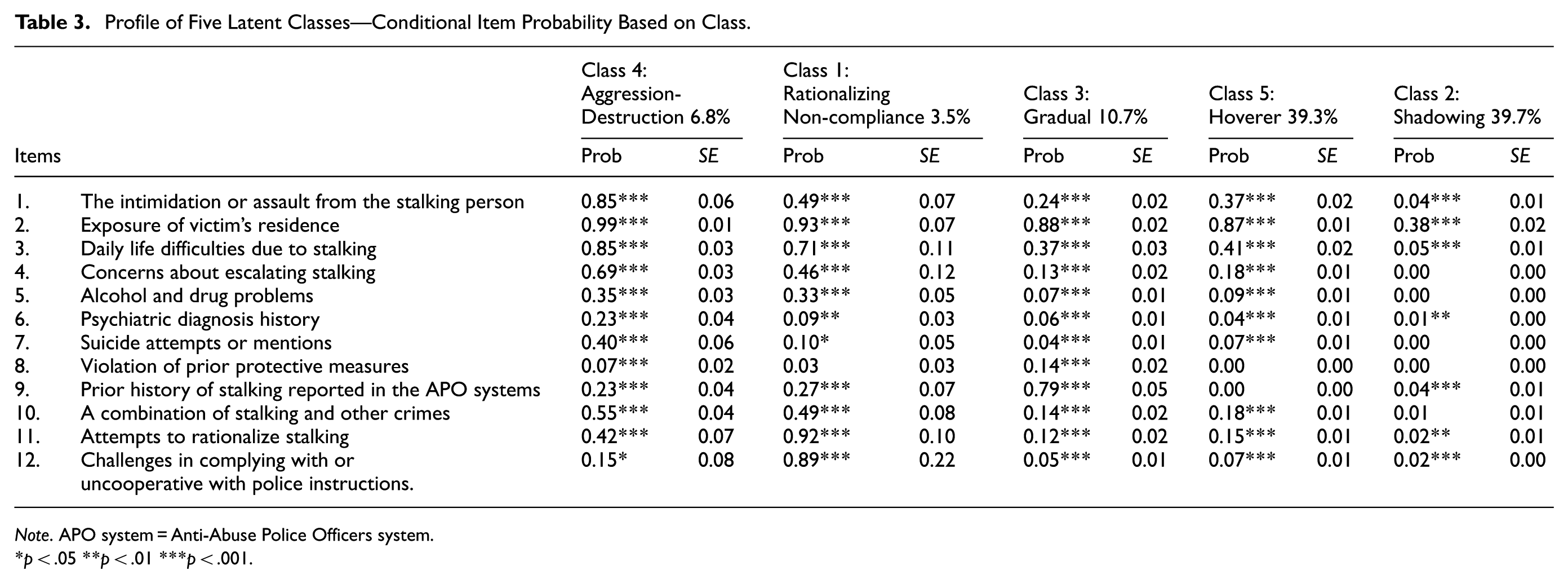
Note. APO system = Anti-Abuse Police Officers system.
p < .05 **p < .01 ***p < .001.
Class 4 accounted for 6.8% of the sample and was characterized by high probabilities across most items, suggesting the highest risk profile. Class 4 exhibited a high likelihood of assaulting or threatening their victims, along with a high probability of intensifying their stalking behavior, thereby threatening victims’ daily lives (e.g., Intimidation or assault from the stalker [Item 1], exposure of the victim’s residence [Item 2], Difficulties in daily life due to stalking [Item 3], and Concerns about escalating stalking [Item 4]). Furthermore, Class 4 demonstrated severe psychological and behavioral issues (e.g., alcohol and drug problems [Item 5], psychiatric diagnosis history [Item 6], and suicide attempts or mentions [Item 7]). Importantly, Class 4 showed the highest possibility of escalating stalking behaviors into violent crimes (e.g., A combination of stalking and other crimes [Item 10]). Class 4 represents the highest-risk profile among all classes and is labeled Aggression–Destruction.
Class 1 accounted for 3.5% of the sample and was characterized by high probabilities on items related to the stalkers’ attempts to rationalize stalking behavior [Item 11] and challenges in complying with or being controlled by police instructions [Item 12]. Additionally, the likelihood of combining stalking with other crimes was the second highest among the classes. Besides, Class 1 was characterized by low probabilities of having psychological problems (e.g., alcohol and drug problems [Item 5] and mentioning or attempting suicide [Item 7]). This finding suggests that individuals in Class 1 are more prone to rationalizing their actions and engaging in additional criminal activities. Furthermore, they display non-cooperative behavior towards law enforcement. Therefore, we called Class 1 Rationalizing Non-compliance.
Class 3 accounted for 10.7% of the sample and was characterized by high probabilities on several indicators related to previous stalking behaviors (e.g., stalker’s violation of protective measures [Item 8], prior history of stalking in the Anti-Abuse Police Officers (APO) systems [Item 9]). Like Class 2, the likelihood of psychological or behavioral issues was low. We designated Class 3 Gradual.
Lastly, Class 5 comprised 39.3% and exhibited a relatively high probability for items related to threatening the victim’s daily life than other items. Similar to Class 4, Class 5 stalkers showed characteristics of ongoing stalking behavior but lacked previous histories (e.g., Previous history of stalking in the APO system [Item 9]). Thus, while Class 5 stalkers threaten their victims’ daily lives, reporting on their stalking behavior is in the early stage or has not yet occurred. Therefore, Class 5 is labeled as Hoverer.
Class 2 comprised 39.7% of the sample and was characterized by the lowest probabilities across all items. Particularly noteworthy was the absence of concerns regarding the combination of stalking with other criminal activities and their psychological or behavioral issues (e.g., a combination of stalking and other crimes [Item 10], alcohol and drug problems [Item 5], history of psychiatric diagnosis [Item 6]). The likelihood of rationalizing stalking was also very low. Additionally, individuals in Class 2 did not demonstrate uncooperative behavior toward police instructions. All stalkers in this class only knew the victims’ residence [Item 2]. In summary, Class 2 was characterized by a low-risk profile, with minimal potential for progression to other criminal activities such as violence. Hence, we called Class 2 Shadowing.
Distal Outcomes
Table 4 reports the relationship between the identified profiles and outcome variables (duration, frequency, necessity, request, and reasons for non-request), as illustrated in Figures 2 through 4. In addition, overall chi-square tests and pairwise comparisons are provided (see Table 5).
Mean and Standard Error of the Outcome Variables for each Latent Class.

Note. Analyses were performed with BCH and DCAT procedures in Mplus 8. Relations between five latent classes and categorical outcomes (necessity, request, fear of reprisal, a matter of no consequence, no expectation of effectiveness, and other) are presented as probability, standard error (SE), and for continuous outcomes (duration and frequency), Mean and SE.
Chi-square Difference Test among Five Latent Classes to the Outcome Variable.

Note. Analyses were performed with BCH and DCAT procedures in Mplus 8. The degree of freedom for the overall test is 4, and the group difference test is 1.
p < .05. **p < .01. ***p < .001.
The classes significantly differed in duration, χ2(4) = 32.97, p < .001. The Rationalizing Non-compliance subgroup (Class 1) demonstrated significantly different scores on this variable compared to individuals in the Shadowing subgroup (Class 2). Similarly, the Shadowing subgroup displayed significant score discrepancies compared to the Gradual subgroup (Class 3), the Aggression–Destruction subgroup (Class 4), and the Hoverer subgroup (Class 5). Among these subgroups, the Aggression–Destruction subgroup exhibited the most prolonged duration (M = 5.10, SE = 0.75). Additionally, the duration was sequentially longer in the Hoverer (M = 4.00, SE = 0.48), Rationalizing Non-compliance (M = 3.66, SE = 0.83), Gradual (M = 3.57, SE = 2.47), and Shadowing subgroups (M = 1.55, SE = 0.33).
The classes also differed significantly in frequency, χ2(4) = 382.79, p < .001, with all subgroups demonstrating statistically significant differences in scores from each other. The Aggression–Destruction subgroup showed the highest frequency among the subgroups (M = 128.59, SE = 7.73). Additionally, the frequency was sequentially higher in the Rationalizing Non-compliance (M = 87.84, SE = 9.72), Hoverer (M = 61.64, SE = 2.30), Gradual (M = 49.96, SE = 3.61), and Shadowing subgroups (M = 19.36, SE = 1.99).
The necessity varied significantly across all subgroups, χ2(4) = 1913.67, p < .001. Specifically, the Rationalizing Non-compliance subgroup’s scores differed significantly from those of the Shadowing, Gradual, and Hoverer subgroups. Similarly, the Shadowing subgroup’s scores differed significantly from those of the Gradual, Aggression–Destruction, and Hoverer subgroups. The Gradual subgroup differed significantly from the Aggression–Destruction subgroup. Lastly, the Aggression–Destruction differed significantly from the Hoverer subgroup. Notably, the Aggression–Destruction subgroup displayed the highest probability of necessitating urgent emergency measures (prob = .88, SE = 0.02), suggesting a heightened risk profile. Sequentially, the probability of necessity was higher in the Rationalizing Non-compliance subgroup (prob = .81, SE = 0.04), followed by the Gradual (prob = .14, SE = 0.03), Hoverer (prob = .11, SE = 0.01), and Shadowing subgroups (prob = .04, SE = 0.01).
Similarly, the request varied significantly across all subgroups, χ2(4) = 1,780.51, p < .001. Specifically, the Rationalizing Non-compliance subgroup demonstrated statistically different scores compared to the Gradual, Gradual, and Hoverer subgroups. The Shadowing group’s scores differed significantly from those of the Gradual, Aggression–Destruction, and Hoverer groups. Additionally, the Gradual subgroup differed from the Hoverer subgroup. Finally, the Aggression–Destruction subgroup differed from the Hoverer subgroup. Again, the Aggression–Destruction subgroup showed the highest probability of requesting urgent emergency measures (prob = .88, SE = 0.02). The probability of request followed a similar sequence: Rationalizing Non-compliance (prob = .81, SE = 0.04), Gradual (prob = .14, SE = 0.03), Hoverer (prob = .11, SE = 0.01), and Shadowing (prob = .04, SE = 0.01). The findings regarding the request closely mirrored those of the overall necessity result.
Furthermore, we investigated the probability of reasons for not requesting urgent emergency measures, which varied significantly among all subgroups, χ2(4) = 287.37, p < .001. Specifically, the Rationalizing Non-compliance subgroup’s scores differed significantly from those of the Gradual, Gradual, and Hoverer subgroups. The Shadowing group’s scores differed significantly from those of the Gradual, Aggression–Destruction, and Hoverer subgroups. Additionally, the Gradual subgroup differed from the Hoverer subgroup, and the Aggression–Destruction subgroup differed from the Hoverer subgroup. Excluding the “other” response, victims of stalkers in the Rationalizing Non-compliance and Aggression–Destruction subgroups primarily cited fear of reprisal as the reason for not requesting urgent emergency measures. In addition, victims of stalkers in the Rationalizing Non-compliance subgroup also cited low expectations of the measures’ effectiveness. Conversely, victims of stalkers in the Shadowing, Gradual, and Hoverer subgroups primarily indicated that they did not perceive stalking as a matter of consequence.

Mean of duration and frequency for each latent class.

Probability of necessity and request for each latent class.

Probability of reasons for non-request of each latent class.
Discussion
The present study utilized LCA of the 12 items of the Urgent Emergency Measure Checklist (UEMC) used in police reports to evaluate the risk of stalkers. The analysis identified distinct subgroups among 6,824 stalking incidents. A five-class solution yielded the best model fit, with the identified subgroups showing different patterns of probabilities on the UEMC items. Our results are consistent with previous studies on South Korean stalking typologies. First, the Aggression-destruction subgroup exhibited risk of escalating stalking and showed psychological problems such as suicide attempts and mental disorders. These characteristics are like the Surveillance and Approach stalking categories (Kang & Kim, 2021; Park & Lee, 2022) among stalking subgroups in South Korean stalking typologies. Additionally, they share similarities with Rejected stalkers and Predatory stalkers in Mullen et al.’s (1999) typology, which often escalate to violent behavior. Since this subgroup poses the greatest risk, protect measures should be prioritized to prevent serious harm to victims. Furthermore, further investigation into psychopathological features of stalkers in this group is necessary. Given the limited evidence on the relation between stalking subgroups and psychopathology (Wheatley et al., 2020), examining specific psychology traits within high-risk subgroups could provide valuable insights for policy-making and clinical interventions related to stalker treatment and management (Wheatley et al., 2020).
Secondly, The Rationalizing Non-compliance and Hoverer subgroups did not appear in previous studies. They are in the relatively early stages of stalking and may have been absent in prior research because their behavior had not yet escalated to a level that resulted in conviction. However, these individuals still pose significant risk, such as the potential escalating stalking behavior or involvement in other crimes. It is crucial to provide early interventions to prevent their stalking from escalating over time. Although stalking may initially seem non-violent, it has been linked to serious acts of violence, making proactive measures essential.
The Gradual subgroup closely resembles the Gradual (Kang & Kim, 2021) and Attack stalking (Park & Lee, 2022) categories. Stalking in this group did not exhibit concerns about escalating stalking or mental disorders. However, they had prior reports in the 112 emergency response system, indicating a history of repeated stalking behavior. Although they do not frequently contact their victims, their stalking behavior is the most persistent over time. The longer stalking persists, the greater the potential harm to victims, making early intervention crucial.
The Shadowing subgroup did not make direct contact with victims but had knowledge of their residence, indicating that they were in the early stages of stalking. This subgroup aligns with the shadowing (Kang & Kim, 2021) and online stalking (Park & Lee, 2022) categories.
The Korean stalking subgroup showed heterogeneous characteristics in several aspects, such as duration, frequency of contact, and risk of recidivism. However, the majority of cases fell into Type I (intimate relationship and acquaintance stalkers) of RECON typology (Mohandie et al., 2006). In our total sample, 61% of stalkers were former intimate partners, and 27.6% were acquaintances, accounting for nearly 90% of all cases. Intimate relationship stalkers, considered the most dangerous type, frequently engaged in violent behavior, including the use of weapons, suicide attempts, alcohol abuse, and illegal drug use. Similarly, acquaintance stalkers were significantly associated with assault. The Aggression-destruction group exhibited characteristics consistent with these high-risk groups. Although other subgroups displayed a lower immediate risk, they still had a high potential for escalating violence, as the majority of stalking incidents occurred within intimate or acquaintance relationships.
Strengths and Limitations
Our study expanded the scope of samples used in stalking research. Parkhill et al. (2022) noted that stalking research has largely been limited to forensic/clinical samples and specific groups like college students, raising concerns about whether findings from such samples can be generalized to stalkers within the criminal justice system. To address this ambiguity, we utilized a broader and more diverse sample of individuals involved in stalking. Additionally, much of the existing research has focused on populations that are Western, educated, industrialized, rich, and democratic (WEIRD) populations (Chung & Sheridan, 2022), leaving questions about whether findings are applicable to non-Western contexts. By examining the heterogeneity of stalking behaviors in South Korea, we aimed to contribute to a more comprehensive understanding of stalking that extends beyond these traditional populations.
However, our study has some limitations. First, the Urgent Emergency Measure Checklist used for LCA comprises three subfactors: risk perceived by the victim, psychological history of the offender, and the risk evaluated by the police. If a stalker flees the scene and remains unidentified, the police may fail to confirm the stalker’s personal information, resulting in an inability to score them on some items. Approximately 70% of items, including the stalker’s psychiatry diagnoses, drug abuse, and suicide attempts, could not be confirmed. Therefore, these items need to be revised to make them applicable without identifying the stalker’s personal information and to assess the stalker’s risk accurately. Secondly, we could not determine whether the same stalker had been reported multiple times in the dataset. Specifically, for high-frequency subgroups such as the Rationalizing Non-compliance or Aggression–Destruction subgroups, the same stalker has likely been reported numerous times. Future studies should collect data that enable the identification of repeatedly reported stalkers.
Future Direction
Our findings suggest the need for differentiated prevention and intervention strategies for stalkers to prevent recidivism and escalation to other violent crimes, given their heterogeneity. It is particularly important to focus interventions on subgroups closely associated with stalking violence risk factors. Histories of substance use, alcohol use, and co-occurring substance and alcohol use, along with psychological distress identified by police, were found to predict moderated violence, with psychological distress additionally predicting severe violence (Landwehr et al., 2024). These findings suggest that clinical interventions such as treatment are especially warranted for the Aggression-destruction subgroup among the five-identified subgroups.
In addition, establishing stalking classification system for police investigation could be valuable, especially considering that many stalking cases in South Korea escalate to murder before any conviction takes place. Such a system could assist police in developing appropriate risk management strategies alongside investigative approaches.
While stalking is typically addressed through legal means such as protection orders and stalker incarceration, legal sanctions alone may not always effectively prevent stalking. Psychological interventions are crucial to addressing the underlying issues (MacKenzie & James, 2011; Racine & Billick, 2014). Although most stalkers do not have a diagnosed mental disorder, a subset may exhibit conditions such as erotomanic Rationalizing Non-compliance (McEwan et al., 2017; McGuire & Wraith, 2000). Additionally, even stalkers without diagnosed mental disorders often display problematic personality traits, such as anger and jealousy following romantic breakups (Dye & Davis, 2003; Manunza & Pintor, 2018; McEwan et al., 2017). The type of psychological intervention required varies depending on the stalker’s mental health. Stalkers with psychotic symptoms may benefit from pharmacotherapy, while those without such symptoms may require psychotherapy. Accurate risk assessment and identification of specific psychological deficits, needs, and responsivity factors are essential for tailored interventions to different stalker subgroups (MacKenzie & James, 2011). A framework for collaboration between police and clinicians should be established to facilitate this process. For instance, police could initially assess and screen problematic stalkers using tools like the UEMC, while clinicians could then reevaluate these individuals and provide specialized services as needed. Therefore, further research is required to explore stalking typology and appropriate interventions for each type.
Footnotes
Acknowledgements
None.

Ethical Considerations
This study received ethical approval from the Institutional Review Board of Dongguk University (DUIRB-2024-06-19) on June 26, 2024. This is an IRB-approved retrospective study, all patient information was de-identified and patient consent was not required. Patient data will not be shared with third parties.
Funding
The authors disclosed receipt of the following financial support for the research, authorship, and/or publication of this article: This work was supported by the Ministry of Education of the Republic of Korea and the National Research Foundation of Korea (NRF-2021S1A3A2A02089039).
Declaration of Conflicting Interests
The authors declared no potential conflicts of interest with respect to the research, authorship, and/or publication of this article.
Data Availability Statement
Data sharing not applicable to this article as no datasets were generated or analyzed during the current study.