




Abstract
This article explored the different clusters of leadership styles and the relationship between principal leadership style and student academic achievement in domains of mathematics, reading, science, and collaborative problem-solving in Germany and China. We used PISA 2015 data covering 6,504 students and 256 school principals from German schools and 9,841 students and 268 school leaders from Chinese schools. Results identified three leadership styles in Germany, namely, transformational (23.4%), instructional (41.3%), and integrated (35.3%) leadership, and two leadership styles in China, namely, transformational (38.6%) and instructional (61.4%) principals. Principals with instructional and integrated leadership had higher student achievements in Germany, whereas only principals with transformational leadership had slightly higher student achievements in China. Moreover, three leadership styles in Germany and two in China showed their relationships with each domain of student achievement. In conclusion, principals in Germany and China had different priorities in leading schools. The differences that principal leadership made on student achievements highlighted the differences in principals’ situational context and leading characteristics between Germany and China.
Introduction
Research Background
Over the last two decades, more studies focused on the effect of school leadership on student learning outcomes (Cruickshank, 2017; Hallinger & Leithwood, 1994; Leithwood, Sun et al., 2020; Robinson et al., 2008). Previous studies showed that principal leadership styles affect school climate, teachers’ attitudes toward leadership and their turnover ratio, and students’ academic achievements (Allen et al., 2015; Urick, 2016). However, studies also emphasized that the leadership style maximizes the effect of principal leadership styles on student achievement with certain roles under certain circumstances (Aldhaheri, 2017; Kythreotis et al., 2010; Liu et al., 2016). Some researchers have investigated the relationship between instructional leadership and student achievement and found that this relationship is positively associated with student outcomes (Day et al., 2016; Soehner & Ryan, 2011). Therefore, leaders employed instructional leadership tend to play the role of “instructor.” Other researchers have examined the relationships of transformational leadership with school climate, school culture, and student academic achievement (Kwan, 2020; McCarley et al., 2016). With the assistance of transformational leadership, principals tended to play the role of “innovator.” Several studies also showed that distributed leadership positively affects school organization, teacher belief, and student achievement (Harris, 2013; Leithwood, Harris et al., 2020). By using distributed leadership, the function principals take is “distributor.” All these studies on school leadership styles contributed to our understanding of leadership and its function in certain school conditions. However, most studies focused only on one or two leadership styles and the relationship between leadership and student achievement, and the relationship between different leadership styles and student achievements remains unclear. Specifically, given the differences across countries (e.g., Western vs. Eastern), researchers are unable to reach a consensus as to which leadership style can contribute to school organization and student achievement and to what extent the different leadership styles make differences in student achievement. Thus, by considering the contextual backgrounds, it provides us an opportunity to simultaneously explore the relationships between different principal leadership styles and student achievement and conduct a comparative study across countries.
Among several studies on school development and principal leadership, the comprehensive influence of international large-scale assessments has led researchers to explore the importance of principal leadership in school improvement from a cross-country comparative perspective. Leithwood and Riehl (2003) argued that leadership has a small but non-ignorable effect on student performance. Previous studies on leadership also highlighted “blank” and “blink” spots (Buschlen & Reusch, 2016; Harris, 2013). Many of these studies proved that effective educational leadership tends to affect student performance, school effectiveness, and school improvement. However, the types or forms of leadership in schools that maximally contribute to student achievement and how these relationships differ across countries remain unknown.
Germany is known for its early stratification and dual education system. This educational management system, particularly its governance, has changed over the past two decades. Historically, the school system is supervised and guided by individual state (Länder), which emphasizes the understanding of hierarchical relationship between the superior state and the subordinate schools (Füssel, 2002; Huber, 2008). With more specifics, the accountability of the educational ministry of individual state is set the general rules and supervise each school to follow the rules. The responsibility of the top administration of education- Federal Ministry of Education and Research, is provide assistance and necessary coordination for states (Edler & Kuhlmann, 2008). This relatively “centralized” system of educational administration provides a space to discern the movements and reforms on educational administration with several approaches from the perspective of democracy, pedagogy, organization, administration, and economics (Richter, 2016). In particular, the PISA 2000, which greatly shocked most German researchers and policymakers, has impelled many reforms and implementations on school management/leadership to improve school effectiveness. These reforms greatly encouraged progress on student outcome (we refer to PISA 2003 for more details). With the increasing prevalence of New Public Management (NPW), the governance of the German education has recently shifted from centralization to decentralization (Thelen, 2018; West et al., 2010). This shift aim is to grant school principals with additional authority and autonomy (Gessler & Ashmawy, 2016; Hanushek et al., 2013; Schwarz & Brauckmann, 2015). Meanwhile, German school principals are required to allocate most of their time to teaching preparation. Therefore, teaching experience is placed at the highest priority. In that sense, principals in Germany have less authority and autonomy compared with their counterparts in other Organization for Economic Co-operation and Development countries (Tulowitzki, 2015).
Compared with their German peers, Chinese students are known as experts on paper-pencil-orientated tests. In addition, in the Teacher and Learning International Survey (TALIS), Shanghai school principals and teachers’ self-reported work effectiveness are high (for details, we referred to TALIS 2013/2018 results). This may either be on the one hand, a result of the influence of Confucius, and on the other hand, the hierarchical administration of education (Wang, 2016; You, 2021). The Ministry of Education (MOE) is at the top, holding the general accountability for supervision and the guidance on education. The relatively strong top-down administrative system regulates the goals and directions of education. Further, the responsibility that schools and principals shoulder and the role they take are associated with the decisions made by the federal senior management (Moos et al., 2008; Qian & Walker, 2019). Although China, in response to the ever-changing discourse of the global knowledge economy and international competition, reformed its administrative system of education from a centralized structure to a decentralized one, major traces of the recentralization within the administrative system is still prevalent (Hawkins, 2000; Spangler, 2016). Consequently, the current actions of schools and the practices of principals are often motivated by the recentralization of strategic powers and a transfer of tactical powers, which also leads to the new regulations on school principal and school management (Huang et al., 2015; Wang & Chan, 2015). For example, with the New Curriculum Reform (NCR) since 2001, school principals have been firmly linked with education innovation and the students’ learning competency reinforcement.
The German education system exemplifies a stably rising state of education in international rankings of student achievement in the Programme for International Student Assessment (PISA) and the Trends in International Mathematics and Science Study (TIMSS) during the last two decades, providing the evidence that the research and development of common standards for principal capacity building and assessment at system level benefit student achievement (Chen et al., 2020; OECD, 2020). On the other hand, the education system of mainland China is an example of East Asian economies that have consistently performed well in PISA and TALIS cycles, greatly contributing to an East Asian Educational Model (EASM) (Zhu, 2021). In this way, sketch out the administrational structures of education and representative practices for principal leadership in two countries is informative. This article aims to address these issues by focusing on multiple leadership styles and their relationships with student achievement. Through this approach, this work may compensate for the limitations of previous studies that only focused on the effect of a single type of leadership. Additionally, how these relationships between leadership styles and student achievement differ across the two countries is further explored.
Theoretical Framework
According to the Contingency Theory, leadership and leadership effectiveness is closely associated with the contexture that leaders are situated (Fiedler, 1978). In that sense, the potential effects of the contextual factors are regarded as a vital key to the assessment of leadership effectiveness and identification of one leadership style as more optimal in comparison to another. Integrating with the categorical framework that links context to leadership of Johns (2006) and Oc (2018), the outcomes of contextual leadership can be affected by omnibus and discrete contextual factors. The factors in three dimensions (where, who, and when) of the omnibus contexts, can influence a discrete context, following which, the factors in four dimensions (task, social, physical, and temporal) of the discrete context, may, in turn, affect leadership. Within leadership, the factors in three dimensions (leaders, followers, and leader-follower dyad) of the influencing process can ultimately exert an effect on organizational outcomes (effectiveness, cognition, attitude, and behavior) (Johns, 2006; Oc, 2018).
In consideration of these two theoretical models, the context factors at macro- and meso-levels collectively establish a context which can be used to explain an optimal principal leadership style for a particular situation. In this study, we attempted to identify leadership styles in Germany and China. These included transformational, instructional, and integrated leadership. Supporting literature for each of leadership style can be found within research on leadership comparison theories (Hallinger, 2003; Robinson et al., 2008; Shatzer et al., 2014). Using this two-combined framework, we examined student achievement as one dimension of organizational outcomes linked with leadership style, aiming to further provide a global knowledge on effective principal leadership style from a comparative perspective and to support a better understanding on the differences that principals are acting with regard to social and cultural contexts.
Principal Leadership Style and Students’ Achievement
Leadership styles have been widely studied globally. The roles played by principals are used as the basic study to further explore principal leadership considering their importance in maintaining school effectiveness and continuous improvement. Previous studies have proven that leadership style directly or indirectly affects student achievement (Dimopoulos, 2020; Kutsyuruba et al., 2015; Savvides & Pashiardis, 2016). For instance, the study found that the behavior of the principal, particularly with the leadership influence on supportive, collegial, and not overly restrictive school climate, enables the student achievement to be positively affected by the impact of leadership on school climate and thus on his or her teaching members. Therefore, principals’ behaviors are supposed to have a firm relation with leadership style (Nir & Hameiri, 2014; Pinkas & Bulić, 2017; Tschannen-Moran & Gareis, 2015). Among several studies on the relationship between leadership style and student achievement, leadership styles of instructional, transformational, distributed/shared, and integrated are usually discussed. Instructional leadership highlights one’s understanding of the curriculum and improves teaching by influencing the instructional behaviors of teachers (Boyce & Bowers, 2018; Neumerski, 2013; Ross & Cozzens, 2016). Hallinger and Leithwood (1994) posited that instructional leadership has three dimensions, namely, “defining school mission,” “managing instructional program,” and “promoting a positive school learning climate,” which can be interpreted as instructional behaviors. Previous studies highlighted the importance of support for instructional behaviors, thereby implying that instruction should be given priority (Brauckmann et al., 2016; Bush, 2013; Shaked, 2018). Quality of teaching also affects student achievement through the instructional behaviors of principals (Kunter et al., 2013). Researchers, such as Nettles and Herrington (2007), proposed that teaching and student achievement tend to be improved if principals promote a school environment wherein instant suggestions and feedback, effective instruction, corporation, supportive working climate for the teaching staff, and professional development opportunities are available.
Researchers on transformational leadership asserted that student achievement is an outcome that reflects the importance of school effectiveness and improvement. Moreover, the roles that principals play is directly linked to the school climate and culture that they intend to create (Bellibas & Liu, 2018). Similarly, Leithwood, Sun et al. (2020) found that transformational leadership is positively associated with four sets of outcomes, namely, teachers’ emotions and beliefs, teachers’ practices, school conditions, and student achievement . Simola et al. (2010) argued that transformational leadership pursues collectivism, which is mainly responsible for encouraging the aspirations of the teaching staff. Additionally, some studies showed that transformational leadership positively influences student achievement and school climate (Anderson, 2017; Shatzer et al., 2014).
However, recent literature tended to propose multiple sources of leadership in schools. Thus, distributed leadership has often been regarded as “shared” or “democratic” leadership and is used to emphasize power/authority delegation. Distributed leadership considers “collective leadership” as its priority, that is, this type of leadership encourages teaching staff/leaders to work together. For instance, Elmore (2000) stated that distributed leadership divides the responsibility of leadership among several leaders to improve teaching expertise. In addition, Spillane et al. (2001) noted that distributed leadership should focus on leadership practice than on its roles or functions. They insisted that the interaction between leaders and their present situation should be linked by distributed leadership, whereas the leading task should be distributed to multiple leaders Harris (2013) also argued that teacher collaborations further compensate for the distributed leadership of school principals. Based on these argumentations, researchers found that school and student achievement tend to be influenced by involving teaching staff in decision-making and enhancing collaboration and trust among teaching staff (Leithwood, Harris et al., 2020; Moolenaar et al., 2012; Ronfeldt et al., 2015).
As the concept of school leadership continues to broaden, integrated leadership, which covers multiple dimensions of leading behaviors, has become an encompassing perspective that is widely adopted in leadership studies. Van Wart (2005) proposed the integrated leadership of transactional and transformational leadership, involving the casually related factors that comprised the linear chain. Moreover, De Maeyer et al. (2007) examined the relationship between integrated leadership and student mathematics achievement and mother tongue achievement throughout the indirect effect of organizational culture. They concluded that integrated leadership affects student achievement depending on the conceptual models that researchers chose. Recently, Boberg and Bourgeois (2016) tested whether the serial mediation models of integrated transformational leadership affected student achievement directly and indirectly. They found that integrated transformational leadership impacted student achievement through teachers’ behaviors and student engagement in learning.
Notably, the relationship between principal leadership styles and student academic achievement is also discussed within the context of further system-related background information of national politics (Döbert et al., 2004). Pietsch and Leist (2019) concluded that the competitive climate between schools which supported by the educational policy and national system greatly influenced principal leadership behaviors associated with leadership for learning with instructional, transformational, and distributed/shared leadership styles (Pietsch & Leist, 2019). From the perspective of holistic leadership, Brauckmann and Pashiardis (2011) stated that the several system-level variables including the pattern of centralization/decentralization of the political system tended to affect the instructional, structuring, participative, entrepreneurial, and personnel development styles throughout the questionnaire survey for 203 principals in Germany. Fend (2008) stated that the social climate and education/school system are in exchange with the interests of the political system, which represents the interests of the community in different manners. This representation of interests remains completely different across dictatorial and democratic conditions (Fend, 2008). In this regard, Wetzstein et al. (2009) argued that the role and responsibility of German principals has shifted from the teacher “with additional administrative tasks” toward an entrepreneurial manager with specific needs and requirements of qualification, the priority of which is make efforts toward improving the quality of the school by using transformational leadership. In addition, with the requirement of school quality assurance and school improvement across 16 states, several researchers supported that the national politic contexture and political skills positively influence on school effectiveness, in that sense, researchers proposed that leadership effectiveness should be measured in terms of the effectiveness of the team as a whole, which represent the essential attributes of effectiveness are in the form of an ideally integrated set of several individuals (Gast, 2010; Gregor-Rauschtenberger & Hansel, 2013; Hogan & Kaiser, 2005; Neuberger, 2002; Von Rosenstiel, 2016).
Along with German colleagues, some researchers in mainland China, in line with Qian and Walker, they suggested that certain implementations have been observed to carry a positive trend that encourages school principals to position instructional leadership as the major focus, as the system is established requires the curriculum to be managed at the central, local, and school levels simultaneously in response to the new curriculum reform (Qian & Walker, 2011). Despite the well-documented impact of national policy on instructional leadership, a growing literature highlights the role that the national policy system plays in fostering transformational leadership in China’s schools (Dou et al., 2016; Sun et al., 2018). Within the top-down national policy process, the top/central policy makers demand the subordinate/local officials to attempt new ways to solve educational problems and expediate school innovation and then back into the formulation of national policy from down-to top (Heilmann, 2008; Lee & Chiu, 2017; Yohannes & Wasonga, 2021).
Research Questions
By following the above arguments, we aim to address the following research questions:
RQ1. How do principal leadership types differ between Germany and China?
RQ2. To what extent does a particular leadership style associate with student achievement across all domains in Germany and China?
Methods
Measures
The target population of the PISA 2015 in each country and economy consisted of 15-year-old students in Grade 7 and higher. For the sampling design, generally, a two-stage stratified design was used. In the first stage, schools that had 15-year-old students within the comprehensive national list were systematically sampled. The second stage was a preparation of the students within sampled schools by setting a target cluster size, wherein 42 students for each computer-based country and 35 students for each paper-based country, were documented in a complete list (for more details, we refer to PISA 2015 Technical Report, OECD, 2016).
The PISA 2015 main survey covered approximately 540,000 students from 72 participating countries and economies. In this study, we used the data which covered 6,504 students and 256 school principals from German schools and 9,841 students and 268 school principals from Chinese schools (Beijing, Shanghai, Jiangsu, and Guangdong). The survey data were collected by administering questionnaires among school principals and students. The school questionnaire was administered using a computer, whereas countries and economies using paper-based testing implemented a slightly shorter version. School questionnaires required principals to answer the question items related to a broad range of contextual variables, such as school organization, educational provisions, school climate, and educational resources, within approximately 60 minutes in the field trial, whereas those collected from students were mainly related to themselves, their homes, their schools, and their learning experiences within approximately 30 minutes (Gurria, 2016) (see PISA 2015 Results in Focus for more details).
Principal leadership
In the PISA 2015 main survey, principal leadership was measured using the frequency of leading activities and behaviors of principals. As mentioned in the “Theoretical framework” section, principal leadership was measured in this study based on the methods recommended by Robinson. Specifically, we identified three dimensions of principal leadership, namely, setting school visions/goals, instructional leadership, and developing people. Setting school vision/goals (P1) was measured using the following items: “use student performance results to develop the school’s educational goals” (x1), “make sure that the professional development activities of teachers are in accordance with the teaching goals of the school” (x2), “ensure that teachers work according to the educational goals of the school” (x3), “promote teaching practices based on recent educational research” (x4), and “praise teachers whose students are actively participating in learning” (x5). Then, instructional leadership (P2) was measured using the following items: “take the initiative to discuss matters when a teacher has problems in his/her classroom” (x6), “draw the attention of teachers to the importance of developing the critical and social capacities of their students” (x7), “pay attention to disruptive behavior in classrooms” (x8), and “solve together the classroom problems raised by teachers” (x9). Finally, developing people (P3) was measured using the following items: “provide staff with opportunities to participate in school decision-making” (x10), “engage teachers to help build a culture of continuous improvement in the school” (x11), “ask teachers to participate in reviewing management practices” (x12), and “discuss the academic goals of the school with teachers during faculty meetings” (x13). The participating school principals rated these items on a scale of 1 (“never occurred”) to 6 (“more than once a week”) (see the school questionnaire for PISA 2015 for more details).
Student achievement
We used the mathematics (PV1MATH), reading (PV1READ), science (PV1SCIE), and collaborative problem solving (PV1CLPS) outcomes of students to represent their achievements. In PISA 2015, the mathematics, reading, science, and collaborative problem-solving tests comprised 83, 103, 184, and 188 items, respectively. Each student was required to build his/her own response to these items. To estimate student performance and ensure that the standard error reflects the test unreliability (by combining imputation error with sampling error), the PISA database provides five plausible values (PVs) for student literacy in each domain. The student performances were analyzed five times and then aggregated. The five PVs were then standardized with an average value of 500 and a standard deviation of 100 (see PISA 2015 Technical Report for more details). The multiple imputation approach is recommended when handling PVs of student achievements (Rubin, 1987).
Table 1 presents the descriptive statistics of the variables.
Descriptive Statistics for the Frequency to School Leading and Management Activities, Student Scores, and Background Characteristics in Germany and China.

Note. N is number of observations. R. M. is raw mean before imputation. W. M. is weighted mean after imputation. Standard deviations are in parentheses. The weighted standard deviations are calculated as
Analyses
To address the research questions, we adopted a two-step strategy to explore the relationship between leadership style and student achievement. First, latent class analyses (LCA) were conducted to examine the typologies of leadership and to identify to which extent different hidden groups are patterned into each meaningful group (Dolan, 2009; Muthén, 2008; Stanley et al., 2017). Similarly, LCA takes a set of survey items (x1 to x13) as dependent variables and then examines and determines the extent to which different groups of respondents are similar or different across items based on their responses. Meanwhile, similar in latent factor analysis, the latent variable in LCA refers to those school principals belonging to a certain profile with a high probability of sharing certain characteristics. The models tested in this work were based on factor mixture modeling, and a six-class analysis should be conducted for each competing LCA model. We initially analyzed one class before adding the five subsequent classes individually. Following the recommendations of Nylund et al. (2007), a higher entropy value and lower Akaike information criterion (AIC), Bayesian information criterion (BIC), and adjusted-BIC (a-BIC) values indicate a better model fit. For accuracy, the p values of the Lo–Mendell–Rubin (LMR) and bootstrapped likelihood ratio tests (BLRT) must be significant (p < .05).
Second, we conducted bivariate analyses to examine the relationship between leadership style and student achievements across domains. Following our LCAs, we grouped the school principals and their respective schools into different classes, then, we calculated the means and standard errors of school achievements within each typical leadership class and those of student achievement across domains within each leadership type, aiming to test the relationship between leadership style and student achievement across domains. Finally, we conducted the one-way ANOVA to further explore the difference in student achievement made by different leadership styles. The discriminatory effects of leadership styles in Germany and China can then be derived from the results.
All analyses were conducted by using Mplus 7.0 and SPSS 23.
Results
Potential Clusters of Principal Leadership Greatly Differ between Germany and China
The “clusters” or “patterns” of principal leadership styles showed great differences between Germany and China. We performed our LCAs by using the one-class model and then continued with integrative testing up to the six-class model. Following Morgan (2015), Nylund et al. (2007), and Enders et al. (2020), the number of classes and the overall fit of the model were deemed ideal when AIC, BIC, and a-BIC are low, the values of Entrop are high (from 0 to 1), the significant p values of LMR-adjusted likelihood ratio test and BLRT (p < .05) are obtained. Table 2 shows the three classes of principal leadership in Germany with AIC = 7,009.719, BIC = 7,618.980, a-BIC = 7,032.890, Entropy = 0.930. Moreover, the p values of LMR and BLRT were less than .05 (p = .03 and .00, respectively). By contrast, two classes in China were indicated with AIC = 9,628.514, BIC = 10,097.459, a-BIC = 9,682.119, Entropy = 0.888, and the values of LMR and BLRT were significant (p = .04 and p < .01, respectively). Figures 1 and 2 show the LCA solutions for the three- and four-profile principal leadership styles in Germany and China, respectively.
The Fit Statistics for Principal Leadership with Latent Profile Analyses in Germany and China.

Note. AIC = Akaike information criterion. BIC = Bayesian information criterion. LMR = Lo-Mendell-Rubin adjusted likelihood ratio test.

Statistical indicator plots of the three groups of principal leadership in Germany.

Statistical indicator plots of the two groups of principal leadership in China.
Figure 1 shows that Germany has identified three principal leadership type clusters, namely, transformational (23.4%), instructional (41.3%), and integrated (35.3%) leadership, with the majority of the principals adopting transformational leadership
The participating principals from China have been shown to have adopted two leadership styles, namely, instructional and transformational leadership. Figure 2 depicted that the majority of these principals practice instructional leadership (61.4%), with the rest practicing transformational leadership (38.6%). Similar to their German peers, those principals who practiced transformational leadership (class-1) tended to place additional attention to school vision/goals, but they were likely to allocate more time to develop teaching staff in their schools. In response, in items x1–x4, which were mainly used to indicate the school’s vision/goals, principals had the highest frequency. Compared with the other leadership style, principals who employed transformational leadership focused on opportunities for teacher development, build the school culture for continuous development with teaching staff, motivate teachers to be a part of school management, and impel teachers to solve the academic problems to further promote schools’ academic goals. Thus, in Figure 2, items x9, x10, x11, and x13 showed the highest frequency (the probabilities were from 0.25 to 0.5). Moreover, principals belonging to class-2 were instructional leaders. Compared with those belonging to class-1, principals using instructional leadership assigned more time to instructional activities. This notion was consistent with that depicted in Figure 2, where items x5, x6, x7, and x8 had higher frequency with probabilities from 0.2 to 0.4. Meanwhile, item x12, which mainly focused on solving the class problems with teachers, showed a higher frequency with a probability of 0.45. From this perspective, the principals in class 2 greatly contributed to ensuring consistency with their teaching staff by focusing on student learning and instruction (Leithwood & Mascall, 2008).
German principals showed the differences in leadership style compared with their Chinese peers because the principal leadership style was more diversely used by German principals. Except for integrated leadership, German and Chinese school principals used instructional and transformational leadership. In particular, instructional leadership was of great importance. For transformational leadership, Figures 1 and 2 showed that German school principals had higher probabilities of developing the vision/goals for school overall (item x1: 0.4 vs. 0.21). On the contrary, their Chinese peers showed more emphasis on developing and promoting teaching staff according to the school’s vision/goals. This finding was consistent with the probabilities presented by items x2 and x4 (item x2: 0.28 vs. 0.35; item x4: 0.25 vs. 0.4). Despite the influence of vision/goals, Chinese principals who employed transformational leadership were more likely to encourage teaching staff to review school management and discuss school academic goals’ development with teachers. This notion was demonstrated by items x11 and x13 with probabilities of 0.35 and 0.48. For instructional leadership, German and Chinese principals reported that instructional leadership had the highest percentage (41.3% and 61.4% in Germany and China, respectively). German school principals tended to eclectically allocate their time to instructional activities with probabilities of approximately 0.4. Furthermore, among these activities, principals in German schools presented that they had higher priority on praise teachers in line with students’ learning engagement, discussing the teaching problems with teaching staff. This notion stresses the importance of the development of students’ social and critical capacities with the probabilities 0.4, 0.45, and 0.4 of items x5, x6, and x7, respectively. Chinese principals who utilized instructional leadership were more likely to praise teaching staff according to students’ learning engagement with the probabilities of approximately 0.4. Following item x5, discussing the teaching problems (item x6) and the development of students’ capacities on socialism and criticism (item x7) were placed at the second and third positions, with probabilities of .32 and .3, respectively.
Relationships between Leadership Style and Student Achievement Significantly Differed between Germany and China
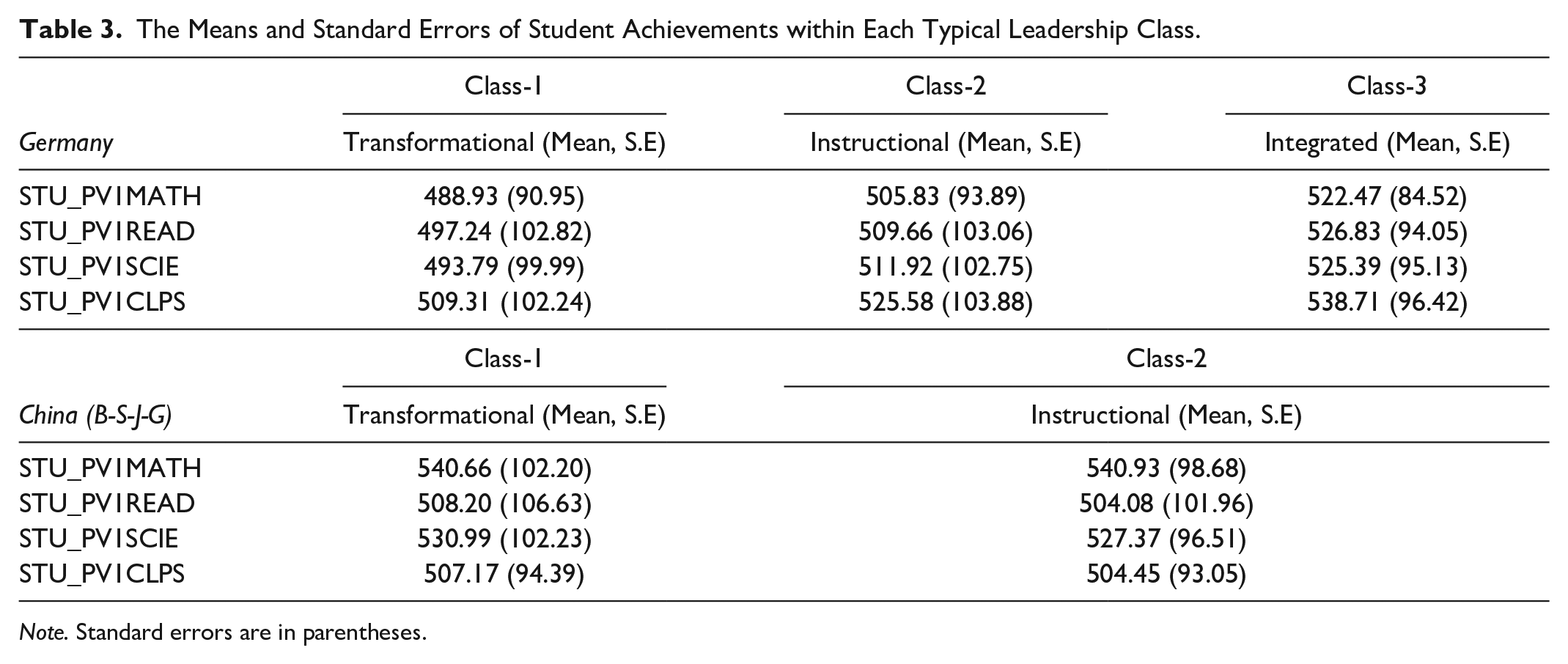
We explored the relationship between each class of leadership style and student achievement in Germany and China, respectively. Table 3 presents such relationships across all domains in the two countries.
The Means and Standard Errors of Student Achievements within Each Typical Leadership Class.
Note. Standard errors are in parentheses.
Table 3 shows that in Germany, principals in the transformational (class-1), instructional (class-2), and integrated leadership (class-3) subgroups demonstrated significant differences in their relationships with student achievement. Those principals utilizing integrated leadership had better student achievement outcomes than those using the other two types of principal leadership. On the contrary, those principals adopting transformational leadership tended to challenge student achievements. Meanwhile, the result showed that among the different domains of student achievement, students tended to perform better in collaborative problem-solving. By contrast, student mathematic achievement was reported to be the lowest within the three principal leadership style than other domains of student achievement. However, the result further demonstrated that principals utilizing transformational leadership and the integrated leadership of transformation and distribution were prone to have higher student achievement in reading. By contrast, student science achievement was reported to be at the second top position when instructional leadership was involved. These results are consistent with previous studies on German school leadership, further proving that instructional leadership was involved most in teaching, and playing an important role in impacting student achievements (Huber et al., 2017).
Compared with Germany, the relationship between leadership styles and student achievement in China showed its special pattern. More specifically, the result presented that the relationships of transformational and instructional leadership and student mathematics achievement were similar. And notably, despite the highest student mathematics achievement within the two leadership styles, student science achievement was reported to be at the second top position. Transformational leadership was reported to have student reading achievement being at the third position and followed by student collaborative problem-solving. By contrast, instructional leadership showed it had the similar student achievement domains of collaborative problem-solving and reading. Besides, compared with instructional leadership, principals who employed transformational leadership were prone to have higher student achievement in domains of reading, science, and collaborative problem-solving.
In general, both German and Chinese principals employed transformational and instructional leadership styles. Compared with China, German principals who utilized transformational leadership had lower student achievement, whereas instructional leaders were reported with higher student achievement. German transformational principals were successively reported with the highest student achievement in collaborative problem-solving followed by reading, science, and finally mathematics. Instructional principals were different from transformational principals, with the highest student achievement in collaborative problem-solving, followed by science, reading, and mathematics. In China, principals in transformational procession tended to have the highest student achievement in mathematics, followed by science, reading, and collaborative problem-solving. On the contrary, instructional principals were likely to have the highest student achievement in mathematics, followed by science, collaborative problem, and then reading (these two domains differed slightly, Δx = 0.37).
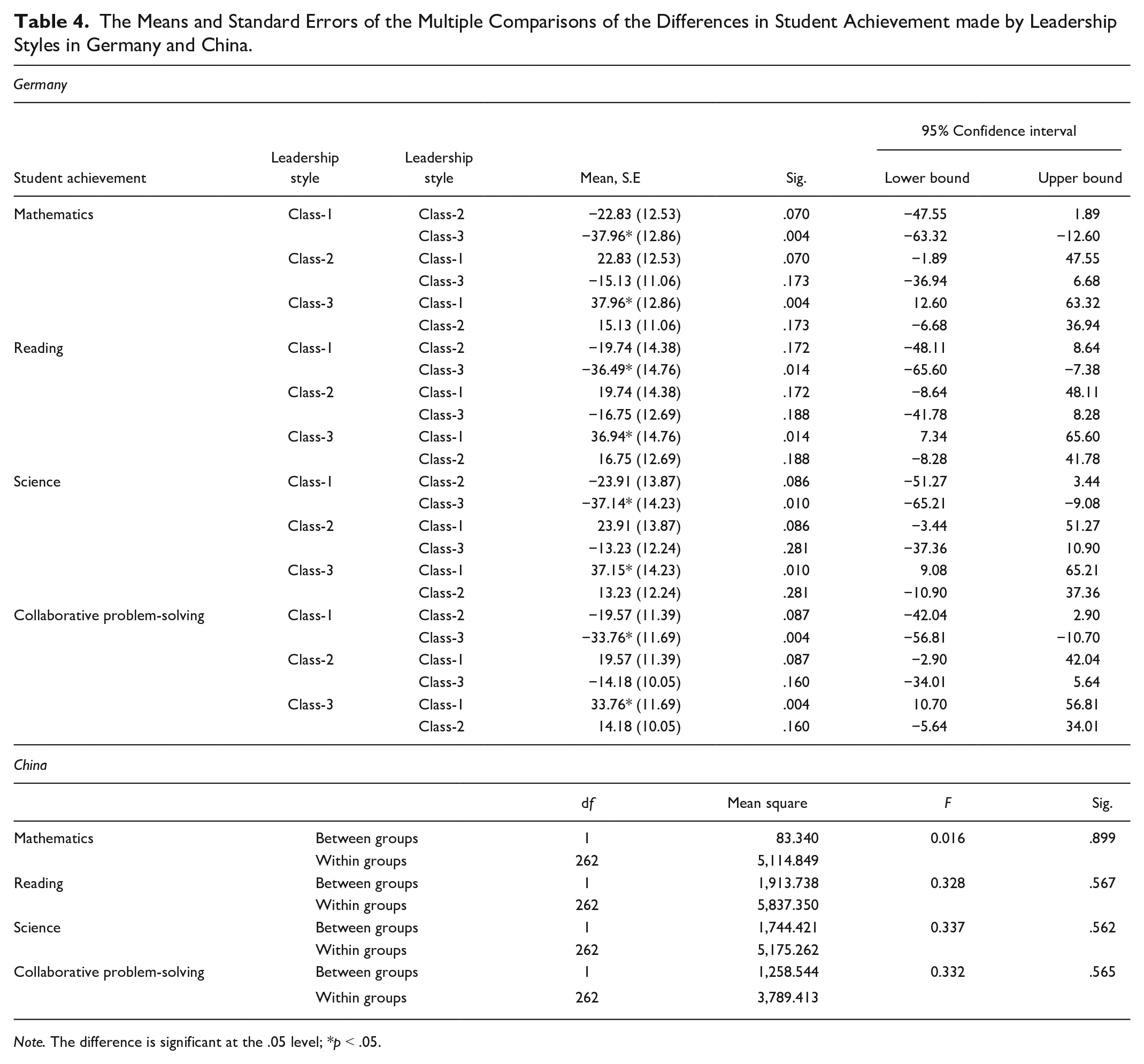
Finally, we further explored the differences in student achievement in each domain made by leadership styles. Table 4 presents the result of multiple comparisons in the two countries.
The Means and Standard Errors of the Multiple Comparisons of the Differences in Student Achievement made by Leadership Styles in Germany and China.
Note. The difference is significant at the .05 level; *p < .05.
Table 4 shows that in Germany, transformational and integrated leadership significantly made differences for four domains of student achievement (Mean = 37.96, p = .04; Mean = 36.49, p = .014; Mean = 37.14, p = .01; Mean = 33.76, p = .04 for the mean differences that two leadership styles made for mathematics, reading, science, and collaborative problem-solving of student achievement, successively). In China, p values in the last column of Table 4 showed that two leadership styles did not make any differences in student achievement as they were non-significant at the .05 level.
Conclusions and Discussion
The purpose of the empirical and comparative study on principal leadership style and its relationship with student achievement between Germany and China was to understand where each leadership was practiced, how leadership styles related to student achievement, and why such differences acted by different styles existed across the two countries. The theoretical framework of our analysis further confirmed that the practices and styles of principal leadership were firmly associated with the contingency of principals situated, and that different leadership styles can make a difference in relation to student achievement. Specifically, the combination of different contextual or situational factors can, to an extent, predict an appropriate leadership style and its priorities within leading tasks of school principal. Insight into the contingency and situational theory, our findings reinforce the impression that student performance, as one predictor of leadership effectiveness, can be enabled or challenged by different leadership styles (Amanchukwu et al., 2015; Lunenburg & Ornstein, 2021). By employing different leadership styles through these leadership behaviors in particular conditions, principals set prerequisites which creates a foundation for student achievement improvement (Sergiovanni, 2015).
Different Clusters of Principal Leadership Indicate Different Priorities in School Leading Between Germany and China
Effective school leadership has drawn the attention of policymakers across the world (Clarke & O’Donoghue, 2017; Courtney et al., 2017; Day & Sammons, 2013). Studies on principal leadership support that principal should use diversified leadership styles in leading their schools (Hsiao & Chang, 2011; Khalifa et al., 2016). Our findings speak to those realities. Specifically, German school principals mostly adopt three leadership styles, whereas their Chinese counterparts tend to adopt two leadership styles. In Germany, instructional and integrated leadership are prevalent, which may indicate that German principals prioritize instructional activities above others. Instructional leadership has a profound effect on schooling and teaching since the Prussian era (Geißler, 2013; Wissinger, 2015). With the introduction of new school improvement processes, the position of instructional leadership was further reinforced (Pashiardis & Brauckmann, 2019). More specifically, the German education system requires school principals to have expertise in teaching. In that sense, principals have potential roles in improving school and teaching effectiveness given their knowledge in solving teaching problems and defining what constitutes excellence in teaching. This shift from a nation/state-centered focus to an individual-school-centered focus highlights the similarities and differences in the leadership styles of principals. Our findings show that instructional or pedagogical leadership can serve as a primary preference for school principals and that teaching and learning are prioritized by German school principals. These principals need to have complete knowledge of teaching to improve the achievement of their students and the effectiveness of their schools (Hancock et al., 2015; Sugarman et al., 2016; Voelkel & Chrispeels, 2017). Of that note, as shown in the German school system, the priority of instructional or pedagogical leadership could be used as an example. The objective is to promote comradeship in pedagogy and explore the abilities that teachers should possess based on the educational system. The relationship between priority in leading and the educational system interacts, indicating that the preferences of principals with regard to leadership styles and behaviors tend to vary based on their respective situations. This analysis could imply the relationship between leadership and leading contextual situation, and thus, integrated leadership is positively used by principals. Given that the leadership style connects student achievement to school improvement, leadership should be integrated into organizational management, which would be a prospective integration of instructional and transformational leadership for German school leadership.
Although instructional leadership is not given the highest priority in China, a high percentage of principals in the country continue to adopt this leadership style along with transformational leadership. With education quality and school effectiveness as their focus, the reforms in the curriculum and the ability of school principals to establish a community conducive to learning are prioritized by policymakers (Liu & Hallinger, 2018). The reason might be that on the one hand, the administrative system of the educational system is hierarchal that principals need to shoulder the accountability for school development by following orders from top levels. Particularly, the direction of school development should be accommodated to the central educational ministry. On the other hand, still, student academic achievement has posed a key issue in the examination-oriented system (Wang, King et al., 2019). By surrounding such a circumstance, providing support for teaching and learning is taken as the priority for school principals in China. That is, they are encouraged to engage more in observing classes and giving instructions to teachers. These principals should adopt instructional leadership to establish a relationship between leading and instruction, whereas teaching staff who face class problems tend to receive assistance from school principals. Principals, in turn, intend to improve teaching by engaging in discussions with their colleagues. Nevertheless, most principals in China give the highest priority to improving student and school achievement. This priority, which aims to improve student academic achievement through support for instruction, provides promotion opportunities for principals based on their success in improving student achievement. Thus, principals are expected to take on the roles of instructors and innovators who are responsible for facilitating curriculum development and creating an innovative school culture.
Relationships Between Typical Leadership Styles and Student Achievements Highlight the Differences in the School Contexts Between Germany and China
Our contextual-based LCAs underscore some differences in the leadership styles of principals from Germany and China. The three major types of principal leadership in Germany emphasize instruction and leadership integration, whereas the two major leadership types in China emphasize transformation and instruction.
As one of the carriers of leadership influence, leadership styles and behavior are mostly used to understand the situation that school principals positioned. German has 16 states (Länder), and the boundaries are still strict (Huber et al., 2017). However, most states are encouraged to cooperate via networks and the integrated programs provided by the educational administration of each state to improve school quality. In particular, according to the new public management in recent years, school principals are supposed to acquire further autonomy, thereby implying a shift of power structure from centralization to decentralization (Zlatkin-Troitschanskaia et al., 2016). This notion demonstrates that principals are gradually empowered to decide on school self-improvement and self-development. The consequence of this situation that school principals positioned can bring change for the school contexts, specifically the challenging school contexts. More specially, Germany has a certain number of immigrant students. On the one hand, these students fall behind the local German students due to the problem of language and culture integration (Naumann & Sälzer, 2017). Thus, the multicultural background needs strong cooperation, collaborations, and communications to further improve school (Barrett, 2018; Tran, 2014). On the other hand, the result implies one of the facts in German school principals, that is, principals at secondary schools have great teaching responsibilities, indicating that instructional leadership is used by most principals (Brauckmann et al., 2016). From the previous illustration, principals can expand the school-based responsibility accordingly. However, the complicated school management tends to contradict principals’ autonomy authority. More specifically, most decisions, particularly the decisions on curriculum and instruction of school, demand the participation or approval of school committees and steer groups. This event leads to debatable argumentations on whether the balance between the school principals, steering group, and school committees is efficient or whether a result can be achieved even in longer decision-making processes with sometimes “more complicated” school management and committee structures. These special contexts allow us to understand why transformational leadership and integrated transformational and distributed leadership can make a distinct difference in relationships with student achievement. By contrast, the contradictions between principal leadership/behaviors and school management enable us to further clarify the paradox of instruction and instructional leadership in Germany.
Compared with Germany, transformation and instructional leadership tend to greatly contribute to student achievement in China, as shown in the Result section. However, the magnitude of these two relationships suggests that student achievement mainly depends on leadership styles and behaviors. This notion allows us to understand the contribution that the context and situation can make for these differences. Transformational leadership is known for its effectiveness in bringing innovative and improved organizational atmosphere and culture. The prevalence of this leadership style in China might be attributed to the development of school quality. Several reforms on curriculum, school-based development, quality education (su zhi jiao yu), and core competence (he xin su yang) can help in facilitating student learning and promoting the professional competency of teachers (Hou, 2015; Walker & Qian, 2017). Moreover, the imbalance between “ordinary schools” and “key schools” has been impelled school principals to nurture innovation of schools. More specifically, key schools tend to be allocated with more funding, and they can select students according to their learning progress and academic achievement. By contrast, ordinary schools are likely to have less chance to compete with other schools that have a high reputation and outstanding student outcomes because of the shortage of financial support and the advantaged pupils. Thus, such special contextual backgrounds potentially expect principals to take efforts in assisting school-based teaching development and improving student learning quality. In response, the implementations involve the teaching and research groups, in which teachers are grouped according to the subjects. In each group, one teacher is selected to lead and manage teaching issues, writing reports, and periodically meeting with principals or vice principals. In addition, school principals initiated several activities, such as class monitoring and observation, teaching quality evaluation in terms of student achievement and peer-reviewed, and the ranking of backbone teachers. These actions reinforced the competitions not only among the schools but also the teaching staff within the school. The priority was placed on student academic achievement, and thus, school principals consider improving student achievement and building an instructional learning community. In that sense, transformational and instructional leadership may be the most used and greatly affected leadership style in the Chinese context.
Implications of the Findings
A bunch of studies place the focus at leadership development, suggesting that leadership style may pose as a mirror which reflects the potential effects of specific practices (Bucic et al., 2010; Drago-Severson, 2012; Hallinger, 2018). A detailed understanding of various leadership styles across contexts (countries) may further contribute to locating methods that enhance school organization effectiveness (Aldhaheri, 2017; Swid, 2014). Therefore, our analyses of leadership styles with a comparative perspective yielded the theoretical evidence which proves that leadership and leadership styles can be influenced by contextual features of national, regional, and educational systems. Which, in turn, the focus of principal leadership improvement should be placed rather than on standardized reforms by investing resources and raising funds, leadership style ought to be further matched to the order of magnitude of the change initiative. In support of this, for example, leadership should systematically support the responsibilities and priorities by identifying tasks that capitalize on the strengths of schools and school members in certain contexts- this implies that successful training for leadership should provide tangible support for principals’ efforts according to the leadership styles adopted in response to the change initiatives.
In consideration of the methodological implications for researchers and policy makers, this study provided two prompts for the future studies on principal leadership and leadership styles. Most previous studies examined the influence that a particular principal leadership style exerted on student achievement in certain contexts, considering the fact that the particular leadership style is a predictor, which provided the influence for student achievement. This study identified the leadership styles adopted across the compared countries, offering a preliminary foundation for the further exploration of the relationships between leadership style and student achievement, and the examination of the differences in student achievement as a consequence of the leadership style. This further reaffirms the importance of professional leadership styles adopted by principals that accounts for a meaningful amount of the variation in student achievement (Alhosani et al., 2017; Allen et al., 2015; Shatzer et al., 2014). In addition, our findings in favor of a “positive” relationship between principal leadership and student achievement also yielded methodological insights into further implications for targeting the most effective leadership practices with employing an appropriate leadership style. This further prompt that the evaluation of leadership style must not only be based on the focal or all practices of school principals, but also be grounded in the suitability of leadership styles and the consequence that an appropriate leadership style brings (Liu et al., 2016).
Limitation and Future Prospects
We provide insights into the classification of leadership styles in Germany and China and explore the relationship between leadership style and student achievement in these countries. However, our study faces three key limitations.
First, our data are collected from the self-responses of school principals, which may lead to bias in our leadership style clustering. Future studies should use diversified data sources and precise multilevel models to address this limitation.
Second, PISA does not allow us to calculate the percentage of time spent by principals in their leading tasks. Our LCA results identify different clusters of leadership styles, but we observe some incongruity in the responses of each subgroup. This phenomenon may be an intriguing topic that warrants investigation in future research. Moreover, the missing information on principals, such as their personality, characteristics, and social cognition, limits us to further explore the differences among principals’ leadership styles by comparisons to the contextual backgrounds. Thus, future studies are expected to collect data related to such information.
Third, our data are cross-sectional, that is, they cannot establish a causal relationship between the leadership style and student achievement. Future studies can conduct longitudinal and tracing work to identify the profound effects of principal leadership exerted on student achievement.
Footnotes
Acknowledgements
This work was part of the study entitled an empirical study of principal leadership evaluation, sponsored by Beijing Union University Fund Educational Research Project (No. JK202104). The funding agency is not responsible for the contents of this article.
Declaration of Conflicting Interests
The author(s) declared no potential conflicts of interest with respect to the research, authorship, and/or publication of this article.
Funding
The author(s) disclosed receipt of the following financial support for the research, authorship, and/or publication of this article: This study is supported by Beijing Union University Fund Educational Research Project (No. JK202104).
