




Abstract
This study pursued three objectives: (1) to examine whether perceived knowledge about the environment affects attitudes and subjective norms; (2) to estimate, within the theory of planned behavior, the effects of attitudes, subjective norms, and perceived behavioral controls on eco-friendly behavioral intentions; and (3) to explore the moderating role of biospheric values in these associations within environmental psychology. Data were obtained from surfing and water sports tourists using a convenience sampling approach between September 1 and 7, 2022. Relationships among the variables were examined via structural equation modeling with maximum likelihood estimation, and moderation analyses were conducted using Jamovi statistical software. The results indicated that perceived knowledge significantly influenced both attitudes and subjective norms. Moreover, attitudes, subjective norms, and perceived behavioral controls significantly predicted eco-friendly behavioral intentions. Finally, biospheric values moderated the relationships between attitudes and eco-friendly behavioral intentions, between subjective norms and eco-friendly behavioral intentions, and between perceived behavioral controls and eco-friendly behavioral intentions.
Plain Language Summary
This study explores how environmental knowledge influences sports tourists’ attitudes and their perceptions of what others think about eco-friendly behaviors. It also looks at how these attitudes and perceptions, along with the ability to control one’s behavior, affect the intention to engage in eco-friendly actions. Additionally, the research investigates how personal values related to environmental protection can change the strength of these influences. Data were collected from tourists involved in surfing and other water sports during a one-week period in September 2022. The study used statistical methods to analyze how environmental knowledge affects attitudes and perceptions of social approval and how these factors, along with the ability to control behavior, impact the intention to behave in an environmentally friendly way. The analysis also checked how personal values related to environmental protection might strengthen or weaken these relationships. The results showed that having more environmental knowledge positively affects both attitudes and perceptions of social approval regarding eco-friendly behavior. Attitudes, perceptions of social approval, and control over behavior all significantly impact the intention to engage in eco-friendly actions. Personal values related to the environment were found to influence how strongly attitudes, social approval perceptions, and control affect eco-friendly intentions. This means that people with strong environmental values are more likely to follow through on their intentions to behave in an eco-friendly manner.
Keywords
Introduction
Amidst the sweeping tides of rapid industrialization and urbanization, numerous nations have witnessed unparalleled prospects for growth, enriching the lives of multitudes. This growth has deeply affected the tourism sector, with particularly pronounced effects in the realm of active sports tourism (Jeong, 2024b). However, this unprecedented surge has generated a concomitant surge of severe predicaments, including environmental degradation, which casts an ominous shadow on global economies, policies, and tourism industries (H. Wu et al., 2021). This grim reality is evidenced by deforestation; the unabated intensification of environmental challenges such as air pollution, global warming, and water contamination and the ongoing drain on natural resources. These issues pose dire ramifications not only for the environment but also for industries reliant on natural resources, including tourism. In particular, active sports tourism, which depends on pristine natural settings (Jeong, 2023), is directly threatened by these environmental challenges.
As a result, there is a rising consensus on adopting green tourism practices that minimize environmental impacts and promote sustainability. Green tourism emphasizes eco-friendly practices that enhance the travel experience while helping conserve essential natural resources for activities such as mountain biking, surfing, and hiking. Consequently, discerning consumers, particularly those engaged in active sports tourism, have become increasingly aware of these environmental challenges. They increasingly demonstrate a propensity to make environmentally conscious choices in both everyday life and travel behavior, selecting destinations and activities that are consonant with their values of environmental stewardship (Emekci, 2019). The health of natural environments is crucial for maintaining the appeal and safety of these tourism activities (Morales-Baños et al., 2023). Environmental degradation arising from pollution and other environmental problems threatens not only tourists’ health and wellbeing but also the long term sustainability of the tourism sector itself (Baloch et al., 2023).
Aligned with contemporary scholarly currents, research in marketing, environmental psychology, and tourism studies has sustained a focus on clarifying environmental responsibility and green consumption. This emphasis is especially salient in active sports tourism, where environmental concerns are embedded in the travel experience and shape consumer behavior (Nguyen et al., 2019). The notion of green signifies a consistent commitment to the preservation of environmental resources, a priority that is critical in tourism settings and particularly in active sports tourism. In this sector, green consumption reflects individual choices while also influencing the broader environmental sustainability of tourism practices. These consumption patterns foster attitudes and behaviors oriented toward a minimal ecological footprint, including recycling, prudent energy use, and the deliberate selection of environmentally responsible products (Semprebon et al., 2019).
This study analyzes the antecedents of eco-friendly behavioral intentions (EFBI, hereafter) within active sports tourism, thereby addressing a notable gap in the extant literature. Although prior research has examined green consumption in general settings, limited attention has been given to how these principles apply to tourists engaged in sports activities that closely interact with natural environments. This study responds to that omission by analyzing how environmental awareness and behaviors among active sports tourists influence both the sustainability of tourism practices and the conservation of natural resources. With sustained emphasis on pro environmental conduct, ecotourism and sustainable tourism have emerged as rapidly expanding segments of the tourism industry. Active sports tourism, which frequently overlaps with these segments, is increasingly recognized for its capacity to shape environmental practices and enhance tourism sustainability (Gabor et al., 2023). Departing from conventional tourism models, ecotourism adopts a participatory approach that grants local communities a substantive role in decision making, promotes ethical consumption practices, and advances educational initiatives aimed at informing both tourists and residents (W. Ahmad et al., 2020). Amidst the diverse tapestry of tourism genres, active sports tourism stands in intimate symbiosis with the local environment, be it mountains, oceans, or lakes, thereby necessitating a heightened sense of responsibility in travel and a steadfast commitment to environmental conservation, surpassing the exigencies encountered in other generic tourism modalities. At its core, active sports tourism embodies the ethos of tourists actively engaging in sports within natural settings, such as mountains, oceans, and lakes. This engagement not only enhances the tourists’ well-being but also underscores the critical need for environmental preservation to sustain these natural venues (Mishra et al., 2022). Be it mountain biking, surfing, canoeing, skydiving, or golfing, these activities are central to active sports tourism and cater to enhancing mental and physical well-being. However, the sustainability of these pursuits is increasingly dependent on the health of natural environments, which are integral to providing enjoyable and safe experiences for tourists (Jeong & Kim, 2019; Jeong et al., 2019). Consequently, it becomes imperative to explore the antecedents underlying the EFBI of active sports tourists. Recognizing these factors is fundamental to developing strategies that foster tourist behaviors that help safeguard and preserve the natural landscapes and resources integral to their activities.
To develop a comprehensive account of the determinants that foster EFBI within active sports tourism, this study adopts the theory of planned behavior (TPB, hereafter). This framework clarifies how attitudes, subjective norms (SN, hereafter), and perceived behavioral control (PBC, hereafter) shape tourists’ environmental behaviors (Bosnjak et al., 2020). Originating as an extension of the theory of reasoned action, TPB is widely regarded as a leading model in social psychological research for explaining complex human behavior (Ulker-Demirel & Ciftci, 2020). TPB maintains that, under a rational decision structure, attitudes, SN, and PBC jointly inform one’s intention to carry out a behavior (Ajzen, 2020). By extending TPB with perceived knowledge and biospheric values, this study advances theoretical comprehension of pro-environmental behavior within the domain of active sports tourism and addresses gaps in the literature where these factors have been insufficiently examined.
Since its 1991 publication, scholars across behavioral inquiry, marketing, sports marketing, tourism, healthy eating behavior, education, online retailing, and green consumption have employed this theory to clarify and forecast an extensive range of behaviors (Yu & Jeong, 2022). Recent investigations indicate that perceived knowledge affects pro environmental behaviors across diverse contexts for example P. Liu et al. (2020) and Zeng et al. (2023), thereby underscoring the value of examining this construct within active sports tourism.
To advance understanding of active sports tourists’ eco-friendly behavior, the present study regards perceived knowledge as an exogenous driver of attitudes and SN. Increasing evidence points to its salience in intensifying these components in TPB models (Guerin & Toland, 2020; Han et al., 2020). Individuals who possess adequate knowledge to interpret pro environmental practices tend to engage in more deliberative decision making. Nevertheless, empirical research on perceived knowledge within the TPB model, particularly in sports contexts, remains limited. Furthermore, this study explores the moderating effect of biospheric values on the hypothesized pathways. Biospheric values represent one of the three dimensional constructs underlying pro environmental behaviors alongside altruistic and egoistic orientations (Stern, 2000). Individuals endorsing pro environmental values exhibit heightened concern for protecting the natural world, and those with a biospheric or ecocentric orientation are strongly shaped by their surroundings and are motivated to preserve nature for its intrinsic worth (Soyez et al., 2009). If biospheric values moderate these relationships, managers and marketers could segment tourists by the strength of their biospheric values. Under high biospheric values, destination managers may emphasize the benefits of environmental conservation during travel, whereas under low biospheric values, managers may highlight a broader range of advantages associated with protecting the natural environment.
Aligned with the guiding aim of the study, the central objective is to clarify the determinants that have direct and indirect effects on EFBI among active sports tourists. To accomplish this aim, the TPB framework is extended by emphasizing three core factors, attitudes, SN, and PBC, thereby yielding a more comprehensive model. The findings are anticipated to yield practical recommendations for tourism marketers and destination managers in designing targeted communication strategies that encourage eco-friendly behavior among tourists. By delineating the roles of perceived knowledge and biospheric values, tourism operators can more effectively meet the escalating demand for sustainability-focused tourism experiences. In parallel, the study probes the moderating influence of biospheric values to address existing research gaps and strengthen its scholarly contribution.
Review of Related Literature
Green Practices in Active Sports Tourism
Active sports tourism, including activities like mountain biking, surfing, and hiking (Jeong, 2023), offers significant opportunities for implementing green practices to mitigate its environmental impact. Green tourism focuses on adopting eco-friendly practices to reduce the carbon footprint and protect natural resources (Mehmood & Kaewsaeng-on, 2024). Key strategies for green practices involve promoting low-impact activities and encouraging tourists to stay on designated paths, thereby minimizing ecological disruption. For instance, riding mountain bikes on established trails and avoiding sensitive habitats helps limit environmental damage. Likewise, conducting surfing and hiking activities in ways that reduce pollution and waste helps maintain the quality of natural water bodies and trails. Supporting local conservation efforts is another crucial aspect (Judijanto et al., 2024). Tourists engaged in active sports can contribute to or participate in local environmental protection programs, aiding in habitat restoration and wildlife preservation. This active involvement simultaneously bolsters sustainable tourism operations and intensifies tourists’ relationships with valued natural environments.
Environmental Psychology and Eco-Friendly Behavioral Intentions
Environmental psychology elucidates how tourists’ attitudes and behaviors are shaped by their connection to nature and by their awareness of environmental issues (Khasanah et al., 2024). Tourists who place high value on natural environments are more disposed to embrace sustainable practices and to make environmentally responsible choices. Educational programs and awareness campaigns can further strengthen this connection and encourage responsible conduct among travelers. In addition, the selection of environmentally friendly accommodations and tour operators is pivotal in green tourism. Businesses that implement sustainable practices such as using renewables, lowering water demand, and managing waste responsibly serve to reduce the total environmental burden of tourism (Belarmino & Janaban, 2023). By opting for these services, tourists support broader efforts to advance environmental sustainability. Moreover, clarifying the psychological drivers of eco friendly behaviors can guide the design of more effective marketing strategies and conservation messages (Mustafa et al., 2022), thereby fostering a deeper commitment to environmental stewardship among tourists.
Theory of Planned Behavior
To understand TPB, it is necessary first to consider its precursor, the theory of reasoned action (TRA; Madden et al., 1992). TRA maintains that intention directs behavior and that intention is shaped by attitudes and SN (Fishbein & Ajzen, 1975). As articulated by Ajzen (1991), attitudes index the favorability of a person’s evaluation of the target behavior. Since the early twentieth century, attitudes have held a prominent place in psychology and are typically conceived as positive or negative appraisals of objects, events, or actions when one contemplates acting.Attitudes are also derived from the Latin word aptus, which means ‘readiness’ or ‘adaptation,’ and is etymologically described as ‘a state of readiness to do something,’ which means that we can predict someone’s next move based on their current attitude. While attitudes are usually divided into cognitive and emotional attitudes, attitudes in the TRA and TPB are characterized by an appraisal of action enactment along a favorable–unfavorable continuum (Tonglet et al., 2004). SN are constituted by perceived approval or disapproval from salient others about performing a behavior (Ajzen, 1991). In other words, individuals exhibit greater likelihood of enacting the behavior when important others such as family, friends, or teachers endorse it, and less likely when they do not. In contrast to attitudes, which are more individually oriented, SN are strongly shaped by external forces and can vary across regions and contexts. It is generally observed that decision making among Western populations is more strongly driven by attitudes, whereas among Eastern populations it is more strongly driven by SN (Yoon, 2019).
The TRA was a mainstay in research through the late 1990s, though its constraints are well recognized. For example, suppose a person has positive attitudes toward sports tourism, and people around them support their participation in sports tourism, but they may not have the time or money to enjoy sports tourism due to frequent overtime at work or a sudden job loss. In such contexts, elements of the behavior fall outside personal control, thereby influencing behavioral intention. To address this limitation, Ajzen (1991) extended the TRA with perceived behavioral control (PBC) to form TPB. PBC refers to individuals’ perception of how easy or difficult it is to perform the behavior (Ajzen, 1991). More precisely, it captures perceived capacity to manage constraints on the actions required in a given situation (Verma & Chandra, 2018). PBC should be highest when time, resources, and opportunities are sufficient (Madden et al., 1992).
Perceived Knowledge
Through traditional mass media that communicate unidirectionally, such as TV, newspapers, radio, and periodicals, or through social media that communicate bidirectionally, such as Blogs, YouTube, Instagram, and Twitter, individuals learn about objects, products, events, and issues. This knowledge and understanding, developed from the simple to the more complex through mass and social media supports individuals in identifying, interpreting, assessing, and retaining representations of objects, goods, events, and issues. Consequently, a wealth of knowledge may reduce individuals’ susceptibility to false information in the decision-making process, making them more likely to act reasonably. It has long been acknowledged that customer perceptions of knowledge are important in understanding customer behavior (S. H. Lim et al., 2019). In extended TPB formulations, cognitive knowledge remains central to the explanation of many behavioral outcomes (Karimi et al., 2021). Within the sports domain, sports customers’ knowledge is recognized as a critical strategic resource: a better understanding of their knowledge helps sports organizations build relationships with customers. For example, consumers of indoor sports facilities who receive various information about viruses and epidemics through different communication channels are likely to avoid situations where their knowledge is insufficient to guide their behavior. Instead, they move toward situations where their knowledge is sufficient to guide their behavior (Han et al., 2020). Accordingly, there are opportunities for much better attitudes and SN among sports tourists with a high level of knowledge.
Values and Pro-Environmental Value Behaviors
A large body of evidence indicates that human values are central predictors of pro-environmental behavior (Stern, 2000). Simply, value can be depicted as ‘the worth of something’ or considering someone or something to be important; concretely, it can be defined as ‘a desirable goal, applicable across contexts and differing in salience, that provides a guiding compass for individual and collective life’ (Schwartz, 1992). Because values can shape a broad array of attitudes and behavioral patterns (De Groot & Steg, 2010), they serve as a cost effective means of describing and explaining what is shared across persons, nations, communities, and cultures (Rokeach, 1973). In effect, the range of beliefs anchored in specific behaviors is effectively uncountable, whereas values constitute a relatively compact set (De Groot & Steg, 2010).
In general, when predicting pro-environmental beliefs and behaviors, three types of values have been regarded as particularly salient (De Groot & Steg, 2008; Steg et al., 2014): Biospheric (i.e., valuing the environment for its own sake, absent explicit links to human interests), altruistic (i.e., prioritizing others’ welfare and equitable treatment), and egoistic (i.e., focusing on the personal costs and benefits a choice imposes on one’s resources, influence, or accomplishments) (Bouman et al., 2018). Tourists can be motivated to engage in pro-environmental behaviors by all three value orientations. For example, a tourist may walk, bike, or take a bus instead of renting a car or taking a taxi for various reasons. These choices can be driven by a value orientation that is (a) egoistic: tourists may perceive walking, biking, or public transportation as the most cost-effective options; (b) biospheric: When tourists choose environmentally friendly modes of transportation, they actively reduce their carbon footprint and thereby contribute to preserving the Earth’s environment. From an altruistic perspective, selecting nonpolluting transportation reduces harmful gas emissions, benefiting both the environment and public health. By aligning their behaviors with these value orientations, tourists can generate positive outcomes for the environment and society. Prior studies document that egoistic values are less liable to foster pro-environmental beliefs, intentions, and behaviors, whereas biospheric and altruistic values present positive associations. (Honkanen & Verplanken, 2004; Kis et al., 2020; Milfont & Gouveia, 2006). This is likely because engaging in pro-environmental behaviors often requires individuals to suppress egoistic tendencies (De Groot & Steg, 2010). In general, however, biospheric values bear stronger relations to pro-environmental intentions and behaviors than altruistic values (De Groot & Steg, 2008). Therefore, the present study used only biosphere values as a moderating variable.
Research Hypothesis Development
Prior studies have indicated that perceived knowledge may shape both attitudes and SN. Suki (2016) tested the effect of green brand knowledge on consumers’ attitudes toward green brands and confirmed that such knowledge is a predictor of these attitudes. Han et al. (2020) proposed a conceptual framework for U.S. international tourists’ post-pandemic travel behavior and found that perceived knowledge of COVID-19 plays a pivotal role in attitudes and SN. Lui et al. (2014) further demonstrated that medical and nursing students’ knowledge about HIV is significantly associated with their attitudes toward HIV patients, indicating that higher perceived knowledge is linked to more positive attitudes. Similarly, Wallace et al. (2020) reported that perceived knowledge moderates how ambivalence affects the potency of attitudes in predicting related behaviors, underscoring knowledge’s central role in shaping attitudes and SN. Building on this line of evidence, other research has shown that perceived knowledge can also have a direct effect on EFBI. For instance, P. Liu et al. (2020) found that higher levels of perceived knowledge significantly increased pro environmental intentions among consumers, lending support to a direct pathway from knowledge to behavior. Against this background, the following hypotheses were formulated for the current study:
Extant research indicates that attitudes, SN, and PBC are associated with behavioral intention. For example, Yu and Jeong (2022) applied the TPB to aspiring e-sport athletes and suggested that more favorable attitudes, SN, and PBC were linked to stronger career pursuits intention. Jeong et al. (2021) applied the TPB to examine fans’ decisions to attend matches amid the pandemic and found positive associations among attitudes, SN, PBC, and sport event attendance intention. Seonwoo and Jeong (2021) modeled structural relations among mentoring, attitudes, SN, PBC, and Taekwondo career pursuit intention, concluding that attitudes, SN, and PBC significantly influence intention. Within tourism contexts, Y. Liu et al. (2021) analyzed Chinese residents’ intentions to pursue outbound travel post-pandemic and identified attitudes, SN, and PBC as core predictors of travel intentions. Focusing on green hotel patronage, Nimri et al. (2020) evidenced that attitudes, SN, and PBC each directly bear on consumers’ intentions to stay at green hotels, with PBC being the most influential predictor. Taken together, these findings substantiate the applicability of the TPB to diverse facets of tourism behavior and provide a foundation for assessing how attitudes, SN, and PBC can be leveraged to predict and strengthen tourism related intentions, including travel choices and sustainable practices. Based on the foregoing, this study proposes the following hypotheses:
As discussed earlier, previous studies have demonstrated that perceived knowledge positively influences both attitudes and SN within the TPB framework (Guerin & Toland, 2020; Han et al., 2020; Jeong & Kim, 2022). Evidence indicates that perceived knowledge exerts a direct influence on EFBI (P. Liu et al., 2020), implying a dual role as both a background construct and a predictive factor within pro environmental behavior models. In addition, attitudes and SN are well established predictors of EFBI (Yu & Jeong, 2022). Although relatively few studies have tested whether perceived knowledge affects behavioral intentions indirectly through these TPB components, it is theoretically plausible that attitudes and SN function as mediators in this association. Accordingly, this study specifies the following hypotheses:
Concerning the moderating role of biospheric values in the relationships between attitudes and EFBI, SN and EFBI, and PBC and EFBI, prior research suggests that attitudes, SN, and PBC generally foster EFBI (Seonwoo & Jeong, 2021; Yu & Jeong, 2022). In parallel, existing studies indicate that values can shape behavioral intentions. For example, H. C. Wu et al. (2016) probed interrelationships among service quality, perceived value, emotions, satisfaction, and behavioral intentions and reported that perceived value markedly predicts behavioral intentions. Jeong and Kim (2020) tested structural relationships linking quality, destination image, perceived value, satisfaction, and destination loyalty, demonstrating a significant effect of value on destination loyalty. Moreover, values have been shown to moderate associations among key variables. In applied psychology, Fischer and Smith (2006) considered whether values moderate the procedural justice perceptions—work outcomes relationship and reported that conservation values moderate justice’s association with organizational commitment. Hsin Chang and Wang (2011) assessed the moderating effect of customer perceived value in online shopping and concluded that satisfaction is a stronger predictor of loyalty for high–perceived value customers than for low–perceived value customers. Therefore, the following hypotheses are proposed:
Drawing on the preceding comprehensive review of prior studies, the current study advances a conceptual framework, as presented in Figure 1.

Proposed conceptual model 1.
Methodology
Sampling and Data Collection
This study drew its data from surf tourists in Yangyang and water-sports tourists in Chuncheon, South Korea. Yangyang is a renowned destination for surfing, known for its consistent waves and vibrant surfing community (Jeong, 2023), while Chuncheon is recognized for its diverse water sports, providing a contrasting setting for comparison. These locations were selected to ensure a diverse sample of active sports tourists, enabling a comprehensive examination of EFBI across different water-based activities. A convenience sampling method was utilized due to its practicality and efficiency in gathering a significant amount of data within the study’s timeframe (Pickering & Blaszczynski, 2021). Face-to-face data collection was performed by the authors and a pair of trained research assistants. at key locations, including bus terminals, beaches, and near surf or water sports shops. This strategic placement aimed to engage tourists who were actively participating in their respective sports, ensuring the relevance of the responses. Data collection occurred from September 1 to 7, 2022, a period of high tourist activity at both locations. Surveys were administered either at the end of or during the tourists’ 2-day stays to capture their immediate experiences and attitudes toward environmental behaviors. This timing was chosen to maximize the accuracy and relevance of the responses.
To preserve data integrity, surveyors carefully reviewed each questionnaire for completeness and accuracy before inclusion. Of the 335 questionnaires distributed, 317 valid responses were obtained and analyzed, yielding a robust dataset. The selection of sampling locations, the sampling method, and the field procedures were designed to capture relevant and timely information while addressing practical constraints of field research. This approach underpins the relevance of the results across the wider active sports tourism setting and contributes to understanding EFBI among tourists. Of the 335 questionnaires dispersed at random, 317 were returned and deemed valid for analysis (94.6% valid). Demographic information was recorded, including sex (male: 64.7%, n = 205; female: 35.3%, n = 112), age (20s: 30%, n = 95; 30s: 38.2%, n = 121; 40s: 19.6%, n = 62; 50 or older: 12.3%, n = 39), education (high school graduate: 16.7%, n = 53; advanced degree: 15.1%, n = 48; college graduate: 53.3%, n = 169; graduation from graduate school: 14.8%, n = 47), and annual sports tourism participation (1–3 times: 32.8%, n = 104; 4–6 times: 27.4%, n = 87; 7–9 times: 23.7%, n = 75; more than 10 times: 16.1%, n = 51).
Measurement
All constructs were measured using instruments adopted from prior research in marketing and environmental psychology. A clarification is warranted regarding the distinction between perceived value and values in this study. Perceived value expresses how individuals gauge the benefits they get from a certain product, service, or behavior, whereas values refer to stable and deeply held beliefs that shape attitudes and behaviors over time. The present study focuses on values rather than perceived value.
Perceived knowledge was captured using three statements based on Han et al. (2020), a scale validated in related contexts and suitable for capturing participants’ self reported understanding of environmental issues. Although originally developed within environmental psychology, these items were applied to active sports tourism. Because the data were collected exclusively from surfing and water sports tourists, the construct reflects perceived environmental knowledge specific to sports tourism experiences and thus serves as a contextually appropriate measure of perceived active sports tourism environmental knowledge.
Attitudes were gauged via three statements taken from Han et al. (2017) and Jeong et al. (2021), using bipolar endpoints such as ‘negative positive’, ‘bad good’, and ‘foolish wise’. This approach accords with established practice in attitude assessment, where adjective pairs capture evaluative dimensions. The interval scale 1 to 5 permits nuanced responses and provides a reliable indicator of respondents’ attitudes.
For SN, three statements were measured from Ajzen (2011), Jeong et al. (2021), J. P. Lim and Ryu (2022), and Yu and Jeong (2022). These adaptations were made to ensure that the items accurately represent the social pressures relevant to active sports tourism, thereby enhancing contextual relevance and reliability.
PBC was gauged using indicators sourced from Ajzen (1991); Han et al. (2017); J. P. Lim and Ryu (2022); and Yu and Jeong (2022). These items effectively capture perceived control over behavior and provide a valid and reliable gauge of participants’ perceived ease or difficulty in performing environmentally friendly behaviors.
EFBI were captured with three items from Han (2015) and J. P. Lim and Ryu (2022). As established indicators of pro-environmental intention, the items are appropriate for this research context.
Biospheric values, reflecting concern for the environment and ecosystem welfare, were captured via three adapted items from Bouman et al. (2018) and Steg et al. (2014). These items were selected for their specific relevance to environmental values and alignment with the study focus.
Each item was rated on a 5-point Likert scale, from 1 (strongly disagree) to 5 (strongly agree). Content validity was established via expert review by two professors in sports psychology and sports tourism, whose comments informed pre-administration refinements.
Study Design
Employing a cross-sectional framework, we probe the relationships among perceived knowledge, attitudes, SN, and EFBI within sports tourism. This design was chosen to provide a snapshot of these variables and their interactions at a specific point in time, allowing for an examination of their immediate effects on EFBI. The cross-sectional approach is useful for capturing a momentary view of how these factors are interrelated and can offer insights into current trends and relationships (X. Wang & Cheng, 2020). However, this design neither captures temporal change nor permits causal inference. To build on the results, future work could use longitudinal designs to track how these variables shift over time and clarify their causal links.
Data Analysis
Using IBM SPSS Statistics alongside AMOS enabled a robust examination of the data. SPSS was used to compute frequency distributions, conduct correlation analyses, and assess reliability, thereby clarifying the descriptive characteristics of the data, identifying patterns, and establishing internal consistency. AMOS was used for both confirmatory factor analysis (CFA) and structural equation modeling (SEM). CFA verified the measurement model by testing how well observed indicators mapped onto their latent factors. SEM then assessed the hypothesized pathways and overall model fit, estimating both direct and indirect effects. In tandem, SPSS and AMOS provided a comprehensive analytic framework that strengthened the robustness of the results and the validity of the proposed relationships.
Ethical Considerations
This study was approved by the Institutional Review Board of Kookmin University Institutional Review Board (IRB No.: KMU-202304-HR-349). Participants were informed of the study aims and gave written consent before participation. Ethical guidelines were followed to prevent any physical or psychological harm. Participation was voluntary, and anonymity and confidentiality were strictly maintained.
Validity and Reliability
Using AMOS, we conducted CFA under maximum likelihood to assess dimensionality. The CFA showed good fit (χ2/df = 2.992; NFI = 0.924; IFI = 0.942; TLI = 0.917; CFI = 0.942; RMSEA = 0.077), meeting recommended criteria (Hooper et al., 2008).
Convergent validity was judged on factor loadings, CR, and AVE. As per Table 1, loadings (0.949–0.805) were all significant (p < .001) and exceeded .50 (Hair et al., 2010); CR (.969–0924) surpassed .70 and AVE (0.912–0.803) surpassed .50 (Tabachnick & Fidell, 2007). Together, these metrics substantiate convergent validity.
Summary of validity estimates.

Note. χ2/df = 2.992, NFI = 0.924, IFI = 0.942, TLI = 0.917, CFI = 0.942, RMSEA = 0.077.
Following the Fornell–Larcker criterion, the diagonal terms in Table 2 outstripped the relevant off-diagonal correlations, and the square roots of AVE were higher than all corresponding correlations, evidencing discriminant validity.
Correlations Among the Constructs.

p < .01.
Note. The boldfaced diagonal values in table indicate the square roots of the average variance extracted (AVE) for each construct, which were compared against the off-diagonal correlations to assess discriminant validity.
Reliability (Cronbach’s α) for perceived knowledge, attitudes, SN, PBC, EFBI, and biospheric values ranged from .877 to .949, exceeding the .70 benchmark and indicating adequate reliability (Fornell & Larcker, 1981; see Table 1).
Results
Model Fit and Structural Model
SEM was employed to test the proposed relationships. Overall model fit was acceptable (χ2/df = 2.952; NFI = 0.916; IFI = 0.908; CFI = 0.900; RMSEA = 0.067). This model was then used to assess the study’s hypotheses. As depicted in Figure 2, perceived knowledge had a strong positive effect on attitudes (β = .737, p < .001), supporting H1a. Perceived knowledge was also significantly related to SN (β = .727, p < .001), supporting H1b. A direct positive effect of perceived knowledge on EFBI was observed (β = .219, p < .001), consistent with H1c. Attitudes positively predicted EFBI (β = .684, p < .001), supporting H2a. SN showed a significant positive association with EFBI (β = .156, p < .001), supporting H2b. Finally, PBC exerted a significant positive effect on EFBI (β = .248, p < .001), supporting H2c.

Structural model results.
Mediating Effects of Attitudes and Subjective Norms
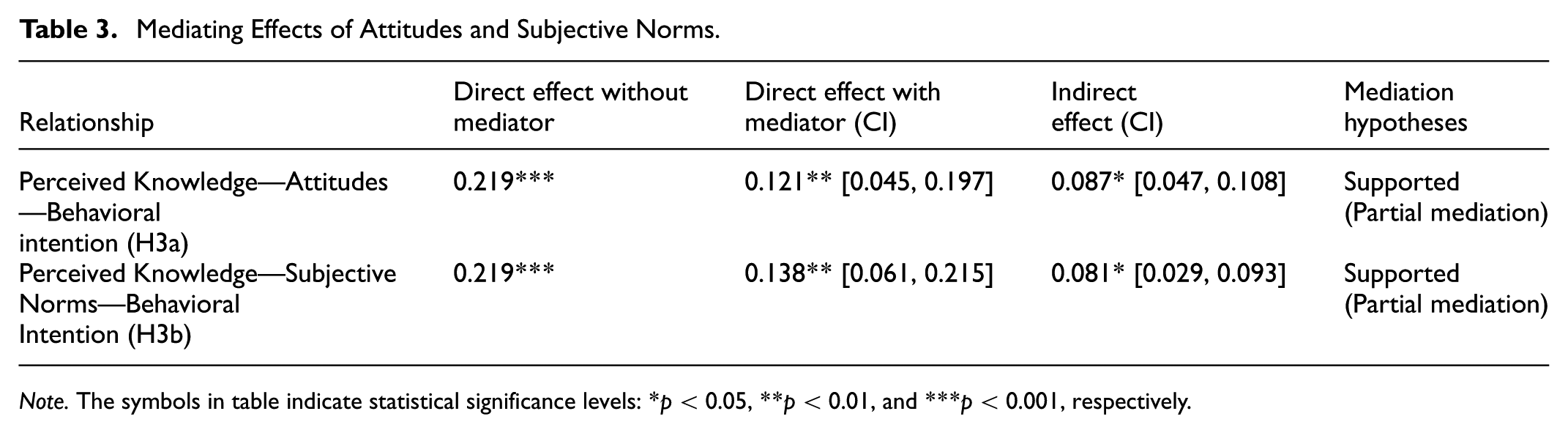
To examine whether attitudes and SN acted as mediators, this study applied the steps proposed by Baron and Kenny (1986). The significance of indirect effects was then evaluated using a 5,000-sample bootstrap, following Preacher and Hayes (2008). The results are reported in Table 3.
Mediating Effects of Attitudes and Subjective Norms.
Note. The symbols in table indicate statistical significance levels: *p < 0.05, **p < 0.01, and ***p < 0.001, respectively.
For H3a, the direct effect of perceived knowledge on EFBI without attitudes in the model was significant (0.219, p < .001). When attitudes were introduced as a mediator, the direct effect declined to 0.121 yet remained significant. The attitude-mediated (indirect) effect was significant, and its confidence interval did not include zero (CI = [0.047, 0.108]). This pattern indicates partial mediation, thereby supporting H3a.
For H3b, when SN were excluded, perceived knowledge showed a significant direct effect on EFBI (0.219, p < .001). After adding SN as a mediator, this direct effect declined to 0.138 but remained significant. The SN-mediated indirect effect was also significant, with a confidence interval that excluded zero (CI = [0.029, 0.093]). Together, these results indicate partial mediation, supporting H3b.
Moderating Effects of Biospheric Values
In line with H4a, biospheric values did not have a significant main effect on EFBI (Z = 0.694, p = .488). By contrast, attitudes (Z = 25.541, p < .001) and the attitudes × biospheric values interaction (Z = 2.260, p = .024) were significant, thereby corroborating H4a. This pattern indicates that both the independent variable attitudes and the interaction term positively and significantly influence intentions, suggesting an enhancing effect when attitudes are combined with biospheric values (Jeong, 2024a).
To further examine the moderating effect of biospheric values, we grouped them into three levels—low (M − 1 SD), average (M), and high (M + 1 SD). A simple slopes analysis tested whether this moderator altered the link between attitudes (predictor) and EFBI (outcome). As shown in Table 4, attitudes significantly predicted EFBI at all three levels—low, average, and high—with Z values of 25.4, 24.5, and 17.3, respectively (all ps < .001).
Moderating Effects of Biospheric Values.

In line with H4b, SN (Z = 11.04, p < .001), biospheric values (Z = 6.61, p < .001), and their interaction (Z = 2.03, p < .01) significantly influenced EFBI, thus corroborating H4b by showing positive effects of SN and of their interaction with biospheric values.
To unpack this moderation effect, biospheric values were again split into three tiers—low (M − 1 SD), average (M), and high (M + 1 SD). A simple slopes analysis tested whether biospheric values moderated the relationship between SN and EFBI. As shown in Table 4, SN significantly predicted EFBI at all three tiers, with Z values of 10.97, 8.61, and 7.92, respectively (all ps < .001). Taken together, these results suggest that biospheric values strengthen the impact of SN on EFBI.
Supporting H4c, PBC (Z = 18.19, p < .001), biospheric values (Z = 3.07, p < .002), and their interaction (Z = 2.41, p < .016) each showed significant effects on EFBI, confirming that PBC and its interplay with biospheric values positively shape intentions.
To scrutinize this moderation more closely, biospheric values were grouped into three levels—low (M − 1 SD), average (M), and high (M + 1 SD). A simple slopes analysis was then used to test whether biospheric values moderated the relationship between PBC and EFBI. As presented in Table 3, PBC significantly predicted EFBI at all three levels with Z scores of 18.1, 17.5, and 12.6, respectively, all at p < .001. These findings indicate that biospheric values strengthen the positive effect of PBC on EFBI, thereby supporting H4c.
Discussion
Theoretical Implications
Our results show that, in eco-friendly sports tourism, perceived knowledge significantly shapes both attitudes and SN. Specifically, perceived knowledge significantly predicts both attitudes toward and SN regarding eco-friendly sports tourism. This underscores knowledge as a key antecedent shaping favorable perceptions and behaviors toward environmentally responsible practices. By elucidating the linkage between tourists’ environmental knowledge and their positive evaluations of eco-friendly sports tourism, the study advances theoretical understanding of how knowledge informs attitudes and norms, thereby addressing a notable gap in the literature. Although eco-friendly behaviors have been widely examined, relatively few studies have focused on how tourists’ perceived knowledge of pro environmental practices influences their attitudes and SN. Consistent with prior work (Han et al., 2020; Jeong & Kim, 2022; Suki, 2016), our results show that greater environmental knowledge is associated with more positive attitudes and more supportive norms. The study extends the literature by evidencing that better-informed tourists are likelier to endorse pro-environmental attitudes and to sense social approval for green behaviors. Thus, our study underscores the importance of integrating perceived knowledge into theoretical models of eco-friendly tourism. It provides valuable insights into how enhancing tourists' environmental knowledge can lead to more favorable attitudes and supportive norms, thus advancing the theoretical discourse on eco-friendly tourism practices.
Our results indicate that attitudes exert the largest influence on boosting EFBI in sports tourism contexts. This contrasts with recent research suggesting that attitudes are often weak predictors of behavioral intentions across various contexts (Jeong et al., 2021; John et al., 2022). Within the fields of environmental psychology and sports tourism, our results indicate that attitudes exhibit the largest effect size, consistent with prior evidence (C. Wang et al., 2020; X. Wang et al., 2021). This pattern suggests that strengthening sports tourists’ positive attitudes is more consequential than emphasizing SN or PBC for shaping their EFBI. Positive attitudes enhance resilience and motivation, enabling individuals to overcome barriers and actively engage in eco-friendly practices. Accordingly, the study underscores the importance of interventions that prioritize attitude enhancement to promote environmentally responsible behavior during travel. This insight advances theoretical understanding of the attitudinal pathway to eco-friendly behavior and highlights its centrality in sustainable tourism initiatives.
This study found a significant link between subjective norms (SN) and stronger EFBI. In line with prior sports research, SN positively shapes intention. For instance, Braksiek et al. (2021) applied the TPB to community sports clubs and observed a prominent role for SN in intentions toward environmentally responsible actions. Likewise, X. Wang et al. (2021) used the TPB to examine college students’ sport-related gambling and identified SN as a key predictor of intention. Extending the TPB to adolescents’ participation in new sports, Bae et al. (2020) also reported that SN positively influenced intention. Overall, these studies underscore the importance of incorporating SN when developing strategies to foster environmentally friendly behaviors. Our results align with this evidence, indicating that understanding and leveraging SN can effectively enhance intentions for sustainable tourism practices.
This study deepens understanding of PBC in the TPB. Although recent debates suggest PBC might act as a moderator, our data indicates it functions as a direct predictor of intention. Ajzen (2020), Hagger et al. (2022), and Castanier et al. (2013) considered or tested moderating roles for PBC, yet many studies point to a direct path. For example, Yadav and Pathak (2017) showed that PBC directly shapes intentions toward green products, and Al-Jubari et al. (2019) likewise identified PBC as a direct antecedent of entrepreneurial intention within a TPB–self-determination framework. Our findings align with these perspectives, reinforcing that PBC should be regarded as a direct factor shaping behavioral intentions rather than merely a moderating variable.
It is also noteworthy that although certain studies conceptually decompose PBC into components such as perceived control costs and facilitating conditions, in this study, PBC was assessed as a unified construct according to Ajzen’s (1991) definition. Consequently, perceived control costs were not individually measured or examined. The approach accords with the original TPB and prior work that treats PBC as an overarching perception of control over behavior.
This study provides a comprehensive explanation of how attitudes, SN, and PBC shape intentions within the TPB, while highlighting biospheric values as a moderator. To our knowledge, it is the first to test this moderating role in this setting. The findings show that biospheric values significantly condition the links between attitudes and EFBI, SN and EFBI, and PBC and EFBI—stronger positive effects appear among individuals high in biospheric values than among those low in such values. Practically, destination managers might stress conservation benefits for high-biospheric value tourists, whereas emphasizing concrete, utilitarian gains from environmental protection may work better for low-biospheric value visitors. Accordingly, recognizing and leveraging tourists’ biospheric values is crucial for destination managers and marketers aiming to advance green sports tourism.
Practical Implications
The findings yield practical guidance for promoting eco-friendly behaviors in sports tourism. A principal implication is the design of tailored education and awareness initiatives. Effective campaigns should prioritize strengthening tourists’ environmental knowledge and highlight the substantial benefits of eco-friendly practices, particularly for individuals high in biospheric values. By contrast, for tourists with lower biospheric values, messaging should foreground pragmatic advantages such as cost savings and enhanced travel experiences, thereby increasing the attractiveness of environmentally friendly behaviors.
Marketing strategies should also be tailored based on tourists’ biospheric values (N. Ahmad et al., 2023). Tourism operators can enhance their effectiveness by developing targeted marketing messages and experiences that resonate with different segments of tourists. For those with high biospheric values, marketing should align eco-friendly practices with their environmental principles. For tourists with lower biospheric values, integrating practical benefits into marketing efforts can increase the adoption of eco-friendly behaviors.
Training programs for tourism staff should be updated to address the diverse environmental values of tourists (Okumus et al., 2019). Staff should be equipped to engage with tourists in a manner that reflects their environmental values, providing personalized recommendations and incentives that align with their level of environmental concern. This approach can boost the success of eco-friendly initiatives and enhance overall tourist satisfaction.
Incentivizing positive attitudes and norms is another effective strategy. Given the salience of attitudes in predicting EFBI, destination managers should institute incentive-based initiatives to acknowledge and cultivate pro-environmental attitudes. Offering incentives like discounts or exclusive perks for tourists who engage in sustainable practices can reinforce these attitudes. Additionally, leveraging community norms and peer influences can further motivate eco-friendly behavior among tourists.
Lastly, the development of policies based on biospheric values is crucial. Recognizing that biospheric values moderate the relationship between attitudes, SN, and PBC with EFBI underscores the need for policies that cater to these values. Given that biospheric values alter the strength of attitudes, SN, and PBC effects on EFBI, policies must be calibrated to these values.Tourism destinations should highlight environmental conservation benefits to tourists with high biospheric values and emphasize the practical benefits of eco-friendly practices to those with lower biospheric values. By addressing these varying perspectives, destination managers and marketers can more effectively promote green sports tourism and engage a broader audience.
Conclusion
The objective of this study is to examine how perceived environmental knowledge—together with the core constructs of the TPB and biospheric values—contributes to the formation of EFBI among active sports tourists. The results reveal a coherent pattern across the nine hypotheses. Perceived knowledge positively affected attitudes (H1a), SN (H1b), and EFBI (H1c), positioning it as a foundational cognitive antecedent. Furthermore, attitudes (H2a), SN (H2b), and PBC (H2c) each showed significant positive associations with EFBI, with attitudes standing out as the most powerful predictor. Third, attitudes and SN partially mediated the relationship between perceived knowledge and EFBI (H3a, H3b), indicating that the influence of knowledge operates both directly and indirectly through psychosocial mechanisms. In addition, biospheric values moderated the strength of the relationships between attitudes (H4a), SN (H4b), and PBC (H4c) and EFBI. Specifically, individuals with pronounced biospheric values exhibited heightened responsiveness to the impact of TPB factors, highlighting the enhancing function of environmental values in influencing intentional action. These results provide a sophisticated theoretical framework in which cognitive awareness directly affects environmental behavior and interacts with social, psychological, and value-based mechanisms. This comprehensive model enhances our comprehension of how to promote ecologically responsible behavior within the realm of active sports tourism.
The study contributes meaningfully to the sports tourism literature. To begin, it highlights why integrating eco-friendly practices is essential, showing how attitudes, SN, and PBC drive tourists’ intentions toward environmentally sustainable activities. This adds an essential dimension to aligning sports tourism with broader environmental sustainability goals. Second, the findings indicate that perceived knowledge significantly influences attitudes as well as SN. By showing that greater knowledge about eco-friendly practices is associated with more favorable attitudes and stronger perceived norms, it emphasizes the value of educating tourists to foster pro environmental behavior and explains how enhancing knowledge can catalyze positive environmental action in the sports tourism sector. Third, the present study advances the field by examining the moderating effects of biospheric values on the relationships among attitudes, SN, PBC, and EFBI. The results indicate that biospheric values significantly condition the strength of these associations, demonstrating that personal values are pivotal in determining how attitudes and norms translate into environmental behaviors. This insight refines the TPB by offering a more nuanced account of the motivational processes driving eco-friendly tourism. Finally, for destination managers and marketers, the practical implications are considerable. It provides actionable recommendations for tailoring strategies to different segments of tourists based on their biospheric values and level of environmental knowledge. This approach can strengthen marketing effectiveness and encourage more tourists to adopt green practices, ultimately supporting the growth of sustainable sports tourism. Overall, this study enriches the literature by integrating perceived knowledge and biospheric values into the TPB framework and offers practical insights for advancing eco-friendly behaviors in sports tourism.
This study yields important insights into EFBI among sports tourists, yet several avenues remain for extension. First, the cross sectional design constrains inference about change over time. Subsequent work should adopt longitudinal designs to track how green behaviors emerge, persist, and attenuate across extended periods, thereby clarifying their stability and long term impact in sports tourism. Second, because the investigation was conducted in a single country, generalizability may be limited. Replications across diverse geographical settings are needed to test whether the observed relationships hold across cultural and national contexts. Comparative multi country designs could illuminate how cultural and regional factors shape EFBI and differentiate universal from context specific patterns. Beyond the moderator already examined, biospheric values, future studies should explore additional moderators to develop a more comprehensive account of eco-friendly behavior. Candidate variables include personal values, environmental awareness, and specific socio demographic characteristics that may condition the links among attitudes, SN, PBC, and EFBI. Notably, although all respondents were active sports tourists, two items assessing EFBI used more general wording. While contextual interpretation likely anchored responses in sports tourism, subsequent research should refine the scale to more explicitly target behaviors within specific sports tourism activities. Finally, exploring the interface between individual drivers and macro-level influences (e.g., policy change or global environmental campaigns) could create new pathways to promote sustainable behavior in sports tourism. Broadening the range of moderators and contextual variables will strengthen both the theoretical reach and the practical utility of research on green sports tourism.
Footnotes

Ethical Considerations
This study was approved by the Institutional Review Board (IRB) of Kookmin University (Approval Number: KMU-202304-HR-349). All research procedures were conducted in accordance with the Declaration of Helsinki and relevant ethical guidelines.
Consent to Participate
All participants provided written informed consent before taking part in the study. The consent process was conducted in accordance with IRB guidelines.
Funding
The authors disclosed receipt of the following financial support for the research, authorship, and/or publication of this article: This work was supported by the Ministry of Education of the Republic of Korea and the National Research Foundation of Korea (NRF-2022S1A5A2A01049332).
Declaration of Conflicting Interests
The authors declared no potential conflicts of interest with respect to the research, authorship, and/or publication of this article.
Data Availability Statement
The data that support the findings of this study are stored in the corresponding author’s lab. Data may be made available upon reasonable request, subject to internal review and approval.