



Abstract
Given the importance of knowledge in attaining competitive advantages, public organizations must now grasp how to leverage knowledge sharing to improve service functions. This study presents an integrated model based on Planned Behavior theory and Expectancy-value theory to identify the key factors influencing knowledge-sharing behavior and their effects on public service delivery. The research model was analyzed using PLS-SEM based on a survey of 300 public servants across various levels of government in Ho Chi Minh City. Self-efficacy and social interaction affect public service delivery, whereas self-enjoyment, self-efficacy, reciprocity, and trust affect knowledge sharing behavior. The data reveal that knowledge sharing behavior promotes public service delivery and mediates the relationships between self-efficacy, reciprocity, trust, and service delivery. Despite not collecting longitudinal data or fully characterizing the nature of knowledge sharing, the study provides valuable insights into how public managers can encourage employees to engage in knowledge sharing to enhance service delivery.
Plain language summary
This study contributes to the understanding of individual and social factors, knowledge sharing behavior, and service delivery in Vietnamese public organizations, specifically in Ho Chi Minh City. The distinctive contribution lies in the integration of Planned Behavior and Expectancy-value theories to provide a comprehensive framework for examining the sophisticated relationships between these factors. Particularly, the study identifies self-enjoyment, self-efficacy, reciprocity, and trust as key motivators influencing knowledge sharing behavior among public servants, and highlights the role of self-efficacy and social interaction in promoting public service delivery. In addition, the research emphasizes the vital role of knowledge sharing in improving public service delivery and the importance of knowledge sharing behavior as a mechanism through which self-efficacy, reciprocity, and trust positively influence service delivery. The results clarify the need for investments in strategies that promote knowledge sharing within public organizations. As a result, managers and policymakers should prioritize strategies and policies that facilitate knowledge sharing, including establishing platforms for information exchange, offering incentives, and promoting a culture of collaboration and continuous learning within organizations. While certain limitations should be acknowledged, this study paves the way for future research in the field. It recommends investigating additional dimensions of knowledge sharing behavior, undertaking longitudinal studies to establish causal relationships, and examining the research framework in a variety of sectors and contexts. Public organizations can strive for more efficient, effective, and citizen-centric service delivery, by adopting these insights and expanding upon the validated research model.
Keywords
Introduction
Amidst ongoing public sector reforms, Vietnamese citizens have increasingly demanded higher quality public services in their interactions with government organizations (Pham et al., 2024). Consequently, there is mounting pressure on the government to proficiently oversee the quality of service provision (Hue et al., 2022). Dikotla (2021) posits that efficient knowledge sharing behavior (KSB) within public organizations can boost innovation, operational performance, and streamline operations to enhance public service delivery (PSD). While prior studies (T.-M. Nguyen & Malik, 2022; Than et al., 2023) highlight the role of KSB in human resource management and its significance as a source of organizational competitiveness in the private sector, its application in public organizations in Vietnam faces unique challenges. These include hierarchical structures, limited rewards for innovation, and cultural norms (Anh-Vu et al., 2022; Hassan et al., 2021). Therefore, fostering KSB within public organizations is crucial for enhancing PSD and meeting rising public expectations (Tahleho & Ngulube, 2022; Y. T. Tran et al., 2024).
This study provides a new perspective on management within public organizations. Firstly, public service efficiency and effectiveness are influenced by various factors, including the abilities and knowledge of individual public servants (Chung & Anh, 2022). In contemporary operational activities, knowledge has emerged as an important resource for determining strategies and goals (Al-Ahbabi et al., 2019; Fattah et al., 2022). However, empirical studies examining the effects of trust, reciprocity, social interaction, self-efficacy, reputation enhancement, and self-enjoyment on KSB and PSD within a single model are limited. To foster KSB among public servants, it is crucial to understand the factors that influence employees’ willingness to share knowledge and contribute to PSD (Al-Ahbabi et al., 2019; Chung & Anh, 2022). Secondly, this study draws on the theory of planned behavior (TPB; Ajzen, 1991) and the expectancy-value theory (EVT; Wigfield & Eccles, 2000) to identify motivating factors and analyze their relationship with KSB and PSD. TPB explains how public servants’ attitudes, subjective norms, and perceived behavioral control shape their intentions to engage in KSB, which is critical in improving PSD in public organizations (Ghouri et al., 2016). EVT, as a primary motivational process theory, provides a comprehensive framework for understanding individuals’ motives and actions (Hsu et al., 2021; Trautwein et al., 2012). Expectancy refers to an individual’s belief in their likelihood of success in completing a task, while value pertains to the perceived benefits or rewards they expect to gain from successfully performing the task (Wigfield & Cambria, 2010). It is worthwhile to create a model to explain how public servants elevate KSB in organizations and how this behavior contributes to improved PSD, drawing on the explanatory power of TPB and EVT. Thirdly, KSB occurs when individuals seek to assist others in developing new capacities for action (Chung & Anh, 2022). Therefore, KSB represents employees’ desire within an organization to share their own knowledge or expertise (T.-M. Nguyen et al., 2021; Tangaraja et al., 2015). However, the link between PSD and KSB has yet to be experimentally examined.
Consequently, this study aims to contribute the following to the existing body of literature. First, this study seeks to fill the research gap in the literature by investigating how the aforementioned factors influence KSB and PSD. Second, this study applies TPB and EVT theories to examine the motivating factors and their relationships with KSB and PSD. Lastly, this study contributes by experimentally examining the relationship between PSD and KSB, as well as the mediating effect of KSB within the context of public organizations in Ho Chi Minh City.
Theoretical Background and Hypotheses Development
Planned Behavior and Expectancy-Value Theories
TPB was first proposed by Ajzen (1985) in his book titled “From Intentions to Actions: A Theory of Planned Behavior” and later developed by Conner and Armitage (1998, p. 1453), who highlighted that “goal intentions are translated into actions and goal achievement.” TPB explains how individual behaviors, such as KSB, are influenced by three main factors: attitudes (the individual’s evaluation of KSB), subjective norms (the social pressure to engage in KSB), and perceived behavioral control (the belief in their ability to share knowledge; Ajzen, 2020; Hassan et al., 2021). In public organizations, these factors shape the likelihood of employees engaging in KSB to enhance PSD (Lee et al., 2021). However, public servants may encounter unexpected outcomes, feedback from others, obstacles, or supportive factors during the performance of a behavior, which can alter their beliefs about the behavior as well as their intentions and subsequent actions (Ajzen, 1991; Conner, 2020).
Similarly, Eccles et al. (1983) devised EVT, a well-established framework for understanding human behavior. In public organizations, EVT suggests that public servants’ motivation to engage in KSB is driven by their belief in their ability to successfully share knowledge and the value they place on improving PSD. This expectation-value dynamic is critical in fostering a knowledge-sharing culture within these organizations (Wigfield & Eccles, 2000). According to Wigfield and Cambria (2010) and Trautwein et al. (2012), EVT posits that public servants are motivated to engage in behaviors, such as KSB, based on two factors: the expectation that they will be successful (e.g., their belief in their ability to effectively share knowledge) and the value they place on the outcome (e.g., improving PSD or enhancing their reputation within the organization). In public service settings, public servants are more likely to engage in KSB if they believe it will lead to valuable outcomes. Although EVT has been extensively applied in private business contexts to explain employees’ motivations for engaging in KSB (Hsu et al., 2021; Wu et al., 2019), it has not been empirically tested in the realm of public personnel management.
TPB and EVT are complementary in understanding KSB among public servants. While TPB focuses on how attitudes, norms, and perceived control influence an individual’s decision to engage in the behavior (Ajzen, 2020; Conner, 2020), EVT adds by showing that the motivation to engage in KSB is also driven by the expectation of success and the value placed on improving PSD (Wigfield & Cambria, 2010; Wigfield & Eccles, 2000). TPB and EVT suggest that understanding employees’ motivations related to KSB can enhance PSD in public organizations. We propose that by addressing these motivational factors, public organizations can foster a culture of KSB, improve employee collaboration, and ultimately enhance the quality and effectiveness of PSD.
Knowledge Sharing Behavior
KSB refers to an employee’s active participation in sharing knowledge (Tohidinia & Mosakhani, 2010), which demonstrates their willingness to facilitate the exchange of work-related information (Chung & Anh, 2022). In knowledge-based economies of the 21st century, such as Vietnam, the importance of KSB for organizational efficiency has been widely acknowledged (Latilla et al., 2018). According to Than et al. (2023), collaborative knowledge exchange among employees facilitates both collective thinking and innovation. However, personal motivations and considerations influence the decision of individuals to engage in KSB and the extent to which they contribute their expertise (T.-M. Nguyen et al., 2022; Wu et al., 2019). In this regard, TPB provides a value framework for understanding the underlying motivations fueling KSB (Ajzen, 2020; Hassan et al., 2021), casting light on the factors that either facilitate or impede the exchange of knowledge among public servants.
KSB has a significant impact on the productivity of both public and private organizations (Dikotla, 2021; T.-M. Nguyen & Malik, 2022). Surprisingly, Massaro et al. (2015) and Al-Ahbabi et al. (2019) found that KSB is more difficult in the public sector due to the perception that knowledge is associated with authority and professional advancement opportunities. Extensive research has investigated the factors that affect KSB in both the private and public sectors. Mustika et al. (2022) and Chung and Anh (2022) identified motivational factors such as the enjoyment of helping others, knowledge self-efficacy, and reciprocal benefits as significant drivers of KSB. T.-M. Nguyen and Malik (2020) elaborated on the efficacy of intrinsic incentives in public organizations and extrinsic incentives in private businesses, particularly in promoting online KSB. Given the collectivist nature of Vietnam’s public servants and their strong sense of organizational membership and shared goal orientation (Anh-Vu et al., 2022; D. T. Nguyen et al., 2020), there is a critical research gap regarding the factors influencing KSB in public organizations despite the abundance of research in private companies. Therefore, additional research is required to address this knowledge-sharing dynamic gap within public organizations in the digital age.
Public Service Delivery
The quality of public services is assessed based on their ability to meet the needs of citizens, who are the customers of public organizations (Li & Shang, 2020). In recent years, there has been a growing academic emphasis on the governance of PSD as the public sector faces unique challenges relative to the private sector (Hassan et al., 2021), leading to the exploration of new strategies for managing PSD globally (Li & Qiu, 2022). Paradoxically, public organizations are frequently expected to take a proactive approach to PSD, despite constant pressure to increase efficiency and comply with government regulations (Y. T. Tran et al., 2024).
Since KSB is driven by a sense of organizational belonging, voluntary knowledge sharing can motivate individuals to enhance service delivery in the workplace (Tahleho & Ngulube, 2022; Tangaraja et al., 2015). Therefore, examining the effects of KSB and its motivational factors on PSD becomes essential. Hue et al. (2022) identified motivated service personnel as essential for delivering high-quality service, while C. Su (2021) discovered that trust plays a crucial role in facilitating KSB and nurturing new social relationships that enhance employee performance. In addition, positive reputation is associated with positive performance evaluations (T.-M. Nguyen & Malik, 2020), and studies by Mustafa et al. (2019) and K. T. Tran et al. (2021) have demonstrated the predictive potential of self-efficacy in individual performance. Furthermore, Kilroy et al. (2023) found a robust correlation between labor productivity and reciprocity. Existing research, however, has primarily examined these factors separately without considering their collective impact on PSD.
Individual and Social Factors
Numerous models have been examined to understand KSB in different organizational contexts, with several factors influencing this behavior, such as organizational climate, top management support, leadership, self-efficacy, reputation enhancement, and the expectation of reciprocity (Chung & Anh, 2022; T.-M. Nguyen et al., 2021; Tohidinia & Mosakhani, 2010). Additionally, factors like the desire to help others, trust, and shared language also contribute to promoting KSB (Mustika et al., 2022; T.-M. Nguyen et al., 2022).
Within the framework of TPB, motivation plays an important role in the knowledge-sharing process (Safa & Solms, 2016). Both intrinsic and extrinsic motivations have substantial effects on KSB within organizations (Hau et al., 2013; Tangaraja et al., 2015). This study integrates six individual and social characteristics derived from the four-dimensional model of knowledge sharing proposed by T.-M. Nguyen (2021), including intrinsic factors such as self-enjoyment and self-efficacy as identified in Rode’s (2016) and Mustika et al.’s (2022) studies, extrinsic factors such as reciprocity and reputation enhancement as found in Rode’s (2016) and Assegaff et al.’s (2016) studies, and community-related factors such as social interaction and trust as explored in Tangaraja et al.’s (2015) and Killingsworth et al.’s (2016) studies, to provide a comprehensive understanding of KSB in the context of public organizations in Vietnam. Mustika et al. (2022) suggested that intrinsically motivated individuals share knowledge due to their fascination or enjoyment, whereas extrinsically motivated employees are driven by specific objectives (Assegaff et al., 2016). Prior research has shown that these two motivations frequently overlap and mutually affect KSB (Rode, 2016). In addition, community-related motives, which reflect social conventions to assist others within one’s network, emerge as key indicators of KSB (Killingsworth et al., 2016; Titi Amayah, 2013).
EVT, which elucidates the cognitive-motivational process underpinning individuals’ pursuit of goals, is a fundamental paradigm for studying organizational behavior and performance (Eccles & Wigfield, 2002; Trautwein et al., 2012). According to EVT, public servants can improve PSD by perceiving the benefits of knowledge contribution and gaining confidence in engaging in KSB (Hsu et al., 2021). By examining the interplay of motivational factors from both TPB and EVT perspectives, this study aims to shed light on the dynamics of KSB within public organizations, contributing to the understanding of factors influencing KSB in the Vietnamese context and informing strategies to foster a positive knowledge sharing culture that ultimately improves the quality of PSD (see Figure 1).

The conceptual model.
Self-Enjoyment (ENJ)
Self-enjoyment, as examined by Jeon et al. (2011), represents public servants’ perceptions of the pleasure derived from sharing knowledge. It has been found that KSB is significantly associated with the enjoyment individuals experience from assisting others (T.-M. Nguyen, 2021; Rode, 2016). In EVT, public servants who experience joy from sharing knowledge are more likely to see it as a valuable and rewarding activity (Wu et al., 2019). Notably, individuals may derive intrinsic pleasure from imparting knowledge to others for their own benefit (Mustika et al., 2022). In addition, self-enjoyment primarily influences the attitude component of TPB (Ghouri et al., 2016). If individuals experience joy and a sense of usefulness from helping others through KSB, they are likely to be more motivated to engage in such behavior (Ngoc-Tan & Gregar, 2019).
Reputation Enhancement (RE)
Reputation enhancement pertains to the perception of increased reputation resulting from contributing knowledge within public organizations, according to Kankanhalli et al. (2005) and T.-M. Nguyen and Malik (2020). Mojdeh et al. (2018) found that reputation, as an individual motivator, positively affects both the perceived utility and the quantity of knowledge communicated. This correlates with TPB and EVT, suggesting that if public servants believe that knowledge sharing would bring benefits to their reputation (perceived behavioral control), they are more likely to engage in knowledge sharing to gain social approval or recognition (Ajzen, 2020; Hsu et al., 2021). KSB can enhance a contributor’s self-perception and positioning as a recognized specialist, which further encourages them to continue sharing within established networks (Rode, 2016). Therefore, employees frequently provide valuable information to acquire peer respect and establish themselves as authorities within their organization (Chung & Anh, 2022; T.-M. Nguyen & Malik, 2020).
Self-Efficacy (EFF)
Self-efficacy, as assessed by Tohidinia and Mosakhani (2010), refers to public servants’ judgments regarding their capability to share valuable knowledge within their organizations. The presence of freedom, independence, control over decision-making, and autonomy over actions encourages the growth of self-efficacy, which functions as an intrinsic motivation for engaging in knowledge sharing activities (Chan et al., 2023; Rode, 2016). Research indicates that individuals with greater self-efficacy are more inclined to share their knowledge (Mustika et al., 2022; Safdar et al., 2021). In TPB, self-efficacy corresponds to perceived behavioral control, where public servants who feel confident in their ability to share knowledge are more likely to engage in KSB (Ajzen, 2020; Mustafa et al., 2019). This aligns with EVT, as public servants with higher self-efficacy are more likely to expect positive outcomes, namely improved PSD (Wigfield & Cambria, 2010).
Social Interaction (SI)
Social interaction incorporates the quality of interpersonal connections, the length of time spent together, and the frequency of communication between public servants (Chiu et al., 2006; Titi Amayah, 2013). Even in highly collaborative environments, individuals with limited levels of connection exhibit a decreased propensity to engage in KSB (Killingsworth et al., 2016). It has been discovered that strong interpersonal relationships among employees substantially enhance KSB (Kwahk & Park, 2016; T.-M. Nguyen et al., 2021). In EVT, public servants who value social interaction and expect to benefit from it (such as building stronger professional relationships or gaining useful knowledge) are more likely to engage in KSB (Kwahk & Park, 2016; Wigfield & Cambria, 2010). Moreover, establishing robust relationships enables individuals to gain access to a wider variety of valuable resources (Ganguly et al., 2019). Thus, according to TPB, strong social interactions within the organization create positive subjective norms that encourage KSB. Public servants who interact frequently with colleagues are more likely to share knowledge, as they feel a social obligation or expectation to do so (Conner, 2020; Titi Amayah, 2013).
Reciprocity (REC)
Reciprocity refers to the belief that present contributions to KSB will result in future satisfaction of knowledge requests (C.-J. Chen & Hung, 2010). It involves performing actions with the expectation of receiving something in return (Kilroy et al., 2023). The establishment of mutual indebtedness through reciprocity engenders a sense of obligation among individuals, or subjective norms pursuant to TPB, thereby increasing the likelihood of knowledge providers leveraging the assistance of others and fostering a supportive knowledge-sharing environment (Matloob & Rizvi, 2021). In EVT terms, public servants who believe that sharing knowledge will result in reciprocal actions from colleagues are more likely to engage in KSB (Wu et al., 2019). Extensive research has consistently demonstrated a positive relationship between reciprocity and KSB (Chung & Anh, 2022; X. Su et al., 2021), although a few studies have reported insignificant (Al-Qadhi et al., 2015) or even negative results (C.-J. Chen & Hung, 2010).
Trust (BEL)
Trust represents the belief in the sincerity, competence, and dependability of public servants in terms of their contributions and reuse of knowledge (H.-L. Chen et al., 2014). It serves as the cornerstone of interpersonal interactions and is essential to the operation of any organization (Ismail & Yusof, 2010). In the context of this study, trust is defined as the degree to which employees perceive that engaging in knowledge sharing will benefit them and that they will not be exploited (Hau et al., 2013; T.-M. Nguyen, 2021). In TPB, trust aligns with attitudes, as public servants are more likely to engage in KSB when they trust their peers and superiors (Safdar et al., 2021; Sonmez & Adiguzel, 2020). Similarly, in EVT, trust enhances the perceived value of KSB, as individuals expect that their trust will lead to positive outcomes in terms of improved PSD (Wu et al., 2019).
Therefore, we propose the following hypothesis:
H1. Individual and social factors, including self-enjoyment (H1a), reputation enhancement (H1b), self-efficacy (H1c), social interaction (H1d), reciprocity (H1e), and trust (H1f), positively affect public servants’ knowledge sharing behavior.
H2. Individual and social factors, including self-enjoyment (H2a), reputation enhancement (H2b), self-efficacy (H2c), social interaction (H2d), reciprocity (H2e), and trust (H2f), positively affect public service delivery.
The Relationship Between Knowledge Sharing Behavior and Public Service Delivery
Empirical research has consistently shown that knowledge-sharing behavior is a key driver of organizational success (Sonmez & Adiguzel, 2020). When public servants engage in KSB, they contribute to collective intelligence, problem-solving capabilities, and overall organizational efficiency (Henttonen et al., 2016; Li & Shang, 2020). In this context, organizational knowledge capabilities play a paramount role in facilitating the delivery of relevant knowledge resources and learning opportunities to employees (Khaksar et al., 2023; Ngoc-Tan & Gregar, 2019). By providing employees with the necessary knowledge, organizations enable them to perform their tasks effectively and efficiently (Henttonen et al., 2016; Khaksar et al., 2023). This can directly benefit PSD by improving the quality of services provided (Henttonen et al., 2016). In other words, KSB functions as a conduit through which organizational knowledge capabilities are conveyed to employees, subsequently influencing their performance outcomes (Cegarra-Navarro et al., 2023; Khaksar et al., 2023). Through the act of sharing knowledge, employees engage in a reciprocal process of learning from one another, gaining access to valuable information, and implementing it in their work in the context of PSD (Ismail & Yusof, 2010; Lăzăroiu et al., 2020). This collaborative process enables individuals to gain insights, hone their skills, and adapt their approaches to better serve the public (Cegarra-Navarro et al., 2023; K. T. Tran et al., 2021).
The interest among scholars in exploring the relationship between KSB and PSD in the public sector has been steadily increasing (Tangaraja et al., 2015). Henttonen et al. (2016) shed light on the importance of knowledge management and KSB in driving managerial effectiveness in the public sector, while T.-M. Nguyen and Malik (2022) and Khaksar et al. (2023) raised concerns about the lack of attention from other academics toward enhancing PSD. Subsequently, they established a positive correlation between KSB and PSD, emphasizing that effective KSB remains a crucial yet frequently neglected aspect of modern businesses (Hussain et al., 2016; T.-M. Nguyen & Malik, 2022). Ismail and Yusof (2010) and Singh et al. (2020) argued that knowledge exchange is essential for effective PSD and proposed the establishment of a knowledge-based public service.
In Vietnam, researchers have explored both PSD and KSB, yet they have hesitated to draw definitive conclusions about the relationship between the two. Within the education sector, Ngoc-Tan and Gregar (2019) emphasized that acquiring academic knowledge through educational programs positively impacts PSD. T.-M. Nguyen and Malik (2022) hypothesized that KSB fosters employees’ service quality. Moreover, considerable attention has been given to the significance and influencing factors of KSB within the public sector (K. T. Tran et al., 2021; Y. T. Tran et al., 2024). However, a notable research gap exists regarding the interdependent relationships between KSB and PSD in the context of public service. This study addresses this gap by applying EVT, which explains how individuals’ behaviors are driven by their expectations about the value of behavioral outcomes (Eccles & Wigfield, 2002; Wu et al., 2019). Accordingly, the central hypothesis of this study posits that public servants’ belief in the value of KSB directly influences their perception of improvements in PSD:
H3. Public servant’s knowledge sharing behavior positively influences public service delivery.
The Mediating Effect of Knowledge Sharing Behavior
Existing research illustrates the role of KSB as a mediator in various relationships, such as trust and virtual team effectiveness (Chumg et al., 2022), organizational justice and innovative work behavior (Akram et al., 2020), and individual and technological factors and reflective thinking (Farahian et al., 2022). T. V. T. Nguyen et al. (2024) examined 490 high school teachers in Vietnam and found that KSB plays a mediating role between inclusive leadership and creative teaching. Than et al. (2023) demonstrated that KSB mediates the relationship between HRM practices and innovation capability.
The role of KSB as a mediator is grounded in both TPB and EVT. According to TPB, individual and social factors affect behavior (KSB), which in turn influences outcomes (PSD). EVT supports this mediating effect by emphasizing that the motivation to share knowledge (which impacts PSD) stems from the perceived value of engaging in such behaviors. However, KSB is a relatively new research area in the context of Southeast Asian countries, especially Vietnam. In addition, little attention has been paid to the role of KSB as a mediator in PSD. To address these gaps, this study seeks to investigate the role of KSB as a mediator between motivational factors and PSD. Consequently, the following hypotheses are proposed:
H4. The relationships between public service delivery and individual and social factors, including self-enjoyment (H4a), reputation enhancement (H4b), self-efficacy (H4c), social interaction (H4d), reciprocity (H4e), and trust (H4f), are mediated by public servants’ knowledge sharing behavior.
Methodology
Measurement of Variables
This study examines the relationships between six individual and social characteristics, KSB, and PSD. The participants’ perceptions were assessed using 5-point Likert scale (1 = Strongly disagree; 2 = Disagree; 3 = Neutral; 4 = Agree; 5 = Strongly agree). The study utilized the four-dimensional model of knowledge sharing proposed by T.-M. Nguyen (2021), focusing on individual factors (self-enjoyment, self-efficacy, and reputation enhancement) and social factors (reciprocity, social interaction, and trust).
The study adapted measurement instruments from established studies to ensure reliability, construct validity, and relevance within public sector contexts. Specifically, the self-enjoyment scales comprise four items adapted from Jeon et al. (2011). For measuring reputation enhancement, five items were adapted from Kankanhalli et al. (2005). Self-efficacy was measured using a five-item scale adapted from Tohidinia and Mosakhani (2010). Social interaction among public servants was measured using four items adapted from Chiu et al. (2006). Reciprocity was measured by three items adapted from C.-J. Chen and Hung (2010). Trust was assessed using five items derived from H.-L. Chen et al. (2014). The measurement items for KSB were adapted from Yang and Chen (2007) and consist of seven items. This scale was selected because the organizational mechanisms in Chinese and Vietnamese public organizations are comparable (Vu et al., 2019), and the items capture both explicit and tacit knowledge in a general sense without specifying the knowledge sharing processes. Additionally, this scale corresponds to the concept of KSB emphasized in this study, focusing on individual engagement in KSB. Finally, PSD was measured by four items adapted from Slåtten (2009).
Data Collection and Sampling
This study focuses on public servants working in Ho Chi Minh City, particularly those in reception or units responsible for providing citizen services. The target sample includes public servants engaged in service provision from city-level functional departments and three levels of people’s committees: ward-level, district-level, and city-level. Given their diverse responsibilities and positions, these individuals have varying levels of knowledge and play crucial roles in facilitating knowledge within public organizations. To ensure an adequate representation of the population, a sample of 300 public servants was chosen using the “10-times rule” for sample size estimation. The use of the 10-times rule is suitable for models with complex relationships and provides sufficient statistical power for evaluating the constructs in this study (Hair et al., 2019).
This study used a cross-sectional survey method to collect data. To guarantee the questionnaire’s suitability for data collection in Vietnamese public organizations, the collaborative and iterative translation approach was adopted. A team of two Vietnamese English-language lecturers, each with at least 2 years of experience living in English-speaking countries, undertook the translation process (Douglas & Craig, 2007). Prior to the questionnaire survey, a pretest was conducted with a sample of 10 participants who had a minimum of 5 years of work experience. The pretest aimed to enhance the questionnaire’s validity and reliability by refining language, grammar, and the phrasing of statements to ensure clarity (Hilton, 2017). Initial inspection revealed no grammatical or phraseological errors, leading to the finalization of the questionnaire for distribution to respondents.
Data was collected using both Google Forms and paper-based questionnaires to ensure broad participation from public servants across various levels of government. The use of multiple formats accommodated different levels of access to technology, ensuring inclusivity and reducing the potential for response bias (Damoori et al., 2020). Following the principle of “know thy data” to improve the generalizability of quantitative data, 330 questionnaires were distributed among employees from targeted public organizations in Ho Chi Minh City by our research team (Polit & Beck, 2010). The survey was performed between August 8, 2022, and October 17, 2022, at various weekday hours. Convenience and snowball sampling techniques were employed to maximize participation. After careful evaluation, 300 responses are deemed valid for the analytic procedure. The profile of the respondents is presented in Table 1.
Demographic Profile of Respondents.

Source. Author’s calculation.
This study followed ethical research standards, ensuring participants’ rights and privacy. Informed consent was obtained via Google Forms for online surveys and printed sections for paper ones. Participation was voluntary, with anonymity guaranteed and all data securely stored.
Data Analysis
In this study, the PLS-SEM analysis was performed using the Smart PLS 3.3.9 software (Ringle et al., 2015), along with 3,000 non-parametric bootstrapping repetitions to test the hypotheses. Using the WebPower online tool to evaluate the multivariate normality of data, Mardia’s multivariate p-values were found to be less than .05, indicating that the data was non-normal (Cain et al., 2017). SmartPLS, as a second-generation statistical software, is well-suited for evaluating sophisticated models with smaller non-normal datasets (Hair et al., 2019; Ringle et al., 2015). As a component-based technique, PLS-SEM provides flexibility in model estimation as it does not place excessive demands on sample size and residual distribution (Dash & Paul, 2021; Sarstedt et al., 2016). Moreover, PLS-SEM offers greater statistical power compared to CB-SEM and regressions based on sum scores, which is suitable when researchers aim to test a theoretical framework in terms of predictive capabilities (Hair et al., 2019). These analytical choices were particularly relevant for this study, considering its focus on a relatively novel area of research, which is investigating the relationships between motivational factors, KSB, and PSD.
PLS-SEM is particularly well-suited for exploratory research, as it allows for the simultaneous analysis of measurement and structural models (Hair et al., 2019). This study used a measurement model to describe relationships between manifest and latent variables, and a structural model to explore relationships among latent variables. The measurement model is analyzed to develop internally consistent validity and reliability, and construct validity that includes convergent and discriminant validity and internal reliability. In addition, the model’s structural model and hypotheses are evaluated by calculating the path coefficients (β) and significance level using the PLS path model’s asymmetric bootstrapping procedure.
Empirical Results and Discussion
Evaluation of the Measurement Model
To ensure the reliability and validity of the construct measures, a number of evaluations were employed, such as composite reliability to evaluate internal consistency, outer loadings of indicators for the individual indicator’s reliability, average variance extracted (AVE) to evaluate convergent validity, and the HTMT criterion to assess discriminant validity (Hair et al., 2019). The test results of the study presented in Table 2 show outer loadings between 0.729 and 0.922, which fulfill the outer loading acceptance range of 0.70 and above (Becker et al., 2023; Hair et al., 2019).
Assessment Results of Reflective Measurement Model.
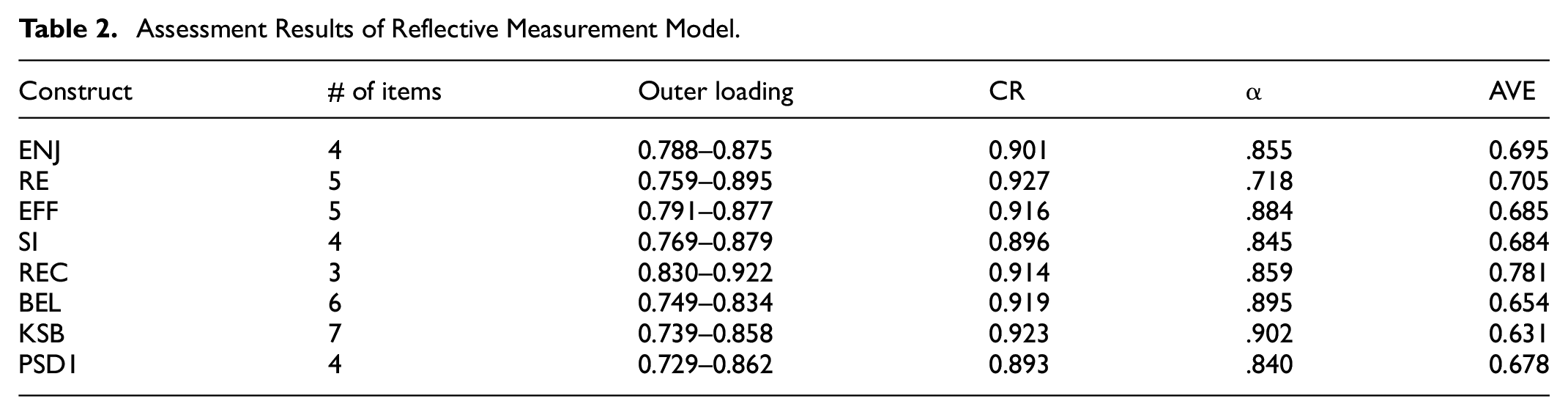
Hair et al. (2019) suggested that Cronbach’s alpha (α) and Composite Reliability (CR) should be above 0.7 to ensure consistency and constructed reliability. As shown in Table 2, the results on Cronbach’s alpha are in an acceptable range of .70 and above (study outcomes have shown a result from .718 to .902). The composite reliability findings are between 0.89 and 0.9, which satisfy the acceptance value of 0.70 and above (see Table 2). This implies that all constructs have internal consistency and reliability. The result for average variance extracted (AVE) is between 0.63 and 0.78, which meets the acceptance value of 0.50 or higher to assure convergent validity (Hair et al., 2019).
Finally, all HTMT values, as shown in Table 3, are below the 0.90 HTMT threshold value indicated by Hair et al. (2019). In addition, the HTMT ratio values indicate that neither the lower nor upper confidence interval (CI) contains the number 1. Therefore, the discriminant validity of the measure is obtained.
Correlation, AVE, and Heterotrait-Monotrait (HTMT) Ratio Values.

Source. The data analysis of the authors.
Note. Correlations and Heterotrait-Monotrait (HTMT) ratio are at the lower and upper of the diagonal, respectively; the square roots of AVE are highlighted in bold.
Evaluation of the Structural Model
After conducting validity and reliability studies, a measurement model was established. The structural equation model was used to examine the endogenous variable variances of KSB and PSD. R2 weight of endogenous constructs was measured to assess the variation in the endogenous variable accounted for by exogenous variables (Hair et al., 2014). Next, a predictive relevance measure was employed to assess the model fit. This study evaluated the clarity indicators of hidden constructs using cross-validated redundancy and Q2 value. Q2 value was obtained to evaluate the predictive significance of the constructs through the PLS approach’s blindfolding technique (Hair et al., 2014). The Q2 value was greater than zero, indicating an acceptable fit for an endogenous variable, and the predictive validity of the model was confirmed (Hair et al., 2019). Cross-validated redundancy for KSB was 0.398, and for PSD it was 0.376. A high degree of predictive relevance shows the model’s fit.
The t-value was then computed using a bootstrapping approach with a resample of 1,000 (Becker et al., 2023; Hair et al., 2014) to test the proposed hypothesis. According to the rule of thumb for testing two-tailed hypotheses, the t-value must exceed 1.96 (level of significance of 5%), 2.57 (level of significance of 1%), and 3.291 (level of significance of 0.1%; Hair et al., 2019). Moreover, p-values must be less than .05.
Table 4 presents the path coefficients of different constructs and their significance levels. KSB was found to have a positive and direct association with ENJ, EFF, REC, and BEL. In details, REC had the greatest effect (
Hypotheses Testing.

Note. Significance level where, *p < .05. **p < .01. ***p < .001.
The results suggested that PSD has a direct and positive relationship with three factors: EFF, SI, and KSB. EFF had the greatest effect (
Table 4 further illustrates the indirect relationship between individual and social factors (ENJ, RE, EFF, SI, REC, and BEL) and PSD, as mediated by KSB. KSB had mediated effects on three individual and social factors (EFF with
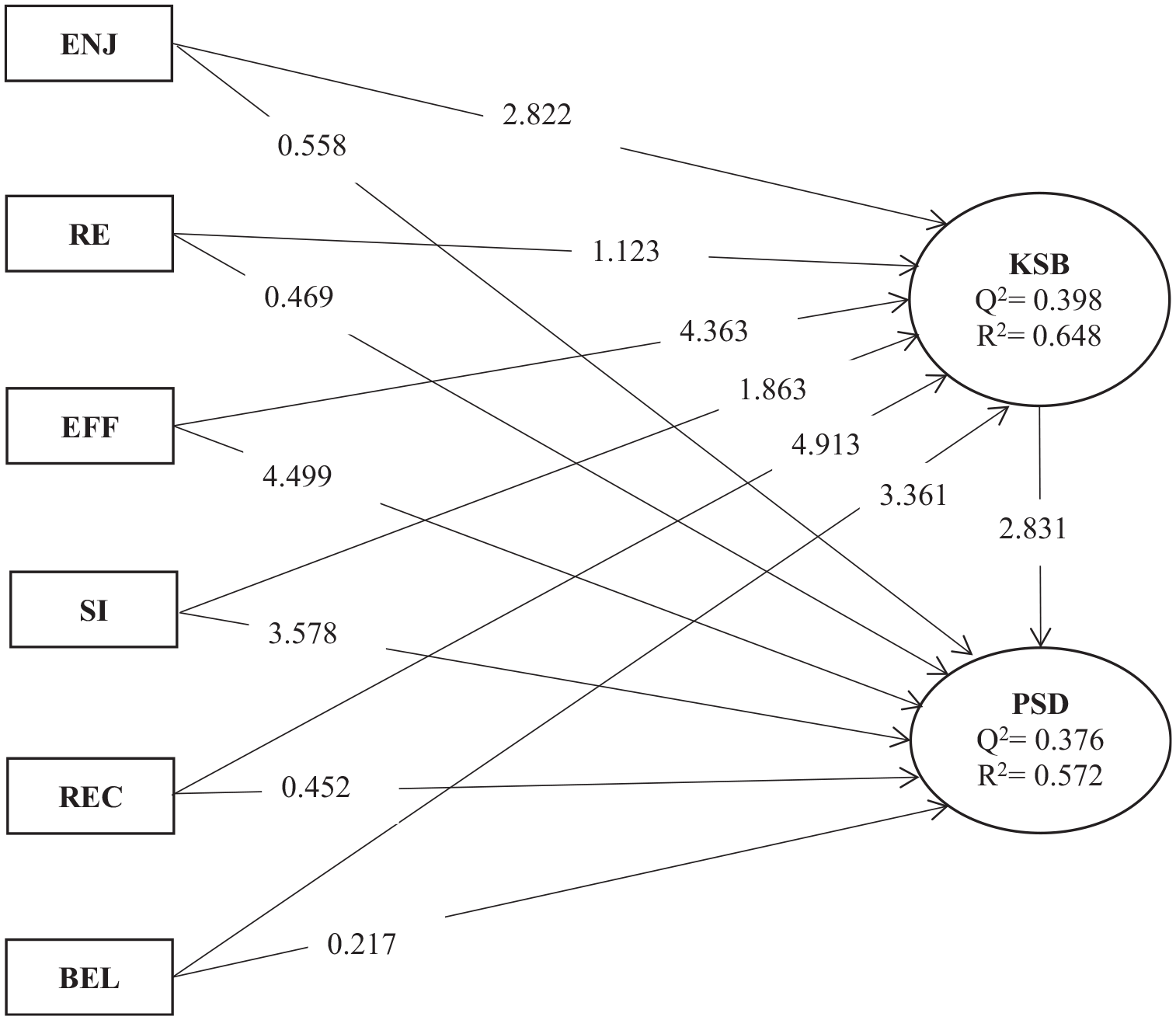
Path coefficients of hypotheses testing.
The Relationship Between Individual and Social Factors and Knowledge Sharing Behavior
The results revealed several significant influences on KSB. Specifically, self-enjoyment (H1a), self-efficacy (H1c), reciprocity (H1e), and trust (H1f) were found to have positive effects on KSB, consistent with previous research (Ngoc-Tan & Gregar, 2019; T.-M. Nguyen et al., 2022; Titi Amayah, 2013), with reciprocity having the most significant impact. These findings contribute to the existing literature by extending the understanding of the factors that motivate individuals to engage in KSB within public organizations. The findings also reinforce TPB, particularly the role of attitudes (self-enjoyment, trust), subjective norms (reciprocity), and perceived behavioral control (self-efficacy) in influencing knowledge-sharing intentions (Ajzen, 2020). Interestingly, factors associated with perceived behavioral control (reputation enhancement) and subjective norms (social interaction) either have a negative impact or show no significant effect on KSB.
Despite the existing literature suggesting that reputation enhancement positively influences KSB, this study revealed a negative relationship (H1b). This result aligns with the studies conducted by Chang et al. (2015) and T.-M. Nguyen et al. (2022). However, it contradicts Chung and Anh’s (2022) findings that reputation enhancement promote KSB in public universities, particularly in cultures that emphasize collectivism like Vietnam. The explanation for this inconsistency may lie in the context of Vietnamese public organizations, where the perceived benefits of reputation are not favorable due to concerns that colleagues may hold negative opinions and provide unsupportive responses (Anh-Vu et al., 2022; Vu et al., 2019).
In contrast to previous studies such as Kwahk and Park (2016) and T.-M. Nguyen et al. (2021), which identified social interaction as a social factor influencing KSB, this study discovered that social interaction (H1d) had an insignificant influence. This result is consistent with the findings of T.-M. Nguyen et al. (2021), who also found that social interaction does not necessarily influence KSB. A possible explanation is that, in many public organizations in Ho Chi Minh City, the physical layout of offices discourages open collaboration and knowledge exchange. This may prevent employees from engaging in informal interactions and hinder their capacity to share knowledge effectively. This unexpected correlation may also be explained by differences in organizational culture in Vietnam, where hierarchical structures may limit open knowledge exchange (Y. T. Tran et al., 2024).
The Relationship Between Individual and Social Factors and Public Service Delivery
This study provided one of the first investigations of the individual and social factors that influence PSD in public organizations. The results revealed that self-efficacy (H2c) and social interaction (H2d) positively influence PSD. This is consistent with previous research, such as the study by Mustafa et al. (2019) and C. Su (2021), which highlights the significance of individuals’ confidence in their abilities and their close relationships with others in attaining high performance. These findings align with EVT, which posits that individuals are motivated to engage in behaviors when they expect success and value the outcomes (Wigfield & Cambria, 2010). Public servants with higher self-efficacy are more likely to engage in behaviors that they believe will improve PSD, and those who value social interaction perceive collaboration as beneficial for achieving service outcomes.
However, it is noteworthy that self-enjoyment (H2a), reputation enhancement (H2b), reciprocity (H2d), and trust (H2e) do not exert a significant influence on PSD within the context of public organizations. This finding suggests that the enjoyment derived from sharing knowledge with colleagues does not directly translate into enhanced PSD. Additionally, the perceived advantages of reputation and reciprocity in Vietnamese public organizations may not be desirable (Anh-Vu et al., 2022). Moreover, trust among public servants may affect interpersonal relationships and collaboration more than it directly impacts service outcomes (T.-M. Nguyen et al., 2021; C. Su, 2021).
The Relationship Between Knowledge Sharing Behavior and Public Service Delivery
The results of the study revealed a significant relationship between KSB and PSD (H3), supporting the framework proposed by Ismail and Yusof (2010) and aligning with the arguments made by Singh et al. (2020) and Tahleho and Ngulube (2022) regarding the potential of KSB to enhance PSD. The study contributes to the literature by exploring the positive association between KSB and PSD. Accordingly, employees who actively participate in knowledge sharing possess specific individual and social characteristics that enhance the quality of their service delivery, as supported by previous studies such as Kwahk and Park (2016) and T.-M. Nguyen and Malik (2022). Notably, this study goes beyond existing research by highlighting the role of KSB in enhancing public servants’ perceptions of their own service provision. By leveraging EVT, public organizations can design incentive structures that align public servants’ expectations with desired knowledge-sharing outcomes, thereby improving PSD.
In addition, the intriguing mediating effects of KSB cast light on the relationships between self-efficacy (H4c), reciprocity (H4e), trust (H4f), and PSD, all of which are full mediation effects except for the case of self-efficacy, where only a partial mediation effect was observed. The results resonate with Akram et al. (2020), who identified the mediating role of KSB in innovative work behavior. Similarly, this study demonstrates KSB’s mediation effect between individual and social factors and PSD and expands the understanding of the mediating role of KSB in organizational settings. The findings imply that when employees have higher levels of self-efficacy, engage in reciprocal relationships, and trust their colleagues, their KSB becomes a key mechanism through which these factors positively impact PSD. However, the study found no mediating effects of KSB relating to self-enjoyment (H4a), reputation enhancement (H4b), and social interaction (H4d). This suggests that the intrinsic satisfaction derived from sharing knowledge, the pursuit of reputation enhancement, and the influence of social interaction may not directly translate into improved PSD. These results are attributable to contextual factors unique to Vietnamese public organizations, such as subjective evaluations, ambiguous evaluation metrics for reputation, and limited opportunities for social interaction within hierarchical structures (Anh-Vu et al., 2022; Vu et al., 2019).
Contribution, Limitations, and Future Studies
In the context of ongoing downsizing and restructuring efforts in public organizations in Vietnam (Pham et al., 2024), this study contributes valuable insights to the debate on improving PSD (Y. T. Tran et al., 2024). By examining the relationship between KSB and PSD, this research provides significant theoretical implications and practical managerial insights to inform decision-making in public sector organizations.
Theoretical Implications
First, this research identifies individual and social factors that influence KSB in public organizations in Ho Chi Minh City, Vietnam. Each individual’s traits, interests, and experiences shape their perceptions, opinions, and behaviors, which drive TPB-compliant knowledge-sharing practices. These insights highlight the fundamental factors (self-enjoyment, self-efficacy, reciprocity, and trust) that play a crucial role in facilitating KSB. In addition, this study is among the first to investigate the impact of individual and social factors, such as self-efficacy and social interaction, on PSD in the Vietnamese public sector. It contributes to a deeper understanding of how motivational factors can drive service delivery outcomes in an underexplored regional context.
Second, the study extends the application of EVT by demonstrating that public servants’ expectations of success and the value they place on self-enjoyment, self-efficacy, reciprocity, and trust significantly influence KSB, which in turn enhances PSD. This contribution is particularly relevant in the public sector, where these motivational factors have not been sufficiently explored. Many studies have overlooked the key role public servants play in contributing their competencies, perspectives, and experiences to improve collective PSD (Y. T. Tran et al., 2024).
Thirdly, this study addresses a key gap in the literature by examining the mediating role of KSB in the relationship between six individual and social factors and PSD in the context of Vietnamese public organizations. While previous research has explored KSB in private sector contexts, its role in enhancing PSD in public service organizations has been underexplored, particularly in Southeast Asia. This lends credence to the notion that, while views of individual and social qualities vary and are adaptable among public employees, they may facilitate KSB in public organizations, hence enhancing the perception of public servants’ PSD performance.
Few studies have provided a validated research model that examines the interrelationships between individual and social characteristics, KSB, and PSD within a unified framework. Therefore, the validated model and findings of this study can serve as a foundation for future research in public organizations.
Managerial Implications
Beyond its theoretical contributions, this study offers practical insights for public service management. It suggests that fostering self-efficacy and enhancing social interaction can lead to improved PSD outcomes. These practical recommendations are grounded in EVT, which highlights the importance of aligning employee expectations with organizational goals to drive performance. By building public servants’ confidence in their abilities, organizations can empower them to share knowledge more effectively, ultimately improving service outcomes. From an economic standpoint, improved PSD can lead to enhanced public perception, more efficient resource allocation, and increased productivity. This, in turn, can lead to increased citizen satisfaction and trust in government institutions.
Furthermore, managers and policymakers must recognize the importance of KSB as a mechanism through which factors such as self-efficacy, reciprocity, and trust influence PSD. Strategies should focus on creating platforms for information exchange, providing incentives for KSB, and fostering a culture that prioritizes collaboration and continuous learning. Policymakers should also consider potential barriers and contextual factors that may hinder KSB, such as subjective evaluations and hierarchical structures. By integrating these insights into policy formulation and implementation, governments can create an enabling environment that encourages effective KSB and ultimately enhances the quality of PSD.
Limitations and Future Studies
This study has certain limitations that provide opportunities for further research. First, this research only adopted six components from two primary dimensions in the four-dimensional model proposed by T.-M. Nguyen (2021) to describe KSB in public organizations. Although the explanation has been provided, it is possible that the nature of KSB has not been completely characterized. Future research may include other dimensions or groups of components to provide a dynamic perspective on KSB. Second, all the variables in the research model are associated with the perceptions of public servants, which are subject to change over time. Therefore, longitudinal study is suggested in order to establish or reinforce the correlations between the variables. In addition, it is advised that the impact of the six factors and KSB in creating improved PSD be examined further in the context of other cities or provinces in Vietnam. Third, the sample was chosen using the convenience and snowball sampling methods. This research only included public servants who gave their permission to complete the questionnaire. However, future research may use other sample selection methods, such as random probability sampling. Furthermore, the data was gathered from public servants from three organizational levels with different working experiences to construct a complete picture of PSD in Ho Chi Minh City. Future studies should include organizational levels and working experiences as control variables and further investigate how they affect the relationships between the variables in the study. Finally, most of what has been discussed so far has concerned voluntary KSB. However, the dark side of KSB, or knowledge hoarding (Holten et al., 2016), wherein people decide not to share knowledge for value creation or participate in activities designed to increase their own power and influence by keeping that knowledge to themselves, should be investigated, as it could be a powerful explanation for why certain factors in the study did not influence PSD.
Conclusion
This study contributes to the understanding of individual and social factors, KSB, and PSD in Vietnamese public organizations, specifically in Ho Chi Minh City. The study’s unique contribution lies in integrating TPB and EVT to offer a comprehensive framework for analyzing the complex relationships among these factors. Particularly, the study identifies self-enjoyment, self-efficacy, reciprocity, and trust as key motivators influencing KSB among public servants, and highlights the role of self-efficacy and social interaction in promoting PSD. In addition, the research emphasizes the vital role of KSB in improving PSD and the importance of KSB as a mechanism through which self-efficacy, reciprocity, and trust positively influence PSD. The results clarify the need for investments in strategies that promote KSB within public organizations.
As a result, managers and policymakers should prioritize strategies and policies that facilitate KSB, including establishing platforms for information exchange, offering incentives, and promoting a culture of collaboration and continuous learning within organizations. While certain limitations should be acknowledged, this study paves the way for future research in the field. It recommends investigating additional dimensions of KSB, undertaking longitudinal studies to establish causal relationships, and examining the research framework in a variety of sectors and contexts. Public organizations can strive for more efficient, effective, and citizen-centric service delivery, by adopting these insights and expanding upon the validated research model.
Footnotes

Ethical Considerations
This research did not require formal approval from an ethics committee as it involved non-sensitive, anonymous survey data collected from public servants in their professional roles. All procedures complied with recognized ethical standards for social science research.
Consent to Participate
Informed consent was obtained from all participants prior to their involvement in the study. Participants were clearly informed about the purpose of the research, their rights, and the use of their data. Consent was provided through a confirmation checkbox on Google Forms and an included consent section in the paper-based questionnaire.
Funding
The author(s) received no financial support for the research, authorship, and/or publication of this article.
Declaration of Conflicting Interests
The author(s) declared no potential conflicts of interest with respect to the research, authorship, and/or publication of this article.
Data Availability Statement
Data sharing not applicable to this article as no datasets were generated or analyzed during the current study.