




Abstract
This work looks into the effects that extreme situations have on the consumption of local products. The COVID-19 pandemic has led to significant changes in consumer behavior where food and especially local produce are concerned. To explain these changes, we used the Goal-Framing Theory as an overarching framework for other approaches such as the Theory of Planned Behavior and the ABC Model, including the effect of consumer resilience to adversity. The research applied to local wine and involved a sample of 762 consumers from the Canary Islands. The hypotheses were tested using the PLS structural equation technique. The main results confirm that there is a change in behavior toward greater consumption of local wine due to the impact of said pandemic, mainly motivated by consumer resilience to adversity and attitude toward the local product, also influencing the personal norm.
Keywords
Introduction
The World Health Organization declared a pandemic in March 2020 (World Health Organization, 2020) as a result of an outbreak of the infectious disease COVID-19, caused by the coronavirus SARS-CoV-2. This disease was detected in China and quickly spread around the world, seriously disrupting the lives of individuals and bringing entire societies to a standstill. To try to stop transmission, countries had to adopt containment measures such as social distancing, self-isolation, teleworking and stopping all non-essential activities (Maliszewska et al., 2020). This resulted in a widespread economic recession (McKibbin & Fernando, 2020) and a considerable change in shopping and consumption habits (Sheth, 2020). The agri-food sector, in particular, was affected both on a local and worldwide scale by the trade policies of some governments, moving toward the restriction of exports and the facilitation of imports (Aday & Aday, 2020), evidencing the importance of local products and short-food supply chains (Cappelli & Cini, 2020). Therefore, due to the significant impact that extreme situations like this can have on consumer habits, it is important and also convenient to understand the changes in consumer behavior regarding local products throughout the pandemic.
Different theoretical approaches like the Theory of Planned Behavior (TPB) (Ajzen, 1991) and the Attitude-Behavior-Context Model (ABC Model) (Guagnano et al., 1995) have been used as powerful explanatory models of local product consumption behavior through attitude, subjective norm, perceived behavioral control, and contextual factors (Manalu & Adzimatinur, 2020; Vabø & Hansen, 2016; Zepeda & Deal, 2009). However, the literature lacks different explanatory perspectives on the consumption of local products. During the COVID-19 pandemic, an academic research trend emerged looking into the consumption of local products (Butu et al., 2020; Castellini et al., 2021; Nemes et al., 2021; Palau-Saumell et al., 2021; Petetin, 2020; Skalkos et al., 2021; Sulhaini, 2021; Zhang et al., 2022), but it is difficult to find studies that have considered the effects of context, such as that of the pandemic, on local product consumption behavior.
Therefore, to fill this gap in the research, the proposal put forward for this study is to find out what the effects are on consumer behavior in terms of local products in extreme situations, such as the COVID-19 pandemic. We also aim to see how these changes can be explained by the Goal-Framing Theory (GFT) (Lindenberg, 2001) as a framework in which to include other theoretical approaches like the TPB (attitude, subjective norm and perceived behavioral control) and the ABC Model (attitude, behavior and contextual factors), adding several antecedents that impact the attitude toward the consumption of local products (consumer ethnocentrism, place identity and personal norm) and investigating the effect of consumer resilience to adversity. In other scopes of application, several authors have identified the GFT as an appropriate overarching framework for understanding consumer behavior (Hameed & Khan, 2020; Liobikienė & Minelgaitė, 2021; Wang et al., 2022). GFT differs from these other theoretical perspectives in its focus on the formation and impact of goal frameworks on consumer behavior (Lindenberg, 2001). By integrating these theoretical perspectives, we hope to gain a more complete understanding of the factors that influence consumer behavior, considering both individual beliefs and relevant contexts and frames of reference.
This study looked into wine as a local product. There are several reasons for this decision. Firstly, the purchase choice of this beverage is much more complex compared to other products due to the wide variety of options, the combination of factors in its production or subjective assessment, among other factors (Lockshin & Corsi, 2012). Secondly, the country and region from which a wine originates are decisive in purchase decisions (Hollebeek et al., 2007). Third and finally, this product plays a crucial role in fostering economic and social progress in numerous regions (Luisa González-SanJosé et al., 2017).
Research into wine consumption habits during or after extreme situations like earthquakes (Forbes & Wilson, 2018), forest fires (Thach & Eyler, 2017), terrorist attacks (Gergaud et al., 2018) and financial crises (de Goeij et al., 2015) have shown that there is a significant increase and decrease in the consumption of this product. Along these lines, various investigations have been published on the behavior of wine consumption during the COVID-19 pandemic. However, most of these studies (Agnoli & Charters, 2022; Dubois et al., 2021; Logodashki, 2020; Rebelo et al., 2021; Vergamini et al., 2021) did not take into account the origin of the product, except in the case of Miftari et al. (2021), who studied the intention to buy Albanian and Kosovar wine during the pandemic but did not analyze the effect of context. These studies confirmed both increases and decreases in wine consumption.
To achieve the proposed objectives, we conducted quantitative research using a self-administered online survey applied to residents living in the Canary Islands, a region of Spain, over 18 years of age who consume wine. We obtained a valid sample of 762 people. The proposed theoretical model analysis was performed using Partial Least Squares Structural Equation Modelling (PLS-SEM).
The Canary Islands have been chosen as a place of study for various reasons. This region has an important history and winemaking tradition, and its wines are internationally recognized thanks to their microclimates, volcanic soils and autochthonous varieties such as Listán (Negro y Blanco), Malvasía Volcánica, Vijariego (Negro y Blanco), Baboso (Negro y Blanco), Albillo Criollo, Marmajuelo, Forastera Gomera, Negramoll and Gual, among others (Siverio et al., 2021). The Canary Islands produce an average of 10 million liters of wine per year on 6,757 hectares, with 320 wineries and 8,000 viticulturists (Siverio et al., 2021). In addition, important restrictions were also applied in this territory due to the COVID-19 pandemic, which provides an ideal scenario to check if there have been changes in the behavior of local wine consumption due to this extreme situation.
This work is set out as follows: in the next section, we will present the theoretical context and hypotheses relating to the characterization and antecedents of the effects on consumer behavior regarding local products in extreme situations, such as the COVID-19 pandemic; we will then present the measurement model, the sample structure and characteristics and the methodological approach, before reporting the empirical results; finally, we present our conclusions with the main contributions and discuss the implications of this study for future research.
Literature Review
Theoretical Background
In the scientific literature, several theories are recognized as powerful explanatory models of wine consumption behavior. The TPB (Ajzen, 1991) is one of the most widely used for this purpose, examining how the attitude toward wine (e.g., perception of its taste, quality, or health benefits), subjective norm (such as the influence of friends, family, or wine experts), and perceived behavioral control over wine consumption wine (such as the ability to access it or control the amount consumed) are positively related to intention and behavior of buying and drinking wine (Agnoli et al., 2016; Caliskan et al., 2021; Miftari et al., 2021; Patrícia Silva et al., 2014; Sabina Del Castillo et al., 2021; Scuderi et al., 2020; Tomić Maksan et al., 2019; van Zanten, 2005; Yang & Paladino, 2015).
The GFT (Lindenberg, 2001) and the ABC Model (Guagnano et al., 1995) have also been applied to similar research into wine. The GFT focuses on goal setting and goal pursuit as key motivators of human behavior. This theory holds that setting specific and challenging goals can improve a person’s performance and motivation and distinguishes between three goal frameworks: hedonic, gainful, and normative (Lindenberg, 2001). In the context of wine, it has been applied to understand consumer buying behavior concerning organic wines (Taghikhah et al., 2020). In our study, we used the GFT to understand how goal setting related to local wine consumption, in the context of the COVID-19 pandemic, can influence attitudes toward the local product and, ultimately, the consumption behavior. The ABC Model incorporates the contextual factor as an integral part of the decision-making process and behavior. This approach recognizes that individual behavior does not occur in a vacuum, but rather is influenced by external or contextual factors (Guagnano et al., 1995). By integrating attitude, behavior and contextual factors, the ABC Model provides a complete theoretical framework for explaining and understanding individual behavior in wine consumption. For example, to check the intention to purchase organic wines based on two factors; attitude and tolerance for ambiguity (Jorge et al., 2020).
There is an unfilled gap in the research in terms of the integration of different perspectives that explain the consumption of local products and how extreme situations like the COVID-19 pandemic affect this. In this study, the GFT is proposed as an overarching framework in which the TPB and the ABC Model form a theoretical model with eight constructs. This integration could allow a more complete and in-depth understanding of the behavior of local wine consumption during the COVID-19 pandemic. Theoretical perspectives address different psychological, social, and contextual aspects that influence local wine consumption intention and behavior, providing a solid framework for analyzing and understanding this specific phenomenon.
Personal Norm
The concept of personal norm (PN) refers to an individual’s internal sense of moral obligation to behave in a specific manner, as defined by Schwartz and Howard (1981). Not acting in accordance with the personal norm often leads to feelings of guilt and disloyalty to oneself (Schwartz, 1977; Steg, 2016). The personal norm is generally stronger when individuals are more convinced that their actions help to alleviate a crisis (Steg, 2016; Steg et al., 2014; Stern, 2000).
It has been confirmed that the personal norm can affect the formation of positive attitudes toward the consumption of both ecological products (Chen & Chai, 2010) and local products (Feldmann & Hamm, 2015; Sabina Del Castillo et al., 2021). We, therefore, propose the following hypothesis:
Hypothesis 1 (H1): There is a significant positive relationship between the personal norm and attitude towards local products.
Place Identity
When people have a sense of place identity, they experience an emotional connection with that place, deeply identify with it, and feel a sense of belonging (Proshansky, 1978). According to Yildiz et al. (2018), consumers who possess a strong sense of commitment to their local community are inclined to support local products through their purchasing choices.
This concept is also studied as national identity (e.g., Blank & Schmidt, 2003), which refers to how a person identifies with and feels a positive link to their own country, placing significant importance on this sentiment (Feather, 1981; Tajfel, 1974). Products originating from their country are often preferred by consumers who have a strong national identity (Zeugner-Roth et al., 2015). Nguyen et al. (2012), for instance, demonstrated that the national identity of Vietnamese consumers has a positive impact on the perceived value of wine produced in their country. Based on such findings, we put forward the following hypothesis:
Hypothesis 2 (H2): There is a significant positive relationship between place identity and attitude toward local products.
Consumer Ethnocentrism
Consumer ethnocentrism (CE) is defined as consumers’ beliefs regarding the appropriateness and morality of buying a product made abroad and loyalty toward products made in their own region (Shimp & Sharma, 1987). A high level of consumer ethnocentrism cultivates positive attitudes toward local products (e.g., Salman & Naeem, 2015; Westjohn et al., 2012; Yildiz et al., 2018), and the purchase of foreign products is avoided as this would be unpatriotic and damaging to the local economy (Durvasula et al., 1997; Verlegh, 2007).
A positive relationship has been observed in various studies between consumer ethnocentrism and attitudes toward the consumption of regional wine (e.g., Miftari et al., 2021; Sabina Del Castillo et al., 2021; Tomić Maksan et al., 2019). Based on these results, we put forward the following hypothesis:
Hypothesis 3 (H3): There is a significant positive relationship between consumer ethnocentrism and attitude toward local products.
Attitude Toward Local Products
Attitude (AT) refers to the extent to which an individual holds a favorable or unfavorable opinion of a product, reflecting a set of preferences for the product and leading to positive or negative intentions toward purchasing it (Ajzen, 1991; Caldwell et al., 2006). Extensive research has demonstrated a significant positive association between attitude and the intention to consume local products (e.g., Çabuk et al., 2014; Campbell, 2013; Qing et al., 2012), including local wine (Gultek et al., 2005; Kolyesnikova et al., 2008).
The COVID-19 pandemic has led consumers to increasingly value the economic benefits, safety, and community connection offered by local products, leading to significant changes in their attitudes toward these brands or products (Palau-Saumell et al., 2021; Zhang et al., 2022). Taking into account the above, we have formed the following hypothesis:
Hypothesis 4 (H4): There is a significant positive relationship between attitude toward local products and local wine consumption behavior due to the impact of the COVID-19 pandemic.
Subjective Norm
Subjective norm (SN) is the feeling that a person has regarding social pressure from their peers (Park, 2000) and that can easily shape their behavioral intention (Ajzen, 1991; James et al., 2009). They play a fundamental role in food consumption behavior (Khayyam et al., 2021; Shen & Chen, 2020; Sultan et al., 2020), including that of local products (Shin & Hancer, 2016).
Numerous authors have been able to verify that the subjective norm of consumers positively affects their intention to consume wine (e.g., Agnoli et al., 2016; Bonn et al., 2016; Caliskan et al., 2021; Patrícia Silva et al., 2014) and local wine (Sabina Del Castillo et al., 2021; Santisi et al., 2018; Scuderi et al., 2020). Due to the COVID-19 pandemic, individual behavior has been influenced and shaped by social pressure, leading shoppers to prioritize sustainable and local brands when making their purchases (Alexa et al., 2021). We, therefore, propose the following hypothesis:
Hypothesis 5 (H5): There is a significant positive relationship between subjective norm and local wine consumption behavior due to the impact of the COVID-19 pandemic.
Perceived Behavioural Control
Perceived behavioral control (PBC) encompasses an individual’s perception of their capability to engage in a specific behavior and their subjective assessment of the ease or difficulty in accomplishing it (Ajzen, 1991). Numerous studies have substantiated the positive relationship between perceived behavioral control and the intention to purchase local products, as demonstrated by Shin and Hancer (2016).
Moreover, this link extends to the intention to consume wine, as evidenced by studies conducted by Agnoli et al. (2016), Capitello et al. (2014), De Magistris et al. (2015), Thompson and Barrett (2016), and specifically, national and local wine, as found in the works of Tomić Maksan et al. (2019) and Sabina Del Castillo et al. (2021) Therefore, we put forward the following hypothesis:
Hypothesis 6 (H6): There is a significant positive relationship between perceived behavioral control and local wine consumption behavior due to the impact of the COVID-19 pandemic.
Consumer Resilience to Adversity
Consumer resilience to adversity (CRA) refers to the consumer’s ability to successfully adapt to and overcome adversity and challenging circumstances (Newman, 2005), such as the COVID-19 pandemic. People use emotions to assess any change or crisis in their lives and they may modify their product purchasing behavior depending on the level of perception of risk of the COVID-19 pandemic (Khoi & Long, 2020). Studies that have measured concern about or the perceived risk of a said pandemic in consumer behavior have confirmed that it can influence attitudes and purchase intentions (Akar, 2021; Akter, 2021), even in the case of local products (Palau-Saumell et al., 2021).
Rebelo et al. (2021) concluded that when faced with an unprecedented situation like the COVID-19 pandemic, people who previously drank wine for pleasure consumed it more often as a way to deal with the unpleasant situation. Therefore, we put forward the following hypotheses:
Hypothesis 7 (H7): There is a significant positive relationship between consumer resilience to adversity and attitude toward local products.
Hypothesis 8 (H8): There is a significant positive relationship between consumer resilience to adversity and local wine consumption behavior due to the impact of the COVID-19 pandemic.
Proposed Theoretical Model
Taking into account the theoretical antecedents, Figure 1 shows the proposed theoretical model for studying the impact of the COVID-19 pandemic on local wine consumption (PILC). We propose that the pandemic’s impact on local consumption depends on three variables of the TPB (perceived behavioral control, subjective norm and attitude) and on consumer resilience to adversity. In turn, three of these constructs form the ABC Model: “Attitude,” represented by attitude toward local products; “Behavior,” constituted by the COVID-19 pandemic impact on local wine consumption; and “Contextual Factors” presented as consumer resilience to adversity. It also includes the direct and positive relationships between consumer ethnocentrism, place identity and the personal norm and attitude toward local products, all of which make up the “normative goal frame” of the GFT, whilst the “gain goal frame” is made up of perceived behavioral control, subjective norm and attitude toward local products.

Proposed theoretical model.
Methodology
Data Collection
To accomplish the intended goals, an online survey was carried out during the second half of 2020, in the midst of the COVID-19 pandemic. The survey was self-administered and facilitated through the services of Toluna, an Internet panel company (www.toluna-group.com).
A total of 762 individuals were included in the sample, all of whom completed the survey and met the requirements of this study. Internet panels are frequently used due to their efficacy in the collection of data. This is thanks to the wide availability of the Internet among different groups of the general population and its efficiency, given that this is a low-cost way of gathering data (Roster et al., 2004). Furthermore, data obtained from the Internet exhibits a level of representativeness comparable to that of data derived from probability samples of the general population (Liu et al., 2010).
To participate, people must meet certain criteria, including being over 18 (the legal drinking age) and being a frequent wine drinker, defined as a minimum consumption of wine every 15 days. The participants were selected from residents living in the Canary Islands, a region of Spain. Recruitment was carried out by sending an email to all of the potential participants in the Toluna databases, who would then be included in the study following a meticulous selection process to ensure their eligibility.
Measurements
The survey consisted of 37 questions and was designed following the guidelines of Ajzen (2013) and after an exhaustive review of the literature. Items were scored on a 7-point Likert scale with values ranging from “strongly disagree” (1) to “strongly agree” (7). The items of the measurement model are presented in Table 2.
To measure attitude, subjective norm and perceived behavioral control, we used items similar to those proposed by Tomić Maksan et al. (2019). Consumer ethnocentrism was evaluated using an adapted version of the CETSCALE developed by Shimp and Sharma (1987). The personal norm was measured by adjusting the items proposed by Vining and Ebreo (1992) and place identity was evaluated using an adaptation of those used by Obst et al. (2002). Given that there are no scales in the academic literature that would have measured consumer resilience to adversity and the impact of the pandemic on local wine consumption in a context similar to that of this work, the items used were adapted from Connor and Davidson’s (2003) resilience scale .
In accordance with Hair et al. (2017), the subjective norm, attitude, place identity and personal norm were formulated as Mode A reflective constructs given that the indicators were expected to correlate. The impact of the pandemic on local wine consumption perceived behavioral control, consumer ethnocentrism and consumer resilience to adversity was formulated as Mode B formative constructs, as it was predicted that the indicators would not correlate and would be an approximation to the formative measurement model.
Sample Structure
Table 1 provides an overview of the surveyed individuals’ demographics. Among the sample population, 43.2% were women and 56.8% were men. The age distribution was as follows: 9.4% were aged 18 to 24, 22.8% were aged 25 to 34, 26.4% were aged 35 to 44, 23.4% were aged 45 to 54, and 18.0% were over 55. In terms of education, 0.7% reported having a basic or primary education, while 36.5% had a secondary education, baccalaureate, or vocational training, and 62.9% had attended university. Regarding their residence, 7.5% were from La Palma, 3.7% were from El Hierro, 3.0% from La Gomera, 43.3% were from Tenerife, 28.3% from Gran Canaria, 6.0% from Fuerteventura, and 8.1% from Lanzarote. Participants’ perception of their income was used to measure their level of income, with 17.7% considering it below average, 61.3% perceiving it as average, and 19.7% considering it above average. In terms of wine consumption frequency, 22.8% reported consuming wine once every 15 days, 31.7% at least once a week, 36.9% several times a week, and 8.6% on a daily basis.
Profile of the Sample.

According to G*Power (Faul et al., 2009), it is recommended that a minimum sample size of 160 individuals is required to achieve a statistical power of 0.95 when testing the proposed model consisting of eight constructs. However, the sample size used in this study (p. 762) greatly exceeds the requirements for this research.
In addition, to analyze the proposed theoretical model and test the underlying hypotheses, we conducted Partial Least Squares Structural Equation Modelling (PLS-SEM) using the software SmartPLS v.4.0.8.5 (Ringle et al., 2022). In order to balance the sample with the population structure based on the size of each island’s population, a weighting vector was employed during the calculations. The proposed model incorporates both reflective constructs (mode A) and formative constructs (mode B), which supports the suitability of employing the PLS technique for its analysis (Chin, 2010; Sarstedt et al., 2017).
Results
Descriptive Analysis
Table 2 contains the construct items of the proposed model and the corresponding results of the descriptive analysis (mean and standard deviation) on a scale ranging from 1 (totally disagree) to 7 (totally agree).
Items of the Measurement Model, Descriptive Analysis and Results of the Evaluation.

Mode A Reflective Constructs
The means of the items of the subjective norm (SN) range from 4.19 to 4.86. The attitude (AT) indicators present mean values from 4.73 to 5.06, whereas the place identity (PI) indicators are slightly higher, between 5.25 and 5.42. The mean values of the personal norm (PN) indicators are also slightly higher than average, ranging from 4.43 to 5.14.
Mode B Formative Constructs
The items referring to the impact of the pandemic on local wine consumption (PILC) among the population researched have mean values ranging from 3.97 to 5.32. Wine consumers prove to have an average perceived behavioral control (PBC) with indicators ranging from a mean of 4.33 to 5.13. There is also a level of self-perception of consumer ethnocentrism (CE) that shows some support toward local products with a mean of between 4.20 and 5.03. CRA is below average on the scale at 3.11 to 3.46, which reveals a relatively low consumer resilience to adversity.
Evaluation of the Overall Model
The model’s SRMR (Standardized Root Mean Square Residual) value of 0.058 can be considered acceptable for PLS-SEM, as it is below the threshold of 0.08 (Henseler et al., 2016). Additionally, there is no evidence of multicollinearity among the antecedent variables of each endogenous construct, as all Variance Inflation Factor (VIF) values are below 5. Furthermore, Common Method Bias (CMB) is not a concern in this study, as there was not a single dominant factor (five different factors accounted for 69.4), and the first factor did not explain the majority of the variance (it accounted for 43.9) (Podsakoff & Organ, 1986).
Evaluation of the Measurement Model
Mode A Reflective Constructs
The individual reliability of the indicators for the reflective constructs in Mode A was assessed by examining the loadings (λ) of the items on their respective constructs. As depicted in Table 2, all of the item loadings in the final measurement model surpass the threshold of 0.707 (Carmines & Zeller, 1979). The reliability of the constructs was also examined in this table, and all of the composite reliability values (Dijkstra & Henseler, 2015) exceed the minimum cut-off point of 0.70 (Fornell & Larcker, 1981). Furthermore, all of the latent variables demonstrate convergent validity, as their average variance extracted (AVE) measurements exceed 0.5 (Fornell & Larcker, 1981).
Discriminant validity was assessed by examining the heterotrait-monotrait (HTMT) correlations (Henseler et al., 2015). The results in Table 3 indicate that the examined constructs satisfy the HTMT correlation requirements (values below .85) (Kline, 2011). Thus, the measurement model was deemed satisfactory and provided sufficient evidence of reliability, as well as convergent and discriminant validity.
Discriminant Validity.

Mode B Formative Constructs
In Table 2 we can see that all of the VIF values of the items belonging to the Mode B formative constructs are less than 3.3 (Diamantopoulos & Siguaw, 2006) and, therefore, we can confirm that there is no multicollinearity between the indicators. The contribution and level of significance of these items to the construct can also be verified, keeping all the indicators since, since there is no multicollinearity, excluding a formative indicator would imply omitting part of the composite latent construct (Roberts & Thatcher, 2009).
Finally, the analysis of the weight of the PILC items indicates that item PILC3 is the one that makes the largest contribution (0.890). In the case of PBC, the item that contributes most is PBC2 (0.731). As far as CE is concerned, the most influential item is CE3 (0.866), whilst for CRA it is CRA2 (0.569).
Evaluation of the Structural Model
The estimated relationships of the structural model are represented by the path coefficients. The statistical evaluation of its significance was carried out using bootstrapping (Hair et al., 2011) by testing a one-tailed Student’s t distribution with n-1 degrees of freedom (n = 10,000 subsamples) and also analyzing the intervals of trust (Henseler et al., 2009).
In Table 4 we can see that AT has the greatest direct significant effect on PILC (H4: β = .341, p < .001, f2 = 0.06) with a large effect size (f2). The f2 evaluates the degree to which an exogenous construct helps to explain a specific endogenous construct in terms of R2 (Cohen, 1988). CRA has the next highest significant direct effect on PILC (H8: β = .327, p < .001, f2 = 0.18) with a large effect size (f2). CE has the closest and most significant relationship with AT (H3: β = .338, p < .001, f2 = 0.15), whereby PI shows very similar values on this same construct (H2: β = .311, p < .001, f2 = 0.12), both having a large effect size (f2). None of the constructs in the structural model presents a direct negative relationship.
Results of the Hypothesis Test, Variance Breakdown, Q2 Redundancy and f2 Effect Size.

Note. n = 10,000 subsamples (one-tailed t Student). t (0.05;4,999) = 1,645; t (0.01;4,999) = 2,327; t (0.001;4,999) = 3,092. Confidence intervals [5%–95%]. Effect sizes f2: if>= 0.15 (moderate), if>= 0.02 (small), if <0.02 (negligible).
*p < .05. **p < .01. ***p < .001; ns = non-significant.
As we can see in the same table, hypotheses H5, H4 and H8 are supported empirically although H5 has a lower significance and a medium effect size (H5: β = .110, p < .01, f2 = 0.01), meaning that the influence of SN on PILC is limited. Regarding the hypotheses put forward that are directly related to the latent variables of AT, there is sufficient evidence to accept research hypotheses H3, H2, H1 and H7, although H7 only makes a small contribution with a low significance and medium f2 size, meaning that the influence of CRA on AT is limited.
The determination coefficient (R2) is a measure of the predictive power that indicates the proportion of variance in a construct explained by the predictor variables of that endogenous construct in the model. The proposed model explains 45.7% of the impact of the COVID-19 pandemic on local wine consumption and 47.5% of the variance in attitude toward local products (Table 4). Additionally, we employed the Stone-Geisser test (Geisser, 1975; Stone, 1974) as a criterion to assess the predictive relevance of the construct. The Q2 values in Table 4 are greater than zero, indicating that the model has predictive power.
Importance-Performance Map Analysis
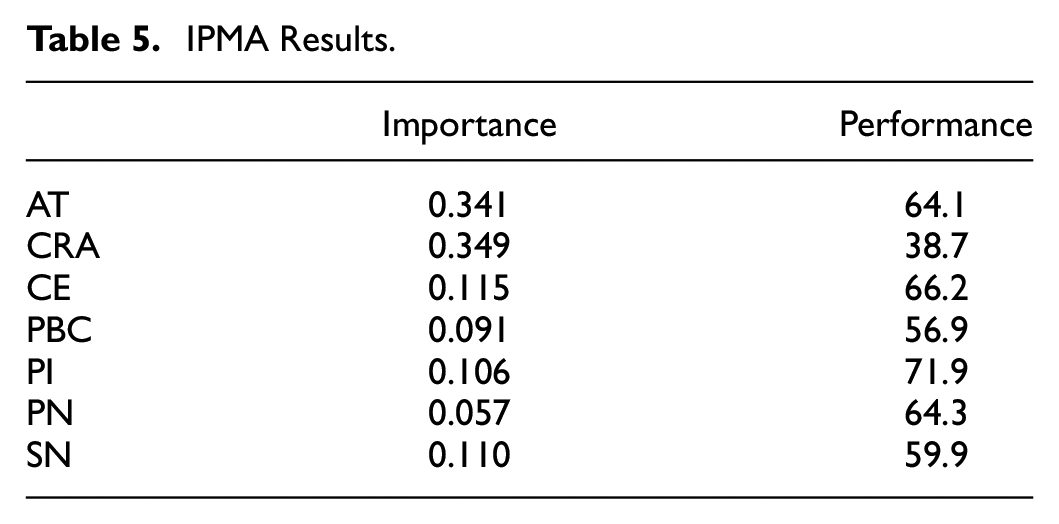
To provide further insights into the PLS-SEM results, we conducted an importance-performance analysis (IPMA) following the approach described by Hair, Sarstedt, Ringle, and Gudergan (2017). This analysis involved plotting the total effect (importance) of the constructs in the structural model, represented by the path coefficients, on the horizontal axis. On the vertical axis, we displayed the performance of each construct, which was obtained by rescaling the latent variable scores to a range from 0 to 100.
In Table 5 we can see that the variables CRA (0.349) and AT (0.341) are those that have the biggest effect when explaining the dependent construct PILC. However, as far as performance is concerned, the variable CRA (38.7%) has more margin for improvement. Therefore, to increase the impact of the COVID-19 pandemic on local wine consumption, CRA must improve, that is, the greater the consumer’s resilience to adversity, the more local wine they will consume.
IPMA Results.
Discussion
The findings of this study confirm that personal norm has a significant positive relationship with the attitude toward local products and corroborate the results of works such as those of Feldmann and Hamm (2015), who confirm this relationship with local foods.
Place identity has also turned out to be a factor that has a significant positive relationship with the attitude toward local products, coinciding with the studies of Zeugner-Roth et al. (2015) and Nguyen et al. (2012) who confirmed that consumers with a strong sense of national identity prefer products from their country of origin.
It is also confirmed that consumer ethnocentrism has a significant positive relationship with the attitude toward local products, in line with the findings of the majority of works that have taken this dimension into consideration, such as García-Gallego et al. (2015), Tomić Maksan et al. (2019), Miftari et al. (2021) and Sabina del Castillo et al. (Sabina Del Castillo et al., 2021).
This research also confirms the significant positive relationship between the attitude toward local products and the COVID-19 pandemic’s impact on local wine consumption. These results ratify those obtained by Palau-Saumell et al. (2021) and Zhang et al. (2022), which reflected that the pandemic has led to the formation of favorable attitudes toward local products.
Subjective norm is a factor that also has a positive relationship with the COVID-19 pandemic’s impact on local wine consumption, confirming the suggestion of Alexa et al. (2021) that the pandemic has shaped people’s behavior due to social pressure.
Contrary to the expectations of this study, perceived behavioral control is not positively related to the COVID-19 pandemic’s impact on local wine consumption. To a certain extent, this finding is related to the results obtained by Miftari et al. (2021) who observed that perceived behavioral control did not have a significant positive impact on the behavior of Albanian consumers toward the purchase of domestic wine during the COVID-19 pandemic.
The results of the study demonstrate that consumer resilience to adversity has a significant positive relationship with the COVID-19 pandemic impact on local wine consumption, and a positive relationship with attitude toward local products, as suggested by Palau-Saumell et al. (2021).
Conclusions
The academic literature consulted in this study shows the importance of local products from an economic, environmental and cultural point of view. Its consumption has a positive impact on the local economy, job creation, environmental sustainability and the preservation of cultural identity. By supporting local products, consumers contribute to the sustainable development of their communities and promote a more conscious lifestyle connected to their environment.
In this work, we have proposed and corroborated an explanatory model of the impact of the COVID-19 pandemic on the consumption of local products, including an overarching framework of three of the theories that are habitually used to study consumer behavior and which reinforce its explanatory power.
Having used wine as the local product for this study, the results confirm that there is a change in behavior toward greater consumption of local wine due to the impact of said pandemic, mainly motivated by consumer resilience to adversity and attitude toward the local product, also influencing the personal norm. Furthermore, attitude toward local products is essentially affected by consumer ethnocentrism, place identity and the personal norm and may also affect consumer resilience to adversity.
These results are promising for local products like wine in their role as economic drivers of a certain region as the COVID-19 pandemic may have contributed to making consumers more aware of their importance for the economy and environment, leading them to choose such products over imported ones.
Therefore, the findings of this study contribute to the knowledge of this subject in a number of ways. Firstly, it provides a theoretical framework that integrates the GFT with the TPB and the ABC Model to explain local wine consumption behavior. Secondly, the contextual factor of the COVID-19 pandemic has been added to the model, enabling us to understand how this extreme situation has affected local wine consumption.
Regarding the implications for management, it allows agents in the wine sector of a region to know and understand consumer behaviors that have been permanently or temporarily modified due to the COVID-19 pandemic. Marketers of local products could focus on consumers with a stronger local identity, associated with trust in the local culture, by using elements of the local traditions. Likewise, in their marketing messages, they could emphasize the superiority of local foods and the positive effects that their consumption has on the region.
Limitations
Given that the effects caused by the COVID-19 pandemic on society have not completely disappeared, people’s feelings may vary; this may reflect changes in behavior leaning toward the consumption of certain foods. This is why it will be necessary to look into the lasting effects and how consumer behavior has changed in terms of local products following the pandemic.
Furthermore, the impact of the COVID-19 pandemic on local foods likely differs from one region to the next, not only depending on the individual but also on political decisions, the level of socio-economic development and the culture. Thus, the need is justified for new studies that explore whether these results are replicated in other regions. Finally, given that those surveyed belonged to a panel, there could be issues of bias due to the selection of the panel members and their representativeness concerning the general population.
Footnotes
Declaration of Conflicting Interests
The author(s) declared no potential conflicts of interest with respect to the research, authorship, and/or publication of this article.
Funding
The author(s) received no financial support for the research, authorship, and/or publication of this article.
Etichs Statement
Ethical review and approval were waived for this study, due to the fact that human interaction is only conducted through an online survey of consumer behaviors.
