




Abstract
Traditional marketing tactics have been significantly challenged by marketers in various areas, especially in the food sector. Firms utilize overt, along with emerging marketing communication strategies in the form of covert marketing, to circumvent customer skepticism and build a good brand image. However, there is limited empirical research that integrates these traditional and novel marketing techniques in green consumerism to develop green purchase intentions and ecologically conscious consumer behavior (ECCB). Therefore, the current study investigates the impact of green product features, green pricing, covert advertising, overt advertising, and guerrilla marketing on purchase intention and ECCB. Furthermore, the study evaluates the moderating impacts of brand evangelism, environmental knowledge and habitat attitude in order to bridge the intention-behavior gap in green consumerism. Data were collected from 568 respondents using the public intercept sampling technique. The participants, who were customers of the frozen food industry in Pakistan, were shown videos or images before completing the questionnaire to help them understand covert and overt marketing tactics. The analysis used the structural equation modeling (SEM) technique through AMOS. The results reveal that covert, overt, and guerrilla marketing impact green purchase intention (GPI), and, in turn, GPI affects ECCB. The results also show that brand evangelism and environmental knowledge moderate the relationship between GPI and ECCB. This research is valuable for marketers as it can help them enhance green consumerism among consumers through green purchase intention and ecologically conscious behavior using innovative marketing strategies.
Keywords
Introduction
In line with the United Nations’ Sustainable Development Goal 12 (Responsible Consumption and Production), many researchers have highlighted the impact of healthy food consumption on consumer health (Allegro et al., 2021; Belyaeva et al., 2020). Likewise, they have stressed the detrimental environmental impacts of intensive food production and over-exploitation of natural resources (Topleva & Prokopov, 2020). So, the researchers are trying to disseminate sustainable practices among consumers to meet economic, environmental, and social constraints (McKenzie, & Williams, 2015). Consequently, consumer preferences have rapidly shifted to balanced, nutritious, and eco-friendly food for their well-being. These individual perceptions not only shape purchase behavior but also influence the definition of the quality of food products (Majid et al., 2020; Pahari et al., 2024; Yang, 2020).
In this regard, green consumerism, which emphasizes the ethical and sustainable consumption of products, is deemed to be a solution to address consumer health and environmental concerns (Nielsen, 2018; Tarabella et al., 2021). So, the growing demand of customers for eco-friendly products has compelled business entities, especially in the food sector, to re-evaluate their marketing techniques in promoting sustainable consumer behavior and green consumerism (Anastasiou et al., 2019; Cecchini & Warin, 2016; Tarabella et al., 2021).
Several studies have explained the positive and rational influence of green marketing on consumer behavior (Joshi & Patel, 2020; Musa et al., 2020). However, a few researchers have focused on integrating new innovative marketing tactics in building green purchase intention and ecologically conscious behavior, particularly in the food sector. Additionally, researchers call for examining the combined effect of various marketing strategies, such as covert, overt, and guerrilla marketing, on consumer behavior in different sectors, especially in developing countries (Davidavičienė et al., 2024; L. Huang et al., 2024; Piroth et al., 2020). Furthermore, limited research investigates the roles of brand evangelism, environmental knowledge, and habitat attitude in sustainable consumer behavior (Dada, 2024; Evans & Wojdynski, 2020; Serazio, 2021).
In this context, the present study investigates the impact of various innovative marketing strategies on green purchase intention and ecologically conscious consumer behavior in Pakistan’s frozen food sector to enhance green consumerism. Secondly, the study examines the moderating roles of brand evangelism, environmental knowledge, and habitat attitude in filling the intention-behavior gap. This gap exists when consumers claim that they would buy green products but do not actually do it due to psychological and situational factors. Hence, the main question of the current research is: How do traditional and novel marketing, such as covert, overt, and guerrilla marketing, develop green consumerism through green purchase intention and ecologically conscious consumer behavior?
The study is based on the theory of planned behavior (TPB), which hypothesizes that the intention of an individual is determined by attitudes, subjective norms, and perceived behavioral control. It also outlines that the intention may cause behavior of a person (Ajzen, 1991). The present study proposes that marketing strategies stimulate green purchase intention and result in ecologically conscious consumer behavior. Furthermore, it is hypothesized that an individual with a strong level of brand evangelism, environmental knowledge and habitat attitude will transform this intention into a behavior. It is assumed that these characteristics in the person are influenced by attitudes, subjective norms and perceived behavioral control. The study is valuable for marketing professionals who can adopt innovative marketing to encourage green consumerism among eco-conscious consumers in the food industry.
Literature Review and Hypotheses Development
Theoretical Background
The current research is based on the theory of planned behavior (TPB). TPB states that an individual’s attitude, perceived behavioral control and subjective norms determine the actual behavior of that person (Ajzen, 1991). In line with theory, the current study implies that a person’s positive attitude toward green products can develop intention. This intention creates ecologically conscious consumer behavior (ECCB) in the person. Likewise, in green marketing, consumer attitudes toward green product features and price can also result in purchase intentions.
Hence, consumers show intention toward green products due to eco-friendly attitudes, green consumerism, and environmental knowledge.
Green Product Features, Green Pricing, and Green Purchase Intention
Green product features impact green purchase intention and consumer behavior. Green or eco-friendly products are produced using environment-friendly methods and non-toxic ingredients, and their product lifecycle reduces environmental harm (Alam et al., 2023; P. Kumar & Ghodeswar, 2015).
Studies indicate that consumers prefer to buy those products that are perceived to cause less harmful effects on themselves, society, and the environment (Joshi & Patel, 2020; Zheng et al., 2021). There is ample evidence that has established the fact that purchasing intention is positively influenced by diverse product characteristics, including environmentally friendly packaging, the usage of renewable resources, and a smaller carbon footprint (Nur et al., 2021). Moreover, customers choose less ecologically damaging products with higher prices, as found by Mataracı and Kurtuluş (2020). These preferences and trends are in accordance with the broader movement of conscious green consumerism to control the further degradation of the environment (Nittala & Moturu, 2023).
Ajzen (1991) explained in the theory of planned behavior that attitude, subjective norms, and perceived behavioral control of an individual affect decision-making intention. This intention then leads to the actual social behavior of that individual. In the current scenario, a positive attitude toward a green product can also be formed by its key feature of having a less adverse effect on the environment, which increases buying intention toward a green product. Moreover, a person who prioritizes sustainability in their personal values may view purchasing green products as a way to align their actions with their environmental beliefs, reinforcing their intention to buy (Panda et al., 2020; Qureshi et al., 2022). This growing trend of green consciousness shows the importance of green product features in influencing consumer behavior.
Green pricing is another crucial factor influencing purchase intention. However, green products are mostly offered at higher prices due to the high alternative cost of environmentally friendly materials and production processes (Hashem & Al-Rifai, 2011). Even though many consumers are willing to pay a premium price to have a green product instead of a regular one, provided that a higher price is justified due to the product’s environmental benefits and long-term value (Sembiring, 2021). Saremi et al. (2014) reveal that a reasonable justification for the high pricing of green products is more likely to be suitable for consumers with high environmental awareness and concern. Ekins and Zenghelis (2021) believe that individuals who prioritize ecological sustainability are willing to sacrifice immediate cost savings for the long-term benefits of reducing environmental impact. However, this is directly relevant to developed nations where affordability is not a major issue. Customers of those markets often weigh the green value of the product against its price. So, developing the pricing strategy is critical in driving green purchase intention (Tseng & Chang, 2015).
Moreover, individuals who believe that any green, environment-friendly product price reflects its environmental value are more likely to develop positive purchase intentions (Musa et al., 2020; Saqib et al., 2015). The perception of fairness of green pricing enhances the intention to buy green products when customers understand the sustainability benefits of these products (Rausch & Kopplin, 2021). For instance, just like consumers regard higher prices for high quality, they consider environmental stewardship for organic or eco-labeled products. So, green product features and pricing are the important determinants of intention (Cherian & Jacob, 2012). Based on these arguments, the study proposes the following hypotheses:
Covert Advertising, Overt Advertising, Guerrilla Marketing, and Green Purchase Intention
Covert marketing employs tactics that are not direct advertising formats, like movies, television shows, or any sort of editorial content, but uses means that are not immediately recognized as an ad. This marketing directly influences the behavior of consumers by blending the media content; for example, cause-related marketing is merged with a specific brand message to be perceived as neutral or unbiased (Faraz et al., 2020; Wojdynski & Evans, 2020). Covert advertising is considered the most efficient tactic to influence and impact consumer behavior. The reason behind this is that the covert ad technique faces low consumer resistance, unlike other traditional marketing and promotional tactics (Lu et al., 2020; U. Zafar & Lodhi, 2018). For instance, placing a product in any popular TV show or movie allows brands to integrate consumers’ daily experiences without disrupting their entertainment and media consumption. Literature also demonstrates that advertising can significantly impact consumer purchase intention and behavior building (U. Zafar & Lodhi, 2018), specifically for products that align with consumers’ values, such as green products (Skiba et al., 2019).
In the context of green marketing, the strongest tool for promoting eco-friendly products is the covert marketing tactic. Awareness by brands could also be increased with the help of embedding green messaging within media content that consumers trust, and without triggering the skepticism often associated with overt promotional efforts, which eventually creates individuals’ positive attitudes toward buying green products (Balasubramanian, 1994). The indirect nature of these types of covert ads can build feelings in the target audience that they are learning about the products on their own and feel an emotional connection with the brand, which eventually leads to positive purchase intention (Lu et al., 2020).
On the other hand, overt ads seem to be a more traditional form of advertisement in which an identifiable, clear message is promoted. Print or electronic media, outdoor billboard marketing, and television are the direct marketing tools for overt marketing because they are directly linked with being more explicit. The advantages to the environment from green products would be more effective with marketing strategy avenues. Keller (2013) state that the message becomes clear and directly connects to the norms and values of the target audience in overt advertising.
Guerrilla marketing is an innovative and creative means of engaging with individuals by utilizing novelty and surprises. It adopts lower-cost yet higher-impact means designed to capture customers through innovative ideas such as advertisements through flash mobs, pop installations, and even bizarre billboards (Gökerik et al., 2018). Because of the uniqueness of these marketing tactics, they create memorable impressions in the minds of the customers. Guerrilla marketing is more relevant to a young audience, those with knowledge about technology, because it requires active engagement to spread word of mouth (Dinh & Mai, 2015). It works best when traditional marketing does not effectively create awareness for the brand associated with organic green products (Damar-Ladkoo, 2016). In this way, a warm relationship is created with customers since it is odd and unforgettable, which may be used to generate a green buying intention (Vasileva & Angelina, 2017).
Some other recent research proves that guerrilla marketing can create consumer behavior. For instance, an organic Turkish consumer study by Yildiz (2017) implies that various elements of guerrilla marketing, such as surprise, novelty, beauty, and emotional stimulation, affect the perception and intent to purchase of the customers. Similarly, research conducted on SMEs in Greece by Gkarane et al. (2019) reported that guerrilla marketing beats traditional marketing in generating a positive consumer intention. Furthermore, Talebpour and Fard (2018) found that guerrilla marketing is advantageous in altering the mindset of consumers over conventional marketing. Similarly, Gökerik et al. (2018) demonstrated that guerrilla marketing has the ability to change the attitudes of consumers toward eco-friendly products.
Based on these arguments, the study hypothesizes as follows:
Green Purchase Intention and Ecologically Conscious Consumer Behavior
Ecologically conscious consumer behavior (ECCB) is behavior and buying choices to safeguard the environment against ecological disruption. These people make additional efforts to make everyday choices to safeguard the environment against ecological disruption (Zhao et al., 2014). Factors that influence ECCB may be different, both internal (e.g., attitudes and beliefs) and external (e.g., social norms and environmental awareness; Prakash & Pathak, 2017).
Several studies have indicated that green purchase intention develops ecologically conscious buying behavior. For instance, Rana and Paul (2017) investigated the impact of health consciousness on consumer behavior in the food industry. They found that consumers prefer green products due to their personal health and environmental concerns. Sajjad et al. (2020) also discovered that the preference for green purchase intention over conventional products suggests that consumers are willing to preserve sustainability, climate, and personal health.
This planned behavior of buying and consuming green products can be translated into actual behavior (N. Zafar et al., 2018). Furthermore, Paul and Rana (2012) determined that consumers with a green purchase attitude display ECCB by cutting down on non-sustainable product usage. Similarly, Paul and Rana (2012) found that consumers who express the intention to buy green products display ECCB through the purchase of organic or sustainably produced goods. It means that consumer behavior is changing toward sustainability (Sajjad et al., 2020). Based on the above-stated studies, this study hypothesizes that:
Moderating Role of Brand Evangelism, Habitat Attitude, and Environmental Knowledge
Brand evangelism refers to an individual’s passionate support and promotion of the brand, which can lead to advocacy among other rivals. An evangelist personality spreads mainly positive word of mouth regarding the brand, influencing potential customers’ purchase intention and eventually establishing a loyal customer-brand relationship (Hsu, 2019; Harrigan et al., 2020). The main difference between evangelism and word of mouth is the depth of emotional connection. A brand evangelist can feel an emotional association with the brand, which could be a reason for building commitment and loyalty (Mehran et al., 2020).
Being a brand evangelist is more likely to have a positive intention toward green purchases and strengthen the linkage between purchase intention and ecological buying behavior. More specifically, it is more relevant to the consumption of green products because passionate endorsements and recommendations influence perception. Various studies support that brand evangelism has the power to significantly strengthen the relationship between green purchase intention and ECCB. For instance, Panda et al. (2020) demonstrated that brand evangelism helps build intentions and behavior toward green products. Similarly, Sanjari Nader et al. (2020) argue that evangelists are likely to exhibit ecologically conscious buying behavior. Based on these arguments, the current study proposes that:
Habitat attitude is defined as the cognitive and emotional predisposition of an individual concerning the environment (Y. C. Huang et al., 2014). It means that an individual does have a personal responsibility toward environmental sustainability. People who are considered habitat-attitude positive will still buy green products even when the same are ridiculously priced since the product conserves the ecology (Chekima et al., 2016; L. Wang et al., 2020). Similarly, Amoako et al. (2020) found that there is a positive relationship between attitudes regarding habitats and sustainable consumption behavior. Based on these arguments, the study proposes:
Environmental knowledge refers to the understanding and awareness of environmental problems, which allows an individual to expand the decision-making process (Jaiswal & Kant, 2018; Vicente-Molina et al., 2013). Such knowledge is pertinent to the creation of ecologically friendly purchasing behavior (Goh & Balaji, 2016). Moreover, B. Kumar et al. (2017) discovered that eco-conscious behavior is largely influenced by environmental knowledge. The described behavior is instilled when a person is made aware of the fact that ecological sustainability is the thing without which humanity will not survive (Mahmoud et al., 2017). So, such a person with high environmental consciousness is expected to display positive intentions toward ecologically conscious purchasing behavior (Goh & Balaji, 2016). Hence, environmental knowledge becomes a factor that strengthens the agreement between intent to purchase green products and consumer behavior since it supplies consumers with adequate information to make an informed choice.
In line with this, the present study proposes:
Based on these arguments, Figure 1 depicts hypothesized relationships between constructs of the study.
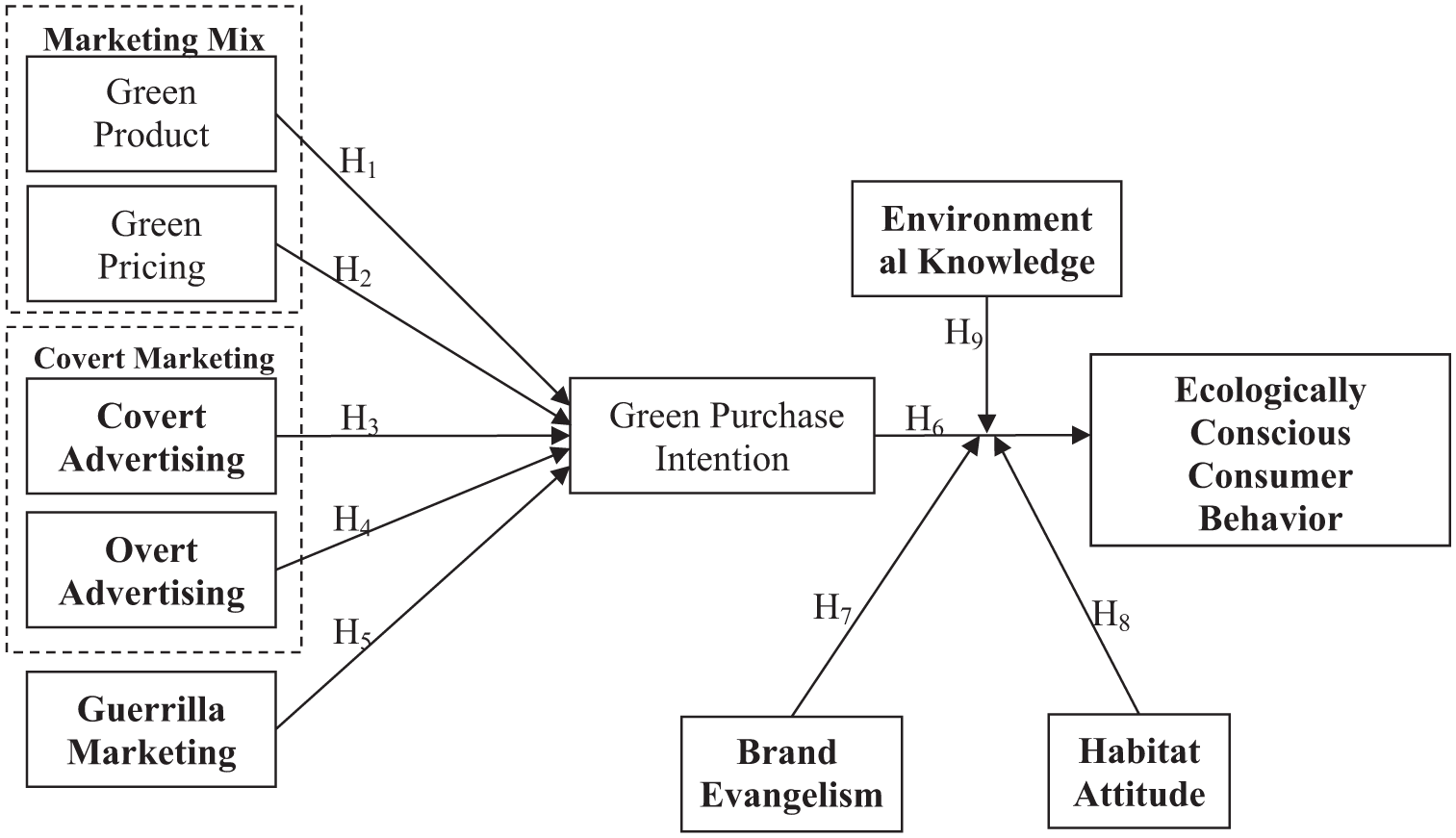
Theoretical framework.
Methodology
Ethical Considerations
The procedures were followed to minimize any potential risk or discomfort to participants. The sensitive personal data were not collected, the responses were anonymous, and participants could skip any question or withdraw at any time without penalty. The potential benefits of advancing the understanding of different marketing tactics on ecologically conscious consumers have far outweighed any minimal risk of participation. Furthermore, written informed consent was obtained from each participant, who was provided with an information sheet with details of the purpose of the study, procedures, and data-use plan.
Research Design and Analytical Tools
This study adopts a quantitative, cross-sectional correlational design to examine the influence of covert, overt, and guerrilla marketing tactics on ecologically conscious consumer behaviors. Data were collected via a structured survey to compute direct relationships between each marketing tactic, green purchase intention, and ecologically conscious consumer behavior (ECCB). Moderation effects of Brand Evangelism, Environmental Knowledge, and Habitat Attitude were also assessed. A two-stage analytical approach was used to establish measurement validity and reliability and test structural paths and predictive performance using structural equation modeling.
Furthermore, the demographic, descriptive statistics, and common method variance (CMV) were computed using SPSS 29. Whereas, we employed SmartPLS 4 to evaluate heterogeneity and the predictive performance of the hypothesized model. Likewise, structural equation modeling (including testing all hypotheses and moderation effects) was carried out in AMOS 24, and the AMOS add-ins were used for validity and reliability to compute composite reliability, average variance extracted and discriminant validity measures.
Participants and Procedure
The present study used quantitative research and primary data to evaluate the influence of covert, overt, and guerrilla marketing tactics. The target population of the study is Pakistani consumers of the frozen food sector. Due to the vast, diverse population, and unavailability of a sampling frame, the study used non-probability public intercept sampling by targeting 1,000 respondents. The questionnaires were distributed from August 1, 2023, to September 30, 2023. From this sample, the valid, completely filled questionnaires were 568, which shows that the response rate of the study was also higher than 56%. First, some questions about the instrument were asked for their demographics, including gender, age, pre-visit, occupation, income, and preferred brand (see details in Table 1). A screening question regarding knowledge of covert marketing was also included to have a real-time, valid response dataset. These demographic results uncover that the data is more male-dominated, with a maximum number of respondents of 25 to 34 years old and frequent well-educated buyers. Lastly, these results also disclosed that K&N and Sabroso are top-of-the-list brands, with maximum responses for these brands.
Demographic Profile of Respondents (N = 568).

Both online and offline means were used for the data collection process rapidly and accurately. In the case of online data collection, a covert marketing example was shown at the top of the questionnaire. For offline data collection, a group of individuals in a specific space, like a college or university class, was selected to show a small video regarding the covert advertisement to create a real-time scenario for getting accurate responses.
Common Method Variance (CMV) refers to the bias due to inflated correlations between variables that can occur when data for both independent and dependent variables are collected from the same source at the same time. There are numerous sources of CMV, scale or item complexity, respondents’ inability or inexperience, having double-barreled items, respondents’ low involvement in research, positions of scale items, etc. The researchers employed two ways, that is, procedural and statistical remedies, to mitigate CMV. The procedural remedies were applied at the design stage of the questionnaire to prevent bias. In this study, the measurement of independent and dependent variables was separated as a procedural strategy. In addition, the study also used two statistical techniques to detect CMV, namely, Harman’s single-factor test in SPSS and confirmatory factor analysis (CFA) for a single factor in AMOS. Harman’s single-factor test evaluates whether a single factor accounts for the majority of the variance in the data (Ali et al., 2021). The cumulative variance was less than 50%, which shows the absence of CMV. Then, CFA for a single factor was applied to all 48 questionnaire items. The poor fit of the model indicated that there is no significant CMV in the model.
Measures
Items were identified from various studies after an extensive literature review to evaluate the integrated model of the marketing mix, covert marketing attitudes, environmental aspects, and ecological behaviors. All the respective items were measured on a 5-point Likert scale. The green marketing mix was measured through the 4-item scale of green product features and green pricing was assessed through four items. An 8-item scale was used to measure covert advertisement, while the overt advertisement was measured through a 4-item scale by Zhang (2020). Likewise, a 7-item scale was used to measure guerrilla marketing purchase intention, and environmentally conscious consumer behavior was measured through eight items by Soon and Kong (2012) and Zabkar and Hosta (2013). Lastly, moderating variables of three concepts were also measured: environmental knowledge was measured through a 3-item scale by Mahmoud et al. (2017), brand evangelism was assessed through a 5-item scale and four items were adopted to measure habitat attitude toward the brand
Data Analysis and Results
Descriptive Statistics
Table 2 provides descriptive statistics, which show that the valid sample size was 568 responses. The mean values indicate that the data points for all variables are above the midpoint, suggesting a tendency toward positive responses. The standard deviations show relatively low dispersion around the mean. Lastly, the table shows the skewness and kurtosis, which are used to analyze the symmetry and peak of the data distribution. Their values of less than ±1.00 show normality in the data (Hair et al., 2014). However, some constructs have values slightly exceeding this threshold. However, according to the central limit theorem (CLT), the sampling distribution of the mean becomes normal if the sample size is larger than 30, even if the population distribution is not normal. So, normality is not an issue for this research.
Descriptive Statistics.

Note. CA = covert advertising; GM = Guerrilla marketing; HAB = habitat attitude; OA = overt advertising; ECCB = ecologically conscious consumer behavior; BE = brand evangelism; GPF = greet product features; GP = green pricing; GPI = green purchase intention; EK = environmental knowledge.
Furthermore, to assess unobserved heterogeneity in the data, we followed the systematic procedure outlined by Sarstedt et al. (2020), using the Finite Mixture Partial Least Squares (FIMIX-PLS) approach. Initially, we conducted a post hoc power analysis based on Sarstedt et al. (2017) to determine the minimum sample size needed for each segment, assuming an effect size of 0.15 and a power level of 80%. The analysis suggested that a minimum sample size of 85 was required, allowing for the extraction of up to six segments. Using this information, we applied the FIMIX-PLS procedure and explored segment solutions ranging from one to six segments, as shown in Table 3.
Fit Indices for the One-to-six-Segment Solutions.
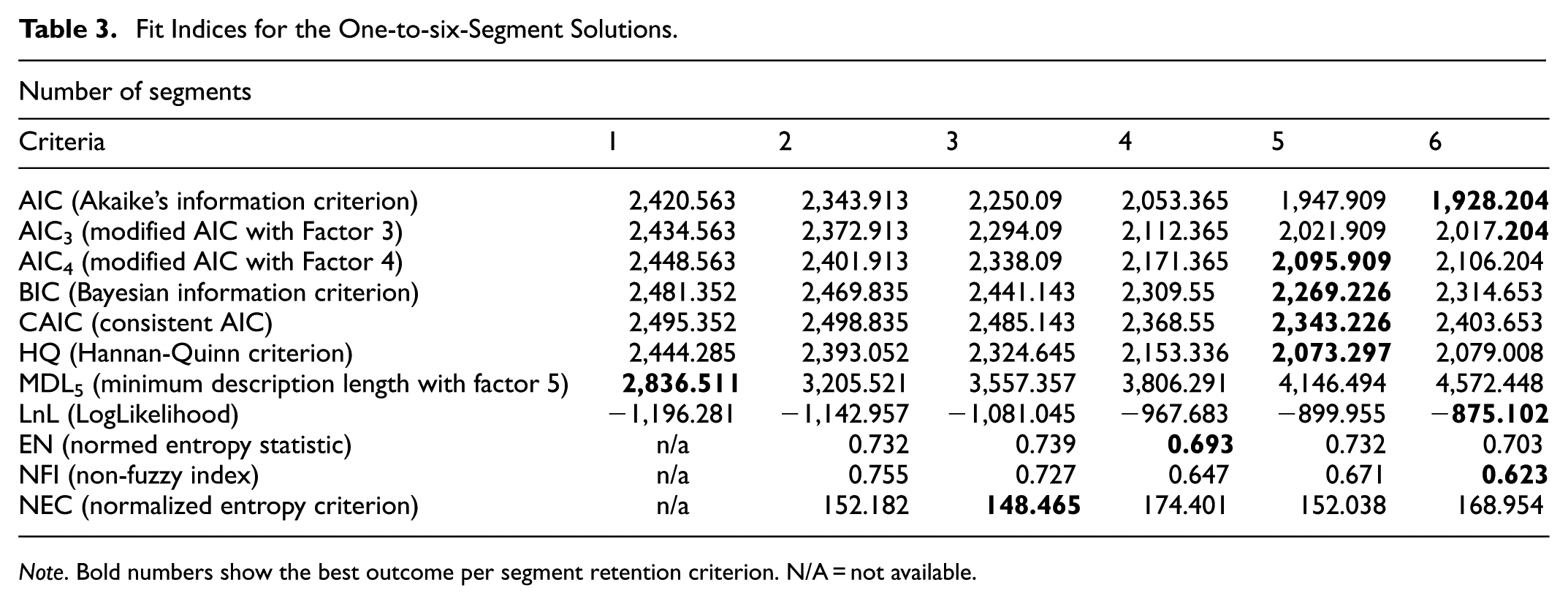
Note. Bold numbers show the best outcome per segment retention criterion. N/A = not available.
The fit indices for these solutions, displayed in Table 3, revealed mixed results. For example, Akaike’s Information Criterion (AIC), modified AIC with Factor 3 (AIC3), and the non-fuzzy index (NFI) suggested that the six-segment solution is optimal. These values indicate better model fit compared to the one-to-five-segment solutions. AIC4 (modified AIC with Factor 4), the Bayesian Information Criterion (BIC), Consistent AIC (CAIC), and the Hannan-Quinn Criterion (HQ) yielded slightly different results, with the minimum values indicating a five-segment solution. Similarly, other criteria have different-segment solutions as optimal results.
The diverse results provided by these fit indices highlight the inherent ambiguity in selecting the number of segments. In cases where AIC3 and CAIC indicate the same number of segments, it is often seen as a reliable indicator of the appropriate number of segments (Sarstedt et al., 2011). However, in this analysis, these criteria differ, so we conclude that unobserved heterogeneity is not significant in impacting the analysis based on the full dataset.
Structural Equation Modeling
The key step of the study is testing the integrated model empirically by targeting the customers of the food sector to measure their buying behavior regarding green marketing. The present study used the covariance-based structural equation model (SEM) applied through AMOS software to perform confirmatory factor analysis (CFA) and path modeling (hypotheses testing; Hair et al., 2017). SEM is a state-of-the-art technique used to measure the inner and outer models of a research framework, which allows for the relation of different concepts in one model (Anderson & Gerbing, 1988; Kline, 2005).
Confirmatory Factor Analysis (CFA)
The CFA of the model has been portrayed in Appendix 1. The goodness-of-fit of the model was evaluated using several well-established fit indices. The SRMR (Standardized Root Mean Square Residual) was 0.0313, well below the recommended threshold of 0.08, indicating a good fit (Hair et al., 2014). The RMR (Root Mean Square Residual) was 0.032, which is acceptable as values closer to 0 indicate a better fit. The GFI (Goodness-of-Fit Index) and AGFI (Adjusted Goodness-of-Fit Index) were 0.866 and 0.846, respectively, where values of 0.90 or higher are considered a good fit (Byrne, 2013). Despite being slightly below this threshold, they still indicate a reasonable fit. The PGFI (Parsimonious Goodness-of-Fit Index) was 0.756, which reflects a balanced model between fitness and parsimony. Additionally, the NFI (Normed Fit Index), CFI (Comparative Fit Index), and TLI (Tucker-Lewis Index) all exceeded 0.90, with values of 0.916, 0.952, and 0.948, respectively, demonstrating excellent fit (Bentler, 1990). The RMSEA (Root Mean Square Error of Approximation) was 0.046, which is well below the recommended 0.05 threshold, indicating a close fit (Browne & Cudeck, 1993). The fit indices suggest the model is well-specified and suitable for further analysis.
Reliability and validity of the model were also crucial for establishing the measurement model. Composite reliability was mainly used to evaluate the internal consistency of data, which is considered more accurate than Cronbach’s alpha (Hair et al., 2019). All the variables have good enough values for CR, which is higher than the acceptable criteria of 0.7, as shown in Table 4 and Appendix 2. Next is validity measurement through convergent and discriminant validity. Convergent validity ensures that items and variables are theoretically correlated; Hair et al. (2019) recommended factor loading and average variance extracted evaluation. Factor loading measure for the outer or measurement model, for this value of each item, should be greater than 0.6 (Hair et al., 2019). In the current study, three items were removed due to loadings not up to the mark, whereas AVE values for contracts that should be greater than 0.5 are also up to the mark to ensure convergence in the inner model (Table 4).
Reliability and Validity.

Note. CA = covert advertising; GM = Guerrilla marketing; HAB = habitat attitude; OA = overt advertising; ECCB = ecologically conscious consumer behavior; BE = brand evangelism; GPF = greet product features; GP = green pricing; GPI = green purchase intention; EK = environmental knowledge.
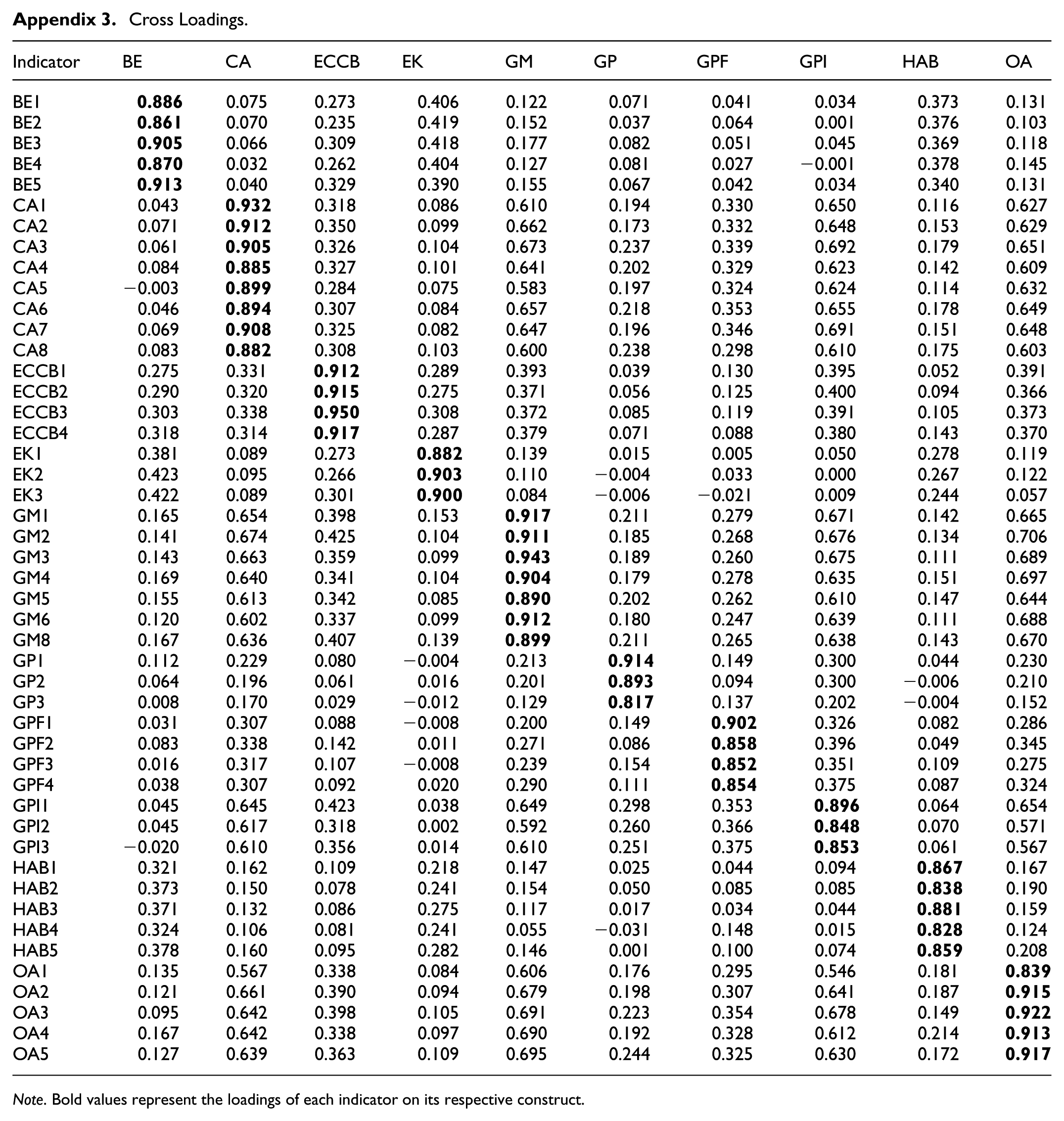
Three key criteria, that is, Cross loading, Fornell-Larcker criterion, and Heterotrait-Monotrait (HTMT) Ratio, were considered to measure the discriminant validity. Appendix 3 shows the results of the cross-loading evaluation. For this, the criteria are that the indicator loadings should be maximum with its own respective construct compared to all other constructs in the model. This also demonstrates that the item is a good measure for its measuring variable; in the current study, all the items possess acceptable discriminant validity through cross-loading (Hair et al., 2018). Secondly, the Fornell-Larcker criterion is a measure for the inner measurement model; the values for this are the square root of AVE for each construct, which should be greater than its correlational values with all other constructs. Table 5 shows that all upper diagonal values are greater than 0.7 and maximum in the column, ensuring the second discriminant validity criteria (Fornell & Larcker, 1981). Moreover, HTMT ratio values were up to the mark with values less than 0.9, a predefined criterion by Hair et al. (2018) to ensure discrimination through HTMT. The last check is through Maximum Shared Variance (MSV) values (refer to Table 4). It also demonstrates that all the MSV values are less than the AVE value of the respective variable, ensuring the goodness of discriminant validity.
HTMT Criteria.

Path Analysis (Hypotheses Testing)
Figure 2 is a graphical representation of path analysis, which was evaluated based on the critical ratio of CR = Estimate/Standard Errors (SE) and p-values, following established guidelines. This figure does not comprise moderators, which were added in a subsequent stage to avoid complexity in computing other effects in AMOS.

Path analysis (taken from AMOS software).
The results in Table 6 show that all the direct hypotheses, that is,
Hypotheses Testing Results.

p < .001.
In a separate analysis (not shown here), the present study also tests three moderators, that is, Brand Evangelism, Environmental Knowledge, and Habitat Attitude, as shown in Table 7.
Moderators’ Coefficient and Model Summary.

Brand Evangelism (
Predictive Performance
To assess the predictive performance of the PLS path model, its results were compared against two naïve benchmarks proposed by Shmueli et al. (2019). First, at the latent level, Q2 values of the endogenous variables determine the predictive power. Second, at the manifest level, the errors in the PLS-SEM are compared with those in the linear regression model (LM) to evaluate the strength of predictive power. Table 8 shows that Q2 > 0 for both endogenous constructs ECCB (Q2 = 0.263) and GPI (Q2 = 0.647), indicating a better predictive performance of the PLS path model relative to mean predictions.
Predictive Performance Summary.

Second, at the manifest level, comparing the errors in the linear regression model (LM) and PLS-SEM path model provides the strength of the predictive performance. Unlike the PLS-SEM model, which is based on a theoretically grounded path structure, the LM ignores this structure and instead regresses all exogenous indicator variables directly on each endogenous indicator variable. This approach allows for an evaluation of whether the structured PLS-SEM model provides better predictions than an unstructured linear regression model. We evaluated the predictive performance of the PLS-SEM model using the Root Mean Square Error (RMSE) criterion because the prediction error distribution was not highly non-symmetrical. As per the guidelines by Shmueli et al. (2019), the predictive power for ECCB is medium, as only one indicator (ECCB1) produces higher prediction errors than the LM benchmark. The predictive power for GPI is low, but the majority of the indicators (GPI2 and GPI3) demonstrate higher prediction errors than the LM benchmark.
Discussion
The primary objective of this study was to evaluate the impact of marketing strategies (covert, overt, and guerrilla) on consumer intention and ecologically conscious behavior in the frozen food sector of a developing economy (Pakistan). The study developed a unique integrated model to analyze novel marketing tactics for developing green consumerism. The findings show that the majority of hypotheses have been accepted. These indicate that the marketing mix of green products and green pricing (
The study also found a significant and positive impact of green purchase intention on ecologically conscious consumer behavior (
The current study also analyzed the moderating roles of brand evangelism, environmental knowledge, and habitat attitude. Findings show that brand evangelism and environmental knowledge (
Implications
Theoretical Implications
Research provides several theoretical contributions. First, the study shows the positive impact of covert and overt marketing tactics on green purchase intention. Green product features (GPF) and gree price (GP) were found to be the key factors for building purchase intention, specifically by targeting developing nations where price sensitivity is considerably important, supported by existing literature (Gustavo et al., 2021; Karunarathna et al., 2020; Liana & Oktafani, 2020; Sembiring, 2021). This study extends the literature by confirming the significant positive influence of GPF and GP on purchase intention with the framework of green consumerism.
Additionally, the current study filled the literature knowledge gap by exploring the role of covert, overt, and guerrilla marketing tactics in building an individual’s behavior. The current study also offers an integrated framework that interlinks the novel marketing tactics with traditional marketing mix elements. The paucity of literature is directly addressed in these findings regarding innovative marketing tactics and their contribution to building green purchase intention and turning it into ecologically conscious consumer behavior (Evans & Wojdynski, 2020; Serazio, 2021).
Research also made significant contributions to the literature by exploring the moderating role of environmental knowledge and brand evangelism, which are significant supporting factors for the relationship between purchase intention and ECCB. This also fills a gap that has been overlooked in existing literature (Musa et al., 2020; X. Sun et al., 2021). The theory of planned behavior (TPB) states that attitudes, subjective norms, and perceived behavioral control are the determining factors for the intention and then behavior of an individual. The study supports the relevance of TPB in explaining the influence of marketing tactics on consumer purchase intentions and, subsequently, ecological behaviors.
Practical Implications
This study also offers practical implications in two important areas in the context of green consumerism. First, marketing managers should emphasize product price and features when developing and promoting products, primarily through novel tactics such as covert, overt, and guerrilla strategies. The findings suggest that while product features and pricing are important factors for consumer decision-making, how products are marketed using unconventional tactics can be a differentiating factor in a competitive marketplace. For example, in 2019, Magnum (Unilever’s premium ice cream brand) launched its “Pleasure Store” pop-up in Melbourne. Using a mobile-first ordering system, the eight-week activation attracted 12,819 unique website visitors, 80% via mobile devices, and sold 14,404 Magnums directly through the pop-up’s integrated POS setup (Campaign Asia Pacific, 2019). To adapt this in Pakistan, brands can deploy an unbranded “freeze-and-reveal” truck in high-footfall locations (e.g., campuses and malls), monitor impressions via platform analytics (TikTok views and Instagram hashtags), and measure local sales uplift through POS data. Managers can translate creative stunts into measurable consumer engagement and purchase gains by following best practices for guerrilla activations, setting clear objectives, leveraging relevant social media channels, and using consistent campaign hashtags.
Second, the strategic insights from this study regarding the moderation of BE, EK, and HAB can help address fundamental business challenges. Positive word of mouth and brand evangelism are critical in marketing today. The findings suggest that satisfied customers who act as brand evangelists can significantly influence consumer behavior and enhance brand loyalty. Environmental knowledge also strengthens this relationship, reinforcing the need for businesses to educate consumers about the environmental benefits of their products. However, while BE and EK were found to be valuable moderators, practitioners should take a cautious approach with Habitat Attitude, as its moderating effect was not significant in this context.
Conclusion
The present study tried to bridge the unaddressed theoretical as well as practical gaps in the sector and literature. The present research contributes to the burgeoning stream of marketing literature by theoretically and empirically testing the marketing mix and covert marketing tactics to build environmentally conscious behavior for green products. Findings indicate that covert marketing tactics are valuable factors for intention building instead of conventional marketing mix tactics. Moreover, findings also emphasize that evangelism and environmental knowledge are significant motivators for building the conscious ecological behavior of customers of the frozen food industry in developing countries. The findings are in line with the previous results. It is recommended that the researchers extend the study by incorporating the shortcomings of the present investigation, as discussed in the limitations section.
Limitations and Future Directions
Despite the theoretical and practical contributions of this research, several limitations provide future directions for researchers. Firstly, the study focused on covert, overt, and guerrilla tactics offers critical insights, however, future research should adopt a full marketing mix perspective (Product, Price, Place, Promotion, and People) to gain more comprehensive managerial guidance. Moreover, as the findings highlighted the influence of covert, overt, and guerrilla marketing tactics, future studies could examine other emerging marketing strategies to expand the scope of intention-building factors. The study also considered moderators like Brand Evangelism (BE) and Environmental Knowledge (EK), significantly strengthening the relationship between purchase intention and ecological behavior. Future research should explore other potential moderators or mediators or even test for mediated moderation to build a more comprehensive model. In particular, considering the Theory of Planned Behavior (TPB), future studies could examine additional TPB constructs, such as perceived behavioral control, to see how these influence purchase intention and ecological behavior in green markets.
The study was limited to the frozen food industry. Future research could expand the framework by testing this model in other sectors, considering covert and overt marketing techniques and measuring its effectiveness in various industries. A cross-country comparison would be a value-added study, especially for the comparison of these marketing tactics in different cultural and economic contexts. Furthermore, the present study did not segregate the possible difference between the outcomes of online and offline data collection. Future researchers should also investigate the accuracy and differential effects of these two approaches to uncover further methodological insights. Lastly, current research considers a non-probability sampling technique, which could be a limitation as it constrains the generalizability of findings. Future research should consider longitudinal probability-based surveys to evaluate the pre- and post-perception of respondents, especially after exposure to covert and overt advertisements. Addressing these limitations in future studies would offer a better understanding of the model and its implications.
Footnotes
Appendix
Cross Loadings.
| Indicator | BE | CA | ECCB | EK | GM | GP | GPF | GPI | HAB | OA |
|---|---|---|---|---|---|---|---|---|---|---|
| BE1 |
|
0.075 | 0.273 | 0.406 | 0.122 | 0.071 | 0.041 | 0.034 | 0.373 | 0.131 |
| BE2 |
|
0.070 | 0.235 | 0.419 | 0.152 | 0.037 | 0.064 | 0.001 | 0.376 | 0.103 |
| BE3 |
|
0.066 | 0.309 | 0.418 | 0.177 | 0.082 | 0.051 | 0.045 | 0.369 | 0.118 |
| BE4 |
|
0.032 | 0.262 | 0.404 | 0.127 | 0.081 | 0.027 | −0.001 | 0.378 | 0.145 |
| BE5 |
|
0.040 | 0.329 | 0.390 | 0.155 | 0.067 | 0.042 | 0.034 | 0.340 | 0.131 |
| CA1 | 0.043 |
|
0.318 | 0.086 | 0.610 | 0.194 | 0.330 | 0.650 | 0.116 | 0.627 |
| CA2 | 0.071 |
|
0.350 | 0.099 | 0.662 | 0.173 | 0.332 | 0.648 | 0.153 | 0.629 |
| CA3 | 0.061 |
|
0.326 | 0.104 | 0.673 | 0.237 | 0.339 | 0.692 | 0.179 | 0.651 |
| CA4 | 0.084 |
|
0.327 | 0.101 | 0.641 | 0.202 | 0.329 | 0.623 | 0.142 | 0.609 |
| CA5 | −0.003 |
|
0.284 | 0.075 | 0.583 | 0.197 | 0.324 | 0.624 | 0.114 | 0.632 |
| CA6 | 0.046 |
|
0.307 | 0.084 | 0.657 | 0.218 | 0.353 | 0.655 | 0.178 | 0.649 |
| CA7 | 0.069 |
|
0.325 | 0.082 | 0.647 | 0.196 | 0.346 | 0.691 | 0.151 | 0.648 |
| CA8 | 0.083 |
|
0.308 | 0.103 | 0.600 | 0.238 | 0.298 | 0.610 | 0.175 | 0.603 |
| ECCB1 | 0.275 | 0.331 |
|
0.289 | 0.393 | 0.039 | 0.130 | 0.395 | 0.052 | 0.391 |
| ECCB2 | 0.290 | 0.320 |
|
0.275 | 0.371 | 0.056 | 0.125 | 0.400 | 0.094 | 0.366 |
| ECCB3 | 0.303 | 0.338 |
|
0.308 | 0.372 | 0.085 | 0.119 | 0.391 | 0.105 | 0.373 |
| ECCB4 | 0.318 | 0.314 |
|
0.287 | 0.379 | 0.071 | 0.088 | 0.380 | 0.143 | 0.370 |
| EK1 | 0.381 | 0.089 | 0.273 |
|
0.139 | 0.015 | 0.005 | 0.050 | 0.278 | 0.119 |
| EK2 | 0.423 | 0.095 | 0.266 |
|
0.110 | −0.004 | 0.033 | 0.000 | 0.267 | 0.122 |
| EK3 | 0.422 | 0.089 | 0.301 |
|
0.084 | −0.006 | −0.021 | 0.009 | 0.244 | 0.057 |
| GM1 | 0.165 | 0.654 | 0.398 | 0.153 |
|
0.211 | 0.279 | 0.671 | 0.142 | 0.665 |
| GM2 | 0.141 | 0.674 | 0.425 | 0.104 |
|
0.185 | 0.268 | 0.676 | 0.134 | 0.706 |
| GM3 | 0.143 | 0.663 | 0.359 | 0.099 |
|
0.189 | 0.260 | 0.675 | 0.111 | 0.689 |
| GM4 | 0.169 | 0.640 | 0.341 | 0.104 |
|
0.179 | 0.278 | 0.635 | 0.151 | 0.697 |
| GM5 | 0.155 | 0.613 | 0.342 | 0.085 |
|
0.202 | 0.262 | 0.610 | 0.147 | 0.644 |
| GM6 | 0.120 | 0.602 | 0.337 | 0.099 |
|
0.180 | 0.247 | 0.639 | 0.111 | 0.688 |
| GM8 | 0.167 | 0.636 | 0.407 | 0.139 |
|
0.211 | 0.265 | 0.638 | 0.143 | 0.670 |
| GP1 | 0.112 | 0.229 | 0.080 | −0.004 | 0.213 |
|
0.149 | 0.300 | 0.044 | 0.230 |
| GP2 | 0.064 | 0.196 | 0.061 | 0.016 | 0.201 |
|
0.094 | 0.300 | −0.006 | 0.210 |
| GP3 | 0.008 | 0.170 | 0.029 | −0.012 | 0.129 |
|
0.137 | 0.202 | −0.004 | 0.152 |
| GPF1 | 0.031 | 0.307 | 0.088 | −0.008 | 0.200 | 0.149 |
|
0.326 | 0.082 | 0.286 |
| GPF2 | 0.083 | 0.338 | 0.142 | 0.011 | 0.271 | 0.086 |
|
0.396 | 0.049 | 0.345 |
| GPF3 | 0.016 | 0.317 | 0.107 | −0.008 | 0.239 | 0.154 |
|
0.351 | 0.109 | 0.275 |
| GPF4 | 0.038 | 0.307 | 0.092 | 0.020 | 0.290 | 0.111 |
|
0.375 | 0.087 | 0.324 |
| GPI1 | 0.045 | 0.645 | 0.423 | 0.038 | 0.649 | 0.298 | 0.353 |
|
0.064 | 0.654 |
| GPI2 | 0.045 | 0.617 | 0.318 | 0.002 | 0.592 | 0.260 | 0.366 |
|
0.070 | 0.571 |
| GPI3 | −0.020 | 0.610 | 0.356 | 0.014 | 0.610 | 0.251 | 0.375 |
|
0.061 | 0.567 |
| HAB1 | 0.321 | 0.162 | 0.109 | 0.218 | 0.147 | 0.025 | 0.044 | 0.094 |
|
0.167 |
| HAB2 | 0.373 | 0.150 | 0.078 | 0.241 | 0.154 | 0.050 | 0.085 | 0.085 |
|
0.190 |
| HAB3 | 0.371 | 0.132 | 0.086 | 0.275 | 0.117 | 0.017 | 0.034 | 0.044 |
|
0.159 |
| HAB4 | 0.324 | 0.106 | 0.081 | 0.241 | 0.055 | −0.031 | 0.148 | 0.015 |
|
0.124 |
| HAB5 | 0.378 | 0.160 | 0.095 | 0.282 | 0.146 | 0.001 | 0.100 | 0.074 |
|
0.208 |
| OA1 | 0.135 | 0.567 | 0.338 | 0.084 | 0.606 | 0.176 | 0.295 | 0.546 | 0.181 |
|
| OA2 | 0.121 | 0.661 | 0.390 | 0.094 | 0.679 | 0.198 | 0.307 | 0.641 | 0.187 |
|
| OA3 | 0.095 | 0.642 | 0.398 | 0.105 | 0.691 | 0.223 | 0.354 | 0.678 | 0.149 |
|
| OA4 | 0.167 | 0.642 | 0.338 | 0.097 | 0.690 | 0.192 | 0.328 | 0.612 | 0.214 |
|
| OA5 | 0.127 | 0.639 | 0.363 | 0.109 | 0.695 | 0.244 | 0.325 | 0.630 | 0.172 |
|
Note. Bold values represent the loadings of each indicator on its respective construct.
Acknowledgements
This research was conducted within the framework of HH Shaikh Isa Bin Salman Al-Khalifa for Technology Management at the Arabian Gulf University.

Ethical Considerations
This study was conducted as per the ethical guidelines given in the Helsinki Declaration. The authors got approval from the ethical committee of the Namal University, Mianwali, Pakistan, Ref: NML-ERC/2023-04.
Funding
The authors received no financial support for the research, authorship, and/or publication of this article.
Declaration of Conflicting Interests
The authors declared no potential conflicts of interest with respect to the research, authorship, and/or publication of this article.
Data Availability Statement
The data from the corresponding author can be obtained upon request.