




Abstract
The purpose of this research was to explore which variables facilitate Chinese SMEs employees’ workplace deviance and focused on uncovering the processes that lead to deviant behavior. Unlike previous studies, rather than simply focusing on variables exploration or main effect verification, we provided and verified the research model related to process by which workplace deviance occurs. Specifically, this research verified exploitative leadership influences workplace deviance through negative emotions and examined the moderated mediation role of fear of negative evaluation. Therefore, this study conducted a data survey on adult employees in SMEs from 25 provinces, municipalities, and regions in China. Ultimately, 305 valid samples were used in the empirical analysis and utilized SPSS 26.0, AMOS 23.0, and PROCESS Macro 3.4.1 to analyze the results. As expected in this study, all hypotheses were supported except hypothesis 6. In addition, based on research results, expected effects are provided in terms of theory and practice. Theoretically, it discloses the mediating role of negative emotions between exploitative leadership and workplace deviance, as well as the moderated mediating role of fear of negative evaluation, broadens the comprehension of the relationships. In practice, it facilitates organizations in identifying and managing exploitative leadership, mitigates workplace deviance, and simultaneously alerts managers to pay attention to the employees’ negative emotions and fear of negative evaluation. Overall, the causal relationship between exploitative leadership and workplace deviance through a process, which can be seen as an expansion of the research field and is considered a contribution of this study.
Keywords
Introduction
In the past 10 years, Chinese enterprises have become increasingly aware of the universality and harmfulness of employees’ workplace deviance. While humanized management is increasingly advocated, employees’ violation of organizational rules based on their own initiative and workplace deviance, which are harmful to organizations or individuals, are becoming more common (Zheng & Chen, 2021). According to Social Exchange Theory, employee’s workplace deviance is likely directly related to their leaders’ exploitative behavior (Tang et al., 2014). Therefore, in the context of Chinese culture, it is relevant to explore the impact of exploitative leadership on employees’ workplace deviance (B. Liu et al., 2017). Meanwhile, this study aims to introduce exploitative leadership as an independent variable triggering employees’ workplace deviance, providing a basis for the healthy development of SMEs in China in the post-pandemic era.
This study contends that leaders are the key factor driving employees’ workplace deviance. This is because in the organization, leaders’ role and influence may have a direct impact on employees’ behavior and attitude (Du & Jin, 2023a). According to the “Investigation Report on the Living Conditions of White-collar Workers in 2020” by Zhaopin Ltd., 63.65% of the employees surveyed said they had experienced PUA in the workplace, including leaders engaging in pressuring behavior, setting unreasonable tasks, and stealing credit for others’ work (Y. D. Sun & Zhang, 2022). Therefore, to effectively deal with the discomfort caused by exploitative leadership, employees will continue to self-adjust and consume their own internal resources, which will lead to more negative long-term effects (Z. Y. Wang et al., 2023). As such, this study contends that exploitative leadership will increase employees’ workplace deviance.
Exploitative leaders serve their own interests by lobbying employees, pressuring them, and increasing their workload. However, when employees consider themselves being used, they may engage in a high level of workplace deviance (Kiyani et al., 2021). In addition, employees displaying high levels of workplace deviance will not approve of the organization, perhaps because when one is exploited, colleagues often remain silent, which exacerbates conflict (L. X. Zhang et al., 2023). Therefore, this study contends that it is significant to explore the level of exploitative leadership in Chinese SMEs and to reveal the causal relationship between exploitative leadership and workplace deviance.
In most previous studies, the effect of exploitative leadership on deviant behavior was simply verified moderating effect (Kiyani et al., 2021) and focused on the relationship between exploitative leadership and psychological distress (Majeed & Fatima, 2020), innovative behavior (Z. Wang et al., 2021), organizational cynicism (Elsaied, 2022), constructive voice (A. Bajaba et al., 2023), and counterproductive work behavior (Guo et al., 2024).
In addition, Research has shown that over 75% of employees have exhibited workplace deviance, with the retail industry alone suffering direct economic losses exceeding $15 million annually due to its adverse effects (Marasi et al., 2018). Based on this, research that verifies the causal relationship between exploitative leadership and workplace deviance is currently quite insufficient. Furthermore, research that uncovers the process of how exploitative leadership causes deviant behavior is even more inadequate. This can be seen as a gap and limitation in the research area of exploitative leadership and workplace deviance. Therefore, in order to resolve this gap and limitation, this study reveals the causal relationship between exploitative leadership and workplace deviance and verifies the process that causes workplace deviance. According to these contents, the necessity and contribution of this study are presented.
The purpose of this study is to test whether exploitative leadership fosters workplace deviance and determine which factors play a mediating role in the process thereof. Employees will experience more anxiety and tension when exploited by leaders and under an organization’s tight control and public criticism. In this situation, if unable to receive counseling in time, they will demonstrate a high level of negative emotion (Y. W. Li et al., 2021). Therefore, in the organization, employees’ negative emotion increases when leaders exploit them for personal benefit, which will lead to workplace deviance. This shows the positive relationship between exploitative leadership and workplace deviance through negative emotion.
Furthermore, this study argues that employees’ workplace deviance is mediated under the effect of the fear of negative evaluation. Individuals with a high fear of negative evaluation are very sensitive to information and uncertain events, and will engage in stress behaviors such as negative emotions when facing them (Peng et al., 2019). Therefore, the moderating effect of fear of negative evaluation must be explored because of the interaction between employees’ negative emotions and fear of negative evaluation, which may drive employees’ workplace deviance.
Based on the above, the purposes of this study are as follows: First, this study clarifies the relationship between exploitative leadership and employees’ workplace deviance, and illustrates how exploitative leadership causes employees’ workplace deviance. This will help to expand the research on workplace deviance.
Second, most studies have explored independent variables that affect workplace deviance (B. Liu et al., 2017; Y. Q. Wang et al., 2012) and have verified its mediating and moderating role in the process of causing this behavior (Singh, 2020; L. X. Zhang et al., 2023). However, this study expands the research scope of workplace deviance, and proposes and validates the moderated mediation model.
Third, exploitative leadership is a newly emerging concept. This study clearly defines the role of exploitative leadership and explains its importance in the organization. In addition, this study illustrates the impact of exploitative leadership on employees’ negative emotion.
Fourth, while most studies employ fear of negative evaluation as a moderating or mediating variable, this study uses fear of negative evaluation as a moderating variable and examines its role. Specifically, through the interaction between exploitative leadership and fear of negative evaluation, it moderates the mediating effect of employees’ negative emotion, which leads to employees’ workplace deviance.
Finally, this study highlights the lack of research in Chinese SMEs on employees’ workplace deviance. To address this gap, this study investigates the role of workplace deviance in these organizations. Specifically, this study proposes a new research model to increase workplace deviance, and clarifies how exploitative leadership leads to this behavior. As such, it expands the research field of exploitative leadership and workplace deviance. It also highlights employees’ fear of negative evaluation in Chinese SMEs and clarifies the role thereof.
Literature Review
Exploitative Leadership
Exploitative leadership is defined as a self-serving approach that robs employees of their achievements (L. Z. Wu et al., 2021). Exploitative leadership seeks personal gains in a friendly and subtle manner, such as by deliberately creating friction among employees and appropriating the achievements of employees’ as one’s own (Z. Y. Wang et al., 2023). The essence of exploitative leadership is selfishness, wherein employees are considered tools for personal gain. As such, it reflects an unequal exchange relationship between leaders and employees (Y. J. Zhang et al., 2023).
According to Social Exchange Theory, exploitative leaders achieve their goals by pressuring employees’ labor and seizing their due benefits (Y. J. Zhang et al., 2023). This destructive type of leadership has significant negative consequences for both employees and the organization (L. Z. Wu et al., 2021). Moreover, due to power dynamics, performance evaluations, and career development, most employees find it difficult to resist the unreasonable and excessive demands of exploitative leaders. Often, they have no choice but to reluctantly accept and portray themselves as “good employees” (Y. J. Zhang et al., 2022).
This relatively new leadership style emerged in recent years and is still in the early stages of research. Previous research positively (+) associates’ exploitative leadership with negative emotions (Y. J. Zhang et al., 2023), emotional exhaustion (Z. Y. Wang et al., 2023), and workplace deviance (Schmid et al., 2019), and negatively (−) with service performance (L. Z. Wu et al., 2021) and organizational citizenship behavior (Abdulmuhsin et al., 2021).
Therefore, this study defines exploitative leadership as a destructive leadership pattern that views employees as tools to fulfill personal objectives and frequently exploits them in their daily work.
Negative Emotion
Negative emotion refers to the negative impact on employees’ psychological state, which causes emotional functional disorders and results in abnormal functionality and behavior (Zeng et al., 2022). In addition, negative emotion refers to a general dimension of subjective distress and unpleasantness that encompasses aversive emotional states such as anger, contempt, disgust, guilt, fear, and neuroticism (E. J. Kim & Joo, 2022). Furthermore, negative emotion is defined as the emotional or affective experiences that arise when an employee’s behavior or cognition is obstructed (K. M. Li et al., 2022).
Although emotional experiences occur naturally, negative emotion and reactions thereto can lead to psychological discomfort in daily life (E. J. Kim & Joo, 2022). When individuals experience negative emotions, it directly affects their subsequent behavioral performance and can cause physiological changes (K. M. Li et al., 2022). If these negative emotions are not promptly alleviated, employees may develop more dissatisfaction regarding the organization and their work (work attitude; Z. Wang et al., 2021).
Previous studies found that negative emotion positively (+) impacts workplace deviance (H. Wang & Xiao, 2021) and turnover intention (J. Z. Wang et al., 2020), and negatively (−) impacts social expectations (E. J. Kim & Joo, 2022), social support (K. M. Li et al., 2022) and knowledge sharing (Zhao, 2020). Thus, this study defines negative emotion as physiological and psychological negative states triggered when employees receive a series of negative information beyond their capacity to bear in their workplace or lives.
Fear of Negative Evaluation
Fear of negative evaluation refers to a social situation in an organization that emphasizes collaboration. In this social situation, employees may be concerned about being negatively judged or discussed by others (Cooper & Brownell, 2020). In addition, fear of negative evaluation refers to the negative expectations and experiences regarding social evaluations from others (Feng et al., 2022). In other words, it is the anxiety and distress that emerge from the fear of being disrespected or antagonized by others (Carleton et al., 2006).
Long-term fear of negative evaluation can hinder employees’ social development and the maintenance of interpersonal relationships (Tuo et al., 2022). It can also lower employees’ social confidence and lead to feelings of inferiority and heightened sensitivity (S. J. Zhang, 2021). They may also exhibit lower levels of trust in others during social interactions, and experience emotional instability and restlessness in response to changes in their surroundings, demonstrating higher levels of aggression (W. Q. Wu, 2022).
Previous studies found that fear of negative evaluation positively (+) impacts social anxiety (G. Liu & Cheng, 2023), depression (Xue et al., 2017), and negative emotion (Winton et al., 1995), and negatively (−) impacts prosocial behavior (Y. Liu & Zhang, 2010) and knowledge-hiding behavior (Syed et al., 2021). Based on the above, this study defines fear of negative evaluation as the psychological anxiety that arises when employees in an organization are in social evaluative situations and fear negative evaluations from others.
Workplace Deviance
Workplace deviance refers to voluntary actions that violate significant organizational norms (Çınar & Karcıoğlu, 2015). It includes actions such as verbally abusing or mocking others, causing embarrassment to colleagues, slacking off, and misappropriating company property, all of which are harmful to individuals and the organization (Y. Z. Wang & Wang, 2019). Moreover, workplace deviance refers to voluntary actions by organizational members that violate significant organizational rules (Lim & Teo, 2005).
Workplace deviance has become a practical problem that organizations pay close attention to and need to address (Y. Z. Wang & Wang, 2019). Employee workplace deviance arises alongside the existence of an organization and significantly impacts its prospects, organizational performance, the legitimate rights of others, and personal development opportunities. It can also disrupt organizations’ sustainable development and the overall harmony and stability of society (F. F. Liu & Liu, 2022). Therefore, in terms of practical application in organizations, if employees understand the potential costs and benefits associated with engaging in workplace deviance, managers can implement more effective intervention measures (L. P. Sun et al., 2021).
Research shows that negative emotion (L. P. Sun et al., 2021), laissez-faire leadership (Peng et al., 2019), authoritarian leadership (F. F. Liu & Liu, 2022), and abusive supervision (B. Liu et al., 2017) increase employee workplace deviance. Conversely, spiritual leadership (Y. Z. Wang & Wang, 2019) reduces the occurrence thereof. Therefore, in this study, workplace deviance refers to voluntary and intentional actions by employees that violate organizational rules with the intention of causing harm to the organization.
Theoretical Background and Hypotheses Development
Exploitative Leadership and Negative Emotion
According to Emotional Cognition Theory, when employees are subjected to mistreatment and unfair treatment by exploitative leaders, their sense of psychological opposition is triggered, leading to the development of a high level of negative emotion (Kayani et al., 2021). A leader’s exploitative behavior may also disrupt a positive work environment, making employees feel manipulated and deceived. Negative emotions arise as a result of such psychological states (Y. J. Zhang et al., 2023). A leader’s exploitative behavior can be considered a typical negative event, and as a result, employees may develop negative emotions such as frustration and anger (Y. D. Sun & Zhang, 2022). Based on this, we propose the following:
Hypothesis 1. Exploitative leadership will positively influence on negative emotion.
Exploitative Leadership and Workplace Deviance
According to Resource Conservation Theory, when employees perceive a reduction in their own resources or face the threat of resource loss, they are more likely to engage in defensive behaviors and attempt to compensate for their losses (Hobfoll, 1989). Therefore, when exploitative leaders prioritize their own needs at the expense of others, and the individuals being sacrificed do not receive resource compensation, they are more likely to vent their dissatisfaction through workplace deviance (S. Bajaba et al., 2022). Furthermore, exploitative leaders may attempt to steal credit for the work of others; however, as employees perceive being used, their workplace deviance will increase (S. M. Bajaba et al., 2021). Based on this, we propose the following:
Hypothesis 2. Exploitative leadership will positively influence on workplace deviance.
Negative Emotion and Workplace Deviance
Employees with a high level of negative emotion often experience emotional distress. Without timely and effective psychological intervention or treatment, they are more likely to engage in workplace deviance (Alias et al., 2012). Essentially, workplace deviance can be considered an expression of employees’ negative emotions, and when the output thereof aligns with their needs, their psychological and emotional state may improve (H. Wang & Xiao, 2021). Moreover, leaders’ failure to consider employees’ needs and feelings during interactions can trigger negative emotions such as hostility and anger, and provoke them to engage in workplace deviance (Shen et al., 2020). Based on this, we propose the following:
Hypothesis 3. Negative emotion will positively influence on workplace deviance.
Mediating Effect of Negative Emotion
Exploitative leaders seek personal satisfaction by intentionally exploiting employees for their own benefit. However, excessive exploitation can give rise to negative emotions among employees. When these cannot be expressed or effectively guided, they become a catalyst for workplace deviance (Schmid et al., 2019). When employees perceive themselves as being exploited or treated unfairly in the workplace, they experience negative emotions such as anger. These negative emotions motivate their engagement in deviant workplace behavior to balance their internal feelings through actions like verbal attacks and sabotage (Le Roy et al., 2012). Exploitative leadership is the root of humiliation and torment inflicted upon employees. This type of behavior depletes their emotional resources, and when there is no opportunity to replenish them, counterproductive workplace deviance may ensue (Murad et al., 2021). Based on this, we propose the following:
Hypothesis 4. Negative emotion will mediate the relationship between exploitative leadership and workplace deviance.
Moderated Mediation Effects of Fear of Negative Evaluation
This study emphasizes the moderating role of fear of negative evaluation and suggests that this variable can amplify the impact of exploitative leadership on negative emotions and workplace deviance. Therefore, the negative emotions and workplace deviance of employees in Chinese SMEs will depend on the interaction between exploitative leadership and fear of negative evaluation. Negative evaluation can harm an individual’s public self-image and create a sense of embarrassment. Thus, fear of negative evaluation can lead employees to experience psychological states such as depression and anxiety (G. Liu & Cheng, 2023). In addition, this fear can lead to feelings of anxiety in individuals, which can cause employees to doubt their own abilities and adopt passive work approaches (Tuo et al., 2022). Because employees in SMEs tend to have a relatively higher level of fear of negative evaluation, which may increase their negative emotions and workplace deviance.
Employees with a high level of fear of negative evaluation are more likely to experience increased anxiety, fear, and even depression, which elevates their negative emotion (Jia & Yue, 2023). Furthermore, when employees experience long-term exclusion in the workplace, they may develop negative emotions such as fear of negative evaluation, which will impact their performance both in and outside their role, leading to behaviors like absenteeism, lateness, and voluntary turnover, which are forms of workplace deviance (Bilal et al., 2020). This suggests that fear of negative evaluation positively influences negative emotions and workplace deviance. Therefore, according to these theories, employees in SMEs often encounter various work-related issues (performance evaluations, etc.). When these problems arise, employees with a high level of fear of negative evaluation tend to amplify and internalize these negative experiences within the organization. In Chinese SMEs, fear of negative evaluation is high. Furthermore, when employees consistently experience high levels of fear of negative evaluation, their levels of anxiety and dissatisfaction, along with other negative emotions, are likely to increase, resulting in a higher occurrence of workplace deviance.
Employees with higher levels of fear of negative evaluation may be experiencing exploitation by their leaders. When leaders engage in exploitative practices, employees often develop high levels of fear of negative evaluation due to the inherent fear of not meeting leaders’ expectations (Y. Liu & Zhang, 2010). Therefore, this study associates’ employees’ fear of negative evaluation in SMEs with exploitative leadership. Moreover, leaders’ exploitative behaviors disrupt an organization’s positive work environment, leading employees to experience feelings of dissatisfaction, depression, and other negative emotions. This then further increases the level of fear of negative evaluation. As the level of exploitation by leaders increases, employees exhibit severe symptoms such as depression, cognitive sluggishness, and social withdrawal due to their high level of fear of negative evaluation (Xue et al., 2017). This study highlights that exploitative leadership enhances employees’ fear of negative evaluation in SMEs: the more severe the exploitation by leaders, the higher employees’ level of fear of negative evaluation.
When facing exploitative leadership, employees endure selfish and oppressive behaviors, which breed resentment and trigger negative emotions (Y. D. Sun & Zhang, 2022). Employees do not easily tolerate exploitative leadership because these types of leaders obtain praise and accolades by oppressing their subordinates. To counteract this situation, employees engage in workplace deviance (Kiyani et al., 2021). Therefore, exploitative leadership plays a crucial role in increasing negative emotions and workplace deviance among employees in SMEs.
Similarly, when employees have a high level of fear of negative evaluation, their negative emotion and workplace deviance remain elevated. Moreover, when leaders exploit their employees, they perceive themselves as being treated unfairly, which increases their negative emotion and workplace deviance. Therefore, the more leaders exploit and pressure employees, the stronger becomes their fear of negative evaluation, which increases their negative emotions and workplace deviance in SMEs.
In summary, as the fear of negative evaluation increases among employees in SMEs, the influence of exploitative leadership on their negative emotions and workplace deviance also intensifies. This explains why fear of negative evaluation moderates the impact of exploitative leadership on employees’ negative emotions and workplace deviance. Moreover, when employees experience a low level of negative emotion, they communicate and interact to accommodate their leaders; however, when they experience a high level of negative emotion, they protect their internal resources and use workplace deviance to express their dissatisfaction (Shen et al., 2020). Therefore, the level of workplace deviance among employees in SMEs depends on their level of negative emotion. In an organization, leaders exploit employees by leveraging their fear of negative evaluation, a process that increases employees’ negative emotion. To protect their own interests and resources, employees engage in higher levels of workplace deviance as a form of resistance. Overall, the higher the fear of negative evaluation among Chinese employees in SMEs, the greater the impact of exploitative leadership on their negative emotion and workplace deviance. Based on these theories and perspectives, the following are proposed:
Hypothesis 5. Fear of negative evaluation will moderate the relationship between exploitative leadership and negative emotions.
Hypothesis 6. Fear of negative evaluation will moderate the relationship between exploitative leadership and workplace deviance.
Hypothesis 7. The mediating influence of negative emotions on the relationship between exploitative leadership and workplace deviance will be moderated by fear of negative evaluation.
Methods
Sample Characteristics
This study sets exploitative leadership as the independent variable, negative emotion as the mediating variable, fear of negative evaluation as the moderating variable, and workplace deviance as the dependent variable, constructing a moderated mediation model with these four variables. In addition, a survey was conducted via Wenjuanxing targeting employees working in small and medium-sized enterprises across 25 provinces and cities in China. The data collection took place from May 16 to 18, 2023, lasting for 3 days, with a total of 305 questionnaires collected and utilized in the study. Regarding data analysis: firstly, this research employed SPSS ver. 26.0 to examine demographic characteristics, exploratory factor analysis, reliability analysis, descriptive statistics, correlation analysis, and moderation hypotheses analysis. Secondly, AMOS 23.0 was used to test confirmatory factor analysis, discriminate validity analysis, and path analysis. Finally, SPSS PROCESS Macro 3.4.1 was utilized to test the moderated mediation hypothesis.
This study examined employees in Chinese SMEs and conducted an online survey questionnaire. The study collected data from May 16 to 18, 2023 from 305 participants. Regarding the demographic characteristics of the participants, 229 (75.1%) are male and 76 (24.9%) females. Regarding age, 26 (8.5%) participants were aged under 20 years, 162 (53.1%) 20 to 29 years, 79 (25.9%) 30 to 39 years, 23 (7.5%) 40 to 49 years, and 15 (4.9%) were 50 years or older. For education, 21 (6.9%) participants had completed technical secondary or high school, 73 (23.9%) junior college, 133 (43.6%) undergraduate degrees, 61 (20%) master’s degrees, and 17 (5.6%) doctor’s degrees or higher. In terms of years of service, 63 (20.7%) participants had worked for a year or less, 47 (15.4%) for 1 to 2 years, 61 (20%) for 3 to 5 years, 44 (14.4%) for 5 to 7 years, and 90 (29.5%) for 7 years or more.
Measurement
All the measurement tools used in this study are international mature scales, which have been verified by international authoritative management or psychological research to have high reliability and validity. In other words, these measurement tools have already been used in most of previous studies and the validity has already been secured.
In addition, since this study is conducted in the context of Chinese culture, to ensure the equivalence of the measurement, this study adopted the translation-back translation technique. Specifically, we translated into Chinese with accurately reflected the original measurement of English version. The two researchers with experience in publishing in internationally authoritative journals and translating scales reviewed and guided our translation and editing of the scale.
In addition, the two researchers translate into English version using Chinese version, which we translated into Chinese. Therefore, all distortions in translation content were reduced and accuracy was improved.
Exploitative leadership is destructive. It believes in the personal interests of supremacy and conveys that subordinates are required to perform well and actively undertake outside work through exploitative means such as pressure and manipulation (Y. J. Zhang et al., 2022). To measure exploitative leadership in Chinese SMEs, this study used a tool by Schmid et al. (2019). Sample items include: “My leader takes it for granted that my work can be used for his or her personal benefit” and “My leader plays my colleagues and me off against each other to reach his or her goals.”
Negative emotion means that individuals have negative psychological reactions such as depression, helplessness, and anger (Zhao, 2020). To measure negative emotions in Chinese SMEs, this study used a tool by Watson et al. (1988). Sample items include: “Distressed” and “Ashamed.”
Fear of negative evaluation refers to a wide range of social evaluation anxiety felt when giving speeches and at parties and other situations, for example (Y. Liu & Zhang, 2010). To measure fear of negative evaluation in Chinese SMEs, this study used a tool by Carleton et al. (2006). Sample items include: “I worry about what other people will think of me even when I know it doesn’t make any difference” and “When I am talking to someone, I worry about what they may be thinking about me.”
Workplace deviance refers to a behavior in which employees purposefully violate organizational discipline and harm the interests of the organization and its members (F. F. Liu & Liu, 2022). To measure workplace deviance in Chinese SMEs, this study used a tool by Thau et al. (2007). Sample items include: “I don’t take an additional or longer break than is acceptable in this organization” and “I don’t take home organizational property without consent.”
The specific content of the measurement tool is shown in Table A1. All items were measured on a seven-point Likert scale (ranging from 1 = strongly disagree to 7 = strongly agree). Negative emotion items were measured on a scale ranging from 1 = much less to 7 = much more. The research model is shown in Figure 1.

Research model (Process Model 8).
Results
Exploratory Factor Analysis and Reliability Analysis
An exploratory factor analysis (EFA) is performed to determine whether the variables we want to measure can be combined into the same factor using appropriate measurement methods and tools (S. Kim et al., 2021). Table 1 shows the results of the EFA and reliability analysis in this study.
The Result of Exploratory Factor Analysis and Cronbach’s Alpha.
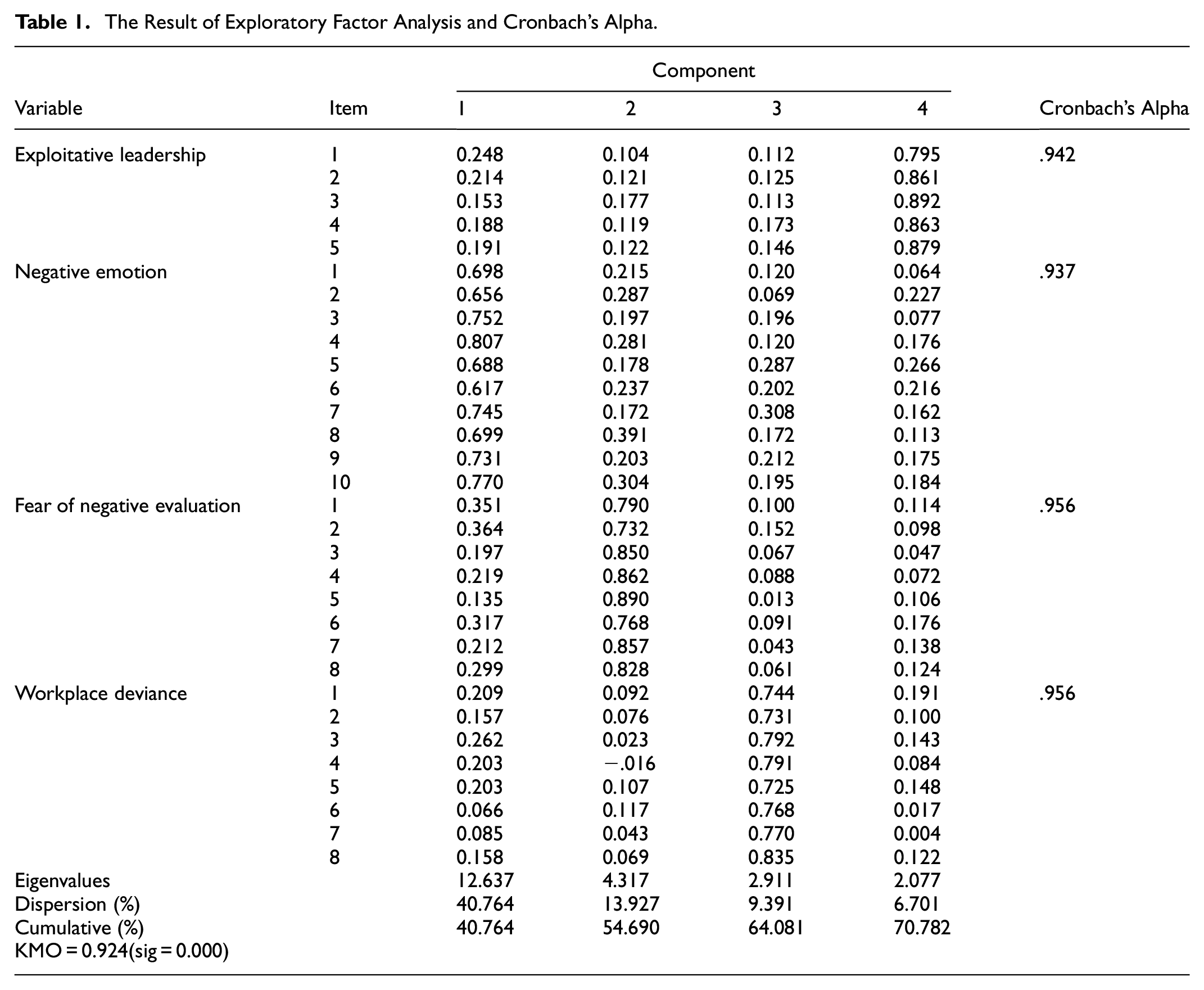
The variables used in this study were exploitative leadership, negative emotion, fear of negative evaluation, and workplace deviance, which were classified into four independent factors. Exploitative leadership consisted of five questions, and the values of the measured questions ranged from 0.795 to 0.892 as Factor 1. Negative emotion consisted of 10 questions, and the values of the measured questions ranged from 0.617 to 0.807 as Factor 2. Fear of negative evaluation consisted of eight questions, and the values of the measured questions ranged from 0.732 to 0.890 as Factor 3. Workplace deviance consisted of eight questions, and the values of the measured questions ranged from 0.725 to 0.835 as Factor 4. All factor values were greater than 0.5. All of these values of loading factor results are acceptable. Therefore, the results of exploratory factor analysis are significant.
In addition, reliability analysis analyzes the reliability of measurement and evaluation indicators, namely, whether the overall logic is consistent in participants’ responses (Yang, 2015). The results of reliability analysis in this study were as follows: exploitative leadership = 0.942, negative emotion = 0.937, fear of negative evaluation = 0.956, and workplace deviance = 0.956. Therefore, the reliability analysis confirmed Cronbach’s Alpha coefficient values as being higher than .7. Reliability is significant when it is above 0.7 (Nunnally, 1978). Therefore, the reliability of this measurement tool is all above 0.7 and these results are significant and valid.
Confirmatory Factor Analysis (CFA)
Through a confirmatory factor analysis, we confirmed the applicability of data and different models (Presson et al., 1997). According to the results shown in Table A2, only the results of Model 1 are the most expected. The results of the confirmatory factor analysis for Model 1 are as follows. First, the absolute fit index was X2(p) = 1083.776 (0.000), X2/df = 2.845, and RMSEA = 0.078. Second, the incremental fit index was IFI = 0.920 and CFI = 0.920. Third, the parsimonious adjusted index was PNFI = 0.723 and PGFI = 0.619. Through these results, it is confirmed that all fit indices of the research model are acceptable values.
This study analyzed the values of the average variance extracted (AVE) and composite reliability (CR). For AVE, exploitative leadership was 0.631, negative emotion was 0.506, fear of negative evaluation was 0.603, and workplace deviance was 0.519. These values are all greater than 0.5. For CR, exploitative leadership was 0.731, negative emotion was 0.795, fear of negative evaluation was 0.854, and workplace deviance was 0.755, all greater than 0.7. A measurement has significant validity if the AVE of variables is higher than 0.5 and CR is higher than 0.7. Therefore, the measurement tools showed that the AVE and CR values of all variables are higher than 0.5 and 0.7, separately. If the values of AVE and CR show greater than 0.5 and 0.7, the measurement tool has significant validity (Jin & Hahm, 2021). Thus, all measurement tools in this research have significant validity. The following Table 2 shows the result of comfirmatory factor analysis.
The Result of Confirmatory Factor Analysis.

p < .001.
Descriptive Statistics and Correlation Analysis
Table 3 shows the descriptive statistics and correlation analysis. The descriptive statistics analysis included the mean and standard deviation (SD). The means for exploitative leadership, negative emotion, fear of negative evaluation, and workplace deviance were 3.880, 3.627, 4.387, and 2.792, respectively. In addition, the SDs of exploitative leadership, negative emotion, fear of negative evaluation, and workplace deviance were 1.887, 1.467, 1.454, and 1.386, respectively.
The Results of Descriptive Statistics and Correlation Analysis.

p < .001.
To verify the correlation among variables, this study conducted a correlation analysis. The results were as follows: exploitative leadership was positively associated with negative emotion (r = .474, p < .001), fear of negative evaluation (r = .333, p < .001), and workplace deviance (r = .321, p < .001). Negative emotion was positively associated with fear of negative evaluation (r = .604, p < .001) and workplace deviance (r = .467, p < .001). Moreover, fear of negative evaluation was positively related to workplace deviance (r = .240, p < .001). These results indicate that a significant correlation between each variable.
Discriminate Validity
Table 4 shows the results for discriminate validity. The results indicate that the AVE value of exploitative leadership was 0.631, which was higher than the r2 value of other dimensions (.097, .064, .043). The AVE value of negative emotion was 0.506, which was higher than the r2 value of other dimensions (.097, .264, .139). The AVE value of fear of negative evaluation was 0.603, which was higher than the r2 value of other dimensions (.064, .264, .030). Finally, the AVE value of workplace deviance was 0.519, which was higher than the r2 value of other dimensions (.043, .139, .030). Based on these results, the AVE value of all variables is higher than the correlation value r2 between variables.
The Results of Discriminate Validity.

Hypothesis Test
Table 5 shows the results of the AMOS analysis. We proposed seven hypotheses for the purposes of this study. First, we verified the effect of exploitative leadership on negative emotion. Second, we verified the effect of exploitative leadership on workplace deviance. Third, we verified the effect of negative emotion on workplace deviance. Fourth, we tested the mediating effect of negative emotion on the relationship between exploitative leadership and workplace deviance.
The Results of Path Analysis.

p < .001. *p < .05.
Hypothesis 1 proposed that exploitative leadership positively influenced negative emotion. Exploitative leadership had a significant positive influence on negative emotion (estimate = 0.389, p < .001). Therefore, Hypothesis 1 was supported.
Hypothesis 2 contended that exploitative leadership positively influenced negative emotion. Exploitative leadership had a significant positive influence on workplace deviance (estimate = 0.088, p < .05). Therefore, Hypothesis 2 was supported.
Hypothesis 3 postulated that negative emotion positively influenced workplace deviance. Negative emotion had a significant positive influence on workplace deviance (estimate = 0.304, p < .001). Therefore, Hypothesis 3 was supported.
Hypothesis 4 proposed that negative emotion mediates the relationship between exploitative leadership and workplace deviance. The mediating role of creativity was tested using 95% confidence intervals and 5,000 bootstrapping resamples. The indirect effect was 0.002. The bootstrapped confidence intervals were Boot LLCI = 0.101 and Boot ULCI = 0.286. As 0 was not included between Boot LLCI and Boot ULCI, the bootstrapped confidence interval was significant. Furthermore, the model fit was checked. First, the absolute fit index was X2(p) = 460.042 (0.000), X2/df = 2.473, and RMSEA = 0.070. Second, the incremental fit index was IFI = 0.955 and CFI = 0.954. Third, the parsimonious adjusted index was PNFI = 0.681 and PGFI = 0.598. These results indicate that the partial mediation effect of negative emotion was significant. Thus, Hypothesis 4 was supported.
Moderating Role of Fear of Negative Evaluation
For Hypothesis 5, we tested the moderating role of fear of negative evaluation on the relationship between exploitative leadership and negative emotion. A multiple regression analysis was conducted using SPSS ver. 26.0 to verify the hypothesis. Table 6 shows the results for Hypothesis 5, which proposed that fear of negative evaluation moderated the effect of exploitative leadership and negative emotion. The results showed that fear of negative evaluation significantly moderated the effect of exploitative leadership on negative emotion (β = .584, p < .001). Therefore, Hypothesis 5 was supported. Figure 2 shows that exploitative leadership increases employees’ negative emotion, and the ‘fear of negative evaluation’ plays a moderating role in this process. The higher the level of fear, the greater the impact of exploitative leadership on negative emotion.
The result of Moderation.

p < .001. **p < .01.

The moderating effect of fear of negative evaluation.
For Hypothesis 6, we again tested the moderating role of fear of negative evaluation on the relationship between exploitative leadership and workplace deviance. A multiple regression analysis was conducted using SPSS ver. 26.0 to verify the hypothesis. Table 7 shows the results for Hypothesis 6, which proposed the moderating role of fear of negative evaluation on the relationship between exploitative leadership and workplace deviance. A multiple regression analysis was conducted using SPSS ver. 26.0 to verify the hypothesis. Table 7 shows the results for Hypotheses 6. The results showed that fear of negative evaluation did not significantly moderate the effect of exploitative leadership on workplace deviance (β = .009, p > .1). Therefore, Hypothesis 6 was rejected.
The Result of Moderation (Workplace Deviance)
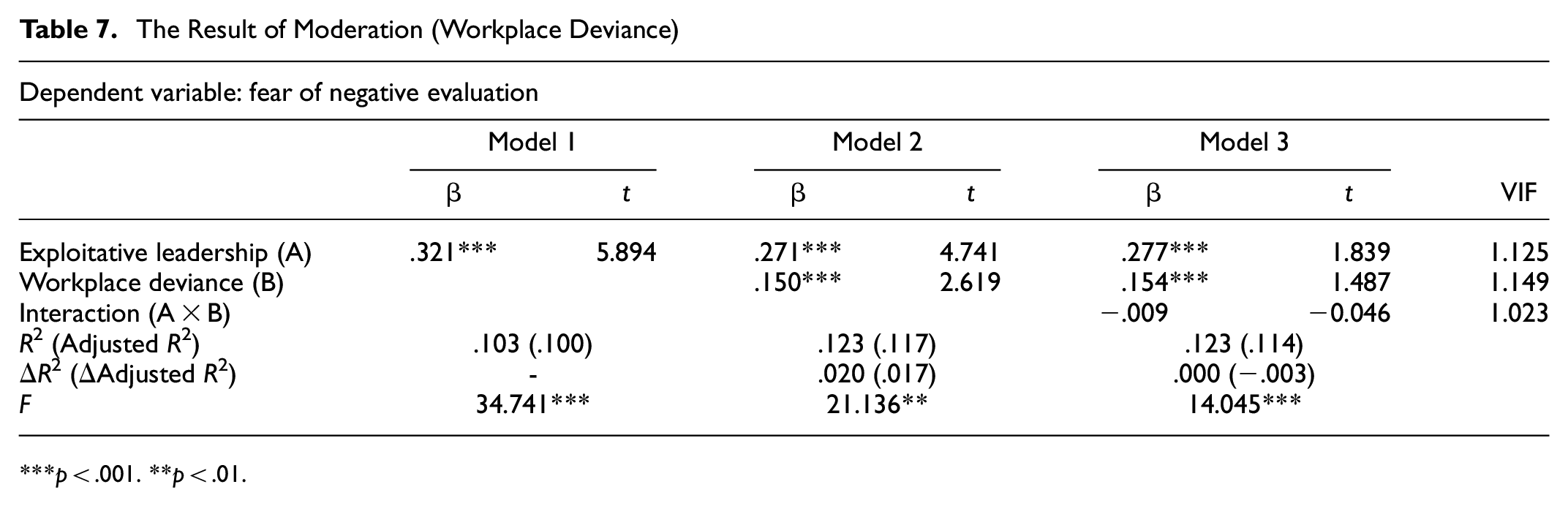
p < .001. **p < .01.
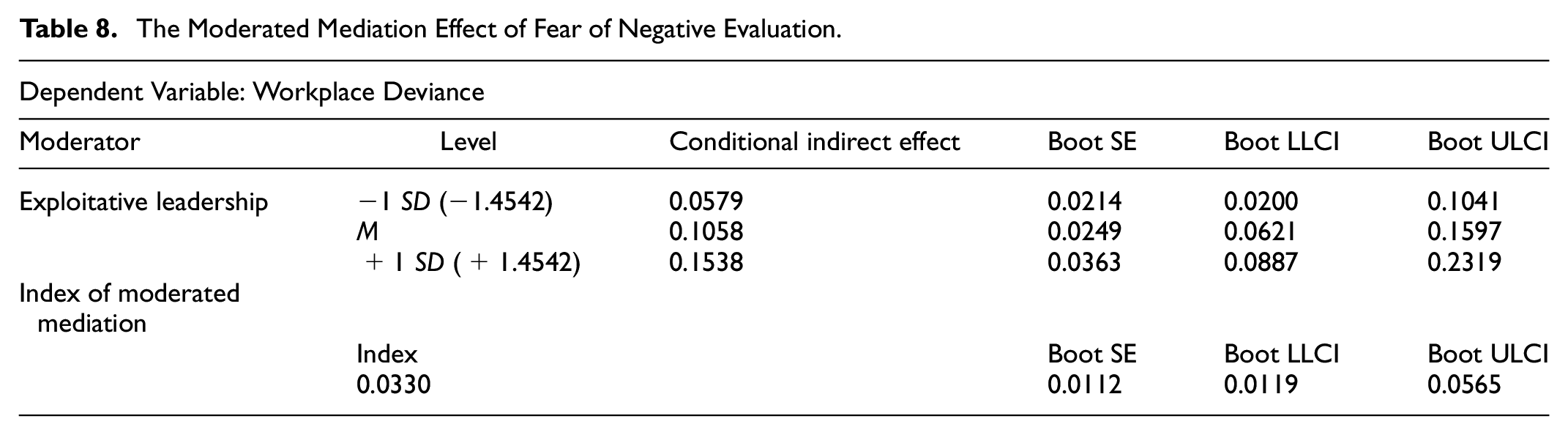
Finally, Hypothesis 7 proposed that fear of negative evaluation moderated the mediating influence of negative emotion on the relationship between exploitative leadership and workplace deviance. Table 8 shows the moderated mediation effect on fear of negative evaluation. The moderated mediation model was examined using SPSS PROCESS Macro 3.4.1 Model 8 and tested using 95% confidence intervals and 5,000 bootstrapping re-samples. When the significance of the mediating effect was established, the conditional indirect effect was evaluated to verify whether the effect of mediation depended on the moderating variable. Hence, the conditional indirect effect of exploitative leadership and workplace deviance was evaluated by analyzing the index of the moderated relationship at three moderator levels: −1 SD, mean (M), and +1 SD. Concerning the −1 SD level, the conditional indirect effect was 0.0579, Boot SE = 0.0214, Boot LLCI = 0.0200, and Boot ULCI = 0.1041. Regarding the level of M, the conditional indirect effect was 0.1058, Boot SE = 0.0249, Boot LLCI = 0.0621, and Boot ULCI = 0.1597. In terms of the +1 SD level, the conditional indirect effect was 0.1538, Boot SE = 0.0363, Boot LLCI = 0.0887, and Boot ULCI = 0.2319. Since 0 was not included between Boot LLCI and Boot ULCI at the level of −1 SD, mean level (M), and mean + 1 SD confidence intervals, we concluded that statistical significance was confirmed. Furthermore, the index of moderated mediation was 0.0330, Boot SE = 0.0112, Boot LLCI = 0.0119, and Boot ULCI = 0.0565. As 0 was not included between Boot LLCI and Boot ULCI, the bootstrapped confidence interval was significant. Overall, the moderated mediation effect of fear of negative evaluation was significant. Therefore, Hypothesis 7 was supported.
The Moderated Mediation Effect of Fear of Negative Evaluation.
Discussion
This study a moderated mediation model was employed to examine whether the path from exploitative leadership to workplace deviance depends on the level of fear of negative evaluation. This provides implications for future research on sustainable development in Chinese SMEs and highlights directions for further progress. A summary of the results of the study follows.
Theoretical Implications
First, exploitative leadership positively impacts employees’ negative emotions. When employees are exposed to stimuli from exploitative leadership, intense negative emotion can lead them to reevaluate the exchange relationship with their leaders. Employees may have a sense of unfairness and perceive themselves as giving more and receiving less in return (Y. J. Zhang et al., 2023). Exploitative leadership can increase employees’ negative perceptions (e.g., differential treatment and leader exploitation), which may lead to negative attitudes and behaviors. Therefore, a high level of exploitative leadership in SMEs will negatively impact both the SME and its employees, and exacerbate employees’ negative emotion.
Second, exploitative leadership positively impacts employees’ workplace deviance. Resource Conservation Theory posits that when individual resources are lost or threatened, employees choose to conserve their own resources to avoid further resource depletion. In China, due to the influence of traditional culture, leaders’ exploitative behaviors toward employees may be more prevalent and employees commonly feel compelled to engage in involuntary behaviors (Y. J. Zhang et al., 2022). When leaders exploit employees for their own benefit, these employees may remain silent to avoid conflict in the short term. This, however, encourages further exploitation by leaders, and when employees are unable to meet their demanding requirements, workplace deviance becomes a means to resist them.
Third, negative emotion positively impacts employees’ workplace deviance. According to the Conservation of Resources Theory, individuals with fewer resources are more susceptible to negative impacts due to resource scarcity and potential resource loss. Negative emotions narrow an individual’s cognitive scope, causing them to perceive the gap between the current and ideal state, attributing this difference to external factors (Zhao, 2020). When employees experience a high level of negative emotion or face negative emotions, their inability to effectively handle them leads to feelings of dissatisfaction, anxiety, and other psychological states. Eventually, when these negative emotions reach an uncontrollable level, employees subconsciously resort to workplace deviance to vent their anger toward the current environment. This helps alleviate their own negative emotions and reduces stress caused by the work environment.
Fourth, negative emotion has a partial mediating effect between exploitative leadership and workplace deviance. Exploitative leadership exacerbates the mismatch between employee needs and what leaders provide, undermining trust in the organization and management. It thus increases the likelihood of employees engaging in workplace deviance (Schmid et al., 2019). Consequently, when leaders’ harsh demands cannot be met, they engage in behaviors such as verbal abuse and bullying toward employees, triggering their feelings of depression and anger. Consequently, employees will vent their dissatisfaction through workplace deviance.
Fifth, fear of negative evaluation moderates the relation-ship between exploitative leadership and negative emotions. When employees perceive workplace evaluation as a source of fear of negative evaluation, their negative emotions intensify and they may engage in other negative behaviors to mitigate their fears (Jia & Yue, 2023). Therefore, regardless of the level of moderation by fear of negative evaluation, the interaction between this fear and exploitative leadership increases employees’ negative emotions. Moreover, when fear of negative evaluation is high, the impact on negative emotion is greater than when it is low.
Sixth, the moderating effect of fear of negative evaluation on the relationship between exploitative leadership and workplace deviance is not significant. When an employee exhibits a high level of fear of negative evaluation, it is more indicative that they are having difficulty fitting into the current organization. This could be due to unfair treatment in the organization, such as exploitation or bullying, and when employees cannot escape this situation, they may engage in workplace deviance to protect their internal resources (Bilal et al., 2020). However, this study suggests that fear of negative evaluation does not have a moderating effect between exploitative leadership and workplace deviant behavior, and regardless of whether fear of negative evaluation is high or low, its interaction value with exploitative leadership cannot influence workplace deviance.
Seventh, to confirm whether fear of negative evaluation can moderate the mediating effect of negative emotion, this study tested its moderated mediation effect. Workplace deviance is regulated by the interaction between exploitative leadership and fear of negative evaluation, and it exhibits a moderated mediating effect. This implies that workplace deviance is regulated by the interaction between negative emotions and fear of negative evaluation, moderating the mediating effect. To validate the moderated mediating effect of fear of negative evaluation, a more comprehensive method was employed to induce workplace deviance to provide a foundation for future exploration or the search for more effective methods of inducing such behavior.
In addition to these theoretical implications, the finding of this study that exploitative leadership can positively impact negative emotions aligns with the studies of Y. J. Zhang et al. (2023) and Y. D. Sun and Zhang (2022) with Chinese employees. Moreover, this study confirmed the positive influence of exploitative leadership on employee workplace deviance and the positive impact of negative emotion on employee workplace deviance. Finally, this study validated the mediating effect of negative emotions and the moderated mediating effect of fear of negative evaluation.
Practical Implications
First, it was affirmed that exploitative leadership does exist in Chinese SMEs. Thus, exploitative leadership not only affects the job performance of individual employees, but also impacts other employees in the organization and overall organizational performance (Y. Z. Wang & Wang, 2019). Therefore, organizational management should pay attention to the negative effects of exploitative leadership on employees. Furthermore, although research confirms that pressure exerted by leadership can have some positive effects on organizational performance, exploitative leadership prioritizes their own interests and fails to empathize with employees’ situations. Therefore, this study suggests that management should not only strengthen the learning of professional ethical standards, but also regularly listen to employees’ evaluations of the workplace environment.
Second, based on the findings of this study, it can be inferred that employees’ own negative emotions are also a major contributing factor to increased workplace deviance. Importantly, not only the workplace environment contributes to increased negative emotions. Factors related to employees’ personal lives, such as changes in their family life outside of work, can serve as significant sources of negative emotion. In practice, due to the smaller size of SMEs and their more flexible management systems, it is important for management not only to understand employees’ needs within the workplace, but also their family situations.
Third, employees in Chinese SMEs exhibit higher levels of fear of negative evaluation. Many factors can trigger fear of negative evaluation, primarily due to experiencing pain, discomfort, fear, anxiety, and other negative emotions in society or the workplace, which can lead individuals to intentionally avoid social interactions and develop a fear of negative evaluation from others (Watson & Friend, 1969). Based on previous research, the main cause of increased fear of negative evaluation among employees is evaluation from others. In pursuit of performance, SMEs may develop a culture where high performance is synonymous with being a “good employee,” while low performance is associated with being “incompetent” or a “bad employee.” Thus, this study suggests that in their day-to-day management activities, organizational management should discern employees’ individual capabilities. Some employees may be better suited for performance-based metrics, while others may not be well-suited for sales or performance-related jobs. It is essential to assign employees to positions that align with their abilities and competencies.
Fourth, during the recruitment process, companies need to screen applicants to identify candidates with strong learning abilities (Du & Jin, 2023b). In the early stages of SME development, there may be higher demands for product research and development and technical expertise, while in the mid-term, emphasis might shift toward sales capabilities.
Therefore, SMEs should select talent based on their current needs and adhere to strict implementation. The main reason for doing so is that when employees are unable to meet the requirements of their current positions, it inadvertently increases operational costs and wastes organizational time.
Fifth, workplace deviance poses risks to organizations. Effectively preventing and addressing employee workplace deviance is a significant challenge that organizations must prioritize (B. Liu et al., 2017). Employees are more inclined to participate in an organization’s production process to benefit from it. Therefore, employee workplace deviance may arise when they vent their dissatisfaction after feeling their efforts are not adequately rewarded. Hence, management should prioritize addressing employee workplace deviance and engage in regular learning activities to make employees aware of the negative impacts of such behavior.
Limitations and Direction of Future Research
Although this study makes significant contributions to the literature by examining the influence, it is important to acknowledge its limitations. These include the following.
First, this was an empirical study on SMEs in China. Considering the geographic location and cultural differences, it would be beneficial to conduct empirical research with employees of SMEs in Europe and the Americas, which have significant cultural differences from China. Research examining whether similar results can be obtained when conducting empirical analyses on organizational members from different countries and cultures is important (Jin, Qing, & Du, 2023).
Second, this study only focused on exploitative leadership. According to the Full Range Leadership Theory, although leaders in organizations tend to lean toward transformational and transactional leadership, it is inevitable that laissez-faire leadership characteristics emerge. Moreover, laissez-faire leadership has a significant positive impact on employee workplace deviance (Peng et al., 2019). In addition, it is worth to demonstrate the relationship between exploitative leadership and trust (Gao & Yan, 2022), job performance (Y. Wang & Jin, 2023), and innovation performance (L. Wang & Yan, 2023). In relation to negative leadership style, we expect that research focusing on the role and influence of machiavellian leaders is needed. Previous research have verified the relationship between leader’s machiavellianism and employees’ counterproductive work behavior (Cai, Wang, & Jin, 2024). Therefore, future research will need to uncover relationships and causal relationships in various aspects, such as knowledge hiding (Jin, Jin, & Qing, 2023) and Whistleblowing Behavior (Cai, Zhu, & Jin, 2024).
Third, this study only focused on workplace deviance, but other forms of negative employee behavior are also worth exploring. For example, in a study by L. X. Zhang et al. (2023) and Y. J. Zhang et al. (2023) on Chinese enterprises, employees’ unethical behavior was employed as a dependent variable (Y. J. Zhang et al., 2023). The research findings revealed that employees’ unethical behavior increased with the increase of exploitative leadership, indicating a positive (+) relationship between the variables.
Fourth, in this study, negative emotion was employed as the mediating variable, while in L. Z. Wu et al. (2021), the focus of the mediating variable was on leader-member exchange (L. Z. Wu et al., 2021). Therefore, future research could continue to explore the performance of other mediating variables in the research model.
Finally, this study only focused on the impact of exploitative leadership on employees’ workplace deviance, neglecting the effects of other types of leadership on workplace deviance. For example, abusive supervision (B. Liu et al., 2017), laissez-faire leadership (Peng et al., 2019), and authoritarian leadership (F. F. Liu & Liu, 2022) all have effects on workplace deviance. Moreover, according to research on spiritual leadership (Y. Z. Wang & Wang, 2019), it can reduce the likelihood of employees engaging in workplace deviance. Therefore, in future studies, we will investigate the influence of other types of leadership on workplace deviance and compare these results with those of this study to establish a more comprehensive theoretical framework for preventing employee workplace deviance.
Conclusions
In conclusion, this study emphasizes the crucial roles of exploitative leadership and fear of negative evaluation in trigger negative emotions and workplace deviance among employees in Chinese SMEs. The results indicate that exploitative leadership has a positively (+) impact on negative emotions and workplace deviance, with negative emotions partially mediating between them. Furthermore, fear of negative evaluation moderates the relationship between exploitative leadership and negative emotions, as well as moderating the mediating role of negative emotions in the model.
The findings of this study provide important insights for Chinese SMEs on how to reduce workplace deviance among employees by controlling leadership styles, employees’ fear of negative evaluation, and negative emotions. It also underscores the significance of exploitative leadership in influencing employee workplace deviance.
By highlighting the negative effects of exploitative leadership, the moderating effect of fear of negative evaluation, and the mediating role of negative emotions, this study further enriches the existing literature on leadership and employees in Chinese SMEs. The practical implications suggest that leaders should avoid adopting exploitative leadership, decrease the likelihood of triggering negative emotions and fear of negative evaluation among employees, and prevent the possibility of employees engaging in workplace deviance.
Footnotes
Appendix A
Summary of Structural Model Fit Results.

| Model | χ2(p) | χ2/df | RMSEA | IFI | CFI | PNFI | PGFI |
|---|---|---|---|---|---|---|---|
| Model 1 (Expected Model of four-factor a ) | 1083.776 (0.000) | 2.845 | 0.078 | 0.920 | 0.920 | 0.723 | 0.619 |
| Model 2 (one-factor b ) | 2768.616 (0.000) | 7.210 | 0.143 | 0.730 | 0.728 | 0.578 | 0.445 |
| Model 3 (two-factor c ) | 1609.038 (0.000) | 4.201 | 0.103 | 0.861 | 0.860 | 0.680 | 0.587 |
| Model 4 (two-factor d ) | 2617.394 (0.000) | 6.798 | 0.138 | 0.747 | 0.745 | 0.593 | 0.463 |
| Model 5 (three-factor e ) | 1489.238 (0.000) | 3.888 | 0.097 | 0.875 | 0.874 | 0.691 | 0.574 |
| Model 6 (three-factor f ) | 1609.038 (0.000) | 4.201 | 0.103 | 0.861 | 0.860 | 0.680 | 0.587 |
Exploitative leadership, negative emotion, fear of negative evaluation, and workplace deviance.
All items were loaded on a single factor.
Exploitative leadership & negative emotion, fear of negative evaluation & workplace deviance.
Exploitative leadership & fear of negative evaluation, negative emotion & workplace deviance.
Exploitative leadership, workplace deviance, negative emotion & fear of negative evaluation.
Fear of negative evaluation, workplace deviance, exploitative leadership & negative emotion.
Acknowledgements
We are grateful to the organizational members from Chinese SMEs who participated in the survey for this research.
Declaration of Conflicting Interests
The author(s) declared no potential conflicts of interest with respect to the research, authorship, and/or publication of this article.
Funding
The author(s) received no financial support for the research, authorship, and/or publication of this article.
An Ethics Statement
This research did not require ethics approval. The main reasons are as follows.
1. All participants were over the age of 18, and there were absolutely no minors included.
2. Our research is not involving animals. Therefore, there is absolutely no content about animal abuse or animal testing.
3. It absolutely did not include human biological experiments or general experiments.
4. Although the survey was conducted, it was not conducted compulsorily or coercively.
Before conducting the survey, participants were allowed to participate voluntarily without being forced. In addition, personal information processing was secured. Therefore, we promise that there are no ethical problems.

Data
The data that support the findings of this study are available from Xiu Jin but restrictions apply to the availability of these data, which were used under license for the current study, and so are not publicly available. Data are however available from the authors upon reasonable request and with permission of Xiu Jin.