




Abstract
The low academic ranking compared to academicians in other disciplines is a work performance issue encountered by accounting academics, particularly in developing countries such as Indonesia. Besides, executing performance systems as a control mechanism mandated by the government also affected academic counterproductive work behavior (CWB) and performance. However, there is a dearth of empirical verification concerning the connection of control systems to the CWB and the performance of accounting academics. Therefore, building upon the job demands-resources theory, this study examines the association among levers of control as institutional performance mechanisms, CWB, and the work performance of academics. A self-administered online survey was conducted on 238 Indonesian accounting academics. Partial least squares structural equation modeling (PLS-SEM) was utilized to run the analyses. This study’s crucial findings depicted the boundaries and interactive control systems as substantial factors to mitigate the tendency of academics to engage in CWB and revealed evidence concerning the negative effect of CWB on work performance. Subsequently, CWB plays a critical role in mediating the positive relationship between those two control systems and performance. The boundaries and interactive levers of control boost performance due to the systems’ success in mitigating academics’ involvement in CWB. The findings are relevant to higher education top management in aligning management control systems with the proper code of conduct and designing performance systems that enable academic freedom, collegial culture, autonomy, and participation to escalate performance. Shifting the control systems’ paradigm toward these characteristics will mitigate academics’ CWB and improve their performance.
Plain language summary
The study looks at how accounting academics in countries like Indonesia struggle with lower rankings compared to academics in other fields. It also examines how government-mandated performance systems affect their behavior and performance at work. However, there hasn’t been much research on how these control systems relate to academics’ behavior and performance. So, using a theory called job demands-resources theory, the study explores how control systems, counterproductive work behavior (CWB), and job performance are connected for accounting academics. They surveyed 238 accounting academics in Indonesia and used a statistical method called partial least squares structural equation modeling to analyze the data. The main findings showed that certain control systems, like boundaries and interactive controls, help reduce academics’ tendency to engage in counterproductive behavior and improve their performance. Counterproductive behavior, in turn, negatively affects performance. So, these control systems indirectly improve performance by reducing counterproductive behavior. The study suggests that higher education managers should align control systems with ethical standards and create performance systems that promote academic freedom, collaboration, autonomy, and participation. By doing this, they can reduce counterproductive behavior and enhance academic performance.
Introduction
In institutions like higher education organizations, where knowledge is key, employee performance significantly boosts the organization’s competitive edge (Kothari & Handscombe, 2007; Wallace et al., 2016). Additionally, performance-related challenges are often linked to behavioral factors. In response, the management control system (MCS) serves as an organizational tool aimed at addressing the consequences of these behavioral issues and enhancing performance (Gerdin, 2020; Otley, 2003).
Management control systems in higher education are inseparable from bureaucratic reform in public sector institutions, shifting toward a managerialism approach through the adoption of New Public Management (NPM) (Dobija et al., 2019). This approach promotes institutional governance inspired by the private sector’s management control with pre-set objectives, measurable performance targets, and result-based performance systems (Speklé & Verbeeten, 2014; van der Kolk et al., 2019). However, implementing these systems in higher education institutions can be a double-edged sword resulting in several behavioral issues. On one hand, these systems boost productivity to satisfy external demands (Heinicke & Guenther, 2020). On the other, focusing solely on achieving performance targets through a results-based, diagnostic approach can lead to negative behavioral outcomes, such as work overload and intense performance pressure (Dobija et al., 2019; Martin-Sardesai et al., 2020). These consequences decrease the academics’ autonomy (Dugas et al., 2020), leading to the system’s gaming (McCarthy & Dragouni, 2021; Pilonato & Monfardini, 2020) and eroding their performance quality (Ek et al., 2013). Such circumstances suggest that the improper implementation of organizational control systems in higher education could lead to concerns regarding the psychological work environment and a decline in academic professionalism, ultimately affecting the behavior and performance of accounting academics (Beime et al., 2024; Burney et al., 2017). This is in line with Otley’s (2003) argument that there is a connection between employees’ behaviors and management control systems because management uses them to influence their behaviors.
Indonesia, as a developing nation in Southeast Asia, faces challenges related to the work performance of academics (Hermanu et al., 2022). In 2022, only five higher education institutions in Indonesia ranked in the top 500 world universities. Sukoco et al. (2021) discovered through their empirical research that a primary factor contributing to this problem is the limited number of indexed publications and citations originating from Indonesian higher education institutions. Furthermore, Hermanu et al. (2022) and Logli (2016) note that the situation is exacerbated by a weak research culture and a lack of commitment to disseminating research and community service outputs. Additionally, lower government funding for research compared to neighboring ASEAN countries like Singapore and Malaysia further compounds the problem. As a result, despite having fewer higher education institutions (HEIs), these neighboring countries produce more internationally recognized publications and achieve higher citation counts than Indonesian HEIs (Sukoco et al., 2023; Suradijono et al., 2017). Additionally, the 2021 webometric rankings of highly cited researchers do not include any Indonesian academics, whereas academics from Singapore, Malaysia, and Thailand are listed.
Teaching performance is another significant issue affecting Indonesian higher education’s international recognition. In its 2020 strategic plan, the Indonesian Ministry of Education and Culture discovered an asymmetry between the teaching curriculum in Indonesian HEIs and the real industry needs. Previously, Kusumastuti and Idrus (2017) also found that the learning methods applied in Indonesian HEIs were not conducive enough to produce effective learning activities. These facts align with Rosser (2023), who detected poor teaching quality as a substantial barrier for Indonesia to produce world-class universities. Additionally, the issue of teaching staff qualifications, including a low proportion of academics with PhD degrees and full professor status relative to the total academic staff, also contributes to the poor ranking of Indonesian higher education institutions (HEIs) (Kusumastuti & Idrus, 2017; Logli, 2016).
To address behavioral issues affecting work performance, one effective performance management practice is Simons’ levers of control, which serves as a management control system (Simons, 1995; Widener, 2007). Each lever (i.e., the beliefs, boundaries, interactive, and diagnostic control systems) represents the tension between the enabling control systems that are more empowering and facilitating and the coercive control systems that tend to constrain employees’ autonomy and creativity (C. X. Chen et al., 2020; Heinicke & Guenther, 2020; Simons, 1995). In their connection with performance, Baird et al. (2019) found that, compared to coercive control systems (i.e., diagnostic and boundaries control systems), enabling systems (i.e., beliefs and interactive control systems) are more positively related to performance. Meanwhile, Heinicke and Guenther (2020) discovered that beliefs, boundaries, and diagnostic control systems positively influence an institution’s research performance in higher education settings. However, existing studies primarily examine levers of control that affect organizational performance, leaving a notable gap in understanding how management control practices, like levers of control, influence individual-level performance. This gap highlights the need for further research in this area, particularly in the HEIs context.
The enabling features found in the beliefs and interactive control systems foster trustful relationships through communication, empowerment, and autonomy, which reduce employees’ counterproductive work behavior (CWB) (Bellora-Bienengräber et al., 2022). Conversely, the boundaries control systems guide employees to comply with the institution’s code of conduct and avoid actions that contradict the organization’s objectives (Simons, 1995). However, the coercive aspects of diagnostic control systems, such as rigid performance targets focusing more on quantity than quality, may diminish employees’ autonomy, satisfaction of psychological needs, increase work stress and skepticism, and worsen CWB (Bellora-Bienengräber et al., 2022; C. X. Chen et al., 2020; Martin-Sardesai et al., 2020). Consequently, the extent of employees’ CWB impacts their work performance (Carpenter et al., 2021; Motowidlo & Kell, 2013; Rotundo & Sackett, 2002).
Moreover, within higher education contexts, there is a lack of research exploring the relationship between levers of control, counterproductive work behavior (CWB), and academics’ work performance. Furthermore, there is a scarcity of studies examining the crucial role of CWB in bridging the relevance of levers of control to work performance. The unique characteristics of higher education, including collegial values and academic freedom, mean that control systems successful in the private sector may not directly translate to higher education settings. Those characteristics necessarily direct top management to adequately accommodate the academics’ voices (Sutton & Brown, 2016) because overlooking their viewpoint may lead to systems dysfunction and negatively impact their behavioral outcomes (Kallio & Kallio, 2014).
Thus, this study seeks to explore the pivotal roles of levers of control in reducing academics’ engagement in counterproductive work behavior (CWB) to enhance their performance. The primary research objective is to identify the relationships between the emphasis on the four levers of control (beliefs, boundaries, interactive, and diagnostic control systems) and CWB. The secondary objective is to examine the relationship between CWB and academics’ work performance. Finally, the study aims to investigate whether CWB mediates the connection between levers of control and academics’ work performance.
This study offers two significant contributions to the literature. Firstly, it enhances the understanding within management control and performance management literature by highlighting the roles of boundaries and interactive control systems in mitigating counterproductive work behavior (CWB). Additionally, it underscores the importance of CWB in mediating the indirect relationship between these control systems and academics’ work performance. Effective improvement of academic performance necessitates control system designs that address employee behavioral issues, as managing organizational members’ behavior is a primary objective of management control systems. Secondly, this study enriches the existing knowledge by providing empirical evidence on management control practices within the higher education environments of emerging countries like Indonesia. This is particularly relevant in evaluating the effectiveness of these systems in enhancing individual performance by preventing academicians from engaging in CWB, an aspect that has received relatively little attention.
The paper is organized as follows. The subsequent section outlines the literature review and hypothesis development based on the research objectives. Following this, the third section discusses the research methods employed. Results are presented in the fourth section, followed by a discussion in the fifth section. The conclusion, along with implications, limitations, and suggestions for future research, are addressed in the final section.
Literature Review and Hypotheses Development
Levers of Control
The levers of control are formal management control systems that deal with behavioral dynamics (Simons, 1995). The systems emphasize the function of control systems as strategic management tools. Management utilizes levers of control to comprehend the connection between strategy and control in dealing with organizational behavior issues and strategic uncertainties (Chenhall & Moers, 2015). The framework consists of the beliefs control systems to deploy the organization’s core values, the boundaries control systems to restrain negative work behaviors, the interactive control systems to focus attention on and handle the organization’s strategic uncertainties, and the diagnostic control systems to ensure the accomplishment of the organization’s critical success factors (Simons, 1995; Widener, 2007). Additionally, several previous studies identified interactive and diagnostic levers of control as an effective approach to utilizing performance management systems. Interactive control systems refer to the enabling use of performance systems. Meanwhile, diagnostic control systems refer to the coercive use of performance systems (Asiaei et al., 2018; Baird et al., 2018; C. X. Chen et al., 2020; Heinicke & Guenther, 2020).
Furthermore, beliefs and interactive control systems (i.e., coercive control systems) are attributed to opportunities and innovation through two-way socialization, discussion, and information sharing (Mundy, 2010). Meanwhile, the boundaries and diagnostic control systems (i.e., coercive control systems) relate to code of conduct compliance, predictable goal achievement, efficiency, and performance target accomplishment (Simons, 1995). The interactive and diagnostic control systems also represent how to utilize performance measurement systems to achieve organizational objectives. The characteristics of interactive systems, such as empowerment and autonomy, represent the enabling use of the system. In contrast, diagnostic control systems that emphasize the performance targets’ compliance are more coercive (C. X. Chen et al., 2020). In the Indonesian higher education context, the control systems implemented are result-based management control systems whose characteristics are identical to those of diagnostic control systems (Hermanu et al., 2022).
The beliefs control systems are the guidelines for top management to communicate and socialize an institution’s goals and values. The effective execution of the systems shapes employees’ awareness and positive work attitude and behaviors toward the organization’s core values (Bellora-Bienengräber et al., 2022). Second, the positive consequence of levers of control on the employee’s work behaviors also arises due to the interactive control systems. Through feed-forward performance information flows and participation, the interactive control systems serve as an efficacious approach to collaboration and empowerment. Interactive systems break down hierarchical borders between organizational members, strengthen their psychological attachments, and intensify their commitment (Bellora-Bienengräber et al., 2022; Burney et al., 2017).
Conversely, boundaries and diagnostic control systems have a double-edged sword effect on employees’ outcomes depending on their utilization, whether in a constraining or supportive approach. The boundaries control systems restrict employees’ opportunity-seeking and “out of limit” behaviors. Meanwhile, compliance with performance targets and deviation avoidance characteristics in the diagnostic control systems lead to employees’ work anxiety and deter their creativity (C. X. Chen et al., 2020). In addition, control mechanisms occasionally become dysfunctional due to undesirable behaviors that emerge as the system’s side effects. For instance, the emphasis on the diagnostic control systems may result in game rationality, a free-riding effect, and acting in a self-interested way (Bellora-Bienengräber et al., 2022; Burney et al., 2017; Kallio & Kallio, 2014).
Counterproductive Work Behavior (CWB)
CWB is individual behavior that goes against the norms, interferes with organizational interests, and harms performance (Burney et al., 2017; Spector et al., 2010). It includes negative deviant behaviors such as purposefully performing erroneous work, making inappropriate work-related complaints, and abusing organization resources and work time (Spector & Fox, 2010).
CWB is critical in determining employee performance (Rotundo & Sackett, 2002). Concurrently, enabling and ethically focused management control and performance measurement systems align with a lower degree of CWB (Bellora-Bienengräber et al., 2022; Burney et al., 2017). In the meantime, abusive supervision has a connection with high CWB (Ju et al., 2019). In higher education settings, previous findings indicate that control mechanisms focused on monetary compensations, quantitative performance measurements, and workload pressures also strongly affiliate with CWB (Agyemang & Broadbent, 2015; Maimela & Samuel, 2016; Martin-Sardesai et al., 2020).
Concerning the performance of accounting academics, including those in Indonesia, there is a notable lag in their research and publication achievements, teaching outcomes, and industry engagement compared to counterparts in other fields (Fogarty, 2021; Madsen, 2015). Additionally, accounting departments often serve as financial pillars for institutions, characterized by large student populations and high student-to-faculty ratios, which can affect overall performance (Pop-Vasileva et al., 2014). Pressures for international recognition, rankings, accreditation, and financial autonomy contribute to what’s termed as “managerialism euphoria,” placing accounting departments and their faculty in a challenging position (Beime et al., 2024; Pop-Vasileva et al., 2014; Pop-Vasileva et al., 2011). Despite reservations about privatization and managerialism, they are compelled to navigate these issues while coping with high workloads and performance expectations (Beime et al., 2024; Pop-Vasileva et al., 2011). These circumstances prompt pragmatic responses among academics, leading to counterproductive behaviors such as salami-slicing practices in publishing. Furthermore, they may lower performance standards to meet publication targets, sacrificing academic quality and innovation (Jacobsen & Andersen, 2014; Kaarsted, 2017; Kenny, 2017).
Job Demands-Resources (JD-R) Theory
Job demands-resources (JD-R) theory, which elaborates on the tension between job demands (e.g., workload) and job resources (e.g., empowerment, autonomy, and academic freedom), may effectively describe the effects of management control and performance systems in higher education environment and their connection with behavioral constructs (McCarthy & Dragouni, 2021). Control systems that facilitate academics’ psychological needs through intellectual freedom, collegial values, and autonomy (i.e., job resources) are vital for higher education institutions in dealing with the challenge of managerialism. Conversely, the more rigid systems create academics’ feelings of powerlessness (i.e., job demands), leading to their counterproductive acts (Fox et al., 2012).
Initially, this theory emerged to explain job strain related to employee burnout, diminished work commitment, and deficiencies in personal efficacy due to high work pressure, an unfavorable physical work environment, and psychological stress in the workplace (job demands). Nevertheless, besides its development, this theory integrates two basic psychological processes with additional discussions on work behaviors, including work engagement, resilience, and dedication due to job support and performance feedback (job resources) (Bakker & Demerouti, 2007, 2017; Schaufeli, 2017). The JD-R theory describes the work environment with specific demands and resources emanating from social, psychological, and organizational aspects. These elements simultaneously establish academics’ work engagement and work behaviors (Giauque et al., 2013). Subsequently, some previous studies employed the JD-R model to explain employees’s CWB (Balducci et al., 2011; H. Chen et al., 2020; Demerouti et al., 2015). H. Chen et al. (2020) utilized this theory to detect the negative association between work engagement that escalates due to job resources and declines because of job demands with CWB. In a similar vein, Balducci et al. (2011) found a positive relationship between job demands (e.g., workload and role conflict) and CWB and a negative relationship between job resources (e.g., decision authority and social support) and CWB. Besides, Demerouti et al. (2015) discovered that work challenges due to job demands give rise to employees’ engagement with CWB, while through autonomy and work engagement, job resources lead to higher task performance.
Moreover, McCarthy and Dragouni (2021) employed this theory to explain behavioral responses to managerialism in United Kingdom business schools. These authors use the theory to analyze the interplay between job demands and job resources due to performance measurement systems, impacting academics’ burnout and turnover. Accordingly, some features of coercive levers of control, such as performance conformity and tight supervision enclosed in the diagnostic systems, display characteristics of job demands. Meanwhile, the enabling characteristics in the beliefs control systems (i.e., socialization and communication) and interactive control systems (i.e., empowerment and constructive debate) represent job resource features. Besides, the encouraging and facilitating codes of conduct encapsulated in the boundaries systems also resemble job resource functions in this setting. These features act as a safeguard against employee creative behavior maneuvers (Simons, 1995). Therefore, this study used the JD-R theory to describe how the four levers of control affect academics’ CWB and performance.
Job characteristics embedded in control systems impact employees’ engagement, resilience, dedication, and well-being. The impact can be positive due to job resources (e.g., control systems containing job support, autonomy, participation, and recognition) or negative because of job demands (e.g., systems consisting of work pressures and stress) (Bakker & Demerouti, 2007, 2017; Schaufeli, 2017). Job resource features in the enabling levers of control are associated with academics’ positive behaviors, amplifying academics’ engagement, proactiveness, and performance. On the contrary, high-pressure targets manifested in the coercive levers of control potentially violate their mental and emotional well-being, triggering counterproductive work behavior and downsizing their performance. Moreover, job demands are identical to physical and psychological work demands, resulting in psychological costs such as academics’ negative behaviors due to frustration and feelings of failure (McCarthy & Dragouni, 2021).
Hypotheses Development
Levers of Control and Counterproductive Work Behavior (CWB)
Levers of control have enabling and coercive functions connected to employees’ motivation (C. X. Chen et al., 2020), determining their work behaviors and performance. Some enabling functions of levers of control are embodied in the beliefs control systems, including bottom-up discussion, information sharing, and constructive debate. These functions are supportive mechanisms that accommodate academics’ autonomy and competence, connecting them with management through the two-way socialization and discussion of the institution’s core values (Simons, 1995).
Bellora-Bienengräber et al. (2022) empirically found a negative relationship between the beliefs control systems and CWB. The two-way discussion between top management and employees in communicating organizational core values encourages bottom-up information sharing and work autonomy, strengthening academics’ work engagement and developing innovation (Agyemang & Broadbent, 2015; Sutton & Brown, 2016; Widener, 2007). Gerdin (2020) discovered how a clear organization’s vision and mission inspire academics’ behaviors, and how the institution disseminates these values to its personnel will result in the academics’ commitment to achieving the organization’s objectives. Concurrently, employees’ work commitment mitigates the tendency to engage with CWB (Bellora-Bienengräber et al., 2022). The systems provide employees with a clear understanding of the institution’s core values and crucial role in executing strategies, motivating employees to stay aligned with the organization’s direction, and contributing to accomplishing institutional goals (Simons, 1995). Based on these discussions, it is proposed that:
Hypothesis 1 (H1). Emphasis on beliefs control systems is negatively associated with CWB.
The boundaries control systems require employees to stay within the radius of acceptable actions and follow specific codes of conduct and work-related procedures (C. X. Chen et al., 2020; Heinicke & Guenther, 2020). Although some studies have argued that the coercive characteristics of the boundaries systems contradict autonomy (Agyemang & Broadbent, 2015; Martin-Sardesai et al., 2020) and create an irritating situation due to feelings of powerlessness (Fox et al., 2001), Simons (1995) explained that this system provides critical mechanisms for organizational freedom and entrepreneurial behavior. Similarly, Mahlendorf et al. (2018) also exhibited a code of conduct as an effective mechanism to prevent unethical work behaviors. The boundaries systems within organizations parallel the function of a car’s brakes, which permits institutions to operate at high speeds in some ways and alleviate high-risk behaviors. This lever consistently strengthens employees’ ethics to align with the institution’s core values and obey the organization’s code of conduct (Bellora-Bienengräber et al., 2022). Moreover, higher collegiality leads academics to identify this system as a device to guard their creativity and focus on the organization’s goals (Vakkuri & Meklin, 2003). Therefore, the second hypothesis predicts:
Hypothesis 2 (H2). Emphasis on boundaries control systems is negatively associated with CWB.
The interactive control systems provide empowerment and constructive debate between managers and subordinates to enhance innovation through organizational learning. This system increases employees’ work autonomy and competence, enhancing their innovation and creativity (Burney et al., 2017). Simultaneously, these authors empirically found a negative association between interactive control systems and CWB. The characteristics embedded in the systems strengthen academics’ job engagement and allow them to develop innovations through academic freedom, collegiality, and independence (C. X. Chen et al., 2020; Heinicke & Guenther, 2020). This enabling approach emphasizing collegial culture is associated with positive work behaviors because it accommodates autonomy and motivates academics to bring their best effort to the organization (Wilkesmann & Schmid, 2012). The system’s fulfillment of employees’ psychological needs reduces emotional exhaustion (Huang et al., 2017) and mitigates the propensity of academics to engage in CWB (Burney et al., 2017). Accordingly, the third hypothesis is:
Hypothesis 3 (H3). Emphasis on interactive control systems is negatively associated with CWB.
The significant characteristics of the diagnostic control systems are performance metrics and constant monitoring to accomplish institutional goals. The systems direct personnel’s attention to managing and achieving individual performance targets (Simons, 1995). Although the diagnostic system supports regulation, order completion, and performance compliance (Martyn et al., 2016), this coercive system can diminish employees’ intrinsic motivation and work outcomes (C. X. Chen et al., 2020). Furthermore, managerialism in higher education institutions, including results-based performance systems, reduces academics’ autonomy (Horta & Santos, 2020; Kallio & Kallio, 2014; Martin-Sardesai et al., 2020). The previous findings also indicate that results-based performance systems make academics focus solely on achieving the targets assigned without trying to pursue the quality of the outcomes (Agyemang & Broadbent, 2015; Dobija et al., 2019; Pilonato & Monfardini, 2020). These circumstances lead to the high pressure of performance targets, restrict academics’ autonomy, and violate the psychological needs of academicians. Consequently, these circumstances trigger academics’ intention to engage with CWB (Martin-Sardesai et al., 2020; Zheng et al., 2017). Hence, the fourth hypothesis is:
Hypothesis 4 (H4). Emphasis on diagnostic control systems is positively associated with CWB.
CWB and Performance of Academics
Work performance is fulfilling responsibilities based on personnel functions contributing to the organization’s technical core (Murphy, 1989). Rotundo and Sackett (2002) specifies this task performance as the activities contributing to the organization’s integral functions of the inherent job (e.g., teaching, research, and community services in higher education settings).
The extant studies on the relationship between work behaviors and performance focus on positive work behaviors, such as proactive behavior and creativity (Matsuo et al., 2021; Su et al., 2022). Meanwhile, managerialism in higher education settings has resulted in negative work behaviors (e.g., CWB) due to the destruction of collegiality, autonomy, and academic freedom (Agyemang & Broadbent, 2015). Additionally, Rotundo and Sackett (2002) demonstrated that CWBs are essential to assessing employee performance. Besides, Carpenter et al. (2021) explored a significant relationship between CWB and task productivity. Negative work behaviors due to work pressures distort the work performance of academics, especially in the quality of their research, teaching, and community service (Martin-Sardesai et al., 2020; Woelert & Yates, 2015). Following these discussions, the fifth hypothesis predicts:
Hypothesis 5 (H5). CWB is negatively associated with academics’ work performance.
The Mediating Role of Counterproductive Work Behavior (CWB)
Su et al. (2022) exhibited the critical role of employees’ behaviors (i.e., creativity and collegiality) in mediating the management control systems’ influence on job performance. Matsuo et al. (2021) and Vihari et al. (2022) explored similar findings using prosocial behavior and innovative work behavior as mediators. In addition, Burney et al. (2009) also utilized organizational citizenship behavior to connect the linkage between performance measurement systems and employees’ performance. However, these previous studies examined the influence of management control systems and performance measurement systems on work performance through positive work behaviors. Meanwhile, in the context of higher education institutions, the adoption of managerialism through management control systems has resulted in negative deviant work behaviors due to the erosion of collegiality, autonomy, empowerment, and academic freedom (Agyemang & Broadbent, 2015; Sutton & Brown, 2016). Some coercive execution of management control systems, such as the coercive use of diagnostic control systems, might result in negative behaviors (e.g., CWB) due to their drawbacks in diminishing these psychological needs of academics (Agyemang & Broadbent, 2015; Kenny, 2017; Martin-Sardesai et al., 2020). Subsequently, negative behaviors such as “gaming” and “smoothing” toward the performance measures will attenuate employees’ performance quality and prevent the execution of the organization’s objectives (Appelbaum et al., 2007; Martin-Sardesai et al., 2020; Su et al., 2022).
In more detail, Agyemang and Broadbent (2015) discovered that high quantitative performance targets with “payment by results” control systems decrease their professionalism about research culture and give rise to transactional motivation. Consequently, this extrinsic incentive engages academics in gaming behavior to maximize their revenue and escalate their academic reputation, sacrificing their academic performance quality. These gaming responses by academics are counterproductive to individuals and organizations building up high-quality research, teaching, and community service (Woelert & Yates, 2015). Conversely, the enabling characteristics of management control systems fulfill employees’ needs for autonomy, competence, and relatedness by facilitating work environments that enable them to actively participate and contribute to designing and executing performance systems (Adler & Borys, 1996; Ahrens & Chapman, 2004; C. X. Chen et al., 2020). The compliance features in boundaries systems also hinder academics from conducting “out of limits” acts during their performance target accomplishments (Mahlendorf et al., 2018). These characteristics will strengthen academics’ work engagement, diminish their engagement in negative acts such as CWB, and develop their professionalism in academic innovation to enhance their performance quality (Agyemang & Broadbent, 2015; Sutton & Brown, 2016).
Subsequently, there are some justifications for utilizing CWB as a mediator for the indirect association of levers of control on academics’ work performance. First, previous literature utilizing psychology theories in management accounting studies argues that MCS influences employees’ work behavior and consequently affects performance (Martin-Sardesai et al., 2020; Wibbeke & Lachmann, 2020). Therefore, how the systems enable the employees’ behavior and performance is the organization’s critical emphasis because it will influence its objectives. Second, complexity in the higher education environment due to managerialism that restricted academic freedom and collegiality might result in personnel CWB triggered by their high burnout and anxiety (Agyemang & Broadbent, 2015; Martin-Sardesai et al., 2020). Meanwhile, CWB is a critical factor in determining employee performance (Rotundo & Sackett, 2002) due to its negative effect on task productivity (Carpenter et al., 2021). Therefore, to enhance employees’ performance, control systems should initially be able to mitigate the employees’ involvement in CWB. The low level of the academics’ CWB facilitates the roles of levers of control (i.e., beliefs, boundaries, and interactive levers of control) in enhancing their work performance. Conversely, the higher CWB attributes the detrimental effect of the coercive use of the diagnostic control systems on the academics’ work performance. Correspondingly, in line with the direct effect among levers of control, CWB, and the academics’ work performance, the mediation hypotheses in this study are:
Hypothesis 6a (H6a). The association between beliefs LoC and academics’ work performance is positively mediated by CWB.
Hypothesis 6b (H6b). The association between boundaries LoC and academics’ work performance is positively mediated by CWB.
Hypothesis 6c (H6c). The association between interactive LoC and academics’ work performance is positively mediated by CWB.
Hypothesis 6d (H6d). The association between diagnostic LoC and academics’ work performance is negatively mediated by CWB.
Methods
Sample and Data Collection
This study utilizes Indonesian accounting academics in public higher education institutions as the population for several reasons connected with their work performance. First, the accounting department has become a “cash cow” for HEIs with a large student body and a high student-to-faculty ratio (Pop-Vasileva et al., 2014). Second, no accounting academics are in the 2021 Webometric highly cited researchers rankings. Moreover, locally, no accounting academics have penetrated the top 50 Indonesian academics based on the 2020 Indonesia Science and Technology Index. Third, accounting academics are undergoing a critical transition, moving from practitioners who also teach at the university to academics who also practice as accountants (Fogarty, 2021). Hence, accounting academics need to focus more on their performance in three academic core functions (research, teaching, and service). The reluctance to revisit their old perspective will impact their work outcomes and academic success (Zimmerman et al., 2017). Lastly, Madsen (2015) discovered that accounting students are underperforming compared to students with non-accounting business degrees, while the accounting department’s performance is also lagging behind that of other departments (Fogarty, 2021). These facts indicate the challenges of accounting education over the years, including those correlated with the performance of its academicians.
The non-probability sampling was employed, with the target respondents being full-time accounting academics with active employment status (i.e., not on leave). The minimum sample size calculation through the G*power indicates a minimum requirement of 85 samples. The calculation is according to the fact that in this research model, the highest number of predictors pointed to in one outcome variable (i.e., the most complex regression) is four (Figure 2) with a medium effect size of 0.15, and the required power is 0.80 in alpha (α) of .05 (Faul et al., 2009; Felipe et al., 2020; Khasni et al., 2023). A cross-sectional online survey was conducted through Qualtrics, an online platform researchers utilize to collect data from their respondents. The survey questionnaire consists of 39 items for eight constructs (Appendix 1), seven questions related to the demographic profile, three items of one marker variable for common method bias (CMB) detection, and one global item for the second-order formative construct of the interactive control systems.
Two hundred sixty-one responses were initially collected from accounting academics at 41 of Indonesia’s public HEIs. Next, using the basic Mahalanobis distance test measured with chi-square at a p-value of .01 (Leys et al., 2018), researchers eliminated 23 observation outliers detected. Besides, there are no straight-lining observations in the dataset, while the missing values issue was handled with Little’s MCAR test in SPSS (i.e., the expectation maximization/EM) (Hair et al., 2017). Finally, 238 observations (91.1%) remained as a dataset for analysis.
Table 1 depicts the 238 respondents’ demographic details. Fifty-five percent of the respondents were female, while 45% were male. Moreover, the respondents’ ages ranged from 26 to 65 years old. Fifty-four percent of respondents have a master’s degree, while the rest have doctorates. Most respondents had academic career positions as senior lecturers and had between 11 and 20 years of experience.
Respondents Profile.

Variable Measurements
The constructs of this study are the four components of the levers of control (i.e., the beliefs, boundaries, interactive, and diagnostic control systems), counterproductive work behavior (CWB), and academics’ work performance in research, teaching, and service. This study adapted the four levers of control measures by C. X. Chen et al. (2020) and H. Chen et al. (2020) through pretests and a pilot study due to the different contexts used (i.e., higher education settings). All levers of control items were evaluated using a seven-point Likert scale, with points ranging from “strongly disagree” to “strongly agree.” The beliefs control systems (Blf) consist of four items that reflect how the function of the institution’s core values inspires employees and how top management communicates these values as the organization’s direction. The boundaries control systems (Bnd) contain four indicators that focus on management’s efforts to communicate risks to limit employee behavior related to seeking opportunities and ensuring compliance with the organization’s code of conduct. The interactive Control Systems (Int) is a second-order formative construct that consists of strategic uncertainty (i.e., Int-SU, three items), attention focusing (i.e., Int-AF, five items), and performance measurement (i.e., Int-PM, two items). The diagnostic control systems (Diag) have four items that reflect critical performance measures as a formal feedback system.
The CWB instrument is based on the five items used by Burney et al. (2017), referring to the work behavior checklist from Spector et al. (2006) that represents sabotage and withdrawal, in which the scoring ranges from never (1) to always (7). The academics’ work performance consists of academics’ work performance in research (AWP-R), teaching (AWP-T), and service (AWP-S) (Jiao et al., 2021), which have four items each and were marked from a very little extent (1) to an extremely great extent (7). The NA (not applicable) scale may also be selected to answer items that do not relate to specific respondents, such as “research student supervision,” that do not match respondents who are not involved in graduate programs.
Finally, besides the primary research variables mentioned above, this study also employed education level as a control variable. The inclusion of control variables in this study prevents the researcher from overlooking the influence of other variables within the designed research model, while these variables might have relationships with the outcome variable in the model (Aguinis et al., 2021; Bernerth & Aguinis, 2016). The use of education level as a control variable in this study is due to the fact that faculty members with better performance tend to possess doctoral degrees (Tien, 2008). Additionally, the use of this control variable is tailored to the context of Indonesian higher education human resources, where the composition of academics is still somewhat balanced between those with doctoral degrees and those with master’s degrees, in contrast to the composition in developed countries, where academics with doctoral degrees predominate. Besides, Bernerth and Aguinis (2016) discovered that education is one of the most utilized control variables in job performance studies. Therefore, in this study, the education level of academics (master’s and doctoral degrees) is predicted to influence their work performance in research, teaching, and service. The code of this categorical variable is “0” for a master’s degree and “1” for a doctoral degree.
Common Method Bias (CMB)
Researchers conducted procedural and statistical remedies to mitigate CMB in this cross-sectional survey with single-source data. This study organizes procedural remedies using different scale labels for predictor and criterion variables. Besides, researchers ensure respondents concerning confidentiality through anonymity (Podsakoff et al., 2012). This research also conducted a pre-test that consisted of expert reviews and comments, content validity index (CVI) scoring (Yusoff, 2019), and cognitive-validity interviews (Memon et al., 2017; Speklé et al., 2017; Wohlgemuth et al., 2019). The pilot study (i.e., 60 respondents) was employed to overcome instrument reliability and validity issues (Johanson & Brooks, 2010; Memon et al., 2017).
Harman’s single-factor test depicts that CMB is not a serious problem because no single factor represents the majority covariance among research variables (i.e., 31.76% of the variance) (Fuller et al., 2016; Hock et al., 2016). Full-collinearity testing through regression analysis between the latent scores of all constructs and a random variable indicates that the bias of single-source data is not a significant problem because all of the VIF scores are less than 5 (Kock & Lynn, 2012; Lindell & Whitney, 2001). As the last statistical remedy, the marker-variable analysis with three items of cognitive rigidity depicts that the beta value (β) and R2 in the two research models (i.e., models with and without marker variables) are not significantly different, revealing that CMB is not a substantial concern for this study (Klijn & Koppenjan, 2016; Lindell & Whitney, 2001).
Results
Measurement Model
Concerning the reflective measurement model, according to Table 2, all reflective variables surpass the measurement model thresholds, which have composite reliability (CR) greater than 0.6. The outer loadings of all indicators are also greater than 0.5. However, the early average score extracted (AVE) of the CWB was slightly below the threshold. Therefore, one CWB indicator with the lowest outer loading (i.e., CWB2) was dropped (Hair et al., 2017), resulting in the new AVE value of 0.505 (i.e., >0.50). The discriminant validity with the heterotrait-monotrait ratio (HTMT) in Table 3 is also accepted (i.e., >0.85) (Hair et al., 2017; Henseler et al., 2015; Ringle et al., 2023). This HTMT criterion represents the ratio of between-trait compared to within-trait correlations. All of the HTMT values below 0.85 indicate that all respondents fully comprehend that each construct or variable is distinct and unique in its ability to capture the perceived phenomenon and is not represented by other constructs in the model (Hair et al., 2017).
Measurement Model of the First Order Reflective Constructs.

HTMT Criterion.

The second order of the interactive control systems is a formative variable consisting of Int-AF, Int-SU, and Int-PM, in which the values are obtained from their first-order latent variable scores. Convergent validity is accomplished through redundancy analysis with the global item (GI) of the intended formative variable (Sarstedt et al., 2013), and Figure 1 indicates that the path coefficient is above 0.70 (Hair et al., 2017). Table 4 demonstrates that all formative indicators are free of collinearity issues (i.e., VIF < 5) (Hair et al., 2020; Kock & Lynn, 2012). Next, according to Table 4, although Int-SU does not significantly contribute to the interactive control systems since the p-value of its outer weight is greater than 0.05 (Table 4), the researchers also acknowledge the indicators’ outer loading (i.e., the thresholds are fulfilled with loadings >.5 and p < .01) in dealing with the nonsignificant outer weight to consider retaining all of the formative indicators (Hair et al., 2017).

Redundancy analysis.
Measurement Model of the Formative Construct.

Structural Model
Smart-PLS was utilized to discover the path coefficients, t-values, p-values, effect size (f2), and bias-corrected confidence intervals (BCI) (Table 5 and Figure 2). The two last metrics, effect size and confidence interval, complement the use of p-values in determining the hypothesis’s significance (Hahn & Ang, 2017). All of the VIF of the direct effect hypotheses are less than 5, implying no critical multicollinearity problem (Hair et al., 2020; Kock & Lynn, 2012).
Hypothesis Testing—Direct Effect.
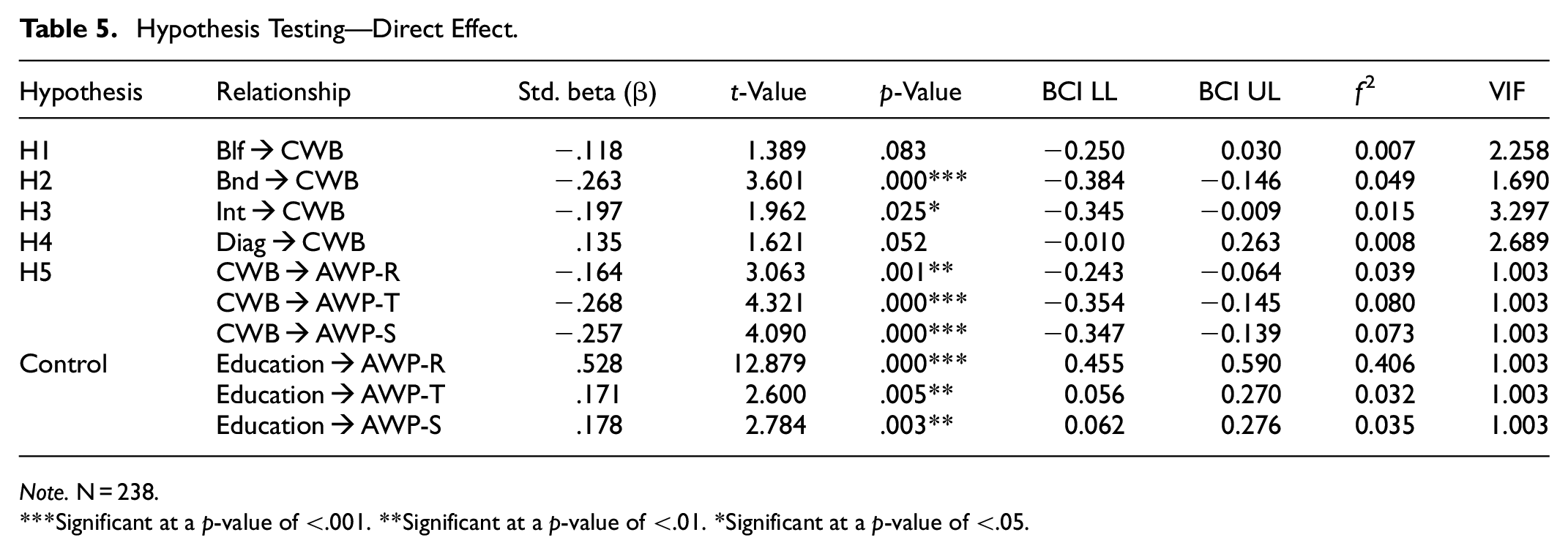
Note. N = 238.
Significant at a p-value of <.001. **Significant at a p-value of <.01. *Significant at a p-value of <.05.

Structural model.
The negative relationship between the beliefs control systems and CWB (H1) only has marginal significance with a p < .1 (β = −.118; p = .083). However, f2 of this hypothesis indicates that beliefs control systems had no effect on CWB (Cohen, 1988), and the confidence interval between the lower level (BCI LL) and the upper level (BCI UL) is straddling zero (i.e., containing zero); therefore, H1 is not supported (Hair et al., 2017). A similar condition also occurs in H4, which predicts the positive relationship between the diagnostic control systems and CWB (β = .135; p = .052), and accordingly, H4 is not supported. Meanwhile, H2 and H3 were supported, in which the boundaries and interactive control systems have a significant negative effect on CWB at p < .01 (β = −.263; p = .000) for H2 and < 0.05 (β = −.197; p = .025) for H3. The H2 and H3 also have a small effect size and do not include zero between BCI LL and BCI UL. H5 that predicts the negative relationship between CWB and AWP-R, AWP-T, and AWP-S is also supported with p < .01 for AWP-R (β = −.164; p = .001), while p < .001 for AWP-T (β = −.268; p = .000) and AWP-S (β = −.257; p = .000), supported by the small effect of these relationships and there are no problems related to the confidence intervals. This study also found a significant positive relationship between education level and AWP-R, AWP-T, and AWP-S.
Besides the five hypothesized direct relationships explained above, Table 5 also indicates that education level has a significant positive association with the academics’ work performance in research (β = .528; p = .000), teaching (β = .171; p = .005), and service (β = .178; p = .003). These results are in line with Tien (2008) and Bernerth and Aguinis (2016). In other words, academics with PhD degrees have a greater connection with higher work performance compared to those with master’s degrees. Furthermore, this difference is especially identical to HEIs in developing countries such as Indonesia, where the composition of academic educational backgrounds varies between master’s and doctoral degrees.
The coefficient of determination (R2), with the addition of education level as a control variable, suggests a small level of predictive accuracy for AWP-T (0.106) and AWP-S (0.103) and a medium level for CWB (0.169) and AWP-R (0.315) (Cohen, 1988; Hair et al., 2017). The blindfolding metrics (Q2) of endogenous constructs indicate the values are larger than 0 (CWB = 0.074; AWP-R = 0.171; AWP-T = 0.050; AWP-S = 0.059), indicating sufficient predictive relevance (Hair et al., 2020).
Next, this study detects mediation analyses through the bootstrapping method according to the confidence interval percentage in the lower and upper bounds (Hayes, 2009; Mackinnon et al., 2004). Instead of solely focusing on the p-values, the other most trustworthy test for indirect effects inferences (i.e., mediation analysis) is the bias-corrected bootstrap confidence interval (Hayes, 2009; Hayes & Scharkow, 2013; Rucker et al., 2011). In this test, besides using the p-value (significance level), judgment related to mediation analysis is also based on the bias-corrected bootstrap confidence interval test. By the same meaning, there is a mediation relationship (i.e., the null hypothesis of the mediation effect is rejected) if this analysis provides the significance level in p < .1 and displays metrics of both the bias-corrected confidence interval lower level (BCI LL) and the bias-corrected confidence interval upper level (BCI UL) that do not include zero (i.e., not straddling zero). Moreover, the mediation analyses (especially those that are exploratory) also use a p < .1 as the significant level (van Den Hurk et al., 2011; van Kesteren & Oberski, 2019; Yan & Guan, 2018).
According to Table 6 above, H6a is not supported because all of the p-values are not significant (p > .1), and there is a zero value between the BCI LL and BCI UL (straddling zero). Next, the significant mediation effects in H6b (p < .05) were supported by the fact that no zero-value existed between their BCI LL and BCI UL, indicating the critical role of CWB in mediating the indirect positive effects of the boundaries control systems on AWP-R, AWP-T, and AWP-S. Concerning H6c, although the significance level of three mediation analyses in H6c is only at p < .1, it can still be justified that CWB significantly mediates the positive indirect effect of the interactive control systems on AWP-R, AWP-T, and AWP-S because their BCI LL and BCI UL do not include zero. Meanwhile, with the same threshold criteria, for H6d, CWB only has a significant role in mediating the indirect negative relationship between the diagnostic control systems and AWP-R because even with a p < .1, BCI LL and BCI-UL metrics do not straddle zero. On the other hand, the two other mediation analyses in H6d are not supported because there is a zero value between the BCI LL and BCI UL (straddling zero).
Hypothesis Testing—Indirect Effect.

Note. N = 238.
Significant at a p-value of <.05. ¥Significant at a p-value of <.1.
Discussion
Among the paucity of studies linking levers of control, CWB, and individual performance, this study discovers the role of the two levers of control, boundaries and interactive control systems, in alleviating the CWB of Indonesian accounting academics. Moreover, the results show a negative association between CWB and their work performance. The mediation analysis also highlights the crucial position of CWB in facilitating those two control levers to improve academicians’ performance.
Concerning the nonsignificant finding of the relationship between the beliefs control systems and CWB (H1), the overemphasis on bureaucracy and quantitative measures might hinder higher education from effectively enhancing the two-way persuasive socialization of their core values to academics and recognizing their voices. Hence, this position demotivates them to integrate their work with organizational objectives enthusiastically.
The new public management (NPM) adoption in higher education leads to behavioral issues and dilemmas in the university’s middle management, such as head of the department roles, limiting their strategic involvement since they do not always have true decision-making powers (Pilonato & Monfardini, 2020). Hence, their role becomes fruitless in communicating institutional core values (Pilonato & Monfardini, 2020). However, socializing institutions’ core values, including key performance indicators (KPIs), is essential in gaining academicians’ work engagement. Synchronously, the JD-R theory contends that job engagement is essential for creating favorable mental conditions that guard work behavior (Bakker & Demerouti, 2017). Therefore, these facts lead to the ineffective function of belief systems in alleviating CWB.
Moreover, in Indonesia’s higher education context, performance data tend to provide misleading information due to a lack of clear information and necessary evidence, impacting the deficiency of clear technical guidance in supporting the execution of the institution’s core values (Hermanu et al., 2022). This fact leaves academics ambiguous concerning their understanding of the institution’s objectives and performance goals, resulting in their pragmatic views about the systems.
Next, as the researchers had anticipated, the exciting finding focuses on the role of the boundaries control systems in overcoming CWB issues (H2). Previous studies have shown that the boundaries systems were repeatedly identified as the constraining mechanism (i.e., coercive) that tends to diminish employees’ autonomy and put high work pressure, anxiety, and exhaustion due to sanction and punishment (C. X. Chen et al., 2020; McCarthy & Dragouni, 2021). However, our results indicate that the boundaries systems in higher education environments might deter academics from engaging in CWB since, within an organization, the systems parallel the function of a car’s brakes, which permits institutions to operate at high speeds in some ways (Simons, 1995). In other words, academics consider the boundaries systems as the way back once their intellectual creativity goes against organizational goals.
Moreover, the JD-R theory clarifies how job resources function to alleviate the side effects of job demands (McCarthy & Dragouni, 2021). According to this theory, Indonesian academics do not assume the boundaries systems as the job demands that limit their intellectual freedom. Due to the job resources inherent in collegiality and autonomy, instead of being seen as harsh punishment, academics consider the boundaries systems to be a series of codes of conduct that remind them to align their acts with organizational objectives. These job resources make punishments (i.e., job demands) more lenient and indirect. In this circumstance, rather than a manager-subordinate relationship, the supervision mechanisms among deans, heads of departments, and academics are closer to collegial communication with a persuasive approach (Pilonato & Monfardini, 2020), which is more characterized by advisement and encouragement. For instance, deviations from the code of conduct are not immediately responded to with direct and strict sanction but instead addressed with the coaching mechanisms. This approach impacts their positive perception of the systems, which may strengthen work motivation and thus enhance the academics’ positive work behavior (Tessier & Otley, 2012).
Equivalently, the higher degree of autonomy and academic freedom leads the organization’s participants to identify the boundaries systems as a device for directing their intellectual creativity while keeping their attention on the organization’s goals rather than directly noticing the systems as a work behavior’s constraint (Vakkuri & Meklin, 2003). Consequently, implementing the boundaries systems in higher education mitigates CWB among academics.
A further critical finding in this study concerns the negative association between interactive control systems and CWB (H3). Empowerment (i.e., job resources) through participation, job autonomy, bottom-up discussion, constructive debates, feed-forward information flows, and process-oriented performance systems inherent in the interactive systems can satisfy academics’ basic psychological needs. These conditions, in turn, escalate academics’ intrinsic work motivation and their positive work attitudes (Agyemang & Broadbent, 2015; Heinicke & Guenther, 2020; Martin-Sardesai et al., 2020; Pilonato & Monfardini, 2020; Sutton & Brown, 2016).
The finding in this third hypothesis concurrently proves that from an accounting academician standpoint, interactive use of the performance systems brings the perspective that performance indicators are not the “end” of conversation but rather a starter of continuous dialog and positive debates among organization members about existing results, performance barriers, and continuous improvement strategies that will bring continuous positive behavioral outcomes (van der Kolk, 2022). The interactive use of control systems, which empowers academics to be actively involved in designing, executing, and improving organizational performance mechanisms, raises their responsibility regarding the success of these systems in accomplishing organizational objectives. In addition, bottom-up and two-way discussions cause institutions and academics always stay focused and engaged with recent environmental updates, providing academics with the awareness that their work performance is an important determinant of the institution’s strategic success. In this way, accounting academics will develop a positive attitude toward their work and prevent them from being involved in counterproductive work behaviors.
Meanwhile, the result in H4 indicates a positive but nonsignificant association between the diagnostic control systems and CWB. In certain contexts, the diagnostic control systems, with their quantitative and result-based performance systems, may become hidden costs and provide drawbacks for academics, such as work stress and commitment insufficiency that trigger behavioral problems called “indicatorism” (van der Kolk, 2022). These facts lead to the destruction of academic autonomy and professionalism, adverse selection of performance results, and short-term indicator orientation that is more instrumental, individualistic, and shortsightedness of performance quality (Beime et al., 2024). However, despite the results-based systems escalating skepticism of the systems and escalating behavioral issues (Agyemang & Broadbent, 2015; Martin-Sardesai et al., 2020), the consequences are not too severe due to the inherent collegiality. This ingrained tradition leads to relatedness among the organization’s participants, which inspires constructive discussions and integrates an interactive approach into existing systems. In this setting, The job resources embedded in the interactive systems help neutralize the severity of diagnostic systems that are executed coercively as job demands (McCarthy & Dragouni, 2021) due to collegiality among academics that play a critical role in enhancing their positive attitudes toward their work (Su & Baird, 2017). Moreover, stimulated by academic autonomy and professionalism as their job resources, they assume unfavorable achievement as a trigger to develop and improve their competence. Concurrently, this perspective subtracts the negative behavioral effects of coercive characteristics in diagnostic control systems.
Results for H5 confirm Carpenter et al. (2021) regarding the detrimental effect of CWB on task performance. Furthermore, concerning accounting academicians’ performance, the dysfunctional behaviors derived from excessive performance targets and work overload negatively influence academics’ performance quality in research, teaching, and community services (Agyemang & Broadbent, 2015; Woelert & Yates, 2015). Those work stressful, in continuance, emerge job burnout and anxiety (Su & Baird, 2017), trigger CWB in the workplace (Kenny, 2017; Martin-Sardesai et al., 2020), and direct academics to solely concentrate on the quantity of performance and overlook the quality (Kenny, 2017).
Work behavioral problems such as “indicatorism” that are intertwined with opportunistic behaviors toward performance targets and numbers gaming direct academicians to the short sighting of their performance quality, decreasing their academic work performance (Beime et al., 2024). These issues eventually revealed that academics are more forced to concentrate on performance output metrics, impacting demands for academics to intensify their efforts on the quantity of performance achieved over the quality (Kaarsted, 2017; Kenny, 2017, 2018). The severe side effects of the behavior issues cause academics to be stuck in dilemmatic decisions, such as slicing the article, lowering the standard of their research, teaching, and community service, and initiating various gaming responses to metrics targets accomplishment (Kaarsted, 2017; Woelert & Yates, 2015). Accordingly, it is important for higher education institutions, especially in developing nations such as Indonesia that are still struggling with their performance, to minimize their academicians from engaging in counterproductive acts so that they can improve their academic performance, both in quantity and quality.
Lastly, the findings of the mediation hypothesis also support the notion that to inspire academicians’ performance, management control (e.g., boundaries and interactive control systems) must first reduce the likelihood of academics engaging with CWB. Otley (2003) argues that at individual levels, the main function of the systems is to direct employees’ behaviors, while the objective of the boundaries control systems also includes this function (Simons, 1995). Due to the fact that academicians consider the boundaries systems as codes of conduct that secure them from out-of-limits behaviors that potentially harm themselves and their institutions, they can mitigate the involvement in counterproductive acts that pull down their academic performance. In other words, the academics’ work performance increases alongside the decline of their entanglement in CWB as a result of the effective functioning of the boundaries systems.
Moreover, the interactive systems that recognize autonomy and creativity are also constructive for employees’ performance (Matsuo et al., 2021) because the systems prevent employees from acting counterproductively in their work (Bellora-Bienengräber et al., 2022; Burney et al., 2017). Accordingly, to function ideally, rather than being assumed to be an instant process, the success of interactive use of performance systems is seen as a long-run alignment process that requires long-term internalization by providing a sufficient portion of academic freedom and choice (Beime et al., 2024). In other words, under this scheme, the control systems are instilled in academicians’ mindsets to become their daily work habits and to facilitate them in accomplishing performance criteria (Gerdin & Englund, 2022).
On the other hand, the overemphasis on the diagnostic control systems that reflect the coercive ways of utilizing the performance management degrades the academics’ work performance in research (AWP-R) due to the aftermath of the systems exacerbating their CWB. The academicians see this constraining system with quantified evaluation as an external pressure that excessively focuses on output optimality (i.e., quantity) while eroding their professionalism and practical relevance in conducting research (Gerdin & Englund, 2022). As a consequence, the detrimental effects of the diagnostic control systems escalate negative feelings in academics, including work stress and mental fatigue, which potentially lead academics to engage with pragmatic and opportunistic behaviors toward executing performance targets in research and, by the end of the day, eroding their research quality (Beime et al., 2024). Therefore, more specifically from the Indonesian higher education angle, the results-based performance systems that are currently being implemented must be accompanied by continuous reviews and updates that actively involve academics to continually align the institution’s objectives and academicians’ voices, particularly in the institution’s needs for long-term outcomes and performance impact in research and publication (Hermanu et al., 2022).
Conclusion
Grounded on the utilization of JD-R theory in higher settings, this study aims to discover the function of levers of control in influencing CWB and subsequently affecting academics’ performance in research, teaching, and service. Through statistical analysis with PLS-SEM, researchers found critical evidence regarding the negative association between the boundaries and interactive control systems and CWB and the negative association of CWB on the performance of academics. In addition, this study also discovered the mediating roles of CWB in the indirect positive effect of the boundaries and interactive control systems on academics’ performance (i.e., in research, teaching, and service) and in the indirect negative effect of the diagnostic control systems on academics’ performance in research.
The results pinpoint the critical functions of the boundaries and interactive levers of control in alleviating CWB and escalating the performance of academics in their three core academic functions. In this context, to effectively enhance the academics’ work performance and execute organizational objectives, the management control functions should first be able to prevent academics from engaging in counterproductive acts in their work by promoting the codes of conduct and empowering performance systems as institutional control mechanisms. The existence of both systems will minimize the drawbacks of the coercive use of diagnostic systems reflected in the result-based performance management as currently adopted by higher education institutions in Indonesia.
Implications
The theoretical implications of this research intensifies JD-R theory utilization (Bakker & Demerouti, 2007) in higher education studies that were previously employed by McCarthy and Dragouni (2021), primarily focusing on the design of management control systems with their enabling (i.e., job resources) and coercive (i.e., job demands) characteristics in influencing CWB and, in turn, affecting the academics’ work performance. This study provides critical insight into the existing literature on organizational management control and performance management by exhibiting empirical support for the significant roles of boundaries and interactive control systems in mitigating CWB that previously, with some differences, were also examined by Bellora-Bienengräber et al. (2022). This study sheds light on the favorable function of the boundaries systems in diminishing CWB in the higher education context. Rather than being seen as punishment, academicians utilize the boundaries systems as a deterrent to behaving out-of-limits and against organizational congruence. The findings also confirm that rather than just focusing on result-based control systems that are diagnostic, higher education requires performance and control systems that empower and support academic autonomy, professionalism, and collegiality as their unique characteristics that can mitigate the behavioral impact of control mechanisms on higher education institutions.
The subsequent insightful finding focuses on the negative effect of CWB on the performance of academics in research, teaching, and community service. In other words, the academics’ work performance is worsened due to their engagement with CWB. This finding clarifies empirically the discussion in previous studies concerning the negative effect of CWB caused by performance targets and workload pressures on the academicians’ performance quality (Agyemang & Broadbent, 2015; Martin-Sardesai et al., 2020). Commensurate with the direct effects findings, this study also contributes to the growing body of knowledge concerning the role of CWB in mediating indirect relationships between boundaries and interactive control systems and the performance of academics. Although previous studies predominantly paired levers of control as management control mechanisms with an organization’s performance (e.g., Bedford, 2015; Heinicke & Guenther, 2020), CWB in this study empirically connects the levers of control function in affecting individual performance. In order for management control to provide favorable consequences for individual performance, the control design must first deal with and be able to mitigate the behavioral side effects of the systems. Respectively, the design of control systems must accommodate behavioral issues among employees. Overlooking the behavioral issues will make the system dysfunctional because, essentially, one of the critical functions of management control systems is to govern the behavior of organizational participants.
Secondly, focusing on Indonesia’s higher education context with their adoption of result-based performance management systems (Hermanu et al., 2022), the findings shed light on the importance of the boundaries and interactive levers of control in complementing the existing performance mechanisms, which are more diagnostic, in order to mitigate the side effects of the system on academics’ work behavior and performance (Kallio & Kallio, 2014; Sutton & Brown, 2016). Organizational control practices in higher education must connect the organization’s performance objectives and code of conduct with the autonomous nature, professionalism, and academic freedom to mitigate CWB and enhance work performance effectively. The impact of control systems on employees’ behavioral responses will depend on how the systems’ practices influence employees’ perceptions, whether they are interpreted as coercive job demands or enabling job resources. Additionally, the extent of CWB mitigated by the boundaries and interactive control systems also significantly contributes to the favorable features of these systems in influencing academics’ performance.
As a practical implication, the findings signal Indonesia’s government bodies and higher education institutions concerning the importance of aligning management control practices with autonomy, feed-forward communication, participation, and the proper code of conduct supporting collegial culture, professionalism, and academic freedom. Shifting the MCS paradigm toward systems more aligned with academic values will increase academics’ innovation and creativity while intrinsically directing them into organizational strategy executions due to the lessened possibility of personnel engaging in CWB.
Limitations and Future Research Agenda
The limitation of this study is that a cross-sectional survey with a single data source focused more on the association than the causal relationship. Besides, the findings rely more on perceptions than objective measures, such as rank for the academics’ work performance construct, which might lead to inadequate measurement of some constructs compared to their key concepts and distract from the findings’ interpretation. Therefore, future studies may take more benefit from the appropriate data for causal relationships and objective measurement for some constructs from a longitudinal or experimental approach, as well as collecting the data for some intended constructs from a more objective measurement, including an objective rating from the head of department or peers.
Footnotes
Appendix
Research Survey.

| No. | Constructs | Items | |
|---|---|---|---|
| 1. | Beliefs control systems (Blf) | Blf1 | The university’s mission statement clearly communicates the institution’s core values (e.g., the quality of teaching, research, and community services) to the lecturers. |
| Blf2 | The university’s top managers communicate core values (e.g., the quality of teaching, research, and community services) to the lecturers. | ||
| Blf3 | Lecturers aware of the University’s core values (e.g., the quality of teaching, research, and community services). | ||
| Blf4 | The University’s mission statement inspires lecturers’ academic activities. | ||
| 2. | Boundaries control systems (Bnd) | Bnd1 | The university relies on the code of conduct for teaching, research, community services, and stakeholders to define appropriate behavior for the lecturers. |
| Bnd2 | The code of conduct for teaching, research, community services, and stakeholders inform the lecturers about behaviors that are off-limits. | ||
| Bnd3 | The university has a system that communicates to the lecturers regarding workforce risks that should be avoided. | ||
| Bnd4 | The lecturers are aware of the institution’s code of conduct for teaching, research, community services, and stakeholders. | ||
| 3. | Interactive control systems - Attention focusing (Int-Af) | University management (including my supervisor) currently relies on the department/ faculty performance measures (e.g., KPIs) to: | |
| Int-Af1 | enable discussion in meetings of department/faculty management and lecturers. | ||
| Int-Af2 | provide a shared view of the organization. | ||
| Int-Af3 | tie the organization togethers. | ||
| Int-Af4 | enable the organization to focus on common issues. | ||
| Int-Af5 | develop a common vocabulary in the organization. | ||
| Interactive control systems - Performance measurement (Int-Pm) | Int-Pm1 | University management pays regular attention to my performance measures. | |
| Int-Pm2 | University management interprets information from my performance measures. | ||
| Interactive control systems -Strategic uncertainties (Int-Su) | University management (including my supervisor) currently relies on the department/faculty performance measures (e.g., key performance indicators/KPIs) to: | ||
| Int-Su1 | signals key strategic areas for improvement. | ||
| Int-Su2 | signals new strategic challenges that need to be addressed. | ||
| Int-Su3 | discuss the impact of potential changes in the competitive environment. | ||
| 4. | Diagnostic control systems (Diag) | Dean/head of department currently rely on performance measures or a performance measurement system to: | |
| Diag1 | track progress towards goals. | ||
| Diag2 | monitor results. | ||
| Diag3 | compare outcomes to expectations. | ||
| Diag4 | review and revise performance indicators. | ||
| 5. | Counterproductive work behaviors (CWB) | In carrying out your work as a lecturer, please indicate how frequently are you: | |
| CWB1 | Purposively wasted my institution’s assets. | ||
| CWB2 | Stayed home from work and said I was sick when I wasn’t. | ||
| CWB3 | Came to work late without permission. | ||
| CWB4 | Told people outside the institution about what a lousy place I work for. | ||
| CWB5 | Complained about insignificant things at work. | ||
| 6. | Academics work performance in research (AWP-R) | Please indicate the extent to which you have meet the department/faculty/school’s expectations in respect to each of performance indicators: | |
| AWP-R1 | Number of publications in refereed, reputable, or indexed journals. | ||
| AWP-R2 | The quality of journals for publications. | ||
| AWP-R3 | External research grants. | ||
| AWP-R4 | Research student supervision. | ||
| Academics work performance in teaching (AWP-T) | Please indicate the extent to which you have meet the department/faculty/school’s expectations in respect to each of performance indicators: | ||
| AWP-T1 | Student evaluation ratings. | ||
| AWP-T2 | Peer feedback. | ||
| AWP-T3 | Innovation in teaching. | ||
| AWP-T4 | Improvement in teaching-related programs. | ||
| Academics work performance in service (AWP-S) | Please indicate the extent to which you have meet the department/faculty/school’s expectations in respect to each of performance indicators: | ||
| AWP-S1 | The Involvement in undertaking significant administrative roles to the department/faculty/university. | ||
| AWP-S2 | Service to the academic community. | ||
| AWP-S3 | Service to the professional/business community. | ||
| AWP-S4 | Service to the local community. | ||
Acknowledgements
The authors would like to thank experts who have provided meaningful insights during the instrument’s development.
Author Contributions
The two authors equally contributed to this study. Kristin Rosalina The first author contributed considerably to conceptualizing the background, design, and research model. This author also had substantial involvement in data collection, analysis, and interpretation. Meanwhile, Ruzita Jusoh provided substantial support in formulating research designs, research models, instrument development, and critical reviews in finalizing the manuscript. Besides, this author contributed significantly to interpreting and elaborating on the findings in the discussion chapter.
Declaration of Conflicting Interests
The author(s) declared no potential conflicts of interest with respect to the research, authorship, and/or publication of this article.
Funding
The author(s) received no financial support for the research, authorship, and/or publication of this article.
Ethical Approval
This research was executed under the approval of the Research Ethics Clearance Application issued by the Universiti Malaya Research Ethics Committee (non-medical) on December 15, 2021 (UM.TNC 2/UMREC).
Informed Consent
The consent statement is the initial and crucial step of the data collection that the respondents in the online survey must fill out. Only respondents who provide a statement of consent can complete the online survey. No personal identifying information will be gathered because the nature of the survey is anonymous and voluntary. All the responses will be treated strictly as confidential. The authors maintain the confidentiality of the related data generated from the respondents

Data Availability
Due to the ethical commitment (confidentiality) between the authors and the respondents, the data analyzed in this study are not available publicly. The corresponding author will respond and provide any data requests for reasonable purposes.