




Abstract
The increasing immigrant population in different countries necessitates such measurement tools to identify teachers’ professional development needs and enhance educational success for immigrant children. This study aims to develop a scale to determine Turkish preschool teachers’ perceptions of their competence in teaching Turkish to Russian and Ukrainian immigrant children. The developed scale consists of four sub-dimensions: general language teaching, subject knowledge, teaching in multicultural classrooms, and collaboration with parents. Initially comprising 76 items, the scale draft was reviewed for construct validity based on expert and teacher feedback. After necessary revisions, researchers administered the scale to 672 teachers via Google Forms and analyzed the data. Exploratory Factor Analysis (EFA) revealed a four-factor structure explaining 61.88% of the total variance. Confirmatory Factor Analysis (CFA) validated the EFA results and showed high model fit indices. The internal consistency coefficient for the entire scale was very high, and reliability analyses supported the scale’s validity. The final version consists of 72 items formatted as 5-point Likert-type statements that can effectively measure preschool teachers’ competence in language teaching to immigrant children and contribute to professional development programs. The scale’s significance lies in its comprehensive approach to measuring teachers’ competencies in teaching language to immigrant children during a critical period of language development. It considers not only language teaching skills but also cultural sensitivity, subject knowledge, and parent collaboration. The findings have implications for teacher education programs, policy development in multicultural education, and the design of targeted professional development interventions for educators working with immigrant populations.
Keywords
Introduction
In recent years, Turkey has faced a rapidly increasing immigrant population. Following the arrival of Syrians, the influx of individuals from Russia and Ukraine has further contributed to a significant rise in the immigrant population. According to data from the Turkish Statistical Institute (Türkiye İstatistik Kurumu [TÜİK], 2023), as of 2023, the number of Syrians under temporary protection in Turkey is approximately 3.5 million. In addition, there has been substantial migration from Afghanistan, Iraq, Iran, Africa, and most recently, Russia and Ukraine. This situation has necessitated profound changes in the education system and the development of new approaches. Preschool education institutions, in particular, play a crucial role in facilitating the adaptation of immigrant children to educational environments. In this context, preschool teachers’ competencies in language teaching to immigrant children are critical for the quality of education and the social integration of these children.
Turkey’s education system operates primarily through Turkish, with preschool institutions delivering instruction within Turkish language activity frameworks (MoNe, 2013). However, increasing migration movements have resulted in classrooms accommodating children with diverse native languages. Following the Russia-Ukraine conflict beginning in 2022, Russian and Ukrainian immigrant populations exceeding two hundred thousand have created new language teaching requirements in educational institutions (TÜİK, 2023). Research indicates language barriers constitute immigrants’ primary challenge (Arslantaş ve Aktürkoğlu, 2023), necessitating specialized methodologies for second language acquisition. Determining preschool teachers’ competencies in Turkish instruction for immigrant children remains critically important for developing effective multilingual classroom strategies.
The acquisition of language proficiency closely links immigrant children’s adaptation to the education system. Language, a fundamental element of communication and learning, also shapes an individual’s social and cultural identity. Given the critical role of language development during the preschool period, the language learning processes of immigrant children in this age group directly impact their future academic success (J. Cummins, 2000). Therefore, it is essential to investigate the level of language teaching and multicultural classroom teaching competencies of preschool teachers working with immigrant children. At this point, developing a scale to evaluate teachers’ language teaching skills and their challenges in this process emerges as necessary. While extensive research has examined teacher competencies for working with immigrant students in primary and secondary school settings, there remains a significant gap in understanding these competencies specifically at the preschool level, where foundational language and social skills are developed.
Literature Review
This literature review examines the theoretical foundations for measuring preschool teachers’ competencies in working with immigrant children. It explores the multilingual turn in education, addresses language teaching challenges in early childhood settings, and reviews existing frameworks for teacher competency assessment in multicultural contexts.
Language Policy and Multicultural Education Approaches in Turkey
The linguistic diversity emerging in Turkey’s education system alongside the country’s increasing immigrant population necessitates a reevaluation of existing language policies. The adoption of Turkish as the official language of instruction establishes the foundation for a monolingual educational approach, which constitutes one of the fundamental challenges that immigrant children encounter in their educational processes (Celce-Murcia, 2001). The focus on Turkish language activities in preschool institutions within the framework of current educational policies results in the limited role of immigrant children’s native languages in the educational process. This situation leads to teachers following standard curricula and failing to develop specialized planning for immigrant children (Chomsky, 2000). Particularly in the preschool period, the fact that immigrant children’s language learning occurs largely through social interactions and daily experiences reveals the absence of a systematic language teaching approach.
When examining language policies implemented in countries with multicultural social structures, it is observed that supportive approaches are adopted to enable immigrant children both to learn the target language and preserve their native languages (Banks, 2010). In Turkey, however, there exists a need to develop a systematic language policy aimed at overcoming the linguistic barriers that immigrant children face in their educational processes. In this context, it is critically important that teachers receive support in language education in regions where immigrant children are densely settled and that educational support be provided regarding the approaches they should adopt (Gay, 2018). Furthermore, the current situation where teachers are compelled to act entirely based on their own knowledge, vision, and experiences creates problems in terms of consistency and quality in education (Nieto, 2010). Therefore, the development of effective language teaching strategies by teachers working in preschool educational institutions within multicultural classroom environments plays a critical role in the implementation of existing language policies.
Language Teaching to Immigrant Children in the Preschool Period
Immigrant children’s language learning challenges are not limited solely to the language itself. These children must also cope with the adaptation difficulties that arise from being in a different cultural environment. Therefore, it is essential to evaluate preschool teachers’ competencies in language teaching and teaching in multicultural classrooms (Gunderson, 2009). The success of language teaching processes for immigrant children is closely related to acquiring language skills and addressing their social and emotional needs (Kardeş & Akman, 2018). In this context, researchers could develop a scale to comprehensively measure teachers’ competencies in language teaching processes, identify deficiencies in this area, and contribute to developing necessary training programs.
Language teaching to immigrant children in the preschool period combines teaching a language as a second language with general preschool education. Within this framework, an instrument to measure teachers’ language teaching competencies should include at least four dimensions. These dimensions are language teaching, subject knowledge, teaching in multicultural classrooms, and collaboration with parents (Fernández-Batanero et al., 2021; Scherzinger & Brahm, 2023). Conducting language teaching in a way that encompasses these dimensions aims to provide a multidimensional approach to the language learning processes of immigrant children.
Language teaching competence refers to teachers’ skills in teaching language. Teaching language to immigrant children is not limited to teaching grammatical rules; it also involves helping children learn the practical use of language in daily life and developing their communicative skills (Krashen, 1985). In this context, teachers must employ instructional methods such as active learning and play-based approaches to support children’s language learning processes (Smith, 2009). Moreover, children’s active and multidimensional participation in the language-learning process accelerates the development of their language skills (Swain, 2000). These skills are closely related to the level of teachers’ subject knowledge.
To successfully teach language to immigrant children, teachers must possess a deep understanding of the structural features of language. Understanding language’s phonological, morphological, syntactic, and semantic structures is critical for accurately conveying this knowledge to children (Celce-Murcia, 2001). Preschool teachers are expected to possess such knowledge, which they use to design and implement instruction in a way that is appropriate for children. Teachers who develop language teaching strategies suited to the cognitive levels of children achieve more effective results in language instruction (Chomsky, 2000). This competence encompasses teachers’ ability to teach both the grammatical structure of language and its social use (Halliday, 1978). When these knowledge and skills are meaningfully applied, taking into account the cultural differences of immigrant children, successful outcomes can be achieved.
Classrooms with immigrant children exhibit a multicultural and multilingual structure. Teaching in such classrooms requires teachers to develop appropriate strategies for children from diverse cultural backgrounds (Banks, 2010). Competence in teaching in multicultural classrooms refers to teachers’ ability to enhance their cultural awareness and consider different cultural dynamics during the educational process (Gay, 2018). Multicultural education strategies are significant in language teaching and fostering children’s social integration (Nieto, 2010). Therefore, teachers should respect different cultural identities when designing instructional content and collaborate with parents in a manner consistent with the nature of preschool education.
The level of collaboration between parents and teachers closely ties parents’ role to the language development process of immigrant children. However, immigrant families may face challenges in participating in educational processes due to language barriers and socioeconomic difficulties (Turney & Kao, 2009). Teachers’ ability to establish effective communication with families and guide their participation in the educational process is critical in supporting children’s language development (Epstein, 2011). This dimension of the scale evaluates teachers’ competencies in collaborating with parents. In preschool education, parents play a vital role in transferring what children learn at school to their daily lives and ensuring the retention of this knowledge. Understanding these collaborative dynamics becomes even more significant when viewed through the lens of contemporary multilingual pedagogical approaches that recognize and value linguistic diversity in educational settings.
The Multilingual Turn in Education
Contemporary educational discourse has witnessed a significant paradigm shift known as the “multilingual turn,” which fundamentally reconceptualizes how multilingual students’ linguistic repertoires are viewed and utilized in educational settings. This transformative approach moves away from traditional monolingual ideologies that often position students’ home languages as barriers to academic success, instead embracing multilingualism as a valuable pedagogical resource (García & Wei, 2014). Research demonstrates that educational strategies designed to work with multilingual students by viewing their languages as assets rather than impediments can have positive effects on learning outcomes, particularly when teachers are equipped with appropriate competencies to leverage these linguistic resources (A. Brown, 2023). The multilingual turn emphasizes the importance of translanguaging practices, where students fluidly draw upon their entire linguistic repertoire to make meaning and demonstrate knowledge, challenging the artificial separation of languages that has long dominated educational practice (Calafato & Simmonds, 2023). This pedagogical shift requires teachers to develop sophisticated understandings of how multilingual students navigate between languages and cultures, necessitating comprehensive assessment tools that can capture the complex competencies required for effective multilingual education.
The implications of the multilingual turn extend beyond language teaching to encompass broader educational outcomes and student achievement across multiple subjects. Studies indicate that multilingualism and diverse learning patterns significantly impact student achievement not only in language learning but also in other academic areas, suggesting that teachers’ competencies in working with multilingual students have far-reaching effects on educational success (Calafato & Simmonds, 2023). Furthermore, research reveals that multilingual approaches in foreign language teaching, particularly at beginning levels, can outperform traditional monolingual methodologies, with students experiencing multilingual instruction demonstrating superior performance across various skill areas including vocabulary acquisition and writing (A. Brown, 2023). These findings underscore the critical importance of developing teacher competencies that align with multilingual pedagogical approaches, particularly in early childhood education where language development is most crucial. The growing body of evidence supporting multilingual education approaches highlights the need for comprehensive assessment instruments that can evaluate teachers’ readiness to implement these innovative pedagogical strategies effectively in diverse classroom contexts.
This theoretical shift towards multilingualism has been accompanied by practical developments in measuring and understanding teacher competencies in multilingual contexts. Researchers have developed specific frameworks and taxonomies for evaluating multilingual teaching strategies, with Calafato (2020) creating comprehensive validation tools for assessing teacher multilingualism across diverse contexts and multiple languages. Similarly, Osidak et al. (2023) have contributed to this field by developing questionnaires that explore language teachers’ multilingual beliefs and practices, providing structured approaches to understanding how educators navigate linguistic diversity. Qualitative investigations have further enriched our understanding, as demonstrated by Haim and Tannenbaum’s (2022) exploration of teachers’ beliefs and practices when working with multilingual immigrant students, revealing the complex interplay between educator attitudes and pedagogical effectiveness. These developments in measuring and understanding multilingual teaching competencies align with García and Sylvan’s (2011) emphasis on recognizing the “singularities in pluralities” within multilingual classrooms, where effective pedagogy requires both theoretical understanding and practical tools for implementation.
Purpose of the Study
This study aims to develop a measurement tool to determine preschool teachers’ perceptions of their competence in language teaching to immigrant children. Turkey’s rapidly increasing immigrant population has necessitated significant changes in the education system and the development of new approaches, particularly in language teaching (Aydın & Kaya, 2011). Language proficiency among immigrant children is critical to their academic success and social integration processes (Castro et al., 2011). Since the language learning process begins in early childhood, it has lasting effects on these children’s future academic achievements and societal participation (Espinosa, 2005). In this context, preschool teachers’ language teaching competence is strategically important in addressing immigrant children’s needs and ensuring equal opportunities in education. However, there is a notable lack of a comprehensive assessment tool to evaluate these teachers’ language teaching skills and competencies in multicultural classrooms (Koyama & Menken, 2013). The researchers will develop the scale to measure teachers’ competencies in language teaching processes, identify deficiencies in this area, and contribute to developing professional development programs.
The significance of this study lies in its effort to understand better teachers’ language teaching skills in facilitating the integration of immigrant children into the education system. The impact of language learning during early childhood is profound and lasting, influencing cognitive development and emotional and social adaptation (Bialystok, 2007). In this process, teachers’ language teaching competencies are highly functional in helping immigrant children adapt to social life and education (F. Cummins, 2012). Furthermore, the challenges teachers face in multicultural classrooms are not limited to language teaching but also include establishing effective communication with children from diverse cultural backgrounds (Gay, 2018). Therefore, the researchers aim to develop a scale to measure teachers’ language teaching competencies, their sensitivity to the cultural differences of immigrant children, and how they incorporate these differences into the teaching process. In conclusion, this study aims to provide an important tool for identifying teachers’ professional development needs and enhancing the educational success of immigrant children (Darling-Hammond et al., 2005).
Method
This study employed a quantitative research approach to develop and validate the scale through exploratory and confirmatory factor analyses.
Study Group
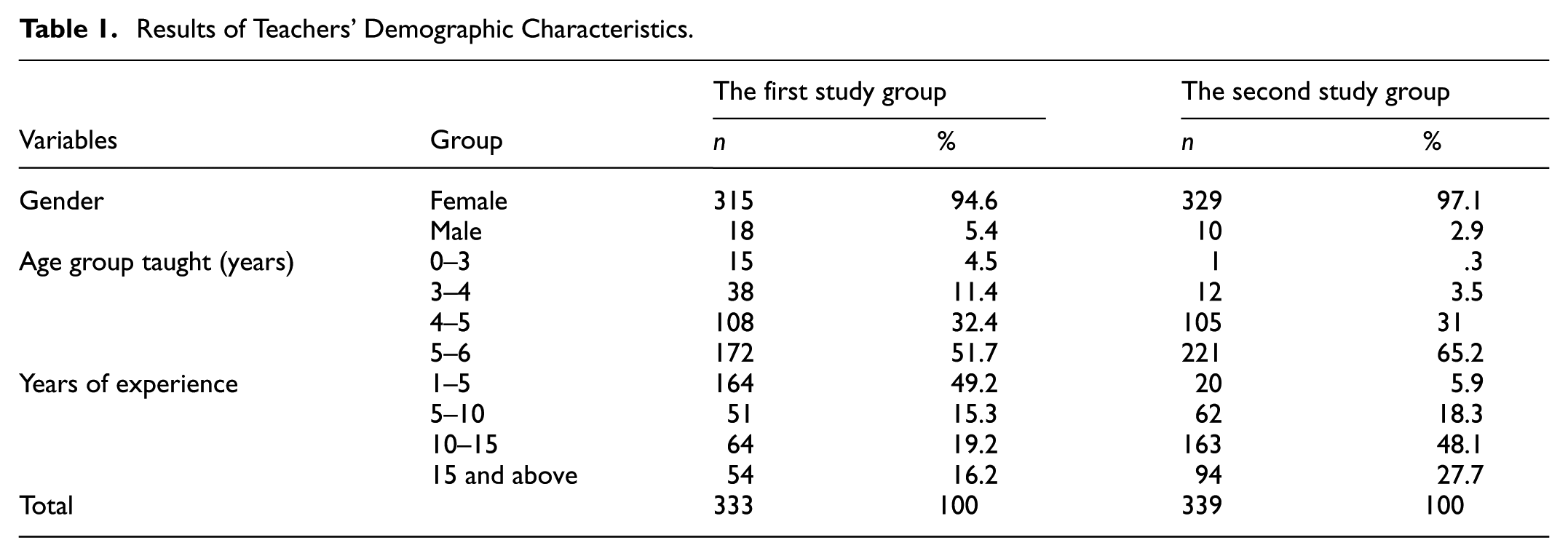
The researchers identified two study groups of preschool teachers to determine the scale’s psychometric properties. They conducted Exploratory Factor Analysis (EFA) using data from the first study group. In contrast, they calculated Confirmatory Factor Analysis (CFA) and internal consistency coefficients using data from the second study group. The first study group consisted of 333 preschool teachers. Among these participants, 315 were female and 18 were male, and they worked with children aged between 3 and 6 years. The teaching experience of the participating teachers with immigrant children ranged from 1 to 15 years or more. The second study group consisted of 339 preschool teachers, of whom 329 were female and 10 were male, working with children aged between 3 and 6 years. Similarly, the teaching experience of these teachers with immigrant children ranged from 1 to 15 years or more. Table 1 presents demographic information about the preschool teachers in the study group.
Results of Teachers’ Demographic Characteristics.
Development of the Scale
The researchers began developing the scale by reviewing the relevant literature and identifying the skills preschool teachers need to possess when teaching language to immigrant children. In this context, they examined studies conducted in countries with immigrant populations (García & Wei, 2014; Suárez-Orozco et al., 2018; Valdés, 2001). They determined that teachers should have competencies in general language teaching knowledge and skills, subject knowledge, teaching in multicultural classrooms, and collaboration with parents. They analyzed the preschool education curriculum, particularly the language activities section, within the scope of these sub-dimensions and wrote items consistent with preschool teachers’ language teaching activities. The researchers designed the items to align with the principles of preschool education while incorporating the principles of second language teaching for young children. Accordingly, they created an item pool consisting of a total of 76 items. They structured the scale as a 5-point Likert scale, with response options ranging from “never” to “always” to indicate frequency. The complete list of these initial 76 scale items is provided in Appendix A.
The researchers obtained feedback from experts and preschool teachers for the draft version of the scale, which consisted of 76 items. Expert feedback was obtained through structured interviews focusing on content validity, item clarity, and alignment with theoretical frameworks. Teachers provided feedback through focus group discussions regarding practical applicability and developmental appropriateness of the items. Based on this feedback, modifications included rewording ambiguous items, removing culturally inappropriate content, and adjusting language complexity to match preschool contexts. The selection criteria for experts included doctoral-level expertise in language education or early childhood education with minimum 5 years of research experience, while participating teachers were required to have at least 2 years of experience working with immigrant children in preschool settings. Specifically, they sought the opinions of four experts—two from the field of language education and two from the field of preschool education—regarding the appropriateness of the items in terms of language and content. The researchers revised items that required modification based on expert feedback and obtained their approval. Additionally, they sought the opinions of four preschool teachers to determine whether the items were consistent with the framework of preschool education. The researchers revised items that required adjustments based on teacher feedback and obtained their approval. Through iterative revisions based on expert and teacher feedback, disagreements were resolved and final approval was obtained from all reviewers for the revised items. Items that received conflicting feedback were further refined through additional consultation until agreement was reached. They then administered the final version of the instrument to the participating teachers.
Data Collection
Ethical approval was obtained from X University Social and Human Sciences Scientific Research and Publication Ethics Committee on November 13, 2023. To ensure that the final version of the scale could reach teachers working in different provinces, the researchers converted the scale into a Google Form and administered it online. The researchers added questions to identify the teachers’ demographic characteristics to the scale’s introduction section. They asked preschool teachers who volunteered to participate to provide their demographic information and respond to the scale items. The researchers distributed the link to the instrument to participants via email.
To prevent any harm to participants, all procedures were conducted on a voluntary basis, and participants’ identities were kept confidential. The potential benefits of the study, including contributions to the education of migrant children and support for teachers’ professional development, outweigh the possible risks. Informed consent was obtained prior to data collection, and participants were thoroughly informed about the study’s purpose, process, and confidentiality rights. Participants were also made aware of their right to withdraw from the study at any time, and this right was fully respected.
Data Analysis
Many studies encompass both exploratory and confirmatory approaches due to including variables related to both known and unknown situations. From this perspective, it is desirable to test assumptions established through exploratory techniques and then confirm or reject them through confirmatory techniques (Jöreskog & Sörbom, 1993). The researchers conducted Exploratory Factor Analysis (EFA) and Confirmatory Factor Analysis (CFA) to obtain empirical evidence regarding the construct validity of the instrument. Before proceeding with the analyses, they tested the fundamental assumptions of multivariate statistics. They applied multivariate and univariate outlier detection methods to identify outliers in the datasets. For multivariate outlier detection, they used a cutoff value of ±3 (Raykov & Marcoulides, 2008a), while for univariate outliers, they evaluated the significance of Mahalanobis distances. Based on these criteria, the researchers excluded participants with 67 outliers in the EFA dataset and 22 outliers in the CFA dataset from the analyses. As a result, they conducted EFA with data from 333 participants and CFA with data from 339 participants. To examine the normality of the data, the researchers checked skewness and kurtosis coefficients. They accepted a cutoff range of ±1 for skewness and kurtosis coefficients. Since the obtained skewness and kurtosis values fell within the mean of ±1, they concluded that the data did not deviate significantly from normality and exhibited a distribution close to normal (Tabachnick & Fidell, 2013). Additionally, they found no missing values in the datasets used for both EFA and CFA. They also tested the potential issue of multicollinearity among the items and detected no problems. Before conducting EFA on the data from the first study group, the researchers performed the Kaiser-Meyer-Olkin (KMO) test to evaluate the adequacy of the sample size for factor extraction. They found the KMO value to be 0.97, indicating that the sample size was excellent for factor extraction (Çokluk et al., 2014). They also conducted Bartlett’s Test of Sphericity on the same dataset to determine whether the data followed a multivariate normal distribution. The test result was significant, χ2(2,556) = 24,497.073, p = .000, confirming the suitability of the data for factor analysis.
The researchers conducted EFA using IBM SPSS 25 and performed CFA using the R programming language with the Lavaan package (Rosseel, 2019). For EFA, they employed the principal axis factoring method. They used the Promax rotation method to uncover the factor structure, recommended when there is a correlation between factors (Tabachnick & Fidell, 2013). They accepted a cutoff value 0.32 for factor loadings (Çokluk et al., 2014). Additionally, the researchers calculated correlations between the factors identified through EFA to assess convergent and discriminant validity. When evaluating the CFA results, the researchers considered the following fit indices: χ2, χ2/df, CFI, RMSEA, TLI, and SRMR. They used the estimation method of DWLS (diagonally weighted least squares). They also used the cutoff values for these fit indices, as shown in Table 2, as benchmarks for evaluation.
Cutoff Values for Fit Indices Used in CFA.

Finally, McDonald’s Omega was calculated to estimate reliability in terms of internal consistency based on the scores obtained from the subscales.
Findings
Results of Exploratory Factor Analysis
The researchers used principal axis factoring as the extraction method to determine the scale’s structure. They selected Promax, one of the oblique rotation methods, as the rotation method. The first EFA results revealed seven factors with initial eigenvalues greater than one. These factors explain 69.51% of the total variance; however, when evaluated in terms of their contribution to the total variance, it was concluded that four factors contribute significantly to the variance, with the contribution decreasing significantly after the fourth factor. Therefore, EFA was repeated for four factors.
In the repeated analysis for four factors, no items were found below the predetermined cutoff value of 0.32. However, the researchers excluded four items from the analysis due to overlap. The contributions of the four factors to the total variance were determined as follows: 49.65% for the first factor, 5.22% for the second factor, 3.98% for the third factor, and 3.03% for the fourth factor. The total contribution of these four factors to the variance was 61.88%. Table 3 presents the factor structure of the scale and the factor loadings.
Factor Loadings of the Scale for Preschool Teachers’ Perceptions of Their Competence in Language Teaching to Immigrant Children.

Note. 1Language teaching competence.
Subject knowledge competence in language teaching.
Competence in teaching in multicultural classrooms.
Competence in collaboration with parents.
As shown in Table 3, the factor loadings at the subscale level range from 0.44 to 0.91 for the first factor, 0.53 to 0.82 for the second factor, 0.42 to 0.88 for the third factor, and 0.72 to 0.91 for the fourth factor. When evaluated in magnitude, the factor loadings can generally range from good to excellent (cf. Tabachnick & Fidell, 2013).
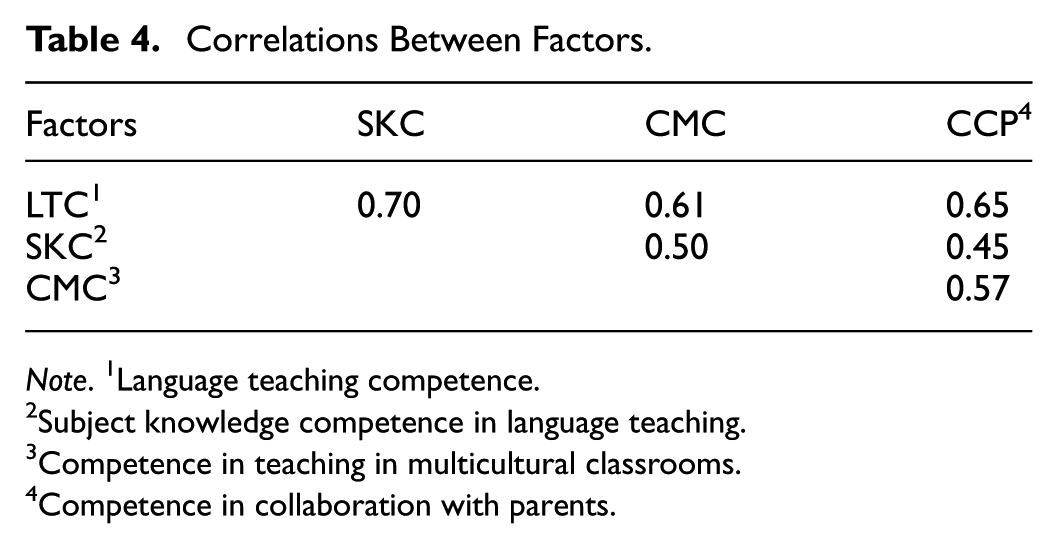
The researchers calculated correlations between the factors to assess convergent and discriminant validity and provide additional evidence for construct validity. Table 4 presents the findings.
Correlations Between Factors.
Note. 1Language teaching competence.
Subject knowledge competence in language teaching.
Competence in teaching in multicultural classrooms.
Competence in collaboration with parents.
Table 4 shows a relatively high correlation coefficient between language teaching competence (LTC) and subject knowledge competence in language teaching (SKC). Moderate correlations were identified between the other factors.
Results of Confirmatory Factor Analysis
Table 5 presents the confirmatory factor analysis (CFA) results for the Scale for Preschool Teachers’ Perceptions of Their Competence in Language Teaching to Immigrant Children.
Confirmatory Factor Analysis Results for the Scale of Preschool Teachers’ Perceptions of Their Competence in Language Teaching to Immigrant Children.

When examining the results of the CFA for the Scale for Preschool Teachers’ Perceptions of Their Competence in Language Teaching to Immigrant Children, the researchers observed that all t-values exceeded 2.56 and were significant at the 0.01 level. Upon reviewing the error variances, they identified no items with error variances above 0.90. They found the standardized coefficients of the items in the scale to be significant, ranging between 0.52 and 0.93.
Based on modification suggestions, the researchers made modifications between items 3 and 30, as well as items 1 and 2, and observed that these modifications contributed significantly to the model’s fit indices. When evaluating the fit indices obtained from the factor analysis, they determined that the χ2/df ratio was less than 3, indicating a good model fit. Since the RMSEA and SRMR values were below 0.08, they concluded that the model demonstrated a good fit, and the CFI and TLI values, which were approximately 0.95, indicated an excellent fit. The researchers confirmed the four-factor structure of the Scale for Preschool Teachers’ Perceptions of Their Competence in Language Teaching to Immigrant Children. Figure 1 presents the path diagram resulting from the CFA.

Path diagram of the confirmatory factor analysis.
Results of Reliability Analysis
McDonald’s Omega reliability coefficients were calculated using the Jamovi (2022) software to determine the scale’s internal consistency reliability. Table 6 presents the results.
Reliability Results.

When examining the reliability coefficients of the Scale for Preschool Teachers’ Perceptions of Their Competence in Language Teaching to Immigrant Children, it was determined that all values exceeded the acceptable threshold of 0.70 (Nunnally & Bernstein, 1994), indicating that the scale demonstrates reliability in terms of internal consistency.
Discussion and Conclusion
In this study, the researchers developed a scale of 72 items across four dimensions to determine preschool teachers’ perceptions of their competence in teaching language to immigrant children. The data obtained in the study were analyzed, revealing that the developed scale is acceptable in terms of its psychometric properties.
The researchers developed the Scale for Preschool Teachers’ Perceptions of Their Competence in Language Teaching to Immigrant Children to assess the language teaching competencies of teachers working with young children in a critical stage of language development and learning the host country’s language as a second language. During the scale development process, items were written based on four theoretical constructs: general knowledge and skills related to language teaching, competence in teaching in multicultural classrooms, subject knowledge competence, and competence in collaborating with parents. The items in the different subdimensions of the scale were structured in alignment with a 5-point Likert-type format, allowing teachers to respond based on the frequency of their practices. The researchers identified four meaningful factors consistent with the theoretical framework as a result of the exploratory factor analysis (EFA), and they grouped all items under their respective dimensions except for four items. Although they set a factor loading threshold of 0.32, the factor loading was generally relatively high. Furthermore, when examining the commonalities, no items were found to have values below 0.20, which is considered an indicator of well-functioning items. Additionally, the fact that the four factors collectively explained more than 50% of the variance can be regarded as evidence of a robust structure for multifactorial models (Hair et al., 2010).
The items in the different subdimensions of the scale were structured in alignment with a 5-point Likert-type format, allowing teachers to respond based on the frequency of their practices. When examining the correlation values obtained to provide evidence for convergent and discriminant validity, a relatively high correlation was observed between the subscales of language teaching competence and subject knowledge competence in language teaching. This result is expected, as language teaching competence is a skill comprising various applications of subject knowledge. In addition to subject knowledge, teaching skills, language proficiency, and contextual knowledge are other sub-competencies that support a teacher’s language teaching ability (Richards, 2010). Moreover, moderate correlations between the other subscales can be considered supportive evidence for construct validity.
The findings obtained from this research are consistent with the theoretical framework of teacher competency development in multilingual educational contexts and particularly support the pedagogical content knowledge model that emphasizes the intersection of subject matter knowledge and pedagogical skills (Koehler & Mishra, 2009). The high correlation observed between language teaching competence and subject knowledge competence (0.70) supports the multilingual education theory that proposes effective language instruction requires both deep understanding of linguistic structures and culturally responsive pedagogical approaches (García & Wei, 2014). Furthermore, the multicultural classroom teaching dimension of the scale reflects the multicultural education framework that advocates for transformative approaches that acknowledge and build upon students’ cultural and linguistic assets (Banks, 2015). This theoretical foundation demonstrates that the developed instrument has a robust structure not only psychometrically but also conceptually.
The researchers conducted a confirmatory factor analysis (CFA) on the second study group and confirmed the four-factor model. They found the standardized coefficients of the items in the analysis to be significant and generally relatively high. Additionally, the fact that the error variances of the items were below 0.90 is another aspect considered favorable from a psychometric perspective. Furthermore, McDonald’s Omega coefficients, calculated to provide evidence of reliability in terms of internal consistency for each subscale, were found to be relatively high across the datasets obtained from both study groups and for each subscale.
The four-dimensional structure of the scale corresponds to contemporary theoretical perspectives on teacher preparation for diverse learners. This structure, which is particularly aligned with the linguistically responsive teacher preparation framework (Lucas & Villegas, 2013), reflects the theory of overlapping spheres of influence that emphasizes the critical role of family-school partnerships in supporting immigrant children’s academic success through its collaboration with parents dimension (Henderson & Mapp, 2002). Additionally, the scale’s focus on multicultural competence resonates with culturally responsive teaching theory, which proposes that effective instruction must be culturally validating and affirming (Gay, 2018). The high reliability coefficients obtained across all dimensions provide empirical support for the transformative pedagogy framework that argues teachers need multifaceted competencies to address the complex linguistic and cultural needs of immigrant students in early childhood education contexts (J. Cummins, 2017). These theoretical supports reveal that the scale can function not only as a measurement tool but also as a guide for teacher development.
All items included in this scale were developed to focus on preschool education and are consistent with language activities designed for young children. Moreover, the results of the exploratory and confirmatory factor analyses indicate that the scores obtained from the scale demonstrate high validity. These findings suggest that researchers can use the scale to assess the language teaching competencies of preschool teachers working with immigrant children at an early age.
The increasing immigrant population in Turkey has made it essential for teachers to equip themselves with diverse skills. Among these, competencies related to language teaching are of primary importance due to the role of language in providing access to opportunities in other areas. This scale, developed to identify the deficiencies of preschool teachers in the critical period of language development, is expected to contribute to the field. Identifying teachers’ competencies in teaching language to immigrants will facilitate the planning of training programs in this area. Therefore, researchers recommend utilizing the Scale for Preschool Teachers’ Perceptions of Their Competence in Language Teaching to Immigrant Children in various studies.
The practical implications of this scale development study extend beyond measurement, contributing to the broader theoretical discourse on professional development in multicultural educational settings. The comprehensive approach of the instrument reflects the sociopolitical context of multicultural education that emphasizes teachers’ need to develop critical consciousness regarding equity and social justice issues in language education (Sleeter, 2012). The scale’s emphasis on frequency-based self-assessment aligns with self-efficacy theory, which proposes that teachers’ perceived competencies in language instruction directly influence their instructional practices and student outcomes (Tschannen-Moran & Hoy, 2014). Furthermore, the findings support the teacher learning framework that advocates for assessment tools that can inform targeted professional development programs and ultimately enhance educational opportunities for marginalized student populations (Darling-Hammond, 2017). In this context, the developed scale can serve as a valuable resource for both researchers and practitioners.
This study offers valuable insights for various stakeholders involved in early childhood education, particularly those working with immigrant children. By identifying preschool teachers’ perceived competencies in teaching Turkish to immigrant children, the findings provide a foundation for developing targeted professional development programs and informing policy decisions. Moreover, the developed scale serves as a practical tool for educators and administrators to assess and enhance teaching practices, ultimately contributing to improved educational outcomes for immigrant children.
This study has several limitations that should be considered when interpreting the findings. First, the sample was limited to preschool teachers working in a specific region, which may affect the generalizability of the results. Second, the data relied on self-reported measures, which can be subject to social desirability bias. Finally, the cross-sectional design of the study limits the ability to draw causal inferences.
Future research could address these limitations by including a more diverse and larger sample from different regions and educational contexts. Longitudinal studies would also be valuable to examine changes in teachers’ competencies over time. Additionally, incorporating observational or performance-based assessments could complement self-reported data and provide a more comprehensive understanding of teacher competencies in multilingual settings.
Footnotes
Appendix A

Ethical Considerations
This study was approved by the Akdeniz University Research Ethics Committee (Approval No. 14.11.2023-779320).
Consent to Participate/Publication
All participants provided informed consent prior to participation in the study. Participants were informed about the purpose of the research, voluntary nature of participation, and their right to withdraw at any time without penalty.
Funding
The authors received no financial support for the research, authorship, and/or publication of this article.
Declaration of Conflicting Interests
The authors declared no potential conflicts of interest with respect to the research, authorship, and/or publication of this article.
Data Availability Statement
Research data is not available.