




Abstract
Given the need to guarantee sustainable, high-quality preschool education and considering preschool teachers’ central role in children’s learning and growth, the effective development of preschool teachers requires serious attention. This study explored the current intention to stay and the factors predicting retention intention among 214 urban preschool teachers in China using a retention intention scale, work value scale, and workload scale. The results showed that the preschool teachers’ retention intentions were above average, with age, marital status, major, years of experience, weekly working hours, salary, working relationship with the preschool, and the type and rank of the preschool significantly influencing this intent. Educational background, qualification certificate, and job title did not affect these intentions. The results indicated that workload was negatively associated with ECTs’ retention intentions, whereas work values were positively associated. Although the interaction between overall workload and total work values was not significant, further analysis of subdimensions revealed that intrinsic values amplified the negative effect of workload on retention intentions, while extrinsic values mitigated it. No significant moderating effect was found for external rewards. The findings highlight potential avenues for improving retention intention by focusing on intrinsic and extrinsic values and alleviating teacher workload in preschools and governmental institutions. This can, ultimately, have developmental benefits for both children and ECTs.
Plain Language Summary
The retention of preschool teachers is a critical factor in fostering professional development and enhancing the quality of early childhood education. This study investigates the impact of workload and work values on preschool teachers’ job retention intentions. A survey of over 200 teachers from diverse kindergarten settings revealed a significant negative correlation between workload intensity and retention willingness. Conversely, teachers demonstrated higher retention intentions when they perceived their work as meaningful, experienced a harmonious organizational climate, and maintained positive collegial relationships. Although the interaction between overall workload and total work values was not significant, further analysis revealed that interactions between workload and specific work value dimensions significantly influenced retention intentions. The findings suggest that preschool administrators and policymakers should implement strategies to reduce workload burdens, cultivate supportive work environments, and provide enhanced professional development opportunities to improve teacher retention rates.
Introduction
In contemporary organizations, employee retention has emerged as a pivotal concern for human resource management due to its significant implications for operational continuity and talent preservation (Yao & Liang, 2017). Early childhood teachers (ECTs) are fundamental to high-quality education programs (Lipscomb et al., 2021) and play a vital role in children’s mental health and behavioral development (Perry & Szalavitz, 2006; Van der Kolk, 2014). However, the early childhood education sector is currently grappling with a dual challenge of teacher shortages and high turnover rates, creating substantial disruptions to educational quality and continuity. According to China’s education authority, the national deficit of ECTs reached 520,000 in 2019 (B. S. Chen, 2019). This phenomenon is not unique to China; Organisation for Economic and Co-operative Development (2012) noted that chronic shortages of ECEC staff were observed in many countries, especially in remote and disadvantaged areas, due to the low wages, low social status, heavy workloads, and lack of career progression paths.
Despite these shortages, ECTs teachers turnover remains a persistent issue. In the United States, Steiner and Woo (2021) have identified escalating turnover rates as a pressing concern, with the National Commission on Teaching and America’s Future reporting a 50% increase in teacher attrition over a 15-year period, culminating in an overall attrition rate of 17% (Wells, 2015). Recent surveys indicate that approximately 25% of American teachers contemplate leaving their positions annually (Steiner & Woo, 2021), while center-based ECEC programs experience turnover rates ranging from 33% to 50% (Wells, 2015). Similarly, Australia has sustained an annual turnover rate exceeding 30% in its ECEC workforce for over a decade (McDonald et al., 2018). In the Chinese context, Z. Y. Li and Gong (2020) revealed that 30.86% of rural preschool teachers expressed intentions to either transfer institutions or exit the profession entirely.
In China, preschool teachers face unique challenges in their working conditions. Empirical evidence reveals significant geographical variations in occupational commitment, with rural educators exhibiting markedly lower job retention willingness compared to their urban counterparts (W. M. Zhao, 2019). Employment status also varies significantly, as many teachers are employed on temporary contracts that often lack job security and benefits. In contrast, those in officially budgeted positions within public institutions benefit from greater job stability, enhanced welfare provisions, and higher job satisfaction (Zhang, 2024). Furthermore, preschool teachers typically earn lower salaries compared to other educational sectors, which may contribute to low job satisfaction and low retention rates (Du et al., 2013). The work environment is equally demanding, particularly in urban areas where large class sizes and high teacher-to-child ratios are prevalent (X. Li, 2019). Additionally, a pronounced imbalance between compensation and workload in the early childhood education sector exacerbates occupational stress and retention concerns (W. M. Zhao, 2019). These factors collectively shape preschool teachers’ retention intentions, highlighting the need for a more comprehensive exploration of their working conditions.
In addition to these challenges, China’s ongoing demographic decline is creating further uncertainties for early childhood educators. The decreasing birth rate has led to a reduction in preschool enrollment, which in turn poses challenges for the sustainability of early childhood education programs. These demographic shifts contribute to workforce instability, as many educators worry about job security and future career opportunities. The evolving policies in response to these demographic trends also affect the working conditions, job satisfaction, and retention intentions of early childhood educators. Taken together, these factors—both structural and demographic—highlight the need for a more comprehensive exploration of preschool teachers’ retention intentions, particularly within the urban context, where such uncertainties are felt more acutely.
The ramifications of teacher turnover extend beyond institutional challenges, significantly impacting child development and organizational efficiency. Frequent disruptions in teacher-child relationships can induce emotional distress and developmental risks for children (Hale-Jinks et al., 2006), adversely affecting language acquisition (Whitebook et al., 1989), and emotional regulation (Egger & Angold, 2006; Hale-Jinks et al., 2006). From an organizational perspective, the departure of experienced educators diminishes institutional productivity and operational efficiency (Larkin, 1995), while the associated costs of turnover and loss of institutional knowledge represent substantial economic inefficiencies (Lockwood, 2003).
To address these challenges, the examination of retention intentions offers a constructive framework. While turnover and retention represent complementary perspectives in studying teacher persistence, the retention framework offers distinct advantages. As L. P. Guo et al. (2021) observe, retention-focused research emphasizes proactive strategies for maintaining workforce stability, avoiding the potentially stigmatizing connotations associated with turnover studies, thereby facilitating more accurate data collection and analysis.
Retention intention, conceptualized as an employee’s commitment to maintain organizational affiliation, represents a multifaceted construct influenced by various determinants. Empirical research has consistently identified job demands and work values as critical antecedents influencing employee retention decisions (X. Li et al., 2020; Yao & Liang, 2017). Excessive job demands, including time constraints and emotional labor requirements, frequently correlate with increased job dissatisfaction and burnout, ultimately undermining retention intentions (X. Chen et al., 2019). Conversely, the fulfillment of work values—encompassing professional development opportunities, perceived job significance, and value congruence with organizational culture—typically enhances organizational commitment (Xue et al., 2022).
Despite substantial scholarly attention to job demands and work values, significant research gaps remain in understanding their interplay in shaping retention intentions, particularly within the context of Chinese urban preschool educators. This population warrants specific attention due to the unique socio-cultural and professional dynamics characterizing urban early childhood education in China. Furthermore, while existing studies have highlighted demographic variations in retention intention, such as rural-urban disparities (W. M. Zhao, 2019) and employment status effects (Zhang, 2024). However, how these factors operate specifically in urban settings remains unclear. To address these gaps, we examine four key questions:
Will demographic factors differentially affect urban ECTs’ retention intention?
What is the relationship between workload and ECTs’ retention intention?
What is the relationship between work values and ECTs’ retention intention?
How do workload and work values interact to affect ECTs’ retention intention?
By investigating the direct and interactive effects of job demands and work values on retention intentions among Chinese urban ECTs, this research aims to bridge the existing research gap. This findings will contribute to a deeper theoretical understanding of retention dynamics in educational settings, while offering empirically grounded insights for educational administrators and policy-makers. Ultimately, this research is expected to inform the development of targeted interventions to enhance teacher retention and improve educational quality in urban early childhood education settings.
Literature Review
Teachers’ Retention Intention and Its Effects
Retention intention, defined as the willingness to continue working in the current organization (Y. L. Pan & Zhang, 1998) and is a strong predictor of employee retention behavior (M. F. Chen et al., 2016). In the context of early childhood education, ECT retention is associated with higher-quality educational programs (Wayne & Youngs, 2003), which positively affect children’s academic and behavioral outcomes (Hamre & Pianta, 2001). Specifically, children in stable educational environments demonstrate better language and pre-math skills, empowered self-view, improved relationships with teachers, and enhanced social behavior (Helburn & Culkin, 1995). Moreover, high retention rates are linked to stronger occupational commitment among teachers, which provides children with better emotional and cognitive support (Jeon & Wells, 2018; Wells, 2015). Consequently, retaining ECTs is vital for promoting positive child outcomes (Cassidy et al., 2011).
However, low retention intention can lead to adverse outcomes, such as burnout and job dissatisfaction (Jiang et al., 2017). For example, studies on registered nurses have shown that shortages and low retention rates result in low-quality care (Backhaus et al., 2017; White et al., 2020), which in turn increases organizational costs due to ongoing recruitment needs and productivity losses (Kurnat-Thoma et al., 2017). Numerous factors influence employees’ intention to stay, including the working environment, organizational trust, personal attributes, leader characteristics, job satisfaction, organizational commitment, and institutional identity (Boyle et al., 1999; Kurnat-Thoma et al., 2017). Among these, work values (as personal attributes) and workload (as part of the work environment) are particularly significant in shaping retention intention (Holland et al., 2019; Song, 2021).
Conceptual Framework
The Job Demands-Resources (JD-R) theory (Bakker & Demerouti, 2007) provides a comprehensive framework for understanding retention intentions among early childhood teachers (ECTs). This theoretical model posits that workplace characteristics can be categorized into two distinct dimensions: job resources and job demands, which respectively contribute to positive and negative occupational outcomes. Job resources, including work values, autonomy, and organizational support, are associated with goal achievement and personal growth, thereby enhancing work engagement and job satisfaction. Conversely, job demands, such as high workload, emotional labor, and work-family conflict, directly contribute to negative outcomes including burnout and turnover intention. In the context of ECTs, work values and workload serve as critical indicators of job resources and job demands respectively, playing a pivotal role in shaping retention intentions. The JD-R model suggests that job demands predict negative outcomes while job resources predict positive outcomes, making it particularly suitable for explaining workforce retention in early childhood education. Based on this theoretical framework and empirical evidence from previous studies, we hypothesize that workload is negatively correlated with ECTs’ retention intention, while work values positively influence their willingness to remain in the profession. This research aims to further illuminate the dynamics of job demands and resources, ultimately contributing to strategies that enhance retention among early childhood teachers.
Workload
Workload refers to various demands that include quantitative, qualitative, mental, and physical tasks (Chowhan & Pike, 2023). Extensive research has demonstrated that excessive workloads negatively impact individual and organizational development. For example, high workloads may lead to job burnout, particularly in the dimension of emotional exhaustion, which is significantly negatively correlated with retention intention (Y. F. Guo et al., 2019). When employees feel emotionally drained, their willingness to remain in their positions decreases. Additionally, high workloads can reduce job satisfaction, further undermining retention intentions (X. Li, 2023). Empirical studies have revealed moderate-to-strong correlations between workload perception and intent to leave (Phillips, 2020), with perceptions of high workload driving individuals to consider leaving their jobs (Holland et al., 2019; Qureshi et al., 2013). Given the similarities between retention intention and turnover intention in terms of influencing factors (Gu et al., 2008), it is reasonable to infer that the workload also affects the retention intention of preschool teachers.
Work Value
Work values, first conceptualized by Super (1970), encompass the sum of employees’ behaviors and attitudes at work. Super’s Work Values Inventory (WVI) identifies three dimensions: intrinsic value, extrinsic value, and extrinsic rewards. Schwartz (1994) further defined work values as specific inner beliefs that motivate employees’ enthusiasm and guide their behavior. Elizur (1984) emphasized that work values represent individuals’ value judgments about outcomes derived from the work environment, which directly influence work behaviors (see also Yao & Liang, 2017). Hegney et al. (2006) highlighted that both internal and external work values significantly affect turnover intention.
Empirical studies have consistently supported the positive impact of work values on retention intention. M. F. Chen et al. (2016) found that work values, along with age, personality traits, and hospital type, significantly improve retention intention among nurses in Taiwan. Similarly, Hou et al. (2014) observed that work values shape work preferences, thereby influencing employees’ positive or negative behaviors. Yao and Liang (2017) further demonstrated that the three dimensions of work values significantly impact retention intention among new employees.
Workload and Work Values Predict Retention Intention
While the relationship between workload, work values, and retention intention has been studied in various professional groups, such as nurses and sales personnel (Qureshi et al., 2013; W. M. Zhao, 2019), these findings may not be directly applicable to ECTs. Employees’ retention intentions are influenced by a complex interplay of factors, and understanding these interactions is crucial for developing effective retention strategies. The JD-R model emphasizes the dual effects of job demands (e.g., workload) and job resources (e.g., work values) on employee well-being and retention intentions. Specifically, workload, as a job demand, may increase stress and the propensity to leave, whereas work values, as personal resources, may buffer the negative effects of workload and enhance retention intentions.
Guided by the Job Demands-Resources (JD-R) model and prior empirical findings on teacher retention, we propose:
To test these hypotheses, we employed a quantitative survey designs with a representative sample of urban ECTs in China. The survey utilized a stratified sampling method, as detailed in the Methodology section, which allows for the detection of both main and interaction effects while controlling for key demographic variables. This approach ensures rigorous testing and is consistent with best practices in organizational retention research (Hom et al., 2017). The findings will contribute to the theoretical advancement of the Job Demands-Resources (JD-R) model within educational contexts and provide valuable insights for developing targeted interventions to improve ECT retention in urban settings.
Methodology
Research Design
This study employed a quantitative research design to explore the factors influencing ECTs retention intentions among urban ECTs. A cross-sectional survey method was utilized to examine the relationships between workload, work values, and retention intention, aiming to identify key predictors of retention among ECTs in urban settings.
Participants
A total of 214 urban preschool teachers who worked with children aged 3 to 6 participated the study. Of these, 94.9% (203) teachers were female and 5.1% (11) were male. 59.8% (128) teachers were unmarried and 40.2% (86) were married. Regarding age distribution, 52.8% (113) were under 25 years old, 36.0% (77) were 25 to 35 years old, and 11.2% (24) were over 36 years old. 82.7% (177) worked at public institutions, while 17.2% (37) taught at private institutions. With respect to school ratings, 42.0% (90) taught in demonstration preschools, 16.5% (31) in first-class preschools, 11.2% (24) in second- or third-class preschools; and 32.2% (69) in unrated preschools. As for salary, 24.7% (53) teachers earned less than CNY 3,000 per month, 53.7% (115) earned CNY 3,001 to 5,000 per month, and 21.5% (46) earned more than CNY 5,000. In terms of working hours, 34.6% (74) teachers worked fewer than 40 hr per week, 55.1% (118) worked 41 to 60 hr per week, and 10.3% (22) reported working more than 60 hr per week. Regarding teaching experience, 75.7% (162) had fewer than 5 years of experience, 14.0% (30) had 6 to 10 years, and 10.2% (22) had over 10 years. In terms of teacher qualification certificate, 81.3% (174) held a preschool teaching certificate, 11.7% (25) had elementary or secondary teaching certificate, and 7% (15) held other type of certification. As for job title, 0.9% (2) of participants were classified as senior teachers, 35.5% (76) held intermediate titles, and the majority (63.6%, 136) had no formal title.
Procedure
Due to financial constraints, we selected five districts in Wuhan, Hubei Province, China, those are representative of urban area in the region. These districts were chosen based on income levels and growth rates that align with the national average. According to the Hubei Provincial Bureau of Statistics (2024), the urban per capita income in Hubei Province is RMB 44,990, which is close to the national urban average We believe that these districts provide a representative cross-section of urban areas in China.
To select the schools, we obtained a comprehensive list of all schools in each district from the Bureau of Education. From this list, we randomly selected 10 urban preschools. We are confident that these schools represent a diverse range of preschools in urban China. The research team consisted of early childhood education teachers from Hubei University of Educaiton, who maintains close contact with principals of the selected schools. The principals were asked to distribute the online survey link to all preschool teachers in their respective schools.
Prior to the survey administration, the research team visited the selected schools to provide participants with detailed explanations of the study’s objectives, the content of the survey, and the rights of the participants. This included informing participants about their voluntary participation, the confidentiality of their responses, and the potential for public accessibility of the results. The verbal consent process was audio-recorded in the presence of an independent witness to ensure transparency and accountability, confirming participants’ understanding and agreement to the study.
Once informed consent was obtained, participants were directed to the online survey link, where they could voluntarily complete the questionnaire. Only those who provided consent were able to access and participate in the survey. Throughout the study, the research team took necessary precautions to protect participants’ privacy, ensuring that their responses remained confidential and would be used solely for academic purposes.
Measures
Before the participants completed the measurement instruments, we gathered their sociodemographic information.
Retention Intention Scale
A scale to examine ECTs’ retention intentions was adapted from Mobley’s (1977) Turnover Intention Scale. The Mobley Turnover Intention Scale, originally comprising five items assessing consideration of turnover opportunities and turnover thoughts, was adapted through a four-step process to reflect retention intentions. First, the items were rephrased to capture retention intentions. For instance, the item “I often think about leaving my current job” was revised to “I often think about staying in my current job.” The Likert scale scoring criteria were retained, with responses ranging from 1 (“very unlikely”) to 5 (“very likely”). To comprehensively assess retention intentions, a positively worded item was added, such as “I am willing to make a long-term commitment to my current organization.” Additionally, some items were reverse-scored to ensure that higher scores indicated stronger retention intentions. For example, the item “I plan to leave my job in the near future” was reverse-scored. The adapted scale consists of six items. A pilot test was conducted, and the results demonstrated good reliability, with a Cronbach’s α coefficient of .892. Confirmatory factor analysis further validated the scale’s structural integrity. Higher scores on the final scale indicate a stronger level of teachers’ retention intentions.
Work Values Inventory
Super’s (1970) WVI measures values both on and off the job. As mentioned above, the scale divides work value into three dimensions: internal value (internal factors related to the nature of the occupation), external value (external factors related to the nature of the occupation), and external reward. There are 13 factors: altruism, beauty, intellectual stimulation, sense of achievement, independence, social status, management, financial rewards, social interaction, security, comfort, interpersonal relationships, variability, and pursuit of new ideas. The scale comprises 52 items, each rated on a 5-point Likert scale (from 1 = unimportant to 5 = very important). Higher overall scores indicate increased work value. Cronbach’s alpha was .921 in this study.
Workload Scale
The National Aeronautics and Space Administration Task Load Index (NASA-TLX), developed by Hart and Staveland (1988), is widely used to measure workload. In this study, we used the adapted Chinese version (Liang et al., 2019). This scale has six items: mental demand, physical demand, temporal demand, performance, effort, and frustration. Each item is represented by a line of 20 equal points, and respondents mark the line where they believe it corresponds to the actual level in their jobs. The scores of the six items were added to determine the average score, which represented the total workload score for each participant. The higher the total score, the higher the subjects’ workload. The Cronbach’s alpha was .80.
Ethical Considerations
This study adhered to ethical guidelines for research involving human participants. All participants were informed of their right to withdraw from the study at any time without penalty. The study design focused on non-invasive data collection methods, and participants were not exposed to any physical, psychological, or emotional risks. A verbal consent process was implemented, ensuring that participants fully understood the study’s purpose, the voluntary nature of their participation, and the confidentiality of their responses. Participants were also informed about how their data would be used strictly for academic research, with no personal identifying information being collected.
The potential benefits of this study include providing valuable insights into early childhood education, which could contribute to the development of effective policies and interventions aimed at improving teacher retention. It is believed that the societal benefits, such as enhancing the quality and stability of the early childhood education workforce, far outweigh the minimal risks involved.
To ensure confidentiality, all responses were anonymized and securely stored. Data was kept confidential and used exclusively for academic purposes.
Analysis
We used SPSS 25.0 for statistical testing. Descriptive statistics were calculated for the variables of ECTs’ retention intention, work value, workload, and participants’ characteristics. Analysis of variance (ANOVA) was used to examine the relationship between participants’ characteristics ( age, marital status, years of experience, educational background, working hours, salary, job title, working relationship with the preschool, teacher qualification certificate, and the type, rank of their preschools) and teachers’ retention intention. To further explore which groups exhibited significant differences in retention intention, the Least Significant Difference (LSD) test was conducted for multiple comparisons. Correlation analyses were used for ECTs’ overall retention intentions, the three dimensions of work value, and the six workload factors to examine the extent to which retention intention was associated with work value and workload. In addition, linear regression was employed to explore the predictive effects of each work value dimension and workload factor on ECTs’ retention intentions. In the regression analysis, demographic variables with a significant influence on retention intention were created as dummy variables and included as control variables. The dimensions of work value and workload factors were taken as predictor variables to explore their predictive effects on ECTs’ retention intention.
Results
ECT Retention Intention and Its Associations With Participants’ Characteristics
The ANOVA results indicated significant differences in retention intentions across various demographic variables (Table 1). The overall average retention intention was 3.66, with ample variability observed among subgroups. Specifically, lower retention intentions were found among ECTs who were unmarried, under the age of 25, majored in early childhood education, worked in private preschools, had 2 years or less experience, or worked fewer than 20 hr or more than 60 hr per week. In contrast, higher retention intentions were associated with higher salaries and employment in higher-ranked schools. These findings partially supported Hypothesis 1: all demographic variables examined significantly influenced retention intentions, except for educational background (F = 0.527, p = .664), qualification certificate (F = 1.113, p = .339), job title (F = 0.537, p = .464), which showed no statistically significant effect.
Descriptive Statistics and Bivariate Associations Between Participants’ Characteristics and Their Retention Intentions.

Note. The symbols “>” and “<” indicate that the mean retention intention of the former dimension is greater or less than that of the latter dimension in the demographic variables.
p < .05. **p < .01.
Associations Between Retention Intention, Work Value, and Workload
Consistent with Hypothesis 2, workload was found to be negative correlated with retention intention (r = −.14, p < .05), indicating that higher levels of workload are associated with lower intentions to remain in the profession. However, workload was not significantly related to overall work values or its subdimensions, suggesting that perceptions of workload may function independently of teachers’ valuation of their work. In support of Hypothesis 3, a moderate positive correlation was observed between retention intention and overall work values (r = .42, p < .01), as well as with its subdimensions: internal values (r = .391, p < .01), external values (r = .493, p < .01), and external rewards (r = .226, p < .01). These results indicated that ECTs who attach greater importance to various aspects of work values are more likely to report stronger intentions to remain in the profession (Table 2).
Correlations and Descriptive Statistics for Key Study Variables.

Note. M = mean; SD = standard deviation.
p < .05. **p < .01.
These findings provide preliminary support for the proposed relationships among variables and justify further regression analyses to test the hypothesized main and interaction effects.
Work Value and Workload Predicting Retention Intention
To ensure the robustness of the regression model, Tolerance and Variance Inflation Factor (VIF) were employed to assess the multicollinearity among independent variables. The analysis revealed that across models 1 to 3, the tolerance values ranged from 0.20 to 0.91, all exceeding the critical threshold of 0.1; Concurrently, the VIF values varied from 1.10 to 4.91, all remaining below the critical threshold of 10. These findings indicate that the regression model in this study are free from statistically significant multicollinearity issues, thereby ensuring the reliability and validity of the regression analysis results.
Hypothesis 4 proposed that workload and work values would interactively influence ECTs’ retention intentions. However, hierarchical regression analysis revealed that the interaction between workload and overall work values was not statistically significant (β = −.04, t = −0.662, p > .05), thus Hypothesis 4 was not supported. To further explore whether specific components of work values might interact differently with workload, additional hierarchical regression analyses were conducted using the three subdimensions of work values: intrinsic values, extrinsic values, and external rewards (see Table 3). In Model 1, demographic and employment-related control variables were entered, accounting for 34% of the variance in retention intention (F = 7.753, p < .001). Model 2 added the main effects of workload and three subdimensions of work values, which explained an additional 18% of the variance (F = 12.319, p < .001). Model 3 included the interaction terms between workload and each subdimension, yielding a significant overall model (F = 10.786, p < .001). Further analysis revealed two significant interaction effects. The interaction between workload and intrinsic values was significant (β = −.25, p < .05), suggesting that the negative impact of workload on retention intention was amplified among teachers who highly valued intrinsic aspects of their work. Conversely, the interaction between workload and extrinsic values was also significant (β = .23, p < .05), indicating that extrinsic values might mitigate the negative influence of workload. However, the interaction between workload and external rewards was not significant (β = .08, p > .05), suggesting no moderating effect.
Hierarchical Regression Results: Predictors of Teachers’ Retention Intentions (N = 214).
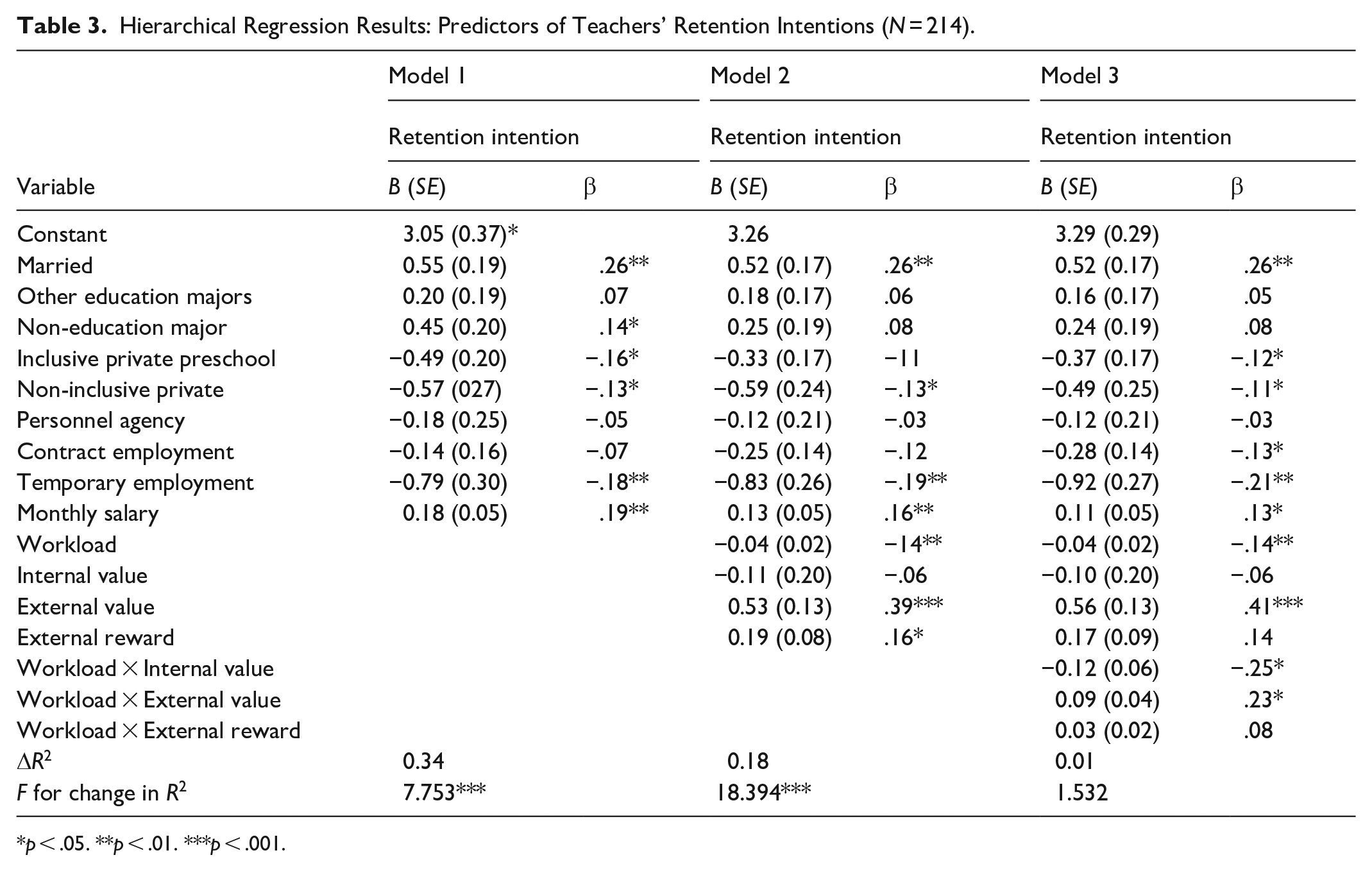
p < .05. **p < .01. ***p < .001.
Discussion and Implications
Alleviating teacher shortages and retaining in-service ECTs is a problem for preschool administrators at the micro level and a national strategic issue at the macro level. The findings of this study offer critical insights into the multifaceted factors that influence the retention intentions of ECTs. The results underscore the pivotal role of demographic variables, workload, and work values in shaping ECTs’ decisions to remain in their profession.
Our results showed that the retention intentions of ECTs in this study were above average, consistent with L. P. Guo et al.’s (2021) findings. This trend may be influenced by the COVID-19 pandemic, which has reduced job opportunities, making individuals less likely to seek alternative employment. Additionally, 83% of the surveyed teachers were from government-funded preschools, possibly making them risk-resistant and more willing to remain in their roles.
Several demographic variables—including age, marital status, major, years of experience, working hours, salary, working relationship with the preschool, and type and rank of preschool were found to significantly influence ECTs’ retention intentions. These results are consistent with Hypothesis 1. In contrast, variables such as educational background, job title, and qualification certificate did not significantly affect retention intentions, which is not consistent with Hypothesis 1. These findings are partially align with the analyses by Pi and Zheng’s (2018) and L. P. Guo et al.’s (2021), who examined the correlations between demographic factors and employees’ retention or turnover intentions. The higher retention intentions observed among married ECTs may be attributed to the financial and emotional stability often associated by marriage, which may mitigate job-related stress and enhance job satisfaction. Furthermore, the positive correlation between salary and retention intentions highlights the critical role of financial incentives in retaining ECTs. This finding is consistent with previous research identifying salary as a key predictor of teacher retention (Guarino et al., 2006). A higher salary not only improves quality of life but also signals recognition and value of the profession, thereby strengthening job satisfaction and fostering greater professional.
The study revealed a slight negative correlation between workload and retention intentions, suggesting that increased workload may diminish ECTs’ desire to remain in their positions. This finding supports Hypothesis 2 and is consistent with previous research demonstrating that excessive workload can lead to heightened work pressure, burnout and job dissatisfaction, ultimately diminishing retention intention (X. Li, 2019; Maslach et al., 2001; G. L. Pan, 2019; Song, 2021; D. Zhao, 2021). The negative correlation is particularly evident in dimensions such as physical demand, temporal demand, and frustration, which highlights their potential impact on lowering retention intentions. These results underscore the importance of effective workload management to enhance job satisfaction and reduce turnover rates among ECTs.
Work values were found to be positively correlated with retention intentions across all three dimensions: internal value, external value, and external reward, thereby supporting Hypothesis 3. These results reinforce the notion that work values are significant predictors of employees’ work attitudes and behaviors, including job performance, organizational identification, and retention intentions (R. Chen, 2020; Fang et al., 2022; Song, 2021; W. M. Zhao, 2019). This finding also aligns with the study by Yao and Liang’s (2017), which identified external value as the most critical factor for retention intention, followed by internal value and external reward. Our finding is consistent with the job satisfaction literature, which underscores the fundamental role of work values in shaping job attitudes and behaviors (Schleicher et al., 2011). It also aligns with the intrinsic motivation literature, which posits that individuals are more likely to remain in jobs that resonate with their personal values and provide a sense of purpose (Deci & Ryan, 2000). Specifically, internal values (e.g., personal fulfillment and a sense of achievement) and external values (e.g., organizational culture, interpersonal relationships, and career development opportunities) were both positively correlated with retention intentions. These results highlight the necessity for educational institutions to emphasize the intrinsic meaningfulness of preschool education while cultivating a supportive work environment characterized by a positive organizational culture, harmonious interpersonal relationships, and opportunities for professional growth. Such initiatives are crucial for enhancing teacher retention and fostering long-term commitment to the profession.
The study examined whether work values moderate the relationship between workload and ECTs’ retention intentions. Contrary to expectations, the interaction between overall workload and total work values was not significant, providing no support for Hypothesis 4. This outcome implies that treating work values as a unidimensional construct may not capture the nuanced ways in which teachers respond to workload in connection with their commitment to stay. Further analyses focusing on subdimensions of work values provided more differentiated insights. The interaction between workload and intrinsic values was significant, showing that teachers who prioritize intrinsic aspects of their profession—such as meaningful work, personal growth, and emotional connection—tended to experience stronger negative effects from high workload. This pattern is in line with existing literature indicating that intrinsically motivated teachers are more emotionally invested, which can increase their vulnerability to burnout under demanding conditions (Deci & Ryan, 2000). In contrast, teachers who emphasized extrinsic values—such as job security, external recognition, and career advancement—appeared more resistant to the adverse effects of workload. These findings are consistent with the Job Demands-Resources (JD-R) model (Bakker & Demerouti, 2007), which suggests that personal resources can buffer the negative consequences of job stressors. It is possible that a focus on external goals provides these teachers with broader coping strategies or long-term motivation that mitigate short-term pressures. Interestingly, external rewards such as salary and benefits did not moderate the workload-retention link. While financial compensation is a necessary factor in job satisfaction, these results imply that it may not significantly influence teachers’ psychological response to workload levels.
These findings underscore the importance of differentiating among types of work values when considering factors that affect teacher retention. For policy and practice, this suggests a twofold strategy: improving working conditions (e.g., task distribution, flexible schedules, sufficient staffing), and promoting value alignment through professional recognition and growth opportunities. Supporting both the material and motivational needs of teachers may offer a more sustainable pathway to reducing attrition in the early childhood education workforce.
Limitations and Future Research
This study has several limitations that should be addressed in future research. The sample size was small which limits the generalizability of the findings. Future research will expand the sample size and study scope to enhance the generalizability of the findings. The cross-sectional design limits the ability to establish causal relationships between the variables. Although the observed associations offer valuable insights into how workload and work values relate to retention intentions, longitudinal studies are also recommended to explore the temporal and causal dynamics among demographic variables, work values, workload factors, and retention intention over time.
The study focused on a limited set of work value and workload, leaving other potentially relevant factors unexplored. Exploring factors, such as organizational culture and leadership, job commitment, job burnout, etc., could provide a more comprehensive understanding of their impact on employee outcomes.
Conclusions
Given that teacher employment stability is a prerequisite for developing high-quality preschool education, preschool education teacher administrators are becoming increasingly aware of the fundamental importance of improving ECTs’ retention intentions. While previous research on turnover intention has focused on negative psychology, this study turned to positive psychology to directly explore retention intention and its influencing factors. The study aimed to explain the influence of relevant factors on teacher willingness to stay in order to identify those factors that can induce ECTs to remain in their roles and, thereby, ensure stability in preschool education.
This study contributes to the existing literature by providing empirical evidence on the role of workload and work values in predicting retention intention among ECTs. The findings support the Job Demands-Resources (JD-R) model (Bakker & Demerouti, 2007), which posits that both job demands (workload) and job resources (work values) are critical predictors of job attitudes and behaviors.
The study also confirmed that while the retention intention level of ECTs was above average, there is room for improvement. Preschool education leaders and managers dealing with preschool teachers need suggestions for human resource management, such as actively guiding ECTs to establish good work values, paying attention to teachers’ needs for intrinsic work value to achieve personal growth and development, and considering their external work value needs. Other measures would include improving factors supporting the work environment, taking into account ECTs’ external work compensation needs, improving talent incentive mechanisms, reducing teachers’ physical and psychological loads, enhancing teachers’ sense of work achievement, and focusing on different employee groups to increase overall retention rates. This should improve staff retention intention and career loyalty, reduce the adverse flow of ECTs, and ultimately promote the sustainable development of high-quality preschool education and benefit employees’ long-term development.
Footnotes

Ethical Considerations
This study was approved by the Hubei University of Education Research Ethics Committee (Approval No. 0001574) on 25/8/2022.
Consent to Participate
Verbal informed consent was obtained from all participants before they could access the questionnaire. The consent was audio-recorded in the presence of an independent witness. The consent process included: Clear explanation of the study’s aim to examine workload, work values, and retention intentions; Emphasis on their right to decline or withdraw without consequences; Confirmation that no personally identifiable information would be collected, and data would be aggregated for analysis; Notification that results may be published in open-access formats. The consent was audio-recorded in the presence of an independent witness to confirm the participant’s understanding and agreement to the study. This process ensured that the verbal consent was obtained in a transparent and accountable manner. Once consent was obtained, participants were directed to the online survey link, where they could proceed to complete the questionnaire. Only those who agreed to the informed consent could access and complete the survey. The research team took care to maintain participants’ privacy, ensuring their responses were confidential and used exclude.
Author Contributions
All authors contributed to the study conception and design. Material preparation, data collection and analysis were performed by Li Cheng, Kimberly Phillips, Xiangting He. The first draft of the manuscript was written by Li Cheng, and all authors reviewed all revisions of the manuscript. All authors read and approved the final manuscript.
Funding
The author(s) disclosed receipt of the following financial support for the research, authorship, and/or publication of this article: This study was funded by a research grant from the Youth Project of the National Education Science Planning (Ministry of Education), “Research on the Formation Mechanism and Promotion Strategy of Inclusive Non-State Preschool Teachers’ Retention Intention” (Project number: EHA210422).
Declaration of Conflicting Interests
The author(s) declared no potential conflicts of interest with respect to the research, authorship, and/or publication of this article.
Data Availability Statement
The datasets used or produced in this study can be obtained from the corresponding author upon reasonable request.