



Abstract
One of the effective ways of preventing the spread of the COVID-19 outbreak is dependent on non-pharmaceutical interventions due to the absence of a vaccine against the virus. This study aims to assess organizational emergency responses to COVID-19 using a social network analysis (SNA) method via Gephi. The data were obtained from a weekly Indonesian magazine, TEMPO, which reported on the Indonesian government’s response to COVID-19 from early March to early April 2020. One hundred and fifty actors represent the nodes and 180 connections denoted as edges are explored and analyzed using the SNA tool. The study found that the emergency response to the pandemic consisted of less solid, non-traditional structural interactions, and that the head of the task force played a lesser role in the response to this outbreak. The content analysis revealed that the team members’ issues of concern included coordination, hoaxes and fake issues, instruction/consultation, social distancing, and the lack of testing equipment. The results of the study are expected to contribute to the literature on research on emergency responses to pandemics. The findings also contribute to the development of the design of organizational emergency policies in the contexts of large-scale pandemics.
Keywords
Introduction
Although the COVID-19 pandemic differs from natural disaster events in many respects, there are also similarities (Centre for Research on the Epidemiology of Disasters - CRED, 2020; Scanlon et al., 2007). Both types of incidents tend to generate panic, there is a shortage of resources, including personnel, equipment, and supplies, and there is a need for an emergency disaster response approach. The World Health Organization (WHO) reported that, since the COVID-19 outbreak at the end of 2019 in Wuhan, China, while each country responded with different interventions, they had a crisis management framework in common (Jee, 2020; WHO, 2020a). Despite the world having experienced the 1918 Spanish Flu—one of the largest pandemics in modern history—that killed 50 million people and affected another almost 500 million, there was no mitigation planning for similar events in the future (Robinson, 2021). Although the number of deaths due to and people by affected by COVID-19 is lower than was the case during the Spanish Flu, studying the authorities’ responses to COVID-19 will still be of value.
Almost all countries worldwide have established special task forces to counter the pandemic instead of using their existing emergency units in acknowledgment of the danger posed by the virus. These task forces consist of inter-agency task forces coordinated by a prime minister or president, a vice-prime minister or president, the Ministry of Health or health authorities. For example, in Japan, the task force is led by the prime minister in coordination with the Ministry of Health, Labour and Welfare (Ministry of Health Japan, 2020); in Australia, task forces have been led by the Department of Health (Australian Department of Health, 2020) while, in the Philippines, the Inter-Agency Task Force on Emerging Infectious Diseases (IATF-EID) was assigned to address COVID-19 (Department Of Health, 2020). Members of the task force include different high-ranking officers from various ministries, such as the Ministry of Economics, the Ministry of Foreign Affairs, the Ministry of Home Affairs, the Ministry of Defense and Police, and the health research and development agencies, as well as independent experts.
It is interesting to note that, in Indonesia, the head of the task force responding to COVID-19 is the head of the National Disaster Management Agency, also known as Badan Nasional Penanggulangan Bencana (BNPB), instead of a person with a health-related background. With regard to health emergencies, Law No. 12/2018 refers to health quarantine, while disaster management, including emergency disaster responses, is regulated by Law No. 24/2007 concerning disaster mitigation. It is worth noting that, under the Disaster Mitigation Law, the definition of disaster covers natural disasters, social riots, pandemics, and technological accidents (BNPB, 2020b). Although national and local contingency planning guidelines are in place in Indonesia, there is a question of inapplicability because such guidelines are focused on natural disasters instead of on non-natural disasters. While Indonesia has been admired as an example of stable post-authoritarian politics, its democratization is not advancing (Mietzner, 2012). There has been extensive friction between the central and local governments regarding many areas related to public management issues (Rosser et al., 2011), including natural disasters and pandemics.
While studies assessing the effectiveness of organizational responses to emergencies have attracted the attention of the field of natural and disease disaster management, little has been done to address the roles of inter-agency government departments and their networking during a large pandemic such as COVID-19. A team of emergency responders established to address such a dangerous event often consists of different organizations and people from diverse backgrounds who do not know each other (Mohammadfam et al., 2015). As successful outbreak prevention depends on the task force team assigned to mitigate COVID-19 (Harapan et al., 2020), it is crucial to explore the roles of and dynamic relationships among various members of a task force working under pressure. This study aims to examine organizational government responses to COVID-19 in Indonesia from a social network analysis (SNA) perspective. The data were obtained from a weekly Indonesian magazine, TEMPO, which reported on the government’s response to COVID-19 from early March to early April 2020. To enrich and to verify the main data, a qualitative content data analysis was also conducted on extracted news reports on the official task force’s website from March 16 to April 11, 2020. The results of the study are expected to fill the gap in the research on emergency response networks, both with regard to natural disasters and to emergencies due to pandemics. This study can assist decision makers and practitioners to design and manage coordination among actors and their networks in future emergency response systems.
Government Measures in Response to COVID-19
The Indonesian government has taken various actions in response to COVID-19. Despite public criticism concerning incapability, the government has established emergency task force responses to COVID-19, such as policies and regulations, large-scale social restrictions, the closure of schools, restrictions on public transport, work-from-home policies, expanded testing centers, additional emergency hospitals, and social protection for the poor (Ekonid, 2020; Indonesian Ministry of Foreign Affairs, 2020). By the end of April 2020, Indonesia was the worst-affected country in Southeast Asia, and had the highest COVID-19 mortality rate in Asia at approximately 8% to 9% (Wahyuni, 2020). On May 9, 2020, the global death toll due to COVID-19 had reached 259,474, with 3,759,967 confirmed cases (WHO, 2020b). Indonesia had 13,112 confirmed cases, with 943 deaths and 2,494 recoveries (BNPB, 2020a).
In terms of policies and regulations, before President Joko Widodo announced the first of the infected cases on March 3, 2020, BNPB had declared (Regulation No. 7a/2020) a “particular state” of disaster emergency in anticipation of the COVID-19 pandemic from January 28, 2020 to February 28, 2020. This regulation was later revised (Regulation No. 9a/2020) to extend the duration of the disaster emergency until May 30, 2020. The declaration alerted the public to the immediate shift to an emergency situation. BNPB became the leading agency responsible for evacuating Indonesian citizens living in Wuhan, China, and brought them back to the military base on Natuna Island for isolation. Other regulations included Presidential Regulation No. 11/2020 on Public Health Emergency Declaration and Presidential Regulation No. 12/2020 on COVID-19 Pandemic as National Disaster (issued on April 13, 2020).
A significant regulation to address the organizational emergency response to the COVID-19 outbreak was Presidential Decree No. 7/2020 (Keppres No. 7/2020) concerning the mitigation task force response to COVID-19, which was issued on March 13, 2020. The task force consisted of the steering committee (SC) and the executive task force. It is important to note that the president appointed the head of BNPB as the head of the mitigation task force response to COVID-19 instead of the Minister of Health (MoH). The MoH served as a vice-head of the SC led by the Minister of Human and Culture Development (MoHCD) as the head of the SC.
The members of the task force were high-ranking officers and staff from the BNPB, the MoH, the Ministry of State-owned Enterprise (MoSOE), the Ministry of Transportation (MoT), the Ministry of Politics and Security (MoPS), the Coordinating Minister for Economic Affairs (CMfEA), and other related ministries, as well as people from universities, research institutes, and personnel from a public hospital. In terms of structural organization, the Presidential Decree on Task Forces did not specify divisions or sub-divisions. On March 24, 2020, the decree was revised via Presidential Decree No. 9/2020 (Keppres No. 9/2020), with the Minister of Finance (MoF) being appointed as secretary and new members being added to the task force (ANTARA, 2020; Ekonid, 2020). In terms of crisis communication, before the mitigation task force response was established, the government also assigned high officials from the MoH to serve as spokespersons for the mitigation task force team.
With regard to economic impact, some government regulations, such as Law No. 1/2020 (Perppu No. 1/2020) on State Finance Policy and Financial System Stability addressing COVID-19 (Ekonid, 2020), were issued. The government also pledged a budget of approximately 405.1 trillion Rupiah (equivalent to about 24.7 billion USD) to combat the COVID-19 pandemic. Other regulations were the Presidential Instruction No.4/2020 on Refocusing the Budget on Healthcare, the Disbursement of Social Funds and Economic Stimulus. Other regulations also applied to industry, taxes, small-to-medium enterprises, and export-import policies.
Disagreements between the central government and the provincial governments concerning lockdowns or social distancing policies caused tension. The central government preferred to apply social distancing instead of lockdown policies. Due to escalating cases in surrounding Jakarta Greater City (Bekasi, Bogor, and Depok cities), the governor of Jakarta insisted that the central government should allow the application of partial lockdown policies in Jakarta. The public also called for stricter central government measures instead of relying on social distancing. Finally, on April 4, 2020, the MoH issued Regulation No. 9/2020 on Guidelines to Large-Scale Social Restriction (Pembatasan Sosial Berskala Besar, or PSBB). Not only was there public criticism of the partial lockdown, but several issues, such as the shortage of masks and hand sanitizer, insufficient rapid tests and personal protection for medical workers, the lack of health facilities, and the lack of coordination among government offices, were also raised (Aminah et al., 2021). Other crucial issues were the lack of transparent data, the lack of centers and facilities for rapid testing, inconsistent policies concerning public transport, and the urgent need for a social safety net for the poor.
Theoretical Framework
This study was mainly conducted using the emergency response framework, or ERF (WHO, 2017). Emergency response is one of the functions of disaster management cycles, which consist of four functions or phases, namely mitigation, preparedness, emergency responses, and recovery (Sawalha, 2020). While there is no single definition of an emergency response, the general features of emergency responses include quick actions, planning and operations, rescue, leadership, command systems, coordination, communication, logistics, and inter-agency cooperation (Drabek, 2005; Grothe-Hammer & Berthod, 2017; Lurie et al., 2013). Emergency response management will be effective under specific conditions, such as adequate planning, having an incident command system, appropriate communication and coordination, available equipment, and effective drills and training (Bennett, 2011). Similar to WHO, the critical functions of incident management systems consist of direction or leadership, coordination, communication and planning, operations and technical expertise, support and logistics, and finance and administration (WHO, 2020a).
The study of emergency responses is largely recognized as being important from academic and practical perspectives. Countless studies of emergency responses to natural disasters, man-made disasters, and public health pandemics have focused on organizational performance (Houghton et al., 2006), communication (Creswick et al., 2009), and community response (Kim et al., 2014); however, studies investigating the roles of members of emergency teams and their networks during a crisis caused by a pandemic are limited. It is widely acknowledged that human factors play important roles in determining the effectiveness of organizations (van der Hulst, 2009).
Although organizational theories have provided principles, standards, guidelines and rules, as well as systematic explanations regarding how individuals and groups shape an organization, institutions have different characteristics during times of peace and in crisis situations. It has been argued that the effectiveness of emergency response organizations, which is characterized as a complex response to sudden changes, often depends on the roles that members play and the ways in which they interact and communicate in a catastrophic crisis situation. In addition, social studies have emphasized the importance of using a social network approach during disasters and pandemic outbreaks (Magsino, 2009). A social network is a useful tool for analyzing the role of an organization or of group members and their relationship patterns in order to understand how an emergency response team functions during a crisis.
A large emergency management team consists of several members with a variety of backgrounds and experience that is led by a manager. The emergency response manager is responsible for the strategic direction and daily operations, as well as for surveillance and response to the emergency events. He/she has full authority to delegate and assign critical functions, and should work with other organizations based on the strategic plan and priorities (WHO, 2017). Under the head of an organization are the secretary, the heads of divisions or sub-divisions, and other ad-hoc teams that operate based on planning and operational strategies, the command system, standard operating procedures, and other guidelines. Each division requires specific knowledge and expertise; therefore, team members often have diverse backgrounds and come from different organizations. It is widely known that an emergency response system consists not only of governmental bodies, but also of parties such as general communities, religious communities, private organizations, the media, and other non-government organizations (Uhr & Johansson, 2007), including non-institutional actors (Giordano et al., 2017).
Coordination and planning constitute one of the most important aspects of an emergency response. Planning and coordination with different authorities and levels of organizations are essential in emergency response management (Raju & van Niekerk, 2013). A pandemic such as COVID-19 is a complex, vast, and invisible threat that requires the involvement of many different jurisdictions, diverse expertise, and different levels within governments to avoid overlaps due to policies and regulations. Coordination in emergency response teams is critical, and can include effective preparation and a better understanding of the roles, responsibilities, and authority of members, which allows for the scheduling of functions and ensuring that the organizational activities are appropriate (Mohammadfam et al., 2015). Effective coordination improves communication and reciprocal cooperation, and avoids duplication and misunderstandings within the organizational team. There are at least three types of coordination, including micro, intermediate, and macro coordination (Bharosa et al., 2010). While the macro-perspective of coordination involves wide inter-organizational activity, the intermediate and micro-perspectives focus on within organizations and among people, respectively.
One way to improve coordination and to resolve operational problems in organizational responses to disasters is to develop a system for emergency responses, such as an incident command system (ICS), an incident management system (IMS), or a national incident management system (NIMS) (Lindell et al., 2005). These systems can improve coordination by implementing standardized organizational plans, structures, and emergency response training. In the US, the NIMS model has frequently been used by most emergency management units across all levels of government, as this model offers a framework for improved coordination in a crisis and provides access to the necessary resources to support an effective emergency response (Annelli, 2006). It is also worth noting that an ICS should be based in a designated operation center (WHO, 2013). Providing a dedicated situation room can ensure the systematic coordination of information, human resources, logistics, administration, and facilities to support decision-making and implementation during a crisis.
Another important feature of an emergency response is communication. Although the effectiveness of risk communication has been demonstrated in many research publications, policies, and guidelines for disaster and public health interventions, many crisis organizations have failed to adopt such an approach to communication (Vasterman & Ruigrok, 2013). The government media often fails to disseminate information about risks to the public (Silva et al., 2019).
Issues related to communication in disaster and pandemic crises include not only how organizations can deliver information better, but also the fact that risk communication is different during a crisis (Longstaff & Yang, 2008; Vaughan & Tinker, 2009). People experiencing threats such as disease are influenced by complex aspects such as demographics, the perceived likelihood of the risk, the experience of disaster, religion, and other social and cultural aspects (Adiyoso & Kanegae, 2013; Wachinger et al., 2013). Another factor in risk communication is that managers should respond immediately to a pandemic instead of delaying decisions due to a need for discussions or to receive feedback (Holmes, 2008). Moreover, many studies have reported that trust is key to effective communication and relationships (Vedula et al., 2017; Xu & Zhao, 2011). Trust affects openness, removes barriers, and allows for the clear communication that is necessary for an organization to address a crisis.
Current studies of emergency responses to COVID-19 have been increasing, resulting in variability in the findings. The results of a study of COVID-19 emergency responses in Stockholm, Sweden, revealed that the mortality rate was lower because the management of primary and community health provided quick and effective responses (Ohrling et al., 2020). Another comprehensive review of management responses to the COVID-19 pandemic in the European Union provided worthwhile lessons learned because the emergency response was effective. The European Union applied the principles of emergency response, such as better communication, coordination, financial support, capacity development, and leadership (Goniewicz et al., 2020). Most of the critical public health emergency issues were addressed, including social restrictions, testing facilities and equipment, isolation facilities, contact and tracing, and the development of a vaccine (Goniewicz et al., 2020). A recent study of COVID-19 discovered that the use of digital technology responses and data mining would allow future responses to be significantly faster (Radanliev et al., 2020).
By contrast, studies identifying gaps in preparedness for and responses to COVID-19 in 10 European emergency department (EDs) caring for children revealed that there was a lack of contingency plans, training simulations, personal protective equipment, and isolation facilities (Bressan et al., 2020). The current studies concerning COVID-19 in Indonesia have produced similar findings, and stated that the lack of coordination and communication delayed the response to the crisis (Salahudin et al., 2020); these studies have also focused more on economic recovery in the short term (Sparrow et al., 2020). Another study found that Italy’s initial response to COVID-19 failed due to a lack of communication and coordination as fundamental aspects of ERF (Ruiu, 2020). According to Amit et al. (2021), the COVID-19 crisis communication in the Philippines failed to decrease the spread of the virus because the government’s messages did not reach the entire population.
Studies of disaster management and public health using SNA have focused extensively on the use of social media or media coverage during disasters and pandemics (Lee & Basnyat, 2013; Nerlich & Halliday, 2007; Reintjes et al., 2016; Vasterman & Ruigrok, 2013; Yeo et al., 2018). SNA has also been employed to examine the role of non-profit organizations during a disaster (Bisri, 2013; Kapucu et al., 2011; Olanrewaju & Ahmad, 2018), as well as the resilience of community networks (Franco et al., 2013; Magsino, 2009) and the public post-disaster response (Chatfield & Brajawidagda, 2012). For example, a study found that Twitter was useful for patients, survivors, and their families in relation to the location of doctors and cancer facilities in the US (Murthy & Eldredge, 2016). A recent study of COVID-19 revealed that the diversity of tweets and the dynamics of users of Twitter during global health crises provided a dataset of actors, their links, topics, and retweets that benefited data science, health databases, and network science (Aguilar-Gallegos et al., 2020). The research investigating the information dissemination via fan pages on Facebook during the 2014 floods in Malaysia used SNA to reveal that social media played an important role in providing information about supplies and assistance (Olanrewaju & Ahmad, 2018). Mainstream media coverage of COVID-19 has been also studied extensively. Studies using data sourced from reports published by the government, non-governmental organizations, and mainstream media have revealed that Bangladesh was severely underprepared for responding to COVID-19 (Biswas et al., 2020). Other research has revealed that exposure to COVID-19 news on the mainstream media increased depressive symptoms, and suggested that mainstream media content should aim to decrease the burden on mental health (Olagoke et al., 2020).
However, research using mainstream media data to assess the comprehensive roles of members and their relationships in inter-ministerial agencies in the context of a large and rapid global pandemic is limited. The studies that do exist have focused only on communication, relationships, and trust in emergency response teams (Patterson et al., 2013), or on the performances of the spokespeople in terms of communicating risk (Lyu et al., 2013).
SNA is a useful tool for describing and understanding complex structures and their relationships in a group or organization. Network analysis can identify which members play central roles in an organization, the closeness or distance of members, and the features of individuals’ relationships. Network analysis also allows policymakers to prepare the most effective interventions and to prevent the failure of emergency organizations in response to a disaster, such as that of the terrorist attack on September 11, 2001. In his study, Kapucu (2005) analyzed the patterns of communication and information flows among actors in the Federal Emergency Management Agency (FEMA) following a terrorist attack, and revealed that there was a gap between the actual performance and the designated roles in the Federal Response Plan. A network analysis approach is capable of explaining the configuration of the different actors and their links that are not observable by the public.
An SNA is a study of interrelated human systems conducted via the assessment and characterization of actors and their relationships in a set of group systems. According to Borgatti and Li (2009), actors can be people, groups, firms, organizations, or countries, and their roles can encompass an entire network, while relationships or links may be associated with kinship, authority and power, communication, friendship, sentiment, or feeling (Borgatti & Ofem, 2010). One actor may have more relationships than others, while some may have few connections. The more links actors have, the more popularity or power they may have, and they may have more resources. The relationships among actors may be strong or weak, while connections may be close or at a distance. The networks that have weak ties may show a slow response. By contrast, networks with stronger ties that have short paths may be quicker to respond (Kapucu, 2015). A study that used a social network-based coordination model involving 224 participants found that there was a link between network ties and coordinated emergency response networks (Hossain & Kuti, 2010).
Advances in algorithm and graph visualizations on computer-based applications supporting SNA have assisted researchers, policymakers, and others to understand the complexity and interactions of individuals in any organization or group. Software such as Ucinet, NodeXl, NetDraw, E-Net, KeyPlayer, StOCNET, Automap, Pajek, and Gephi has been developed, and can process and present data networks visually (Apostolato, 2015). Gephi provides a statistics and metrics framework, thus allowing it to analyze social network features such as degree centrality, “betweenness” and closeness centrality, diameters, coefficients, short paths, page-ranks, and ego networks or modularity. Another useful feature of Gephi is that it is equipped with excellent and rich visualization features that enable the exploration of large networks (Jacomy et al., 2014).
Methods
Participants
SNA pertains to the roles of actors or people and their relationships with others in a group. When collecting data, identifying the actors or people involved in a mitigation task force team’s response to COVID-19 and the relationships among them is of paramount importance. All the data were obtained from six issues of the weekly Indonesian magazine, TEMPO, following the method used to study the presidential candidacy during Indonesia’s general election in 2014 (Eriyanto, 2014). TEMPO is a respected and independent weekly magazine in Indonesia. Another reason for using TEMPO was the impossibility of accessing the actors involved in the mitigation task force, who were mainly high-ranking government officers. Second, it was difficult to contact the task force members and other people involved in the response to COVID-19 due to the large-scale restrictions. Third, TEMPO covered the progress of the government’s response to COVID-19 from early March to early April 2020 by publishing four special issues reporting on COVID-19, and by reporting news about COVID-19 in two other issues (Tempo, 2020).
To enrich and to verify the main data, a qualitative content data analysis was conducted by identifying actors and issues of concern in the news reports on the task force’s official website (www.BNPB.go.id). Only news reports including a press release that provided updates on new cases were included. Task force efforts to counter hoaxes and fake news on the website were excluded from the analysis as part of the process of content analysis; that is, decreasing the amount of the text collected, grouping categories, and seeking the meaning of the text (Bengtsson, 2016).
Measures
The people or actors identified were mainly government officers involved in contributing to the formulation and execution of the emergency response to COVID-19. They were either official members of a task force or had other roles and positions that linked them directly or indirectly to the task force members. However, in a few cases, people who were not involved in the response team were included because they had links to task force members, such as a person suspected of being infected, local health workers, independent experts, and non-government organizations (NGOs), who often responded to government policies regarding COVID-19.
Relationships or ties among task force members were classified based on whether they involved direct meetings, assignments, a hierarchy of instructions, online meetings, responding, communicating, mentioning, and referencing. For example, when the president spoke in public and addressed such issues in a speech asking the MoF to reallocate the budget for the fight against COVID-19, this was categorized as one relationship between the president and the MoF. As such relationships are complicated, the relationships among people in the task force team were considered to be indirect relationships, and weighting was not applied. The data gathered identified more than 180 relationships or ties. This study also used the content analysis method to identify the important themes or topics being discussed, communicated, or responded to by the parties. For example, when the president instructed the MoH to prepare more rapid tests for COVID-19, the shortage of rapid tests was categorized as a topic discussed by or concerning both the president and the MoH. News reports from the task force’s official website were also collected, identified, and categorized by group, while certain text meanings were interpreted. People, newsmakers, and issues of concern in the news reports on the task force’s official website were calculated.
Analysis
The analysis of the network attributes was conducted using Gephi Version 9.1.2, and by applying calculations of density, the degree of centrality, closeness and betweenness centrality and modularity (egocentric networks). Density corresponded to all the members, while ties referred to the connectedness among them (Thangaraj & Amutha, 2018). The density is represented by scores ranging from 0 to 1 (Eriyanto, 2014). The higher the number, the denser the network. Degree centrality explains who had the most connections, while closeness centrality refers to how close an actor was to another, and betweenness centrality is related to the roles of actors in connecting one sub-group to another. Centralities are measured using a particular score, and often used normalized data. The normalized scores range from 0 to 1. The higher the score, the greater the degree of the actor’s closeness and betweenness centrality. Modularity, or egocentric networks, explain the degree of separation.
Data from the official task force website were identified, including the actors mentioned and the issues raised in the news reports. The actors and topics that appeared frequently were compared to the main data reported in the TEMPO magazines.
Results
One hundred and fifty nodes or actors were identified as being reported in TEMPO, including the president, the MoH, the MoHCD, the head of the task force, MoFA, the MoF, the MoSOE, six governors of Java Island, the head of the Local Government Health Office, the Director General of MoH, the Minister of Industry, a special staff of MoH and MoSOE, the spokesperson for the task force, researchers, professors, and public health associations and NGOs.
In terms of relationships or edges, an analysis of the data obtained from TEMPO revealed that there were more than 180 relationships or ties among the people involved in responding to COVID-19. Various relationships, such as direct meetings, instructions, communication, online meetings, responses, answers, lobbying, sending letters, and other interactions were identified. Frequent relationships were direct meetings between the president and ministers, and the head of the task force or ministers with other ministers or governors. Another form of the tie was the relationship between the governor of Jakarta and ministers when discussing whether Jakarta City should be placed in partial lockdown. For example, TEMPO reported that the governor of Jakarta sent the MoPS a letter requesting social restrictions. Different people may have many relationships depending on their role(s) in a team. For example, the spokesperson for the task force had different kinds of ties because he needed to respond to many actors via various actions. He sometimes responded to criticism from the public, or to elaborate on strategic government policies.
Overall, the density of the 150 actors involved in the government task force responding to COVID-19 was 0.016, which is very low. This indicates that not all the actors were connected proportionally. Density is used to explain how all the actors interact with each other. The perfect density parameter is 1, as this score indicates that all the actors had relationships or contact with each other. The limited network was also reflected in the diameter network, which was 13. This means that the farthest distance from one actor to others was approximately 13 paths. In addition, the average distance to each actor in the network was around 4.4 paths. The distance illustrates the degree to which the network is interrelated. A solid network indicates how close each person is to others in terms of contact or communication without third parties being involved. As there were actors at an average distance of 4.4, this shows that more than five people were required in order for an actor to contact others. Figure 1 shows that the visualized network was less dense, and centered on a few actors. The MoH, the president, the spokesperson for the task force, the head of the task force, the governor of Jakarta, the MoSOE, and the MoHCD were among the actors at the center. The scattered nodes at the top right show that these actors only had connections to a limited number of other members.

The network of the task force response to COVID-19.
In terms of the roles of actors in the network, Table 1 shows the degree of centrality of the top 10 actors, in which the president and the MoH were the most strongly connected actors. The third and fourth actors were the head of the task force and the spokesperson for the task force, respectively. It is interesting to note that the governor of Jakarta was the fifth most closely linked actor. Other members with more connections were the MoSOE, the MoHCD, the director general of the MoH, the governor of West Java Province, and police public relation officers. Degree centrality indicates that the most extensively connected actors may have more power and be more active, more responsible, and more popular compared to others.
Degree Centrality.
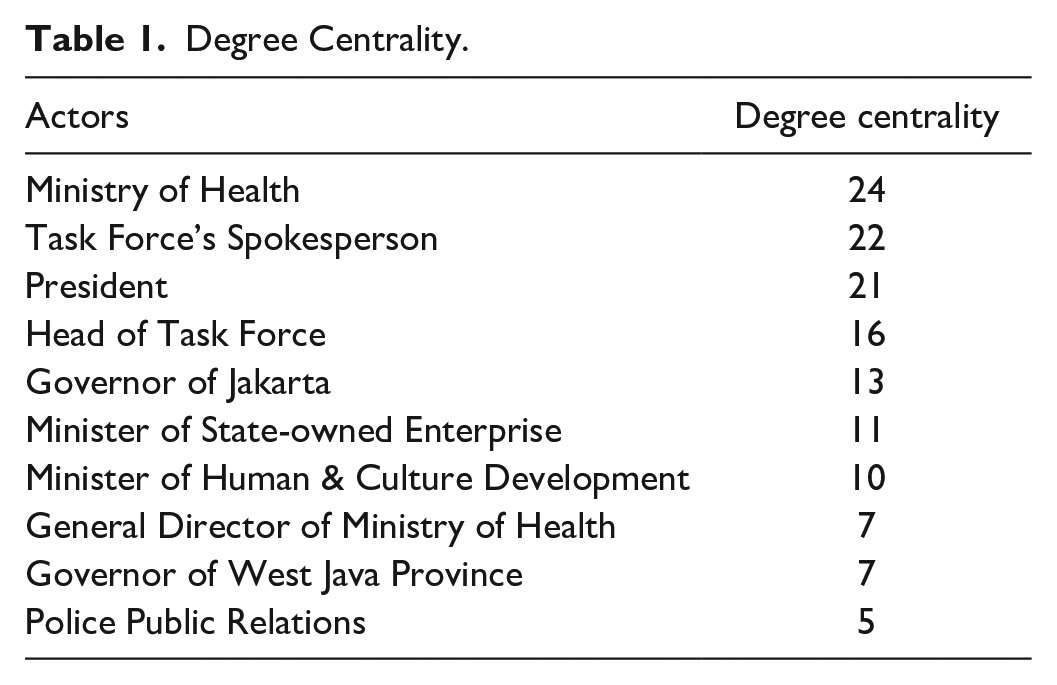
Table 2 shows the statistical results for the closeness and betweenness centrality of the network. Closeness centrality refers to how close an actor is to other actors in the group. It shows the average path from the first node to all the nodes in the network. The higher the normalized score of closeness centrality, the closer the network. Table 2 shows that the top 10 actors with the closest networks were the special staff for the president, the Minister of Manpower (MoMP), the director of Central Java Hospital, immigration officers, the immigration office in West Nusa Tenggara (NTB), the MoD, the airport authority, the Indonesian military, health quarantine in NTB, and the Indonesia Ombudsman Body.
Closeness and Betweenness Centrality.

In addition, Table 2 shows the betweenness centrality results for the top 10 actors in the network. The higher the score, the greater the actor’s role as a connector to other sub-group networks. The president was the top actor in the betweenness centrality among the members. The lower ratings were for the MoH, the spokesperson for the task force, the governor of Jakarta, the Ministry of Communication and Information (MoCI), and the head of the task force, respectively. The remaining actors with high betweenness centrality were the head of police, the MoHCD, police public relation officers, and the MoSOE.
Another important aspect of network analysis is the egocentric network (Rice & Yoshioka-Maxwell, 2015). The egocentric network refers to a sub-group network in which members are centered on one actor. A modularity analysis using Gephi resulted in 11 sub-group networks. Figure 2 shows the top six egocentric networks; the first was the MoH, which had ties to the president, the task force’s spokesperson, the MoHCD, and the governor of Jakarta. Most of the actors connected to him were people involved in health organizations, such as the director general of the MoH, the inspector of the MoH, the special staff of the MoH, and public hospitals. In addition to these actors, he also had relationships with the Corruption Eradication Body, Roche Indonesia, Toyoma Chemical and the Eijkman Institute.

The top six actors in the egocentric network.
The second actor in the egocentric network was the president’s sub-network, which was mainly connected to actors who had other actors with degree centrality, such as the MoH, the task force’s spokesperson, the head of the task force, the governor of Jakarta, the MoSOE, and the MoHCD. Other actors connected to the president were the Minister of Defense, the Minister of Manpower, some governors, a special staff of the president, WHO Indonesia, the Eijkman Research Institute, and Toyoma Chemical.
The task force’s spokesperson constituted another egocentric network. As the spokesperson appeared on television almost every day to communicate information about, to announce, and to respond to issues related to COVID-19 with the public, he had contact with the president, the MoH, the head of the task force, and local governments. The spokesperson also had connections to various actors apart from government officers, such as patients, public health associations, research institutes, and NGOs. The head of the task force had relationships with the president, the MoH, the task force’s spokesperson, the police, the military, experts, volunteers, and medical doctor associations. Surprisingly, he had no relationship with the head of the SC of the task force. Other connections were with the South Korean Embassy in Jakarta and the University of Islam Malaysia.
The governor of Jakarta and the MoSOE constituted the rest of the top six sub-groups of networks. The governor had relationships with the president, the MoH, the MoHCD, the MoPS, the MoCI, and the internal staff in Jakarta Province. Of interest, the MoSOE only had a relationship with the president, and mainly coordinated with his staff, including special staff and the director of state-owned enterprises. The MoSOE managed vital state-owned companies such as oil and gas, electricity, medical and health industries, food, infrastructure, and others.
The findings also revealed the issues or topics of concern to the actors in the network. Figure 3 shows the number of issues that appeared in the network. The most common issues were testing equipment, hoaxes and fake information, instructions/consultations, social distancing, and coordination. Other themes were collaboration, government coordination, the lack of coordination, rapid testing facilities, and chloroquine use. Communication, data transparency, the lack of testing equipment, personal protective equipment, research collaboration, and the lack of testing facilities were among the other topics that attracted the attention of members of the group.

Issues related to the task force as reported by TEMPO magazine.
Data extracted from the news reported by the task forces’ official website (http://BNPB.go.id) from March 16, 2020 to April 11, 2020 revealed that 130 news items, 63 actors, and 51 topics were identified. Actors who were involved in the task force activities included the task force spokesperson, the president, the head of the task force, the minister of research and technology (MoRT), the task force expert team, the head of research and development, education, training, and information, the Ministry of Underdeveloped Villages and Transmigration (the head of R&D MoUV), the director of fire and disaster management (FDM MoH), MoH, and the secretary of the Fatwa Commission, Indonesian Ulema Council (MUI). Figure 4 compares the actors involved in the task force that were reported in the TEMPO magazine and on the official website of the task force. With regard to the actors, at least three actors appeared in TEMPO and on the website. Although MoH and MoSOE, who were reported in TEMPO, were not on the official website, they were reported on the website, but not as often as in TEMPO. Of interest, MoRT, the head of R&D MoUV, FDM MoH, and the secretary of MUI were the actors reported on the official website, thus implying that they played important new roles (Table 3).

Issues related to the task force reported on the official website.
Actors Reported on the Task Force’s Official Website.

The topics discussed on the official website ranged from updating the number of people infected, deaths and recoveries from COVID-19, public donations, social distancing, social restriction policies, collaboration, and personal protective equipment. Other issues that were discussed included public support, research and development, community self-isolation, the important role of children, and government advice not to travel. Figure 4 shows the issues of concern in the news reports on the official website.
Discussion
The network of the organizational government in response to COVID-19 was represented by a low-density visualization, which shows that the members of the task force were less connected to others. Each member tended to be linked to a particular person in the group. In addition, the connections among the individuals were unsystematic. The pattern also showed that the role of the head of the task force was not at the center of the group, indicating that the hierarchical structure did not work effectively. The results confirm the existing literature stating that organizational emergency responses, which are generally established during crises and short-term situations, often fail to implement contingency plans, lack communication, and fail in the command-and-control system (Lloyd-Smith, 2020). This finding is also in line with Cross et al.’s (2002) study in collaboration with a consortium of Fortune 500 companies involving 22 different organizations, which revealed that the traditional hierarchy of functional structures was less effective than were informal relationships. This study revealed that social networks were more able to increase collective knowledge, to assess different collaborations, and to ensure integration when restructuring an organization, than were formal structures (Cross et al., 2002).
In terms of actors’ centrality, it is clear that the head of the task force was not the epicenter of the group. Despite being the commander of the incident system, he had fewer connections than did the president, the MoH, and the task force’s spokesperson. According to a network analysis, the actor with the greatest degree of centrality may be the most popular or important person in the network. This is inconsistent with emergency regulations in that the highest authority in responding to COVID-19 after the president is the head of the task force. With regard to a large and critical COVID-19 outbreak, it is reasonable to assume that the president is responsible for addressing various directions and issues concerning the COVID-19 pandemic. Similarly, the task force’s spokesperson would disseminate information about COVID-19 to the public, and appear daily to announce, address and respond to any issues related to the progress of the response to COVID-19. The domination of the MoH, which was not assigned to lead the task force, is in line with the finding in the study that one of the barriers to policy implementation in response to COVID-19 was that of unsynchronized regulations among ministries (Aminah et al., 2021). It is also worth noting that the strong leadership of the task force was a key factor in reducing the spread of coronavirus, as demonstrated in Wuhan, China (Forman et al., 2020).
The MoSOE was also actively involved. In comparison to other ministries, the MoSOE had the economic resources to support the task force in terms of building health facilities, purchasing rapid tests, and other forms of support that were not required bureaucratic procedures. The strategic roles of the MoSOE in providing rapid testing and medical equipment are in accordance with the ERF, which indicates that the provision and distribution of logistics are vital during a large-scale disasters (pandemics) (Chen et al., 2008).
It is interesting to analyze why other ministries were more active than was the head of the task force, who was also the head of the BNPB. Under the hierarchical government system, the BNPB is at a lower level than are the ministries, although it is directly under the president. This is not surprising due to the political culture of Indonesia. Social culture is still dominant in the Indonesian political system, and the result is that those in higher-level positions are reluctant to be instructed by those in lower-level positions (Pratama, 2017). Another explanation for the limited function of the head of the task force is the overlapping of regulations. Law No. 24/2007 states that disasters include natural and non-natural disasters such as a pandemics, technological accidents, and social riots. In addition, Presidential Regulation No. 17/2018 gives the BNPB the authority to take action during disasters under certain conditions. By contrast, Law No.36/2009 and Law No. 6/2028 on Health and Health Quarantine granted the MoH control of the pandemic on behalf of the central government. These complicated laws and diverse organizations may have contributed to the relationships of the members in the task force responding to COVID-19 forming a fairly uneven network.
The appearance of the governor of Jakarta in the network of governmental responses to COVID-19 was not surprising, as Jakarta was hit hardest by the outbreak. As the capital city and a national and international hub, Jakarta was extremely vulnerable to the coronavirus. The governor took active measures to prepare for and to address the outbreak. He preferred lockdown policies other than the partial lockdown proposed by the central government. In terms of funding, Jakarta has a significant amount of money compared to other provincial governments, although decisions such as lockdown policies remain under the authority of the central government. Different organizational authorities are involved in responding to a crisis, which affects the effectiveness of emergency response organizations. The finding is similar to a previous study of social support for prenatal health, which found that, in terms of the number of members, a smaller network was a more active network (Hether et al., 2016). Another possible reason is that each organization has different laws and regulations, and are often in conflict with each other; therefore, the governor might have preferred to work with the internal Jakarta provinces instead of with the larger stakeholders.
Other interesting findings were that major issues embedded in the relationships of the network were testing equipment, hoaxes and fake issues, direction/consultation, social distancing, and coordination. These findings confirmed the general principles within the ERF, namely that the provision of testing equipment, medical equipment, and personal protective equipment are critical in responding to pandemic outbreaks (Anderson et al., 2020; WHO, 2017). Risk communication during a crisis is often difficult, as supported by the crisis literature, which notes that hoaxes and fake news become serious problems during a crisis (Sellnow et al., 2019). It is recommended that emergency managers focus on real issues rather than on hoaxes, and educate the public in terms of media literacy. Concern that the main problem in managing an emergency response was coordination was widespread. Coordination involves the entire group of members, including divisions or sub-divisions, as well as coordination among task force members, other government institutions, and wider communities. The issue of government coordination validates previous studies stating that integrating different resources and functions in a panic situation and taking urgent action during a large-scale pandemic across the nation is a challenge for emergency response managers (Zhou, 2020).
In the absence of pharmaceutical interventions, social distancing and social restrictions are effective ways to control the virus. This is consistent with the result of the present study, namely that lockdowns are effective in curbing the spread of the virus (Imtyaz et al., 2020). Other issues raised by the task force were collaboration, data transparency, communication, public support and donations, research collaboration, and government advice to follow public health protocols, although these were not the main focus. It is clear that other findings of the study revealed that establishing organizational emergency responses to such global outbreaks in the future should consider comprehensive public health management (Liu et al., 2020), and better communication and coordination (Teng-Calleja et al., 2020).
Conclusion
The COVID-19 pandemic is a disaster for humanity. The purpose of this study was to assess and explore the organizational emergency response to COVID-19 from the SNA perspective. The data analyzed were obtained from a weekly magazine that reported on the emergency response to COVID-19 in March of 2020. The data were also enriched by a content analysis of news reports published on the official website. This study concluded that the emergency response to the pandemic was less cohesive, thus indicating the roles of non-structural organizations and the limited roles of the head of the task force and the head of the SC in managing the emergency responses. The dynamic roles of actors and their relationships within the group reflect the weaknesses of the organizational emergency response to COVID-19. The complexity of the problems in combating COVID-19 led to major challenges for the task force team. Cultural aspects, the overlapping of regulations, and the lack of communication between central and local governments may have contributed to the lack of cohesion in the organizational response. The overall findings were consistent with previous research on assessing emergency responses to COVID-19 elsewhere, in that people were not satisfied with the government’s performance in responding to the pandemic (Prastyo et al., 2020), and that better preparation and the application of a comprehensive organizational response were required (Rajan et al., 2020). The future establishment of organizational emergency responses should clearly be based on the government’s roles and regulations, as well as on expertise. The task force should be the central and highest authority when addressing pandemic outbreaks, and should involve different line ministries, research institutions, professional associations, community organizations, and private institutions.
The major issues raised by task force members were related to testing equipment, hoaxes and fake news, directions/consultation, social distancing, and coordination. Other issues, such as collaboration, testing facilities, and the lack of government coordination were important concerns in the emergency response to COVID-19. Although the task force addressed important issues in emergency responses, the government should also consider emergency response issues such as better communication and coordination, the provision of testing facilities, collaborative research, data transparency, and social protection. This study provides valuable insights into the dynamic roles of team members and their networks, which are crucial for the success of the response to COVID-19. Better preparation for emergency responses using the ERF is necessary for future pandemics.
Strengths of the Study
The findings are expected to contribute to the development of the design of organizational emergency policies in different contexts, particularly to the development of future disaster and emergency responses to a large-scale pandemic. While it was impossible to gather primary data during the COVID-19 outbreak, the SNA approach, which allows researchers to collect electronic-based media information, was an advantage in this study. Given the availability of the information on online media, an assessment of the organizational emergency response to COVID-19 can be accomplished rapidly.
Limitations of the Study
The first limitation of this study is that, since the actors involved in the government’s emergency response were only identified from six issues of a weekly magazine, not all of the actors’ activities and relationships have been covered. Second, as this study was conducted within a short time and the pandemic was ongoing at the time of writing, this may change the dynamics of emergency responses to COVID-19 including the actors, their relationships, and themes. Third, as the locus of the study has unique characteristics in terms of politics, regulations, government organizations, and social-cultural aspects, the results of the study may not apply to other countries.
Footnotes
Appendix

| Abbreviations | |
|---|---|
| BNPB | Badan Nasional Penanggulangan Bencana/National Disaster Management Body |
| CMfEA | Coordinating Minister for Economic Affairs |
| Director of FDM MoH | Director of Fire and Disaster Management, Ministry of Home Affairs |
| Eijkmen | Eijkmen Research Institute |
| GD of MoH | General Director of Ministry of Health |
| Central Java Governor | Governor of Central Java Province |
| Jakarta Governor | Governor of Jakarta |
| West Java Governor | Governor of West Java Prov. |
| Head of MDA | Head of Medical Doctor Association |
| Head of Police | Head of National Police |
| Head of R&D MoUV | Head of Research and Development, Education and Training, and Information, Ministry of Underdeveloped Village and Transmigration |
| Head of TF | Head of Task Force |
| MoCI | Minister of Communication and Information |
| MoF | Minister of Finance |
| MoH | Minister of Health |
| MoHCD | Minister of Human and Culture Development |
| MoMP | Minister of Manpower |
| MoRT | Minister of Research and Technology |
| MoSOE | Minister of State-Owned Enterprise |
| MoPS | Ministry of Politic and Security |
| MoD | Ministry of Defence |
| MoT | Ministry of Transportation |
| Police PR Division | National Police Public Relations Division |
| NTB | Nusa Tenggara Barat/West Nusa Tenggara Province |
| PSBB | Pembatasan Sosial Berskala Besar/Large-Scale Social Restriction |
| President | President of the Republic of Indonesia |
| PSO | Presidential Staff Office |
| Secretary of MUI | Secretary of Fatwa Commission, Indonesian Ulema Council (MUI) |
| SS of MoH | Special Staff of Ministry of Health |
| SS of MoSOE | Special Staff of Minister of State-Owned Enterprise |
| SC | Steering Committee |
| Task Force Expert | Task Force Expert Team |
| Spokesperson | Task Force Spokesperson |
Declaration of Conflicting Interests
The author declared no potential conflicts of interest with respect to the research, authorship, and/or publication of this article.
Funding
The author received no financial support for the research, authorship, and/or publication of this article.
Disclaimer
The views and opinions expressed in this article are those of the author and do not necessarily reflect the official policy or position of author’s agency.
Ethics Statement
This study is not apply for animal and human studies involvement.
