




Abstract
The purpose of this study was to assess the contribution of mid and lower-level academic leaders in bringing about change readiness in the university. To this end, 180 academic staff were sampled from the five colleges and one institute using a stratified random sampling method. Data were collected using a modified form of the organizational change recipients’ beliefs scale and an adapted change attitude assessment scale. The collected data were analyzed using descriptive and inferential statistics using simple linear regression. The analysis of the collected data revealed that change readiness in the university is low and met usually with resistance from the academic staff of the university. Moreover, the relationship between change leadership and change readiness of the academic staff of the university revealed that there is a significant relationship between change leadership and change readiness of the academic staff of the university. Accordingly, the regression coefficient between change leadership and discrepancy, principal support, valence, efficacy, and appropriateness of the change effort was found to be .464, .212, .444, .347, and .202, respectively. Thus, it was recommended that the mid and lower-level leadership of the university as a whole need to work toward improving the change readiness perception of the academic staff of the university. It should also show commitment to the smooth implementation of change tools being implemented in the university and provide adequate material, psychological, training, and other forms of support needed for smooth implementation of change in the universities.
Introduction
Organizational change processes often fail due to various reasons. Some of these reasons are lack of acceptance of change by organizational members, lack of understanding of what and how to change, resistance to change, dearth of leadership commitment, paucity of required resources, the pace of change introduction, and others (Walinga, 2008; Yukl & Gardner, 2020). For the organizational change process to be effective the change itself must first be well accepted by organizational members that are responsible for its implementation and considered the only way the organization is going to survive. When employees view that change is essential and benefits the organization as well as their interest, they tend to be fully committed to its successful implementation (Dung & Van Hai, 2020). For change to be accepted by organizational members the leadership of the organization at various levels should exert a concerted effort to communicate what and how to change together with why change is needed (Abbas & Ashghar, 2010; Mangundjaya, 2013; Mangundjayaa et al., 2015; Nanjundeswaraswamy & Swamy, 2014). In support of this, Miller (2011) claims that “effective change leadership happens when leaders of change provide direction, guidance, and support to the people who are implementing the change. . .. as well as those having to adapt to change.” In effecting successful change in an organization, change leadership plays a significant role (Hanna, 2017). Employees react toward change in three different ways, that is, negatively, a favorable reaction such as readiness to change, and commitment to change. The negative connotations of change include such feelings as uncertainty, loss of control, fear of failure, injustice, anger, frustration, and resistance to change (Liu, 2010; Yukl, 2013).
According to Liu (2010) and Yukl (2013), organizational justice, high-quality leader-member exchanges (LMX), and managerial influence tactics, including legitimization and ingratiation, can overcome negative connotations toward change. The more favorable reactions toward change include readiness to change and openness to change. Researchers (Mangundjaya, 2013; Mangundjayaa et al., 2015) observe that favorable reactions to change are consequences of effective change leadership that results in high self-esteem, optimism, perceived control, and participation in the change decision process. A continuous and effective change leadership results in absence of negative feelings and attitudes associated with change but goes further toward enabling employees to exert willful effort for the realization and institutionalization of change, which is a commitment to change (Liu, 2010). Change receptivity is a defining activity for change to succeed or fail. In support of this, Duignan (2006), Hao and Yazdanifard (2015), Elving (2005), and Smith (2005) contend that change leaders must openly discuss the change initiative itself and what loss or other effects it will have on those who are involved in the process. On the other hand, when a top-down change is initiated and the leadership of an organization makes no effort so that organizational members accept change, change resistance occurs.
Through teaching and research, higher educational institutions are the storehouses and disseminators of the nation’s knowledge and innovation. This gives them a competitive advantage enabling them to facilitate innovation and diffuse new thinking in society. The education system of a nation contributes to the economic development of a nation when the institutes created to render the services are effective. Educational institutions especially universities are established, among other things, to assist in the development efforts of a nation. In fulfillment of such noble objectives in the dynamic environment they exist and the changing needs of the economy, higher education institutions need to introduce various change efforts to cope with the demand of the economy.
Moreover, organizations, that is, universities or others need to change to survive, grow and stay relevant in light of the dynamic environment in which they operate. Also when they are fraught with problems the usual solution proffered by those responsible for their effective functioning is to initiate some sort of change that they think will solve all problems. However, bringing about organizational transformation through the introduction of some change models in an organization is a difficult task (Anderson & Anderson, 2001; Seipp, 2019). Many researchers (Burnes, 2005; Harung et al., 2009; Jones-Schenk, 2019) report that significantly large (70%) change initiatives fail to bring about the desired transformation in organizations. This is more pronounced in higher educational institutions where the culture of these institutions is a major obstacle to introducing large-scale rapid change initiatives. Universities have introduced several change efforts hoping to revamp their system and improve their performance as a university so that they can proffer the services required of them in a proper manner. The changes introduced include business process reengineering, balanced scorecard, and kaizen which is a method of achieving continuous improvement based on the belief that little, consistent positive adjustments may lead to big gains, cooperative learning, and others. Considering the existing problems in the university and its performance lag compared to other universities of its status, whether these change endeavors have brought the desired result is questionable.
The study is conducted in a public university located in the eastern part of Ethiopia. Ethiopia is the second-most populous country in sub-Saharan Africa. The country, Ethiopia, is located in sub-Saharan Africa and is among the developing countries of the world. Currently, it has 50 public universities and over 270 private higher education institutions. With its current higher education system, it has achieved a GER of 10% which is better than the average higher education GER in some sub-Saharan African countries (Ministry of Education, 2016/17). Among the 50 public higher education institutions established over the last 15 years, one is Dire Dawa University. Dire Dawa University is located in the industrial and commercial city of Dire Dawa, 515 km east of Addis Ababa, the capital. To improve access to higher education in the country, the government established 13 universities in 2007GC. Dire Dawa University is 1 of 13 universities established in 2007GC to achieve improved access to the country’s youth by providing quality education. Currently, the university has one Institute (Institute of Technology) and five Colleges (College of Computational & Natural Sciences, College of Business & Economics, College of Social Sciences and Humanities, College of Law, and Medical and Health Sciences) with 47 under-graduate and 48 post-graduate degree programs. Current enrollment has reached more than 21,159 students in undergraduate and graduate programs through regular and non-regular admission methods. However, the university failed to achieve its goal of student enrollment, which should have been in line with its academic qualifications. To date, the university has launched several transformation programs aimed at improving program efficiency. However, a desirable change to bring about improved efficiency, increase in capacity, and the level of improved quality education has not yet been achieved. Therefore, such failures make it necessary to study how the introduction and implementation of change initiatives were conducted.
Theoretical Framework
Employees in an organization show commitment to change and exert greater effort for the implementation of change initiatives when they believe that change is necessary and important resources and leadership commitment to change is noticeable. Leaders committed to bringing about effective implementation of change in an organization need to influence followers deliberately so that they accept change, be committed to the change introduced, and implement it effectively. With such influence, researchers argue that (Armenakis et al., 1993; Armenakis & Harris, 2002; Weiner et al., 2008) can only be effective when leaders communicate every aspect of the change introduced as well as provide the necessary support for its effective implementation.
Researchers (Holt et al., 2007; Kirch et al., 2005; O’Connor & Fiol, 2006) argue that for successful implementation of change, change readiness is indispensable. Armenakis et al. (1993) provide a change readiness model to analyze and understand the psychological commitment of employees for the implementation of change. They forward five indicators of employees’ change readiness, that is employees’ valence, appropriateness, principal support, discrepancy, and efficacy. Valence refers to the perceived benefit of the change for employees if it succeeds. Discrepancy refers to a belief that change is needed while appropriateness refers to the belief that the change is an appropriate response to the existing problem. In addition, efficacy refers to an individual’s perceived ability to effectively implement change and bring about the desired result while principal support is about employees’ beliefs that the leadership and peers will offer concrete support in terms of resources required and others when asked to do so (Rafferty et al., 2012). Different authors define change readiness differently, for example, Weiner (2009) defines organizational readiness to change as employees’ commitment to change and their efficacy to implement change effectively. Likewise, Rafferty et al. (2012) define change readiness as employees’ predisposition to accept change and implement it to alter the status quo deliberately. In addition, Weiner et al. (2008) consider change readiness as the views, attitudes, and intentions of employees regarding the extent as to the need for change and the organization’s ability to accomplish those changes. When employees are committed to the change introduced, they exert effort to implement it successfully. When employees consider that change will bring about psychological safety, control, and identity they exert effort for its successful accomplishment (Abdel-Ghany, 2014). Therefore, this study is informed by and tested the change readiness model formulated by Armenakis et al. (1993). Further, it tried to test the change readiness theory these authors developed and see how much leaders who work toward creating change readiness can effectively get change initiatives implemented.
Accordingly, when change is introduced in the university mid-level leaders must consider that communicating the change and trying to create buy-in from instructors as well as admin staff is important. When mid-level leaders, that is, deans and directors of various sections of the university tasked with the implementation of major change in the university perceive the importance of change readiness and try to inculcate it in employees, they create a conducive condition for successful implementation of change. This readiness to change among employees creates a fertile condition for change to flourish and bring about results. Therefore, the role of leadership in bringing about the required change and whether such change endeavors have brought about the desired performance improvement needs to be investigated. In light of these the study will try to answer the following research question;
How well is the change efforts introduced in universities accepted by those affected by it?
Methodology
Survey Instruments
The research employed a descriptive survey design as it enables to infer the characteristics, attitudes, or behavior of a population from the analysis of data collected from a sample (Fowler, 2014). To assess the contribution of change leadership in bringing about change readiness in terms of provision of adequate support for change to succeed, communication of the change and its consequences, reduction of change resistance, and building a positive attitude toward change a standard questionnaire was adopted and used in the study. The survey instruments employed for this study are the OCRBS (Organizational Change Recipients’ Beliefs Scale) and the LDQ (leadership description questionnaire) developed by Bryan (2009). Moreover, self-developed questionnaire items were included in these questionnaires to collect data on factors relevant to change implementation as well as obstacles to it. These three were combined into one to reduce respondent boredom in the completion of the questionnaire and improve response rates. The survey questionnaires were pilot tested to contextualize the instruments to the cultural conditions that are prevalent in the university.
After the self-developed questionnaire was prepared, the final draft was given to experts in the field for assessing its construct validity. Then improvements were made to the draft questionnaire based on their suggestions. Following this, the questionnaire was piloted by sampling instructors from a nearby college, namely Ethio-Italy Poly-technique institute, which was implementing the same change initiatives. From instructors of this college 37 individuals were sampled using a simple random sampling technique. This part of the pilot test was conducted to identify the internal consistency of the self-developed questionnaire using Cronbach alpha. The analysis resulted in a coefficient alpha of .721, which was accepted as sufficient to use the questionnaire for the study (Salkind, 2007).
Sampling design
The study was conducted in one government-owned university in Ethiopia, namely Dire Dawa University. The university is organized into five colleges and one institute. Currently, the university is implementing a range of change initiatives to improve its efficiency. To conduct the study, respondents were selected from the institute and the five colleges. In order to select participants for the study, a stratified sampling method and simple random sampling methods were used. Accordingly, 32 respondents each from the College of Social Sciences and College of Computational and Natural Sciences, 13 respondents from the College of Law, 32 respondents from the College of Medicine and Health Sciences, 31 respondents from the College of Business and Economics, and 40 from the Institute of Technology were selected. In general, 180 respondents in total were selected from the five colleges and the institute.
Variables of the study
From the discussions given in the literature on the relationship between change leadership and employees’ change readiness, it can be deduced that change leadership affects employees’ change readiness. Based on this fact the following dependent and independent variables were developed in the study.
Change Leadership is an independent variable while employees’ change readiness is the dependent variable. The literature shows the influence of change leadership as change agents on employees’ readiness for the change. Hence, employees’ readiness for change is a dependent variable while change leadership style is an independent variable to examine the relations between change leadership and employees’ readiness for change while answering the basic question and testing the different hypotheses set in the study. According to Armenakis et al. (1993), change readiness is composed of employees’ discrepancy, efficacy, appropriateness, principal support, and valence. The degree to which one believes there are genuine reasons and needs for the proposed change is referred to as discrepancy. While Change efficacy refers to employees’ belief that they have the abilities and are capable of carrying out the duties and activities related to the proposed change’s implementation. The degree to which one believes he or she will or will not gain from the execution of the proposed change is referred to as valence. While the degree to which one believes the organization’s leadership is committed to and supports the proposed change is referred to as principal support. Appropriateness is a term that refers to the degree to which one believes the organization will gain from the adoption of the proposed change.
Data Analysis Method
The quantitative data collected using the survey instruments were analyzed using descriptive thematic analysis and simple linear regression. Data were summarized using tables, frequencies, and percentages. The summarized data were entered into the SPSS version 20 software, cleaned, and analyzed using Pearson product-moment correlation and simple regression to see the relationship that exists between change leadership and change readiness. Frequency count and the percentage were used to analyze and rank the major obstacles to change implementation. The qualitative data collected were transcribed, reduced, and coded and, themes identified, summarized, and analyzed through thematic analysis with the help of frequencies and percentages and also used to substantiate the findings of quantitative data analysis.
Results and Discussion
The study was designed to assess the major hindrances to change leadership and the contribution of change leadership in HEIs toward the smooth implementation of change initiatives in Universities.
As the data in below table 1 indicates, all of the five dimensions of academic staff’s perception of change were rated very low with discrepancy (1.77) the highest, followed by efficacy (1.76), valence (1.66), appropriateness of the change process (1.6), and finally principal support of the leadership in the implementation of change, which was rated nearly 1.5. All the mean ratings are low which indicates that there is a lack of institutional readiness for change in the university as perceived by the academic staff. This implies that there is an urgent need for agreement on the change process or institutional readiness for change in universities.
Organizational Readiness for Change Perception in the University.

Change Leadership and Employees’ Perception of Change
The main purpose of the basic question was to examine the links between the leadership style of university mid and lower-level leadership and the academic staff’s perception of the change taking place in the university. To this end, one basic question and five hypotheses were developed to examine the linkages between change leadership and the five employees’ perception of change using simple regression analysis.
What is the relationship between change leadership and employees’ perception of change in the DDU?
The relationship was examined by taking the links between change leadership with the five employees’ perceptions of change (discrepancy, appropriateness, efficacy, principal support, and valence) where the former were the dependent and the latter independent variables. Specific hypotheses were also developed to further test-specific linkages between variables.
Hypothesis: There is no significant relationship between change leadership and discrepancy perception of change at public HEIs.
As clearly seen in the above Table 2, F (1,113) = 30.723, p < .05 shows that the simple regression is significant. This indicates that the discrepancy perception of change is significantly determined by changes leadership styles. In a similar vein, the t-values in the table show the contribution of each of the variables. Accordingly, change in leadership style was found to significantly affect the discrepancy perception of change (p < .05). The Table also shows that the R2 value of .215 depicts the amount of variance of the criterion variable accounted for by the independent variable. This further indicates that 21.5% of the discrepancy in perception of change was explained by the leadership style exhibited at the University.
Discrepancy Leadership Regression.

Note. Dependent variable: discrepancy (D).
As illustrated in Table 2, the strength of the relationship between change leadership style and discrepancy perception of change was moderate where r = −.464 and t = −.464 which was significant at the .05 level of significance since (p > .05). Therefore, the null hypothesis of no relationship was rejected. That is that there is a statistically significant relationship between change leadership style and discrepancy perception of change.
On the other hand, researchers (Burke, 2017; Ford et al., 2021; Kotter, 1996; Seipp, 2019; Weiner, 2009) argued that before a change can take place, reform leaders must create a sense of urgency. Without this sense of urgency, change will not happen. For him, the first step in creating a sense of urgency is to be able to articulate the need for change in clear and dramatic words. Failing to do so by leaders or reformers, Kotter noted, that instead of being encouraged to embrace change, workers will be confused about what is needed to be changed and the process needed. Based on these facts, it is clear to expect strong and positive links between mid and lower-level university leadership behaviors and academic staff’s perception of the need for change or discrepancy in the university. These mid and lower leaders are tasked with bringing about the required change by seeing to it that the day-to-day activities performed in implementing change are what help to bring change. However, the relationship between change leadership and discrepancy, though significant is negative. This can be explained by the proposition of some researchers (Cameron, 1986; Keller, 1983; Mintzberg et al., 1988) that academic institutions are composed of self-governing scholars and loosely coupled entities that do not respond and accept influence attempts by the leadership.
Ho = There is no significant relationship between change leadership and discrepancy perception of change at public HEIs.
As clearly illustrated in the regression Table 3 below, F (1,112) = 4.744, p < .05 indicates that the multiple regression is significant. This shows that employees’ appropriateness perception of change is significantly determined by change leadership style. Similarly, the t-values in the table show the contribution of change leadership. Thus, change leadership style was found to significantly affect the appropriateness perception of change (p < .05). Furthermore, Table 3 indicates that the R2 value of .041 depicts the amount of variance of the criterion variable accounted for by the independent variable. This, therefore, shows that 4.1% of the appropriateness perception of change was explained by the change leadership style exhibited by mid and lower-level leaders.
Appropriateness: Leadership Regression.

Note. Dependent variable: appropriateness of the change process (ACP).
Therefore, by introducing the transformation plan, leaders must demonstrate not only that change is needed, but also that the proposed solution is the right one. Hence, the presence of a negative and significant relationship between change leadership behavior and academic staff’s perception of the appropriateness of the change being implemented in the university is not supported by the literature. If leaders try to show or convince that the change introduced is important and the right one employees should respond positively to it and such results are unexpected.
According to some researchers (Avolio & Bass, 1991; Bass, 1990; Nanjundeswaraswamy & Swamy (2014), laissez-faire leaders delay and appear indifferent to what is happening with their followers. They avoid taking stands on issues, do not emphasize results, refrain from intervening, and often fail to follow up. Hence, it is difficult to expect laissez-faire leaders to show the appropriateness of the change or transformation taking place in the university as it is perceived by the academic staff. Thus, the existence of the negative and weak but significant relationship between change leadership and appropriateness perception of the change process is justified only because these leaders are doing nothing to convince followers.
Ho = There is no relationship between change leadership and employees’ efficacy perception of change in public HEIs.
Table 4 given here below shows that the F (1,112) = 15.370, p < .05 the regression is significant. This indicates that employees’ efficacy perception of change is significantly determined by the variable of change leadership. Similarly, the t-values in the table show the contribution of change leadership in affecting in determining the efficacy perception of the variables. Accordingly, the change leadership style was found to significantly affect employees’ efficacy perception of change (p < .05). Table 4 also shows the R2 value of .121 depicts the amount of variance of the criterion variable accounted for by the independent variable, change leadership. This further illustrates that 12.1% of the efficacy perception of change was explained by the change in leadership styles. The relationship between the independent variable with the efficacy perception is examined for the hypothesis developed is as follows.
Efficacy Leadership Regression.

Note. Dependent variable: efficacy.
Hypothesis
H0 = There is no significant relationship between change leadership and employees’ efficacy perception of change.
As can be seen in Table 4 above, the strength of the relationship between change leadership style and employees’ efficacy perception of change was low and negative where r = −.347 and t = −3.921 but was significant at the .05 level of significance since (p < .05). Therefore, no evidence supports the null hypothesis. This means the alternative hypothesis is accepted. It also implies that there is a low and negative but significant relationship between the change leadership style of mid and lower-level university leaders and employees’ efficacy perception of change.
Change leaders through their focus to formulate a vision to help steer the transformation effort and develop strategies to achieve that vision to encourage the engagement of their followers. They provide rewards, provide direction to their followers, and can be seen as a source of motivation for them to do their job well and be committed to their work organization. However, professionals require autonomy and want to be left alone once they are told about the change. Moreover, highly skilled professionals dislike close follow-up and continuous direction. This might have contributed to the weak and negative relationship between change leadership style and academic staff’s efficacy perception of change in public higher learning institutions. On the other hand, organizational change can only be achieved when employees are confident that they have the necessary knowledge and level of skills required to make the effort successful but if they do not have the necessary skills they will resist this intervention and are not encouraged to play an active role in the whole process (Madesen, 2008). To this end, employees require to be trained on the need, ways, what, and how to change. However, as the data collected through interviews reveal the training on the change initiatives organized were too late and too little. Training was organized once a year and only for those who were new to the university. The training organized were not adequate and do not assist in informing the implementers. Thus, due to such problems, it is expected to have weak and negative links between competent professional university staff perception of their confidence to implement the change process and change leaders’ behaviors in the University. However, the relationship was significant.
According to some researchers (Avolio, 2011; Robert & Vandenberghe, 2020; Yang, 2015), some leaders whom the authors describe as laissez-faire delay and are seemingly indifferent to what is happening with their followers. They avoid taking matters into their own hands, insist on the results, stop intervening, and often fail to follow through. Leaders are expected to make employees aware of the changes or appropriate interventions so that they feel more confident to manage or manage the changing environment effectively when laissez-faire leaders do not have (Jimmieson et al., 2004; Van der Voet, 2013). It is obvious therefore to come up with the weak and negative relationship between laissez-faire leadership and employees’ efficacy perception of change which this study reveals. Hence, it is difficult to expect laissez-faire leaders to show the efficacy of the change or transformation taking place in the university as it is perceived by the academic staff. Thus, the existence of a negative and weak but significant relationship between change leadership and efficacy perception of the change process is justified only on the grounds that these leaders are doing nothing to convince followers.
H0 = There is no significant relationship between change leadership and employees’ principal support perception of change
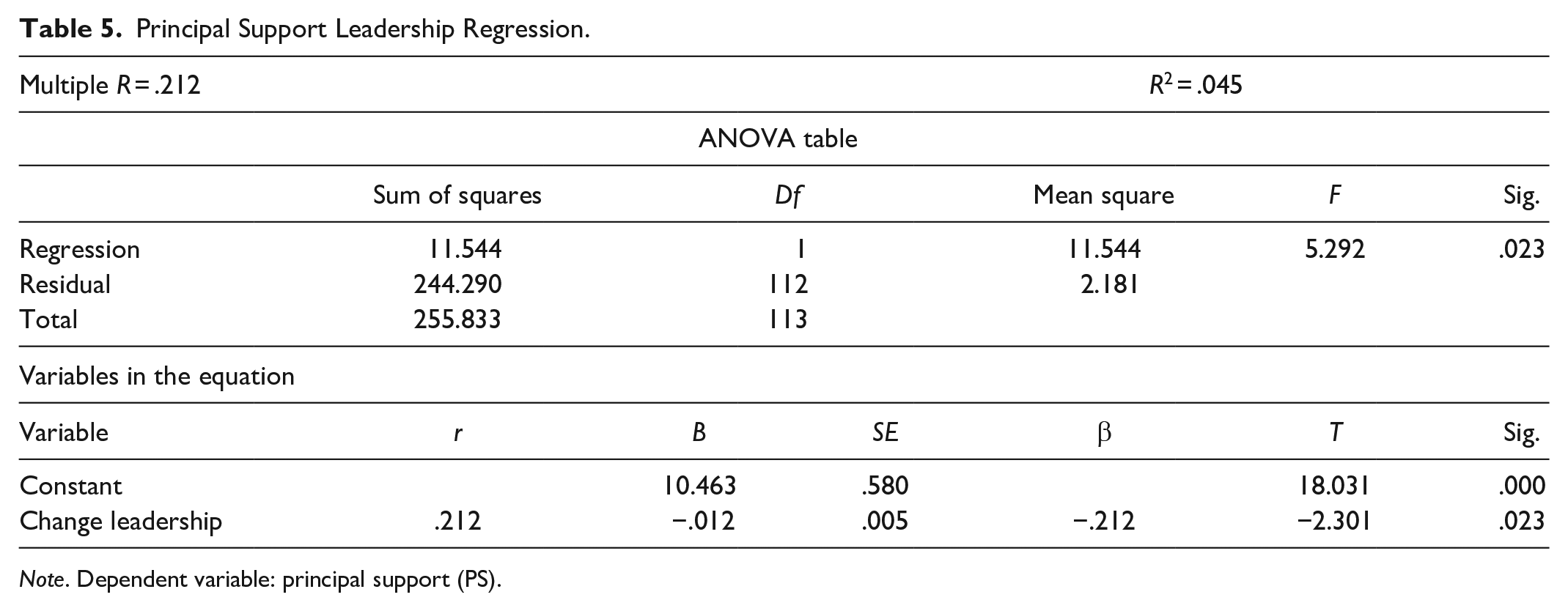
As data in Table 5 below clearly portrays, F (1, 112) = 5.292, p < .05 indicates that the simple regression is significant. This shows that change leadership significantly determines employees’ principal support perception of change. Similarly, the t-values in the table depict the contribution of the independent variable. Accordingly, change leadership styles were found to significantly affect the principal support perception of change (p < .05). Table 5 further reveals that the R2 value of .045 depicts the amount of variance of the criterion variable accounted for by the independent variable. This, therefore, shows that change leadership explained 4.5% of the principal support perception of employees. The relationship between the independent variable with the principal support perception is examined as follows:
Principal Support Leadership Regression.
Note. Dependent variable: principal support (PS).
As can be seen in Table 5 above, the strength of the relationship between change leadership and employees’ principal support perception of change was low where r = .212 and t = −2.301, and was significant to the .05 level of significance since (p < .05). Therefore, no evidence supports the null hypothesis. This means the alternate hypothesis is accepted. It also implies that there is a significant but negative relationship between change leadership of mid and lower-level University leaders and employees’ principal support perception of change.
Principal support perception refers to the employee’s belief that the program, change, or transformation has the long-term support of organizational leadership (Armenakis & Harris, 2002). The academic staff of the university sees change leaders as less supportive of the change being implemented in the university. This can also be substantiated by the academic staff response when they were asked to identify the most significant challenge for the successful implementation of change in which they rated lack of leadership commitment as the most significant. Thus the negative relationship between principal support and change leadership is due to the perception of academic staff that change initiatives introduced are not adequately supported by mid and lower-level leaders in the university.
Hypothesis: There is no relationship between change leadership and employees’ valence perception of change in public higher learning institutions.
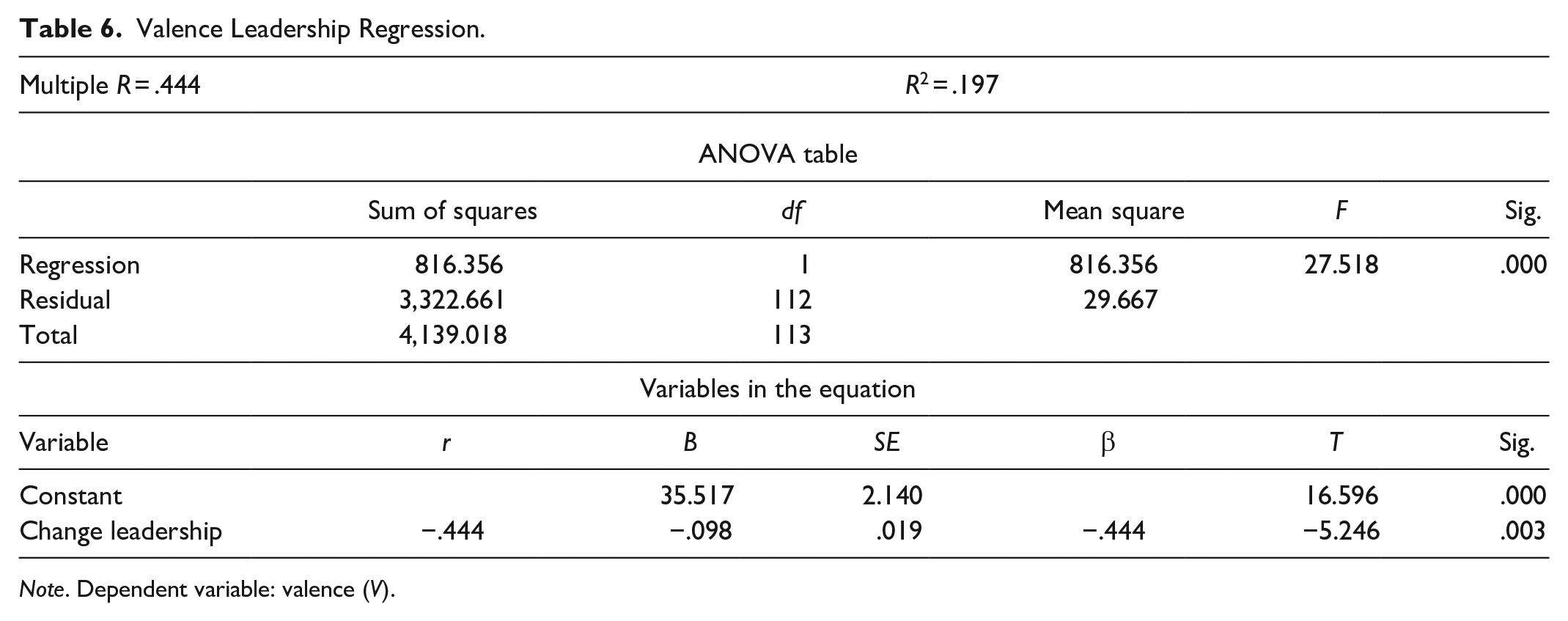
As clearly indicated in Table 6 below, F (1, 112) = 27.518, p < .05 shows that the simple regression used is significant. This reveals that employees’ valence perception of change is significantly determined by the independent variable, change leadership. Similarly, the t-values in the table indicate the contribution of the independent variable to the change in the criterion variable. Accordingly, change leadership was found to significantly affect the valence perception of change (p < .05). Table 6 also shows that the R2 value of .197 depicts the amount of variance of the criterion variable accounted for by the independent variable, change leadership. This further indicates that 19.7% of the valence perception of change was explained by the change leadership style of mid and lower-level leaders in HEIs. The relationship between the independent variable with the valence perception is examined for the hypothesis developed as follows:
Valence Leadership Regression.
Note. Dependent variable: valence (V).
H0 = There is no significant relationship between change leadership and employees’ valence perception of change
As can be seen in Table 6, the strength of the relationship between change leadership style and employees’ valence perception of change was moderate where r = −.444 and t = 2.982 but was significant to the .05 level of significance since (p < .05). Therefore, no evidence supports the null hypothesis. This means the alternate hypothesis is accepted. It further implies that there is a significant relationship between the change leadership style of mid and lower-level university leaders and employees’ valence perception of change.
Discussion on the Negative Relationship
The regression coefficients between change leadership and the different factors of change readiness resulted in negative regression coefficients indicating that there is a reverse relationship between change leadership and the different factors of change readiness. This is due to instructors’ resistance to change due to the change agent. When followers think that change leaders have a hidden agenda, they respond negatively to their influence attempts. Similarly, public HEIs’ instructors have a lack of trust in their immediate leaders which is explained by the negative relationship between change leadership and change readiness perception of the academic staff. Resistance to change agent is directed at the person leading the implementation of the change and often incorporates personality and other differences. Transformation agents who are isolated and unfriendly to other people in the context of change, who appear to be self-employed, or who have a high emotional impact on these changes are more prone to such problems. Research also shows that transformation agents who are different from other people in the context of changes in size such as age, education, and economic conditions can face strong opposition to change.
Summary of the Findings
All of the respondents are males indicating that the study incorporates the beliefs and ideologies of male instructors of the university rather than depicting the overall perception of change leadership in the university.
Most of the respondents are second-degree holders with work experience of at least 3 years or more, such employees are accustomed to a certain way of running their business in the university, and thus, require a lot of convincing to change their ways implying that deliberate effort has to be exerted to change these employees.
The implementation of change tools in the university is plagued with a severe lack of change receptivity due to what the respondents believe is the absence of effective change leadership.
The change readiness perception of staff is rated below average while the biggest rating is around 1.77 for discrepancy perception followed by efficacy perception of change which is around 1.76.
The opinion survey of research participants shows that they perceive lack of leadership commitment, lack of management support, and lack of materials needed for the change to be the major obstacles to effectively implementing change.
Change leadership mainly works in getting employees to readily accept change so that the commitment that results propels employees to exert their level best to implement change. To this end, five hypotheses were developed and their examination resulted in a significant relationship. The hypothesis test between change leadership and various factors of change readiness resulted in mixed regression coefficients. The regression between discrepancy perception of change resulted in a negative but with moderate regression coefficient (R = −.464) while the regression between change leadership and appropriateness perception of change resulted in a positive but very low regression coefficient. On the other hand, the regression between change leadership and efficacy perception of change resulted in a moderate but negative regression coefficient, the regression between change leadership and principal support resulted in a negative, and very low regression coefficient while the regression between change leadership and valence perception of change resulted in a moderate but negative regression coefficient.
Conclusions and Implications for Future Research
Conclusion
The following conclusions were drawn based on the major findings of the study:
Leadership plays a key role in goal achievements in any organization including complex organizations such as universities. Particularly the leadership role is more pronounced during the time of institutional or organizational change and transformation. The role played by the leadership of a University during the time of change is crucial to determine the fate of these changes as they are change agents responsible to develop their vision, communicate it, implement, and finally institutionalizing it. This further requires not all leadership behaviors but those styles that encourage the implementation of the change process.
Higher education institutions, including public universities, are embarking on massive change and transformation. The absence of leadership or change agents at the university hinders the effective implementation and success of the change. The leadership literature has often argued that strong and committed change leadership is generally effective in organizational change. It is the right attitude of leadership in any situation of change, which in turn will lead to the effective implementation of change.
Leaders play a major role during the time of organizational transformation. They are responsible to show employees that the current practice in their organization is no more useful to organizational goal achievement through different means. They need to raise employees’ awareness of the importance of changing the way things are carried out to remain competitive. Leadership is also responsible for clearly indicating the existing gap or the need for change, showing the advantages of introducing change, and making their organization members ready for the change. Furthermore, they are expected to develop their new vision, then communicate, and implement change. In other words, by building and communicating with a change-related perspective, involving employees in transformation-specific decision-making, helping people deal with the challenges associated with change, and providing a common response to the transformation process, leadership is able to reduce change-related uncertainty. In general, they are expected to create institutional readiness for change. As the results of this study suggested, however, the links between the change leadership and academic staff’s perception of change or organizational readiness for change was very low. This indicates the role played by the mid and lower-level change leadership in creating organizational readiness for change was minimal. However, academic staff’s perception of the need for change or institutional readiness for change was very high as shown by the mean ratings of the academic staff involved in the study. Therefore, it is possible to conclude that the role of mid and lower-level change leadership in creating organizational readiness during the time of change was low although academic staff’s perception of organizational readiness for change as measured by the mean ratings for the discrepancy, appropriateness of the change process, efficacy, principal support, and valence was high.
Change Leaders are also responsible to make their followers put extra effort toward the implementation of change. What is more, they are expected to develop a sense of satisfaction and are perceived as effective in their leadership by their followers.
In short, empirical results of the study found that change leadership style had low, negative, and significant linkages to institutional readiness for change, and finally, leadership commitment, material support, and psychological support are considered the most important or biggest challenges to the smooth implementation of change efforts in the university.
Recommendation
Based on the Findings the Following Are Recommended
Change can only be effectively implemented when those tasked with the implementation believe that it is absolutely important to change the existing conditions, change is the only way to bring about improvement in the existing dire condition of the organization when they believe that they have the capacity to successfully implement change and see the benefit when it is implemented effectively. Thus, it is indispensable that the university’s mid and lower-level leaders work toward the improvement of change readiness of the academic staff of the university.
Any change leader needs to be fully committed to the implementation of change exerting extra energy to realize the commitment of his/her followers to the change initiatives introduced. Leaders who are defined as major promoters and sponsors of change must continue to provide care and authorization that demonstrates a commitment to realizing it to the end. Thus, mid and lower-level leaders at public HEIs need to signal a full commitment to the effective implementation of the change tools.
For leaders to effectively lead change and bring about the desired result, they need to be perceived by instructors of each college and department as role models who are to be trusted and looked after. This will help to build leaders’ charisma and facilitate the exertion of influence over subordinates. While this is the case elsewhere, however; at public HEIs’ instructors often show a lack of trust toward their immediate leaders which is explained by the negative relationship between change leadership and the change readiness perception of the academic staff. Thus, these mid and lower-level leaders need to work to build follower confidence in their leadership ability.
Implication for Further Research
As it has already been pointed out in chapter one, the limitation of the study, the data presented in this study was based on the academic staff’s perception of the links between change leadership and change readiness and major obstacles to change implementation. However, it did not include the perception of other stakeholders such as support staff, students enrolled at different programs and at different levels, etc. Therefore, there is a need to conduct the same study on these different groups not covered in this study to arrive at a comprehensive conclusion. Moreover, a similar study could also be conducted to examine mid and lower-level university leaders’ own perception of their leadership style. And compare if there are significant differences between the mid and lower-level university change leadership style and commitment in leading change in the University as well as if there are differences in staff ratings of these leaders’ leadership styles.
Footnotes
Acknowledgements
This paper is dedicated to my wife Senayit Bekele for her relentless support and encouragement.
Declaration of Conflicting Interests
The author declared no potential conflicts of interest with respect to the research, authorship, and/or publication of this article.
Funding
The author received no financial support for the research, authorship, and/or publication of this article.
Ethical Approval
Ethical clearances for this kind of research are not applicable.
