



Abstract
Teachers’ occupational well-being is crucial; however, the lack of validated instruments in Latin American contexts hinders its measurement and effective assessment. The present study aimed to construct and validate a scale to measure the well-being at work of Latin American teachers. Using a cross-sectional quantitative approach, the scale was applied to 1,007 active teachers in eight Latin American countries, assessing seven key indicators of well-being at work: happiness at work, job resilience, task commitment, corporate social responsibility, positive relationships, job autonomy, and self-learning. These items were derived from a prior study using an initial 20-item scale with teachers from the same countries. Item Response Theory was applied. Statistical analyses included descriptive analysis, reliability tests, analysis to evaluate the structure of the scale using the principal components method, analysis using the asymptotic free distribution method, invariance test, asymmetry and kurtosis analysis, multicollinearity, and convergent and discriminant validity of the scale. Statistical evidence shows that the Employee Well-Being Scale for Teachers in Latin America is a unidimensional instrument with high internal reliability (α = .937) and measures teacher well-being in seven key aspects. Exploratory analyses show a predominantly positive perception, with means between 5.91 and 6.15 on a scale of 1 to 7. In addition, it meets the criteria for model fit and presents metric, scalar, and strict invariance between genders, which allows valid comparisons between groups. This instrument offers a robust tool for measuring well-being, demonstrating strong construct validity (AVE is 0.699 and AVE1/2 is 0.836).
Keywords
Introduction
The evaluation of teacher well-being at work is crucial, given that their satisfaction and psychological health have a direct impact on their quality of life, the quality of the education they offer, and the integral development of their students. However, despite its relevance, challenges persist in the accurate measurement of this construct, especially in the Latin American teaching context, which is why a robust scale is needed to fill this gap.
Despite the growing development of instruments to assess workplace well-being, most existing scales have been designed for the general worker populations and do not account for the specific characteristics of the teaching profession (Pradhan & Hati, 2022; Zheng et al., 2015). A review of the instruments compiled by Harvard University (Harvard Center for Population and Development Studies, 2025)—including the Affective Well-Being at Work Scale (which assesses five bipolar affective dimensions at work: anxiety–comfort, depression–pleasure, boredom–enthusiasm, tiredness–vigor, and anger–placidity), the Job-Related Affective Well-Being Scale—JAWS (which captures job-related emotions categorized by valence and arousal level: enthusiasm, relaxation, anxiety, depression), Warr’s Job-Related Well-Being Scale (which measures positive and negative affective states, perceived competence, job aspiration, and emotional spillover from work), the Index of Psychological Well-Being at Work (which includes interpersonal fit, thriving, competence, recognition, and involvement at work), the Thriving at Work Scale (which assesses employees’ experiences of vitality and learning in their roles), the Workplace Wellbeing Questionnaire—WWQ (which measures job satisfaction, organizational respect, employer care, and work-life interference), the Employee Well-Being Scale (which integrates life well-being, work well-being, and psychological well-being), and the Worker Well-Being Questionnaire—WellBQ developed by NIOSH (which provides a holistic assessment of organizational climate, physical environment, health status, and social context)—revealed that none of these tools were specifically designed or validated for educational settings.
Workplace well-being has traditionally been assessed using general occupational models (Blanch et al., 2010). Although some adaptations have been made for teachers—such as the Colombian validation (Enríquez-Villota et al., 2023)—existing tools still overlook key aspects of teaching practice. The education sector faces specific psychosocial demands that require a focus on positive psychology and well-being promotion, beyond stress reduction (Kun & Gadanecz, 2022; Kyriacou, 2001; Seligman & Csikszentmihalyi, 2000). Studies confirm that higher teacher well-being is linked to lower stress and burnout (Li & Zhang, 2019; Mennes et al., 2023; S. Zhang et al., 2020). This highlights the need for a culturally adapted, teacher-specific scale such as the Employee Well-Being Scale for Teachers in Latin America (EWBTS-LATAM).
Higher job well-being is associated with higher job satisfaction and lower stress (Collie, 2024; Collie et al., 2015; Heyder, 2019). Conversely, poor well-being can lead to increased stress and emotional exhaustion, which negatively affects job satisfaction (Bartosiewicz et al., 2022; Chan et al., 2024). Therefore, a well-constructed scale helps assess different dimensions of teacher well-being, including student interactions (Collie et al., 2015). This comprehensive assessment can identify areas needing improvement and guide interventions to improve the overall well-being of teachers.
Studies have shown that the well-being of teachers significantly affects their performance and the quality of interactions with students, while greater well-being is associated with better classroom organization, emotional support, and teaching quality (Chan et al., 2024). In addition, teacher well-being influences students’ motivation and emotional well-being (Braun et al., 2020; Chan et al., 2024). Scales such as the Tripartite Occupational Well-Being Scale (TOWBS) measure factors such as subjective vitality, behavioral engagement, and professional growth, which are essential to teachers’ ongoing development and commitment to their profession (Collie, 2024). Other studies have found that tracking teachers’ well-being can predict their intention to stay in the profession and their performance levels. Teachers who experience higher well-being are less likely to leave their jobs and more likely to perform effectively (Alshuaili & Yussef, 2024; Redelinghuys & Rothmann, 2020).
By identifying specific well-being factors, schools can tailor interventions to address specific needs. For example, improving working conditions, providing better organizational support, and promoting professional development can improve teacher well-being (Ibrahim et al., 2021; Rinne et al., 2022; Woynarowska-Sołdan & Weziak-Białowolska, 2012). A scale could provide a holistic understanding of well-being by considering various aspects, and this holistic view helps to design comprehensive support systems for teachers (Fináncz et al., 2020; K. Zhang et al., 2022). Teaching is among the most stressful professions, increasing the risk of psychological and emotional strain compared to other occupations (Okeke et al., 2024). Given the direct impact of teachers’ well-being on both educational quality and student health (Kuchma et al., 2023), it is essential to develop robust instruments that accurately and comprehensively assess teacher well-being, thereby supporting student outcomes as well (Leung & Cheung, 2024).
Motivation, Theoretical Rationale, and Conceptual Boundaries of the EWBTS-LATAM
Among the main motivations for the study was the Regional Gap, although occupational well-being has been widely studied in Europe, North America, and Asia, a significant gap persists in Latin America, especially in the field of teaching. The scarcity of validated instruments limits the ability to adequately assess this construct and, therefore, hinders the design of educational policies adapted to the socio-educational realities of the region.
The study was also motivated by the post-pandemic context, studies show that the COVID-19 pandemic intensified levels of stress and burnout among Latin American teachers, highlighting the urgency of having specific well-being assessment tools. A recent study of more than 2,000 teachers in Argentina, Chile, Ecuador, and Peru found that these teachers experienced elevated levels of burnout related to the abrupt changes generated by the COVID-19 pandemic (Marsollier et al., 2024) Another study in Peru, Colombia, Chile, Brazil, Mexico and Ecuador, warns about the prevalence of role stress (ambiguity, conflict and overload) in teachers; the study explicitly highlights the need to rethink psychosocial intervention alternatives for the post-pandemic period (Deroncele-Acosta et al., 2021). Finally, another motivation is related to cultural specificity; unlike generic scales developed in other contexts, the EWBTS-LATAM includes dimensions contextualized to the Latin American context.
A significant aspect of this proposal is the conceptual delimitation of teachers’ well-being at work concerning other broader constructs, or related constructs, such as burnout, perceived organizational support, and job satisfaction. EWBTS-LATAM is focused on conceptual clarity and delimitation of the construct of teachers’ well-being at work, emphasizing positive indicators, avoiding mixing it with negative symptoms or clinical conditions, which would divert the purpose toward a diagnosis of discomfort or job stress. EWBTS-LATAM can be complemented with other existing scales validated in Latin America that measure burnout, such as the Maslach Burnout Inventory, validated in countries such as Chile (Olivares-Faúndez et al., 2014), Colombia (Bravo et al., 2021; Córdoba et al., 2011), Ecuador (Zumárraga-Espinosa & Cevallos-Pozo, 2023), Mexico, Peru, and Venezuela (Aranda Beltrán et al., 2016; Juárez García et al., 2020) or the Spanish Burnout Inventory, validated in a recent study in 17 countries and regions in Europe, Asia, and Latin America, specifically in countries such as Peru, Brazil, Colombia, Uruguay, Ecuador, and Mexico (Gil-Monte et al., 2023). Burnout focuses on negative aspects, cognitive and emotional impairment, withdrawal behaviors, and sometimes guilt. The EWBTS-LATAM complements, rather than replaces, these measures by assessing positive indicators like resilience and autonomy, enabling early detection and proactive prevention.
We also conceptually delimit teacher well-being at work concerning Perceived Organizational Support (POS). According to Eisenberger et al. (1986), employees develop a general belief about the degree to which the organization values their contributions and cares about their well-being. Along the same lines, a highly cited literature review of more than 70 studies on POS confirms that Perceived Organizational Support (POS) is employees’ general belief that the organization values their contributions and cares about their well-being, noting that POS arises from experiences such as fairness, supervisor support, and good working conditions, and is related to greater commitment, satisfaction, and performance (Rhoades & Eisenberger, 2002). In Latin America, specifically in Brazil, authors demonstrated that perceived organizational support influences the autonomous motivation of higher education teachers, impacting their health and life satisfaction (Pauli et al., 2018). Although the POS is related to well-being and satisfaction, it does not directly measure specific components of work well-being as EWBTS-LATAM.
Finally, according to Edwin A. Locke, in his classic work What is Job Satisfaction?, job satisfaction is defined as a pleasurable emotional state resulting from the perception that one’s job enables the achievement of personal work-related values (Locke, 1969). In contrast, occupational well-being is a broader construct that goes beyond satisfaction to include dimensions such as happiness at work, resilience, autonomy, task commitment, positive relationships, social responsibility, and autonomous learning, as proposed by the EWBTS-LATAM.
Literature Review
Employee Well-Being in Teachers
Employee well-being has established itself as a central construct in psychological and organizational research, addressing key dimensions such as psychological, emotional, and social well-being in work contexts (Bakker & Demerouti, 2014; Diener, 2000). For teachers, well-being at work requires a comprehensive approach that integrates cognitive, emotional, and social dimensions. Key factors include task engagement, job autonomy, resilience, happiness at work, and continuous self-learning. Positive relationships and corporate social responsibility also play a central role in fostering a supportive and meaningful work environment.
The theoretical foundation of this study is also supported by the Self-Determination Theory (SDT), which provides a robust framework for understanding the conditions that foster or inhibit human motivation and well-being. The satisfaction of three basic psychological needs—competence, autonomy, and relatedness—is essential for intrinsic motivation, personal growth, and mental health (Ryan & Deci, 2000). When these needs are met, individuals exhibit higher engagement, resilience, and well-being; when thwarted, they experience demotivation, alienation, and psychological distress. In the educational context, these principles are particularly relevant for teachers, whose professional well-being depends not only on task-related factors but also on the social and organizational environments that support their autonomy and relationships.
Happiness at Work
One study indicates that employee well-being is characterized by three fundamental dimensions: happiness, health, and relationships, which are interconnected to influence organizational performance directly (Van De Voorde et al., 2012). These dimensions align with the notion of “very happy people,” which emphasizes that those individuals who report higher levels of happiness tend to have more satisfying relationships, greater work engagement, and better management of adversity (Diener & Seligman, 2002).
Regarding happiness in teachers, an interesting study found that students’ perception of teacher happiness was significantly (and positively) related to students’ general attitude and motivation, as well as to students’ attitude toward the teacher, interpreted as a process of positive emotional contagion between teachers and students (Moskowitz & Dewaele, 2021). When teachers are happy, they foster a motivating environment that positively influences students’ attitudes. This emotional contagion supports the idea that well-being and performance are mutually reinforcing, though ensuring both remains a challenge for organizations (Nielsen et al., 2017, p. 101). Happiness at work is a core dimension of teacher well-being, shaping both personal satisfaction and the pedagogical climate. It fosters ethical, joyful teaching, strengthens commitment, and reflects a deeper sense of vocation and purpose (Noddings, 2003).
Happiness in teaching is based on internal psychological resources such as hope and optimism, as well as factors such as goal achievement, feedback, and meaningful relationships. These elements form the basis of perceived well-being and highlight the importance of a positive outlook for its promotion (Kun & Gadanecz, 2022). Research shows that a sense of purpose in teaching strengthens relationships with students, which increases job satisfaction and contributes to a meaningful experience of happiness in the educational environment (Lavy & Bocker, 2018). Recent research provides a comprehensive psychosocial perspective by demonstrating that teacher job satisfaction mediates between dispositional traits (such as self-esteem) and physical and mental health. In this model, the work environment becomes a key space for activating positive affective processes, capable of translating into objective and sustained well-being (Benevene et al., 2019).
From a comprehensive perspective, happiness in teaching can be defined as a positive and sustained state that emerges from the interaction between internal psychological resources (such as hope, optimism, and self-esteem), an ethical and caring work environment, and a sense of purpose in the educational task. This form of happiness transcends immediate pleasure, as it is nourished by meaningful relationships, personal achievements, positive feedback, and the possibility of impacting students’ lives, generating personal well-being, professional commitment, and a motivating pedagogical atmosphere.
Workplace Resilience
Resilience in the workplace has been recognized as an essential component of teacher well-being, enabling teachers to maintain emotional balance and professional effectiveness in demanding environments. Various studies have shown that this capacity is linked to internal resources such as self-efficacy, hope, and optimism, which strengthen teachers’ confidence in dealing with complex situations and sustaining their commitment to their work (Avey et al., 2010; Charney, 2004; Pretsch et al., 2012).
From a relational and contextual perspective, it has been suggested that resilience is not an innate or static quality, but rather a dynamic construct that develops throughout a teacher’s career, influenced by personal, social, and organizational factors. Thus, resilient teachers can articulate their personal and professional identities to face the challenges inherent in educational practice, maintaining their pedagogical purpose in adverse contexts (Gu & Day, 2007).
In addition, researchers have identified that teachers are particularly vulnerable to stress, and that their resilience depends both on individual attributes—such as altruistic motivation or self-efficacy—and on the support they receive from the school, colleagues, and students. This relational and multi-causal understanding offers an alternative to approaches that focus exclusively on stress or professional burnout (Beltman et al., 2011).
In response to these findings, a comprehensive framework for developing teacher resilience has been proposed, incorporating dimensions such as well-being, motivation, emotions, and relationships. This approach has been implemented in initial teacher training to develop skills and strategies that strengthen teachers’ adaptability and professional sustainability (Mansfield et al., 2016). It has also been emphasized that school environment conditions, both in terms of leadership and institutional culture, directly affect the experience of resilience. Teachers need not only personal skills, but also work environments that recognize and promote the building of resilience through relationships of trust and structural support (Gu & Day, 2013).
Resilience in the teaching workplace can be defined as the dynamic and contextual ability of teachers to adapt positively to professional challenges while maintaining their emotional balance, pedagogical commitment, and work effectiveness. This skill is built and strengthened throughout one’s career through the interaction between personal resources (such as self-efficacy, hope, and motivation), relational support networks, and favorable organizational conditions that promote well-being and professional sustainability.
Task Engagement
Task engagement has emerged as a key dimension of teacher well-being at work, conceptually distinct from burnout and compulsive work due to its positive focus on vitality, commitment, and sense of purpose at work (Guest, 2017; Schaufeli et al., 2008). This form of involvement is closely associated with self-efficacy and teacher autonomy, which act as independent predictors of greater job satisfaction and lower emotional exhaustion, reinforcing the connection between professional control and motivation (Skaalvik & Skaalvik, 2014).
Furthermore, emotional regulation capacity and psychological well-being significantly predict work engagement, suggesting that emotional balance not only protects against burnout but also strengthens teachers’ sustained commitment (Greenier et al., 2021). From a procedural perspective, it has been shown that goal orientation and coping strategies—both problem-focused and emotion-focused—shape different trajectories of involvement or exhaustion, depending on the type of motivation and personal resources of the teacher (Parker et al., 2012).
This link between involvement and well-being has also been observed in new teachers, where greater self-efficacy and commitment to the task are associated with lower intention to leave and greater professional satisfaction, especially in the early years of their career, which are considered high risk for teacher attrition (Høigaard et al., 2012). For their part, longitudinal studies have revealed reciprocal relationships between positive emotions (such as joy, pride, or affection) and higher levels of involvement, while negative emotions predict decreasing commitment (Burić & Macuka, 2018).
Thus, by integrating personal and work resources with environmental demands, it has been shown that the demands-resources model can explain how conditions such as role ambiguity or task conflict negatively affect dedication, while quantitative overload influences both involvement and exhaustion, highlighting the need for balanced management of working conditions to promote teacher involvement (Lorente Prieto et al., 2008).
Task engagement in teaching is a positive motivational state characterized by vigor, dedication, and absorption in work. It emerges from the dynamic interaction between self-efficacy, emotional regulation, psychological well-being, and supportive organizational conditions. Clear goals, professional autonomy, and positive emotions sustain this engagement, especially when work demands are balanced with adequate personal and contextual resources.
Corporate Social Responsibility
Corporate Social Responsibility (CSR) has gained relevance in the field of education as an emerging dimension of teacher well-being, transcending financial objectives to focus on the ethical, social, and environmental impact of institutions. Various studies indicate that when educational organizations adopt CSR practices, teachers not only find greater meaning in their work but also experience higher levels of eudaimonic well-being, motivation, and commitment (Ahmad et al., 2023; Bauer, 2022; Kim et al., 2018; Ramdhan et al., 2022).
From a teaching perspective, it has been shown that the implementation of CSR programs in schools can lead to significant improvements in institutional development, especially in infrastructure, teaching materials, and quality of school life, which indirectly affects teacher motivation and satisfaction (Ismail et al., 2014). Furthermore, teachers’ positive perception of CSR practices in their schools is associated with an increase in their organizational citizenship behavior—that is, their willingness to collaborate beyond their job duties—when there are adequate levels of job satisfaction and identification with the institution (Cek & Eyupoglu, 2019).
On the other hand, teaching social and personal responsibility as a formative component within the school curriculum represents a challenge and an opportunity for teachers, who act as agents of ethical transfer, promoting the extension of the values practiced in the classroom to other contexts of students’ lives. This implies an institutional commitment to comprehensive education and consistency between pedagogical discourse and organizational culture (Gordon & Doyle, 2015).
This evidence allows us to define corporate social responsibility beyond an institutional strategy, toward a symbolic environment that promotes the well-being of teachers by providing ethical coherence, a sense of transcendence, and positive links between educational work and social impact. Therefore, corporate social responsibility in education can be defined as the set of institutional practices aimed at social, environmental, and ethical well-being, which strengthen the sense of belonging, job satisfaction, and teacher commitment by linking educational work to a collective and transcendent purpose.
Positive Relationships
Positive relationships in the teaching environment are a fundamental pillar of eudaimonic well-being, as they facilitate meaningful connections that promote self-efficacy, professional aspiration, and a sense of purpose in work (Bauer, 2022). Beyond the institutional level, it has also been shown that support from family and supervisors helps reduce conflict between personal and professional life, preserving emotional balance and overall well-being (Lapierre & Allen, 2006).
In the field of education, various studies emphasize that positive relationships between teachers and students not only affect the emotional climate of the classroom but also directly influence student engagement and academic achievement. This is demonstrated by the study by Reyes et al., who found that a positive emotional climate in the classroom improves academic performance through increased student participation, highlighting the importance of affective interactions for school success (Reyes et al., 2012).
From the teachers’ perspective, interpersonal relationships with students are perceived as essential components of their professional role, although they are not without tension. Teachers report the need to balance emotional closeness with the exercise of authority, navigating between emotional well-being, disciplinary rules, and behavior management (García-Moya et al., 2019). This ambiguity highlights the need for clear strategies to strengthen healthy relationships without compromising the pedagogical structure.
Along these lines, Bennett and colleagues propose practical strategies for strengthening the teacher-student relationship, such as using inclusive language, promoting authenticity, and setting clear expectations. Although developed in physical education contexts, these practices apply to any educational setting where emotional interaction and mutual trust are essential for the student’s comprehensive development and the teacher’s professional satisfaction (Bennett et al., 2023).
From this perspective, positive relationships in teaching are defined as emotional and professional bonds of trust, respect, and mutual support, which strengthen the emotional climate of the classroom, promote motivation and commitment, and act as protective factors for teachers’ well-being and job satisfaction.
Job Autonomy
Work autonomy has been widely recognized as a key factor in teacher well-being, allowing teachers to make decisions about their teaching practice and time management, which translates into greater job satisfaction, motivation, and professional performance (Alkan et al., 2023; Thompson & Prottas, 2006). This freedom to decide strengthens self-efficacy and commitment, reducing the stress associated with rigid or overly controlled work environments.
From a motivational perspective, it has been shown that job autonomy directly influences the type of passion teachers develop for their work. Thus, greater autonomy promotes a harmonious passion, related to professional effectiveness and sustained well-being, while its absence is associated with an obsessive passion that increases emotional exhaustion (Fernet et al., 2014). This finding suggests that the quality of the emotional bond with teaching depends, in part, on the degree of perceived autonomy.
Likewise, autonomy acts as a buffer against the wear and tear associated with organizational citizenship behavior (OCB), that is, those voluntary actions that exceed the contractual duties of teachers. While these behaviors are beneficial to the institution, they can also lead to overload, role ambiguity, and tension. However, this negative effect is significantly reduced when teachers perceive high levels of autonomy (Somech, 2016).
At the university level, it has been confirmed that job autonomy, together with organizational support and prosocial motivation, strengthens teachers’ commitment to their work, making it an essential element in consolidating sustainable, high-quality educational processes (Jankelová et al., 2025). This highlights that autonomy not only benefits individual teachers but also has a structural impact on institutional improvement.
Evidence suggests that autonomy in teaching is not only a professional right but also an essential condition for well-being, healthy motivational development, and the sustainability of pedagogical commitment at different levels of the education system. In this sense, teaching autonomy can be defined as the ability of teachers to make decisions about their pedagogical practice and the organization of their work, which enhances intrinsic motivation, harmonious passion, sustained involvement, and stress reduction, establishing itself as a key factor in professional well-being and commitment to the educational institution.
Self-learning
Self-learning is essential for teacher development, enabling autonomous growth and adaptation to educational changes. It fosters autonomy and personalized learning paths (Wu, 2021) while linking motivation, self-determination, and reflective practice to improved teaching performance (Brenner, 2022). Additionally, affective responses to work demands influence teachers’ engagement in self-learning, integrating emotional well-being with professional growth (Van Katwyk et al., 2000).
In initial teacher training, it has been shown that high-quality self-learning programs focused on feedback and professional reflection strengthen cognitive, practical, and self-reflective skills. However, motivating students remains a challenge, requiring appropriate pedagogical support (Zdanevych et al., 2022). From a motivational perspective, rubric-guided self-learning environments promote enjoyment, sustained effort, and autonomy by reducing dependence on external stimuli and strengthening intrinsic motivation (Schweder & Raufelder, 2024).
In methodological terms, the use of asynchronous learning paths has shown that success in these environments depends largely on the development of self-regulation skills and the ability to apply one’s strategies. While they benefit autonomous learners, they also present challenges for those who require more structure, which raises the need to design differentiated spaces that favor progressive self-training (Drumm, 2025).
Furthermore, self-directed learning (SDL) is fundamental to professional development in higher education, as it improves educational quality and allows teachers to adapt to changes and innovations in the environment, thus ensuring their relevance and effectiveness (Cadorin et al., 2012; Palaščáková et al., 2024). Teachers who engage in self-study processes strengthen their professional identity through critical reflection on their practice, while also generating a positive impact on their educational communities (Pithouse-Morgan, 2022). This attitude encourages innovation and makes teachers role models of lifelong learning, motivation, and creativity for their students (Cadorin et al., 2012; O’Shea, 2003).
In summary, teacher self-learning is defined as a self-directed, reflective, and intrinsically motivated process of professional development, allowing educators to adapt to changing educational demands, strengthen their professional identity, and foster innovation in diverse contexts.
The foregoing makes it clear that a teacher’s well-being at work, as a complex construct, is based on seven key elements that make up an integral and specific vision of the educational context (see Figure 1).

Theoretical-conceptual framework.
Consequently, the present study aimed to construct and validate a scale to measure the well-being at work of Latin American teachers.
Method
Methodological Approach
The present study adopted a cross-sectional quantitative methodological approach, oriented to the measurement of employee well-being in eight Latin American countries: Chile, Colombia, Cuba, Dominican Republic, Ecuador, Mexico, Paraguay, and Peru. This approach enabled the cross-sectional collection of data through a structured design, allowing for the validation of a unidimensional scale that assesses seven key indicators of teacher well-being, providing an innovative tool for educational research in the region.
Variables
The main variable of the study is the teacher’s Employee well-being, understood as a construct that integrates the following indicators:
Happiness at Work: Positive and sustained perception of satisfaction, purpose, and personal fulfillment of teachers in the educational environment.
Workplace Resilience: The teacher’s ability to adapt effectively to workplace challenges while maintaining emotional balance and professional commitment.
Task Engagement: The degree of dedication, vigor, and concentration with which the teacher engages in their daily teaching tasks.
Corporate Social Responsibility: Teachers’ perceptions of their institution’s ethical, social, and environmental commitment and its influence on educational goals.
Positive Relationships: Quality of teachers’ professional and emotional relationships, characterized by respect, trust, and mutual support in the workplace.
Job Autonomy: The degree to which teachers feel free to make decisions about their teaching practices and work organization.
Self-learning: The ability of teachers to independently manage their learning based on reflection, motivation, and continuous improvement.
Sample and Sampling
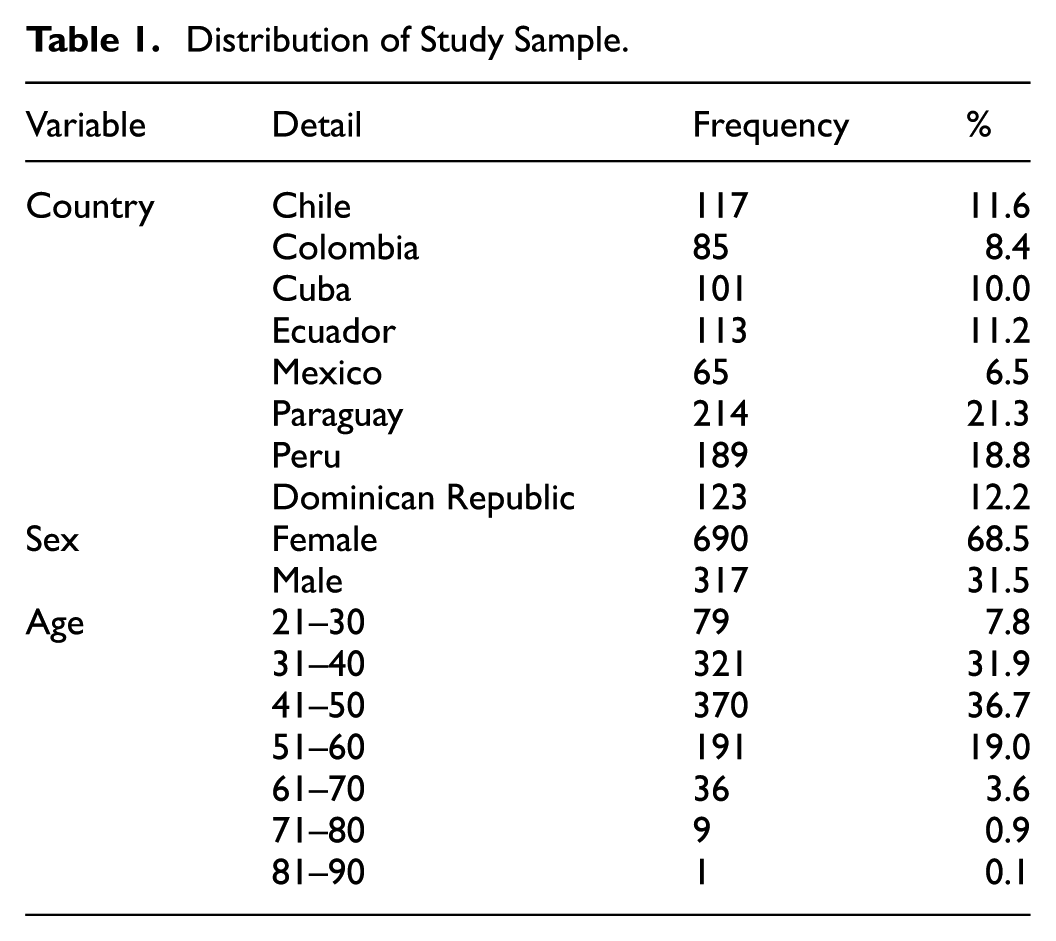
The study sample consisted of a total of 1,007 teachers from eight Latin American countries: Chile, Colombia, Cuba, Ecuador, Mexico, Paraguay, Peru, and the Dominican Republic. The distribution by country, gender, and age is shown in Table 1, which shows that 21.3% of the respondents were from Paraguay and only 6.5% were from Mexico. 68.5% are female and 36.7% are between 41 and 50 years old.
Distribution of Study Sample.
The sampling method employed in this study was non-probabilistic and purposive, specifically designed to select teachers who were actively working in educational institutions located in the countries previously mentioned. This approach enabled the identification of participants whose characteristics and professional experience could provide valuable and relevant insights aligned with the study’s objectives. Additionally, only those teachers who explicitly consented to participate were included, ensuring voluntariness and adherence to ethical principles in the research process.
Instruments for Obtaining Information
For data collection, a teacher well-being scale designed and validated specifically for this study was used. The scale measured seven indicators of the labor well-being of Latin American teachers, using a Likert-type scale from 1 to 7, where 1 represented “totally disagree” and 7 “totally agree.”
The items evaluated were the following:
Happiness at work: “In my workplace, I feel a general satisfaction and sense of happiness in what I do.”
Workplace resilience: “When I face challenges at my workplace, I find effective ways to overcome them and move forward with determination.”
Task engagement: “I feel that my tasks are clearly defined and aligned with what I like to do.”
Corporate social responsibility: “My institution’s commitment to society acts as a key motivating factor in my daily work performance..”
Positive relationships: “I feel that I have positive relationships with my colleagues and superiors at my workplace.”
Job autonomy: “I enjoy autonomy in the performance of my tasks.”
Self-learning: “At my workplace, I feel that I have the energy to learn autonomously.”
To ensure the validity of the content and cultural relevance of the EWBTS-LATAM instrument, a rigorous evaluation process was carried out by a panel of eight experts, one from each participating country. The inclusion criteria for selecting these specialists included: a doctoral degree, more than 20 years of teaching experience at different levels of the education system, relevant scientific output on related topics (such as well-being, educational assessment, or teacher health), and in-depth knowledge of the sociocultural and educational context of their country. In addition, cultural adaptation procedures were implemented, including the revision of technical language, the semantic adaptation of items to the linguistic and professional realities of each country, and the evaluation of the contextual relevance of the dimensions in school environments with disparate structural conditions. This allowed the content of the instrument to be refined to ensure conceptual equivalence and regional relevance, thus promoting a valid, comparative measurement that is sensitive to the educational and cultural particularities of Latin America.
Fieldwork
Before the final scale, a pilot test was applied to 240 teachers (30 from each participating country), applying the item response theory (IRT; Edelen & Reeve, 2007). The initial instrument had 20 items: 1. Creative self-efficacy, 2. Task Variety, 3. Prosocial behavior, 4. Ecological Sense, 5. Self-learning, 6. Task Autonomy, 7. Positive relationships, 8. Social Responsibility, 9. Self-confidence, 10. Task Identification, 11. Collaborative innovation, 12. Shared Values, 13. Psychological empowerment, 14. Task Importance, 15. Well-being economy, 16. Recognition, 17. Resilience, 18. Performance Feedback, 19. Happiness at work, 20. Salary.
Items 1, 2, 9, 15, and 16 were eliminated for having unusual factor loadings (greater than 1). While items 18 and 20 were eliminated for having a commonality lower than 0.6. Thus, of the initial 20 items, 13 items remained in this second stage, and factor analysis was performed again, finding a great deal of variability among the errors; Thus, 6 items were eliminated (Psychological empowerment, Importance of the task, Prosocial behavior, Collaborative innovation, Ecological sense and Shared values) that were already being measured by other constructs (Happiness at work, Workplace resilience, Task engagement, Corporate social responsibility, Positive relationships, Job autonomy, Self-learning), leaving the latter as a result in the unidimensional scale that was applied to this study.
The fieldwork was carried out with the collaboration of a representative selected in each participating country, who was responsible for coordinating data collection in their respective national contexts: ADA (Peru, Colombia, Mexico, Dominican Republic, and Paraguay), RLM (Cuba), ERC (Ecuador), and PSS (Chile). In addition, the representatives were responsible for attending to any doubts or clarifications that the teachers might have regarding the data collection instrument, thus ensuring a correct understanding and application of the questionnaires.
The data collection was carried out through the application of questionnaires in digital format, using an online platform designed to guarantee accessibility for the participating teachers in the different countries. The data collection process took place during the first semester of the year 2024. The teachers participated voluntarily, having been previously informed of the objectives of the study. Likewise, their consent was requested both for their participation and for the subsequent publication of the data in an anonymous and aggregated manner, respecting the ethical principles of confidentiality and privacy.
Data Analysis
The data obtained were processed and analyzed using descriptive and inferential statistical techniques. The procedure is detailed below:
Descriptive analysis: frequencies, percentages, and means of the items were calculated to identify the general perception of teachers in each dimension of occupational well-being.
Reliability tests: Cronbach’s alpha, Theta, and Omega were used to determine the internal consistency of the scale, obtaining values above 0.93, which confirms its high reliability.
Exploratory factor analysis (EFA): An EFA was performed to evaluate the structure of the scale using the principal components method. The KMO statistic (0.939) and Bartlett’s test of sphericity confirmed the adequacy of the data for factor analysis. In addition, high communalities and factor loadings above 0.80 were found.
Confirmatory factor analysis (CFA): The CFA was estimated using the asymptotic free distribution method, which confirmed the validity of the single-factor model. The model fit indices included acceptable values for GFI (0.957), CFI (0.928), and RMSEA (0.026), although some parsimony indices (TLI and NFI) showed values slightly below the optimal limits. Important methodological considerations were taken into account for these factor analyses (Schmitt, 2011).
Invariance test: Metric, scalar, and strict invariance according to the sex of the teacher was evaluated, confirming the stability of the instrument and the possibility of making comparisons between groups.
Other statistical tests: Skewness and kurtosis analyses were performed to examine the distribution of responses, as well as multicollinearity through the VIF, whose values indicated the absence of significant problems.
Data collection was carried out using a digital online questionnaire that allowed secure and simultaneous access by teachers from eight participating countries. Upon completion of the fieldwork, a thorough review of the database was conducted, and no records with incomplete responses, inconsistent patterns, or outliers were identified.
The absence of these problems confirmed the integrity of the data collected, thus ensuring a solid, reliable database suitable for the statistical procedures applied. In addition, analyses of distribution (skewness and kurtosis), normality, and multicollinearity (VIF) were performed, the results of which confirmed the absence of relevant statistical problems that could affect the reliability of subsequent analyses. These procedures ensured the cleanliness of the data and strengthened the conclusions of the study by relying on valid and reliable information.
Results
Exploratory Data Analysis
From Table 2, it is observed that 41.6% of the respondents agree that they feel happy at work, 46.2% of the respondents agree that they are resilient in the workplace, 45.1% of the respondents strongly agree that they feel committed to their tasks, 49.2% of respondents strongly agree that corporate social responsibility is important to them, 49.0% of respondents strongly agree that they maintain positive relationships at work, 43.7% of respondents strongly agree that they have autonomy in their work, and 42.7% of respondents strongly agree that they practice self-learning.
Descriptive Results for the Items.

Table 3 shows that the item means range between 5.91 and 6.15 (scale of 1–7), indicating that participants tend to have a positive perception of all items with homogeneous standard deviations among them. All items present negative skewness (values between −2.015 and 2.531) and high kurtosis (from 4.208 to 7.343), indicating a concentration of responses in the positive part of the scale, with few disagreements. The normality test shows significant values (p < 0.001) for all items, indicating that the distributions of the responses are not normal. The values of Cronbach’s alpha reliability statistic without each item range from 0.925 to 0.931, suggesting that the scale has high internal reliability and the exclusion of any item does not decrease the overall internal consistency of the scale. Finally, the VIF values, ranging from 2.375 to 2.993, are below the threshold of 10, indicating that there is no multicollinearity problem among the items, although some are moderately correlated.
Item Summary Statistics.

Table 4 presents the results of the multivariate normality tests (Mardia, Royston, Henze-Zirkler, and Energy), which reveal significant deviations from the multivariate normal distribution, as all statistics exhibit high values and p-values below .001. These findings are consistent with the univariate Kolmogorov-Smirnov normality tests, further supporting the evidence of non-normality. Consequently, the use of nonparametric estimation methods is justified for fitting the confirmatory factor model to ensure the validity of the estimated parameters.
Multivariate Normality Tests.

From Table 5, all reliability statistics indicate a high internal consistency of the scale, which supports its validity as a measurement instrument. Cronbach’s alpha, with a value of .937, reflects excellent internal reliability, suggesting that the items are highly consistent with each other. Complementarily, the Theta (0.937) and Omega (0.949) values confirm these results, providing a more robust assessment of the instrument’s reliability. Taken together, these indicators show that the scale is adequate for the reliable measurement of the variables studied and guarantees precision in the results obtained.
Reliability Statistics.

From Figure 2, the items of the occupational well-being scale are strongly correlated with each other, which means that the items of the scale are interdependent.

Matrix of correlations between the items.
Factor Analysis
Table 6 shows that the KMO and Bartlett’s test confirm the existence of sufficient correlations to justify the use of exploratory factor analysis.
KMO Measure and Bartlett’s Test of the Scale.

From Table 7, it is observed that the items present good levels of commonalities, MSA, and factor loadings, indicating that they are adequate and well represented by a unifactorial model. In addition, the values of ω (0.942) and CR (0.942) indicate that the instrument used to measure the construct has excellent internal reliability.
Factor Analysis Measures.

Note. Principal components method, without the rotation method. McDonald’s Omega (ω) = 0.942. Composite Reliability (CR) = 0.942.
Figure 3 presents the standardized factor loadings of the Employee Well-Being Scale for Teachers in Latin America (EWBTS-LATAM). The model identifies seven dimensions contributing to employee well-being, each represented as a latent variable with its respective observed items: Self-learning (0.86), Job autonomy (0.80), Positive relationships (0.81), Corporate social responsibility (0.83), Task engagement (0.83), Workplace resilience (0.86), and Happiness at work (0.84). These factor loadings reflect strong associations between the dimensions and the overall construct of employee well-being, confirming the reliability and robustness of the scale. Additionally, the covariances between some dimensions—specifically, Positive relationships and Corporate social responsibility (0.16) and Task engagement (0.20)—highlight their interconnected nature within the model. Overall, the figure supports the factorial structure of the EWBTS-LATAM and its capacity to capture multidimensional well-being effectively.

Scale measurement model.
From Table 8, it is observed that the items consistently measure the unifactor construct of employee well-being, with each item showing a strong and significant relationship. Significant covariances between the errors indicate additional specific relationships between certain items, possibly sharing common components in the work context.
Scale Measurement Model Weights.
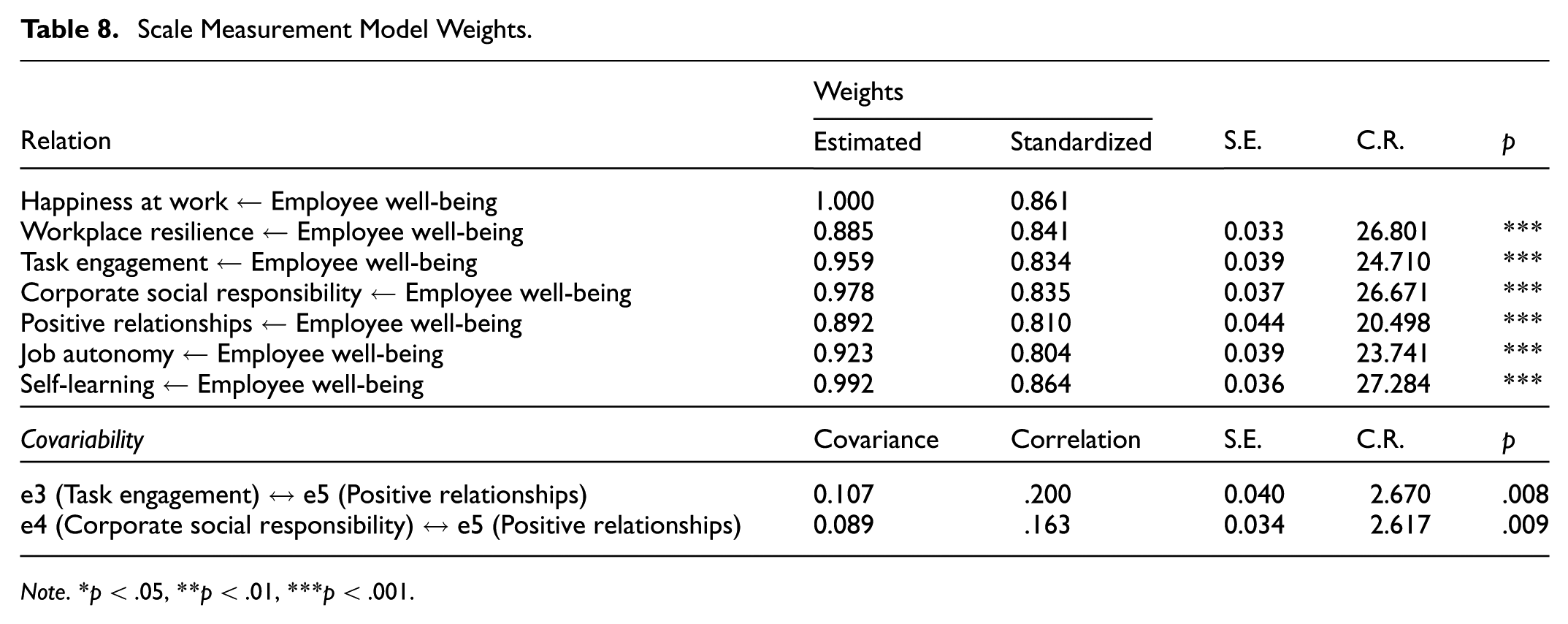
Note. *p < .05, **p < .01, ***p < .001.
From Table 9, it is observed that the model shows an adequate fit in general, with most of the indices meeting the reference values. However, some parsimony and incremental fit indices (TLI and NFI) are below the acceptable limit, suggesting that the model could be simplified to improve its parsimony.
Measures of Fit of the Scale Measurement Model.

Table 10 shows that the models meet the criteria of metric, scalar, and strict invariance, which means stability in the measurements across the male and female groups, allowing reliable comparative interpretations in the latent structure of the model.
Test of Invariance of the Scale Items According to the Teacher’s Gender..

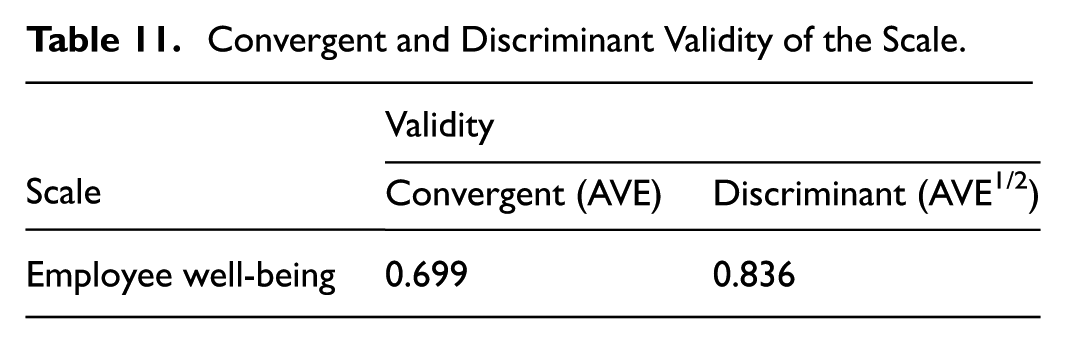
According to Table 11, the value of AVE = 0.699 indicates that 69.9% of the total variance of the items is explained by the employee well-being scale, which is a strong indicator of convergent validity since it exceeds the recommended minimum criterion of 0.50. Furthermore, the discriminant value of 0.836, which corresponds to the square root of the AVE, is higher than the maximum correlation observed between the scale and the “happiness at work” item (0.817), meeting the Fornell-Larcker criterion. This means that the employee well-being scale presents discriminant validity, that is, it is well differentiated and measures a single concept.
Convergent and Discriminant Validity of the Scale.
Discussion
The present section is devoted to the discussion of the results found on other scales of teacher well-being. Although there are robust scales of well-being, which even pass the thousand citations in Scopus (Diener et al., 2010; Tennant et al., 2007) these have been initially validated on students in the UK and US context respectively, while other highly cited studies were developed with male workers in the UK (Warr et al., 1979). Thus, when we enter the specific field of occupational well-being in teachers, the scientific evidence is drastically reduced, and although we have been able to recover some relevant scales, particularly for teachers, as we will see below, studies in the Latin American teaching context continue to be underrepresented. For this section, we conducted a review of academic databases such as Scopus, Web of Science, and PubMed. Our analysis reveals a slight increase in the development of teacher well-being scales following the COVID-19 pandemic. Below, we present a selection of the most relevant instruments organized by region to highlight the global distribution of research efforts:
Asia: Hong Kong, Malaysia, Taiwan, Thailand
Oceania: Australia
Europe: Spain, Germany, Poland
Africa: Ethiopia
North America: United States, Canada
Latin America: Brazil, Mexico, Chile, Peru, Argentina, Colombia, Ecuador
Recently, a study used a mixed methods approach to develop and validate the Teachers’ Emotions in Teaching Scale; it assesses teachers’ positive and negative emotions. The process of scale development and construct validation involving three samples of 726 in-service teachers from Hong Kong was reported (Leung & Cheung, 2024). This study is methodologically sound due to its mixed design and multiple samples. However, it focuses exclusively on the Asian context, which limits its direct applicability to the Latin American environment, where emotional expressions and regulations may vary culturally.
Another very recent study developed the TPWB scale suitable for Malaysian teachers. It involved 733 teachers, consisting of focus group interviews, exploratory factor analysis, and confirmatory factor analysis. The results showed that TPWB comprises six factors, which are meaning, relationship, system, autonomy, hope, and competence (Goh et al., 2025). Although the TPWB includes relevant dimensions such as autonomy and meaning, it does not analyze cultural sensitivity in contexts with less institutional structure, as is the case in many Latin American schools, which prevents the direct extrapolation of its factors.
In Taiwan was validated the Clinical Teachers’ Occupational Well-Being Dimensions Scale, was validated in 346 participants, the scale has 29 items in five dimensions: personal qualities (11 items), academic research and professional development pressure (6 items), teaching experience (4 items), learning experience (4 items) and teaching and communication pressure (4 items). These five dimensions explained 65.279% of the total variance (Pan et al., 2024). Despite the high percentage of variance explained, this scale focuses on clinical teachers, a profile that is uncommon in Latin America, so its direct extrapolation to this context would require conceptual and semantic adaptation.
Another study in Taiwan also provides scientific evidence regarding the measurement of teachers’ occupational well-being; however, the same authors state that because the sample was composed only of Taiwanese teachers, the results are not generalizable to other occupations or cultures, not even to Eastern or Chinese cultures (Yu & Yang, 2022). This study is valuable in that it warns of the limits of cultural generalization. It reinforces the need for scales developed specifically for Latin America, which consider the structural and cultural conditions of teaching in the region.
In this same region, a recent study conducted in Thailand developed and validated the OWB-47 scale, composed of six dimensions of occupational well-being: affective, professional, social, cognitive, psychological, and psychosomatic well-being (Daovisan & Intarakamhang, 2024). Although its application focused on a broad sample of workers in Laos and not exclusively on teachers, the multidimensional approach of this scale offers a robust conceptual framework that could enrich future measurements in the education sector. However, its extrapolation to the Latin American context would require cultural and sectoral adjustments, since the working, social, and emotional conditions of teachers in Latin America have particularities not contemplated in the Thai model.
While in Sydney, Australia, author Rebecca J. Collie developed the Tripartite Occupational Well-Being Scale (TOWBS) in a sample of 502 Australian teachers. The TOWBS has 12 items encompassing three factors: subjective vitality, behavioral engagement, and professional growth. (Collie, 2024). The tripartite model provides conceptual clarity, but the scale is built on school structures specific to the Australian system. It would be worthwhile to explore whether these three dimensions adequately capture the contextual complexity of well-being in Latin America.
In Spain, the “Scale of Attitudes towards New Post-Pandemic Scenarios” (SANPS) was developed. The questionnaire was administered to a sample of 966 participants, considering dimensions such as empowerment/motivation, autonomy/situated learning, and emerging digital pedagogies, explaining 66.53% of the total variance (Hervás-Gómez et al., 2023). The SANPS reflects emerging concerns in the wake of the pandemic. However, its application in Latin America would require consideration of deeper digital divides and less consolidated levels of professional autonomy than in the Spanish context.
In Spain, the validation of the Basic Psychological Needs at Work Scale (BPNWS) has emerged as a significant contribution to understanding and enhancing teacher well-being in professional settings. This scale, rooted in the Self-Determination Theory, assesses the fulfillment of three core psychological needs: autonomy, competence, and relatedness, which are critical predictors of workplace well-being. The Spanish validation study involved a sample of 584 secondary school teachers, providing insights into how these needs are met in the educational context (Abós Catalán et al., 2018). The anchoring in self-determination theory is solid and replicable, but it requires empirical verification in Latin American settings where job autonomy and institutional belonging are more restricted.
In Germany, a new survey instrument was also developed to investigate teacher educators’ motives for entering the profession, and we examined associations between motives and job satisfaction and emotional exhaustion in both teachers and teacher educators. Using data from 145 teacher educators in Germany, who instruct in-service teachers, we identified four motives: career aspirations, social contribution, escape from routines, and coincidence (Richter et al., 2021). Although it provides relevant motivational variables, this study focuses on teacher trainers, so its approach is more distant from the everyday school classroom. It would be useful to compare it with scales applied to teachers in service in vulnerable environments.
We reveal a study in Poland, with a sample of 270 teachers from health-promoting schools in that country. The instrument was composed of 45 items divided into five subscales (working conditions, teachers’ community, students’ and parents’ community, organization, workload, and professional competencies; Woynarowska-Sołdan & Weziak-Białowolska, 2012). This analysis reinforces that teacher well-being cannot be understood in isolation, but rather as the result of a set of organizational, relational, and personal factors that must be addressed in a systematic and structured way in educational policies. This study emphasizes that teacher well-being should be understood as a systemic phenomenon. This approach is particularly relevant in Latin America, where organizational and community conditions are highly influential.
In Ethiopia, a study aimed to adapt and validate the Teacher Well-Being Scale (TWBS) in an Ethiopian education setting, working with a sample of 1,117 Ethiopian university teachers. The TWBS remained consistent across genders -male and female (Zewude & Hercz, 2022). This result is like our study, where the models meet the criteria of metric, scalar, and strict invariance, which means stability in the measurements across male and female groups. This study represents a relevant effort to adapt instruments to non-Western contexts. Comparison with our Latin American study reveals similar methodological trajectories, particularly in terms of tests of invariance between groups.
In a recent study conducted in the United States, an exploration of the factor structure of the Teacher Subjective Well-Being Questionnaire (TSWQ), an instrument designed to assess key aspects of teacher well-being, was carried out. The research focused on two key dimensions: connectedness to school, which measures the degree to which teachers feel connected and supported within their school environment, and teaching effectiveness, which assesses educators’ perceptions of their competence and effectiveness in the classroom. The study was conducted with a representative sample of 1,883 teachers from eight different states, allowing for a robust and diverse analysis of the factors involved in teacher well-being (Mankin et al., 2018). The inclusion of “connection with school” as a dimension is relevant, although in Latin America, this variable is mediated by unstable and fragmented working conditions, which could modify its structural weight.
An interesting study in the United States offers a different perspective, namely the Student Well-being Teacher-Report Scale (SWTRS). The results suggested that the SWTRS items may best represent three context-specific indicators of youth well-being behavior: (a) academic, (b) social, and (c) emotional well-being. The current study involved a sample of elementary schools. Teachers’ (N = 12) ratings of their students’ (N = 184) behavior in school (Roberson & Renshaw, 2019). This study is fabulous in examining an area little explored in the literature and putting the spotlight on teachers’ reports of student well-being, which places a special emphasis on teachers being attentive to students’ feelings and emotions in the classroom. This approach, which focuses on teachers’ perceptions of student well-being, introduces a two-way perspective that could enrich future Latin American research by exploring well-being as a relational phenomenon.
The Teacher Subjective Well-Being Questionnaire (TSWQ) was also developed in the United States. It is a brief eight-item scale that assesses teacher well-being through two dimensions: connection to school and perceived efficacy (Renshaw et al., 2015). Although it has adequate convergent and predictive validity, its narrow focus leaves out essential components of psychosocial and organizational well-being. The EWBTS-LATAM expands this framework by integrating dimensions such as resilience, autonomy, and social responsibility, allowing for a more comprehensive and culturally contextualized assessment of well-being among Latin American teachers.
In Canada, another study of teacher well-being explored its components and a practice-oriented scale. This study examined the psychometric properties of the Teacher Well-Being Scale, which assesses three factors of teachers’ work-related well-being: Workload well-being (6 items), Organizational well-being (6 items), and Student interaction well-being (4 items). The participants were 603 Canadian teachers (Collie et al., 2015). The Canadian scale incorporates useful practical dimensions, although its conditions of application require levels of infrastructure and support that are not standard in many Latin American education systems.
EWBTS-LATAM is similar to the scores of other scales such as TPWB (Goh et al., 2025), TOWBS (Collie, 2024), TWBS (Zewude & Hercz, 2022), EBED (Rebolo et al., 2020), BPNWS (Abós Catalán et al., 2018), and Teacher Well-Being Scale (Collie et al., 2015), and at the same time constitutes a more comprehensive scale.
Teacher Well-Being Measurement in Latin America: Toward a Multidimensional and Transnational Model
In Brazil, one paper presents the process of construction and validation of the Teacher Well-being Scale (Ebed), a study of high relevance for our research because it was developed in the Latin American context. It is an instrument developed to identify the factors that contribute to the well-being of teachers with their work and was initially applied to 353 Basic Education teachers in Brazil. The Ebed is an instrument that aims to assess the level of satisfaction of teachers using 37 items of the four aspects of work, which are: work activity, socioeconomic, relational, and infrastructural (Rebolo et al., 2020). The EBED is a validated instrument in a Latin American country, making it a key benchmark. However, its focus on objective working conditions could be complemented by more integrated psychological dimensions.
In Mexico, the Teacher Well-Being Scale (EBTD) was developed, which focuses on “well-being” as a key component of job satisfaction, assessed through 75 items in four factors. Although it offers solid psychometric properties (alpha .86 to .96) and analyzes invariance by gender, its approach is more relational and ethical than psychological. It does not explicitly explore comprehensive dimensions such as job satisfaction or teacher autonomy, which limits its application as a complete measure of well-being (Orozco-Solis et al., 2024). In contrast, EWBTS-LATAM is based on a broader model of well-being, encompassing psychosocial, emotional, and organizational aspects.
In Chile, the Situated Model of Teacher Well-being was revealed based on variables such as self-efficacy, discomfort due to workload, and well-being in the organization. Although the model is relational and offers a contextualized reading of well-being, it does not propose an explicit scale for its generalizable measurement, which limits its practical use beyond research (Dávila Ramírez et al., 2024).. The EWBTS-LATAM complements this approach by operationalizing seven key dimensions in an instrument applicable in various Latin American contexts.
Another study in Chile presented a Teacher Professional Identity Scale. Although it addresses relevant constructs such as satisfaction, self-efficacy, and professional meaning, it is restricted to a very specific population and does not address teacher well-being in service or in a multidimensional way (Aracena Vega et al., 2024). EWBTS-LATAM broadens the spectrum by being useful at different stages of the teaching career cycle.
In Chile, the authors also presented a Teacher Social Well-being Scale, adapting a social well-being scale to teachers and school staff. Although this is a step forward in measuring socio-affective well-being, its exclusive focus on social well-being reduces its scope as a general indicator of work well-being (Bilbao et al., 2024). The EWBTS-LATAM, on the other hand, integrates positive relationships with other dimensions such as resilience and autonomy, achieving a more comprehensive measurement.
In Peru, authors validated a Teacher Occupational Self-Efficacy Scale (OSS-SF), a short version focused on occupational self-efficacy, with good psychometric indicators in Peruvian teachers. Its contribution is valuable for evaluating a specific psychological resource, but since it does not integrate other dimensions of well-being, its usefulness is limited for broad comparative policies or studies (Santa-Cruz-Espinoza et al., 2024). EWBTS-LATAM indirectly incorporates self-efficacy through dimensions such as autonomy, involvement, and resilience.
Peru also introduced a Work Life Quality Scale, emphasizing objective working conditions such as safety, compensation, and development. Although useful for organizational studies, this scale does not include psychological dimensions such as happiness, self-development, or positive relationships, which are central aspects of modern teacher well-being (Muguerza-Florián et al., 2023). EWBTS-LATAM contributes to filling this gap by articulating subjective, relational, and institutional dimensions.
Finally, we considered a study conducted with teachers in Chile, Peru, Argentina, Colombia, and Ecuador. The authors address the effects of teacher cyberbullying on well-being, mediated by dimensions of burnout. Although it includes a multinational sample, its objective is limited: to demonstrate a specific causal relationship rather than to develop or validate a comprehensive well-being scale (Varela et al., 2025). EWBTS-LATAM fills this gap by offering a transnational diagnostic measure, built from a preventive perspective that promotes well-being.
Thus, unlike the scales, all of which were developed in specific countries, the EWBTS-LATAM represents a significant advance by proposing a transnational instrument that has been validated in eight Latin American countries. This comprehensive regional perspective constitutes an unprecedented contribution to the field of teacher well-being in Latin America.
Although there are previous scales addressed in the discussion of the study that include important dimensions, the EWBTS-LATAM differs in three key aspects: (1) It is the first teacher well-being scale validated simultaneously in eight Latin American countries, ensuring adequate cultural adaptation, linguistic adaptation, and regional validation, (2) The scale prioritizes positive indicators such as happiness at work, resilience and social responsibility, rather than focusing on symptoms or risks such as burnout, being an expression of a shift from a deficit-based model to a model of positive change (3) The final instrument integrates seven key indicators, offering a concise and robust tool (AVE = 0.699; α = 0.937), which facilitates its practical application in educational contexts and accounts for its simplicity and parsimony.
Conclusions, Limitations, and Future Perspectives
This study aimed to answer the following research question: How can teacher well-being in Latin America be assessed in a comprehensive, valid, and culturally relevant manner? Addressing this question, the literature review revealed two main gaps: on the one hand, the scarcity of research on teacher well-being conducted in Latin American contexts; and on the other, the absence of instruments that integrate multiple dimensions of well-being into a single, culturally adapted scale for the region. To fill this gap, the EWBTS-LATAM scale was designed and validated. The main strength of this instrument lies in its comprehensive and culturally contextualized design, which integrates seven key dimensions of teacher well-being and has been validated across eight Latin American countries, thereby enhancing its regional relevance and cross-country comparability. The expert evaluation from multiple countries and the robust psychometric properties of the EWBTS-LATAM ensure its reliability and validity. Furthermore, the results of this study offer relevant practical implications for the design of educational policies in Latin America. The EWBTS-LATAM can serve as a diagnostic tool for educational institutions and policymakers to monitor teacher well-being and develop targeted interventions according to each evaluated dimension. For instance, if the results reveal low levels of job autonomy, policies promoting pedagogical decentralization or teacher leadership training could be implemented. If resilience is the weakest dimension, emotional support programs and stress management interventions should be considered. Likewise, low levels in the social responsibility dimension could guide efforts to strengthen school-community ties. Its psychometric validity and regional adaptation also allow for comparative purposes between countries and population groups.
Despite the advances achieved, this study presents several limitations. The current application of the EWBTS-LATAM was limited to urban settings and did not cover all Latin American countries, which restricts the generalizability of the findings to rural contexts or to countries not included in the sample. Additionally, there is an imbalance in the representation of certain countries, such as Mexico and Cuba, whose participation was lower compared to other countries in the region. Moreover, since this is a cross-sectional study, it is not possible to assess the evolution of teacher well-being over time or establish causal relationships. Another significant limitation is the unifocal perspective, as the study relied exclusively on teachers’ perceptions, without incorporating the views of students, families, or school administrators. This limits a more holistic understanding of well-being in educational environments.
For future research, it is recommended to expand the sample to include underrepresented Latin American countries and balance the participation between urban and rural areas, allowing for a more diverse and representative view of teacher well-being in the region. It is also advisable to conduct longitudinal studies to analyze the sensitivity of the EWBTS-LATAM to change and to assess how teacher well-being evolves. Complementary qualitative studies, such as interviews or focus groups, are suggested to explore teachers’ subjective perceptions and contextual factors in greater depth. Furthermore, future adaptations of the scale could incorporate indicators of occupational distress, such as somatization, burnout, and alienation, following approaches like Blanch’s model, to provide a more comprehensive assessment that captures both positive and negative aspects of occupational well-being. Finally, it is recommended to promote cross-cultural comparative studies and encourage mixed-method, multi-level, and multi-informant research that integrates individual, organizational, and contextual variables. This will strengthen the global understanding of teacher well-being and foster contextualized actions that contribute to its sustainable improvement.
The EWBTS-LATAM has the potential to directly influence future regional teacher support initiatives and educational policies by providing precise, evidence-based insights into seven key dimensions of teacher well-being. Results from this tool could inform initiatives such as recognition programs to strengthen Happiness at Work; professional support networks and stress management protocols to enhance Workplace Resilience; workload optimization and alignment of tasks with teachers’ strengths to foster Task Engagement; school–community projects with social and environmental impact to reinforce Corporate Social Responsibility; collaborative and peer mentoring spaces to improve Positive Relationships; granting real decision-making power in teaching and organizational practices to promote Job Autonomy; and institutional time and resources for self-directed professional growth to encourage Self-learning. Furthermore, the EWBTS-LATAM can enable the integration of perspectives from psychology, pedagogy, sociology, educational management, and other relevant fields into a common analytical framework. Its application can optimize coordinated efforts among researchers, educational authorities, and educational communities, generating shared diagnoses and aligned solutions, contributing to a more equitable, innovative, and sustainable future for education in the region. By translating measurements into targeted actions, this tool can guide the design of contextualized strategies that improve teacher motivation and educational quality across Latin America.
Footnotes
Acknowledgements
We thank all the women who participated in this study for their valuable experiences and for opening the doors of their souls to tell us their success stories. We are grateful to Universidad San Ignacio de Loyola SRL for their constant support of the research, especially to the vice-rectorate for research.

Ethical Considerations
Approved by the EDUSIL group, code 023-22/INFO-USIL.
Consent to Participate
Written, informed consent was obtained from all participants.
Consent for Publication
All participants in this research provided written informed consent to report the results of our study anonymously.
Author Contributions
Angel Deroncele-Acosta: Conceptualization, Data curation, Formal analysis, Software, Investigation, Methodology, Project administration, Resources, Software, Supervision, Validation, Writing—original draft, Writing—review & editing. Roger Pedro Norabuena-Figueroa: Data curation, Formal analysis, Software, Investigation, Methodology, Validation, Writing—original draft. Rosendo López Mustelier: Data curation, Conceptualization, Writing—original draft. Eldis Roman Cao: Data curation, Conceptualization, Writing—original draft. Pedro Sotomayor Soloaga: Data curation, Conceptualization, Writing—original draft.
Funding
The authors received no financial support for the research, authorship, and/or publication of this article.
Declaration of Conflicting Interests
The authors declared no potential conflicts of interest with respect to the research, authorship, and/or publication of this article.
Data Availability Statement
Study data are available and may be requested from the lead author upon reasonable justification of the request.