




Abstract
In an organizational context marked by a concern for well-being, decent working conditions, and the proliferation of events associated with happiness, a theory called the happy-productive worker thesis (HPW) emerged. This thesis is based on the premise that happy workers are more productive than their opposites. Therefore, managing organizations focusing on the internal customers (employees) seems a win-win situation for both parties. In this sense, this study aims to analyze the extent to which the HPW thesis has been explored theoretically and empirically, as well as the forms of measurement used to evaluate happiness and performance. This study presents a systematic literature review that defines the “happiness productive worker” as the key term to search on the Web of Science and Scopus databases. This study analyzes seven literature reviews and 38 articles. With these articles, the investigators used the VOSviewer to develop a keyword co-occurrence analysis. This methodology analyzes the strength between keywords, establishing an association between them. The results made it possible to divide the articles analyzed into three clusters: HPW and positive psychology, HPW and happiness measurement, and HPW and the association between the measurement of happiness and performance. This work concluded that of the 38 articles and seven reviews analyzed, all approved empirically and theoretically the premise that happy employees are more productive than their opposites and listed the main scales used.
Plain Language Summary
The study aims to develop a systematic literature review that allows the happy-productive worker thesis to be analyzed in ways of conceptualizing and measuring the underlying constructs in the thesis (happiness and performance). The methodology of co-occurrences of keywords allowed an analysis by thematic groups, through the most mentioned terms in research on this topic. From this analysis, a framework and a research agenda were developed.
Introduction
Organizations are going through complex periods; globalization, increasing uncertainty, and the turbulence of the markets make it essential to focus on strategies capable of making them representative and competitive (Ripoll et al., 2017). In addition, there has been an increase in concern about well-being and working conditions, an increase in events about employee happiness, and even the creation of a new profession associated with this area. This concern has even reached institutions such as the United Nations (UN), including these topics in two of its 17 Sustainable Development Goals (SDGs). It is in this line that the happy-productive worker (HPW) thesis emerges, which postulates that happy workers are more productive than unhappy ones (Ripoll et al., 2017; Sender, Nobre, et al., 2021; Wright, 2004; Wright & Cropanzano, 2007).
Happiness and performance are not new in the investigation field, but the HPW thesis is a modern line of research whose emergence is attributed to Staw, who made the first reference to the thesis in 1986 (Gutiérrez et al., 2020; Sender, Nobre, et al., 2021). The managers need to understand that the classic forms of management are not sufficient to pass all the divergences (Costa et al., 2022; Mazzarolo et al., 2021); the organizations need more humanized strategies, focused on the internal component like the HPW thesis. This wave of research focused on positive components comes from the influence of Positive Psychology (García-Buades et al., 2019; Wright & Cropanzano, 2007), which has led to a paradigm change in research so that the focus is no longer on the negative components of health (like burnout), to study positive aspects (e.g., well-being, and engagement, among others).
This article is a systematic literature review (SLR) that analyzes the return to happiness research and analyzes its return on performance. The study of this relationship in the literature is called the happy-productive worker thesis. This study aims to answer the following questions: How has the HPW thesis been approached and tested? How has the happiness construct been measured? How has the performance construct been measured? The study presented in this article aims to achieve three objectives. Firstly, the article seeks to ascertain whether the work carried out on the subject has validated the relationship postulated by the thesis. Next, the authors intend to analyze the main concepts used to define and measure happiness and performance, listing them by cluster and group. Finally, a framework and a research agenda will be constructed. The framework will summarize the conclusions drawn from the analysis of the clusters found, and the agenda will indicate possible lines of future research on the subject. Web of Science (WoS) and Scopus are the databases selected. After that, a bibliometric analysis with the VOSviewer software that follows the keywords co-occurrence methodology (Martín-del-Río et al., 2021; van Eck & Waltman, 2022). Through the bibliometric analysis, was developed the analysis of the articles by thematic groups (clusters). The study responds to some GAPs in the literature on the subject under scrutiny. In this sense, this study offers an SRL that uses a distinct methodology of analysis (co-occurrence of keywords), using two simultaneous databases of relevance to the field of research. In addition, a framework has been drawn up that allows a visual understanding of the association of the main topics addressed by these investigations and a list of all the scales used to this point, listed by group and cluster.
The thesis could be interpreted from multiple frameworks. The most common is the social exchange theory. This theory determines “a reciprocal relationship in which the employee offers something (behavior)” (Costa et al., 2022, p. 3), waiting for a return from the organization. In this perspective, all organizations want to have profited through the clients—employees (internal) and customers (external)—satisfaction (Bohnenberger et al., 2019; García-Buades et al., 2019; Peiró et al., 2021; Taştan & Davoudi, 2020). That said, employee happiness becomes a necessary condition for better results (performance), the same belief associated with the HPW thesis.
In this paper, happiness at work will be considered a subjective concept about each person’s perception of the overall work context (Bergsma et al., 2020; Costa et al., 2022). Job performance corresponds to all of the business actions that allow for achieving the pre-established objectives, contributing to the efficacy and competitiveness of the organizations (Gutiérrez et al., 2020; Kożusznik et al., 2019; Zelenski et al., 2008).
This paper is divided into an introduction (to contextualize the theme), the methods and data (to present the followed protocol), and sample evolution (to explore the development and interest in the theme), followed by a summary cluster analysis (give the topic segmentation), a framework (that allows understanding, schematically, the relationship between the clusters), a research agenda (that presents several paths for future investigations), and conclusions, implications (practical and theoretical), and limitations.
Methods and Data
This paper presents a systematic literature review (SLR) using a bibliometric analysis based on the keyword co-occurrence method (van Eck & Waltman, 2022) to systematize the state of the art and list some paths for further investigation. Bibliometric analysis was used “to examine how disciplines, fields, specialties, and individual papers are related to one another” (Zupic & Čater, 2014, p. 429). Combining an SLR and a bibliometric analysis was a strategic choice to map the investigation field, excluding subjective bias.
Sample Selection and Evolution
WoS and Scopus are the databases used because of their high reputation in the field of this work, but also for their broad scope of content and the high number of citations (Cristo-Andrade & Ferreira, 2020; Jambrino-Maldonado et al., 2022). From WoS are collected 35 articles (32 articles + 3 literature reviews (LR)—Figure 1) and from Scopus 26 articles (see the research protocol in Figure 1) that analyze almost half a century (from 1974 to 2022).
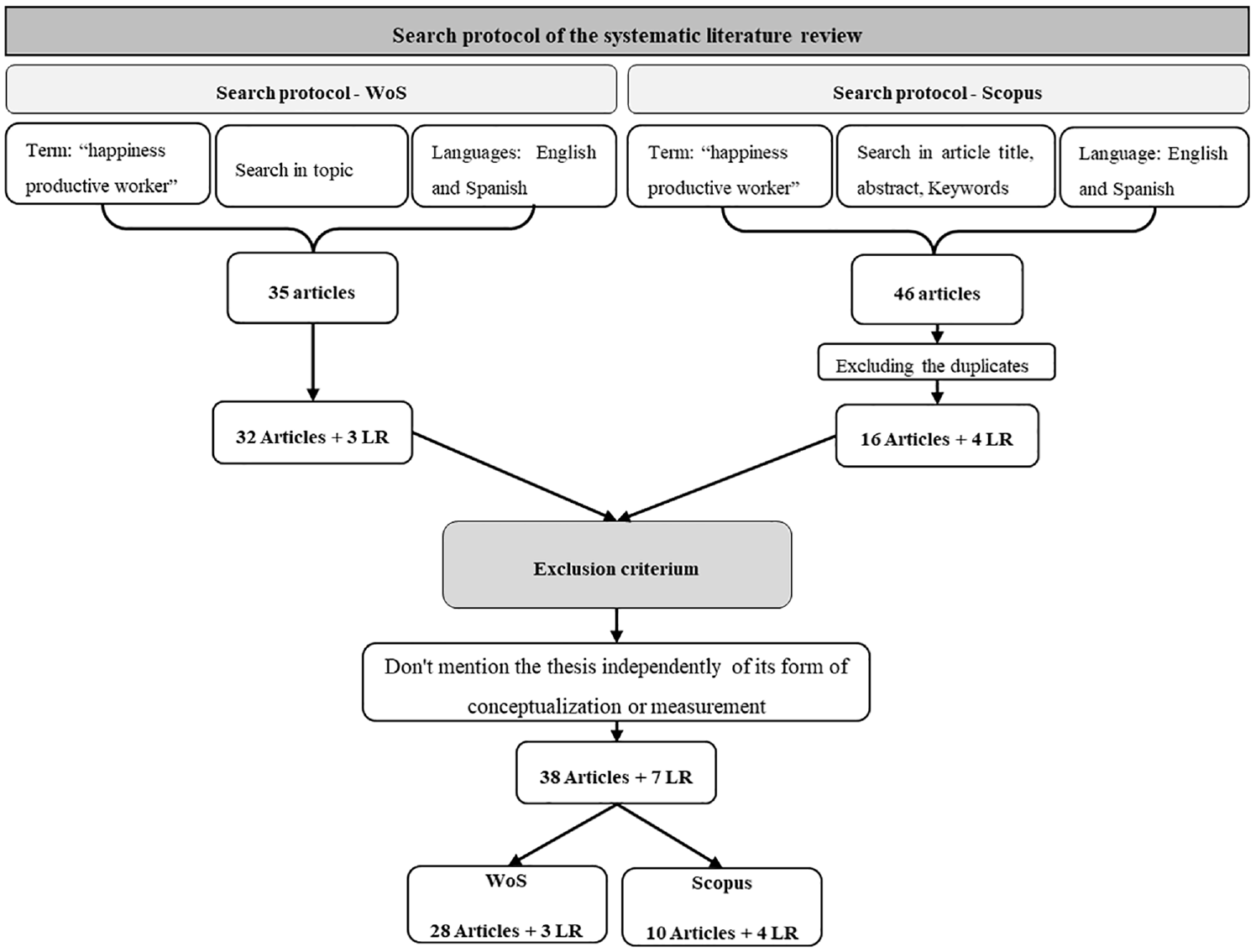
Search protocol of the SLR.
The choice of keyword was based on the objectives set for this study. The keyword selected should focus on articles that address the HPW thesis and where it would be possible to determine how it has been approached empirically and theoretically, as well as identifying ways of measuring both constructs implicit in the thesis (happiness and performance).
Results
Descriptive Analysis
The research mentioned here was conducted on June 12, 2022, and updated on January 11 and May 9, 2023. Table 1 presents the sample overview. After the duplicates exclusion is made, a prior review of each article was made to see if they met the only defined criterion (addressing the HPW thesis). With these, 10 papers were excluded; this resulted in 31 articles from WoS and 14 from Scopus.
Sample Overview.

The sample evolution considers 55 articles (38 articles and 7 LR), and the first paper emerged in 1974 (even though we couldn’t find out if it includes both thesis constructs). Since 2018, the number of publications has grown exponentially. Regarding citations, the theme has experienced multiple fluctuations, but there has been an upward trend since 2018 (Graph 1).

Number of articles and citations per year.
The considered articles are published in 43 journals and seven conference proceedings. Table 2 shows the journal with more number of citations.
Top Five Journals with the Highest Number of Citations.

Note. 1Values consulted on May 9, 2023.
Through the database of articles considered for the development of this study, 126 different authors can be found. Although the sample size is not large, we can already see that the topic is beginning to be explored more by several researchers. The authors have, therefore, been listed, and their respective contributions to the selected sample are shown below. Of these, only Kozusznik and Peiró contributed to five articles, Cropanzano and Wright in four, and Soriano in three. Ten authors contributed in two articles, like Abrahamsson, Denney, Fagerholm, Graziotin, Hosie, Moline, Sender, Sevastos, Wang, and Wright.
The authors found 230 keywords, and the most used are happiness (5.2%), productivity (3%), happiness at work and job satisfaction (2.6%), and job performance and performance (2.2%).
The authors developed Table 3, which summarizes the number of citations per article and cluster. This allows us to understand which type of papers or perspectives of the thesis analysis are more popular among researchers.
Citations per Article/Clusters.

Note. Values consulted on May 9, 2023.
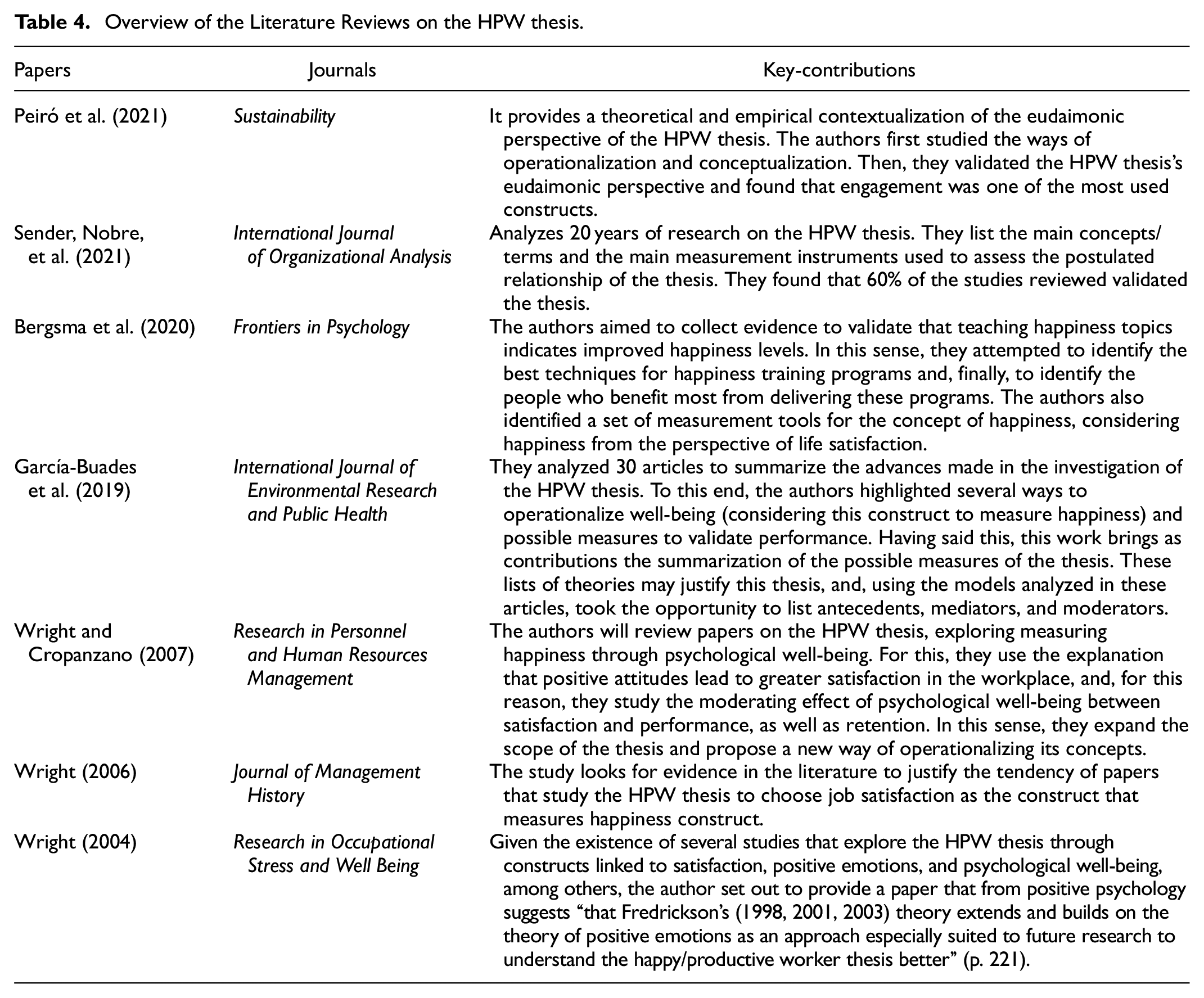
To conclude, the authors analyzed the literature reviews found in the sample considered in the study (Table 4). By analyzing them, most of them focus on exploring ways of measuring the concepts of happiness but equate this construct with concepts that are considered similar, such as the eudaimonic perspective, well-being and psychological well-being, positive psychology, positive attitudes, and job satisfaction. Only Sender, Nobre, et al.’s (2021) review presents a more general study, focusing on a holistic view of the terms and forms of measurement used to validate both constructs in the HPW thesis.
Overview of the Literature Reviews on the HPW thesis.
Keywords Co-occurrence
A bibliometric analysis uses the keywords co-occurrence as a methodology (Martín-del-Río et al., 2021; van Eck & Waltman, 2022). The criterion aims to identify the number of occurrences of a given keyword and estimate its relationship with the other. VOSviewer (version 1.6.18) was the software used. The methodology adopted is innovative since no further review has used it. In addition, the co-occurrence method of keywords makes it possible to explore a topic, considering the trends of words that best characterize it (Martín-del-Río et al., 2021).
As was said before, 10 articles were eliminated for not exploring the thesis, resulting in 38 articles and seven LR. Two papers had insufficient information to be included (Lehmann, 1974; Thotram, 2005), and four did not measure the relationship defended in the thesis (Bakshi, 2011; Peters, 2006; Rizki et al., 2021; Rupčić Kelam & Kelam, 2020), one only measured happiness (Bill, 2012), and another one only considers the belief behind the thesis (Kaur et al., 2020), and two others that only explore the performance (Babel & Bala, 2007; Sukardjo & Wisprayogie, 2011).
After these articles’ elimination, we only considered 38 articles, and six were manually integrated into the clusters because they lacked keywords. Figure 2 shows the output produced by VOSviewer, which incorporates all the articles in three clusters.
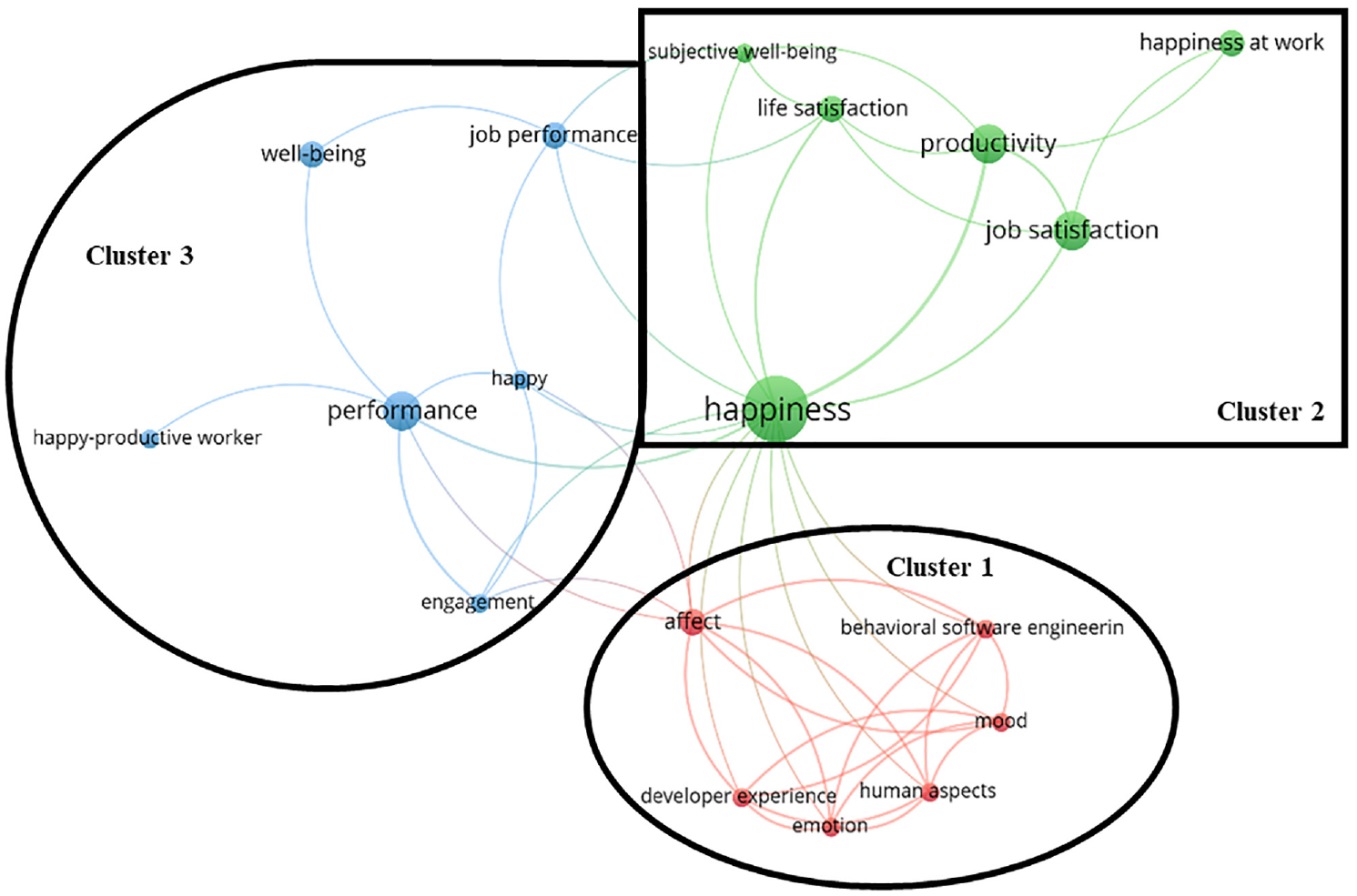
Bibliometric analysis output.
Thematic Groups
HPW and Positive Psychology (C1, n = 7)
Of the seven articles that compose the cluster, six are empirical (four quantitative and two mixed), and one is conceptual. All these papers explore the thesis through the positive psychology perspective, focusing on happiness’s measurement and conceptualization form.
It was in the 1930s that the well-being of employees emerged as the new concern of managers, and this emerged with the movement of human relations (Salgado et al., 2019; Zelenski et al., 2008). With this scenario, the perception that happy employees are more productive than their opposites appeared and later was named the HPW thesis. The manager’s concern about exploring the well-being of workers is understandable because, if we invoke the theory of social exchange, this concern will translate into advantages for both parties (Haagsman, 2018; Zelenski et al., 2008).
The HPW thesis defends that happy employees have better performance, and this may be an organizational strategy to gain a competitive advantage and achieve the objectives (Graziotin et al., 2017a, 2017b; Haagsman, 2018). The empirical studies have proofs that validate the relationship postulated by the thesis (Caballero-García et al., 2018; Graziotin et al., 2017b; Salgado et al., 2019), but Zelenski et al. (2008) also mentioned studies that couldn’t validate this relationship. These investigations of the organizational sciences are also considered the Holy Grail (Zelenski et al., 2008) and are thought to originate from positive psychology (Caballero-García et al., 2018). In this field, it should be proven if this relationship is always positive and if it always occurs in this direction (Cropanzano & Wright, 2001)
Being happy is a universal desire, but describing happiness is a complex process. Happiness could be considered “a sequence of experimental episodes” (Graziotin et al., 2017a, p. 325). Positive psychology says that the number of positive experiences determines (un)happiness (Graziotin et al., 2017b). Happiness is subjective because it depends on the individual judgment of the overall life (Cropanzano & Wright, 2001). It is because of this last perspective that happiness is sometimes compared to subjective well-being (Zelenski et al., 2008), which could be defined as “the cognitive and affective evaluations that the individuals make of their lives, that is, how individuals think and feel about their own lives and work” (Salgado et al., 2019, p. 94).
People who lived more happy experiences are more resilient, have a greater capacity to face adversity, handle complex (high-stress) situations better, develop more at the professional level, are more attentive, intuitive, creative, more sensitive to rewards, more optimistic, proactive, and have a lower propensity to experience stress levels (Caballero-García et al., 2018; Haagsman, 2018). Happy people tendentially have better jobs, are more satisfied with their jobs, are less likely to be unemployed for a long time, have better peer reviews, are more creative and productive, are more likely to be in supervisory positions and therefore better paid, have less absenteeism; have a lower propensity to quit or leave their workplace; tend to be more relaxed and extroverted (Caballero-García et al., 2018; Cropanzano & Wright, 2001; Haagsman, 2018).
Performance “includes all of the actions relevant to achieving organizational goals” (Zelenski et al., 2008, p. 525). This construct can be measured through productivity (individual or collective). So, it corresponds to all activities that allow for fulfilling the pre-established objectives.
Table 5 shows the scales used for the papers integrated into this cluster, organized by group.
Scales Used in C1.

Note. NM = not mentioned.
Open question.
HPW and Happiness Measurement (C2, n = 16)
Of the 16 articles that compose the cluster, 13 are empirical (11 quantitative and two mixed), and three are conceptual. All these papers explore the thesis, focusing on the measure ways of the happiness construct.
Nowadays, talent retention is a big challenge. Knowing that employees want to stay when they are loyal and feel committed (Luna-Arocas & Danvila-del-Valle, 2021), but they do not consider staying in the same company until retirement because of the mutable nature of the jobs (Edwards, 2009), new perspectives like the HPW thesis emerged in the research field (Baadel & Kabene, 2020; Hosie & Sevastos, 2009).
Happy employees are more productive than unhappy; this is the premise of the HPW thesis (Baadel & Kabene, 2020; Foncubierta-Rodríguez, 2021; Luna-Arocas & Danvila-del-Valle, 2021; Piekałkiewicz, 2017). Some investigations said positive emotions can stimulate happiness (Sender, Carvalho, et al., 2021). It was necessary to introduce positive psychology to start experiments focused on the person’s positive aspects (Luna-Arocas & Danvila-del-Valle, 2021). Including the impact of the contexts is essential because happiness and performance are “influenced not only by personal characteristics but also by the characteristics of the environment and the interaction with it” (Foncubierta-Rodríguez, 2021, p. 595).
Happiness hasn’t a consensual definition, but its investigation dates from ancient Greece, where “Aristotle stated that happiness is every human’s goal, and it was a matter of living a good, virtuous life” (Sender, Carvalho, et al., 2021, p. 1). However, happiness is usually conceptualized holistically. Positive psychology says happiness is defined by the number of positive emotions/experiences and the absence of negative emotions/experiences. Positive emotions/experiences make people more healthy, happy, and productive, with better interpersonal relations, more satisfied with life and work, more creative and innovative, provide superior service, have a greater ability to manage conflict, and are more committed to achieving goals (Edwards, 2009; López & Fierro, 2016; Piekałkiewicz, 2017; Ribeiro et al., 2019; Yang & Hung, 2017).
Happiness at work is a “state is perceived by the individual (perceptions), and its presence is influenced by some factors (antecedents). This positive state also impacts individual behavior in the workplace (consequences)” (Sender, Carvalho et al., 2021, p. 3). The antecedents and consequences of this construct are still little explored in the literature.
Happiness also can be considered from the classic perspective. The hedonic is the perspective related to the search for pleasure and escape from suffering, and the eudaimonic view is associated with the person feeling that what they do is meaningful and favorable to development and personal growth (López & Fierro, 2016; Luna-Arocas & Danvila-del-Valle, 2021; Sender, Carvalho, et al., 2021).
As there is no consensus on the definition of happiness, this concept has been compared to (psychological) well-being, job satisfaction, commitment to the organization, engagement, intrinsic motivation, and positive affects (Al Jassmi et al., 2019; Duncan et al., 2015; Kessler et al., 2008; López & Fierro, 2016; Luna-Arocas & Danvila-del-Valle, 2021; Piekałkiewicz, 2017; Shimizu et al., 2022; Yap & Badri, 2020).
Based on Luna-Arocas and Danvila-del-Valle (2021), well-being is a complex construct that includes job satisfaction, personal satisfaction, and organizational commitment. Psychological well-being comprises three dimensions: “one internal, cognitive, which is life satisfaction and two external, relating to experiences of positive emotions or the absence of negative emotions” (López & Fierro, 2016, p. 186). Job satisfaction is the subjective, individual, and holistic evaluation that each person makes of their work as a whole (Kessler et al., 2008; López & Fierro, 2016), but only considers the components that the employees can control (Ribeiro et al., 2019). Commitment to the organization is related to the level of delivery that the employee presents about the organization. Engagement is a positive state of mind that makes employees interested in their work and is considered in some broader definitions of happiness at work (Ribeiro et al., 2019). Intrinsic motivation allows employees to take pleasure from the task or the work itself (Duncan et al., 2015). Positive affects are associated with positive/good feelings, like enthusiasm and determination (Hosie et al., 2012). Some investigators discovered happiness antecedents like health and employment because being unemployed tends to be associated with a negative emotion (Baadel & Kabene, 2020).
Performance is a construct not much explored by the articles in this cluster but can be measured through productivity (perceived or real), perceived performance, or service quality. Performance can also be divided into task performance—the efficiency with which workers perform the assigned activities- and contextual performance—associated with the psychological bonds of interpersonal relationships and carrying incidental or indirect rewards in consideration with performance (Hosie & Sevastos, 2009).
Table 6 shows the scales used for the papers integrated into this cluster, organized by group.
Scales Used in C2.

Note. NM = Not mentioned.
HPW and the Association Between Measurement of Happiness and Performance (C3, n = 15)
Of the 15 articles that compose the cluster, 10 are empirical (nine quantitative and one case study), four conceptual, and one that couldn’t be determined from the abstract. These works study which measurement forms represent the constructs’ most robust and significant relationship.
Being happy and knowing the secret to extending this feeling is a universal desire (Moccia, 2016; Thompson & Bruk-Lee, 2021; Wright & Cropanzano, 2000). In the new millennium, these investigations understand that happiness is a collective project because it brings advantages for both parties (employees and employers). The time spent at work is increasing; therefore, perceiving it as something meaningful is fundamental to feeling happier (Hosie et al., 2012; Kożusznik et al., 2019; Moccia, 2016).
The premise that happy employees have better performance than unhappy is the basis of the HPW thesis (Gutiérrez et al., 2020; Hosie et al., 2012; Huang et al., 2016; Kożusznik et al., 2019; Muñoz & Casallas, 2021; Peiró, Kozusznik, & Soriano, 2019; Wright & Cropanzano, 2000). Some authors say that the origin of this thesis goes back to the Hawthorne studies (Hosie et al., 2012; Wright et al., 2002), but it was in the 30s that these studies reached their high point (Gutiérrez et al., 2020; Muñoz & Casallas, 2021).
The constructs associated with the thesis are complex (Peiró, Kozusznik, Rodríguez-Molina, et al., 2019; Salas-Vallina et al., 2020; Wright et al., 2002). So happiness has been measured by (subjective) well-being and satisfaction and also by the classic perspectives—eudaimonic and hedonic (Gutiérrez et al., 2020; Huang et al., 2016; Kożusznik et al., 2019; Peiró, Kozusznik, & Soriano, 2019; Peiró, Kozusznik, Rodríguez-Molina, et al., 2019). These are controversial because some investigators think happiness is a different construct (Thompson & Bruk-Lee, 2021).
Happiness is an emotional or affective experience (Hosie et al., 2012; Thompson & Bruk-Lee, 2021; Wright & Cropanzano, 2000) characterized by a feeling of happiness in a specific moment. Happiness at work is compared to an attitude toward work, composed of behaviors that determine the employee’s profile, interpersonal relations, and adaptation to the context, among other dynamics (Salas-Vallina et al., 2020). Positive psychology supports the postulate of the HPW thesis (Huang et al., 2016). It is an area that studies the behavior, the results, and the process at different levels (Coo & Salanova, 2018). The happiness studies show that happy people are more committed to achieving competitive advantage and success, have higher job satisfaction, find meaning in their work, are cognitively and physically engaged, are loyal employees, healthy, willing to put more energy into the pursuit of their tasks, and have higher levels of productivity (Moccia, 2016; Salas-Vallina et al., 2020).
Performance is related to the productivity of an employee. So, performance is a set of attitudes that generate the behavior of each individual since this behavior helps in the development of the organization and in obtaining the pre-established objectives, contributing to efficacy and competitiveness (Gutiérrez et al., 2020; Kożusznik et al., 2019).
Table 7 shows the scales used for the papers integrated into this cluster, organized by group.
Scales Used in C3.
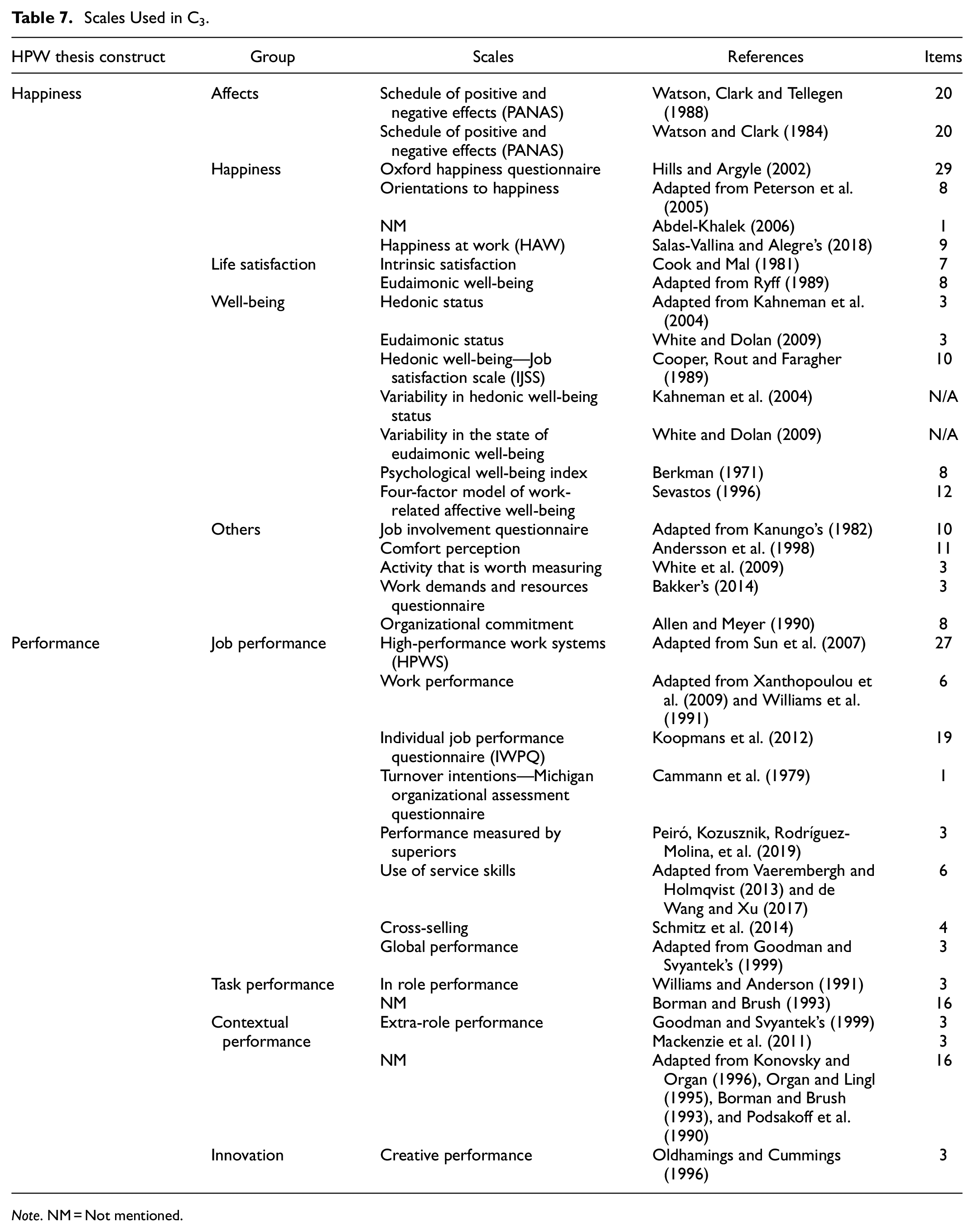
Note. NM = Not mentioned.
Framework and Research Agenda
The framework establishes the association of the clusters and explains the HPW thesis investigations (Figure 3). In this sense, cluster 3 could be considered the background because the articles try to collect empirical evidence of the relationship postulated by the thesis, seeking to list the constructs whose relationship shows the most robustness. Cluster 2 focuses on the forms of measuring in the construct of happiness, and Cluster 1 tries to simplify through the positive psychology by reducing the conditions of measuring and conceptualization of the happy construct and limiting to affects, emotions, or positive experiences to the detriment of affects, emotions, or negative experiences. Cluster 3 studies the thesis as a whole and focuses on listing the benefits for the organization arising from this relationship. In this sense, the authors mention that happy people have better levels of job satisfaction and are more engaged, loyal, healthier, and more productive (Moccia, 2016; Salas-Vallina et al., 2020). This increase in productivity leads to achieving objectives and better efficiency and competitiveness (Gutiérrez et al., 2020; Kożusznik et al., 2019). Knowing that happiness has these multiple benefits, the question is how happiness is measured, and several studies have emerged intending to answer this (cluster 2). The ways suggested can be grouped into well-being (as whole, subjective/psychological well-being), satisfaction (with life/work), motivation, affect (positive/negative) and engagement (Al Jassmi et al., 2019; Duncan et al., 2015; Kessler et al., 2008; López & Fierro, 2016; Luna-Arocas & Danvila-del-Valle, 2021; Piekałkiewicz, 2017; Shimizu et al., 2022; Yap & Badri, 2020). The articles in cluster 1 act as a filter explaining that happiness can be considered through affects. That said, positive psychology here provides the key to developing this construct, pointing out that happiness is a formula in which the more positive affections/emotions/experiences are recorded to the detriment of negative ones, the closer the individual is to happiness (Graziotin et al., 2017b).

HPW thesis framework.
For future investigation paths, through a holistic vision, investigations are composed of small samples and based on a micro level of analysis. Therefore, there is a need to develop studies with more extensive samples, qualitative studies to understand the reasons, and at the level of analysis to create macro studies that include variables like organizational climate, leadership, culture, communication, motivation, and rewards, among others and longitudinal studies to understand the phenomenon of the thesis during the time (Haagsman, 2018).
Generational studies are also needed to understand the differences, considering that the new generations have distinct perceptions about work conditions and quality of life. Also, there is a need to investigate the classic perspectives without separating the two forms (hedonic and eudaimonic). Antagonistic thesis patterns (e.g., happy-productive, happy-unproductive, unhappy-productive, and unhappy-unproductive) must be studied to understand the actual direction of this relationship (García-Buades et al., 2019; Gutiérrez et al., 2020; Peiró et al., 2021), in other words testing if this is unilateral or bidirectional (Hosie et al., 2012). Future investigators must explore the antecedent, predictor, mediator, and moderator variables of this relationship.
Another gap that the investigators need to find is related to the inexistence of model proposals to study empirically the thesis. In this sense, it looks essential to develop models with frameworks that justify the variables chosen to include in the investigation. Conceptually, several frameworks are associated with the thesis (Costa et al., 2022), but in this research, we need help finding a paper that integrates them into a model proposal.
The analysis of Table 4 shows that researchers are more interested in works that study the thesis from the perspective of positive psychology. Systematic literature reviews and papers focusing on measuring and conceptualizing ways should be more appreciated.
Conclusions
In a period marked by uncertainty, difficulty in retaining talent, and market turbulence, it is necessary to realize that the classical management models can no longer provide sustainable responses to these facts (Costa et al., 2022). The HPW thesis emerged as a possible answer to these questions and integrated into the SDGs objectives.
This SLR uses a bibliometric analysis with the application of the keywords co-occurrence methodology to analyze the articles found in WoS and Scopus databases. Based on the sample collected, an analysis of the evolution of the sample was carried out, the articles were contextualized into thematic groups, and some suggestions for future research were identified. In this investigation, three clusters are found and designated as HPW and positive psychology, HPW and happiness measurement, and HPW and the association between the measurement of happiness and performance.
The origin of the HPW thesis could be more precise, but some investigators say that it comes from the knowledge gained from positive psychology. In this sense, cluster 1 explores the thesis from this psychology area. These bring differences in the field research in how investigators examine human disease to study positive behaviors (Moccia, 2016). This area says that the number of positive experiences in detriment of the negative ones defines the level of happiness. Cluster 2 brings definitions of the principal ways to measure happiness. That is satisfaction (Kessler et al., 2008; López & Fierro, 2016; Luna-Arocas & Danvila-del-Valle, 2021; Thompson & Bruk-Lee, 2021; Wright, 2006; Wright & Cropanzano, 2000; Yap & Badri, 2020), well-being, and psychological well-being (Al Jassmi et al., 2019; Luna-Arocas & Danvila-del-Valle, 2021; Piekałkiewicz, 2017; Shimizu et al., 2022; Thompson & Bruk-Lee, 2021; Wright & Cropanzano, 2000), but also the classic perspectives (Bergsma et al., 2020; Gutiérrez et al., 2020; Kożusznik et al., 2019; López & Fierro, 2016; Luna-Arocas & Danvila-del-Valle, 2021; Peiró et al., 2021; Peiró, Kozusznik, & Soriano, 2019; Peiró, Kozusznik, Rodríguez-Molina, et al., 2019; Sender, Carvalho, et al., 2021). Cluster 3 tries to improve the development of the thesis, presenting papers that study the ways of measurement that represent more robustness and significance to the relationship.
Happiness is a universal desire, but every time, happiness is a utopia because happiness is a subjective concept that depends on perceptions and is easily changeable (Moccia, 2016; Thompson & Bruk-Lee, 2021; Wright & Cropanzano, 2000). Performance corresponds to the actions that allow one to achieve a specific objective. Job performance refers to the behaviors of each employee who contributes to the organization’s development, works to obtain a competitive advantage, and executes the pre-established objectives (Kożusznik et al., 2019; Zelenski et al., 2008). Performance is generally measured by productivity (real and perceived), perceived performance, or quality of service (Bouranta et al., 2019; García-Buades et al., 2019; Ripoll et al., 2017). HPW thesis is a relevant research field in the way that this thesis brings advantages for employees and organizations. That said, the focus on happiness promotion is a way to determine employee behaviors that will lead to a win-win (reward) through their performance.
Considering the first starting question (How has the HPW thesis been approached and tested?), through the analysis of all the considered papers, all approved theoretically and empirically the relationship postulated by the thesis. In addition, all the ways used to measure the concepts in the thesis have been listed by group and cluster (as stipulated in the objectives). To achieve the objectives defined, the methodology of co-occurrences of keywords was applied, making it possible to analyze the terms most used in the development of research on the thesis. Also, several suggestions were left for future investigations, and the themes that are most popular in the thesis were identified.
Implications
This paper presents some theoretical and practical implications. This SLR systematized the main concepts that have been used in the thesis. The methodology used (bibliometric analysis with keyword co-occurrence) and the software (VOSviewer) allow the segmentation of the paper found about the thesis in both databases (WoS and Scopus). The summarized tables by the cluster present all the scales used in the papers analyzed, making it easier for future researchers to find or select them. Also, characteristics of happy people have been presented, providing information that allows profiling people with high happiness levels and visualizing individual and organizational advantages. Regarding the practical implications, at the macro level, policymakers should analyze the factors that disallow a higher level of happiness in nations because, based on the postulate of the thesis, this will directly impact their performance; that is, it will determine the level of economic development of the country (Piekałkiewicz, 2017). At the business level, the promotion of employee happiness has multiple benefits, so companies must be aware of the factors that can boost these levels of happiness to gain a competitive advantage. At the academic level, educational institutions must rethink their program contents and invest in teaching new forms of management adapted to the new reality of organizations.
Limitations
In terms of limitations, the biggest obstacle is the small amount of existing research in this area and the difficulty of making a more concise summary of the conceptualization and measurement of happiness and performance. The performance construct needs to be more widely explored in the papers, and it is difficult to find possible definitions. In addition, the study only considered two databases, so other studies may have needed to be included.
Footnotes
Acknowledgements
Thanks to all the people who have been with me in writing this paper and providing feedback on it. To my co-authors and supervisors of my PhD thesis, my family, and my co-workers, thanks for the support.
Author Note
This research was conducted while Pedro Ferreira was at University Portucalense. He is now at University of Aveiro and may be contacted at pjferreira@ua.pt
Declaration of Conflicting Interests
The author(s) declared no potential conflicts of interest with respect to the research, authorship, and/or publication of this article.
Funding
The author(s) received no financial support for the research, authorship, and/or publication of this article.
Ethical Approval
The authors declare that this submission follows the principals of the Ethical Statement.

Data Availability Statement
Data sharing not applicable to this article as no datasets were generated or analyzed during the current study.