



Abstract
Student motivations and expectations regarding Transnational Higher Education (TNHE) have gained increasing attention over the past two decades. This paper employs a bibliometric analysis of 266 journal articles from the Web of Science and Scopus databases, covering the period from 2014 to March 2024. Using the TCMT framework, we identify the theoretical concepts, contexts, methods, and main themes discussed in literature, and summarises the implications for future research. This study contributes to the existing body of literature by systematising research on student motivations and expectations within TNHE. The findings provide valuable references for researchers and practitioners seeking to further explore this area of knowledge.
Plain language summary
This study reviews the existing literature on student motivations and expectations in transnational higher education (TNHE). It identifies key theoretical concepts, contexts, research methods, and main themes discussed in literature, and summarises their implications for future research. By systematising research on student motivations and expectations within TNHE, this study contributes to the existing body of knowledge. The findings offer valuable insights for researchers and practitioners seeking to further explore this area.
Introduction
Since the early 2000s, Transnational higher education (TNHE) has developed into a major dimension of the globalisation of higher education (Bennell, 2019; Liu, 2025). It is often defined as the movement of academic programmes or institutions from one country to another (Knight, 2016; N. H. N. Tran et al., 2023). TNHE can be categorised into two main forms based on the interaction between the home and host institutions: independent TNHE and collaborative TNHE (Knight & McNamara, 2017). Independent TNHE encompasses franchise programmes, international branch campus, and self-study distance education. On the other hand, collaborative TNHE involves joint programmes, which may also be referred to as dual/multiple degrees or twinning arrangements; joint universities, and distance education in conjunction with local academic partners (Sudhana et al., 2021; N. H. N. Tran et al., 2023).
Among these, twinning programmes and overseas branch campuses have become the most prevalent models of TNHE. Statistics indicate that by the close of 2022, there were 306 overseas branch campuses operating across 37 countries of origin and 83 host nations (Zhou et al., 2024). Given the popularity of TNHE, a growing body of research has examined student motivations and expectations regarding TNHE (Ahmad & Buchanan, 2016; Dowling-Hetherington, 2020; Fang & Wang, 2014; Haupt et al., 2021; J. Hou et al., 2017; Li et al., 2021; Liu et al., 2023; Sin et al., 2019; Xie, 2022; Yao & Garcia, 2018). However, a comprehensive synthesis of the literature is notably absent. While previous literature has offered valuable insights into specific dimensions of TNHE, such as student employability (Schueller, 2023), implementation challenges (N. H. N. Tran, 2022), or international branch campus development (Wilkins, 2021), there remains a lack of a comprehensive on student motivations and expectations of TNHE. In particular, no study has been identified that employs a hybrid approach combining bibliometric analysis with the Theory, Context, and Method (TCM) framework (Paul et al., 2017) to explore these motivations and expectations within the context of TNHE.
This research therefore attempts to provide a systematic review of the literature on student motivations for and expectations of TNHE. Specifically, the TCM framework is extended by incorporating the concept of “main theme” to provide a more comprehensive review of the relevant literature. The review aims to synthesise knowledge regarding student motivations for and expectations of TNHE, with the aim of comprehensively understanding existing research and identifying areas for future investigation. It specifically addresses two questions: (1) What are the main theories, context, methods, and main themes found in the existing research? (2) What are their implications for future research in this field?
Review Methodology
A scoping review method was used to understand student motivations and expectations in TNHE. It should be noted that a scoping review method is different from a systematic one as it aims to indicate what exists on this topic, instead of making quality assessments about literature. A scoping review is an initial evaluation designed to gauge the breadth and extent of existing research literature, thus acting as an initial phase in justifying the need for a systematic review, constrained by temporal and thematic boundaries (Schueller, 2023).
Data Source and Selection Criteria
The two databases were used: The Web of Science (WoS) and Scopus, both of which provide a wide range of reliable articles used for higher education-related review studies (Luo et al., 2023). The keywords for search included a combination of “student motivation”/“student expectation”/“student attitude”/“student perception”/“student experience” and “transnational higher education”/ “transnational education”/“international education”/“cross-border education”/ “overseas education”/ “twining programme”/“branch-campus”/ “articulation programme.” The search period starts from 2014 to 2024 (March) as transnational higher education has experienced rapid development over the last decade. Table 1 summarises the data sources and selection criteria.
Summary of Data Source and Selection Criteria.

Note. The inclusion criteria were developed with reference to Arksey and O’Malley (2005) and validated through a pilot screening of 50 articles. Exclusion criteria included non-empirical works, studies lacking a TNHE context, and duplicates.
The PRISMA (Figure 1) model (Page et al., 2021) was used to conduct the search and filter the studies. A total of 997 peer reviewed journal articles were retrieved, with “student motivations”/“student experience”/“transnational education” studies sourced from the Web of Science, and “cross-border Education”/“student motivations”/ “international branch campus” / “transnational higher education” from Scopus and Web of Science. Literature screening was conducted independently by three researchers. Duplicates (n = 86) were removed using EndNote X9, followed by a double-blind title and abstract screening. The results were then manually cross-checked by the remaining authors. After an initial screening of the retrieved records, studies that were invalid, inconsistent with the research focus, or repeated were excluded, resulting in a final total of 266 studies.

PRISMA diagram (Adapted from Page et al. (2021)).
To streamline the screening process and enhance accuracy, we employed Covidence, a widely recognised reference management and screening platform. Covidence is designed specifically for systematic review and scoping review projects. Specifically, Covidence facilitated the implementation of a standardised two-stage screening process. During the title and abstract screening, the software’s “Batch Screening” function allowed us to process 50 records at a time, marking each as “Include,”“Exclude,” or “Uncertain” via drop-down menus. For example, when encountering a study titled “Campus Design in Transnational Education,” a reviewer could quickly exclude it by selecting “Irrelevant topic” from the pre-defined exclusion criteria. Covidence automatically aggregated these decisions and generated a discrepancy report. Approximately 12% of the initially “Uncertain” cases, such as those involving ambiguous definitions of TNHE, were subsequently discussed and resolved by the research team.
Data Synthesis and Presentation
The TCM framework was used for presenting the findings of the review. Within this framework, “theory” (T) refers to the perspective guiding scholars’ research, “context” (C) outlines the study’s background, and “method” (M) denotes the tools and instruments used in the study (Luo et al., 2023; Paul et al., 2017). To provide a more comprehensive analysis of the relevant literature, the TCM framework was extended to TCMT through incorporating the concept of “theme.” Therefore, the findings below are organised according to the main theoretical framework used, the research contexts, the main methods used, and the main themes found in the literature on student motivations for and expectations of TNHE.
Findings
Theoretical Concepts Explaining Student Motivations for and Expectations of TNHE
Table 2 presents the main theories used to explain student motivations and expectations in TNHE. As shown in Table 2, the academic community in the field of student motivation and expectation research primarily engages with the following theories with higher frequency (frequency ≥ 5): Push-pull theory, Cosmopolitanism, Transculturalism. It is noteworthy that 62 studies explicitly cited theoretical frameworks, whereas the remaining 204 papers examined student motivations and expectations without a clearly articulated theoretical foundation. This underscores the need for more theory-driven research in this field.
The Frequency of the Main Theories Applied in THEN.
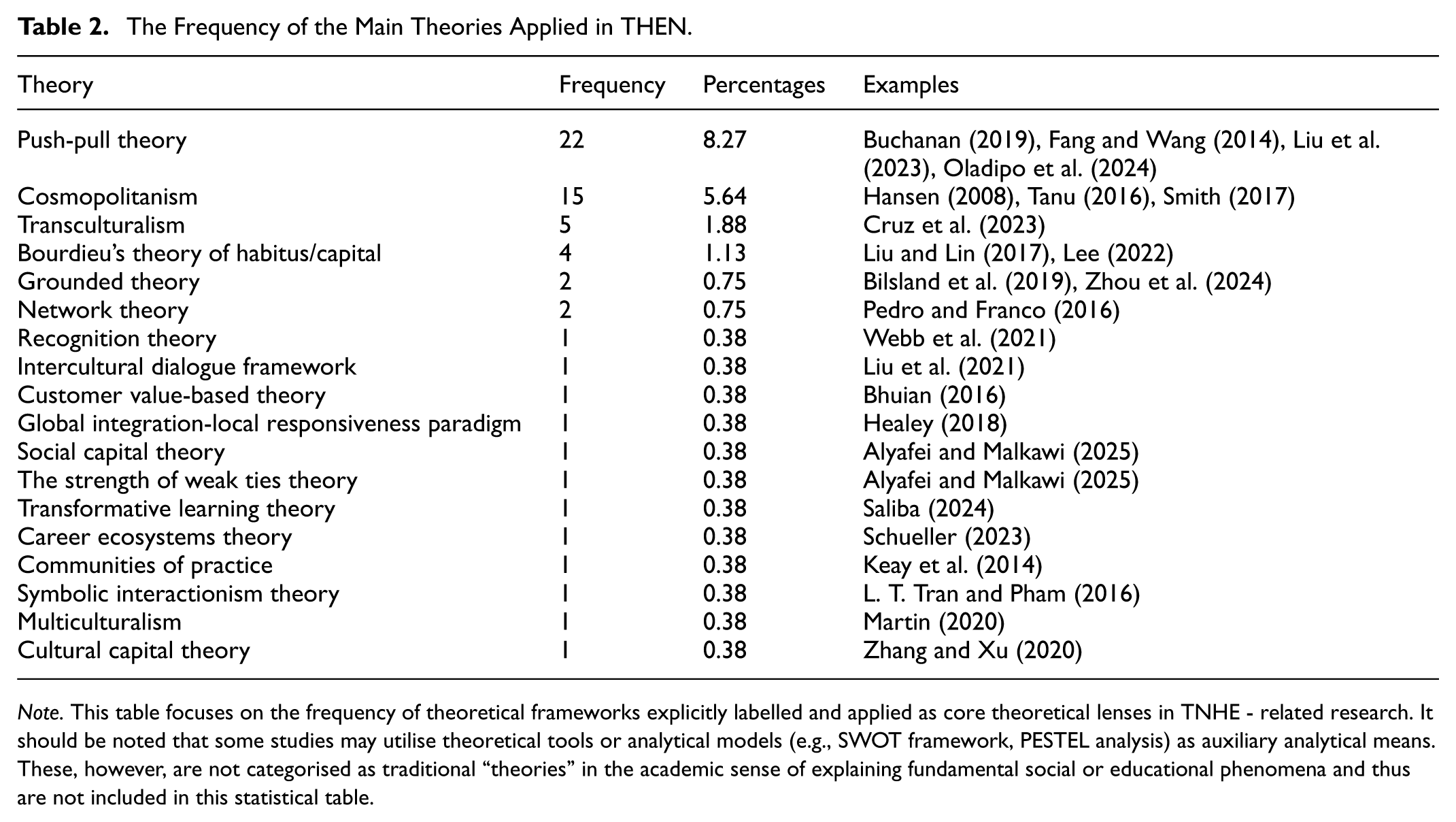
Note. This table focuses on the frequency of theoretical frameworks explicitly labelled and applied as core theoretical lenses in TNHE - related research. It should be noted that some studies may utilise theoretical tools or analytical models (e.g., SWOT framework, PESTEL analysis) as auxiliary analytical means. These, however, are not categorised as traditional “theories” in the academic sense of explaining fundamental social or educational phenomena and thus are not included in this statistical table.
The push-pull theory is a widely used framework in migration studies, frequently applied to explain why individuals relocate. It suggests that migration is driven by “push” factors-negative conditions prompting departure-and “pull” factors-positive attributes attracting individuals to a new location. In recent years, this model has gained prominence in analysing students’ choices for TNHE (e.g., Ahmad & Buchanan, 2016; Fang & Wang, 2014; Liu et al., 2023; Wilkins et al., 2012). Push factors include inadequate local education quality, limited programme availability, employer preference for international qualifications, and family influence (Fang & Wang, 2014; Liu et al., 2023). Pull factors highlight programme quality, institutional or national reputation, English-speaking environments, cultural exposure, further study opportunities, and access to foreign teaching methods (Ahmad & Buchanan, 2016; Dowling-Hetherington, 2020; Wilkins et al., 2018).
Fang and Wang (2014) and Oladipo et al. (2024) were the main contributors to the development of this theory. Fang and Wang (2014) made a significant theoretical contribution by adapting and expanding the traditional push-pull theory to better suit the context of TNHE. In Fang and Wang’s (2014) study, their push-pull theory was different from the widely recognised push-pull theory, which attributed push factors solely to the home country and pull factors exclusively to the host country. Fang and Wang (2014) provided a more extended to cover the unfavourable elements that drive students away from pursuing either overseas or domestic higher education, whereas the pull factors highlight the positive attributes of TNHE, with personal factor included. The revised push-pull model offers an enriched lens through which to interpret the complexities of student choice in TNHE (Liu, 2025).
According to Oladipo et al. (2024), the push–pull dynamics are structured into three distinct layers to better interpret students’ choices of TNHE programmes in China: the macro level of the nation, the meso level of institutions, and the micro level of individuals. Oladipo et al. (2024) further emphases that institutional collaboration significantly contributes to students’ attraction to TNHE. Such development enables a deeper and more integrated understanding of the factors shaping students’ motivations and expectations towards TNHE (Liu, 2025).
Cosmopolitanism, with its cultural, political, ethical, and methodological dimensions, supports post-national and transnational perspectives. In TNHE, educational cosmopolitanism, a moral outlook blending global openness with local cultural loyalty (Hansen, 2008), offers a useful lens for understanding student motivations. Students may pursue TNHE to develop cosmopolitan skills such as critical self-reflection, global identity, and intercultural competence. In contexts like China, where educational internationalisation navigates nationalist and cosmopolitan tensions, students may view TNHE as a means to balance these influences.
Transculturalism, which sees cultural interaction as a dynamic process creating new identities, offers another lens for understanding TNHE. International students, often more globally oriented than their Western peers, enrich cross-cultural learning (Cruz et al., 2023). For these students, TNHE serves as a platform for engaging with diverse perspectives and acquiring global navigation skills. Transculturalism also signals opportunities for academia to diversify knowledge and foster international research collaborations, aligning with student aspirations for a globally relevant education. Institutions, in turn, must provide diverse programmes catering to both local and global student needs.
Theories with a frequency of 1 in Table 2 are as follows: Recognition theory (applied in Webb et al., 2021), Intercultural dialogue framework (used in Liu et al., 2021), Customer value - based theory (adopted in Bhuian, 2016), Global - Integration - Local responsiveness paradigm (utilised in Healey, 2018), Social capital theory (employed in Alyafei & Malkawi, 2025), The Strength of Weak Ties Theory (also in Alyafei & Malkawi, 2025), Transformative learning theory (featured in Saliba, 2024), Career Ecosystems Theory (applied in Schueller, 2023), Communities of Practice (used in Keay et al., 2014), Symbolic interactionism theory (adopted in L. T. Tran & Pham, 2016), Multiculturalism (featured in Martin, 2020), and Cultural capital theory (utilised in Zhang & Xu, 2020). Each of these theories is individually applied in its corresponding cited article within the realm of TNHE - related research, serving as a distinct analytical lens for exploring relevant research questions.
Contexts Covered
The common TNHE classification framework for International Professional and Practice-based Mobile (IPPM) students (Knight & McNamara, 2017) identifies three main contexts: destination country (Table 3), student populations (Table 4), and types of TNHE (Table 5).
Destination Countries for TNHE.

Population of Students Who Choose TNHE.

Types of TNHE.

Destination Country
Research on TNHE is predominantly focussed on China and the UK, each accounting for 3.75%. These countries are central to TNHE, particularly for international branch campuses and joint universities. China’s economic development and growing global prominence, alongside increasing demand for international education, contribute to its central role. The UK’s appeal stems from its high-quality educational offerings and global demand for academic talent.
The Arabian Gulf region, particularly Qatar and the UAE, accounts for 3.76% of the reviewed articles (1.88% each). The UAE’s attractiveness is linked to its economic diversification, high-skilled employment opportunities, and internationally ranked universities. Southeast Asia also plays a significant role, with Malaysia (1.88%) and Singapore (1.5%) combining for 3.38%, driven by their strategic positioning in the global education market.
France (1.5%) and Finland (1.13%) are also notable destinations. France’s involvement is likely due to its historical ties to international education, while Finland is emerging as a hub for innovative TNHE practices. Other countries, including the USA, Australia, and Germany (0.75% each), offer unique contributions to TNHE research. Countries like Italy, Namibia, Russia, South Africa, and Vietnam each account for 0.38%, with focussed studies addressing specific TNHE aspects, such as the growing demand for International Distance Education (IDE) in South Africa (Mittelmeier et al., 2019).
The Population of Students
Table 4 provides a detailed breakdown of the student population that has been the focus of research within the realm of TNHE. The table categorises the number of papers, their percentage share of the total, and examples of studies conducted in various countries. The data highlights the global scope of TNHE studies, with a diverse range of student populations examined.
China emerges as the most researched population, comprising five papers (1.88% of the total). These studies explore why Chinese students prefer TNHE programmes within China, particularly at Sino-foreign universities, over studying abroad (Liu et al., 2023). For instance, Dai et al. (2024) analysed international branch campuses (IBCs) in the Greater Bay Area under the “one country, two systems” framework, identifying global (e.g., internationalisation), national (e.g., shared cultural values), and local (e.g., cost-effectiveness) factors influencing enrolment.
The United Arab Emirates (UAE) accounts for four papers (1.5%), reflecting its prominence as a higher education hub. Studies, such as those by Wilkins (2020) and Wilkins et al. (2022), examine student motivations and experiences in this well-funded, internationally appealing region.
Australia contributes three papers (1.13%), focussing on student challenges and experiences in various educational modes. Furlonger and Gencic’s (2014) quantitative study examined satisfaction and coping strategies among 295 students, revealing differences in satisfaction between distance education and on-campus students.
Other countries, including Ghana, India, Malaysia, Namibia, South Africa, the UK, and Zimbabwe, have single papers (0.38% each), offering valuable insights into diverse TNHE contexts. Japan and Vietnam each feature two papers (0.75%). Bilsland et al. (2014) highlights TNHE in Vietnam, while Owusu-Kumih et al. (2019) provide perspectives from Ghana.
Types of TNHE
Table 5 categorises TNHE research by collaborative and independent provision models, illustrating their diversity. Independent provision dominates, with international branch campuses comprising 42 papers (15.79%), underscoring their prevalence as a primary TNHE model (Wilkins, 2020). Self-study distance education follows with 17 papers (6.39%), reflecting its growing importance, especially post-pandemic. Ingram et al. (2021) highlight this trend through a study on a Collaborative Online International Learning (COIL) partnership between the University of South Carolina and Coventry University, exploring course content and lessons learned as a model for cross-cultural distance learning. Franchise programmes account for 9 papers (3.38%), as exemplified by Juusola and Rensimer’s (2018) analysis of legitimacy strategies in Western MBA franchises in the UAE.
Collaborative TNHE provision, while less prominent, remains significant. Partnership programmes represent 21 papers (7.89%), with Vu and Doyle (2014) examining Vietnamese students’ pedagogical adaptation in twinning programmes. Joint universities (seven papers, 2.63%) and distance education with local academic partners (three papers, 1.13%) are less researched but notable. Che (2023) and Goorney et al. (2023) explore these models, with Goorney et al. introducing the innovative “open master” concept, leveraging flexible learning to address global demand for advanced digital skills. According to Goorney et al. (2023), “open master” is a novel model of transnational higher education that leverages open, distance, and flexible learning to deliver specialist postgraduate courses, particularly in emerging fields like AI and quantum technology, across borders without relying on bilateral institutional partnerships. It enables local accreditation and credit recognition, aiming to create a more open and accessible global ecosystem for advanced education.
Methods Used
Table 6 summarises the primary research methods used in TNHE studies, highlighting their frequency and applications.
The Frequency of Research Methods.

Note. Some articles utilised more than one research method, meaning the total count of method applications across all articles exceeds the number of individual articles analysed.
Interviews dominate, with 102 occurrences (38.35%), valued for their flexibility and depth in exploring participants’ perspectives. Semi-structured interviews, offering both structure and adaptability, are widely used. For instance, Rensimer (2021) utilised interviews with South Asian students at British international branch campuses (IBCs) to investigate their perceptions of IBCs as pathways to valuable degrees that improve employability in the UAE and provide security amidst uncertain futures.
Questionnaires follow closely at 101 occurrences (37.97%), demonstrating their efficacy in assessing broad educational outcomes such as student motivation. Likert scales and multi-section designs are common. Wilkins and Huisman (2014), for example, used questionnaires to explore factors shaping student perceptions of IBCs, revealing the importance of personal recommendations and elite institutions’ reputations in influencing choices.
Case studies, with 89 occurrences (33.46%), provide detailed insights into specific educational contexts due to their focus and accessibility. Fang and Wang (2014) used a case study approach to examine international students in a representative Chinese university, offering findings that could be extrapolated to similar settings.
Modelling, though less frequent (26 occurrences, 9.77%), plays a critical role in analysing complex variable relationships. Structural Equation Modelling (SEM) is a key tool in this category, enabling analysis beyond traditional regression methods. For example, Owusu-Kumih et al. (2019) applied SEM to examine data from TNHE students in Ghana, leveraging a large sample size for robust results.
As for specific research participants, only one study, conducted by Bendrups et al. (2021), focussed on the experiences of doctoral candidates, whereas the remaining research has primarily examined undergraduate and master’s level students, echoed by D. Liu (2025). A possible explanation lies in the fact that doctoral candidates represent a relatively small and specialised group, whereas undergraduate and master’s students constitute larger and more heterogeneous populations, thereby providing wider opportunities for research.
Main Themes
The content analysis of the publications revealed four main themes related to students’ motivations and expectations in TNHE (see Table 7 below): (1) Personal development and prospect; (2) Society, economy, culture, environment and family; (3) Quality of education and resources; and (4) Requirements of institutions and policies.
Main Themes of This Research.

Personal Development and Prospects
Personal development and future prospects are significant motivators for students pursuing TNHE, driven by aspirations for personal growth, global cultural capital, career advancement, and language proficiency.
A key motivation is acquiring global cultural capital, which enhances students’ ability to work in diverse cultural contexts. Huang and Yoon (2015) highlight that students pursue TNHE to develop these competencies and improve their prospects in the international job market. TNHE also provides opportunities for cultural exposure and broadening personal horizons (Zhou et al., 2024). Career advancement plays a central role in TNHE decisions. Ahmad and Buchanan (2015) observe that students view TNHE as a pathway to gaining intercultural competencies valued by employers. Multicultural learning environments foster critical employability skills such as adaptability, communication, and teamwork, which are increasingly in demand (Dowling-Hetherington, 2020).
Language proficiency is another key motivator, with students aiming to improve their English or other languages to enhance employability (Dowling-Hetherington, 2020). English-medium instruction (EMI) programmes are particularly popular, as they often lead to improved language skills and better job prospects (Reynolds, 2021). However, non-English-speaking students, particularly from China, may initially struggle with English-medium environments, facing challenges like social isolation. Over time, these students often develop stronger national identities and adapt to their academic and social surroundings (Miao & Yang, 2024; Moon, 2019).
Society, Economy, Culture, Environment and Family Factors
Societal, economic, cultural, environmental, and family factors significantly shape students’ decisions to pursue TNHE. These elements act as motivators or barriers, influencing academic aspirations in various ways.
Family dynamics are pivotal in TNHE decisions. Virtual platforms enable students to maintain close ties with family, alleviating isolation during studies (Ahmad & Buchanan, 2015). Emotional and financial support from family is often essential, with family members’ educational backgrounds and experiences abroad influencing students’ choices (Ahmad & Buchanan, 2016; Zhou et al., 2024). Living environments and geographic distance also affect decisions. Safety, cost of living, and cultural compatibility are highly valued, making countries with secure, affordable, and culturally familiar environments more appealing (Ahmad & Buchanan, 2015; Zhou et al., 2024). Reputations for safety and security further attract international students (Dowling-Hetherington, 2020).
Cultural diversity in TNHE settings offers both challenges and opportunities. Initial adaptation difficulties often lead to growth, with educators guiding students in navigating intercultural environments. This process fosters global competencies and a cosmopolitan worldview (Dowling-Hetherington, 2020). Economic and social ties with the home country influence TNHE decisions, as many students aim to return with skills that enhance their careers and family socio-economic status (Ahmad & Buchanan, 2015). However, emotional and practical challenges, such as adjusting to life without family support, impact on the study-abroad experience.
Quality of Education and Resources
The quality of education and resources is a key factor influencing students’ decisions to pursue TNHE. Institutional reputation plays a significant role, as students value institutions with high rankings and professional competence, associating them with enhanced employability and career prospects (Zhou et al., 2024). Prestigious institutions, offering globally recognised degrees, are particularly attractive for their perceived value.
Degree recognition is another critical consideration. Internationally accredited degrees, especially Western-accredited qualifications, are often seen as more credible and advantageous in the global job market (Dowling-Hetherington, 2020; Liu et al., 2023). Cost considerations, including tuition fees and scholarships, also shape TNHE choices. Affordable destinations like Malaysia are increasingly popular, offering quality education at lower costs (Ahmad & Buchanan, 2016; Zhou et al., 2024). Scholarships further reduce financial barriers, enabling access for students from diverse socio-economic backgrounds. Further, educational quality at international institutions motivates students, providing advanced resources, innovative teaching methods, and research opportunities unavailable in their home countries (Ahmad & Buchanan, 2015; Dowling-Hetherington, 2020). Lastly, infrastructure and facilities are also influential. Modern campuses with state-of-the-art facilities attract students by enhancing their learning experiences and academic outcomes (Ahmad & Buchanan, 2016; Roos Breines et al., 2019).
Requirements of Institutions and Policies
The final theme identified relates to institutional and policy factors shaping students’ TNHE choices, including entry criteria, English language requirements, host country policies, institutional practices, and regulatory frameworks.
Achievable entry requirements serve as a key “pull factor” for students. Accessible standards at foreign institutions attract those who may not meet the high thresholds of prestigious domestic universities. For example, Chinese students unable to secure top-tier National College Entrance Examination (NECC) scores often turn to TNHE options abroad, where entry criteria are more attainable (Dowling-Hetherington, 2020; Zhou et al., 2024).
English language proficiency is another crucial factor. Stringent requirements can deter students from non-English speaking backgrounds. To avoid this barrier, many students opt for TNHE programmes in their home countries or regions with less demanding language standards, allowing them to gain international exposure without immediate fluency (Liu et al., 2023).
Institutional and governmental policies significantly influence TNHE access. Policies related to student recruitment, visa regulations, and support services can either enable or restrict opportunities (Webb et al., 2021; Youssef, 2014). Host country’s regulatory frameworks are equally important. Accreditation policies ensure the legitimacy of foreign qualifications, shaping students’ trust and decisions to study abroad (Mok, 2016).
Discussion, Conclusions and Implications
This study used the TCMT framework to review the relevant studies on students’ motivations and experiences of TNHE. This is the first scoping review which aimed at synthesising existing research on the main theories, context, methods, and main themes in students’ motivations and experiences of TNHE. Based on the findings, the study provides important theoretical, contextual, methodological and thematic implications for future research.
Theoretical Implications
Theoretically, push-pull theory emerges as a dominant framework, explaining how students’ decisions to engage in TNHE are shaped by a combination of factors that push them away from their home institutions and pull them towards foreign institutions. The widespread application of this theory in TNHE research highlights its central role in understanding the motivations behind students’ choices. Despite the widespread use of push–pull theory in TNHE settings, the diverse theoretical perspectives presented above indicate that students’ motivations and expectations are complex and encompass multiple dimensions (Liu, 2025; Liu et al., 2023), which cannot be fully accounted for by any single theoretical perspective as students’ motivations and expectations differ across social and cultural contexts. Therefore, a critical appraisal of the applicability of each theory in varying contexts is warranted. Future research should explore how less frequently employed theories might be integrated to develop a more comprehensive understanding of students’ motivations and expectations in TNHE, as emphasised by Liu (2025).
Cosmopolitanism, which promotes global openness and cross-cultural engagement, and transculturalism, involving the integration of diverse cultural influences, offers important perspectives on how global citizenship and intercultural experiences influence student motivations. However, their infrequent application compared to the dominant application of the push and pull theory, suggests a potential gap in current research. Future studies could explore how students’ cosmopolitan and transcultural attitudes affect their experiences in TNHE, particularly how these attitudes influence their social integration, identity formation, and academic success in international contexts.
Contextual Implications
Contextually, the focus on specific destination countries, such as China and the UK, calls for a broader research scope. Although these countries play a significant role, other emerging regions like the Arabian Gulf and Southeast Asia warrant further study. Investigating factors such as economic diversification in the UAE and educational advancements in Southeast Asia could provide a more comprehensive view of global TNHE trends.
Additionally, the limited research on students from underrepresented regions, like Africa, highlights a gap in the literature. For example, there has been a significant expansion of TNHE partnerships in Africa, particularly in nations such as Kenya, South Africa, Congo and Tanzania (Fehrenbach & Huisman, 2024). Data indicate that twelve African countries have collectively seen the establishment of 21 international branch campuses, including three in South Africa, three in Morocco, four in Mauritius, two in Tunisia, two in Ghana, one in Tanzania, one in Somaliland, one in Botswana, one in Egypt, one in Kenya, one in Nigeria, and one in Rwanda (Nnazor, 2018). Similarly, South American countries, particularly Brazil and Chile, are beginning to experience a rise in TNHE initiatives (Shahjahan et al., 2024). Despite this notable growth, there remains a paucity of research examining the impact of these partnerships on students’ motivations and expectations within the continent. Future studies could explore the experiences of these populations, considering their socio-economic and educational contexts. This would contribute to a more inclusive understanding of TNHE’s impact on diverse student groups.
Thirdly, there is a noticeable gap in research concerning online study abroad programmes and other less conventional forms of transnational higher education (TNHE), including offshore, onshore, and abroad models. With the rapid rise of online learning—particularly in the wake of the COVID-19 pandemic—it is increasingly important for future studies to explore the motivations and expectations of students participating in online TNHE initiatives, as pointed out by Liu (2025). Such research could provide insights into the distinct challenges and opportunities inherent in virtual learning environments and how these experiences compare with those offered by traditional face-to-face TNHE programmes.
Methodological Implications
Methodologically, a multi-layered analysis has been conducted to explain student motivations and expectations in TNHE, predominantly with qualitative interviews and questionnaires, offering a balance between in-depth qualitative insights and broad quantitative data. While interviews provide detailed personal perspectives, questionnaires enable the identification of general trends from larger groups. Future research could continue using these methods but may benefit from integrating them with other approaches, offering a more comprehensive view by combining individual experiences with broader patterns.
Case studies, frequently employed, are valuable for exploring specific instances of student motivation. However, incorporating longitudinal studies could enhance understanding by examining how motivational factors evolve over time and assessing the long-term effects of motivational strategies.
Although less common, modelling allows researchers to test theories and predict outcomes related to student motivation. Expanding the use of modelling, particularly with advanced statistical and computational techniques, could offer deeper insights and strengthen the theoretical framework of student motivation research.
Finally, research on TNHE participants, specifically those pursuing undergraduate or master’s studies, indicates that future investigations should examine various student groups and diverse geographical contexts, both internationally and nationally. More specifically, upcoming studies should prioritise postgraduate student cohorts, as existing research tends to focus mainly on undergraduate students.
Thematical Implications
Thematically, future research in TNHE should focus on several key areas identified in the literature. First, a deeper investigation into the factors influencing student motivations and expectations is needed, such as career opportunities, language proficiency, multicultural exposure, socio-cultural dynamics, economic considerations, and institutional reputation. These factors shape students’ decisions to pursue TNHE and their academic experiences. Research should explore how aspirations for global cultural capital, personal growth, and career advancement influence students’ adaptability, creativity, and professional opportunities. Additionally, examining the long-term impact of language proficiency and multicultural exposure on employability and interpersonal skills would provide valuable insights.
Further research is also needed on socio-cultural factors, such as family support, geographic proximity, and emotional ties to home culture, and their effects on academic success and emotional well-being during the TNHE journey. Exploring financial incentives, including tuition fees, scholarships, and the perceived return on investment of international degrees, can shed light on how these economic factors shape students’ expectations and decisions. Moreover, the influence of institutional factors, such as reputation, education quality, resources, and entry requirements, should be investigated for their impact on students’ academic success, satisfaction, and overall outcomes.
A comprehensive examination of these areas will help uncover how TNHE influences students’ academic and career trajectories, social identities, and integration into the global labour market. This research will be vital for institutions, policymakers, and stakeholders to align TNHE programmes with student aspirations, ensuring these educational models meet the demands of an increasingly globalised world.
In conclusion, this paper provides a comprehensive bibliometric analysis of the motivations and expectations of students in TNHE, highlighting key theoretical concepts, methodologies, and themes within literature. It offers important insights for both researchers and practitioners. The findings not only contribute to the systematisation of TNHE research but also serve as a valuable reference for those aiming to deepen their understanding of student motivations and expectations in this growing field, while suggesting avenues for future exploration.
Footnotes

Ethical Considerations
The research was improved by the ethical committee of G University (No. 2024RC045). The research is a systematic review, without any human participants/subjects involved.
Author Contributions
Siqi Che: data collection and analysis, writing original draft.
Dan Liu: conceputalisation, review & editing.
Qiuxi Liu: data collection and analysis.
Funding
The authors disclosed receipt of the following financial support for the research, authorship, and/or publication of this article: This project was supported by Humanities and Social Sciences Foundation of Ministry of Education of the People’s Republic of China (Project No.24YJC880080), 2024 Guangdong Provincial Grant for Special and Innovative Projects in Regular Higher Education Institutions (Grant No. 2024WTSCX113), University-Level Research Start-up Fund for Recruited Talents, Guangdong University of Foreign Studies (2024RC045), and the grant from the China Scholarship Council (Grant No. 202408440296).
Declaration of Conflicting Interests
The authors declared no potential conflicts of interest with respect to the research, authorship, and/or publication of this article.
Data Availability Statement
The data supporting this study’s findings are available from the corresponding author upon reasonable request.