




Abstract
The purpose of this article is to examine the current literature addressing interventions to support the developmental process of children of early age with disabilities in Indonesia, who are threatened with significant environmental risk. To achieve that, a scoping review was conducted. The following databases were searched: PsycINFO, PubMed, Embase, CINAHL, ERIC, Social Services Abstracts, and Scopus, as well as the reference lists of all included studies. We searched 46 open access Indonesian journals and conducted hand-searches at the four main Indonesian universities. Searches were conducted of Google Scholar and the websites of Indonesian government and nongovernmental agencies to identify gray literature. These agencies were also personally contacted to identify relevant reports. Eight studies met our inclusion criteria. The existing research investigates on various interventions including two studies utilizing strategies indigenous to Indonesian. Environmental risk factors were not addressed directly by all the interventions. The eight studies targeted all areas of early childhood development. Several limitations were found in these studies’ methodology, and they also used similar research designs. This review highlights the need of more rigorous and culturally relevant research to fulfill the developmental needs of young children with disabilities in Indonesia.
Introduction
There are approximately 4.2 million children experiencing disabilities in Indonesia, with an estimated prevalence in the general population of 21.3% (2006 figures; South-East Asia Regional Office–World Health Organization [SEARO-WHO], 2013). While this prevalence is extremely high, those living outside the main centers are at added risk due to the “the physical, social and attitudinal environment in which people live and conduct their lives” (World Health Organization [WHO], 2007, p. xvi). Such environmental risks include poverty, stigma and discrimination, poor interaction with parents and caregivers, violence, abuse and neglect, and limited access to programs and services (Maloni et al., 2010; WHO, 2012).
Environmentally at-risk young children are defined as those who experience one or more of these risks, to the extent that their development is negatively impacted as a consequence (Guralnick, 2013). Given the additional burden experienced by these children, early-intervention programs focusing on reducing environmental risk are needed to ensure that their development and well-being is not impacted further. This early childhood development phase, which comprises of cognitive, sensory motor, communication and social-emotional factors, is crucial as it impacts upon the entire course of an individual’s life (WHO, 2012).
Various early-intervention programs for a range of disabilities have been developed and reviewed. For example, a recent meta-analysis (Reichow, 2012) provides strong evidence for Early Intensive Behavioral Intervention programs for improving outcomes for children with autism spectrum disorder (ASD). Similarly, a systematic review of the Head Start program for school readiness in children affected by poverty in the United States has been found to be effective in preventing developmental delays (Anderson et al., 2003).
While these two examples demonstrate that early-intervention programs have had some success in improving outcomes for young children with disabilities, most of the existing programs are devised for children in Western or developed countries. Very few programs have been specifically designed in the context of rural communities; in addition, they tend not to consider environmental risk factors (Maulik & Darmstadt, 2007) thus further limiting generalizability to low- and middle-income countries such as Indonesia (Mishra & Gupta, 2006). Moreover, programs devised in partnership with local communities will provide better outcomes for children given that they will arguably be more culturally appropriate and draw upon locally available resources and knowledge (WHO, 2011).
Despite the need for such interventions, government agencies and nongovernmental organizations (NGO) based in Indonesia continue to focus their attention and resource programs for physical health priorities such as malaria, avian influenza, nutrition, and child mortality (UNICEF Indonesia, 2010). Against this backdrop, this article addresses the following research question:
Thus, we aim to add to similar studies from low- and middle-income countries (Njelesani, Couto, & Cameron, 2011), by identifying what further research is required for addressing unmet developmental needs for children with disabilities in these contexts. The results from this review should help government agencies and NGOs in Indonesia and other low- and middle-income countries to decide what evidence-based interventions are available to be adapted into national- and provincial-level policy.
Method
Scoping Review
Scoping reviews provide an important method through which to overview and map the relevant literature in a specific field of study (Arksey & Malley, 2005). Similar to systematic reviews and meta-analyses, they are considered comprehensive and rigorous enough to stand-alone as a form of project (Arksey & Malley, 2005). There are two main differences between systematic reviews and scoping reviews. The first is that a systematic review usually has a well-defined research question with specific study designs that are noted in advance. Scoping reviews are more relevant where previous research in an area is sparse and, as such, have a broader focus that includes different study designs. The second difference is that while systematic reviews include an assessment of the quality of the extant studies, scoping reviews aim to provide an overview of research in an emerging area, and do not necessarily aim to provide extensive evaluation of quality. As such, scoping reviews are considered appropriate in considering emerging cross-cultural research where traditional quality evaluations may be inappropriate or exclude studies that are potentially important contributions to the literature.
This study followed five stages identified as important to scoping reviews based on published guidelines (Arksey & Malley, 2005): (a) identifying the research question, (b) identifying relevant literature, (c) selecting the literature, (d) charting the data, and (e) collating, summarizing, and reporting the results. Furthermore, as Levac, Colquhoun, and O’Brien (2010) suggest, we outline the research and practice implications stemming from the results of this study.
Study Inclusion and Exclusion Criteria
For studies to be included, they had to meet all of the following inclusion criteria: (a) be an empirical evaluation of an intervention with the objective of supporting the developmental process of young children with disabilities (therefore we excluded opinion pieces and review literatures), (b) address intervention targeted at young children in the early childhood period (prenatal to 8 years of age), (c) address an intervention targeted at any type of disability as defined by the International Classification of Functioning, Disability and Health (WHO, 2011), and (d) address an intervention conducted in Indonesia. To increase the scope of the research, we included studies regardless of publication year, and in the gray literature, such as those in the main government and nongovernment reports as well as theses from the four main Indonesian universities.
Types of Participants
Participant inclusion criteria included a focus on young children, defined as those below 8 years of age (WHO, 2012). The United Nations Convention on the Rights of Persons With Disabilities (CRPD) declares that people with disabilities include those with long-term impairments which in interaction with existing barriers may hamper their participation in the community (United Nations, 2006), and thus, a broad definition of disabilities was applied in this study.
Outcomes and Nature of the Intervention
All types of interventions were considered, including those that focused on one particular outcome or multiple outcomes. Thus, interventions could address any or all of the following areas of the early childhood development phase: cognitive, sensory motor, communication, and social-emotional.
Search Methods
The first author conducted the searches in consultation with the co-authors and an experienced research librarian (Learning and Research Services, University of Adelaide). The following academic databases were searched: PsycINFO, PubMed, Embase, CINAHL, ERIC, Social Services Abstracts, and Scopus using a logic grid (available by contacting the first author), as well as the reference lists of all included studies. Open access Indonesian journals not necessarily indexed in the aforementioned databases were also searched (N = 46 journals). Hand-searches were conducted in the libraries of the four main Indonesian universities (University of Indonesia, Padjajaran University, Indonesia University of Education, and Gadjah Mada University). To locate gray literature, searches were conducted of Google Scholar and the websites of Indonesian government (using “go.id”) and nongovernmental agencies (The Ministry of Education and Culture, The Ministry of Social Affairs, UNICEF, Plan Indonesia, World Vision, ChildFund, Handicap International). These agencies were also personally contacted by the first author to identify relevant reports.
Study Selection
First, all authors discussed decisions about study inclusion and exclusion. The subsequent steps were conducted by the first author in consultation with the other authors. The titles returned by the initial search were categorized as relevant, not relevant, or possibly relevant. The abstracts of the relevant and possibly relevant titles were reviewed. The full-text of articles considered relevant or possibly relevant were read to make final decisions concerning inclusion. There was no blinding of authorship.
Charting the Data
The first author used a data-charting form (Levac et al., 2010) designed for scoping reviews of mixed-method studies to extract the data. A descriptive review method was used for each included study as follows: the author/s, year of publication, country in which the research took place, aim of the study and research question/s, study design, the age of study participants, type of intervention, outcomes, results, main findings, and limitations. Two additional aspects were assessed: the type of resources used (universally available/only locally available) and the area of early childhood development targeted by the intervention (cognitive, sensory motor, communication, social-emotional). After extracting the data, the first author consulted with the others to determine whether the obtained information was consistent with the research question.
Collating, Summarizing, and Reporting the Results
Data collation and summarization was done using both a table and text (“Results” section), followed by a discussion of research, practice, and policy implications (Levac et al., 2010), in the “Discussion” section.
Results
A total of 1,832 records were identified with 1,548 excluded based on duplication and irrelevant titles (as determined by the inclusion criteria outlined previously). A total of 284 abstracts of studies were screened and 59 studies were included to be reviewed in full. Google scholar identified 418 articles as potentially relevant, with two studies included for full review. The search of the Indonesian government websites identified three studies for full review. The search of the 46 Indonesian open access journals identified five studies to be reviewed in full. The review of 29 NGO websites revealed one study to be included. The search of the four Indonesian university libraries found nine studies to be included. To summarize then, a total of 20 titles were included from gray literature to be reviewed in full-text. After reviewing the full-text of all relevant articles, eight studies were eligible and included in the scoping review (see Figure 1).

Flowchart of study selection.
Excluded Studies
Seventy-one articles were excluded following the review of the full-text. Studies were excluded if they did not provide the age of the participants, were purely descriptive in nature, and considered at-risk children rather than those with a current disability. Studies that did not provide the age of the participants tended to describe children in relation to current school status, which in low- and middle-income countries may not be correlated with age due to the tendency for children with disabilities to begin kindergarten or preschool past the early childhood period (WHO, 2011).
Descriptive Summary of the Studies
Manuscripts were published between 2006 and 2014. Three of the articles were published in open access, peer-reviewed academic journals and were based on bachelor degree theses from the State University of Surabaya (Kurniawati & Madechan, 2013; Putri & Widajati, 2013; Sekarwati & Riyanto, 2013; see Table 1).
Descriptive Summary of the Relevant Studies.
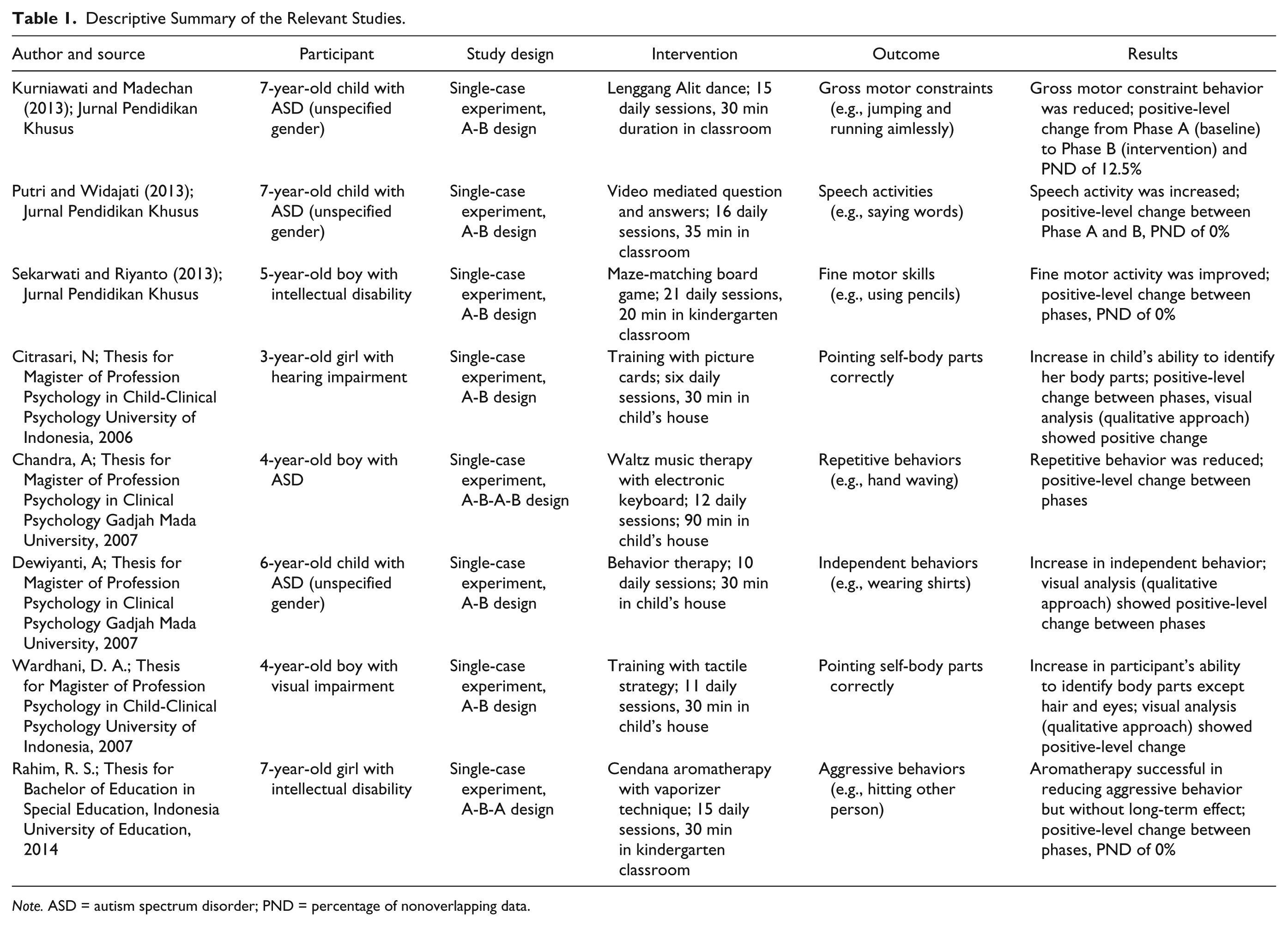
Note. ASD = autism spectrum disorder; PND = percentage of nonoverlapping data.
Chronological Distribution of Studies
Despite not limiting our search to specific dates, all of the included studies were relatively recent, with the oldest study being published in 2006 (Citrasari, 2006). Half of the included studies were published more recently between 2013 and 2014.
Geographic Distribution of Studies
Six of the eight studies examined interventions conducted in Java. This may be as a consequence of the fact that the hand-search of university libraries was confined to the four main institutions on Java, and the open access journal that published three of the included studies is published by a state university in Java (Kurniawati & Madechan, 2013; Putri & Widajati, 2013; Sekarwati & Riyanto, 2013). The other two studies (Chandra, 2007; Dewiyanti, 2007) did not cite the exact location, but were completed for fulfillment of a degree in Gadjah Mada University, the national university in Java.
Intervention Recipient
Participants included boys and girls aged between 3 and 7 years of age. Diagnoses included ASD (Chandra, 2007; Dewiyanti, 2007; Kurniawati & Madechan, 2013; Putri & Widajati, 2013), intellectual disability (Rahim, 2014; Sekarwati & Riyanto, 2013), hearing impairment (Citrasari, 2006), and visual impairment (Wardhani, 2007). Thus, the extant research has considered both physical and mental health disabilities, with a particular focus on ASD.
Range of Interventions
The studies examined a variety of programs with implementation length from 6 days (Citrasari, 2006) to a period of 3 weeks (Sekarwati & Riyanto, 2013), with between six sessions (Citrasari, 2006) and 21 sessions (Sekarwati & Riyanto, 2013) conducted. The two studies addressing physical impairment (Citrasari, 2006; Wardhani, 2007)) included skills-based training for the children to identify parts of their body so as to improve “self-awareness.” A therapeutic approach was utilized by three studies: specifically, Cendana aromatherapy (Rahim, 2014), behavior therapy (Dewiyanti, 2007), and music therapy (Chandra, 2007). The other three studies used various interventions, including traditional dance, a board game, and question and answer activity.
Thus, six of the eight studies examined interventions incorporating universally available resources such as the maze-matching board game (Sekarwati & Riyanto, 2013), behavior therapy (Dewiyanti, 2007), and picture cards (Citrasari, 2006). Two studies employed local approaches including the Lenggang Alit dance (Kurniawati & Madechan, 2013) and Cendana wood unique to Indonesia and nearby areas (Rahim, 2014). The interventions addressed all areas of early childhood development: cognitive (Citrasari, 2006; Wardhani, 2007); sensory motor (Chandra, 2007; Dewiyanti, 2007; Kurniawati & Madechan, 2013; Sekarwati & Riyanto, 2013), communication (Putri & Widajati, 2013), and social-emotional (Rahim, 2014).
Research Designs and Outcomes
All of the studies used the single-case experimental design with outcomes presented as the frequency of the targeted behavior at each data collection period. This outcome measure was obtained through observation by the researcher who also provided the intervention.
Results of the Included Studies
All studies reported improvement on outcomes. Data were typically presented in graphical format that was often difficult to assess (Citrasari, 2006; Wardhani, 2007). Results were frequently presented in relation to percentage of nonoverlapping data (PND) which is the extent to which data in the baseline (A) versus intervention (B) phases do not overlap, suggesting an improvement in outcomes where there is little or no overlap (Parker & Vannest, 2009). Three studies reported 0% PND (Putri & Widajati, 2013; Rahim, 2014; Sekarwati & Riyanto, 2013). One study (Kurniawati & Madechan, 2013) reported 12.5% PND, while four studies did not specify PND, but still claimed that the interventions were effective as per increases or decreases in the frequency of the targeted behavior (Chandra, 2007; Citrasari, 2006; Dewiyanti, 2007; Wardhani, 2007).
Analysis of the Studies as a Whole
Overall then, the body of literature is small with interpretation severely hampered by limitations in research design, data analysis and reporting, and the potential for researcher bias. A central limitation of the research relates to the ways in which disability was defined. Most of the studies examined very specific forms of disability, such as ASD, and thus did not consider the broader environmental context. Some studies referred to “children with special needs” instead of “children with disability.” The use of the term “children with special needs” highlights the emphasis on education in relation to children with disabilities, as this term is typically used in Indonesia only in an educational context (Citrasari, 2006; Kurniawati & Madechan, 2013; Rahim, 2014; Sekarwati & Riyanto, 2013). This emphasis could be due to the fact that Indonesian law has particular provisions related to the right to education for children with special needs, including “special” education if appropriate (Primus, 2014). Another shortcoming is that none of the included studies made statements regarding approval from properly constituted human research ethics committees.
Discussion
This scoping review explored the existing literature about interventions designed to support the development of young children with disabilities in Indonesia. Despite the scale of childhood disability, this is the first published review that we are aware to form a coherent picture of current knowledge. Only eight articles met the inclusion criteria and none of these were published in international journals. More research might have been found however, had we extended our search of university libraries given that this was one of the main sources of the identified research. This finding might also apply to other low- and middle-income countries where publishing is mainly done in domestic platforms.
Intervention Date and Site
The chronological distribution of the studies indicate that it has only been in the last 12 years that researchers have paid attention to researching interventions for young children with disabilities. This situation is similar to that of other countries in the South-East Asia region (e.g., Cambodia, Vietnam), which typically pays more attention to adults with disabilities (SEARO-WHO, 2012). At the same time, the fact that half of the included studies were published recently could be viewed as a signal of a positive momentum to address the challenge of caring for young children with disabilities.
The geographical focus of the research deserves note and highlights the disparity of research being conducted between the main island of Java and other jurisdictions in Indonesia. This finding has also been noted in reviews of research about disability from other low- and middle-income countries such as Vietnam (Ha, Whittaker, Whittaker, & Rodger, 2014) and Namibia (Coomer, 2013). Certainly, the geographic spread of Indonesia across a vast archipelago makes the dispersion of resources more difficult, and our results highlight the need for programs and research that take account geographical location, as environmental risk and poorer access to services are more acute outside of the main centers.
Nature of Intervention
A wide range of interventions were employed including two that utilized local resources—specifically Lenggang Alit dance and Cendana aromatherapy. Lenggang dance is native to the Malayu or Melayu tribe and has many variations (Jakarta Tourism & Culture Office, 2015), while Cendana is a wood that can be easily found in East Nusa Tenggara province, Indonesia. Cendana oil has been used for many purposes, including aromatherapy (“Mengembalikan harum cendana,” 2010).
This may reflect the movement within Indonesian universities to utilize local knowledge and resources in the design of locally specific interventions (Sugiarto, 2015). This is occurring in alignment with the position that local knowledge will be more suitable to explain and solve local challenges rather than generalized research from the so-called “WEIRDos” (Western, Educated, Industrialized, Rich, and Democratic) countries (Jones, 2010). This particular movement is also taking place in other countries in Asia, namely, South Korea, Philippine, China, and Taiwan (Kim, Yang, & Hwang, 2006), and indicates that we can expect more of locally specific intervention research in the future.
Objective of Intervention
The studies were broad in terms of the developmental aspects addressed and included cognitive, sensory motor, communication, and social-emotional focus. This is exceptional considering the dearth of research, workforce, and services in Indonesia. It might be partly explained by the disciplinary background of the researchers, which included both psychology and special education. However, the lack of involvement of social science researchers and practitioners is curious, considering that the Ministry of Social Affairs is the leading agency tasked with to tackling disability issues in Indonesia.
Noticeably, none of the interventions took account of environmental risk and focused directly on the specified disability suggesting a narrow individualistic approach. This narrow approach is in contrast to that indicated in other reviews from countries such as Tanzania which document that environmental conditions are readily incorporated into research from that country (Njelesani et al., 2011).
Methodology and Duration of Intervention
The included research was generally of poor quality. The single-subject design used in the included studies is popular for examining the efficacy of interventions for children with disabilities, as it is simple and less complex than other approaches (Cook & Bennett, 2014). The choice of design might have been additionally influenced by the difficulties with recruiting participants due to stigma, an environmental risk factor that is at play in much of Indonesia (WHO, 2011) and other low- and middle-income countries (WHO, 2012). Nevertheless, more research using robust designs with pre-powered sample sizes is necessary to improve outcomes for children living with disabilities in these settings.
The review also indicates that improvements in research procedure and especially ethics oversight is needed to avoid harm. Furthermore, the included interventions appeared to be very time and resource intensive, occurring averagely 2 weeks and conducted by a trained professional (albeit a student). Such an approach is unlikely to be able to be disseminated at the scale required to improve outcomes at the population level given the dearth of workforce and services.
Implications for Disability Rehabilitation
The results from this review indicate an emphasis on home- and class-based interventions with a lack of research about community-based interventions. This is concerning given WHO reports indicating that such an approach is ubiquitous in the South-East Asia region (SEARO-WHO, 2012). There is clearly a need to improve the documentation of community-based rehabilitation as well as to better prepare workers in this area to utilize local resources to take account of the inter-related effects of disability and poverty (van Pletzen, Booyens, & Lorenzo, 2014).
Future Research
This review should provide useful information for policy makers and practitioners working with young children with disabilities in low and middle-income countries such as Indonesia.
Development of evidence-based interventions utilizing local resources is critical. Available resources such as religious leaders (e.g., priests, ustads) and other local practitioners may address the issue of access by offering people-centered, integrated primary health services such as suggested by the Global Strategy for Health (Campbell, Admasu, Soucat, & Tlou, 2015). Internet-based approaches may also be beneficial considering the Indonesian government’s recent efforts to improve Internet-access (Noor, 2015), which is also happening in other low- and middle-income countries (West, 2015). Taken together, initiatives such as these might prove to be useful in improving access to basic and targeted services thus assisting Indonesia and other low- and middle-income countries to achieve global development goals such as those recently restated by the United Nations (2015).
Conclusion
This scoping review provides an overview of the current available evidence regarding interventions designed to support the development of young children in Indonesia. The fact that only eight articles with minimal quality were found after searching the published and unpublished literature highlights the need for more contextually relevant research. This review highlights the need for more research to ensure access to evidence-based, context-specific, and culturally appropriate services to address childhood disability in Indonesia and other low- and middle-income countries.
Footnotes
Declaration of Conflicting Interests
The author(s) declared no potential conflicts of interest with respect to the research, authorship, and/or publication of this article.
Funding
The author(s) disclosed receipt of the following financial support for the research, authorship, and/or publication of this article: The first author is sponsored by the Indonesia Endowment Fund for Education (LPDP) for this study and the whole PhD program in The University of Adelaide.