




Abstract
Building a music city has become the vision of a few governments. Previous studies have argued that people, venues, and economic scale represent the strength of a music city, failing to see the correlation between the three and neglecting the economic impact of participant networks and experiential atmospheres. This study constructed a PSA assessment framework based on the theory of social network, scene, and atmosphere. It used a panel data regression model to explore the impact of the performing arts network, scene, and atmosphere on the performing arts industry. The results show that performing arts practitioners, performing arts enterprises, conservatories, professional spaces, seating capacity, performance events, and number of audience participation have a facilitating effect on the performing arts economy. In contrast, performance associations and entertainment spaces have a negative effect. Further research found that entertainment space had a negative effect on the performing arts economy because the statistics department did not include entertainment space revenues in the performing arts economy. By analyzing 7 years of data from 31 provinces in China, the study aims to provide Chinese experience and evidence for the study of music cities, with a view to providing reference suggestions for the construction of music cities worldwide.
Plain language summary
The contributions of this study are threefold: (1) Clarifying the concept of music cities. (2) Synthesizing the conclusions of previous qualitative studies by distilling their viewpoints into three overarching concepts and nine sub-variables, thereby developing an original and scientifically validated framework for evaluating music cities, which lays a solid foundation for future quantitative research. By doing so, the study contributes a practical tool for policymakers and urban planners to assess and design music cities systematically. (3) Regression results challenge past conclusions by revealing that performance associations and entertainment spaces do not always yield positive economic effects. Furthermore, heterogeneous analysis reveals that research results vary between high-economic and low-economic regions. In response to these findings, the study provides a detailed explanation of the underlying reasons and offers corresponding government policy recommendations. It provides warnings and important insights for cities aiming at developing the music city model.
Introduction: From Creative to Music
The consumer behavior of watching performances across cities and countries is particularly prominent in the performing arts industry, and the resulting spillover effect, which brings visible economic growth to tourism, catering, hotels, transportation, and other industries, can hardly fail to attract the whole society’s attention. More and more local governments are beginning to pay attention to the benefits of live performances and have introduced policies to try to seize the crown of “music city.” This is because developing the performing arts industry means becoming a more vibrant city, stimulating a thriving economy, and thus providing officials with a better track record. At present, there is no consensus on the definition of “music city” in academic circles, and there are three different views on the definition of this concept. The first view is economic values: this view holds that music cities are not only cities with large music industries and rich activities but also symbols of urban vitality and economic strength (A. Baker, 2019, 2021); the second view is superstar view: this view emphasizes that music cities are cities that can gather artists at the top of the pyramid. These artists not only have exceptional musical talent but also have a wide influence and fan base on a global scale, and their presence brings a unique musical atmosphere and cultural charm to the city (Florida, 2015); the third view is the number of venues: this view emphasizes the large number of historical performance venues owned by music cities. These venues are not only important carriers of music activities but also important symbols of urban music culture inheritance and development (Johnston, 2012, 2013). However, these views are one-sided, especially since the number of superstars and music venues does not determine whether a city can be called a music city (Darchen et al., 2023). They fail to see the correlation between the three perspectives, such as that performance activities are composed of people, venues, and events and that performance value and knowledge production are born from networks of participants and spatial venues (Granger, 2020). Therefore, there is a causal correlation among the three existing perspectives of music city, and the latter two have a promoting effect on the former. Secondly, the existing definition of a music city also ignores cultural factors. From the perspective of music development history, there are many regions in the world that have been circulated as music cities by folk, such as Vienna, which is famous for classical music, New York City for dark punk music, Nashville for country music, and Berlin for electronic music. These cities were the birthplace of leading music culture (style, celebrity, composition, and atmosphere), making them ideal locations for record labels, music companies, and associations of the time (Bader & Scharenberg, 2010; Hill, 2016), while their legacy became tourist destinations (Cantillon et al., 2023). Therefore, cultural factors are not only an important part of a music city but also the source of its uniqueness and attraction. To sum up, this study believes that music cities refer to those cities that show rich diversity and vigorous development in music talents, industries, and cultures, attract a large number of practitioners and tourists to perform and experience, and thus gain wide recognition. The performing arts economy in cities relies on people’s social networks, spaces dedicated to performance and production, and cultural atmospheres for experiential consumption.
The rise of music cities is closely related to the emergence of creative cities, as many concepts of music cities are derived from the development of creative cities (A. J. Baker, 2017; T. Bennett, 2020; Homan, 2014). Firstly, it is widely acknowledged in academia that creative cities are a combination of cultural economies and creative industries (Cooke & Lazzeretti, 2008). Building creative cities has been regarded as an urban development strategy (Landry, 2012). By fostering the 3Ts (Talent, Technology, Tolerance) and the 3Cs (Creative Class, Creative Infrastructure, Culture), cities can attract creative classes, thereby generating considerable economic revenue (Florida, 2005). Similarly, A. J. Baker (2017) and T. Bennett (2020) argued that the concept of music cities was also proposed by cultural teams as an abstract notion aimed at advancing policy agendas and urban marketing. By promoting live performances and music festivals, cities can attract tourists and audiences, which in turn benefits tourism and other industries (T. Bennett, 2020; Gibson & Connell, 2011). The practice of branding places as music cities has recently been embraced by various Chinese cities, including Beijing, Shanghai, Guangzhou, and Macau, with governments introducing policies that explicitly aim to develop music cities and improve cultural infrastructure. From the perspective of urban development, both creative and music cities can be regarded as urban development strategies aimed at enhancing competitiveness. Both emphasize the construction of public infrastructure to provide residents and tourists with a comfortable and convenient urban environment. Additionally, both strive to enhance nightlife and cultural vibrancy through creative activities, thereby fostering a positive urban image (Nofre et al., 2018). Consequently, perspectives and measures from creative city research offer valuable lessons for the development of music cities. However, there are differences in the specific focuses and roles of the two concepts (see Figure 1). For instance, creative cities emphasize the scale of the creative economy and the needs of the creative class for creative infrastructure. In contrast, music city planners often focus solely on attracting consumers through live music events, aiming to generate economic benefits for other industries while neglecting the demands of the performing arts sector in terms of production, education, and other aspects. This has led to a disjointed development of music cities, as observed in Europe (Quinn, 2020) and Australia (Darchen et al., 2023). In order to warn other cities under construction or soon to be built, attention needs to be paid to how to avoid this.

The object, method, and impact of developing a music or creative city.
Research on creative cities has been developing for decades, thanks to the launching of the Creative Cities Network (UCCN) by UNESCO in 2004. This organization categorizes UCCN into seven creative areas: crafts and folk arts, design, cinema, gastronomy, literature, media arts, and music. How to create a capital of gastronomy and cinema has thus been widely discussed in academic circles, but music has often gone unseen, even though it has been an important part of the development of cultural industries and is often used as one of the strategies of creative cities. While creative cities, including their several derivative labels and corresponding assessment indices, are two of the more popular research themes in the creative field, the development of music cities has always suffered from two problems. The first lies in the absence of a distinctive analytical framework, namely, which factors contribute to the growth of music cities? The second is whether music cities require the same emphasis on human capital as creative cities. Therefore, when redirecting the research perspective to the music city itself, this study endeavors to draw upon the empirical model of creative cities and puts forward a novel creative index named the PSA model (Performing Arts Network, Scene and Atmosphere) based on the particularity of the music industry in an effort to fill the gap in this domain.
Literature Review: Theoretical Foundations of the PAD Model
In order to develop an evaluative model for assessing the size of music cities (i.e., the PSA model), this paper first revisits the predecessor of the creative city by examining the discussion on urban creativity. Prior to the 1980s, scholars such as Marshall, Robert Park, and Jane Jacobs unanimously viewed well-established industries and their symbiotic network clusters as prerequisites for urban creativity. Subsequently, the impact of networks on the music industry is reviewed, revealing their persistent influence on its development. For example, in the 1970s, the rise of punk music was closely linked to the network. Musicians, bands, record labels, and agencies quickly connected via the network (venues, magazines, and word of mouth), and the punk DIY spirit spread. Great musicians met each other and formed bands through the network, and successful bands were mined, signed, and promoted by brokerage companies through the network. The network has fostered a large audience for punk music and led to the development of related industry chains, including clothing production, album sales, instrument manufacturing, music festivals, etc. (Crossley, 2014). It can be seen that the network not only accelerated the spread of punk music but also promoted the growth of the British performing arts economy to a certain extent. A similar example is The Record Pool in Disco Music, which links record labels, DJs, and discos together to form a network that shortens the path and time of music transmission. Many big-city DJs receive the latest music quickly and regularly, and DJs experiment with it in dance halls and then provide live audience feedback to record labels so they can adjust production direction or optimize marketing strategies more quickly (Stibal, 1977). These cases reflect that the network promotes the prosperity of music and also drives the development of related industrial chains. Are they equally important to the construction of music cities? Nevertheless, amidst discussions on musical cities, the concept of spatial scenes has emerged as a prevalent topic among scholars from diverse fields. One notable example is the expansion of the “place scene” concept, originally introduced by Straw (2004, p. 80) in urban studies, into the realm of musicology. Musicologists study music not only as a text, esthetic, or industry but also how place influences the production and dissemination of music (Homan et al., 2021, p. 6; Woo et al., 2015, p. 287) There are also scholars in the fields of economics (Florida, 2014, 2015) and sociology (A. Bennett, 2004, 2017) who have been involved in the discussion of the spatial scene’s impact on the practice, production, dissemination, and consumption of music. Some may question why the spatial scene is important to the music city. Florida et al. (2010, p. 78) argue that because live music is, in theory, highly sensitive to distance, meaning that performers and consumers need to be within the same spatial scene in order to produce and consume, cities need to provide adequate venues. However, to assess a city’s creative production and consumption experience, network and scene theory alone is not enough. Therefore, finally, returning to the field of urban studies, there is a theory about the atmosphere that is starting to be noticed by scholars. The atmosphere is thought to influence spatial properties and sensory experiences (Böhme & Thibaud, 2016); the atmosphere created by the combination of musical performances and the daily life of the city affects the perception of the city. (Michels & Steyaert, 2017) It may even be a reason to attract music businesses and associations to the area (Bader & Scharenberg, 2010, p. 7). Inspired by their theories, this study innovatively draws on the theories of “social network,”“scene,” and “atmosphere” and tries to put the three theories into a unified analytical framework for in-depth elaboration. This attempt at interdisciplinary integration is a great improvement over the existing theories of social networks, scenes, and atmospheres. This interdisciplinary integration has not been attempted in existing research, and it provides new theoretical tools and analytical perspectives for understanding complex socio-cultural phenomena, which is expected to fill the research gaps in related fields. Despite the close relationship between music cities and creative cities, this study does not simply emphasize creative human capital (creative class) as Florida (2005)and Yum (2020) do, nor does it ignore Bourdieu’s theory of cultural capital proposed by references in Yum’s 3C model (people, buildings, and venues), but instead it arrives at the model after careful consideration of considering creative human capital as a link in the social network (see Table 1 ).
3T, 3C and PSA Model Differences.

Performing Arts Networks
Social networking refers to the social connections or relationships that participants may utilize in the process of building a new business (Greve & Salaff, 2003). It’s easy to observe social networks in the creative industries (Chen et al., 2017) Because creative work relies heavily on interaction and collaboration (McAndrew & Everett, 2015). Social networks are still used by the art world to find work, disseminate information about their work, learn about emerging artists, and communicate with each other (Currid-Halkett, 2009). When the concept of social networking was introduced to the performing arts industry, the performing arts network formed by the interaction between participants also began to attract attention (Crossley, 2023; Emms & Crossley, 2018; Sedita, 2013). For example, organizing a performance involves the participation of multiple stakeholders. Maintaining contact with other artists, performance organizers, and vendors can effectively address special circumstances, such as the temporary absence of performers and the urgent borrowing of musical instruments, costumes, lighting, and audio equipment. Or perhaps a music major with a formal education at an institution of higher learning can use networking connections to showcase his or her talent to patrons, agents, and publishers during a music career. Although virtual, online, and digital networking relationships are currently widely discussed by academics in the field of social networking, just as the production of a song can be a joint effort of people from different regions and time zones around the globe (Watson, 2012). However, because the performing arts industry has not yet been able to replace the live experience for the audience, live performances, often in the form of projects, will need to be sustained by a realistic performing arts network more than any other industry. Scott (2010) considers social networks as an integral part of creative cities, cultural economies and urban creativity. with a large body of qualitative studies demonstrating that social networks play a key role in the success of creative entrepreneurs (Chen et al., 2015, 2017) and individual musicians, and participants in the network (practitioners, businesses, schools, associations, etc.) have also been considered to have an impact on the development of the creative economy (Chapain & Comunian, 2009; Crossley et al., 2014; Dovey et al., 2016; Hield & Crossley, 2014), Yet could the positive effects of participants on the creative economy be equally observed in the performing arts economy? Practically speaking the social network participation base may be a prerequisite for the prosperity of the performing arts economy, that is, if the social network in the performing arts economy has a sufficiently large number of participants, is the economy likely to be more prosperous? Given the above reasoning, four hypotheses are developed:
Scene
The performing arts industry, more than any other industry, relies heavily on scenarios for value production, knowledge dissemination, and shared experiences (A. Bennett & Rogers, 2016; Carah et al., 2021; Okwulogu, 2024; Picaud, 2023; Watson et al., 2009). Although Florida (2005)argues that companies will pursue the creative class, the cases of Berlin and Minneapolis demonstrate that it is the musical scene and atmosphere that actually attract businesses to relocate (Bader & Scharenberg, 2010; Hagar, 2008). Because economists believe that participants such as practitioners, businesses, and suppliers will interact with each other in an informal manner within specific scenarios (such as bar gatherings; Currid-Halkett, 2009; Picaud, 2023), the scenario is viewed as a location where participants engage in networks (Lobato, 2006). Therefore, A. J. Baker (2017) proposed a qualitative framework, arguing that Live music venues are one of the key indicators for building a music city. However, it is not easy to assess the impact of creative infrastructure, including venues and seating capacity, on the local creative economy (Chapain & Comunian, 2009). Baker also fails to define the scope of Live music venues. For instance, live music spaces are categorized into Adopted spaces, Adapted spaces, Created spaces, Mobile spaces (Kronenburg, 2013), and Fabricated spaces (Cashman, 2013). How to measure the relationship between these spaces and the economy, and even how to categorize the numerous venues, poses a challenge. However, using a binary perspective, it can be observed that professional and formal performance spaces (such as theaters, auditoriums, and concert halls; Carter, 2002; Emms & Crossley, 2018; Weber, 2017) and casual, informal entertainment spaces (like bars and live houses) collectively contribute to the construction of a musical city (Charman & Govender, 2020; Gibson & Homan, 2004; Victoria, 2011). Therefore, in order to examine the effectiveness of music scenes division and their capacities on the performing arts economy, the following hypotheses are proposed:
Atmosphere
Atmosphere is a complex and multidimensional concept. In the disciplines of music and marketing, atmosphere emphasizes how sound interacts with the surrounding environment. Cultural scholars argue that in environments filled with music, everyone can perceive the atmosphere (Riedel, 2019). This atmosphere has been proven by marketing scholars to have significant benefits in facilitating order completion (Keikhai & Naseri, 2024), achieving higher consumption (North et al., 2000), shaping brand images, and enhancing customer perceptions (Hwang & Oh, 2020). In the fields of tourism and urban studies, the atmosphere is often used to describe the cultural vitality and attractiveness of a city or region (Di Croce & Bild, 2024; Ho & Szubielska, 2024). Taking Lisbon and Guangzhou as examples, this atmosphere can be created through the hosting and practice of performing arts (J. Lin et al., 2024; Paiva & Sánchez-Fuarros, 2021). Customers are attracted by live performances and festivals (Kay Smith et al., 2022), and the atmosphere created by these live performances can strengthen the perceptions of residents and tourists toward the city (A. Bennett & Rogers, 2014), thereby leaving impressions of the city as energetic or lifeless (Waitt et al., 2020). Therefore, urban planners have always sought to enhance the benefits of the atmosphere by providing a richer variety of cultural products. However, economists point out that there is no causal relationship between cultural supply and performing arts consumption (Rodríguez-Puello & Iturra, 2024). Further analysis reveals that the variable used by these economists for cultural supply, which is based on data on cultural practitioners, may be controversial. Therefore, regarding how to select variables to measure the cultural atmosphere of a city, Chapain and Comunian (2009), from a qualitative perspective, suggest starting with quantitative indicators such as the frequency of urban cultural events and the scale of participant engagement. This is because a larger audience for music consumption indicates a stronger musical atmosphere in the region, which in turn attracts more musicians (Rushton, 2013). Taking Melbourne, Austin, and Berlin as examples, a higher frequency of performances usually means fiercer competition. Interestingly, this competition instead contributes to a stronger musical atmosphere in the city. Musicians are more inclined to perform in public places such as streets to earn extra income or gain exposure (A. Baker, 2019). In summary, the musical urban atmosphere emerges from the interaction between live performances and participants, and the atmosphere can be judged as intense or sparse based on the frequency of performances and the scale of participant engagement. Considering the importance of performance events and audience participation to the performing arts, it is reasonable to believe that they can also promote the performing arts economy. Based on the above literature review, the following hypothesis is derived:
Methods and Data
PSA Modeling
Previous studies have predominantly employed qualitative methods to describe the importance of performing arts networks, scenes, and atmospheres to the music industry, yet they lack substantial evidence. Given that multiple regression equations are widely used in economics to test the influence of various factors on industry scale, this study will adopt a mixed method combining qualitative and quantitative approaches. By summarizing previous research, the PSA model is divided into three major categories (performing arts networks, Scene, and atmosphere) and nine subcategories. Furthermore, we will utilize Stata to establish a PSA panel data model for regression analysis. The regression formula is as follows:

Where β0 represents a constant term, i denotes province, t denotes year, λ is an individual fixed effect, and ε is the error term. PAES stands for the economic scale of the performing arts industry and is used as the explanatory variable in this study. Performing Arts Practitioners Index (PAPindex) is considered the core variable, aiming to test the importance of human capital in the economy of the performing arts. PAPindex is measured by referring to the creative class index of Florida (2005)and Yum (2020), using the total number of people in the cultural services industry is divided by the number of people employed in performing arts venues plus performing arts enterprises multiplied by a percentage, and the formula is expressed as:

As for performing arts enterprises (PAE) and audience participation (AP), etc., which are used as control variables, the specific abbreviations and pronouns of the variables are sorted out with reference to previous literature (see Table 2).
PSA Model Abbreviations and Interpretations.

Data Sources and Descriptive Statistics
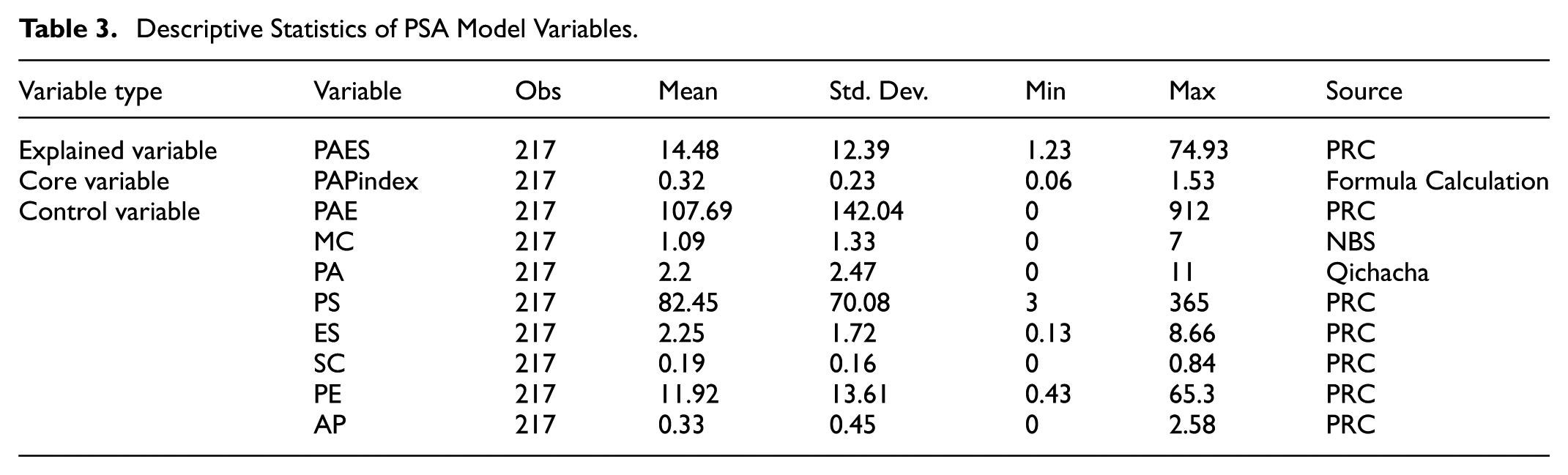
In this study, the relevant data from 31 provinces in China from 2015 to 2021 are summarized and processed from the China Urban Statistical Yearbook published by the Department of Urban Social and Economic Surveys of the National Bureau of Statistics (NBS), as well as the China Statistical Yearbook of Culture and Tourism published by the Ministry of Culture and Tourism of the People’s Republic of China (PRC) annually. Among them, the total number of employees in the cultural service industry used for calculating the PAP index is sourced from the National Bureau of Statistics (NBS), while the data on the number of employees in performing arts venues and enterprises is sourced from the People’s Republic of China (PRC)’s relevant authorities. The specific calculation formula is as shown in the previous text; PA is obtained by the author through annual statistics from Qichacha based on the registration years of performing arts associations. Descriptive statistics of the relevant variables are shown in (Table 3).
Descriptive Statistics of PSA Model Variables.
Analysis of Empirical Results and Discussions
PSA Model Fixed Effects Regression Results and Discussions
Initial regression analyses were conducted on the control variables, with Model 1 indicating statistically significant correlations between these variables and the performing arts economy. Subsequently, the core variable (PAPindex) was introduced. Model 2 demonstrates that:
(1) H1a-c were supported, while H1d was rejected: The significantly positive coefficients for H1a-c indicate that practitioners, enterprises, and music colleges positively contribute to the performing arts economy. The validation of H1a aligns with Florida’s emphasis on human capital as a driver of economic output. Empirical results demonstrate that a one-unit increase in the Performing Arts Practitioners Index corresponds to a 7.230-unit rise in the performing arts economy. From a social network theory perspective (Greve & Salaff, 2003), growth in enterprise numbers enhances network node density, facilitating efficient flows of capital, projects, and talent. The confirmation of H1b indicates that each additional enterprise elevates the performing arts economy by 0.016 units, underscoring firms’ role in connecting practitioners, venues, and markets. This finding resonates with C.-Y. Lin (2018), who identified creative enterprises as catalysts for cultural economies, confirming their capacity to activate local performing arts ecosystems. Similarly, H1c’s validation is consistent with Mehrabani et al. (2022), who broadly observed art schools’ positive impact on creative industries. This study specifically quantifies music colleges’ contribution: each additional music college increases the performing arts economy by 8.578 units. Conversely, H1d is statistically insignificant and exhibits a negative coefficient, rejecting the initial hypothesis that performance associations positively influence the economy. Empirical evidence indicates these associations exert a suppressive or inhibitory effect on the performing arts economy.
Although, from both practical and academic perspectives, performance associations play a pivotal role in the performing arts network by facilitating information sharing, knowledge dissemination, and even funding acquisition for businesses and practitioners. On the other hand, performance associations can sometimes bring regulatory pressures on businesses, hindering their development (Yao et al., 2022). An excessive number of associations may lead to competition, resulting in the dispersion of credibility and weakening their normal functioning. Therefore, in the construction of music cities, the number of performance associations should be reasonably controlled to avoid exceeding actual demand. For instance, the establishment of associations should meet or address specific industry needs, with each association having a clear area of responsibility within the industry (Dutt et al., 2016). Alternatively, encouraging performance associations to operate as alliances can be effective. The UK’s LIVE (Live Music Industry Venues Entertainment) serves as a prominent example: a coalition of 15 music industry associations representing thousands of entrepreneurs and tens of thousands of performing arts practitioners, LIVE focuses on addressing artists to tour internationally, ticket fraud, and legislative matters, ensuring that the industry’s needs and challenges are effectively communicated to all relevant stakeholders in a timely manner.
(2) H2a and H2c were supported, while H2b was rejected: Significantly positive coefficients for H2a and H2c confirm that professional venues (e.g., theaters, concert halls) and seating capacity enhance the performing arts economy. This finding empirically substantiates prior qualitative assertions by Guo Lufang and Hao (2017) and C. Lin and Lv (2016) regarding the critical role of performance infrastructure. Specifically: Each additional professional venue increases the performing arts economy by 0.103 units. Each unit increase in seating capacity contributes 9.980 units to economic growth. The relatively limited economic stimulus from professional venues (H2a) stems from their prioritization of cultural value and social impact over pure financial returns. These spaces predominantly host artistically refined productions (e.g., classical music, experimental theater) with inherently niche audiences. Thus, while statistically significant, their per-unit economic contribution remains modest compared to other variables. Conversely, seating capacity (H2c) exerts a stronger influence by directly enabling scaled audience participation and box office revenue (Mehrabani et al., 2022). Expanded capacity permits large-scale productions with higher ticket sales potential, thereby generating more substantial economic returns. Notably, H2b exhibits a significantly negative coefficient, rejecting the initial hypothesis. This contradicts A. J. Baker (2017), who posited that entertainment spaces (e.g., bars, cafes) foster music career development and talent cultivation.
Regarding the result that H2b does not hold, in reality, entertainment spaces do contribute to the development of the performing arts economy. As an important part of the performing arts scene, entertainment spaces often give consumers great autonomy with lower admission fees and stronger interactions. As alternatives to medium and large-scale professional spaces, these venues are often more conducive to incubating avant-garde or small-scale performing arts works. It has become normal for a new generation of performers to perform in venues outside the traditional realm (Pitts, 2020). A large number of young consumers are attracted to entertainment spaces based on motives such as low ticket prices (Westgate, 2020), following performers, and discovering new entertainment (Perron-Brault et al., 2020). Professional spaces and entertainment spaces compete for young customers. However, the reason why H2b does not hold could also be that, according to China’s “Classification of National Economic Industries,” statistical departments only include the revenue of venues such as concert halls, theaters, and operas as part of the performing arts economy in their industry statistics. Entertainment spaces like bars, clubs, and Live houses, although in recent years, it has become common for them to offer live performances from a niche space into the current more popular young people’s cultural consumption space (Zhang & Xiao, 2023). However, when these venues were established in the early stage, their business essence was more to provide catering services, and these companies often registered their industry ownership in the catering service industry rather than the performing arts industry in order to more easily obtain the catering business license and pass the relevant approval. This results in the situation that, as more and more performers and audiences flock to entertainment spaces, statistically, the increase in entertainment spaces does not necessarily contribute to the performing arts economy. It may even inadvertently “divert” some young performing arts customers, thereby reducing the scale of the performing arts economy.
The unsupported result of H2b can also be traced back to (Hume, 2008), who believes that customers may prefer venues that allow eating, drinking, and more interaction compared to the strict rules enforced in concert halls, such as silence and no photography. In these venues, the distance between performers and audiences is infinitely shortened (Kelle, 2024), and audiences can enjoy a freer and more intense experience (Sanderson, 2021). This immersion and tacit understanding cannot be provided by concerts, cinemas, or digital media (Sanderson, 2021). In short, the services provided by entertainment spaces (such as allowing eating and drinking, close interaction, etc.) offer consumers an experience distinct from professional spaces, with the ability to attract a broader range of customers (including but not limited to those of traditional theaters; Behr et al., 2020). In reality, they do make a positive contribution to the performing arts economy. However, since the revenue data of entertainment spaces is not included in the performing arts economy, the statistical results show that it has a negative effect on the performing arts economy. In the future, relevant departments can consider leveraging the power of entertainment spaces in the process of building music cities by including them in the scope of subsidies for cultural consumption vouchers or providing subsidies to spaces with box office revenue reaching a certain amount to incentivize them to change their industry codes and join the performing arts industry.
(3) H3a-b were supported: The significantly positive coefficients of H3a and H3b indicate that both the frequency of performance events and the number of audience participants can promote the performing arts economy. For every one-unit increase in performance events and audience participation, the performing arts economy grows by 0.090 and 3.958 units, respectively. The validation of these two hypotheses also indirectly supports the ambiance theory (A. Bennett & Rogers, 2014). That is, active performance events and a large number of audience participants will make the urban music ambiance increasingly vibrant, ultimately serving as a driving force for the development of the performing arts economy and promoting its growth. The reason why the frequency of performance events shows a relatively less pronounced promoting effect on the performing arts economy in the regression results is that a high frequency of performances does not necessarily equate to good attendance rates and positive word-of-mouth. Beyond generating direct box office revenue, substantial audience participation increases ancillary income for performing arts enterprises through purchases of beverages, apparel, and souvenirs. As these revenues are fully incorporated into the performing arts economy, audience participants demonstrates a statistically significant stimulative effect on its development. Therefore, audience participation has a significant promoting effect on the performing arts economy. Lastly, both Model 1 and Model 2 demonstrate robust explanatory power and significance, as indicated by their high R2 and F values (see Table 4).
PSA Model Fixed Effects Regression Results.

p < .01. **p < .05. *p < .10.
PSA Model Robustness Analysis
To further examine the robustness of the PSA model, this study employs the following three testing methods: (1) Increase control variable: With reference to the 3C model, the number of libraries (LA) and museums (ME) has been added as control variables. The data indicates that the significance of each variable is largely consistent with the baseline regression results. (2) Adjust the sample period: To test whether the model might be affected by the pandemic period, leading to unstable results, we followed the approach of Li and Zhang (2023) by restricting the sample period to pre-pandemic years (i.e., 2019) for regression analysis. The results show that performing arts practitioners, performing arts companies, and music conservatories have a more significant impact on the economy, while the significance of other variables remains consistent with the baseline regression. (3) Excluding municipalities: Since the data for China’s 31 provinces includes four separately established municipalities (Beijing, Shanghai, Chongqing, and Tianjin), to avoid the influence of these cities on the results, this study follows Wang and Shao (2023) by excluding the data from these four cities and then performing regression analysis again. The variables remain significant, with little change in coefficients. However, it is noteworthy that the negative impact of the Performing Arts Association becomes more significant in this regression, suggesting that after excluding the municipalities, the inhibitory effect of the Performing Arts Association on the economy is more pronounced. Overall, the results of these three methods all pass the robustness tests, proving that the model is stable and reliable (see Table 5).
Robust Regression Results of PSA Model.

p < .01. **p < .05. p < .10.
PSA Model Heterogeneity Analysis and Discussions
To further examine whether the research findings vary across different environments and to provide a more comprehensive analysis of the interaction between variables affecting the performing arts economy, this study considers the potential synergy between performing arts practitioners and performing arts enterprises (papindex_pae_interaction). Specifically, an increase in the number of enterprises may attract more practitioners. Drawing on Li and Zhang (2023) and introducing interaction terms, the study employs a heterogeneity analysis by dividing China’s 31 provinces into high-economic and low-economic regions. The results indicate that: (1) In high-economic regions, performing arts practitioners, music college (educational resources), Professional space, and audience participation significantly contribute to the economy, whereas the number of Performance associations has a negative and significant impact on the economy. By calculating the Average Marginal Effects (AME), it is found that the marginal effect of Performance association is not statistically significant. At first glance, it seems that an increase in the number of performances does not significantly drive economic growth in the performing arts sector in high-economic regions. However, considering that a large number of artistic organizations in China annually conduct free public welfare performances in schools, communities, or rural areas, these non-profit artistic education activities are also included in the statistics of the number of performances, thereby affecting their performance in regression analysis. Additionally, there are indeed some poorly made performances on the market that rely on trends or successful replicas and are produced on a large scale but yield low returns (e.g., the rise of immersive concepts has flooded the market with works of varying quality). Therefore, for public welfare performances, it is recommended to adopt an independent statistical standard to separate them from commercial performance data. Secondly, appropriately balance the quantity and quality of performances, reduce the number of low-quality performances with monotonous content and high audience complaint rates, and introduce higher-quality foreign performance resources to meet the needs of different audiences while avoiding the homogenization and excessive repetition of performance types. (2) In low-economic regions, professional venues, seating capacity, and audience participation significantly contribute to the economy, especially audience participation, which has a more pronounced effect on economic growth in these regions. However, due to the underdeveloped market in low-economic regions, variables such as practitioners have not fully realized their potential. Therefore, in low-economic regions, local governments should strengthen the infrastructure construction of performance venues and seating to meet initial market demands. Subsequently, develop vocational training programs to improve the quality of practitioners, guide practitioners and enterprises to jointly develop locally distinctive performance works by fully tapping into local culture or human stories, and attract nonlocal audiences through subsidies or cultural tourism policies, thereby further activating the market. (3) Overall, the interaction term coefficients are not significant in both regions, which is likely due to the fact that the performing arts industry in China is still a young and relatively small industry, and statistical indicators are not yet comprehensive enough (e.g., the revenue of professional venues is not included in the statistics). The synergistic effect between enterprises and practitioners has not yet been fully observed in regional-level statistics. Therefore, to develop into a truly worthy music city, relevant personnel should still prioritize activating and enhancing the synergistic effect among various participants in the performing arts network. Meanwhile, infrastructure construction and the creation of a cultural atmosphere ensure the healthy development of the market (see Table 6).
Regression Results of PSA Model Heterogeneity.

p < .01. **p < .05. *p < .10.
Conclusion
Music City, as a derivative of the creative city, is a young and relatively niche research topic. Previous academic interpretations of the music city have struggled to form a consensus, arguing that (1) economic value, (2) superstars, respectively, and (3) maximizing the number of venues is what makes a music city. This study argues that there is a causal relationship between these three perspectives, with the latter two being one of the facilitators of the former, as performance value and knowledge production are born out of participant networks and spatial places. To test this hypothesis, a PSA model is constructed by referring to the 3T and 3C models, and data from 31 provinces in China are collected for panel data empirical analysis, which proves that Performing arts practitioners, performing arts enterprises, music colleges, and universities, performance spaces, spatial seating capacity, number of performances, and number of spectators have a positive effect on the size of a music city. Although Performing arts associations and Entertainment spaces show negative effects, in real life and in the longer term, the associations can act as a bridge between the industry and the government and play the role of a quasi-government or foundation, while Entertainment space is more capable of carrying and attracting more customers outside the theater. The scale of the music city, therefore, remains dependent on the social networks formed between people, the venue spaces dedicated to performance and production, and the experiential consumer atmosphere. The relevant government should pay attention to the above variables that affect the scale of music cities and appropriately increase subsidies or supplies for the variables so as to become a real music city.
Contribution
The contributions of this study are threefold. Firstly, this research addresses the debates surrounding the definition of a “music city” by incorporating cultural factors and historical music development to offer a refined concept: A music city is defined as one that “demonstrates diversity and vitality in music talent, industry, and cultural atmosphere, attracting practitioners and tourists for performances and experiences, and gaining widespread recognition as a result.” Secondly, while prior studies on music cities predominantly adopt qualitative approaches, this study introduces a quantitative perspective by employing theories of social networks, scenes, and atmosphere. The research integrates these theories into a structured framework consisting of three core concepts and nine subcategories, such as “professional space,”“entertainment space,” and “atmosphere,” with clearly defined variables. This framework, validated through empirical analysis, demonstrates originality and provides a scientifically sound foundation for subsequent quantitative research. Finally, the study empirically explores the influence of networks, scenes, and atmosphere on the performing arts economy, revealing that most variables in the framework significantly and positively contribute to economic outcomes. It also provides reasonable explanations and policy suggestions for variables, like performance associations and entertainment spaces, that sometimes exhibit negative impacts under specific conditions. By refining the conceptualization of music cities, introducing a validated and operationalized framework, and offering practical insights, this study advances both the theoretical understanding and practical development of music cities.
Limitations and Future Studies
This study has several limitations and areas for future exploration. Firstly, the research scope is limited to China, which restricts the generalizability and applicability of the findings. Future research could expand the scope to explore the characteristics and developmental patterns of music cities and the performing arts economy under different cultural, economic, and social contexts. Secondly, although the interaction term between performing arts practitioners and performing arts enterprises is not significant in the regional regressions, it still warrants further attention from future scholars, as its long-term synergistic effects may become evident, particularly as the industry expands and matures. Lastly, emerging forms of the music industry—such as online music performances, virtual music idols, and the integration of music with technology—potentially contribute to the development of the performing arts industry. However, two challenges hinder the macro-level observation and analysis of their impact: On one hand, companies in these industries often register under technology, internet, or manufacturing sectors to obtain subsidies, research incentives, or other funding rather than under the performing arts sector; on the other hand, performing arts enterprises, such as orchestras and theaters, face difficulties in quantifying and reporting their digital transformation benefits. Consequently, this study primarily focuses on the contribution of live performing arts to the performing arts economy. With the improvement of statistical frameworks and the maturation of emerging music industries, future research could investigate how these new forms of music industries promote the performing arts economy and contribute to the development of music cities.
Footnotes

Ethics and Informed Consent Statement
This study exclusively utilized publicly available statistical data. No human subjects, biological samples, or private information were involved, and no ethics documentation was required.
Funding
The author received no financial support for the research, authorship, and/or publication of this article.
Declaration of Conflicting Interests
The author declared no potential conflicts of interest with respect to the research, authorship, and/or publication of this article.
Data Availability Statement
The Data used in present study will be available on a reasonable request.