



Abstract
The existing literature of the café lacks research on pet cafés and their relevant attributes. This study fills the gap by investigating the influence of café attributes and pet attributes on customers’ behavioural intentions. Specifically, this study investigates the influences of two pet café attributes (cleanliness and coffee quality) and two pet attributes (pet interactivity and pet cuteness) on customer satisfaction and social media sharing intentions. A total of 423 valid survey responses were collected in pet cafés in China. Partial least squares structural equation modeling (PLS–SEM) was applied to analyze the data. Pet café cleanliness, pet interactivity and pet cuteness were positively related to customer satisfaction. Pet interactivity and pet cuteness were positively related to social media sharing intentions. This study enriches the literature in the café field and provides practical guidance for pet cafés to formulate strategies based on the attributes of cafés and pets.
Introduction
Coffee is prevalent all over the world and its consumption is still increasing. In 2020 to 2021, around 166.63 million 60 kg bags of coffee were consumed worldwide (Statista, 2021). Along with this rapid growth, various forms of café have been developed in recent years, such as international café chains (e.g., Costa, Starbucks, CaffeNero), non-specialist stores (e.g., KFC, McDonalds), independent cafés, and cafés with a particular theme (e.g., Maid Cafés; Ferreira, 2017). Pet cafés, as a special form of cafés, have attracted many pet lovers in recent years. Since the opening of the first cat café in Taiwan in 1998, the growth of pet cafés has been dramatic in Asia (S. E. McMillan et al., 2021). Pet café customers have totally different experiences from traditional café as the former provides customers with a deep experience of playing with pets while drinking coffee (Nghiêm-Phú & Phạm-Lê, 2023). As pet café operators, they not only face the challenges that traditional café operators may have on maintaining coffee quality, café operations, and so on, but also face challenges in taking care of pets and exploring a business model that would satisfy customers and maintain their sustainable business. However, the knowledge about pet cafés is very limited in existing literature. Surprisingly, the attributes that influence customer satisfaction in pet cafés have not been investigated though satisfaction is practitioners’ major interest.
In current literature of cafés, many studies have examined what attributes should be included in traditional cafés (e.g., coffee quality, service quality and atmosphere; Chen & Hu, 2010; Yildirim & Akalin-Baskaya, 2007). Different from traditional cafés, pet cafés have more value-added attributes such as psychological benefits gained from interaction with pets. These attributes, however, have been overlooked (Nghiêm-Phú & Phạm-Lê, 2023). Therefore, this study attempts to expand the attribute-satisfaction-intention framework by examining both café-related attributes and pet-related attributes, and their impact on customer satisfaction and social media sharing intentions.
Previous studies primarily focused on traditional café customer behavior intentions including electronic word-of-mouth, revisit intention and loyalty (Chen & Hu, 2010; S. Kim, Koh, et al., 2015; Yildirim & Akalin-Baskaya, 2007). However, for some new forms of restaurants such as pet cafés, practitioners desire to increase the publicity of their form of cafés. Toward this end, they would like to increase exposure via social media which are regarded as the most prominent advertising and promotional tool in the restaurant industry, and it is also the most widely used marketing strategy by restaurateurs (S. Kim, Koh, et al., 2015). To maximize the value of social media marketing, sharing experience by customers is crucial (Bai et al., 2025; Wong et al., 2024). Through social media sharing, the cuteness of pet can be showcased to potential customers on social media (Sashi et al., 2019), while the customers can have positive feeling when they share their experience (Wong et al., 2020). Therefore, this study examines social media sharing intentions as the outcome variable. Furthermore, this study also considers the mediating role of satisfaction between pet café attributes and social media sharing intentions.
In summary, the first aim of this study is to extend our understandings from traditional cafés to pet cafés, and establish a new framework based on café-related attributes and pet-related attributes. The second aim is to know how these attributes influence pet café customers’ social media sharing intentions, by applying the attribute-satisfaction-intention framework to study the relationships between attributes, pet café satisfaction, and social media sharing intentions. The potential contributions of this study are exhibited in three aspects. First, this study identifies the key attributes for pet café which is an emerging form of restaurant. Second, this study expands our understanding of the mechanism of the attribute-satisfaction-intention framework by examining it in the context of pet cafés, specifically how those attributes work together to influence satisfaction, and further sharing intentions on social media. Third, the results of this study can be used by operators of pet cafés or special form of cafés to formulate strategies that meet customers’ needs while motivating them to share on social media.
Literature Review
Theoretical Background and Pet Café Attributes
Theoretical Background
Lancaster’s (1966) approach to consumer theory expands the traditional approach of utility derived from goods by arguing that attributes or characteristics of the goods are the source of consumer utility. The theory has been verified by researchers in various fields, such as consumer preferences for food safety attributes, and poverty alleviation (Ortega et al., 2011). Based on the concepts of consumer theory, Mittal et al. (1999) developed the Consumption system approach (CSA) model to describe the relationship between attribute-level evaluations of products and services and the outcome variables including customer satisfaction and behavioral intentions. In the hospitality and tourism industry, M. Zhang et al. (2019) suggested a modified CSA model and applied it to study customer experience in the New Zealand café industry, and the modified CSA proposes that café attributes affect customers’ satisfaction and thus their behavioral intentions. Specifically, they proposed the attribute-satisfaction-intention framework by integrating tangible attributes (i.e., food quality, coffee quality and beverage quality) and intangible attributes (service quality and ambiance) in their assessment of café experience and their behavioral outcomes. Furthermore, Liu and Tse (2018) explored the factors of customers’ restaurant choices based on the attribute-satisfaction-intention framework. Following these previous studies, according to the modified CSA (M. Zhang et al., 2019), the current research applied the attribute-satisfaction-intention framework by integrating café-related and pet-related attributes as antecedents of customer satisfaction and social media sharing intention, and it might be one of the first studies using attribute-satisfaction-intention framework in the food and beverage field.
With the rapid development of the coffee industry around the world and the continuous changes in customer demands, traditional cafés can no longer meet the needs of today’s customers (Salmiah et al., 2024). As a result, many cafés with special themes have emerged to cater to customers with different needs. For example, pet cafés (e.g., cat cafés) as a special form of cafés, pets are given primary sentimental value here (Giannitrapani, 2018). The close interaction between customers and pets in pet cafés can bring a sense of healing and relaxation (Plourde, 2014). Besides that, pet café is a place where pets are available for adoption (Ropski et al., 2023). However, the existing literature on pet cafés is very limited. Therefore, this study chose pet cafés as the research background for investigation.
Coffee Shop Related Attributes in Pet Café
In current research on cafés, coffee shop related attributes have been extensively studied. Specifically, it generally includes the following aspects: food quality, beverage quality, coffee quality, and cleanliness (Chen & Hu, 2010; M. Zhang et al., 2019). Among them, the most important and fundamental attributes for traditional cafés are cleanliness and coffee quality (Barber et al., 2011; W. S. Lee et al., 2018).
Research shows that cleanliness is very important to consumers and is a major factor that they consider (Barber et al., 2011; Liu & Lee, 2018), as well as one of the fundamental attributes of traditional cafés (Kang et al., 2015). Therefore, for special-themed cafés, such as pet cafés, it must first meet the fundamental attributes of traditional cafés, and then other special theme features can work as a distinction. In pet cafés, cleanliness is even more important to consumers as it is one of the key issues in pets (L. Zhang et al., 2024), as animal cafés may easily have cleanliness and smell issues (Nghiêm-Phú & Phạ m-Lê, 2023). Therefore, cleanliness is a fundamental attribute of a pet café and hence included in this study.
In addition, as mentioned before, coffee quality is another important and fundamental attribute for traditional cafés (M. Zhang et al., 2019). Consumers’ assessment of coffee quality is generally through the lens of physical (e.g., bean size), sensorial (cup quality) and chemical properties (key compounds attributed to quality; Cheng et al., 2016). Therefore, as a special-themed café, pet cafés must meet another fundamental attribute of traditional cafés, which is coffee quality. For these consumers, coffee quality is a fundamental attribute of a pet café and hence included in this study.
Pet-Related Attributes in Pet Café
In current research on pets, pet-related attributes have been widely studied, among which human-pet interaction and pet cuteness are considered key factors in pet research (Wei et al., 2024; Zou et al., 2024). Specifically, it is argued that the positive interactivity between people and pets has a positive impact on experience. S. J. McMillan and Hwang (2002) proposed that interactivity can be categorized according to individual characteristics, processes, perceptions, or their combinations. In the context of humans and animals, interaction with pets can help people reduce anxiety, loneliness, and depression, thereby delaying the occurrence of stress and related diseases (Wilson & Barker, 2003). In this study, we refer interactivity to whether pets respond positively to people. It plays an important role in the pet cafés and is an indispensable attribute for consumers in pet cafés.
On the other hand, as mentioned before, pet cuteness is also regarded as one of the crucial factors in pet studies (Thorn et al., 2015). Lorenz (2010) proposed the concept of Kindchenschema, referring to young animals and infants with common physical traits, such as chubby cheeks and stubby limbs, large, round eyes, showing clumsy behavior or other suggestive weaknesses. It is generally considered that those who have the above characteristics can be called cuteness. Cuteness is a primary esthetic and often associated with pet images (Maddox, 2021). Thorn et al. (2015) examined the extent to which canine likability and canine personality factors predicted human-dog relationship quality, and they found that cute dogs are perceived to have more desirable personality traits, but having a strong relationship with a dog may also inflate its perceived cuteness. Based on the discussion above, cuteness should be another important pet-related attribute in pet cafés.
Therefore, in summary, pet café cleanliness, pet café coffee quality, pet interactivity, and pet cuteness were examined as the attributes of pet cafés in this study.
Pet Café Satisfaction
Customer satisfaction is a post-choice evaluative judgment concerning a specific purchase decision (Oliver, 1980). Its importance has been demonstrated in its robust impact on customers’ purchase decision-making and revisiting intentions (M. Zhang et al., 2019). In the field of hospitality and tourism, many researchers have confirmed the relationship between attributes and customer satisfaction. For example, Bi et al. (2020) explored the asymmetric impact of attribute performance on customer satisfaction in different market segments, including different types of hotels, different types of travelers, and travelers from different regions. Park et al. (2020) explored the wellness attributes and classified them as satisfiers and dissatisfiers.
According to the modified CSA (M. Zhang et al., 2019), café attributes will affect customer satisfaction. Moreover, existing literature also shows that café attributes have a positive impact on customer satisfaction (e.g., W. S. Lee et al., 2018; M. Zhang et al., 2019). Therefore, in pet cafés, both café-related attributes (café cleanliness and café coffee quality) and pet-related attributes (pet interactivity and pet cuteness) may have positive effects on customer satisfaction, and the following hypotheses are proposed:
Social Media Sharing Intentions
Ma et al. (2018, p. 787) defined social media sharing intentions as “a user’s intention to share articles from enterprise official accounts to the user’s social media (e.g., WeChat) moments.” Social media sharing intentions are different from electronic word-of-mouth (e-WOM). E-WOM focuses on the comments made by consumers on various online tools (such as social media, online discussion forums, blogs, etc.; Cheung & Thadani, 2012). Its concept is broader (compared to social media sharing intentions) and may not be real-time during trip. Generally speaking, e-WOM refers to the comments made by tourists after the trip on online tools (Li et al., 2022). On the other hand, social media sharing intentions are tourists’ real-time sharing intentions during the trip, which will of course continue to the post-trip stage, but it only focuses on social media as an online tool (Wong et al., 2020). Social media sharing intentions have been widely studied in many areas, such as news sharing on social media, information sharing through Facebook or Wechat, and employee knowledge sharing and so on (e.g., K. S. Lee & Tao, 2022). In the area of hospitality and tourism, Hur et al. (2017) explored the factors influencing social media continuance usage and information sharing intentions among Korean tourists.
The relationship between attributes and behavioral intentions has been extensively verified in the area of hospitality (e.g., Akhtar et al., 2022). As mentioned earlier, although all attributes are considered important, each attribute may be different from their contribution to social media sharing intentions in the context of pet cafés. According to the modified CSA (M. Zhang et al., 2019), café attributes will affect customer behavioral intentions. In addition, existing research on cafés shows that café attributes positively influence customers’ behavioral intentions (e.g., W. S. Lee et al., 2018; Sasongko et al., 2020). Hence, in pet cafés, both café-related attributes (café cleanliness and café coffee quality) and pet-related attributes (pet interactivity and pet cuteness) may have positive effects on social media sharing intentions. Therefore, this study proposes the following hypotheses:
The relationship between satisfaction and behavioral intention has been extensively verified (e.g., W. H. Kim et al., 2019). For instance, Attar et al. (2021) showed that different social media activities can affect user trust and e-satisfaction at different levels, which in turn affects purchase intention. Chinelato et al.’s (2023) study on restaurant customers showed that customer satisfaction positively influenced e-WOM. Yang (2017) also found that restaurant satisfaction positively influenced e-WOM intention. Social media sharing intention is a type of behavioral intention. According to the modified CSA (M. Zhang et al., 2019), café satisfaction affects behavioral intentions. In addition, previous studies have also shown that café satisfaction have a positive impact on customer behavioral intentions (e.g., W. S. Lee et al., 2018; Sasongko et al., 2020). Therefore, in pet cafés, pet café satisfaction may have positive effects on social media sharing intentions. So, this study makes the following hypothesis:
H5. Pet Café Satisfaction and Social Media Sharing Intentions are Positively Related
The mediating role of satisfaction has also been examined extensively. For example, Rasoolimanesh et al. (2022) examined the mediating role of satisfaction in the relationship between memorable tourism experiences and behavioral intentions. Altunel and Erkurt (2015) examined the mediating role of satisfaction on the relationship between involvement and recommendation intention. According to the modified CSA (M. Zhang et al., 2019), café attributes affect satisfaction and thus affect behavioral intention. In existing studies on cafés, the mediating effect of customer satisfaction between café attributes and behavioral intentions has been widely confirmed (e.g., Alessandro et al., 2024; Taqwim et al., 2021). Hence, in pet cafés, both café-related attributes (café cleanliness and café coffee quality) and pet-related attributes (pet interactivity and pet cuteness) may have positive effects on social media sharing intentions through satisfaction. Therefore, this study proposes the following hypotheses:
Research Model
According to the hypotheses proposed above, this study proposed a research model as shown in Figure 1. The model illustrates the hypothesized relationships between the two café-related attributes (pet café cleanliness, pet café coffee quality) and the two pet-related attributes (pet interactivity and pet cuteness), pet café satisfaction and social media sharing intentions.
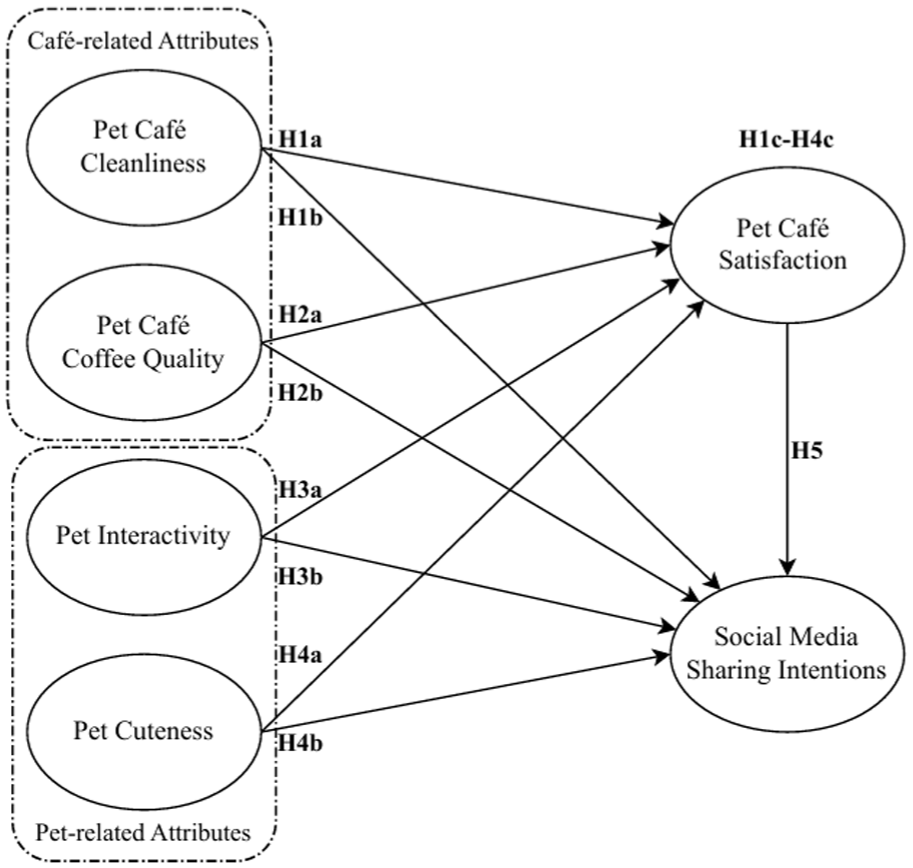
Hypotheses related to this study.
Methodology
Questionnaire Design and Measurement
The questionnaire consists of two parts. The first part is the major part of the questionnaire. This section contains 26 items including seven constructs in our model. They are measured using seven-point Likert scale ranging from “strongly disagree” (one point) to “strongly agree” (seven points). The second part is about respondents’ demographic information including gender, age, education, monthly income, and times to attend pet café.
The measurable items were adapted from previous studies. Items measuring pet café cleanliness, pet café coffee quality, pet interactivity, and pet cuteness were adapted from Vos et al. (2019; seven items), Chen and Hu (2010; five items), Kubinyi et al. (2009; four items) and Takamatsu (2020; four items) respectively. Regarding pet café satisfaction and social media sharing intentions, the items were modified based on Yuksel et al. (2010; three items) and Hur et al. (2017; three items) respectively. The questionnaire was proofread by two tourism professors to confirm the accuracy of all items (Wang et al., 2023). Furthermore, to ensure the content validity, a pilot study was conducted with 30 customers in order to ensure participants can understand the questionnaire contents (Lowe, 2019). Participants did not indicate any problems in their understanding of the questionnaire, and these 30 samples were not used for further analysis. The items are exhibited in Table 2.
Research Site and Data Collection
The research site of this study was chosen in Guangzhou City for the following reasons. First, Guangzhou is one of the cities in China with the most pet cafés according to Dianping, a famous food and beverage online review platform in China. Second, based on the location selection reasons of Zhao et al.’s (2024) study choosing Shanghai cat cafés as a case, this study chose Guangzhou because it is another economically developed city in China and pet cafés in such a city will be relatively popular.
A systematic sampling method was chosen for the study. The specific process refers to the research of Wang et al. (2023). From December 2024 to January 2025, after gaining permission from the pet café operators, four well trained research assistants collected questionnaires at the pet cafés near Tiyu West, Guangzhou, of which there are more than 10 pet cafés. Before each data collection, research assistants would draw a random number (e.g., n) from 1 to 10 using a random number generator. The n-th customer leaving the pet café was selected as the respondent. Then, the selected customers who left the pet cafés were asked to complete a questionnaire, and it took about 5 to 10 min for each of them to complete the survey. Respondents could choose to answer the English or Chinese version of the questionnaire. The English questionnaire was firstly translated into Chinese by a professional translator. The Chinese version was then translated back to English by another professional translator to prevent translation bias. A total of 600 questionnaires were distributed in this survey, of which 450 respondents agreed to participate in the survey, with a response rate of 75%. Among them, 27 questionnaires were found invalid because of the missing and straight-lining responses. Finally, 423 questionnaires were deemed valid. Table 1 exhibits the background information of the 423 valid respondents, and Figure 2 shows the picture of one pet café environment. Figure 3 summarizes the concept map of the methodology.
Background of Respondents (N = 423).

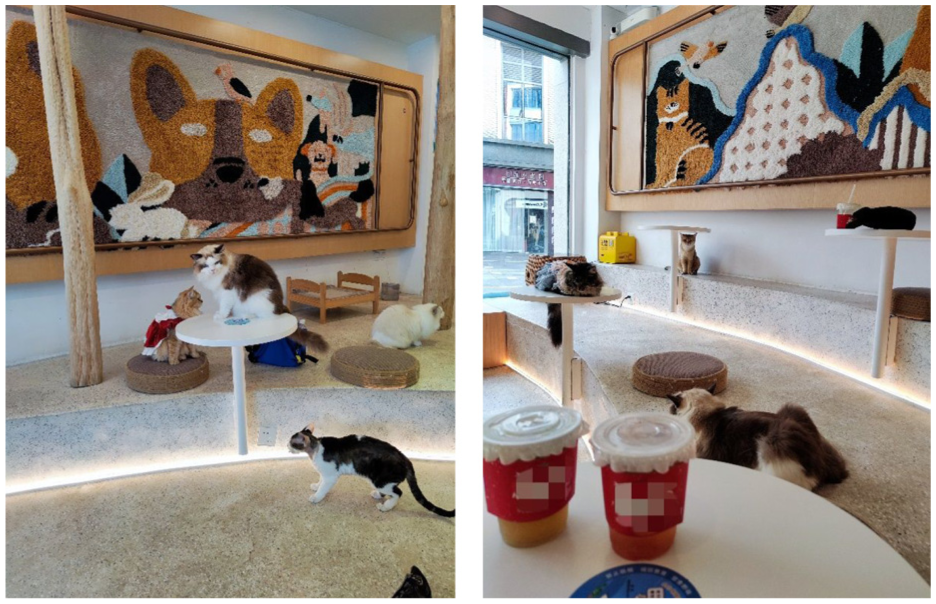
The picture shows the environment of one pet café which taken by the authors.

The picture shows the concept map of methodology including questionnaire design, research site and sampling method.
Findings
Assessment of Measurement Model
Partial Least Square Structural Equation Modeling (PLS-SEM) was applied to analyze the data. The PLS-SEM method was chosen for the following reasons. First, this study focused on the four dimensions that predicted the dependent variable – pet café satisfaction (Wong et al., 2020). Second, the PLS-SEM method is considered to have advantages when analyzing small sample sizes (Hair et al., 2017). Third, it provides a one-stop solution for calculating all values for reliability and validity tests (Ringle et al., 2015). Table 2 shows the mean, standard deviation, and PLS outer loading for the 26 measurable items. All outer loadings (ranging from 0.708 to 0.861) are higher than 0.7. Table 3 shows the values of Cronbach’s alpha (ranging from .729 to .897) and composite reliability (CR, ranging from 0.733 to 0.899) which also exceed the recommended level of 0.7. Therefore, all the constructs have high internal consistency. The values of average variance extracted (AVE, ranging from 0.551 to 0.723) from all constructs exceed the threshold of 0.50 (Fornell & Larcker, 1981). Furthermore, the values of the correlation between the two latent variables range from .397 to .705. Additionally, the values of the Heterotrait-Monotrait Ratio (HTMT, ranging from 0.397 to 0.899) are less than 0.90, indicating that the measurement model has no discriminant validity issues (Hair et al., 2021).
Mean, Standard Deviation (S.D.), and Outer Loading of 26 Measurable Items.

Note. S.D. = standard deviation.
Reverse-scored.
Reliability, Validity, and Correlations.

Note. CL = pet café cleanliness; CQ = pet café coffee quality; CU = pet cuteness; IN = pet interactivity; SAT = pet café satisfaction; SI = social media sharing intentions; CR = composite reliability; AVE = average variance extracted.
Assessment of Structural Model
The bootstrapping technique, using 5,000 resamples, is applied to examine the statistical significance of the hypotheses (Hair et al., 2021). The results of PLS-SEM analysis are shown in Table 4 and Figure 4. All the inner variance inflation factor (VIF, ranking from 1.321 to 2.547) values were lower than 3.3, so that collinearity is not a critical issue (Hair et al., 2021). The values of R-squared for two endogenous latent variables are .546 and .588 respectively. These values are much higher than the suggested R-squared value (0.26) so that the explanatory power of the predictors is high (Cohen, 2013). The path coefficients from four attributes of pet cafés (pet café cleanliness, pet café coffee quality, pet interactivity, and pet cuteness) to the pet café satisfaction are 0.158 (t-statistics = 3.822, p = .000), 0.071 (t-statistics = 1.636, p = .102), 0.155 (t-statistics = 3.238, p = .001), and 0.527 (t-statistics = 11.453, p = .000). Therefore, H1a, H3a, and H4a are supported whereas H2a is not supported. The path coefficients from four attributes of pet cafés to the social media sharing intentions are 0.026 (t-statistics = 0.679, p = .497), 0.031 (t-statistics = 0.654, p = .513), 0.237 (t-statistics = 4.84, p = .000), and 0.221 (t-statistics = 3.714, p = .000). Thus, hypotheses H1b and H2b are not supported but H3b and H4b are supported. The path coefficient from the pet café satisfaction to the social media sharing intentions is 0.4 (t-statistics = 7.199, p = .000). Therefore, hypothesis H5 is supported.
Results of Hypotheses Tests.

Note. CL = pet café cleanliness; CQ = pet café coffee quality; CU = pet cuteness; IN = pet interactivity; SAT = pet café satisfaction; SI = social media sharing intentions.

Partial least squares structural equation modeling, showing the relationship between different variables.
Table 5 shows the results of the specific indirect effects. Pet café cleanliness (H1c), pet cuteness (H3c) and pet interactivity (H4c) have significant indirect effects on social media sharing intentions through pet café satisfaction, whereas the indirect effect of pet café coffee quality (H2c) is not significant. Therefore, H1c, H3c, and H4c are supported whereas H2c is not supported.
Results of specific indirect effects.

Note. CL = pet café cleanliness; CQ = pet café coffee quality; CU = pet cuteness; IN = pet interactivity; SAT = pet café satisfaction; SI = social media sharing intentions.
Conclusions and Discussions
Conclusions
This study applied a modified consumption system approach (CSA) developed by M. Zhang et al. (2019) and Mittal et al. (1999), and further extend this framework to introduce a comprehensive model by integrating two café attributes (pet café cleanliness and pet café coffee quality) and two pet attributes (pet interactivity and pet cuteness) to study their relationships with pet café satisfaction and social media sharing intentions.
In terms of pet café satisfaction, the findings suggest that pet cuteness has a stronger effect on pet café satisfaction (H4a), followed by pet interactivity (H3a) and pet café cleanliness (H1a), which is partially consistent with some existing studies, arguing that the cuteness of pets will make people feel happy and relaxed, interactivity affects customer’s satisfaction (D. Lee et al., 2015); pet owners report higher life satisfaction than non-pet owners (Bao & Schreer, 2016); and café cleanliness positively influences customers’ intention to visit traditional cafés (Lim et al., 2020). Although this study is partially consistent with existing studies, there are still some differences. As one of the very few studies in special-theme cafés, the results firstly show that pet-related attributes (pet interactivity and pet cuteness) would be more important for pet café satisfaction compared to café-related attributes. This means that unlike traditional cafés, in special theme cafés like pet cafés, special theme-related attributes (such as pet-related attributes) are the key factors affecting customer satisfaction. Secondly, the results show that among the pet-related attributes, pet cuteness has a stronger impact on pet café satisfaction than pet interactivity. This shows that in pet cafés, the attribute that has a stronger impact on customer satisfaction is the pet itself (i.e., the pet cuteness) than other attributes. Furthermore, coffee quality does not have a significant impact on pet café satisfaction (H2a), which is different from the findings in traditional cafés (W. S. Lee et al., 2018). The possible reason is that coffee quality is the basic attribute in a café, and customers in pet café may not care much about coffee quality when they are playing with pets in the café.
In terms of social media sharing intentions, the findings suggest that pet interactivity has a stronger effect on social media sharing intentions (H3b), followed by pet cuteness (H4b). Both of which are pet-related attributes. Similar to existing studies such as Lin and Chang (2018), interactivity has a significant impact on social media sharing intentions. However, this study was conducted in the context of pet cafés and may be the first to suggest that special theme-related attributes (i.e., pet-related attributes) have a positive impact on social media sharing intention. In addition, the study also showed that pet interactivity has a stronger impact on social media sharing intention than pet cuteness. This is also related to Chinese culture to a certain extent. S. Zhang's (2019) research believes that due to the unique Chinese cultural background, pet cafés are also considered a place for healing and relaxation. In addition, Zhao et al.’s (2024) research on Chinese pet cafés also showed that if customers cannot interact well with pets, it is considered a waste of money. Furthermore, pet café cleanliness and coffee quality do not have any influence on customers' social media sharing intentions (H1b, H2b). These results are different from the traditional café research (D. Kim, Jang, & Adler, 2015), which show that café-related attributes significantly affect social media sharing intentions. The reason may be that for special-themed cafés like pet cafés, the special theme-related attributes are the main reasons for customers’ social media sharing intention. Café-related attributes are the most basic for a café, whether it is a traditional café or a special-themed café, so they will not lead to customers’ social media sharing in special-themed cafés. Therefore, the importance of attributes varies with the context of cafés. Pet-related attributes are the cause of customers’ social media sharing intentions. On the contrary, different from traditional café, café-related attributes may not be the key reasons customers share their photos on social media.
In addition, for the mediating effect of pet café satisfaction on the relationship between attributes (café-related and pet-related) and social media sharing intention, the findings suggest that pet café cleanliness (H1c), pet cuteness (H3c) and pet interactivity (H4c) have significant indirect effects on social media sharing intentions through pet café satisfaction, whereas the indirect effect of pet café coffee quality (H2c) is not significant. The possible reason is that in special-themed cafés like pet cafés, coffee quality, as the most basic attribute of a café, may not have any impact on customer satisfaction and social media sharing intention.
Based on the above, in the context of pet cafés, pet-related attributes (pet interactivity and pet cuteness) and pet café cleanliness have significant impact on customer satisfaction, but not do coffee quality. Pet-related attributes (pet interactivity and cuteness) have a significant impact on social media sharing intentions, but not do café-related attributes (pet café cleanliness and pet café coffee quality).
Theoretical Implications
This study has several theoretical implications. First, although the scales in this study are borrowed and revised from prior research, some contributions are made for future research as this study is yet the first empirical study of pet cafés, which contributes to our knowledge of the attributes that influence pet café satisfaction and social media sharing intentions.
Second, this study extends the attribute-satisfaction-intention framework by identifying several attributes related to pet café and linking them to satisfaction and social media sharing intentions in an under-researched type of café. In addition, under the framework of attribute-satisfaction-intention, this study reveals four attributes within café-related attributes (pet café cleanliness and pet café coffee quality) and pet-related attributes (pet interactivity and pet cuteness). It provides insights for researchers to conduct their research in other themed hospitality sectors by applying the attribute-satisfaction-intention framework.
Finally, as the results of this study, pet-related attributes have significant impacts on social media sharing intentions. Therefore, the results inspired tourism researchers to consider not only the influence of cafe-related attributes on social media sharing intentions, but also the influence of theme-related attributes on social media sharing intentions when studying special-themed cafés.
Practical Implications
This study has several practical implications. First, in terms of pet café satisfaction, pet cuteness has the most significant influence on pet café satisfaction. In order to attract more pet lovers and increase customer traffic, pet café operators may use coupons to provide customers with chances to choose cute pets and cute pet clothing they like, and fully use the cute elements of pets to create unique characteristics in the pet café.
Second, in terms of social media sharing intentions, pet interactivity has the most significant influence on customers’ social media sharing intentions. Therefore, pet café operators should emphasize the element of human-pet interaction to encourage customers to share photos or experiences on social media. For instance, pet café operators can also provide customers with items such as cat teasers, cat strips or dog food to promote good interaction between humans and pets, so that they are willing to share their experiences on social media.
Third, the results of this study show that special-themed attributes (like pet-related attributes) should be more important than basic café attributes in special-themed cafés. Therefore, for special theme café operators, café-related attributes must first meet the basic requirements, but more attention should be paid to the characteristics of cafés, such as maid café operators should pay more attention on maids rather than coffee quality. For pet café operators, pet-related attributes are the special features of their theme cafes. Therefore, in addition to fulfilling the basic functions of a café, they also need to pay more attention to pets themselves, expand the advantages of special themes, and form competitiveness.
Limitations and Future Research
This study has several limitations. First, this study extends the attribute-satisfaction-intention framework and applies it to pet cafés. However, this study does not distinguish the pet category between cats and dogs, future research on pet cafés may consider separating cat cafés and dog cafés as customers may have different perceptions on them. Second, the sampling method of this study is systematic sampling, but there is randomness and uncertainty in the sampling process of this method, and the collection efficiency is not high. Future research can improve the sampling process such as reducing the sampling interval to improve efficiency. Third, the sample of this study is mainly Chinese because data collection was conducted in Guangdong province, China, which may not represent all pet cafés. Future studies may be conducted in other countries or regions. Fourth, this study only explored two café-related attributes and two pet-related attributes, some more attributes (e.g., AI or other technology antecedents; Wong et al., 2025), or some potential moderators (such as personal traits and social media post popularity; Ye et al., 2025) related to this topic can be considered to include and enrich this framework.
Footnotes

Ethical Considerations
All procedures performed in studies involving human participants were in accordance with the ethical standards of the institutional and/or national research committee (the committee decided this study did not need ethics approval) and with the 1964 Helsinki declaration and its later amendments or comparable ethical standards.
Consent to Participate
All participants voluntarily participated in the study and gave written informed consent.
Funding
The authors received no financial support for the research, authorship, and/or publication of this article.
Declaration of Conflicting Interests
The authors declared no potential conflicts of interest with respect to the research, authorship, and/or publication of this article.
Data Availability Statement
The data that support the findings of this study are available from the corresponding author upon reasonable request.