




Abstract
While sharing positive content about a brand’s products can bring huge benefits, when and what motivates consumers to post on social media is still an underexplored area, especially in a conspicuous consumption context. Therefore, this study tries to explain customers’ journey when engaging in conspicuous consumption and consumption-sharing behavior on social media by applying fear of missing out (FOMO), self-presentation, and social network types. This research was conducted with 400 respondents in the US, and the data were analyzed using PROCESS models. Results reveal that FOMO positively affects conspicuous consumption and consumption-sharing behavior. Moreover, conspicuous consumption and consumption-sharing behavior differ under the influence of self-presentation desire and the type of social network they have. The study contributes to the current literature by investigating the factors encouraging customers to share their conspicuous consumption on social media. It also offers significant insights and recommendations for marketers to increase brand awareness.
Plain language summary
This study delves into why consumers share posts about products they’ve bought, particularly in cases of conspicuous consumption, where purchases are made to show off wealth or status. The research focused on three key concepts: fear of missing out (FOMO), how we want others to see us (self-presentation), and our social network types. The study involved 400 participants from the US and used advanced analysis methods. The findings showed that FOMO does drive conspicuous consumption and the act of sharing these purchases on social media. Additionally, the desire to present oneself in a certain way and the nature of one’s social network also influence these behaviors. But, the effects differ depending on these factors. This research helps us understand what motivates people to show off their purchases on social media, offering valuable insights for marketers looking to boost their brand awareness
Keywords
Introduction
In an era where people use social media daily to establish desired profiles and present social status to others (Islam et al., 2018), exposure to others’ content on social media leads to the phenomenon that individuals also want to positively project their images to maintain and enhance their self-concept (Chaudhuri et al., 2011). Consumers tend to buy and show their consumption on social media to be social inclusive and recover their self-images. The behavior of sharing consumption on social media creates fame for consumers’ online image and increases brand awareness by promoting brands to the consumers’ community (Taylor & Strutton, 2016).
FOMO involves the feeling that missing out on things will make someone feel left behind personally and socially (Zhang et al., 2020). Through social media ability, users develop and maintain their social lives and seek to gain social approval from others (Alt & Boniel-Nissim, 2018). Individuals with a high level of FOMO prefer to use social media as an effective tool to satisfy their need to socialize. In the social media context, FOMO is the anxiety about losing the chance of social interactions, meaningful experiences, and investment (Alt & Boniel-Nissim, 2018). Reagle (2015) described FOMO as envy-related anxiety about missed experiences of conspicuous sociality. Previous research has explained FOMO as the motivation to purchase products (Souiden et al., 2011) and engage in social media activities (Osemeahon & Agoyi, 2020). Fear of being left behind and losing social approval put pressure on customers to purchase conspicuous products to gain status achievements (Aral & Walker, 2011). However, whether FOMO can directly motivate consumers to post-purchase on social media, such as posting or sharing their products, remains unexplored in previous research.
Conspicuous consumption refers to the consumption of goods or the willingness to buy them because of their higher price. The conspicuous products tested in this study are specifically expensive because conspicuous consumption generally refers to purchasing costly items targeted for upmarket of specific customers’ segments with high income (Schiffman & Kanuk, 2004). It is usually associated with the purchase of “status” or “luxury products,” whose price and quality are not a primary concern for the consumers purchasing as they are more focused on these products’ symbolic or emotional implications (Bronner & de Hoog, 2018). Expensive and luxury products can act as a barrier to product acquisition, leading to increased attractiveness and conferring status, wealth, honor, and esteem to the individual (Han et al., 2010). This relationship between conspicuous consumption and sharing purchase and their huge benefit to the business has not been previously studied.
In the conspicuous consumption context, consumption-sharing behavior is characterized by showing off high-quality goods purchased to gain popularity and enhance one’s public image (Trigg, 2001). Although consumption-sharing behavior on social media, from now on referred to as sharing behavior, is a word-of-mouth approach, it is more than peer-to-peer communication about a purchase. Individuals who pay attention to their self-identify are sensitive to prestige and desire to own products that show their position and status. The fear of falling behind and losing social approval motivates customers to purchase conspicuous products to maintain and enhance status achievements (Aral & Walker, 2011). Sharing their purchases on social media is a new form of digital consumption used to express wealth and maintain or gain social status through public goods (Trigg, 2001). Social media users can display their best possessions when posting on social media platforms (Yoo, 2018), especially their purchases.
This study uses FOMO and conspicuous consumption as precedents of consumption-sharing behavior about their buying. However, these relationships can also differ depending on customers’ desire for self-presentation and their audience type on social media. Self-presentation relates to the impression individuals prefer to project to their image according to their wants (Alt, 2015). The desire for self-presentation makes individuals want to highlight their inner selves and show positive images to others (Belk, 2013). Most studies related to self-presentation have focused on personality traits such as the users’ intrinsic factors (Barry et al., 2017), cognitive capabilities (Yau & Reich, 2019), and self-presentation methods in social media (HanYun, 2014). Previous research on consumer behavior proved that individuals purchase products for utility, symbol, and expression (Smith & Colgate, 2007). Buyers prefer to display those positional goods through social media to enhance their extended self (Taylor & Strutton, 2016). However, there is a literature gap on how self-presentation desire controls conspicuous consumption and sharing behavior, which will be answered in this study.
On social media, we communicate not only with our friends but also with strangers whom we may never meet in reality. The person involved in the communication process influences how social media users behave and respond. Even though social media users want to display themselves by posting on social media, their audience controls how they want to build their images (Pontari & Glenn, 2012). Individuals are more likely to seek self-enhancement from strangers than their friends during interactions (Yoo, 2018). Therefore, this study argues that social media users’ network differences can affect how they share their conspicuous consumption.
This study aims to explore the effect of the fear of missing out (FOMO), self-presentation desire, and social network type as a motivation for social and self-pressure to explain conspicuous consumption and sharing consumption behavior. First, this study points out the factors affecting how customers consume conspicuous products and share their conspicuous purchases on social media to gain more insights. Only a few studies have provided empirical evidence to explain this phenomenon, making it challenging for marketers to get customers to engage and share them on social media. Second, this study examines FOMO’s direct and indirect effects on customers’ sharing behavior through conspicuous consumption to expand the literature on FOMO and conspicuous consumption context. Finally, this measures the moderation effect of self-presentation desire and social network type on the relationship between FOMO, conspicuous consumption, and sharing behavior. By presenting a new framework to explain consumption-sharing behavior on social media in the context of conspicuous consumption, these findings can contribute to the existing literature on FOMO and conspicuous consumption. Additionally, they can provide marketers with guidance on how to evoke FOMO among customers to encourage conspicuous consumption-sharing behavior on social media.
The remainders of this study are structured as follows. The next section provides the literature reviews of all constructs and their relationship in this study. The method part contains the respondents’ sampling part and measurements used in this research. All results of this study are presented in the result section. Finally, this study’s discussion shows the study findings, theoretical contribution, managerial implications, limitations, and future study recommendations.
Literature Review
Fear of Missing Out
FOMO is an emerging phenomenon that has drawn increasing research attention. JWT (2011) defined FOMO as the uneasy feeling of others doing better or gaining more knowledge. Reagle (2015) also mentioned FOMO as envy-related anxiety about missed experiences of conspicuous sociality. Although there are various ways to define FOMO, the definition by Przybylski et al. (2013) is the most widely used. Based on the Self determinant theory of Deci and Ryan (2000) about three psychological needs, Przybylski et al. (2013) defined FOMO as “a pervasive apprehension that others might have rewarding experiences from which one is absent.” In summary, the FOMO concept is usually mentioned as private and social anxiety (Zhang et al., 2020), presented as a low self-concept (Chaudhuri et al., 2011), need to belong (Wang et al., 2019), desire to stay in touch (Beyens et al., 2016), worry about losing social interaction (Przybylski et al., 2013), or the fear of falling behind (Good & Hyman, 2020).
In the social media context, FOMO is the anxiety about losing the opportunity to participate in social interactions and acquire meaningful experiences (Alt & Boniel-Nissim, 2018); thus, it motivates people to perform actions to maintain or enhance their social status (Zhang et al., 2020). On the other hand, FOMO is an emotion resulting from the threats to self-concept that affects consumers engaging in experiential consumption, the increase in the use of social networks (Overmyer, 2016), or the excessive use of social media (Lai et al., 2016). FOMO is associated with customers’ buying decisions and social media engagement (Dinh & Lee, 2022; Zhang et al., 2020). Recently, in the context of conformity consumption, FOMO has been referred to as an experience in which individuals fear being socially excluded. As a result, they have a strong desire to connect with others or events and seek to understand others (Kang et al., 2019). Furthermore, FOMO is an experience that is tied to both private and public self, motivating individuals to act in order to maintain or elevate their self or social status (Zhang et al., 2020). The conspicuous products tested in this study are specifically expensive because conspicuous consumption generally refers to purchasing costly items targeted for upmarket of specific customers’ segments with high income (Schiffman & Kanuk, 2004). Thus, FOMO has an important role in explaining customers’ conspicuous consumption desires.
Conspicuous Consumption and Consumption-sharing Behavior on Social Media
The most common definition of conspicuous consumption comes from (Veblen, 2009), who described it as acquiring and displaying possessions to signal wealth and social status. Gierl and Huettl (2010) identify three conspicuous consumption types: ostentation and symbol, uniqueness, and social conformity. Conspicuous consumption is usually associated with the purchasing status of owning products, where the price and quality are not the consumer’s primary concerns but symbolic or emotional purposes (Bronner & de Hoog, 2018). In other words, conspicuous consumption refers to the consumption of goods or the willingness to buy them solely because of their higher price. Conspicuous consumption generally involves costly items targeted toward specific customer segments with high income (Schiffman & Kanuk, 2004). This study uses expensive products as representations of conspicuous products. Expensive products can act as barriers to product acquisition, conferring owners’ status, wealth, honor, and esteem (Han et al., 2010). The consumption and display of exclusive and expensive products in the public context create positive feelings and impressions of a high social standing. Thus, consumers prefer expensive goods because they are associated with wealth and social status (Amaldoss & Jain, 2005).
Social media has an essential effect before, during, and after phases of the customer buying process. Hutton and Fosdick (2011) showed that social media changes how customers behave; it turns customers from passive to active users who create content about products and consumer experiences. Consumption-related posting on social media allows consumers to express their feelings and thoughts about their purchases or items to their audience (Duan & Dholakia, 2018). This study focuses on the consumption-related posting regarding conspicuous consumption because most posts on social media are associated with conspicuous meanings (Duan & Dholakia, 2018). Social media allows users to exhibit conspicuous consumption to satisfy their social needs. Posting behavior on social media is motivated by expressing oneself, gaining attention from others, or showing wealth and status. Despite its significance, consumption-related posting behavior remains an underrated construct, with only a few studies exploring this phenomenon. Thus, the research into conspicuous consumption-related posting behavior on social media is even less.
Consumption-sharing behavior on social media refers to how consumers share their feelings and thoughts about their purchases with their audiences (Duan & Dholakia, 2018). Most consumption-related content on social media is associated with conspicuous meanings (Duan & Dholakia, 2018). In this study context, consumption-sharing behavior on social media refers to customers’ willingness to share positive thoughts or feelings about consumed conspicuous items via their content on social media to show off their possessions. Sharing behavior is motivated by the desire to express oneself, gain attention, or demonstrate wealth and status (Yoo, 2018). Sharing purchased products on social media may stem from feelings of envy (Cheng & Fu, 2019), one’s level of materialism, the type of purchase made, the enjoyment derived from social media use (Duan & Dholakia, 2018), and the satisfaction gained from brand equity and products (Schivinski et al., 2020). Consumption-related posting behavior is associated with purchasing happiness (Duan & Dholakia, 2017).
Self-presentation Desire and Social Network Types
Individuals can manage their impressions on social media by creating their profiles, uploading photos, posting on their walls, and commenting on others’ posts. Those actions positively shaping their online image to impress others are called self-presentation. This study suggests self-presentation as a desire to be seen as the images they want, resulting in them spending time, costs, and effort to form, such as purchasing conspicuous goods and posting such purchases on social media, to create positive online images (Schau & Gilly, 2003). Self-presentation is a personal need of individuals to present themselves as acceptable to others in a way that fits how they want to be seen (Choi et al., 2020). This study defines self-presentation as individuals’ desire to shape their identity online. This motivates them to invest time, money, and effort in creating a positive online image. For example, they may buy conspicuous goods and share these purchases on social media (Schau & Gilly, 2003). In other words, self-presentation refers to how people attempt to convey their information or image to control or shape how others view them (Hollenbaugh, 2021). Individuals can manage their images on social media by creating their profiles, uploading photos, posting on their walls, and commenting on others’ posts.
In the context of social media, online self-presentation can be categorized into two types of communication behaviors. The first involves controlling negative perceptions that others may have about oneself, while the second involves disclosing positive information about oneself (Rui & Stefanone, 2013). Previous research has shown that users with a larger number of friends on social media platforms strive to appear more socially attractive (Walther et al., 2008). Social media users expect their friends to see the images they want, so they invest time, money, and effort in creating positive online images (Schau & Gilly, 2003).
Social media is the primary means of modern communication. The development of social media has enabled people to build friendships online, even with complete strangers whom they only know through online profiles (Pontari & Glenn, 2012). This feature of social media gives rise to a significant phenomenon: our interactions determine how we post, share, communicate, and shape our online identities. Therefore, the audience on the receiving end of communication or social network connections is crucial in predicting the behavioral differences among social media users. People indeed aim to project a positive self-image to others, but they customize it based on their audience. In other words, how people form their impressions depends on the audience they are dealing with (Pontari & Glenn, 2012). Social network types are categorized as friend-dominated or stranger-dominated networks (Yoo, 2018). A friend-dominated network refers to a relationship network on social media platforms that involves more actual offline friends than “friends” who are strangers and are purely known through social media. A stranger-dominated network is a relationship network on social media platforms involving more “friends” who are strangers with weak or no real ties than offline friends.
Hypotheses and Research Framework
Based on the literature review, this study proposes hypotheses to investigate the relationships between variables. Figure 1 presents the study’s framework.

Research model.
The social pressure of belonging to the community is satisfied only when consuming referent products to present a good social impression (Dinh & Lee, 2022; Seo & Park, 2018). When people are socially excluded and feel threatened, they regain their self-esteem by engaging in compensatory consumption (Sivanathan & Pettit, 2010). Basic needs like self-esteem, the need to stay updated with trends, and the fear of lagging behind are dimensions of FOMO (Kang et al., 2019). The lack of these needs can only be fulfilled by acquiring products that are consumed by their reference group in order to create a social impression (Seo & Park, 2018). In other words, conspicuous products are the primary choice for individuals when they want to improve their self-images (Chaudhuri et al., 2011) and attract attention (Podoshen & Andrzejewski, 2012). The lower the self-esteem individuals have, the higher their potential they consume expensive and branded products (Souiden et al., 2011) because they fear missing new trends and product hauls (Przybylski et al., 2013). Those with a high level of FOMO exhibit a greater desire to belong to a group and a need for social approval (Alt & Boniel-Nissim, 2018), so they tend to prefer purchasing conspicuous products to display their status and stay connected with their peers. Therefore, individuals with high FOMO reveal a grand passion for social belonging and social approval and prefer products mainly on the basis of their social needs rather than the products’ high quality.
A common benefit of social media is satisfying users’ needs to be socialization. Those personal needs and social desires drive social media adoption (Zolkepli & Kamarulzaman, 2015). Fear is an emotion resulting from threats to one’s well-being (Gill & Burrow, 2017). FOMO stems from a persistent lack of needs, causing individuals to resort to social media as a means of compensation (Przybylski et al., 2013). This leads users to engage in social media due to the ongoing needs (Osemeahon & Agoyi, 2020). FOMO is activated as a threat to self-concept, which urges individuals to behave in a way that is consistent and enhances their self-concept (Zhang et al., 2020). Therefore, individuals project their images by showing their conspicuous possessions on social media to prove their levels (Yoo, 2018). FOMO motivates customers to participate in social media activities like posting, responding, sharing, and commenting on brand-related content (Osemeahon & Agoyi, 2020). In summary, sharing conspicuous consumption on social media is a way for consumers to attract attention and impress others to enhance their self-esteem.
Previous research showed that conspicuous products are “buying to impress others” because high-end brands help express and enhance one’s self-image (Giovannini et al., 2015) and imply outstanding achievements (Tsai, 2005). Consumers can showcase their desired products publicly to impress others. This behavior is particularly prominent in the online realm, where customers share their purchases on social media to communicate their achievements. By posting their purchases on social media platforms, they intentionally validate their consumption and contribute to their digital legacy while boosting their self-image (Giovannini et al., 2015). Sharing behavior is a new form of digital consumption used to express wealth and maintain and gain social status through public goods (Trigg, 2001). Therefore, social media platforms are the potential place for users to have their conspicuous consumption noticed. Consumers can use social media to promote their purchases to a larger audience, which allows for consumption-related posting behavior. This is more advantageous for seeking status compared to an offline context with limited audiences (Lampel & Bhalla, 2007). The more social status consumers seek, the more they engage in conspicuous consumption and sharing behavior on social media (Duan & Dholakia, 2018).
The desire for self-presentation effectively explains customer behavior because customers purchase goods for utility and symbolic values (Smith & Colgate, 2007). The purpose of self-presentation is to gain others’ acceptance through self-identified images (Hollenbaugh, 2021); thus, individuals must present themselves in line with their social roles and ensure that their image is positively evaluated. Those with significant concerns about their self-image want to create a positive image to gain social approval and thus consider conspicuous consumption their most suitable choice (Ghosh & Varshney, 2013). Thus, when consumers feel FOMO and want to enhance their self-esteem, conspicuous consumption is their choice. When consumers feel social exclusion and are sensitive to social status, the need to maintain one’s image and reputation arouses them to consume to recover it. Chaudhuri et al. (2011) emphasized conspicuous consumption as self-representational consumption and defined it as actively purchasing and consuming scarce and culturally inherent goods. Thus, conspicuous consumption results from FOMO when consumers seek to present their positive self-images to others.
To gain social approval, individuals seeking a good public self-image employ self-presentation strategies, including using conspicuous products to create the desired impression (Hollenbaugh, 2021). Conspicuous products, such as expensive products, are preferred because they are publicly consumed and can help owners show their social status (Chaudhuri et al., 2011). Conscious consumers who engage in self-promotion strive to showcase their accomplishments, abilities, or talents online. In other words, when consumers buy conspicuous products and want to use such purchases to represent their status, they are more likely to share conspicuous consumption on social media. Based on these discussions, the desire for self-promotion significantly affects conspicuous consumption and sharing behavior. People who crave self-presentation on social media prefer showcasing their conspicuous purchases online to demonstrate their social status more than those who do not.
Pontari and Glenn (2012) found that people are less self-enhancing toward their friends than strangers during interactions. The initial thoughts of one’s friends are relatively difficult to manipulate their prior knowledge of the person. The individual’s self-enhancing behavior can lead to inconsistencies and be perceived as conceit (Schlenker & Pontari, 2000). However, people often elevate themselves in front of strangers and highlight only their positive aspects. When engaging in self-promotional impression management, strangers are more accessible to manipulate than one’s friends because they lack knowledge of the individual’s actual characteristics and qualities (Yoo, 2018). Hence, people try to share their most positive photos and moments to enhance their self-esteem because they are motivated to impress others through self-enhancement (Liang et al., 2018). Moreover, the use of social media more strongly provokes conspicuous consumption with a network dominated by strangers than with a network dominated by friends (Yoo, 2018). This study suggests that using social media with a stranger-dominated network increases sharing behavior more greatly than using a friend-dominated network.
Methods
Participants
A pretest was conducted with 50 participants prior to the main data collection. The results indicated that the questionnaire was suitable for further data collection. In 2021, a survey was administered on the MTurk platform in the US, as this platform is commonly employed in various research studies to investigate people’s opinions (Dogan, 2019; Duan & Dholakia, 2018). Anonymous participants responded to an online survey on this platform. This study specifically selected individuals who have personal experience with social media as research participants. Consequently, participants who indicated that they had never used social media platforms were excluded from this study and did not complete the survey. Nevertheless, all participants confirmed their prior use of social media platforms.
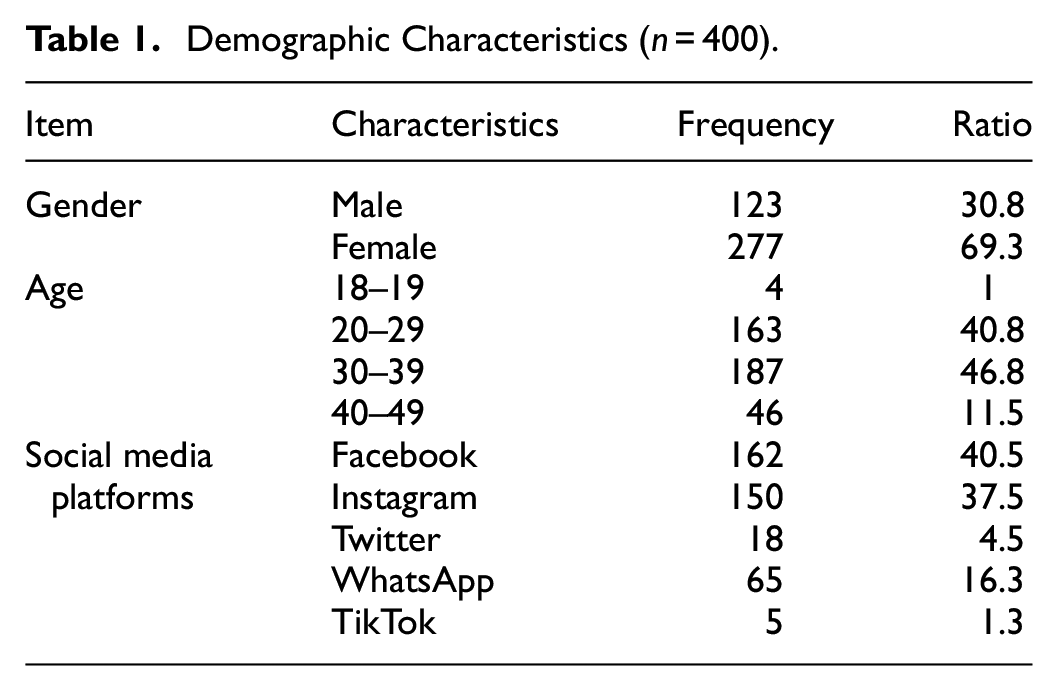
Based on Chaffey’s (2022) report, the leading ages of social media users are 19 to 49 years. Thus, respondents aged 18 to 49 were chosen for this study. This study selected expensive products to represent conspicuous goods because conspicuous consumption refers to buying expensive items targeted to upmarket specific customers’ segments with high income (Schiffman & Kanuk, 2004). The participants were required to choose a social media platform they used most and specify the number of friends they had on their preferred social media platform and the number of their actual friends. They were also asked to answer the rest of the questions about motivation and buying behaviors related to the seven constructs in this research. The detailed demographic data of the study sample are presented in Table 1.
Demographic Characteristics (n = 400).
Measurements
Conspicuous consumption was measured through expensive products, generally described as the consumption of high-priced items targeted toward specific customer segments with high income (Schiffman & Kanuk, 2004).
The survey started with an exclusive question about the participants’ social media experience. The succeeding questions concerned the participants’ demographic information, such as age and gender, and the social media platforms they used the most (e.g., Facebook, Instagram, and WhatsApp).
Subsequently, the participants were asked to estimate the total number of friends they had in their social network and the number of those they considered actual friends to identify their social network type. This measurement was adopted from Stutzman et al.’s (2012) work. Social network type was defined on the basis of the ratio of actual friends to total friends and was calculated by the number of actual friends divided by the network size. If the ratio was equal to or greater than 0.5, then the participant’s social media network was deemed a friend-dominated network; otherwise, it was considered a stranger-dominated network.
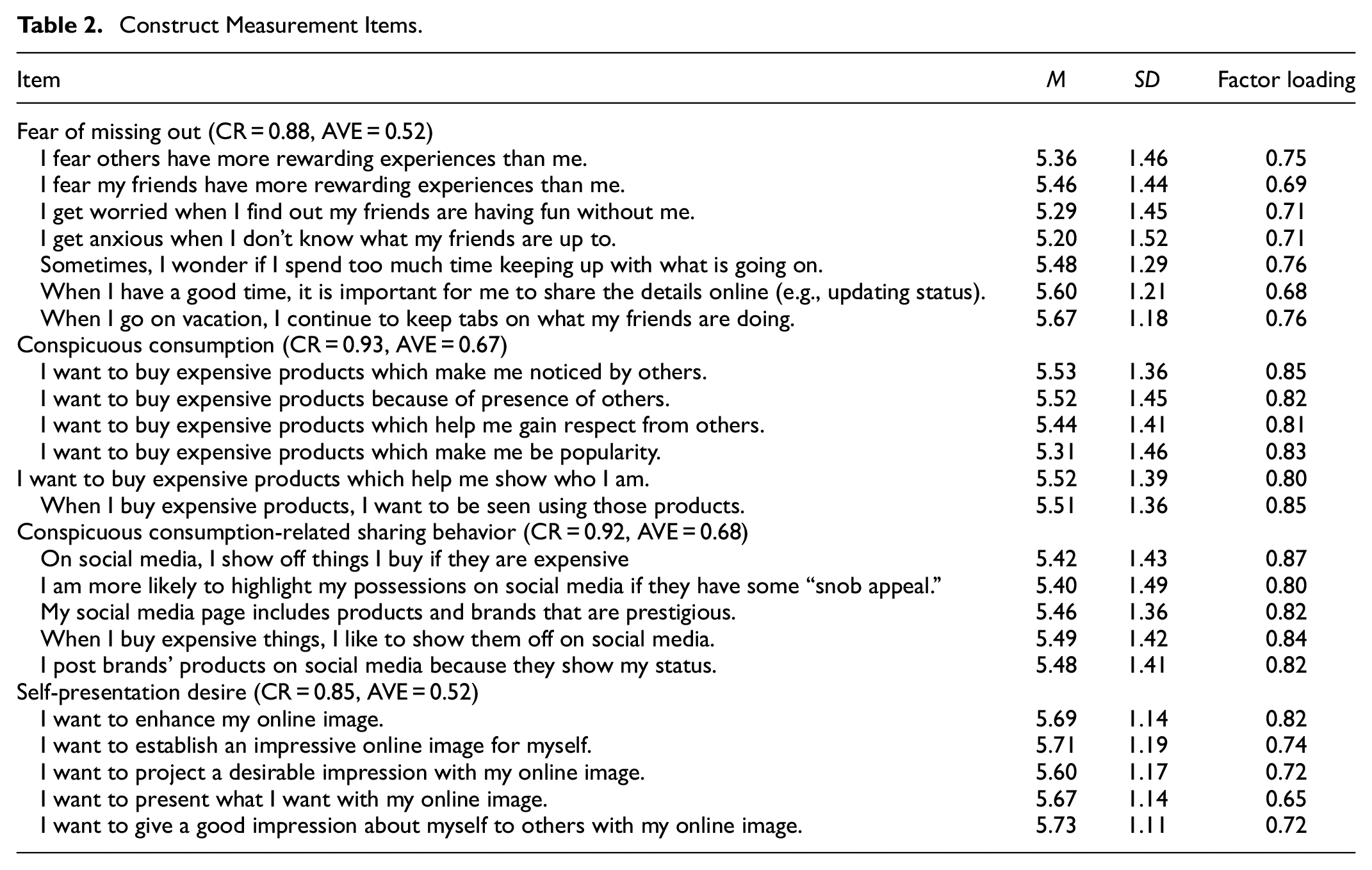
The remaining questions were evaluated using a seven-point Likert scale (1: “strongly disagree” to 7: “strongly agree”) to measure the seven constructs. The FOMO scale was developed by Przybylski et al. (2013) with ten items. Conspicuous consumption measurement was developed based on the work of O’Cass and Frost (2002). The consumption-sharing behavior scale was adopted by Taylor and Strutton (2016). The self-presentation desire scale developed by Kim and Chan (2007) was used. The items of measurement are presented in Table 2.
Construct Measurement Items.
Confirmatory Factor Analysis (CFA)
The model showed a good fit to the data, with the Chi-square being significant with χ2 (208, N = 400) = 685.908 (p < .05), RMSEA = 0.076, CFI = 0.93, IFI = 0.93, and TLI = 0.92. All the measurements met reliability and validity requirements. The lowest factor loading was 0.65, indicating good convergent validity. The lowest CR value was 0.85, which surpassed the threshold of 0.70. The lowest AVE value was 0.52, greater than 0.50. Therefore, the reliability of this measurement was deemed acceptable (Fornell & Larcker, 1981). The detailed indexes of items and constructs are presented in Table 2.
The correlations between variables indicate the association among them. All estimated path coefficients were statistically significant, indicating that all the constructs were relatively correlated. The detailed results of the correlation test among the constructs are shown in Table 3. Based on these results, there are significant gaps in the mean, median, and mode of the variables. The skewness and kurtosis values of the data in this study also show a highly skewed distribution.
Descriptions and Correlations of Variables.

Note. N = 400. SD = standard deviation. **p < .01.
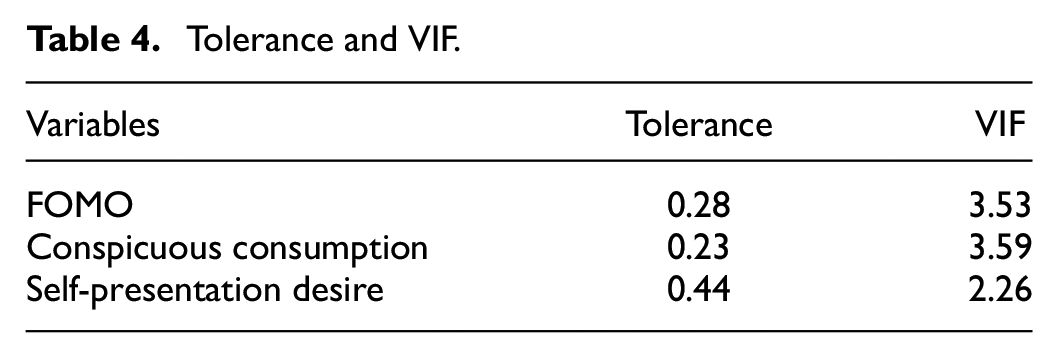
To check for multicollinearity among the variables, we ran a collinearity test. According to Ringle et al. (2015), multicollinearity is ruled out if the tolerance values exceed 0.2 and the variance inflation factor (VIF) is less than 5. Table 4 shows that the lowest tolerance value in this study was 0.23, and the highest VIF value was 3.59. Hence, there was no issue of multicollinearity in this study.
Tolerance and VIF.
Results
This study bootstrapped samples of the PROCESS Model 64 (Hayes, 2018) to examine FOMO’s direct and indirect effects on conspicuous consumption and sharing behavior. The moderation effects of self-presentation desire and social network types were also tested using this model. The results of the multiple regression analysis are presented in Table 5.
Moderation Effects of Self-presentation Desire and Social Network Types.

Note. N = 400. Each column is a regression model that predicts the criterion at the top of the column.
p < .05. **p < .01. ***p < .001.
Based on Model 1, FOMO is significantly associated with conspicuous consumption (b = 0.11, p < .001), confirming H1. In Model 2, the relationship between FOMO and sharing behavior is significant and positive (b = 0.14, p < .001), thereby supporting H2. Furthermore, Model 2 also supports H3, demonstrating a significant positive association between conspicuous consumption and sharing behavior (b = 0.11, p < .001).
The bias-corrected percentile bootstrap method revealed that the mediation effect of FOMO on sharing behavior via conspicuous consumption was significant. The mediation effect of conspicuous consumption was significant under both low (1 SD below the mean) and high (1 SD above the mean) levels of the moderation of self-presentation and social network type. The results indicated that all the upper and lower bootstrap ranges differed from zero (CI = 0.32–0.93). Therefore, H4, which explains that conspicuous consumption mediates the impact of FOMO on sharing behavior, was supported.
This study examined the influence of self-presentation desire and social network type on the associations between FOMO and conspicuous consumption, as well as conspicuous consumption and sharing behavior, in Models 1 and 2. Table 5 presents the findings of the moderation effect of self-presentation desire. Model 1 indicated that self-presentation moderated the link between FOMO and conspicuous consumption (b = −0.29, p < .001), suggesting that H5 was supported. Specifically, individuals with strong self-presentation desires are more inclined to showcase their conspicuous purchases online compared to those with weak desires.
Similar results were found in the relationship between conspicuous consumption and sharing behavior. Model 2 showed that self-presentation significantly moderated this relationship and supported H6 (b = −0.05, p < .001). This indicated that the impact of conspicuous consumption on sharing behavior was stronger when self-presentation was strong compared to when self-presentation was weak. The moderation effects of social network types on the relationship between conspicuous consumption and sharing behavior were analyzed based on Model 2. The findings revealed that social network type influenced the relationship between conspicuous consumption and sharing behavior (b = 0.04, p < .05), supporting H7. In other words, individuals with a stranger-dominated network were more likely to engage in sharing behavior than those with a friend-dominated network.
Discussion
This study sought to determine the influence of FOMO on sharing behavior through the mediation of conspicuous consumption. Those relationships were controlled under the moderation effect of self-presentation desire and social media type. The detailed research findings are hereinafter explained.
This study found a strong effect of FOMO on social media users’ consumption-sharing behavior. Individuals who experience FOMO have pressure to share their purchases on social media to manage their public self. This finding parallels previous research showing that when individuals feel their self-concept and social position is threatened, they want to share their possessions (Osemeahon & Agoyi, 2020). While a previous study showed the impact of FOMO on social media users’ activities (Abel et al., 2016), this study found a detailed result about the impact of FOMO on conspicuous consumption sharing behavior. Due to the desire to stay in touch with current streams acts like social pressure (Przybylski et al., 2013), FOMO motivates customers to share their conspicuous consumption on social media to highlight their social status.
This study also tested the mediation effect of conspicuous consumption on the relationship between FOMO and sharing behavior. Consistent with Seo and Park’s (2018) finding that individuals with anxiety about social issues are more likely to buy referenced products to establish a social impression, the results of the present study pointed out that those with a high level of FOMO choose to buy conspicuous goods to enhance their self-image. Social connection is a basic need, and when social exclusion or social status is threatened, individuals try to recover their self-esteem through conspicuous consumption (Chaudhuri et al., 2011). Moreover, this study also found that consumption-sharing behavior is unavoidable because of conspicuous consumption. Consumers buy conspicuous goods to fulfill their desire for social acceptance. They also want to showcase their consumption on social media to make an impression on others. The motivation for purchasing expensive goods is to impress others (Giovannini et al., 2015). Thus, when owning conspicuous products, customers are likelier to show them off on social media to be noticed by others (Yoo, 2018). Based on those discussions, the mediating role of conspicuous consumption was proved.
This study aimed to gain more insights into the relationships between FOMO, conspicuous consumption, and sharing behavior. To achieve this, the study moderated the self-presentation desire and social network type. Previous studies found that social media profiles function as an online identity, and people concerned about their online self-image try to create a positive image to gain social approval from others (Rui & Stefanone, 2013). Also, sharing conspicuous consumption on social media aims to show one’s wealth and happy life to other users to maintain and enhance one’s social status (Ghosh & Varshney, 2013). By comparing the difference between strong and weak desires for self-presentation on FOMO, conspicuous consumption, and sharing behavior, the results suggest that individuals with strong desires for self-presentation are more likely to engage in conspicuous consumption and share their purchases on social media compared to those with weak desires for self-presentation. When users of social media aim to protect and enhance their online image, they are more inclined to showcase their products through conspicuous consumption on social media.
Previous research has studied the difference between social ties on users’ behavior (Lee-Won et al., 2014; Wilcox & Stephen, 2012). However, how social network type can affect how users present themselves on social media remains unanswered. By separating social networks into two types, stranger-dominated and stranger-dominated networks, this study revealed that their primary audience on social media decides how they will perform themselves. In particular, using social media with a stranger-dominated network increases sharing behavior more than with a friend-dominated network. This finding is against Pontari and Glenn’s (2012) research that people are less self-enhancing toward their friends than strangers during interactions. However, it can be explained by Schlenker and Pontari (2000) that when users’ friend lists on social media are composed of their actual friends, the sharing behavior of showing off can damage their previous image and be perceived as conceit. Therefore, they prefer to share less about their consumption on social media to maintain consistency. When their audience is composed of online friends with little knowledge about them in reality, social media users are more likely to demonstrate their wealth and success to manipulate and impress such friends and enhance their self-esteem (Liang et al., 2018).
Conclusions
Theoretical and Methodology Implications
This research contributes to the literature on FOMO, conspicuous consumption, sharing behavior, self-presentation desire, and social network type by creating a new framework to explain the motivation behind online sharing behavior. Although sharing behavior about purchased products helps increase the popularity of their products and brands, as well as promotes products’ desirability in those customers’ friend circles, only a few studies have looked at this phenomenon. Therefore, further studies are needed to explore the influence of FOMO on consumption-sharing behavior and expand the current literature. This study found that conspicuous consumption sharing behavior results from customers’ motivation, self-intentions, and social pressure.
To explore the relationship among constructs, this study applied measurements in previous studies and modified them to fit the research contexts. This brings the confidence and implication for future studies to apply those measurements in a conspicuous consumption and FOMO context. Moreover, this study employed PROCESS Model 64 from Hayes (2018) to identify the mediation-moderation effect of social network type and self-presentation desire on the relationship between FOMO, conspicuous consumption, and sharing behavior. This advanced multivariate moderated–mediation model can simultaneously test all the hypotheses rarely applied in previous research.
Although conspicuous consumption is becoming a popular type of customer buying behavior in the current context, little empirical research has been focused on conspicuous consumption and sharing behavior. Sharing behavior is typical among those who buy conspicuous products, allowing conspicuous product owners to show off their possessions online and present their prestige. This behavior is typical in conspicuous consumption contexts when customers mainly buy to impress others, but it is still a blur in previous studies. Therefore, the relationship between conspicuous consumption and sharing behavior was tested in this study to fill the existing research gap.
Moreover, this study expands the conspicuous consumption and FOMO literature by using FOMO as a precedent of conspicuous consumption. FOMO results from the threats to self and social needs to maintain and enhance their private and public self (Zhang et al., 2020), which is closely associated with the desire to buy conspicuous products and share them on social media to gain respect from others. However, its influence on conspicuous consumption and sharing behavior still presents a notable gap in previous research. By testing the effect of FOMO on conspicuous consumption and sharing behavior, this study expands the FOMO literature in the context of social media and consumer behavior.
Finally, this study tested self-presentation desire and social network type as moderators of the relationship between FOMO and conspicuous consumption and between conspicuous consumption and sharing behavior. Although the difference between the strong and weak desire for self-presentation is a decisive factor affecting customers’ product purchase behavior to express themselves, no research has explored how it can moderate customers’ sharing behavior on social media. This study helps fill that gap and broadens the application of the self-presentation desire concept in the customer behavior area. This study also empirically tested the moderating role of social network type, which is still an under-researched area. For example, previous research only focused on the strength of social network ties that affect how people behave on social media (Wilcox & Stephen, 2012). However, people are more affected by their friend list type than by the strength of their ties on social media platforms. Moreover, scarce research has examined how this social network type would affect social media sharing behavior. This study extends social network type knowledge by proposing and testing its moderating roles that influence the relationship between conspicuous consumption and sharing behavior.
Practical Implications
This study brings several important practical implications for social media users and marketers. FOMO was found to urge individuals to consume conspicuous products and engage in sharing behavior. Therefore, marketers should evoke FOMO among customers to encourage conspicuous consumption and sharing behavior. Marketers can promote FOMO by creating a buzz around purchases to encourage the fear of losing the trending products and providing a curation service so that customers can feel they are accessing the hottest items and trends. Marketers can tailor their strategies to specific segments, crafting messages that effectively tap into FOMO triggers for each group. They can also leverage real-time data and trends to create limited time offers or exclusive products that capitalize on the sense of urgency linked to FOMO. This approach can motivate customers to act quickly, reinforcing their fear of missing unique opportunities.
Moreover, marketers should make their products stand out by highlighting the trendiness or prestige that customers can obtain when they own a particular brand or product. The motivation for buying conspicuous products is buying to impress others (Giovannini et al., 2015); thus, brands should highlight their products as an option for customers to express and enhance their self-image. Products should match customers’ dominant self-image because self-presentation desire, social status maintenance, and social inclusion drive customers to purchase conspicuous products. By providing personalized recommendations, marketers can increase the customers’ likelihood of purchasing to match their aspirations.
Furthermore, marketers should encourage customers to share positive feedback on social media. Customer buying decisions are driven by the strong desire to own possessions and the anxiety of missing out on the current trends. User-generated content not only showcases products in real-world scenarios but also enhances the sense of community and belonging. It aligns with FOMO-driven behaviors. Therefore, marketers can promote customers’ desire for their products by increasing the fear of lacking and missing such products. Social media is the primary source of customers when seeking feedback (Hasson et al., 2019). Thus, marketers can encourage their customers to share their positive feedback by giving free samples, issuing discounts, sharing their purchases, or creating viral campaigns on leading websites (Kulkarni et al., 2020) to enhance their social media status. Companies can develop interactive social media campaigns that engage users and prompt them to interact with their brand. This can be achieved through contests, challenges, and polls which create a sense of participation and engagement. By encouraging users to share their experiences, companies can foster a stronger connection with their audience.
Limitations and Future Research
This study has some limitations that might be improved in future studies. First, this study used FOMO as the antecedent of conspicuous consumption. However, other variables also affect the way people consume conspicuous goods to present themselves, and they include social identification (McGowan et al., 2017), social exclusion (Liang et al., 2018), and perceived social value (Sun et al., 2016).
Second, this study used social network types with two categories (i.e., stranger-dominated and friend-dominated networks). However, there are other ways to clarify social media to test its effects, such as the types of platforms, content, or message sources. Forthcoming studies can use those constructs as alternatives to gain comprehensive results.
Third, this study is limited to using a specific conspicuous consumption type (i.e., expensive products). However, conspicuous consumption includes all products that signal wealth and social status (Veblen, 2009), including products that can help their owners show off their symbol, uniqueness, and social conformity (Gierl & Huettl, 2010). Future researchers can use this model to test other types of conspicuous consumption.
Finally, this study has some limitations. The data were skewed and lacked normal tendencies. The discriminant validity of the FOMO variable in this study was not met. Additionally, this study examined the impact of FOMO on consumption-sharing behavior on social media in the US using the MTurk platform. This gives rise to standard method bias due to the use of a single method, namely self-reporting, to measure constructs. Respondents may exhibit a consistent response style, thereby inflating correlations among the variables. Consequently, future research would benefit from employing multiple methods to measure the constructs and collecting more reliable data to achieve more representative outcomes.
Footnotes
Acknowledgements
None.
Declaration of Conflicting Interests
The author(s) declared no potential conflicts of interest with respect to the research, authorship, and/or publication of this article.
Funding
The author(s) disclosed receipt of the following financial support for the research, authorship, and/or publication of this article: This work was supported by the 2024 Yeungnam University Research Grant.
Ethics Statement
The survey instrument was carefully designed to protect the anonymity and confidentiality of participants, and no personally identifiable information was collected. Participants were made aware that their involvement was voluntary, and consent was secured from every respondent. The study adhered to all ethical guidelines.
