



Abstract
This study investigates the impact of prosocial media exposure through virtual reality on altruistic behavior, drawing upon Social Cognitive Theory. It posits that exposure to prosocial content elicits moral elevation, which in turn fosters altruistic behavioral intentions. The study also examines the moderating effects of media synchronicity characteristics, specifically feedback transmission velocity, reprocessability, and rehearsability, in the relationship between prosocial content exposure and moral elevation. Additionally, the role of perceived community responsibility is explored as a moderator in the relationship between moral elevation and altruistic behavior. To test these hypotheses, data were collected from a Taiwanese sample and analyzed using Structural Equation Modeling (SEM) and Artificial Neural Networks (ANN). The findings provide empirical support for the proposed relationships. Specifically, the results indicate that media synchronicity features significantly strengthen the positive effect of prosocial content exposure on moral elevation. Moreover, a heightened sense of community responsibility was found to amplify the effect of moral elevation on altruistic behavior. These findings contribute to the theoretical understanding of how technological affordances and psychological constructs jointly shape prosocial outcomes. Practically, the study offers insights for media designers, educators, and policymakers seeking to leverage immersive media environments to cultivate altruistic and community-oriented behavior. By identifying both media-driven and individual-level moderators, this research advances the design of effective prosocial media interventions in contemporary digital contexts.
Keywords
Introduction
In recent years, altruistic content has become increasingly prevalent across various modern media platforms, including virtual reality (VR). Altruistic content refers to media that depicts and promotes behaviors and actions intended to benefit others, often at a personal cost to the individual performing the action (Rose et al., 2022). Virtual reality is increasingly being used by renowned charitable organizations such as the United Nations and Global Citizen to spread information about social issues requiring the action of individuals (Alsop, 2023; Fortune Business Insights, 2023; Kandaurova & Lee, 2019). By leveraging the immersive nature of VR, these organizations aim to facilitate individuals’ engagement in the altruistic communication process and, ultimately, enhance the adoption of the altruistic behaviors that they advocate for (Barbot & Kaufman, 2020). However, individuals’ altruistic motivations after viewing altruistic content in VR cannot be assumed. For instance, in some cases, viewers tend to avoid altruistic content as it triggers discomfort or feelings of guilt. This leads them to disengage rather than adopt the positive behaviors being promoted (Ball & Wozniak, 2022; Berkowitz, 1972). Thus, it is necessary to develop an understanding of the factors that may enhance the impact of exposure to prosocial VR content in VR on audiences’ prosocial behavior.
This research applies social cognitive theory to explore the effect of exposure to prosocial VR content on altruistic behavior. The theory emphasizes the role of observational learning in shaping human behavior, including altruistic actions (Bandura, 2001). According to the theory, individuals learn behaviors by observing others, including through media representations (Kim et al., 2020). Existing research suggests that when individuals encounter stories or images of altruism, they experience a profound emotional response known as moral elevation, which motivates them to engage in similar behaviors (Aquino et al., 2011; Pohling & Diessner, 2016; Zheng et al., 2019). While emotional processes are crucial in shaping altruistic behavior, existing research on social cognitive learning in altruistic contexts has largely overlooked the role of emotions in driving helping behaviors (Almuqrin & Mutambik, 2021; Cai & Shi, 2022; Zhou et al., 2021). As its first objective, this research addresses this gap by examining moral elevation as the key mechanism linking exposure to prosocial VR content to altruistic behavior.
However, mere exposure to altruistic content is not enough to stimulate positive responses by an individual. Extant research indicates that the features of media channels shape the acceptability of characterized by high synchronicity affect the psychological and emotional responses of audiences to information transmitted through those media (Son et al., 2019; Thomas et al., 2023). Among the dimensions of media synchronicity identified by the theory are feedback transmission velocity, reprocessability and rehearsability (Dennis et al., 2008; Kashian & Walther, 2020). These features enable individuals to quickly clarify communicated content, revisit it and preview it before engaging with it. Such capabilities—rapid feedback, repeated processing and previewing—can enhance empathy and compassion (Dennis et al., 2008; Zhou & Charoensukmongkol, 2024), emotional responses which typically characterize moral elevation (Y. W. Park & Lee, 2019). Given the role of the three dimensions of media synchronicity in media users’ emotional responses to media use, this research proposes, as a second objective, that these three dimensions moderate the effect exposure to prosocial VR content in VR on moral elevation.
This research also proposes that the effect of moral elevation on altruistic behavior can be amplified by sense of community responsibility. Although moral inspiration can inspire individuals to act when their help is needed, community responsibility can foster this intent by fostering the belief that that one’s actions are vital for the group’s well-being. An individual’s sense of accountability to a community compels them to feel morally obliged to help others in the community as they perceive it as their duty to contribute to collective well-being in their society (Huang et al., 2023). When individuals perceive themselves as accountable for the well-being of others, they are more likely to experience their emotional responses, such as empathy or compassion, as not merely personal feelings but as cues for action that are reinforced by social and moral obligations (Ortega-Galán et al., 2021; Welp & Brown, 2014). This sense of responsibility can provide a stronger internal justification for turning emotions into concrete helping behaviors, as it aligns the emotional impulse with a deeply felt moral duty to contribute to the welfare of others (Tomasello, 2020). Thus, as a third objective, this research also examined the moderating role of sense of community responsibility in the relationship between moral elevation and altruistic behavior.
This research contributes to the literature on technology-mediated altruistic communication in different ways. First, this research explores how exposure to prosocial content enhances altruistic behavior in new media contexts, particularly VR. Extant research had largely focused on traditional media such as television, radio and offline appeals for altruism (Brasher, 2022; Fukui & Toyoshima, 2014; Martín-Santana et al., 2018). This research demonstrates not only that exposure to prosocial content via VR enhances altruistic behavior, but also that this effect is mediated by moral elevation. Thus, the research demonstrates the important role of aroused emotional factors in the development of altruistic behaviors after exposure to prosocial VR content. Secondly, this research provides a novel understanding of the role played by the features of communication media in the altruistic communication process. Prior research demonstrated the direct behavioral choice outcomes of media synchronicity (Münzer & Holmer, 2009; Son et al., 2019; Thomas et al., 2023) The research shows that feedback transmission velocity, re-processability and rehearsability can amplify the effect of exposure to prosocial VR content on moral elevation, which in turn shapes the altruistic behaviors of those exposed to the altruistic media content. Thus, this research adds to the media synchronicity perspective by demonstrating that media synchronicity plays an intervening role in shaping the emotional outcomes of altruistic communication in the altruistic communication process. Finally, this research demonstrates the role of personal factors in shaping altruistic behavior. Specifically, it shows that the sense of community responsibility interacts with moral elevation to generate altruistic behaviors. Thus, it provides a more holistic understanding of the process by which altruistic behaviors develop from exposure to prosocial VR content.
The rest of the paper is structured as follows: the introduction is followed by a review of relevant literature on the topic and hypothesis development. Thereafter, the methodology used by the study is introduced, followed by a presentation of the findings and a discussion of the findings and their theoretical and managerial implications. The paper concludes with a discussion of the limitations and areas for further research.
Literature Review
The Social Cognitive Theory
The social cognitive theory (SCR) model is a theoretical framework widely used in psychology and behavioral sciences to explain the process through which individuals learn behaviors by observing external stimuli (Almuqrin & Mutambik, 2021; Bandura, 2001; Zhou et al., 2021). The theory proposes that humans do not passively respond to environmental dynamics. Rather, as they observe environmental dynamics, they rationalize the expected outcomes of the behaviors and if they determine that the behaviors result in positive outcomes, they engage in the behaviors (Sumantri Oei & Hasking, 2013). On the other hand, if they determine that the behaviors result in negative outcomes, they avoid the behaviors (Obembe, 2012). Various studies have applied the social cognitive theory to understand human behavior in political contexts, marketing contexts and online communities (Cai & Shi, 2022; Kim et al., 2020; Zheng et al., 2019; Zhou et al., 2021). These studies generally indicate that external stimuli elicit behavioral responses by stimulating cognitive responses such as increased knowledge, social capital, self-efficacy, and satisfaction (Cai & Shi, 2022; Kim et al., 2020; Kursan Milaković, 2021). However, other scholars have indicated that when individuals witness altruistic acts, they develop emotional responses such as empathy and compassion, which characterize moral elevation that could potentially drive them to engage in the altruistic acts themselves (Aquino et al., 2011; Pohling & Diessner, 2016; Zheng et al., 2019), corroborating other perspectives which have proposed emotion as a crucial driver of behavior (Abramson et al., 2020; Kowalczyk & Pounders, 2016). This study applies the social cognitive theory to examine the mediating effect of moral elevation in the relationship between exposure to prosocial VR content on altruistic behavior, considering the moderating roles of media convergence and sense of community responsibility.
Prosocial VR Content and Altruistic Behavior
Extant research has examined the effect of prosocial VR content on altruistic inclinations. These studies have examined several mediational mechanisms by which prosocial content leads to altruistic behaviors. These include empathic concern, hostility, prosocial thoughts, and social closeness. When individuals encounter stories or images of selfless acts, they often experience empathic concern, which is a deep emotional response that involves putting themselves in the shoes of those being helped (FeldmanHall et al., 2015; Lin et al., 2022; Padilla-Walker et al., 2015). Empathic concern can lead to the formation of an emotional connection with those who are suffering and can lead to a heightened desire to alleviate others’ suffering or contribute to their well-being (Berry et al., 2018; Wilhelm & Bekkers, 2010). Altruistic content can also reduce feelings of hostility or aggression by providing positive examples of human behavior and fostering a more optimistic view of others (Greitemeyer, 2022). When individuals are exposed to acts of kindness and generosity, negative emotions such as anger or resentment, which are often barriers to prosocial behavior, are diminished (Graziano & Habashi, 2010; Welp & Brown, 2014). This reduced hostility creates a more favorable emotional environment in which individuals are more open to helping others (Greitemeyer, 2022). With less hostility, individuals are less likely to engage in aggressive or self-centered behavior and more likely to act in ways that benefit others.
Exposure to prosocial VR content can also stimulate prosocial thoughts, which are cognitive processes focused on the welfare of others and the benefits of helping (Greitemeyer, 2011). When individuals consume media that showcases altruism, it can prompt them to think about how they can contribute to society, the importance of helping others, and the positive outcomes of such actions (Padilla-Walker et al., 2015). These prosocial thoughts serve as a cognitive mediator that bridges the gap between exposure to prosocial VR content and actual altruistic behavior. Moreover, altruistic content can enhance feelings of social closeness with those in need (Hu et al., 2016; Welp & Brown, 2014). Media that portrays individuals working together can foster a sense of shared humanity and social bonds (Ruggieri et al., 2023). When people feel socially connected to those around them, they are more likely to engage in behaviors that benefit others as they see them as part of their in-group or community (Fukui & Toyoshima, 2014).
Media Synchronicity and Altruism
Media synchronicity refers to the degree to which communication processes are synchronized and facilitate effective information exchange and mutual understanding (Münzer & Holmer, 2009). It encompasses several dimensions, including feedback transmission velocity, reprocessability, and rehearsability, which collectively determine the efficiency and effectiveness of communication (Son et al., 2019). Feedback transmission velocity refers to the speed at which feedback is provided in the VR system usage process (Zhou & Charoensukmongkol, 2024). Reprocessability allows information to be revisited and processed multiple times, and this can facilitate ongoing synchronization between the viewer’s reflective processes and the content (Kashian & Walther, 2020). Rehearsability, on the other hand, enables users to mentally prepare and process their responses before engaging with the content (Damali et al., 2022). High synchronicity media enables enable real-time interaction, which can facilitate immediate emotional responses and engagement (Münzer & Holmer, 2009). Conversely, low synchronicity media allows for delayed responses, potentially reducing the individual’s engagement in the communication process (Zhou & Charoensukmongkol, 2024). Although extant research has not done much to examine the role of media synchronicity, some studies seem to suggest that it plays a role in shaping altruistic outcomes.
High synchronicity media are characterized by their ability to provide immediate feedback and interaction, which can enhance emotional engagement and social presence (Münzer & Holmer, 2009). Research suggests that these factors are critical in fostering altruism. For instance, Cheshin et al. (2011) found that real-time communication via video conferencing increased empathic concern and the likelihood of helping behaviors in group settings. The immediacy of communication in high synchronicity environments allows for more profound emotional exchanges (Kashian & Walther, 2020), which can trigger immediate altruistic actions, such as donating to a cause or offering help to someone in need (Krol & Bartz, 2022). Furthermore, the sense of social presence, or the feeling of being connected with others in real-time, has been shown to enhance feelings of social closeness and empathy, which are key drivers of altruistic behavior (Say et al., 2021). In high synchronicity settings, individuals may experience stronger emotional bonds and a greater sense of accountability to others, which can increase their willingness to engage in prosocial acts (Pittman, 2020). This connection is particularly relevant in online charitable campaigns or emergency response situations, where the immediacy of communication can significantly influence the effectiveness of altruistic appeals (Rady et al., 2013). On the other hand, the lack of immediate feedback in low synchronicity environments can lead to reduced emotional engagement, potentially dampening the intensity of altruistic responses (Derks et al., 2008). Without the emotional immediacy provided by high synchronicity media, individuals may feel less compelled to act on their prosocial impulses, especially in situations requiring urgent action (Pittman, 2020; Rady et al., 2013). This study extends the understanding on the role of media synchronicity in altruism by exploring its moderating role in the effect of exposure to prosocial VR content on emotional responses to the exposure.
Hypothesis Development
Exposure to prosocial VR content on modern media platforms can positively impact on moral elevation due to the emotional power of visual storytelling, the accessibility and engagement these platforms offer, and the amplification of social connectivity. Modern media, such as virtual reality devices platforms utilize visual content that vividly portrays acts of kindness and generosity (Greitemeyer, 2022; D. K. L. Lee & Borah, 2020). As viewers witness real or dramatized acts of moral beauty that resonate deeply with their values and ideals, they can get morally uplifted and inspired (Greitemeyer, 2011). The widespread availability and interactive nature of these platforms also allow individuals to engage with and share prosocial content (Agnihotri et al., 2022). This can deepen the emotional experience and increasing the likelihood of feeling uplifted and inspired, because the more frequently individuals are exposed to and interact with prosocial content, the more likely they are to experience moral elevation because of their repeated engagement with virtuous examples (Kowalczyk & Pounders, 2016; J. Lee & Hong, 2016). Thus, exposure to prosocial content can amplify the sense of moral elevation by making individuals feel part of a larger, morally conscious community. The following hypothesis is proposed:
Exposure to prosocial VR content can prime individuals to act by leveraging social influence and providing immediate opportunities for action. When people frequently encounter examples of kindness and generosity on these platforms, it primes them to consider and engage in similar behaviors themselves (Kumar & Pandey, 2023). Modern media, with its frequent and varied depictions of altruism, continuously reinforces these positive behaviors, making it more likely that individuals will translate the observed actions into their own lives (Greitemeyer, 2011; Millar, 2016). In addition, modern media platforms often feature prosocial content that is widely shared and endorsed by social networks, which creates a normative environment that encourages altruistic behavior (Huang et al., 2023; Kumar & Pandey, 2023). The widespread sharing and endorsement of such content within social networks create a normative environment that encourages altruistic behavior, as individuals are motivated by the desire to align with socially approved actions (Lim et al., 2022). Furthermore, modern media platforms often facilitate immediate altruistic actions, such as donating or participating in charitable activities with just a few clicks (Morgan, 2023). This reduces barriers and makes it easier for users to act on their altruistic impulses. The following hypothesis is therefore proposed:
Moral elevation is a crucial emotional response that plays a significant role in the process of altruism. It creates a powerful internal motivation that drives individuals to engage in prosocial behaviors such as helping others and contributing to the well-being of society (Pohling & Diessner, 2016). When people experience moral elevation, they feel inspired to emulate the virtuous actions they observe, which can lead to increased altruistic behavior (Aquino et al., 2011). External stimuli can have a profound impact on emotional responses, as they trigger specific feelings based on the nature of the stimuli. For instance, witnessing acts of kindness or bravery can evoke emotions like empathy and moral elevation (Barbot & Kaufman, 2020; Chen & Xu, 2021; Pohling & Diessner, 2016; Zheng et al., 2019). Altruistic content delivered through modern technologies, such as VR particularly effective in eliciting moral elevation because these platforms are designed to engage users on a deep emotional level (Agnihotri et al., 2022; Dale et al., 2017). The immersive nature of videos, stories, and images depicting prosocial acts enables individuals to connect emotionally with the content, potentially enhancing moral elevation (Pohling & Diessner, 2016). This emotional response is intensified by the accessibility and immediacy of modern technologies, which allow for frequent and repeated exposure to uplifting and morally inspiring content (Barbot & Kaufman, 2020).
Emotional responses play a pivotal role in motivating prosocial behaviors. When individuals experience positive emotions, such as empathy or compassion, they are more likely to act in ways that benefit others (Greitemeyer, 2011). Specifically, moral elevation, the uplifting feeling experienced after witnessing acts of moral beauty, directly influences altruistic behaviors (Abramson et al., 2020; Barbot & Kaufman, 2020). When people feel morally elevated, they are inspired to replicate the virtuous behavior they have observed (Brasher, 2022). This translates their emotional response into concrete actions like volunteering, donating, or helping others in need (Greitemeyer, 2011; Martín-Santana et al., 2018). This connection between moral elevation and altruistic behavior is particularly strong when the elevation is triggered by content from modern technologies, as the emotional engagement facilitated by these platforms fosters a deeper, more enduring commitment to prosocial actions (Barbot & Kaufman, 2020). Thus, exposure to prosocial media affects moral elevation, which in turn influences altruistic behavior. The following hypotheses are proposed:
Mere exposure to altruistic content can elicit emotional responses from viewers; however, this effect may also be influenced by intervening factors, such as the technological features through which the content is delivered (Liao et al., 2020). Altruistic information presented through media with user-friendly features tends to receive a more positive reception. Media synchronicity, which encompasses feedback transmission velocity, reprocessability, and rehearsability, is widely recognized as a key factor in enhancing communication effectiveness in technological contexts, as it elicits positive responses from information recipients (Münzer & Holmer, 2009).
When altruistic content is transmitted rapidly through high-velocity media, such as live streams or instant messaging (i.e., feedback transmission velocity), the immediacy of the experience can heighten emotional engagement (Thomas et al., 2023; Zhou & Charoensukmongkol, 2024), potentially leading to a more intense and immediate sense of moral elevation. The real-time nature of high feedback transmission velocity immerses viewers in the moment, amplifying their emotional response as they witness acts of kindness or generosity unfolding before them (C. Park et al., 2014; Urban & Urban, 2021). In contrast, slower transmission may diminish the immediacy of the emotional impact, weakening the strength of the moral elevation experienced (Damali et al., 2022).
VR technologies that enable users to revisit altruistic content (i.e., those that allow reprocessability) facilitate deeper cognitive and emotional engagement (Thomas et al., 2023). Repeated engagement with the content reinforces the positive emotions initially evoked (Kashian & Walther, 2020; Son et al., 2019), heightening and sustaining moral elevation. This repeated exposure also allows individuals to reflect on the prosocial acts they have witnessed, internalize the values portrayed, and strengthen their emotional connection to the content (Greitemeyer, 2011; Wilson, 2008), further amplifying the experience of moral elevation.
Additionally, media that provide users with the ability to pause, reflect, and mentally rehearse their reactions to prosocial content (i.e., enable rehearsability) can enhance the depth of moral elevation experienced. When individuals take time to process the altruistic acts they have observed and consider their personal responses, they are more likely to develop a stronger and more meaningful emotional connection (Thomas et al., 2023). This cognitive engagement not only deepens the emotional impact but also prepares individuals to translate these elevated feelings into future prosocial actions (Abramson et al., 2020; Cherewick et al., 2022), making moral elevation more impactful and enduring. Based on these considerations, the following hypotheses are proposed:
When individuals experience moral elevation, they are often inspired by acts of kindness or moral beauty and feel a desire to emulate such behaviors (Pohling & Diessner, 2016). However, the degree to which this emotional response leads to actual altruistic behavior may also depend on other factors that may amplify its effect. One personal factor that is considered integral in translating emotions such as moral elevation into concrete behavior is sense of community responsibility (Nowell et al., 2016). The sense of responsibility activates social norms and values that emphasize collective well-being and mutual support (Huang et al., 2023; Kumar & Pandey, 2023; Lim et al., 2022) and reinforces the expectation that one should contribute to the common good (Huang et al., 2023). When individuals feel accountable to their communities, their moral elevation is likely to translate into tangible altruistic actions (Karuza et al., 1990). Moreover, community responsibility reduces self-serving motives and make individuals to focus on collective benefits and the general good (Kumar & Pandey, 2023; Pittman, 2020). In light of these considerations, it is proposed that a sense of community responsibility moderates the effect of moral elevation on altruistic behavior. By strengthening the social and normative pressures that encourage helping, a strong sense of responsibility increases the likelihood that the emotional uplift from moral elevation leads to enduring and consistent prosocial actions (Aquino et al., 2011; Pittman, 2020).

Research framework.
Methodology
This study applied structural education modeling (SEM) and artificial neural networks (ANN) as a multi-analytical technique to achieve the objectives outlined. SEM was used because it can analyze linear relationships in complex models that include mediators and moderators, as present in this research. However, although SEM provides insights into the relationships among constructs, it can only capture linear relationships and cannot show the relative power of the effects examined. ANN, on the other hand, can capture non-linear relationships and show the relative power of examined effects. As it employs the hidden layer approach, ANN can capture the subtle and unexpected variable interaction that are not hypothesized in the model. Moreover, ANN can address irregular data more effectively than SEM by finding robust patterns amidst variability. Given these considerations, this research utilized ANN alongside SEM, with the aim of ensuring that the ANN model could make up for the shortfalls of SEM in the data analysis process.
While various machine learning algorithms such as support vector machines (SVM), random forests (RF), and gradient boosting machines (GBM) are also capable of capturing non-linear relationships, ANN was selected for several reasons. First, unlike tree-based models which can suffer from high variance in small datasets, ANN is robust to data irregularities when configured with appropriate regularization. Second, ANN allows for simultaneous handling of multiple input variables and learns complex interaction patterns without pre-specifying them, aligning with the exploratory objective of uncovering hidden non-linearities. Third, compared to SVM and GBM, ANN offers easier implementation of multi-output modeling and sensitivity analysis for estimating relative predictor importance in a continuous outcome framework. Given these advantages and the medium-sized dataset used, ANN was deemed most suitable for complementing SEM in this study.
Sample and Data Collection
This study collected survey data from Taiwanese participants who had previously viewed altruistic information through VR at the time of data collection. Data were obtained via an online platform and an actual survey. Since the participants’ primary language was Mandarin Chinese, the questionnaire was back-translated into Mandarin Chinese by the researcher and verified through a pretest involving 20 participants. No issues were reported, and the questionnaire was subsequently used in the main study. A screening question was included: “Have you ever viewed altruistic content (i.e., content depicting people helping others) using VR?” Participants who responded “yes” proceeded with the survey, while those who responded “no” were instructed not to continue. Of the 1,381 collected responses, 647 failed attention checks or provided uniform responses and were excluded from the analysis, resulting in a final sample size of 734. Among the participants, 496 were female, 442 were aged 15 to 29, 506 held a bachelor’s degree, and 442 were self-employed. Sample demographics are presented in Table 1.
Demographic Information.

The study was designed to minimize any potential risk to participants by utilizing a non-invasive, survey-based methodology conducted in a virtual environment. Participants were exposed to prosocial media content through virtual reality under controlled conditions, without involving any physical or psychological manipulation that could cause distress. The prosocial content was carefully curated to induce moral elevation, a positive emotional state, rather than to provoke negative emotional responses. Additionally, all data were anonymized and securely stored to ensure the protection of participant confidentiality and privacy.
The potential benefits of this research significantly outweigh any minimal risk involved. At a societal level, the study offers valuable insights into how immersive media technologies can promote altruistic behavior and community responsibility, important outcomes for fostering prosocial norms and civic engagement. For participants, the exposure to morally uplifting content may contribute to enhanced moral reflection, emotional well-being, and a strengthened sense of social connectedness. The findings may ultimately inform the development of ethical and effective media interventions that support the public good.
Informed consent was obtained prior to participation. All participants were provided with a detailed explanation of the study’s purpose, procedures, potential risks, benefits, and their rights, including the right to withdraw at any time without penalty. Consent was obtained electronically through an online platform, where participants were required to indicate their agreement before proceeding with the study. This procedure adhered to institutional ethical guidelines and ensured voluntary and informed participation.
Measurement, Sampling, Common Method Bias, Reliability, and Validity
Measurement and Sampling
All measures used in the study were adapted from existing studies. All items were measured on a 7-point Likert scale. Exposure to prosocial VR content was measured using 10 items from Den Hamer et al. (2017) (Cronbach’s α = .926). Moral elevation (ME) was measured using 8 items adapted from Aquino et al. (2011) (α = .912). Altruistic behavior was measured using items adapted from Manzur and Olavarrieta (2021) (α = .873). Feedback transmission velocity, reprocessability, and rehearsability were measured using items adapted from Bettiga et al. (2013), with reliabilities of 0.726, 0.728, and 0.816, respectively. Sense of community responsibility was measured using items adapted from Y. W. Park and Lee (2019) and Boyd and Nowell (2017) (α = .820).
Common Method Bias (CMB), Reliability and Validity
Common method bias was examined using both proactive and reactive strategies. For the proactive measures, construct names were concealed, items were randomized, and participants’ identities were also concealed to reduce participant concerns. As a post-detection measure, Harman’s single-factor test was conducted via exploratory factor analysis using SPSS 22. The first factor explained 26.414% of the variance, which was below the 50% threshold recommended by Podsakoff et al. (2003), indicating that common method bias was not an issue in this study.
The measurement model was further analyzed using SmartPLS 3.0 software. Convergent validity was assessed by examining the factor loadings and the average variance extracted (AVE) for each construct. All factor loadings were higher than the minimum threshold of 0.7, and the AVE values were all above 0.5, confirming convergent validity (Hair et al., 2013). Discriminant validity was evaluated using the Fornell and Larcker (1981) criteria and heterotrait-monotrait (HTMT) ratios. According to the Fornell and Larcker criterion, the square root of the AVE for each construct was higher than the correlation coefficient between the construct and any other construct. Additionally, HTMT ratios for all constructs were below the 0.90 threshold recommended by Hair et al. (2013), affirming discriminant validity and demonstrating that the constructs were distinct.
Furthermore, the composite reliability of all constructs exceeded the minimum threshold of 0.7 recommended by Hair et al. (2013), confirming their internal consistency. To assess multicollinearity, the variance inflation factor (VIF) for all measurement items was examined. The results showed that all VIF values were below 5 (Kock, 2015), indicating that multicollinearity was not an issue in the data. Detailed results can be found in Tables 2 and 3.
Model Assessment.

Note. VIF = variance inflation factor; AVE = average variance extracted.
Fornell-Larcker Criterion and HTMT Ratios.

Note. The diagonal shows the values of the square roots of the AVE. The values above the diagonal are HTMT ratios and the values below the diagonal are correlation coefficients. SD = standard deviation; EPRO = exposure to prosocial VR content; ME = moral elevation; TRAN = feedback transmission velocity; REP = reprocessability; REH = rehearsability; SOCR = sense of community responsibility; ALTRU = altruistic behavior.
Results
The hypotheses were tested using SEM conducted in SmartPLS 3. Before analyzing the data, this research examined the model fit using AMOS 22 software, and the data showed an acceptable fit (χ2/df = 3.927, GFI = 0.830, NFI = 0.839, CFI = 0.875, AGFI = 0.805, RMSEA = 0.063; Hair et al., 2013). The results (see Table 4) confirmed that exposure to prosocial content positive affected moral elevation (β = .355, CI [0.278, 0.432], p < .001) and altruistic behavior (β = .180, CI [0.044, 0.325], p < .01), supporting H1a and H1b. In addition, moral elevation had a positive effect on altruistic behavior (β = .311, CI [0.204, 0.403], p < .001), supporting H2. The indirect effect of exposure to prosocial VR content on altruism on through moral elevation was also significant (β = .129, p < .001, CI [0.082, 0.185]). Thus, H3 was supported (see Table 5). The moderation results also showed that the moderating roles of feedback transmission velocity (β = .176, CI [0.040, 0.178], p < .05), reprocessability (β = 0. 185, CI [0.027, 0.196] p < .01) and rehearsability (β = .179, CI [0.052, 0.182] p = .004) in the effect of exposure to prosocial VR content on moral elevation were significant, supporting H4a, H4b, and H4c. The moderating role of sense of community responsibility in the relationship between moral elevation on altruistic behavior was also significant (β = 0. 157, CI [0.010, 0.171], p < .001), supporting H5 (see Table 6 and Figure 2). Among the control variables, only gender (β = −.086**) had a significant effect on altruistic behavior.
SEM Results.

Note. EPRO = exposure to prosocial media content; ME = moral elevation; ALTRU = altruistic behavior.
p < .01. ***p < .001.
Mediation Results.

Note. EPRO = exposure to prosocial VR content; ME = moral elevation; ALTRU = altruistic behavior.
p < .001.
Results for Moderation Effects of Media Synchronicity.

Note. SE = standard error.
p < .5. **p < .01. ***p < .001.

Study results.
ANN Results
Extant research indicates that ANN can be used alongside structural equation modeling to enhance the robustness of the results. The data applied in the structural equation modeling technique can also be utilized in the ANN procedure to ensure that non-linear relationships are examined to enhance prediction accuracy. Thus, the descriptive statistics of the data used in the SEM study also apply in the ANN study.
The ANN analysis was conducted using SPSS 22, with the multilayer perceptron function applied to run the analysis. Ninety percent of the dataset was allocated for training, while the remaining 10% was reserved for testing (Aghaei et al., 2023). Both the input and output layers used a sigmoid function (Mustafa & Zhang, 2022). Additionally, a tenfold cross-validation technique was adopted to reduce the possibility of overfitting. This technique is widely accepted in the literature, as a lower number of folds can introduce bias, while a higher number of folds can lead to high variance and computational inefficiency. The Root Mean Square Error (RMSE) was calculated for both the training and testing phases to evaluate the accuracy of the model’s prediction capabilities (Aghaei et al., 2023). RMSE was chosen because it is more sensitive in evaluating predictive models involving continuous data, as this research involved continuous variables. In accordance with the study’s framework and the significance of the relationships, the model estimation incorporated six input variables (i.e., all the predictors and moderators) and one hidden layer (Figure 3) and applied a three-layer model, with one “black box” (Aghaei et al., 2023; Mustafa & Zhang, 2022). Table 7 shows that the RMSE values for the training and testing datasets were 0.120 and 0.118, respectively, indicating a high level of accuracy in the model’s prediction. According to the result, the model of the eighth iteration (ANN8) was the best-performing model, as it had not only the lowest testing RMSE (0.100), but also the lowest training RMSE (0.117) and a comparatively lower training sum of squares due to error (SSE) of 8.967.

ANN Model for altruistic behavior.
RMSE Values for Training and Testing Models.
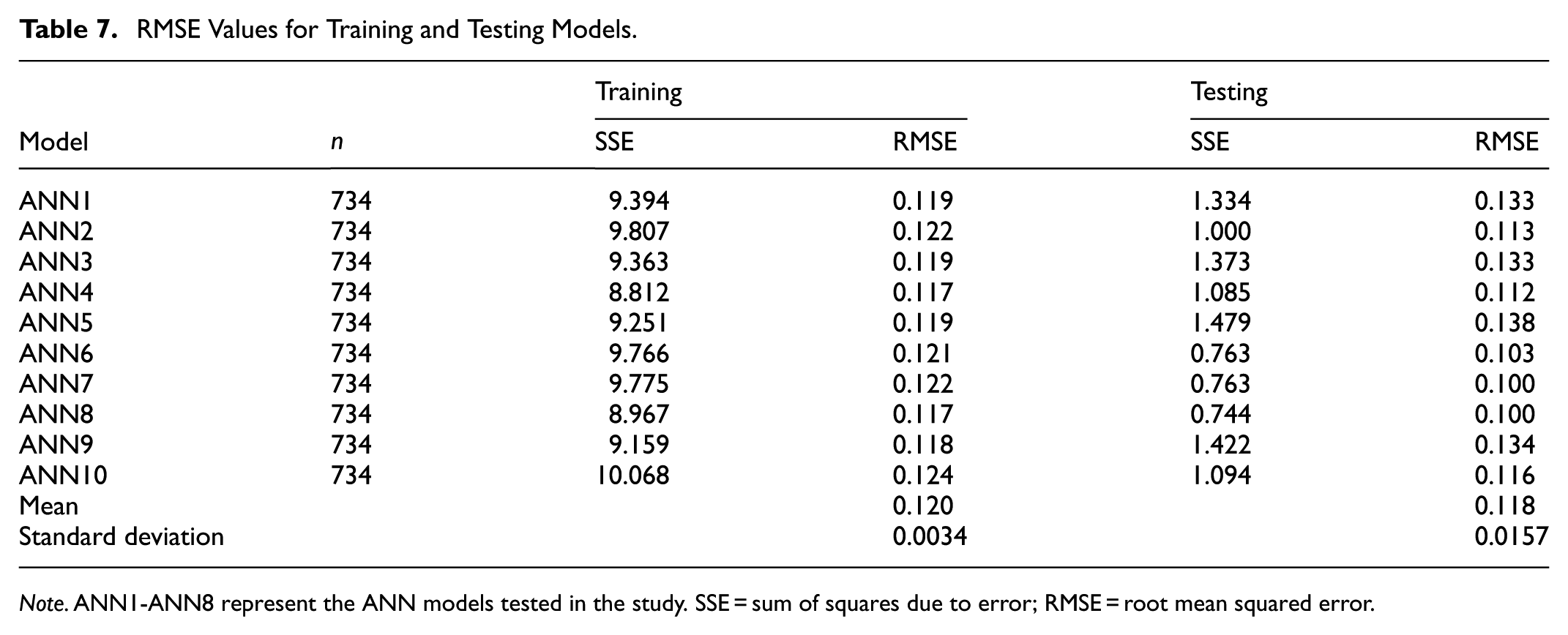
Note. ANN1-ANN8 represent the ANN models tested in the study. SSE = sum of squares due to error; RMSE = root mean squared error.
A sensitivity analysis was also performed to evaluate the relative importance of the input variables concerning their effect on the output variable (see Table 8). The normalized importance calculates the ratio of the significance of each element to the important value considered the most significant. Moral elevation was the most significant input variable, indicating that it was the most important factor affecting altruistic behavior, followed by exposure to prosocial VR content and rehearsability, with relative importance values of 65.6% and 41.8%, respectively. The other input variables, feedback transmission velocity, reprocessability, and sense of community responsibility, showed relative importance values of 28.1%, 11.6%, and 19.1%, respectively. The sensitivity analysis showed that, on the best performing model (ANN8), the predictors (exposure to prosocial content, moral elevation, transmission velocity, reprocessability, rehearsability and sense of community responsibility) had importance values of 0.145, 0.402, 0.157, 0.061, 0.110, 0.124, respectively. Thus, moral elevation had the highest degree of importance in predicting the outcome variable in the best performing ANN model.
Neural Network Sensitivity Analysis.

Note. ANN1-ANN8 represent the ANN models tested in the study. EPRO = exposure to prosocial VR content; ME = moral elevation; TRAN = transmission velocity; REP = reprocessability; REH = rehearsability; SOCR = sense of community responsibility.
Discussion
This research explored how exposure to prosocial content via VR affects altruistic behavior. It also examined the mediating role of moral elevation and the moderating roles of feedback transmission velocity, reprocessability, rehearsability, and sense of community responsibility. Drawing on the SOR model, the findings of the study show that exposure to prosocial VR content enhances altruistic behavior. This finding aligns with the findings and theorizations of prior studies that media stimuli tend to shape the prosocial behaviors of the audience (Greitemeyer, 2011, 2022; Padilla-Walker et al., 2015; Rose et al., 2022). Moreover, the research establishes that the relationship between prosocial content exposure and altruistic behavior is mediated by moral elevation. Thus, exposure to prosocial VR content enhances moral elevation, which in turn enhances altruistic behavior. This finding underscores the importance of emotional factors in shaping helping behavior, which has also been observed by prior studies (Abramson et al., 2020; Krol & Bartz, 2022; Ortega-Galán et al., 2021).
Furthermore, the findings showed that feedback transmission velocity, reprocessability and rehearsability moderate the effect of exposure to prosocial VR content on moral elevation. The positive effect of exposure to prosocial VR content on moral elevation diminished when the medium of communication enabled high feedback transmission velocity, reprocessability and rehearsability. These findings align with prior research, which demonstrated that media synchronicity enhances the effectiveness of communication (Damali et al., 2022; Kashian & Walther, 2020; Son et al., 2019). These findings suggest that when individuals perceive that feedback in the VR system is delivered quickly (i.e., high feedback transmission velocity), they are likely to experience a stronger and more immediate emotional response, and this can lead to a heightened sense of moral elevation. Similarly, if a platform enables an individual to revisit and review the content multiple times (i.e., reprocessability) and gives individuals the possibility to mentally prepare and process the content before engaging with it (rehearsability), they have more opportunities to repeatedly engage with the prosocial content and to align their cognitive and emotional states with the prosocial message being conveyed. Repeated engagement and preparation can lead to a more meaningful emotional connection with the content, resulting in stronger moral elevation. It is also noted that reprocessability had the highest effect, followed by rehearsability and feedback transmission velocity, in that order. Thus, when individuals perceive that VR content can be reprocessed, they tend to have a higher emotional reaction (i.e., moral elevation) as compared to when they perceive that VR content can have high rehearsability and high transmission velocity. This could be because the revisiting of content that reprocessability enhances can foster deeper cognitive processing and emotional resonance (Thomas et al., 2023), enhancing potentially leading to heightened moral elevation.
The findings also show that a sense of community responsibility moderates the effect of moral elevation on altruistic behavior. Thus, individuals who feel a strong sense of responsibility to their communities tend to be more likely to act on their emotions and, thus, engage in altruistic behavior. This aligns with prior research, which has consistently shown that individuals who feel a deep attachment to their social groups or communities are more inclined to engage in behaviors that benefit those entities (Deng et al., 2023; Procentese & Gatti, 2022; Yang et al., 2020). The sense of accountability to one’s community strengthens the drive to act on elevated emotions (particularly moral obligation) and thus makes altruistic behavior more likely. A strong sense of community is likely to activate social norms related to collectivism and mutual well-being. When individuals feel accountable to these norms, the emotional uplift from moral elevation becomes channeled into fulfilling a perceived social duty in the form of altruistic acts. Thus, feeling accountable to the community can magnify the emotional resonance of moral elevation such that that, it develops into a deepened perception that the individual’s actions matter to the community. Thus, the individual’s sense of responsibility becomes an important driving force behind altruistic behaviors that benefit the individual’s broader social group.
Theoretical Implications
This research makes three contributions to literature on technology-mediated altruistic communication. First, it contributes to the emerging work on how digital technologies shape prosocial outcomes. While prior research has shown that exposure to altruistic content through traditional media (e.g., television, print, and radio) can elicit helping behaviors (Brasher, 2022; Fukui & Toyoshima, 2014; Martín-Santana et al., 2018), the current study advances this understanding by examining how such effects play out in new media environments, specifically VR. Unlike traditional media, VR allows for immersive, interactive experiences and real-time feedback, which transform how users emotionally engage with content (Borah et al., 2022; Cummings et al., 2022). The current research identifies moral elevation as the emotional mechanism linking prosocial content exposure to altruistic behavior. Thus, it integrates affective processing perspective with media psychology. This perspective underscores the affective affordances of new media, extending scholarship on media effects by demonstrating that emotional uplift (rather than just cognitive awareness) is a key driver of digital altruistic behavior.
Second, this research extends the media synchronicity theory beyond its traditional cognitive and task-oriented boundaries (Dennis et al., 2008). Existing research has mainly focused on how synchronicity enhances task performance and decision-making efficiency (Kashian & Walther, 2020; Thomas et al., 2023). This study, however, shows that media synchronicity can amplify emotional reactions to content, specifically moral elevation. By demonstrating that high-synchronicity media (e.g., real-time interaction or immersive VR) enhance the emotional effects of prosocial content, this research introduces an affective dimension to the media synchronicity literature. This finding bridges media richness theory with emotion-based models of behavior change, suggesting that synchronicity not only facilitates clearer communication but also deeper emotional engagement, particularly critical in contexts where persuasion and moral activation are required (e.g., fundraising, volunteer recruitment, crisis communication).
Third, this research makes a valuable contribution to theories of altruism by integrating emotional and dispositional antecedents. While existing literature has acknowledged that emotional factors such as empathy and elevation can drive helping behavior (Cherewick et al., 2022; Krol & Bartz, 2022), less has been done to examine the interactive effect of emotional and personal factors. By showing that sense of community responsibility strengthens the effect of moral elevation on altruistic behavior, this study highlights a synergistic relationship between transient emotional states and stable individual traits. This provides a more comprehensive model of altruistic behavior by demonstrating that emotional inspiration alone may not be sufficient. Personal commitment to community values is necessary to translate emotion into sustained prosocial action. Theoretically, this supports dual-process models of moral behavior that combine affective and motivational components (Narvaez, 2009) and provides a pathway for future research on tailoring altruistic messages based on personal values.
Practical Implications
The findings of this study offer several practical insights for communication practitioners aiming to promote altruistic behavior through technology-mediated interventions, particularly those employing VR. First, the results underscore the potential of VR platforms in eliciting moral elevation, which is a core emotional response that significantly influences altruistic behavior. VR’s immersive and interactive nature allows users to virtually inhabit scenarios of moral beauty and prosocial acts, making the emotional experience more immediate and compelling than in traditional media. Charitable organizations, educators, and humanitarian communicators can therefore utilize VR to design emotionally resonant content that vividly depicts acts of kindness, solidarity, or self-sacrifice. Such content, when framed in immersive narratives, can serve not only to inform but to inspire, triggering internal motivations to emulate the observed altruistic behavior.
Second, the study demonstrates that media synchronicity features (feedback transmission velocity, reprocessability, and rehearsability), significantly amplify the emotional impact of prosocial content. These features should therefore be a key consideration in the design of altruistic communication. Platforms that offer real-time feedback capabilities can intensify the immediacy of users’ emotional engagement, while reprocessability allows for repeated exposure and reflection, which deepens moral elevation over time. Likewise, rehearsability enables users to mentally and emotionally prepare for their responses, fostering a more integrated affective-cognitive reaction. Practitioners should therefore leverage VR technologies that support these affordances, for instance by enabling users to replay emotionally powerful scenes, pause for reflection, or receive real-time prompts during the experience.
Finally, the research emphasizes the importance of audience segmentation and value-based message targeting. Specifically, the findings indicate that individuals with a strong sense of community responsibility are more likely to translate the emotional uplift elicited by prosocial VR content into concrete altruistic actions. This suggests that a uniform approach to altruistic communication may be suboptimal. Instead, content should be strategically tailored to audiences already dispositionally inclined toward prosocial behavior—such as individuals engaged in civic initiatives, local volunteerism, or members of collectivist cultural or religious communities. Moreover, for general audiences, value-based framing can be used to activate community-oriented values. By emphasizing themes such as collective responsibility, social interdependence, and moral obligation, communicators can encourage individuals to interpret moral elevation not merely as a personal feeling, but as a socially driven call to action.
Limitations and Future Research Directions
This study has several limitations that could be addressed by future research. First, the data used in the study was collected in Taiwan, a country that is known to have may technologically apt people (Kemp, 2023). Thus, the respondents would have a higher level of readiness, which could possibly lead to positive responses to altruistic content. Future research could examine this framework in other contexts, such as countries where technological readiness is relatively low, to ascertain the robustness of the model. Moreover, it is noted that a good number of the initial participants in the study did not pass the attention checks. This is due to provision of uniform responses for each question in the survey and failure to maintain attention checks. This could possibly affect the generalization of the findings on the overall data population, necessitating the examination of the model with a sample comprising less excluded elements. Thirdly, the data used in the study was collected at one point rather than in a longitudinal manner. However, technology is fast changing, as it incorporates new features to enhance user experience and to reach out to more users (Fan et al., 2020). Future research could examine the model using data collected at different times to capture the changes in user behavior of the technology and how it impacts their emotional responses and altruistic behaviors over time. Thirdly, this study did not focus on specific media platforms. Rather, it collected data from people who had any form of new media. However, different media have different features (Burgess et al., 2017), which tend to influence the effectiveness of communication executed through those media. Future research could therefore examine the framework using data collected from users of more specific media. Some relationships within the model could be explored from different perspectives. For example, prior studies suggest that communication can influence a sense of community responsibility (Deng et al., 2023; Procentese & Gatti, 2022). Future research could investigate whether exposure to altruistic content directly impacts the development or enhancement of a sense of community responsibility. Future studies could also compare the results of data collected from users of different new media platforms. This could provide a more holistic understanding of the outcomes of exposure to prosocial content view new media platforms. In addition, a considerable share of the study’s sample was female, and aged 15 to 29. This could limit the generalizability of the results. Future research needs to examine this model with a more evenly distributed sample to ensure better generalizability of findings. Finally, this research found that gender had a significant effect on altruism behavior. This suggests that altruistic behavior may differ depending on the gender of the person viewing the altruistic content in VR. Future research could examine this model by comparing the differences between genders in altruistic behavior for people who view altruistic content in VR.
Footnotes

Ethical Considerations
In the announcement letter dated March 22, 2012 (Ref: MOHW Medical Letter No. 1010064538), the Ministry of Health and Welfare (Taiwan) issued a clarification regarding Article 4 of the “Human Research Act.” It was clarified that this article does not apply to “Social Behavioral Science research” (i.e., research on interactions between individuals and the external social environment) and “humanities research” (i.e., research observing, analyzing, and critiquing social phenomena and cultural arts). The research under consideration is characterized as non-human contact, anonymous, and non-intrusive, conducted in a public setting.
Consent to Participate
Informed consent was obtained prior to participation. All participants were provided with a detailed explanation of the study’s purpose, procedures, potential risks, benefits, and their rights, including the right to withdraw at any time without penalty. Consent was obtained electronically through an online platform, where participants were required to indicate their agreement before proceeding with the study. This procedure adhered to institutional ethical guidelines and ensured voluntary and informed participation.
Funding
The authors disclosed receipt of the following financial support for the research, authorship, and/or publication of this article: This research was funded by the Tzu Chi Cultural and Communication Foundation and the Yin Shun and Cheng Yen Education Foundation.
Declaration of Conflicting Interests
The authors declared no potential conflicts of interest with respect to the research, authorship, and/or publication of this article.
Data Availability Statement
All data generated or analyzed in this study have been incorporated into the published article.