




Abstract
The issue of waste in Indonesia and the global world is a crucial problem, and until now, it has not been resolved effectively and has not prioritized sustainable governance. Almost all regions are experiencing a handling crisis primarily from consumer waste, such as paper, food, electronics, plastics, metals, and packaging. This research aims to develop an effective waste management policy strategy at the municipal government level in Banten Province, Indonesia. Specifically, this research examines the strategy of changing people’s behavior through the perspective of social change behavior theory and rational-legal authority. This study employed a qualitative case-study approach, incorporating field observations, in-depth interviews, and focus group discussions. The findings indicate that waste management governance in Banten Province’s urban areas should operate optimally. The increasing waste production and the behavior of urban communities that still need to sort their waste have worsened waste management in the region. Therefore, there needs to be a policy strategy for waste management through changes in community behavior, which is implemented through promotion policies, campaigns, socialization, and educational activities for the community. Then, the city government should also provide clear waste bin facilities and management and consider individual preferences and local culture in changing people’s behavior in sustainable waste management.
Plain language summary
Waste management is a growing problem in urban areas of Banten Province, Indonesia. The region faces increasing waste production from consumer goods such as plastics, food, and electronics. However, local waste management policies have not been fully effective. People often do not sort their waste, and waste collection systems combine all types of garbage, making recycling difficult. This study explores strategies to improve waste management by focusing on changing people’s behavior. It highlights the need for community education, government policies, and better waste collection systems. The research found that while many residents know the benefits of waste separation, they lack proper guidance and incentives to follow through. Some believe sorting waste is unnecessary since garbage collectors remix it. Key recommendations include encouraging public participation, which the government should involve communities in waste management by making clear rules and offering rewards for good practices. Education and awareness campaigns need to be done in schools, and religious leaders and community groups should teach people about waste sorting and its environmental benefits. The local government also must make better infrastructure to provide separate waste bins and collection trucks for organic and inorganic waste, which is crucial. Besides, the government should introduce strict waste management regulations, with incentives for compliance and penalties for violations. However, collaboration among local authorities, businesses, NGOs, and educational institutions should collaborate to create a sustainable waste management system. By implementing these strategies, urban areas in Banten Province can reduce pollution, improve public health, and work toward a “zero waste” future where waste is minimized, reused, and recycled effectively.
Introduction
The issue of waste is a crucial problem, and until now, it has not been resolved effectively and has not prioritized sustainable governance. Consumer waste, including paper, food, electronics, plastics, metals, and packaging, is a major waste problem. World Bank data from 2012 shows that the world produces around 1.3 billion tonnes of municipal waste annually, increasing to 2.2 billion tonnes by 2025. This condition has adverse social, economic, and environmental impacts (Ebrahimi & North, 2017). Waste management has strategic value, as the United Nations has included it in the Sustainable Development Goals (SDGs) agenda number 12, which concerns responsible consumption and production (Bappenas, 2015). In addition, the increasing urbanization of people in urban areas has led to uncontrolled waste production owing to poor management, causing severe environmental and health impacts.
Conceptually, an environment-friendly solution is to reduce waste production and recycling (Heidari et al., 2018; Struk, 2017). Waste production is reduced by reducing consumption and utilizing environmentally friendly materials. Meanwhile, consumer waste can be recycled by separating organic and inorganic waste. Waste segregation is essential for successful recycling (Chen & Lee, 2020). However, this strategy required community participation. The demographic and socioeconomic characteristics of the community play a crucial role in achieving effective waste management. Waste management requires strategic capabilities, significantly changing people’s behavior, and being more aware of the importance of reducing waste production (Yang et al., 2018). Waste is also a public problem that requires the participation of all stakeholders (Diaz-Ruiz et al., 2019; Lee-Geiller & Kütting, 2021).
Municipal solid waste generation is a critical environmental challenge worldwide, with the world producing about 1.3 billion tonnes in 2012, projected to reach 2.2 billion tonnes by 2025. In Indonesia’s Banten Province (comprising Serang City, Cilegon City, and South Tangerang City), daily waste generation is particularly high (e.g., 601.38 tonnes in Serang City). Traditional approaches (primarily landfilling) dominate urban waste management in Banten, but these are land-intensive and cause severe environmental impacts. Moreover, local regulations (e.g., Banten Provincial Regulation No.8/2011) have not been fully implemented, leaving a gap between policy intent and practice. Based on data from the Ministry of Environment and Forestry’s Waste Management Information System in 2023, as shown in Table 1, waste production in Serang City amounts to approximately 601.38 tonnes per day (Rifa’i’, 2021), Cilegon City 278.83 tonnes per day, and South Tangerang City 1,011.45 tonnes of waste per day (Kementrian Lingkungan Hidup Dan, 2023).
Daily Waste Generation of Banten Province in 2023.

Source. Ministry of Environment and Forestry of Republic of Indonesia, 2023. Has provided in the reference list.
The results of the research team’s field observations show that urban waste management in Banten Province relies on a traditional approach with landfills in each district and city. Landfills in Banten Province include the Cilowong landfill in Serang City, the Bagendung landfill in Cilegon City, and the Cipeucang landfill in South Tangerang City. Landfilling not only requires a large area but also causes unpleasant odors (Mendes et al., 2023). The impact of landfilling is 10 times higher than that of other available waste treatment methods (Gao et al., 2017), landfilling is the most popular waste treatment method worldwide, especially in developing countries (Feiz et al., 2020).
The local government has adopted a waste management policy through Banten Province Regional Regulation No.8 of 2011 (Peraturan Daerah Provinsi Banten, 2011), but it has yet to be implemented as expected. Some obstacles in waste management include local government policies that do not touch the community because of the lack of socialization and action of the policies, even though waste management aligned with norms, standards, procedures, and public service criteria is the responsibility of local governments (Palilingan et al., 2018). Other causes include lack of investment in adequate waste management infrastructure, other than landfills, and people who are less concerned with waste issues, such as not sorting organic-anorganic waste, littering, and lack of awareness of household waste handling (Liu et al., 2023; Mendes et al., 2023; Rahmanda et al., 2023). Waste management has become a global environmental issue, as increasing population and consumption leads to significant waste generation volumes (Hidalgo-Crespo et al., 2024).
The environment has always been studied and has become an essential issue in the field of human behavior, especially the idea that individual behavior impacts the surrounding environment (Li & Chen, 2018). If individuals understand and care about the environment, they will implement positive behaviors, influencing the community to preserve it (Tam & Chan, 2017). An increasing population has an impact on the amount of waste generated. It requires waste management as part of a circular food system in addition to production and consumption processes (Mendes et al., 2023). The government must establish waste management policies to address environmental problems by planning, implementing, controlling, and managing the knowledge of environmental accounting (Latifah & Soewarno, 2023; Syarif & Novita, 2019).
Future waste management efforts should emphasize transforming public attitudes and behaviors, encouraging community-driven, bottom-up approaches, as the current top-down strategies have shown limited effectiveness. Zero waste is a new approach to waste management that promotes the 3R principles (reuse, reduction, and reecycling) with the localized waste management principle to reduce the transportation burden (Ebrahimi & North, 2017). Zero waste is a concept that encourages the redesign of a resource from a linear system to a closed cycle, so that all products can be reused. Zero waste refers to a waste management and planning approach that emphasizes the prevention of waste production in contrast to the traditional approach to waste management (Lee et al., 2020). Zero waste is more than just recycling; it includes prevention and reduction (Davidson, 2011; Tufaner, 2021).
Many studies have examined and analyzed waste management issues in several countries. From the results of the mapping of waste management research conducted by the research team using bibliometric analysis with the VOSviewer application (Marcucci et al., 2021; Smyrnova-Trybulska et al., 2018), research topics regarding waste management are still focused on waste handling technology and its impact on the environment, while topics related to management and waste management strategies are still not widely studied, as shown in Figures 1 and 2.

Waste management research mapping.

Qualitative data analysis framework.
Based on a search of the Scopus database, there were 37 research clusters concerning waste management technology and its impact on the environment, with 292 articles. There were only eight research articles related to waste management. Ferronato stated that waste management in developing countries still focuses on environmental pollution and social problems, and needs to be managed (Ferronato, 2019). Developing countries still need improvements in dealing with waste issues (Gupta et al., 2015; Miezah, 2015). Developed countries in Europe have processed their waste into energy sources (Brunner, 2015; Kumar, 2017; Malinauskaite et al., 2017), involving multiple stakeholders (Soltani, 2015). Good municipal waste management is also assessed based on environmental impacts by applying a life cycle assessment or LCA methodology (Erses Yay, 2015).
Based on previous studies that focused more on waste management technology management, this research focused on developing an effective zero-waste-based waste management policy strategy through changes in community behavior and government policies. This study makes a novel contribution by analyzing the zero waste discourse through a behavioral perspective using behavior change theory that has never been used in urban environments in developing countries. This study fills a gap in the literature by emphasizing psychological elements, including attitudes, subjective norms, and perceived behavioral control, rather than focusing solely on technical and regulatory aspects. The results of this study not only expand the use of behavior modification theory in the environmental sector, but also build a foundation for behavior-based policy interventions.
However, field observations show limited public sorting and low awareness of waste impacts. Studies have linked pro-environmental behavior to attitudes and intentions (Theory of Reasoned Action and Planned Behavior) and highlight the role of social norms and education in motivating recycling. This study investigates the factors shaping urban waste management in Banten from two theoretical perspectives: social change behavior theory (which focuses on how communities adopt new behaviors through collective processes and cultural influence) and Weber’s rational-legal authority (which emphasizes the role of formal regulations and bureaucracy in legitimizing policy). Social change theory suggests that shifts in norms and shared practices (such as collaboration with religious and community leaders) can drive environmental behavior change, as seen in successful zero-waste communities (Fagerholm et al., 2025). Rational-legal authority implies that legally backed policies and enforcement can institutionalize these changes. We explore the following research questions:
1. What is the condition of community behavior in waste management in urban Banten?
2. What strategies could produce effective and sustainable waste management at the city government level?
3. How can community behavior change be fostered through the lens of social change theory and rational-legal authority?
Research Methodology
This research employed a qualitative methodology using a case study framework to formulate a strategic model for urban waste management. As a qualitative method, the case study approach enables the exploration of contemporary, bounded phenomena in real-world contexts through comprehensive data gathering from multiple sources (Creswell, 2016). As Yin (2018) noted, case studies are particularly valuable for investigating events over which researchers have minimal or no control (Ebneyamini et al., 2018; Qathrunnada & Nugroho, 2023; Yin, 2018). The study utilized data collection techniques, including direct observations, focus group discussions, and in-depth interviews, whereby data collection is crucial and strategic in the research process (Plano Clark et al., 2023).
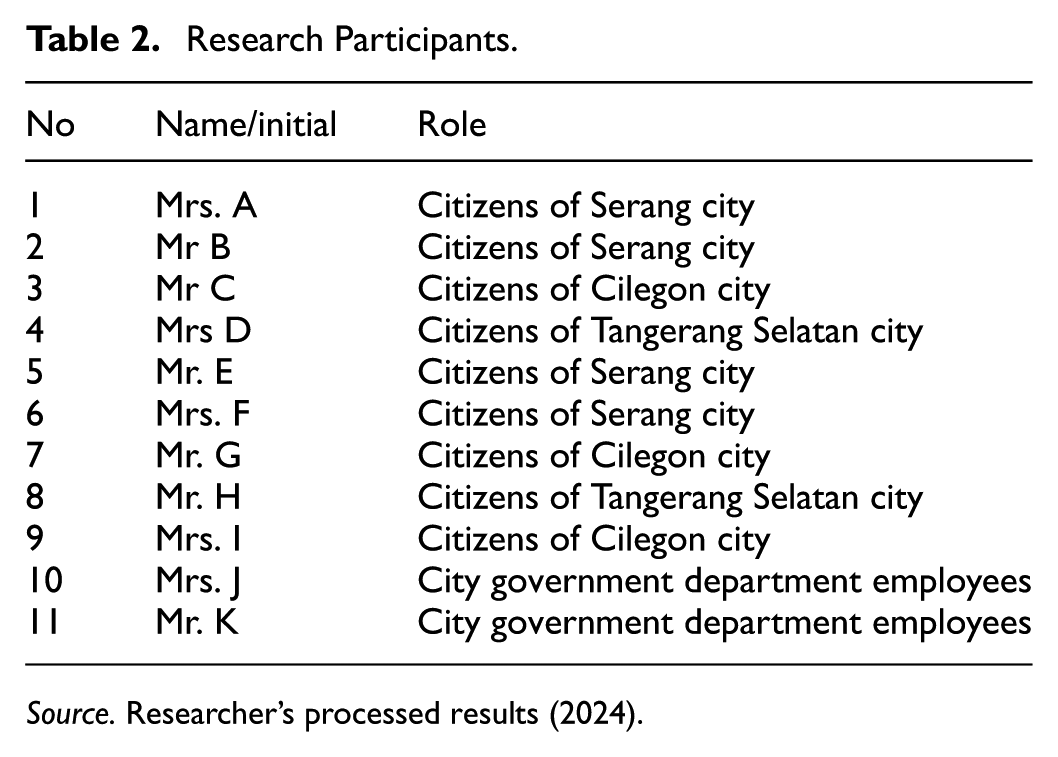
The study involved participants comprising policymakers, community members, and environmental practitioners, selected through purposive sampling. This method consists of selecting individuals based on predefined criteria established by the researcher, in this case, stakeholders engaged in urban waste management in Banten Province, Indonesia, who were willing to share relevant insights regarding waste-related challenges. The participants in this study were four Serang City residents, two Cilegon City residents, and two South Tangerang City residents who were involved in waste management. In addition to in-depth interviews with participants, the researcher conducted focus group discussions with stakeholders from the Department of Environment and Hygiene of Serang City and Cilegon City, as well as academics and environmentalists in Banten Province. Focus group discussions were conducted by considering several things, namely: First, selecting representative discussion participants (actors who understand waste management); Second, using a structured guide related to waste management in urban areas in Banten Province; and third, prioritizing data triangulation, namely by comparing FGD results with other data sources (interviews, observation, and documentation). At the participants’ request and to protect their data, the researcher only displayed the initials of the research participants’ names. The initials of the names and roles of the research participants are presented in Table 2.
Research Participants.
Source. Researcher’s processed results (2024).
We used purposive sampling to identify 11 key informants (policymakers, community representatives, and environmental actors) across three cities in Banten (Serang, Cilegon, and South Tangerang). This research involved key informants spread across three cities in Banten Province, namely South Tangerarang City, Cilegon City, and Serang City. The informants were purposively selected with the following criteria: (1) having direct involvement in household or community waste management, (2) having experience in zero waste practices or similar programs, and (3) willing to be interviewed in-depth. They consist of people who understand the waste issues in their respective cities. The sample included local government department employees and active neighborhood citizens (Table 2). Although small, this sample is typical for qualitative research focusing on “information-rich” cases (Vasileiou et al., 2018). Such purposive samples are aimed at depth and relevance rather than statistical generalization. We continued data collection until data saturation was reached: after the 11th interview, new information became repetitive, indicating thematic saturation. All individuals involved in this research gave verbal consent to be identified using their initials and their roles in the urban waste management sector in Banten Province, Indonesia. They also expressed, both orally and in writing, their agreement to allow partial or complete quotations from interviews and Focus Group Discussions.
The data collection process, which took place from February 2022 to December 2023, served as the methodological cornerstone of this research. The corresponding author can access all data underpinning the study’s conclusions upon reasonable request. The research employed direct observation and in-depth interviews as primary data collection methods. Observational studies were conducted in Cilegon, Serang, and South Tangerang, focusing on the practical execution of waste management. Non-participant observation allowed researchers to unobtrusively observe activities without informing the informants, thereby capturing more authentic behaviors (Eldh et al., 2020; Mills et al., 2010). In-depth interviews collect detailed data from sources or informants using semi-structured guidelines on the phenomenon being studied (Hidayat et al., 2024). Interviews are conducted openly and directly with individuals involved in urban waste management. These interviews were recorded using visibly placed devices, and the presence of these devices was disclosed to participants. The research team subsequently transcribed all recordings, with thematic topics and relevant questions selected for detailed analysis.
Data from observations, focus group discussions, and interviews with participants were recorded and documented visually (photos) through audio, and video. This data becomes the researcher’s documentation and will remain confidential. Qualitative data were processed using ATLAS TI and AHP software to obtain a model of waste management governance strategy in the urban areas of the Banten Province. Qualitative data from FGDs, interviews, documentation, and observations were analyzed using ATLAS TI version 9. The process began with open coding of the transcripts of the qualitative data. Initial codes were developed inductively from the data, then categorized into major themes based on similarities in meaning. To increase reliability, validity of findings was tested by confirming through source triangulation techniques and member checking with informants. To prioritize strategies, the Analytic Hierarchy Process (AHP) method was used. AHP data processing using the AHP Priority Calculator application.
Based on the thematic results from ATLAS.ti, we built a hierarchical AHP model: the goal was defined as “Optimize Urban Waste Management Strategy.” The criteria corresponded to the central strategy themes (e.g., community participation, education, collaboration, monitoring, regulatory compliance), and sub-criteria detailed specific actions under each (Table 3). For example, under Community Participation, we included sub-criteria such as “Incentives/Penalties” and “Legal reforms”; under Education, we included “School programs” and “Public workshops.” Pairwise comparisons were then conducted to assess the relative importance of each criterion and sub-criterion. A panel of the research team (based on researcher consensus and stakeholder input) rated the importance of each element on a 1 to 9 scale. These judgments were entered into the AHP Priority Calculator software (Saaty’s method). Consistency ratios were checked to ensure reliable comparisons (all matrices had CR < 0.1). The resulting weights indicate the priority ranking of each strategic area. For transparency, Table 3 illustrates the AHP hierarchy with example criteria and sub-criteria.
Hierarchical AHP Model.

Source. Researcher’s processed results (2024).
The data analysis in this study co-occur with other parts of qualitative research development, namely, data collection and writing findings (Creswell, 2016). The data analysis technique used in this study uses qualitative data analysis references according to Creswell in (Creswell, 2016; Malau et al., 2024) qualitative data analysis framework, involving the following steps:
Result and Discussion
Community Behavior in Waste Management in Urban Areas
Waste is an environmental issue that remains a challenge and needs to be resolved in urban areas of Banten Province, especially in Serang City. The data show 90 illegal waste points in Serang City, which previously had approximately 120 points. This condition caused Serang City, which is also the capital city of Banten Province, to look shabby. The Serang City Government has made efforts through the illegal waste task force by conducting sweeps to transport it in the Serang City area. This is because people still litter, and data shows that Serang City produces 800 tons of waste daily (Antara, 2023; Rifa’i’, 2021)
Currently, Serang City already has Regional Regulation Number 7 of 2021 related to waste management, which aims to reduce waste in Serang City with several rules, namely:
The obligation of waste management by every citizen or business in the Serang City area.
Restrictions on using single-use plastics and plastic bags that are not environmentally friendly.
The establishment of waste banks is a place to collect, sort, and process waste.
Proper waste disposal is according to the rules set by the government.
Administrative sanctions include fines or temporary suspension of business activities for violators of rules (Kusuma, 2023).
This policy is more effective in practice. Therefore, there needs to be a change in the community waste management behavior of each household. The actual problem of waste is how it is lost through the sorting process using the 3R principle (Reuse, Reduce, and Recycle). The data show that the people of Serang City still need to sort their waste. Several participants revealed that sorting waste is “complicated” and “useless.” Even though there is sorting, waste still needs to be sorted when transported by officers. In addition, people would want to do so if the city government educated the community on how to sort waste. This statement was expressed by several people in Serang City as follows:
“Do residents sort their waste between organic and inorganic waste? The answer is no, it’s complicated. The reason is that the bins are still combined, and even though it has been sorted, those who pick up the waste are still combined again” (Interview with Informant A, 2022).
Another informant revealed that the community could make the selection if educated by the city government. This was expressed by one of the residents of Serang City:
“In my neighborhood, the community is not like that, maybe because there has been no socialization or information from related parties to residents, so understanding waste sorting for residents is trivial and does not need to be done. But if people are given proper knowledge about waste processing and sorting, they will be more aware, and it will impact waste that is not managed wisely” (Interview with informant B, July 2022).
Despite efforts to improve waste management systems, achievements still need to be made. Waste generation remains high, and active community involvement in sustainable waste management efforts must be improved. More policies and implementations must be implemented at the community level. Therefore, an emphasis on changing people’s behavior is crucial for understanding how to increase participation in waste management. A person’s level of concern for the environment and intention to perform environmentally friendly behavior (Fishbein & Ajzen, 2011) can play an essential role in the behavior of love for the environment sorting waste (Setiawan et al., 2020, 2021). The concept of waste management usually applies waste recycling, known as the Reduce, Reuse, Recycle (3R) principle, which is the spearhead in dealing with waste in the community environment if it is just a slogan that does not hit, even though the behavior of sorting waste not only reduces risks to human health and the environment but also creates business opportunities and jobs of economic value (Dhir et al., 2021).
The desire or intention of the community to conduct waste management through waste segregation exists. Even the community has knowledge about the environment in waste management and understands the impact of the waste, for example, understanding the impact of plastic waste on the environment because it cannot decompose, resulting in soil and water pollution. This was expressed by one of the people of Serang City as follows:
“Yes, there is an intention to reduce plastic waste. After all, plastic is a difficult waste to decompose, resulting in soil pollution, which is very dangerous for soil and water fertility. If we talk about the city of Serang, the location around the disposal site is still often used as agricultural and plantation land; of course, this is detrimental to the surrounding community.” (Interview with participant C, April 2022)
Other participants expressed about environmental knowledge, primarily related to waste management:
“Yes.Waste segregation will make it easier to recycle waste for reuse, while plastic waste is a tough waste to degrade.” (Interview with participant D, February 2023).
Waste is an item or object that has exhausted its value. The prevailing definition of waste tends to frame it as an undesirable material that must be eliminated from residential spaces (Salvia et al., 2021). This perspective may hinder efforts to promote responsible waste management at the individual level. Reevaluating this conceptual approach could enhance public engagement in managing household waste and support broader efforts to reduce the environmental impact associated with improper waste disposal. Therefore, overcoming the problem of waste in the urban areas of Banten Province must understand and change people’s behavior to promote the concept of zero waste, sustainability, and environmental responsibility. This refers to a planning approach that emphasizes preventing waste production, both in terms of selecting organic and inorganic waste and limiting the use of plastic waste through education and public awareness.
Since 2003, Kamikatsu in Japan has established sustainable Zero Waste practices that have achieved recycling rates exceeding 80%. By exploring how society shapes itself around the concept of zero waste by encouraging lifestyle changes, changing norms, creating shared experiences, establishing incentive systems, and developing self-awareness routines, Kamikatsu has been able to achieve this goal (Fagerholm et al., 2025). Zero waste is a visionary and evolving concept that requires a holistic approach involving sustainable production, responsible consumption and effective waste management. By adopting the principles of zero waste, communities and countries can significantly reduce their environmental impact and move toward a more sustainable future (Kumari et al., 2025; Zaman, 2015, 2017).
Government Policies in Waste Management
The value of awareness and positive attitudes of residents toward waste segregation already exist but have not been maximally implemented. There needs to be massive promotion and socialization carried out by the city government through environmental policies, so that the government provides a significant stimulus for changes in people’s behavior in protecting the city environment (Tran et al., 2019; Wang et al., 2021). Researchers agree that waste management is not only a technical and environmental problem, but is also caused by human behavior and can be overcome by changing these behaviors. Therefore, a social assessment of people’s behavior and the causal relationship between these behaviors must be conducted before designing a sustainable waste management system because people need to accept and understand the design to make good use of the innovation (Ulhasanah & Goto, 2018).
The Serang City Government has not yet promoted or disseminated information regarding garbage management in each hamlet of Serang City. This situation impacts the community’s understanding of waste segregation. A citizen of Serang City stated
“There has not been any socialization regarding waste selection for several years.”“(Interview with Participant E, December 2023).”
In addition, the Municipal Government in Banten Province has not implemented policies related to waste segregation. Waste is still combined during the waste collection process. Therefore, the community considers waste selection at the community level useless if the transportation system is still conventional or unified. One of the residents of Serang City expressed this as follows:
“So far, I have sorted it, but do the officers in the field and at the landfill site do the same thing? That is what I do not know. Because as far as I know, when the waste is put in the collection vehicle, it becomes one” (Interview with participant F, February 2022).
This condition will certainly make a real contribution to the intention and awareness of the community in waste management in their area because the city government should be able to play a significant role in promoting, socializing, counseling, and educating the public about the importance of waste selection, for example, by conducting campaigns, publications, and training to educational institutions from primary to tertiary levels and to mothers at the Neighborhood Association (RT), Neighborhood Association (RW), and Kelurahan levels, so that people increase their awareness of the importance of controlling waste production through the sorting process. In addition, the city government must also provide infrastructure and facilities to support waste segregation, including clear and separate waste bins, separate transportation systems, and building waste recycling centers. The government must then implement policies that support the practice of waste segregation, incentives for them, and sanctions for citizens who violate the rules because the policy is an essential instrument for changing people’s behavior. Furthermore, the government must be able to collaborate with the private sector, NGOs, and educational institutions to change people’s behavior in sorting waste through educational activities, develop recycling technology, and empower communities to achieve sustainable waste management goals.
Figure 3 describes the government’s vital role in encouraging behavioral change in waste segregation to achieve success in sustainable waste management. Studies have shown that government interventions and policies can significantly influence individual engagement in waste segregation and recycling (Katan, 2023; Pongpunpurt et al., 2022). Knowledge factors, subjective norms, and facility support, as well as being influenced by government incentives, have positively impacted individual community intentions in sorting waste (Kountouris, 2022) Then, the results of the study show that the effectiveness of local management culture and environmental governance that the government has suggested was proven to contribute to changes in citizen behavior (Katan, 2023; Wang & Hao, 2020).

Existing waste management governance in urban areas.
The spiritual values of urban communities in Banten Province did not significantly influence the behavior of people in sustainably managing waste. Islam has provided values and rules for protecting the environment and nature. For example, “keeping clean is part of faith.” Therefore, the government must collaborate with religious leaders (Ulama) to jointly campaign for a waste management system in the community, one of which is the sorting process. Ulama and pesantren can improve the quality of the environment by constructing ecological wisdom based on fiqh al-bī’ah (Putri et al., 2024). Therefore, the government needs to use a comprehensive approach that considers individual preferences and local culture to change people’s behavior toward sustainable waste management. Effective environmental governance requires measures to generate intrinsic motivation or liking at the community level. Therefore, the government needs to use a comprehensive approach that considers individual preferences and local culture to change people’s behavior toward sustainable waste management.
Development Model of Waste Management Policy Strategy in Urban Areas
The results showed that in developing urban waste management policy strategies in Banten Province by paying attention to several aspects, namely: First, overcoming the problem of waste in the urban areas of Banten Province must understand and change people’s behavior to promote the concept of zero waste, sustainable and environmentally responsible; Second, the role of government is very important in encouraging behavioral changes in waste sorting to achieve success in sustainable waste management; and Third, the spiritual values of the community must have a significant influence in changing people’s behavior in managing waste in a sustainable manner. Because to date, there is no single development model for waste management policy strategies (Jiménez-Martínez, 2018; Ratnasari et al., 2023; Xu et al., 2023) Different countries and regions have different approaches and challenges in waste management. The results of data management using hierarchical process analysis showed that there are several waste management governance policies in the urban areas of Banten Province, as shown in Figure 4.

Calculation results of process hierarchy analysis of urban waste management policy strategies.
To solve the urban waste problem in Banten Province, the government must implement several governance policy strategies. First, the government should encourage and strengthen the participation of citizens through legislation to be equally responsible for waste management, especially in separating organic and organic waste in their respective households by taking into account citizen conventions and local culture, because urban communities in Banten Province intend to separate waste. Therefore, the government must be stimulated to conduct campaigns, socialization, and education for the city community and provide separate waste bins and collection trucks. Second, there needs to be an environmental education strategy, both formal and informal. Educational institutions must collaborate with the government to conduct environmental education, especially in waste management (waste separation) for schoolchildren, both at the Early Childhood Education (ECE), kindergarten (TK), Elementary School, Junior High School (SMP), Senior High School (SMA), and college levels. In addition, the government must also encourage and organize environmental education, especially in informal waste management, both at the Rukun Tetangga/RT and Rukun Warga/RW (neighborhood association), Kelurahan (villages), and Kecamatan (sub-district) levels so that people have good environmental knowledge and understand the impacts caused if they do not carry out sustainable waste management.
Third, there must be joint action through a collaborative process between local stakeholders, including the city government, private sector, universities, NGOs, and other educational institutions to carry out a sustainable waste management process. They must all consider the importance of a sustainable waste management process, for example, by separating waste from homes and institutions, equally reducing the use of plastic waste, providing separate waste disposal facilities, and educating their respective institutions. Then, the City Government must also make regulations to trigger an increase in sustainable waste management performance, and the logic of incentives and punishments must be put forward in order to create order in the implementation of these policies, namely, promoting the concept of zero waste with a new approach to waste management, which puts forward the 3R principle (reuse, reduce, and recycling) so that waste processing will be localized and reduce the burden of transportation.
Fourth, to ensure the effectiveness of our policies, we needed a clear instrument to measure their success. Regular monitoring and impact evaluation are crucial in this regard. By periodically measuring these aspects, we can be confident that our policies effectively reduce the production and accumulation of waste in the urban areas of Banten Province. Fifth, the party responsible for waste management must ensure that the final disposal site meets legislative standards. Compliance in the maintenance and sustainability stages of waste disposal should be promoted to minimize environmental impacts. The Serang City Government must sort the waste transported from neighboring areas and manage waste at the Cilowong landfill to ensure that it meets the segregation requirements. Similarly, the city governments of Cilegon and South Tangerang should be able to better manageBagendung and Cipeucang landfills. Therefore, commitment and collaboration between regions that use landfills must have the same perception and commitment regarding a sustainable waste management system, one of which is the sorting process.
Building on the themes and using AHP prioritization, we identify several strategic directions. The most supported strategies (in descending order of weighted importance from AHP) emphasize a mix of community-focused and institutional measures: (1) strengthen citizen participation and accountability. Empower households to be responsible for sorting (e.g., through local bylaws or community charters). For instance, participants suggested legislation that requires waste separation combined with community conventions and incentive programs (e.g., rewards for neighborhood recycling), and clear penalties for non-compliance were also mentioned. These measures reflect rational-legal authority (formal rules) but rely on social acceptance to work, which might involve city councils mandating household segregation while launching district competitions to raise interest; (2) enhance environmental education (formal and informal). Integrate waste management into school curricula and community education. Interviewees highlighted involving schools at all levels (kindergarten through university) and local associations (RT/RW, villages) in teaching waste sorting. By building knowledge and pro-environmental attitudes, these efforts follow social change principles: shaping norms in younger generations and communities. For example, involving teachers and parents in workshops creates a supportive social environment for change; (3) foster multi-stakeholder collaboration. Establish partnerships among government agencies, private companies, NGOs, universities, and religious/cultural organizations. Several participants noted that no single actor can handle waste alone; joint action is needed. Creating forums or working groups can encourage shared goals and resources. This strategy blends authority and social change: bureaucracies set the agenda, but success depends on trust and co-creation across society; (4) implement monitoring and evaluation systems. Develop clear indicators and regular assessments of waste management policies. Participants stressed the lack of oversight: it is hard to adjust strategies without data on successes or failures. Introducing formal monitoring (e.g., tracking recycling rates, conducting periodic surveys) institutionalizes accountability (rational-legal) while informing the community of progress (building trust and continued engagement); (5) ensure compliance at disposal sites. Improve landfill and final-disposal management to meet standards. Participants cited the need for better sorting and management at major sites (e.g., Cilowong, Bagendung). For example, the Serang government should audit incoming waste for segregation and work with neighboring cities to share best practices. Legislative enforcement (inspections, fines for dumping unsorted waste) underpins this recommendation. While technical in nature, it also has a social aspect: demonstrating government commitment increases public confidence in participating.
Considering the strategic directions identified through AHP and participant input, it is helpful to compare Banten’s urban waste governance with other regional examples that blend community engagement and regulatory authority. Bandung’s Kang Pisman (Reduce, Reuse, Recycle) program, launched in 2018, has become a model for waste sorting at the household level, combining mayoral decrees with extensive school and neighborhood campaigns to embed new social norms (Fatrianingsih et al., 2022). Penang, Malaysia, has seen success by aligning Islamic teachings on cleanliness with pro-environmental behavior, particularly among urban Muslim communities—thereby framing recycling as both a civic and religious responsibility (Nasir & Yaacob, 2022; Shompa & Mohd Mohadis, 2022). Similarly, Singapore’s Pay-As-You-Throw scheme uses differentiated tariffs and smart-bin technology to promote household waste reduction, backed by strong monitoring and enforcement mechanisms (Cheng et al., 2022; Zhou et al., 2022). These cases illustrate how policy layering—combining behavioral nudges with legal mandates—can be effective in diverse Southeast Asian contexts. The Banten strategy model, while emergent, reflects a hybrid of these approaches, integrating community-based change agents and rational-legal instruments into a locally rooted governance framework.
These recommendations reflect the themes from our analysis and are ranked by combined researcher judgment. Crucially, they illustrate integrating social change (education, community norms, collaboration) with rational-legal elements (policy enforcement, bureaucracy, monitoring). For instance, as indicated by Weber’s framework, encouraging participation through campaigns (social change) must be accompanied by clear legal responsibilities (rational-legal; Guzmán, 2018; Weber, 2014).
Conclusion
This study provides an understanding of developing a comprehensive urban waste management policy strategy that prioritizes the concept of zero waste with a new approach to waste management that emphasizes 3R principles (reuse, reduction, and recycling). Sustainable waste management must include effective implementation to protect natural resources, prevent adverse environmental and health effects, and ensure community participation. There needs to be a policy strategy to realize this, one of which is to sort waste in each household and institution. However, several things must be implemented, namely: (1) the government must encourage and strengthen citizen participation; (2) there needs to be an environmental education strategy, both formally and informally; (3) there must be joint action through a collaborative process between local stakeholders; (4) there needs to be a precise instrument to measure the success of policies related to sustainable waste management; and (5) there must be a party responsible for waste management and ensure that landfill sites meet and comply with legislative standards.
The findings suggest that bottom-up and top-down approaches are needed: community-focused initiatives to shift social norms and attitudes (social change theory), robust legal frameworks, and administrative action (rational-legal authority). Our key recommendations include expanding waste sorting education, enhancing public participation programs, fostering stakeholder collaboration, and strengthening formal policies and enforcement. For example, municipalities might launch school and community workshops on recycling (building new norms) and concurrently enact local ordinances that mandate waste separation at the source (leveraging bureaucratic authority). Integrating cultural values (such as religious teachings on cleanliness) into campaigns could further facilitate social acceptance of these policies.
All of this can be implemented if the government formulates a waste management policy from the household level, both in providing sanctions and in providing incentives for citizens. This is very important, especially for countries that experience urban waste management problems. For this reason, it is hoped that in the future there will be researchers who are concerned with studying community awareness related to waste management from the aspect of spiritual values. However, these conclusions are drawn from qualitative data with a limited sample. The suggested strategies should be viewed as informed hypotheses rather than definitive prescriptions. Future research could test these approaches in larger samples or experimental designs to evaluate effectiveness. By carefully blending educational, cultural, and regulatory tools, urban governments can move toward more sustainable waste systems—acknowledging that lasting change comes from aligning policy design with the social fabric of communities.
Footnotes
Acknowledgements
We express our gratitude to all of research participants.

Ethical Considerations
This study involved human participants and was conducted per the ethical principles of the Declaration of Helsinki and applicable Indonesian regulations. The Research and Publication Ethics Commission reviewed and approved the research protocol, University of Serang Raya, Banten, Indonesia (Approval No.: SK 05/KEPK/VIII/2024). All study procedures (e.g., recruitment, data collection, handling of interview/observation notes) were designed to minimize risk and burden to participants.
Informed Consent Statements
Before any data collection, all prospective participants received a plain-language information sheet describing the study s aims, procedures, potential risks/benefits, data protection measures, and the voluntary nature of participation. Written informed consent was obtained from each participant before enrollment.
Funding
The authors disclosed receipt of the following financial support for the research, authorship, and/or publication of this article: This work was supported by Serang Raya University Banten and Telkom University Bandung, Indonesia.
Declaration of Conflicting Interests
The authors declared no potential conflicts of interest with respect to the research, authorship, and/or publication of this article.
Data Availability Statement
Data sharing is not applicable to this article, as no datasets were generated or analyzed during the current study.