




Abstract
This article draws conclusions from four separate case evaluations from different development programs in Finland and aims to discuss the role of welfare state values in new public management. The study develops a comprehensive picture of the change in public management since 2000. The synthesis of the four case studies follows the critical realism tradition. This article shows that cooperation forms the key mechanism in all public administration projects and in any changes to their structure. The new structure is the postmodern service production sector that still faces many challenges with regard to the traditional welfare state values. One of these is the conflict between the deep-seated moral imperatives of the old welfare state and the goal-attainment priorities of the new public management. While evaluation research has become one of the operations in public administration that fulfills the control function, the value bases of society, management, and evaluations should be balanced together. Also the objectives of public management and evaluations should be more clearly defined in relation to values other than efficiency. An applied science, like evaluation, needs basic social research to formulate, recognize, and conceptualize the new public management structure. Furthermore, there is an urgent requirement to address those values that underpin society as a whole.
Keywords
Science and politics are two separate entities because of the aim of objectivity of the former. Science is not a vehicle for dictating to protagonists what should be done, rather it appeals to concepts, theories, and objective methods and it tries to rationalize society.
In this work, I examine evaluation studies in the first decade of the 2000s and the part they played in the change in public administration during the time in question. An evaluation study tries to combine science, practices, and values. It moves in these different spheres and has to create dialogue between them.
The evaluation study has become a manifestation of how administrations were in need of information to support their own operations at the end of the 1990s and in the first decade of the 2000s. At the same time, the scientific authority has lost its credibility in the eyes of those who subscribe to evaluations. In the evaluation study, the researcher has to be in continuous dialogue with the practical actors and scientific argumentation. Researchers must also be constantly on their guard to ensure that they do not inadvertently become spokespeople for subscribers, as that would compromise their objectivity. Risks and problems, which in basic research are avoided, are integral to the evaluation study. There are, for example, conflicts of interest that are related to commissioned research, development of research problems, political pressure, different results expectations, and often practical problems too, such as tight schedules. However, these problems are part and parcel of evaluation research. Unless the information needs of different actors are considered and conflicts addressed, there can be no basis for an evaluation study. By aiming to answer these questions, the acceptability of the evaluation study in scientific discussion can even be increased. With this approach, scientific discussion is able to consider the burning issues in society at the relevant time, enabling the study to reach a wider audience. The evaluation study adds the potential for a wider social adoption of scientific knowledge.
The role of the evaluation study in bringing about changes in administration has been criticized in sociological discussions, because the research settings create the fear that the basic values of the traditional welfare society might be undermined. Ideas of effectiveness have been seen to have displaced the traditional principles of the welfare state, such as democracy or universalism. In this article, I will show how values other than economic ones can be taken on in evaluation research and that the information generated in the evaluation field may accumulate to scientific understanding of society.
I address the question of how changes in administration can be analyzed and how those changes can be conceptualized with the help of evaluation study. I present four evaluation studies in which the methods and theory of realistic evaluation have been adapted. I take a look at the change that has occurred at the operative level of public administration in Finland in the period 2000-2010. The evaluation study that is placed in the middle ground of basic research and practical development serves as my method.
Management Change and Evaluation
Social sciences have proposed that modern society will in future be based on a new social system and “post” prefixes are used to create concepts to describe that new system, for example, post-modern and post-industrialized. They indicate that something is changing, but they are not able to describe the real change.
In Finland, the change in public administration was particularly connected to joining the European Union, to the economic depression at the beginning of the 1990s, and to the economic crisis of the welfare state. In other parts of the world, administrations had to change their methods of operation because of contextual pressures. In the European Union in particular, the ideas of new public management are important. However, the change in the traditional Nordic welfare state has not been easy as the values of universalism and equality are often seen as being contradictory to new public management ideas.
Generally, the need for change resulted from the fact that states were no longer able to economically maintain the service systems they had created. At the same time, change touches fundamentally on the basic ideological values of the welfare society (see also Farmbry & Bennet, 2008; Mattei, 2009). To understand the change, the structure of public administration in modern society and its value statements must also be understood. The administration was formulated in such a way as to produce welfare for citizens. Democracy and the welfare state were inextricably linked. The rules that underpinned the bureaucracy were introduced in an attempt to rid the organization of the influence of individual values. The establishment of basic values were determined politically and discussed in democratically created forums. The civil servants’ role in the organization was determined according to the rules of the organization and laws. These regulations restricted the civil servants’ undue influence on individual citizens (Pollitt & Bouckaert, 2000).
Decentralization was a trend in the development schemes for administration in Finland before the depression of the 1990s and joining the European Union. The objective was to move decision making and responsibility to the local level. Strictly hierarchical and rigid administration had to be relaxed and simplified. The consequential dynamic environment seemed to require citizens’ closer participation in decision making, but the setting of direction remained the responsibility of the central administration. The uppermost organs of government, political decision makers, parliament, and state government, set out social objectives and controlled the means of implementing them (“Hallinnon hajauttaminen,” 1986; Kaarakainen, 2008).
In the 1990s and early 2000s, studies of administration tried to describe the change which caused the power of the public management structure to crumble. Private services and services provided by the third sector are new features in public administration. Flexibility and economic effectiveness have been sought through a number of different development projects. Furthermore, the projects provided simple answers whenever the administration was simplified. Projects provided the means whereby the external tasks of the administration, which were not required by law, have been carried out. After the depression, the credibility crisis in administration was resolved and more legitimacy was brought to the administration through an increase in public involvement in projects (Kooiman, 2005; Temmes, 1994).
According to the New Public Management doctrine, the units of administration should have clearly defined objectives and broader freedom to define the means whereby the objectives are pursued. Public administrators should be free to operate as flexibly as actors in the private sector, so regulation is relaxed and goals are set for reaching objectives. To achieve these goals, private-sector production and outsourcing can be used as parts of the administration. At the same time, the emphasis is placed on citizens as customers and consumers of services. The role of the state is to operate as a procurer of services (Mattei, 2009).
This concept of governance extends the phenomenon to beyond the defined administrative organization. In governance, the state or another institution in a dominant central position can determine its own means of control. If the state administration is unable to fulfill its objectives, it can link into other channels of external organizations or institutions to achieve its aims. Control is embedded in these different objectives and links without any discernible active involvement of the central administration. Control is exercised not only in the internal processes of the administration or in the maneuvering of external organizations by legislation but also in the control of the means by which common objectives are addressed (Kooiman, 2005; Pierre & Peters, 2000).
However, the inherent structure of public administration, in which certain values are aspired to, has been passed from generation to generation, but now, for the first time, the historical change of public management lies in the fact that the state itself is not controlling its environment but is having to adapt itself to it (Pierre & Peters, 2000). A feature of the new administration is the breaking down of bureaucratic rules and operations to achieve the ability to react quickly to changes.
Evaluation and Values
The evaluation study is an applied social science by means of which an attempt is made to govern societal development and change. The evaluation study differs from other developing or participating research because of the evaluation that is connected to it. The evaluation study aims to compare the possible change in administration with the preset value arrangements and objectives of practices.
In scientific research, the values could be understood as mental structures or significant constructions that define what makes up the sensibility of the life of individuals and groups. They are kinds of thought structures which answer the question of what is significant in the life of a human being. Paasio (2003, 2006) illustrates this through three dimensions of value creation. First of all, values are individual features that enable individuals to establish their own evaluations. Second, there are practical operations in which the appreciations are carried out and, third, information and data must be derived from those practical operations. The evaluation study tries to connect these three dimensions: It cannot serve merely as a philosophical value and moral adviser. It has to attempt to connect the value arrangements and scientific data to create different ways of action or operations and model the functions of society. Because the evaluation study must address practical operations and study them systematically, value arrangements also have to be considered from the point of view of practical problems.
The values certainly present a huge challenge to the evaluation study. There can be as many values and principles on which the evaluation is established as there are people. Often, it is easier to bypass the value arrangements and merely treat project operations or project objectives as values. This means comparing the practices and achievement of objectives. Anyhow, the value arrangements set for the background of the evaluation study must be clearly defined. The evaluation study derives its authority from the idea that the task of the public sector is to provide welfare impartially to all its citizens. In my understanding, the most important question to be addressed by the evaluation study is how successful the administration has been in improving people’s welfare.
However, it is difficult to determine the value assumptions contained in the measures of public administration. Furthermore, it is also difficult to develop methods of study to evaluate how public administration determines these values. Understanding the effects of measures and setting the right indicators for the operation are some of the challenges faced when setting up an evaluation study.
The simplest indicator of value (and perhaps the most commonly used in evaluation studies) is economy, in which case understanding changes in the costs of the different measures is complete in itself. In that case, there would not necessarily even be an interest in what that investment had produced or how those economic resources had focused on the promotion of citizens’ welfare. However, public measures or development projects are estimated with regard to whether objectives set beforehand have been achieved. This, too, is quite a problematic arrangement from the point of view of values, because the bigger question is whether the objectives were correct or justified with regard to the social problem concerned. The objectives can be poorly defined from the point of view of society or the welfare of individuals.
Furthermore, it is difficult to obtain data on what kind of chain reactions are created in society by the introduction of different measures. Also, the effects of measures can be positive or negative. For example, how can we estimate if the use of health care services increases as the resultant effect of an employment project? Citizens may be better taken care of but the project may have increased health care costs to the municipality. How should this change be evaluated and which values should be put forth in evaluation? Here the relevance of the field of evaluation study comes to the fore, as it should be possible to combine practical operation, scientific data acquisition, and value arrangements impartially.
Data and Method
I have used several different data sets in this study and the data can be divided into two parts. First of all, four evaluation case studies comprise the primary data set. I reanalyzed these case studies from the point of view of my research question. What kind of picture does the evaluation study provide of the change in public administration? How can the change be conceptualized by taking on the traditional values of the welfare state? From these values, I give weight to universality, equality, democracy, and efficiency.
The second data set consists of all the data that I have gathered from carrying out the evaluation cases. These data are quite wide-ranging because the objectives have differed from project to project. The data includes documentation of the projects, the executor organizations, projects’ customers, target groups, and actors’ views (Table 1).
Case Evaluation Data.

I have analyzed materials using the principles of realistic evaluation. Realistic evaluation emphasizes the creation of theory for social change. It develops a structuralist model, where the change is seen as a result of the interplay between agents and social structures. It is a process in which the inherent generational structure directs and restricts the actions of agents, but at the same time the agents have some possibilities to change their actions. In publicly organized projects, the decision makers and public officers aim to produce some social change through development projects. However, this change is possible only if the linkages between the particular context and the measures are sufficiently intact (Pawson & Tilley, 1997).
Realistic evaluation is based on the ideas of critical realism where social action patterns are seen as repetitive. There is some similarity in action patterns in different contexts. This is manifested in a developmental project when similar measures work in different contexts. Pawson and Tilley (1997) present a realistic evaluation model where the result of a project is a combination of mechanisms (or measures) and context. They propose that there are similar action patterns that take place in similar contexts and environments (Pawson & Tilley, 2001). Mechanisms should have three features. First, they should reflect the project embeddedness in social reality. Second, they should form such an explanatory model where the social action pattern is understandable at micro and macro levels of society. Third, mechanisms should present how the results of projects are due to agents’ choices of action and their resources to make these choices.
In critical realism, the research is often done in steps, which also suits the description of this research (see Danermark, Ekström, Jakobsen, & Karlsson, 2002).
Description aims at locating the social phenomenon and describing it by using different quantitative or qualitative data.
Analysis divides the phenomenon into different layers, viewpoints, and parts.
Abduction, as a theoretical redefinition of the phenomenon, then combines these parts together and compares those with the wider social theory and structure. The results of analysis are set into a new theoretical context and framework.
Retroduction is done by different methodological means in researching what is the fundamental social prerequisite for the phenomenon. These prerequisites are seen as mechanisms of change.
Comparing different theories and abstractions puts the fundamental prerequisite into different structures where the phenomenon is located.
Concretization and recontextualization returns to study the practical social action in real concrete social situations and testing the validity of analysis.
In this research, I have concentrated on the understanding of contexts and mechanisms. I have examined projects as processes but, instead of analysis of successive periods, I concentrated more on the relationships of projects and social action in projects to their contexts. The research was a process where the description and analysis of phenomena were performed in case evaluations using multiple data. In addition, the abduction was carried out in the conclusions of case evaluations. In this article, I present the retroduction as what is the fundamental prerequisite of change in public administration, and comparing different theories and abstractions as how the picture transforms when the mechanism is compared with the larger setting of administrative change and the value arrangements therein.
In practice, I took a step back and asked the case evaluation: “What is the fundamentally same or similar social action, which is present in each of the projects and is described in each evaluation case?” Only when I was convinced of the fundamental social feature, which I decided to call the mechanism, did I turn to comparing it with theory. In this comparison, I mainly entered into dialogue with realistic evaluation theory and theories of administrational change (Mattei, 2009; Pierre & Peters, 2000; Pollitt & Bouckaert, 2000; Rantala & Sulkunen, 2006). In this study, I have not dealt further with the materials of individual evaluation studies, because my objective was to form a synthesis of the studies and to see the resultant changes in administration. However, I had to return to the original materials at the final stage of my work when I tested my results to ensure their robustness.
When analyzing the fundamental features of project evaluation cases, I entered into dialogue with theories of public administration and other sociological theoretical ideas. I understood the social reality as a generative structure where the same phenomenon may be reflected in slightly different ways at different levels of social reality. Furthermore, the social theories are also situated at different levels of society. Individuals, projects, the administrative organizations, and the scientific community have their own ways of creating theories, and they may be situated in individual mind structures or in the theoretical framework of society. None of these levels is to be seen as dictating the others, as the levels of social reality are mingled together. Difference between levels can be visualized only by analytical and logical reasoning. All the manifestations of the same phenomenon embody each other (Figure 1).
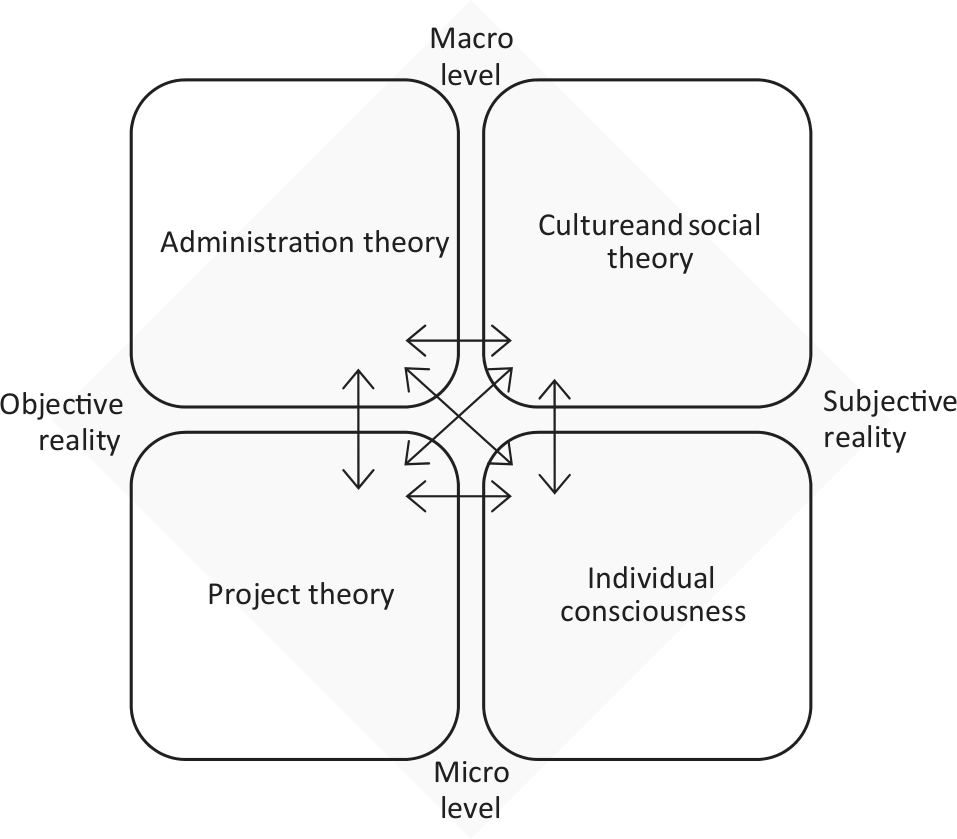
Levels of social reality as description of generative structure of administrative projects.
I illustrate the idea of generative reality in Figure 1 with four concepts (see also Ritzer, 1992). The level of culture and social theory covers the social value structures in large scale. Administration theory encompasses shared viewpoints, rules, and management styles inside organizations (e.g., the new public management doctrine). These ideas direct the decisions made concerning measures or projects and objectives. Project theory reflects in practice the individual projects’ inner logics and project plans. It is a theory of how the project measures are supposed to have an effect on the action. Individual consciousness then covers the individual value settings and experience-based knowledge on what things are and how they affect each other.
Results
Context
To understand the projects’ values, it is essential that the social situation extant at the time of planning the project is clear. The four exemplary case evaluations are each thematically quite different and the objectives to be evaluated were taken from different subject areas. However, a common thread was that they were all development projects within public administration and were undertaken at a time when the administration was diversifying into networking, cooperation, and efficiency to obtain its objectives.
Evaluations show how new methods of control arose out of a clash of traditional administrative cultures. Changes in the environment which had directed the need for new administrative cultures were also underlying factors in evaluations and project contexts (Table 2).
Project Theories.
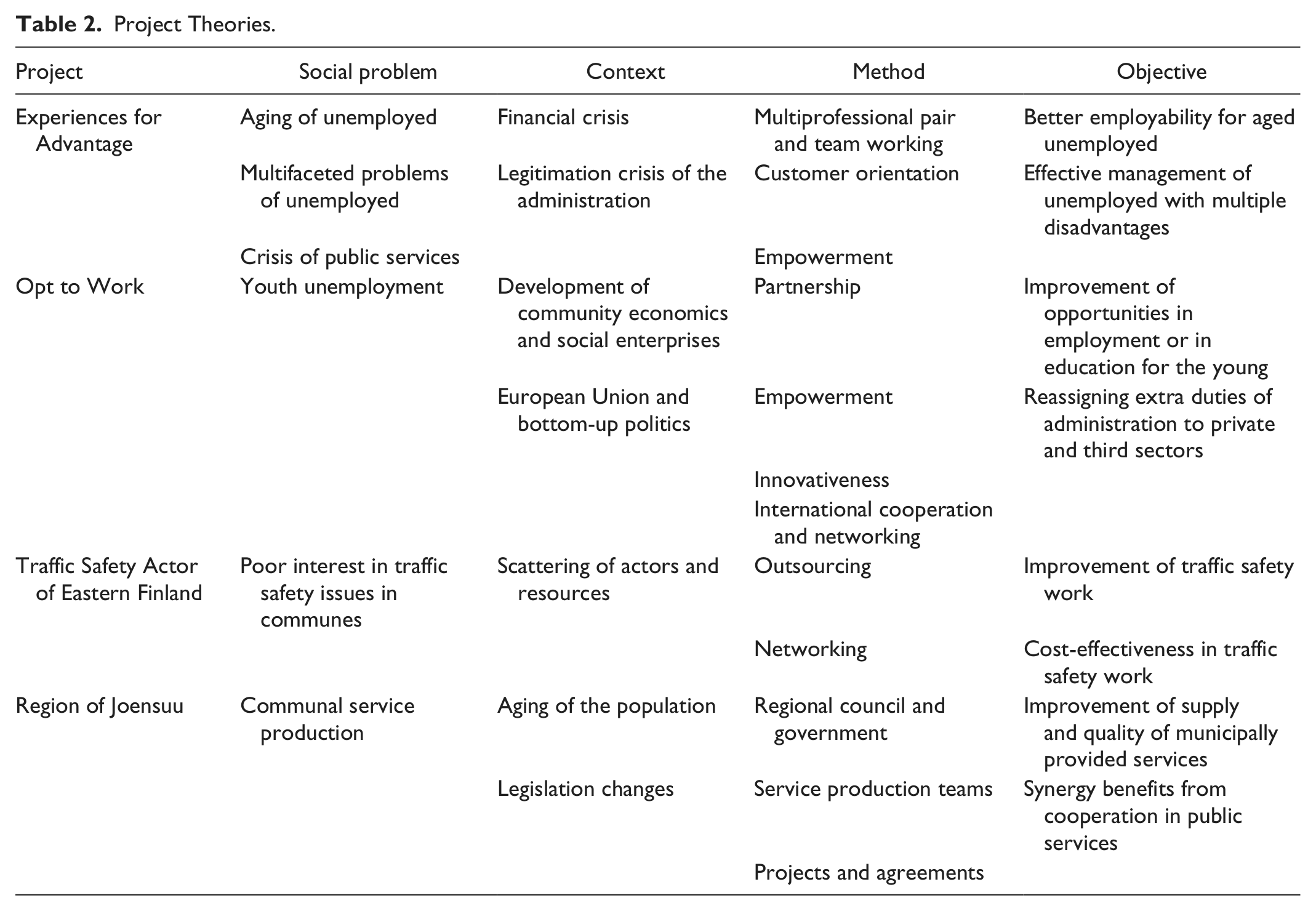
Some examination of which values the administration wished to emphasize in projects can be derived from the contextual factors and objectives of the projects. Efficiency remains a fundamental objective in projects and evaluation cases. It is accepted that actions aim at effectiveness but that their relation to the overall economy of organizations is based on assumptions. It is not possible to include real economic indicators in the analysis of context factors.
The other value present in objects and context is the welfare of citizens. It is assumed that when public services improve, it has some positive effect on the individual lives of citizens. Through this link, universality and equality become visible as improving the overall services with similar standards in one region would increase the equality between citizens of different municipalities, and giving some extra help to those in disadvantaged positions in the labor market might improve the equality between different social groups. Democracy as a value comes to the fore in project methods in customer orientation and empowerment.
Mechanisms
The cooperation method has been employed in all projects in a range of models. Case evaluations have described multiprofessional pair working, multiprofessional team working, partnerships, networks and regional councils, and forums. The central factor in these methods has been the increase in cooperation between actors in the public, private, and third sectors. Strong views and great expectations arose from the belief that cooperation provided the means or the method to pursue effectiveness. The defining of tasks and the authority to make decisions was distributed to a wider actor group which, however, cooperated closely. Around the start of the 2010s, an attempt was also made to bind the network operation more closely to the old organizations, instead of using it only for occasional projects (Table 3).
Project Operations.

The cooperation method, in its diverse models, was used in projects as a means to solve institutional or organizational problems in society and, in particular, in public administration activities. I deal with it as a project mechanism that should fulfill the above-mentioned three criteria. I state that the cooperation invariably provides some sort of answer to the questions and problems that arise during a change of administration. It makes the permanent relations between different actors possible, provides structures, and conceptualizes the administration (see Kooiman, 2005).
First of all, cooperation reflects the project embeddedness in a social reality. It is connected to the objectives of public administration at a macro level where the aim has been to change into a flexible organization. First attempts to cooperate were quite modest models of pair working but, as the knowledge of working together grew, the models became more complex. The latest models of networking within or between old organizations are matured ways of understanding cooperation. The different ways of cooperating reflect the change in the general way of thinking in administration, and the adaption of cooperation models is linked to practical operations and learning from it. The more sophisticated models of cooperation provided answers to the practical problems that were faced in previous cooperation models. Cooperation development connects individual project cooperation and action to the whole structure of public management.
Second, the cooperation mechanism forms an explanatory model for changes at both the macro and micro levels of operation. Changes that take place at the macro level of projects are marked by the institutionally driven conditions, and cooperation has been a way of changing these conditions. Furthermore, the changes that have taken place at the micro level, in other words at the level of the individual actor organizations and individuals, can be attributed to the process of cooperation. Cooperation has created a channel through which new resources for individual agents arise. Agents were able to make different choices when the measures of different institutions were brought together. Within the traditional boundaries of the administrative sectors, these new courses of action could not have taken place.
In different evaluation cases, different types of problems arose. Sometimes cooperation worked, and sometimes it did not. For example, in the Opt to Work project evaluation, it was stated that the partnership did not succeed as a cooperation model and, furthermore, that the project did not achieve the objectives set for the partnership. In the evaluation, attention was paid to the obstacles of the partnership with regard to difficulties in crossing boundaries, mutual trust in dealing with shortcomings and various organizational barriers, and territorial thinking. However, in this particular project, individual service-specific operation models were created.
Two of the undertakings processed mainly service production in municipalities. As these evaluations were made closer to the start of the 2010s, it was possible to perceive how a network-like organization was developing toward merging with a fixed organization. The network-like action was a little easier in the development project on traffic safety in which the outsourcing of some of the branches of traditional organizations was carried out. An attempt was made not to connect two old-fashioned organizations at all but to create a new entity that operated relatively independently in the appointed task field. The task had also been allocated to the production of a particular service, so it was easy for the project to bring the network together.
In the evaluation of regional cooperation, a conflict between the changes in the traditional structures and the practical environment arose. The arrangement of the services for individuals by separate municipalities was regarded as good and active both at the level of temporary cooperation and in the results. However, the creation of other fixed and permanent cooperation organizations was regarded as difficult as conflicts arose, particularly if the trust toward the second actors was not high.
In Table 3, I have also depicted some features that could be seen as moderators of cooperation. I deal with these dimensions as factors that affect how well the cooperation materialized. Such features are flexibility, trust, division of labor, transparency, liability distribution, flow of information, resource allocation, commitment, administration, regional history of common interest, and interaction. The power of each of the features in moderating cooperation is still unclear. More research is needed to describe the weighting of these factors. Nevertheless, I must emphasize that three factors were prominent in the results of three evaluations out of four, namely, trust, division of labor, and resource allocation, implying that those are central factors in creating well-functioning cooperation.
Conceptualizing the Change in Administration
The development of cooperation met many adversities during the first decade of the 2000s. The transition to cooperation has not been easily performed. It was found, for example, that the customer’s legal rights become more prominent when cooperation is developed. However, the advantages perceived from cooperation, both to the operation of organizations and to customer service, were clear. The question of liability distribution arose in partnership cooperation evaluations. Network-like or partnership operations no longer recognized hierarchical responsibility or power relations of bureaucracy, so power and responsibility devolved to many separate actors and became hidden within different social structures outside the traditional administration organization.
In evaluation cases, the clearest project result were seen in the development of particular services that were targeted at very strictly defined social groups, including a service for managing junior school windfalls, a service for the quick checking of the municipal traffic safety situation, information and communication technologies education for older unemployed people, and so on. Altogether in these projects, 15 different service packages were developed. In evaluations, the creation of these packages was seen as an indicator of whether the project had achieved its objectives.
Another way of looking at object achievement was to measure the performance of the project. This was performed by counting those who gained employment during the projects, how many municipalities had revised their traffic safety strategy, or how many cooperation situations had been conducted within a project. Also, in this data acquisition, the experiences of the project customers were targeted. They were asked whether they felt that the services had improved or whether they had gained anything useful from the project.
The results of the evaluations inform us that, as a result of development projects, public administration has been broken up into small entities, each of which concentrates on the production of certain services that have been allocated through the networks and outside the traditional administrative system. Branches are no longer devoted to the needs of whole sectors but have been broken down into small units addressing individual service packages. In this way, the characteristic power structure of the administration has been dismantled and its control removed and distributed to networks. Also, the consequent effect of the demand for efficiency has been that the operations are calculated in strictly defined parts of action.
In Figure 2, I describe the structure of the new public administration within the concept of public service production. I depict development in which the change is accomplished by the projects. In projects, this change has been brought about by the different forms of cooperation, which can also be considered as mechanisms for a change in perception (Figure 2).

Change process and mechanism of administrative structure and social context.
In Figure 2, I have placed my reasoning chain in boxes. The structure of public administration and its crisis led to the experiment of cooperation models and to incorporating separate fields of administration. The project is a tool which has made the cooperation experiments possible but it is not, in itself, a central mechanism in the solution of societal problems. The development projects have operated as mediators of change and have transformed the operation. Yet in fact, the cooperation inside the projects has been the key mechanism in breaking down the limits of organizations and the hierarchy of the traditional bureaucracy. Cooperation and interaction are means by which the multiformity of the environment is controlled (see Kooiman, 2005).
The different experiments and models of cooperation describe the learning process of administration. Moderators are dimensions of cooperation (trust, division of labor, liability distribution, resource allocation, etc.). The dimensions of cooperation do not directly influence or alter the final results; instead they strengthen them as factors.
Through project activity, the structure of administration has been gradually transformed from a bureaucratic model to a network-like service production. However, many problems in cooperation are still unsolved. Many organizational solutions are yet to be found, such as the answers to the questions of the assumption of liability or power. Citizens’ legal protection is unclear when acting in different networks or when being subjected to the operation of these networks. It is difficult for individual actors to perceive the new public service or to understand how it is controlled.
Discussion
The extensive change in public administration began at the end of the 1980s, and the recession of the 1990s accelerated and expedited cutbacks in public, social, and health services. During that time, new methods arose based on neoliberal ideas and changed the way that the role of the public sector in society was understood. New methods of control became topics for discussion. In the early 2000s, it was seen that the course of the new regime was gradually being altered, but it was impossible to predict the force of these changes at that stage. For example, the scattered field of evaluation research has not been able to combine its results into a bigger picture of the change.
In this work, I have examined evaluation studies that have used the theoretical framework of a realistic evaluation. The work indicates that projects with different themes and contents can be examined together when the binding factor is a congruent theory that is sufficiently comprehensive. The projects are basically always matters of social operation that are directed by official institutions, social norms, and rules, essentially within public administration. Even though the realistic evaluation study is always connected to local operations and the perspectives of local actors, there is, at the same time, a connection to the universal social theoretical framework through the information it produces. The testing of these connections through several local and overlapping studies that are conducted at a practical level is very important. I have directed my efforts and my contribution to the development of the theory by showing how cooperation is an important mechanism in recent public administration change.
As revealed in this study, the projects started to form a new structure that embraced service production. The administration has built this change through cooperation and project activity. It is a new model in which the public service assumes the role of fulfiller of objectives, a role which becomes more important than the control function. However, the relics of the old bureaucratic control structure and value arrangement set around it still exist, and this undoubtedly causes conflict and problems in new public management. The foundation of the welfare state, with its values and legitimacy, is far removed from the old structures and objectives with which the new ways of action and structures seem to be in conflict.
In this work, I have attempted to conceptualize the change in public administration from the perspective of social values of management. The measurement of the effectiveness of public services and customer orientation is considered in the administration as new factors that determine the values. None of these values, however, provides answers to the problematic areas of the new service production. The effectiveness does not apply equally to all citizens, and customer orientation cannot replace democratic decision making. Certain social groups benefit from some measures in ways that exclude other social groups. Voting via consumer habits, however, will be an illusion if society is drifting toward a situation where some citizens do not have real access to services.
In the demonstrated evaluation studies, among others, the increasing reality of citizens’ legal protection, the division of responsibility and power, and the withdrawal of politics and democracy in service production became apparent. These themes are closely connected to the operation of the old bureaucracy and to those core areas of values which the bureaucracy developed as a protection. These values are protecting the citizen from undue power implied upon him or her (democracy), and equality of humankind with no respect to place of residence, gender, religion, and so on (universality) in welfare services. This conflict of economic and social values can cause crises in the state and in the social administration system. However, the conflict experienced between new service production and old bureaucracy refers to the fact that the value structure of the affluent society is still extremely strongly present in new public management.
Furthermore, it has been stated that new forms of control are needed in network management to eradicate the problems. However, simply controlling the networks will not be enough if one wants to provide a value base for the structure of the entire public service production. The shared values of the society and public management were at the core of the old bureaucratic structure, as they should be the one leading idea for the new public service production. Even when economic values are put forth, the old values remain.
When evaluation is a feature in the control of society, one should think about how the evaluation study could be developed as a means of accumulating information so that the results do not remain disconnected statements. More attention should be paid to the accumulation of information created by the evaluation study. If the place and role of the evaluation are clearly defined, the information derived from it can be used to clarify the operation of public administration and stimulate discussion between the different actors. It should be possible to show different value choices to reflect the evaluations.
Finally, the scientific study is not able to give significance to its results. Their significance in society or organization consists of what values it supports. The challenges identified should certainly now be taken seriously and the place of values and evaluation studies in public administration should be clarified.
Footnotes
Author’s Note
This article is based on the author’s licentiate thesis (2010) and evaluation research executed in University Eastern Finland, Karelian Institute.
Declaration of Conflicting Interests
The author(s) declared no potential conflicts of interest with respect to the research, authorship, and/or publication of this article.
Funding
The author(s) disclosed receipt of the following financial support for the research and/or authorship of this article: This work was supported by the North-Carelian Centre for Economic Development, Transport and the Environment; and Joensuu Regional Planning Administration.
Author Biography