



Abstract
The entrepreneurial ecosystem, a prominent subject in entrepreneurship, plays a pivotal role in fostering creativity, expediting the entrepreneurial process, and contributing to social development and economic progress. Despite growing research on entrepreneurial ecosystems, a comprehensive review is lacking. To fill this research gap and obtain insights into the current research status, emphasis, and prospective future research directions, this study adopts a bibliometric approach to conduct a comprehensive review of entrepreneurial ecosystem research in the Web of Science Core Collection. The analysis reveals a consistent annual increase in articles on entrepreneurial ecosystems, with a significant surge after 2016. Developed nations, particularly the United States and United Kingdom, are the primary locations for this research, with universities serving as the principal conduits. Keyword analysis highlights the prevalence of such terms as “economic growth” and “education,” indicating their close association with studies on entrepreneurial ecosystems and their impact on economic development. Furthermore, the topic of education encompasses student entrepreneurship, university entrepreneurial ecosystems, and innovative entrepreneurial education systems. The literature can be categorized into two main areas: studies elucidating the concept of digital entrepreneurial ecosystems, including their compositional frameworks and construction pathways; and research examining sustainable development within entrepreneurial ecosystems, which involves broader investigations into entrepreneurial ecosystems and the cultivation of sustainable dynamics within core entrepreneurial landscapes. This study sheds light on current research progress and suggests future research trajectories in entrepreneurial ecosystem studies, thereby advancing the field.
Plain Language Summary
Imagine a garden in which plants grow because of the sun, soil, water, and insects surrounding them. Similarly, entrepreneurial activities require a healthy environment, which we call the “entrepreneurial ecosystem,” to thrive. The entrepreneurial ecosystem includes all people, companies (including start-ups and mature enterprises), and elements that help new businesses grow, such as universities, investors, and even government rules. Our study unfolds like a detective story in which we use bibliometric analysis to reveal the aspects of how researchers around the world have been studying startup gardens. We analyze who wrote these articles, their countries and institutions of origin, the most popular research topics, and future research suggestions. Our main findings are summarized as follows: 1. Publication Trends: The number of papers on entrepreneurial ecosystems has grown over time, like seeing more and more trees in the forest. 2. Authors and Countries/Institutions: Some researchers, countries, and institutions are more active and influential than others are, as if some gardeners plant more seeds than others do. 3. Research Topics: We identify five main themes that have attracted attention in entrepreneurial ecosystem research. 4. Future Research Directions: Future research should mainly focus on the conceptualization of entrepreneurial ecosystems, their digitalization, sustainability, and entrepreneurial ecosystems related to education.
Keywords
Introduction
The enduring repercussions of the COVID-19 pandemic, coupled with the dire ramifications of the Russia–Ukraine conflict, have precipitated a state of unprecedented disruption across global supply chains (Q. Wang, 2023). This has manifested as spiraling energy and food costs and significant disturbances across international markets, culminating in a period marked by lethargic economic expansion and heightened inflation (McCausland, 2020). In this complex global environment, entrepreneurship has emerged as a universally acknowledged catalyst for economic and social rejuvenation, assuming a pivotal role in promoting economic development and strengthening national competitiveness (Araki et al., 2024; Luor et al., 2014).
Global organizations and governments have taken decisive steps to foster a vibrant entrepreneurial ecosystem. The World Bank has been instrumental in offering specialized tools and frameworks to evaluate and enhance the entrepreneurial landscape. It provides policy recommendations tailored to the unique needs of each country. In 2022, the European Union introduced the European Innovation Plan, designed to catalyze entrepreneurial growth and innovation by offering financial backing, resources, and networking opportunities, focusing on the critical sectors of green and digital transformation. Concurrently, the United States (US) has implemented several supportive entrepreneurship policies that remain impactful, such as the Small Business Innovation Research program, Startup Visa, and the National Strategy for Entrepreneurship. These policies not only offer financial assistance to small businesses and encourage research and development (R&D) but also specifically target the advancement of female, minority, and rural entrepreneurs. Entrepreneurial ecosystems encourage innovative thinking and technology, providing a favorable environment for innovators to quickly experiment with new ideas and business models (Alaassar et al., 2022). This ecosystem is not merely about fostering nascent industries through strategic capital and technological infusions; it also plays a transformative role in refurbishing established sectors (Prencipe et al., 2020). Malecki illuminated how entrepreneurial ecosystems bolster economic competitiveness and sustainability, thereby infusing resilience and adaptability against various risks (Malecki, 2018). Corroborating this stance is the Global Entrepreneurial Ecosystem Report 2023, unveiled by Start Genome in June 2023, which positions Silicon Valley at the apex of global ecosystems, followed closely by a joint second place shared by New York City and London. The 2022 Silicon Valley Index Report reveals that, despite prevailing economic headwinds, venture capital investments in Silicon Valley soared to $44.1 billion in 2021. These figures underscore the significant influence of entrepreneurial ecosystems on sculpting economic landscapes. They serve not only as engines powering regional innovation and economic proliferation but also as foundational pillars that cement a competitive edge in today’s dynamic and ever-shifting business arena (Daniel et al., 2022; Iqbal et al., 2022).
Entrepreneurial ecosystems, as a vibrant area of research, have a limited research horizon despite the large body of retrospective literature. Current research focuses on specific regions or individual entrepreneurial ecosystems (Bejjani et al., 2023; Correia et al., 2024; Fernandes & Ferreira, 2022; Qian, 2018; Stam, 2023). However, few studies have systematically organized and reviewed the entrepreneurial ecosystem literature, affecting the expansion and deepening of the theory of entrepreneurial ecosystems. In addition, the research lacks timeliness and does not cover the latest research findings (Alvedalen & Boschma, 2017; Mack & Mayer, 2016; Mason & Brown, 2014). Furthermore, while the field of entrepreneurship research has been evolving for several decades since the 1960s (Ireland et al., 2005), the investigation of entrepreneurial ecosystems began to gain prominence as a key research area only around 2010 (Cai et al., 2016). Currently, studies on entrepreneurial ecosystems exhibit significant diversity and lack a unified consensus. The core focus and trajectory of this research remain largely undefined. Consequently, it is imperative to methodically review and synthesize the existing literature, encapsulate the latest findings on entrepreneurial ecosystems, delineate current controversies and consensus, and delineate potential future research directions. To address these gaps, this study employs a bibliometric approach supported by a robust and comprehensive framework. The investigation commences with a meticulous data compilation phase that leverages the leveraging the Web of Science (WOS) Core Collection to ensure data veracity. Initial literature identification hinges on strategic keyword deployment, followed by a rigorous manual review to distil the corpus for subsequent analysis. This study employs the bibliometric tools VOSviewer and CiteSpace to provide an objective and comprehensive multidimensional analysis of the research on entrepreneurial ecosystems. With the assistance of these tools, combined with an in-depth interpretation of relevant literature, this study not only reveals the core topics and research trends in the field of entrepreneurial ecosystems, but also provides an intuitive and systematic research review, providing a solid foundation for subsequent research. This study addresses the following research questions (RQs), based on literature from 2013 to 2023.
The remainder of this paper is organized as follows. In Section 2, we delineate the importance of this research. Section 3 introduces the concept of entrepreneurial ecosystems. Section 4 describes the data collection process, analytical methods, and tools employed. Section 5 presents and discusses the results. We begin by analyzing current publication trends and the overall landscape. Then, we present the principal institutions and countries involved in these publications, highlighting the collaborative networks they engender. We discuss various research themes within the domain of entrepreneurial ecosystem studies. We elucidate the core concepts and highlight existing debates and controversies. Additionally, we pinpoint potential avenues for future scholarly inquiries, outlining the emerging directions and thematic considerations. In Section 6, we capture the key insights from our analysis and offer an extended overview of the research trajectories suggested in the preceding section.
Significance of the Study
Our bibliometric analysis of the entrepreneurial ecosystem domain yields significant contributions as follows.
Charts the evolution and trends in entrepreneurial ecosystem research: We delineated the current state and trajectory of the field, identifying key influencers, institutions, and countries. This systematic collation of research outcomes and pivotal research avenues will aid future scholars in navigating and comprehending the entrepreneurial ecosystem landscape.
Advances entrepreneurial ecosystem theory: Through an exhaustive literature review, we highlight prominent research hotspots and areas that have yet to be adequately explored. This paves the way for future studies by offering clear directives that foster a deeper academic understanding of entrepreneurial ecosystems.
Fostering international research comparison and collaboration: By examining the evolution of entrepreneurial ecosystem research globally, we discern the comparative strengths and limitations of different countries’ contributions. This insight not only encourages cross-border scholarly dialog and partnerships, but also promotes the development of a more interconnected international network for academic collaboration.
Entrepreneurial Ecosystems
The concept of the entrepreneurial ecosystem is grounded in ecological metaphors, drawing from the field of ecology, which examines the intricate relationships among populations, communities, and their surrounding environments. This interdisciplinary approach is dedicated to exploring how ecosystems sustain, contract, or expand their living spaces, offering valuable insights into the dynamics of entrepreneurial environments (Kremen, 2005) Drawing from ecological theories, the entrepreneurship research landscape has undergone a significant paradigm shift. Initially, the focus was predominantly on individual firms or entrepreneurs. However, contemporary studies now delve into the intricate patterns of interactions among entrepreneurial agents within the broader entrepreneurial ecosystem. This shift in perspective aims to reveal how these dynamic interactions foster or impede the growth and development of regional economies (O’Connor & Audretsch, 2023). In an entrepreneurial ecosystem, the innovation system is an important component in realizing value output; promoting knowledge creation, technical support, and talent training through innovation; accelerating the commercialization of technology; enhancing the overall competitiveness of the ecosystem; and promoting regional economic development. The entrepreneurial ecosystem is a complex system characterized by self-organization, self-adaptation, diversity, and multi-subjectivity, encompassing multiple layers and elements (Vogt et al., 1997). These components interact in tandem to propel the evolution of the entrepreneurial ecosystem and facilitate holistic system development (Lafuente et al., 2022). At its core, various entrepreneurial subjects—including entrepreneurs, entrepreneurial enterprises, research institutions, investors, and governmental entities—engage in interactions aimed at fortifying the entrepreneurial capabilities and competitive prowess of each subject (Fischer et al., 2022). Simultaneously, environmental elements within the outer circle layer (e.g., culture, policy, infrastructure development, and economic and technological environments) foster an enabling environment for entrepreneurial ecosystems, bolstering overall operational efficiency (Stephens et al., 2022).
The theoretical underpinnings of the entrepreneurial ecosystem can be traced to ecological theory in the biological domain, initially proposed by German biologist Haeckel in 1866. The term “ecosystem” was first used by Tansley (1935) This theory posits that ecosystems arise from the interaction between organisms through the flow of matter and energy, as well as the exchange of information (Ament, 2020). In the early stages of ecosystem studies, the concept was predominantly grounded in theoretical formulations, with scholarly efforts concentrated on examining individual populations and communities (Vogt et al., 1997). However, the trajectory shifted significantly in the 1960s as ecologists began to delve into the intricate web of organism interactions, paying particular attention to the dynamics of population–community relationships, including predation and competition mechanisms (Schmitz et al., 2008). Moreover, this shift entailed a conceptual transformation: the physical environment was no longer viewed as a peripheral influence but was recognized as an integral part of the ecosystem fabric, contributing to its structure and function (Gibert et al., 2015). With further advancements and amalgamation of research across diverse disciplines, some scholars have transposed ecological theory into the realm of social sciences (Cai et al., 2016), employing ecological metaphors to describe individuals and complex organizations, thereby giving rise to a series of derivative theories. In 1977, Hannan and Freeman introduced organizational ecology in their book Ecology of Organizational Populations, while Moore extended this concept to business research by introducing the notion of a business ecosystem and framing it as the external environment of a business (Moore, 1993). Spilling subsequently proposed the concept of an entrepreneurial system, contending that the complexity and diversity of entrepreneurial participants, along with environmental factors, interact to determine regional or local entrepreneurial performance (Spilling, 1996). Neck et al. (2004) and Cohen (2006) further studied the components of the entrepreneurial ecosystem—incubators, spin-offs, organizational networks, physical infrastructure, and the cultural environment—asserting that these components interact to create a conducive environment for entrepreneurial activities. Aldrich delved deeper into studying entrepreneurial ventures and related processes from an ecological perspective, emphasizing the importance of examining corporate entrepreneurship within an ecological framework (Aldrich, 1990). However, it was not until 2010, when Isenberg published the article “How to Start Entrepreneurial Revolution” in Harvard Business Review (Isenberg, 2010), that the concept of the entrepreneurial ecosystem gained widespread traction, catalyzing the surge in entrepreneurial ecosystem research (Isenberg, 2010).
Data Sources and Research Methods
Data Selection and Filtering
The concept of the entrepreneurial ecosystem can be traced back to Spilling’s proposition of the “entrepreneurial system” (Spilling, 1996). to the term “entrepreneurial ecosystem” appeared in the 2000s, and a comparison of the terms “entrepreneurial ecosystem” and “entrepreneurial system” in database searches reveals that the former has gained prominence (Alvedalen & Boschma, 2017), particularly in 2016. Additionally, the similar term, “entrepreneurship ecosystem” has received significant attention in the database (Malecki, 2018). Consequently, “entrepreneurial ecosystem” and “entrepreneurship ecosystem” were used as our search terms. Given the frequent coexistence of innovation and entrepreneurship ecosystems, we further incorporated the term “innovation and entrepreneurship ecosystem” as a search keyword. Figure 1 shows the data collection method and structure of the scientometric analysis.

Overall research framework of bibliometric analysis on entrepreneurial ecosystem.
The search within the WOS Core Collection involved using Boolean logic “OR” for topics (TS) or titles (TI) containing the keywords “Entrepreneurial Ecosystem,” “Entrepreneurship Ecosystem,” and “Innovation and Entrepreneurship Ecosystem” in the subject (TS) or title (TI) fields. The wildcard character “*” was employed to ensure that strings containing any of specified keywords could be identified. The publication year (PY) was restricted to 2013 to 2023, resulting in the following search equation: TS = Entrepreneurial Ecosystem* OR TS = Entrepreneurship Ecosystem* OR TI = Entrepreneurial Ecosystem* OR TI = Entrepreneurship Ecosystem* OR TI = innovation and Entrepreneurship Ecosystem* OR TS = Innovation and Entrepreneurship Ecosystem* and PY = 2013 to 2023. We obtained 458 relevant studies from 2013 to 2023 were obtained through the search formula, and then the search results were scrutinized via abstract analysis, further validated through full-text assessment, and refined through subsequent screening; ultimately, we ensured they were not duplicated using the “Remove Duplicates” function of CiteSpace. Consequently, 43 articles were excluded during the final screening process, leaving 415 articles in the dataset for analysis. The exclusion criteria are presented in Table 1.
Exclusion Criteria.

Research Methods and Tools
Bibliometrics is an important research methodology (Klimo et al., 2016). It was initially proposed by Belgian librarian Paul Otlet in his book The Characterization of Literature in 1934 (Rousseau, 2014). This approach such harnesses as VOSviewer and CiteSpace to scrutinize publication patterns through co-occurrence and collaborative network analyses (Van Eck & Waltman, 2014). VOSviewer, developed by Nees Jan Van Eck and Ludo Waltman of Leiden University (Van Eck & Waltman, 2010), facilitates the visualization of various network data, including co-authorship and citations, by utilizing network, overlay, or density views (Arruda et al., 2022). By contrast, CiteSpace, developed by Chaomei Chen of Drexel University and WISE Labs (Chen, 2006), provides the capability to visualize the relationship between studies in the form of a scientific knowledge graph. This aids in elucidating the past research trajectory, current status, and prevalent topics within a given field, identifying its future directions. This study employed VOSviewer to map authorship, institutional affiliations, geographic distribution, and collaborative networks, while CiteSpace was utilized for feature extraction and keyword analysis.
Results and Discussion
Features of Published Documents
Research on entrepreneurial ecosystems can be categorized into three distinct stages, as illustrated in Figure 2. The initial stage, spanning from 2013 to 2016, represented the emergence of entrepreneurial ecosystem research, with a notably small number of articles, accounting for only 1.92% of the search results. The subsequent period from 2016 to 2019 marks the growth stage of entrepreneurship ecosystem research, witnessing a total of 98 published articles, accounting for 23.61%. The content of these articles gradually expanded during this phase. The explosive stage of the entrepreneurial ecosystem unfolds from 2019 to 2023, with a total of 309 relevant research papers accounting a substantial 74.46% of the search results. This surge suggests that entrepreneurial ecosystem research gained significant traction after 2016, in line with the 2016 Global Entrepreneurship Index Report’s recognition of ecosystems as an advanced form of corporate innovation. Moreover, emerging directions such as digital entrepreneurial ecosystems and the sustainable development of entrepreneurial ecosystems have garnered increased attention. Of the 415 publications included in this analysis, 96.14% (n = 399) comprised and 3.85% (n = 16) were reviews. Notably, the year 2022 emerged as the most prolific period for entrepreneurial ecosystem research, accounting for 26.02% (n = 108) publications, closely followed by 2021 at 23.85% (n = 99) each. By contrast, 2014 and 2015 had the fewest publications, each amounting to only one or two publications per year. Furthermore, entrepreneurial ecosystem research permeates various disciplines, as Table 2 shows, indicating a trend in interdisciplinary research. Management has the highest number of records at 203, closely followed by business (192 records) and economics (91 records) as the most researched disciplines within the realm of the entrepreneurial ecosystem.

Annual trends of publications in the entrepreneurial ecosystem (2013–2023).
Top 10 Web of Science Categories of Entrepreneurial Ecosystem.

Additionally, Table 3 reveals the 10 most co-cited journals featuring papers on the search term. Small Business Economics, with 348 citations, is the most cited journal, encompassing topics related to entrepreneurial processes, new business creation, self-employment, family businesses, innovative entrepreneurship, and entrepreneurial finance. Entrepreneurship Theory and Practice, with 339 citations, ranks second and is recognized as a leading academic journal in the field of entrepreneurship. Research Policy, with 317 citations, is acknowledged as a preeminent journal in the domain of innovation research, emphasizing the impact of innovation, technology, R&D, and science on the economy, Policy, management, organizations, and the environment. Other prominent journals include The Journal of Business Venturing, The Journal of Technology Transfer, The Journal of European Planning Studies, Harvard Business Review, Strategic Entrepreneurship Journal, Entrepreneurship & Regional Development, and The Academy of Management Review, each contributing significantly to the discourse surrounding entrepreneurship and its multifaceted dimensions.
Top 10 Journals with the Highest Number of Citations for the Entrepreneurial Ecosystem.

Authors and Author Collaboration Networks
In Figure 3, 30 prolific authors are shown, with five authors each contributing more than five publications. Notably, David Audretsch is the most prolific author. Further analysis revealed that Audretsch’s research focused on the construction and development of entrepreneurial ecosystems and their impact on economic, social, and technological innovation. This study focused on the framework conditions and theoretical foundations of entrepreneurial ecosystems in cities. Subsequently, this research extends to education and explores models of stakeholder cooperation and governance in entrepreneurship education. In more recent studies, the relationship between entrepreneurial ecosystems and sustainable development has been explored in depth, as well as how institutions and policies can facilitate the effective functioning of ecosystems and value creation. Maxim, a researcher focusing on regional entrepreneurial ecosystems and the interplay between entrepreneurial ecosystems and their associated environments, ranks prominently among these prolific authors. Evangelos Grigoroudis, from the Technical University of Crete, delves into entrepreneurial ecosystems based on the Helix model of innovation (Carayannis et al., 2021; Jovanović et al., 2022). Christina Theodoraki, affiliated with the Toulouse Business School, centers her research interests on sustainable entrepreneurial ecosystems and business incubator research (Theodoraki et al., 2022). Matthias Menter, from the Friedrich Schiller University of Jena, focuses on the digital entrepreneurship ecosystem (Bejjani et al., 2023), explores the impact of entrepreneurial ecosystems and governance considerations (Cunningham et al., 2019).

Top 30 authors by number of articles on the entrepreneurial ecosystem.
Additionally, Table 4 presents the most cited authors; five authors garnered over 500 citations in the literature. Among them, Audretsch and Belitski stand out, with a substantial number of publications and citations. Erik Stam, affiliated with Utrecht University, emerges as the most cited author for “Entrepreneurial ecosystems and Regional Policy: A Sympathetic Critique” underscoring the extensive recognition of his policy-related research. His research encompasses entrepreneurial ecosystem components (Stam & Van de Ven, 2021) and indicators (Leendertse et al., 2022). Spigel’s work delves into the sustainability of the entrepreneurial ecosystem (Coad & Srhoj, 2023) and conceptual studies (Wurth et al., 2022). Zoltan Ács’s research interests span entrepreneurial ecosystem optimization (Lafuente et al., 2022) and digital entrepreneurial ecosystems (Sussan & Ács, 2017).
Top 10 Authors in Citations on the Entrepreneurial Ecosystem.

The collaborative network of the authors is depicted in Figure 4, with the line thickness indicating the strength of their partnership. To facilitate interpretation and analysis, a minimum threshold of two articles per author was applied. A total of 139 authors satisfied this criterion, leading to the exclusion of disconnected items in the network, and resulting in a final collaborative network diagram of the authors. Owing to the relatively small size of the remaining collaborative networks, our focus here lies on the collaborative network centered around Audretsch and Elias Carayannis. The team, led by Audretsch, focused on a sustainable entrepreneurial ecosystem to investigate the establishment of a sustainable entrepreneurial environment conducive to long-term economic development. A sustainable entrepreneurial ecosystem emphasizes the economic performance and social responsibility of firms, highlighting the interaction and symbiosis between firms and the external environment (Casson, 2005), as well as firms’ commitment to social responsibility (D. B. Audretsch et al., 2024; Buratti et al., 2023). Carayannis investigated the entrepreneurial roles of various subjects within an ecosystem and their interrelationships. The first component of the research explores how subjects interact to contribute to ecosystem development, the second delves into the mechanisms governing their interactions, and the third scrutinizes the relationships among subjects within the system (Carayannis et al., 2022; Kshetri, 2014). Entrepreneurial ecosystem research has garnered substantial academic interest and significant output, contributing to a deeper academic comprehension of entrepreneurial ecosystems. However, the collaborative network of authors in entrepreneurial ecosystem research produced smaller and more interconnected collaborative networks. Nevertheless, the connections among these collaborative subclusters remain weak and require further reinforcement.
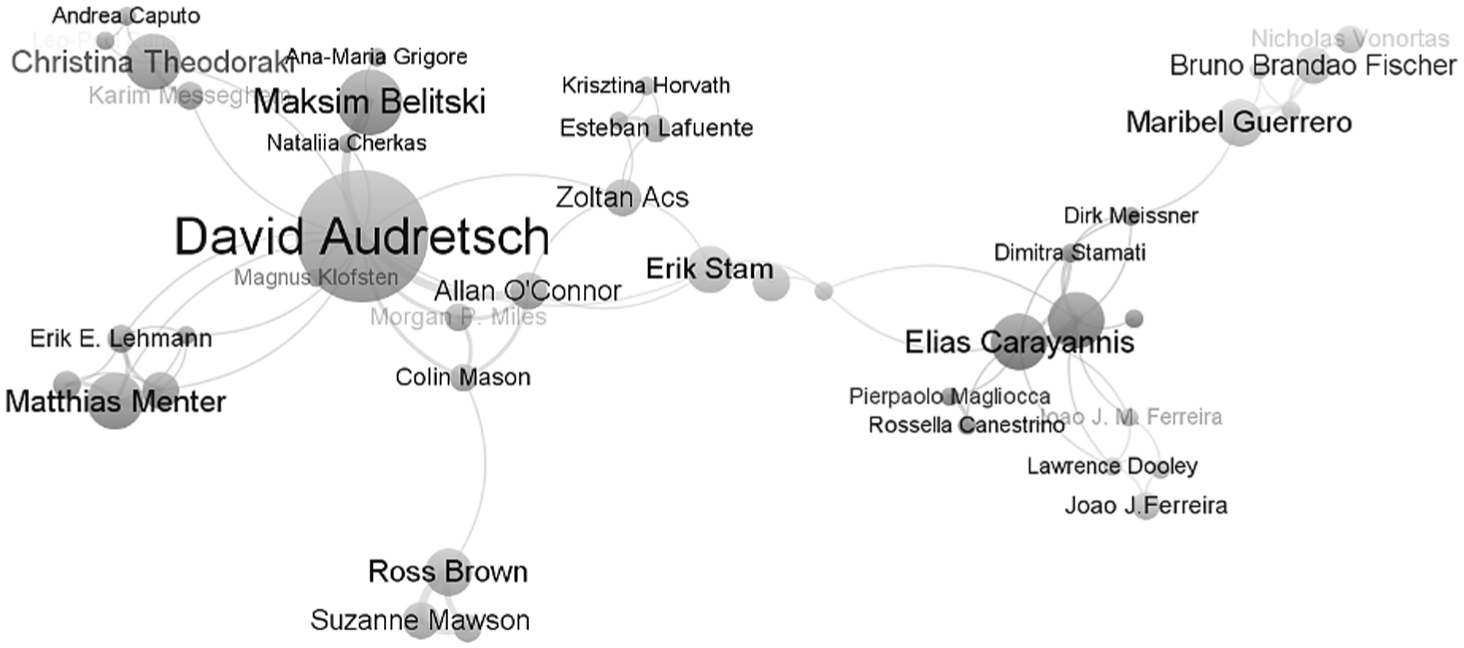
Author collaboration network for entrepreneurship ecosystem research.
The degree data in Figure 3 show that Audretsch has the highest degree of 9, indicating that he is central to research in this area, that his work may involve extensive international collaboration, and that he is frequently cited. He is closely followed by Allan O’Connor Allan and Colin Mason, both of whom have a degree of 4, indicating their influence in the academic community and the breadth of their research activities. By contrast, Belitski Maksim has a degree of 1, which could mean that his research, while within the field, is relatively independent or that his work may be focused on more specific research questions. Looking at the data as a whole, the wide variation in degrees between authors may reflect the existence of a number of research cores or leaders within the entrepreneurial ecosystem research field who are advancing knowledge in the field through extensive collaboration. At the same time, a number of authors may conduct research in more niche areas and their work may be more focused on specific topics, thereby having smaller collaborative networks.
Institutions and the Co-institution Collaboration Network
The literature search on entrepreneurial ecosystems involved 599 institutions. Table 5 displays the top 10 institutions based on their publication numbers. Indiana University Bloomington has 15 papers featuring recent works exploring the conceptual framework of regional entrepreneurial ecosystems from the perspective of forest ecosystems (O'Connor & Audretsch, 2023) and the role of sustainability orientations among entrepreneurial ecosystem participants (D. B. Audretsch et al., 2024). Newcastle University in the United Kingdom (UK), with 12 publications, delved into the social entrepreneurial ecosystem, community engagement within entrepreneurial ecosystems, and longitudinal dynamics testing of entrepreneurial and intrapreneurial activity (Buratti et al., 2023). Equally represented by 12 publications, Utrecht University and the University of North Carolina pursued studies on the European entrepreneurial ecosystem and gender differences in entrepreneurial success, respectively (Markussen & Røed, 2017; Welsh et al., 2023). Additionally, Northumbria University explored student entrepreneurial intentions and efficacy, while George Washington University and the University of Edinburgh focused on diverse aspects, such as technological and societal challenges, human-centric innovation ecosystems, and policies within entrepreneurial ecosystems (Ferreira et al., 2023; H. Wang et al., 2023). Friedrich Schiller at the University of Jena examined the digital entrepreneurial ecosystem, whereas the National Research University Higher School of Economics concentrated on mechanisms to achieve knowledge-intensive sustainable development (Siqueira et al., 2023). Finally, Lund University analyzed the impact of inter-subjective interactions on ecosystem dynamics (integration and disintegration; Pocek, 2022). These rankings underscore the high visibility and representativeness of the articles on entrepreneurial ecosystems from these institutions.
Top 10 Institutions with the Highest Number of Publications.

Figure 5 presents an analysis of institutions with three or more publications, forming a collaborative network map. Notably Indiana University, Bloomington University, Northumbria University, and George Washington University are hubs for larger collaborations. Indiana University Bloomington collaborated with 22 institutions, whereas University South Australia and University Reading exhibited strong collaborative ties. Specifically, both institutions focus on the dynamics of the entrepreneurial ecosystem, exploring multiple conceptions of time and their influence on entrepreneurship rates, firm growth, and evolution (D. Audretsch et al., 2021). The University of Reading also focuses on regional entrepreneurial ecosystems, investigating the roles of institutions, creative classes, and entrepreneurship within these ecosystems and the framework conditions that shape the regional entrepreneurial ecosystem. The collaborations with George Washington University involved 17 institutions, with the Technical University of Crete being the closest collaborator. Their study examined the impact of new ventures. Additionally, they explored quadruple/quintuple-based entrepreneurial ecosystems and the structural hierarchy of entrepreneurial ecosystems (Carayannis et al., 2021; Fischer et al., 2022).

Collaborative network of institutions on entrepreneurship ecosystem research.
Northumbria University collaborated with 18 institutions, with the University of Desarrollo being the most collaborative. These studies elucidate the mutually beneficial relationships between universities, regional innovation, and entrepreneurship ecosystems (Schaeffer et al., 2021). Collaborative efforts by Friedrich Schiller University, Jena, and others have investigated the factors in the entrepreneurial ecosystem that either promote or discourage re-entry into entrepreneurship after failure (Guerrero & Espinoza-Benavides, 2020), the evolution of the entrepreneurial ecosystem according to life cycle theories (Cantner et al., 2021), and how regional stakeholders can build collaborative relationships for long-term growth.
Moreover, St. Andrews University and Strathclyde University have emerged as intensely collaborative institutions within the Edinburgh-focused collaborative network, where they have investigated the complex relationships underpinning entrepreneurial ecosystems (A. Rocha et al., 2022). They also proposed an interdisciplinary research program within the field of entrepreneurial ecosystem research field (Wurth et al., 2022). The University Utrecht Collaboration has conducted research on the impact of entrepreneurial ecosystem quality on new firm formation and scale-up activities (Q. Zhang et al., 2023), as well as how incubator support mechanisms can enhance entrepreneurial ecosystem connectivity. Finally, the University Beira Interior collaborative team analyzed the entrepreneurial ecosystem in Portugal (A. Rocha et al., 2022) and its impact on to the, while the University Valencia collaborative team assessed the entrepreneurial ecosystem’s impact on student entrepreneurial financing (Longva, 2021). These analyses reveal that research related to entrepreneurial ecosystems primarily focuses on universities. Although inter-institutions have established vast and closely connected cooperation networks, their collaborative themes are relatively diverse and lack centralized and in-depth cooperation. Therefore, strengthening collaboration is imperative.
Analysis of Issuing Countries
Geographical Distribution and Co-countries
Table 6 presents the 10 leading countries based on the quantity of published research and their corresponding influence in the entrepreneurial ecosystem domain, as measured by centrality. The US has a list of 103 publications, followed by the UK (84), China (49), Italy (40), Germany (40), Spain (35), France (31), New Zealand (23), Australia (20), and Turkey (19). In the US, the digital dimension of the entrepreneurial ecosystem is a focal point, as exemplified by several studies. Sussan and Ács (2017) provided a conceptual framework for entrepreneurship in the digital era, Sarma examined its manifestation within smart cities (Sarma & Sunny, 2017); Sarkar analyzed its dynamics amidst the COVID-19 pandemic (Sarkar et al., 2023); and Khurana investigated digital transformation strategies for businesses within this ecosystem (Khurana et al., 2022).
Top 10 Countries in Terms of Publications.

British researchers have focused on the university’s role within the entrepreneurial ecosystem, including its influence on entrepreneurship, its potential to mitigate barriers to student entrepreneurship (Kwong et al., 2022), and its elements of success. Chinese scholars tend to emphasize enterprise-level analysis, investigating the entrepreneurial ecosystem on firm growth, the entrepreneur’s impact on performance (Shen et al., 2023), and policy implications for ecosystem expansion within enterprises. In Italy, attention has been directed toward gaging the relative importance of different ecosystem elements in specific regions and devising models for academic innovation ecosystems (Angrisani et al., 2023). German research has explored the relationship between business incubators and entrepreneurs’ sustainable development and the construction of tourism-related entrepreneurial ecosystems (Milwood & Maxwell, 2020). Spanish researchers have analyzed ecosystem metrics and extended insights into its social dimension, while New Zealand researchers have assessed the role of intermediaries in fostering collaboration (Hernández-Chea et al., 2021), and applied an entrepreneurial lens to cultural and creative industries in urban areas (Loots et al., 2021). Studies in Australia and Portugal have examined the fintech entrepreneurial ecosystem and its institutional impact on ecosystem efficiency (Lafuente et al., 2022). Additionally, collaborative efforts between Italian and German scholars have addressed governance mechanisms within entrepreneurial ecosystems. Jointly, French and New Zealand researchers examined how family firms shape regional entrepreneurial ecosystems, while Spanish and Australian researchers examined the sports industry’s entrepreneurial activities. Furthermore, Turkish and Italian investigations have dissected interactions in the fintech sector. The connecting lines and thicknesses in Figure 6 illustrate the extent of collaborative research on entrepreneurial ecosystems across countries. The UK is the most collaborative country, particularly with the US and China. The UK–US joint research has delved into the formation of entrepreneurial ecosystems through daily subject interactions, assessing economic, technological, and social impact spatial features, sustainability orientation of entrepreneurs, and the influence of institutions in urban entrepreneurial settings.

National cooperation network diagram for entrepreneurship ecosystem research.
British and Chinese academics have adopted a longitudinal approach using Bourdieu’s two-phase model to study the development of these ecosystems, examining urban entrepreneurship success factors and the specific dynamics of university-based ecosystems in China (He et al., 2019), as well as how ecosystem participant interconnections affect entrepreneurship rates by employing network theory (Prokop & Thompson, 2023). Italian and German researchers investigated governance mechanisms within entrepreneurial ecosystems in smaller consortia. Teams from France and New Zealand examined the role of family businesses in structuring regional ecosystems, while Spanish and Australian scholars examined sports-related ecosystems. Additionally, Turkish and Italian researchers explored the interactions within fintech entrepreneurial ecosystems.
Entrepreneurial ecosystem research has garnered international interest, with developed nations representing the majority of the top 10 countries by publication volume. This indicates that research on entrepreneurial ecosystems predominates in developed regions, but remains less advanced in developing nations. The UK has demonstrated significant external collaboration in this field, bolstering innovation and global entrepreneurial endeavors. Nevertheless, there is a need for enhanced cooperation across countries, particularly between developed and developing countries.
Betweenness Centrality Insights into Countries
Betweenness centrality reflects the mediating role of a country in the literature citation network within that research area, that is, the extent to which research in those countries acts as a bridge to other research, as described in Figure 7, which gives an idea of the strength of research in those countries.

Top 10 countries in terms of centrality.
The US and UK are far ahead on the centrality indicator at 0.35 and 0.34, respectively. This finding suggests that these two countries have significant leadership and influence on entrepreneurial ecosystem research. They are likely to be strong in terms of research output, international collaboration, quality, and innovation. Germany and China were in third place, with a centrality of 0.15. Although they fall short of the top two, this shows that they also have an international influence and are involved in research in this area. As a representative of Asia, China shows the potential for and strength in entrepreneurial ecosystem research. Spain, Sweden, Hungary, France, Japan, and Pakistan are all in the middle of the pack relative to the top four centralities, which are relatively weak in research and influence in this field, but still occupy a certain position and require more effort and input to improve their research strength and influence.
The overall trend shows that North American and European countries have a stronger influence in the field of entrepreneurial ecosystem research, whereas Asian and African countries have a relatively weaker influence. This may be related to the investments in STEM resources in these countries. For example, the US and UK have long invested in higher education and research to establish their leading positions in global research. Although China is not as good as the US and UK in terms of centrality indicators, it still occupies a position globally, demonstrating its potential and strength in entrepreneurial ecosystem research. With China’s rapid economic development and emphasis on an innovation-driven development strategy, its contribution to this area is expected to’ further increase.
Focus of Studies
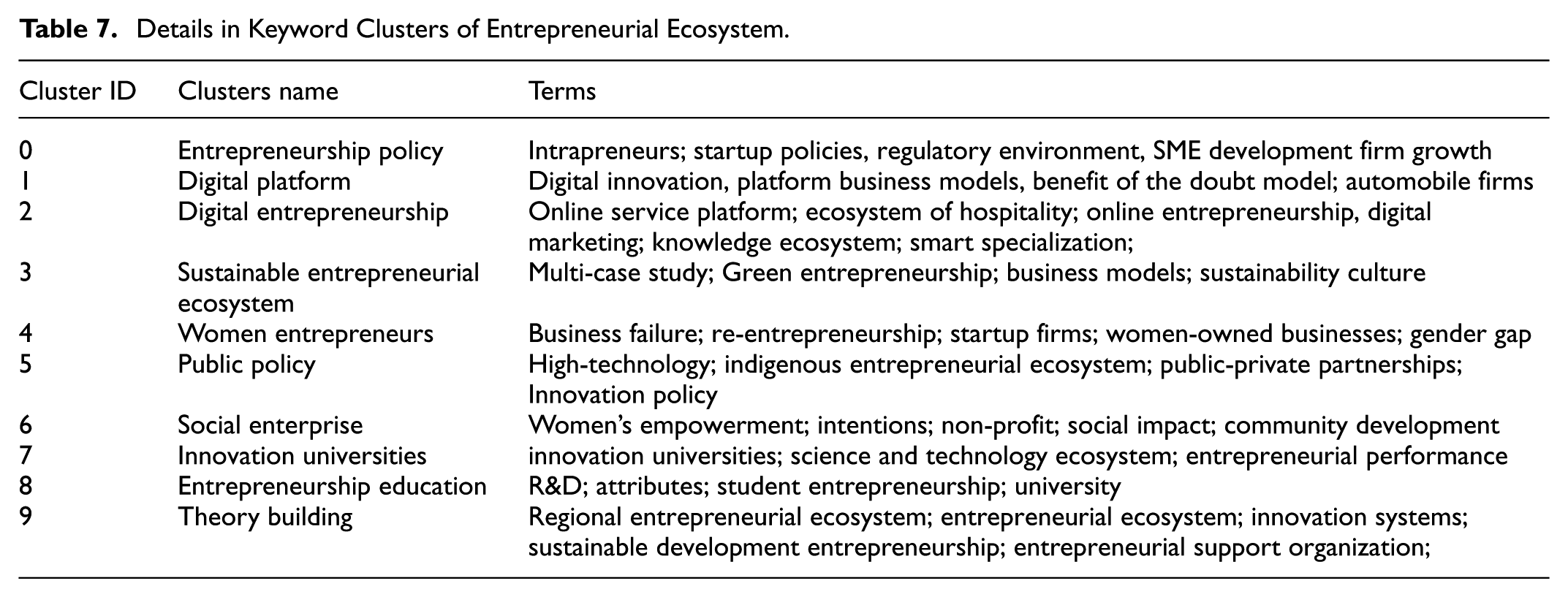
To ascertain the study’s primary focus, we utilized a keyword clustering map derived through an analysis that yielded a module value (Q) of 0.35 and a mean silhouette score (S) of 0.73. These metrics—module value and mean silhouette score—serve as indicators of clustering effectiveness, with values exceeding 0.3 for Q and 0.7 for S, suggesting structurally significant and convincing clusters (Chen et al., 2012). Consequently, the 10 research themes depicted in Figure 8 reliably represent the current scope of research, and Table 7 shows the keywords included in these research clusters. We identified 23 keywords that appeared at least 20 times and generated a word tree diagram (Figure 9). Based on the analyzed data, combined with in-depth literature reading, we identified five research themes.

Keyword clusters of entrepreneurial ecosystem.
Details in Keyword Clusters of Entrepreneurial Ecosystem.

High frequency keyword word tree map of entrepreneurial ecosystem literature.
Research Theme 1: Conceptualizing Entrepreneurial Ecosystems
In keyword correlation analysis, theoretical constructs (cluster 9) appear as keyword clusters, and theoretical definitions are the foundation on which any research construct begins (Alvedalen & Boschma, 2017). Entrepreneurial ecosystems can be considered a young field of research, and although there have been many definitions of entrepreneurial ecosystem in previous studies, disagreements persist.
One contention is the connotations of entrepreneurial ecosystems. Currently, there are two perspectives on the conceptualization of the entrepreneurial ecosystem, with one group of scholars arguing that the entrepreneurial ecosystem is the entrepreneurial environment external to a single entrepreneurial entity, holding an “environment” perspective (Cohen, 2006; Isenberg, 2010). The other view is that the entrepreneurial ecosystem is a holistic system that includes both entrepreneurial actors and the external entrepreneurial environment, and is characterized by the “environment-subject” view. They argue that the entrepreneurial ecosystem, as a dynamic network of interactions within a specific geographic area, consists of interdependent entrepreneurial subjects (e.g., entrepreneurs, investors, and firms) as well as key environmental elements (including markets, policies and regulations, financial services, and cultural climate), and that the subjects and the environment coexist and interact with each other to facilitate the establishment of new firms (Mason & Brown, 2014). Overall, more studies have been conducted based on the environmental-subject theory perspective. Although there is controversy over the concept of entrepreneurial ecosystems, the idea of a system whose internal elements interact with each other to drive the system is commonly recognized (Alvedalen & Boschma, 2017).
The second is the boundary demarcation of entrepreneurial ecosystems, which can be extended from the micro-level of enterprises to the macro-level of the country or even the global level. At the micro level, entrepreneurial ecosystems are mainly researched around entrepreneurial firms, higher education institutions, and communities (Alam et al., 2024; de Bruin et al., 2023; Roundy, 2016; Q. Zhang et al., 2023),for example, “firm” and “start” in the keyword map (Figure 8) represent research on firms at the micro level. At the meso-level, regional entrepreneurial ecosystems are the focus of attention. At the macro level, the focus is on national and global entrepreneurial ecosystems (Andersen, 2010; Y. Zhang & Roelfsema, 2022; Zhao et al., 2023), but research on entrepreneurial ecosystems at the national level is more popular. The current research focuses on the key aspects of their growth paths, access to resources, and network building in entrepreneurial ecosystems. Because of different research objectives, there are differences in defining the scope of entrepreneurial ecosystem boundaries even within the same level, for example, Rocha defined the boundaries of entrepreneurial ecosystems as areas defined by communities and geographic areas, also regional entrepreneurial ecosystems (H. Rocha & Audretsch, 2022),whereas Fischer, in his study, argued that the boundaries of entrepreneurial ecosystems should be defined based on the entrepreneurial ecosystem formation processes rather than reflecting pre-fixed political, geographical or administrative boundaries (Fischer et al., 2022). Therefore, the boundary definition of entrepreneurial ecosystems at various levels has not yet formed a unified understanding and standard and needs to be explored further.
Research Theme 2: Digital Entrepreneurial Ecosystems
With the development of digital technologies such as the mobile Internet, cloud computing, big data, Internet of Things, and artificial intelligence, new business models and entrepreneurial opportunities continue to emerge, which serve as enablers of entrepreneurial activities and promote the formation of digital entrepreneurial ecosystems (Autio et al., 2018; Nambisan, 2017). Digital entrepreneurship (clusters 1 and 2) highlights the influence of digital innovation and digital markets (Xia et al., 2023).
There are two research streams in the related literature. The first is the digital entrepreneurial ecosystem concept research, which was proposed in 2017 and states that the digital entrepreneurship ecosystem is formed by the fusion of the digital ecosystem and the entrepreneurship ecosystem (Sussan & Ács, 2017). Currently, the operational mechanism and composition of the elements within the digital entrepreneurship ecosystem are in the exploratory stage and require further in-depth investigation. Second, the role of digital technology in the digital entrepreneurship ecosystem is significant, as Table 7 illustrates; the key terms under this theme include digital innovation, digital platforms, and online platforms. Digital innovation is the core driving force of the digital entrepreneurship ecosystem. It not only expands the boundaries of the innovation subject, but also comprehensively integrates and enhances traditional entrepreneurial elements through digital means. This provides a sustained impetus for the development of the ecosystem and stimulates innovative activities, such as the innovation of digital products, services, processes, and business models (Sussan & Ács, 2017).
Research Theme 3: Sustainability Issues in Entrepreneurial Ecosystems
With deepening globalization and economic integration, countries and regions are actively pursuing sustained economic growth and transformation through innovation and entrepreneurship. However, entrepreneurial ecosystems face numerous challenges during development, including resource scarcity, environmental pollution, and growing social inequalities (Neumeyer & Santos, 2018). These issues pose significant threats to the sustainability of entrepreneurial ecosystems (Volkmann et al., 2021). How entrepreneurial ecosystems can achieve sustainable development has also emerged as a research hotspot, as indicated by Cluster 3 in Figure 8.
In the field of entrepreneurial ecosystems, Scholars have explored various aspects of sustainability in Entrepreneurial Ecosystems. Mas-Tur examined the entrepreneurial characteristics that promote sustainability and argued that entrepreneurs’ perceived opportunities, capabilities, motivation, and job-creation aspirations are crucial factors in shifting the entrepreneurial ecosystem toward a sustainable model (Mas-Tur et al., 2021). From the perspective of governments and policymakers, Stam (2015) highlights the impact of the policy environment on entrepreneurial activity, noting that clear regulatory frameworks, tax incentives, support for innovation, and the development of supportive infrastructure significantly contribute to the growth of entrepreneurial firms and the overall sustainability of the ecosystem (Stam, 2015). Gabriela analyzed the relationship between higher education and scientific research institutions in terms of their capacity to transform scientific research results and concluded that strengthening industry-university-research cooperation and promoting the flow of knowledge and technology transfer are key strategies to enhance the innovation capacity and sustainability of entrepreneurial ecosystems. Karahan’s research indicates that effective intermediary services can accelerate the diffusion of innovation, foster cooperation and knowledge sharing among entrepreneurial firms, and thereby enhance the ecosystem’s synergies and overall competitiveness (Karahan et al., 2022).
Research Theme 4: Entrepreneurial Ecosystem Policy Studies
Policies play a crucial role in entrepreneurial ecosystems by providing necessary support, such as infrastructure, subsidies, regulations, and cultural support, to foster entrepreneurial activities. Policies can also contribute to the development of entrepreneurial ecosystems by providing R&D funding, education, and training opportunities, and promoting open and distributed innovation models. Through Clusters 0 and 5 and Table 7, we find that policy research is also an entrepreneurial ecosystem research theme.
First, researchers have explored how policies affect the development of entrepreneurial ecosystems, including support for start-ups, incentives for innovation, and education and training policies. Sound policies can create an environment conducive to entrepreneurship and innovation by providing the necessary resources and incentives to facilitate the growth and success of new businesses (Poon et al., 2024; Qian & Acs, 2023; H. Wang et al., 2023). Second, focusing on policy dynamics, this study highlights the need for policies to adapt as ecosystems evolve and how policies can be used to guide the healthy evolution of ecosystems (Autio et al., 2014; Lafuente et al., 2022).
Policy research within entrepreneurial ecosystems is a multifaceted field that encompasses a variety of themes, including support for start-ups, innovation incentives, education and training, policy dynamics, and the need for policies that adapt to ecosystem evolution. Through these research themes, scholars aim to provide actionable insights for policymakers to support and nurture entrepreneurial ecosystems better.
Research Theme 5: Research on Entrepreneurial Ecosystems from a Social Perspective
From a social perspective, by combining the charts, we found three directions of attention: the effects of gender differences on entrepreneurial ecosystems, the effects of social enterprises on entrepreneurial ecosystems, and higher education institutions in entrepreneurial ecosystems.
Female entrepreneurs (Cluster 4) focused on their distinctive contributions of women entrepreneurs and the effects of gender on entrepreneurship (Jung & Lee, 2020). Female entrepreneurs (Cluster 4) focused on their distinctive contributions of women entrepreneurs and the effects of gender on entrepreneurship (Neumeyer et al., 2019). The study shows that female entrepreneurs play an increasingly prominent role in entrepreneurial ecosystems, not only by enhancing the diversity of the system, but also by advancing the system through networking. The opportunity identification process and human capital utilized by female entrepreneurs differ from those of male entrepreneurs in that they focus more on product design and quality to provide unique and innovative products and services to the ecosystem (Hechavarria & Ingram, 2019; Jung & Lee, 2020)
Social enterprise (Cluster 6) addresses businesses with primarily social objectives that simultaneously innovate and uphold social values (E. L. Wang, 2023), Studies explore the emergence and influence of social enterprises within regional ecosystems (de Bruin et al., 2023; Woo & Jung, 2023). The study concludes that social enterprises in entrepreneurial ecosystems enhance ecosystem diversity through their uniqueness and social goal orientation. Their pursuit of not only economic benefits but also their commitment to solving social problems and meeting community needs brings new opportunities for innovation and possibilities for collaboration in the ecosystems, and, through their innovative business models and operational mechanisms, social enterprises promote social and environmental sustainability, foster social innovation, and work together to solve complex societal challenges through collaboration with businesses and governments (Busch & Barkema, 2022; McMullen, 2018).
Innovative universities and entrepreneurship education encompass the role of higher education ’in the ecosystem (Clusters 7 and 8). The first area of study concerns the role of education institutions in the entrepreneurial ecosystem. Universities are not only generators of new ideas and knowledge, but also cultivate innovative knowledge and entrepreneurial ideas through their research and educational activities. Simultaneously, they produce translatable innovations that fuel the innovation power of the entrepreneurial ecosystem (Hsieh & Kelley, 2019). The second of which is the entrepreneurial ecosystem centered around universities. Universities, as cradles of knowledge and technology, continuously generate new ideas, theories, and technologies through teaching and research activities. These outcomes often transcend academic boundaries and permeate the industrial world, thereby becoming a significant force in promoting economic growth and social progress. A substantial knowledge spillover effect also exists (Secundo et al., 2021).
Research Frontiers
Emergent words that occur with high frequency over a specific timeframe and exhibit notable shifts in usage can illuminate the evolving research interests within a field. By identifying these emergent words, this study delineates the frontiers and trends in entrepreneurial ecosystem research.
Table 8 lists the keywords used recently to study entrepreneurial ecosystems. Table 8 shows that entrepreneurship “education” and “economic growth” have increased in frequency and acceleration, signifying their recent emergence as research frontiers in the entrepreneurial ecosystem domain (Theodoraki et al., 2018). Education is crucial for fostering innovation and entrepreneurship as well as facilitating the dissemination of technology and knowledge. This enhances students’ entrepreneurship and innovation capabilities, thereby energizing the entrepreneurial ecosystem. Collaboration among educational institutions, businesses, governments, and research organizations promotes the flow of knowledge and the transfer of technology, contributing to the growth of entrepreneurial ventures (Kwong et al., 2022), education research predominantly focuses on student entrepreneurship, encompassing studies on students’ entrepreneurial willingness, self-efficacy, and the establishment of university entrepreneurial ecosystems. Economic growth creates market opportunities and provides financial support for the entrepreneurial ecosystem. Increasing market demand offers space for entrepreneurs to thrive, whereas economic prosperity leads to greater investment in and support for entrepreneurial initiatives, further promoting the development of entrepreneurial programs (Acs, 2006). Economic growth studies have focused on entrepreneurial performance and regional entrepreneurial ecosystem development. “Institution” has been a longstanding cornerstone of this scholarly terrain. Early inquiries centered on institutional impacts on the entrepreneurial ecosystem evolved to consider institutions as integral components within it, thus maintaining its relevance as a persistently popular keyword. A notable emergent term is “regional development,” which underscores a paradigm shift from theoretical to practical applications of the entrepreneurial ecosystem’s role. Amongst the other emergent keywords, “system” and “university” a feature more extended periods of prominence. The term “system” originated from initial conceptual discussions about the entrepreneurial ecosystem and has seen a decline as the conceptual framework was established. “University,” which is central to entrepreneurial ecosystem research, emerged naturally as a keyword, and with expanding research, has gradually transitioned to encompass broader educational contexts in ecosystem studies.
Top 10 Keywords with the Strongest Citation Bursts in the Entrepreneurial Ecosystem.


Figure 10 charts the evolution of keyword prominence across clusters, indicating a shift from theoretical exploration to a more diverse and interdisciplinary approach, with digital and sustainable entrepreneurship as emergent areas of interest. Initially, terms such as “entrepreneurial ecosystem,” “system,” and “innovation” prevailed, underscoring early research emphases on the ecosystem’s composition, theoretical underpinnings, and its relationship with innovation. Subsequent scholarship pivoted toward exploring the entrepreneurial ecosystem’s influence on business practices, regional growth, highlighting keywords like “performance,” “firm,” and “regional development.” As the scope of research broadened, the emergence of terms such as “study” and “women entrepreneur” signaled an examination of women’s roles within entrepreneurial environments and broader ecosystem case studies, encapsulating successful models and mature system analyses. This was followed by inquiries into the framework of systemic interactions, particularly the “triple helix” model of government, industry, and academia collaboration. More recently, discourse has gravitated toward the historical evolution of entrepreneurial ecosystems within the context of digital transformation and sustainable development. Topics encompassing digital and sustainable entrepreneurship ecosystems have gained prominence, focusing on their developmental trajectories, operation mechanism, and concept definitions, thus marking these areas as burgeoning fields of research interest.

Spatio-temporal evolution of entrepreneurial ecosystem keywords.
Research on entrepreneurial ecosystems has undergone significant diversification over the past decade. This may lead to more targeted educational programs and initiatives aimed at nurturing entrepreneurial skills and mindsets among students and professionals. Consequently, we can expect improvements in educational outcomes and a greater number of individuals equipped with the knowledge and ability to successfully navigate the entrepreneurial landscape. The emphasis on economic growth highlights the potential of entrepreneurial ecosystems to drive economic development. By fostering innovation and encouraging new businesses, these ecosystems contribute to job creation, income generation, and overall economic prosperity. This is particularly important in the context of global economic challenges such as slow growth rates and high unemployment rates in certain regions. The digital entrepreneurial ecosystem enables faster and more efficient collaboration, resource sharing, and innovation. By leveraging digital technologies, start-ups can reach new markets, scale their operations more quickly, and create new business models that disrupt traditional industries. This can lead to faster economic growth and creation of entirely new industries and sectors.
Discussion
Through a systematic literature review of the entrepreneurial ecosystem research field, we found rich diversity and cutting-edge research trends. In terms of the characteristics of published literature, entrepreneurial ecosystem research results have emerged in the past few years and have gradually become a popular research topic. A close partnership has been formed between researchers and institutions to jointly promote the development of entrepreneurial ecosystem research, reflecting a high degree of cooperation and active academic exchanges. However, there is a need to expand the scope of cooperation to promote knowledge exchange. In terms of geographical distribution, entrepreneurial ecosystem research shows a trend of globalization, with increasingly close cooperation among different countries. The US, China, Spain, Germany, and the UK occupy an important position in the cooperation network, playing the role of a bridge and link. In terms of research focus and frontiers, we summarize five main research themes: the conceptualization and theoretical construction of entrepreneurial ecosystems, the rise of digital entrepreneurial ecosystems, sustainability in entrepreneurial ecosystems, research on policies related to entrepreneurial ecosystems, and research on entrepreneurial ecosystems from a social perspective.
Among the previous similar review studies, entrepreneurial ecosystem theory construction has also been considered a possible research direction (Alvedalen & Boschma, 2017). Entrepreneurial ecosystem research is a relatively young research field, coupled with the emergence of relatively strong geographical characteristics. Thus, there has been no unified concept for an extended period, which has long been a topic of concern in this research field. Our bibliometric dataset includes related studies on digital entrepreneurial ecosystems, entrepreneurial ecosystem sustainability, and entrepreneurial ecosystem policy-related issues. Unlike previous studies, we consider education research related to entrepreneurial ecosystems as a possible research direction. Education not only provides the theoretical foundation and practical guidance for cultivating future skills with innovation and entrepreneurial ability, but also, by bridging theoretical research and practical practice, can enable researchers to focus initially on the structure and function of entrepreneurial ecosystems; as the understanding of entrepreneurial ecosystems deepens, researchers can focus on the role of education. The importance of entrepreneurial ecosystems as a key link in the development of future entrepreneurs and innovators has gradually been recognized, and related studies are gradually increasing.
This analysis can help researchers broadly understand the work and scholarly impact of entrepreneurial ecosystem publications; and that researchers can support each other, and promote an understanding of work, theories, and the relationship between the field of study and the themes outlined in this study. Our research also enables the identification of new directions and a clear introductory synthesis to guide new researchers who want to conduct inquiries into entrepreneurial ecosystem theory.
Conclusion and Future Research Directions
Main Conclusions
Using the WOS Core Collection database, we performed a comprehensive analysis of publication trends, geographical distribution, and key research themes within the field of entrepreneurial ecosystem studies from 2013 to 2023. Moreover, we meticulously examined pertinent literature to provide insights that could enhance the understanding and advancement of entrepreneurial ecosystem research. The primary findings of our investigation are outlined as follows. With regard to the quantity of articles published, the volume of published literature on the entrepreneurial ecosystem has significantly risen since 2013, yet the overall output still appears relatively modest. Future research should focus on reinforcing scholarly endeavors to enhance the productivity and impact of entrepreneurial ecosystem studies. Efforts to strengthen collaborative ties between developed and emerging developing nations are essential along with fostering deeper cooperation among author groups from various countries. This collaboration would help establish targeted research themes and facilitate the development of core cooperative networks.
Regarding academic disciplines and specific journals in which articles were disseminated, management, business, and economics emerged as the three disciplines with the highest number of studies. Notably, Small Business Economics and Entrepreneurship Theory and Practice are the most prolific journals.
In terms of authors, institutions and geographical distribution, analysis of authors, institutions, and publication locations reveals an absence of a central core network among scholars; however, a small collaborative network primarily involving Audretsch and Grigoroudis is evident. Indiana University Bloomington has published a number of papers fostering relatively close global collaboration, particularly in the US and UK. Research activity in this area is predominantly situated in the US and UK, with developing countries still trailing in terms of research contributions.
Future Research Directions
The trajectory of entrepreneurial ecosystem research has evolved from theoretical exploration to multidisciplinary integration, encompassing domains such as entrepreneurship education and entrepreneurial intention research, and ultimately transitioning to entrepreneurial ecosystem research within the context of digitization and sustainable development. Consequently, digital entrepreneurship and sustainable entrepreneurship have emerged as prevalent research themes. These findings suggest several potential directions for future research.
Research should clarify the conceptual connotations and boundaries of entrepreneurial ecosystems. Current research on entrepreneurial ecosystems is still in the theoretical deepening stage, and there are many ambiguous areas of theoretical concepts that need to be further explored. Based on existing research results, we need to further determine the intrinsic connections and differences between entrepreneurial ecosystems and other related concepts, such as cluster, innovation ecosystems, and business ecosystems. Specifically, these concepts should be carefully compared and differentiated from multiple dimensions, such as the definition of connotation, composition of subjects, delineation of scope, setting of goals, analysis of impacts, and characterization of features, to clarify the definition of entrepreneurial ecosystems.
Digital technology and digital innovation are core drivers of the digital entrepreneurship ecosystem, driving its continued development. Moving forward, we need to not only deepen our understanding of how these technologies and innovations shape the ecosystem, but also broaden our perspective to explore other key drivers. This requires us to adopt a holistic approach to the multidimensional development of the digital entrepreneurship ecosystem, ensuring that we not only grasp the direct impact of technology and innovation, but also gain insights into the roles of other potential elements that contribute to the ecosystem’s prosperity and evolution. Consequently, a deeper exploration of the implications of the pivotal components of these ecosystems (digital user citizenship, digital technology entrepreneurship, digital infrastructure, and multilateral digital platforms) is warranted. Simultaneously, a thorough analysis of the interactions and synergies between these key components is essential for a more comprehensive understanding of the fundamental operating mechanisms of digital entrepreneurship ecosystems.
Research should explore sustainable development paths for entrepreneurial ecosystems. Current research often proposes development strategies from the perspective of a single entity. Future studies could explore composite solutions by considering group dynamics. Furthermore, research could start by examining the entire operation process of the entrepreneurial ecosystem, thereby analyzing the whole process to identify sustainable development paths.
Research should emphasize the role of education in the entrepreneurship ecosystem. This research should first examine how to construct an educational ecosystem that fosters innovation and entrepreneurship. This could include exploring the synergy between the government, universities, enterprises, and society, as well as strategies for promoting the healthy development of the ecosystem through policy support and resource allocation. Second, it should investigate how to establish an effective evaluation system to assess the impact of innovation and entrepreneurship education. Additionally, it should consider how to modify and optimize the educational model based on feedback received.
Limitations of the Study
This study has limitations in terms of data collection and processing. Specifically, because of to the limitations of data accessibility and compatibility, we used data only from the WOS Core Collection for analysis and did not include commercial report data or other potential datasets. Future studies should consider expanding the scope of the dataset for a more comprehensive analysis.
Footnotes

Funding
The authors received no financial support for the research, authorship, and/or publication of this article.
Declaration of Conflicting Interests
The authors declared no potential conflicts of interest with respect to the research, authorship, and/or publication of this article.
Data Availability Statement
The data that support the findings of this bibliometric analysis were derived from the resources available in the public domain: [Web of Science Core Collection]. The data are available from the respective database providers under a license/subscription, and were used under license for the current study. The processed data (e.g., citation networks, keyword co-occurrence matrices) are available from the corresponding author upon reasonable request.