



Abstract
In the aftermath of the COVID-19 pandemic, this study centers on the themes of crisis response and epidemic prevention capacity. With the growing demands brought about by an aging population, the significance of the medical equipment sector has become increasingly pronounced. Accordingly, this research examines the development and influence of the medical equipment industry in the post-pandemic context. The primary aim is to analyze how knowledge management, knowledge stock, and intellectual capital interrelate, while also assessing whether transformational leadership plays a moderated-mediating role in these dynamics. Utilizing a questionnaire-based survey, data was collected from 547 respondents. The analysis reveals that knowledge stock significantly mediates the connection between knowledge management and intellectual capital. In addition, transformational leadership exerts a notable moderated-mediation effect. Based on these findings, the study offers theoretical insights and practical recommendations, along with suggestions for future research avenues.
Plain Language Summary
Driven by an aging society, there is an increase in the demand for medical care, emphasizing the importance of the medical equipment industry. This study explores the impact and development of the medical equipment industry in the post-pandemic era. The purpose of this study is to investigate the relationship among knowledge management, knowledge stock, and intellectual capital, and further test the moderated-mediation effect of transformational leadership. Via a questionnaire survey and data analysis of 547 samples, the findings confirm knowledge stock has a significant mediating effect on the relationship between knowledge management and intellectual capital. Furthermore, transformational leadership has a significant moderated-mediating effect. Finally, theoretical and practical implications are proposed based on the research results, and future research directions are suggested.
Keywords
Introduction
The rapid development of artificial intelligence (AI) technology has brought about unprecedented changes in the global healthcare industry. This transformation not only revolutionizes medical diagnosis and treatment methods but also significantly impacts the operation of healthcare systems worldwide. According to Chatterjee et al. (2023), eHealth encompasses the application of digital information and communication technologies to enhance healthcare services and promote health-related activities, and there is increasing pressure for digital technologies to enhance public health outcomes. In this era of digitization, the scope of eHealth has expanded to encompass AI, big data, and telemedicine, introducing more efficient and intelligent solutions to healthcare systems (J. Srivastava et al., 2022). Within this context, the medical equipment industry has become a strategic focus for governments around the world. To boost the competitiveness of this sector, the accumulation of technological assets is essential (Manika et al., 2021).
In the face of intense global competition, environmental uncertainties, and the rapid emergence of the knowledge-based economy, knowledge has become a vital strategic resource that empowers organizations to build and maintain competitive advantages (Yu et al., 2017). It is also widely recognized as a fundamental driver of continuous innovation and long-term organizational achievement (Phillips & Phillips, 2017). Within this dynamic and fiercely competitive business landscape, the ability to manage knowledge effectively is not only essential but forms the backbone of organizational performance and sustainability. Knowledge management (KM) involves the integration of professional knowledge with the transfer of information, communication, and technology to organizations, employees, and customers (Clark et al., 2020). At its core, KM aims to transform knowledge into a source of power and leverage it to create value for the enterprise. By employing systematic and organized learning methods, KM enhances employee capabilities and supports the accumulation of organizational experience.
In the context of KM, one of the major organizational challenges is the creation and effective deployment of intellectual capital (IC). As the knowledge economy continues to evolve, the strategic value of developing and applying intellectual and knowledge-based assets has become increasingly evident (Kim et al., 2012; Serenko & Bontis, 2017). A deeper challenge, however, involves fostering IC in ways that encourage managerial support for knowledge sharing practices and highlight the essential role knowledge plays in organizational performance (Ramadan et al., 2017). The recognition of human expertise and the diverse forms of IC as key contributors to competitive advantage has solidified their status as indispensable assets in contemporary organizations (Ramadan et al., 2017).
Findings from multiple empirical studies indicate that IC positively impacts corporate profitability (Hatane et al., 2019; Ovechkin et al., 2021; Singla, 2020; Uswatun Khasanah & Agus Harjito, 2020) and contributes to the creation of long-term value. To navigate increasingly challenging environments, organizations must leverage KM to accumulate and optimize IC (Shih et al., 2010). Moreover, KM and IC are recognized as mutually influential constructs, with their interrelationship playing a crucial role in enhancing organizational effectiveness (Shih et al., 2010). As a result, scholarly interest in the intersection of IC and KM has grown significantly, attracting increasing academic attention (Al-Jinini et al., 2019; Massaro et al., 2019).
Although previous studies have focused on the relationship between KM and IC (Hsu & Sabherwal, 2012; Seleim & Khalil, 2011), their causal linkage remains unclear and warrants further empirical validation. Moreover, fragmented and inconsistent perspectives exist in the literature (Garcia-Perez et al., 2020; Paoloni et al., 2020), suggesting that the KM–IC relationship may vary due to unexamined moderating variables, thereby limiting the generalizability of research findings. In increasingly competitive markets, various industries emphasize KM capabilities and IC performance as critical organizational assets that contribute to sustainable competitive advantage (Ramadan et al., 2017). Therefore, the first purpose of this study is to examine the impact of KM on IC.
Despite its importance, there remains limited understanding of how organizations dynamically create and accumulate knowledge through KM processes (Marr et al., 2003). Knowledge stock (KS) refers to the accumulated knowledge assets within an organization, while knowledge flow represents the knowledge entering the organization. These knowledge flows can be absorbed, developed, and transformed into KS, shaping the foundational knowledge base of the firm (Dierickx & Cool, 1989). The resource-based view (RBV) suggests that an organization can achieve long-term competitive advantage when it possesses resources that are valuable, difficult to replicate, uncommon, and not easily replaced by alternatives (Barney, 1991).
In the knowledge economy, knowledge is considered the most vital resource for organizations (Rahmi et al., 2023). A rich knowledge base enables organizations to better absorb new external knowledge and reorganize existing internal knowledge. Firms with extensive knowledge reserves are more capable of establishing competency-based trust with their partners (Muthusamy & White, 2005; M. K. Srivastava et al., 2015) and maintaining competitive advantages by adjusting knowledge structures and upgrading technologies. This, in turn, allows them to identify and integrate external knowledge and expand technological applications to mitigate technological uncertainty. Accordingly, the second research purpose is to explore whether KS serves as a mediating variable in the linkage between KM and IC.
Two of the major challenges faced by many organizations are how to generate and nurture knowledge and how to engage with an increasing number of market players (Aldulaimi, 2015). In response to the dynamic business environment, enterprises must adapt their operations and behaviors to survive and thrive (Schiuma et al., 2022). Organizational human resources play a pivotal role in the development, dissemination, and application of knowledge, directly shaping the capacity to effectively utilize institutional knowledge (Nonaka & Takeuchi, 2019). From this standpoint, it becomes essential for organizations to actively cultivate and manage both tacit and explicit knowledge, as well as apply it in practical contexts to foster innovation and maintain a competitive edge (Nonaka & Takeuchi, 2019). The ability to translate knowledge into actionable outcomes is often seen as a hallmark of visionary leadership and transformative organizations (Nonaka & Takeuchi, 2011). Recent research in KM highlights that a lack of leadership engagement frequently undermines KM initiatives, underscoring the importance of leadership style in determining their effectiveness (Aminbeidokhti et al., 2016; Schiuma et al., 2022). Consequently, the nature of leadership becomes a key influence in the successful execution of KM strategies (Baskoro et al., 2021).
In recent years, transformational leadership (TL) has garnered considerable attention (Hussain & Li, 2022; Nogueira et al., 2018; Raziq et al., 2018). Transformational leaders articulate a clear vision, foster strong relationships with employees, and inspire subordinates by understanding their individual needs, supporting their development, and leveraging their strengths to enhance overall organizational performance (Purwanto, 2020). Risambessy et al. (2012) examined the relationship between transformational/transactional leadership and various KM attributes, demonstrating that TL behaviors—particularly inspirational motivation and intellectual stimulation—are positively associated with knowledge acquisition. However, relatively few studies have confirmed which leadership style is most influential on KM activities (Baskoro et al., 2021), or whether leadership style significantly affects an organization’s ability to retain knowledge. Thus, the third research purpose is to investigate how TL influences the relationship among KM, KS, and IC, both as a moderating and a moderated-mediating effect.
This study offers several potential contributions to both academic research and practical application. First, it aims to address a gap in the current literature by adopting knowledge-based theory as a foundation to clarify the relationships among KM, KS, and IC. Second, it seeks to improve conceptual understanding by incorporating TL as a moderating variable. From a practical standpoint, the study provides an integrative framework tailored to the medical equipment industry and offers actionable insights for firms seeking to accumulate technological assets and respond effectively to the challenges of the emerging knowledge economy.
Literature Review
Knowledge Management and Knowledge Stock
KM is the effective use of organizational and professional knowledge, business concepts, industry trends, operating procedures, and customer information generated through various business channels (Antunes & Pinheiro, 2020). Through classification and storage in a KM system, most knowledge is managed and preserved within an organization to enhance employee contributions and achieve organizational goals (Mahdi & Nassar, 2021). KM includes acquisition, accumulation, diffusion, agitation, application, modification, and operation (Fakhar Manesh et al., 2021). Innovation, technology, information, globalization, and competitiveness are the driving forces for business growth, the operation of which relies on the accumulation, application, and transformation of knowledge. In a rapidly changing business environment, inherent conditions of adaptability, knowledge application, and creativity, and the ability to respond to changes in resource-related conditions are required by enterprises to adjust their original operation modes and adopt effective management to conform to the principle of competition. Having knowledge-based mechanisms enhances an organization’s ability to create and apply knowledge and increase their competitive advantage (Park et al., 2020). Therefore, the focus of KM is how to effectively manage, apply, innovate, and maintain organizational and employee knowledge, and how to maximize the value of this knowledge (Uziene, 2010).
If leaders or managers can effectively use their knowledge, they can achieve organizational goals and other aspects of performance, thus KM is an acquisition process. The process of storing, sharing, and using knowledge, if it can be managed, can provide effective learning for employees, thereby improving performance (Al-Emran et al., 2020). Cabeza-Pullés et al. (2020) also state KM is the most basic internal management operation method of an enterprise or organization. KM enables organizational members to enhance their idea and transform individual idea or knowledge into collective knowledge through effective management of intellectual resources.
With the expansion of knowledge driven by the speed of scientific and technological progress, the methods by which individuals can acquire knowledge continue to increase, with the Internet as the trending source. Integrating knowledge and transforming the heterogeneity of knowledge into effective knowledge is a challenge (Ravichandran & Giura, 2019). Based on the knowledge interaction of organizational members, this study argues the current tacit and explicit knowledge of an organization is the KS of the organization. All accumulated KS are integrated between businesses and partners, allowing knowledge to flow between organizations.
KS is composed of the knowledge, skills, and abilities possessed by organizational members with different professional backgrounds. When organizations recruit employees from alternative professional fields, its internal human capital pool gains diversified knowledge (Sung & Choi, 2018). Therefore, through the internal human capital’s knowledge and the exchange of ideas and information with external sources, organizational members can acquire more knowledge, experience, and skills. This process strengthens existing knowledge, enhances the possibility of breakthroughs for the enterprise, and ultimately contributes to a competitive industry position (Mahdi & Nassar, 2021). As differing knowledge can hinder organizational development, enterprises should integrate various types of internal and external knowledge. Thus, knowledge exchanges are imperative among members, making it necessary to build a foundation network for the application of organizational knowledge. In other words, since organizational KS is an internal resource for organizational development and innovation, companies with greater knowledge sources are more capable of possessing more technological opportunities (Sung & Choi, 2018).
KM can assist an organization by sharing, retaining, and enhancing the storage of the information the organization needs (Abubakar et al., 2019; Antunes & Pinheiro, 2020). With the evolution of the time and space context, KM can further enable the cooperation, competition, and complementarity among organization members to achieve synergy and improve productivity (Olan et al., 2022). Rajapathirana and Hui (2018) confirm the key factor for companies to create an advantage in a highly competitive environment is to continuously innovate and manage knowledge, integrating it into the organization’s strategy to become the organization’s KM system and structure (Gloet & Samson, 2016). The manufacturing and service industry has made KM an integral part of organizational development and business strategies (Ganguly et al., 2018).
KM is not only about storing and sharing information, but also about building a continuously evolving learning organization (Demir et al., 2023). With the development of technology and networks, companies can manage and utilize internal and external knowledge resources more effectively, thereby achieving effective knowledge storage to enhance organizational competitiveness. Based on the aforementioned discussion, this study proposes the first hypothesis.
Knowledge Stock and Intellectual Capital
Both IC theory and knowledge-based theory emphasize the importance of knowledge-related resources—such as human and IC—as fundamental drivers for establishing effective business processes and achieving competitive advantage (Subramaniam & Youndt, 2005; Youndt et al., 2004). IC can be viewed as the knowledge-driven component of an organization’s equity, encompassing elements like paid-in capital, reserves, and retained earnings, which collectively reflect the outcomes of value creation and organizational performance. As an intangible asset, IC plays a critical role in strengthening a firm’s operational effectiveness and overall business success, which includes employee’s knowledge and skills, work experience, maintenance of relationships with customers, patents or intellectual property rights, and the efficiency of operating and management procedures. Thus, the intangible assets that enhance an organization’s competitive advantage or generate more than the book value are IC.
According to Hejase et al. (2016), IC represents the application of individuals’ knowledge within an organization, serving as a core source of competitive advantage that drives both tangible and intangible value creation. It contributes significantly to achieving financial returns as well as broader organizational benefits. Similarly, Yang (2006) emphasizes that the synergy among the three components of IC—human, organizational, and relational capital—positively influences value creation and business performance. This suggests that organizations should pay close attention to how these elements interact, rather than viewing them in isolation. The ongoing interplay among these forms of capital is essential for building a robust knowledge base and enhancing organizational outcomes. Kong and Prior (2008), focusing on the context of non-profit organizations, explore knowledge transfer through the lenses of human, structural, and relational capital. Their findings highlight that the effective formation and management of IC can serve as a powerful strategic asset, even in mission-driven sectors.
IC embodies an area of intangible resources that are not quantified in budget documents (Paoloni et al., 2020) and is often described as time-specific KS which is accumulated through knowledge flow activities (Ramadan et al., 2017). Seleim and Khalil (2011) state disclosing IC information in developing economies is an important component of corporate competitiveness. Therefore, if an organization effectively stores knowledge, it will further develop intellectual capital, ultimately leading to a competitive advantage. (Sung & Choi, 2018).
A strong connection exists between IC and KS. IC encompasses an organization’s intangible resources—such as employee expertise, accumulated experience, and organizational know-how (Cohen & Kaimenakis, 2007; Saddam & Jaafar, 2021)—while KS can be understood as the repository or aggregation of these intellectual resources. According to Ramadan et al. (2017), IC serves as a foundational asset for knowledge-driven, high-tech enterprises, where a firm’s market value often hinges on its ability to manage and apply its IC effectively. As organizations continuously acquire, combine, and utilize knowledge, their KS expands, contributing directly to the growth and refinement of IC. This knowledge flow not only activates IC but also supports the creation of sustainable competitive advantages (Ramadan et al., 2017). Based on this conceptual linkage, the second hypothesis of this study is formulated.
Knowledge Management, Knowledge Stock, and Intellectual Capital
Organizational knowledge is not only preserved in the memory of members, but also in the organization’s technology and culture. Therefore, the organization’s knowledge accumulation represents its KS. KM is related to the development of information technology and the Internet. To build a system that enriches the functions of searching, archiving, and sharing, it is necessary to consider the future integration needs in the initial planning stage and combine all databases to establish a central knowledge base. KM is the continuous process of planning integration architecture to combine knowledge repositories, so that all knowledge bases become a substantial overall system. Whether it is internal innovation or the absorption of external knowledge, KM becomes the knowledge base within the organization through aggregation and storage, and reaches all parts of the organization through the transfer function, ensuring all members can learn and absorb its content (Subramaniam & Youndt, 2005; Youndt et al., 2004).
The KS stored by the organization is the IC of the organization, which the organization uses to gain a competitive advantage. IC creates the knowledge, information, wisdom, and experience of the organization. Davidavičienė et al. (2020) empirically state culture, motivation, conflict, and information factors, such as trust and leadership, directly affect KS. Pinjani and Palvia (2013) propose inter-organizational trust, task interdependence, and technical collaboration exhibit the diversity of team members’ attitudes, values, and preferences and have a positive relationship with KS. In the post-pandemic period, within the knowledge economy, Dutta et al. (2023) observed that both social interaction and the processes of KM and KS play a significant role in influencing innovation. Their study suggests that integrating explicit and tacit forms of knowledge can enhance innovative outcomes, reinforcing the positive linkage between KM and innovation. Additionally, previous research has established that IC is closely associated with innovation performance, further supporting the importance of intangible assets in driving innovation (Maurer et al., 2011; Pérez-Luño et al., 2019).
Sharing and developing new knowledge is essential, but retaining it within the organization for easy access remains a challenge, as the quality and quantity of knowledge sharing inevitably impact profitability and future growth. The faster knowledge is shared, the greater the opportunity for enterprise members to generate new idea, highlighting the importance of effective KM and storage methods.
The impact of the pandemic on the global economy has led to negative consumption patterns and new economic models. In response to the post-pandemic era, the industry gradually leans toward the development of a knowledge economy, emphasizing cultivation, knowledge, and intellectual resources, which lead to the development of IC (Kim et al., 2012; Ramadan et al., 2017; Serenko & Bontis, 2017). Therefore, research on IC and KM has gradually increased and gained support (Al-Jinini et al., 2019; Massaro et al., 2019).
According to human capital theory and knowledge-based theory, the development of an organization’s IC depends on its KM mechanisms and then forming the KS (Nieves & Haller, 2014). Employees who are professionally trained, educated, experienced, and optimistic contribute significantly to building IC (Chahal & Bakshi, 2016; Seleim & Khalil, 2011). In addition, the critical role that KM mechanisms play in developing IC, demonstrating how effective KM contributes to accumulating KS (Lee, 2016; Dahiyat, 2021; Hendriks & Sousa, 2013). Based on the research purpose, literature review, discussion, and research framework, this study proposes Hypothesis 3.
The Moderating and Moderated-Mediating Effect of Transformational Leadership
TL is defined as a leadership approach that induces change in individuals and social systems. It is one of the most widely discussed leadership paradigms in academic research (Usman, 2020). Aminbeidokhti et al. (2016) divide TL into four dimensions. Ideal influence is a leader’s behavior that invokes employees to follow, admire, and create a sense of trust toward the leader who serves as a role model for subordinates. Inspirational motivation involves leaders having high expectations for the performance of their subordinates and motivating them with an attractive vision to encourage them to achieve organizational performance. Intellectual stimulation is leaders encouraging subordinates to work hard and think creatively about problems and find appropriate solutions. Individualized consideration provides leaders with opportunities to address the concerns and needs of followers on a personal level (Kirkland, 2011).
TL, as outlined by Asbari (2020), focuses on fostering interpersonal connections and collaborative interactions that enhance the motivation levels of both leaders and their team members. Kirkland (2011) state TL is a leadership model used to change the status quo. To achieve greater understanding, through motivation, persuasion, and excitement, leaders identify subordinates who are concerned about organizational issues. In addition, the TL style adopted by leaders has a positive impact on employee performance and a direct effect on improving employee motivation (Ekhsan & Setiawan, 2021; Risambessy et al., 2012). With multiple empirical studies supporting the link between transformational leaders and individual, group, and organizational outcomes, the importance of this concept cannot be denied.
In the current rapidly changing business environment, the challenges faced by organizations are more complex, making managers and their chosen leadership styles critical to overcome them. Managers’ knowledge and mental models influence the quality of decisions and thus, the performance of the organization (Ammirato et al., 2021). KM is of great importance, as with the explosive growth of information and knowledge, organizations need to effectively manage and utilize these resources to cope with challenges and achieve competitive advantages (Muthuveloo et al., 2017; Wang et al., 2015). KM can increase the organization’s KS by promoting the creation, diffusion, integration, and application of knowledge, as well as protecting and storing knowledge assets. Culture, motivation, conflict, and information factors, such as trust and leadership, directly affect KS. Inter-organizational trust, task interdependence, and technical collaboration evidence the diversity of team members’ attitudes, values, and preferences and have a positive relationship with KS. TL plays a crucial role in establishing vision, creating a favorable climate for employee innovation and enhancing competition (Aminbeidokhti et al., 2016; Jung et al., 2003). TL seeks positive changes in employees and achieves desired changes through the organization’s strategies and structures. Thus, transformational leaders can effectively promote KM and help store the organization’s knowledge assets by driving change, establishing a shared culture, nurturing a learning environment, and building trust and support (Baskoro et al., 2021; Ghasabeh, 2021; Herlina et al., 2024), thereby improving the competitiveness of the organization. As such, this study proposes the final hypotheses.
Research Methods
Sample and Data Collection
The data for this study were collected from 100 healthcare companies in Taiwan, which were selected as survey objects, and a questionnaire was given to the company in a purposive and convenience sampling. Taiwan’s medical instruments and apparatuses industry integrates AI-driven technologies to enhance patient care, optimize hospital operations, and improve medical decision-making. Collecting data from this industry ensures a representative sample that reflects AI implementation in real-world medical settings. Additionally, Taiwan’s focus on digital transformation and KM in healthcare makes it an ideal setting to explore how AI-driven knowledge systems impact efficiency, innovation, and decision-making in medical institutions, ensuring valuable research insights.
Before the formal survey, a pilot trial of the questionnaire was conducted with a small sample to ensure clarity, reliability, and validity of the questions. Based on the feedback, necessary revisions were made to enhance comprehension. The final questionnaire was then distributed to targeted respondents. After data collection, invalid questionnaires—those with incomplete responses, inconsistencies, or straight-line answers—were removed to ensure data quality and accuracy. The questionnaire was answered by the company’s supervisor; the questionnaire was awarded and recovered mainly by mail. The survey time was January 2, 2024 to February 21, 2024 a total of 1,000 questionnaires have been sent for employees, and 557 valid questionnaires have been recovered. The recovery rate is 55.7%.
Measurement
Knowledge Management
KM was assessed five-items by Gold et al. (2001). KM is the creation, transfer, and exchange of organizational knowledge to achieve a competitive advantage (Gold et al., 2001). Sample item is “The company frequently collects new information and stimulates new ideas through the integration of new and existing knowledge.” The Cronbach’s α was .916.
Knowledge Stock
The items of KS proposed in this study refer to the scale developed by Nonaka and Takeuchi (2019), and there are six items in total. The Sample item is “I believe the company values storing external design and technical information.” The Cronbach’s α was .885.
Intellectual Capital
IC was measured 4-items scale by Subramaniam and Youndt (2005). Sample item is “I believe that employees in the company are highly qualified and capable of generating new ideas and knowledge,” and the Cronbach’s α was .844.
Transformational Leadership
This study measured TL scale developed by Avolio et al. (1999). There are 5 items in total. The sample item is “The leader acts in ways that build my respect.” Responses are indicated on five-point Likert scale and this part of questionnaire was completed by employees, and the Cronbach’s α was .926.
Results
Construct Analysis
Table 1 presents the means, standard deviations, and correlation coefficients for the study variables. Specifically, the fit of the proposed four-factor model was compared against alternative one-, two-, and three-factor models. The fit indices for all tested models are summarized in Table 2. Among these, the four-factor structure demonstrated the best model fit, with χ2 = 316.15, degrees of freedom = 86, χ2/df = 3.676, p < .001, GFI = 0.902, and RMSEA = 0.101. The factor loadings for each variable are as follows: KM (0.72–0.88), KS (0.76–0.89), IC (0.68–0.81), and TL (0.71–0.86).
Summary Statistics and Correlation of Observed Variables.

Note. KM = knowledge management; KS = knowledge stock; IC = intellectual capital; TL = transformational leadership; SD = standard deviation.
p < .05; **p < .01.
Results of Confirmatory Factor Analysis.
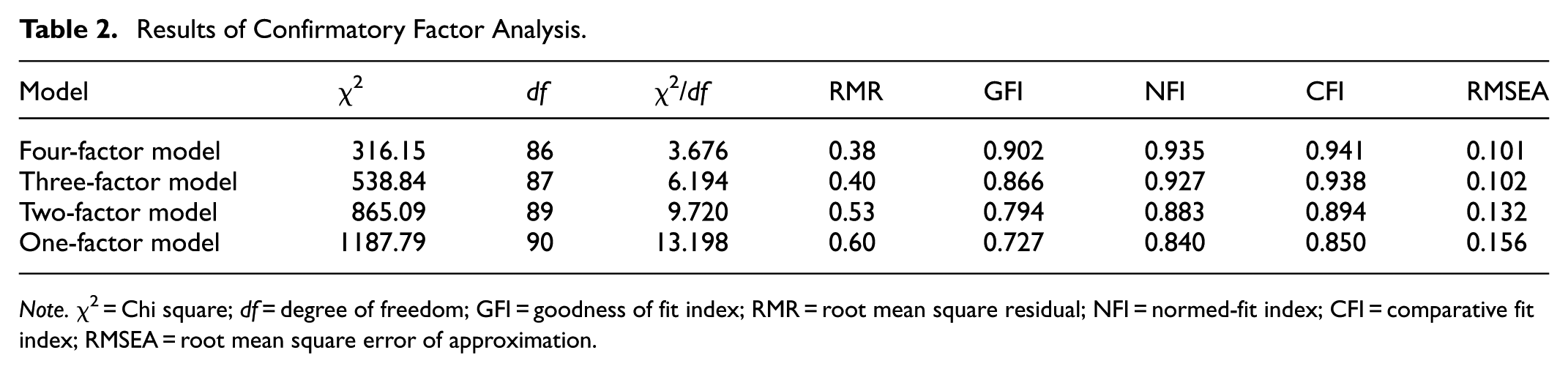
Note. χ2 = Chi square; df = degree of freedom; GFI = goodness of fit index; RMR = root mean square residual; NFI = normed-fit index; CFI = comparative fit index; RMSEA = root mean square error of approximation.
Testing the Hypothesized Structural Model
The structural model was evaluated using AMOS 24.0. The results showed that the model demonstrated an acceptable fit to the data, with fit indices reported as follows: χ2(82) = 318.126, χ2/df = 3.88, GFI = 0.912, NFI = 0.953, CFI = 0.963, RMR = 0.047, and RMSEA = 0.081. All fit values met or surpassed the commonly accepted thresholds for model adequacy as suggested by Hu and Bentler (1999). The study tested five hypotheses: (1) KM positively influences KS; (2) KS positively affects IC; (3) KS serves as a mediator between KM and IC; (4) TL moderates the KM–KS relationship, with stronger TL enhancing the positive impact of KM on KS; and (5) TL also moderates the indirect effect of KM on IC via KS, amplifying this indirect relationship when TL is more prominent. Figure 1 illustrates the standardized path estimates along with the corresponding t-values for the model relationships.

Research framework.
Figure 1 and Table 3 show that KM in medical instruments and apparatuses industry have positive influence on KS (β = .612, p < .001); therefore, Hypothesis 1 is supported. It shows that if Medical instruments and apparatuses industry could effectively utilize KM such as acquisition, accumulation, diffusion, agitation, application and modification; and operation., it would encourage employee behavior of innovation and risk-seeking. The skills to apply and store, share, create and apply knowledge will become an important key to organizational competition.
Regression Results.

Note. N = 547. KM = knowledge management; KS = knowledge stock; TL = transformational leadership; CCM = covariance-components model.
p < .05; **p < .01; ***p < .001.
In addition, research results indicate that KS have positive influence on IC (β = .573, p < .001); therefore, Hypothesis 2 is supported. Furthermore, KM will indirectly affect IC through KS, with the mediating effect being 0.465. Results indicated that Sobel test of the indirect effect of KM on IC through KS is significantly different (p < .001). This shows that Medical instruments and apparatuses industry with KM will upgrade organizations with KS, which will lead to higher IC. Therefore, Hypothesis 3 of this study is supported.
To evaluate Hypothesis 4, the interaction term between TL and KM was examined. As shown in Table 3, the interaction had a significant effect on KS (β = .22, p < .01), indicating a moderating role of TL. The full moderated model accounted for 49% of the variance in KS (R 2 = 0.49). This finding suggests that the influence of KM on KS is stronger when TL is high, thereby confirming Hypothesis 4.
For Hypothesis 5, the moderated-mediation analysis assessed whether the strength of the indirect effect varied depending on TL levels. Following the approach recommended by Zhang et al. (2014), the R program was used to compute bias-corrected 95% confidence intervals for the indirect path from KM to IC through KS at high and low levels of TL (i.e., one standard deviation above and below the mean). The results showed a significant difference in indirect effects depending on TL level (difference = 0.23, p < .05). Table 4 showing that, for employees with higher levels of perception of TL, the conditional indirect effect for KM via KS on IC was 0.02 with a 95% confidence interval (CI) of [−0.10, 0.04], versus −0.15 with a 95% CI of [−0.22, −0.05] for employees with lower levels of TL. Thus, Hypothesis 5 was supported, indicating that when TL is higher, KM has a stronger relation to IC via KS.
Multilevel Moderated Mediation Results.

Discussion and Conclusions
Discussion
This study aims to clarify the relationships among KM, KS, and IC. The empirical results demonstrate that KM mechanisms exert a positive and significant influence on both KS and IC. One of the key theoretical contributions of this study lies in its integration of KM and IC literature through the mediating role of KS. While previous research has treated KM and IC largely as independent constructs, our study conceptualizes KS as a dynamic intermediary that links KM practices to the development of IC. This perspective adds nuance to the understanding of how knowledge is transformed within organizations and offers a more granular view of the internal processes that underlie IC formation.
In addition, this study extends the theoretical boundary of KM research by introducing TL as a moderating and moderated-mediating variable. Although leadership has been recognized as important for KM implementation, empirical investigations into how specific leadership styles condition the effectiveness of KM processes remain limited. By demonstrating that TL strengthens the positive relationship between KM and KS, and thereby indirectly enhances IC, this research provides novel insights into the contingent role of leadership in knowledge-based value creation. This contributes to a growing body of literature emphasizing the behavioral and relational dimensions of knowledge transformation.
Moreover, the study addresses recent calls in the literature for a deeper understanding of how KM mechanisms function in knowledge-intensive and innovation-driven sectors. By focusing on the medical equipment industry—a field characterized by rapid technological change and high knowledge dependency—this research offers context-specific insights that may be transferable to other high-tech or R&D-intensive environments.
Theoretical Implications
Grounded in the RBV, which posits that competitive advantage arises from resources that are valuable, rare, inimitable, and non-substitutable, our findings highlight the critical role of KM in mobilizing and integrating internal organizational resources to shape IC. Specifically, KM serves not only as an operational process but also as a strategic capability that facilitates the accumulation and conversion of knowledge into organizational capital. The empirical results of this study demonstrate that KM mechanisms have a positive and significant impact on both KS and IC. Establishing a robust KM mechanism enables organizational members to share knowledge effectively; store internal and external information—including technical data, project solutions, and design processes; integrate and protect knowledge assets; and generate new knowledge through collective learning, thus shaping organizational wisdom. Therefore, an organization’s KM mechanism directly influences both its KS and IC. In summary, it is essential for organizations to implement systematic KM mechanisms to maintain and develop knowledge assets, positioning them as strategic resources that drive organizational performance.
According to Al-Ali (2003), IC comprises employees’ experience, knowledge, and intellectual capabilities, along with knowledge embedded in databases, systems, processes, and organizational culture. In this context, KS plays a mediating role between KM mechanisms and IC. The processes of acquiring, applying, and storing knowledge within KM practices contribute directly to the development of IC. This aligns with Gold et al. (2001), who argue that well-structured KM procedures support organizational effectiveness by linking knowledge storage, the creation of new knowledge, and the development of organization-specific IC.
Furthermore, this study confirms that TL positively moderates the relationship between KM and KS. TL is widely recognized as a leadership style that fosters innovation and change (Usman, 2020). By guiding the implementation of KM, TL enhances KS through promoting knowledge creation, sharing, and transformation. This finding adds to the theoretical understanding of KM by identifying leadership style as a critical boundary condition for its success. Therefore, in addition to establishing effective KM mechanisms, organizations should cultivate transformational leadership to ensure the successful deployment of KM initiatives and to support sustainable competitive advantage.
Practical Implications
Based on the research findings, the following management implications are provided for the medical equipment industry. This study found KM have a significantly positive impact on KS, which means that if a medical equipment company effectively manages knowledge resources by sharing, retaining, and enhancing the storage of information needed by the organization, it can expand the company’s KS. If companies value knowledge preservation capabilities, they can invest in relevant KM tools and technologies, or cultivate KM-related talents.
The results confirm KS has a positive and significant impact on IC. This shows that as KS increases, IC can be enriched and developed. In the modern knowledge economy, IC is a significant contributor to innovation, competitiveness, and sustainable development. If medical equipment companies can strengthen investments in knowledge accumulation, establish effective KM systems, and successfully incorporate knowledge into the organization’s knowledge base, this will promote the formation and development of IC.
Finally, while enhanced KM and knowledge accumulation are imperative to the cultivation and development of IC, TL is also critical. This study found TL can promote effective KM and thus, have a positive impact on the transformation and accumulation of knowledge within medical equipment companies. Leaders can encourage subordinates to share and exchange knowledge by establishing an effective KM mechanism and combining it with a TL style. This will promote the construction of learning organizational culture and other methods to continuously improve the KS, thereby enhancing the competitive advantage and innovation ability of IC.
During the recent pandemic there was worldwide panic among the general public, affecting individuals’ bodies, mind, and spirit, and society as a whole. At a time when most government strategies are facing disintegration, knowledge can empower individuals and communities to protect and defend themselves, as even if the post-pandemic circumstances ease, life will never completely return to pre-pandemic times. As a result, the medical equipment industry is now a primary focus for governments globally. With the advancement of science and technology, to continuously improve the competitiveness of the medical equipment industry, accumulating technical assets is key. In the ever-changing competitive environment, technology developers and researchers can discover unobserved information through databases. In addition to understanding changes in technological development and competition analysis, they can also evaluate the research and development capabilities of countries or enterprises. In conclusion, if medical equipment companies apply knowledge to management functions such as products, services, production and manufacturing, and marketing, it will not only significantly improve but also further obtain sustainable competitive advantages.
Suggestions and Research Limitation
The limitations of this research are, firstly, the data were collected using self-reported measures, introducing potential biases such as social desirability or common method variance. Future research could address this limitation by incorporating mixed-method approaches, combining quantitative surveys with qualitative interviews or observational methods. Qualitative data would provide deeper insights into the practical mechanisms through which transformational leadership facilitates KM and KS practices, and how these processes enhance IC and organizational innovation. Additionally, integrating objective measures of innovation performance, such as patents, new product launches, or financial outcomes, could validate self-reported findings and enhance research rigor.
Second, the current study utilized purposive and convenience sampling, limiting the generalizability of findings. Future research should adopt a more robust sampling approach, such as stratified or random sampling, to ensure greater representativeness across different industries, organizational sizes, and geographic regions. A broader and more diverse sample would enhance the external validity of the results, allowing researchers to explore variations in KM practices and innovation outcomes among different contexts, potentially yielding insights into industry-specific or culturally-driven differences.
Third, the cross-sectional nature of this research restricts causal inferences about the relationships among KM, KS, IC, and innovation. To overcome this limitation, future studies should consider employing longitudinal research designs. Collecting data at multiple points in time would enable the examination of changes and developments in KM practices and their impacts on innovation. Longitudinal studies could reveal how transformational leadership and KM mechanisms evolve over time, shedding light on their sustained impacts on the formation and utilization of IC. This approach would help establish clearer causal pathways and temporal sequences among key variables.
Moreover, future research could further explore the moderating or mediating roles of organizational culture, digital technologies, and environmental uncertainty in shaping the relationship between KM and innovation. Investigating these contextual factors could provide a more nuanced understanding of the conditions under which KM processes most effectively contribute to innovation outcomes. Researchers may also extend the scope by examining industry-specific characteristics, particularly in sectors undergoing rapid technological changes such as healthcare, technology, or manufacturing.
Lastly, the company size and various management styles of the studies carried out in other industries were not specified. Investigating how organizational size (small, medium, large enterprises) and various management styles (transformational, transactional, laissez-faire) influence knowledge management and innovation would provide more targeted insights. Comparative studies across multiple industries can clarify how management practices interact differently within diverse organizational contexts. Clearly documenting these characteristics would enhance the precision of findings, enable better understanding of generalizability across industries, and offer practical implications tailored to specific organizational environments.
Footnotes

Ethical Considerations
This study was conducted in accordance with the ethical standards of the institutional and/or national research committee and with the 1964 Helsinki Declaration and its later amendments or comparable ethical standards. Ethical approval for this study was obtained from [National Cheng Kung University Governance Framework for Human Research Ethics] (Approval Number: 104-093). The Governance Framework for Human Research Ethics at National Cheng Kung University approved our interviews (approval: 104-093) on March, 2024.
Consent to Participate
Respondents gave written consent for review and signature before starting survey. All participants provided written informed consent prior to participating.
Funding
The authors received no financial support for the research, authorship, and/or publication of this article.
Declaration of Conflicting Interests
The authors declared the following potential conflicts of interest with respect to the research, authorship, and/or publication of this article: Dr. Mao-Sung Chen hereby declare that I have no conflicts of interest to disclose regarding the submission of my manuscript titled “Knowledge management mechanism and intellectual capital in the medical instruments and apparatuses industry: Examining a moderated-mediation model” to Sage Open. No financial, personal, or professional relationships exist that may influence the interpretation or evaluation of the research presented in the manuscript.
Data Availability Statement
Data sharing not applicable to this article as no datasets were generated or analyzed during the current study. The datasets generated and/or analyzed during the current study are available from the corresponding author on reasonable request.