




Abstract
Previous studies reveal a gap in literature relating the contribution of personal knowledge management (PKM) at the individual level within organization. In addition, the mediating role of organizational learning in the relationship between transformational leadership on personal knowledge management is less studied. Therefore, this study aims to address the gap by investigating the combined effects of transformational leadership, information and communications technology (ICT) literacy, and organizational learning toward teachers’ PKM in the context of school in Indonesia. It is also aimed to explore the role of organizational learning as the mediating variable. We collected questionnaire data from 80 teachers at an international school in Jakarta, Indonesia and used partial least squares structural equation modeling to examine the data. Our findings showed that ICT literacy, transformational leadership, and organizational learning culture positively affect PKM. ICT literacy found to have the biggest impact on the PKM of the teachers. In addition, organizational learning found to mediate the effect of transformational leadership on PKM, even though the increase is not high. These findings provide managerial implications for the school management to improve their ICT literacy by building ICT literacy ecosystem in the school to improve teachers’ PKM.
Keywords
Introduction
In the Organization for Economic Co-operation and Development (OECD) report, Schleicher (2012) emphasizes the role of teachers as knowledge workers. For this reason, teachers should have a high level of knowledge and continually develop their professional skills. As academic professionals, teachers should disseminate knowledge material to students and help them understand methods for learning (i.e., learning how to learn) as a tool required to survive, become a lifelong learner, and be ready to face life’s challenges. The development of teachers’ professional skills is one of Sustainable Development Goals (SDGs) envisioned by the United Nations that it aims to achieve by 2030 (United Nations, 2019).
To achieve the vision proposed by the United nation about SDGs, teachers should be competent as professional educators to continue to add, organize, evaluate, analyze, update, or present their knowledge effectively, especially in schools where performance is mainly determined by teachers as intellectual workers. In this rapidly changing era, schools should improve their capacity by providing knowledge for enhanced decision-making and innovation (Chu et al., 2011). To do so effectively, it is crucial for teachers to develop their knowledge management (KM) skills (Cheng et al., 2015).
In general, KM refers to leveraging two levels of intelligence, tacit knowledge and explicit knowledge (see Figure 1), to advance individual and organizational improvement and to reach an organization’s goals. KM is said to be strongest when it incorporates both tacit and explicit knowledge, ranging from “know-what” to “know-how” (Chu et al., 2011). However, many people relate KM exclusively to the information and communications technology (ICT) used in an organization (Dalkir, 2011). By incorporating knowledge management, organizations build lifelong learners who will continue to be of benefit in assessing and addressing rapid changes (Ranf & Herman, 2018).

Inukshuk model of knowledge management.Source. Girard (2005).
The study of KM at the individual level is an important concept. Further, Pauleen and Gorman (2016) asserted that personal knowledge management (PKM) is not simply KM on an individual level but also incorporates personal information management, philosophy, cognition, knowledge management, communications, and more. PKM, which is at the core of the educational process (Cheng et al., 2015), is a person’s ability to learn and manage knowledge. The success of PKM depends on a person’s desire to discover, learn and communicate, as well as their interpersonal skills, use of technology, and organizational learning (Pauleen & Gorman, 2016).
KM has been researched since the 1990s, and its importance has been recognized in various fields of organization, including education. However, most studies on KM focus on the organizational level, and only a few studies have focused on the personal level (Bhatt, 2001; Ekobelawati et al., 2019; Tsekhovoy et al., 2019; Walczak, 2005). In addition, the mediating role of organizational learning and transformational leadership on personal knowledge management is less studied. This study aims to address the gap found and the effect of transformational leadership, ICT literacy, and organizational learning on PKM in the context of school in Indonesia. This objective was addressed by examining the path coefficient of these research questions:
(1) Does ICT literacy positively affect personal knowledge management?
(2) Does transformational leadership positively affect personal knowledge management?
(3) Does transformational leadership positively affect organizational learning?
(4) Does organizational learning positively affect personal knowledge management?
(5) Does transformational leadership positively affect personal knowledge management through organizational learning?
Literature Review
Personal Knowledge Management (PKM)
PKM is a derivative of KM which was coined by Sveiby (2001) and defined as “the art of creating value from intangible assets.” Sveiby (2001) divided KM into two levels, namely organizational and individual levels. KM at the individual level is then referred to as PKM. PKM is a personal effort to manage explicit knowledge at the individual level and understand how information and knowledge is distributed throughout an organization and transforms into new meaningful knowledge and informed decisiveness (Liu et al., 2017). Pauleen and Gorman (2016) described PKM as a strategy whereby an individual leverages personal skills and knowledge to produce essential value for themselves. PKM involves innovative gathering, absorption, and application of knowledge using various aids. Pauleen and Gorman (2016) added to the definition of PKM to include an individual professional development process that is important to cultivate a learning environment.
Ismail and Ahmad (2012) simplified the PKM process into four steps they refer to as GUSC, a cycle that consists of (1) Get (gather information), (2) Understand (analyze and evaluate information), (3) Share (share and collaborate), and (4) Communicate (pass on information to others). In addition, research conducted by Kordab et al. (2020) proposed a knowledge management model with five compositions related to knowledge, including (1) acquisition, (2) creation, (3) storage, (4) sharing, and (5) application.
One study of Organizational Knowledge Management (OKM), mostly used as a reference, is the Inukshuk model developed by Girard in 2005. The Inukshuk model was first used to quantitatively measure the KM process in Canada’s military organization. The term Inukshuk refers to the human-like pile of stones used by the native Inuit tribe in Canada for navigation and as evidence of their existence. This human-like shape is consistent with OKM’s philosophy in that it positions human beings as the main component of the KM process, and shows that each organization’s KM system is unique, just as human beings are different from one another (Dalkir, 2011; Girard, 2005). The Inukshuk model explains that OKM is supported by three main components, technology, culture, and leadership as presented in Figure 1.
Girard (2005) found that leadership is the main driver of the KM process in organizations; culture and technology also support KM. Girard’s qualitative study showed that KM cannot be implemented well in an organization if the leader fails to recognize its importance even when a reliable culture and technology exists in the organization. Unfortunately, the leaders at the Terbit Harapan School are not focused on increasing teachers’ PKM competencies. Without strong PKM competencies, it would be impossible to truly achieve teachers’ professional skill development, which is one of the United Nations’ Sustainable Development Goals (SDG). Therefore, PKM in the context of Terbit Harapan School should be studied to find the factors that contribute significantly to PKM.
ICT Literacy
The ability to use information and communication technology is known as ICT literacy, and the use of technology plays a vital role in PKM. Initially, ICT literacy was defined by technical skills related to technology and information and communication processing (Wilson et al., 2015); however, this definition has evolved over time. Van et al. (2017) defined ICT for the 21st century as the ability to use ICT optimally to develop knowledge in one’s area of expertise, to further one’s role as a capable and qualified worker. Ainley et al. (2016) defined ICT literacy as one’s ability to use digital technology, communication devices, and networks to access, manage, integrate, evaluate, and create information to participate in the knowledge community.
ICT literacy is essential to equip knowledge-based workers to face complex requirements in the context of globalization. Effective sharing and development of knowledge in an organization help to overcome this challenge. ICT development has resulted in a rapid change among people and has compelled members of organizations to have sufficient ICT literacy to develop knowledge in their organizations (Cheng, 2015). ICT literacy is a determining factor of one’s success in learning (Pauleen & Gorman, 2016).
Luo and Bu (2016) described ICT as consisting of telecommunication service processes and networks, internet and intranet, electronic mail, short message, smartphone, and network conferencing. Yu et al. (2017) defined ICT as “a medium that can support processing, storage, transmission, and communication of data and information via the internet and other equipment.” Hara (2009) used the term “Cyber Ba” for ICT technology to describe a portal that can be used to collaborate in building knowledge online and to overcome the barriers of time and place.
Rapid progress in ICT technology has driven several organizations to change rapidly, thus demanding high ICT literacy from every organization member to enhance organizational knowledge (Cheng, 2015), especially for educational organizations. Well-developed ICT literacy and online and offline ICT systems help improve one’s PKM competence (Di Virgilio, 2018; Pauleen & Gorman, 2016). Moreover, one of the concepts of ICT literacy is information literacy in education, which strongly emphasizes critical thinking, metacognition, and procedural knowledge (Santos et al., 2019) and is strongly related to PKM. Therefore, ICT literacy is mandatory for ICT teachers and those teaching in schools, which is challenging for teachers designing learning and examination materials (Wilson et al., 2015).
Although several schools allocate a budget to develop ICT, these are often inefficient. Schools do not consider the effectiveness of using ICT in enhancing the quality of the learning process in the classroom. Teachers are not allocated enough time to increase their ICT literacy levels. They are provided a brief technical training on ICT use, but it is not integrated with appropriate curriculum planning and instructional design (Cheng, 2015).
Transformational Leadership
The concept of transformational leadership was first proposed by Burns (1978) who explained that transformational leaders set a moral example and work for the common good of both the organization and the community. Zumitzavan and Michie (2015) cited leadership as the key factor in creating a learning culture within an organization because a leader can nurture commitment among the organization’s members through the leaders’ vision of, and drive to achieve the organization’s goals. Transformational leaders encourage members to maximize their individual performance by providing intellectual insights and opportunities, such as discussions, requesting opinions, and collaborative solution-making (Lai et al., 2020). Furthermore, Zumitzavan and Michie (2015) added that transformational leadership is the most ideal leadership style for achieving an organization’s goal in the digital era. This kind of leadership can nurture positive relationships between superiors and subordinates, improve leaders’ effectiveness, and increase subordinates’ satisfaction, creativity, performance, and work motivation (Masa’deh et al., 2016).
Robbins and Judge (2017) defined transformational leaders as those who are proud of their subordinates and inspire them to work beyond their abilities to help develop the organization. Similarly, Colquitt et al. (2013) described transformational leaders as those who can exemplify, motivate, and inspire their subordinates to always focus on common goals. Masa’deh et al. (2016) described transformational leadership as emphasizing good relations between leaders and subordinates.
Briefly, Burns (1978) divided transformational leadership elements into four categories: (1) individual consideration, (2) intellectual simulation, (3) inspirational motivation, and (4) idealized influence. Meanwhile, Bass and Riggio (2006) underlined the four components of transformational leadership: (1) Idealized Influence, the ability to be an example for followers, (2) Inspirational Motivation, the ability to motivate and inspire subordinates by continuously referring to organization’s goals and being aware of its challenges, (3) Intellectual Stimulation, the ability to stimulate members of the organization to work more innovatively and creatively, and (4) Individualized Consideration, the ability to devote attention to each member’s need for achievement and development.
Zumitzavan and Michie (2015) showed a positive relationship between types of transformational leadership and PKM competencies, especially in the process of evaluation, analysis, and presentation of knowledge on organizational performance. However, Masa’deh et al. (2016) found that the type of transformational leadership does not influence the process of knowledge sharing, which contradicts earlier theories and studies. Therefore, transformational leadership needs further studies to examine its effect on PKM.
Organizational Learning
Apart from ICT literacy and transformational leadership, organizational learning (OL) influences PKM. Argyris (1977), who is the father of OL theory, explained that OL can be formed because of individuals who learn which then impacts on the organization because of the existence of an ecological system facility called the organizational learning system. Therefore, organizational leaders must provide an OL system. Schein (2010) emphasized that a leader should be an innovative learner and a learning culture manager who encourages members by providing sufficient time, facilities, and learning resources. Senge (2006) defined a learning organization as one where members can enhance their learning capacity and are free to express their aspirations, so they can develop new ideas and learn how to learn well (i.e., learning how to learn) to achieve goals together.
Several studies recognize that a person’s cultural background can affect an organization’s learning environment and KM (Zumitzavan & Michie, 2015). PKM’s success is determined by one’s willingness to learn; learning management; communication and interpersonal skills; ability to use technology; and OL, which is essential to organizational culture. Schein (2010) defined OL as how people relate to their environment (organization) as a proactive step toward problem-solving. Rebelo and Gomes (2010) defined OL as a culture that promotes, upholds, and enables its members to learn and share the results of their learning with a bigger group in the organization and, finally, contribute to the organization’s success.
The success of organizations in managing maximum organizational learning depends on how the organization manages its human resources (Antunes & Pinheiro, 2019) Organizational culture is both a supporting factor and a barrier in applying KM in an organization, which changes the existing organizational culture. The role of culture in management has been studied extensively. Serrat (2017) described several factors affecting OL culture: (1) organizational conditions and structure; (2) people—namely, teachers’ trust in the organization, leaders, colleagues, openness, and motivation; (3) knowledge—namely, the basic knowledge of organizational members, PKM, and types of leadership; and (4) technology in terms of availability and ICT literacy.
Schmitz et al. (2014) found that culture and OL, especially the internal integration aspects, are strongly positively related to the three dimensions of KM studied. Some studies have even stated that cultural factors are more important than leadership and ICT factors. Over time, culture determines KM’s maturity level and differentiates an organization from others (Dalkir, 2011). Therefore the factors that influence KM need further study.
Based on the findings in the literature related to this study, we developed the following four hypotheses:
H1: ICT literacy has a positive effect on personal knowledge management.
H2: Transformational leadership has a positive effect on personal knowledge management.
H3: Transformational leadership has a positive effect on organizational learning.
H4: Organizational learning has a positive effect on personal knowledge management.
H5: Transformational leadership has a positive effect on personal knowledge management through organizational learning.
Methodology and Data
Research Design
We conduct our quantitative research using non-experimental statistical analysis and the Partial Least Squares-Structural Equation Modeling (PLS-SEM) method using SmartPLS software. PLS-SEM was chosen because it is an appropriate method to use with nonparametric data. All of the variables involved are latent constructs or variables, as they cannot be directly measured (Bartholomew et al., 2011). Constructs were measured according to indicators that are agreed upon based upon the relationship between PKM, ICT, transformational leadership, and OL. This research focuses on ICT literacy and transformational leadership as exogenous constructs and PKM as an endogenous construct. In addition, OL is both an exogenous and endogenous construct, which also has a mediating role in relation to the effect of transformational leadership on personal knowledge management.
Research Subjects
The research subjects included 80 teachers in a school with the pseudonym Terbit Harapan School in Jakarta, Indonesia (to maintain the school’s confidentiality). The subject of this research was not parametric because the research was aimed specifically at exploring the subjects in the schools studied. Non-parametric data from this population data match the selected research method, namely PLS-SEM which is designed for non-parametric data; therefore, the study results cannot be generalized to a wider population (Hair et al., 2014). This study employed a population study, however, the number of respondents represents only 70% of the total teachers in the school, as the process of completing the questionnaire was based on the voluntary willingness of the teachers. The selection of respondents was carried out using a convenient technique by prioritizing the respondents’ freedom to be involved in this research. Respondents of this study have various characteristics from ages consisting of generations X, Y, and Z, educational backgrounds consisting of bachelor’s, master’s, and doctoral degree, and the length of teaching experience. Table 1 presents the details of the characteristics of the respondents.
Respondents’ Profiles.

Adequate ICT facilities and transformational leadership in the school made this school an ideal choice for study on factors related to PKM. It is an international school using English as the medium of instruction. This school provides education to students ranging from kindergarten to senior high school who are mostly from middle to high socioeconomic status. Students and teachers are of various nationalities, although the majority are Indonesian.
Ethical Declaration
This research has gone through ethical clearance checks conducted by the Institute for Research and Community Service of Surya College of Education, Indonesia (no. 013/STKIP-LPPM/Ket/IX/2021). This research was carried out by prioritizing the fulfillment of research ethics. Regarding informed consent from the organization, the researcher obtained written permission to conduct this research from the school head. In addition, individual respondents filled out the consent form for voluntary involvement in research written in the questionnaire form provided. The researcher has also explained the purpose of data collection so that the respondents fully understand the purpose of the research and for publication purpose. The researcher also explained that the confidentiality of respondents’ identities was a priority in the study, including the use of pseudonyms for the names of the organizations studied.
Measurement of Variable
The data were measured using a questionnaire developed from our five hypotheses formed in 16 items. The type of questionnaire used was a close-ended questionnaire using a five-point Likert scale, where 1 = strongly disagree, 2 = disagree, 3 = neutral, 4 = agree, and 5 = strongly agree. The research questionnaire was based on the theoretical framework of each variable.
On the PKM variable, the questionnaire was based on Ismail and Ahmad (2012) theory that consists of gathering, understanding (analyzing and evaluating), sharing, and communicating the information. The sample item includes “I can identify which information answers my questions” and “I can integrate old and new knowledge gained from research findings.” The Cronbach alpha of the PKM variable is .893.
Meanwhile, the ICT literacy variable was based on Oguche’s (2017) theory which consists of the ability to use ICT in collecting, organizing, creating, and creating the necessary information. The sample item includes “I am capable of using ICT to determine the reliability of information” and “I am confident in creating digital information from various reliable online sources.” The Cronbach alpha of the ICT literacy variable is .732.
The transformational leadership variable was based on Bass and dan Riggio’s (2006) theory, consisting of idealized influence, inspirational motivation, intellectual stimulation, and individualized consideration. The sample item includes “The school’s leaders motivate teachers to be more creative in dealing with problems” and “Leaders show care when I need help.” The Cronbach alpha of the TL variable is .862.
Meanwhile, the organizational learning variable was based on Senge (2006) and Schmitz et al. (2014) theories, which consist of being motivated to learn new things, happy to share knowledge with other teachers, always trying to improve themselves, and involving members in decision making. The sample item includes “The teachers in my school are used to giving feedback for mutual progress” and “The school works with other parties to achieve common goals.” The Cronbach alpha of the OL variable is .820.
Data Collection Technique
The data collection was based on the theory proposed by Dörnyei (2007), which starts from the type of data that need to be collected; in this study, the interval data were obtained through surveys. Dörnyei’s (2007) method of collecting data using a survey questionnaire has several stages, (1) determining the survey subject, (2) determining the type of questionnaire, (3) determining the scale of the questionnaire measurement, (4) piloting the questionnaire, and (5) administering the questionnaire. This study’s subjects were teachers at an international school in Jakarta. The questionnaire was close-ended using 5 Likert scale. Moreover, the research questionnaire was not piloted because the data analysis used the PLS-SEM method, which directly accommodates the classical assumption tests that consist of validity and reliability and the data’s homogeneity and normality tests; hence, it need not be conducted at the beginning (Hair et al., 2014). In the process of administering the data, the researcher distributed the questionnaires directly to the respondents and gave them 2 weeks to fill out. Respondents can freely fill out or not fill out the questionnaire voluntarily. If the respondents are willing to be involved in the research and fill out the questionnaire, they can return the questionnaire to the locker provided. After the data was obtained, the process of administering the data was carried out to make data tabulations.
Data Analysis Technique
The data were analyzed using descriptive statistics for the demographic information and inferential statistics through outer and inner model testing with PLS-SEM following Hair et al.’s (2014) framework. The first was the outer model that included the validity and reliability of the data. The validity of the data was confirmed by testing the loading factor, where the rule of thumb is 0.7 (Hair et al., 2014). Moreover, the AVE values also confirmed the validity, with a rule of thumb of 0.5 (Hair et al., 2014). Meanwhile, the reliability of the data was carried out with Cronbach’s alpha and composite reliability with the rule of thumb 0.7. In the inner model’s second stage, data analysis was carried out using multicollinearity, R-square, and hypothesis testing. The multicollinearity test ensures that each tested variable is unique and different from the others with the threshold <5.0 (Hair et al., 2014). The R-square test aims to evaluate the research model by looking at the effect of all exogenous variables on endogenous ones (Hair et al., 2014).
Findings and Discussion
The presentation of the research results was carried out concerning the data analysis of Hair et al. (2014). Data analysis is divided into two stages. The first stage is the outer model that ensures that the research data meets the PLS-SEM rules. The second stage is the inner model that aims to test the research hypothesis. We first present the profile data of the research respondents.
Respondents’ Profiles
A total of 80 teachers completed the questionnaire, which is 70% of total teachers in the school. The demographic profile of the respondents is shown in Table 1.
Inferential Statistics
Outer Model Testing
To carry out the PLS-SEM test, model testing is needed to ensure that the construct items under study meet the requirements. In testing the model, the construct items used in the study were tested for validity and reliability through a loading factor test, composite reliability, Cronbach’s alpha, and Average Variance Extracted (AVE) value. The purpose of testing the outer model is to ensure that it describes each indicator’s relationship to its latent variable. The results of the outer model test of this study are presented in Table 2.
Factor Loading, Reliability, and AVE.

Table 2 presents the items in the constructs in this study ranging from 0.706 to 0.927. This means that all construct items met the threshold value, which is above 0.70 (Hair et al., 2014). The AVE test aims at the average value of the squared load of the indicators associated with the construction with threshold value above 0.50 (Hair et al., 2014). The AVE value for each construct in this study states that they meet the generally accepted threshold value for a construct’s AVE of at least 0.50. Furthermore, the composite reliability and Cronbach’s alpha tests have the same threshold value, which is above 0.70. Based on testing the constructs of this study, all constructs were declared reliable, as they had a value above 0.70.
The outer model test also looks at discriminant validity, aiming to ensure that each construct differs from other constructs. This test calculates the square root of the AVE value. A construct is declared eligible if it has a value higher than the highest correlation value for other constructs (Hair et al., 2014). Based on the test results, all constructs are shown to be unique and different from other constructs, as they meet the requirements. The results of the discriminant validity test are presented in Table 3.
Discriminant Validity Test Results.
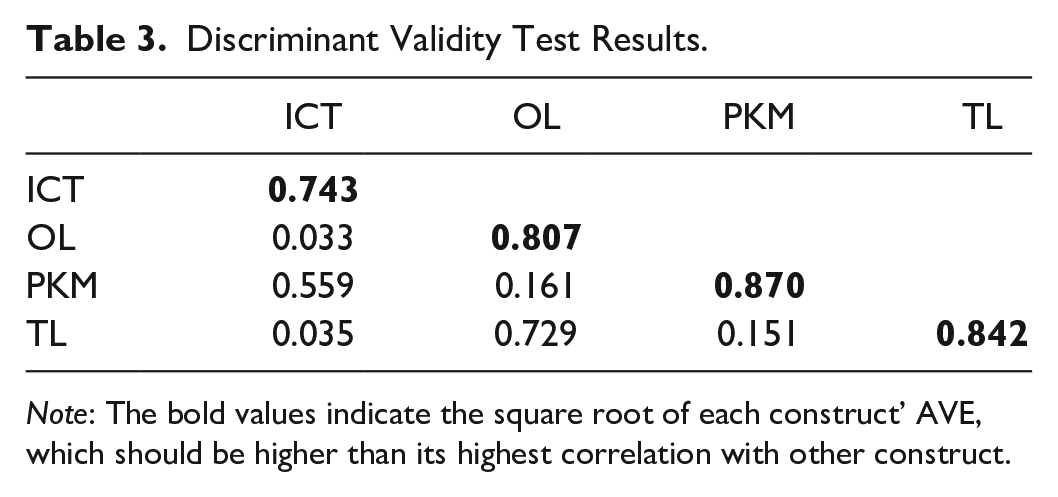
Note: The bold values indicate the square root of each construct’ AVE, which should be higher than its highest correlation with other construct.
Inner Model Testing
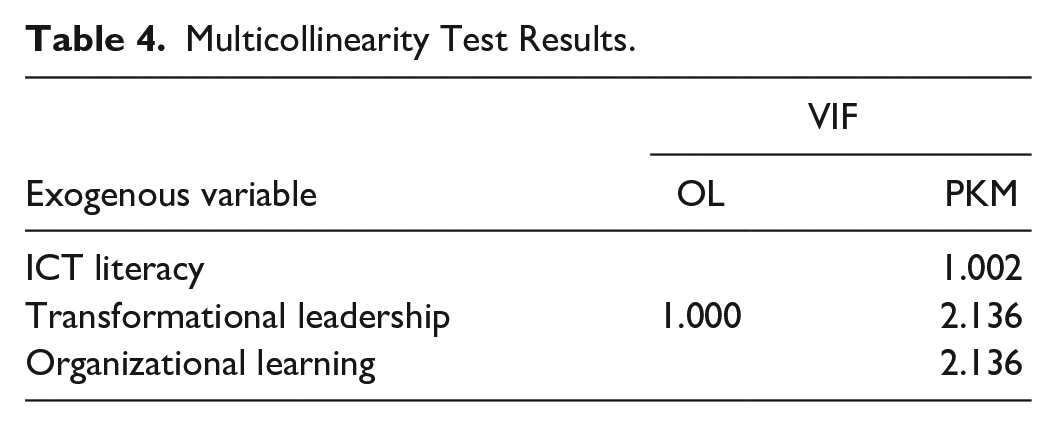
Inner model testing shows the estimated relationships among the constructs. The Variance Inflation Factor (VIF) value measures the relationships between exogenous variables (Hair et al., 2014). The recommended VIF value is below 5.00, as a higher VIF indicates collinearity among these variables. As shown in Table 4, the relationships among the exogenous variables have VIFs <5.00, indicating that multicollinearity is not a concern.
Multicollinearity Test Results.
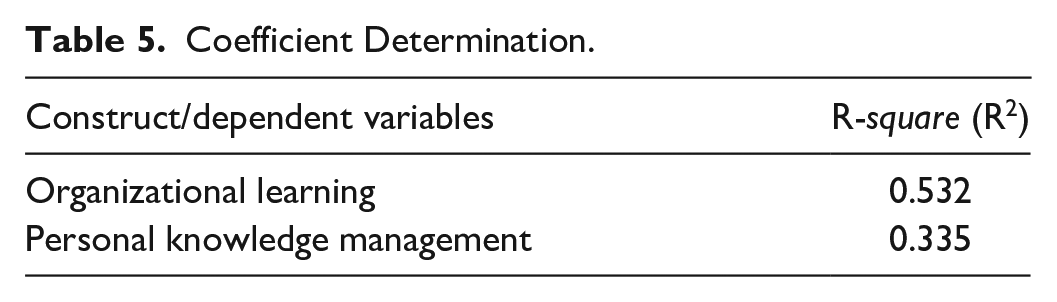
The coefficient of determination indicates how much influence an exogenous variable has on the endogenous variables simultaneously. The coefficient of determination values are shown in Table 5. The R2 value obtained from organizational learning has a significant impact because it covers more than 50%, which implies that the independent variables significantly influence PKM. Meanwhile, R2 obtained from personal knowledge management shows less significant impact.
Coefficient Determination.
Our final test assesses our research hypotheses. Hypothesis testing is based on the path coefficient value for each exogenous variable toward the endogenous variable. The results are presented in Table 6.
Hypothesis Tests.

Based on the results of our hypothesis testing and the coefficients of determination, a research model can be described along with the path coefficient as presented in the Figure 2.

Path coefficient test model.
The R2 value suggests that 33.5% of the PKM variables can be explained by the three exogenous values, and other variables explain the rest. This means that the teachers’ ICT literacy and the transformational leadership and OL culture experienced by the teachers contribute significantly to PKM competency development among the teachers at the Terbit Harapan School. This result is in line with Girard (2005) who explained that KM is affected by three main factors: technology, culture, and leadership. In addition, the R2 value on the OL variable suggests that the transformational leadership variable alone affects OL by as much as 53.2%, with the other variables explaining the rest. This indicates the significance of transformational leadership in OL. When teachers perceive that they are supported by transformational leaders, the learning culture among them improves. The value of the path coefficient, also called an R-square, leads to the following Structural Equations 1 and 2:


Discussion
ICT Literacy Has a Positive Effect on PKM
The first hypothesis test result showed that the ICT literacy variable has a positive effect on PKM with a path coefficient of 0.554. It confirms the findings of Gyaase et al. (2015), which highlighted the importance of ICT in affecting knowledge management. Gyaase et al.’s (2015) research focuses on the use of ICT for the effectiveness of knowledge management in educational institutions in Ghana. They determined the necessity to increase the capacity and quality of ICT in educational institutions to provide significant improvements to knowledge management both at the individual and organizational levels. In the context of this research, the high ICT literacy of the teachers at the Terbit Harapan School is reflected in the various administrative tasks and teaching demands that are to be met with the help of ICT. This can motivate teachers to have good ICT literacy to meet their day-to-day work requirements, even though there is no ICT training or testing. The ability of teachers to extract information from various digital sources contributes to the formation of PKM. In addition, teachers also create and share information using ICT to build confidence and skills that affect PKM. Therefore, we conclude that the ICT literacy skills the teachers possess support their ability to obtain and compile learning materials using data and other information obtained from various digital sources, which is in accordance with Santos et al. (2019). The teachers’ ICT literacy also supports the process of sharing information through digital platforms to increase the teachers’ personal knowledge.
Transformational Leadership Has a Positive Effect on PKM
The result of the second hypothesis test shows that the transformational leadership variable has a positive effect (with a path coefficient of 0.060) on the PKM of the teachers at the Terbit Harapan School Jakarta. This indicates that the teachers’ PKM increases modestly as their perception of the school’s transformational leadership increases. It appears that the PKM competency of the teachers at Terbit Harapan School Jakarta is strong even though the school’s leaders are not necessarily perceived to be transformational. Nevertheless, transformational leadership is valuable as shown by the positive effects test value. This hypothesis supports Zumitzavan and Michie (2015) who suggests that transformational leadership contributes positively to improvements in PKM. In addition, this result confirms the findings of Gelard et al. (2014) who examined the relationship between transformational leadership and knowledge management in a non-educational organization in Iran. The results show that there is a positive relationship between transformational leadership and knowledge management, including at the individual level. Gelard et al.’s (2014) research found that transformational leadership provides more space for organizational members to be involved in the process of managing knowledge and benefiting from the process. However, the finding in this study is not consistent with Masa’deh et al. (2016), who indicated that transformational leadership contributes negatively to KM improvement, especially in terms of knowledge sharing. When viewed in terms of the teachers’ responses to the indicator items, we see that transformational leadership can encourage teachers to collaborate with other teachers, thereby increasing the personal knowledge of each teacher. In addition, transformational leadership in the Terbit Harapan School can encourage teachers to increase creativity and problem-solving skills and to explore knowledge independently.
Transformational Leadership Has a Positive Effect on OL
Testing our third hypothesis shows that transformational leadership has a strong positive effect on OL, with a path coefficient of 0.729. This means that OL at the Terbit Harapan School increases as the teachers’ perception of transformational leadership at the school increases. This hypothesis result supports Serrat’s (2017) explanation that nurturing OL in an organization requires the leaders’ support and active participation. More specifically, Schein (2010) and Zumitzavan and Michie (2015) emphasized the importance of a leader’s role in developing a culture of OL so that associates in an organization can share knowledge and develop as individuals in confluence with the organization’s development. When viewed in terms of the teachers’ responses to the indicator items, we see that transformational leadership in the Terbit Harapan School can encourage teachers who have common goals to share knowledge. Transformational leadership at the school also encourages teachers to think with a global perspective. This study confirms the findings of Begum et al. (2020) who examined the effect of transformational leadership on organizational learning in the context of small to medium enterprise CEOs in North China. The results of the study indicate a positive effect of the two variables. Moreover, Begum et al. (2020) found that transformational leadership is designed to promote knowledge transfer in organizational learning.
OL Has a Positive Effect on PKM
Testing the fourth hypothesis reveals that OL affects PKM positively, albeit with a low path coefficient of 0.099. This indicates that the PKM of teachers at the Terbit Harapan School will increase slightly as the OL culture at school increases. Even though the increase is modest, OL improvement does improve teachers’ PKM competency. The positive result of this hypothesis test confirms Schmitz et al.’s (2014) and Kordab et al.’s (2020) explanation suggesting that an improvement in OL impacts improvement on workers’ PKM. Kordab et al. (2020) examined the effect of OL on PKM in the context of corporate accountants. Their results reveal that organizational learning positively affected PKM in all dimensions, including knowledge acquisition, knowledge creation, knowledge storing, knowledge sharing, and knowledge application. When viewed in terms of the teachers’ responses to the indicator items, we find that the OL of teachers, is reflected in the willingness of those teachers to share knowledge and work together, which can increase their personal learning capacity. Well-organized sharing of knowledge among teachers can help them to integrate their existing knowledge with new knowledge obtained from their peers. In addition, teachers can verify information with each other to obtain more details and greater precision in answering the questions that teachers have. The empowerment of the human resources of schools (teachers) will optimally succeed in managing organizational learning, which will then improve PKM for teachers (Antunes & Pinheiro, 2019).
Transformational Leadership Has a Positive Effect on PKM through Organizational Learning (Mediating Role)
The fifth hypothesis test results demonstrate that organizational learning has succeeded in mediating the effect of transformational leadership on PKM with a value of 0.072. This value uncovers only a small effect; however, this pathway is greater than the direct effect of transformational leadership on PKM, which is 0.060. This test shows that transformational leadership has very little effect in shaping teachers’ PKM in the Terbit Harapan School, either directly or through OL. The combination of transformational leadership that encourages teachers to be innovative learners and always presents a learning culture (Schein, 2010), with organizational learning. This enhances their learning capacity and allows them to freely express their aspirations to develop new ideas and learn how to learn well. Senge (2006) found a positive impact of the personal knowledge management of teachers. This result is congruent with Uddin et al.’s (2017) findings, who examined the mediating role of organizational learning in the relationship between transformational leadership and knowledge management among organizational members at various management levels in several organizations, including Chittagong Export Processing Zone. The results showed that organizational learning succeeded in mediating the effect of transformational leadership on knowledge management where the value of the influence exerted was greater than the direct effect.
Conclusions and Recommendations
Conclusions
Based on the analysis of the variables in this research, we offer the following conclusions regarding PKM in Terbit Harapan School. All exogenous variables in this study, namely, ICT literacy, transformational leadership, and organizational learning, have a positive effect on PKM. In addition, transformational leadership also has a positive effect on organizational learning. The results of the TL path to PKM are important to conclude considering that there are differences in the results of previous studies by scholars, namely the results of a positive influence and the results of a negative influence. Furthermore, organizational learning as a mediator for the effect of transformational leadership on PKM shows a positive effect, but the value of the influence is smaller than the direct effect.
Based on the study results, ICT literacy was found to have the greatest influence on PKM. Therefore, it is concluded that school managerial authorities should pay special attention to teachers’ ICT literacy. Thus, they are also expected to provide improvements to PKM at Terbit Harapan School. In addition, the results of the study also concluded that transformational leadership has a great influence on OL, which then succeeded in mediating its influence on PKM. Although the value of the mediation effect is not too large, school management can also pay attention to improving OL to encourage PKM activities for teachers in schools.
Managerial Implications
School management should recognize that while not all teachers have a high degree of PKM competency, they are willing to set aside time to learn. Leaders should design a series of programs and systems to support teachers’ PKM competency. Based on the results of this study, ICT literacy is an influential factor in building PKM. Therefore, schools should build ecosystems related to ICT literacy, including the administration of ICT literacy tests when recruiting new teachers and the periodic provision of ICT training for teachers. The school could also require teachers to participate in online learning and/or finish school administrative work online.
Leaders at Terbit Harapan School need to develop their leadership patterns to be more transformational through various training programs, guidance, monitoring, and evaluation from the foundation. It is also crucial for the school to nurture a learning culture among its teachers so that OL values can be instilled in every individual. One way to do so would be to create a room set aside for teachers to learn and share their experiences. This can be in the form of a physical facility, such as a discussion room, or it could be an online discussion portal supported by ICT facilities. In addition, the school should design school programs to support OL improvements.
Research Limitations
Our study does have some limitations. First, as a census, this study uses population data, but the number of questionnaires returned only amounted to70%, because the questionnaire was voluntary. Second, our research on PKM competency is limited to the three exogenous variables, ICT literacy, transformational leadership style, and OL culture. Other aspects of technology, other leadership styles, and other organizational cultures are not considered, and it is possible that other variables have an even greater effect on PKM. Using SmartPLS, research model conformity is determined based on the coefficients of determination (R2) and path coefficient values. Other measurement tools, such as SPSS, are needed to conduct goodness of fit tests, but this involves additional data requirements in terms of number of observations, normality, and homogeneity.
Recommendations
We offer several suggestions for future studies based on our research process and findings. First, comparing data from different types of schools or schools in different areas will lead to more robust conclusions in testing the theory. Second, other leadership styles, such as transactional leadership, and other types of culture, such as a competitive culture, need to be studied in terms of their effect on the teacher’s PKM variable. Third, for further study, it is also necessary to search for mediating variables that are considered as exerting more influence on the formation of PKM. Finally, further investigation into how far respondents’ intrinsic qualities such as motivation, trust, stress, burnout, communication skill, or interpersonal skill may affect their PKM competency is needed.
Footnotes
Acknowledgements
We express deepest our gratitude to John P. Girard, Ph.D., Peyton Anderson Endowed Chair, Professor of Information Technology, Department of Information Technology, School of Computing, Middle Georgia State University for the permission granted to use the Inukshuk knowledge management model in this study.
Declaration of Conflicting Interests
The author(s) declared no potential conflicts of interest with respect to the research, authorship, and/or publication of this article.
Funding
The author(s) disclosed receipt of the following financial support for the research, authorship, and/or publication of this article: This research was supported by Center for Research & Community Development, Universitas Pelita Harapan, number: 30/LPPM UPH – BD/III/2022.
